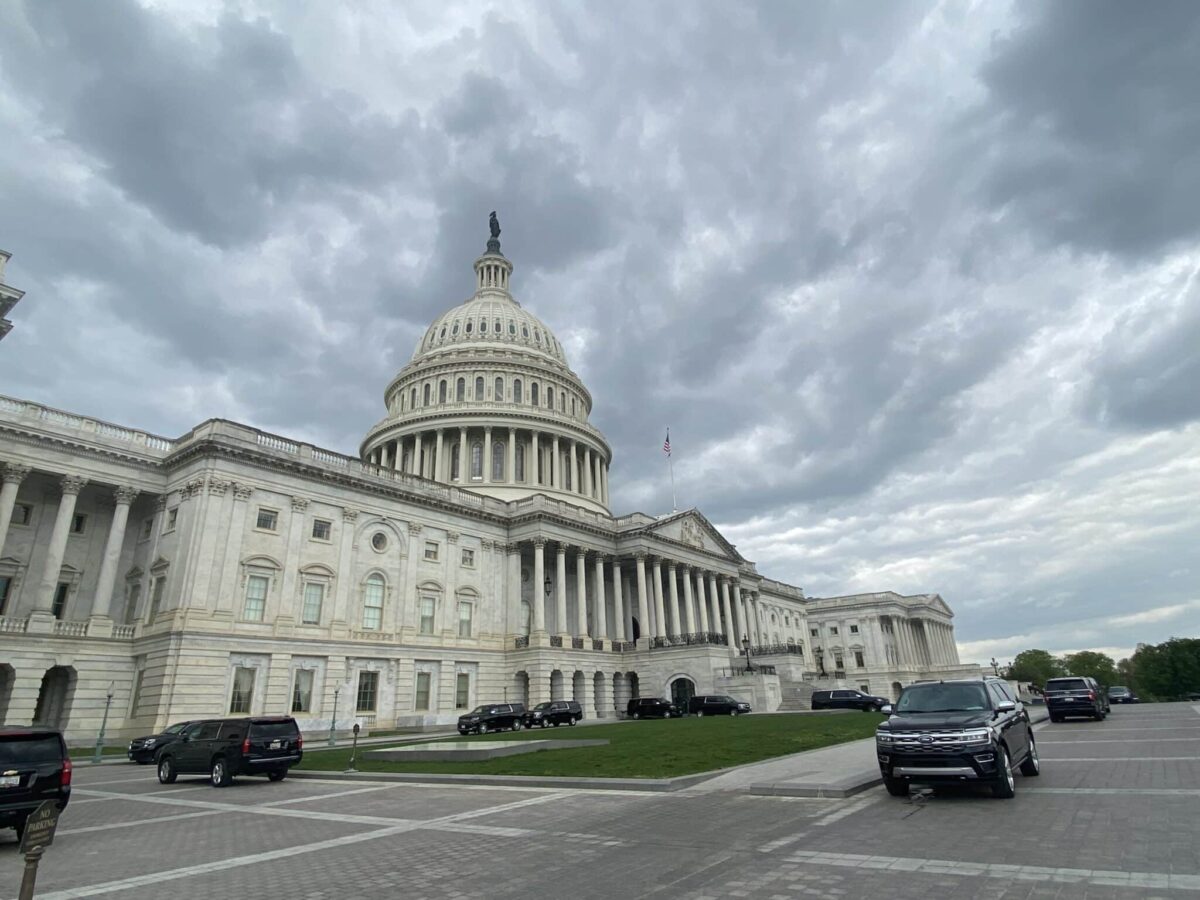
(AP) — President Donald Trump said Monday that he’d be open to striking a deal with Democrats on the health care subsidies they’ve made central to the shutdown fight, cracking the door slightly to negotiations that Republicans have said should only happen after the government reopens.
But Trump also said “billions and billions” are being wasted, nodding to arguments from conservatives who do not want the health subsidies extended to lessen the cost of plans offered under the Affordable Care Act, commonly referred to as Obamacare.
“We have a negotiation going on right now with the Democrats that could lead to very good things,” Trump said. “And I’m talking about good things with regard to health care.”
Trump’s comments were one of the few hopeful signs Monday as the government shutdown hit its sixth day. Negotiations between the two parties have been virtually nonexistent since the start of the shutdown despite the impact on federal services. Democrats have urged that Trump get involved, saying no deal will be possible without the president’s approval.
The two Democratic leaders in Congress, Sen. Chuck Schumer and Rep. Hakeem Jeffries, both denied there are any negotiations with Trump. Jeffries said the White House “has gone radio silent” since a meeting in the Oval Office last week.
“Trump’s claim isn’t true, but if he’s finally ready to work with Democrats, we’ll be at the table,” Schumer said.
Senate Majority Leader John Thune told reporters “there may be a path forward” on ACA subsidies, but stressed, “I think a lot of it would come down to where the White House lands on that.”
More doomed Senate votes
The president’s comments came shortly before the Senate took another doomed pair of votes Monday on funding the federal government. Neither the Republican measure nor the Democratic proposal came close to gaining the 60 votes needed to advance.
Both parties used much of the day to ramp up the pressure on the other to end the impasse.
Thune said a critical food aid program for women, infants and children was starting to run low on funds, blaming Democrats and saying “now it’s the American people who are suffering the consequences.”
Schumer said his side was ready to work with Republicans to “reopen the government and end the health care crisis that faces tens of millions of Americans.”
“But it takes two sides to have a negotiation,” Schumer said.
Earlier in the day, the two sides dug in. House Speaker Mike Johnson said “there’s nothing for us to negotiate” while Jeffries declared the “time is now” to work out a deal on health care.
Johnson, R-La., told reporters they could stop asking why he wasn’t negotiating an end to the impasse. It was up to a handful of Democrats to “stop the madness” and pass a stopgap spending bill that had earlier passed the House, he said.
“We did the job to keep the government open, and now it’s on the Senate Democrats,” Johnson said.
The House is not expected to be in session this week, focusing attention on the Senate to take the lead on any deal in the Republican-led Congress. Yet even with House lawmakers away, the Republican and Democratic leaders have been holding almost daily briefings as they frame their arguments and seek to shift blame for the shutdown.
Democrats are insisting on renewing subsidies to cover health insurance costs for millions of households, but Republicans have insisted that can be dealt with later. They say the subsidies are a separate debate than the one on keeping the government funded for a few weeks while the two sides work out their differences on a full-year spending package.
While some Democratic senators said they viewed Trump’s comments about the status of negotiations as positive, there was also skepticism from members on both sides of the political aisle about whether they represented much of a breakthrough.
“The discussion can’t happen until we reopen the government. The Democrats want to have these talks. The president has just signaled he wants to talk, but reopen the government,” said Sen. Markwayne Mullin, R-Okla.
“I have a hard time taking it seriously,” said Sen Richard Blumenthal, D-Conn. “Because Johnson and Thune as well as Trump are all saying ‘we won’t talk until you open up the government.’”
Turmoil for the economy
The stalemate comes at a moment of troubling economic uncertainty. While the U.S. economy has continued to grow this year, hiring has slowed and inflation remains elevated as the Republican president’s import taxes have created a series of disruptions for businesses and hurt confidence in his leadership. At the same time, there is a recognition that the nearly $2 trillion annual budget deficit is financially unsustainable.
Trump had seemingly suggested Sunday night that layoffs were already taking place, but White House press secretary Karoline Leavitt said Trump was talking about furloughs. Under a furlough, workers cannot report to work, but they will return to their job and get paid retroactively after the shutdown ends. She said layoffs were still planned if the shutdown continues.
The talk of layoffs has escalated an already tense situation in which Washington lawmakers have struggled to find common ground and build mutual trust. Leaders in both parties are betting that public sentiment has swung their way, putting pressure on the other side to cave.
The Graphite One mine work camp, located on the Seward Peninusla coast about 35 miles north of Nome, is seen in this undated photo. (Photo provided by Graphite One Inc.)
This story was originally published by Grist and Alaska Public Media. Sign up for Grist’s weekly newsletter here.
The Kigluaik Mountains stretch across the Seward Peninsula of western Alaska like a spine, their jagged ridges keeping a record of time. The Inupiaq have long read these ridges and valleys as a living story: Fire and fracture have marked the rock, and glaciers’ slow grind polished it. The talus slopes gleam in the low fall sun, meltwater from the snowfields spilling into streams that thread across the map of caribou trails on the tundra below.
Hidden beneath these remote valleys lies one of the world’s largest known graphite deposits. Over millions of years, carbon deep within the earth was subjected to immense heat and pressure, forming crystalline sheets black and soft as pencil lead. Canadian company Graphite One plans to mine the valuable material for batteries and strategic minerals — despite many residents’ objections, and so far, without the federally required tribal consultation with the nearby communities of Teller, Brevig Mission, and Mary’s Igloo.
The area slated for development drains into Imuruk Basin, an estuary fed by four rivers that create one of the continent’s most biodiverse ecosystems. This vital hunting and fishing area is essential to residents’ food security and the traditions that tie them to the land. As Lucy Oquilluk, president of Mary’s Igloo Traditional Council, told the federal government, sidelining her community denied it “the opportunity to have our voice heard on issues that directly impact our communities and ways of life.”
After President Trump invoked emergency powers to produce critical minerals this spring, the federal government fast-tracked the mine’s permitting. Three of the four local tribes have vehemently opposed the project, and say the public review process has been short-changed. (The fourth, Nome Eskimo Community, has not joined the opposition, and did not respond to an interview request.)
In June, Graphite One became the first Alaskan mine — and among the first in the country — to qualify for FAST-41, a process that expedites federal approval of critical infrastructure. This hastens environmental reviews to as little as 30 days. The complex choreography of federal permits — spanning the Army Corps of Engineers, the Bureau of Land Management, and the Fish and Wildlife Service — is now moving with unprecedented speed.
The company, which did not respond to requests for comment, envisions carving a sprawling operation into the Kigluaik: To access the remote site, it will need to use 30 miles of public road and lay 17 miles of new road, cutting across salmon streams and archaeological sites. It plans to truck the ore year-round over public roads to a temporary holding facility in Nome until a deep-water port can be built. From there, the material will make its way to Ohio, where the company plans to build a processing facility on a brownfield once used by the Department of Defense.
Graphite supply is vital to both the battery industry and national defense, and China dominates the global market. Company CEO Anthony Huston said the site “is the perfect home for the second link in our strategy to build a 100-percent U.S.-based advanced graphite supply chain.” Yet the company plans to rely on a Chinese manufacturer, Hunan Chenyu Fuji New Energy Technology Co., for design, construction, and operations — underscoring how even “domestic” supply chains remain tied to global networks and exposed to geopolitical risks.
On the strength of its promises to reduce reliance on overseas sources, the venture has received significant subsidies. In 2019, Republican Governor Mike Dunleavy nominated it as a high-priority infrastructure project, streamlining permitting. Four years later, Graphite One secured pivotal support from the U.S. Department of Defense. With funds from the Inflation Reduction Act, the company received a $37.5 million grant to expedite its feasibility study. Framed as a national security measure under the Defense Production Act, the funding aimed to develop domestic supplies of critical minerals. The resulting analysis estimated the mine could generate $43 billion in revenue for the Canadian company. In 2023, Graphite One received an additional $4.7 million from the Defense Department to develop a foam fire suppressant. Earlier this month, the company received $570 million from the Export-Import Bank of the United States, the official credit agency of the federal government.
This kind of governmental support has helped fuel a surge in mining across Alaska, where state officials are encouraging rapid development. Dunleavy recently decreed that if a state agency misses a permitting deadline, the project gains automatic approval — raising concerns of a regulatory free-for-all. Earlier this month, for example, the state approved a United States Antimony Corporation operation near Fairbanks, just three months after the company acquired the mine, saying it met permitting exemptions under state law.
In Graphite One’s case, fast-tracking has pushed tribal input to the margins. In September 2023, the tribal governments of three Inupiaq communities sent letters to the U.S. Department of Defense, protesting the fact they had not been consulted as legally required before the agency funded the project’s feasibility study. It did not respond until the White House intervened. “After the fact doesn’t count,” said Austin Ahmasuk, a Nome Eskimo Community tribal member.
During a Zoom meeting more than a year later, the department finally acknowledged the oversight, but the tribes report they never received the promised meeting notes or any follow up. The feasibility study the company produced with that federal funding explicitly tries to exclude tribes as “cooperating agencies,” limiting their ability to influence project planning and environmental assessments. (The U.S. Army Corps told Grist this was incorrect, and that relevant tribal entities have been invited into the FAST-41 process.) All of this “violates free, prior, and informed consent,” Ahmasuk said, referring to a requirement under the U.N. Declaration on the Rights of Indigenous Peoples, or UNDRIP, that tribes be consulted and involved in any decisions affecting their lands.
A similar pattern is emerging with the U.S. Army Corps of Engineers. It initially estimated an environmental review would take over two years, but after a 2023 Supreme Court decision narrowed the definition of “waters of the United States,” the agency reduced the review’s scope, despite the company’s plans to expand the size of the mine, and accelerated its timeline. Tribes have insisted on the required consultation before this permit is issued, and while the Corps has agreed in principle, Graphite One submitted an application in August, while a meeting has not yet been confirmed. These expedited reviews, said Hal Shepherd, a consultant who works with tribes on water policy, turn consultation from a meaningful process into a bureaucratic checkbox. “Even if consultation does take place, the tribes are in an uphill battle to have any meaningful input for this project,” Shepherd said.
Such consultation is more than a courtesy — it is a legal and ethical requirement. Multiple federal laws and statutes require agencies to engage with tribes on projects that affect their lands. Yet across the country, critical mineral projects are pressing ahead with minimal input from the Indigenous peoples whose lands and resources they affect. In Nevada, the Thacker Pass lithium mine moved forward in February without free, prior, and informed consent. In Minnesota, tribes report being sidelined as the Department of Defense funds mineral projects, while in Arizona, a transfer of federal lands to a copper mining company was just greenlit despite a lawsuit from the Apache Stronghold.
Canada also has moved to require meaningful Indigenous consultation. Although Canadian regulations generally don’t extend to operations abroad, British Columbia, where Graphite One is based, became the first jurisdiction in Canada to enshrine Indigenous rights under UNDRIP in 2019. In 2021, Canada’s Parliament followed, requiring federal laws to align with the U.N. declaration.
Amid these broader Indigenous rights debates, Alaska Native communities are voicing their concerns: Tribal leaders from around the Kigluaik Mountains gathered September 20 to oppose Graphite One. They discussed its “irreversible damage,” the potential violence against women that often accompanies the arrival of a large workforce in remote locations, and the generational impacts to the landscape. Tribal leaders also brought up the Trump administration’s executive order eliminating federal diversity and anti-discrimination policies, which they worry will undermine potential job opportunities at the mine for community members.
Although some Nome residents support the mine for its potential economic benefits, others are upset that the Bering Straits Native Corporation, a regional for-profit entity where many tribal members are enrolled as shareholders, invested $2 million in the project without a shareholder vote. “The tribe has the treaty responsibility and the right to government-to-government consultation,” said Nome Eskimo Community tribal member Addy Ahmasuk, who is Austin’s daughter. “But the corporation has taken up a lot of power as the owner of the subsurface rights.” When corporate interests exploit divisions within Native communities, she said, sovereignty debates can turn into conflicts over profit rather than a community’s well-being.
These divisions are compounded by accelerated reviews, which Austin Ahmasuk worries means environmental risks will be overlooked. “Even now, at the exploration stage, there’s a very noticeable change in the landscape,” he said, including the construction of roads, which he said will likely damage cultural sites. “You simply cannot avoid the archeological history. You essentially stumble across it everywhere,” he said.
On a recent afternoon, he tried to imagine what his hometown would look like once the mine was built. The company plans to build a facility almost as large as the town itself to store its ore. The public road the trucks would rumble down crosses numerous salmon streams, where families go to put away fish for the winter. “This mine needs so much infrastructure,” he said. “That’s a significant change to the community.” New sections of road risk disturbing wildlife habitat and may prevent access to hunting grounds and fishing sites generations have depended on. Without these lands, he said, families risk losing their main sources of food. Oversight of the mine, he added, will fall largely on the community “to even understand potential violations,” noting that state and federal regulators are rarely present in the region, and in his experience, provide only minimal monitoring. “People who really care about this area, we feel sort of hopeless,” he said.
Addy Ahmasuk, meanwhile, fears the toxic tailing ponds mining creates will pollute Imuruk Basin, which sustains the surrounding communities. Graphite One plans to mill and burn the ore to concentrate it prior to shipping, releasing graphite into the wind near a lagoon many families depend on for potable water, especially communities like Teller that lack running water. “Graphite dust makes water undrinkable,” she said. The ground naturally contains sulfides that, when disturbed by mining, will create a significant risk of acid drainage that will require long-term management. “Pretty much every mine that’s mining in sulfide material has some sort of water quality impact,” said Dave Chambers, founder of The Center for Science in Public Participation. The nonprofit provides technical support on mining and has been following the project closely.
He notes faster permitting has historically led to mining projects that go awry, pointing to the Rock Creek Mine, an open-pit gold mine near Nome that benefited from accelerated oversight. “Not only did the mine not even open because their engineering was so sloppy, but they killed a couple people,” Chambers said. “That’s a really good example of what happens when you try to grease the skids and get a project through as fast as possible.”
For Addy Ahmasuk, the lesson isn’t just to slow down, it’s to rethink what activism can look like. This land is central to her tribe’s creation myths. She’s launched a grassroots organization, Sacred Kigluait, aimed at restoring and sharing the stories that colonization and boarding schools sought to erase. In doing so, she hopes to protect more than just the land under threat from Graphite One — she’s fighting for the living traditions rooted in it. “The center point isn’t stopping a mine,” she said. “The center point is coming together to remember our creation stories and start telling them again.”
NOTN- Juneau voters are wrapping up CBJ’s municipal election that will decide three Assembly seats, three School Board positions, and a trio of ballot propositions.
Ballots were mailed to all registered voters on Sept. 19 and must be returned by 8 p.m. tomorrow, Oct. 7.
Ballots can be dropped in one of five secure drop boxes across Juneau, including City Hall, Douglas Library, Mendenhall Valley Public Library, Alaska Electric Light & Power, and Statter Harbor, or mailed with an Oct. 7 postmark. Voters may also cast ballots in person at City Hall or the Mendenhall Valley Library, both of which will be open from 7 a.m. to 8 p.m. on Election Day.
Three Assembly seats are on the ballot this year are, Areawide Assembly, Ella Adkison, District 1, Greg Smith, District 2, Wade Bryson and Nathaniel “Nano” Brooks.
The Board of Education race includes Steve Whitney, Melissa Cullum, Jenny Thomas, Jeremy “JJJ” Johnson, and Deedie Sorensen.
Voters will also weigh in on three propositions.
Proposition 1 asks whether to amend the city charter to lower the property tax cap from 12 mills to 9 mills, according to a voter Q&A posted to CBJ’s website, Proposition 1 would not change the FY26 mill rate, however, assuming no changes to values or budgets for the FY27 budget process, the City and Borough would plan for a revenue reduction of $1,050,716 based on reducing the mill rate to 9.0 mills.
Proposition 2 would exempt groceries and residential utilities from local sales tax, potentially reducing tax collections by an estimated $9–11 million per year.
Proposition 3 would create a seasonal sales tax, setting rates at 3% in the winter and 7.5% in the summer , repealing the existing 5% sales tax.
If both Propositions 2 and 3 pass, city officials estimate the overall impact on revenue would be minimal, with residents paying roughly $300 less per year on average in sales tax.
Voters who have not received a ballot or who require accessible voting assistance can vote in person at City Hall or the Mendenhall Valley Library. Ballots sent by mail must be postmarked by Oct. 7 and received by Oct. 20. Final certified results are scheduled for release Oct. 21.
Full candidate profiles, sample ballots, and proposition details are available at CBJ’s website.
“I voted” stickers are seen on display in the headquarters offices of the Alaska Division of Elections in Juneau on Tuesday, Nov. 12, 2024. (Photo by James Brooks/Alaska Beacon)
Election day is around the corner for most of Alaska’s local governments, and many communities are considering whether to raise local sales taxes to pay for the escalating cost of public services, including basic infrastructure like road repairs and landfills.
Alaska’s largest city, Anchorage, holds its elections in the spring, as do Valdez and Cordova, but most of the state’s 150-plus municipal governments will have their elections in the next week.
In the state capital, Juneau, where voting has been underway by mail since late September, voters are considering three ballot measures with major implications for the City and Borough of Juneau budget.
Measure No. 1 would tighten the cap on local property taxes below current rates, effectively cutting city revenue by about $1 million and eliminating the city’s ability to raise rates.
The second measure would exempt food and residential utilities from local sales taxes. That would eliminate between $10 million and $12 million per year from the city budget.
To compensate, there’s also Measure No. 3, which would raise the city’s sales tax from 5% to 7.5% in the summer and lower it to 3% in the winter. If that measure passes, it would roughly balance the lost money if Measure No. 2 passes.
If ballot measure No. 3 doesn’t pass, Juneau city officials expect to significantly cut local services in order to balance the budget.
Juneau is one of several communities deciding whether to pass sales tax hikes this month.
In Skagway, voters are considering a seasonal sales tax increase from 5% to 7% in the summer, with some of the proceeds earmarked for water, wastewater and garbage services in order to lower local rates.
In neighboring Haines, voters are deciding whether to raise the local sales tax from 5.5% to 7% in the summer within the Haines townsite, with a smaller increase in the rest of the borough. The sales tax would fall to 4.5% in the townsite during the winter, 3% in the rest of the borough, and groceries would be exempted.
In Ketchikan, borough residents are being asked whether they want to extend part of the local sales tax through 2032. The borough has a 2.5% sales tax, but half of a percent is dedicated to construction and renovation projects at local schools. That’s what voters will consider renewing.
Slightly north, in Petersburg, voters will decide whether to reduce a senior citizen sales tax exemption so it applies only to low-income residents.
Ketchikan city voters consider seven ballot measures
While voters in the Ketchikan borough contemplate a sales tax measure, voters within the city of Ketchikan itself will also have seven other ballot propositions to consider.
First is a $15 million bond to pay for sewer mains and upgrades to the city’s water treatment facility. Those upgrades are being mandated by the state and federal governments.
Voters in the First City also will decide six different amendments to the city charter. Proposition No. 2 would eliminate a 30-day waiting period for city ordinances to take effect. No. 3 would allow the city manager to live outside city limits, but only on the road system of Revillagigedo Island, where the city is located.
Proposition No. 4 would remove the requirement that voters approve the sale of any city property worth more than $30,000. Instead, the city council would have the authority to approve those sales.
The fifth proposition would allow the city to award large contracts to someone other than the lowest bidder, and the sixth would allow the city to approve sales or contracts with city employees and elected officials as long as there are at least three cost quotes and the chosen contract is “the most advantageous to the city.”
The last proposition, the seventh, would allow the city’s annual fiscal audit to take more than four months.
In addition to those ballot measures, three candidates are running for two seats on the Ketchikan City Council. There’s also a two-way race for borough mayor, two contested borough assembly races and two contested school board races.
Voters in Sitka will consider two ballot measures. The first would allow the city to use proceeds from the local tobacco tax and the sale of the local hospital for parks and recreation.
The second, if adopted, would require all ballot measures to include a comprehensive economic impact study report before reaching the signature-gathering phase.
Six people are running for two seats on the Borough Assembly in Sitka, and there are three candidates for two seats on the local school board.
In Petersburg, two candidates are running for mayor and five candidates are running for two seats on the borough assembly. There is one candidate and two open seats for the school board.
In Skagway, the one candidate for mayor is running uncontested, after the previous mayor resigned earlier this year. There are four candidates for two assembly seats, and one candidate for two open school board seats. In Haines, there are four candidates for two assembly seats, and two candidates for two school board seats.
North Slope voters contemplate big borrowing plan
In the North Slope Borough, two of four assembly races are contested, and only one of four school board races is contested. Borough voters also will consider eight different bond proposals. That’s more ballot propositions than any other municipal election taking place this month in Alaska.
The borough is proposing to borrow a combined $204 million for public facilities, including light, power, water, sewage, public safety, education and flood control.
At Utqiagvik, the borough’s largest town and the northernmost town in the United States, voters will choose between two candidates for mayor. There’s also two city council races, only one of which is contested.
Voters also are being asked to choose whether or not to extend Utqiagvik’s 20% wholesale tobacco tax to cover “alternative nicotine products and equipment,” such as vape and e-cigarette products.
Within the Northwest Arctic Borough, there are four borough assembly seats on this year’s ballot. Only one race is contested, and one seat — covering Ambler, Kobuk and Shungnak — has no candidates at all.
Similarly, among three races for school board, none are contested and one of the three seats has no candidates.
In the Kotzebue city election, two seats on the city council are on the ballot, and each race has two candidates. Another seat was vacated by the resignation of Ruth Moto in September, and someone will be appointed to fill that seat after the election, with the replacement being up for election in October 2026.
The Nome Nugget noted “meager interest to run for public office” in Nome this year, with two city council seats and two school board seats unopposed, but voters there will also be asked whether to raise the city’s sales tax from 5% to 6%.
This week, the Nugget reported that if the tax increase doesn’t pass, city officials will cut services.
In the Matanuska-Susitna Borough, Houston considers sales tax hike
The Matanuska-Susitna Borough holds its elections in November (as does Metlakatla in Southeast), but the cities within the Mat-Su borough vote in October.
Wasilla has no ballot measures; its city election includes three city council races, only one of which is contested.
In Palmer, five people are competing to become the city mayor, the most competitive single municipal race this fall. Three people are competing for two three-year seats on the city council. There also is a one-year seat on the council, and two people are vying for it.
Palmer voters are also being asked if they want to change the city charter so the city manager is no longer required to live within the city. The change would allow the manager to live within five miles of city limits.
Within Houston, six people are running for three spots on the city council. Houston also has four ballot measures. One asks whether voters support a city-owned airport. A second asks voters to approve a 2% sales tax increase (from 2% to 4%) in order to pay for road repairs. The third and fourth measures ask voters to approve the “Matanuska Thunder Festival” and “Founder’s Day” as city holidays.
Many ballot measures in the Kenai Peninsula Borough
Proposition No. 2 would create a special taxing district in Ninilchik to fund a new local swimming pool there. No. 3, if approved, would increase the property tax exemption in the borough so the first $75,000 of a homeowner’s residence would be exempted from local property taxes. The current exemption applies to the first $50,000.
The fourth proposition would raise the borough’s sales tax cap every five years. Currently, sales taxes only apply to the first $500 of a purchase.
Proposition No. 5 would shift borough elections to November, aligning them with state and federal elections, much as the Mat-Su borough has done.
Five seats on the Kenai borough assembly are up for election, and three of the races are contested. Three school board seats are on the ballot as well, with two races contested.
Among city elections on the Kenai Peninsula, only Soldotna has a ballot measure. That proposition asks voters to approve or reject the annexation of 2.63 square miles of nearby land into the city limits.
In the Interior, none of Fairbanks’ three local governments have ballot measures this year, but this year’s ballot will decide three seats on the borough assembly and two on the borough school board. There’s a two-person race to become Mayor of Fairbanks, and two seats on the city council are up for election.
Southeast of Fairbanks, in North Pole, four seats on the city council are up for election. There are only four candidates, but the order of the candidates will determine who gets a three-year term, a two-year term or a one-year term.
Kodiak will pick a new mayor
In Kodiak, voters will pick between two candidates for borough mayor, five candidates for two seats on the borough assembly, and they will vote on a variety of service area boards.
Within city limits on Kodiak, four people are running to replace longtime Mayor Pat Branson, and four candidates are running for two seats on the city council.
In southwest Alaska, Bethel has four open city council seats but only three registered candidates and one write-in candidate.
In Unalaska, Mayor Vince Tutiakoff Sr. is running unopposed for re-election, and three people are running for one of the two city council seats on the ballot. The other incumbent for city council is unopposed. On the local school board, three people are running for one of two school board seats; the other seat is held by the incumbent school board president, who is unopposed in his re-election bid.
Within the Aleutians East Borough, which includes Sand Point, King Cove and Cold Bay, two of three borough assembly seats have unopposed races, and the third has two candidates. All three school board seats on the ballot have candidates running unopposed.
Further north in Dillingham, two city council seats have two candidates apiece, and three people are running unopposed for three school board seats.
Within the Bristol Bay Borough, based in Naknek, three people are running for two seats on the borough assembly, and there are five candidates for the two school board seats on the ballot.
In the Lake and Peninsula Borough, two borough assembly members and two school board members are running unopposed. Those elections, like those in Juneau, are conducted by mail, and ballots must be postmarked by Oct. 7 and received by the borough clerk before Nov. 7.
Anchorage Mayor Dave Bronson speaks in May 2022 at the Alaska Sustainable Energy Conference. (Photo by Yereth Rosen/Alaska Beacon)
Former Anchorage Mayor Dave Bronson said Thursday in Fairbanks that he intends to run for governor in 2026, becoming the 13th candidate and 12th Republican in next year’s race.
Incumbent Gov. Mike Dunleavy is term-limited and unable to run again, which has caused an unusually large number of early entries into the governor’s race.
Only one Democratic candidate, former Anchorage state Sen. Tom Begich, has entered the race. Other Democrats say they are awaiting the possible run by former Democratic U.S. Rep. Mary Peltola, who had the highest favorability rating among top candidates, according to one poll this summer.
Republicans face no such obstacle. In addition to Bronson, the Republican field of candidates includes former state Sen. Click Bishop of Fairbanks; Lt. Gov. Nancy Dahlstrom of Eagle River; Anchorage businesswoman Bernadette Wilson; podiatrist Matt Heilala of Anchorage; Matanuska-Susitna Borough Mayor Edna DeVries; former teacher James William Parkin IV of Angoon; current state Sen. Shelley Hughes of Palmer; Bruce Walden of Palmer; former Alaska Revenue Commissioner Adam Crum; and former Alaska Attorney General Treg Taylor.
All of those candidates have filed letters of intent or statements of candidacy with the Alaska Public Offices Commission, which allows them to fundraise and spend money on a campaign.
They have not yet registered with the Alaska Division of Elections, which officially places a candidate on the August primary ballot.
Republican Henry Kroll of Soldotna, who has not registered with the Public Offices Commission, is the lone candidate to have registered with the Division of Elections.
The deadline to file with the Alaska Division of Elections is June 1, 2026.
In Alaska, the top four vote-getters for a state office, regardless of political party, advance from the August general election to the November general election.
Wilson has vowed to withdraw from the election if she finishes in the top four but isn’t the top Republican. She has encouraged other Republicans to take similar vows in an attempt to consolidate support for the top Republican front-runner in the general election.
Bronson, who delivered brief remarks in Fairbanks before participating in a panel discussion with six other Republican candidates, said he supports increased spending on infrastructure and the Permanent Fund dividend, saying he would like to see a constitutional amendment that would mandate a dividend paid according to a formula that was used from 1982 through 2016.
That would require spending an additional $2 billion per year for dividend payments above what lawmakers and Dunleavy approved this year. As a whole, the state’s operating budget is currently $5.9 billion. Bronson did not explain how he intends to pay for the increase.
An experienced pilot, Bronson was elected mayor of Anchorage in 2021, months after the incumbent Democratic mayor resigned during a sex scandal and amid a conservative backlash against COVID-19 mitigation efforts imposed by the Anchorage assembly.
He served a single term and was endorsed for re-election by Dunleavy and U.S. Sen. Dan Sullivan but lost in 2024 to current Mayor Suzanne LaFrance.
Bronson’s time in office was marked by major conflicts with city employees, public health officials and the assembly. In 2023, the city manager Bronson appointed and fired, sued him and the city, alleging illegal and unethical acts. The assembly settled that case in 2024 for $250,000 after Bronson left office.
In January, Dunleavy appointed Bronson to manage Ted Stevens Anchorage International Airport. After less than eight months, he announced his resignation from that job in August.
Elayna Cunningham, a college student interning at Koahnic Broadcast Corp., records a program on July 10, 2025, at the Anchorage, Alaska, studios of KNBA, the flagship station for National Native News. (AP Photo/Mark Thiessen)
Elayna Cunningham, a college student interning at Koahnic Broadcast Corp., records a program on July 10, 2025, at the Anchorage, Alaska, studios of KNBA, the flagship station for National Native News. (AP Photo/Mark Thiessen)
NOTN- Months after Congress eliminated federal funding for public broadcasting, 14 Alaska stations have been granted temporary relief.
Eligible stations were then presented with two potential funding options: they could partner with a Tribe, either through a 638 compact or 638 contract, or they could go through a grant process.
Stations will likely be funded through a program that supports tribal stations, but they won’t receive the temporary funding until after the federal government Shutdown.
In a press release, Senator Lisa Murkowski announced the funding, calling it a critical but short-term measure to keep rural stations operating after Congress rescinded $1.1 billion from the Corporation for Public Broadcasting.
“This funding will help some of Alaska’s most rural radio stations make ends meet for now.” Murkowski said, “But it is one-time funding, and the job isn’t done until every station in Alaska has stable, long-term support.”
Stations set to receive funding include KNBA in Anchorage, KBRW in Barrow, KYUK in Bethel, KDLG in Dillingham, KUCB in Unalaska, and others serving communities from the Aleutians to the Arctic.
U.S. Senate Democrats and Republicans remained at a stalemate Wednesday as government offices closed and hundreds of thousands of federal workers faced furloughs on the first day of a government shutdown that showed no sign of ending.
Proposals from each side of the aisle to fund and reopen the government failed again during morning Senate votes, mirroring the same vote breakdowns as Tuesday evening, when lawmakers could not reach a deal hours before the government ran out of money.
The nonpartisan Congressional Budget Office projected up to 750,000 federal workers could be furloughed, leading to a $400 million per day impact on the economy.
Locked in their positions, Republicans failed to pick up enough Democrats to reach the 60 votes needed to advance their plan to fund the government until Nov. 21.
Senators will break Thursday to observe Yom Kippur but will return Friday to again vote on the funding proposals.
Democratic Sens. Catherine Cortez Masto of Nevada and John Fetterman of Pennsylvania, along with independent Angus King of Maine, again joined Republicans in the 55-45 vote for the House-passed stopgap spending bill. GOP Sen. Rand Paul of Kentucky voted no.
Democrats also failed to find support to move forward their bill to fund the government through Oct. 31, roll back GOP cuts on Medicaid and permanently extend subsidies that tie the cost of Affordable Care Act health insurance premiums to an enrollee’s income level.
The Democrats failed to advance their plan in a party-line 47-53 vote. King, who caucuses with Democrats, voted in favor.
Shutdown tied to health care tax credits
Senate and House Democrats say they will not support a GOP path to reopen the government unless Republicans agree to negotiate on rising health care costs.
House Minority Leader Hakeem Jeffries said at a press conference that Democrats are “ready to sit down with anyone at any time and at any place in order now to reopen the government, to enact a spending agreement that meets the needs of the American people and to address the devastating Republican health care crisis that has caused extraordinary harm on people all across the country.”
The New York Democrat pointed to harms in “rural America, working class America, urban America, small-town America, the heartland of America and Black and brown communities throughout America.”
Democratic leaders blitzed Capitol Hill with their message on health care, holding press conferences and attending an evening rally Tuesday on the lawn outside the U.S. House.
U.S. Senate Minority Leader Chuck Schumer, D-N.Y., speaks during a press conference inside the Capitol building in Washington, D.C., on Tuesday, Sept. 30, 2025. Also pictured from left are Washington Sen. Patty Murray, Minnesota Sen. Amy Klobuchar and Illinois Sen. Dick Durbin. (Photo by Jennifer Shutt/States Newsroom)
They pointed to new data published this week showing annual insurance premiums could double on average in 2026 if the subsidies expire at year’s end, according to an analysis from the nonprofit health policy research organization KFF.
Open enrollment for next year’s ACA health insurance plans opens Nov. 1 in most states, and Oct. 15 in Idaho.
Uptake of ACA health insurance plans has more than doubled to over 24 million, up from 11 million, since the introduction of the subsidies in 2021, according to KFF.
During their own budget reconciliation deal in 2022, Democrats extended the insurance premium tax credits until the end of 2025. The majority of ACA enrollees currently rely on the credits.
Democrats also want assurances that the White House and Senate Republicans will not cancel any more funds that have already been approved by Congress, as was the case this year when the administration and GOP lawmakers stripped funding for medical research, foreign aid and public broadcasting, among other areas.
‘This can all end today’
GOP leaders in the House and Senate continued to blame Senate Democrats for the government shutdown at the expense of furloughed federal workers and Americans who rely on their services.
At a Wednesday morning press conference, House Speaker Mike Johnson said “troops and border patrol agents will have to go to work, but they’ll be working without pay.”
Johnson also claimed at the press conference that veterans benefits would stop. The claim is false, as Veterans Administration medical care will continue uninterrupted and vets will also continue to receive benefits, including compensation, pension, education and housing.
House Speaker Mike Johnson of Louisiana speaks at a press conference outside the U.S. Capitol on Oct. 1, 2025, in Washington, D.C., alongside fellow GOP leadership in the U.S. House and U.S. Senate. (Photo by Shauneen Miranda/States Newsroom)
“As we speak here this morning, there are hundreds of thousands of federal workers who are getting their furlough notices. Nearly half of our civilian workforce is being sent home — these are hard-working Americans who work for our federal government,” the Louisiana Republican said, flanked by fellow GOP leaders on the Upper West Terrace of the U.S. Capitol overlooking the National Mall.
Johnson decided in late September the House will be out until Oct. 6, canceling this week’s votes.
The speaker said he will bring House members back next week, even if the government is still shut down.
“They would be here this week, except that we did our work — we passed the bill almost two weeks ago out of the House, sent it to the Senate,” Johnson said. “The ball is literally in (Senate Minority Leader) Chuck Schumer’s court, so he determines that.”
Senate Majority Leader John Thune said “this can all end today” and “needs to end today.”
The South Dakota Republican said the funding lapse can cease when Senate Democrats vote for the GOP’s “clean” short-term funding bill.
“We will continue to work together with our House counterparts, with the president of the United States, to get this government open again on behalf of the American people,” Thune said.
Bipartisan deal and Trump
Virginia Democratic Sen. Tim Kaine said later in the day that a bipartisan group huddled on the floor during votes to talk about a possible path forward on “health care fixes” and ensuring that if a bipartisan deal is brokered, the Trump administration will stick to it.
Republican senators, he said, could give Democrats assurances they won’t vote for any more rescissions requests from the White House, which ask Congress to cancel already approved government spending. But other issues, like laying off federal workers by the hundreds or thousands, have to be a promise from the president.
“If I find a deal, should Congress have to follow it? Yes. Should the president have to follow it? Yes. Well, what if the president won’t follow it? Oh, yeah, you got a problem,” Kaine said. “So you know, rescission, impoundment, those are Senate words. But a deal is a deal — people get that.”
Kaine also emphasized that it’s not a “clean” stopgap funding bill if the Trump administration unilaterally cancels some of the spending.
“In the past, we voted for clean (continuing resolutions), but the president has shown that he’ll take the money back,” Kaine said, referring to the technical name for a short-term funding bill. “I mean, just in Virginia, canceling $400 million to our public health, $40 million economic projects just pulled off the table, firing more Virginians than any president.
“So we just want you to agree, if we do a deal, then you’ll honor the deal,” Kaine said. “It’s not that much to ask.”
‘People are suffering’
North Carolina Republican Sen. Thom Tillis said he doesn’t expect the shutdown will have long-term ramifications for senators’ ability to negotiate bipartisan deals — a necessity in the upper chamber, which has a 60-vote threshold to advance legislation.
“It’s all transactional,” Tillis said. “I think there’s going to be opportunities for some bipartisan work, but none of that happens, you can’t even really consider it when you’re in a shutdown posture.”
Cortez Masto, who voted to advance Republicans’ seven-week stopgap bill, said the GOP “created this crisis” on health care and “need to address it.”
“They have no moral standing — no moral standing —- to say that this is all on the Democrats. They are in control. They’ve created this crisis,” Cortez Masto said. “People are suffering and they need to come to the table.”
Missouri Republican Sen. Josh Hawley, who was sworn in for the first time during the last shutdown, said he worries about longer-term effects.
“My concern is it’s going to poison the well on negotiations going forward on a lot of things,” Hawley said. “I can’t speak for anybody but myself, but I would just say that these tactics are very destructive. And it’s destructive, not just for relationships, but for real people.”
Officials with the cruise line Holland America announce an Alaska-themed float at the Macy’s Thanksgiving Day Parade in Juneau on Sep. 30, 2025 (Photo by James Brooks/Alaska Beacon)
The cruise line Holland America will have a large Alaska-themed float in the annual Macy’s Thanksgiving Day Parade, the company announced Monday during a ceremony in Juneau.
A mock-up of the proposed Alaska-themed float in the Macy’s Thanksgiving Day parade, sponsored by Holland America, is displayed in Juneau on Sep. 30,2025 (Photo by James Brooks/Alaska Beacon)
Alaskans haveoccasionallyparticipated in the parade in New York City, which is celebrating its 99th anniversary this year, but the company believes this will be the first time that the state will be represented by a float in the event.
The announcement came on one of the last days of Holland America’s summer cruise ship operations in Alaska’s capital city. Juneau will continue receiving occasional large cruise ships through October.
“The float will be named simply ‘The Land of Glaciers, Wildlife and Wonder,’” said Leanne Jones with Holland America official during a ceremony announcing the float and a $5,000 donation to Trail Mix, a local trail-building nonprofit in Juneau.
“This marks the first time Alaska will be featured in the iconic holiday event, and the first time Holland America Line has ever participated in this parade,” Jones said. The parade is scheduled to start at 4:30 a.m. Alaska time on Thursday, Nov. 27.
A rendering displayed Monday shows a howling wolf, black bear and a moose at the back of the float. The main platform is a glacier and river with leaping salmon.
“Well, that’s a pretty exciting announcement,” said Juneau Mayor Beth Weldon. “And you know, after Macy’s parade, we do have a Fourth of July parade in Juneau.”
The Juneau cruise dock is seen on Sep. 30, 2025 (Photo by James Brooks/Alaska Beacon)
Rendering of proposed Welcome Center provided by Golbelt.
NOTN- Juneau’s city leaders heard directly from Goldbelt Inc. on Monday night about the corporation’s plan for the Douglas Island port project, which includes two proposed cruise ship docks.
Deputy Mayor Greg Smith said it was the first time the full Assembly had received a detailed briefing from Goldbelt, calling it “a good start to the conversation.” The project, nicknamed “Goldbelt Aaní” is still in its early stages with no announced opening date.
“They give a good overview of the project, of the vision, the intent, you know, ,there’s still a fair bit to be determined and plan.” Said Smith. “There wasn’t an expected date. I did ask what kind of minimum infrastructure they would need out there to be open, they’re still evaluating that.”
According to Goldbelt, Goldbelt Aaní will highlight Lingít culture and boost the city’s economy.
Plans include docks, a welcome center, employee housing, child care facilities, and even a replica Lingít village.
Smith said Assembly members raised questions about transportation impacts, including whether North Douglas Highway could handle added traffic.
“My sense from the response was that they’re not planning to be bussing in tons and tons and tons of people. It’s people staying on the site, or going places via water again, we still need to learn more how that would work, what that looks like.” Said Smith, “How does the five ship limit play into it? That’s definitely been a big concern.”
Smith noted the project remains under evaluation, but Monday’s discussion helped open communication between the city and the Native corporation.
A copy of the Homer News is seen in 2015. Newsroom employees at the News and the Peninsula Clarion submitted their resignations on Monday, Sept. 29, 2025, to protest the actions of the newspaper’s ownership. (Photo by James Brooks/Alaska Beacon)
Reporters and editors at the Homer News and Peninsula Clarion announced their resignations on Monday, citing a decision by the papers’ corporate owners to bow to political pressure to amend an article about a vigil for the slain far-right activist Charlie Kirk.
The resignations, which include two editors and two reporters based in Homer and Kenai, were scheduled to take effect in two weeks, but managers at Carpenter Media Group fired all four immediately.
Carpenter Media Group, an international chain, owns the News, Clarion and the Juneau Empire, as well as the Yukon News and hundreds of other newspapers in the Lower 48 and Canada.
The resignations follow a similar mass resignation at the Juneau Empire earlier this summer.
When combined, both actions leave Carpenter Media Group with a single in-state Alaska reporter among its three newspapers.
Mary Kemmis, senior vice president of Carpenter’s publications in Alaska and Canada, did not return phone calls seeking comment on Tuesday, nor did Chloe Pleznac, the reporter who authored the original article.
Jake Dye, a former reporter for the Peninsula Clarion and one of the people who resigned this week, said by phone that Carpenter’s handling of the story was “problematic in a lot of ways.”
Since his killing, conservatives, including many Republicans, have held rallies to memorialize Kirk.
After a vigil in Homer, Pleznac published an article describing Kirk as a “far-right political activist and Christian-Nationalist icon,” and went on to describe his “often racist and controversial views” before going on to detail the vigil.
Soon after the article was published, Rep. Sarah Vance, R-Homer, published a letter on official state legislative letterhead that criticized the characterization of Kirk and the Homer News coverage and said in part, “If the paper continues to treat community events as opportunities for partisan spin, the consequence will be financial as well as reputational.”
After the letter, which was reprinted on her legislative Facebook page, Carpenter officials rewrote the article without consulting editors or reporters at the Homer News, according to the staff who resigned.
Vance did not answer a phone call and text message Tuesday asking about the incident.
In their resignation letter, Carpenter’s Alaska reporters and editors said they don’t have an issue with Vance’s perspective but “what we do have a problem with is Carpenter Media management changing a story at the behest of an elected official. We believe this destroys the credibility the public has placed in us as reporters and editors.”
The worry, the resigning staff said, is that having once caved to political pressure, Carpenter Media will invite further attempts to steer news coverage by political officials and people who are part of the story.
“We cannot do our jobs knowing that pressure from an elected official can mean our stories are edited without prior consultation with us,” the resignation letter says.
Vance’s letter to Carpenter Media comes amid nationwide pressure by Republican and conservative officials to clamp down on language deemed critical of Kirk. Some states have launched investigations of university officials and other public employees for comments made on social media.
The three publications were owned by Georgia-based Morris Communications until 2017, when they were purchased by New Jersey-based GateHouse Media. Later that year, they were sold again to Washington-based Sound Publishing, a division of Canada-based Black Press.
In Juneau, the entire reporting staff of the Juneau Empire — including seasonal interns — resigned simultaneously amid complaints about low pay, benefits and a lack of institutional support.
The former editor of that newspaper has since gone on to help start an independent, nonprofit newsroom for capital-city news.
Dye, by phone on Tuesday, said he’s not sure what’s next for either himself or the Peninsula Clarion. Journalism in Alaska as a whole is in a dim spot amid budget cuts to public media, he said, but he’s trying to stay optimistic.
“There’s not a lot of light at the end of the tunnel, but I guess I truly believe that somehow, things are going to work out for the state and for us,” he said.