Gov. Mike Dunleavy discusses proposed education legislation at a news conference on Jan. 31, 2025. (Photo by Corinne Smith/Alaska Beacon)
NOTN- Alaska’s governor will not withdraw an executive order proposing to create a new state Department of Agriculture, he said in a letter sent Monday to the leaders of the state House and Senate.
Gov. Mike Dunleavy’s letter comes days after a joint House-Senate panel voted to spend up to $100,000 on a lawsuit against the governor if he goes ahead with his proposal to create the department unilaterally.
Alaska is one of only two states without a cabinet-level state Department of Agriculture, and legislators have spoken favorably about the idea of creating one, but a majority of the House and Senate want to authorize that new department through law, not by the governor’s executive order.
In March, the Legislature voted 32-28 to reject an administrative order that would have created the Department of Agriculture by splitting off part of the Department of Natural Resources, the agency that currently oversees agriculture.
Shortly before the vote, lawmakers in the House and Senate introduced new legislation to create the department. Neither the House bill nor the Senate bill advanced to a final vote, and either could be taken up during the next regular legislative session, which begins in January.
When Dunleavy called lawmakers into special session in August, he reissued the executive order, but the leaders of the state House and Senate declined to accept the order as valid, saying that the Alaska Constitution does not grant the governor the power to issue an order during a special session.
Lawmakers also say they believe that it isn’t legal to reintroduce a previously rejected order.
“There clearly exists a disagreement between the executive and legislative branch as to the governor’s ability to introduce an executive order in a special session,” the governor wrote in Monday’s letter. “When such a dispute exists, it is appropriate to seek clarification from the courts.”
The governor’s letter notes that lawmakers could have met during the special session to vote down his executive order. Legislators have previously said they did not wish to do so, because taking the vote would have been the equivalent of acknowledging that the governor has the power to issue an executive order during a special session.
Rep. Sara Hannan, D-Juneau, is chair of the Legislative Council, the joint House-Senate committee that authorized the lawsuit against the governor.
By phone on Tuesday, she said she isn’t sure when the suit will be filed, but she expects it to move quickly.
The executive branch is preparing to launch the new department by Jan. 1, and legislators want to stop it before then.
“We have two prime legal issues that we think need to be addressed by a court, because the executive branch is interpreting them completely different,” she said.
Hannan said she expects that once a trial judge decides the issue, the losing party in the case will rapidly appeal to the Alaska Supreme Court for a final determination.
Regardless of who wins the case, Hannan said the state may still end up with a Department of Agriculture by June because legislators are advancing bills that would create the department.
“The 34th Legislature still may create a Department of Agriculture, but the executive order action of creating that and attempting to do it in a special session and after an executive order has been rejected, those are the legal questions that we need addressed,” she said.
The Kuskokwim River is seen in this image captured by scientists working on NASA’s Arctic Boreal Vulnerability Experiment, or ABoVE, which measured the elevation of rivers and lakes in Alaska and Canada to study how thawing permafrost affects hydrology. (Photo by Peter Griffith/NASA)
On Monday, the Alaska Department of Law asked the Supreme Court to reconsider a ruling from a three-judge panel from the 9th U.S. Circuit Court of Appeals, which upheld the state’s existing two-tiered subsistence fishing system last month.
State attorneys have argued unsuccessfully since 2021 that federal law, as interpreted by recent rulings from the Supreme Court, means the state, not the federal government, has the power to regulate fishing in navigable waters on federal land.
A federal law, the Alaska National Interest Lands Conservation Act, requires that rural Alaskans be given preferential treatment when hunting and fishing are regulated in Alaska. Simultaneously, the Alaska Constitution forbids that kind of preference.
For decades, the result has been a two-tiered system under which the federal government regulates hunting and fishing on federal land and water, and the state regulates it everywhere else.
Under the state framework, someone from Anchorage would have the same fishing rights on the Kuskokwim River as someone who lives a mile away. Under the current system, the local resident gets priority in parts of the river within federal land.
In 2021, a regulatory dispute on the Kuskokwim River during a salmon shortage resulted in the federal government filing a lawsuit against the state. The Alaska Federation of Natives, Association of Village Council Presidents and other Native groups from across the state joined the lawsuit on the side of the federal government.
In 2024, a U.S. District Court judge in Alaska ruled in favor of the federal government, but the state appealed that decision. Last month, three judges from the 9th Circuit again ruled in favor of the federal government. Rather than appeal the issue to the full 9th Circuit, the state is going directly to the Supreme Court.
The state’s filing on Monday was formally known as a “cert petition,” which asks the court to take up the case.
The court takes only about 1% of the cases it receives, though the acceptance rate is higher (about 5%) if the large number of cases involving prisoners representing themselves in court are excluded.
In a written statement announcing the filing, Alaska Gov. Mike Dunleavy and Attorney General designee Stephen Cox said the state believes that federal law gives Alaska control of its navigable waters when it comes to fishing.
“Alaska is asking the Supreme Court to hold fast to the text, because fidelity to the law as written is the foundation of the rule of law,” Cox said in his statement.
Doug Vincent-Lang, commissioner of the Alaska Department of Fish and Game, said he believes the 9th Circuit decision “deepens a fractured system that undermines conservation, creates confusion, and threatens equitable access for all Alaskans. Salmon don’t recognize federal and state boundaries — our management shouldn’t either. We remain committed to sustainable management and will continue fighting for a system that works for every Alaskan. The Court should decide this case and reverse the Ninth Circuit.”
Attorneys representing Alaska Native groups said on Monday that they expected an appeal to the Supreme Court, even if they didn’t know the exact timing.
Nathaniel Amdur-Clark, who has represented the Kuskokwim River Intertribal Fish Commission in the lawsuit to date, said by text message on Monday that his clients “are disappointed, but not surprised, to see the state’s cert petition. It is just a continuation of the state’s push to undermine subsistence protections for Alaska Natives and rural Alaskans.”
The Supreme Court does not have a set timeline for considering the state’s petition, which will be taken up in a closed-door judicial conference after both sides of the argument file written briefs on the issue.
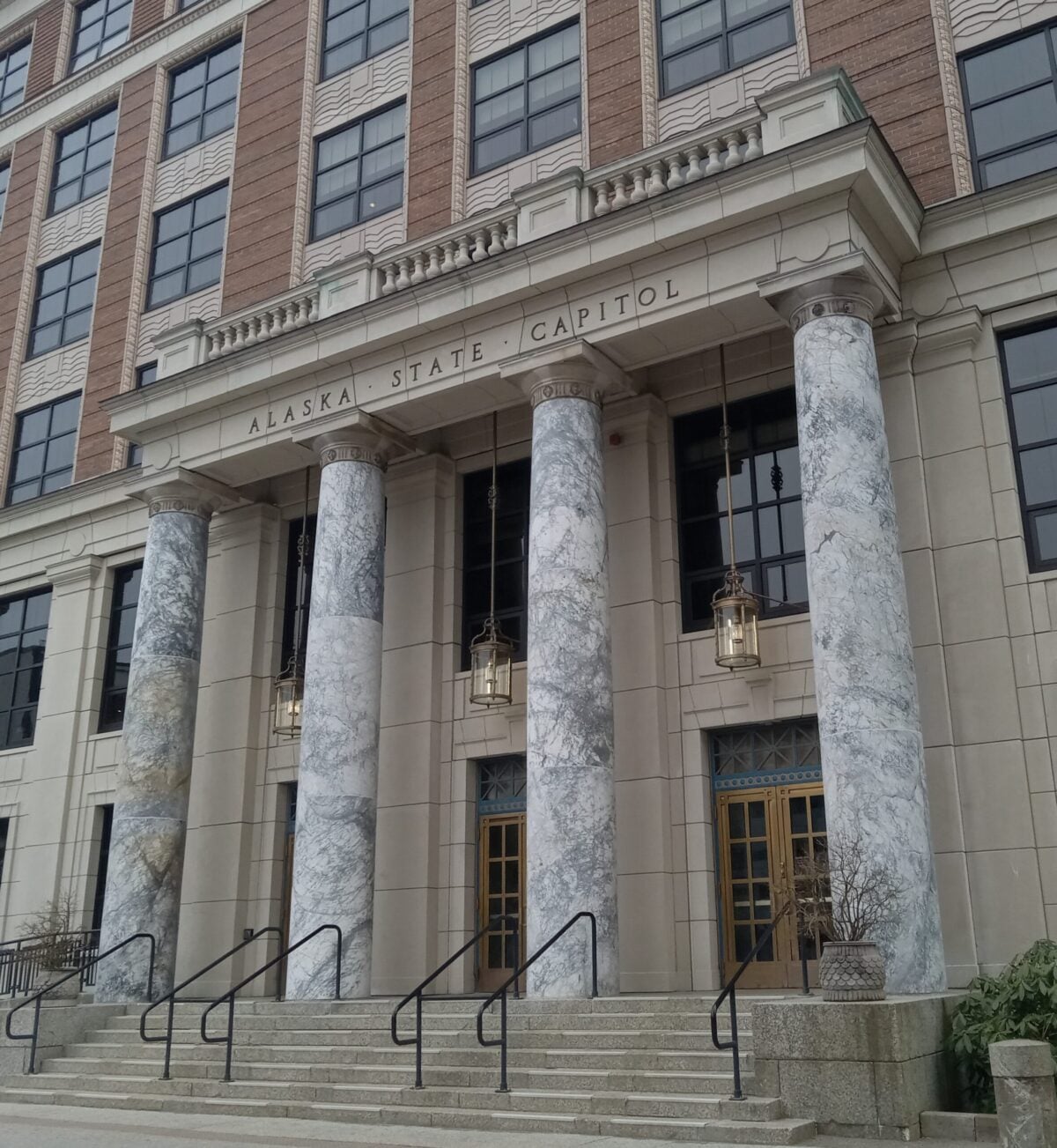
The Alaska State Capitol in downtown Juneau.
(Photo by Greg Knight/News of the North)
By: James Brooks, Alaska Beacon
The Alaska State Capitol in downtown Juneau.
(Photo by Greg Knight/News of the North)
A panel of state lawmakers voted 9-2 on Wednesday to approve spending up to $100,000 on a lawsuit against Gov. Mike Dunleavy.
The lawsuit, if filed, would challenge the governor’s decision to press ahead with plans to create a cabinet-level Alaska Department of Agriculture via executive order.
The governor issued an executive order in January, but lawmakers rejected it in a 32-28 vote in March, saying they preferred to create it through legislation instead. Creating the department through legislation, legislative leaders said, would allow lawmakers to debate and structure the department how they wish, instead of relying on the governor’s plans alone.
Dunleavy disagrees with that approach and in August filed a new executive order during a 30-day special session.
The leaders of the House and Senate refused to accept the filing, saying that it was not within the governor’s power to issue an executive order during a special session, or to reintroduce an already-rejected order.
The governor’s office has said that lawmakers’ failure to vote down the new order means that it will take effect and allow the executive branch to create the cabinet-level department at the start of 2026.
Why does the Legislature’s failure to vote on the executive order matter?
Article III, section 23 of the Alaska Constitution says that executive orders automatically take effect “unless disapproved by resolution concurred in by a majority of the members in joint session.”
The question that could be decided in court is whether lawmakers need to take that vote if an order is issued during a special session. Is issuing an order in a special session even legal? And does it matter if the order is identical to one that’s already been issued and voted upon?
Under Article III, section 23 of the Alaska Constitution, the “legislature shall have sixty days of a regular session, or a full session if of shorter duration, to disapprove” executive orders that would make a change to the functions of the executive branch.
For almost two hours on Wednesday, members of the joint House-Senate Legislative Council — a committee that makes decisions for the Legislature when it is out of session — heard about the dispute behind closed doors, then debated it briefly in open session before voting.
“It’s a disagreement between the Legislature and the governor about whether or not the governor has the authority under the Alaska Constitution to introduce an executive order during a special session,” said Emily Nauman, director of Legislative Legal Services, the legal department for Alaska’s legislative branch.
Because the House and Senate’s presiding officers returned the order to the governor without taking action, “the governor is asserting that he will give effect to the executive order because it was not specifically rejected or disapproved by the legislature, thus causing a conflict in the interpretation of the Constitution between the Legislature and executive branch.”
Rep. Louise Stutes, R-Kodiak, voted in favor of authorizing the Legislature to prepare and, if necessary, file a pre-emptive lawsuit to keep the governor from enacting the executive order.
“It’s just a question, to me, of, we said, ‘No. Don’t you understand what no means?’”
Rep. Calvin Schrage, I-Anchorage, also voted in favor of moving forward with a lawsuit. He said that while there is still time for the governor to back away from his position, “I really see it as our prerogative to protect ourselves procedurally, and for us to do that, I believe we need to file litigation.”
The two votes against Wednesday’s proposal came from Reps. Chuck Kopp, R-Anchorage, and Mike Prax, R-North Pole.
Prax said he feels as if it could set a precedent that could allow lawmakers to disapprove of a future governor’s actions in a “more urgent” situation by simply not taking action.
“We would establish a precedent that the Legislature can do something by doing nothing, and that just does not seem like a very good practice to have established for any organization,” Prax said.
Sen. Jesse Kiehl, D-Juneau, said he doesn’t think that’s a correct interpretation of the lawsuit.
“With great respect to Representative Prax, no one is asserting here that the Legislature may act by inaction. What is before us is the question of whether the second shot at an executive order came in a way that the Constitution allows. I am convinced it did not.”
Kopp said he believes the governor may be prepared to change course on his executive action, and he’s reluctant to approve a lawsuit unless the governor attempts to take action and actually create the department.
“I would like to see us not initiate this until there’s some overt action by the administration that clearly indicates their intent to move unilaterally on this issue outside of the legislative process,” he said.
As of Friday, there was no estimate as to when a lawsuit might be filed.
Under the Alaska Constitution, the executive branch may not sue the legislative branch. Lawsuits by the Legislature against the governor are rare; this would be the fourth against Dunleavy during his two terms in office beginning in 2018.
In 2019, lawmakers sued the governor over a school funding issue. The governor won that case in the Alaska Supreme Court. The following year, legislators sued Dunleavy over their failure to consider some of his appointees during the COVID-19 pandemic emergency. The Alaska Supreme Court again ruled in Dunleavy’s favor.
In 2022, lawmakers filed a ‘friendly’ lawsuit against the governor in a dispute over the proper handling of oil and gas tax settlements. That dispute, which dates to the administration of Gov. Bill Walker, has yet to be decided by the Alaska Supreme Court.
Protesters gather at the Roadless Rule Rally September 13th, Photo by: Greg Knight/ News of the North
NOTN- Conservation group Southeast Alaska Conservation Council (SEACC) and local advocates like Juneau for Democracy are urging Alaskans to speak out against a federal proposal that could roll back long-standing protections for millions of acres in the Tongass National Forest, the world’s largest intact temperate rainforest.
The call to action culminated as Alaskans from Juneau to the organized village of Kake, rallied at the downtown whale statue, where they gathered in solidarity to oppose the Trump administration’s renewed attempt to rescind the federal roadless rule.
The roadless rule, adopted in 2001, bars large-scale commercial logging, mining, oil and gas development and road construction on 58.5 million acres of national forest land across the United States. In the Tongass alone, the protections cover 9.3 million acres of old-growth forest that support subsistence, recreation and some of the state’s most profitable industries.
“It was a rule process that involved the public for many years to get support, it was by far one of the biggest public participation events on a federal document in the history of the United States.” Said Nathan Newcomer, Federal Campaigns Manager of SEACC, “1.6 million people submitted comments on this rule-making process back in 2001, and the vast majority was support, it was 96% of Americans who wanted to see the Roadless Rule put in place.”
The Trump administration attempted to eliminate the rule once before, which triggered widespread public opposition before former President Joe Biden reinstated the protections.
The administration has now revived the effort, this time under an accelerated timeline.
A notice of intent was published in the Federal Register on Aug. 29, opening a public comment period of just 21 days, far shorter than most federal rulemaking processes. That window closes in less than a week.
“Initially it was only going to be 14 days that the public could comment on this document. That’s unheard of, It’s unprecedented. ” Said Newcomer, “They gave us an extra week, So they gave us 21 days.”
The window for public comment closes on September 19th.
Eagle Raven dancer Raelhiya Fulmer took part in the event. Photo: Greg Knight/ News of the North
Advocates say tribal voices have been sidelined in the process. The Organized Village of Kake, a federally recognized tribe, has led opposition to the rollback since the early 2000s. President Joel Jackson from the Organized Village Kake and President Mike Jones from the Organized Village of Kasaan joined Saturday’s rally in Juneau.
“We’ve been battling all this since time’s first contact,” said Áakʼw Ḵwáan Tribal spokesperson Fran Houston, “this was our land, this was our territory, and it was taken away from us. And now, hundreds of years later, here I am standing on the grounds of my ancestors, trying to protect what they had. we were forced to live in two worlds.”
“This is the home of the Tlingit, Haida and Tsimshian people, and to cut them out of the process is reprehensible.” Newcomer said, “I can tell the audience that the US Department of Agriculture was supposed to hold a tribal consultation online Zoom meeting with tribal governments, and then they canceled at the last minute and never rescheduled it. So what does that tell you?”
Áakʼw Ḵwáan Tribal spokesperson Fran Houston spoke at the event. Photo: Greg Knight/ News of the North
In a commentary article published by the Alaska Beacon, Ariel Hasse-Zamudio, public advocate with Juneau for Democracy and the Director of Alaska Energy Infrastructure, wrote, “For thousands of years, the Tongass National Forest has provided for the people and wildlife who have lived below its canopies and along its shorelines. The lands protected by the Roadless Rule are the delicate habitats that allow the rest of the forests to thrive. Resource development, while sometimes necessary, almost inevitably changes or destroys habitats essential to the flora and fauna humans depend on.”
Tourism and fishing, two industries closely tied to the health of the Tongass, contribute billions of dollars annually.
According to Newcomer and Hasse-Zamudio, commercial fishing generates more than $6 billion a year, while tourism adds more than $5 billion.
“Without this protection, the other parts of the forest that are able to be managed for logging and mining, won’t be healthy enough for us to even be able to use those resources.” said Hasse-Zamudio, “So this is also about the health of the entire forest, even the parts that are managed for resources.”
For now, the focus is on generating public comments before the deadline. As of this article, more than 86,000 comments have been submitted nationwide.
“It is a specific action everyone can take to elevate their voice and be a part of the democratic process, because it is work to be a citizen in a democracy, and this is how you participate.” Said Hasse-Zamudio.
Saturday’s protest included cultural performances, speakers from tribal governments and conservation groups, and a message of solidarity.
“Because we do live and work in this sacred land, and we need to stand up for it with one solid voice.” Said Newcomer.
Public comments can be submitted through the Federal Register under ‘Special Areas; Roadless Area Conservation; National Forest System Lands.’
For more information about the Roadless Rule, visit the Southeast Alaska Conservation Council website.
The U.S. Capitol on July 2, 2025. (Photo by Ashley Murray/States Newsroom)
Alaska Republican U.S. Sens. Lisa Murkowski and Dan Sullivan joined fellow Senate Republicans Wednesday night in voting to set aside a budget amendment that would have compelled the U.S. Department of Justice to release files related to the late sex offender Jeffrey Epstein.
The vote to table the amendment, stopping the Senate from considering it, was 51-49.
All of the Senate’s Democrats voted in favor of the amendment, as did Republican Sens. Josh Hawley of Missouri and Rand Paul of Kentucky.
The failure of either of Alaska’s Republican senators to vote for the amendment drew criticism from the Alaska Democratic Party.
Alaska Republican U.S. Sens. Lisa Murkowski and Dan Sullivan (Alaska Beacon file photos)
Murkowski, talking by phone on Thursday, said the amendment, proposed by Senate Minority Leader Chuck Schumer, D-New York, came as a surprise, and she voted against it for procedural reasons, not because she opposes the idea of a release.
“What Schumer did was nothing more than a political stunt,” Murkowski said.
In July, Murkowski and other members of a Senate budget subcommittee voted unanimously to amend a proposed appropriations bill to mandate that the U.S. Department of Justice compile a report on the activities of Epstein, a sex trafficker with extensive ties to rich and powerful people worldwide. Epstein died in jail while awaiting trial in 2019.
The final text of the bill requires a report, but not the release of original documents in the possession of the federal government.
President Donald Trump campaigned on releasing the documents during last year’s presidential election, but this summer has since broken that campaign pledge, downplaying the case
In February, U.S. Attorney General Pam Bondi said she had Epstein’s client list “sitting on my desk right now.” But in July the FBI announced in a memo that there was no “client list” and no more public information would be released. The announcement caused a public outcry, and the federal government still has not released the documents.
Trump’s social relationship with Epstein was well-documented, and this week, the Wall Street Journal published a copy of a birthday greeting Trump sent to Epstein in 2003. Trump has claimed the letter doesn’t exist, but it bears his signature.
The letter was released to the public after being obtained by U.S. House members investigating the Epstein case.
“I have been — I don’t know if it’s fair to say one of the rare Republicans — certainly a very early Republican on the Senate side who said, ‘Look, just, just release these Epstein files. Just get this stuff out there,” Murkowski said.
The appropriations bill with Murkowski’s preferred Epstein language would fund the U.S. Department of Justice and other commerce and science-related parts of the federal government. For that reason, it’s been nicknamed the “CJS bill.”
It has not yet come to a floor vote, and with senators hurrying to pass budget bills before the end of the federal fiscal year on Sept. 30, it isn’t clear when it will come up.
“Will we see the CJS as part of a floor package that could move through the Senate? It’s not impossible, but we are kind of running out of daylight,” Murkowski said.
Schumer’s amendment would have forced the Senate to debate the Epstein issue immediately, as part of the annual defense authorization bill now under debate.
In response to a request for comment, Sullivan’s office issued a written statement that also criticized Schumer’s amendment and defended his vote.
It said in part, “Senator Sullivan has repeatedly said that he believes the DOJ should release as much information as possible on Epstein’s horrific crimes, while protecting survivors. Chuck Schumer tried slipping the Epstein provision into the National Defense Authorization Act (NDAA), knowing full well it would be stripped out as the bill went through the process, leaving no doubt he’s using Epstein’s atrocious crimes as a political pawn instead of focusing on building up our military in the NDAA, which Schumer has never shown any interest in doing.”
Murkowski said the amendment disrupted normal work on the defense bill and “threw a real wrench into the whole negotiated process that had really been moving along in a positive way.”
She said she believes Schumer brought up the Epstein issue because Senate Republicans are preparing to change the rules for the confirmation of Trump’s executive-branch nominations.
Ordinarily, the Senate approves uncontroversial nominees without a roll-call vote to make the process more efficient. Since the beginning of Trump’s second term, none of his nominees have been approved without a roll-call vote, an unprecedented change in the Senate, and one that has slowed both the Senate and the Trump administration’s confirmations.
In response, Senate Republicans are planning to change the Senate’s rules to allow the approval of multiple nominees with a single vote.
“I think he was trying to kind of change the narrative,” Murkowski said of Schumer’s proposed amendment. “I don’t think he was making much headway on his pushback on some of the nominations. And he made a decision that, I think, is going to be short-lived in its political fire. He really kind of poisoned the waters around here in terms of good-faith negotiations.”
The day after the vote, Alaska Democratic Party Chair Eric Croft released a statement, saying by email: “Just two months ago, Dan Sullivan called on the Department of Justice to release the documents to shine a light on convicted sex offender Jeffrey Epstein’s horrific crimes. But last night, Dan Sullivan was a deciding vote to continue the cover-up and block an effort to force the DOJ to release the Epstein files. Instead of listening to Alaskans and the victims of Jeffrey Epstein, Sullivan acted in his usual fashion – like a spineless politician who’s only loyal to his billionaire buddies. Alaskans and survivors deserve better.”
Sullivan faces re-election in 2026 and is running for another term in Congress.
To date, no Democrat has filed with the Alaska Division of Elections to challenge Sullivan. Filings with the Federal Elections Commission show Republican Christopher Miklos of Homer and Democrat Ann Diener of Fairbanks have filed forms necessary to begin fundraising.
The U.S. House, meanwhile, is close to having enough support to force a vote on the Epstein issue. While Speaker of the House Mike Johnson, R-Louisiana, opposes bringing up the topic, a bipartisan petition could override the Speaker if it has 218 signatures. As of Wednesday night, it had 217. Alaska’s lone member of the House of Representatives, Rep. Nick Begich, has not signed the discharge petition. His office did not respond to questions about his position on the Epstein issue and whether he will sign the petition.
Sen. Mike Shower, R-Wasilla, speaks Friday, April 12, 2024, on Senate Bill 187, the capital budget. (Photo by James Brooks/Alaska Beacon)
Wasilla Republican Sen. Mike Shower will run for lieutenant governor alongside Republican gubernatorial candidate Bernadette Wilson, the two announced Tuesday night in Big Lake.
Wilson is the first of Alaska’s 10 governor candidates to announce her running mate.
The other nine candidates include former Democratic Sen. Tom Begich of Anchorage and eight Republicans: former state Sen. Click Bishop of Fairbanks; former Alaska Revenue Commissioner Adam Crum; current state Sen. Shelley Hughes of Palmer, Lt. Gov. Nancy Dahlstrom of Eagle River; Matanuska-Susitna Borough Mayor Edna DeVries; podiatrist Matt Heilala of Anchorage; former teacher James William Parkin IV of Angoon; and Bruce Walden of Palmer. Former Alaska Attorney General Treg Taylor is also expected to file for the office.
Current Rep. George Rauscher, R-Sutton, said he will run for Shower’s seat in the state Senate. Rauscher previously ran for Senate in 2018 and said he put his name in “one minute after Bernadette stated it was Shower.”
By phone, Wilson said the lieutenant governor has two jobs: taking care of the state seal, and taking care of elections.
“The Division of Elections is incredibly important and too important to get passed off to who is the politically expedient candidate,” she said.
Bernadette Wilson and Mike Shower pose for a photo on Tuesday, Sept. 9, 2025, in Big Lake, Alaska. (Bernadette Wilson photo)
Wilson said she believes “election integrity and the ability to vote at the ballot box is the very foundation of the Republic” and said that Shower is the right person to fix problems with voting in rural Alaska, an unusually large voter roll, and slow-to-arrive results.
“I felt very confident that Sen. Mike Shower has the knowledge in that area. It is an area that he is passionate about, which is the first step in solving any problem, and he’s worked on that extensively. So I felt that that was incredibly important and made him the best choice for Alaska’s next lieutenant governor,” she said.
Shower served over 20 years as a pilot in the U.S. Air Force and currently works as a commercial cargo pilot.
Shower was originally appointed to the Senate in February 2018 to replace Mike Dunleavy, who held the seat until resigning to run for governor. Elected on his own merits later that year and re-elected in 2022, he has repeatedly introduced proposals to make changes to the state’s elections system.
His first proposal was introduced in 2019 related to election security protocols, before President Donald Trump began lying about fraud in the 2020 election.
Currently the Senate’s minority leader, he has regularly re-introduced legislation related to the state’s elections system and has frequently been a key figure in end-of-session negotiations on the topic. Thus far, the Legislature has been unable to pass significant changes.
As a member of the Senate, Shower has consistently endorsed the idea of a large Permanent Fund dividend, going so far as to propose a statewide tax in order to pay for it.
Wilson said that she and Shower are confident in their ability to win the governor’s race, but if they finish behind another Republican in the August primary, they will withdraw and throw their support behind the leading Republican.
Under Alaska’s current voting system, all candidates for the same office run in the same race, regardless of political party. The top four-vote getters advance to the general election, where Alaskans use ranked choice voting to pick the ultimate winner.
Wilson, one of the leaders of a campaign to repeal that system, said she believes “that when you’ve got multiple people on the ballot of any party, it leads to so much confusion, it leads to voters only ranking one at the end of the day. … I think it’s very arrogant to say, Well, I’m not the top vote getter, but I’m going to stay in anyways. I just don’t think that that’s appropriate.”
An Anchorage Superior Court judge’s ruling has cleared the way for the state of Alaska to repeal its “80th Percentile Rule,” enacted by the state in 2004 as part of an attempt to reduce health care costs in the state.
The Dunleavy administration repealed the rule in 2024, saying it was counterproductive and argued it contributed to higher health care costs. Medical providers say that isn’t true and that repealing the rule will cause some clinicians to close down.
In 2023, a group of medical providers sued the state, alleging problems with the process used to repeal the rule. On Aug. 27, following a four-day bench trial in February, Judge Yvonne Lamoureaux ruled in favor of the state.
In her findings of fact and conclusions of law, Lamoureaux concluded that the repeal was not “unreasonable or arbitrary,” and the state did not conduct an improper procedure.
An appeal to the Alaska Supreme Court is possible.
When in place, the rule required that insurance companies reimburse out-of-network medical providers at a rate equal to the 80th percentile of charges for the given service.
If five clinics provide a given procedure, the required payment would be what the second-most-expensive clinic charges.
The rule was intended to prevent Alaskans from being left with large medical bills after visiting out-of-network clinics. The state and Alaska’s largest health insurance company, Premera Blue Cross Blue Shield of Alaska, contend that it required insurance companies to pay more for services than was warranted, contributing to higher insurance costs.
Photo of Charlie Kirk at Utah Valley University event Wednesday, courtesy of AP
NOTN/AP- An Alaskan resident attending Brigham Young University said she was just feet away when conservative commentator Charlie Kirk was shot and killed during a campus event on Wednesday.
Margie Brown of Kasilof, Alaska, described the scene as “surreal” and said she is still processing what she witnessed.
“I’m okay. I definitely know I’m probably still in a little bit of shock,” Brown said in an interview with News of the North. “As he was setting his microphone down, you heard the crack, it was behind me, and I saw him, with my own eyes, get shot in the neck, and I knew it was the neck because there was a lot of blood.”
Videos posted to social media from Utah Valley University show Kirk speaking into a handheld microphone while sitting under a white tent emblazoned with the slogans “The American Comeback” and “Prove Me Wrong.” A single shot rings out and Kirk can be seen reaching up with his right hand as a large volume of blood gushes from the left side of his neck. Stunned spectators are heard gasping and screaming before people start to run away.
Brown, a history major finishing her last semester at Brigham Young University in Provo, Utah, said she and a friend signed up to attend Kirk’s appearance and they found seats near the stage, about 50 feet from where Kirk was speaking.
Immediately before the shooting, Kirk was taking questions from an audience member about mass shootings and gun violence.
Brown said she hit the ground hard before urging others to run.
FILE – Interior Secretary Doug Burgum listens as President Donald Trump speaks with reporters in the James Brady Press Briefing Room at the White House, Monday, Aug. 11, 2025, in Washington. (AP Photo/Mark Schiefelbein, File)
The rule was a key part of efforts under former President Joe Biden to refocus the Interior Department’s Bureau of Land Management, which oversees about 10% of land in the U.S. Adopted last year, it allowed public property to be leased for restoration in the same way that oil companies lease land for drilling.
Industry and agriculture groups were bitterly opposed to the Biden rule and lobbied Republicans to reverse it. States including North Dakota, where Burgum served as governor before joining Trump’s Cabinet, pursued a lawsuit hoping to block the rule.
Wednesday’s announcement comes amid a flurry of actions since Trump took office aimed at boosting energy production from the federal government’s vast land holdings, which are concentrated in Western states including Alaska, California, Nevada, New Mexico, Utah and Wyoming.
Interior officials said the Biden rule had sidelined people who depend on public lands for their livelihoods and imposed unneeded restrictions.
Burgum said in a statement that it would have prevented thousands of acres from being used for energy and mineral productions, grazing and recreation. Overturning it “protects our American way of life and gives our communities a voice in the land that they depend on,” Burgum said.
“The previous administration’s Public Lands Rule had the potential to block access to hundreds of thousands of acres of multiple-use land – preventing energy and mineral production, timber management, grazing and recreation across the West,” Burgum said.
Environmentalists had largely embraced the rule that was finalized in April 2024. Supporters argued that conservation was a long-neglected facet of the land bureau’s mission under the 1976 Federal Lands Policy Management Act.
“The administration cannot simply overthrow that statutory authority because they would prefer to let drilling and mining companies call the shots,” said Alison Flint, senior legal director at The Wilderness Society.
While the bureau previously issued leases for conservation purposes in limited cases, it never had a dedicated program for it.
Critics said the change under Biden violated the “multiple use” mandate for Interior Department lands, by catapulting the “non-use” of federal lands — meaning restoration leases — to a position of prominence.
National Mining Association CEO Rich Nolan said Burgum’s proposal would ensure the nation’s natural resources are available to address rising energy demands and supply important minerals.
“This is a welcome change from the prior clear disregard for the legal obligation to balance multiple uses on federal lands,” Nolan said.
The rule also promoted the designation of more “areas of critical environmental concern” — a special status that can restrict development. It’s given to land with historic or cultural significance or that’s important for wildlife conservation.
In addition to its surface land holdings, the land bureau regulates publicly-owned underground mineral reserves — such as coal for power plants and lithium for renewable energy — across more than 1 million square miles (2.5 million square kilometers). The bureau has a history of industry-friendly policies and for more than a century has sold grazing permits and oil and gas leases.
The pending publication of Burgum’s proposal will kick off a 60-day public comment period.
House Republicans last week repealed land management plans adopted in the closing days of former President Joe Biden’s administration that restricted development in large areas of Alaska, Montana and North Dakota. Interior officials also announced a proposal aimed at increasing mining and drilling in Western states with populations of greater sage grouse. Biden administration officials proposed limits on development and prohibitions against mining to help protect the grouse.
Attorneys general (from left to right) Treg Taylor of Alaska, Marty Jackley of South Dakota, Kris Kobach of Kansas, J.B. McCuskey of West Virginia, and Liz Murrill of Louisiana participate in a panel discussion on Thursday, Aug. 28, 2025, at the Alaska Oil and Gas Association conference in Anchorage. (Photo by James Brooks/Alaska Beacon)
During a pair of public panel discussions during the last week of August, attorneys general from five conservative Republican states said they see climate ‘superfund laws’ passed by Democratic states as major threats to the fossil fuel industries of their state.
“I think that the group of people that are on this panel are all united in making sure that all of the expertise in all of our offices are being utilized to make sure that this doesn’t keep going, because it’s very, very dangerous,” said J.B. McCuskey, attorney general of West Virginia, at the annual meeting of the Alaska Oil and Gas Association.
Alongside him were attorneys general Kris Kobach of Kansas, Liz Murrill of Louisiana, Marty Jackley of South Dakota, and then-attorney general of Alaska, Treg Taylor.
The attorneys general said they are also concerned by lawsuits from states and local governments that could result in financial penalties against fossil fuel companies for disasters attributed to climate change.
Vermont made history in 2024 when it enacted a law that allows the state to hold fossil fuel companies financially liable for the negative impacts of climate change on that state. New York followed suit with a similar law later in the year.
Under both laws, fines levied by the states and paid by fossil fuel companies would go into a large fund that would be spent on projects that could mitigate natural disasters or subsidize clean energy projects.
“Now that we have a friendly EPA and a friendly administration, the blue states are deciding that they’re now going to be the EPA,” McCuskey said, speaking at a different panel hosted by the Republican Women of Anchorage.
The attorneys general, plus Ken Paxton of Texas, who was not present at the industry panel, nodded along as McCuskey spoke.
“Their argument is that every single permitted operation that happened in Alaska caused $75 billion worth of damage to the people of New York. It’s completely outrageous. And the problem isn’t just that it’s New York, it’s that Illinois has one. California is going to have one. Vermont’s going to have one. Massachusetts is going to have one. You name a place that has radical environmentalists running their government, and then it becomes an amount of money that’s not withstandable,” McCuskey said.
Taylor, who has since resigned as Alaska’s attorney general and is expected to run for governor, said he believes that in states with budget holes, “it’s pretty convenient just to raise taxes on oil and gas, right? And those states that don’t have oil and gas, that’s their way of dealing with their budget shortfalls, is to take it out of oil and gas through these types of acts.”
Republican attorneys general from five states speak at an event hosted by the Anchorage Republican Women on Thursday, Aug. 28, 2025, in Anchorage. (Photo by James Brooks/Alaska Beacon)
Fossil fuel businesses and trade groups, including the American Petroleum Institute and the U.S. Chamber of Commerce, filed suit last year against the Vermont law.
A group of Republican attorneys general, led by McCuskey, sued New York in February. Another McCuskey-led suit, filed in May, targets Vermont.
Those suits say companies should be financially liable for harm caused by climate change.
Speaking at the Alaska oil panel, Kobach said he’s concerned about climate lawsuits filed by cities and counties and believes they’re being encouraged by national environmental law firms and groups.
“The reason I’m so energized about fighting back against that is Ford County, Kansas, which you probably never heard of, where Dodge City is — little tiny county, rural county, very low population — somehow, they were convinced by some very well-heeled attorneys in California to be a plaintiff in one of these lawsuits. And so we’re chasing them around. My office is chasing them around, trying to get them kicked out of court because they don’t speak for the people of Kansas,” he said.
Taylor said he sees the same issue.
“We’re seeing those opportunistic plaintiffs’ attorneys convince municipalities and boroughs and cities to take on litigation that’s really not in their best interest and really puts money into their own pockets,” he said during the panel discussion.
McCuskey, of West Virginia, said his state is considering a law that would restrict the ability of local governments to sue.
Nationally, the fossil fuel industry is lobbying Congress to pass a liability shield law akin to the one passed in 2005 to protect the gun industry against lawsuits attempting to hold gun manufacturers responsible for gun crimes.
In June, McCuskey and other attorneys general wrote a letter to the U.S. Attorney General to offer support for a national liability shield to protect fossil fuel companies.
McCuskey, speaking at the oil panel, got a laugh from the audience when he asked attendees what they thought West Virginians would say if New York tried to collect a fine from the state of West Virginia.
“Our big joke is that the people in New York are literally looking down on us from the skyscrapers that were built with coal from West Virginia,” McCuskey said at the oil and gas association panel. “So they’re not just looking down on us figuratively, but both literally and figuratively, and they just have no contemplation of why their economies were built by the people who do the work that’s happening here.”