Stryder Greenhalgh, 17, serves a latte he made on Oct. 9, 2025. Greenhalgh works at Black Cup, a coffee shop in Midtown Anchorage. The population of Alaskans of prime working age has diminished; teens and seniors now account for bigger percentages of the state’s workforce. (Photo by Yereth Rosen/Alaska Beacon)
As Alaska’s population of working-age adults shrinks, according to economists, other demographic groups have become bigger segments of the labor force: seniors and teenagers.
Residents who are 65 and older made up 6.2% of the Alaska worker population in 2023 after steadily increasing over two decades, according to an analysis by the state Department of Labor and Workforce Development. In 2003, that age group made up just 1.8% of all working Alaskans, according to the data.
For teenagers, the two-decade trend has been different. In 2003, teenagers 14 to 17 years old made up 4.4% of Alaska’s resident workers, but that percentage dropped in subsequent years – reflecting national trends — until it bottomed out at 2.7% during the COVID-19 pandemic year of 2020. Since then, the percentage of teens in Alaska’s workforce rebounded, and it hit 3.7% in 2023.
The information is detailed in a pair of articles in the current issue of Alaska Economic Trends, the department’s monthly magazine published by the department’s research section.
The analysis of senior workers was written by state labor economist Karinne Wiebold; labor economist Rob Kreiger reported on the labor trends among teenagers.
A big difference between older and younger workers is the degree of the male-female pay gap, Wiebold’s analysis showed.
For workers 65 and older, the gap is wide. Men in that age group had average annual earnings of $54,835, compared to average earnings of$38,797 for women 65 and older.
In dollar terms, older women in Alaska earned 71 cents for every $1 earned by men 65 and older.
The gap widens with age, the analysis found. The gap existed even in the highest-paid job category, the analysis found. Top male executives who were at least 65 years old earned $112,799 a year on average in 2024, while top female executives in the same age group earned an average of $87,514.
Statewide, across all age groups, women earn 73 cents for every $1 earned by men, her article said.
Wiebold said numerous factors contribute to the wage gap and the way it widens with age. Those might include historic discrimination, but other factors are work experience, training, education, hours worked, job and industry choice and time out of the workforce for reasons like childcare and elder care, she said.
“All of these choices and conditions are amplified with age,” she said by email.
In contrast, the male-female pay gap among teens aged 14 to 17 was very small, Kreiger’s analysis showed. On average, girls in that age group earned 96 cents for every $1 earned by boys in 2023, the statistics showed.
For the most part, teenaged boys and girls worked in similar jobs. Accommodation and food-service jobs accounted for more than a third of employment, while retail jobs accounted for 18.4%.
By working mostly in similar industries and at similarly entry-level positions, the teens “haven’t had time for other factors to influence the wage gap,” Weibold said.
There are multiple and interplaying causes, said Dan Robinson, research chief for the Department of Labor and Workforce Development.
Part of the reason is net outmigration – with more people moving away from Alaska than moving to the state. Another factor is the aging of Alaska’s population, he said.
There are also numerous responses to the loss of Alaskans of prime working age residents. One has been more employment of nonresident workers, he said.
Nonresident hire hit a new record in 2023, the department said earlier this year.
Increased workforce participation by teens and seniors is part of the multifaceted picture, he said.
“For teens, it’s because a higher percentage of them have been working since the pandemic, and for seniors there are simply more of them,” Robinson said by email. “It could be that seniors are postponing retirement as a result of the worker shortage, and for teens they are likely lured into the labor force by recent wage growth in low wage jobs,”
State officials and employers have also taken actions to entice more seniors and teens into the workforce.
Last month, the state marked an official “Employ Older Workers Week,” with a Sept. 21 gubernatorial proclamation noting that “older workers play an increasingly important role in maintaining Alaska’s economy and leadership in the global marketplace, adding depth in perspective, social networks, and talent.”
The proclamation mentioned the Department of Labor and Workforce Development’s Mature Alaskans Seeking Skills Training program, which trains people 55 and older who might have encountered barriers to employment in the past, such as disabilities.
As for the young Alaskans, the Legislature this spring passed a bill allowing workers as young as 18 to serve alcohol at restaurants. Key support for the bill came from the Alaska Cabaret, Hotel, Restaurant, and Retailers Association, which cited a labor shortage as one of the significant challenges facing its members.
However, that labor shortage might not continue.
“There are early signs that the labor shortage is easing and we’re returning to a more normal balance between job openings and job seekers, but we’re still gathering and thinking about that data,” Robinson said.
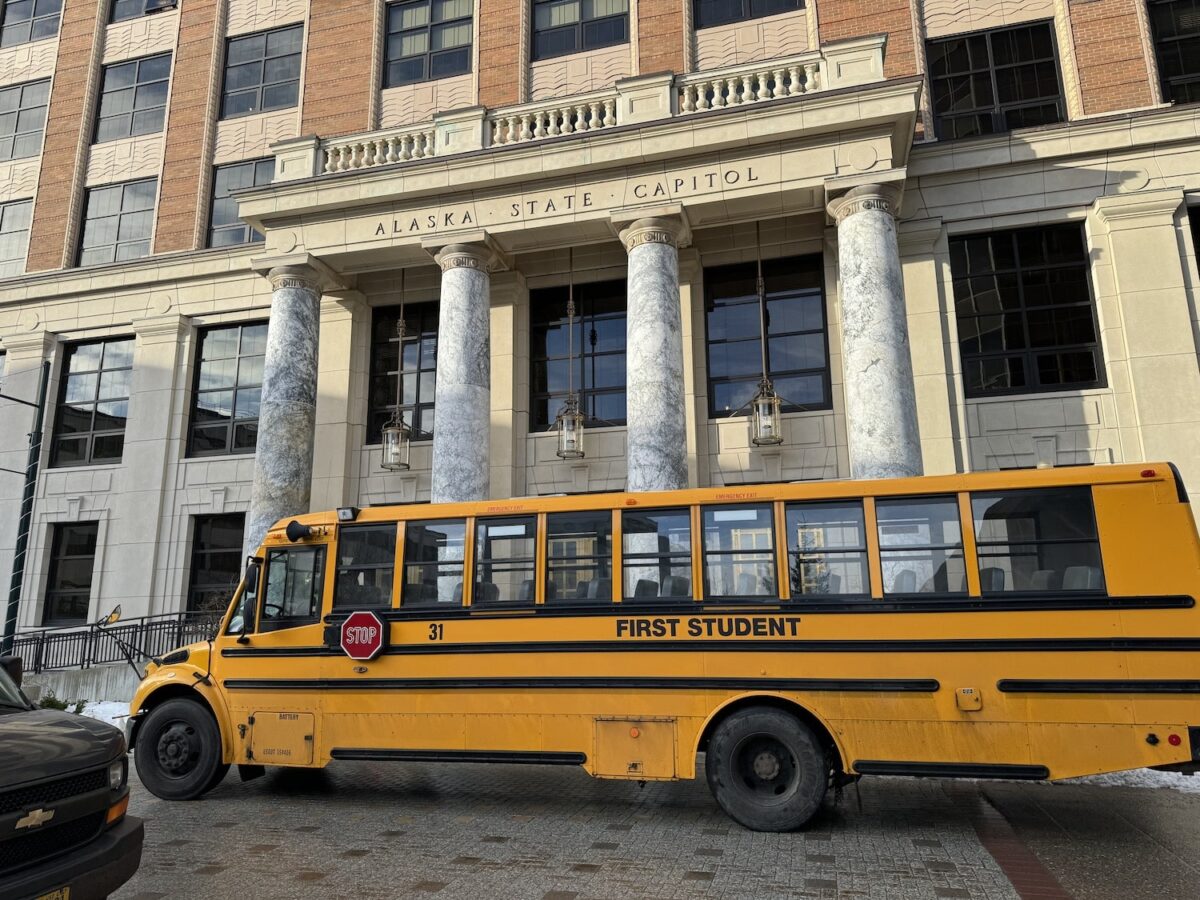
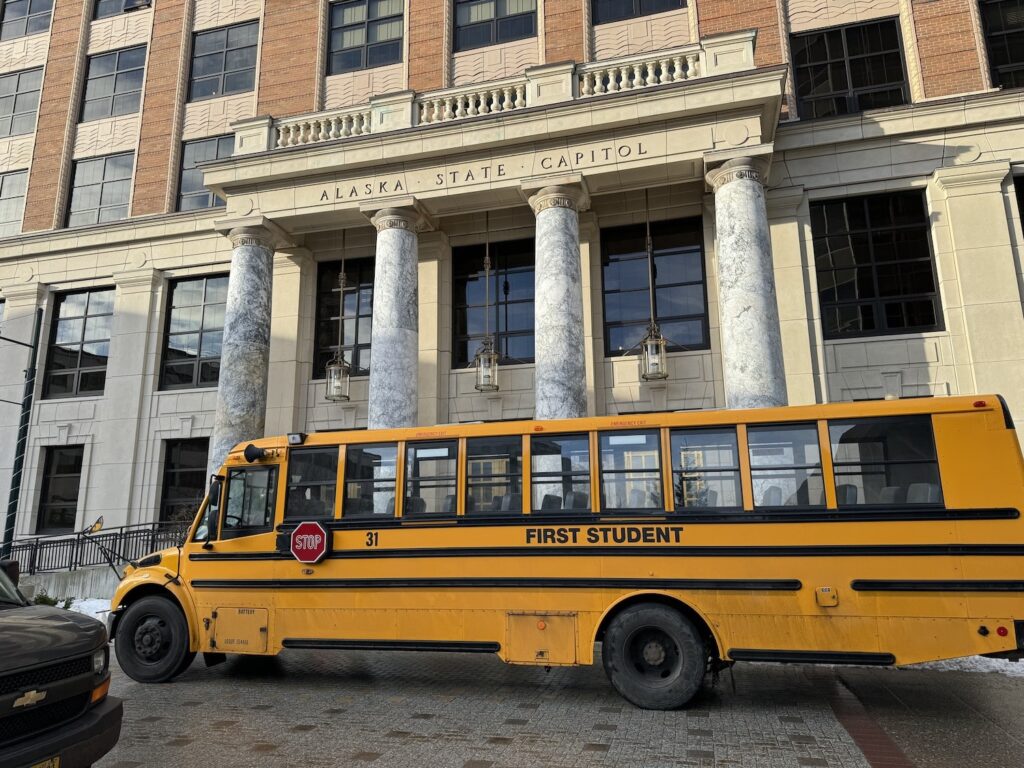
A school bus passes in front of the Alaska Capitol on Tuesday, Feb. 6, 2024. (Photo by James Brooks/Alaska Beacon)
By: Corinne Smith, Alaska Beacon
A school bus passes in front of the Alaska Capitol on Tuesday, Feb. 6, 2024. (Photo by James Brooks/Alaska Beacon)
Officials with the Alaska Department of Education and Early Development have walked back a proposal to limit local governments’ funding for public schools, instead asking the State Board of Education to take no action on the item this week.
The State Board of Education was set to vote this week on a controversial measure that many school officials and education advocates say would bar local municipalities from providing much-needed funding and support services to local schools.
Instead the board voted unanimously on Thursday, at a DEED official’s request, to take no action and return the proposal to the department for further development.
A screenshot of the Alaska State Board of Education during their quarterly meeting, where Education Commissioner Deena Bishop addresses the proposed regulation change to local contributions on Oct. 8, 2025 (Screenshot)
“As a result of the feedback we received, the department will be recommending that the state board take no action on this item, return the proposed regulation to the board or to the department for further collaboration and input with key stakeholders,” said Heather Heineken, the division director for finance and support services for the department, to the board Wednesday, the first day of a two-day meeting.
The proposal came under sharp criticism and public alarm beginning in June, when DEED introduced the measure as an emergency regulation change. Officials said the move was intended to redefine the amount local municipalities provide for schools — called the local contribution — to include “services provided at no charge to a district by the city or borough.”
At the time, DEED officials said it was a way to address the balance of funding for schools ↣— in Alaska’s complex school funding formula which includes local, state and federal funding — and avoid failing a federal disparity test.
The disparity test is required by the U.S. Department of Education to regulate the spread between the highest and lowest funded districts, because of the way the state uses some federal funding, called impact aid. The state failed the test earlier this year, but is in the process of appealing the ruling.
Education Commissioner Deena Bishop, however, reversed that argument and told board members further discussion was needed with districts and financial offices to clarify what “in-kind” contributions are being made and how they were accounted for. She said that was needed to align with state law and standards for equity between districts.
“We’re not reacting to the federal government. What we are (doing) is trying to meet the state statute that calls for that equitable funding,” Bishop told the board on Wednesday.
Public raises alarm at unclear change to local contributions
State board members received more than 600 public comments, mostly opposing the measure, in June and July when the regulation was introduced, calling the proposed change vague and potentially limiting vital municipal funding for schools.
During public comment on Thursday, several district officials expressed opposition and concern.
Valdez School District Superintendent Jason Weber said the change could jeopardize essential city funding, including for transportation and school meals.
“Our Food Service Program is also at a breaking point. Even after raising lunch prices by $1 per meal last year, we’re still operating at a deficit. Every dollar cut from food service funding is $1 taken away from the plates of kids, these regulations would directly reduce the food we can provide for our students, something no community should have to accept,” he said.
“Each Alaskan community has unique needs and challenges the decisions about how to support and operate schools should be made by those who live and work closest to them, not through a one size fits all mandate from the state level, undermining local authority threatens the very foundation of community supported education in Alaska,” Weber said.
Juneau School District Superintendent Frank Hauser pointed to the state’s own appeal of the federal disparity test as evidence the change is unnecessary.
“According to DEED’s July 14 letter, the state would meet the disparity standard, not with a regulation change, which isn’t even mentioned, but by a different accounting method,” Hauser said.
Hauser asked board members to vote the regulation down.
“I am terrified of version 3.0 of this regulation. Each subsequent attempt at this regulation change has had exponentially more negative impacts, impacts beyond what the department realizes, even to REAAS, home school and correspondence students, instead of enacting the oft quoted definition of insanity, doing the same thing over and over and expecting different results, I ask you today to take a different direction and ask the department to stop with this effort altogether,” he said.
During public comment, district officials also raised concerns at a recent DEED Facebook post, which shared a statement over an image of a burning dumpster fire, calling several Anchorage officials’ out by name, saying that their information was “inaccurate” and saying DEED no longer was pushing the proposal. Commenters called the social media post “unprofessional” and not “positive or proactive communication.”
Anchorage officials had penned an op-ed in the Anchorage Daily News, opposing the regulation change, saying it could “gut” the district and strip $15 million in municipal funding, including for school buses and school resource officers.
State board members vote to return proposal to DEED
Before the vote, several state board members questioned whether the proposal should come back to the board.
“I guess I’m questioning now, is it really an issue, or is that needs to be addressed, or does it just need to go away?” asked board member Pamela Dupras on Thursday.
Bishop responded that DEED will gather more feedback, and work with districts to adhere to state law and requirements for equitability. She also pointed to the new Legislative Task Force on Education Funding that may take up the issue and recommend new legislation to define local contributions.
Bishop said DEED would work with district officials and finance departments to further clarify the requirements. “I’m glad that you’re pulling this back,” she said.
She also acknowledged the frustration of districts. “Every two weeks from August until now, I’ve been sharing the same message that, yes, we do not want to put this forward. So I understand the frustration with what was in writing, certainly superintendents that attended all those meetings knew the intent,” she said.
“I think just the stress about school funding, a lot of trust isn’t there,” Bishop added. “The Department wants to earn that trust back and continue with the work.”
An early voting station is set up in the atrium of the State Office Building in Juneau, Alaska on Monday, Aug. 5, 2024, the first day of early voting for the 2024 Alaska primary election. (Photo by James Brooks/Alaska Beacon)
An early voting station is set up in the atrium of the State Office Building in Juneau, Alaska on Monday, Aug. 5, 2024, the first day of early voting for the 2024 Alaska primary election. (Photo by James Brooks/Alaska Beacon)
NOTN- Juneau voters are set to approve two tax-cutting measures according to unofficial results from the City and Borough of Juneau’s municipal election released Friday.
Early results show challenger Nathaniel “Nano” Brooks leading incumbent Wade Bryson 4,652 votes to 4,242 in the city’s only contested Assembly race.
Greg Smith and Ella Adkison, both running unopposed, secured their seats for District 1 and the areawide Assembly positions, respectively.
In the race for the Board of Education, Steve Whitney leads, followed by Melissa Cullum, Jenny Thomas, Jeremy “JJJ” Johnson and Deedie Sorensen.
Speaking Wednesday morning, Weldon said due to high voter turnout, preliminary numbers for Ballot propositions 1 through 3 won’t likely change.
“Ballot Proposition 2, taking the sales tax off food, that’s not going to change. The seasonal sales tax is not going to change. Proposition 1 has a possibility of changing, but is likely going to stay that way.” Weldon Said.
Proposition 1, which would lower the city’s property tax cap from 12 to 9 mills, is ahead with 5,002 votes in favor and 4,807 opposed.
Proposition 2, which exempts food and residential utilities from sales tax, passed by a wide margin 6,842 votes to 2,995 .
Proposition 3, which would have created a seasonal sales tax aimed at shifting more of the burden to tourists, was rejected 5,681 to 4,174.
The updated totals include all ballots received and verified through Thursday. Additional mail-in ballots postmarked by Election Day are still being processed, with final certification expected on Oct. 21.
“We’ll just evaluate and figure out where we can fill the hole with cutting services a bit and other things, the biggest hit to the budget was taking sales tax off food without filling that hole. So that’s, you know, somewhere around $8 million.” Weldon said, “It’s easy to cut $8 million one time, but it’s a little more difficult to cut it year after year after year. But we’ll just go back to work and our finance means will be pretty interesting.” She said.
In a complaint filed Friday and a motion for summaryjudgment on Monday, the Legislature’s contracted attorney asks a Juneau Superior Court judge to decide whether or not a governor may issue an executive order during a special legislative session.
The lawsuit had been expected for months.
In August, Dunleavy issued an order seeking to create an Alaska Department of Agriculture, shortly before lawmakers convened for a special session called by the governor. Speaker of the House Bryce Edgmon, I-Dillingham, and Senate President Gary Stevens, R-Kodiak, rejected the validity of the order.
Representatives for the governor’s office said they believed the order was valid and that it would take effect unless lawmakers voted it down.
The leaders of the House and Senate said they did not want to take up the order, because doing so risked setting a precedent, effectively declaring that executive orders could be issued during a special session.
The question that could be decided in court is whether issuing an order in a special session is legal. And does it matter if the order is identical to one that’s already been issued and voted upon?
Alaska is one of two states without a cabinet-level Department of Agriculture, and creating one is seen as a key first step for boosting food production in Alaska.
“The parties require the court’s prompt assistance to resolve this legal dispute before January 1, 2026,” wrote attorney Kevin Cuddy. “Otherwise, there is a risk that the state will move forward with a Department of Agriculture that may have been unconstitutionally created, and thus without legal authority to act.”
The Alaska Department of Law, which will represent the governor in the case, has been served with the lawsuit but has not yet filed its reply.
Patty Sullivan, a spokeswoman for the Department of Law, said by email, “We are working on a briefing schedule with the counsel for the Legislature and the court. Our goal is to expedite the case and ensure that a decision is made before the legislative session begins.”
Alaska’s constitution forbids lawsuits by the executive branch against the legislative branch; the inverse is not true. Lawmakers have now sued Dunleavy four times since he took office in 2018.
Alaska pollock, shown here from a harvest, make up the nation’s top-volume single-species commercial seafood catch. Alaska pollock, harvested mostly in the Bering Sea but also in the Gulf of Alaska, are processed into fish sticks, fish burgers, imitation crab meat and other common fish products. (Photo provided by NOAA)
For the organization that oversees commercial fisheries in federal waters off Alaska, the most significant impact of the federal government shutdown might materialize in December.
That is when the North Pacific Fishery Management Council is scheduled to issue harvest limits for Alaska pollock – the nation’s top-volume commercial harvested species – and other types of groundfish harvested in the Bering Sea and Gulf of Alaska, such as Pacific cod and sablefish.
The Bering Sea and Gulf of Alaska pollock harvests start in January.
To set the groundfish harvest levels, the council relies on federal scientists’ analysis of fish stocks in the ocean, work that is based in large part on scientific surveys conducted over the summer.
But during the shutdown, most National Marine Fisheries Service employees, including the scientists who analyze survey data to assess the conditions of commercially targeted fish stocks, are furloughed.
On Wednesday, the last day of the council’s October meeting, the members considered how to deal with scientific uncertainty if the government shutdown prevents completion of the detailed analysis that is usually provided in time for the December meeting.
Council member Nicole Kimball referred to a warning issued eight days prior by Bob Foy, director of the NMFS Alaska Fisheries Science Center, the organization that does the stock assessments. Foy said then that a shutdown lasting more than five days would compromise the ability to complete stock assessments and that a shutdown beyond 15 working days would “dramatically impact” those assessments.
The 15-day threshold is not too far away, Kimball said.
“How does the council and the public understand what to expect in December, in between the October and December meeting, relative to stock assessments?” she asked.
Diana Evans, the council’s deputy director, said impacts are yet to be determined, but the public will be notified of them as soon as possible.
“We don’t think we can answer that until we have a better sense of exactly where we land and how many days of work are remaining between the time that government workers are back and able to resume that work and the meeting,” she said.
Advocates with environmental organizations said they worry about shutdown effects on scientific information needed for harvest decisions, which would add to the effects of mass firings and retirements at NMFS and other agencies.
“I’m terrified at the prospect of flying blind into the next fishing season, especially as the Trump administration has decimated the ranks of scientists who monitor the health of our oceans,” Cooper Freeman, Alaska director of the Center for Biological DIversity, said by email. “I’m especially worried about fisheries like the massive pollock trawl fleet that has been harvesting millions of tons annually at the expense of the larger ecosystem.”
“The first challenge with this shutdown is the instant level of uncertainty it creates. Normal processes face delays that can easily impact or inhibit active fisheries. Potential staff losses will exacerbate that,” Michelle Stratton, executive director of the Alaska Marine Conservation Council, said by email.
“But beyond the concern for continuing day to day services, are those major efforts — like stock assessments and (total allowable catch) setting — that rely on substantial NMFS staff input, data processing and expert analysis. If this continues to the point where we are unable to set catch limits for the start of the 2026 seasons, we’ll be in seriously uncharted territory, and could well see massive economic impacts to our fishing communities and fleets,” she said.
The shutdown forced the council to rearrange its October meeting because federal representatives were unavailable to present information.
One major agenda item was postponed: review of a work plan for assessing essential fish habitat. Other items on the agenda were abbreviated.
The shutdown has already affected fishery management operations to some degree, said council member Jon Kurland. As Alaska regional director for NMFS, Kurland is one of a small group of agency employees remaining at work during the shutdown.
Kurland, in comments last week at the start of the meeting, said some services have been unavailable during the shutdown, such as the processing of harvest quota transfers.
NMFS is still doing basic management of ongoing fisheries, monitoring and closing them as needed, and is supported by contractors, he said. But that level of work has its limits, he said.
“If there are significant unforeseen problems, we will have limited ability to address those. Fingers crossed,” he said then.
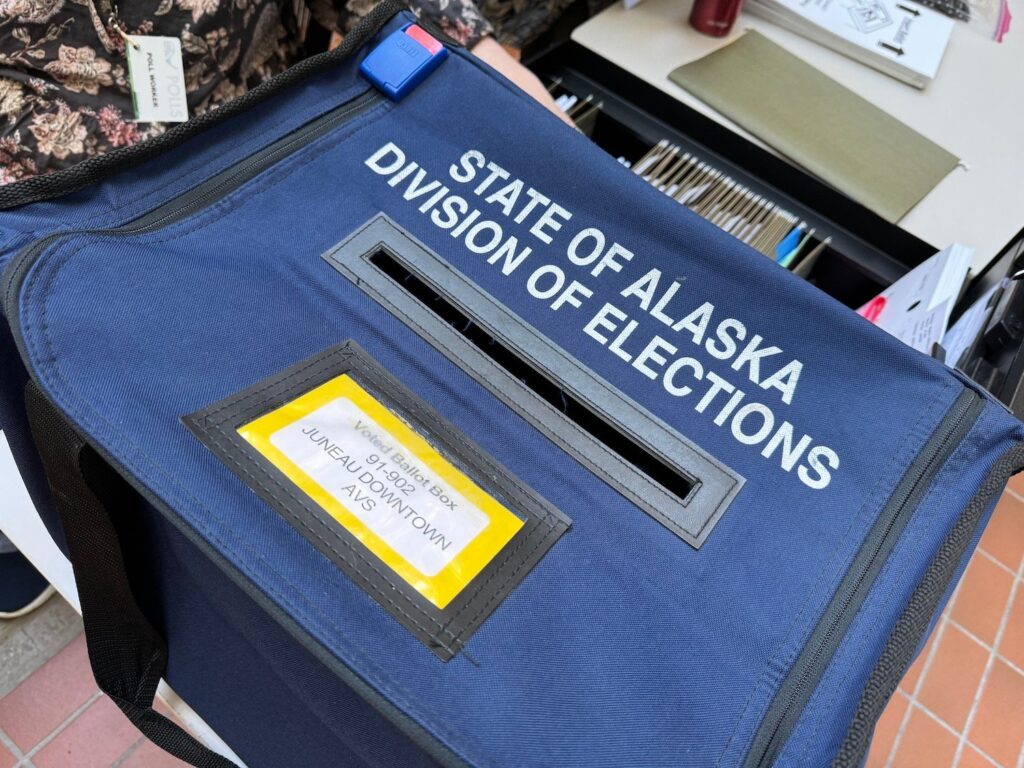
Election materials are seen at the Alaska Division of Elections headquarters in Juneau. (Photo by James Brooks/Alaska Beacon)
NOTN- Juneau Mayor Beth Weldon says city officials are already preparing for possible spending cuts following Tuesday’s municipal election, where early results show voters favoring two tax-limiting propositions that could significantly reduce city revenue and potentially the cost of living for residents.
“If you’re looking at our website to see the election results, just hit the tab the button that says election, and then you’ll see preliminary results.” Said Weldon, “Up at the top it says 21% Well, that’s 21% of our registered voters. So typically we end up with somewhere between 9 to 10%, this is a little bit of a bigger ballot, so we might get as much as 12,000 votes. So it’s not 21% of the vote. I would say it’s somewhere between 40 to 50%.”
Speaking Wednesday morning, Weldon said due to high voter turnout, preliminary numbers for Ballot propositions 1 through 3 won’t likely change.
“Ballot Proposition 2, taking the sales tax off food, that’s not going to change. The seasonal sales tax is not going to change. Proposition 1 has a possibility of changing, but is likely going to stay that way.” Weldon Said.
She noted that while full election results won’t be certified until mid-October, most races appear decided. Only the tight Assembly District 2 race between incumbent Wade Bryson and challenger Nathaniel “Nano” Brooks, separated by three votes in preliminary results on Wednesday remains too close to call.
Weldon said the city had anticipated either outcome and began planning for both scenarios before the election. “We’ll just evaluate and figure out where we can fill the hole with cutting services a bit and other things, the biggest hit to the budget was taking sales tax off food without filling that hole. So that’s, you know, somewhere around $8 million.” Weldon said, “It’s easy to cut $8 million one time, but it’s a little more difficult to cut it year after year after year. But we’ll just go back to work and our finance means will be pretty interesting.”She said.
The City and Borough of Juneau’s next update on unofficial election results is expected Friday. Certification is scheduled later this month.
U.S. Sen. Dan Sullivan, R-Alaska, speaks to the Alaska Legislature on Thursday, March 20, 2025. (Photo by James Brooks/Alaska Beacon)
The FBI searched the cellphone records of Republican Alaska Sen. Dan Sullivan and seven other U.S. senators and a member of the U.S. House as part of its investigation into the Jan. 6, 2021 insurrection at the U.S. Capitol, a newly released document shows.
The call logs cover several days during and around the insurrection, when rioters stormed the Capitol in an attempt to support then-incumbent President Donald Trump, who falsely claimed to have won reelection in 2020.
The logs do not show that the FBI obtained phone call recordings, only that an investigating agent was interested in who the senators were talking to, when they talked, how long they talked, and where the callers were. The document, released this week by the U.S. Senate Judiciary Committee, does not say why those senators were identified in particular and it does not say whether any investigative leads resulted from the records.
According to a news release from the committee, the FBI sought and obtained data about the senators’ phone use in the days before, on and after the Jan. 6 insurrection, from Jan. 4 through Jan. 7, 2021.
The U.S. Department of Justice indicted Trump in 2023 for allegedly conspiring to overturn the results of the 2020 presidential election, but the special prosecutor in charge of the investigation abandoned that case after Trump was re-elected in 2024. Department policy says that sitting presidents cannot face criminal prosecution, and after the 2021 insurrection, the U.S. Supreme Court issued a decision limiting a president’s liability for conduct while in office.
Asked whether Sullivan had any contact with people who participated in or organized the riot at the U.S. Capitol, Devyn Shea, a spokesperson for Sullivan, said, “absolutely not.”
In a written statement, Sullivan called the FBI investigation “an absolute outrage.”
“We’ve just learned the Biden FBI was engaged in what appears to be an unprecedented fishing expedition against at least nine sitting Republican members of Congress — none of whom were under any type of investigation — surveilling our personal cell phone calls with family members, staff and colleagues. This is a new low in the political weaponization of the Justice Department,” Sullivan’s statement said.
The other seven senators were Cynthia Lummis (R-Wyo.), Lindsey Graham (R-S.C.), Josh Hawley (R-Mo.), Tommy Tuberville (R-Ala.), Ron Johnson (R-Wis.), Marsha Blackburn (R-Tenn.), and Bill Hagerty (R-Tenn.). Rep. Mike Kelly (R-Pa.) was also on the FBI list.
Some senators, including Hawley and Tuberville, voted to object to the certification of the electoral results of the 2020 election.
Sullivan voted to support the certification of the election, and in a statement the day after the Jan. 6 violence at the Capitol, he called the event “sad” and “dispiriting.”
All have been supporters of Trump and his policies; in office, Sullivan has been a reliable vote for the president and his agenda.
(AP) — President Donald Trump said Monday that he’d be open to striking a deal with Democrats on the health care subsidies they’ve made central to the shutdown fight, cracking the door slightly to negotiations that Republicans have said should only happen after the government reopens.
But Trump also said “billions and billions” are being wasted, nodding to arguments from conservatives who do not want the health subsidies extended to lessen the cost of plans offered under the Affordable Care Act, commonly referred to as Obamacare.
“We have a negotiation going on right now with the Democrats that could lead to very good things,” Trump said. “And I’m talking about good things with regard to health care.”
Trump’s comments were one of the few hopeful signs Monday as the government shutdown hit its sixth day. Negotiations between the two parties have been virtually nonexistent since the start of the shutdown despite the impact on federal services. Democrats have urged that Trump get involved, saying no deal will be possible without the president’s approval.
The two Democratic leaders in Congress, Sen. Chuck Schumer and Rep. Hakeem Jeffries, both denied there are any negotiations with Trump. Jeffries said the White House “has gone radio silent” since a meeting in the Oval Office last week.
“Trump’s claim isn’t true, but if he’s finally ready to work with Democrats, we’ll be at the table,” Schumer said.
Senate Majority Leader John Thune told reporters “there may be a path forward” on ACA subsidies, but stressed, “I think a lot of it would come down to where the White House lands on that.”
More doomed Senate votes
The president’s comments came shortly before the Senate took another doomed pair of votes Monday on funding the federal government. Neither the Republican measure nor the Democratic proposal came close to gaining the 60 votes needed to advance.
Both parties used much of the day to ramp up the pressure on the other to end the impasse.
Thune said a critical food aid program for women, infants and children was starting to run low on funds, blaming Democrats and saying “now it’s the American people who are suffering the consequences.”
Schumer said his side was ready to work with Republicans to “reopen the government and end the health care crisis that faces tens of millions of Americans.”
“But it takes two sides to have a negotiation,” Schumer said.
Earlier in the day, the two sides dug in. House Speaker Mike Johnson said “there’s nothing for us to negotiate” while Jeffries declared the “time is now” to work out a deal on health care.
Johnson, R-La., told reporters they could stop asking why he wasn’t negotiating an end to the impasse. It was up to a handful of Democrats to “stop the madness” and pass a stopgap spending bill that had earlier passed the House, he said.
“We did the job to keep the government open, and now it’s on the Senate Democrats,” Johnson said.
The House is not expected to be in session this week, focusing attention on the Senate to take the lead on any deal in the Republican-led Congress. Yet even with House lawmakers away, the Republican and Democratic leaders have been holding almost daily briefings as they frame their arguments and seek to shift blame for the shutdown.
Democrats are insisting on renewing subsidies to cover health insurance costs for millions of households, but Republicans have insisted that can be dealt with later. They say the subsidies are a separate debate than the one on keeping the government funded for a few weeks while the two sides work out their differences on a full-year spending package.
While some Democratic senators said they viewed Trump’s comments about the status of negotiations as positive, there was also skepticism from members on both sides of the political aisle about whether they represented much of a breakthrough.
“The discussion can’t happen until we reopen the government. The Democrats want to have these talks. The president has just signaled he wants to talk, but reopen the government,” said Sen. Markwayne Mullin, R-Okla.
“I have a hard time taking it seriously,” said Sen Richard Blumenthal, D-Conn. “Because Johnson and Thune as well as Trump are all saying ‘we won’t talk until you open up the government.’”
Turmoil for the economy
The stalemate comes at a moment of troubling economic uncertainty. While the U.S. economy has continued to grow this year, hiring has slowed and inflation remains elevated as the Republican president’s import taxes have created a series of disruptions for businesses and hurt confidence in his leadership. At the same time, there is a recognition that the nearly $2 trillion annual budget deficit is financially unsustainable.
Trump had seemingly suggested Sunday night that layoffs were already taking place, but White House press secretary Karoline Leavitt said Trump was talking about furloughs. Under a furlough, workers cannot report to work, but they will return to their job and get paid retroactively after the shutdown ends. She said layoffs were still planned if the shutdown continues.
The talk of layoffs has escalated an already tense situation in which Washington lawmakers have struggled to find common ground and build mutual trust. Leaders in both parties are betting that public sentiment has swung their way, putting pressure on the other side to cave.
“I voted” stickers are seen on display in the headquarters offices of the Alaska Division of Elections in Juneau on Tuesday, Nov. 12, 2024. (Photo by James Brooks/Alaska Beacon)
Election day is around the corner for most of Alaska’s local governments, and many communities are considering whether to raise local sales taxes to pay for the escalating cost of public services, including basic infrastructure like road repairs and landfills.
Alaska’s largest city, Anchorage, holds its elections in the spring, as do Valdez and Cordova, but most of the state’s 150-plus municipal governments will have their elections in the next week.
In the state capital, Juneau, where voting has been underway by mail since late September, voters are considering three ballot measures with major implications for the City and Borough of Juneau budget.
Measure No. 1 would tighten the cap on local property taxes below current rates, effectively cutting city revenue by about $1 million and eliminating the city’s ability to raise rates.
The second measure would exempt food and residential utilities from local sales taxes. That would eliminate between $10 million and $12 million per year from the city budget.
To compensate, there’s also Measure No. 3, which would raise the city’s sales tax from 5% to 7.5% in the summer and lower it to 3% in the winter. If that measure passes, it would roughly balance the lost money if Measure No. 2 passes.
If ballot measure No. 3 doesn’t pass, Juneau city officials expect to significantly cut local services in order to balance the budget.
Juneau is one of several communities deciding whether to pass sales tax hikes this month.
In Skagway, voters are considering a seasonal sales tax increase from 5% to 7% in the summer, with some of the proceeds earmarked for water, wastewater and garbage services in order to lower local rates.
In neighboring Haines, voters are deciding whether to raise the local sales tax from 5.5% to 7% in the summer within the Haines townsite, with a smaller increase in the rest of the borough. The sales tax would fall to 4.5% in the townsite during the winter, 3% in the rest of the borough, and groceries would be exempted.
In Ketchikan, borough residents are being asked whether they want to extend part of the local sales tax through 2032. The borough has a 2.5% sales tax, but half of a percent is dedicated to construction and renovation projects at local schools. That’s what voters will consider renewing.
Slightly north, in Petersburg, voters will decide whether to reduce a senior citizen sales tax exemption so it applies only to low-income residents.
Ketchikan city voters consider seven ballot measures
While voters in the Ketchikan borough contemplate a sales tax measure, voters within the city of Ketchikan itself will also have seven other ballot propositions to consider.
First is a $15 million bond to pay for sewer mains and upgrades to the city’s water treatment facility. Those upgrades are being mandated by the state and federal governments.
Voters in the First City also will decide six different amendments to the city charter. Proposition No. 2 would eliminate a 30-day waiting period for city ordinances to take effect. No. 3 would allow the city manager to live outside city limits, but only on the road system of Revillagigedo Island, where the city is located.
Proposition No. 4 would remove the requirement that voters approve the sale of any city property worth more than $30,000. Instead, the city council would have the authority to approve those sales.
The fifth proposition would allow the city to award large contracts to someone other than the lowest bidder, and the sixth would allow the city to approve sales or contracts with city employees and elected officials as long as there are at least three cost quotes and the chosen contract is “the most advantageous to the city.”
The last proposition, the seventh, would allow the city’s annual fiscal audit to take more than four months.
In addition to those ballot measures, three candidates are running for two seats on the Ketchikan City Council. There’s also a two-way race for borough mayor, two contested borough assembly races and two contested school board races.
Voters in Sitka will consider two ballot measures. The first would allow the city to use proceeds from the local tobacco tax and the sale of the local hospital for parks and recreation.
The second, if adopted, would require all ballot measures to include a comprehensive economic impact study report before reaching the signature-gathering phase.
Six people are running for two seats on the Borough Assembly in Sitka, and there are three candidates for two seats on the local school board.
In Petersburg, two candidates are running for mayor and five candidates are running for two seats on the borough assembly. There is one candidate and two open seats for the school board.
In Skagway, the one candidate for mayor is running uncontested, after the previous mayor resigned earlier this year. There are four candidates for two assembly seats, and one candidate for two open school board seats. In Haines, there are four candidates for two assembly seats, and two candidates for two school board seats.
North Slope voters contemplate big borrowing plan
In the North Slope Borough, two of four assembly races are contested, and only one of four school board races is contested. Borough voters also will consider eight different bond proposals. That’s more ballot propositions than any other municipal election taking place this month in Alaska.
The borough is proposing to borrow a combined $204 million for public facilities, including light, power, water, sewage, public safety, education and flood control.
At Utqiagvik, the borough’s largest town and the northernmost town in the United States, voters will choose between two candidates for mayor. There’s also two city council races, only one of which is contested.
Voters also are being asked to choose whether or not to extend Utqiagvik’s 20% wholesale tobacco tax to cover “alternative nicotine products and equipment,” such as vape and e-cigarette products.
Within the Northwest Arctic Borough, there are four borough assembly seats on this year’s ballot. Only one race is contested, and one seat — covering Ambler, Kobuk and Shungnak — has no candidates at all.
Similarly, among three races for school board, none are contested and one of the three seats has no candidates.
In the Kotzebue city election, two seats on the city council are on the ballot, and each race has two candidates. Another seat was vacated by the resignation of Ruth Moto in September, and someone will be appointed to fill that seat after the election, with the replacement being up for election in October 2026.
The Nome Nugget noted “meager interest to run for public office” in Nome this year, with two city council seats and two school board seats unopposed, but voters there will also be asked whether to raise the city’s sales tax from 5% to 6%.
This week, the Nugget reported that if the tax increase doesn’t pass, city officials will cut services.
In the Matanuska-Susitna Borough, Houston considers sales tax hike
The Matanuska-Susitna Borough holds its elections in November (as does Metlakatla in Southeast), but the cities within the Mat-Su borough vote in October.
Wasilla has no ballot measures; its city election includes three city council races, only one of which is contested.
In Palmer, five people are competing to become the city mayor, the most competitive single municipal race this fall. Three people are competing for two three-year seats on the city council. There also is a one-year seat on the council, and two people are vying for it.
Palmer voters are also being asked if they want to change the city charter so the city manager is no longer required to live within the city. The change would allow the manager to live within five miles of city limits.
Within Houston, six people are running for three spots on the city council. Houston also has four ballot measures. One asks whether voters support a city-owned airport. A second asks voters to approve a 2% sales tax increase (from 2% to 4%) in order to pay for road repairs. The third and fourth measures ask voters to approve the “Matanuska Thunder Festival” and “Founder’s Day” as city holidays.
Many ballot measures in the Kenai Peninsula Borough
Proposition No. 2 would create a special taxing district in Ninilchik to fund a new local swimming pool there. No. 3, if approved, would increase the property tax exemption in the borough so the first $75,000 of a homeowner’s residence would be exempted from local property taxes. The current exemption applies to the first $50,000.
The fourth proposition would raise the borough’s sales tax cap every five years. Currently, sales taxes only apply to the first $500 of a purchase.
Proposition No. 5 would shift borough elections to November, aligning them with state and federal elections, much as the Mat-Su borough has done.
Five seats on the Kenai borough assembly are up for election, and three of the races are contested. Three school board seats are on the ballot as well, with two races contested.
Among city elections on the Kenai Peninsula, only Soldotna has a ballot measure. That proposition asks voters to approve or reject the annexation of 2.63 square miles of nearby land into the city limits.
In the Interior, none of Fairbanks’ three local governments have ballot measures this year, but this year’s ballot will decide three seats on the borough assembly and two on the borough school board. There’s a two-person race to become Mayor of Fairbanks, and two seats on the city council are up for election.
Southeast of Fairbanks, in North Pole, four seats on the city council are up for election. There are only four candidates, but the order of the candidates will determine who gets a three-year term, a two-year term or a one-year term.
Kodiak will pick a new mayor
In Kodiak, voters will pick between two candidates for borough mayor, five candidates for two seats on the borough assembly, and they will vote on a variety of service area boards.
Within city limits on Kodiak, four people are running to replace longtime Mayor Pat Branson, and four candidates are running for two seats on the city council.
In southwest Alaska, Bethel has four open city council seats but only three registered candidates and one write-in candidate.
In Unalaska, Mayor Vince Tutiakoff Sr. is running unopposed for re-election, and three people are running for one of the two city council seats on the ballot. The other incumbent for city council is unopposed. On the local school board, three people are running for one of two school board seats; the other seat is held by the incumbent school board president, who is unopposed in his re-election bid.
Within the Aleutians East Borough, which includes Sand Point, King Cove and Cold Bay, two of three borough assembly seats have unopposed races, and the third has two candidates. All three school board seats on the ballot have candidates running unopposed.
Further north in Dillingham, two city council seats have two candidates apiece, and three people are running unopposed for three school board seats.
Within the Bristol Bay Borough, based in Naknek, three people are running for two seats on the borough assembly, and there are five candidates for the two school board seats on the ballot.
In the Lake and Peninsula Borough, two borough assembly members and two school board members are running unopposed. Those elections, like those in Juneau, are conducted by mail, and ballots must be postmarked by Oct. 7 and received by the borough clerk before Nov. 7.
Anchorage Mayor Dave Bronson speaks in May 2022 at the Alaska Sustainable Energy Conference. (Photo by Yereth Rosen/Alaska Beacon)
Former Anchorage Mayor Dave Bronson said Thursday in Fairbanks that he intends to run for governor in 2026, becoming the 13th candidate and 12th Republican in next year’s race.
Incumbent Gov. Mike Dunleavy is term-limited and unable to run again, which has caused an unusually large number of early entries into the governor’s race.
Only one Democratic candidate, former Anchorage state Sen. Tom Begich, has entered the race. Other Democrats say they are awaiting the possible run by former Democratic U.S. Rep. Mary Peltola, who had the highest favorability rating among top candidates, according to one poll this summer.
Republicans face no such obstacle. In addition to Bronson, the Republican field of candidates includes former state Sen. Click Bishop of Fairbanks; Lt. Gov. Nancy Dahlstrom of Eagle River; Anchorage businesswoman Bernadette Wilson; podiatrist Matt Heilala of Anchorage; Matanuska-Susitna Borough Mayor Edna DeVries; former teacher James William Parkin IV of Angoon; current state Sen. Shelley Hughes of Palmer; Bruce Walden of Palmer; former Alaska Revenue Commissioner Adam Crum; and former Alaska Attorney General Treg Taylor.
All of those candidates have filed letters of intent or statements of candidacy with the Alaska Public Offices Commission, which allows them to fundraise and spend money on a campaign.
They have not yet registered with the Alaska Division of Elections, which officially places a candidate on the August primary ballot.
Republican Henry Kroll of Soldotna, who has not registered with the Public Offices Commission, is the lone candidate to have registered with the Division of Elections.
The deadline to file with the Alaska Division of Elections is June 1, 2026.
In Alaska, the top four vote-getters for a state office, regardless of political party, advance from the August general election to the November general election.
Wilson has vowed to withdraw from the election if she finishes in the top four but isn’t the top Republican. She has encouraged other Republicans to take similar vows in an attempt to consolidate support for the top Republican front-runner in the general election.
Bronson, who delivered brief remarks in Fairbanks before participating in a panel discussion with six other Republican candidates, said he supports increased spending on infrastructure and the Permanent Fund dividend, saying he would like to see a constitutional amendment that would mandate a dividend paid according to a formula that was used from 1982 through 2016.
That would require spending an additional $2 billion per year for dividend payments above what lawmakers and Dunleavy approved this year. As a whole, the state’s operating budget is currently $5.9 billion. Bronson did not explain how he intends to pay for the increase.
An experienced pilot, Bronson was elected mayor of Anchorage in 2021, months after the incumbent Democratic mayor resigned during a sex scandal and amid a conservative backlash against COVID-19 mitigation efforts imposed by the Anchorage assembly.
He served a single term and was endorsed for re-election by Dunleavy and U.S. Sen. Dan Sullivan but lost in 2024 to current Mayor Suzanne LaFrance.
Bronson’s time in office was marked by major conflicts with city employees, public health officials and the assembly. In 2023, the city manager Bronson appointed and fired, sued him and the city, alleging illegal and unethical acts. The assembly settled that case in 2024 for $250,000 after Bronson left office.
In January, Dunleavy appointed Bronson to manage Ted Stevens Anchorage International Airport. After less than eight months, he announced his resignation from that job in August.