NOTN- Power has been restored to Juneau after a citywide outage this afternoon that left much of the city in the dark for roughly an hour.
Alaska Electric Light & Power (AEL&P) reported just that the outage appeared to be impacting all areas of town, with crews immediately responding. AEL&P later confirmed that the disruption occurred on its transmission system.
“We have identified that the outage occurred on our transmission system and are currently flying and patrolling the line,” AEL&P said in an update on social media. “In the meantime we are restoring power with backup generation while we continue to investigate the cause.”
AEL&P announced later in a social media post that power had been restored across Juneau.
AEL&P added that short-term use of backup generation does not affect customers’ bills and that it has been years since the company needed to rely on extended backup power.
AEL&P said it would release further information as the investigation continues.
U.S. Coast Guard MH-60 Jayhawk helicopter aircrews conduct overflights of Kipnuk, Alaska, after coastal flooding impacted several western Alaska communities, Oct. 12, 2025. (U.S. Coast Guard photo courtesy of Air Station Kodiak)
Search and rescue efforts continued into Monday in the Kuskokwim River delta in the aftermath of devastating storm surge and hurricane-force winds brought by the remnants of Typhoon Halong. The storm tore homes from their foundations and sent them floating away.
One woman was found dead in Kwigillingok on Monday, according to Alaska State Troopers.
U.S. Coast Guard MH-60 Jayhawk helicopter aircrews conduct overflights of Kipnuk, Alaska, after coastal flooding impacted several western Alaska communities, Oct. 12, 2025. (U.S. Coast Guard photo courtesy of Air Station Kodiak)
The search for two more people unaccounted for in that community will continue, by boat and air, the state troopers said on a Facebook post. Search and rescue is being conducted by the U.S. Coast Guard, Alaska Army National Guard and Alaska Air National Guard, as well as state troopers.
The storm damaged boats, roads, airports, and power and sewer infrastructure over a vast region, and damage assessments were not immediately available as emergency rescue efforts entered a second day.
“We’re moving quickly. We’re moving as fast as we can,” said Gov. Mike Dunleavy at a news conference in Anchorage on Monday with state officials and the congressional delegation.
Fifty-one people and two dogs were rescued in Kwigillingok and Kipnuk on Sunday, Troopers said, located on the Bering Sea coast. Those predominantly Alaska Native coastal communities saw the most severe impacts of the storm, with a storm surge of up to 6.6 feet above normal and high winds that inundated communities.
“Preservation of life is our top priority,” said Capt. Christopher Culpepper, commander of U.S. Coast Guard Sector Western Alaska and U.S. Arctic.
“Several of these villages have been completely devastated,” Culpepper said. “Absolutely flooded, several feet deep, and so this took homes off of foundations. This put people in peril, where folks were swimming, floating, trying to find debris to hold on to in the cover of darkness, at nighttime.”
U.S. Coast Guard Sector Western Alaska and U.S. Arctic Commanding Officer Captain Christopher Culpepper speaks at an Oct. 13, 2025, news conference about rescue work and the response to Typhoon Halong damages in Western Alaska. Behind him and also participating in the news conference held in Gov. Mike Dunleavy’s Anchorage office, is David Kramer, a meterologist with the National Weather Service. (Photo by Yereth Rosen/Alaska Beacon)
“And so as the sun broke on the first day, devastation became more and more apparent,” Culpepper said, referring to Sunday as the storm lifted. “Coast Guard helicopter crews, along with Army National Guard and Air National crews, particularly two pairs of rescue jumpers that also assisted … picked people up off their homes,” he said, and were taken to higher ground. Several people were medically evacuated to Bethel.
Some people trapped in floating homes early Sunday used their cellphones to call for help. Some of those calls reached the State Emergency Operations Center, said incident commander Mark Roberts.
“The folks that were in houses that were floating and didn’t know where they were, was one of the most tragic things our folks in the state EOC have ever faced,” Roberts said. “And some of them called into the state EOC, and we just stayed on the phone with them to talk.”
Members of the Alaska National Guard and Alaska State Defense Forces living in western Alaska, up to 80 personnel, have been activated, said Maj. Gen. Torrence Saxe, commissioner of the Alaska Department of Military and Veterans Affairs, which oversees the Alaska National Guard.
“This may end up being the largest off-the-road-system response for the National Guard in about 45 years,” Saxe said.
Over 50 airports were impacted by the storm but largely cleared as of Monday to allow planes to land with emergency supplies and personnel. The coastal communities throughout the region are only accessible by small plane or boat. “There also have been numerous reports to us of roadway damage, boardwalk damage – boardwalks are the roads in this region – and then also the various power outages and lighting problems throughout the region,” said Ryan Anderson, commissioner of the Alaska Department of Transportation.
More than 1,000 people were displaced from their homes across the region, according to estimates from the Yukon-Kuskokwim Health Corporation, the region’s largest healthcare provider.
Roughly 400 people are sheltering in the local school in Kwigillingok, and 680 people in Kipnuk are at the school there, they said. Thirty seven homes in Kwigillingok were destroyed.
Emergency supplies, including water, food, hygiene products, baby formula and bedding are being flown into coastal communities, according to a statement on Monday by YKHC. “The need is great,” they said. The response effort is coordinated between YKHC, Alaska Native Tribal Health Consortium (ANTHC), the Association of Village Council Presidents and the state of Alaska, to assess and respond to community needs.
Medical providers and prescription medications were being sent to Kwigillingok, Kipnuk, Tuntutuliak and Chefornak, they said, and plans were underway to evacuate about 40 people, including elders and pregnant women, to Bethel.
Alaska State Sen. Lyman Hoffman, D-Bethel, said over 1,000 emergency meals had been delivered already to coastal villages, but those supplies would run out.
State Sen. Lyman Hoffman, D-Bethel, speaks at an Oct. 13, 2015, news conference about the impacts of Typhoon Halong’s to Western Alaska. Behind him and also speaking at the news conference, which was held at Gov. Mike Dunleavy’s Anchorage office, are National Weather Service meteorologist David Kreamer, U.S. Coast Guard Sector Western Alaska and U.S. Arctic Commanding Officer Captain Christopher Culpepper and Ryan Anderson, commissioner of the Alaska Department of Transportation and Public Facilities. (Photo by Yereth Rosen/Alaska Beacon)
“They need additional food supplies, and it’s difficult to get people out there,” he said.
He said Kipnuk’s runway was still damaged, and planes could not land there. Power is still out there as well. “There has to be a short-term assessment done of those homes that are out there, whether they are livable or not livable … and needs to be made as quickly as possible,” Hoffman said. “Winter is coming.”
The state of Alaska has activated a multi-agency emergency response, and with the governor’s extended disaster relief declaration, residents and communities are eligible for recovery assistance, including temporary housing assistance.
“We’ve had a few injuries; we’re moving into a higher-level care as needed, and then we’re moving right on in to support sheltering, and then right on into the next to support the ability for people to live in a safe, warm place through the winter,” Roberts said.
U.S. Sen. Dan Sullivan, R-Alaska, said he was communicating with officials with the Federal Emergency Management Agency, who would provide assistance.
“FEMA right now is in direct contact with our state and local officials and has an incident management team on the ground and a FEMA search and rescue group pre-positioned on standby,” Sullivan said. “As we move into the recovery phase – and we’re not there yet – the federal agencies need to act very quickly. We’re going to be seeing freeze-up and very cold weather, probably quite soon. So they have committed to being very ready to move into that phase of operations once we get there.”
Sen. Lisa Murkowski, R-Alaska, underscored the trauma residents are experiencing from this disaster. “When the waters subside, when the analysis is complete — we have many, many families (and) we have communities that are in trauma, that will be in shock over the loss and so, making sure that we have trauma specialists, if you will, that are culturally in tune with the region and with the people there is something that I think we all need to be challenged to think about,” she said.
While the Trump administration has recently cut or frozen significant amounts of federal funding for rural Alaska, like for infrastructure and climate resilience initiatives, Murkowski said she will continue to push officials for federal support.
“I think this disaster that we are seeing is yet one more reason why the delegation needs to lean in and make sure that the administration fully understands the value of what it means to to have a level of preparedness, to have a level of resilience in an area that is so exposed on our western flank,” she said.
This week’s disaster came as the remnants of Typhoon Halong battered the region Saturday night into Sunday, sweeping north across the western Alaska coast. The National Weather Service reported hurricane-force winds up to 107 mph in the Kusilvak Census Area, 100 mph in Toksook Bay and 98 mph in the island of St. George in the Bering Sea.
The storm has now weakened over Canada and is moving east, said meteorologist David Kramer, but flood warnings are still in effect for the Kuskokwim Delta and western and northwest Arctic coasts through Tuesday.
Another storm is forecasted for the Kuskokwim River delta region early on Wednesday morning, with winds gusting up to 40 mph from the southeast, and water levels from one to three feet.
“From the records that we set recently, over six feet, this is significantly less impact,” Kramer said. “The main concerns are high water levels, rough surf and the potential for some coastal erosion.”
A gray seal surveys its surroundings, Tuesday, Sept. 30, 2025, off the coast of Brunswick, Maine. (AP Photo/Robert F. Bukaty)
AP- Republican lawmakers are targeting one of the U.S.’s longest standing pieces of environmental legislation, credited with helping save rare whales from extinction.
Conservative leaders feel they now have the political will to remove key pieces of the Marine Mammal Protection Act, enacted in 1972 to protect whales, seals, polar bears and other sea animals. The law also places restrictions on commercial fishermen, shippers and other marine industries.
A GOP-led bill in the works has support from fishermen in Maine who say the law makes lobster fishing more difficult, lobbyists for big-money species such as tuna in Hawaii and crab in Alaska, and marine manufacturers who see the law as antiquated.
Conservation groups adamantly oppose the changes and say weakening the law will erase years of hard-won gains for jeopardized species such as the vanishing North Atlantic right whale, of which there are less than 400, and is vulnerable to entanglement in fishing gear.
Here’s what to know about the protection act and the proposed changes.
Why does the 1970s law still matter
“The Marine Mammal Protection Act is important because it’s one of our bedrock laws that help us to base conservation measures on the best available science,” said Kathleen Collins, senior marine campaign manager with International Fund for Animal Welfare. “Species on the brink of extinction have been brought back.”
It was enacted the year before the Endangered Species Act, at a time when the movement to save whales from extinction was growing. Scientist Roger Payne had discovered that whales could sing in the late 1960s, and their voices soon appeared on record albums and throughout popular culture.
The law protects all marine mammals, and prohibits capturing or killing them in U.S. waters or by U.S. citizens on the high seas. It allowed for preventative measures to stop commercial fishing ships and other businesses from accidentally harming animals such as whales and seals. The animals can be harmed by entanglement in fishing gear, collisions with ships and other hazards at sea.
The law also prevents the hunting of marine mammals, including polar bears, with exceptions for Indigenous groups. Some of those animals can be legally hunted in other countries.
Changes to oil and gas operations — and whale safety
Republican Rep. Nick Begich of Alaska, a state with a large fishing industry, submitted a bill draft this summer that would roll back aspects of the law. The bill says the act has “unduly and unnecessarily constrained government, tribes and the regulated community” since its inception.
The proposal states that it would make changes such as lowering population goals for marine mammals from “maximum productivity” to the level needed to “support continued survival.” It would also ease rules on what constitutes harm to marine mammals.
For example, the law currently prevents harassment of sea mammals such as whales, and defines harassment as activities that have “the potential to injure a marine mammal.” The proposed changes would limit the definition to only activities that actually injure the animals. That change could have major implications for industries such as oil and gas exploration where rare whales live.
That poses an existential threat to the Rice’s whale, which numbers only in the dozens and lives in the Gulf of Mexico, conservationists said. And the proposal takes specific aim at the North Atlantic right whale protections with a clause that would delay rules designed to protect that declining whale population until 2035.
Begich and his staff did not return calls for comment on the bill, and his staff declined to provide an update about where it stands in Congress. Begich has said he wants “a bill that protects marine mammals and also works for the people who live and work alongside them, especially in Alaska.”
Fishing groups want restrictions loosened
A coalition of fishing groups from both coasts has come out in support of the proposed changes. Some of the same groups lauded a previous effort by the Trump administration to reduce regulatory burdens on commercial fishing.
The groups said in a July letter to House members that they feel Begich’s changes reflect “a positive and necessary step” for American fisheries’ success.
Restrictions imposed on lobster fishermen of Maine are designed to protect the right whale, but they often provide little protection for the animals while limiting one of America’s signature fisheries, Virginia Olsen, political director of the Maine Lobstering Union, said. The restrictions stipulate where lobstermen can fish and what kinds of gear they can use. The whales are vulnerable to lethal entanglement in heavy fishing rope.
Gathering more accurate data about right whales while revising the original law would help protect the animals, Olsen said.
“We do not want to see marine mammals harmed; we need a healthy, vibrant ocean and a plentiful marine habitat to continue Maine’s heritage fishery,” Olsen said.
Some members of other maritime industries have also called on Congress to update the law. The National Marine Manufacturers Association said in a statement that the rules have not kept pace with advancements in the marine industry, making innovation in the business difficult.
Environmentalists fight back
Numerous environmental groups have vowed to fight to save the protection act. They characterized the proposed changes as part of the Trump administration’s assault on environmental protections.
The act was instrumental in protecting the humpback whale, one of the species most beloved by whale watchers, said Gib Brogan, senior campaign director with Oceana. Along with other sea mammals, humpbacks would be in jeopardy without it, he said.
“The Marine Mammal Protection Act is flexible. It works. It’s effective. We don’t need to overhaul this law at this point,” Brogan said.
What does this mean for seafood imports
The original law makes it illegal to import marine mammal products without a permit, and allows the U.S. to impose import prohibitions on seafood products from foreign fisheries that don’t meet U.S. standards.
The import embargoes are a major sticking point because they punish American businesses, said Gavin Gibbons, chief strategy officer of the National Fisheries Institute, a Virginia-based seafood industry trade group. It’s critical to source seafood globally to be able to meet American demand for seafood, he said.
The National Fisheries Institute and a coalition of industry groups sued the federal government Thursday over what they described as unlawful implementation of the protection act. Gibbons said the groups don’t oppose the act, but want to see it responsibly implemented.
“Our fisheries are well regulated and appropriately fished to their maximum sustainable yield,” Gibbons said. “The men and women who work our waters are iconic and responsible. They can’t be expected to just fish more here to make up a deficit while jeopardizing the sustainability they’ve worked so hard to maintain.”
Some environmental groups said the Republican lawmakers’ proposed changes could weaken American seafood competitiveness by allowing imports from poorly regulated foreign fisheries.
Alaska Lt. Gov. Nancy Dahlstrom (Photo by Greg Knight/News of the North)
NOTN- Lt. Gov. Nancy Dahlstrom announced last week that she is officially running for governor, saying she hopes to lead Alaska toward “a stronger, more self-sufficient future” built on resource development, job creation and a focus on public safety.
In an interview with News of the North on Tuesday, Dahlstrom said she was motivated to launch her campaign because she wants to “make Alaska a place where families can put down roots, businesses can grow, and communities can thrive.”
“I decided to step up and run for Governor because I believe in Alaska’s future.” Said Dahlstrom, “I want our kids and grandkids to be able to stay here and have successful lives. And I know that we have some challenges, but we have many, many opportunities right in front of us, and I think I’m the person that can help bring some of these things to fruition.”
Dahlstrom, who has served as lieutenant governor since 2022 under Gov. Mike Dunleavy, previously served in the Alaska House of Representatives and as the state’s corrections commissioner. She says these experiences have shaped her vision for Alaska.
“Serving in the legislature, I was able to craft legislation that really tightened crime laws and made Alaska safer for everyone.” Dahlstrom said, “I feel confident the experience I have is going to be beneficial for Alaska.”
Dahlstrom said her top priorities include lowering energy costs, expanding resource development, and supporting job creation as a way to improve both economic and mental health across the state.
“Having a job is probably the one thing you need to help have good mental health. When people have a job, they feel successful about themselves, and they’re moving forward, their mental health is better.” Said Dahlstrom, “We’re high on mental health and substance use issues, and we need to be working towards fixing that.”
Dahlstrom also called for “unleashing Alaska’s resources,” including mining and drilling.
“I’m going to continue helping the government, the State, the President and others in Alaska in unleashing our resources, so we are able to mine and drill to get the wonderful things we have in this State, there’s going to be jobs everywhere, and it’s going to be a wonderful situation.”
If elected, Dahlstrom said her first 100 days in office would focus on meeting with legislative leaders and reviewing department budgets.
Dahlstrom, who moved to Alaska as a teenager and said she “fell in love with the state.”
“I came here when I was 18 for a vacation, and I just never wanted to leave,” she said.
Dahlstrom joins a crowded republican race for governor, following term-limited Mike Dunleavy.
NOTN- Sealaska Heritage Institute held a public ceremony yesterday to officially open new Indigenous Science Building and dedicate a newly carved totem pole that will take its place on Juneau’s waterfront.
The event, held on Indigenous People’s Day included the formal naming of the facility, the dedication of a Sukteeneidí kootéeyaa (totem pole), and cultural performances at Heritage Plaza next to the Walter Soboleff Building.
SHI President Rosita Worl said the four-story building will serve as a hub for education programs that center Indigenous knowledge, languages and values while incorporating modern science and technology.
“The Indigenous Science Building will offer learning experiences that showcase the traditional knowledge of Tlingit, Haida and Tsimshian peoples that has existed for thousands of years. By bringing Indigenous knowledge that integrates Western science into the classroom, we will empower youth and community members with critical thinking skills that will strengthen regional economies and deepen our knowledge of the environment,” Worl Said.
The building will feature a traditional foods kitchen, digital media lab, Indigenous science research lab, and fabrication and makerspace facilities. It will host K–12 and community programs, after-school and weekend classes, and summer workshops for students from Alaska and beyond.
The façade features a monumental art installation based on an original piece by the renowned Haida artist Robert Davidson, whose work also inspired the facades of the institute’s Walter Soboleff Building and Atnané Hít, the Sealaska Heritage Arts Campus building, which SHI opened in 2015 and 2022 respectively. During the ceremony, the facility will officially be given the name Indigenous Science Building.
During Monday’s ceremony, the new totem pole was dedicated as part of SHI’s Kootéeyaa Deiyí (Totem Pole Trail) project in downtown Juneau. The pole was carved in Ketchikan by Haida artist Lee Wallace and five apprentices.
A series of recent events has sparked alarm about rising levels of political violence in the U.S. These episodes include the assassination of political activist Charlie Kirk on Sept. 10, 2025; the murder of a Democratic Minnesota state legislator and her husband in June 2025; and two attempts to kill Donald Trump during the 2024 presidential campaign.
My research is in political science and data analytics. I have conducted surveys for almost 25 years. For the past three years, I have studied new techniques that leverage artificial intelligence to conduct and analyze interviews.
My own recent surveys, which use AI to ask people about why they give their answers, show that the surprisingly high level of support in response to these questions is likely the result of confusion about what these questions are asking, not actual support for political violence.
Law enforcement officials lead a procession as pallbearers carry caskets after a funeral ceremony for Minnesota state Rep. Melissa Hortman and her husband, Mark Hortman, on June 28, 2025, in Minneapolis. Stephen Maturen/Getty Images
A failure to communicate
Why would multiple surveys get the answers to this important question wrong? I believe the cause is an issue called response error. It means that respondents don’t interpret a question in the way the researcher thinks they will.
As a result, the answers people provide don’t really reflect what the researcher thinks the answers show.
For example, asking whether someone would support the use of force to achieve a political goal raises the question of what the respondent thinks “use of force” means in this context. It could be interpreted as violence, but it could also be interpreted as using legal means to “force” someone to do something.
Such response errors have been a concern for pollsters ever since survey research began. They can affect even seemingly straightforward questions.
What did you mean by that?
To avoid this problem, I used an AI interviewing system developed by CloudResearch, a well-known survey research company, to ask respondents some of the same questions about political violence from previous surveys. Then I used it to ask what they were thinking when they answered those questions. This process is called cognitive interviewing.
I then used AI to go through these interviews and categorize them. Two short reports that summarize this process as applied to both polls are availableonline. These analyses have not been peer-reviewed, and the results should be considered very preliminary.
Nonetheless, the results clearly demonstrate that respondents interpret these questions in very different ways.
Nuance matters
For example, in my survey, about 33% of Democrats agreed with the statement that “use of force is justified to remove President Trump from office.” However, when asked why they agreed, more than 57% gave responses like this: “I was not thinking physically but more in the sense that he – the president – might need to be ‘fired’ or forced out of office due to rules or laws.” Still others were envisioning future scenarios where a president illegally seizes power in a coup.
Once you account for these different interpretations of the question, the AI only coded about 8% of Democrats as supporting use of force in violent terms under current conditions.
Even here, there was substantial ambiguity – for example, this type of response was not unusual: “The language ‘use of force’ was a bit too broad for me. I could not justify killing Trump, for example, but less extreme uses of force were valid in my eyes.”
Similarly, 29% of Republicans agreed that “use of the military is justified to stop protests against President Trump’s agenda.” However, almost all of the respondents who agreed with this statement envisioned the National Guard interceding nonviolently to stop violent protests and riots. Only about 2.6% of Republicans gave comments supporting use of the military against nonviolent protests.
Almost all those who agreed that use of the military was justified expressed thoughts like this: “I see the military coming and acting as a police force to stop or prevent the demonstrations that become violent. Peaceful protesters must be allowed to exercise their right to free speech.”
When is political violence justified?
Even questions that explicitly ask about political violence are open to wide interpretation. Take, for example, this question: “Do you think it is ever justified for citizens to resort to violence in order to achieve political goals?”
The lack of a specific scenario or location in this question invites respondents to engage in all kinds of philosophical and historical speculation.
In my survey, almost 15% of respondents said violence could sometimes be justified. When asked about the examples they were thinking of, respondents cited the American Revolution, the anti-Nazi French Resistance and many other incidents as a reason for their responses. Only about 3% of respondents said they were thinking about actions in the U.S. at the current time.
Moreover, almost all respondents stated that violence should be a last resort when all other peaceful and legal methods fail.
One respondent illustrated both problems with one sentence: “The (American) colonists tried petitions and negotiations first, but, when those efforts failed, they resorted to armed conflict to gain independence.”
A call for understanding
Even these numbers likely overestimate Americans’ support for political violence. I read the interviews, checking the AI system’s labeling, and concluded that, if anything, it was overestimating support for violence.
Other factors may also be distorting reports of public support for political violence. Many surveys are conducted primarily online. One study estimated that anywhere from 4% to 7% of respondents in online surveys are “bogus respondents” who are selecting arbitrary responses. Another study reported that such respondents dramatically increase positive responses on questions about political violence.
Respondents may also be willing to espouse attitudes anonymously online that they would never say or do in real life. Studies have suggested that “online disinhibition effects” or “survey trolling” can impact survey results.
In sum, my preliminary research suggests that response error is a substantial problem in surveys about political violence.
Americans almost universally condemn the recent political violence they have witnessed. The recent poll results showing otherwise more likely stem from confusion about what the questions are asking than actual support for political violence.
Ryan Kennedy does not work for, consult, own shares in or receive funding from any company or organization that would benefit from this article, and has disclosed no relevant affiliations beyond their academic appointment.
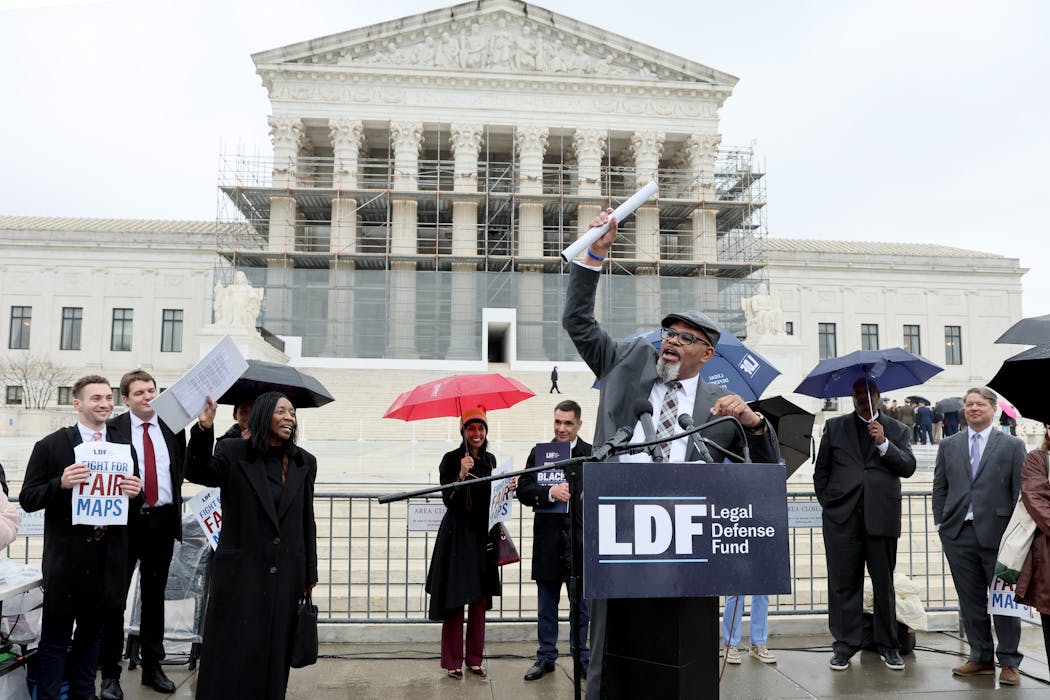
Black Louisiana voters and civil rights advocates ask U.S. Supreme Court justices to uphold a fair and representative congressional map in Louisiana v. Callais on March 24, 2025. Jemal Countess/Getty Images
On Oct. 15, 2025, the Supreme Court will hear oral arguments in one of the most anticipated cases of the 2025-2026 term, Louisiana v. Callais, with major implications for the Voting Rights Act, racial representation and Democratic Party power in congress.
The central question in the case is to what extent race can, or must, be used when congressional districts are redrawn. Plaintiffs are challenging whether the longstanding interpretation of Section 2 of the Voting Rights Act, which requires protection of minority voting power in redistricting, violates the Equal Protection Clause of the U.S. Constitution, which guarantees that individuals should be treated the same by the law.
In short, the plaintiffs argue that the state of Louisiana’s use of race to make a second Black-majority district is forbidden by the U.S. Constitution.
To understand the stakes of the current case, it’s important to know what the Voting Rights Act does. Initially passed in 1965, the act helped end decades of racially discriminatory voting laws by providing federal enforcement of voting rights.
Section 2 of the Voting Rights Act forbids discrimination by states in relation to voting rights and has been used for decades to challenge redistricting plans.
The current case has its roots in the redistricting of Louisiana’s congressional districts following the 2020 Census. States are required to redraw districts each decade based on new population data. Louisiana lawmakers redrew the state’s six congressional districts without major changes in 2022.
State troopers in Selma, Ala., swing billy clubs on March 7, 1965, to break up a march by advocates for Black Americans’ voting rights. AP Photo, File
Soon after the state redistricted, a group of Black voters challenged the map in federal court as a violation of the Voting Rights Act. The plaintiffs argued that the new map was discriminatory because the voting power of Black citizens in the state was being illegally diluted. The state’s population was 31% Black, but only one of the six districts featured a majority-Black population.
The federal courts in 2022 sided with the plaintiffs’ claim that the plan did violate the Voting Rights Act and ordered the state legislature to redraw the congressional plan with a second Black-majority district.
The judges relied on an interpretation of Section 2 of the Voting Rights Act from a 1986 Supreme Court decision in the case known as Thornburg v. Gingles. Under this interpretation, Section 2’s nondiscrimination requirement means that congressional districts must be drawn in a way that allows large, politically cohesive and compact racial minorities to be able to elect representatives of their choice.
Following the court order, the Louisiana state legislature passed Senate Bill 8 in January 2024, redrawing the congressional map and creating two districts where Black voters composed a substantial portion of the electorate in compliance with the Gingles ruling. This map was used in the 2024 congressional election and both Black-majority districts elected Democrats, while the other four districts elected Republicans.
These new congressional districts from Senate Bill 8 were challenged by a group of white voters in 2024 in a set of cases that became Louisiana v. Callais.
Essentially, the plaintiffs claimed that the courts’ interpretation of Section 2 of the Voting Rights Act was unconstitutional and that the use of race to create a majority-minority district is itself discriminatory. Similar arguments about the 14th Amendment’s Equal Protection Clause were also the basis of the Supreme Court’s recent decisions striking down race-based affirmative action in college admissions.
In 2024, a three-judge district court sided with the white plaintiffs in Louisiana v. Callais, with a 2-1 decision. The Black plaintiffs from the original case, and the state of Louisiana, appealed the case to the Supreme Court. The court originally heard the case at the end of the 2024-2025 term before ordering the case re-argued for 2025-2026.
If the Supreme Court ultimately upholds the lower court decision in Louisiana v. Callais, deciding that Louisiana’s congressional districts are unconstitutional racial gerrymanders, it will have substantial impacts on minority representation. The decision would upend decades of precedent for Section 2 of the Voting Rights Act.
For 39 years, Section 2 of the Voting Rights Act has required redistricting institutions to consider racial and ethnic minority representation when devising congressional districts. Majority-minority districting is required when a state has large, compact and cohesive minority communities. Historically, some states have redistricted minority communities in ways that dilute their voting power, such as “cracking” a community into multiple districts where they compose a small percentage of the electorate.
Section 2 also provides voters and residents with a legal tool that has been used to challenge districts as discriminatory. Many voters and groups have used Section 2 successfully to challenge redistricting plans.
Section 2 has been the main legal tool for challenging racial discrimination in redistricting for the past decade. In 2013, the Supreme Court effectively ended the other major component of the Voting Rights Act, the preclearance provision, which required certain states to have changes to their elections laws approved by the federal government, including redistricting.
If the court overrules the current interpretation of Section 2, it would limit the legality of using race in redistricting, end requirements for majority-minority districts and eliminate the most common way to challenge discriminatory districting.
Additionally, because of the strong relationship between many minority communities and the Democratic party, the court’s decision has major implications for partisan control of the House of Representatives.
If Section 2 no longer required majority-minority districts, then Republicans could use the ruling to redraw congressional districts across the country to benefit their party. Politico reported that Democrats could lose as many as 19 House seats if the Supreme Court sides with the lower court.
Recent Supreme Court precedent gives conflicting signals as to how it will decide this case.
Sam D. Hayes does not work for, consult, own shares in or receive funding from any company or organization that would benefit from this article, and has disclosed no relevant affiliations beyond their academic appointment.
Kailyn Lowry is kind of in mourning at the moment.
The Teen Mom alum announced on her latest Barely Famous podcast episode that her dad, Raymond, passed away on September 29.
Father and daughter were VERY estranged having met just one time in the past, during the filming of Lowry’s 16 and Pregnant episode in 2009.
However, Lowry told fans last month that she had made a point of visiting Raymond while he was on hospice for having stage 4 chronic obstructive pulmonary disease (COPD).
In June of 2025, Kailyn Lowry sat down for a special episode of her podcast. (Image Credit: YouTube)
“I went in there angry, and sort of not really open-minded, just more so doing it because everyone told me I’d regret it [if I didn’t],” Kailyn said on a previous podcast installment, adding that she “had all these conflicting feelings.”
Lowry seemed grateful that her dad “let me ask every single question I had” during this get-together, although he seemed “winded” from talking so much.
Continued Kailyn upon describing this emotional meeting back then:
“There are no questions I wish I had asked that I didn’t ask. There were no answers I wasn’t satisfied with I feel lighter, I feel more at peace. I feel forgiveness for him. I think all my anger was very misplaced. He did what he could for what he had, but he didn’t have a whole lot.”
Kailyn Lowry attends the 2018 MTV Video Music Awards at Radio City Music Hall on August 20, 2018 in New York City. (Photo by Nicholas Hunt/Getty Images for MTV)
As for how she now learned of Raymond’s passing?
“My aunt called and I was like, ‘Let me answer’ because she doesn’t really call me,” Kail told listeners. “I answer and I don’t think she even said ‘Good morning’ or anything. It was, ‘Your dad passed away.’ He passed away that morning.
“It was exactly two Mondays after I saw him… I saw him on September 15th and he died on the 29th.”
Kailyn said she had only begun to “process everything that occurred” during her trip to see her father and did not know how to handle the news that Ray was now dead.
Kailyn Lowry has no regrets about her time on Teen Mom. (MTV)
“I was going back and forth on even going to go see him and stuff like that,” she explained.
“And the day I went to visit him with my sister and my aunt, I was driving there with the ‘F-ck you’ mentality. I get to the door, and then I cry for the entire two-hour visit. By the end of it, I know that he said that I still looked mad. At the end of the visit, that’s what he said.
“And I said, ‘I don’t want to be mad. But you have to think about, this is 30 years of what I thought was a betrayal. I thought you didn’t care about me, just to learn that you tried [to be in my life].’
“It’s like, it’s going to take some time to process this and, I don’t know, really come to terms with it.”
As it turns out, according to Raymond, Lowry’s mom had lied about his past and he actually had wanted to be more involved in his daughter’s life.
“I thought that I was going to have one more visit in me, in him,” she said on Friday.
“Like I thought I would go down [to see him] one more time by the end of the year. I softened up enough to think about, ‘OK, I might go down one more time before he passes.’ And I never got a chance in those two weeks.”
We send our condolences to Kailyn Lowry and all those impacted by Raymond Lowry’s passing. May he rest in peace.
Kaley Cuoco has been married and divorced more than once over the course of her career.
Not all of her famous relationships have involved tying the knot.
And some of her breakups have been more amicable than others.
Here is a look at Cuoco’s most famous relationships and marriages — and where things stand today.
Actress Kaley Cuoco attends The 2017 InStyle and Warner Bros. 73rd Annual Golden Globe Awards Post-Party at The Beverly Hilton Hotel on January 8, 2017. (Photo Credit: John Sciulli/Getty Images for InStyle)
In the aughts, Kaley Cuoco dated Johnny Galecki for a couple of years
Kaley Cuoco’s first big claim to fame was The Big Bang Theory.
On the polarizing sitcom, she co-starred with Johnny Galecki.
The two dated for about two years, keeping their relationship very private.
In December 2009, Cuoco and Galecki split.
However, they would go on to remain on good terms. That’s a good thing — especially for co-stars whose show lasted an unbelievable 12 seasons.
Actors Kaley Cuoco and Johnny Galecki attend The Paley Center For Media’s 33rd Annual PALEYFEST Los Angeles ÃThe Big Bang Theory’ at Dolby Theatre on March 16, 2016. (Photo Credit: Matt Winkelmeyer/Getty Images)
She was briefly engaged to Josh Resnik (2011-2012)
In October 2011, Cuoco became engaged to Josh Resnik.
Unlike her TBBT co-star, Resnik is not an actor — he is an addiction specialist.
Their brief engagement would last mere months.
By March of 2012, Cuoco and Resnik had split.
Her next major romance, however, would be far more consequential.
Actress Kaley Cuoco and Ryan Sweeting attend the 4th Annual Critics’ Choice Television Awards at The Beverly Hilton Hotel on June 19, 2014. (Photo Credit: Kevin Winter/Getty Images for Critics’ Choice Television Awards)
Kaley Cuoco married Ryan Sweeting in 2013 and divorced him in 2015
In September of 2013, Kaley Cuoco became engaged to Ryan Sweeting.
She and the professional tennis player had been dating for only three months.
On New Year’s Eve 2013, Cuoco and Sweeting tied the knot in Santa Susana, California.
Almost exactly two years after their engagement, they realized that things were not going to work.
They announced their divorce on September 25, 2015. In May of 2016, they finalized their split.
Actress Kaley Cuoco arrives for the 82nd annual Golden Globe Awards at the Beverly Hilton hotel in Beverly Hills, California, on January 5, 2025. (Photo Credit: ETIENNE LAURENT/AFP via Getty Images)
Not every relationship lasted very long (and that’s healthy!)
Three months after filing for divorce from Sweeting, Cuoco began dating Paul Blackthorne.
Blackthorne has had a lengthy career, from starring on The Dresden Files and Arrow to a guest role on The Gates to appearing via motion capture in video games like Star Wars Battlefront II.
They broke up in early 2016.
Speaking of handsome British dudes who don’t always get to use their natural accents on screen, news broke in July 2016 that Cuoco and legendary hottie Henry Cavill were dating.
A mere 10 days after those headlines, they split — but reportedly remain good friends. Notably, both have played major DC characters (Harley Quinn and Superman), and Blackthorne of course was on Arrow. Small world.
Actress Kaley Cuoco and Karl Cook arrive at the 9th Annual Stand Up For Pits event hosted by Kaley Cuoco at The Mayan on November 03, 2019. (Photo Credit: Amanda Edwards/Getty Images)
Kaley Cuoco and Karl Cook married in 2018, separated in 2021, divorced in 2022
In late 2016, Kaley Cuoco began dating Karl Cook, an equestrian.
About a year later, in November 2017, they became engaged. That happened to be on her 32nd birthday — November 30.
In June of 2018, they married.
A little over three years later, Cuoco and Cook announced their separation in September 2021.
Then, in June of 2022, four years after they tied the knot, Cuoco and Cook finalized their divorce.
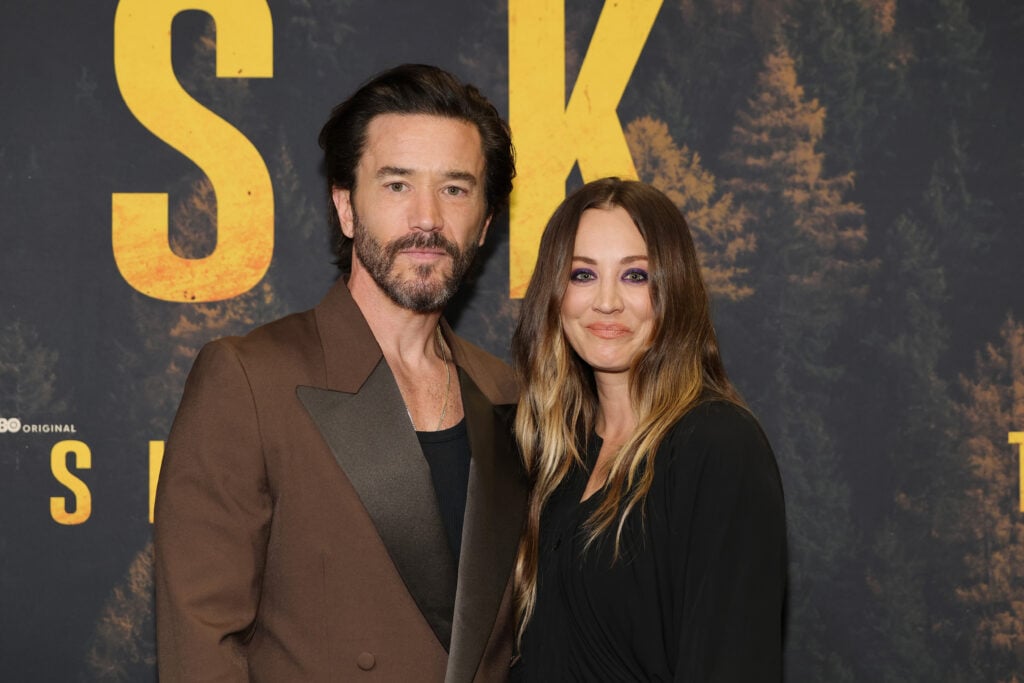
Actor Tom Pelphrey and Kaley Cuoco attend HBO’s “Task” premiere at Perelman Performing Arts Center on September 04, 2025. (Photo Credit: Dia Dipasupil/Getty Images)
Kaley Cuoco is currently dating Tom Pelphrey (and they have a kid together!)
In May of 2022, Cuoco confirmed that she was in a relationship with fellow actor Tom Pelphrey.
As you can see in this throwback video on Reddit, Miley handled the question with a lot of maturity and clarity.
“I am not pregnant. I am 14 years old, and that is very lame because I’m a minor,” she told the cameras in 2007.
This was on a red carpet — so we’re not talking about an absurd rumor remaining on social media, either.
“And yeah. So stupid. The main reason that I’m here tonight [is to] set the record straight,” Miley added at the time.
She speculated: “I think that people that make stuff up like that do that, [it’s] kind of a cry for help, for attention.”
Singer-songwriter Miley Cyrus arrives for the 2025 Met Gala at the Metropolitan Museum of Art on May 5, 2025. (Photo Credit: ANGELA WEISS/AFP via Getty Images)
Does Miley want to have kids?
More than half of people under 50 don’t want kids.
That includes all of Millennials, younger Gen Xers, Gen Z, and we’re pretty sure that Gen Alpha are children so they are probably not answering surveys.
Miley Cyrus was born in 1992. No matter where you draw the line on the Millennial/Zoomer divide, she’s firmly in the Millennial camp.
And she is no exception to the majority take of younger adults.
In 2019, Miley told Ellethat everyone is “expected to keep the planet populated,” particularly if they happen to have a working uterus.
Singer Miley Cyrus attends the 82nd Annual Golden Globe Awards at The Beverly Hilton on January 05, 2025. (Photo Credit: Amy Sussman/Getty Images)
“And when that isn’t a part of our plan or our purpose,” Miley observed, “there is so much judgment and anger.”
Pointing out alarming legislation over the past decade, she added: “They try to make and change laws to force it upon you.”
Grimly, Miley noted: “even if you become pregnant in a violent situation.”
In many cases, people who do not want children feel this way due to our dismal financial realities.
But she noted that many are blissfully child-free.
Singer Miley Cyrus attends the 97th Annual Academy Awards at the Dolby Theatre in Hollywood, California on March 2, 2025. (Photo Credit: ANGELA WEISS/AFP via Getty Images)
Her fans are, in a way, a little like her kids
And Miley Cyrus has spoken on the topic more recently, admitting that she wasn’t sure if she wants kids in July 2024.
In her mind, her fans are a little like her children.
(That’s a sentiment shared by her godmother, Dolly Parton)
At some point, hopefully society will progress to a point where both people will be able to afford to have kids (and have confidence that they aren’t inheriting our current hell world) and where people won’t ask if someone’s pregnant. That question is almost always rude.
For now, perhaps we should settle for “unless you’re a doctor or guidance counselor, don’t ask if a 14-year-old is pregnant.” That should not have to be explained to anyone.