The UK’s unemployment rate has risen to a four-year high, in a surprise deterioration that boosts the case for a Bank of England interest rate cut.The Latest News from the UK and Around the World | Sky News









The UK’s unemployment rate has risen to a four-year high, in a surprise deterioration that boosts the case for a Bank of England interest rate cut.The Latest News from the UK and Around the World | Sky News

Eight babies have been born in the UK with DNA from three people following a procedure to eliminate an incurable inherited disease.The Latest News from the UK and Around the World | Sky News
By: Shauneen Miranda, States Newsroom
Republican members of the U.S. Senate called on Office of Management and Budget Director Russ Vought in a letter Wednesday to release the $6.8 billion in funds for K-12 schools that the Trump administration is withholding.
The letter marked a major friction point between President Donald Trump and influential lawmakers in his own party as his administration tests the limits of the executive branch’s authority in clawing back federal dollars Congress has already appropriated. Every state has millions in school funding held up as a result of the freeze.
Wednesday’s letter came after the Supreme Court temporarily cleared the way earlier this week for the administration to carry out mass layoffs and a plan to dramatically downsize the Department of Education that Trump ordered earlier this year.
Just a day ahead of the July 1 date when these funds are typically disbursed as educators plan for the coming school year, the Education Department informed states that it would be withholding funding for several programs, including before- and after-school programs, migrant education and English-language learning, among other initiatives.
“Withholding these funds will harm students, families, and local economies,” wrote the 10 GOP senators, many of them members of committees that make decisions on spending. Sen. Shelley Moore Capito, a West Virginia Republican and chair of the Senate Appropriations Subcommittee on Labor, Health and Human Services, Education, and Related Agencies, led the letter.
Sen. Susan Collins of Maine, chair of the broader Senate Appropriations Committee, also signed onto the letter, along with: Sens. Katie Britt of Alabama, Lisa Murkowski of Alaska, John Boozman of Arkansas, Mitch McConnell of Kentucky, Deb Fischer of Nebraska, John Hoeven of North Dakota, Mike Rounds of South Dakota and Jim Justice of West Virginia.
“The decision to withhold this funding is contrary to President Trump’s goal of returning K-12 education to the states,” the senators wrote. “This funding goes directly to states and local school districts, where local leaders decide how this funding is spent, because as we know, local communities know how to best serve students and families.”
States Newsroom has asked the Office of Management and Budget for comment on the letter.
Meanwhile, a slew of congressional Democrats and one independent — 32 senators and 150 House Democrats — urged Vought and Education Secretary Linda McMahon in two letters sent last week to immediately release the funds they say are being withheld “illegally.”
Democratic attorneys general and governors also pushed back on these withheld funds when a coalition of 24 states and the District of Columbia sued the administration earlier this week.
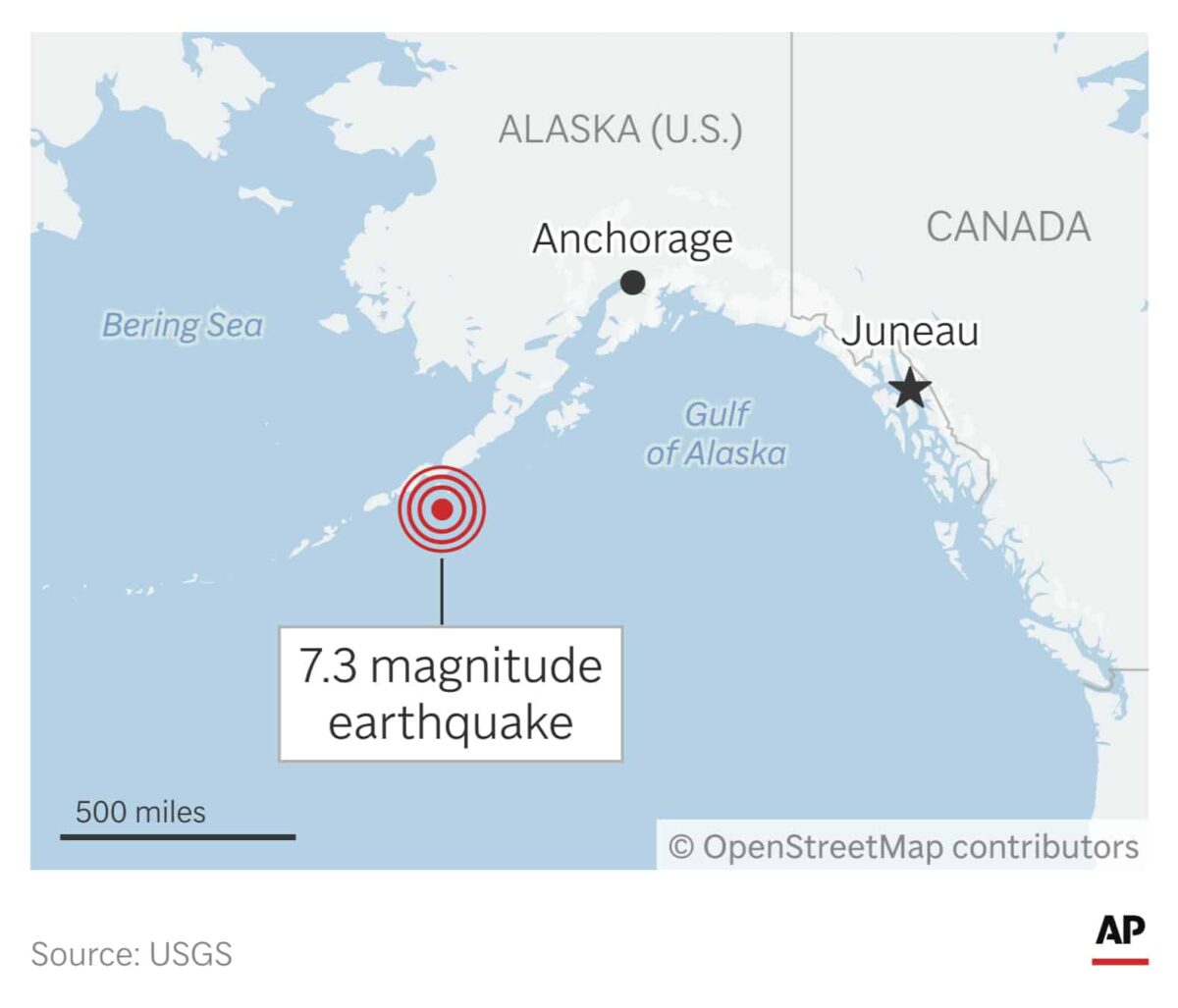
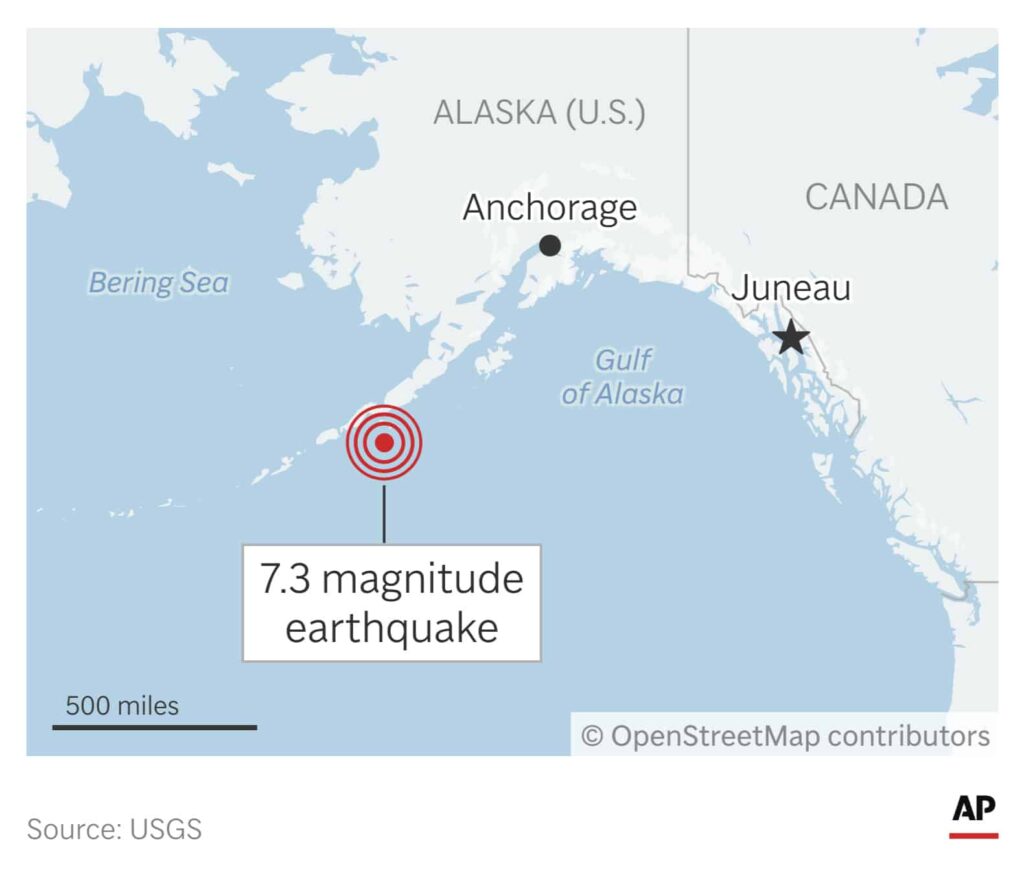
(AP) — Communities along a 700-mile (1,127-km) stretch of Alaska’s southern coast ordered residents to higher ground after a powerful offshore earthquake Wednesday, but officials quickly downgraded and then canceled a tsunami warning for the region. There were no reports of significant damage.
The earthquake, with a preliminary magnitude of 7.3, struck at 12:37 p.m. local time south of Sand Point, a community of about 600 people on Popof Island, in the Aleutian chain, according to the Alaska Earthquake Center.
There were 40 aftershocks detected within the first three hours, the center said.
“We have seen other earthquakes in the area that have not generated significant tsunami waves, but we’re treating it seriously and going through our procedures, making sure communities are notified so they can activate their evacuation procedures,” said Jeremy Zidek, a spokesperson for Alaska’s emergency management division.
The quake was felt as far away as Anchorage, almost 600 miles (966 km) to the northeast.
The National Tsunami Warning Center issued a warning for an area stretching from about 40 miles (64.4 km) southwest of Homer to Unimak Pass, a distance of about 700 miles (1,126 kilometers). Among the larger communities in the area was Kodiak, with a population of about 5,200. The warning was downgraded to an advisory about an hour later, and canceled just before 2:45 p.m.
The highest water level generated by the earthquake in Sand Point was not quite 2.5 inches (6.3 cm) above the tide, the center said.
“There’s no damage at the airport, doesn’t appear to be any damage at the harbor, no damage to speak of, really,” Sand Point Police Chief Benjamin Allen said.
There was some damage — in the form of broken bottles — at the Alaska Commercial general store in town. Manager Vickey McDonald said about half of the store’s alcohol aisle had crashed and shattered.
“I’ve got liquid smoke and barbecue sauce and pickles … broken on the floor,” McDonald said. “It smells horrendous in here.”
In Unalaska, a fishing community of about 4,100, officials urged people in possible inundation zones to move at least 50 feet above sea level or 1 mile (1.6 km) inland. In King Cove, which has about 870 residents on the south side of the Alaska Peninsula, officials sent an alert calling on those in the coastal area to move to higher ground.
Tourists Jodie Stevens and her husband, Aaron Park, were looking at the puffins at the Alaska SeaLife Center in Seward when they heard someone yelling that there had been an earthquake and they needed to evacuate. They walked a few blocks uphill in the rain, with a woman from the center yelling to those they passed to get to higher ground.
They were about halfway to the official high ground spot when they heard a siren signal that all was clear, she said.
The National Weather Service said in posts on social media that there was no tsunami threat for other U.S. and Canadian Pacific coasts in North America, including Washington, Oregon and California.
Alaska’s southern coast is earthquake-prone, and Wednesday’s was the fifth in roughly the same area since 2020 exceeding magnitude 7, state seismologist Michael West said.
“Something’s moving in this area,” he said. “I would not call this an isolated earthquake. It appears to be part of a larger sequence spanning the last several years.”
That has the attention of seismologists, he said.
“This area has been and remains capable of larger earthquakes and earthquakes capable of significant tsunami damage,” he said.


If you’re an Alaskan and believe a government agency or public official is doing something seriously wrong, something that puts public safety or welfare at risk, you now have a clear and official way to ask for an investigation.
Alaskan residents now have a more transparent process to request an Investigative Grand Jury to probe suspected systemic wrongdoing by public figures or public entities in Alaska. This effort aims to empower the community and ensure that public trust in government is maintained.
This Department of Law initiative formalizes a process that follows rules created by the Alaska Supreme Court by dedicating a new webpage, standing up policies and procedures, and assigning attorneys to examine criteria to facilitate the convening of an Investigative Grand Jury in situations where citizens present evidence on matters that jeopardize public welfare or safety.
“The Alaska Constitution guarantees that an Investigative Grand Jury will have the authority to investigate matters of public welfare or safety, and that this right shall never be suspended,” said Alaska Attorney General Treg Taylor. “This new, transparent process ensures that every Alaskan’s voice can be heard when it comes to safeguarding our community and holding our government accountable.”
An investigative grand jury is a group of citizens that are tasked with investigating potential criminal activity or issues of public welfare and safety within a specific jurisdiction. Unlike a trial jury, its role is not to determine guilt or innocence, but rather to investigate potential wrongdoing and decide whether there is sufficient evidence to issue an indictment or make recommendations for action.
Back in 2022, the Alaska Supreme Court updated the rules around Investigative Grand Juries. The Court gave the Attorney General and the Department of Law the responsibility of reviewing citizen requests and determining whether they should go forward. But until now, there wasn’t a public-facing process for how to do that.
If a citizen investigation involves actions, sections or offices within the Department of Law, a neutral prosecutor will be appointed to advise the Investigative Grand Jury.
The Department of Law says this is just phase one of a broader effort to make Alaska’s legal system more open and responsive to public concerns. More improvements and public input opportunities are expected to follow.


AP- Dozens of Native American radio stations across the country vital to tribal communities will be at risk of going off the air if Congress cuts more than $1 billion from the Corporation for Public Broadcasting, according to industry leaders.
The U.S. Senate is set to vote this week on whether to approve the Department of Government Efficiency’s plan to rescind previously approved public broadcasting funding for 2026 and 2027. Fear is growing that most of the 59 tribal radio stations that receive the funding will go dark, depriving isolated populations of news, local events and critical weather alerts. The House already approved the cuts last month.
“For Indian Country in general, 80% of the communities are rural, and their only access to national news, native story sharing, community news, whatever it is, is through PBS stations or public radio,” said Francene Blythe-Lewis, CEO of the Lincoln, Nebraska-based Native American video programming producer Vision Maker Media. “If the claw back happens, I would say a good 90% of those stations will cease to exist.”
Local radio plays an outsized role in the lives of many who live in Indigenous communities, where cable television and broadband internet access are spotty, at best, and nonexistent for many. That leaves over-the-air TV stations — usually a PBS station — and more often local radio to provide local news, community event details and music by Indigenous artists. Sometimes the news is delivered in Indigenous languages.
“It means we’re not going to hear our language on the radio,” Blythe-Lewis said.
Flagstaff, Arizona-based Native Public Media, which supports the network of 59 radio stations and three television stations serving tribal nations across the country, said about three dozen of those radio stations that rely heavily on Corporation for Public Broadcasting funding will be the first to go dark if funding is cut for the coming fiscal year that starts Oct. 1.
Loris Taylor, CEO of Native Public Media, said in an op-ed that the tribal stations reach more than 1.5 million people and “may be the only source of locally relevant news, emergency alerts, public safety announcements, language preservation, health information and election coverage.”
GOP senators are under pressure from President Donald Trump, who promised last week on his Truth Social platform that any Republican who votes against the cuts “will not have my support or Endorsement.”
Many Republicans say the public media system is politically biased and an unnecessary expense. Sen. Eric Schmitt, a Republican from Missouri, recently defended the cuts as necessary to hack away at the nearly $37 trillion national debt, adding, “It is critical in restoring trust in government.”
But some Republicans have pushed back, such as Maine Sen. Susan Collins, who questioned the proposed cuts last month during a Senate committee hearing. She said that while some of the federal money is assigned to National Public Radio and the Public Broadcasting System, most of it goes to locally owned public radio and television stations.
Jaclyn Sallee is president and CEO of Koahnic Broadcast Corporation and KNBA, its radio station in Anchorage, Alaska. Koahnic produces National Native News, a five-minute daily newscast that features headline news from across Indian Country, and Native America Calling, a daily hourlong call-in program, for about 190 stations across the nation. It also produces Indigefi, a music program in Indigenous languages.
KNBA is on Native Public Media’s list of those stations that would be most affected by the federal funding cuts — a concern Sallee confirmed, as 40% of the station’s funding comes from CPB.
“What we’re really worried about are the rural stations in Alaska where they may be the only station in the community,” she said. “The people that live there depend on the station for vital weather alerts, emergency alerts; it’s the local hub of the community where people share information. So that is very troublesome because people’s lives are at risk without this service.”
It’s currently fishing season in Alaska, she said, “which means getting out in the ocean or in rivers and going long distances to subsist, and so they really rely on weather reports.”
Having the news reported in a tribe’s language isn’t just about preserving that language, she said. Sallee spent summers in Nome with her mother’s family. Her grandmother, she said, spoke only Inupiaq.
New Mexico PBS’s signal reaches all but one of the more than 20 tribes and pueblos in the state. It also has signed an agreement with the Navajo Nation, which has the largest reservation of any tribe in the U.S., that allows the tribe to carry the PBS signal and programming on the Navajo Nation Television network, New Mexico PBS general manger Franz Joachim said.
“It’s no question in my mind that, you know, immediately some stations will pretty much go dark,” Joachim said.
When those first stations fail, it won’t take long for others to follow, Joachim said. And as they do, it will mean fewer and fewer stations left to pay membership dues that also help fund all of the stations.
“So now the whole system starts to fracture,” he said. “So for me, the federal funding is really about the system as a whole that keeps us in place.”
That funding also helps produce national content that groups like Vision Maker Media produce. Those include Native American documentaries shown on PBS like “Mankiller,” the story of Wilma Mankiller who became the first woman elected principal chief of the Cherokee Nation.
Blythe-Lewis compared the potential loss of tribal stations to the country’s past attempts to erase Native American cultures, such as through federal boarding schools where Indigenous children were sent for generations to assimilate them into white society and where systemic abuse of Indigenous children was carried out.
“We’re erased from public media and therefore invisible and therefore become unknown and unheard of,” she said.
By: Corinne Smith, Alaska Beacon
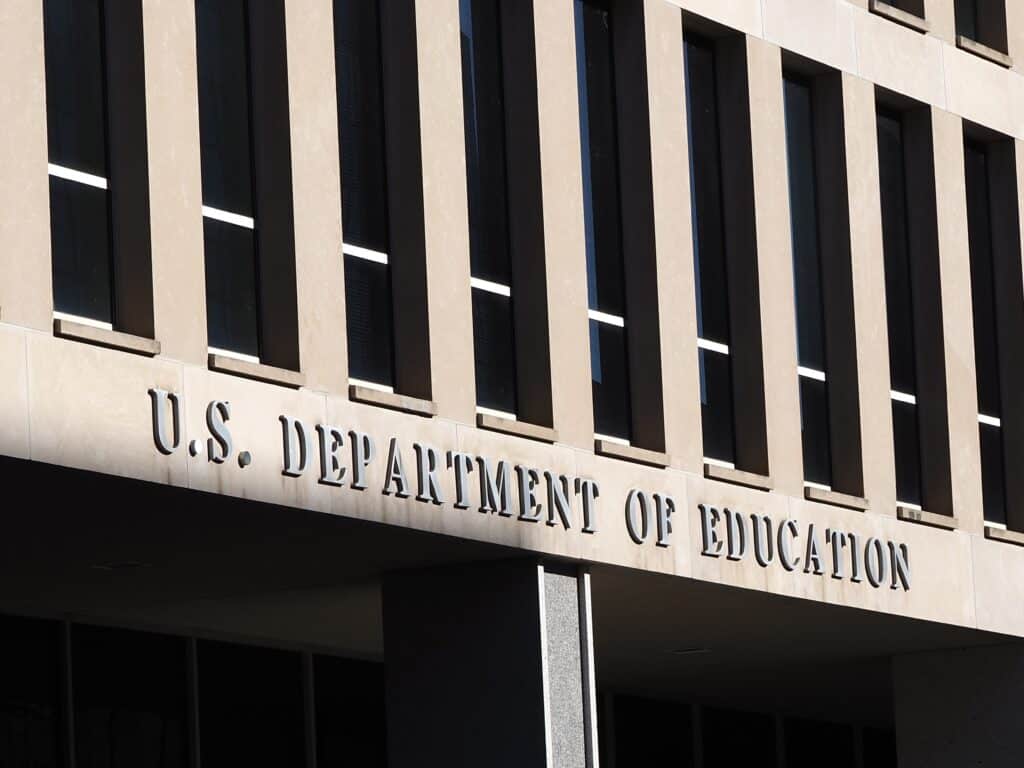
Federal funds for adult education services were among those blocked by the Trump administration on July 1, causing immediate cuts to Alaska adult education and workforce development programs and staff layoffs.
The U.S. Department of Education has withheld more than $6 billion in congressionally approved grants for education, including over $629 million for adult education basic grants, and more than $85 million in adult integrated English literacy and civics education grants. The administration has said that it’s withholding the federal funding to review the grant programs to ensure they align with the Republican president’s priorities.
Adult education can range from classes that help adults learn basic literacy to programs that assist students in gaining certificates equivalent to high school diplomas, and can teach skills that are essential to performing certain jobs.
Alaska had over $1.1 million allocated as part of an adult education basic grant, according to the Alaska Department of Labor and Workforce Development, which administers the grants. A department spokesperson said on Tuesday the grant amounts for English literacy and civics education this year were not available, but the state received more than $99,600 last year.
The withheld funds means immediate cuts to services for Alaska adult learners and staff layoffs, according to grant recipients.
“We were definitely blindsided,” said Lucie Magrath, executive director of the Literacy Council of Alaska, a Fairbanks-based nonprofit that provides adult education programs, including adult literacy, English language learning, civics and General Educational Development, or GED, preparation classes.
Magrath said an estimated $180,000 in federal funding, or over half of their budget, was impounded, causing immediate cuts to services and staff layoffs. While the organization did not identify the number of layoffs in an interview last week, the Fairbanks Daily News-Miner has since reported that there were five layoffs.
“So we are having to make some pretty drastic decisions with staffing and programming,” she said in a phone interview on Thursday. “We likely will not be able to serve nearly as many people this year, and we’re making staffing cuts right now.”
The organization provides in-person and virtual instruction and mentoring to adult learners in Fairbanks, as well as in villages in the Interior and Western Alaska, stretching from the Yukon Flats to the Yukon-Kuskokwim Delta.
They also have a workforce development program, the Pathways Program, serving youths and young adults ages 16 to 24, and run the used bookstore Forget-Me-Not Books in Fairbanks, which provides revenues for its programs, jobs training and employment.
Shelby Cooke is the assistant executive director of the Literacy Council of Alaska, and said it’s difficult to fill such a large funding gap, especially on such short notice, and Alaskans will be impacted.
“The real detriment is to our students and Alaskans who need that GED credential to go to work, or maybe they’re a super-skilled person in their native tongue, but they need enough English to be able to navigate a job interview,” she said. “Those are the folks that are suffering, and in turn, our economy suffers too.”
Magrath said some programs will be suspended immediately. It’s possible that these suspensions will be temporary, as her organization figures out its next steps. “We’re looking at restructuring some of our programs just to be able to use the resources that we have to the maximum impact for our community and our students,” she said. “So we have a lot to figure out right now.”
Southeast Regional Resource Center, a nonprofit educational services agency that provides a variety of services statewide, including adult education, English language learning and workforce development programs. In addition, SERRC provides educational and business services to school districts, including special education programs, human resources and grant administration.
“We do have some state funds, and so we’ve had to modify our budget just off what we know we have for funding — for state funds — and we are looking at having to reduce our staffing,” said Chris Reitan, its executive director, in a phone interview Thursday. He said the organization is looking at cutting at least two staff positions and a few part-time positions. “So we are concerned about the ability to have the same level of impact.”
Reitan said the federal funding freeze withheld over $86,600 for adult education programs in Southeast Alaska, and over $64,000 in the Aleutians region.
Chris Reitan, executive director, SERRC, said SERRC’s program served 112 students last year in the areas of GED support, English language learning and workforce development across the state.
“Number one, adult education provides a kind of a lifeline for Alaskans seeking to improve their lives, and it also helps strengthen our state’s workforce,” he said, and will have an immediate impact on adult learners, “which then could immediately impact their ability in regards to getting good-paying jobs, their ability to provide for their families, their ability to contribute to their local communities.”
He added: “I see this as being a significant impact across the state, in regards to our citizens being able to have the opportunity to better themselves.”
SERRC and the Literacy Council of Alaska are two of 14 adult education programs across the state with grant funding administered by the Alaska Department of Labor and Workforce Development. A department spokesperson, Adam Weinert, said by email that the department has continued to award available state matching funds for the programs, totaling more than $1.9 million.
“Sub-grantees were informed that we were moving forward at this time with state funding only,” Weinert said of the programs. “Once federal funding is released, we will move forward with a budget modification to provide for the federal funding.”
The full impact of how the freeze will affect some programs in the long term remains unclear.
The University of Alaska system has several adult education programs, funded in part by federal funds, as well as state and local funding. Jonathan Taylor, the university’s director of communications, said by email Monday that “discussions are ongoing” around funding but those programs are scheduled to continue.
Taylor said at the University of Alaska Fairbanks, the Bristol Bay Adult Education program will start up in August with funding from Bristol Bay Economic Development Corp.
Within the University of Alaska Anchorage, there are adult education programs at Kodiak College, serving the Kodiak Island Borough; Kenai Peninsula College, serving the Soldotna, Homer and Seward regions; and Prince William Sound College, serving the Valdez, Cordova and Copper Basin regions.
“We have received assurances that all three will receive some sort of funding this year,” Taylor said. “To our knowledge, the state will initiate these awards using either state funding or federal funding it has access to. If additional Federal Funds become available, the state will amend the agreements to make up to the original intended funding amount. Currently, this is an active endeavor and ongoing discussion with the state.”

Nativism, the idea that government must guard native-born Americans from various threats posed by immigrants, has a long history in the United States.
Today, the Trump administration is citing the Immigration and Nationality Act of 1952, a restrictive measure written by nativist members of Congress decades ago when fears of communism were rampant, to sharply restrict the rights of noncitizens.
Under this law, also known as the McCarran-Walter Act, federal agencies have arrested and detained noncitizens associated with pro-Palestinian protests, reintroduced immigrant registration requirements, and imposed a new travel ban that affects 19 nations.
Since the 1950s, Congress has removed some of this sprawling federal law’s most discriminatory features, such as racist national origins quotas. But other key provisions remain on the books. Now they are the primary legal basis for some of President Donald Trump’s most controversial immigration crackdowns.
In March 2025, the White House invoked the McCarran-Walter Act to justify arresting and deporting Mahmoud Khalil, a legal permanent resident who had participated in pro-Palestinian protests at Columbia University. Officials pointed to Section 237(a)(4)(C) of the law, which states that any “alien whose presence or activities in the United States the Secretary of State has reasonable ground to believe would have potentially serious adverse foreign policy consequences for the United States is deportable.”
This has been tried only once before. In 1995, the Clinton administration unsuccessfully sought to use the provision to deport a former Mexican official, Mario Ruiz Massieu, to face charges in his homeland for extortion and obstructing a murder investigation. Ruiz Massieu was later indicted in the U.S. on money laundering charges and died by suicide shortly before his arraignment.
The Trump administration cited the same provision to justify detaining Tufts University doctoral student Rumeysa Ozturk in March. Ozturk came under government scrutiny because she co-authored an op-ed in the Tufts student newspaper criticizing the university’s position on the Israel-Gaza war.
Surveillance footage of a terrified Ozturk being arrested by masked Immigration Customs and Enforcement agents on a street in Somerville, Massachusetts, drew criticism from government officials and civil liberties advocates. In response, Secretary of State Marco Rubio alleged that Ozturk had harmed U.S. interests by supporting “movements that are involved in doing things like vandalizing universities, harassing students, taking over buildings, creating a ruckus.”
Khalil and Ozturk both were released after weeks in detention, pending final resolution of their cases. Their lawyers argue that their clients’ treatment violates free speech protections and that the defendants were punished for expressing their political beliefs.
The McCarran-Walter Act also authorizes intrusive registration and tracking requirements for noncitizens who remain in the U.S. for 30 days or longer.
On Jan. 20, 2025, Trump issued an executive order directing the Department of Homeland Security to enforce an “alien registration requirement.” The agency issued a final rule in April requiring all noncitizens over the age of 14 to register and be fingerprinted. Parents or guardians must register noncitizen children under age 14. The rule also requires adult noncitizens to carry “evidence of registration” at all times.
Such policies aren’t new. Noncitizen registration was codified in the Alien Registration Act of 1940, on the eve of U.S. entry into World War II. The law was designed to regulate the foreign-born population and encourage eligible noncitizens to join the U.S. armed forces. Its requirements were written into the McCarran-Walter Act.
After the 9/11 terrorist attacks, the Bush administration created the National Security Entry-Exit Registration System, which targeted noncitizen males age 16 or older from 25 Muslim-majority countries. It required registrants to submit biometric information, check in regularly with immigration authorities and use specific ports of entry for travel.
The Obama administration suspended this system in 2011 and permanently dismantled it in 2016.
Today, Trump administration officials say they are simply enforcing long-standing legal authority. A federal judge agreed, ruling on April 10 that the Homeland Security Department could require noncitizens to register and carry documentation.
On June 2, Trump announced a new travel ban on foreign nationals from 12 countries, mostly in Africa and the Middle East. The ban draws its authority from the McCarran-Walter Act. Two days later, Trump claimed the same legal discretion to exclude Harvard University’s international students from the U.S.
During his first term, Trump invoked these sections of the law to justify a travel ban on seven predominantly Muslim countries. The U.S. Supreme Court ultimately upheld this action in 2018 by a 5-4 vote in Trump v. Hawaii. Writing for the majority, Chief Justice John Roberts stated that the travel ban was well within broad powers over immigration granted to the president under the McCarran-Walter Act. He added that the court had “no view on the soundness of the policy.”
Trump’s new ban is more carefully crafted than earlier versions and more likely to withstand legal challenges. But his efforts to use the McCarren-Walter Act to ban international students from attending Harvard University face stiff legal headwinds.
On May 22, Homeland Security Secretary Kristi Noem notified Harvard officials that the agency was revoking the school’s certification to participate in the Student and Exchange Visitor Program, which grants visas to international students to come to the U.S. In a June 4 proclamation, the White House claimed that foreign students at Harvard had behaved in ways that threatened U.S. national security.
A federal judge in Boston quickly blocked the revocation, holding that it violated core constitutional free speech rights. “The government’s misplaced efforts to control a reputable academic institution and squelch diverse viewpoints seemingly because they are, in some instances, opposed to this administration’s own views, threaten these rights,” wrote Judge Allison D. Burroughs.
The latest step came on July 9, when the Trump administration subpoenaed Harvard for information on its foreign students, including their disciplinary records and involvement in campus protests.
Ironically, congressional sponsors of the McCarran-Walter Act were at odds with the White House when the law was enacted in 1952. They overrode a veto by President Harry S. Truman, who thought the law’s nativist ideas were unfitting for a nation of immigrants and global defender of democracy.
However, the expansive executive powers created by this law have endured largely unaltered over time, through waves of immigration reform.
Now they are a boon to the Trump administration’s ambitious immigration crackdown. It’s a telling reminder that repressive old laws can come back to life – even when they don’t reflect the current views of many Americans.

Daniel Tichenor does not work for, consult, own shares in or receive funding from any company or organization that would benefit from this article, and has disclosed no relevant affiliations beyond their academic appointment.
Politics + Society – The Conversation

In spring 2024, pro-Palestinian student encampments that began at Columbia and Harvard spread to university campuses throughout the U.S. as Israel invaded Gaza in response to Hamas’ Oct. 7, 2023, surprise attack. At least 100 campuses had encampments for at least a few days during this period.
While some campuses erupted in violence, others remained peaceful and didn’t experience the open conflict that led to congressional hearings, university presidents losing their jobs and repercussions that are continuing to be felt today.
What made the difference?
In spring 2024, Ohio State University’s College Impact Laboratory, where we all work, surveyed universities to learn more about whether their campuses experienced protests, what happened and how they handled them. Part of our goal was to understand how spiritual leaders played a role, if any, in managing the protests. We’ve been analyzing the data ever since. The results from those who responded point to several lessons universities could learn from to avoid violence in future protests.
Campus protests have long been a defining feature of social and political change in the U.S. From the civil rights movements of the 1950s and 1960s to the student-led climate strikes of recent years, higher education institutions have served as a critical space for activism.
Often, these protests reflect broader societal tensions, and how universities respond has played a significant role in shaping their outcomes.
Historically, protests have been most likely to escalate when students feel unheard. In contrast, institutions that adopt proactive strategies, such as facilitating conversations or including students in decision-making, often experience better outcomes.

As our survey data shows, the pro-Palestinian protests illustrate this dynamic.
To gather data, the College Impact Laboratory sent questionnaires to administrators at the 329 universities that participate in our Interfaith Spiritual, Religious and Secular Campus Climate Index, also known as the INSPIRES Index, as well as hundreds of colleges and universities in our recruitment database.
In all, 35 schools responded to our 23-question survey. Of those, we found that most protests were led by students, half lasted less than a week, and the vast majority were nonviolent. Fifteen did not have protests, while the rest did. While the number of institutions that participated in this survey is relatively small, it does give us key insights into what schools were thinking.
Half of the campuses with protests reported law enforcement involvement – either campus police or city officers – with 20% experiencing physical altercations between protesters and police. Other disruptive actions such as academic interruptions, vandalism, physical violence and doxxing were reported with varying frequencies.
Protests at campuses that participated in our survey peaked during April and May 2024, with 70% of them experiencing demonstrations in these months.
Here are three takeaways from the survey, suggesting steps universities can take before and during future protests to avoid escalation:
At every surveyed institution that reported protests, students were at the forefront of organizing and leading these efforts.
Yet, despite this clear student leadership, about one-third of institutions said they didn’t consult with students to establish guidelines for engagement. Those that did invited representatives from student organizations or student government officers into the policymaking process to determine what protocols would be followed to manage protests and keep them peaceful.
On campuses where administrators didn’t engage with student leaders, tensions tended to escalate, and protests disrupted the institutions for weeks, often after police were called in or curfews were imposed.
While many of the protests lasted only one to seven days, we found that institutions that opened lines of communication early between administration and student protest leaders were more likely to deescalate tensions quickly. In contrast, campuses where administrators did not engage early on saw protests lasting weeks or involving greater disruptions.
Also, institutions that engaged early with student leaders were less likely to face stronger demands, such as calls for administrators to be fired, divestment from Israeli companies or calls to defund the campus police.
Our survey results suggest it’s important for administrators to engage with students early to establish clear guidelines to make it less likely future protests spiral into violence.
Discussion of difficult topics, such as the conflict between Israel and Palestinians, shouldn’t wait until protests break out to begin. We found that every school in our survey that proactively supported dialogue between Jews and Muslims – before the war broke out – didn’t see violence result from the protests.
Dialogue isn’t just a strategy for preventing protests from spiraling out of control; it is fundamental to intergroup learning in higher education. These events create safe spaces for students − whether Arab, Jewish, Palestinian or members of different ethnic or religious groups − to engage with classmates with different points of view.
But even once protests begin, dialogue can help. When institutions engaged in dialogue, during or as a result of a protest, the protests were less likely to involve violence. At half of the campuses that participated in our survey and experienced protests, protests were ended peacefully through dialogue.
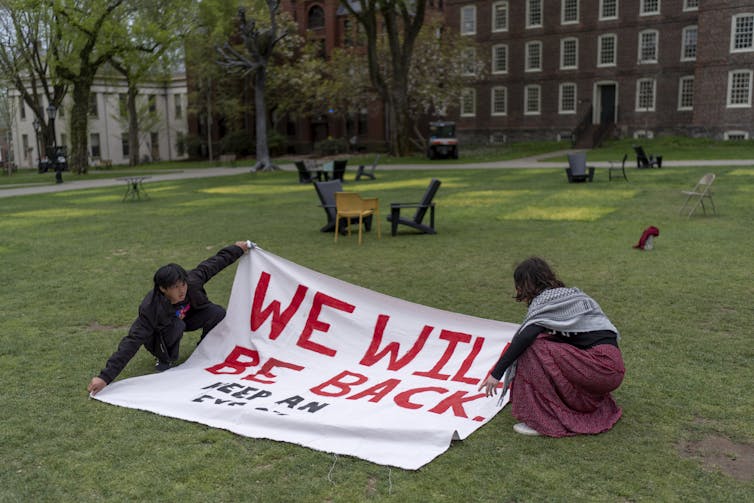
Brown, for example, modeled the power of institutional listening in its response to its April 2024 encampment. Rather than escalating tensions, university leaders engaged directly with student activists, resulting in a peaceful resolution and a commitment to bring the students’ divestment proposal to a formal vote in October. It ultimately failed to pass the board of directors.
Most administrators in our survey, as they considered how to engage with protesters, reached out to relevant student groups such as those that focus on Jewish and Muslim students to better understand their perspectives.
However, only 28% consulted a religious or spiritual life office staff member on campus.
Religious or spiritual life staff are present on both private and public campuses and may include university-employed multifaith chaplains, interfaith coordinators or directors of spiritual life. Unlike student-led religious groups, these professionals often serve as liaisons to the religious and nonreligious communities represented on campus.
The focus of such roles on serving students from all worldviews positions them as key resources for deescalation through community outreach, support and two-way communication. Additionally, these professionals have valuable expertise in religious pluralism and community relationships. This experience helps them to advise administrators on policy and potential courses of action in times of tension.
Consulting with university staff with a focus on religion or spiritual life makes particular sense given the nature of the protests and how religion is intertwined, but our data suggests they may be underutilized more broadly for their expertise in navigating tensions related to competing worldviews.
Proactive engagement with these leaders not only helps campuses navigate an immediate crisis but demonstrates a commitment to inclusivity and respect for different groups’ perspectives.
Put another way, our research suggests institutions can avoid the negative outcomes of protests by embodying the traits commonly associated with universities, such as showing mutual respect, fostering democratic debate and engaging in critical thinking even on divisive issues. Engaging from a mindset of goodwill with student leaders shows administrators value student voices and are willing to work collaboratively toward solutions.
But when campuses ignore peaceful protests or refuse to engage with student leaders, they risk turning manageable situations into prolonged crises.
At a time when divisions run deep, we believe campuses that lead by example by embracing dialogue and engaging student activists before, during and after protests take place are not only likely to see less violence, but are likely to help heal America’s great divides.

Matthew J. Mayhew receives grant funding for various research projects from the National Science Foundation, the ECMC Foundation, the Templeton Religion Trust, the Arthur Vining Davis Foundations, and Pew Charitable Trusts. Currently, Dr. Mayhew leads the College Impact Laboratory at The Ohio State University. He is the Principal Investigator for the INSPIRES Index project and is the current editor of the Digest of Recent Research.
Renee L. Bowling works for the College Impact Lab at The Ohio State University that produces the INSPIRES Index and serves as Chair of NASPA’s Spirituality and Religion in Higher Education Knowledge Community.
Anisha Gill-Morris and Hind Haddad do not work for, consult, own shares in or receive funding from any company or organization that would benefit from this article, and have disclosed no relevant affiliations beyond their academic appointment.
Politics + Society – The Conversation
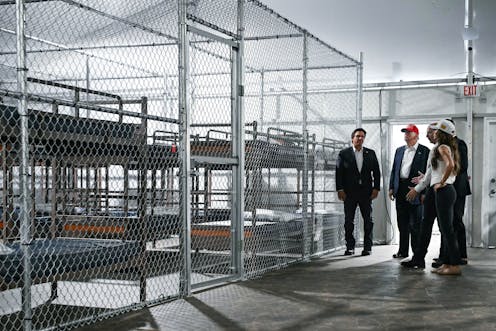
The state of Florida has opened a migrant detention center in the Everglades. Its official name is Alligator Alcatraz, a reference to the former maximum security federal penitentiary in San Francisco Bay.
While touring Alligator Alcatraz on July 1, 2025, President Donald Trump said, “This facility will house some of the menacing migrants, some of the most vicious people on the planet.” But new reporting from the Miami Herald/Tampa Bay Times reveals that of more than 700 detainees, only a third have criminal convictions.
To find out more about the state of Florida’s involvement in immigration enforcement and who can be detained at Alligator Alcatraz, The Conversation spoke with Mark Schlakman. Schlakman is a lawyer and senior program director for The Florida State University Center for the Advancement of Human Rights. He also served as special counsel to Florida Gov. Lawton Chiles, working as a liaison of sorts with the federal government during the mid-1990s when tens of thousands of Haitians and Cubans fled their island nations on makeshift boats, hoping to reach safe haven in Florida.
U.S. Department of Homeland Security Secretary Kristi Noem has characterized the migrants being detained in facilities like Alligator Alcatraz as “murderers and rapists and traffickers and drug dealers.” Do we know if the detainees at Alligator Alcatraz have been convicted of these sorts of crimes?
The Times/Herald published a list of 747 current detainees as of Sunday, July 13, 2025. Their reporters found that about a third of the detainees have criminal convictions, including attempted murder, illegal reentry to the U.S., which is a federal crime, and traffic violations. Apparently hundreds more have charges pending, though neither the federal nor state government have made public what those charges are.
There are also more than 250 detainees with no criminal history, just immigration violations.
Is it a crime for someone to be in the U.S. without legal status? In other words, is an immigration violation a crime?
No, not necessarily. It’s well established as a matter of law that physical presence in the U.S. without proper authorization is a civil violation, not a criminal offense.
However, if the federal government previously deported someone, they can be subject to federal criminal prosecution if they attempt to return without permission. That appears to be the case with some of the detainees at Alligator Alcatraz.
What usually happens if a noncitizen commits a crime in the U.S.?
Normally, if a foreign national is accused of committing a crime, they are prosecuted in a state court just like anyone else. If found guilty and sentenced to incarceration, they complete their sentence in a state prison. Once they’ve served their time, state officials can hand them over to U.S. Immigration and Customs Enforcement, or ICE. They are subject to deportation, but a federal immigration judge can hear any grounds for relief.
DHS has clarified that it “has not implemented, authorized, directed or funded” Alligator Alcatraz, but rather the state of Florida is providing startup funds and running this facility. What is Florida’s interest in this? Are these mostly migrants who have been scooped up by ICE in Florida?
It’s still unclear where most of these detainees were apprehended. But based on a list of six detainees released by Florida Attorney General James Uthmeier’s office, it is clear that at least some were apprehended outside of Florida, and others simply may have been transferred to Alligator Alcatraz from federal custody elsewhere.
This calls to mind the time in 2022 when Gov. Ron DeSantis flew approximately 50 migrants from Texas to Martha’s Vineyard in Massachusetts at Florida taxpayer expense. Those migrants also had no discernible presence in Florida.
To establish Alligator Alcatraz, DeSantis leveraged an immigration emergency declaration, which has been ongoing since Jan. 6, 2023. A state of emergency allows a governor to exercise extraordinary executive authority. This is how he avoided requirements such as environmental impact analysis in the Everglades and concerns expressed by tribal governance surrounding that area.
For now, the governor’s declaration remains unchallenged by the Florida Legislature. Environmental advocates have filed a lawsuit over Alligator Alcatraz, and the U.S. Supreme Court upheld a decision by a federal judge temporarily barring Florida from enforcing its new immigration laws, which DeSantis had championed. But no court has yet intervened to contest this prolonged state of emergency.
This presents a stark contrast to Gov. Lawton Chiles’ declaration of an immigration emergency during the mid-1990s. At that time, tens of thousands of Cubans and Haitians attempted to reach Florida shores in virtually anything that would float. Chiles’ actions as governor were informed by his experience as a U.S. senator during the Mariel boatlift in 1980, when 125,000 Cubans made landfall in Florida over the course of just six months.
Chiles sued the Clinton administration for failing to adequately enforce U.S. immigration law. But Chiles also entered into unprecedented agreements with the federal government, such as the 1996 Florida Immigration Initiative with U.S. Attorney General Janet Reno. His intent was to protect Florida taxpayers while enhancing federal enforcement capacity, without dehumanizing people fleeing desperate circumstances.
During my tenure on Chiles’ staff, the governor generally opposed state legislation involving immigration. In the U.S.’s federalist system of government, immigration falls under the purview of the federal government, not the states. Chiles’ primary concern was that Floridians wouldn’t be saddled with what ought to be federal costs and responsibilities.
Chiles was open to state and local officials supporting federal immigration enforcement. But he was mindful this required finesse to avoid undermining community policing, public health priorities and the economic health of key Florida businesses and industries. To this day, the International Association of Chiefs of Police’s position reflects Chiles’ concerns about such cooperation with the federal government.

Now, in 2025, DeSantis has taken a decidedly different tack by using Florida taxpayer dollars to establish Alligator Alcatraz. The state of Florida has fronted the US$450 million to pay for this facility. DeSantis reportedly intends to seek reimbursement from FEMA’s Shelter and Services Program. Ultimately, congressional action may be necessary to obtain reimbursement. Florida is essentially lending the federal government half a billion dollars and providing other assistance to help support the Trump administration’s immigration enforcement agenda.
Florida is also establishing another migrant detention facility at Camp Blanding Joint Training Center near Jacksonville. A third apparently is being contemplated for the Panhandle.
ICE claims that the ultimate decision of whom to detain at these facilities belongs to the state of Florida, through the Florida Division of Emergency Management. Members of Congress who visited Alligator Alcatraz earlier this week have disputed ICE’s claim that Florida is in charge.
You advised Florida Division of Emergency Management leadership directly for several years during the administrations of Gov. Charlie Crist and Gov. Rick Scott. Does running a detention facility like Alligator Alcatraz fall within its typical mission?
The division is tasked with preparing for and responding to both natural and human-caused disasters. In Florida, that generally means hurricanes. While the division may engage to facilitate shelter, I don’t recall any policies or procedures contemplating anything even remotely similar to Alligator Alcatraz.
DeSantis could conceivably argue that this is consistent with a 287(g) agreement authorizing state and local support for federal immigration enforcement. But such agreements typically require federal supervision of state and local activities, not the other way around.

Mark Schlakman served as special counsel to Florida Gov. Lawton Chiles and as a consultant to Emilio Gonzalez at the U.S. Department of Homeland Security during his tenure as U.S. Citizenship and Immigration Services Director during the George W. Bush administration.
Politics + Society – The Conversation