By: Corinne Smith, Alaska Beacon
In her annual speech, Alaska’s chief justice of the Supreme Court told lawmakers the state is making significant progress on the court’s backlog of criminal cases, but there is more work to be done.

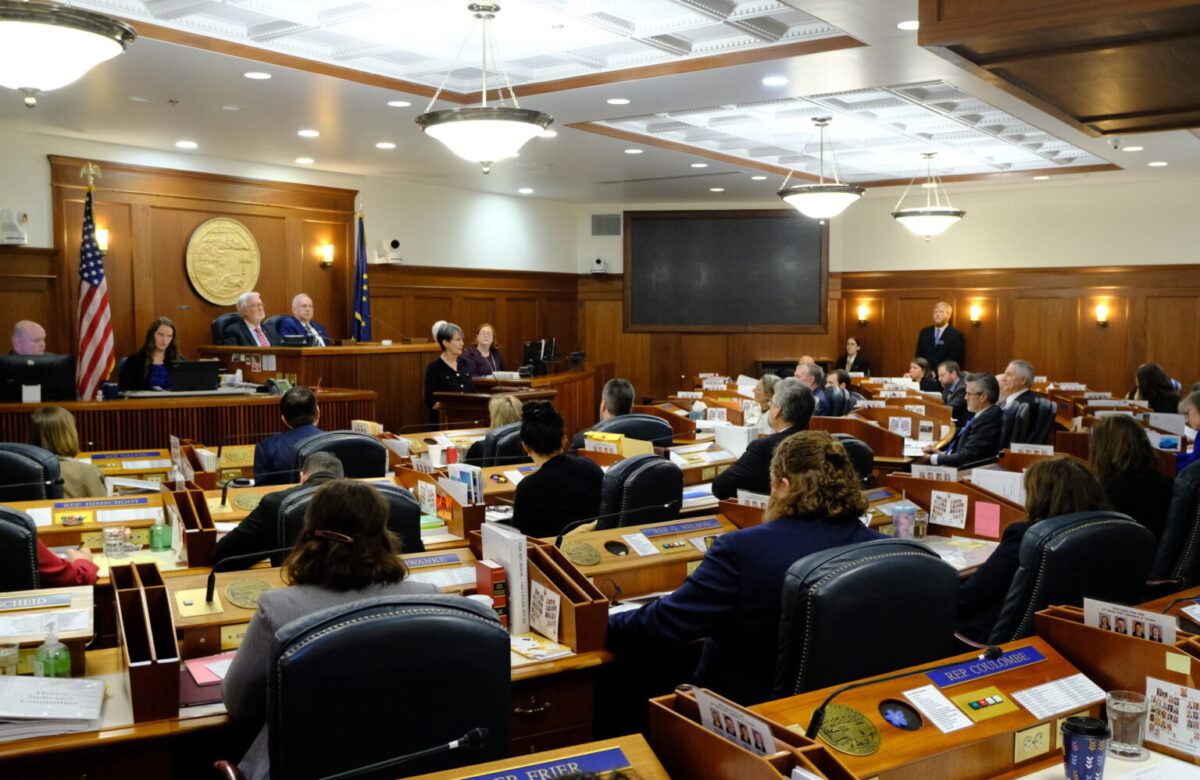
Susan Carney gave the annual State of the Judiciary address to members of the Legislature on Monday. She is now in the second year of her term as chief justice, presiding over the five-member Alaska Supreme Court.
Carney has practiced law in Alaska for over 40 years, and has served on the Supreme Court since 2016, when she was appointed by Gov. Bill Walker. She’s the second woman to serve in the role as chief justice, leading Alaska’s first female-majority Supreme Court.
“We have eliminated the pandemic backlog,” she said. “But I told you last year, and I’ll reiterate to you today, that our work isn’t done.”
Alaska’s court system has grappled with significant pre-trial delays, with some defendants and victims languishing for years before court rulings — as highlighted by investigative reporting from the Anchorage Daily News and ProPublica. The time to resolve the most serious criminal cases, such as murder and sexual assault, has nearly tripled in the last decade, reporters found.
“It’s not comfortable to have the press focus on a few extremely sad but also extremely unusual cases, but it’s valuable for us,” Carney said in her address. “I know that the cases with extreme delay are outliers compared to the vast majority of criminal cases and the time it takes to resolve them, but it’s still heartbreaking to think of the anguish that victims suffer and the problems that delays cause to everybody involved.”
Carney said pending criminal cases ballooned during the COVID pandemic to over 20,000 cases in 2023, which she said was unprecedented. She said with focused efforts, and the legislature’s approved raises for state attorneys, the courts are making progress. “There are now fewer than 11,000 open criminal cases,” she said.
Last year, the Supreme Court ordered limits on continuances, or time extensions granted by judges, in order to limit delays and speed up court proceedings. The order required that there be no more than 270 days of new delays for criminal cases filed in 2022 or before.
“Our order addressed continuance requests because judges are not the ones that delayed cases. Delays happen when an attorney, whether on the defense or prosecution side, asks for more time to prepare for a hearing or to file some kind of document,” Carney said. “And the judge grants that request.”
Carney said the order requires all requests to be made on the record or documented in writing, and judges are given guidelines for making rulings on whether to grant delays. “For example, a medical emergency will almost always be a good cause to put off a case, but negotiations with the other side will just about never be a good cause.”
She said as a result, the number of pending felony cases in criminal court has dropped by more than half.
“On January 1, 2023 there were 1,677 pending felonies, more than two years old. That was nearly one out of every four pending felony cases,” she said “This year, on January 1, 2026 we had fewer than 750 pending felonies over two years old. This is great progress.”
Carney emphasized that criminal cases are complex, and continuing the effort to reduce the backlog requires work from everyone involved — from juries and witnesses, to prosecutors and defense attorneys. “We continue to work with the prosecution and the defense agencies so that we can all keep cutting down the time it takes to move cases through the criminal justice system,” she said.
Carney noted criminal cases make up roughly 30% of all cases in state courts, and the 70% that are civil cases — which can be divorces, child custody, or foster care decisions — are highly emotional and can take extra time and care from judges as well.
“When people come to a courthouse, they are generally having their worst day ever, and they’re going through very challenging and often life changing circumstances. We work hard every day to provide not only fair and reasonable decisions, but to recognize the difficulties that Alaskans are having when they come into our courthouses and to explain and to help them feel heard and feel that we understand them,” she said.
Moving forward, Carney said the courts have requested one new Superior Court judge in Palmer to address the growing case load of the Matanuska-Susitna Borough’s growing population. The four judges based in Palmer are handling an average of 683 cases per judge, compared to a statewide average of 458 cases per judge, according to state data.
“They are the busiest in the state, and they have been the busiest each of the last five years,” she said, adding that judges from Anchorage to Valdez have stepped in to relieve the burden.
“This is mostly for criminal and Child in Need of Aid cases, but that leaves all the other kinds of cases — the divorces, the custody business matters — just waiting,” she said. “We do not want to clear out all the oldest criminal cases only to find a similarly problematic group of old civil cases causing our new crisis.”
Rep. Andrew Gray, D-Anchorage, who chairs the House Judiciary Committee, after the speech questioned whether just one more judge is enough. “The idea that we just need one judge is, I find, a little bit conservative. I think we might need more judges,” he said.
Gray has called for the state to expand the number of prosecutors and public defenders. He said imposed timelines for trials is a concern, with overburdened attorneys carrying high case loads, and can risk a mistrial and more delays.
“Our prosecutors and our public defenders have too many cases. We need more of them. We need to lower their caseloads,” he said. “That’s going to improve these timelines the most, and ensure that folks are getting the best lawyer available who’s fully prepared and ready to do the work.”
Carney, in an interview after the address, said the request for the Palmer Superior Court is the focus for now. “Bringing in another judge will, I think, at the very least, mean that we don’t have to keep bringing judges from other places,” she said. “I think it will allow us to keep even at this point.”
Lawmakers are now considering House Bill 262, which would expand the number of judges, which passed the House Judiciary Committee on Monday. If the bill becomes law, the Alaska Judicial Council would put forward recommendations for a new state judge that would then be approved by the governor.