







Categories
Featured Juneau News Juneau Local Ketchikan Local News Feeds Sitka Local

8.8 magnitude quake strikes off Russia’s Far East. prompting tsunami warnings in Alaska

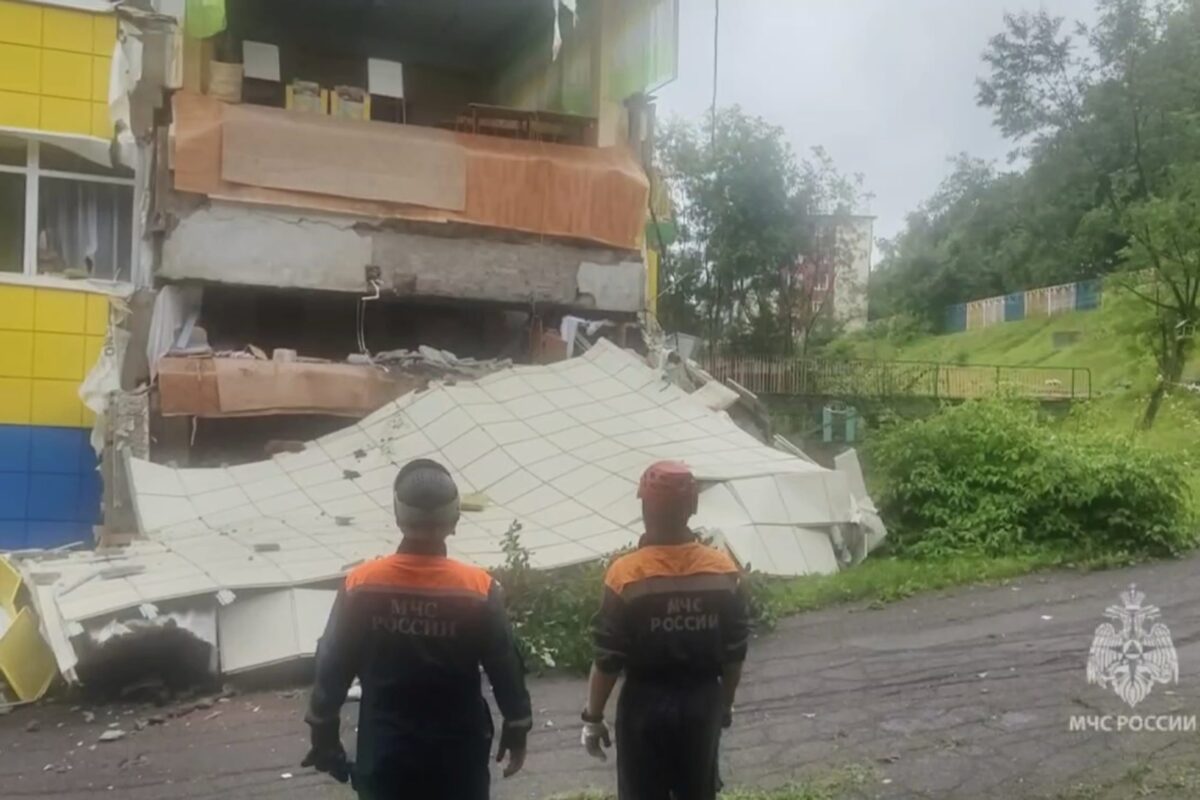
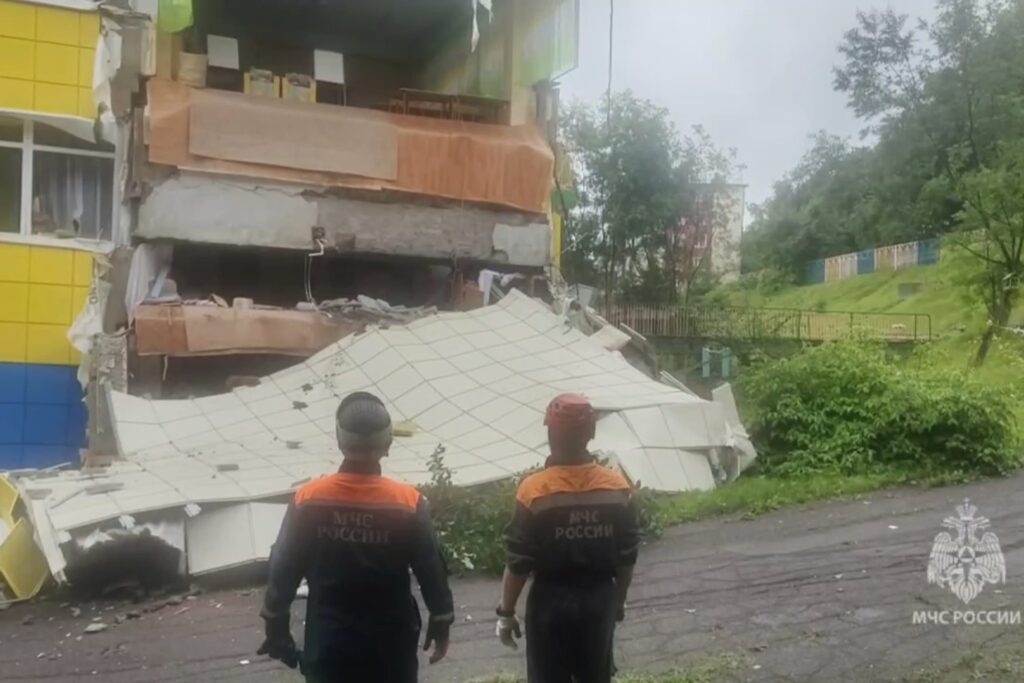
In this image taken from a video released by Russian Emergency Ministry Press Service, rescuers inspect a kindergarten damaged by an earthquake in Petropavlovsk-Kamchatsky, Russia, Wednesday, July 30, 2025. (Russian Emergency Ministry Press Service via AP)

AP- One of the strongest earthquakes ever recorded struck off Russia’s sparsely populated Far East early Wednesday, sending tsunami waves into Japan, Hawaii and the U.S. West Coast. Several people were injured, but none gravely, and no major damage has been reported so far.

Authorities warned the risk from the 8.8 magnitude quake could last for hours, and millions of people potentially in the path of the waves were initially told to move away from the shore or seek high ground.

But the danger already appeared to be lessening in some places, with authorities downgrading their warnings in Hawaii, Japan and parts of Russia.

Residents fled inland as ports flooded on Kamchatka near the quake’s epicenter, while frothy, white waves washed up on the shore in northern Japan. Cars jammed streets and highways in Honolulu, with standstill traffic even in areas away from the sea.

People flocked to evacuation centers in affected areas of Japan, with memories fresh of the 2011 earthquake and tsunami that caused reactor meltdowns at a nuclear power plant. No abnormalities in operations at Japan’s nuclear plants were reported Wednesday.

Russian authorities said several people were injured, but said all were in stable condition, though they gave few details. In Japan, at least one person was injured.

A tsunami height of 3 to 4 meters (10 to 13 feet) was recorded in Kamchatka, 60 centimeters (2 feet) on Japan’s northern island of Hokkaido, while tsunami waves about 2 to 5 feet high reached San Francisco early Wednesday, officials said.

Much of the West Coast, spanning California, Oregon, Washington state, Briefly coastal Alaska and the Canadian province of British Columbia, were under a tsunami advisory.

Hawaii downgrades to tsunami advisory

Hawaii was still under a tsunami advisory as Wednesday began, but evacuation orders on the Big Island and Oahu, the most populated island, had been lifted.

An advisory means there is the potential for strong currents and dangerous waves, as well as flooding on beaches or in harbors.

“As you return home, still stay off the beach and stay out of the water,” said James Barros, administrator of the Hawaii Emergency Management Agency.

The impact of the tsunami could last for hours or perhaps more than a day, said Dave Snider, tsunami warning coordinator with the National Tsunami Warning Center in Alaska.

“A tsunami is not just one wave,” he said. “It’s a series of powerful waves over a long period of time. Tsunamis cross the ocean at hundreds of miles an hour — as fast as a jet airplane — in deep water. But when they get close to the shore, they slow down and start to pile up. And that’s where that inundation problem becomes a little bit more possible there.”

Hawaii Gov. Josh Green earlier said Black Hawk helicopters were activated and high-water vehicles ready to go in case authorities needed to rescue people.

The Oregon Department of Emergency Management said on Facebook that small tsunami waves were expected along the coast. It urged people to stay away from beaches, harbors and marinas and to remain in a safe location away from the coast until the advisory is lifted.

“This is not a major tsunami, but dangerous currents and strong waves may pose a risk to those near the water,” the department said.

A tsunami of less than 30 centimeters (under 1 foot) was forecast to hit parts of Vancouver Island, British Columbia, and waves of up to 1.4 feet (under 30 centimeters) above tide levels were observed in Alaska’s Aleutian Islands.
Categories
Featured Juneau News Juneau Local Ketchikan Local News Feeds Sitka Local

An Alaska tsunami warning had residents scrambling for high ground after 7.3 magnitude earthquake

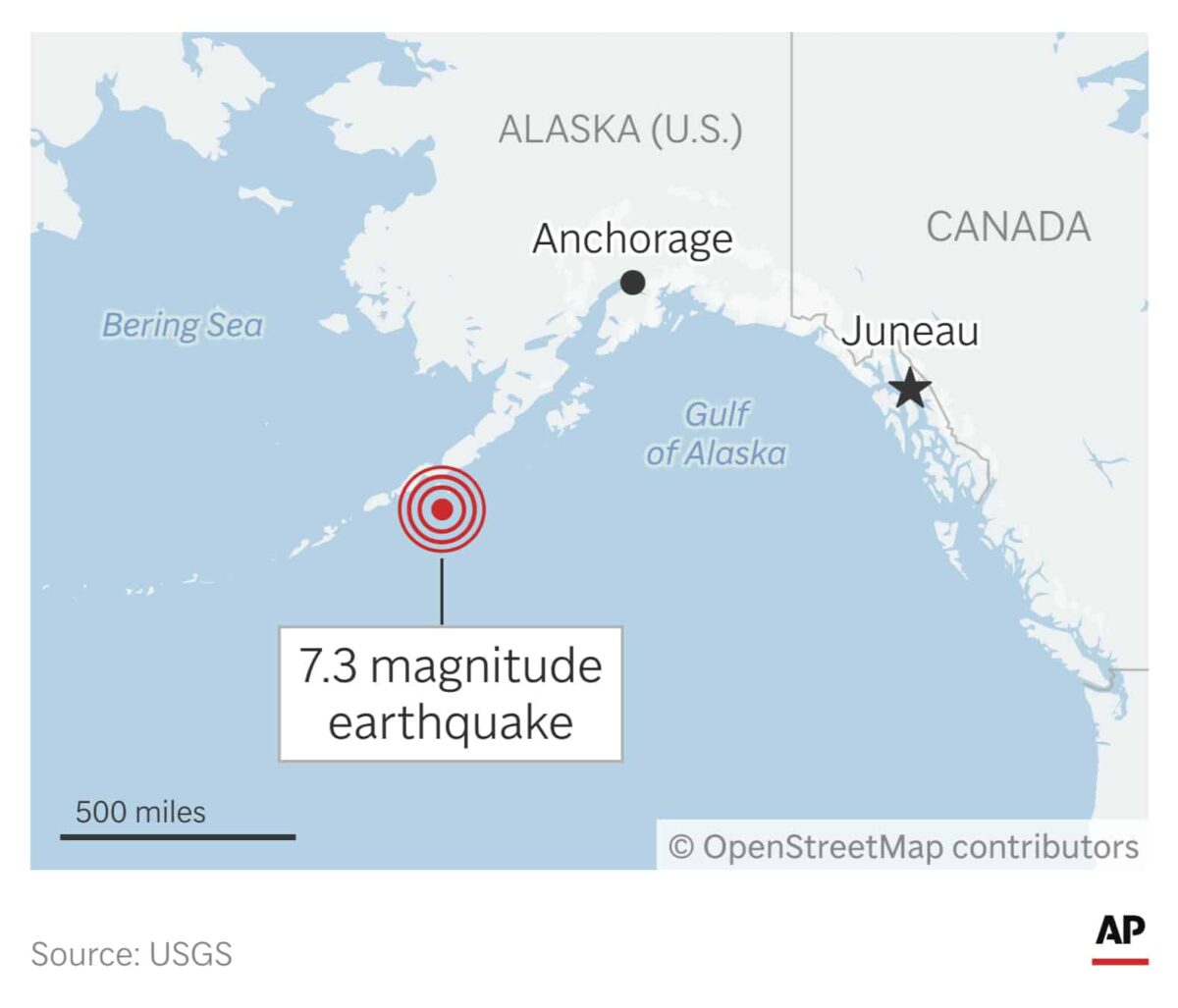
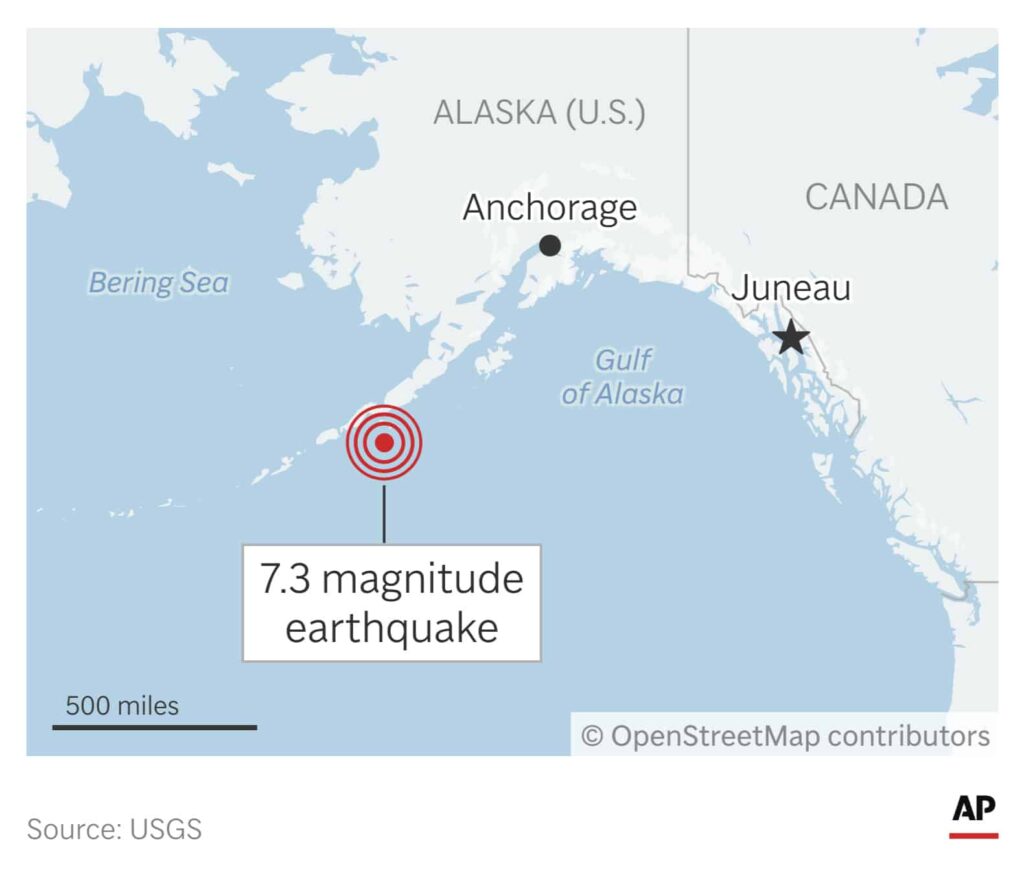
A strong earthquake Wednesday off the Alaska coast triggered a tsunami warning. (AP Graphic)

(AP) — Communities along a 700-mile (1,127-km) stretch of Alaska’s southern coast ordered residents to higher ground after a powerful offshore earthquake Wednesday, but officials quickly downgraded and then canceled a tsunami warning for the region. There were no reports of significant damage.

The earthquake, with a preliminary magnitude of 7.3, struck at 12:37 p.m. local time south of Sand Point, a community of about 600 people on Popof Island, in the Aleutian chain, according to the Alaska Earthquake Center.

There were 40 aftershocks detected within the first three hours, the center said.

“We have seen other earthquakes in the area that have not generated significant tsunami waves, but we’re treating it seriously and going through our procedures, making sure communities are notified so they can activate their evacuation procedures,” said Jeremy Zidek, a spokesperson for Alaska’s emergency management division.

The quake was felt as far away as Anchorage, almost 600 miles (966 km) to the northeast.

The National Tsunami Warning Center issued a warning for an area stretching from about 40 miles (64.4 km) southwest of Homer to Unimak Pass, a distance of about 700 miles (1,126 kilometers). Among the larger communities in the area was Kodiak, with a population of about 5,200. The warning was downgraded to an advisory about an hour later, and canceled just before 2:45 p.m.

The highest water level generated by the earthquake in Sand Point was not quite 2.5 inches (6.3 cm) above the tide, the center said.

“There’s no damage at the airport, doesn’t appear to be any damage at the harbor, no damage to speak of, really,” Sand Point Police Chief Benjamin Allen said.

There was some damage — in the form of broken bottles — at the Alaska Commercial general store in town. Manager Vickey McDonald said about half of the store’s alcohol aisle had crashed and shattered.

“I’ve got liquid smoke and barbecue sauce and pickles … broken on the floor,” McDonald said. “It smells horrendous in here.”

In Unalaska, a fishing community of about 4,100, officials urged people in possible inundation zones to move at least 50 feet above sea level or 1 mile (1.6 km) inland. In King Cove, which has about 870 residents on the south side of the Alaska Peninsula, officials sent an alert calling on those in the coastal area to move to higher ground.

Tourists Jodie Stevens and her husband, Aaron Park, were looking at the puffins at the Alaska SeaLife Center in Seward when they heard someone yelling that there had been an earthquake and they needed to evacuate. They walked a few blocks uphill in the rain, with a woman from the center yelling to those they passed to get to higher ground.

They were about halfway to the official high ground spot when they heard a siren signal that all was clear, she said.

The National Weather Service said in posts on social media that there was no tsunami threat for other U.S. and Canadian Pacific coasts in North America, including Washington, Oregon and California.

Alaska’s southern coast is earthquake-prone, and Wednesday’s was the fifth in roughly the same area since 2020 exceeding magnitude 7, state seismologist Michael West said.

“Something’s moving in this area,” he said. “I would not call this an isolated earthquake. It appears to be part of a larger sequence spanning the last several years.”

That has the attention of seismologists, he said.

“This area has been and remains capable of larger earthquakes and earthquakes capable of significant tsunami damage,” he said.