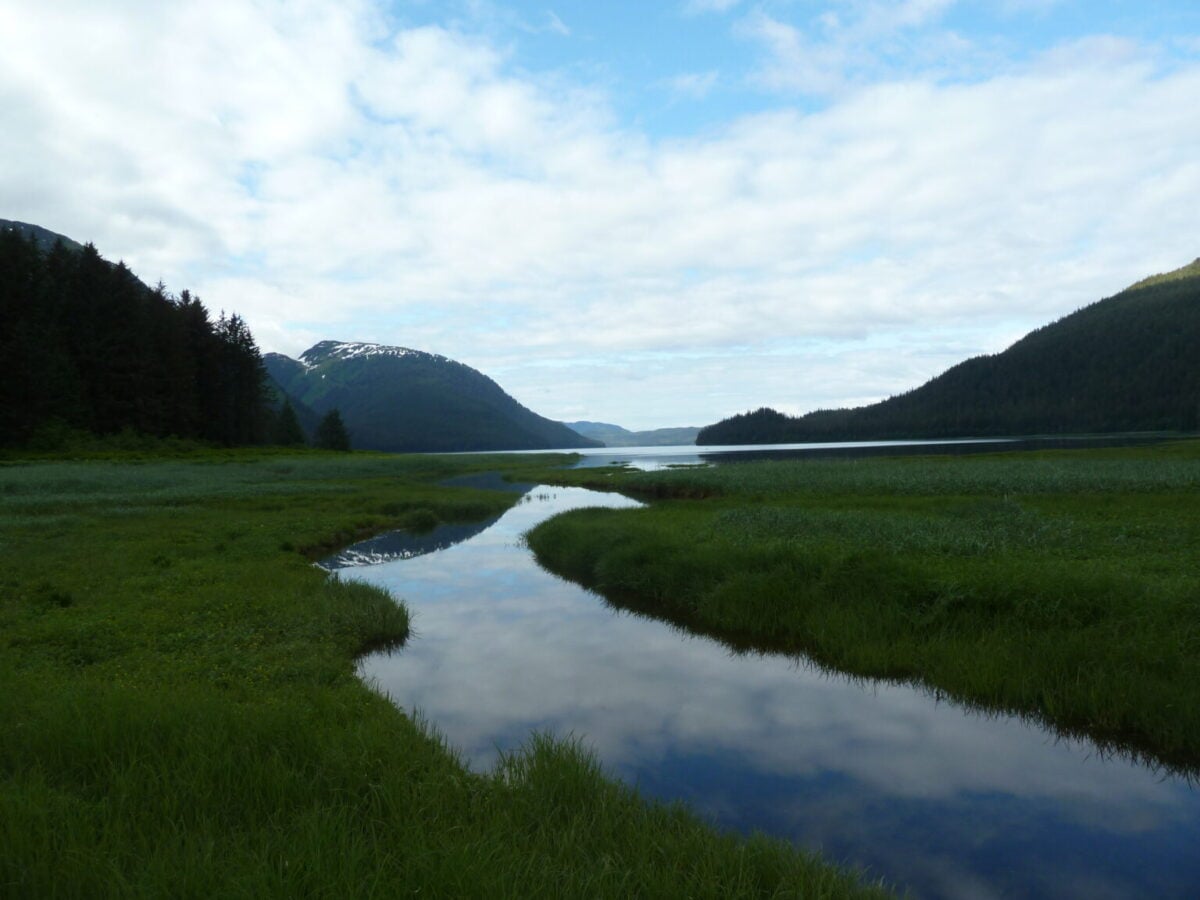
A stream reflects the clouds on June 20, 2011, in Kootznoowoo Wilderness, Admiralty Island National Monument, Tongass National Forest, Alaska. (Forest Service photo by Don MacDougall)
A federal judge in Alaska has rejected a lawsuit that sought to reinstate a management plan that would allow heavier logging in the world’s largest temperate old-growth rainforest.
The result leaves an Obama-era management plan in place, but it could be short-lived: The administration of President Donald Trump is already at work on a new plan that could allow more logging in Alaska’s Tongass National Forest.
In an order published Friday, Judge Sharon Gleason dismissed the lawsuit filed by Viking Lumber, Alcan Timber and the Alaska Forest Association.
The three groups sued the U.S. Department of Agriculture — the parent organization of the U.S. Forest Service — last year, alleging in part that the federal Tongass Timber Reform Act of 1990 required the Forest Service to offer enough timber sales to meet market demand.
Gleason ruled otherwise, finding that TTRA does not impose “a mandatory duty” on the Forest Service to ensure that market demand is met by Tongass timber sales.
“Whether the harvest levels are designed to actually meet market demand is a discretionary agency action, not a mandatory requirement imposed by the TTRA on the Forest Service,” she wrote.
Gleason also declined to take up plaintiffs’ argument about whether the Forest Service violated the Administrative Procedures Act, and she ruled that a 2021 announcement about Tongass strategy did not amount to formal rulemaking under law. She did not analyze whether it would have met legal standards if it had been a formal rulemaking process.
Plaintiffs were represented by Pacific Legal Foundation, which on Friday said that the Forest Service’s approach has been devastating to plaintiffs.
Kyle Griesinger, a spokesperson for the foundation, said that even with a new management plan in the works, the case isn’t moot because the old plan remains in effect until superceded.
“And, moreover, the Forest Service has not lived up to the 2016 plan so any new plan they may not live up to is no guarantee for our clients,” he said.
Marlee Goska, an attorney for the Center for Biological Diversity, agreed that last week’s ruling still has merit.
Goska was one of several attorneys who represented tribal, tourism, fishing and environmental groups that intervened on the side of the Department of Agriculture.
“I don’t think we have enough information yet to say the Forest Service is going to implement what the plaintiffs want. And certainly we’ll fight tooth and nail to stop that from happening,” she said of the upcoming plan change.
Goska added that last week’s ruling is important because it shows that the Forest Service does not have to meet market demand under existing law, and it shows that federal law doesn’t draw a distinction between old-growth harvests and new-growth ones.
“To the extent this administration and the Forest Service might be thinking about saying the TTRA mandates large old-growth timber sales to meet market demand, the court has already said that is incorrect,” she said.
Gleason published a final judgment on Friday. Plaintiffs have 30 days to file an appeal.
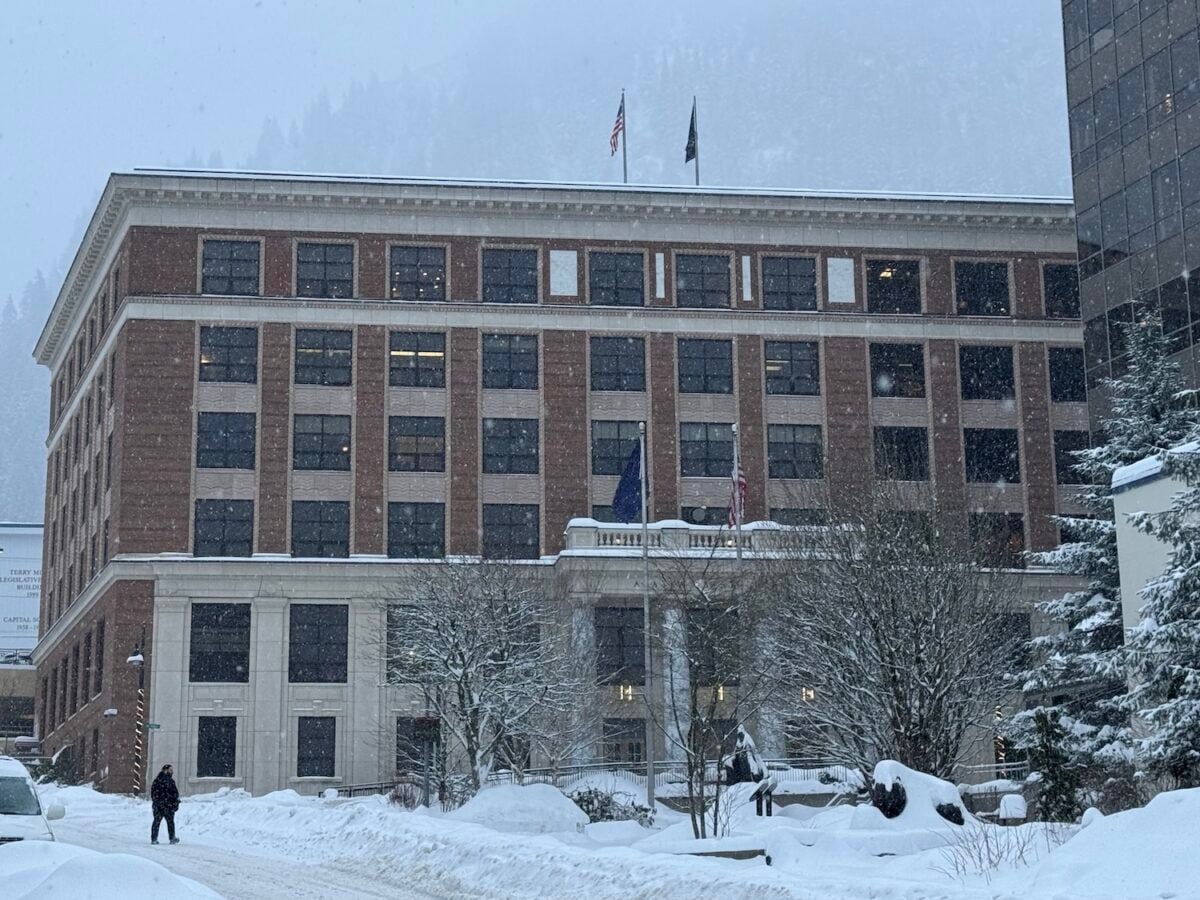
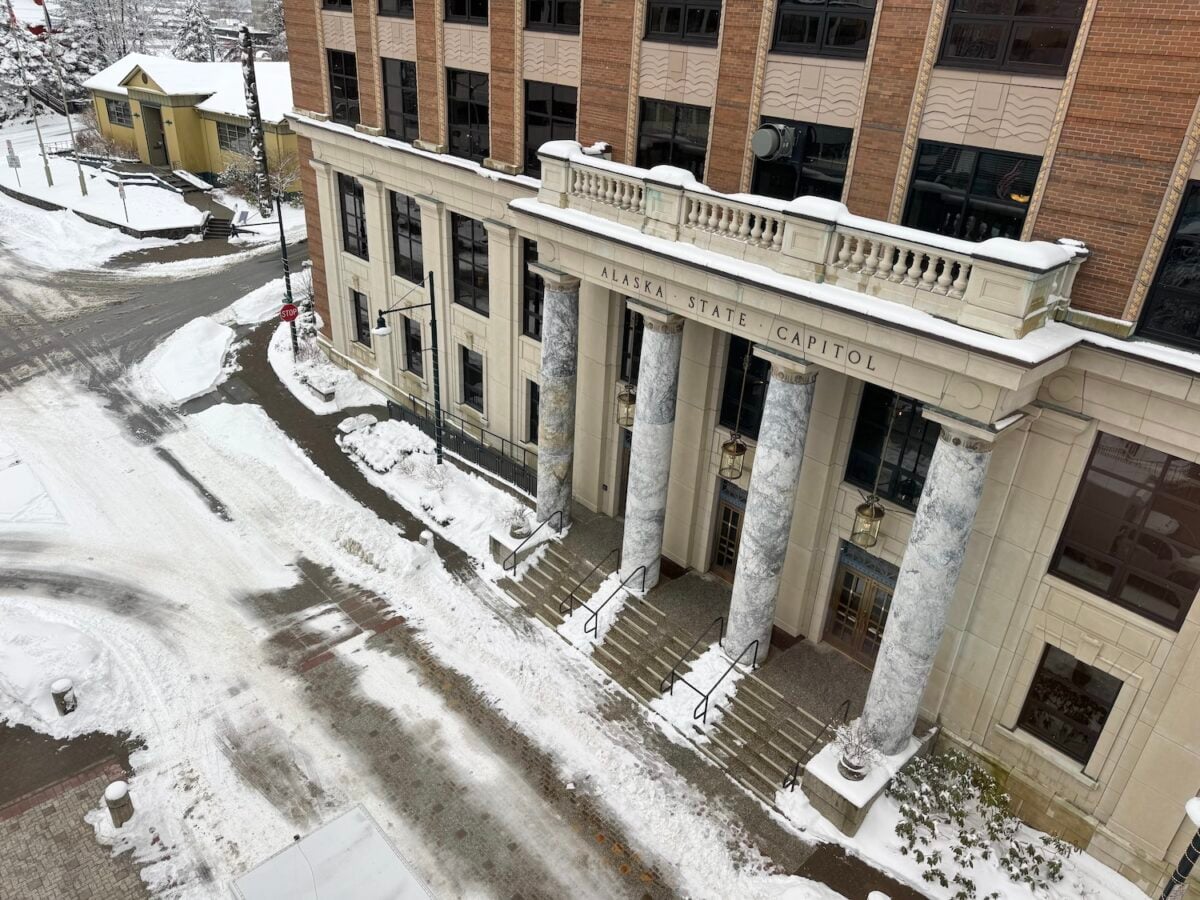
The Alaska State Capitol is seen on Wednesday, March 4, 2026. (James Brooks photo/Alaska Beacon)
By: Corinne Smith and James Brooks, Alaska Beacon
The Alaska State Capitol is seen on Wednesday, March 4, 2026. (James Brooks photo/Alaska Beacon)
A potential $500 million windfall is giving the Alaska House of Representatives a headache.
On Friday, the Alaska Department of Revenue released a forecast predicting that the state of Alaska will collect hundreds of millions of dollars more oil revenue by June 30 than previously expected.
That forecast landed in the middle of an ongoing debate over whether or not to spend from savings to cover almost $530 million in extra expenses, largely added by Gov. Mike Dunleavy, to the state budget since last spring.
The Senate approved a proposal to pay for roughly three-quarters of those expenses and it is now in the state House, awaiting a vote that could come as soon as Monday.
Tensions rose on Friday, with no agreement among House lawmakers on how to pay for the proposal.
The House is led by a 21-person multipartisan coalition whose members have been urging fast action on the issue. They say it is particularly important to fund $70 million for the state’s transportation projects to unlock more than $630 million in additional federal funding.
Without sure money, majority lawmakers say projects can’t go out to bid and construction firms can’t make purchasing and hiring decisions.
The majority wants to use the state’s Constitutional Budget Reserve, a savings account, to provide guaranteed funding.
The majority can pass a bill on its own, but it can’t spend from savings on its own. It takes 30 members of the House and 15 from the Senate to approve spending from the Constitutional Budget Reserve, the state’s principal savings account.
The Senate has already given that approval, but in the House, at least nine members of the 19-person, all-Republican House minority would have to support the majority, and so far, they’re not willing to do that.
Part of that reluctance is because as currently written, the supplemental budget bill allows lawmakers to spend up to $373.6 million from the reserve regardless of whether or not the war-caused bonus becomes real.
If oil prices stay high and the reserve money isn’t needed, the majority could spend it on other things without further input from the minority. That’s because it takes only 21 votes to advance a budget bill.
The money would return to the reserve only if it was unspent at the end of the fiscal year.
If lawmakers don’t spend from savings and the Iran war ends unexpectedly quickly, causing oil prices to fall, the minority could vote to spend from savings later to fill the gap.
The result is an ironic set of circumstances — Trump has said that the war will be short, but minority House Republicans’ action is effectively a bet on a long war.
Minority members say they’re being fiscally responsible. So do members of the majority, who add that there’s an opportunity cost for any delay — Alaska construction companies can’t make plans for the summer until they know what projects they’ll need to build.
Majority members also expressed frustration that the supplemental budget was largely requested by the governor, who they say has been absent in negotiations.
In addition, legislators and Gov. Dunleavy could also find themselves with a problem if oil prices fall after legislators have adjourned for the summer.
Legislators typically write budgets based on forecasts from the Department of Revenue, but this year’s forecast is especially uncertain, the department said.
Rep. Calvin Schrage, D-Anchorage, co-chair of the House Finance Committee and a member of the majority, said he’s skeptical of banking on the forecast.
“I have a lot of concern over budgeting based on that forecast, because that’s all it is. It’s a forecast. It’s not realized money, it’s not money in hand,” he said Friday.
“Even with this optimistic forecast, you are just barely, maybe able to balance the budget — if everything goes perfect. We still don’t have additional supplementals,” he said, referring to more budget amendments that could be requested by the governor.
Schrage said lawmakers will be scrutinizing the forecast in the coming days and weeks, and he said there’s still the possibility the Legislature may need to draw from savings.
But minority Republicans said they considered drawing from savings fiscally irresponsible.
“Taking a draw from our savings account to put into the general fund to fund things that were, by all accounts and purposes, able to be funded without it would have been irresponsible,” said Rep. Justin Ruffridge, R-Soldotna, on Friday.
House Minority Leader DeLena Johnson, R-Anchorage, said she’s confident in the forecast projections. “There’s some actuals there too. So I’m very comfortable with actuals, and I also know, if there’s changes, we can come in and we can come in and make them, and make a different vote. I’m not as worried about that.”
Speaker of the House Bryce Edgmon, I-Dillingham, expressed frustration at the delay.
“This is pure politics. We should have had the supplemental budget funded. A long time ago,” he said. “The House Majority coalition prioritized the funding of the entire package that was proposed by the governor. Every single item came from the governor. And so here we are, you know, in a really precarious state, because we’re at the point where every week that goes by gets us a week closer to that federal match not being achieved for the summer construction season.”
Edgmon and other majority legislators have voiced frustration about “moving goal posts” on the budget bill. While there are more than $530 million in proposed additions, the bill in front of House lawmakers contains only three-quarters of that amount because majority members wanted to attract members of the minority for the savings vote.
The remainder will still have to be addressed later, regardless of what happens in the upcoming vote.
Edgmon said it’s not clear to him what the Republican minority wants in exchange for a budget reserve vote.
“We don’t know what the ask is,” he said. “But it’s all about leverage, and unfortunately, it’s falling on the shoulders of a lot of smaller contractors around the state.”
As of Friday afternoon, it appeared as if the budget bill was on course to pass, but without approval to spend from savings.
If that occurs, the state of Alaska will be in the awkward position of hoping for a war long and difficult enough to keep oil prices high for months.
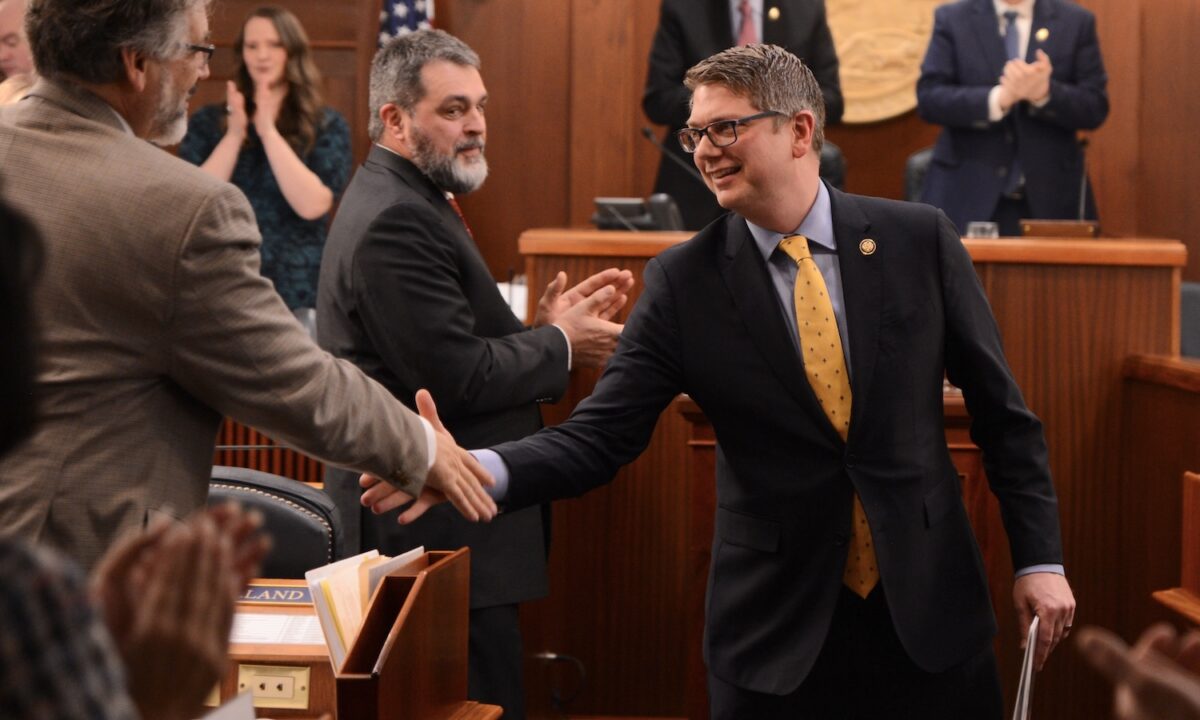
Rep. Nick Begich III, R-Alaska, shakes hands with state Rep. Ky Holland, I-Anchorage, as he leaves a joint session of the Alaska Legislature on Tuesday, March 10, 2026. (James Brooks photo/Alaska Beacon)
By: James Brooks, Alaska Beacon
Rep. Nick Begich III, R-Alaska, shakes hands with state Rep. Ky Holland, I-Anchorage, as he leaves a joint session of the Alaska Legislature on Tuesday, March 10, 2026. (James Brooks photo/Alaska Beacon)
In a speech to the Alaska Legislature this week, Alaska Rep. Nick Begich III urged state lawmakers to boost the development of a proposed trans-Alaska natural gas pipeline.
“The federal path is largely cleared, but investors also need state level clarity, fiscal predictability and simplicity,” Begich said. “Scrutinize it carefully, model it thoroughly. But my request to you is not to become a roadblock.”
But legislators who are dealing with the pipeline on a daily basis say they don’t have answers to basic questions, including how much the pipeline will cost and whether the gas it carries will be affordable to Alaskans.
“I have not seen any figures,” said Sen. Cathy Giessel, R-Anchorage and chair of the Senate Resources Committee.
Senate President Gary Stevens, R-Kodiak, said legislators are not going to be a roadblock.
“We’re not going to throw sand in the works. Everybody wants a pipeline. We all hope that it comes about, but it’s got to be done properly and make sure that we know what’s going on.”
Sen. Bill Wielechowski, D-Anchorage, said he has heard “from very credible sources” that the price of gas through the pipeline could be $50 per million cubic feet by 2046.
The current cost of gas from Cook Inlet for Southcentral Alaska is about $10 per MCF.
“Just imagine if you have utilities locked into 30-year contracts for gas at $50 an MCF. That would be catastrophic,” Wielechowski said. “That’s the sort of thing that we’re trying to protect Alaskan consumers all up and down the Railbelt from — an absolute catastrophe to our economic system.”
As currently proposed, the pipeline project consists of two phases. The first phase includes an 807-mile pipeline from the North Slope to the west side of Cook Inlet, with a tie-in to existing natural gas infrastructure around Anchorage.
The second phase would extend the pipeline to the Kenai Peninsula, where an export terminal would be built. The second phase would also include a processing plant on the North Slope.
Since the acquisition, Glenfarne has signed a number of nonbinding agreements with potential gas purchasers and gas sellers, but it has not disclosed estimates for the project’s cost, and it hasn’t disclosed what it expects the cost of gas to be.
Last year, company officials said they expected to make an investment decision by the end of 2025. In a subsequent filing with the Federal Energy Regulatory Commission, they said they would make the decision in February. A new timeline hasn’t been made public.
The lack of data is particularly problematic because legislators are considering whether to offer a property tax break to pipeline developers.
Those taxes are significant. Because Alaska does not have a statewide income tax or sales tax, its state budget suffers when people move into the state. More people means more demand for things like schools, parks and roads, but no increased revenue to pay for those things.
“That bill should be next week,” Dunleavy said during a Thursday news conference with U.S. Interior Secretary Doug Burgum, confirming the 0.2% rate will be part of the new legislation.
“Last couple weeks, we’ve been working with municipalities, getting their input as to what this should look like before (we) put the bill out,” he said. “So look forward to probably next week on that PILT bill, so that we can look at the economics of this line and also ways to ensure that municipalities benefit from this directly.”
This week, Begich expressed some support for a lower property tax rate, saying it could encourage people to invest in the pipeline.
“The classic 2% tax burden that would apply, say, to a $50 billion asset, would be a billion dollars in cash flow early in the project’s life cycle,” Begich said. “If that cash flow coming out of the project lowers the rate of return for investors, they’re not going to show up and invest. And so we need to make sure that our tax policy is A, doing what’s right for Alaskans. B, is not impeding the ability for the project to move forward. And I think we can do both of those things with some creative thinking and conversations with the industry.”
While a lower tax rate would benefit pipeline developers, it has the potential to harm residents who live near the pipeline.
If pipeline construction and operation mean more people moving to Alaska and municipalities are unable to raise revenue to meet the resulting demand for services, local governments could be forced to raise taxes or cut basic services in order to pay for the pipeline subsidy.
Last week, the Senate Resources Committee introduced Senate Bill 275, which imposes some transparency requirements on the pipeline project, eliminates a tax exemption relevant to the project, and imposes a new surcharge on gas processing plants.
That bill was introduced just days before Begich urged lawmakers not to be a “roadblock.”
Giessel, who chairs the resources committee, said she didn’t think Begich’s comments were directed at her or her committee’s bill.
“We’re not being a roadblock. We’re doing exactly what we’re supposed to do according to our constitution,” she said.
Asked whether he was thinking of Giessel’s bill during his speech, Begich said, “It was not my direct intention. No, I think it’s always worth having the conversation about the tax structure, about the incentive structure, though that’s an ongoing discussion that happens at the state legislature in Alaska. I think it’s important that when we have those conversations, they’re done in a way that is going to encourage, rather than discourage, industry from coming in and saying, ‘Yes, this is a good place for us to invest in.’”
Speaking to reporters after his speech, Begich said the state would benefit by getting more information from Glenfarne.
“I welcome more information,” Begich said. “I recognize that they’ve got certain restraints on what they can share. But look, I’d like to see more information shared. I’d like to see more of the economics of the project shared so we can understand what the full potential is and what’s on the table. I believe that’s going to come with time, but more information is better.”
"I voted" stickers are seen on display in the headquarters offices of the Alaska Division of Elections in Juneau on Tuesday, Nov. 12, 2024. (Photo by James Brooks/Alaska Beacon)
“I voted” stickers are seen on display in the headquarters offices of the Alaska Division of Elections in Juneau on Tuesday, Nov. 12, 2024. (Photo by James Brooks/Alaska Beacon)
NOTN- Alaska lawmakers considered a wide-ranging elections bill today that supporters say would expand voter access and strengthening election security.
The House Finance Committee scheduled hearings on Monday as well as this morning on Senate Bill 64, a measure covering a broad range of election policies, including voter registration, campaign rules and election administration.
The bill would create a ballot curing process which would allow absentee voters to fix mistakes like missing signatures.
According to testimony submitted to lawmakers, more than 1,300 ballots were rejected in 2024, many due to correctable issues like improper witness signatures.
The proposed bill would also require the state to create an online ballot-tracking system so voters can see when their ballot is sent, received and counted. The bill includes prepaid postage for absentee ballots to improve access for voters, especially for voters in rural communities.
The bill also calls for a rural community liaison within the Division of Elections to work with tribes and municipalities to improve early and absentee voting access in remote areas.
Supporters, including the League of Women Voters of Alaska, Alaska Voter Hub and the Alaska Federation of Natives say the reforms are necessary because of Alaska’s geography and the challenges rural voters face with mail service, staffing shortages and limited polling locations.
The Alaska State Capitol is seen on Monday, March 9, 2026. (James Brooks photo/Alaska Beacon)
By: James Brooks, Alaska Beacon
The Alaska State Capitol is seen on Monday, March 9, 2026. (James Brooks photo/Alaska Beacon)
The Alaska Senate voted unanimously Wednesday to spend more than $300 million from savings and reverse some of Gov. Mike Dunleavy’s most recent budget vetoes.
In a pair of 20-0 votes, the Senate approved a bill that would spend $373.5 million from the Constitutional Budget Reserve to pay for a variety of expenses and fill a deficit in the current budget year.
“This is money to fund the budget that was passed last year for things that the governor already spent on,” said Sen. Bill Wielechowski, D-Anchorage.
The bill now goes to the House, which failed last month to approve the needed spending from the budget reserve.
Among the expenses in the new supplemental budget bill is $70.2 million needed to unlock federal transportation grants. Dunleavy vetoed that funding last year amid a dispute with the Legislature about the proper source of the money.
Also in the bill is $98.7 million for the state’s wildfire response fund and up to $75 million for the disaster relief fund. That latter figure is dependent upon negotiations with the federal government about who will pay for the response after ex-Typhoon Halong devastated southwest Alaska last year.
The largest single item in the bill is $129.6 million needed to refill the state’s higher education investment fund, which was used to cover expenses due to a separate veto-involved dispute between the Legislature and governor.
That fund covers scholarships paid to Alaska high school students who meet academic standards and attend in-state schools.
The Senate-passed bill is significantly smaller than a $531 million version that had been previously considered. It shrank at the urging of the Senate’s six-person, all-Republican minority caucus.
It takes three-quarters of the House and three-quarters of the Senate — 30 Representatives and 15 senators, respectively — to spend from the budget reserve.
That’s a high hurdle, particularly because the Senate’s bipartisan majority caucus has just 14 members and the House’s multipartisan majority has just 21 members.
In both cases, compromises with the all-Republican House and Senate majorities are needed to spend from the reserve.
On Monday, the Senate pulled the supplemental budget bill from its schedule with no advance notice. Sen. Lyman Hoffman, D-Bethel, said at the time that the Senate Majority had unexpectedly lost a minority vote it needed to spend from the reserve.
That spurred hours of closed-doors negotiations between the Senate minority and members of the majority.
Since the United States and Israel started bombing Iran on Feb. 28, the price of oil — and, in turn, Alaska’s potential oil revenue — has risen, giving legislators another way to erase a looming deficit.
“We went over and talked with (the Senate Finance Committee) co-chairs and just said, ‘Hey, obviously, the price of oil is changing,’” said Senate Minority Leader Mike Cronk, R-Tok.
At the minority’s urging, the co-chairs removed almost $150 million from the bill — extra spending for state prisons, money for Medicaid, and millions in backup “headroom” for unforeseen expenses, among other items.
Cronk said the items removed during the compromise discussions could come back later, in the state’s regular budget bill, and the goal was to create “a real supplemental fast track” bill.
According to figures provided by staff for Hoffman, if Alaska North Slope oil prices average roughly $75 per barrel between now and June 30, the end of the state’s fiscal year, the state will earn enough oil revenue to pay for the removed items without spending from savings.
Since the start of the legislative session, construction companies have been lobbying for quick passage of a supplemental budget bill because they fear losing hundreds of millions of dollars’ worth of federally funded construction projects scheduled to take place as soon as this summer.
The Alaska Department of Transportation and Public Facilities has disputed the need for early funding, and on Wednesday, Sen. George Rauscher, R-Sutton, attempted to strike that item from the supplemental budget.
He withdrew his proposed amendment after encountering opposition, saying he was satisfied with the smaller bill on the floor.
“We’ve come down a long way from $500 million,” he said.
After the Senate voted on Wednesday morning, members of the House majority attempted to call a vote to confirm the Senate’s changes.
Members of the House minority objected, and the vote is now scheduled later, at 2:30 p.m. Thursday.
House Minority Leader DeLena Johnson, R-Palmer, said members of the minority wanted to wait until Friday, when a new state revenue forecast is expected.
“We’re talking about a $300 million draw. We may not need to take that full amount out of savings when we have money coming in,” she said, referring to the way the price of oil has surged during the Iran war.
Asked whether the new, lower draw from the reserve is more acceptable to members of the minority, Johnson said she wasn’t sure yet.
“There’s probably a number that’s better than others, but I mean, as low as possible is our number,” she said.
Wooden gavel with books in background. Law and justice concept
By: James Brooks, Alaska Beacon
Wooden gavel with books in background.
The state of Alaska filed civil lawsuits Tuesday against six crowdfunding websites, accusing them of illegally soliciting donations for thousands of Alaska charities without consent.
In complaints filed at Anchorage Superior Court, the consumer protection unit of the Alaska Department of Law said GoFundMe, PayPal, Charity Navigator, Pledgling Technologies, JustGiving and Network For Good each violated the Alaska Charitable Solicitations Act thousands of times.
That act, in place since 1993, requires state registration for anyone who seeks donations on behalf of a charity.
The suits ask a judge to order the sites shut down the pages devoted to Alaska nonprofits and immediately disburse any donations to those nonprofits. It also asks for “separate civil penalties … of not less than $1,000 and not more than $25,000 per violation.”
According to the complaints, the six crowdfunding sites scraped IRS data to obtain the information of thousands of Alaska nonprofits, then set up donation pages for each of those nonprofits without their consent.
That scraping was part of a nationwide campaign that encompassed almost a million and a half federally registered organizations.
In some cases, the sites charged fees or encouraged “tips” to themselves during the donation process. In many cases, they poured donations into a third-party account and only released donations to charities who stepped forward to claim them, according to the complaints.
Attorney General-designee Stephen Cox said the state became aware of the issue after California reporters and state officials began investigating why GoFundMe created donation pages for 1.4 million nonprofits without their consent or knowledge.
GoFundMe later took down many of those pages, but other crowdfunding websites did not. On Tuesday morning, donation pages were still visible on Charity Navigator, one of the defendants named in the new Alaska lawsuits.
Earlier this week, almost two dozen state attorney generals sent a letter to GoFundMe, demanding answers to questions about its policies.
Alaska did not sign that letter, in part because officials here believed the response was too weak.
In a prepared statement, Cox said, “Alaska law is clear: if you’re going to raise money in a charity’s name, you must first get the charity’s consent. These lawsuits are about protecting donors, protecting nonprofits, and preserving the public trust that makes charitable giving possible.”
Laurie Wolf is President and CEO of the Foraker Group, which advises Alaska nonprofits and provides them with administrative support.
By phone on Tuesday, Wolf said the issue is a matter of consent: “They are impersonating 1.2 million nonprofits across this country, they’re impersonating them without their consent or even their knowledge.”
She said the issue became particularly important last fall, when people across the United States and the world became aware of the devastation caused by ex-Typhoon Halong in Western Alaska.
Many people, not knowing local Alaska charities, simply donated via links they found on internet searches. Some of those donations may have never reached their intended recipients.
If a crowdfunding website operates independently of the charity it intends to benefit, it might interfere with the charity’s own fundraising, she explained.
Someone might never be recognized for their gift and become angry, hurting the charity’s long-term relationship with their community.
“They take away the ability for the organization to make choices for itself about how it wants to build trust and relationships with its donors, and how it wants to put its brand and its mission out in the public sphere. They’ve taken away all of our choices about that,” she said.
In addition, donations may be subject to fees or never reach a charity at all, particularly if the charity is unaware that a crowdfunding website is holding money for it to collect.
The Foraker Group went so far as to conduct an experiment and had an employee donate to the group through several of the defendants’ platforms. In multiple cases, it took weeks before the donation reached its intended recipient, and in some cases, the donor’s identity was concealed, making it impossible for the charity to properly thank them.
GoFundMe was the only defendant to respond to emailed inquiries before the Beacon’s reporting deadline on Tuesday.
“GoFundMe’s mission is to help people help each other by making it easier for donors to discover and support the causes they care about. We are committed to helping nonprofits reach new supporters by connecting them with the millions of people on our platform who want to make a difference. Nonprofit Pages were created using publicly available information to help people support nonprofit organizations, with donations going to the intended nonprofit,” said Jeff Platt, communications manager for GoFundMe.
“After hearing feedback from nonprofit leaders in October, we acted quickly to make Nonprofit Pages fully opt-in, removed and de-indexed unclaimed pages, and turned off search engine optimization by default. The immediate changes we made directly addressed the concerns of the nonprofit community, and reflect our continued commitment to transparency, accountability, and partnership with the nonprofit sector,” he said.
That bill passed the Alaska Legislature amid a surge of concern about telemarketers soliciting donations by phone.
Then-Rep. Ron Larson, a Democrat from the Matanuska-Susitna Borough, sponsored the act and told fellow lawmakers at the time that “lookalike organizations” were “ripping off” legitimate charities.
“Alaskans are generous people. But generosity depends on trust,” Cox said in his prepared statements. “GoFundMe and similar platforms used nonprofits’ good names to solicit donations without coordinating with the organizations actually doing the charitable work. That means some Alaskans may have donated thinking they were supporting a specific charity, when the charity never authorized the page and may never have received the donation — or may have received less than donors intended because of fees.”
Representative Andi Story presenting to the House Education Committee, Screengrab courtesy of Gavel Alaska and KTOO
NOTN- Alaska lawmakers are weighing a proposal to let school districts use a three-year average of student counts or the prior year’s enrollment to calculate state funding.
This bill, supporters say would give districts more certainty as they build budgets and issue teacher contracts.
“We force school districts to budget in such an irrational way.” Said Representative Andi Story, “This backwards budgeting consumes a great deal of valuable time to reshuffle numbers, from personal experience this causes great pain in the community.”
The biggest change in the bill is how Alaska calculates average daily membership, or ADM, which is the student count used to determine state education funding.
According to the Alaska Department of Education and Early Development, the ADM is a count of enrolled K-12 students taken for 20 days ending the last Friday in October of each year, the ADM is adjusted due to a few factors including school size, district cost, and special needs.
Under the bill, districts would generally receive funding based on the higher of their most recent student count or a three-year average.
“Alaska should create a 3 year averaging approach statewide to replace the current Hold Harmless Provision.” Story said during her presentation.
The Hold Harmless Provision currently protects school funding if their ADM drops by 5% or more each year, which allows the previous year’s student count to be used as a base to mitigate a drop in funding.
“It could also provide districts with greater stability and planning.” Story said, “As districts would not be so concerned about unexpected changes in enrollments at the October count period. About 19 states use an approach that either averages, combines or provides the better of multiple years of student counts.”
Under the framework discussed at today’s House Education Committee meeting, if the policy took effect July 1, 2026, districts could choose a three-year average from the 2022, 2023 and 2024 October counts, or they could use the single-year count from 2025 once that data is finalized.
That choice, according to Story, would allow growing districts to lean on their most recent numbers, while stable or declining districts might favor a three-year average that smooths out drops.
Lawmakers on the panel pressed for more data on how the change would affect different districts over time. Story said she plans to bring back a committee substitute incorporating feedback and allowing further amendments.
NOTN- Tonight at Centennial Hall, Juneau will honor community leaders and raise funds for AWARE at the Women of Distinction gala.
AWARE, serves survivors of domestic violence and sexual assault and has been doing so since the 1970s.
AWARE relies on community support to keep shelters, transitional and permanent housing, and advocacy services running.
“AWARE does many things, number one is that there’s a lot of education about what domestic violence and sexual assault and all forms of violence are, what a healthy relationship looks like.” Said Christina Love, Women of Distinction Honoree, “I would say, the heart of AWARE really is the advocates, people who are trained to listen to these stories, to sit with you and give you that experience of somebody who really understands what you’ve gone through and will support you in whatever decision you are choosing to make.”
Organizers say this year’s Women of Distinction Gala theme, “The Butterfly Effect,” highlights how small acts create big change.
“I think one of my favorite things about Women of Distinction is listening to stories, because someone always talks about this event that happened, when they were 7 or when they were 23, and it changed the way they looked at their relationship with the world.” Love said, “And so what we thought about for this year’s theme, is just to imagine that all of these women who are so strong and capable and smart were at one point little girls who had these events happen to them and then also made things happen for themselves. It’s just so powerful to hear when they reflect back on their lives, what are the things that motivated them? That’s my favorite part of Women of Distinction.”
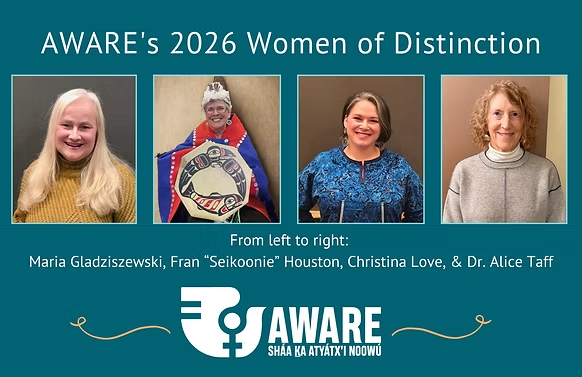
This year’s honorees, who according to AWARE are celebrated women of distinction in the Juneau community, whose work (paid and/or volunteer) has benefited the lives of women and children in Juneau; are Maria Gladziszewski, Seikoonie Fran Houston, Christina Love, and Dr. Alice Taff.
“The Women of Distinction, what we do is for the people.” Said Houston, “We have the heart and we have the energy, and what we do is for the good of the people around us.”
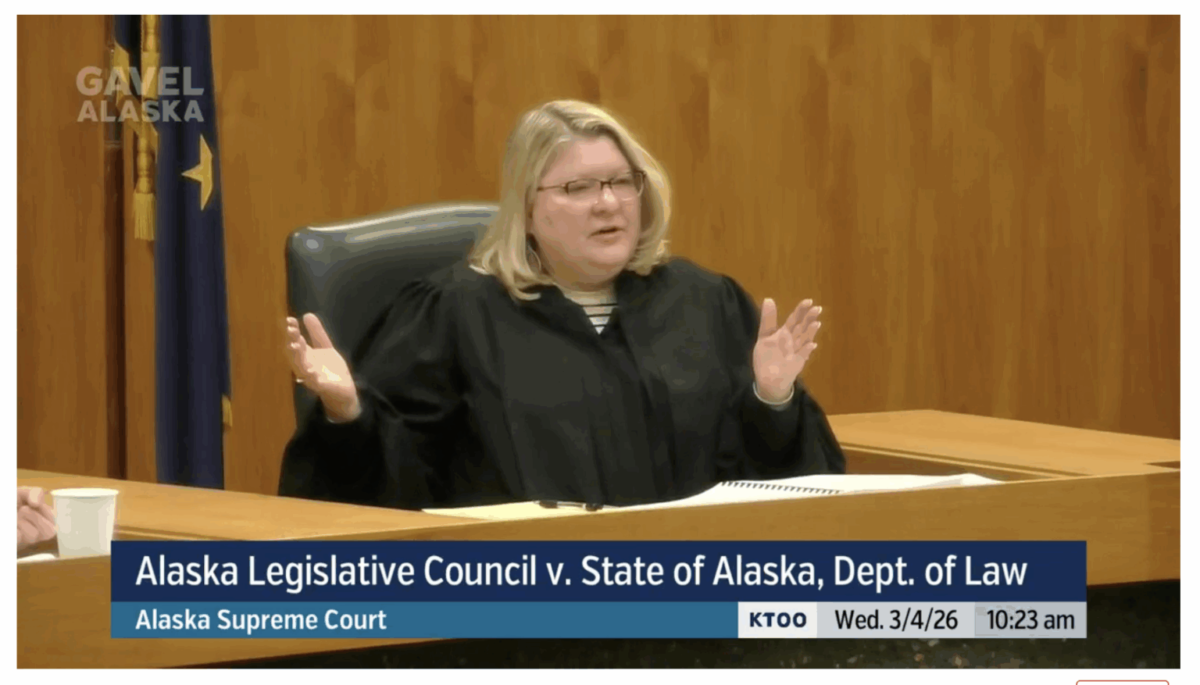
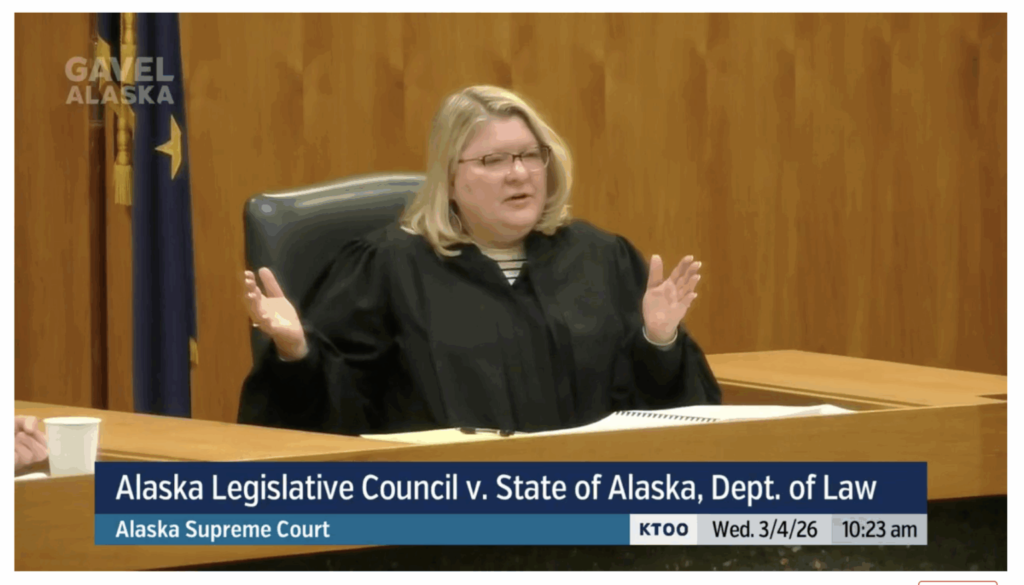
In this screenshot from Gavel Alaska, Alaska Supreme Court Justice Aimee Oravec speaks during a hearing on Wednesday, March 4, 2026. (Screenshot)
For years, politically conservative members of the Alaska Legislature have attempted to restrict state-paid abortion care via language in the annual state budget.
That maneuver and similar actions could be ruled unconstitutional by the Alaska Supreme Court, which on Wednesday heard oral arguments in a lawsuit that may determine the limits of the Alaska Constitution’s confinement clause, which requires that budget bills be limited to spending and not include policy changes.
Legislators said the contract, at more than $600,000, was too expensive, and in 2020 and 2021, they carved the budget for the Alaska Department of Law into two segments in an attempt to limit the contract.
Two of the governor’s attorneys general said they believed the Legislature was actually targeting the union dues plan, and its actions thus represented an unconstitutional infringement of the executive branch’s power.
Dunleavy vetoed the contract-specific language, technically eliminating all funding for the defense, and his administration kept on spending.
The Legislature’s auditor concluded in 2023 that the Dunleavy administration likely violated state law and the Alaska Constitution by continuing to spend money that had been eliminated from the budget.
Lawmakers sued in January 2024.
By that time, the Alaska Supreme Court had ruled that the union-dues changes had been enacted illegally. Four days after the Legislature filed its lawsuit, the U.S. Supreme Court said it would not hear an appeal requested by the administration, an act that leaves the state supreme court’s ruling in place.
In 2025, over the Legislature’s objections, Anchorage District Court judge Dani Crosby ruled that lawmakers’ lawsuit was moot because the money had already been spent, and she dismissed it.
Legislators appealed to the Supreme Court, arguing that there is a public interest in having the issue resolved, because it is likely to return again.
“That idea of no funding for this, some funding for that, these conditions are a regular feature of the budgeting process,” he said in Wednesday’s oral argument, arguing that the issue is not moot.
Deputy Solicitor General Jessie Alloway represented the state in Wednesday’s hearing and said the abortion issue is an example of why the court should decline to take up the Legislature’s arguments.
“This is exactly why the court should say this is moot and not take a more abstract view … because there is an unlimited number of hypotheticals that we could come up with that would be problematic,” she said.
If the court does overrule Crosby, both sides asked the justices to give them a firm answer rather than having Crosby take up the issue again.
The justices would then have to decide whether legislators overreached by attempting to restrict the executive branch, whether the executive branch overreached by continuing to spend, and where exactly the line rests between legislative and executive power.
“That’s what we keep coming back to: Who gets to decide this, whether these contracts are necessary?” asked Justice Aimee Oravec.
One prior Supreme Court case discussed Wednesday may offer some clues. In 2001, the court ruled on a legislative lawsuit against then-Gov. Tony Knowles over a series of budget vetoes.
One of those vetoes involved a dispute over bed space bought by the state prison system in private facilities. Legislators wrote in the budget that the space had to be bought from private contractors.
The supreme court upheld that language in its ruling.
“Conditions are permissible, as this court held in the Knowles case,” said Cuddy, the Legislature’s attorney, “including saying what types of services, public versus private, or private versus public, the money can be spent upon.”
But Alloway, arguing for the state, said legislators were attempting to define purchases that had already happened. That’s different from Knowles.
“What was happening was the (attorney general) had already retained outside counsel via his statutory authority. The Legislature knew about it, and then the appropriation targeted that decision by eliminating the amount the AG could spend on the contract,” she said.
During Wednesday’s argument, chief justice Susan Carney was absent. Staff for the court said she was recovering from surgery and out on medical leave.
Justice Dario Borghesan, a former Department of Law attorney, recused himself from the case, leaving three justices, all Dunleavy appointees, for Wednesday’s hearing. Justice Jennifer Henderson, presiding over oral arguments, said Carney may be involved in deliberations before a final decision is published at a later date.
Rep. Sarah Vance, R-Homer, speaks in support of a bill she sponsored, HB 47, that would add state criminal penalties for AI-generated child sexual abuse material, on the House floor on Feb. 27, 2026. (Photo by Corinne Smith/Alaska Beacon)
Anyone that possesses, creates or shares child sexual abuse material created with artificial intelligence in Alaska would face new state felony charges under legislation advanced by the Alaska House of Representatives on Friday — plus AI companies and social media companies could face state penalties too.
House members passed House Bill 47 almost unanimously by a 39 to 0 vote, with Rep. Neal Foster, D-Nome, absent. The bill is sponsored by Rep. Sarah Vance, R-Homer, and would enact new state felony charges for creating AI-generated images or videos that visually depicts sexually explicit or obscene content involving anyone under the age of 18. Previously known as child pornography, it’s now referred to as child sexual abuse material or CSAM.
“A decade ago, we couldn’t even imagine what it is that the vulnerable and our children are facing, and tools that are being used to exploit them,” Vance said Friday on the House floor ahead of the vote. “But here we are in a fast-paced technological environment, and our prosecutors are left with very few tools,” she said.
Vance lauded the bill as closing a gap in state criminal law. Currently there are no state laws directly addressing AI-generated CSAM, though there are statutes that prohibit the viewing, possession and distribution of child sexual abuse materials. Vance emphasized that the bill would update Alaska law to penalize AI-generated CSAM, and noted it would apply regardless of whether images depict a victim or AI-generated material.
“Currently in statute, you have to prove the harm of an actual child. And what this bill does is says that anything that is generated obscene material of minors will be criminalized to the same level as if it were a real child,” Vance said.
Vance and others pointed to the recent arrest of an Alaska senator’s chief of staff for soliciting minors for CSAM on Snapchat, and the need to increase state penalties. Other lawmakers said the case demonstrates the need for more parental controls on minors’ social media.
Legislators added on and approved significant parental controls and penalties for tech companies too, through an amendment process on Wednesday.
Under the revised bill, social media companies will require age verification and parental or guardian consent for minors to create or maintain social media accounts. Parents would have full access to minors’ social media, including all minors’ messages and interactions on the platform. The bill enacts a social media curfew for minors from 10:30 p.m. to 6:30 a.m., unless modified by a parent.
Rep. Zack Fields, D-Anchorage, sponsored the amendments and said with increased parental control measures, parents and guardians will be able to intervene on potentially predatory behavior or victimization of children.
“The fundamental question is: Do parental rights supersede the rights of predators?” Fields said on the House floor Wednesday. “And do parental rights supersede the rights of multi-national corporations, which we have heard knowingly target children with addictive, destructive algorithms. We know that.”
Targeted advertising to minors on social media would also be prohibited, as would content targeting minors, addictive design or features that “encourages or rewards a minor user’s excessive or compulsive use of the platform or that exploits the psychological vulnerabilities of a minor user,” according to the bill.
Families or the state would be able to bring civil legal action against social media companies for harm due to such violations under the bill, and companies could face a penalty of up to $10,000 for each violation.
“I don’t care how hard it is. We should not back down from Big Tech when it comes to protecting our children,” Fields said.
The amendment passed with a 28 to 12 vote, with supporters and opponents spanning party lines.
Rep. Genevieve Mina, D-Anchorage, the youngest member of the House, opposed the provision.
“I absolutely agree that social media can be harmful for youth, especially given the vast environment, where there are a lot of different strangers and people on the internet. I also know I’m probably one of the only people in the body who very much grew up online,” she said Wednesday on the House floor.
“I’ve wrestled back and forth with these types of policies, especially as it relates to age verification or requiring consent from a minor,” she said, and added that she shared concerns about first amendment and privacy rights. “But I just don’t believe that age verification through government regulation is the right way.”
Vance, the sponsor of the bill, also opposed the increased parental controls provision citing First Amendment concerns.
Lawmakers also voted to approve a provision levying civil penalties on any AI organization that facilitates users creating AI-generated CSAM of up to $1 million for each instance.
Rep. Calvin Schrage, D-Anchorage, sponsored the amendment which was passed unanimously.
“I think this is something that creates an incentive for these large companies to curtail or at least put some controls and protections around what I think can be a very powerful and useful tool, but is so often used today for really malicious, nefarious and, I would say, disgusting purposes,” Schrage said.
The bill would also prohibit the distribution of generated sexual depiction of adults without their consent or participation. It would also prohibit distribution of a “forged digital likeness,” known as “deep fakes” often used as misinformation, revenge pornography, scams or blackmail.