An oil tanker sits at the dock in Valdez, where vessels pick up crude moved from the North Slope by the Trans Alaska Pipeline System. (ConocoPhillips photo)
The Alaska Senate approved a measure to boost state taxes on oil and gas production on Wednesday. Lawmakers tacked it on to what would have been a routine renewal of a state oil royalty agreement.
Sen. Forrest Dunbar, D-Anchorage, sponsored the amendment to House Bill 194, saying it would close a corporate income tax loophole and potentially capture more than $100 million in new state revenues each year — at a time when Alaska is in dire need of revenue to pay for state services.
Sen. Forrest Dunbar, D-Anchorage speaks on the Senate floor on Mar. 25, 2026 (Photo by Corinne Smith/Alaska Beacon)
“Can we afford this loophole while we close schools? Can we afford this tax subsidy while we slash the permanent fund dividend? Can we afford this tax subsidy while our infrastructure languishes, while we struggle to recruit and retain state troopers and firefighters and maintenance crews?” Dunbar said. “The answer is no.”
The provision would impose the state’s corporate tax rate on oil and gas companies doing business in the state, at a maximum rate of 9.4% for companies whose net profits are more than $5 million per year.
Alaska’s oil prices are surging amid the Iran War, and state forecasters are projecting hundreds of millions in potential state revenue in the coming months. Despite the spike in oil prices, Dunbar said lawmaker action to capture more revenue from the oil and gas industry is long overdue.
“There is still a long term revenue problem in this state, regardless of short term prices connected to the Iran war,” he said. “Now is the time to do this. Prices for oil are high. These corporations are doing very well. You fix the roof when the sun is shining.”
The Senate approved the amendment by an 11 to 8 vote, then passed the underlying legislation by a 12 to 7 vote, with Sen. Kelly Merrick, R-Eagle River, absent.
The original legislation was introduced by the governor, and passed the Alaska House last year. It would renew a three-year oil royalty agreement between the state and Marathon Petroleum Corporation, for state owned oil to be processed at its refinery in Nikiski, on the Kenai Peninsula. The proposed contract is estimated to generate between $4 million to $18 million in state revenue.
However the bill’s sponsor, Sen. Jesse Bjorkman, R-Soldotna, objected to the new oil tax provision, saying the Senate should take time to evaluate how the tax measure would affect the broader industry and energy supply for Alaskans.
“I’m a no vote on this amendment, because we do need a legitimate plan,” he said. “We don’t rush things. We don’t do things in a half-cocked manner, because that’s how mistakes are made.”
He said lawmakers should model potential revenue measures so they know how they will function within a state fiscal plan.
Lawmakers have been hotly debating Alaska’s oil and gas tax structure for years. A bill introduced last year, Senate Bill 92, would change the way the state’s corporate income tax applies to the oil company Hilcorp, which is an S-corporation, and the state’s largest oil producer. Hilcorp is a privately held, Texas-based energy company that since 2020 has operated the Prudhoe Bay oil field in the North Slope, as well as most of the operations in Cook Inlet.
That bill is currently in the Senate Rules Committee and has not moved this year.
The measure approved by the Senate on Wednesday would enact state taxes not just on Hilcorp but many companies, and collect revenues that would otherwise be leaving the state, Dunbar said in an interview after the vote.
“To be clear, it’s not just Hilorp that might be affected by this, but that is one of the large, obvious holes we see in our oil tax structure right now that is causing us to shift tens of millions, and over the long term, hundreds of millions of dollars, from schools and roads and the permanent fund dividend to out of state companies and individuals,” he said.
The amended bill now goes to the House for a concurrence vote.
Dunbar urged support for the measure, citing financial woes in his own district where the Anchorage School Board has voted to close three elementary schools and cut hundreds of staff positions to help address a $90 million budget shortfall.
“I hope they agree that it’s not an acceptable world where the price is high and this industry is booming and we are closing Lake Otis Elementary School because we don’t have enough money,” he said.
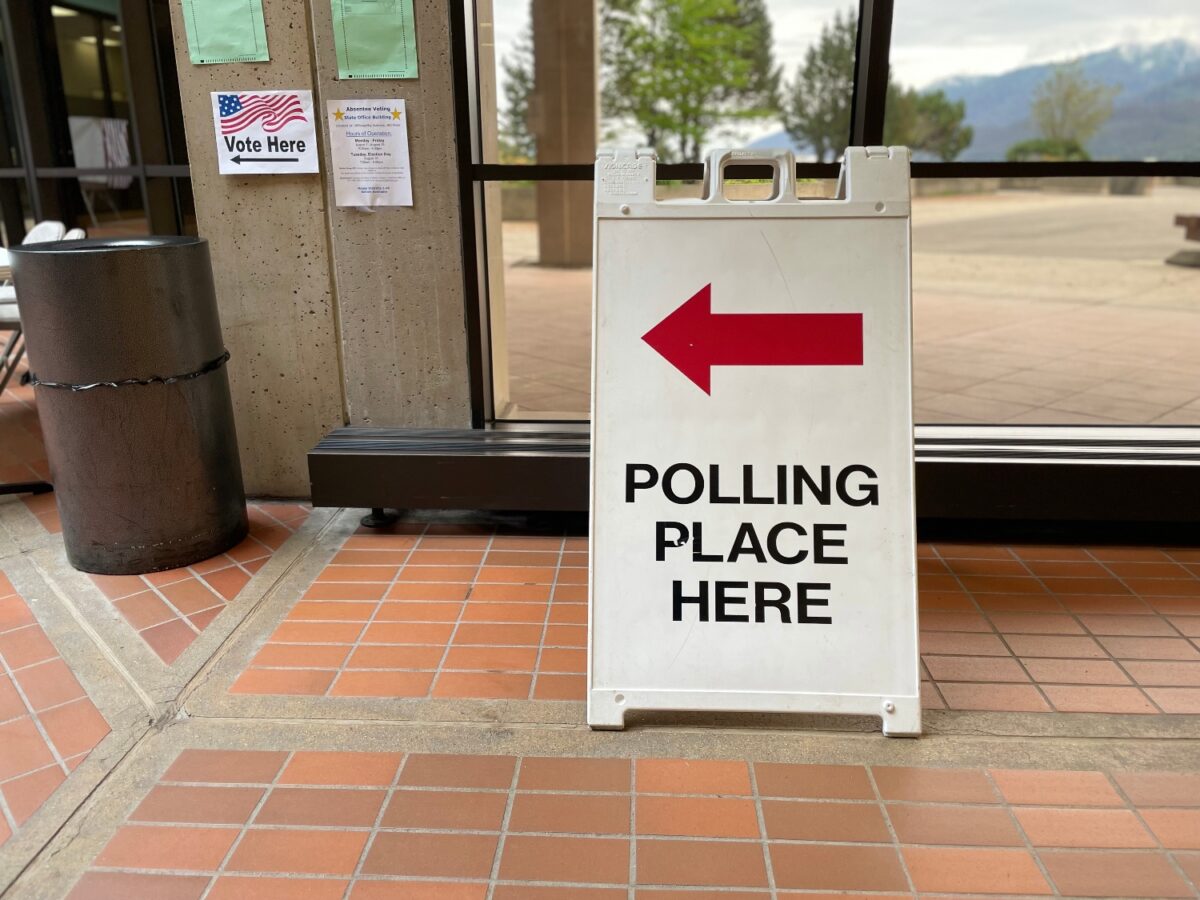
A polling place sign at the State Office Building in Juneau on Aug. 15, 2022. (Photo by Lisa Phu/Alaska Beacon)
The Alaska House of Representatives passed an elections bill aimed at streamlining the state’s voting process and updating the voter rolls with a bipartisan vote on Monday. If signed into law, the bill would implement a new ballot tracking system, provide paid postage for all absentee mail-in ballots and implement provisions for faster election results, among other changes.
The House passed Senate Bill 64 by a 23 to 16 vote on Monday evening, with Rep. Ashley Carrick, D-Fairbanks, absent. Three members of the House minority caucus joined the majority in supporting the legislation: Rep. Sarah Vance, R-Homer, Rep. Kevin McCabe, R-Big Lake, and Rep. Jeremy Bynum, R-Ketchikan.
Sen. Bill Wielechowski, D-Anchorage, sponsored the legislation as chair of the Senate Rules Committee and said at a news conference on Tuesday the bill was at least a decade in the making and the result of a bipartisan effort.
“We’re going to agree on the things that we can agree on, things that just fundamentally make our elections better. And after 10 years, I think this bill does that,” he said. “It’s not a perfect bill. There are still things that need to be worked on, but this goes a long way towards improving our election system for every single person in the state of Alaska.”
The House made a variety of changes to the bill that the Senate passed last year, and the bill now goes back to the Senate for a concurrence vote on Wednesday. If signed into law by Gov. Mike Dunleavy, some elections changes would be implemented immediately, like a review of the voter rolls. Changes to ballot tracking and curing would go into effect after the August primary.
Lawmakers have focused on updating the state’s voter rolls to make sure voters are currently living in Alaska. Wielechowski said the new system will help the state maintain active voter rolls.
“We have 105% more registered voters than we have eligible citizens in the state of Alaska,” Wielechowski said, calling the discrepancy a “fundamental problem.”
“Everyone in Alaska knows that our elections in Alaska are probably the most difficult elections to conduct in the United States for a variety of reasons, but mostly because of geography, because of weather, because people are just spread out over such a vast area,” he said.
Under SB 64, the Division of Elections would send a notice to confirm address and residency in Alaska if the voter has:
Registered to vote in a another state
Received a driver’s license in another state
Registered a vehicle in another state
Served on a jury in another state
Receives a residential property tax exemption in another state
Receives public assistance in another state
If the bill passes, the Alaska Division of Elections will review the voter rolls and, based on a list of factors, send a postcard by mail to verify a voter’s address and establish residency. Once the notices are sent, voters have a period of 45 days to respond and confirm their Alaska residency to the division — or be moved to an inactive voter list for a period of 28 months or two elections.
Some members of the Republican House minority caucus expressed concern that military members stationed overseas would be kicked off the voter roles.
Rep. Sarah Vance, R-Homer and a member of the minority caucus, spearheaded the House version of the bill and said that even if voters are inactive, they will still be on a master voter list for eight years, under federal law.
“We cannot cancel, according to federal law, someone off of the master register for eight years. So this includes the military voters,” she said. “But I want to make sure that everyone else understands they’re not going to be inadvertently canceled either.”
Under the bill, voters would be able to show identification issued from a federally recognized tribe to register to vote or for voting. To confirm active voting status, voters would be able to contact the division by calling, emailing or by voting.
Under the Senate’s version of the bill, the state would have done away with the requirement of a witness signature for all absentee mail-in ballots, but the House objected to that change and opted to keep the witness signature.
If passed, the bill would also allow voters to fix mistakes on their ballot – a process called ballot curing — by requiring the division to contact the voter by phone or email within 24 hours. Within two to five days, the division would send notification by mail. The voter would have to return a form to correct the ballot with a copy of identification by email or by mail within 10 days of the election for their ballot to be counted.
If passed, the bill would require the state to provide paid postage for all absentee mail-in ballots. The state would also enact a new tracking system so that voters will be notified when their ballot is received and counted.
Wielechowski said that will help with transparency, as will new provisions to get election results published faster. Additionally, the elections department will start reviewing ballots 12 days ahead of Election Day — five days earlier than under current law — to allow more ballots to be counted on Election Day.
Require all absentee ballots to be received within 10 days of Election Day;
Establish a new rural community liaison position within the Division of Elections to support rural districts, including recruitment and training of poll workers;
Require the Permanent Fund Dividend Division to share data to improve the accuracy of the voter rolls’
Require the state to develop a cybersecurity program, and notify the public if there is a data breach;
Require the division to publish results for all rankings in the precinct results.
Require presidential ballots to include a line for write-in votes for president and vice president
Updates crimes of unlawful interference with an election, ballot tampering and election official misconduct
Wielechowski said the new rural liaison established by the bill would be charged with helping small, rural communities prepare to hold their elections, coordinate equipment and polling places, and hire poll workers to improve operations on Election Day.
“That person is responsible for working with the local villages … working with those communities to ensure that all the citizens are able to exercise their fundamental right to vote,” he said.
“The polls never opened in Wales in 2024 in the primary. The polls in Anaktuvuk Pass in 2024 opened up 30 minutes before closing, and roughly seven people out of about 250 were able to vote in that election in person,” Wielowski said.
The changes to Alaska’s process of voting and elections this year could come amid potential sweeping changes to national elections.
The U.S. Supreme Court is considering a case that would require all ballots to be received by Election Day in order to be counted for federal elections.
All ballots received after that deadline would be thrown out, which could potentially disenfranchise thousands of Alaska voters who cast ballots that may be delayed by weather, flight delays or election logistics challenges.
“It’s going to create some havoc in our election system, and it may very well require a special session for us to come in and deal with it,” Wielechowski said. “And so you could get in a situation where you have ballots coming in that don’t count for the federal election, but do count for the state election. And so there would have to be some kind of way that you figure out how to process those ballots in a different manner.”
The Supreme Court is expected to rule next summer.
Meanwhile, the Trump administration is putting pressure on the U.S. Congress to pass the SAVE America Act, which would, in part, require voters to present identification and proof of U.S. citizenship in person when they vote.
Alaska Republican U.S. Sen. Lisa Murkowski has loudly opposed the bill, saying it’s logistically impossible for most Alaskans, as the state only has six in-person elections offices and fewer than a dozen DMV offices. Republicans U.S. Sen. Dan Sullivan and U.S. Rep. Nick Begich III have supported the bill, saying they don’t think it would be hard to comply with its requirements.
The U.S. Senate is currently debating the bill amid another contentious debate around funding for the U.S. Department of Homeland Security and ending a five-week partial shutdown for the department. On Tuesday, Senate Majority Leader John Thune said the Senate may drop the voting bill in order to reach an agreement with Democrats over funding DHS, and return to it after Easter, according to reporting by Politico.
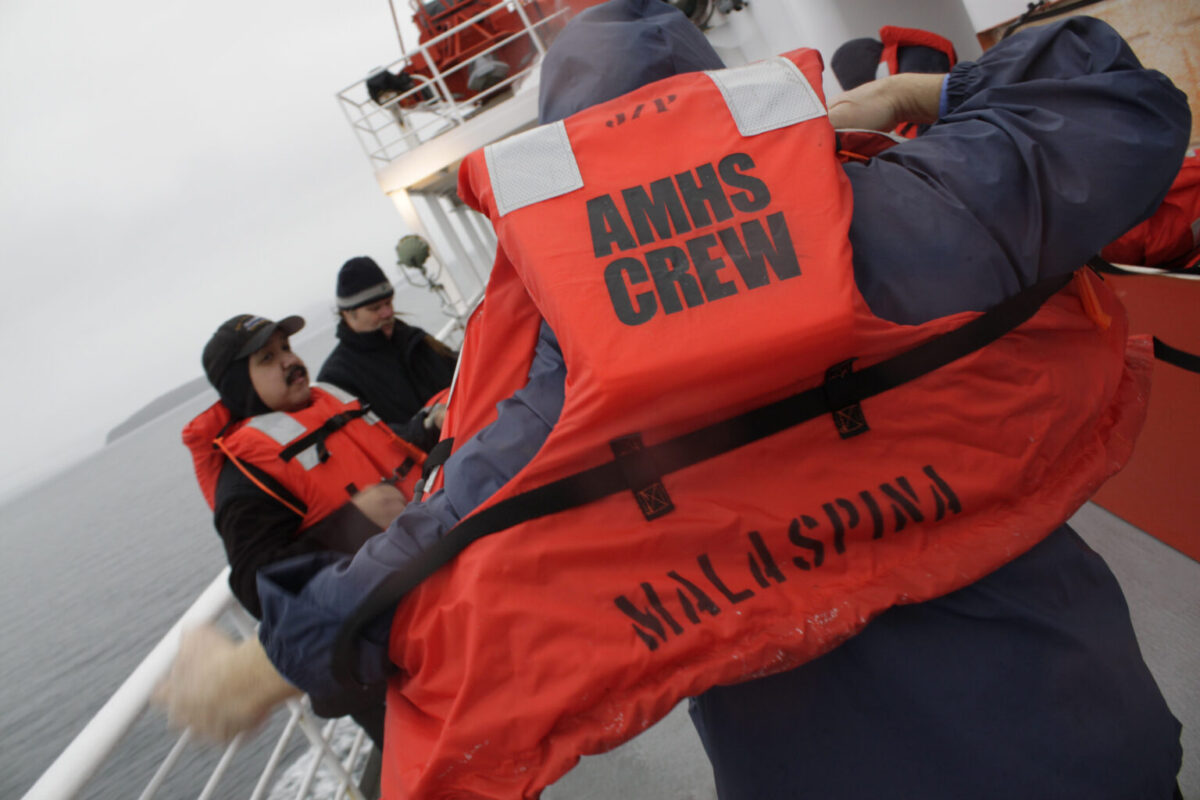
A crewman aboard the Alaska Marine Highway System ferry Malaspina dons a life jacket during a rescue boat drill Monday, Nov. 24, 2014 in Lynn Canal.
(James Brooks photo)
By: James Brooks, Alaska Beacon
A crewman aboard the Alaska Marine Highway System ferry Malaspina dons a life jacket during a rescue boat drill Monday, Nov. 24, 2014 in Lynn Canal.
(James Brooks photo)
The state of Alaska is looking for someone to take the Matanuska, one of the first three ships built as part of the Alaska Marine Highway System after statehood.
In a public notice published Friday afternoon, the Alaska Department of Transportation and Public Facilities said it is now looking for “interested parties regarding the opportunities to dispose of the vessel in a manner that honors its historic significance while allowing it to continue serving Alaska in new innovative ways.”
DOT is primarily looking for people or groups interested in operating the Matanuska “as a museum vessel, maritime training ship, tourism or hospitality venue, community facility, research platform, heritage site, or other maritime or public-serving use,” according to a detailed document accompanying the public notice.
Any applicant would have to demonstrate that they have the financial resources necessary to take care of the ship.
Retired ferries are notoriously expensive to operate, and idealistic plans for other ships have repeatedly fallen apart. The former Washington state ferry Kalakala was turned into a cannery in Kodiak, recovered and towed back to Washington, but fell derelict and almost sank into a canal before being scrapped in 2015.
Built in 1963, the Matanuska served as an active ferry for almost 60 years and still has a gold-painted funnel indicating its status as the “Queen of the Fleet,” the oldest operating ship in state service.
Despite that honor, the Matanuska has been out of regular service for at least three years, and has been laid up in Ketchikan for use as a “hotel ship” by the ferry system. Last year, DOT officials said the ferry system lacked the money needed to return the ship to service, and they recommended fully retiring it.
Proposals for the Matanuska’s future are due to DOT by 2 p.m. April 14.
“Letters of interest proposing scrapping, dismantling, or scuttling the vessel may be submitted for informational purposes,” the agency said, but for the time being, it’s looking at ideas to reuse the ship.
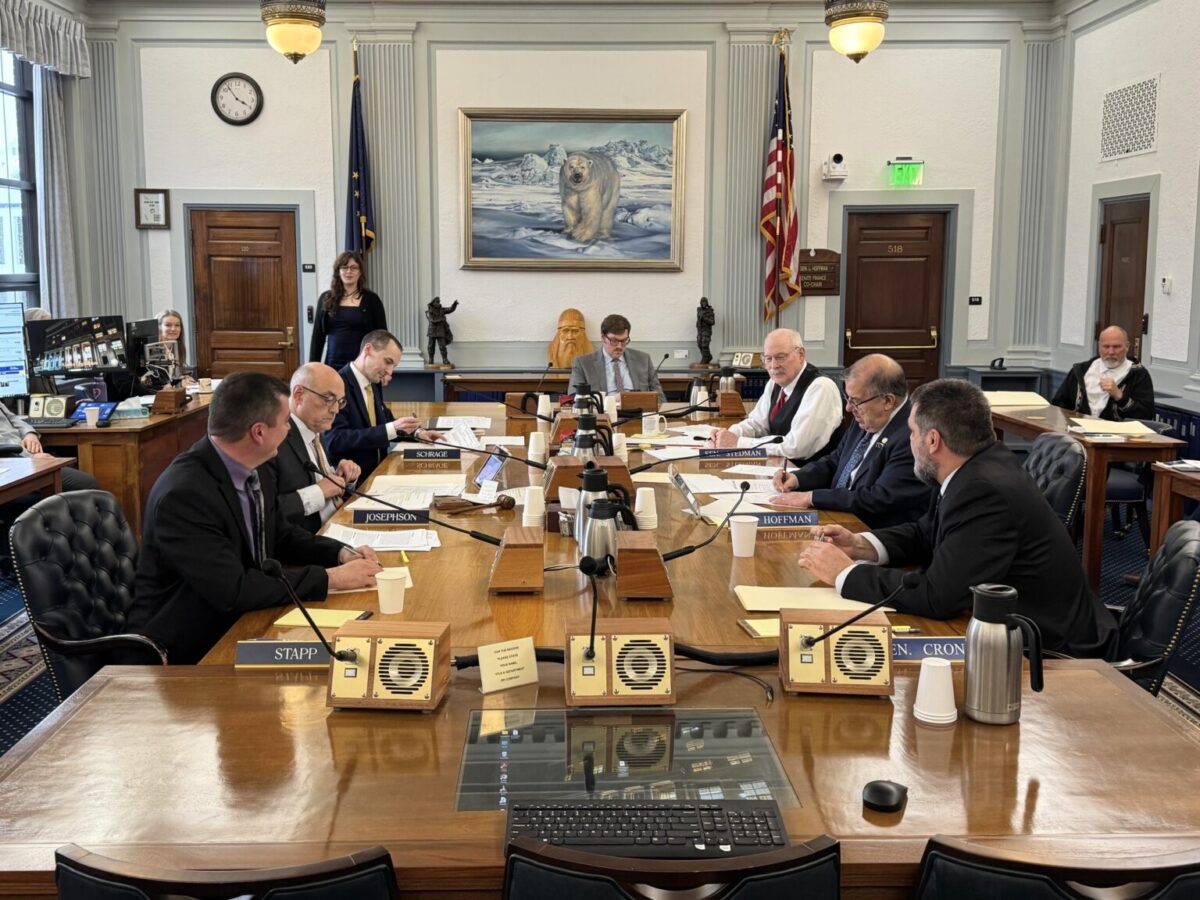
Members of the bicameral conference committee charged with writing a compromise supplemental budget sign the final documents on Monday, March 23, 2026, at the Alaska Capitol in Juneau. (James Brooks photo/Alaska Beacon)
By: James Brooks, Alaska Beacon
Members of the bicameral conference committee charged with writing a compromise supplemental budget sign the final documents on Monday, March 23, 2026, at the Alaska Capitol in Juneau. (James Brooks photo/Alaska Beacon)
The Alaska Legislature is preparing to re-vote on a key spending bill that will cover millions of dollars in disaster response and construction projects in the current fiscal year.
On Monday, a bicameral conference committee voted 5-1 to send an amended version of the bill to final votes in the House and Senate. Those votes may take place Wednesday.
The state’s fast-track supplemental budget contains $449.3 million in spending — expenses accrued since legislators and Gov. Mike Dunleavy adopted the state budget last year.
Legislators are separately working on a budget for the next fiscal year, which begins July 1. A vote on that is expected at the end of the legislative session in May.
The supplemental budget bill includes $70.2 million to unlock grant-funded construction projects principally paid for by the federal government — a major lobbying priority for the state’s construction industry.
It also includes tens of millions for the state response to last year’s wildfire season and millions more as a down payment for the state’s response to ex-Typhoon Halong, which devastated Western Alaska last fall.
The new spending would largely be paid for with new revenue the state expects because of higher oil prices caused by the Iran war.
As long as prices remain high through June 30, the end of the fiscal year, legislators expect there will be enough general-purpose money to cover the expenses, plus a smaller package of budget amendments already proposed by Dunleavy.
Those amendments arrived too late to be added to the supplemental bill.
If oil prices don’t match expectations, the bill contains language that would allow the state to use the Constitutional Budget Reserve, the state’s principal savings account, to cover the difference plus $20 million in “headroom.”
That clause may run into problems in the House, where the 19-person House Republican minority caucus has voted several times against spending from the reserve.
It takes 30 votes in the House and 15 in the Senate to spend from the reserve; while the Senate has met that threshold and is expected to do so again this week, it isn’t clear whether the House will do so.
The 21-person, predominantly Democratic coalition that controls the House would need to attract at least nine minority votes, and in earlier votes, it was unable to do so — something that forced the bill into a bicameral conference committee for further negotiations.
Rep. Will Stapp, R-Fairbanks and the minority’s negotiator on the conference committee, was the only lawmaker to vote against the revised bill on Monday, saying he doesn’t believe any kind of spending from the reserve is necessary at this point.
Members of the House majority have argued that allowing reserve spending — if necessary — would provide surety for construction businesses making summer plans.
They have also argued that time is of the essence: Delaying action on the bill would mean those companies might have to defer purchasing and hiring decisions ahead of the summer construction season.
Members of the House minority argued that as previously written, the bill would have allowed members of the majority to direct the spending of hundreds of millions from the reserve, even if it wasn’t needed to balance the supplemental budget.
That version was cut to less than $375 million in spending, an attempt to attract minority votes, but while that approach worked in the Senate, it did not succeed in the House.
When the House failed to pass the reserve vote, lawmakers there sent the bill to the conference committee for further work.
While that committee was able to finalize a draft compromise, it won’t be clear until later whether that compromise can pass out of the Legislature.
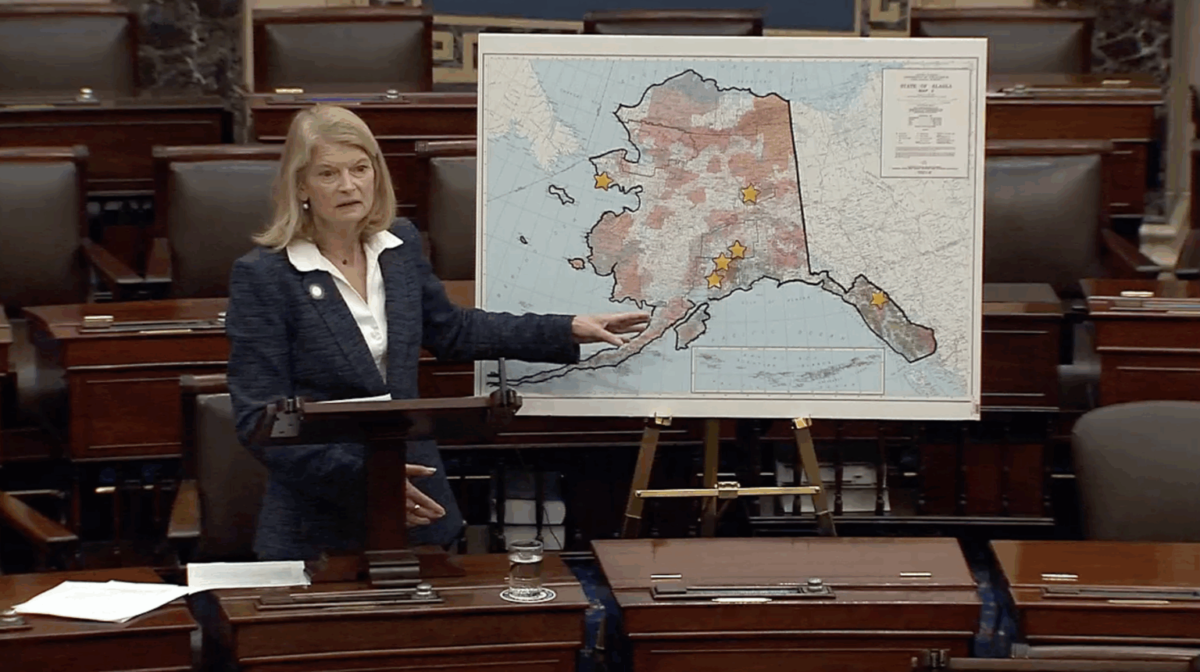
U.S. Sen. Lisa Murkowski, R-Alaska, speaks Thursday, March 19, 2026, on the floor of the U.S. Senate, in this screenshot of a video broadcast by the Senate. (Screenshot)
An elections bill being debated by the U.S. Senate could cost thousands of Alaskans the ability to vote in this year’s elections, Sen. Lisa Murkowski said Thursday in a lengthy speech on Capitol Hill.
The SAVE America Act, supported by President Donald Trump and most congressional Republicans, is ostensibly intended to prevent noncitizens from voting in American elections, but its implementation could prevent many Americans from being able to vote.
“While disenfranchisement may not be the intent of the SAVE America Act … I think that we will see that. In fact, I fully expect it to be an outcome of this,” Murkowski said.
The act would require that voters present photo ID when they vote, and that people present documentary proof of citizenship when they register to vote. That would mean presenting proof of citizenship in person at an elections office or other specially licensed state license.
“This would be a major, major departure from how most Alaskans currently register to vote,” Murkowski said.
In 2024, about 29,000 Alaskans registered to vote. Most of those — 25,000 or so — would have run into problems if the current bill had been law at that time, she said.
Most of Alaska’s voter registrations are done online or through the state’s motor-voter or PFD voter process. The bill could allow citizenship verification, but it’s not clear how that would happen, Murkowski.
Mandating in-person registration would have big effects in Alaska.
Some other state agencies might also be able to accept that proof, but the bill’s requirements take effect immediately, and it contains no funding for states to make changes that would allow remote offices to verify ID.
In practice, that means the bill would require rural residents to fly to urban Alaska, Murkowski said.
In addition, anyone seeking to register would have to have either a passport — roughly 50% of Alaskans don’t have one, Murkowski said — or some other form of appropriate ID.
Alaska driver’s licenses wouldn’t be good enough to register to vote, nor would most tribal IDs, because they don’t specifically label someone as a citizen or not.
The bill allows someone to self-certify their citizenship if they sign an affidavit, but that clause only applies if the person has already made “reasonable efforts” to obtain a copy of a valid ID.
It isn’t clear what that means, Murkowski said.
The bill also would end Alaska’s practice of allowing anyone to cast an absentee ballot for any reason. It would restrict absentee voting to a subset of specifically identified voters, including people living out of the state where they are registered to vote.
Murkowski said she hasn’t seen evidence that these kinds of measures are needed to address a small-scale problem.
Voting by noncitizens is rare in Alaska. A report obtained by the Alaska Beacon through a public records request showed 70 possible cases since 2015. At least 11 people on that list have been charged in state court.
“That’s basically seven a year,” Murkowski said.
“You look at what we’re trying to chase here with this balance — with disenfranchising so many who would be faced with almost insurmountable challenges in order to register or vote — I look at this and on balance, it doesn’t weigh,” she said.
Earlier this year, Rep. Nick Begich III, R-Alaska, voted in support of the bill as it passed out of the House, saying afterward that he doesn’t think it will be hard to comply with the bill.
Sen. Dan Sullivan, R-Alaska, has said he supports the act despite its ramifications for the state.
“I do think that having the ability to show an ID and proof of citizenship to keep elections safe is important, and it’s supported by the vast majority of Americans,” he said in response to a question during a February forum hosted by the Juneau Chamber of Commerce.
At that forum, he was confronted by an angry attendee who questioned how he could speak on Elizabeth Peratrovich Day, a state holiday honoring an Alaska Native civil rights leader, and support a bill that would have detrimental effects on Alaska Native voters.
“I have a very, very, very strong record as it relates to the franchise for our people, in particular, the Alaska Native community,” he said, referring to actions he took during the 2010 Alaska election, when he served as attorney general.
“I think voting, in my view, should be easy, but cheating on voting should not be,” Sullivan said.
While Sullivan has said he supports the bill, he also told reporters last month that he doesn’t support overriding the Senate’s filibuster to pass it.
In practice, the filibuster means that the bill would require 60 votes, not 50 and the vice president, to advance through the Senate.
With all of the Senate’s Democrats and Murkowski opposed to the SAVE Act, the bill — at least as of Friday — lacks the support it needs to become law.
Two animals in the Teshekpuk Caribou Herd are seen on June 27, 2014, in the National Petroleum Reserve in Alaska. A right-of-way agreement reinstated through a federal court order protects the Teshekpuk Lake area and the habitat used by the caribou herd named for the lake. But in an oil and gas lease sale, the Trump administration auctioned off tracts in that right-of-way area nonetheless. (Photo by Bob Wick/U.S. Bureau of Land Management)
A controversial oil and gas federal lease sale in the National Petroleum Reserve in Alaska generated a new bidding record, according to results released on Wednesday. It was the first auction held in that Arctic Alaska territory since 2019.
The lease sale produced $163 million in high bids, beating the $104 million mark set during the first competitive oil and gas lease sale in the Indiana-sized reserve, which was held in 1999 during the Clinton administration.
Eleven companies submitted bids for more than 1.3 million acres of the nearly 5.5 million acres offered in the auction.
Kevin Pendergast, Alaska state director for the U.S. Bureau of Land Management, called the results “historic.”
“This is the strongest sale we have ever had in the National Petroleum Reserve in Alaska by nearly every measure. It makes clear that for the NPR-A, despite all the successes to date, the best days are still ahead,” Pendergast said at the conclusion of the bid opening, which lasted about two hours.
In statements issued after the bid reading, federal and state officials hailed the results.
“Today’s lease sale underscores the National Petroleum Reserve in Alaska’s vital role in strengthening America’s energy security while fueling economic growth across Alaska,” Secretary of the Interior Doug Burgum said in a statement. “The Reserve was created to support our nation’s energy needs, and this successful sale demonstrates what’s possible when we align responsible development with that original purpose.”
Gov. Mike Dunleavy celebrated the results in a Facebook post that thanked President Donald Trump “for believing in the great State of Alaska.”
“Today’s record setting NPR-A lease sale is a major win for our state and our country. It reinforces Alaska’s role as a reliable energy producer, supports high-paying jobs for our families, generates additional revenue for the state, and strengthens American energy security at a time when energy security is more important than ever,” he said in the post. “Alaskans have demonstrated that we know how to unlock our vast resources while protecting the land for future generations. This is exactly the kind of balanced, commonsense progress Alaskans have been calling for.”
The lease sale was one of five mandated in the reserve over the next 10 years by the sweeping budget and tax bill called the “One Big Beautiful Bill Act.” That mandate calls for lease sales to be conducted under a Trump administration management plan that opened 82% of the reserve to oil development. Previously, the Obama administration held annual lease sales in the petroleum reserve, but that administration’s management plan protected about half of the land through the designation of “special areas” considered important to wildlife and to Native cultural practices.
Prominent bidders were energy giants ConocoPhillips and Repsol, which are already active in the area. ConocoPhillips is developing a huge project within the reserve, the Willow Ppoject, that is expected to produce up to 180,000 barrels a day after its expected startup in late 2029. Repsol is a partner in another huge oil field, Pikka, which is on state land bordering the reserve and is set to start production this year.
Late-afternoon sunlight bathes the ConocoPhillips building in downtown Anchorage on March 10, 2026. ConocoPhillips, long active in the National Petroleum Reserve in Alaska, was a major bidder in the lease sale held Wednesday. (Photo by Yereth Rosen/Alaska Beacon)
The petroleum reserve and adjacent state and Native-owned lands along its eastern border are considered highly prospective for new oil finds because of a geological feature called the Nanushuk Formation that underlies it.
Federal officials auctioned tracts of protected land
Much of the bidding in Wednesday’s sale was for territory that was previously off-limits to oil development under protections that date as far back as the Reagan administration.
The inclusion of long-protected land in the sale, predominantly the area around ecologically sensitive Teshekpuk Lake, made the lease sale contentious. It is the subject of two lawsuits filed by Native and environmental groups.
Bids were accepted even for tracts within an area encircling Teshekpuk Lake, the North Slope’s largest lake, despite a federal court order issued Monday that reinstated development prohibitions there.
U.S. District Court Judge Sharon Gleason on Monday issued an injunction reinstating a right-of-way agreement with Nuiqsut Trilateral Inc., a partnership of Nuiqsut’s city and tribal governments and Kuukpik Corp., the village for-profit Native corporation.
Nuiqsut, an Inupiat village of about 500, is the community closest to oil development occurring in the reserve, including the Willow project. Under the agreement, oil development is banned within the right-of-way territory, though the Nuiqsut Trilateral Inc. has the right to waive that ban.
The court ruling was not mentioned Wednesday when BLM officials in Alaska opened the bids.
But in a statement issued later in the day, the U.S. Department of the Interior acknowledged that BLM did sell tracts that lie within the Nuiqsut right of way and that legal issues concerning those tracts remain.
“We can confirm that lease offerings within the right of way are included in today’s sale. Any lease issuance for tracts within the right of way will be consistent with the court’s order,” the statement said.
DOI officials did not elaborate on how they would follow the court order.
Criticism of expanded lease offerings, but praise as well
The Trump administration’s decision to auction off long-protected land, and especially its decision to press forward with leasing of tracts within the Nuiqsut right of way, dismayed critics.
A map shows the tracts within the National Petroleum Reserve in Alaska that are at issue in two lawsuits targeting the Trump administration’s management of the land unit. The orange tracts are in previously protected areas that were off-limits to leasing. Some tracts are within the Nuisuit Trialateral Inc. right of way and the subject of that organization’s lawsuit. A lawsuit filed by the Native organization Grandmothers Growing Goodness and The Wilderness Society is seeking to prevent development in all of the tracts colored orange. (Map provided by Layla Hughes, one of the plaintiff attorneys)
Among them was Rosemary Ahtuangaruak, leader of one of the plaintiff groups suing the Department of the Interior over its management of the petroleum reserve. She criticized the Trump administration for abandoning protections deemed important for several generations of Indigenous North Slope residents.
She cited in particular a narrow corridor of land northeast of the lake that is important to migration of the Teshekpuk Caribou Herd. The BLM accepted a $2 million bid from a company called Epoch Oil and Gas LLC for a large block within that migration corridor.
“It’s very concerning that they’re not putting a better foot forward in protecting what’s important about this area,” said Ahtuangaruak, a resident of Nuiqsut and leader of the group Grandmothers Growing Goodness. “For me, it’s really important that we push back on the activities that are encroaching around us.”
She said it was hard for her to watch the latest lease sale unfold because it added to a pattern of development encroaching on the village and resulting problems like air pollution and the January accident that overturned a huge drill rig intended for ConocoPhillips work in the area.
“It’s painful every time I watch these because these are important traditional land use areas. And the further they get into the Teshekpuk Lake area, the more traditional land use areas are going to be impacted,” Ahtuangaruak said.
The Trump administration’s decision to press ahead with auctioning land within the area protected by the Nuiqsut Trilateral right-of-way agreement drew particular ire from critics.
A plain reading of the right-of-way agreement shows that leasing in that area is not allowed without a waiver from the Nuiqsut group, said Andy Moderow of the Alaska Wilderness League.
“For the administration to not even acknowledge that is absurd,” he said.
In contrast, a different organization representing Indigenous people of the North Slope, Voice of the Arctic Iñupiat, praised the Trump administration’s management of the lease sale and celebrated its results.
“Today’s lease sale proves what we have been saying for years: when there is meaningful policy in place supporting responsible onshore development, industry interest will follow,” Nagruk Harcharek, Voice of the Arctic Iñupiat’s president and chief executive, said in a statement. “Over the past year, we have supported the Trump-Vance administration and Congress’s efforts to build more durable policies affecting our homelands. This successful NPR-A lease sale is a gratifying reminder (of) our work that will strengthen our self-determination for generations to come.”
Half of the royalties derived from oil production in the National Petroleum Reserve are designated for North Slope communities through a grant program established in federal law.
A competitive auction
Lease sale bidding was competitive, with some tracts receiving as many as six different offers. ConocoPhillips focused much of its bidding on tracts near the eastern border of the lease sale area and closest to its Willow project.
A pair of tundra swans swim on a lake on June 25, 2014, in the northeastern part of the National Petroleum Reserve in Alaska. The northeastern part of the reserve is highly prospective for oil, But it also has wetlands, including Teshekpuk Lake and various smaller lakes, that are important to birds that migrate from as far away as Antarctica. (Photo by Bob Wick/U.S. Bureau of Land Management)
ConocoPhillips did not bid for any tracts within the Nuiqsut Trilateral right of way, however,
Exxon Mobil was among the companies that bid for tracts within the right-of-way area, emerging as the apparent winner of tracts along the southern shore of the lake.
The lease sale marks a return to Alaska of sorts for Exxon.
While it maintains part ownership of the Prudhoe Bay field and the trans-Alaska oil pipeline, Exxon pared down its Alaska presence in recent years. In 2021, it transferred the operator position at the Point Thomson field to Hilcorp. Earlier that year, the company dropped its longtime corporate sponsorship of the Iditarod Trail Sled Dog Race.
Also returning to Alaska through the lease sale is Royal Dutch Shell. The bids submitted by Repsol were in partnership with Shell Frontier Oil and Gas Inc., a company subsidiary. Several of those Repsol-Shell winning bids were for over $2 million per tract.
Shell engaged in an expensive Arctic offshore exploration program in past years that turned out to be a failure. After spending at least $7 billion and wrecking a drill ship, Shell in 2015 abandoned its Arctic offshore program and eventually dropped its leases in the Chukchi and Beaufort Seas. The company in 2024 relinquished leases in state offshore territory.
Another active bidder was North Slope Exploration LLC, which is a unit of Denver-based Armstrong Oil and Gas. The company was the high bidder on over 70 tracts, according to preliminary results, adding to acreage in the reserve acquired during the 2019 lease sale.
The debate continues
While there is excitement among development supporters about the big sale, legal questions about the lease sale and the management plan under which it was conducted persist.
While Gleason on Monday issued the preliminary injunction reinstating the Nuiqsut Trilateral right of way, thus erecting a roadblock to any oil development in that approximately 1-million-acre area, on Wednesday she rejected the request from Ahtuangaruak’s group for a broader injunction that would have barred leasing in a wider region around Teshekpuk Lake.
Gleason, in her Wednesday ruling, said the Grandmothers Growing Goodness-Wilderness Society plaintiffs could try for another injunction should the BLM authorize any surface-disturbing activities in the formerly protected area.
That lawsuit remains active, as does the lawsuit filed by Nuiqsut Trilateral Inc., which is seeking a permanent reinstatement of the right-of-way agreement.
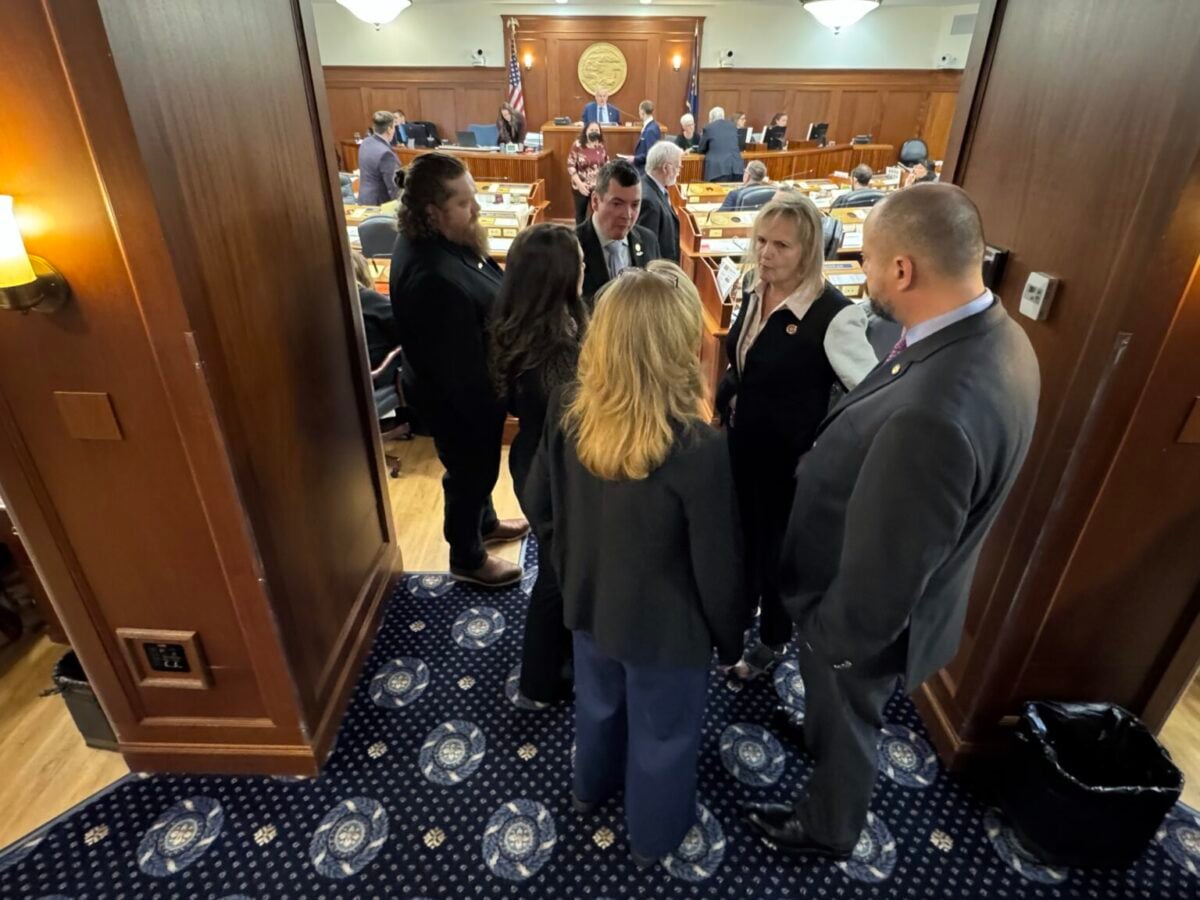
Members of the Alaska House minority talk strategy during a break in the Wednesday, March 18, 2026, session of the Alaska House of Representatives. (James Brooks photo/Alaska Beacon)
By: James Brooks, Alaska Beacon
Members of the Alaska House minority talk strategy during a break in the Wednesday, March 18, 2026, session of the Alaska House of Representatives. (James Brooks photo/Alaska Beacon)
Alaska legislators have sidetracked a bill originally intended for the legislative fast track.
In a pair of votes Wednesday, the Alaska House and Senate voted to send House Bill 289, the state’s supplemental budget bill, to a conference committee empowered to iron out differences between two different versions respectively enacted by the House and Senate.
Lawmakers took that unusual action after the House failed to approve a Senate-passed plan to pay for the bill with more than $373 million from the state’s principal savings account, the Constitutional Budget Reserve.
The committee is scheduled to hold its first meeting at 3:45 p.m. Thursday.
HB 289 is intended to fund expenses in the current state fiscal year that were incurred after lawmakers adjourned last year’s legislative session.
That includes money needed to respond to last summer’s wildfires and ex-Typhoon Halong, which devastated Western Alaska in the fall.
One key item in the bill — $70.2 million intended to unlock federal construction grants — is time sensitive. For months, the state’s construction industry has been lobbying for fast action on that money, saying that without surety on federal grants, they cannot make hiring and purchasing decisions for this summer’s construction season.
In February, the House passed a version of HB 289 with more than $500 million in expenses and proposed to pay for it by spending from the reserve.
It takes 30 votes in the House and 15 votes in the Senate to unlock the reserve. This month, in order to meet the threshold in the Senate, lawmakers there cut the bill to slightly over $373 million.
For more than a week, that caucus has been united in opposition to spending from savings, saying that a forecast boon to state finances — caused by higher oil prices amid the Iran war — should be enough to pay for the extra spending.
Members of the House majority, meanwhile, have been just as adamant in their position that it is unwise to rely on war-driven oil prices.
Sens. Lyman Hoffman, D-Bethel; Bert Stedman, R-Sitka; and Mike Cronk, R-Tok, were appointed to represent the Senate on the committee. Reps. Andy Josephson, D-Anchorage; Calvin Schrage, I-Anchorage; and Will Stapp, R-Fairbanks; will represent the House.
Cronk and Stapp are members of their respective minority caucuses; the other four lawmakers are representing their respective majority caucuses.
Additional meetings are expected after Thursday’s initial organizational hearing.
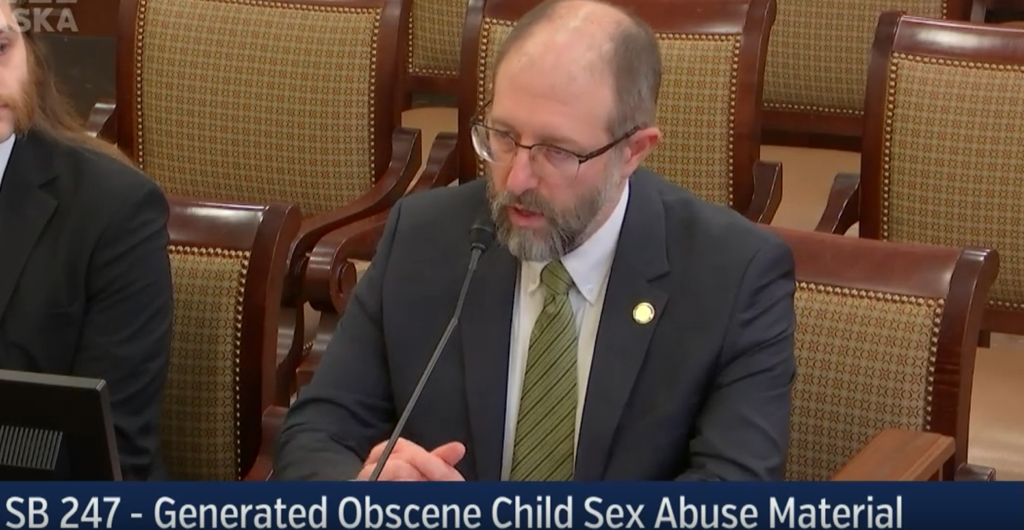
Senator Jesse Kiehl presenting SB 247 to the Senate Community and Regional Affairs Committee on Tuesday March 17, Photo courtesy of Gavel Alaska
Lawmakers are considering legislation that would expand criminal penalties for child sexual abuse material to include images generated using artificial intelligence and other digital tools.
Senate Bill 247, Sponsored by Juneau Sen. Jesse Kiehl, would create new crimes for the possession and distribution of “generated” child sexual abuse material, also known as CSAM, including images that appear to depict minors but may not involve real children.
Under the bill, distributing such material would be a felony, with harsher penalties for repeat offenders. Possession of generated CSAM would also be a felony offense.
Distribution under this bill is relatively broad and includes sharing or posting such content online.
United Nations, just this January released a warning on escalating AI threats to children.
The staggering amount of harmful AI-generated online content has prompted an urgent call from across the UN system for a raft of measures to protect children from abuse, exploitation and mental trauma.
This is a new form of sexual exploitation, the rapid progression of AI means lawmakers are struggling to craft legislation to prevent such harm from happening.
“Artificial intelligence is leading to the ability to generate images, generate videos, generate vast amounts of content, and that ability is growing fast, unfortunately, along with the ability to modify or create your own cute cat videos, some people use these technologies to terrible effect.” Said Kiehl, ” Senate Bill 247 addresses computer generated or otherwise generated Child Sexual Abuse materials. It amends Alaska law to create parity between generated Child Sexual Abuse materials and non generated Child Sexual Abuse materials, what we think of as photos or videos that have not been modified of real children. We know that artificial intelligence is, when it comes to images, a highly sophisticated collage machine, and that those images are made ultimately from things that are real, those are the data sources of millions, often billions, of real images on which these large language models, these artificial intelligences, are trained. The bill sets the punishments for generated Child Sexual Abuse materials on par with, and equal to non-generated CSAM that avoids overburdening bogging down law enforcement resources, court system resources, with the difficulty of proving that an amalgamated image has a real child under the age of 18 in it.”
The proposal also updates existing laws to include manipulated or altered images of real minors, even if the material was digitally created or modified.
In addition to criminal penalties, the bill would require the permanent revocation of teaching certificates for individuals convicted of certain sex offenses involving minors, including those tied to generated materials. It would also prohibit people convicted of those crimes from obtaining school bus driver licenses.
“The real prevalence of child sexual abuse is not known because so many victims do not disclose or report their abuse. However, adult representative or retrospective studies by the CDC has shown that one in four women and one in six men were sexually abused before the age of 18, and we know Alaska has one of the highest rates per capita of child sexual abuse in the nation.” Said Trevor Storrs, the President and CEO of the Alaska Children’s Trust, “Ai generated CSAM represents one of the most urgent and fast moving threats facing children today. In 2023 the National Center for Missing Exploited Children, received 4700 reports of AI related CSAM, by 2024 that number had grown to 67,000 and in the first half of 2025 alone, they received more than 400,000 such reports, an average of over 2000 every single day. At the same time, extortion, where offenders use real or AI generated images to blackmail children, continues to surge.”
Lawmakers say the bill is part of a broader effort to modernize Alaska law while technology continues to evolve, it’s one of several bills currently making their way through the legislature meant to strengthen protections for children.
SB 247 is set to be heard again in the legislature on Thursday.
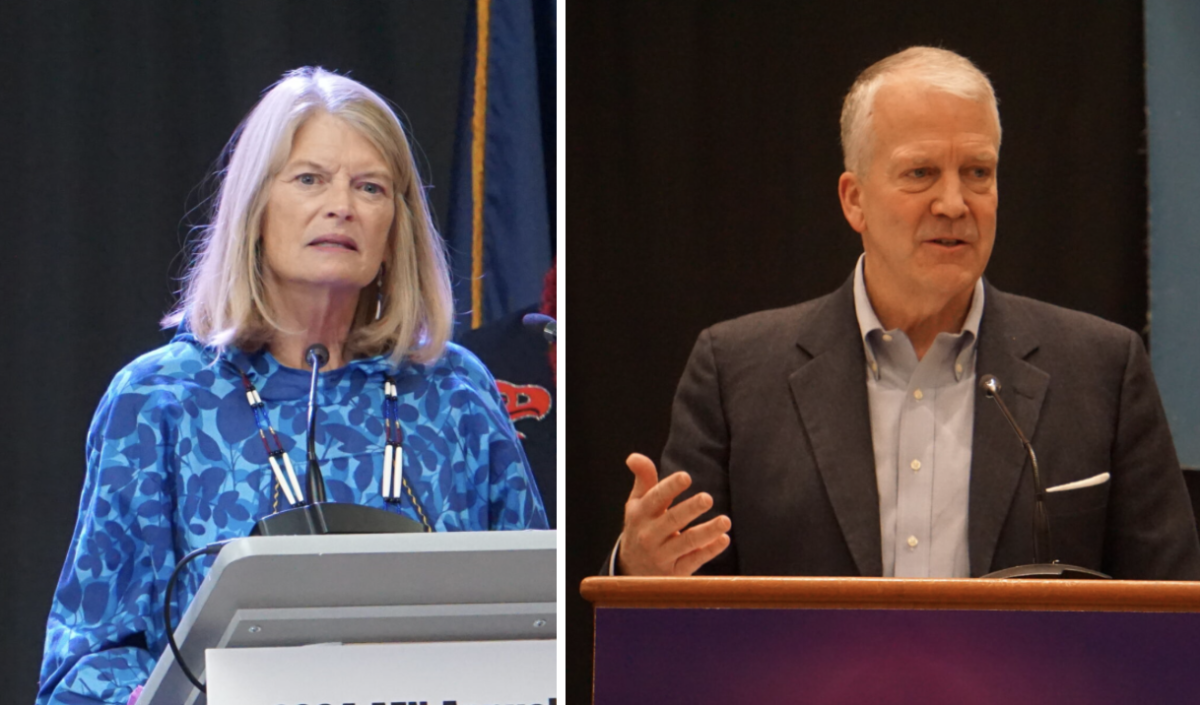
Alaska U.S. Senators Lisa Murkowski and Dan Sullivan (Alaska Beacon file photos)
Alaska’s Republican U.S. senators are pushing the Trump administration to waive a recently hiked visa fee for all public school employees.
The Trump administration raised the fee for highly skilled workers visas, known as the H-1B visa program, from $5,000 to $100,000 per visa in September. That has consequences for Alaska school districts, which have grown to rely on international hiring to fill teaching and staff positions.
“As soon as this proclamation was released last year, I have been sounding the alarm with the administration about the importance of the H-1B visa program to Alaska’s school districts,” U.S. Sen. Lisa Murkowski said in a prepared statement announcing the bill.
Murkowski introduced legislation in the U.S. Senate on Mar. 12, saying it would help alleviate financial strain for Alaska’s school districts. U.S. Sen. Dan Sullivan signed on as a cosponsor of the bill on Tuesday.
The H-1B visa program provides non-immigrant visas for U.S. employers to recruit highly skilled workers, with at least a bachelor’s degree, in fields such as healthcare, technology or education. The visa is valid for up to six years.
“Our public school classrooms have been facing a staffing crisis for years, but teachers in Alaska on H-B visas have been instrumental in bridging that shortage and serving our students with talent and care,” Murkowski wrote. “This legislation offers a commonsense exemption that will ensure Alaska’s schoolchildren have access to more high-quality educators while keeping class sizes reasonable.”
The Alaska House of Representatives introduced a resolution this month urging the visa waiver for teachers.
There are close to 600 international teachers working in Alaska and 341 of them use H-1B visas, according to data provided by the Alaska Council of School Administrators, which assists districts in recruitment and hiring.
“In some rural districts, visa teachers make up 50% to nearly 80% of the teaching staff,” said Lisa Parady, the council’s director, in a statement with the bill’s announcement. “School districts already invest $6,000 to $12,000 per teacher to recruit and sponsor educators through the H-1B visa process. Adding a $100,000 federal visa fee has made it financially impossible for many districts to continue hiring the teachers their students depend on.”
Alaska districts are also in the process of hiring teachers for next year, and officials say the fee imposes an impossible financial barrier.
Cyndy Mika, superintendent of the Kodiak Island Borough School District, said in a written statement with the bill’s announcement that nearly 20% of teachers district wide — and 75% of village teachers — are international hires through visa programs.
“These educators are not replacing American teachers—we simply do not have applicants for these positions,” she said. “Without access to international educators, districts like Kodiak will struggle to fill classrooms and provide consistent learning environments for students.”
The situation is exacerbated in Alaska’s rural districts by recent additional restrictions on the J-1 visa program, which requires visa-holding teachers to be placed in areas with access to health care services, transportation and other public services.
Tammy Dodd, superintendent of the Bering Strait School District, said in a statement the new J-1 visa restrictions put rural districts at a unique disadvantage.
“So the H-1B visa is the only choice,” she said. “The Bering Strait School District employs 86 international teachers, which is roughly 40% of certified staffing. With the new fee in place, the district would be unable to replace those positions with international hires.”
Murkowski sent a letter of concern to the former U.S. Sec. Kristi Noem with the Department Homeland Security, which administers the visa program. Noem responded in a letter on Dec. 15 shared by the senator’s office. Noem wrote that some exemptions are possible.
“Exceptions to the $100,000 payment are extremely rare and are granted only in extraordinarily compelling circumstances. Petitioning employers may seek an exception by sending their request,” Noem wrote.
“Evidence should support the alien worker’s presence in the United States as an H-1B worker is in the national interest, no American worker is available for fill the role, the alien worker does not pose a threat to security or welfare of the United States, and requiring the petitioning employer to pay the $100,000 payment would significantly undermine the interests of the United States,” she wrote.
Jennifer Schmitz, director of the Alaska Educator Retention and Recruitment Center, a division of the Alaska Council of School Administrators, said by email Monday that some districts have sought individual exemptions from DHS for teachers with pending H-1B visa applications, but have received no response and no timeline from the department.
Economist Dan Stickel talks to the Alaska House Finance Committee on Monday, March 16, 2026. (James Brooks photo/Alaska Beacon)
By: James Brooks, Alaska Beacon
Economist Dan Stickel talks to the Alaska House Finance Committee on Monday, March 16, 2026. (James Brooks photo/Alaska Beacon)
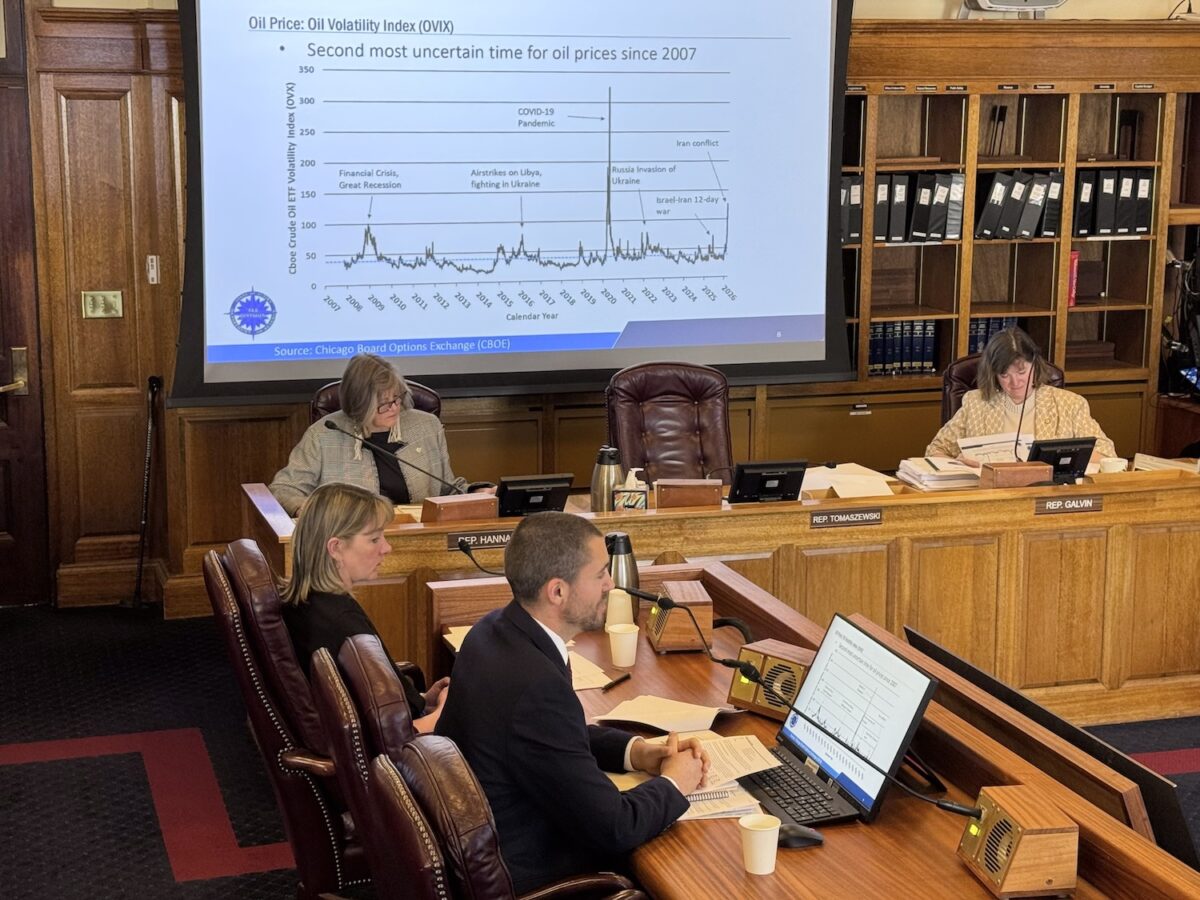
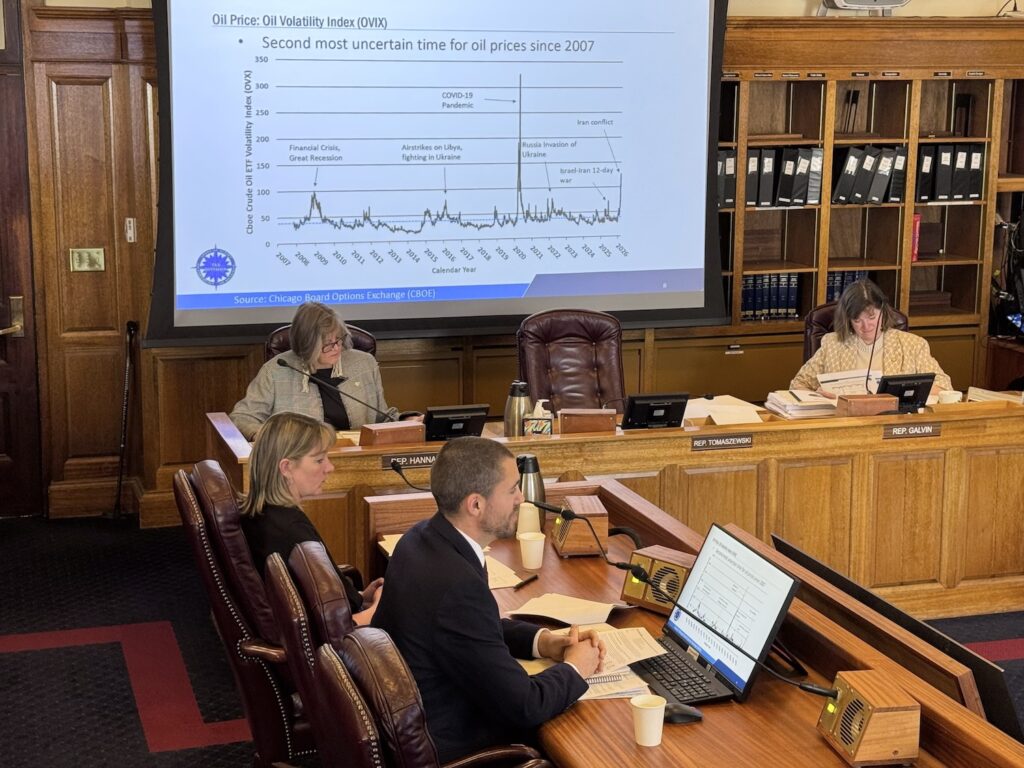
The U.S.-Israeli war against Iran has left oil markets more uncertain than they were during the Great Recession, a state expert told the Alaska Legislature on Monday.
In a pair of hearings, Alaska Department of Revenue economist Dan Stickel told state legislators that the volatility of global oil markets is the second-highest on record, leaving future forecasts particularly unreliable.
“The level of uncertainty around future prices in the oil markets now is higher than during the peaks of the Great Recession in 2008-2009 and it’s higher than the Russian invasion of Ukraine, and it’s higher than any of the COVID spikes other than the initial April 2020 spike,” he said during a Monday morning hearing of the Senate Finance Committee.
“The message here is to plan for the possibility that revenue doesn’t come in exactly at what we forecast for the next couple of years,” Stickel said.
Oil is the second-largest source of general-purpose revenue for the Alaska state budget, and Stickel’s testimony came days after the department released a new Alaska revenue forecast showing $545 million more in current-year revenue than projected in the fall. Most of that higher prediction is due to the price of oil.
That forecast has snarled relations in the Alaska House of Representatives, which has repeatedly postponed discussion of a bill that would fund a variety of amendments to the fiscal year 2026 budget passed by lawmakers and Gov. Mike Dunleavy last spring.
On Monday, after more than two hours of acrimonious debate, House legislators again declined to take up the bill.
Soon after the House adjourned its floor session, Stickel testified in front of the House Finance Committee, and told lawmakers that “the level of certainty that we will hit our exact forecast is low.”
As he spoke, on the other end of the Capitol’s fifth floor, the Senate Finance Committee was simultaneously hearing from Office of Management and Budget director Lacey Sanders, who said the governor’s office was requesting another $18 million in spending for the current fiscal year.
Altogether, the governor has requested almost $427 million in additions to the budget. Add in additional spending proposed by lawmakers, and there’s only about a $30 million difference between the new revenue forecast and the additions proposed by the governor and legislators.
At the latest forecast prices, said Rep. Calvin Schrage, I-Anchorage, a $2 change in the average price of a barrel of North Slope oil is worth $30 million.
He asked Stickel what the odds were that the forecast misses low by more than $2.
“Roughly a slightly less than 50% chance that we come in more than $2 below the forecast,” Stickel said, then alluded to the fact that there’s a similar chance of coming in above the forecast.
“The level of certainty that we will hit our exact forecast is low in either direction,” he said.
Currently, members of the House majority are advocating that legislators unlock the state’s principal savings account to provide surety for some of those budget additions.
Doing so would avoid problems if oil prices turn out to be lower than forecast.
But spending from the Constitutional Budget Reserve, the state’s principal savings account, requires 30 votes in the House and 15 votes in the Senate.
The House’s multipartisan coalition majority has 21 members, which means they need support from the all-Republican House minority caucus.
Members of that group have been arguing against unlocking the budget reserve right now, saying that the new forecast and the current balance of the state’s general-purpose accounts demonstrate it isn’t needed.
In addition, as currently written, the supplemental budget bill in the House would allow spending from savings regardless of the price of oil. That could allow the majority to dictate extra spending even if prices stay high.
The Senate has already approved spending from the Constitutional Budget Reserve, and on Monday morning, Sen. Bert Stedman, R-Sitka and co-chair of the Senate Finance Committee, said a draw from the reserve would act as a “safety net.”
Sen. Lyman Hoffman, D-Bethel, said senators don’t intend to spend dollars from savings unless it is needed.
“If they are not needed, they will stay in the CBR,” he said, adding that without permission to spend from savings, there’s a chance that lawmakers would need to return in August to fix budget problems in a special session.