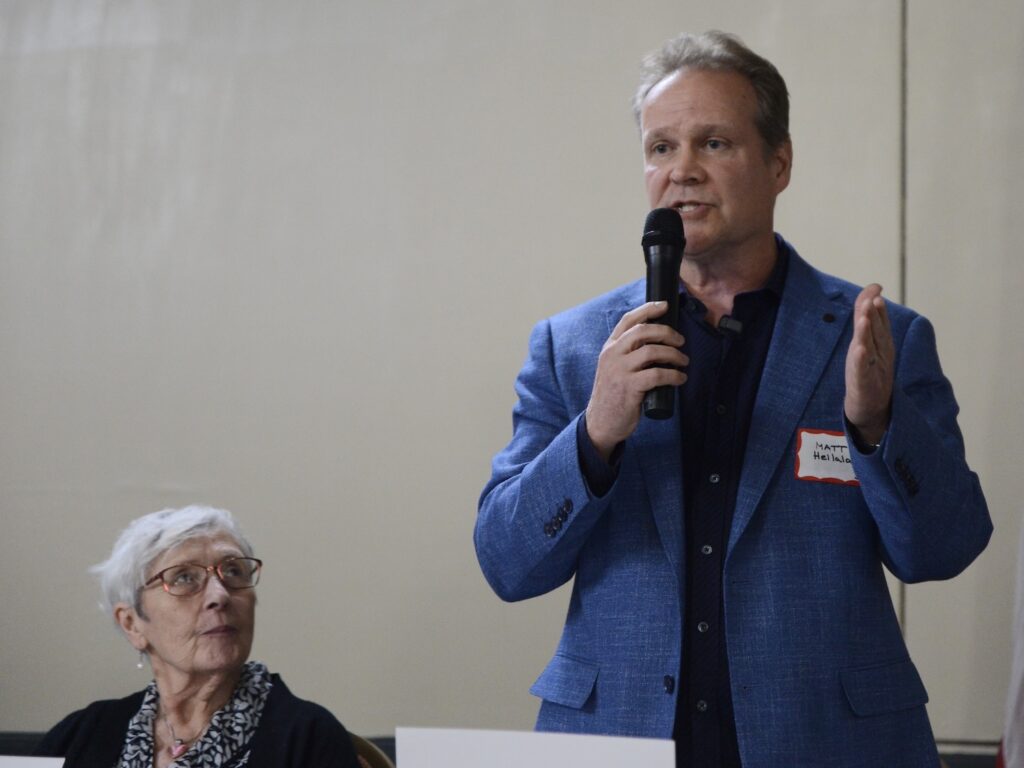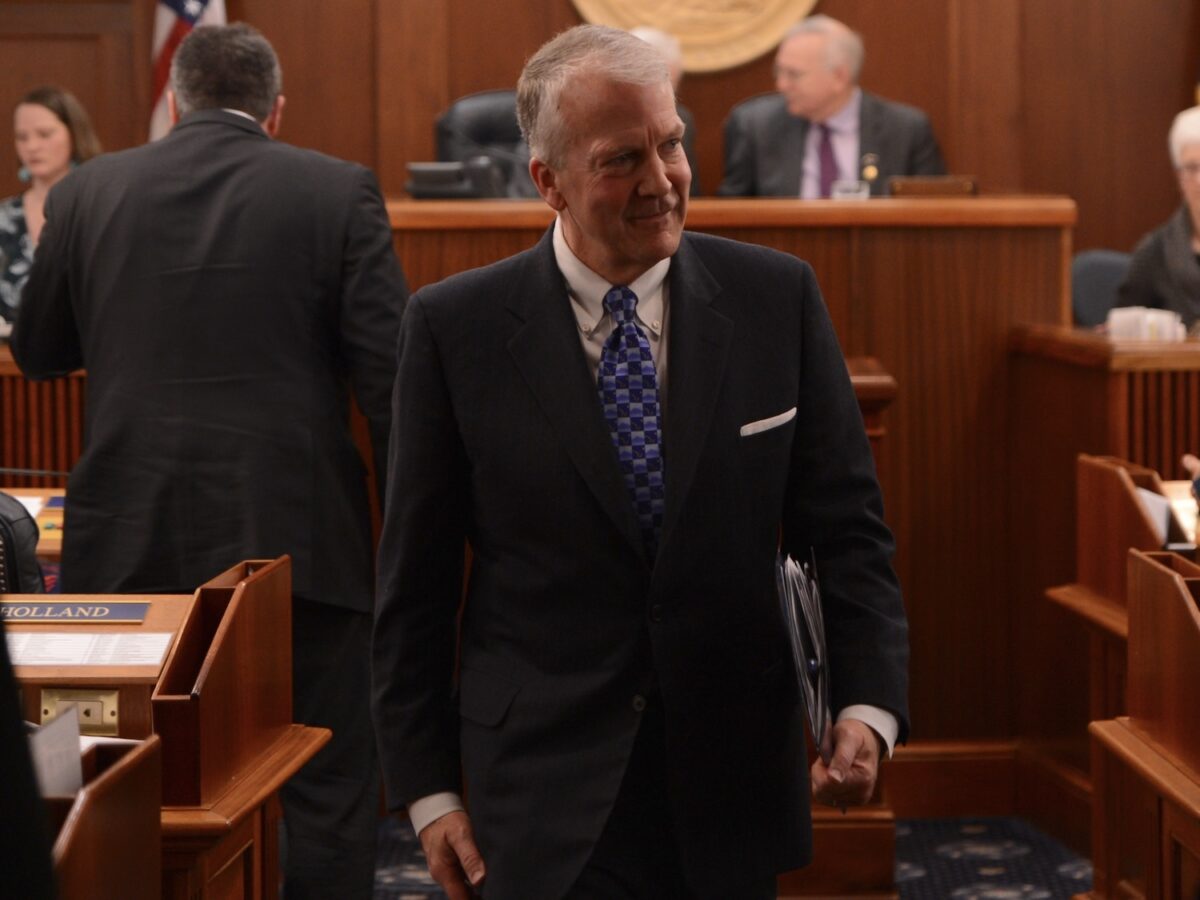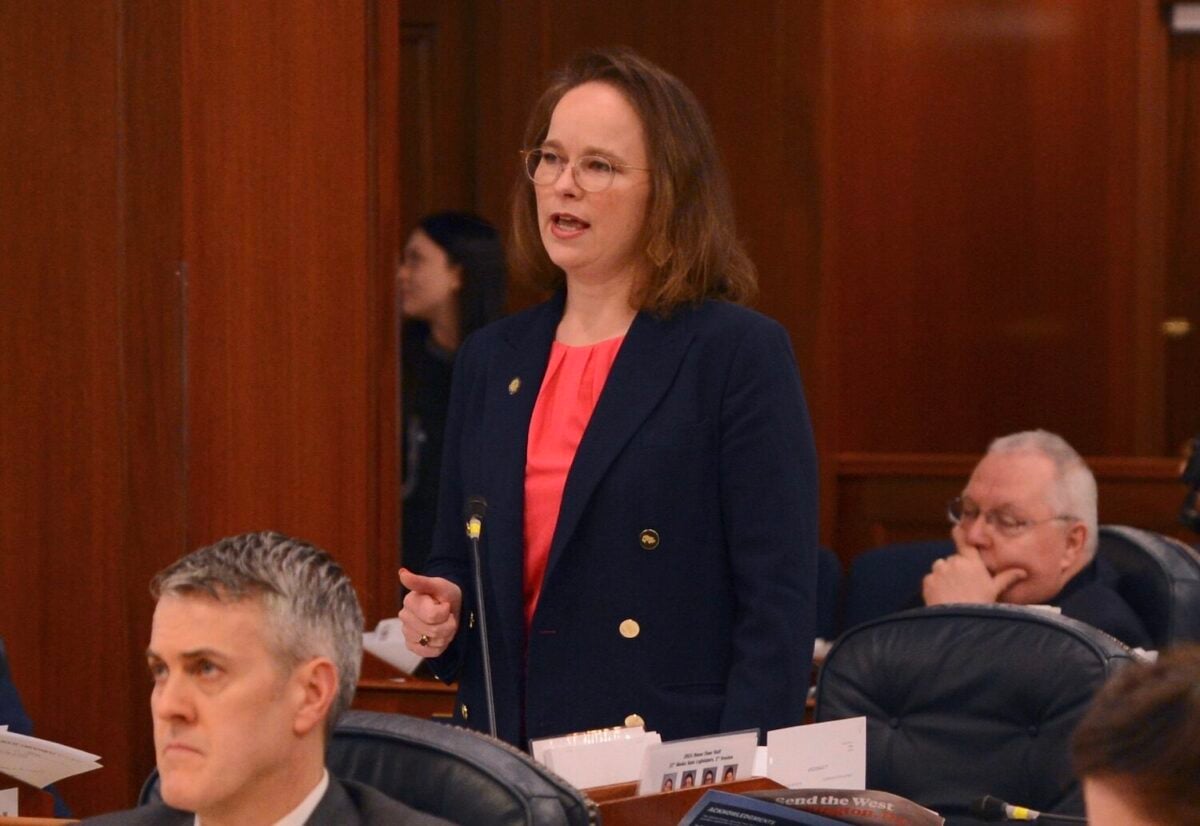
John Boyle, commissioner of the Alaska Department of Natural Resources, speaks on Nov. 15, 2023, at the Resource Development for Alaska annual conference in Anchorage. (Photo by Yereth Rosen/Alaska Beacon)
John Boyle, commissioner of the Alaska Department of Natural Resources, abruptly resigned his position on Friday.
Gov. Mike Dunleavy announced the appointment of his deputy, John Crowther, as acting head of the agency that regulates Alaska’s agriculture, mining, oil and gas.
The governor’s office declined Monday to answer questions about the resignation, which had not been previously announced.
Dunleavy is term-limited and will leave office in December 2026. Boyle’s departure follows those of Revenue Commissioner Adam Crum and Attorney General Treg Taylor.
The resignations of both of those men — who are now Republican candidates for governor in next year’s elections — were announced in advance, unlike Boyle’s departure.
Boyle could not be reached for comment on Monday.
The departing commissioner has extensive experience in the oil industry. Before joining Dunleavy’s cabinet in 2023, he was a lobbyist for BP and Oil Search.
Crowther, who will replace Boyle on an interim basis, has been with the Department of Natural Resources since 2012, the governor’s office said.
He previously worked as director of the governor’s Washington, D.C. office and served on the staff of the U.S. Senate’s Energy and Natural Resources Committee. He holds a law degree from Georgetown University.
“The Department of Natural Resources is at the forefront of protecting and developing Alaska’s precious land and waters. Mr. Crowther’s legal background and experience as a deputy commissioner make him a great choice to advance the responsible development, and maximum use, of Alaska’s natural resources consistent with the public interest as mandated by Alaska’s Constitution,” the governor said in a prepared statement released on Friday.
U.S. President Donald Trump speaks during an executive order signing.
WASHINGTON — More than 200 Democratic lawmakers and one Republican are urging the U.S. Supreme Court to strike down President Donald Trump’s sweeping global emergency tariffs.
The 207 members of the U.S. House and Senate argued in an amicus brief late Friday that the International Emergency Economic Powers Act, or IEEPA, does not authorize the president to unilaterally impose tariffs. The lawmakers urged the justices to agree with a lower court finding that Trump’s wide reaching import taxes triggered under IEEPA violate the Constitution, which grants duty powers to Congress.
“IEEPA contains none of the hallmarks of legislation delegating tariff power to the executive, such as limitations tied to specific products or countries, caps on the amount of tariff increases, procedural safeguards, public input, collaboration with Congress, or time limitations,” the lawmakers wrote.
“In the five decades since IEEPA’s enactment, no President from either party, until now, has ever invoked IEEPA to impose tariffs.”
Sens. Jeanne Shaheen, D-N.H., and Ron Wyden, D-Ore., ranking members of the Senate committees on Foreign Relations and Finance, led the signatures of 36 members of the upper chamber. Sen. Lisa Murkowski, an Alaska Republican, was the single GOP co-signer on the brief. A majority of House Democrats, 171 in total, also joined.
The lawmakers filed the friend-of-the-court brief ahead of oral arguments scheduled before the Supreme Court next week on the question of whether Trump’s emergency tariffs are legal.
The U.S. Court of Appeals for the Federal Circuit in late August upheld a lower court ruling striking down the administration’s IEEPA tariffs.
The Senate is expected to vote on three bills this week that aim to terminate Trump’s import taxes on products from Canada, Brazil and any other country subject to emergency duties.
Fentanyl, trade deficits as emergencies
Trump began imposing tariffs under IEEPA in February and March on China, Canada and Mexico, declaring these countries responsible for illegal fentanyl smuggling into the U.S.
The president escalated the emergency tariffs over the following months on goods from around the globe, declaring trade deficits a national emergency. A trade deficit means the U.S. imports more goods from a country than that nation purchases from U.S. suppliers.
Domestic businesses and purchasers now pay the U.S. government anywhere from 10% to 50% in tariffs on most imported products. The government had collected $195 billion this year in customs duties at the end of September, according to a U.S. Treasury monthly statement.
State AGs and businesses launched court challenge
Several private businesses and a dozen states sued Trump over the use of the emergency statute to trigger the steep import taxes.
Arizona, Colorado, Maine, Minnesota, Nevada, New Mexico and Oregon were among states, led by Democratic state attorneys general, that brought the suit.
Businesses that sued the Trump administration include the lead plaintiff, V.O.S. Selections, a New York-based company that imports wine and spirits from 16 countries, according to its website.
Other plaintiffs include a Utah-based plastics producer, a Virginia-based children’s electricity learning kit maker, a Pennsylvania-based fishing gear company, and a Vermont-based women’s cycling apparel company.
The U.S. Court of International Trade ruled Trump’s tariffs under IEEPA illegal in late May.
FILE – Alaska Airlines planes are shown parked at gates with Mount Rainier in the background on March 1, 2021, at Seattle-Tacoma International Airport in Seattle. (AP Photo/Ted S. Warren, File)
NOTN- Alaska Airlines will be bringing in outside experts to review it’s IT system after a second major outage in four months occurred last week.
Last Thursday’s system failure halted operations for about eight hours, cancelling flights and affecting nearly 50,000 passengers.
As of Saturday October 25, the airline released the following statement;
“We have increased guest care staffing to support higher volumes but recognize that wait times have been frustratingly long.
We know our guests put their trust in us when they choose to fly with Alaska, and this level of performance is not acceptable. And while safety is our most critical responsibility, the reliability of our operations is an essential expectation of our guests.
Following a similar disruption earlier this year, we took action to harden our systems, but this failure underscores the work that remains to be done to ensure system stability. We are immediately bringing in outside technical experts to diagnose our entire IT infrastructure to ensure we are as resilient as we need to be.
The reliability of our technology is fundamental to our ability to serve guests and get them to where they need to be. As we expand and execute the plan to ensure our systems are sufficiently resilient, we will continue to share updates on our progress.”
A similar outage in the summer caused days of flight disruptions.
Britt’Nee Brower of Utqiagvik peers through hanging jewelry at her table at the Alaska Federation of Natives convention on Oct. 16, 2025. Brower creates works of art out of a variety of media. Among her skills is carving, sewing, beading, etching, fashion design and poetry. She is among the artists listed in the Alaska Native Arts Directory. (Photo by Yereth Rosen/Alaska Beacon)
A new online statewide directory has been launched to showcase and connect Alaska Native artists across disciplines.
The Alaska Native Arts Directory is the work of the nonprofit Alaska Native Arts Foundation. Listing is free. The directory went live last week, timing that coincided with the Alaska Federation of Natives annual convention in Anchorage.
As of Monday, about 200 artists were listed, most of them with photos and biographical information. The Alaska Native Arts Foundation said it is seeking to expand that number to more than 1,000 by next year.
The Anchorage-based foundation said it also has a goal of holding a first-ever Alaska Native Arts Economic Summit next year, bringing together artists, policymakers and other partners to work on building the Indigenous creative economy.
There are other artists’ directories in Alaska, some of them with a focus on Indigenous artists. One, the Collective49 Marketplace, enables member artists to promote and sell their work online. And there are numerous local artists directories, such as those in Ketchikan and Homer.
The Alaska Natives Art Directory, however, is intended to be more comprehensive. Along with being statewide, the directory includes writers, musicians and other performing artists along with those who create carvings, paintings and other physical works of art. It includes contemporary art forms as well as traditional Indigenous arts.
“The Alaska Native Arts Directory celebrates the full spectrum of Alaska Native creativity, visual and written arts, performance, design, and traditional practices, reflecting the diversity and vitality of Alaska’s Indigenous cultures,” Gail Schubert, chair of the Alaska Native Arts Foundation, said in a statement.
Launch of the Alaska Native Arts Directory represents a renaissance of sorts for the Alaska Native Arts Foundation.
The foundation was created in 2002 and for several years operated an ecommerce site and a gallery in Anchorage. But it shut down those operatioons in 2016 after losing state funding and encountering other financial problems.
The directory project and other new activities now have a variety of funding sources, according to the foundation’s statement. The effort is backed by grants and other support from organizations that include the Rasmuson Foundation, the U.S. Small Business Administration, the office of U.S. Sen. Lisa Murkowski, R-Alaska, the Alaska State Council on the Arts and the Municipality of Anchorage, among others, according to the statement.
Britt’Nee Brower of Utqiagvik helps a custmoer at her table at the Alaska Federation of Natives convention on Oct. 16, 2025. Some of her earrings and prints are in the foreground. Brower creates works of art out of a variety of media. She is among the artists listed in the Alaska Native Arts directory. (Photo by Yereth Rosen/Alaska Beacon)
Democratic U.S. House candidate Matt Schultz is seen in an undated photo published on his campaign website. (Screenshot)
An Anchorage pastor announced Monday that he is running for Alaska’s lone U.S. House seat, challenging incumbent Republican Rep. Nick Begich.
The Rev. Matt Schultz, of Anchorage’s First Presbyterian Church, is a registered Democrat with an extensive history of support for progressive policies and ideals. On Saturday, he spoke at Anchorage’s No Kings day rally.
In an interview on Tuesday, Schultz said he was motivated to run by his belief “that every person has a responsibility to use the many gifts and opportunities we have as a way to be of service to the world.”
Schultz said that what tipped him over into running was his sense that daily life has become too difficult. “The policies that our current legislators have put in place have made life unaffordable, just on the basics like food and rent and on the larger but just as important things such as health care.”
Schultz was born and raised in rural New York state, which he described as “a place that had more cows than people.”
He moved to Alaska with his wife in 1997. They have three children, two of whom are grown and one of whom attends high school in Anchorage.
Schultz and his wife left the state about four years after arriving in order to attend graduate school and returned in 2013 permanently.
Schultz’s father was a Catholic priest, his mother, a Catholic nun.
“They got married and excommunicated in the same moment,” he said, describing his family history.
“So I sort of inherited the family business, in a way, but I chose a different path slightly,” he said.
In regular opinion columns and letters submitted to the Anchorage Daily News, Schultz has espoused a progressive Christian viewpoint, with support for LGBTQ Alaskans, higher minimum wages and improved government-backed healthcare.
Begich, elected in 2024, has been a reliable vote for President Donald Trump, including on Trump’s signature budget proposal, which reduced federal services and increased federal tax breaks, particularly for wealthy Americans.
The Congressional Budget Office expects the proposal to significantly increase the federal debt, something Begich doubts.
Schultz said he felt the budget “really just put the hammer on people who are working hard to get by,” and he hasn’t been happy with Begich’s decision to eschew town hall meetings to discuss his vote.
“I don’t know how it’s possible to be a representative that doesn’t show up for things like town halls and to listen to the people’s concerns, so I will definitely be doing that as much as possible,” Schultz said.
Officially, Schultz is the second Democrat in the race; Fairbanks Democrat John Williams signed up for the race in July but has not raised any money or conducted significant campaign events.
Williams is the only candidate to have officially registered with the Alaska Division of Elections.
Schultz registered with the Federal Elections Commission on Monday, which allows him to begin fundraising and advertising. Williams and Begich have already registered, and according to the latest available FEC data, Begich had approximately $1.6 million available in his campaign account, discounting about $376,000 in debt.
More candidates may enter the race; the deadline to do so is June 1. The top four vote-getters in the August primary election will advance to the general election in November.
The Alaska and American flags fly in front of the Alaska State Capitol on Tuesday, April 22, 2025. (Photo by James Brooks/Alaska Beacon)
If the federal government shutdown continues, more than 66,000 Alaskans will lose federal food aid within weeks, the state of Alaska is warning.
On Monday, the Division of Public Assistance within the Alaska Department of Health said that the federal government “has directed states to stop the issuance of Supplemental Nutrition Assistance Program (SNAP) benefits for the month of November due to insufficient federal funds. This means that Alaskans may not receive SNAP benefits for November, even if they are authorized to receive them.”
The division estimates that 66,471 Alaskans would be eligible for benefits under the program.
In its written statement, the division said that it tried to pay for the program with state money “and determined that a state subsidy was not mechanically possible under the federal payment system.”
Similar warning messages went out from other states across the country starting Friday. In Kentucky, where one in eight residents receives food aid, Gov. Andy Beshear said the pending cut makes this “a scary and stressful time.”
Altogether across the country, more than 42 million Americans rely on the food stamp program, which the federal government funds and individual states administer.
Sixty votes in the U.S. Senate are needed to advance a House-passed stopgap funding bill. That would require the support of some Senate Democrats, but they oppose its passage unless lawmakers also agree to extend subsidies for health insurance purchased through the federal marketplace.
Existing subsidies are scheduled to expire at the end of the year, sending prices soaring.
Thus far, Republicans have been unwilling to agree to the Democratic demand, and Senate Republicans also have been unwilling to change the Senate’s filibuster rule. Doing so would allow them to advance the stopgap funding bill with 50 votes instead of 60.
Members of the Tlingit, Haida and Tsimshian group Aanchich’x Kwaan perform on Oct. 18, 2025, at the Alaska Federation of Natives convention in Anchorage. The dance and singing group has members of all age groups, from young children to elders. The group was among several that performed traditional dances at the convention. (Photo by Yereth Rosen/Alaska Beacon)
The Alaska Federation of Natives convention in Anchorage, while it featured the usual cultural celebrations, socializing and discussions of state and federal policies, had a strong focus this year on a particular subject: the ravages on the Yukon-Kuskokwim Delta of ex-Typhoon Halong.
Natasha Singh poses for photos in the hallway of the Dena’ina Civic and Convention Center, site of the Alaska Federation of Natives annual convention. Singh, who is president of the Alaska Native Tribal Health Consortium, had just delivered her keynote speech on the opening morning of the convention. (Photo by Yereth Rosen/Alaska Beacon)
Speaker after speaker at the convention, the largest annual convention of any kind in Alaska and one of the largest Indigenous gatherings in the nation, referenced the storm. It has displaced more than 1,500 people, killed at least one person and dislodged houses from their foundations. Residents of stricken villages have been airlifted away, with hundreds getting temporary residency in Anchorage. The state’s largest city is about 490 miles east of the evacuees’ home villages, and vastly different in culture and character from the highly rural Indigenous communities.
“My heart with everyone impacted by the recent coastal storms,” Natasha Singh, the president of the Alaska Native Tribal Health Consortium and the keynote speaker on the first day of the convention, said at the start of her address.
“While the damage is so vast, the love for our people is even greater. And even as we feel the pain and the loss, I also feel a sense of inspiration to see so many people reach out to help,” she continued.
Volunteers work on Oct. 18, 2025, to sort donated items being collected in a room in the Dena’ina Civic and Coonvention Center, site of the Alaska Federation of Natives annual convention. Donations of diapers, clothing, hygiene products, bottled water, shelf-stable food and other items were being collected for Yukon-Kuskokwim Delta residents displaced by the remnants of Typhoon Halong. (Photo by Yereth Rosen/Alaska Beacon)
A special feature of the convention was a second-floor room at the Dena’ina Civic and Convention Center that was set aside to collect donations headed to the storm victims. Over two days, as convention proceedings unfolded in the third-floor ballroom, the collection room became filled with boxes of diapers, toiletries, clothing items, shelf-stable food and other necessities that were sorted by volunteers.
On Saturday, the final day, delegates passed a resolution seeking an immediate national disaster declaration, and investment by the federal government in better infrastructure in rural Alaska to protect against future disasters.
The ravages of the remnants ofTyphoon Halong demand more than an emergency response, the resolution said. The disaster “has continued to expose vulnerabilities in infrastructure, housing, and emergency preparedness for rural Alaska/extreme remote America, and highlights the need for stronger tribal-state-federal collaboration,” it said.
Alaska Federation of Natives convention attendees from the Yukon-Kuskokwim region listen on Oct. 16, 2025, to the keynote address delivered by Natasha Singh, president of the Alaska Native Tribal Health Consortium. (Photo by Yereth Rosen/Alaska Beacon)
The call for a national disaster declaration and the aid that would come with it was among a packet of resolutions passed on Saturday. Many of the resolutions concerned food security and efforts to ensure that Alaska Natives can safely practice their traditional fishing and hunting practices.
One highly anticipated convention speaker was former U.S. Rep. Mary Peltola, D-Alaska, who is considered a possible candidate for governor or U.S. Senate.
But Peltola made no campaign announcement.
“I want to preface everything I’m saying with: This is going to be very anticlimactic for everybody, I think,” she said at the start of her speech. “No big announcements, no big declarations.”
Former U.S. Rep. Mary Peltola, D-Alaska, speaks at the Alaska Federation of Natives convention on Oct. 17, 2025, about subsistence food gathering. Peltola is Yup’ik and from Bethel. (Photo by Yereth Rosen/Alaska Beacon)
Instead, she discussed subsistence – the traditional harvests of wild foods and arts materials – and the legal and environmental threats to its continued practice.
State legislators sit onstage at the Alaska Federation of Natives convention on Oct. 17, 2025, as House Speaker Bryce Edgmon, I-Dillingham, addresses the audience. Lawmakers pictured are, from the left, Rep. Neal Foster, D-Nome; Rep. Maxine Dibert, D-Fairbanks; Rep. Andrew Gray, D-Anchorage; Rep. Zack Fields, D-Anchorage; Rep. Robyn Burke, D-Utqiagvik; Rep. Louise Stutes, R-Kodiak; Sen. Donny Olson, D-Golovin; and Rep. Nellie Jimmie, D-Toksook Bay. (Photo by Yereth Rosen/Alaska Beacon)
She spoke about the way subsistence ties Alaska Natives to their home regions.
“Those spots, the places that we hunt and fish, they’re like another personality to us,” Peltola said.
She referred to a close friend who recently died. When she was on her deathbed, her family gathered around, Peltola said. “And at one point, they just talked about places. They just said the names of the places where they pick berries, or get whitefish, gather greens. And it was one of the most beautiful moments I’ve ever experienced, just reciting names.”
Kendra Berlin mans a pro-voting table at the Alaska Federation of Natives convention on Oct. 16, 2025. Berlin, originally from Bethel but now living in Palmer, was distributing T-shirt and buttons promoting the Natives Vote cause. (Phot by Yereth Rosen/Alaska Beacon)
Hundreds gather at Overstreet park in Juneau (James Brooks, Alaska Beacon)
Alaskans came out to protest the Trump administration as part of the nationwide No Kings protest on Saturday, with speeches, songs, and increasingly creative flair — signs, slogans, and costumes, some as inflatable animals like eagles and polar bears.
In downtown Anchorage, protesters filled Town Square Park, and the crowd spilled over to line W 5th and W 6th avenues, where they waved signs and passing cars honked in support.
“It’s a matter of we are losing our rights,” said Keri Lord of Anchorage, dressed in a long cape and crown for the no kings theme. “And we are headed towards fascism, and it needs to stop now.”
Thousands gather at Town Square Park in downtown Anchorage for the second No Kings day protest to denounce the Trump administration and its policies on Oct. 18, 2025 (Photo by Corinne Smith/Alaska Beacon)
There were speeches, chants, poetry and songs. The crowd also showed support for the evacuees of the devastating storm in western Alaska, and urged donations and continued aid for relief and recovery efforts. Non-profits and advocacy groups hosted tables along the Atwood Concert Hall with educational materials and hot coffee.
“It’s great to see so many people come out,” said Karan Gier, matching Lord in a cape and crown, holding a sign reading “No troops in our streets.“ And from all ages. That’s what’s especially wonderful. We’ve seen that all summer, because we’ve been to all of (the protests) all summer long. And it makes your heart feel good to see this. We’re not a silent majority. We are loud.”
At least 25 communities held events throughout the state for No Kings day, including Kotzebue, Nome, Fairbanks, Talkeetna, Healy, Wasilla, Anchorage, Girdwood, Soldotna, Kenai, Homer, Seward, Dillingham, Kodiak, Valdez, Haines, Gustavus, Juneau, Sitka, Ketchikan and others.
Around 45 protesters rallied in Healy, pop. 723, in the Denali Borough of Interior Alaska for the second No Kings day protest on Oct. 18, 2025 (Photo by Michelle Femrite)
Alaskan’s protest signs shared on social media and in Anchorage used humor and satire to mock and condemn President Donald Trump, his cabinet, and recent moves to expand executive powers as authoritarian. Speakers denounced cuts to federal funding and social services such as Medicaid, disregard for the rule of law, and the ongoing government shutdown.
Many protest signs denounced the deployment of U.S. military troops in Democratic-led cities across the country, and the actions of U.S. Immigration and Customs Enforcement violently arresting immigrants and U.S. citizens.
“I love this country, and I think we should be better,” said Kathryn Schild, a life-long Anchorage resident. “I’m appalled at what we are doing to our friends and our neighbors and our loved ones.”
“And this is what we can do, right?” she said. “We have a voice, we can call, we can protest, we can stand up, and we can demand that our government work for us.”
AP- The special delivery arrived in a plastic storage box after a chartered flight in bouncy single-propeller plane. Veterinarian Susan Shaffer Sookram snipped the zip ties securing the lid and greeted the cargo: four dogs, one with a gray collar bearing its name, Happy.
“What a scary ride!” she said. “You made it!”
As officials in Alaska work around the clock on one of the most significant airlift operations in state history — evacuating more than 1,000 people from remote, flood-battered villages on the coast of the Bering Sea — another rescue operation is playing out: getting the dogs left behind to safety, in hopes of later reuniting them with their owners.
The pet shelters closest to the devastated villages are in Bethel, a regional hub around 90 miles (150 kilometers) away by boat or plane.
When Bethel Friends of Canines, a nonprofit that helps rehome animals, learned that 50 to 100 dogs might be abandoned in one of the villages, Kipnuk, it scrambled to charter a plane to evacuate them.
“It costs us $3,000 to do this so and we don’t know how many times we’re gonna have to do it,” organizer Jesslyn Elliott said by phone Wednesday. “We’ve never had a natural disaster to this, like, magnitude. So this is all very, very foreign and new to us. So we’re just kind of winging it.”
The first flight arrived in Bethel on Wednesday night, and more happened Thursday. Dozens of dogs have passed through her kennel since the floods began. The nonprofit had raised more than $22,000 after pleading on Facebook for donations.
The flooding, caused by remnants of Typhoon Halong, has damaged homes in 11 small rural communities, with no more than a few hundred residents, according to FEMA. Many homes cannot be repaired until next summer as winter temperatures and snow are forecast for this month.
Pets were not allowed on the military evacuation flights. State officials have said that the evacuation of people is the priority.
Bethel Friends of Canines received dogs throughout the week as people fleeing their homes arrived by boat and by plane. There are no roads connecting towns in the area.
Many of the pets owners want them back soon, but need time to prepare temporary lodgings in cities like Anchorage and Nome, which are more than 250 miles (400 kilometers) away.
Before the devastating floods, Bethel Friends of Canines typically held 15 to 20 dogs at any one time. Now as many as 15 dogs have arrived on a single flight. Elliott expects most of the additional dogs to stay in Bethel temporarily before being reunited with their owners or extended family that can foster them.
At least eight dogs had been reunited with owners in Anchorage as of Thursday morning, she said.
Homes in affected villages are so damaged that they many not be livable in the winter, emergency management officials said Wednesday, and forecasters said rain and snow could arrive this weekend.
With the human population in Kipnuk shrinking each day, the animal caretakers in Bethel realized they had to act fast, before everyone who knew the dogs was gone.
“There’s going to be nobody left there,” said Sookram, the veterinarian, in a phone interview. “We’re having to kind of accelerate how the animals are going to be leaving places only accessible by, at first, helicopter and now small planes,”
Some of the last people to stay behind and serve the community are teachers. Schools in flooded towns have served as emergency shelters and meeting places through the relief effort.
Back in Kipnuk, the dog with the gray collar, Happy, was found waiting on its owner’s clothes, refusing to move or eat, by teacher Jacqui Lang. She said in a text message that the dog has since been reunited with its family.
She’s one of two or three teachers who helped wrangle the pets to be loaded at the airstrip, according to Lower Kuskokwim School District Superintendent Andrew ‘Hannibal’ Anderson.
When Bethel Friends of Canines worker Matthew Morgan landed in Kipnuk on Wednesday, the teachers had fed the dogs, coaxed them into crates and labeled them with tags listing their owners.
“You’ve got some heroes out in Kipnuk. They’re like the last people left there,” Morgan said. Without them, “it would have been chasing dogs all night in the mud.”
Volumes of the Alaska Administrative Code are seen on Wednesday, Oct. 15, 2025, at the Legislative Reference Library in the Alaska State Capitol at Juneau. (Photo by James Brooks/Alaska Beacon)
In the next few years, Alaskans could see sweeping changes to everyday life under an ambitious and far-reaching program launched by Gov. Mike Dunleavy.
Administrative Order 360, issued in August, calls on state agencies to reduce the number of state regulations by 15% before 2027 and 25% cumulatively before 2028.
Both deadlines would come after Dunleavy, who is term-limited, leaves office in December 2026.
If laws are the bones of a state, regulations are the ligaments and connective tissue that keep it moving. Alaska’s administrative code, a shelflong 10-volume set of thick books, dictates everything from how to conduct an election to the proper labeling of eggs and the correct way to install an underground fuel tank.
Forty-five different professions are regulated by the state: Pharmacists follow the rules in that code, as do nail technicians, concert promoters, barbers, midwives, and people who euthanize animals.
Elections officials operate under a system of regulations, as do local electric companies, water providers, and the people providing Internet service. Utilities, which have local monopolies on critical services, are tightly regulated, with even their profit margins controlled by the state.
Regulations are intended to protect the public and ensure safety, but some businesses see them as a problem, particularly if the cost of following them is high, or if they go beyond what the business owner thinks is warranted.
“There are often numerous, unnecessary requirements that simply impose an unnecessary burden on businesses, the public, and the agencies themselves,” says a regulatory reduction guide distributed by the Dunleavy administration to state agencies as part of the administrative project.
Development permitting regulations are a top priority
The governor’s order specifies that the departments of Natural Resources, Environmental Conservation and Fish and Game focus “on permitting process reform,” eliminating regulations that lay out steps to take before a development project like a new mine, road or neighborhood can be built.
Attorney General-designee Stephen Cox began leading the Alaska Department of Law not long after Dunleavy issued AO 360, and his agency is taking a lead role in its implementation.
“One of the things that the governor is trying to do is make Alaska all the more attractive for investment,” he said.
Sometimes, Cox said, regulations go farther than what was intended by law. Rather than serving as connective tissue, they can act “almost like a spider web” as additional forms and requirements are added over time, with none taken away.
“You might start out with a single strand, but then there becomes this whole web that you can walk right into. You can feel it everywhere. … it’s just sort of expanding and expanding, and it hardly ever shrinks, until the rain comes, and that’s what AO 360 will be akin to,” he said.
Department of Law officials believe the state has a large number of outdated regulations that could be easily removed.
In other cases, regulations have adopted parts of federal law by reference, but agencies haven’t checked to see whether those federal laws have been repealed or changed in the meantime.
A cursory review shows some areas of the code haven’t kept up with technological development. “Telegraph” appears five times in the code, “fax” 16 times, “telex” four times.
For many departments, the guide suggests that reducing training requirements or eliminating parts of mandatory forms could earn credit toward the governor’s goal, even if the main regulation stays in place.
“Consider, for instance, a requirement that an applicant for a professional license complete 1,000 hours of training before he or she can be certified. Some training is necessary, so the requirement should not be eliminated completely, but 1,000 hours may be excessive. Requiring 500 hours of training, for instance, may be sufficient,” the guide states.
Fairbanks writer Dermot Cole, a frequent critic of the Dunleavy administration, noted online that doctors are required by regulation to take 25 credit-hours of continuing-education classes each year. Under the guide, the state is encouraging Alaska’s state medical board to reduce that requirement, he argues.
The guide states that when eliminating requirements, “agencies should be mindful of the important role of regulations in promoting public health, safety, and welfare, and developing our natural resources, and should not eliminate any requirements that are critical to protecting the public and the environment.”
Deadlines approach for early action
Already, state agencies have flooded Alaska’s public notice system with requests for Alaskans submit suggestions for regulations to eliminate. The first deadlines to do so are this week.
According to a draft schedule, agencies have until Jan. 5 to draft “a proposed plan setting forth regulations identified for reform based upon stakeholder meetings.”
Final plans should be posted for review no later than Feb. 1.
Further squeezing agencies is a requirement that they submit guidance documents — materials that tell Alaskans how to follow regulations — to the Department of Law for review. By Feb. 1, the department will make a determination whether those documents should themselves become regulations.
If they do, that would mean the agencies would have to make further cuts in order to fit their guidance documents within the number of regulations they’re allowed.
The state’s baseline number of regulations — a figure that will dictate how many regulations must be cut under the governor’s plan — was supposed to be published by Oct. 13, according to the draft schedule. It has not yet been finalized.
Seven agencies have completed or substantially completed their baseline count information, according to a spokesperson for the Department of Law. The remaining agencies have asked for an extension.
The Alaska Public Interest Research Group, a consumer watchdog, has been following the governor’s project with some alarm. It’s particularly concerned with upcoming changes to utility regulations.
“We support thoughtful, periodic review of regulations to make sure they’re effective and up to date. But this process isn’t that. By setting an arbitrary target for cuts and moving at breakneck speed, the state is creating a chaotic process that favors well-organized industry interests, leaves the public at a disadvantage, and places unnecessary strain on state agencies already stretched thin,” said AKPIRG regulatory analyst Brian Kassof.
“Regulations exist to protect the public interest and provide stability and certainty for communities and businesses. This rush to eliminate 15% of regulations across our state agencies does not leave adequate time for meaningful public engagement and risks creating unintended consequences that will be much harder to fix later.”
Alaska’s program follows others in Idaho and Virginia
Dunleavy’s program is modeled after a similar one that began in Virginia in 2022, Cox said. That one was itself modeled after a different but similar effort in Idaho that started in 2019.
Both of those programs had the support of prominent national conservative groups, including the Federalist Society and the American Legislative Exchange Council, which has offered example programs to states for them to use.
Think-tanks like the Heritage Foundation have called Virginia’s program a “role model for other states,” and the Hoover Institution praised both Virginia’s system and a newly launched one in Texas.
In July, after three years of work, Virginia Gov. Glenn Youngkin held a ceremony to celebrate the fact that his state had beaten its 25% regulation-reduction goal.
That event showed the similarities and differences between that state’s program and the one in the works for Alaska, which has fewer state agencies and regulations.
Youngkin, for example, praised the elimination of tens of thousands of regulations related to home construction, something he claimed had reduced the cost of new homes in the state.
Here in Alaska, the state doesn’t regulate home construction. In Alaska’s administrative code, the word “house” appears only 316 times, and is more likely to apply to housing assistance or an ice fishing house than a residential structure.
Virginia’s program significantly reduced the rules governing how stormwater runoff is regulated. Andrew Wheeler, former EPA director for President Donald Trump, launched Virgnia’s program for Youngkin and said that before he started work, Virginia’s stormwater regulations formed a stack 23 inches high. Afterward, the stack was five inches high.
In Alaska’s administrative code, the word “stormwater” appears just seven times.
The federal government has taken steps toward regulatory reform under multiple Republican and Democratic administrations, but during the first Trump administration, the president tried regulatory budgeting and ordered that two federal regulations be repealed for every new one. That was new.
“They adopted something called regulatory budgeting, and so they would look for ways to reduce the number,” Cox said.
Something similar will be in place in Alaska. If an agency wants to enact a new regulation, it needs to find another to remove, while also pursuing additional removals to meet the 25% goal.
Cox said AO 360 was issued with the federal context and other states’ context in mind.
“It’s with that goal of really unleashing the Alaska economy and inviting new investment into Alaska, that is motivating the governor in terms of why this is appropriate,” he said.