Categories
Featured Juneau News Juneau Local Ketchikan Local Music News Feeds Sitka Local

Government shutdown creates uncertainty for fisheries management in waters off Alaska

By: Yereth Rosen, Alaska Beacon

Alaska pollock, shown here from a harvest, make up the nation’s top-volume single-species commercial seafood catch. Alaska pollock, harvested mostly in the Bering Sea but also in the Gulf of Alaska, are processed into fish sticks, fish burgers, imitation crab meat and other common fish products. (Photo provided by NOAA)

For the organization that oversees commercial fisheries in federal waters off Alaska, the most significant impact of the federal government shutdown might materialize in December.

That is when the North Pacific Fishery Management Council is scheduled to issue harvest limits for Alaska pollock – the nation’s top-volume commercial harvested species – and other types of groundfish harvested in the Bering Sea and Gulf of Alaska, such as Pacific cod and sablefish.

The Bering Sea and Gulf of Alaska pollock harvests start in January.

To set the groundfish harvest levels, the council relies on federal scientists’ analysis of fish stocks in the ocean, work that is based in large part on scientific surveys conducted over the summer.

But during the shutdown, most National Marine Fisheries Service employees, including the scientists who analyze survey data to assess the conditions of commercially targeted fish stocks, are furloughed.

On Wednesday, the last day of the council’s October meeting, the members considered how to deal with scientific uncertainty if the government shutdown prevents completion of the detailed analysis that is usually provided in time for the December meeting.

Council member Nicole Kimball referred to a warning issued eight days prior by Bob Foy, director of the NMFS Alaska Fisheries Science Center, the organization that does the stock assessments. Foy said then that a shutdown lasting more than five days would compromise the ability to complete stock assessments and that a shutdown beyond 15 working days would “dramatically impact” those assessments.

The 15-day threshold is not too far away, Kimball said.

“How does the council and the public understand what to expect in December, in between the October and December meeting, relative to stock assessments?” she asked.

Diana Evans, the council’s deputy director, said impacts are yet to be determined, but the public will be notified of them as soon as possible.

“We don’t think we can answer that until we have a better sense of exactly where we land and how many days of work are remaining between the time that government workers are back and able to resume that work and the meeting,” she said.

Advocates with environmental organizations said they worry about shutdown effects on scientific information needed for harvest decisions, which would add to the effects of mass firings and retirements at NMFS and other agencies.

“I’m terrified at the prospect of flying blind into the next fishing season, especially as the Trump administration has decimated the ranks of scientists who monitor the health of our oceans,” Cooper Freeman, Alaska director of the Center for Biological DIversity, said by email. “I’m especially worried about fisheries like the massive pollock trawl fleet that has been harvesting millions of tons annually at the expense of the larger ecosystem.” 

“The first challenge with this shutdown is the instant level of uncertainty it creates. Normal processes face delays that can easily impact or inhibit active fisheries. Potential staff losses will exacerbate that,” Michelle Stratton, executive director of the Alaska Marine Conservation Council, said by email.

“But beyond the concern for continuing day to day services, are those major efforts — like stock assessments and (total allowable catch) setting — that rely on substantial NMFS staff input, data processing and expert analysis. If this continues to the point where we are unable to set catch limits for the start of the 2026 seasons, we’ll be in seriously uncharted territory, and could well see massive economic impacts to our fishing communities and fleets,” she said. 

The shutdown forced the council to rearrange its October meeting because federal representatives were unavailable to present information.

One major agenda item was postponed: review of a work plan for assessing essential fish habitat. Other items on the agenda were abbreviated.

The shutdown has already affected fishery management operations to some degree, said council member Jon Kurland. As Alaska regional director for NMFS, Kurland is one of a small group of agency employees remaining at work during the shutdown.

Kurland, in comments last week at the start of the meeting, said some services have been unavailable during the shutdown, such as the processing of harvest quota transfers.

NMFS is still doing basic management of ongoing fisheries, monitoring and closing them as needed, and is supported by contractors, he said. But that level of work has its limits, he said.

“If there are significant unforeseen problems, we will have limited ability to address those. Fingers crossed,” he said then.

Categories
Featured Juneau News Juneau Local Ketchikan Local News Feeds Sitka Local

Alaska Landslide Inventory tracks hazard risks, high wind and rain continue across southeast.

Screenshot of Alaska Landslide Inventory Map

NOTN- In response to landslides in Alaska, the state established the Landslide Hazards Program in 2022 to assess and communicate landslide risks. A key part of this program is the Alaska Landslide Inventory, a database compiling mapped landslides from published geological reports and newly identified events reported in the news or detected through aerial imagery.

first reported by Alaska Public Media, the inventory classifies landslides by type, including slides, falls, flows, spreads, and thaw-related events, and includes metadata such as kinematic features, and event dates.

While the database is not complete, its goal is to serve as a resource for planners, researchers, and the public to identify landslide-prone areas and reduce economic losses and fatalities.

Users are encouraged to review the methods and limitations of the database, which will be updated periodically as more landslides are mapped and additional data become available.

Over the weekend, Auke lake Trail saw two landslides due to heavy rainfall and intense wind gusts, and for the second time in two years an apartment complex on Gastineau Avenue was evacuated last Wednesday after a landslide caused two trees to fall beside the apartments.

Landslide and downed trees along Auke Lake Trail

Intense weather will continue through late this evening according to the National Weather Service, bringing wind gusts up to 70 mph and heavy rain.

Categories
Featured Juneau News Juneau Local Ketchikan Local News Feeds Sitka Local

Heavy Rainfall Causes Landslides at Auke Lake Trail, Flooding Expected at Montana Creek

The following is an advisory from the City and Borough of Juneau

Residents are advised to be aware of their surroundings and take precautions as heavy rainfall and wind may increase hazard risk in the Juneau area through late Monday night. Read the full National Weather Service (NWS) Flood Watch notice.

City & Borough of Juneau (CBJ) Parks and Recreation teams closed the Auke Lake Trail on Saturday after two landslides were observed. For their safety, residents should to stay clear of the trail and out of the lake until weather conditions improve and staff can clear the debris.

The National Weather Service also issued a Flood Advisory for Montana Creek. Significant rainfall is increasing water levels around Montana Creek, with water observed in low-lying areas and the potential for flooding on Montana Creek Road and Back Loop Road at the Montana Creek Bridge. If you see water on the road, turn around. Do not drive on flooded roadways.
From the National Weather Service Flood Watch for Juneau:

“While the current periods of heavy rainfall will diminish Saturday evening, another band of heavy rain will move through on Sunday. This will result in elevated streams and the potential for minor flooding. This will be followed by a strong system on Monday which will bring with it strong winds and more heavy rain. Rainfall totals of between 3-5 inches are expected during this time, with higher amounts possible in isolated areas and at elevation.”

CBJ will remain in close contact with the NWS and our response partners and provide updates as available. Residents can also stay tuned to weather.gov/Juneau for further developments.

Categories
Featured Juneau News Juneau Local Ketchikan Local News Feeds Sitka Local

UPDATE: Flood warning issued for Mendenhall Lake and River Cancelled

NOTN- Officials issued a flood warning today for the Mendenhall Lake and River after gauges showed that Suicide basin had begun releasing water.

The National Weather Service said flooding is imminent or already occurring near the glacier visitor center, Mendenhall Campground, Skaters Cabin Road, View Drive and possibly downstream of the Back Loop bridge. The warning remains in effect until around 8:00 am to 12:00 pm tomorrow.

Officials from the National Weather Service in Juneau said in an interview that the flood is expected to crest at around 11.5 to 11.9 feet, it’s not expected to be on the same scale as the flood that struck in August.

“This one’s going to come out significantly lower,” said Jeff Garmon with National Weather Service Juneau, “That doesn’t mean there won’t be impacts, but it’s not the same situation we were facing in August.”

Garmon advised residents to monitor updates from the City and Borough of Juneau for any evacuation guidance but said no immediate evacuations were being recommended.

He added that forecasters are continuing to refine projections as new data becomes available.

“We’re working with CBJ right now. We’ll have more information going out on social media.” He said.

This story has been updated as of Tuesday morning to reflect the National Weather Service had warned water from Suicide Basin could crest near 12 feet overnight, but the river actually peaked lower about 9.6 feet around 7:30 p.m. Monday, just shy of the moderate flood stage.

The Flood Warning for the Mendenhall Lake and River has since been cancelled. Levels have been steadily dropping and were already below minor flood stage by 10 p.m.

Categories
Featured Juneau News Juneau Local Ketchikan Local News Feeds Sitka Local

From rain-drenched mountains to Arctic permafrost, Alaska landslides pose hazards

By: Yereth Rosen, Alaska Beacon

default

From the Southeast rainforest to the Arctic tundra, warming conditions are creating a variety of Alaska landslide hazards, some of them posing extreme hazards to human safety and others creating expensive problems for important infrastructure.

Just how many hazardous sites are out there? Bretwood “Hig” Higman, a geologist based in the Kenai Peninsula town of Seldovia, has done a basic inventory.

From 2012 to early this year, there have been more than 1,000 slow-moving slides of different varieties, with triggers that include receding glaciers, thawing permafrost, extreme weather or combinations of those factors, according to his calculations.

A Ketchikan landslide covers the Tongass Highway at a spot called Wolfe Point on March 20, 2025. The slide closed that part of the highway for days after, but there were no injuries that resulted from it. (Photo provided by the Alaska Department of Transportation and Public Facilities)

In a state where people contend with earthquakes, floods, wildfires and erupting volcanoes, it may be difficult to add another type of natural disaster to the public’s list of worries, Higman said. But elevating landslide awareness and preparedness is necessary as events increase, he said.

“It is vastly more risky than most things we deal with,” said Higman, a partner in an Alaska landslide science program created by the Massachusetts-based Woodwell Climate Research Center.

Shallow, sudden slides triggered by rain

The lesson has been learned in Southeast Alaska, where catastrophic slope failures triggered by extreme rains have proved deadly. Since 2015, 12 people have been killed by landslides in Sitka, Haines, Wrangell and Ketchikan. Victims included an entire family of five killed by a sudden slide in Wrangell in late 2023.

In Southeast Alaska, steep mountains that were created through tectonic processes rise from the water’s edge, and rain is frequent. It is naturally susceptible to landslides.

A rainstorm-caused landslide in Haines is seen on Dec. 3, 2020. Extreme rainfall caused several slides in that Southeast Alaska town, including one that killed two people. (Photo by Lt. Erick Oredson/U.S. Coast Guard)

“One of the primary processes that sculps the landscape in southeast Alaska is landslides and glaciers and rivers,” said Dennis Staley, a U.S. Geological Survey scientist and Alaska landslide program leader. “When you combine rapid uplift with steep slopes with junky rock and lots of rainfall, you have all of the key ingredients for landslides.”

Southeast Alaska landslides are classified as shallow slides because they involve the soil, trees and other materials atop the bedrock rather than the rock itself. Those slides are numerous; the USGS recorded 162 news-reported slides in Southeast Alaska from 1990 to 2024. They are longstanding threats. A 1936 landslide in Juneau, for example, killed 15 people.

Now climate change is compounding the threat by creating more extreme rainfall events, driven by atmospheric rivers, as well as bringing more winter rain that, in other years, would be snowfall.

That means efforts to monitor landslide risks extend not just to topography studies but also the details about precipitation. Whether it is rain or snow – or rain-on-snow – has implications for slope stability, and the multiagency team studying landslide risks in Southeast Alaska has developed a prototype monitoring station to record precise qualities of the precipitation, as well as wind and temperature.

Dennis Staley, the U.S. Geological Survey's Alaska landslide team leader, stands in the agency's Anchorage warehouse on Aug. 20, 2025, by a prototype of a monitoring device that scientists hope to use in Southeast Alaska. The device has instruments to measure wind, precipitation and discern whether precipitation is rain or snow. (Photo by Yereth Rosen/Alaska Beacon)
Dennis Staley, the U.S. Geological Survey’s Alaska landslide team leader, stands in the agency’s Anchorage warehouse on Aug. 20, 2025, by a prototype of a monitoring device that scientists hope to use in Southeast Alaska. The device has instruments to measure wind, precipitation and discern whether precipitation is rain or snow. (Photo by Yereth Rosen/Alaska Beacon)

Beyond federal and state agencies’ work and that of university organizations like the Alaska Earthquake Center at the University of Alaska Fairbanks, there is focused work by tribal governments and community organizations.

The Sitka Sound Science Center, previously known for its fisheries and ocean science work, now has one of the most well-developed landslide programs. The center’s landslide program was launched in 2015, after a slide there killed three. The center now maintains a local landslide hazards dashboard, and it participates in and coordinates a variety of research projects and educational programs.

One is the Kutí project, a partnership with the Central Council of the Tlingit & Haida Indian Tribes of Alaska and other tribal partners. Named for the Lingit word meaning “weather,” the program is funded by a National Science Foundation grant awarded in 2022. The purpose is development of a more regional Southeast Alaska monitoring, warning and educational system.

The Sitka center’s work has been hampered by Trump administration budget cuts and policies. A landslide conference that the center was set to host last spring was canceled because Trump administration policies prevented federal partners from attending.

Permafrost thaw and frozen lobes

A sign seen on May 5, 2023, advises travelers that the road through Denali National Park is closed at about its midway point because of the landslide at Pretty Rocks. (Photo by Yereth Rosen/Alaska Beacon)

Farther north, slopes are shifting and creeping as permafrost thaws, creating hazards for infrastructure. The best-known case may be in Interior Alaska at Denali National Park and Preserve, where one of the more than 140 detected landslides along the park’s sole road interfered with travel.

That slide, at a site called Pretty Rocks at the midpoint of the 92-mile road, had been ongoing for years, creating maintenance headaches for park staffers trying to keep the road open. In 2021, it finally made the road impassable there.

project is underway to create a bridge over the slide area, but it is proving more complicated than originally envisioned. Early on, it was estimated to cost a bit under $100 million and expected to be completed by the 2025 tourist season. Since then, the completion date has been pushed back, with full road access expected to resume in 2027. The cost is now estimated at $150 million, a figure that does not include potential work at other landslide sites along the park’s road.

More than infrastructure at risk from Interior landslides. Last summer, when a guided rafting expedition encountered a landslide on the Nenana River just outside the park, a woman in the party was killed.

A frozen debris lobe in Gates of the Arctic National Park and Preserve is seen in 2020. This lobe of frozen material was stable and nearly completely vegetated until about 2005, when it began to thaw and move downslope. (Photo provided by the National Park Service)

Yet farther north, masses of frozen material are working their way down to the corridor that holds the trans-Alaska pipeline. University of Alaska Fairbanks and state scientists have identified more than 200 of them in the Brooks Range. As of last year, said UAF’s Margaret Darrow, there were 99 identified along the Dalton Highway, the road that parallels the trans-Alaska pipeline and the sole land route to the Prudhoe Bay oil complex.

The conglomeration of moving ice, water, crumbling rock and vegetation have their own descriptive name: “frozen debris lobes.” Darrow, the principal investigator on various UAF projects, began studying them in 2011, when she drove up the Dalton Highway for a two-family camping trip with a colleague.

The lobes, which move more quickly than thawing permafrost but are not causing sudden collapse, proved enough of a threat to the highway that the Alaska Department of Transportation and Public Facilities rerouted a section in 2018, part of a $25 million project that addressed thaw problems along the highway.

The reconfiguration proved necessary. The leftover section of highway was left in place as a test site, and the frozen debris lobe continued to flow. By late 2023, it had shoved the leftover highway section about a foot to the side, according to research led by Darrow.

Margaret Darrow, in her University of Alaska Fairbanks office on Oct. 10, 2024, holds a piece of thin, brittle slate retrieved from a far-north site where thawing lobes of ice, rock, soil and vegetation are creeping down mountain slopes. The geology in those areas contributes to the slides. Darrow leads the UAF team studying the frozen debris lobes along the Dalton Highway and elsewhere in the Brooks Range. (Photo by Yereth Rosen/Alaska Beacon)

In the Arctic, in Alaska and elsewhere, permafrost thaw caused by warming temperatures has triggered widespread landslides known as retrogressive thaw slumps.

Among the affected sites is the Noatak Valley in mountainous Gates of the Arctic National Park and Preserve, considered a hotpot for such slides. In that remote region, the safety of people and property is not much of an issue, but water quality can be. Numerous retrogressive thaw slumps have dumped tens of thousands of cubic meters of sediment into a single creek, according to the National Park Service.

Keeping abreast of the hazards from all types of unstable slopes in Alaska requires coordination by agencies at all levels of government, universities and other entities, said Jillian Nicolazzo, a geologist who leads the state’s landslide hazards program.

“At the moment, we can’t do it all,” said Nicolazzo, a geologist who leads the landslide program at the Alaska Division of Geological and Geophysical Surveys. “Everyone pitches in a little bit, because it is just too much for any one agency.”

A retrogressive thaw slump in the Noatak National Preserve is seen in this photograph. The escarpment on the top is about 10 feet tall. (Photo provided by the National Park Service)

Addressing federal uncertainty

The state program gets funding from the USGS, and a big boost for U.S. landslide monitoring has been provided by the National Landslide Preparedness Act signed into law in 2021. Through that act, Congress in 2021 appropriated $4 million specifically to landslide hazards in Prince William Sound.

But the law, which authorized federal funding for landslide programs, expired in 2024.

Legislation is pending in Congress to reauthorize it, with sponsors from Alaska and Washington, states with deadly slides in recent years. One bill is sponsored by U.S. Sen. Lisa Murkowski, R-Alaska, and U.S. Sen. Maria Cantwell, D-Washington. Another is sponsored by U.S. Rep. Suzan DelBene, D-Washington.

Without reauthorization, prospects for future funding are clouded.

The Trump administration’s proposed budget for the coming fiscal year would cut funding for USGS natural hazards work – which includes landslide hazards – by about a quarter, from $203 million to $157 million, according to a Congressional Research Service report.

As with the canceled Sitka conference, Trump administration policy interrupted landslide work last spring in Prince William Sound. Massive federal layoff and spending freezes prevented some planned maintenance work at the Barry Arm landslide site.

If federal support for Alaska landslide monitoring becomes spotty, there is a potential backstop: citizen science.

Sen. Lisa Murkowski, R-Alaska, speaks on April 22, 2025, at the Alaska Infrastructure Development Symposium in Anchorage. (Photo by Yereth Rosen/Alaska Beacon)
Sen. Lisa Murkowski, R-Alaska, speaks on April 22, 2025, at the Alaska Infrastructure Development Symposium in Anchorage. Murkowski and Sen. Maria Cantwell, D-Washington, are sponsoring a bill to reauthorize the National Landslide Preparedness Act. A similar bill is pending in the U.S. House. (Photo by Yereth Rosen/Alaska Beacon)

The Division of Geological and Geophysical Surveys earlier this year launched an online app through which members of the public can report the landslide risks they encounter. Those could be actual slides, small rockfalls, cracks or anything unusual, and the division encourages people to submit photographs.

The hope is that important information will be gathered “if people are out hunting and fishing and recreating, especially if they see a lot of landslides that we don’t,” Nicolazzo said.

Without help from the public, scientists like her have to rely a lot on things like satellite imagery, she said. “I mostly sit at a computer and look at Google Earth. The images can be years old,” she said.

So far, the Alaska Landslide Reporter app has not been promoted or used much. But Nidolazzo is hopeful about its eventual utility.

Public awareness is, for now, the prime solution to the landslide problem in a place as big, mountainous, wild and fast-changing as Alaska, Nicolazzo said.

“I think educating people about the risk is the best we can do at this point. Because the area is so large and people are everywhere,” she said.

Categories
Featured Juneau News Juneau Local Ketchikan Local Music News Feeds Sitka Local

Juneau redirects $5 million to repair flood barriers, weighs long-term protection after August glacier outburst

This drone image provided by the City and Borough of Juneau shows flooding from a release of water and snowmelt at Mendenhall Glacier covered some roads and threatened homes along the Mendenhall River in Juneau, Alaska on Wednesday, Aug. 13, 2025. (City and Borough of Juneau via AP)

NOTN- Juneau officials say repairing damaged flood barriers and planning for long-term protection along the Mendenhall River will be a top priority in the wake of August’s glacier outburst flood.

At a Monday night work session, the Assembly said that Phase One of the HESCO barrier project, temporary flood walls installed to protect neighborhoods, sustained an estimated $1 million in damage.

“We are still gathering a lot of information on what happened this year, so folks are looking at, how did the basin change? How did the river change? So we still need a lot of information from our scientists before we’re ready to make any decisions.” Said Christine Woll head of the Finance Committee, “Essentially, last night, we started talking abou are we going to extend the barriers? Last year, we prioritized protecting the areas that had flooded in 2024, but as we think about the potential for this flood to increase in size, we start thinking about, do we want to extend the barriers to essentially the rest of the river? What’s the cost for that going to be and how are we going to pay for it? It starts to get kind of increasingly more expensive for the other areas of the river just because they’re trickier, and those areas are less likely to flood. So it makes for interesting policy decisions about how much the city can afford.”

The Assembly discussed whether to build barriers to a 17-foot or 18-foot model, this carries implications for construction depth, bank armoring, and overall cost. Expanding protection both north and south of the current installation could require substantial outside funding.

Members also considered long-term options for the View Drive neighborhood, where flood protection is difficult to build.

“There’s lots of challenges, but one of them is definitely View Drive, which meets the criteria of being significantly impacted every year by this flood, and yet, you know, has engineering challenges to put HESCOs up” said Woll.

Deputy City Manager Robert Barr said a potential buyout program could be pursued, but cost is the leading question.

“There’s some unanswered questions there that we need to resolve. Specifically, how much is going to cost and how many of the folks in the View Drive area need to participate for that to be a program that the federal government will participate in.” Barr said.

Last nights meeting was a Work Session however the Assembly took one actionable step, voting unanimously to shift $5 million from the Capital Civic Center project into flood mitigation. That money will help repair existing HESCO barriers and support the next phases of protection planning.

“These are decisions we’re going to have to tackle in the coming months,” he said. “We’ll keep looking for federal and state help, but ultimately we have to prepare for what may come next summer.”

The August flood, caused by an outburst from Suicide Basin above the Mendenhall Glacier, inundated neighborhoods and left behind millions in property damage.

Categories
Featured Juneau News Juneau Local Ketchikan Local News Feeds Sitka Local

Back Loop Bridge may reopen soon after crews restore banks with 5.7M pounds of rock

Screenshot of Backloop Bridge Damage, sent to KINY

NOTN- Repairs continue on the Mendenhall River Back Loop Bridge after the record glacier lake outburst flood this month caused severe damage, authorities reported.

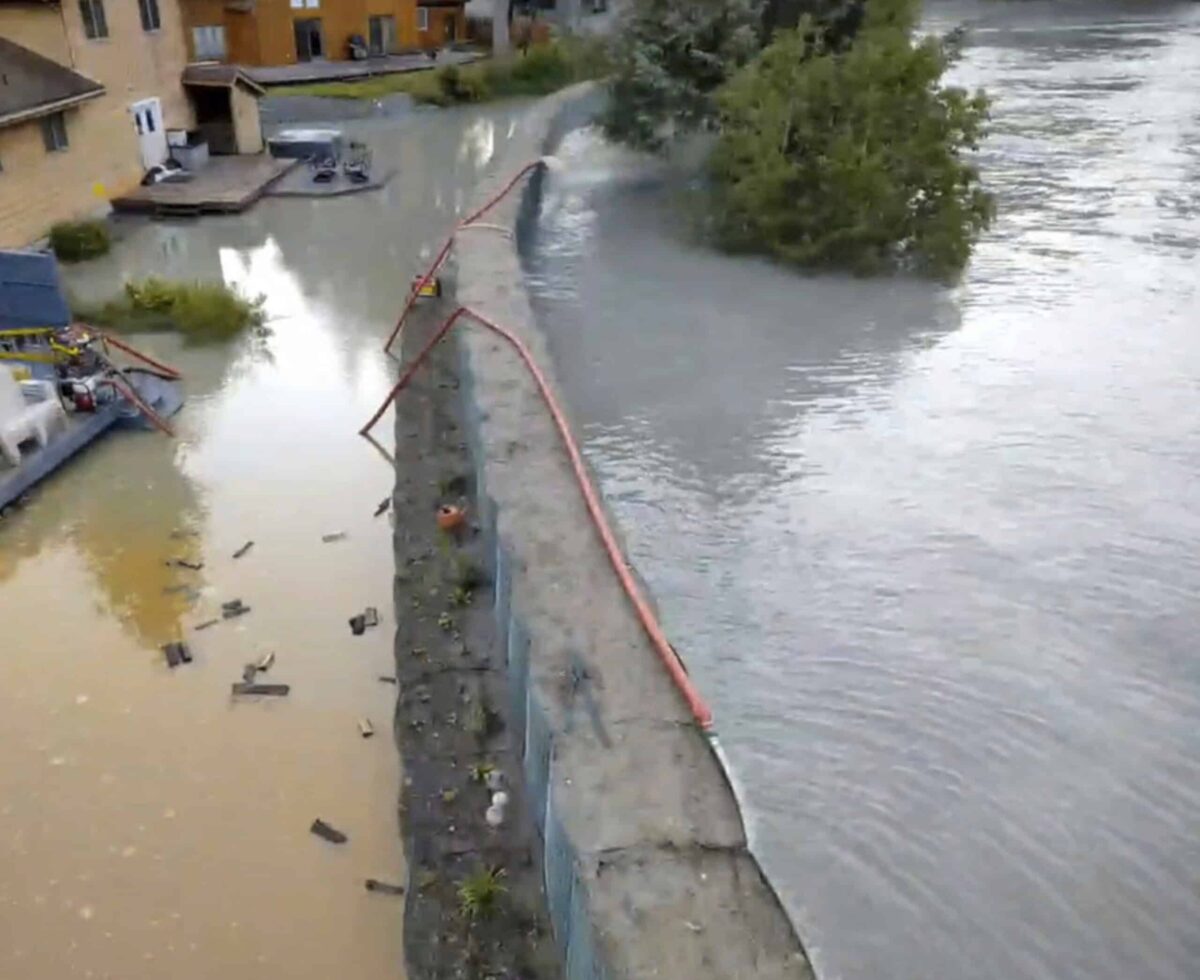
The flood scoured an area approximately 16 feet deep, 50 feet long, and 120 feet wide, displacing roughly 3,555 cubic yards of material, equivalent to about 300 dump-truck loads.

Since Saturday, Aug. 16, crews have excavated more than 22 feet to reach stable material and begin rebuilding around the undermined but stable bridge structures. Officials said about 5.7 million pounds of rock have been placed to restore the riverbanks and roadway.

If conditions allow, officials are targeting a reopening of the bridge by tomorrow, Aug. 26, with paving to follow depending on crew availability. Authorities urged motorists to be patient, noting that safety and long-term durability guide the reconstruction effort.

Categories
Featured Juneau News Juneau Local Ketchikan Local News Feeds Sitka Local

HESCO barriers, View Drive, and the possibility of another flood; Officials reflect on Suicide Basin release

This drone image provided by the City and Borough of Juneau shows flooding from a release of water and snowmelt at Mendenhall Glacier covered some roads and threatened homes along the Mendenhall River in Juneau, Alaska on Wednesday, Aug. 13, 2025. (City and Borough of Juneau via AP)

NOTN- City officials in Juneau say flood protection measures largely held during this month’s Suicide Basin release, but the risk of another release later this year remains.

Emergency Programs Manager Ryan O’Shaughnessy said five of the most severely damaged homes were on View Drive.

The barriers prevented widespread destruction but still experienced seepage and minor flooding in some areas.

“Six homes did have that major damage classification, And what that means is that water entered the living space and was generally above the height of a standard electrical outlet.” Said O’Shaughnessy, “At this time, the best professional judgment of the CBJ Engineering and Public Works team does believe that the HESCO barriers are not a viable solution for View Drive, so we’re working to identify any other solutions we can.”

Officials say long-term options for View Drive could include state- or federally sponsored buyouts. Meanwhile, the city is focusing on assessing barrier performance, repairing damaged sections, and moving forward with “Phase Two” of the project, which would extend protection as far as Brotherhood Bridge and Meadow Lane.

“There’s a lot of questions about phase two, and we’re working really hard to answer those, but seeing the effectiveness of the HESCO barriers this year is a great indication and a good reminder that we’re not out of the woods yet,” O’Shaughnessy said.

Last year, Suicide Basin released again in October with a final flood stage of just under 11 feet, and officials warn the glacier-dammed lake is currently refilling at a steady rate of about three feet per day, O’Shaughnessy said. “It is entirely possible we could see another release this year, another great reminder that we have a lot of work to do as a community.”

The city issued evacuation notices to more than 1,000 homes ahead of the flood, which crested at 16.6 feet, the highest on record. O’Shaughnessy credited the unified response involving the City and Borough of Juneau, state agencies, tribal partners, and the U.S. Coast Guard with preventing loss of life.

Categories
Featured Juneau News Juneau Local Ketchikan Local News Feeds Sitka Local

Flood damage could cost up to $1 million, City officials say they’re working towards a long-term solution

Mendenhall Glacier, photo courtesy of Alaska Beacon

NOTN- Juneau officials reflected on the city’s response to this month’s glacial outburst flood, saying while the emergency actions were effective more work is needed to strengthen protections.

Deputy City Manager Robert Barr said “We’ve been getting a fair amount of expressions of concern that we’re early in congratulating the people that worked on it, expressing our appreciation and thanks, and we have, because it was a great response to a tragic event. At the same time, I think we are all capable of holding two truths at once, we have work to do. We have a long road ahead of us, the barrier project was far from perfect.”

Following a damage assessment of the city, it was revealed that 16 houses experienced minor water damage while six homes suffered major impacts, primarily on View Drive.

Juneau Mayor Beth Weldon said damage repairs could cost up to a million dollars. “We’re not standing around patting ourselves on the back. We’re just thankful that the houses didn’t get flooded to the number that happened last year, and we are continuing to look for not just another phase of our short term, but also our long term solution.”

The U.S. Army Corps of Engineers says the temporary flood barriers helped protect Juneau neighborhoods during last week’s flood.

The Corps shipped more than 37,000 feet of barrier wall, 112,000 sandbags, and other materials from Illinois to Juneau, where they were placed in phases along 2.5 miles of the river.

Floodwaters peaked at 16.6 ft., the highest on record.

“The HESCO worked.” Said Mayor Weldon, “and yes, there’s water in people’s yards on the other side, but the difference in height is pretty tremendous.”

Categories
Featured Juneau News Juneau Local Ketchikan Local News Feeds Sitka Local

Juneau Mayor details flood damage

This drone image provided by the City and Borough of Juneau shows flooding from a release of water and snowmelt at Mendenhall Glacier covered some roads and threatened homes along the Mendenhall River in Juneau, Alaska on Wednesday, Aug. 13, 2025. (City and Borough of Juneau via AP)

Juneau Mayor Beth Weldon provided more details following a damage assessment of the city’s recent glacier lake outburst flood, revealing that 16 houses experienced minor water damage while six homes suffered major impacts, primarily on View Drive.

“16 houses were affected, and what affected means is they had water in their garage that they could just vacuum up, or water in their crawl space, but there was no damage to insulation or sheet rock or anything like that.” Said Mayor Weldon, “25 minor, so that means water in their house or their garage affected something besides just being able to shop Vac, but did not go up past outlets in the wall.”

The U.S. Army Corps of Engineers says temporary flood barriers helped protect Juneau neighborhoods during last week’s flood.

The Corps shipped more than 37,000 feet of barrier wall, 112,000 sandbags, and other materials from Illinois to Juneau, where they were placed in phases along 2.5 miles of the river.

Floodwaters peaked at 16.6 ft., the highest on record.

Of the 751 homes above the 17-foot flood line, most remained unaffected by recent flooding. The city’s HESCO barriers largely performed as intended, though some areas experienced water seepage and tree damage.

Mayor Weldon says there were about 6 homes with major damage. “of those six major, five are on View Drive. So we know that View Drive is still a dilemma for us.” she also stated about 23 homes were unverified.