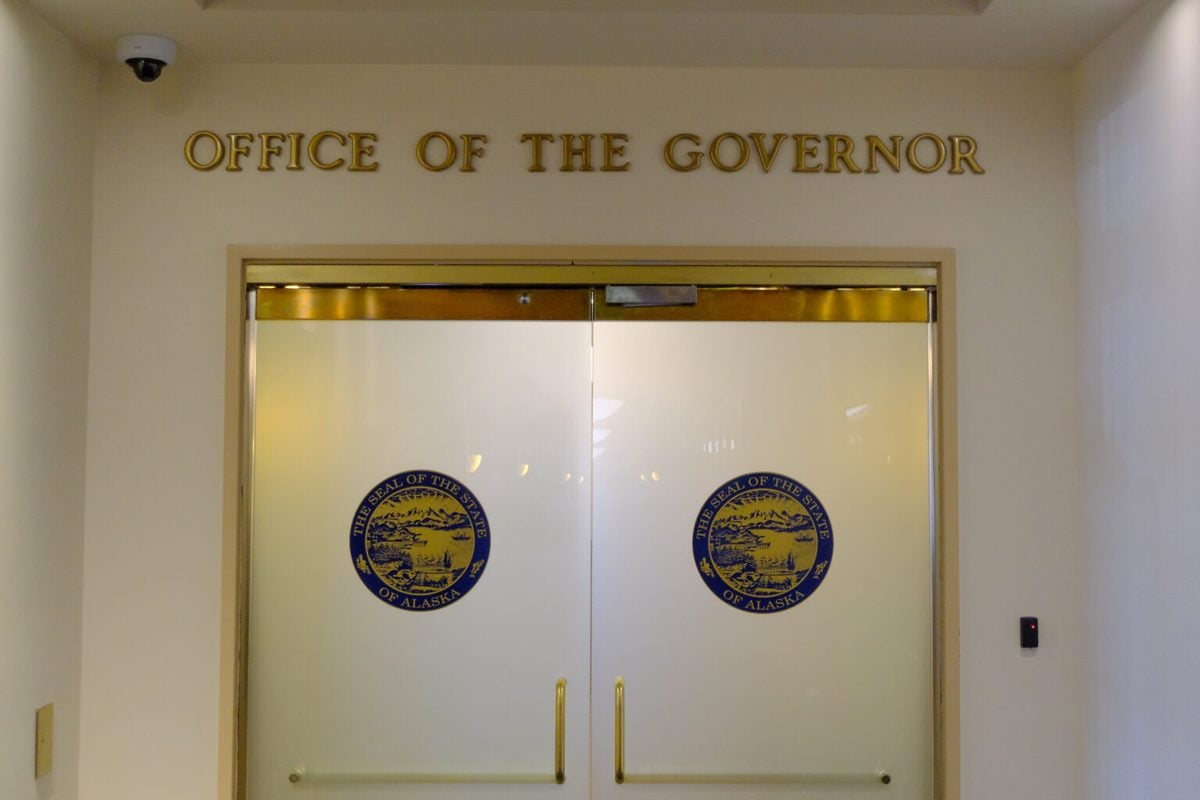
The doors of the governor’s office in the Alaska State Capitol is seen on Apr. 10, 2026. (Photo by Corinne Smith/Alaska Beacon)
Alaska’s November election for governor will include one Democrat and three Republicans after a final-days shakeup that included a wild last-hour substitution on Monday, the deadline to make changes after August’s primary election.
Under Alaska’s unique elections system, all candidates for an office run against each other in the primary election. The top four candidates, regardless of political party, advance to the general election in November.
Former state Rep. Jonathan Kreiss-Tomkins, a Democrat from Sitka, finished August’s primary election with 22.5% of the vote, the most out of 16 candidates seeking to replace incumbent Republican Gov. Mike Dunleavy.
The second-place finisher, Democratic candidate Tom Begich, withdrew from the race officially on Monday despite earning 20.8% of the vote.
That promoted Anchorage businesswoman Bernadette Wilson, a Republican, to the second spot on the November ballot. Wilson had 10.1% of the vote in the primary.
Begich’s withdrawal put former Anchorage Mayor Dave Bronson, a Republican, into the third spot for November. Bronson earned 8.1% of the primary vote.
The withdrawal would also have promoted Republican candidate and former Attorney General Treg Taylor into the fourth spot, but on Monday, Lt. Gov. Nancy Dahlstrom disqualified Taylor because of gaps in a legally required financial report.
Alaska Attorney General Treg Taylor speaks at a news conference on Thursday, Dec. 15, 2022, at the Alaska State Capitol in Juneau. (Photo by James Brooks/Alaska Beacon)
That left Taylor’s lieutenant governor candidate, Republican businesswoman Candice English, to decide by 5 p.m. whether to withdraw or continue with another running mate.
English found one — Taylor’s wife, Jodi Taylor, who became English’s lieutenant governor candidate in a form filed less than an hour before the 5 p.m. deadline.
According to the Anchorage Press, which was on the scene in Anchorage, English told election workers, “I’m stepping up to governor.” She also told another visitor to the office: “It’s all for the good of the state. The state needs the right people in place. We can’t get it wrong.”
It was not immediately clear on Monday evening whether the substitution is legal. Jodi Taylor’s required personal financial disclosure form contains the same information as Treg Taylor’s, and state regulators found it inadequate.
State law gives Jodi Taylor 30 days to amend her report before a final determination on her candidacy.
In Alaska’s November general election, voters will rank the four candidates (and any write-in candidates) in order of preference.
When ballots are counted, the candidate with the fewest top rankings is eliminated, and any votes for them are redistributed to their voters’ second choices.
The process continues until only two candidates are left, and the person with the most votes wins.
Ranked choice voting reduces the chances that candidates from the same party will split available voters and improve the odds for a candidate from a different party, but the system does not eliminate that chance entirely.
Since 2022, when Alaska began using the current system, a significant number of voters have continued to rank just one candidate.
As a result, political parties have pressured lower-finishing primary candidates to withdraw ahead of the general election in order to consolidate support.
In the case of Alaska’s governor race, where governor and lieutenant governor run as a single ticket, that led to talks around consolidation, where a lower-finishing governor candidate takes the place of a lieutenant governor on a higher-finishing ticket.
That didn’t happen on the Republican side, but it did on the Democratic one.
Second-place finisher Tom Begich confirms withdrawal
Hours before the 5 p.m. deadline to withdraw, second-place finisher Tom Begich, a Democrat and former state senator, officially filed his paperwork to quit the race.
Begich had announced his intentions on Friday, saying he is now supporting the first-place finisher, former state Rep. Jonathan Kreiss-Tomkins, a fellow Democrat.
In a written statement, prerecorded video and interviews after the announcement, Begich said that withdrawing means Democratic support is consolidated around a single candidate.
That means more money for the Kreiss-Tomkins’ campaign and less chance of a split vote in November.
While Alaska uses ranked choice voting, which would allow voters to pick both Kreiss-Tomkins and Begich, results over the past four years show a significant number of voters decline to rank multiple candidates.
Lieutenant governor rejects fourth-place finisher Treg Taylor
Lt. Gov. Nancy Dahlstrom on Monday declined to certify former Attorney General Treg Taylor as one of the four finalists in Alaska’s top-four primary election for governor.
Taylor, who finished fifth in the primary, was promoted to fourth after the withdrawal of the second-place finisher, Democratic candidate Tom Begich.
Nick Begich III announces endorsement of Bernadette Wilson
Alaska’s incumbent U.S. Representative, Republican Nick Begich III, said he is endorsing Republican businesswoman Bernadette Wilson as his preference for Alaska’s next governor.
Begich is running for re-election this year; Wilson worked on his prior campaigns for U.S. House, and Begich had previously vowed to support the top-finishing Republican candidate.
Arkansas Gov. Sarah Huckabee Sanders endorsed Wilson on Saturday, as did U.S. Rep. Byron Donalds, the leading Republican candidate to become Florida’s next governor.
Turnout is highest for regular primary election since 2014
According to Monday’s certified results, 166,992 voters participated in the August primary election, the most since the 2022 primary, which coincided with a special general election following the death of U.S. Rep. Don Young, R-Alaska, earlier that year.
Excluding that race, turnout this year was the highest for a primary since 2014, when voters decided a high-profile referendum on whether or not to repeal an oilindustry tax cut.
In terms of the number of votes cast, the 2026 primary was the fourth-largest in state history; in terms of percentage turnout, it was the 18th largest since 1974.
A voter joins a line of voters waiting to cast their ballots on Aug. 15, 2022, at the state Division of Elections office in Anchorage. (Photo by Yereth Rosen/Alaska Beacon)
The Alaska Supreme Court issued a fast-tracked ruling on Thursday, affirming a lower court’s decision that the Alaska Division of Elections’ language for an elections overhaul ballot measure is “true and impartial,” but ordered the division to make one additional change.
The Court issued the ruling days after hearing oral arguments from two groups of plaintiffs on opposing sides of the current ranked-choice voting system. The groups appealed a lower court’s ruling issued in June, challenging the language of Ballot Measure 2 as unclear, politically partisan and containing omissions they sought to change.
Ballot Measure 2, which will appear on the ballot as 24ESEG, would repeal the state’s current ranked choice voting and open primary systems, as well as repeal campaign disclosure rules enacted by voters in 2020.
The Supreme Court ruling Thursday affirmed a Superior Court’s finding that the Alaska Division of Elections’ fulfilled its legal duty in preparing the ballot measure title and summary in a “true and impartial” manner.
But the justices identified one omission: the division must add language that explains if the measure is approved, and nonpartisan, open primaries are eliminated, candidates for Governor and Lieutenant Governor would run for election separately.
Currently, candidates for Governor and Lieutenant Governor run together on a combined ticket in the primary election. The top-four vote getters in the open primary advance to the ranked choice general election.
A spokesperson for the Alaska Department of Law, which defended the division and its ballot measure language in court, said by email Friday they welcomed the ruling and would make the change.
“We are pleased that the Alaska Supreme Court rejected nearly all the challenges to the lieutenant governor’s true and impartial ballot summary,” said Sam Curtis, an information officer. He called the court’s directive a small change.
“The State had considered this a minor detail that did not need to be in a ballot summary, but the Court disagreed,” he said. “The Office of the Lieutenant Governor will issue a revised summary soon.”
The revised language is expected to be published by the division before a ballot printing deadline of Sep. 2.
Both groups of plaintiffs that filed appeals in court expressed mixed reactions, saying they were “disappointed” but “appreciated” the court’s decision.
One group of plaintiffs that also sponsored the ballot measure, called the “Repeal Now” campaign, filed a lawsuit challenging the language in court. Among a series of language changes requested, they had argued for language to explain the governor and lieutenant governor would run separately. Their attorney Julie Pack said by email Thursday they maintained concerns.
“We’re disappointed that the summary will continue to incorrectly state that open primaries would end with Ballot Measure 2,” Pack wrote. “Primaries would remain defaulted at open following Ballot Measure 2’s passage, just like they previously were.”
The group argued, in part, that if approved Alaskans would still vote in “open primaries.”
But the ballot measure language states “the act would get rid of open party primaries.” That’s because if voters approve the measure, the elections system would revert to a partisan primary system in which political parties establish rules governing which candidates may appear on their ballot and which voters may participate.
Voters in the primary would no longer be able to vote for candidates of any party running for statewide and federal offices, as they currently do.
The issue is of particular concern to another group of plaintiffs that filed suit in court, represented by attorney Scott Kendall, who was one of the primary sponsors of the 2020 ballot implementing the current ranked-choice voting system.
He argued the current language on the ballot measure related to how the primaries would change is incomplete.
“Our specific request was that it be made more clear that each political party will have the power to not only close their primaries, but to close them and make it unlawful for undeclareds and nonpartisans to vote,” Kendall said in an interview Friday. “There’s some language in the ballot measure that gestures at that, but I don’t think it really makes it clear.”
Overall Kendall said the group is grateful to the court and division for rejecting language proposed by Repeal Now he called “radical changes.”
“We’re very, very grateful that the court correctly rejected those baseless edits,” he said.
Kendall said the Supreme Court’s added change is “a good one.”
“It wasn’t so much about what’s good policy, bad policy. It was when a voter steps into the booth and picks up the pen, are they equipped with full knowledge of what their yes or no vote means?”
Ballot Measure 2 as currently proposed by the Alaska Division of Elections:
An Act Restoring Political Party Primaries, Ending Ranked Choice-General Elections, and Repealing Recent Campaign Finance Laws
This Act would get rid of open primary elections, where all candidates appear on one ballot. It would also get rid of ranked-choice general elections. It would bring back political party primaries and single-choice general elections. It would also repeal certain campaign finance rules that were added by a 2020 ballot measure.
Elections would occur as they did before open primaries and ranked choice elections. In the primary election, voters would choose a party’s ballot, unless prohibited by the party’s bylaws. They would only vote for candidates on that ballot. The winning candidates from each primary would be the party’s nominee. In the general election, voters would vote for only one candidate in each race. Party petitions, special runoff elections, and other processes would return.
This act would repeal campaign finance rules that were passed in 2020. It would remove the limits on donations to joint campaigns for governor and lieutenant governor. It would remove limits and disclosure rules under current law, including for digital ads, out-of-state donations, undisclosed donations and the true source of donations. It would change the meaning of a campaign expenditure and remove some fines.
Should this initiative become law?
Correction: This story has been updated to clarify that if approved, the ballot measure would enact a partisan primary system where political parties establish rules governing which candidates may appear on their ballot and which voters may participate.
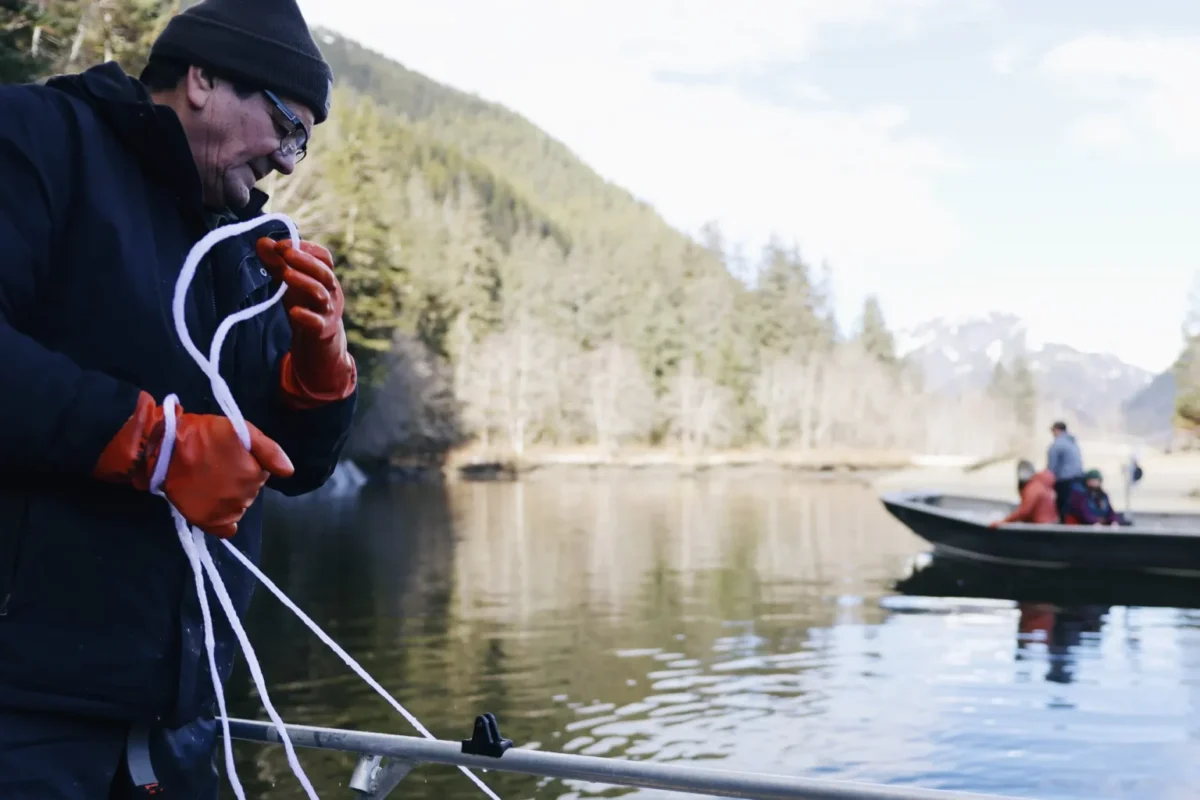
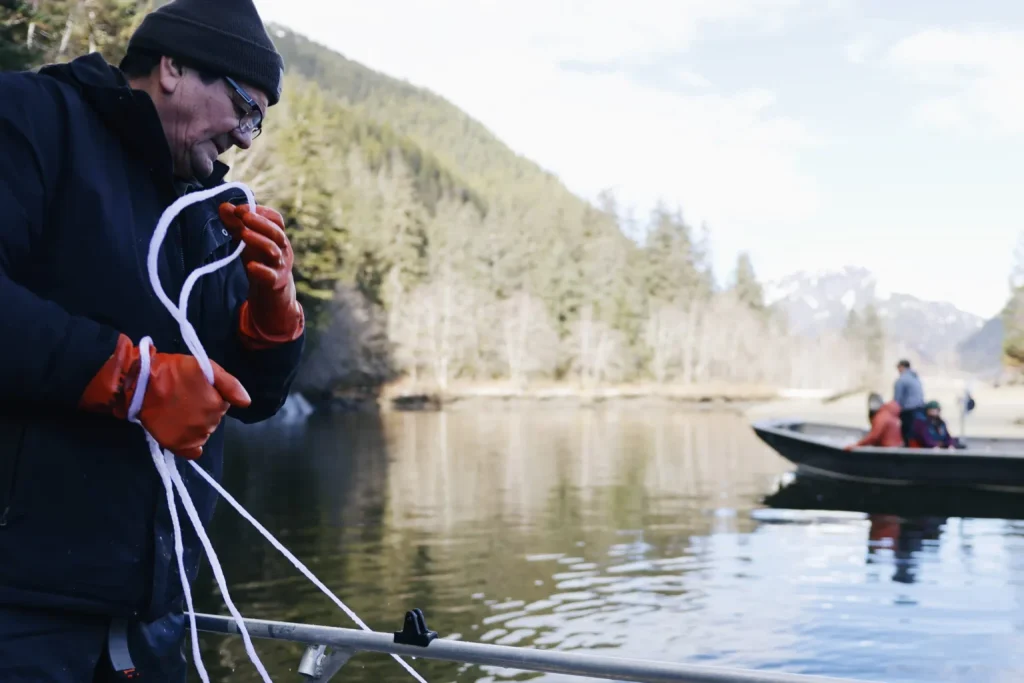
Louis Wagner Jr. pulls up ooligan nets on the Unuk River in southeastern Alaska in March 2024. He and his wife, Cindy Wagner, have fished in the area for years. (Photo by Sonia Luokkala/courtesy of the Southeast Alaska Indigenous Transboundary Commission)
The salmon and the ooligan that spawn in the Unuk and Stikine rivers have no say in the expansion of mining operations in British Columbia. Neither do the Alaskan tribes that live on the same rivers.
The power lies across the border in Canada, where the mining companies and the provincial, federal and Tahltan Nation authorities have joined forces in a modern-day gold rush to expand the Red Chris Mine at the headwaters of the Stikine River. Plans are also underway to restart the idled Eskay Creek Mine on the Unuk River.
The investment of a half-billion Canadian dollars supporting the expansion of the Red Chris mine by Prime Minister Mark Carney’s government has heightened an international conflict between the Native peoples and others in southeastern Alaska and the First Nations people in Canada who support the project.
A pictograph of the rising sun along the Unuk River is thousands of years old and reflects the influence of the Tèiḵwèidi Tlingit Clan of the Sàanyàa Ḵwáan, the people of the Unuk River, according to river advocates. (Photo by Sonia Luokkala/courtesy of the Southeast Alaska Indigenous Transboundary Commission)
Seven tribal nations could be affected by the Eskay Creek Mine, and the Red Chris expansions poses similar threats, according to officials with the Southeast Alaska Indigenous Transboundary Commission, or SEITC, a collective of 14 Haida, Tlingit and Tsimshian nations that have united to uphold stewardship over the lands, waters and sacred sites in their territories.
“The expansion of Red Chris means more risk in the headwaters of a river that has sustained our people since time immemorial, “ said SEITC President Esther Aaltseen Reese, Eagle Tsaagweidí (Killerwhale) from Ḵéex̱ʼ Kwáan (Kake), who lives down river of the Red Chris Mine.
“We are salmon people,” Reese told ICT. “The Stikine is part of who we are. We are already seeing contamination from Red Chris entering waters that feed the Stikine, yet British Columbia approved a major expansion without consulting the tribal nations downstream whose ways of life are on the line.”
The Tahltan Nation, which has agreements in place for both mining projects, did not respond to questions about the project posed by ICT via email.
In November 2025, the SEITC filed a judicial review in the British Columbia supreme court to force “meaningful consultation” with Alaskan tribes on mining projects in the headwaters of the Unuk, Stikine and Taku rivers.
“There is no legal or moral basis for B.C. to exclude our tribes who have deep ancestral ties and relationships to land and territory on both sides of the border,” Reese said in a statement issued at the time. “We deserve a seat at the table when decisions are made upstream that could obliterate our way of life.”
Canada’s Ministry of Environment and Parks responded to ICT questions in a written statement.
“We are not expediting projects at the expense of meeting our consultation obligations or compromising our high standards of environmental protection — we are finding opportunities that can do both in our processes,” according to the statement.
In regards to concerns from Alaskan tribes, officials said, “The matter of consultation with Alaska tribes for the environmental assessment of the Eskay Creek project near the B.C./Alaska border is currently before the courts, we are not able to comment.”
Eskay Creek Mine
The Unuk and Stikine rivers are part of the transboundary watershed, a collection of rivers, streams and tributaries that also include the Taku and Salmon rivers that flow south from British Columbia into Alaska and then on to the Pacific Ocean.
The watershed is crucial spawning grounds for salmon and other fish, and provides sustenance to Indigenous people and others along the rivers.
Cindy Wagner, Haida/Tsimshian, is concerned that the rapid expansion of mining in Canada will have significant environmental impacts on the transboundary watersheds in Alaska.
Louis Wagner Jr., rear left, delivers ooligan with his daughter Lee, center, and wife Cindy in this undated photo. (Photo courtesy of Cindy Wagner)
Wagner, assistant executive director of the SEITC, and her husband, Louis Wagner Jr., live downstream of the Eskay Creek Mine on the Annette Islands Reserve in Alaska on the Unuk River, where she has lived and fished all her life.
She has seen first hand the impact of mining on the Unuk.
The Eskay Creek Mine operated from 1994 to 2008, and the ooligan fishery on the river was closed in 2001. In recent years, ooligan, a small fish also known as eulachon, have begun to return, along with salmon and mackerel.
But she fears that could change with the reopening now underway of the Eskay Creek Mine on a much-larger scale. The mine received its Environmental Assessment Certificate in January.
“This is all for the Unuk River,” Wagner told ICT. “It’s a major salmon river, an ooligan spawning river, a mackerel spawning river, and vital to southeast Alaska.”
Ooligan, shown here, are small fish used in a variety of ways by Indigenous people and others in southeastern Alaska. (Photo by Sonia Luokkala/courtesy of the Southeast Alaska Indigenous Transboundary Commission)
Reese says her people are concerned about a possible overflow or dam breach at the tailings ponds that collect the mining byproducts. In 2014, a breach at the Mount Polley copper and gold mine tailings dam resulted in billions of liters of wastewater spilling into the waterways. The mine is owned by Imperial Metals, which also owns a share of the Red Chris mine.
“Contamination or a failure at Red Chris could travel downstream, across the border, and through one of the most intact salmon systems left in the world,” Reese said. “The cumulative impacts of multiple large mines only magnify that risk.”
A waterway in transition
Tribes on the American side of the border have been living with the impact of mining for decades and fighting, to no avail, to stop expansion, local officials said.
On June 19, however, the province of British Columbia approved the transition of the Red Chris mine from an open-pit mine to a block cave mine that would largely be underground. On July 2, the Canadian government approved the funding support.
The Tahltan Nation in British Columbia has signed on with Red Chris mine’s owners and operators, Newmont Corporation and Imperial Metals, according to a statement from the companies.
The outlook is not as rosy downstream. The Annette Islands Reserve of the Metlakatla Alaska Native Community is Alaska’s only reservation, with other Native lands transferred to Alaska Native Corporations under the Alaska Native Claims Settlement Act, or ANCSA.
The reserve sits on the pristine Alexander Archipelago about 250 miles south of Juneau.
The Tongass rainforest towers over the Unuk River in southeastern Alaska. (Photo by Sonia Luokkala/courtesy of the Southeast Alaska Indigenous Transboundary Commission)
Wagner has lived off the Unuk River for most of her life, and in recent years has been defending Alaska’s waterways against mining development in Canada.
“I have always been fishing, even as a child,” she said. “My parents brought us out, all four of us, on a little 35-foot boat … I met my husband. The first time I helped him was down on his brother’s boat. He was selling ooligan and he didn’t have anyone to help him, and so I helped him.”
Wagner and her husband have always watched the waters of the Unuk River, and taken note of how clean and deep they were, and how the fish changed in appearance and in number. Then, in 1999, after the Eskay Creek Mine began operating, they noticed that industrial waste was piling up in the low part of the river.
“We are way up this river,” Wagner said. “How does a rusted-up oil drum get this far? How does all this plastic and old tarps and old pallets get up here? This looks to be an important part where the moose stepped into the river to get across, and it’s blocked with junk.”
The fish noticed, too, she said.
“In about 2001, we started noticing the ooligan bypassing the Unuk River,” she said.
Ooligan are different from mackerel and salmon, which return to the waters where they were spawned. Ooligan go to where the water is best, she said.
Dramatic escalation
The Unuk River was beginning to recover after the Eskay Creek Mine shut down in 2008, Wagner said, when a mining boom began on the Canadian side, in an area in northwest British Columbia called the “Golden Triangle.”
By 2022, just two mines were in operation, BruceJack and Red Chris. But four mines were proposed, seven were under development and seven more exploration projects were underway, mostly to dig for gold, according to a provincial report on mines. The ore extracted from the ground is processed to pull out the valuable gold and copper that it can contain.
Guy Archibald, executive director of the transboundary commission and a self-described “reformed miner,” said the transition from an open-pit mine to a block cave mine at Red Chris will mean a dramatic escalation involving hydraulic fracturing, known as fracking, a controversial method also used for extracting natural gas.
Archibald said the SEITC member nations “upholding their sovereign rights and defending the transboundary Stikine, Taku and Unuk Rivers from rapidly expanding mining development occurring in the Canadian headwaters.”
An environmental chemist, Archibald has been with the commission since its inception in 2014. Before that, he worked in the uranium industry in southeastern Utah and the oil shale industry in western Colorado in the 1970s and 1980s, he said.
Archibald explained the process behind a block cave mine.
“They’ve mined out the ore body that’s closest to the surface, and in order to go deeper, they’re going to have to access it underground,” he said. “They’re going to drive a ramp underneath the ore body, and then … they’re going to fracture the ore body pretty much the same as they do hydraulic fracturing, fracking for natural gas.”
The crumbled ore falls into the ramp and is carted above ground, he said.
“They’re going to just start scooping it out from the bottom as this cavity, this cave, just naturally collapses in,” he said. “It’s just going to turn into a big crater in the earth, and that’s block cave mining.”
The practice is not new, but in the past, miners would use drilling. With this project, they’ll use fracking.
“Block cave mining has been around for a long time,” Archibald said. “The only difference I see with the way Red Chris is doing it is by doing the hydraulic fracturing from the surface, drilling down and then pumping high pressure water into the ore body to break it up.”
The introduction of fracking to the block cave operation is a major concern to the SEITC. Officials say the mine can’t contain its current tailings, which already end up in the groundwater.
“The studies have been showing the tailings dam leaks into the groundwater 26 percent of its volume every year,” Archibald said. “Those tailings have to be constantly covered with water so that they don’t oxidize and turn acidic. We already have downstream pollution problems in groundwater and surface water…Using more water to frack this ore body is not going to help that situation.”
‘A critical step’
The Red Chris mine operation is a joint venture partnership between the Newmont Corporation, which owns 70 percent, and Imperial Metals, which owns 30 percent.
The Red Chris was one of 18 major projects named by Canada’s Major Projects Office, the new federal department created by the Carney government to push forward his “Build Canada Strong” strategy. The half-billion-dollar investment may be just the beginning.
“With the authorizations granted by the province and the support of the Tahltan Nation, the stage has been set for the development of Red Chris into a Block Cave mine,” Imperial President Brian Kynoch said, following the approval of the British Columbia government. “These approvals are a critical step in advancing a final investment decision by the joint venture partnership.”
Newmont officials welcomed the news in a statement promising that the project would not only increase Canada’s copper production by an estimated 15 percent but that the infrastructure could be a hub for mining for decades.
“The project is expected to extend the life of the current Red Chris mine by approximately 14 years and sets the foundation for decades of potential additional mining,” Newmont stated. “It represents a significant opportunity to create long-term value for Newmont’s shareholders, strengthen critical mineral supply chains, and deliver long-term benefits for local communities, Indigenous partners, British Columbia, and Canada.”
Canada’s Major Projects office is promoting both production and Indigenous participation, stating that the project was “developed in close collaboration with the Tahltan Nation, whose Traditional Territory overlaps directly with the mine site” and that “the project supports reconciliation while strengthening Canada’s role as a reliable supplier of critical minerals.”
Provincial leaders have changed the laws, however, to eliminate participation of U.S. tribes when it comes to environmental impacts. The province passed Bill 15 in April to amend the dispute resolution processes in British Columbia’s Environmental Assessment Act to limit participation of tribes in the U.S. and exclude them as “participating Indigenous nations.”
Archibald says the moves have raised concerns for taxpayers as well.
“Subsidizing the Red Chris just furthers the privatization of profit while transferring the risk on to the taxpayer,” he said. “If Newmont and Imperial Metals can’t afford their own infrastructure, what assurance do we have that adequate funds will be available for long-term tailings management, closure, and cleanup to protect the Stikine River for hundreds of years into the future?”
The Eskay Creek Mine, owned by Skeena Gold + Silver, is an open-pit gold and silver mine that is being redeveloped with a projected 12-year mine life.
In approving the mine’s expansion, British Columbia Premier David Eby hailed the relationship with First Nations.
“Today marks success for yet another multibillion-dollar investment in our province that will deliver prosperity, jobs and stability for all British Columbians, achieved in true partnership with the Tahltan,” Eby said in a Jan. 27, 2026, press release. “Congratulations to all who were involved in this important work. Those who want to end our work with First Nations would not have delivered these thousands of jobs, period. Following their advice would leave us poorer, tied up in court and in a place of uncertainty.
Kerry Carlick, president of the Tahltan Central Government, issued a statement in the same press release.
“This is a hugely important day,” Carlick said. “TCG’s decision to consent to the Eskay Creek Project reflects a historic, precedent-setting process that affirms Tahltan Nation’s authority over development in our Territory, recognized by the Province and Skeena Gold + Silver.”
When asked to comment regarding concerns of Indigenous Alaskans about environmental concerns, a spokesperson for Skeena Gold + Silver responded that they had answered those concerns.
“We have already addressed many questions regarding concerns from the Alaskan groups, as we were going through our permitting process,” Galena Maleger, the vice president of investor relations told ICT in an email. “There is a significant amount of information available online as to how Eskay Creek is adhering to the highest standards in environmental management.”
Looking ahead
Downstream on the Unuk River, Wagner and her husband are already seeing more and more boats hauling material north to the dam site. They can only imagine the size of the massive project based on the garbage that piles up in the river.
Wagner has a message for the Tahltan Nation whose members will profit from the two mines.
“I think they should be more aware of what’s coming down the river, because it’s not staying up there on their territory,” Wagner said. “It’s coming down on my territory, my tribe’s territory, all southeast territory, and we have to deal with it.”
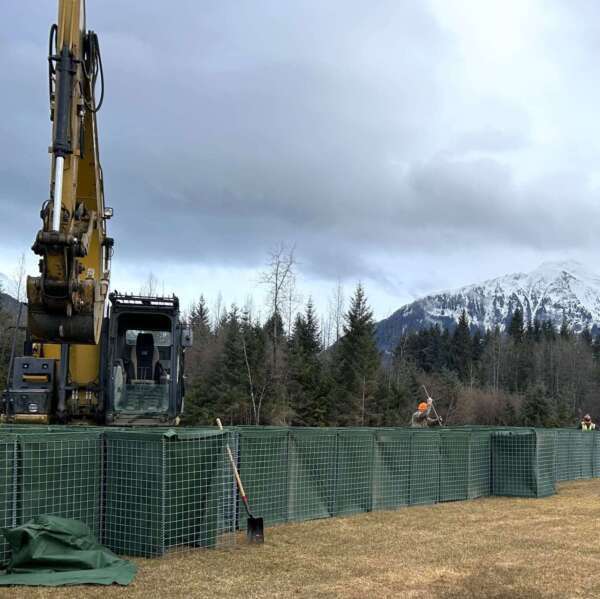
Photo provided by CBJ following the installation of the HESCO barrier project
Photo provided by CBJ following the installation of the HESCO barrier project
NOTN- A memo from City Manager Katie Koester says the city could be responsible for 25% of the cost of an accelerated Army Corps of Engineers project, rather than the 10% local share associated with previous proposals.
First reported by the Juneau Independent, Koester writes Juneau could establish a new service area and tax to help pay for ongoing flood protection and the city’s share of a permanent solution to the annual glacial lake outburst floods.
The Assembly Committee of the Whole will meet on Monday to discuss.
The city has spent millions of dollars on temporary flood protection, including HESCO barriers, while the U.S. Army Corps of Engineers pursues a permanent solution for annual flooding from Suicide Basin.
Koester said the Corps is seeking proposals from industry for an emergency water conveyance prototype capable of permanently addressing the floods. The goal is to keep water levels in Suicide Basin below 1,100 feet so any eventual release would be significantly smaller.
The project is being pursued under the federal Flood Control and Coastal Emergencies authority, which allows for a faster process but requires a 25% local share of construction costs for permanent flood control projects.
The city is working with Alaska’s congressional delegation to change that cost share to 10%, similar to the federal share available for projects involving tribal lands.
The total cost of a permanent project has not yet been determined, but the city expects it to exceed the amount currently available through the federal emergency account. The account receives about $40 million annually for flood control projects nationwide, meaning Juneau will need to advocate for additional federal funding.
Koester recommends the Assembly consider putting a bond or debt proposition before voters once the Corps provides a more reliable estimate of the project’s total cost.
In the meantime, Juneau is continuing to spend money on temporary protections. Nearly $50 million in federal, state and local funding was spent this summer on flood mitigation in the Mendenhall Valley, according to the memo.
Koester said the city expects to remain responsible for regular HESCO maintenance, including inspections, repairs from settling, responding to vandalism and refilling the barriers. The city also must continue coordinating with homeowners, maintaining property access and handling permitting.
She writes the work has also diverted city staff and resources from other projects, according to the memo.
One option under consideration is creating a service area with its own mill rate to fund flood protection and related services. The tax could apply either to properties within the protected area or citywide.
A service area would require approval by voters living within its boundaries. Koester said a citywide property or sales tax could also be appropriate because the annual floods have been characterized as an existential threat to Juneau as a whole, rather than a localized disaster affecting only the Mendenhall Valley.
Koester also recommended that the city push the Alaska Legislature to make construction of a lake emergency water conveyance prototype a state priority during the next legislative session, which begins in January.
Voters at Anchorage City Hall wait in line to cast their ballots on Nov. 4, 2024, the day before Election Day. City hall, in downtown Anchorage, was one of the designated early voting sites in the state’s largest city. (Photo by Yereth Rosen/Alaska Beacon)
The Alaska Supreme Court heard oral arguments on Tuesday on legal challenges brought by two groups on opposing sides of the state’s current ranked choice voting election system. The two groups of plaintiffs brought lawsuits against the Alaska Division of Elections challenging the language of a ballot measure, set to go before voters in November, abolishing the voting method along with other changes.
Ballot Measure 2, which will appear on the ballot as 24ESEG, would overhaul the state’s elections system via three major components: repeal ranked choice voting; rescind the nonpartisan, open primary system; and repeal campaign disclosure rules enacted by voters in 2020.
A Superior Court ruled in June that the state’s ballot summary was “true and impartial,” siding with the Alaska Division of Elections, overseen by Lt. Gov. Nancy Dahlstrom.
Plaintiffs have appealed that decision to the Alaska Supreme Court, which is expected to issue a fast-tracked ruling before a division deadline of Sept. 2 to print general election ballots.
The Alaska Supreme Court heard oral arguments in a case challenging the Alaska Division of Elections’ language of a ballot measure that would overhaul state elections on Aug. 25, 2026. (Screenshot of hearing via Gavel Alaska)
One group of plaintiffs are represented by attorney Scott Kendall, an author of the 2020 ballot measure implementing Alaska’s ranked choice voting and open primary system. They argued that the current ballot measure language is unclear, partisan and omits serious implications of the repeal effort.
The other group of plaintiffs, drafters of the measure, is called the “Repeal Now” campaign. The measure’s primary sponsors are Republican gubernatorial candidate Bernadette Wilson, along with former Anchorage library director Judy Eledge and former Alaska House Rep. Ken McCarty of Eagle River.
In court, attorneys representing Repeal Now argued against the lawsuits being combined and for a series of language changes, including changing of the term “repeal,” which they say is not easily understood by voters, and the term “true source” of campaign disclosures as “inflammatory partisan suasion.”
Under Alaska law, the division is required to prepare a ballot measure with a “true and impartial” summary of the proposed law. It must be “free from misleading tendency, whether the amplification, of omission, or of fallacy, and … must contain no partisan coloring.”
In the June ruling, a Superior Court judge found the division fulfilled its legal obligation and “if ballot summary language is true and impartial, the Court will not invalidate the language just because better language could be written.”
On Tuesday, the division, represented by attorney Laura Fox with the Alaska Department of Law, argued that the ballot language could be edited thousands of ways, but the division fulfilled its legal duty and prepared the ballot with a “true and impartial” summary and title.
“This case is not an editing exercise,” Fox argued. “We’re not assembled here as a big team of editors trying to polish a piece of writing by committee, as fun as that might be. Instead, the question here is just whether the summary clears the basic hurdle of being true and impartial. Because it does, the court should affirm.”
The Alaska Supreme Court justices will either uphold the lower court’s decision or order the division to revise the language. They’re expected to issue a ruling before Sept. 2 and then follow sometime later with an extended legal opinion.
Timeline of ballot measure and legal challenges
Alaska voters narrowly rejected a similar initiative to repeal ranked choice voting in 2024. Proponents quickly restarted the campaign in 2025, collecting more than 34,000 signatures to again place the question on the ballot in 2026. The division first published the ballot language last December.
A group of plaintiffs represented by Kendall filed a lawsuit challenging the ballot language in January. Plaintiffs include Anchorage Republican Sen. Cathy Giessel, AFL-CIO union president Joelle Hall, and former member of the Juneau Borough Assembly and vice president of Ocean Conservancy ‘Wáahlaal Gidaak Barbara Blake. They argued the ballot language was biased and inaccurate.
The division subsequently revised the ballot language in February with significant changes to the title and summary. The plaintiffs dropped the lawsuit without prejudice, according to court documents.
In mid-February, the Repeal Now group filed a lawsuit challenging the new language, arguing “opponents got their preferred language” adding the term “repeal” three times, and the summary was not “true and impartial.”
Giessel and fellow plaintiffs filed a new lawsuit, and the two suits were consolidated by the Superior Court judge in April.
Both groups of plaintiffs filed suggested ballot language with the court, and the state filed a motion defending their ballot language.
Court arguments
On Tuesday, Kendall argued before the Supreme Court that the ballot language should be a clear map for voters to understand what the measure does.
“But the state’s language here isn’t a map. It’s effectively an obstacle course where a voter can only understand Ballot Measure 2 by doing independent research outside the four corners of the ballot language. The state’s language is unclear, contains partisan suasion, and omits details that would give voters significant pause,” he said.
In particular, Kendall raised concerns the ballot measure does not clarify that if passed, nonpartisan or Independent voters would be excluded from voting in party primaries, unless registered with that party.
“It fails to make clear that Ballot Measure 2 specifically empowers political parties at the stroke of a pen to make it illegal for undeclared and nonpartisans to vote in the primary election,” he said. “I think voters need to be put on notice, especially the two-thirds of voters that don’t belong to either party, that you may not be able to vote in the primary election at all.”
Kendall also argued the language related to campaign finance disclosure rules was inadequate, and fails to give details of the implications.
If passed, the measure would repeal campaign disclosure rules and limits enacted by the ballot measure passed in 2020, including rules that individuals and entities who contribute more than $2,000 to candidates or campaigns must disclose the true source, as defined by law.
Attorney Julie Pack, representing the group of plaintiffs with the Repeal Now campaign and supporting the ballot measure, argued against the use of the term “repeal” because she said campaigners collecting signatures for the ballot measure found voters were not familiar with the term.
“Many people do not use that word on a daily basis. It’s not common parlance. It is for lawyers. It’s not for people who are not lawyers, and it’s not a term that is readily understood,” she said.
Justices pushed back, pointing out the term is in the name of their organization.
“My organization named itself before they canvassed, got all the signatures, talked to over 31,000 Alaskans, and understood that repeal is not a word that lots of people understand,” she replied. “So my client named itself before it learned that repeal is a term that’s mildly to moderately sophisticated.”
“There is no need to use words that are sophisticated,” she added. “When ‘redo,’ ‘remove,’ ‘undo,’ ‘get rid of’ are perfectly fine, and they would protect Alaskan voters’ right to know what they’re voting on.”
Pack also raised concerns with the term “true source” related to campaign finance disclosures, and argued the measure would maintain “open primaries.”
Arguing on behalf of the Division of Elections, Fox urged the justices to reject the plaintiffs arguments and affirm the lower court’s decision that the division met its legal obligations and should print the ballot measure as is.
Ballot Measure 2 as currently proposed by the Alaska Division of Elections:
An Act Restoring Political Party Primaries, Ending Ranked Choice-General Elections, and Repealing Recent Campaign Finance Laws
This Act would get rid of open primary elections, where all candidates appear on one ballot. It would also get rid of ranked-choice general elections. It would bring back political party primaries and single-choice general elections. It would also repeal certain campaign finance rules that were added by a 2020 ballot measure.
Elections would occur as they did before open primaries and ranked choice elections. In the primary election, voters would choose a party’s ballot, unless prohibited by the party’s bylaws. They would only vote for candidates on that ballot. The winning candidates from each primary would be the party’s nominee. In the general election, voters would vote for only one candidate in each race. Party petitions, special runoff elections, and other processes would return.
This act would repeal campaign finance rules that were passed in 2020. It would remove the limits on donations to joint campaigns for governor and lieutenant governor. It would remove limits and disclosure rules under current law, including for digital ads, out-of-state donations, undisclosed donations and the true source of donations. It would change the meaning of a campaign expenditure and remove some fines.
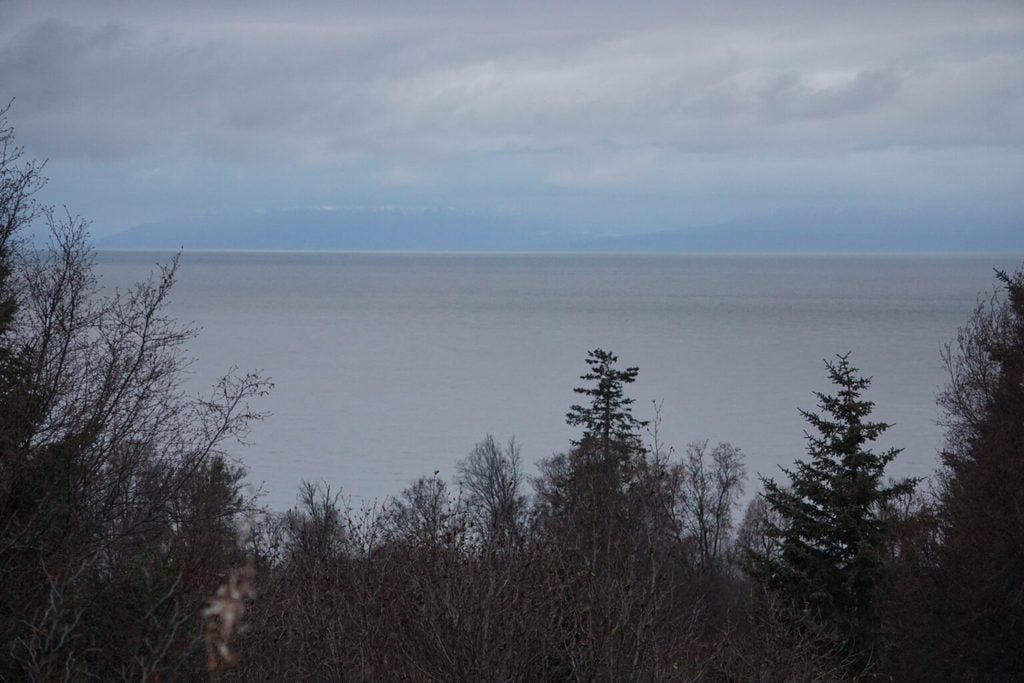
Cook Inlet near Clam Gulch is seen on Oct. 23, 2025. (Photo by Yereth Rosen/Alaska Beacon)
State and industry officials and the U.S. Coast Guard were responding on Tuesday to an unexplained oil spill roughly 60 miles southwest of Anchorage in Southcentral Alaska’s Cook Inlet.
The spill, which produced a long oil sheen on the water near the Trading Bay area on the western side of the inlet, was first spotted by a pilot on Monday. His report prompted a multiagency response.
The multiagency unified command is composed of the Alaska Department of Environmental Conservation, the U.S. Coast Guard and Hilcorp, the dominant oil and gas operator in Cook Inlet.
The sheen was seen near the idled Spark platform, one of 17 oil and gas platforms in the inlet. Six of those, including Spark, are now inactive. The Spark platform was acquired by Hilcorp as part of its 2012 purchase of Marathon Oil’s Cook Inlet assets. It has been inactive since 1992, said a statement issued by the unified command responding to the spill. The wells associated with the Spark platform were plugged and abandoned by a previous owner in 2009, the statement said.
As of Tuesday afternoon, however, the ongoing investigation has not pinpointed a source of the spill, its size or even the substance, DEC officials said.
An oil-response vessel sent by Hilcorp to the site arrived shortly after 2 a.m. on Tuesday, but its crew was not able to spot the sheen with infrared imaging technology, said the incident command statement. The spill-response vessel, the Endeavor, has been sailing in a grid pattern to search for the spilled material and its possible source, the statement said.
A closeup view of a 2022 Alaska Division of Oil and Gas map shows the pipelines and oil and gas platform locations in Cook Inlet. (Map provided by the Alaska Division of Oil and Gas)
There were no reports of impacts to fish or wildlife as of Tuesday afternoon, said a DEC situation report issued on Tuesday afternoon.
Fish could be potentially at risk, the situation report said. All five species of Pacific salmon swim in the affected waters, and coho and sockeye salmon were migrating through the area at the time the spill was reported, the situation report said.
Representatives of area environmental groups said Tuesday that the event was a warning about risks to the inlet.
Satchel Pondolfino, the clean water lead for Cook Inletkeeper, said she and others are concerned about the apparent association with the idled but still-standing Spark platform.
“It’s just another reason why it’s so important that Alaska use its authority to hold Hilcorp and every other operator accountable for dismantling the infrastructure,” she said.
Activists have called for the removal of such unused infrastructure from the inlet, but the state so far has not ordered any company to do that.
Cooper Freeman, Alaska director of the Center for Biological Diversity, said numerous natural resources continue to be at risk from the incident and others like it.
“It’s gut-wrenching to see the inlet’s beleaguered salmon and belugas take a hit they can’t afford from a miles-long oil spill,” he said in an emailed statement. “We need Cook Inlet’s fish and wildlife to recover, and we can’t keep treating their home like an industrial waste zone. This is yet another wake-up call that our over-reliance on fossil fuels imperils not just our region’s long-term energy stability, but the vitality of our environment for all future Alaskans.”
FILE - Dan Sullivan, a candidate in Alaska's U.S. Senate race who shares his name with the incumbent seeking reelection, talks with a reporter, July 3, 2026, in Petersburg, Alaska. (AP Photo/Becky Bohrer, File)
FILE – Dan Sullivan, a candidate in Alaska’s U.S. Senate race who shares his name with the incumbent seeking reelection, talks with a reporter, July 3, 2026, in Petersburg, Alaska. (AP Photo/Becky Bohrer, File)
AP- A candidate with the same name as Alaska’s incumbent U.S. senator has advanced to the general election in what will be one of the most closely watched races in the country this fall.
Dan J. Sullivan, who goes by Dan Sullivan, was among the top four finishers after the Aug. 18 primary and on Tuesday moved on to the November matchup, which is a ranked choice contest. The incumbent, Republican Sen. Dan Sullivan, and Democratic former U.S. Rep. Mary Peltola also have advanced.
The challenger Sullivan, a retired teacher from the island community of Petersburg, sued for a spot on the ballot and succeeded after a judge invalidated a decision by a top state elections official who said he had filed his candidacy with an intent to confuse voters. The allegation was driven by claims raised by the senator and his GOP allies. The state Supreme Court ultimately ordered Dan J. Sullivan eligible for the ballot.
While the challenger sought to appear on the ballot as Republican Dan J. Sullivan, the Division of Elections listed him as Daniel J. Sullivan Jr., with no party affiliation. The senator was listed as Dan S. Sullivan, Republican and incumbent.
A call seeking comment from the challenger was not immediately returned Tuesday, and emails to campaign staff for the senator also were not immediately returned.
President Donald Trump endorsed Sen. Sullivan for reelection and called the other Sullivan’s candidacy an attempt to trick voters. Dan J. Sullivan criticized the incumbent for embracing Trump’s endorsement and said the president was “more interested in raising tariffs on our allies than in lowering the cost of groceries, housing and energy.”
It was too early to determine who would fill the fourth and final slot in the Senate general election race.
The Senate race was one of three major contests on Alaska’s primary ballot, which also featured races for the state’s lone U.S. House seat and governor.
In the congressional race, Republican Rep. Nick Begich, seeking a second term, advanced earlier to the general election along with independent Bill Hill. The other two spots remained too early to call.
Democrats Jonathan Kreiss-Tomkins and Tom Begich, former state lawmakers, advanced on election night in the race for governor, topping a field of mostly Republican candidates all vying to succeed Republican Gov. Mike Dunleavy. Tom Begich is Nick Begich’s uncle. Republican Bernadette Wilson also advanced on Tuesday, with the fourth spot remaining too early to call.
The state accepts absentee and overseas ballots up to 10 days after the primary as long as they were postmarked by election day.
The incumbent Sullivan and Peltola are the leading candidates in the Senate race, after raising the most money and having statewide name recognition. It’s one of a handful of Senate races around the country considered competitive and pivotal for both parties’ hopes of controlling the chamber.
Dan J. Sullivan’s presence on the general election ballot adds a twist to the race because of Alaska’s ranked choice voting system. Under it, candidates who finish third or fourth in the general election can play a crucial role in deciding the eventual winner if their supporters rank other choices beyond them.
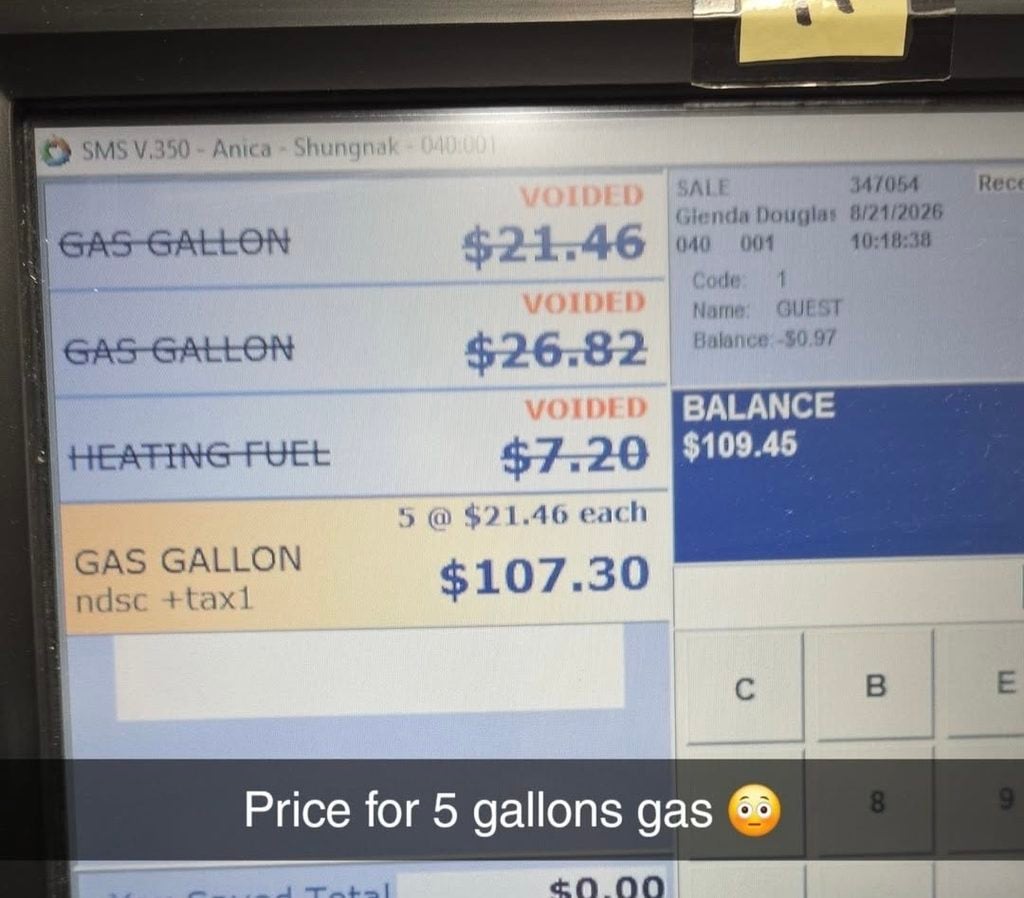
Glenda Douglas of Shungnak, in the Northwest Arctic Borough, shared this photo on social media of a gasoline purchase she made on Friday, Aug. 21, 2026. (Glenda Douglas photo)
By: James Brooks, Alaska Beacon
Glenda Douglas of Shungnak, in the Northwest Arctic Borough, shared this photo on social media of a gasoline purchase she made on Friday, Aug. 21, 2026. (Glenda Douglas photo)
It’s not a typo. The price of a gallon of gasoline in the northwest Alaska village of Shungnak was $26.82 on Friday, local residents and regional officials said, likely giving the community the dubious honor of having the most expensive gasoline in the United States.
“It is very much real,” said Glenda Douglas, who manages the store in Shungnak and posted a picture of the price on Facebook.
Shungnak is about 280 river miles east of Kotzebue, up the Kobuk River, or 150 miles as the airplane flies. Air travel is the only reliable, year-round form of transportation.
In summer, the river is usually navigable by boat. In winter, residents travel by snowmachine. Last fall and for parts of this summer, water levels on the Kobuk were low enough to interrupt barge traffic, which contributed to the high price of gasoline.
“We sell groceries, diesel and gas,” Douglas said via Facebook message. “We had to get gas flown in twice this summer since (the) barge isn’t able to make it this way because the river water levels (are) too low. Just yesterday, the price was 13.99, but now it is 26.82.”
Shareholders in NANA Regional Corp. are eligible for a discount — they can buy gas for $21.46 per gallon.
Albie Dallemolle is NANA’s vice president of economic development and sustainability.
“Confirmed, Shungnak gasoline price is $26.82 per gallon, which had to be flown into the community,” she said by text message. “This price does reflect the highest cost for gasoline in the region … for now. Unfortunately, prices for gasoline and diesel are expected to increase once communities receive their fall barge deliveries.”
That’s because the current price is based in part on an average of the air-delivered fuel and cheaper barge-delivered fuel. New barge-delivered fuel, bought after the Iran War began, is expected to be more expensive than fuel bought before the war.
Shungnak frequently endures some of the highest fuel prices in Alaska.
In 2007, a gallon of regular unleaded was already $8.11 per gallon, so costly that the Wall Street Journal used the village as an example of what rural Alaska was experiencing that year. By 2022, the price was $14.03 per gallon, according to figures from the Northwest Arctic Borough.
In a message, Douglas said one thing that particularly concerns her is the fact that hunting season has arrived in the region.
Many people in the region practice a subsistence lifestyle, hunting and fishing for food they use to survive.
“(That price) is really going to hurt our hunters that pay for gas to hunt,” she said.
David Leslie, who’s currently sitting in fourth place in preliminary results in Alaska’s U.S. Senate race, says he’s not a “perennial candidate.” (Photo courtesy David Leslie)
This story was originally published in the Anchorage Press. Subscribe here.
Leading up to Alaska’s high-profile U.S. Senate primary, political groups spent millions of dollars to boost not only the leading Republicans and Democrats, but also fringe candidates who could tip the balance of a tight race in November.
Most of those efforts fell flat — namely, those that tried to boost spoiler candidates who don’t even live in Alaska, like Arizona resident and Green Party candidate Richard Grayson, who garnered just 343 votes in preliminary counts.
One novice candidate who did crack the top four, though, and is now poised to appear on the general election ballot is David Leslie — a Democrat, Democratic Socialist and Fairbanks resident who, unlike some of the other longshot candidates, has spent years in Alaska politics.
If preliminary results hold, Leslie’s presence on the general election ballot, as a Democratic candidate, could represent a win for conservatives who want to see as few Republicans as possible in the race, to avoid competition for votes for incumbent GOP U.S. Sen. Dan Sullivan.
But if Leslie were to drop out before an Aug. 31 withdrawal deadline, it could bump the fifth-placed finisher, Republican Gerald Heikes, onto the ballot — which some politically operatives say would boost the chances of Democratic challenger Mary Peltola.
We wanted to know what Leslie was thinking: why he’s in the race, and whether he might drop out. So, on Thursday, the Anchorage Press called him.
Below is a transcript of the interview, edited for clarity and length.
Nathaniel Herz: For people who don’t know David Leslie, who is he?
David Leslie: I am Iñupiaq. My mom was born in Kotzebue. She was sent to Nome for school when she was four or five, and she was raised in Fairbanks by my white adoptive grandparents, Chuck and Carol Leslie. Chuck was really high up in the plumber pipefitters union, Local 375. I grew up going to all of the union holiday parties. And I was born in Louisiana — my mom finished high school there. My mom was in a terrible car accident when she was pregnant with me — she survived, but that’s why, as soon as I could get on a plane when I was a few weeks old, we moved from Louisiana back to Fairbanks so my grandparents could raise me.
My biological grandfather was John Schaeffer, the first president and CEO of NANA.
Herz: What’s your history in politics?
Leslie: I first really got involved in activism when I was 16 years old, a junior in high school at Lathrop High School (in Fairbanks). I became the vice president of the Gay-Straight Alliance, especially because I was the only openly queer guy in my class. As an Iñupiaq person, raised by my white family, I’ve been on a journey of reconnecting and rediscovering my Iñupiaq family. I actually met a lot of my aunts and uncles through organizing around NANA’s ICE detention contracts, and that has been a silver lining — to realize that I’m not just against these contracts, but my family, who I’ve never met before, we all share these same values.
I was involved with Occupy Fairbanks when that went down in 2011, 2012. I was out there protesting for, like, six months at 50 below. I also was the union steward for the Fairbanks Pioneer Home, and for biographical purposes, I’m still on the board of the Northern Alaska Environmental Center.
If you follow politics, you know that I have been involved. I’m not this weird outsider person, a perennial candidate. I am someone who cares deeply about the community, and I’m deeply involved in many different facets of Alaska politics, and this is just the obvious next step.
Herz: How do your values differ from Mary Peltola’s, and why did you feel the need to run against her?
Leslie: There are three main issues why I decided to primary Mary Peltola. There also was ranked choice voting, which is an important part of why I made this decision. If we did not have ranked choice voting, I would not be running, because it is so important that we get Dan Sullivan and Republicans out of power.
But the biggest issue was the genocide in Palestine. Alaska Native people are still enduring a genocide here in Alaska. And if you can deny that blowing up children, blowing up grandparents, starving tens of thousands of people is a genocide — if you can deny that, you can deny the genocide of Alaska Native people happening in front of us here.
Herz: What do you mean by ongoing genocide of Native people?
Leslie: You talk to our elders, they remind us that this genocide never ended.
Our languages are still dying off, and the state and federal government are not ensuring that we don’t lose these languages. We have an epidemic of murdered and missing Indigenous women, two-spirit people, and just people in general. The cops still kill Alaska Native people at higher rates. And also we see our land being continually encroached upon by industry in ways that harm not only our people, but also make us less able to live off the land in our traditional ways — which is both harming us physically, but also harming us culturally. And we still have not seen a proper reckoning of the boarding school era, which didn’t end until the 1990s.
All of these things compound to show that there is still a genocide. There has not been reparations for boarding schools. There has not been a full-on attempt to stop the dying of our languages, and there has not been an investment in investigating all the murdered and missing Indigenous people in the state.
Herz: When it comes to Israel and Palestine, you’re critical of Mary Peltola’s position there?
Leslie: I really wanted to see Mary Peltola explain why she took AIPAC money, and then commit to not taking it, to saying that there are allegations of human rights abuses and crimes against humanity and genocide, and address that. But her Alaska-centric campaign is better fit for a gubernatorial candidate, and the fact that she has not answered these yet is such a huge issue.
Democrat Mary Peltola is leading in preliminary results in Alaska’s U.S. Senate election. (Nathaniel Herz/Northern Journal)
Another issue I decided to primary her on is the environment. Her support for the Willow project, as climate change is destroying our actual villages. You know, Kotzebue, my people’s ancestral homeland, damn near eroded into the ocean from one of the typhoon remnants. We saw how those typhoons destroyed other villages. We cannot continue to ignore how the oil companies are causing climate change, which is destroying our homelands and making them unlivable.
And then, third, when the U.S. Customs and Border Protection agents, ICE, murdered Alex Pretti and Renée Good, we need someone who’s going to say, ‘These ICE agents are murdering people. They are tools of violence. They’re equivalent to brown shirts, and that their camps are concentration camps that are crimes against humanity and must be shut down.’
( Peltola’s campaign did not respond to a request for comment on Leslie’s statements.)
Herz: What’s your take on Peltola, generally?
Leslie: Mary Peltola is obviously better than Dan Sullivan in so many ways, but we can’t be running campaigns on not being as bad as the other person. We need someone with strong vision and a strong value that actually aligns with our Alaska Native values to be the leaders in our country. And running concentration camps, continuing this rhetoric that borders are not under control — which has led to the murder and rape of immigrants — is not our Alaskan Native values. Native people don’t know borders. The borders crossed us.
Herz: Obviously, there is a concern among liberals, progressives — I think even among some folks who are very closely aligned with you politically — that your presence in the race, assuming the results hold, risks making you a spoiler to Peltola. I’m wondering what your response is to that contention.
Leslie: I have met so many people who will not vote for Mary Peltola because of her stance on the genocide in Gaza.
By having someone who will take a strong stance on Palestine and Gaza, I am encouraging people to show up to the ballot who normally wouldn’t, and will rank her second. These people have strong moral convictions, which is good — but they need someone to get them to the polls in the first place. I am that candidate that will allow these people to vote their values, and then they will rank Mary Peltola second. If I was not in this race, they would not be there at all.
Herz: Do you encourage them to rank Mary second?
Leslie: I do. When I first announced my declaration of candidacy, I said, ‘I will ask people to rank Mary Peltola second, because Dan Sullivan and the Republicans are the party of white supremacy, Christian nationalism, and genocide on our own lands. We must remove them from office, no matter what.’ (A Sullivan spokesman, Nate Adams, said in a statement: “Alaskans can come to their own conclusions about David Leslie’s radically liberal worldview, but at least he has principles.”)
I am running so that more progressives, liberals, and Democrats show up — so they will at least rank me and Peltola, so we can get Dan Sullivan out of office.
Herz: There are clearly, though, some Republicans that see you and your presence on the general election ballot as advantageous to them. How confident are you that your participation won’t hurt Peltola?
Leslie: I have had people express concern that people will only vote for who they believe in the most, and ultimately end up submitting an exhausted ballot. I really, truly believe we are still fully understanding the importance of ranked choice voting, as we continue to relitigate it.
There is so much power in ranked choice voting. It has been so important for us to have that in Alaska. We are setting the path for so many other states to join us. We have to believe that ranked choice voting operates as it should.
There are some people who are only going to vote for one person, and that is their right. But we must exercise our rights and tools of democracy to make sure that we get the best candidates we can. And I believe ranked choice voting is that way, and again, I am only running because we have it. It is so important that we maintain it and we use it to its fullest extent.
Herz: What consideration will you give to dropping out before the Aug. 31 deadline, if you do end up being the fourth-placed candidate in the primary?
Leslie: The things that I am running on, the values I hold, are strong. I am not here to waver in my beliefs. I think it’s good that we have two progressives in the race. I believe that by dropping out, I would be platforming dangerous Republicans who are white supremacists and Christian nationalists, and we must not allow their rhetoric to take hold. That is also dangerous.
Herz: Have you heard from Peltola or the Alaska Democratic Party since Tuesday?
Leslie: I’ll be meeting with someone from the leadership of the Alaska Democrats later today.
Herz: Is there a world in which, if there was a commitment from Peltola or others on the issues that matter to you, you would entertain the idea of dropping out?
Leslie: A lot can happen between now and Aug. 31. I don’t want to take any options off the table. But at this point in time, there’s so many huge issues that are important, and these issues will determine whether or not tens of thousands of people will die.
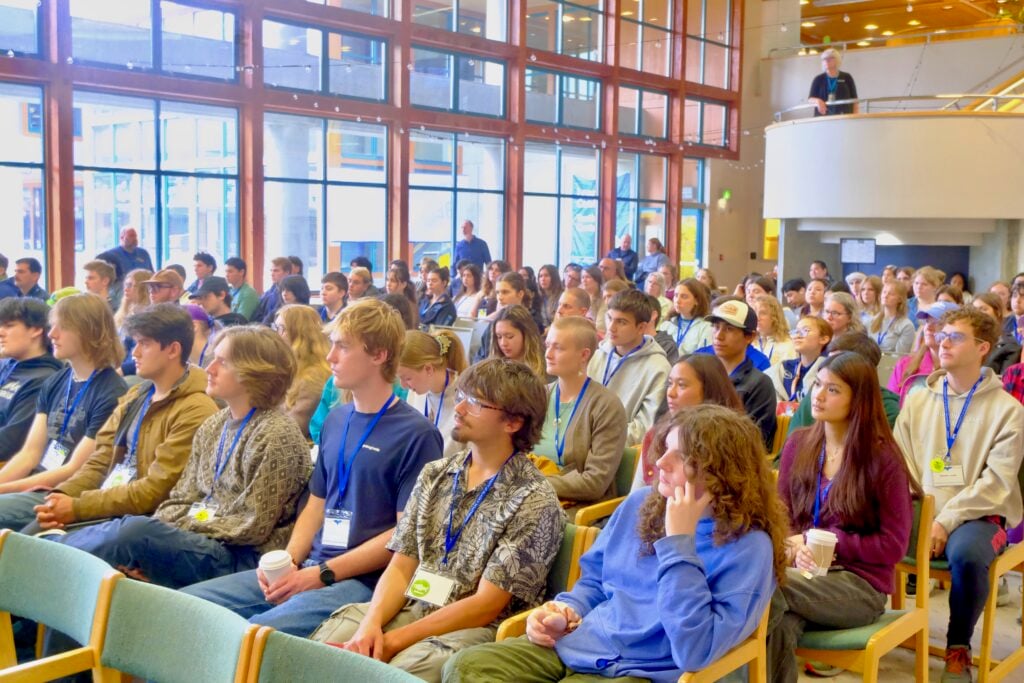
New students at the University of Alaska Southeast attend orientation at the Egan Library on the Juneau campus on Aug. 21, 2026. (Photo by Corinne Smith/Alaska Beacon)
Under a driving Juneau rain, dozens of new students at the University of Alaska Southeast gathered Friday for orientation and to kick off the fall semester. This year, the public university saw a boost in enrollment of out-of-state students, which officials and students say is largely due to a new policy eliminating the non-resident tuition rate.
UAS piloted the new tuition policy this year, called Alaska Unlocked, which offers the standard in-state tuition rate for all undergraduate courses, regardless of the student’s residency.
That’s resulted in an estimated 36% increase this year in out-of-state students enrolling at UAS compared to last year, according to university officials.
New students at the University of Alaska Southeast attend orientation at the Egan Library on campus in Juneau on Aug. 21, 2026. (Photo by Corinne Smith/Alaska Beacon)
“We are so thrilled with that much of an increase,” said UAS Chancellor Aparna Palmer, in an interview after her welcoming remarks to students at the Egan Library. “We know that a high percentage of our graduates stay in Alaska and work in Alaska within one year of graduation. And so most of these students are our future Alaskans.”
New students have arrived from 28 states, according to university data, with the top home states including Washington, California, Colorado, Idaho, Minnesota and Wisconsin.
The in-state tuition rate was a draw for 22-year-old Nicole Wilson of Phoenix, Arizona. After classes at community college, she enrolled at UAS to pursue a bachelor’s degree in marine biology with a focus on mammals. “I decided to come here both based on the in-state tuition and also because it was such, like, an ‘open to marine biology’ type school. My original plan was to go out to Hawaii, but it’s extremely expensive from out of state,” she said.
Wilson said housing was also a factor. “I did the math. If I were to take a dorm, which I would have had to, at any of the major universities in Arizona, it was actually more expensive than coming out to Alaska,” she said.
Cost of housing was the main consideration for 20-year-old Owen Kellon of Portland, Oregon, who is pursuing a bachelor’s degree in environmental sciences. “It was the bigger concern when it came to the cost of schooling, just because tuition was like a couple hundred bucks per class, which is perfectly reasonable. It’s about how much I was paying back at my community college in Portland, but the housing cost was the biggest factor.”
The John Pugh Hall student dorms houses 120 beds for students on-campus in Juneau, seen on Aug. 21, 2026. (Photo by Corinne Smith/Alaska Beacon)
The standard in-state tuition rate is expected to be available across the University of Alaska system next year. Earlier this month, the UA Board of Regents moved to eliminate out-of-state tuition rates for all locations and degree types, aiming to draw more students to Alaska.
Currently, out-of-state tuition is double to quadruple the amount of resident tuition, depending on degree type. The Board of Regents is expected to take up a final vote on the policy change in November.
UAS has the smallest student population of Alaska’s public universities, with roughly 3,600 students last year across campuses in Juneau, Ketchikan and Sitka.
This year’s preliminary enrollment data shows roughly the same number of students as last year, signalling Alaskan student enrollment may have declined. But Palmer emphasized that it’s too soon to tell, as enrollment numbers are subject to change in the next few weeks with more Alaska students possibly signing up for dual enrollment programs or classes beginning later in the fall.
University of Alaska Southeast Chancellor Aparna Palmer welcomes new students at orientation in Juneau on Aug. 21, 2026. (Photo by Corinne Smith/Alaska Beacon)
This year, UAS saw a 21% increase in applications from out-of-state students, and a 36% increase in newly enrolled out-of-state students. More than 80 new out-of-state students have enrolled this year, compared to 60 students last year, according to university officials.
UAS is an open access enrollment institution, Palmer noted. “What that means is, no matter where you are in life, whether you just graduated from high school, in high school, or whether you’re, you know, in your sixties or seventies, there is a way in which you can access UAS,” she said.
Most students are working adults or part-time students, Palmer said, and can enroll in classes in-person or online. “So, we do have a really diverse group of students,” she said.
In Juneau, new students had a jam-packed schedule for orientation week. On Friday, students were welcomed by UAS administrators, a Tlingit elder and student leaders, followed by a campus tour and briefings on campus resources, student clubs, tutoring, career counseling, and anti-discrimination and Title IX rights and reporting.
Students expressed excitement for the new school year and to be in Alaska, including Owen Kellon of Oregon.
“I love the rain,” he said. “ I am excited to see how the winter months will look like with only like six hours of sunlight. I’m scared, but I’m also excited.”
New students at the University of Alaska Southeast pose for a photo by Auke Lake during a campus tour as part of orientation in Juneau on Aug. 21, 2026. (Photo by Corinne Smith/Alaska Beacon)
Correction: This story has been updated to correct the number of students enrolled at UAS, which was roughly 3,600 students last year.