Categories
Alaska News Featured Juneau News juneau Juneau Local Juneau Local Ketchikan Local News Feeds Sitka Local

Alaska candidates for governor address growing gap in childcare

By: Corinne Smith, Alaska Beacon

 Children’s bicycles are parked outside of the Interior Alaska Center for Non-Violent Living in Fairbanks, Alaska on September 14, 2023. (Photo by Claire Stremple for the Alaska Beacon)

One of the many issues before the next governor of Alaska will be the growing gap between available providers and the demand for childcare, which some advocates are calling a “childcare crisis.” 

Many Alaska families are grappling with finding reliable care due to a lack of childcare facilities and workers that contributes to fewer slots, long waitlists and rising costs for families. 

An estimated half of Alaskan families cannot fully participate in the workforce because they lack access to childcare, according to thread, a statewide childcare resource and referral organization. The organization estimates that’s more than 25,000 Alaskans that could be more active in the workforce. 

The average cost to Alaska families is estimated at over $14,000 per year, thread estimates, sometimes surpassing the monthly cost of rent.  

Advocates say a patchwork system of federal, state and local funding is insufficient in providing Alaska families with adequate childcare, with childcare providers reporting struggles to complete licensing requirements to open new facilities, provide competitive wages to workers and keep daycare operations going. 

Democrat Jonathan Kreiss-Tomkins and Republicans Dave Bronson and Treg Taylor said they would seek to reduce state regulations for childcare providers and promote incentives for employers to provide childcare, if elected.

Kreiss-Tomkins and Bronson also said they would support recurring state funding for childcare. 

The three are among four candidates running for governor in the November election, along with Republican Bernadette Wilson. Wilson’s campaign declined to comment on her platform on childcare issues after numerous calls, texts and emails over the course of a week. 

Kreiss-Tomkins, Bronson and Taylor said their administrations would prioritize expanding access to childcare, especially in rural Alaska. 

Bronson called childcare “essential infrastructure” for the state’s economy. “I would work with local communities, tribes, employers, school districts, and existing providers to expand the options that fit each community. So whether that’s a licensed center, a home-based provider, a cooperative, or an employer-supported program,” Bronson said. “Rural Alaska needs solutions designed locally, because a model that works in Anchorage may not work in a village.” 

Kreiss-Tomkins also said he would support opening smaller, home-based providers and for childcare workers in rural areas, which would also boost rural employment opportunities. “Making training available to providers creates jobs for people who already live and work in rural communities and lets parents go to work, go hunting, or back to school,” he said.

Currently, only some Alaskan families receive childcare assistance based on available funding and eligibility. The non-profit thread estimates that 23% of children receive a subsidy from the government or employer.  

Kreiss-Tomkins cited a true cost study commissioned by the Dunleavy administration in 2024 that showed a wide gap between childcare assistance and the cost of care — which is significantly larger in rural areas — in his support for boosting state childcare funding.

“Besides direct investment in programs like Child Care Assistance at the state level, I think one aspect we should clearly do more with is investment in the child care workforce, and partner with unions, tribes and universities to make those investments,” Kreiss-Tomkins said. 

Bronson also said he supports recurring state funding, as well as “targeted employer partnerships” and pursuing federal grant programs.

But Taylor disagreed, saying before more state funding he would look to federal funding and tax credits for families and employers. “Any state support would come from the existing budget, not new taxes, and be tied to one result: more open slots for Alaska families,” he said.

All three candidates said they would pursue state incentives, like tax credits, for employers to provide childcare. 

The three candidates split in views on expanding statewide childcare through implementing a statewide “universal” pre-Kindergarten program. Currently some Alaska school districts provide preschool and early education programs, but not all. 

Kreiss-Tomkins said it would be a long-term intention of his administration to “get to a place where pre-K is something all parents in Alaska can count on.” 

“That’s a lofty goal, and maybe a ways away, but I want to bring local governments, the state government, and other partners to the table to work toward it,” he said. Kreiss-Tomkins said he would also aim to expand paid family leave to reduce the demand for infant childcare.

Bronson and Taylor said they do not support a statewide pre-K program. Bronson said instead he supports families’ choices for public, private, tribal and community-based options. Taylor said he supports existing pre-K for children who qualify and choices for families, including homeschool programs. 

Likewise the Democratic and Republican candidates split on their approaches to supporting childcare worker recruitment and retention. 

Kreiss-Tomkins said he would support childcare workers through loan forgiveness programs, and “robust” apprenticeship programs. Bronson also said his administration would “work with employers and  training institutions to recruit and prepare new workers.” Taylor said his administration would “lower barriers to entry” by reducing credential and education requirements for childcare jobs. 

The Trump administration has announced plans to roll back regulatory requirements for Head Start programs, which serve children ages three to five years old, including changing provider ratios to allow more children per adult.

Bronson said he opposes an increase in ratios “as a quick fix,” citing safety. Kreiss-Tomkins did not say directly that he was in opposition of a ratio increase, but said he wants to be “thoughtful” with changing staffing ratios. “I think for infants, especially, there should be reasonable ratios on the number of infants any one caregiver is responsible for,” he said.

Taylor said he supports increasing staff ratios, in order to expand childcare programs, “with safety as the line I won’t cross,” he said. “The bigger threat to providers today is rules that make it impossible to staff a room or make the business pencil out. More flexibility helps them stay open.” 

All three candidates who responded to the Alaska Beacon expressed support for reducing regulations for childcare providers licensed under the Alaska Department of Health to help ease barriers and help expand new childcare centers. 

Wilson also indicated at an October candidate forum in Juneau that she would focus on cutting regulations in order to expand childcare capacity.

“For this administration, our first day in office, we’re going to come back and we’re going to roll those pages of bureaucratic regulations off the books. If they shouldn’t have been there, and the governor’s got the ability to do it, then by God, we’re going to get in there, and we’re going to do it,” she said. “We’ve got to roll those back and get them out of the way.”


Categories
Alaska News Featured Juneau News juneau Juneau Local Juneau Local Ketchikan Local News Feeds Sitka Local

Local Business Leaders Honored at This Year’s Gala Chamber Dinner

Congratulations to Kenny Solomon-Gross and Dorian Gross of Gross-Alaska Theatres, who accepted the Business of Distinction award at this weekend’s Juneau Chamber of Commerce dinner, and to Charlie Williams of Valley Paint Center, who received the Lifetime Achievement award for his outstanding work in our community. Gross-Alaska Theatres has brought people together at the movies since 1897, and Charlie’s recognition shows the difference a local business owner can make in his neighbors’ lives.

Screenshot

Juneau has so many local business owners and employees who give their time, support community events, and help each other through the tough stretches. There was a lot to celebrate this weekend, and we were grateful to be included.

Lisa and I want to express our sincere thanks to the Juneau Chamber of Commerce for recognizing us as Citizens of the Year. We were genuinely touched by this honor.

While our names may be on the award, we see it as a reflection of the people we’re fortunate enough to work alongside every day.

Our Alaska First Media teams in Juneau, Ketchikan, and Sitka are an extraordinary group of people who care about their communities, their listeners, and the work they do. They’re the ones who show up every day, keep our radio stations connected to the communities they serve, and make us proud to be part of it all.

We especially want to recognize Angel Montgomery, Charlee Quintal, Grace Dumas, Steven Allwine, Devon Stickler, Jason Palmer, Mike Clasby, Justin Miller, Scott Mills, Chuck Geiger, Dan (Dano) Ondrejka, Tori Peck, Conner Lendrum, Krystal Rose, Kevin Allen, Lance Mitchell, Kelly Peres, Brittany Rickard, Mason Hightower, Garrett Leighton, Julie Lekwauwa, Ted Ellis, Pratik Patel, AJ, Alfred Zagloul, Wade Bryson, Nano Brooks, Tracy Brown, Russell Wodehouse, Rally Wolford and Phoenix Lampkin, along with everyone else who contributes to our stations across Southeast Alaska.

Screenshot

We’re proud of the work being done across our Juneau stations, KINY, Mix 106, TAKU 105, KXJ, The Hawk and KJNO, as well as our stations serving Ketchikan and Sitka.

We’re also grateful for the local businesses, community organizations, friends, and listeners who have welcomed us and supported what we’re trying to build.

Juneau is home. We’re proud to be part of this community, grateful for the friendships and relationships we’ve built here, and fortunate to have the opportunity to help ensure these radio stations continue serving Southeast Alaska for generations to come.

Thank you again to the Juneau Chamber of Commerce for this very kind recognition. We share it with a lot of good people.

Cliff and Lisa Dumas

Categories
Alaska News Featured Juneau News juneau Juneau Local Juneau Local Ketchikan Local News Feeds Sitka Local

Where do Alaska’s gubernatorial candidates stand on the gas pipeline and energy?

By: James Brooks, Alaska Beacon

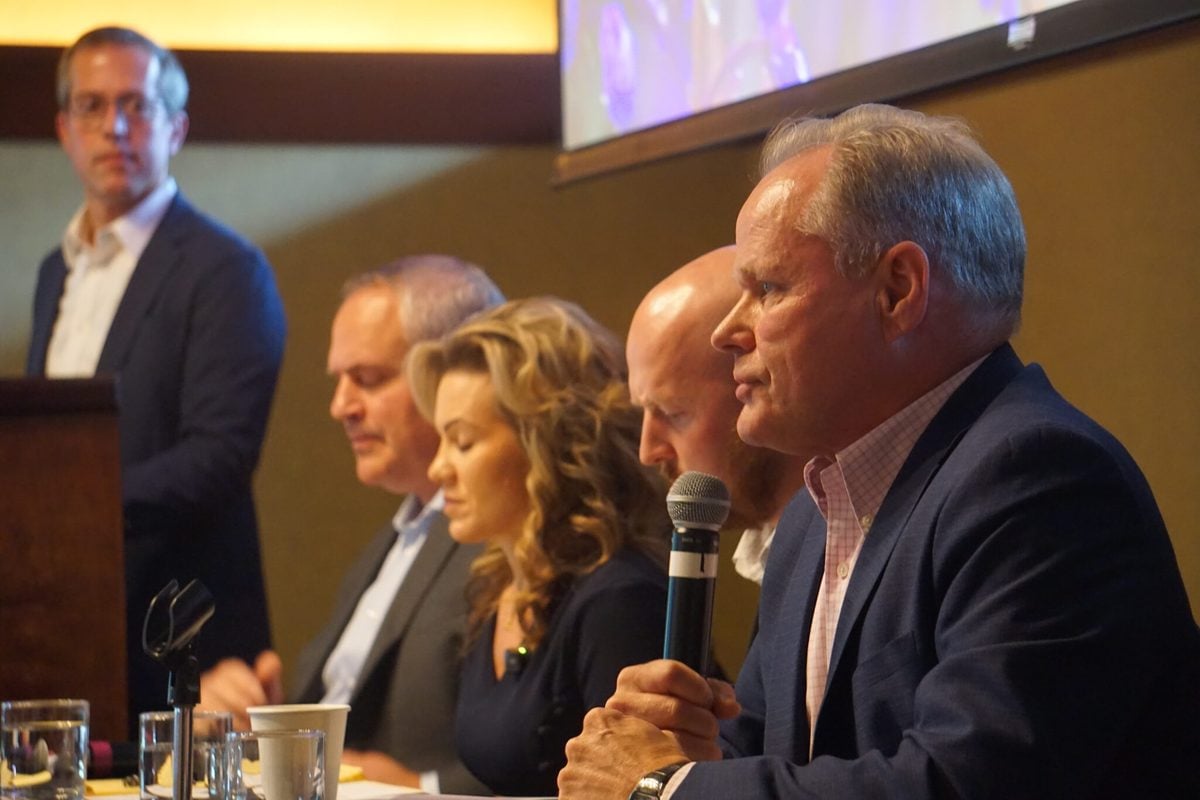
Former Anchorage Mayor Dave Bronson speaks at a gubernatorial candidate forum on Sept. 16, 2026, while former Attorney General Treg Taylor, Anchorage business owner and talk-show host Bernadette Wilson and former state Rep. Jonathan Kreiss-Tomkins listen. (Photo by Yereth Rosen/Alaska Beacon)

All four of the candidates in Alaska’s gubernatorial election this year support construction of a trans-Alaska natural gas pipeline and increased, state-backed drilling for natural gas in Cook Inlet.

But in a pair of forums held Sept. 21 and Oct. 2 in Anchorage, the four differed on a variety of other topics pertaining to the state’s energy policy, and one said he plans to borrow hundreds of millions of dollars in order to invest in projects that could pay off over decades.

Republicans Dave Bronson, Treg Taylor and Bernadette Wilson, together with Democratic candidate Jonathan Kreiss-Tomkins are each competing to replace Republican Gov. Mike Dunleavy, who is term-limited and cannot run again.

With Southcentral Alaska facing a shortage of cheap natural gas-fired electricity and rural Alaska continuing to experience high utility costs, the cost of energy is likely to be a major issue over the next four years. 

All four candidates participated in the first forum, hosted by the Renewable Energy Alaska Project, while only Bronson and Kreiss-Tomkins attended the second forum, hosted by the Alaska Power Association.

“The difference between prosperity and decline in Alaska is often measured in cents per kilowatt-hour. That’s the bottom line,” Taylor said at the REAP forum. “Without affordable, reliable energy, Alaskan families are going to struggle.”

Absentee voting by mail and fax is underway, and early voting in person will begin Oct. 19. Election Day is Nov. 3. 

Cook Inlet natural gas

Southcentral Alaska relies on natural gas for electricity and heating, but production from oil and gas deposits beneath and near Cook Inlet hasn’t kept up with demand.

After a cold 2025-2026 winter, utilities are worried that regionwide supplies could run short. Even if this year’s winter passes without incident, the long-term production trend is downward, and utilities are planning to import natural gas as soon as the end of the decade.

“I think we need to immediately incentivize more exploration and capital projects in the Cook Inlet,” Taylor said on Sept. 21. 

“We’ve also got to prepare — because of where we’ve put ourselves — for importing LNG, and that’s a horrible place to be when you’re an energy-rich state,” Taylor said. 

Currently, the state of Alaska is directly and indirectly subsidizing natural gas production. The Alaska Industrial Development and Export Authority — the state’s development financer — has provided loans to HEX, a company drilling in the region, and the state is foregoing royalties on gas leases in the area.

“I think it is appropriate for the state to offer royalty relief to Cook Inlet natural gas producers, as is currently the case,” said Kreiss-Tomkins at the APA forum, adding that he believes “getting every last molecule out of the Cook Inlet natural gas basin is a state priority.”

Speaking after Kreiss-Tomkins, Bronson said the state needs to somehow encourage a second jack-up drilling rig in Cook Inlet to allow the drilling of more wells in Cook Inlet.

“The most important stuff is natural gas production in the near term, to provide our immediate needs as we plan on more generation and transmission going forward,” he said. 

Wilson said she believes structural changes are needed to boost Cook Inlet gas.

“We most certainly need to incentivize production in Cook Inlet,” she said on Sept. 21. 

“Yes, whatever we can do to incentivize HEX, whatever we can do to incentivize Hilcorp,” she said, referring to two of the three companies currently drilling for gas in Cook Inlet.

In the room at the time of the debate were some sitting state legislators who supported a proposal to raise business taxes on Hilcorp, HEX and other privately owned oil and gas firms.

Wilson said she believes the threat of a tax increase deterred those companies from drilling. 

“We have to pay very close attention that when we complain and — quite frankly —  bitch and moan about the gas shortage, who has brought this on? We brought it upon ourselves, and we have to change the outlook,” she said.

On the gas pipeline

If Cook Inlet natural gas is the answer for the immediate future, Bronson said on Oct. 2, “for the long-term future, it is the gas line.”

The proposed Alaska LNG project envisions a pipeline from the North Slope to Cook Inlet, bookended by a pair of industrial processing plants. The project would bring abundant gas to Southcentral and to foreign customers via an export terminal. 

According to official estimates, the project is expected to cost between $44.5 billion and $54.5 billion, but skeptics — including some state legislators — believe it will cost $65 billion or more.

For now, it isn’t certain how that project will be funded, who would sell natural gas into it, or who will buy that natural gas. 

“We definitely need to have a sustainable energy system. But what we can do right now — what we have to do — the first three things we’re going to do is build a gas line, build a gas line, build a gas line,” Bronson said on Sept. 21.

Earlier this year, the Alaska Legislature took up — but failed to pass — a tax cut that would have benefited the project. 

“I strongly support the natural gas pipeline and support restructuring property taxes for the state of Alaska if it helps us get to yes,” Kreiss-Tomkins said on Oct. 1. 

Taylor said he thinks that on energy, the state needs to “think big, like the Alaska gas line, for example, a $50 billion project that would put a lot of Alaskans to work and solve a lot of our energy needs along along the Railbelt, and with the potential to export that energy to our our allies.”

Wilson said she ultimately hopes Alaska will be able to boast about having the lowest energy prices in the country.

“A gas line obviously is front and center of that conversation,” she said on Sept. 21.

“For 40 years, we have debated if we were going to make enough money from a gas line, and in 40 years, we have made precisely $0 from a gas line, because we’re debating on ‘Are we going to get our fair share?’ Enough,” she said. 

A pipeline isn’t currently expected before the end of the decade, and the first phase of the project involves building a gas import facility that would later be turned around to export gas.

“I think it’s pretty much inevitable that there are going to be LNG imports in Cook Inlet and the Railbelt. That’s obviously incredibly unfortunate,” Kreiss-Tomkins said.

Borrowing for power

Speaking about energy more broadly, Kreiss-Tomkins said that if elected, he would ask the Alaska Legislature for permission to borrow money for projects across the state.

“I believe we need to pass a statewide energy bond in Alaska and make a generational investment in energy infrastructure and transmission infrastructure,” he said on Oct. 1.

When it comes to picking which projects would be funded by that bond, Kreiss-Tomkins said he would consult experts. 

“I think we can take some big swings in some projects that can set up Alaska for the next 50 to 75 years,” he said on Sept. 21. 

The Democrat said he believes Alaska is too reliant on natural gas alone and wants to see the state adopt a variety of power sources. 

“Diversification is a key principle I have,” he said on Oct. 2, explaining that he believes the state should be funding projects through its existing renewable energy fund. He also wants to preserve the $1 billion trust fund that subsidizes rural prices through a program known as Power Cost Equalization.

Taylor said he also supports diversification but didn’t endorse Kreiss-Tomkins’ idea of borrowing money to build projects. 

“We have to approach this problem with an all-of-the-above approach. We have to pursue all the avenues, and then let the market decide the winners and the losers,” Taylor said on Sept. 21.

Taylor said he believes the state needs to think big, with both the gas pipeline and the long-shelved Susitna-Watana hydroelectric project, which would put one of the largest dams in the United States between Anchorage and Fairbanks. 

While the project would have a large up-front cost, the federal government is offering large tax credits for hydroelectric projects that begin construction before 2033.

Taylor said what he’d like to see is “a unified electric grid with a dispatcher to dispatch the lowest-cost energy to Alaskans along the Railbelt.”

It was a sentiment echoed by Kreiss-Tomkins, who said, “we need to coordinate our utilities.”

Wilson did not specify her plans for rural energy or energy in general but reiterated that she wants to see fewer restrictions on development and construction.

In both forums, Bronson said he supports the construction of large-scale computing data centers because he believes they will bring their own electricity generators. 

“They’ll create their own electricity. They’ll deal with the cooling and the noise problems, and I think that’ll be good for us,” Bronson said on Sept. 21.

If the state requires datacenter owners to produce more power, that electricity could be sold locally, Bronson said.

“That’s how you drive down the cost of electricity. Let private enterprise come in and invest, and you compel them to produce more than they actually need,” he said.

In the short term, he believes the state should fund the replacement of older diesel generators in rural Alaska.

“A lot of the diesel generators out there are older than the people that maintain them. I think that’s unacceptable, and the cost of electricity with the newer-generation diesel generators goes down considerably,” he said on Oct. 1.

“I’m not a big fan of wind because it’s not reliable. It’s not base load electricity. Solar isn’t either,” Bronson said.

In the longer term, Bronson said he wants to see small-scale nuclear power plants in rural Alaska away from the Railbelt. The U.S. military is already planning so-called “microreactors” at some of its Alaska bases.

Kreiss-Tomkins didn’t agree with Bronson on nuclear power.

“I think micro-nuclear is compelling … but I think by any measure, it’s still an immature technology and not anything that we can bank on,” he said.

Categories
Alaska News Featured Juneau News juneau Juneau Local Juneau Local Ketchikan Local News Feeds Sitka Local

After Democrats boost JKT, national Republicans send $1.6 million to Alaska for governor’s race

By: Nathaniel Herz, Anchorage Press

A national Republican organization has put $1.6 million into the Alaska governor’s race — going toe-to-toe with Democratic money that’s also flooded into the state in recent days.

The Republican Governors Association made the transfer Wednesday to Kodiak PAC, an Alaska group that’s working in support of GOP gubernatorial candidates, according to campaign finance disclosures.

A separate donation last week from an arm of the Democratic Governors Association brought its total contribution to a competing group, Forward Frontier, to $1.25 million.

A separate, organized labor-affiliated group, Putting Alaskans First, also reported spending $175,000 this week on radio ads intended to benefit Jonathan Kreiss-Tomkins, the former state House member who’s the only Democrat in the four-candidate gubernatorial field.

While Kreiss-Tomkins won the primary and remains the heavy favorite among political insiders — and prediction markets — the contribution from the RGA indicates that national Republicans think Alaska is still in play. The group did not respond to a request for comment Thursday.

“I’m sort of surprised they’re even bothering at this point,” said Jim Lottsfeldt, a centrist political consultant who’s working with groups supporting Kreiss-Tomkins’ campaign. “It’s hard to imagine any of the Republicans prevailing. But I guess they have plenty of money.”

One unanswered question about the Republicans’ participation in the race is what message they will broadcast — and whether they’ll try to boost one of the GOP candidates over the others.

GOP activist Bernadette Wilson was the top-ranked Republican in the August primary, ahead of former Anchorage Mayor Dave Bronson and former Alaska Attorney General Treg Taylor .

Numerous conservatives, including Bronson and Taylor, have warned that GOP infighting could cost Republicans the governor’s race — if negative campaigning causes voters to choose just one or two of the three GOP candidates in Alaska’s ranked choice voting system.

But Wilson hasn’t played along, labeling both Bronson and Taylor as “spoilers” and asking them to suspend their campaigns.

Independent groups like Kodiak PAC are barred by law from working directly with candidates. Reached by phone Thursday, officials with both the campaigns of Republicans Dave Bronson and Treg Taylor said they hadn’t heard about the $1.6 million contribution.

“We hope this money goes to something that benefits the Republican Party in a ranked choice voting scenario,” said a spokesperson for Bronson. “It’s news to us.”

April Gettys, Taylor’s campaign manager, also denied any knowledge of the RGA’s donation or Kodiak PAC’s plans.

“As of right now, the campaign doesn’t know anything about the PAC,” she said.

Wilson did not immediately respond to a request for comment.

A spokesperson for Kreiss-Tomkins also didn’t respond to a request for comment. His campaign sent a fundraising email earlier Thursday criticizing a new ad from Wilson that attacks him for raising campaign funds from employees of artificial intelligence companies and labeling him as “Chat JKT.”

This story was originally published in the Anchorage Press. Subscribe here. 

Categories
Alaska News Featured Juneau News juneau Juneau Local Juneau Local Ketchikan Local News Feeds Sitka Local

After years of problems, Alaska plans to outsource payroll for 14,000 public employees

By: James Brooks, Alaska Beacon

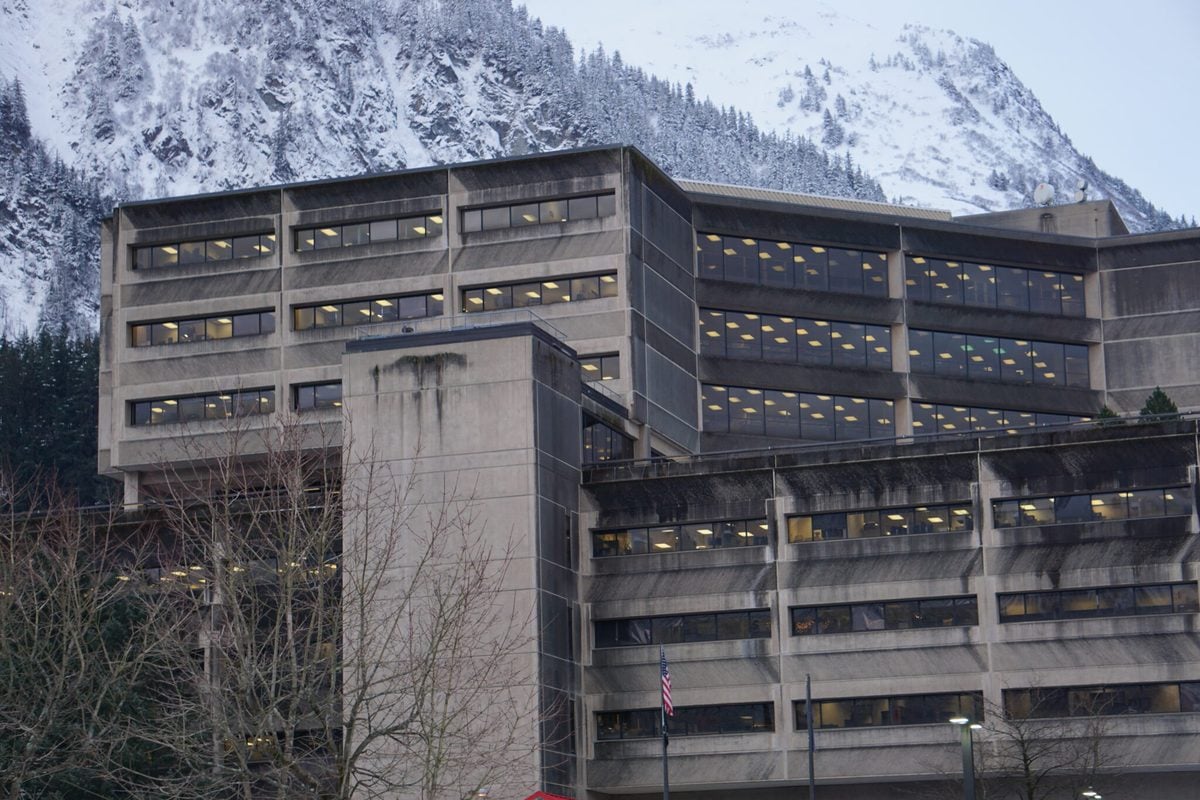
The Alaska State Office Building in Juneau, the state capital, is seen on Feb. 16, 2023. (Photo by Yereth Rosen/Alaska Beacon)

By the end of 2027, as many as 14,000 Alaska state workers could be paid by someone outside the state.

After years of trouble within the payroll department within the Alaska Department of Administration, the agency is planning to outsource the state’s public employee payroll to an outside company.

Proposals from interested companies were due Thursday, and in an internal letter, DOA Commissioner Paula Vrana said “it likely will be several weeks before a final decision is made.”

Vrana implied that if the proposals aren’t affordable or are otherwise unfavorable, the state will not proceed with outsourcing. 

“As of now, we are exploring what options are available to the state and what value may be realized by this approach,” she wrote. “The final decision will be based on the proposals we receive.”

Vrana wrote that the department will begin talking with unions “to explore the options for transfers/placements of employees displaced by outsourcing” and if DOA does choose to outsource, “we will also work with the vendor to include as many existing state payroll employees as possible in their staffing plan.”

The state’s payroll department has struggled with staffing issues for years, leading to times when employees missed paychecks or encountered other problems with their pay. 

In April, DOA published a request for information from companies that might be interested in providing “comprehensive payroll processing” for the state.

A three-page feasibility study dated Sept. 28 states that payroll work involves 78 employees in different agencies; all would be affected by outsourcing.

According to the state’s formal request for proposals, it is prepared to pay $4 million per year for a company to handle payroll. It currently spends about $10 million per year on payroll employees and functions, the feasibility study stated. 

According to the study, in fiscal year 2025, state employees filed more than 1,500 “notice of pay problem” reports, and reducing the number of problems could make employees in other departments happier.

The first outsourced paychecks would come to a handful of departments on April 1, 2027, and other departments would be transferred to the outsourced payroll company through the rest of the year.

The outsourcing company would have to use the state’s existing payroll software programs, the document states, and the work would have to be done in the United States, but the contractor could get a waiver from the state that would allow payroll work to be done in a foreign country.

“The goal is not to change the system used to process payroll but to make payroll processing more efficient and ensure the state’s existing systems and processes are supported by qualified contracted professionals who can maintain continuity, reduce errors, and uphold the state’s obligations to its employees and the public,” the document states.

DOA provided a copy of the RFP documents to the Beacon this week; they were not previously published on the state’s public notice system, and the two public employee unions whose members would be affected by the outsourcing said they also had not previously seen the documents.

The Beacon asked DOA for an interview with Vrana or someone else involved with the outsourcing decision but was turned down.

In response to a written question asking why the department is planning to outsource, a spokesperson said by email: “Ensuring that employees are paid correctly and on time is the essential duty of payroll. Challenges stemming from high turnover and persistent vacancies within the Department have resulted in pay problems for some state employees. The administration has determined that outsourcing payroll may both provide significant recurring cost-savings to the State and improve services to its employees. However, no final decision on outsourcing payroll will be made until responses to the RFP issued earlier are evaluated.”

Jeff Kasper is the business manager of the Alaska Public Employees Association, which represents payroll workers. He’s not a fan of outsourcing. 

“It usually costs more and doesn’t provide the efficiencies that you’re looking for. When you’re talking about public services, you’re essentially having the public pay more for something that’s probably not as good,” he said. 

Kasper isn’t convinced that the Department of Administration has done enough to fix the problems that have deterred Alaskans from working for the payroll department.

“If people aren’t applying for jobs and accepting jobs, it’s usually because it doesn’t pay enough or it doesn’t provide benefits or it’s bad working conditions. This one could be all three, and I don’t think any of them have been addressed,” he said.

The state’s own feasibility study acknowledged those problems.

“Payroll processing occurs on a bi-weekly basis and does not have down time. This work environment and the entry level pay range are likely reasons for low retention and high staff turnover,” the study concluded.

As of last month, the study said, 58% of all payroll positions in the state are vacant, and it can take as long as a year of training before a new worker is capable of working independently.

MaryAnn Ganacias is the interim executive director of the Alaska State Employees Association, whose members are paid by the payroll department. 

“Alaskans deserve to know what the problem is with the state and what they’re trying to solve by privatizing payroll,” she said. 

Ganacias said state money spent outside Alaska is money that doesn’t benefit Alaskans.

“We need to do better investing in our own employees here in Alaska, and not outsourcing where the money actually goes,” she said.

Kasper said he doesn’t think the timeline described in the state’s RFP follows collective bargaining agreements or is realistic.

“The union’s not just gonna sit down and let this happen,” he said. “We don’t think the state has been following the process that’s in the contract.”

Kasper said his union’s contract with the state requires a 30-day consultation period before any outsourcing takes place, and even though the state’s RFP calls for a contract in November, he doesn’t think one is likely before Gov. Mike Dunleavy leaves office in the first week of December. 

Kate Sheehan, policy adviser for the Department of Administration, said by email in response to Kasper’s comments, “The State engaged the Confidential Employees Association (CEA) on September 25th, and we have entered into the 30-day period for the union to submit any alternate plans to be considered during this process. DOA does not intend to contract out prior to the Union’s response and analysis of their input.”

Categories
Alaska News Featured Juneau News juneau Juneau Local Juneau Local Ketchikan Local News Feeds Sitka Local

A second release of Suicide Basin is occuring, crest likely tomorrow

NOTN- A secondary release of Suicide Basin is occurring.

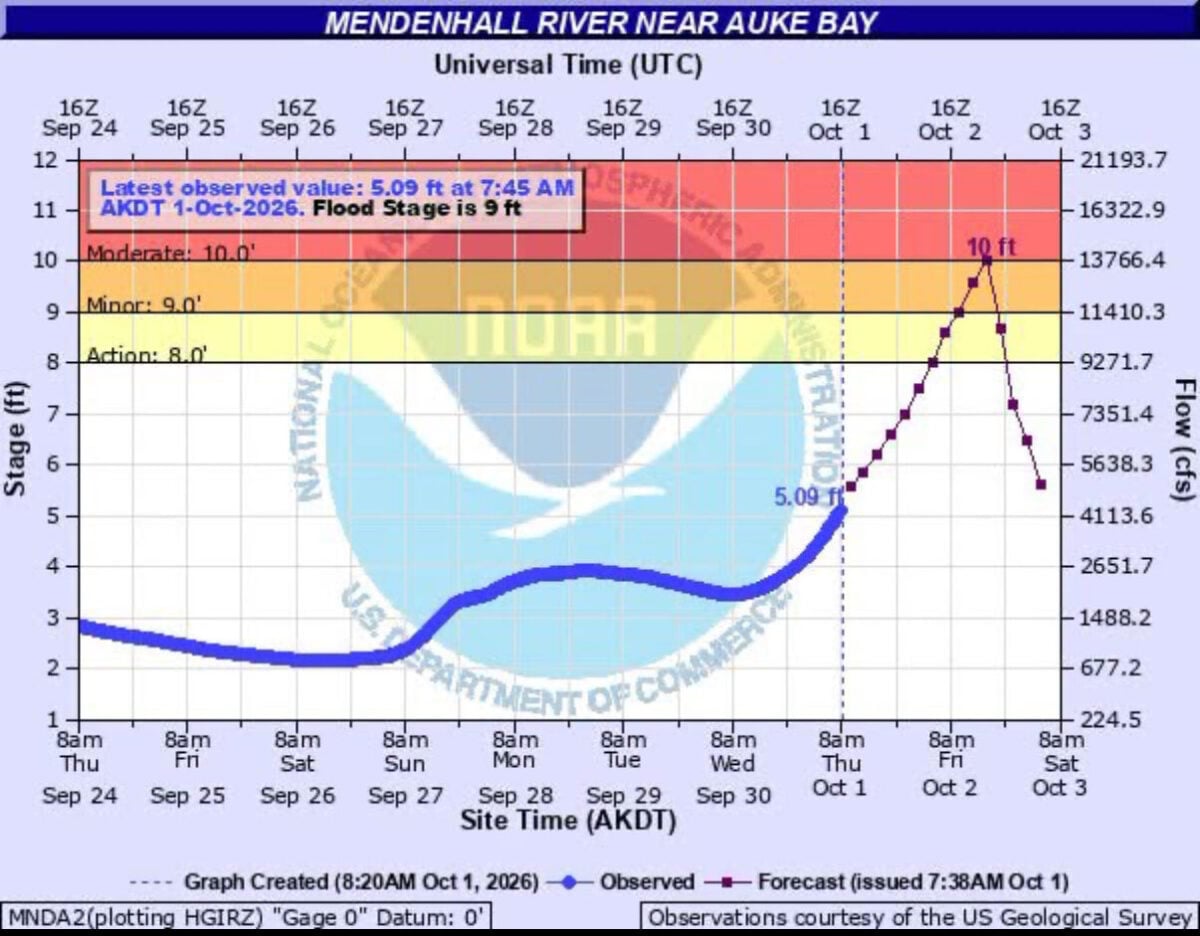
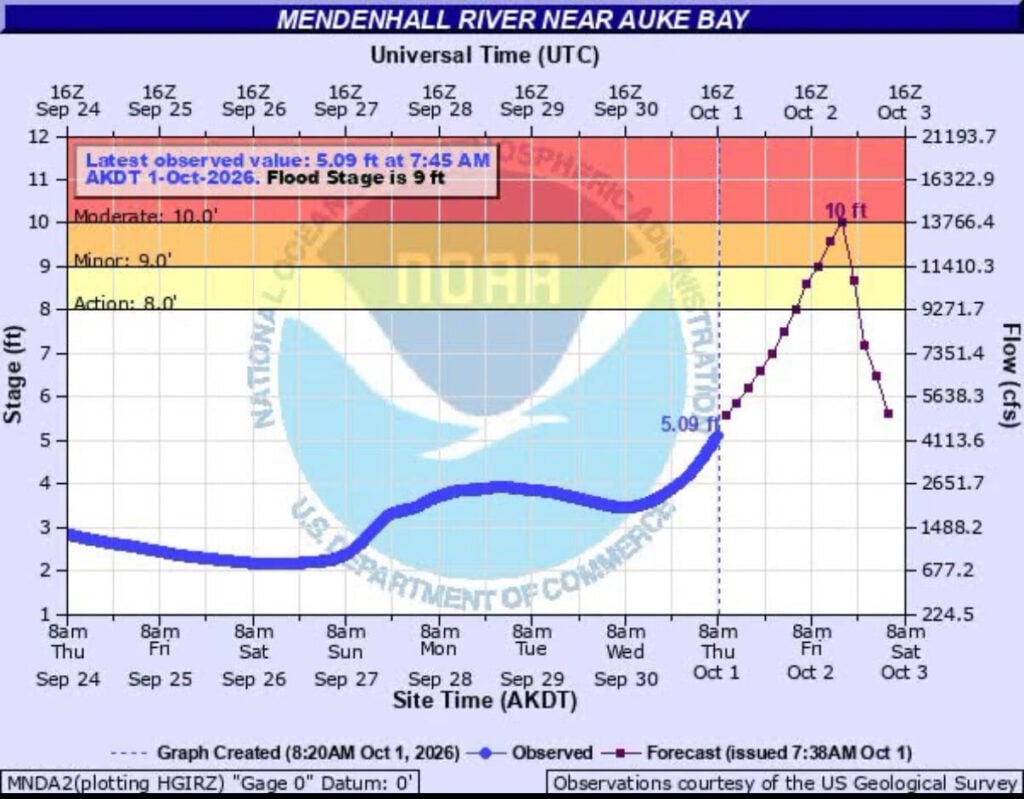
The National Weather Service Juneau’s current forecast indicates Mendenhall Lake cresting near 9.8 to 10.3 feet sometime between 2 pm and 6 pm on Friday, October 2.

Ten feet is considered moderate flood stage. Flooding should be expected around the Mendenhall Campground, Skaters Cabin Road, some flooding in the View Drive area, between 1 and 3 feet.

The Weather Service says to expect closures of pedestrian paths near the Mendenhall River.

Categories
Alaska News Featured Juneau News juneau Juneau Local Juneau Local Ketchikan Local News Feeds Sitka Local

Trump touts Korea as source of funding for long-desired Alaska gas project

Sen. Dan Sullivan, R-Alaska, speaks about Alaska natural gas at an event Wednesday in the White House. President Donald Trump, seated, announced what he said was a deal with the Republic of Korea to invest in the Alaska liquefied natural gas project. Korean officials, however, said the government has not committed to invest in the project but only to continue to examine it. Behind Trump and Sullivan are U.S. Commerce Secretary Howard Lutnick, U.S. Interior Secretary Doug Burgum and U.S. Energy Secretary Chris Wright. (Screenshot from White House video)

By: Yereth Rosen, Alaska Beacon

President Donald Trump on Wednesday announced that he had secured a deal with the Republic of Korea to spend $54 billion on a long-desired Alaska natural gas pipeline project, part of a $200 billion package of investments that include a major power plant in Texas and several nuclear power plants.

South Korea’s trade minister quickly shot down that claim, saying the government is simply reviewing the Alaska project and will proceed with investment “only if its commercial viability is established,” the Korea JoongAng Daily newspaper reported.

Trump spoke in glowing terms of an Alaska liquefied natural gas project as a sure accomplishment — even though half a century of efforts by state and federal officials and the energy industry have failed to make the project a reality, and even though Korean officials have disputed his claim that they are committed to investing in it.

“This alone will be one of the largest energy projects in American history and a gigantic win for the people of Alaska,” Trump said at the event, held in the White House’s Oval Office. “It will create up to 12,000 construction jobs immediately and 1,000 operational jobs. It’ll also save Alaska households up to $1,500, maybe even as much as $2,200 a year in energy costs. It’s amazing.”GET THE MORNING HEADLINES.SUBSCRIBE

The Alaska LNG investment is part of a “colossal package of investments” stemming from his trade and tariff policies that make “a major step toward securing our critical energy supply chain, ensuring American energy dominance, and making our partnership with South Korea and the entire Pacific region stronger than ever before,” Trump said.

South Korea’s industry, trade and resources minister quickly shot down Trump’s claim about securing $54 billion for the Alaska project. Minister Kim Jung-kwan said the Korean government is simply reviewing the Alaska project and will proceed with investment “only if its commercial viability is established,” the Korea JoongAng Daily newspaper reported.

Trump made the announcement while flanked by a crowd of men that included three cabinet members, Republican Gov. Mike Dunleavy and U.S. Sen. Dan Sulivan, R-Alaska, and U.S. Rep. Nick Begich III, R-Alaska. Also in the group was Brendan Duval, chief executive of the Glenfarne Group, the investment company leading the current proposal for a natural gas project in Alaska.

The current proposal is to ship gas from the North Slope through a yet-to-be-built 807-mile pipeline from the North Slope to tidewater at Southcentral Alaska’s Cook Inlet, where it would be liquefied and put on tankers for shipment to Asian markets.

Alaska’s North Slope holds vast amounts of natural gas along with its oil resources. But geographic distance and costs have kept that natural gas stranded from markets, despite numerous schemes proposed over the years to build different types of pipeline systems to ship the product to either Asia or to the Lower 48.

The natural gas pipeline has been a perennial issue in Alaska elections, including this year’s U.S. Senate race, which is hotly contested. The energy investments Trump announced also affect Texas, another state where there is a competitive Senate race.

Trump and others who spoke at the ceremony spent much of their time praising Sullivan, whom he called “a great senator who is totally responsible for this pipeline,” and urging that he be reelected.

Sullivan is facing a stiff challenge from former Democratic U.S. Rep. Mary Peltola, who led in votes in the primary election. But Trump spent much of his time at Wednesday’s Oval Office event talking about retired Petersburg teacher Dan J. Sullivan, the third U.S. Senate candidate on the Alaska ballot whose candidacy has been challenged by state election officials.

“That Dan Sullivan is a disgraceful fraud,” Trump said.

“It’s so corrupt. The Democrats are corrupt. . . When they put up a man with his exact name, they picked him out of a hat. They said, ‘Anybody named Dan Sullivan in Alaska?”

Trump has said he is planning to come to Alaska to campaign for the senator and against the Petersburg candidate.

Sullivan, in turn, praised Trump and also described the natural gas pipeline projects as if it is a sure thing.

“Mr. President, I would say this is the most important project in our state by far,” he said. “This is the project that is going to keep our kids and grandkids in Alaska, with a great, bright future.  This is the project that our state has been working on to try to get done for almost a half century.”

Positive reaction, and also skepticism

Peltola, whom Trump did not mention but who finished 8.1 percentage points ahead of Sen. Sullivan in Alaska’s Aug. 18 open primary, issued a statement saying she welcomes Korean investment in the gas project.

She cited “bipartisan work” she did in the state legislature and Congress and said she will continue to do that work if elected to the Senate. “Today’s announcement is great news for Alaska, and I appreciate President Trump’s work to unleash Alaska energy. I look forward to continuing this bipartisan work with the President as Alaska’s next United States Senator,” she said in the statement.

Also issuing a positive statement was former State Rep. Jonathan Kreiss-Tomkins, a Democrat running for governor.

“Alaska should welcome foreign investment that helps responsibly develop our resources, creates good-paying jobs, and builds new markets for Alaska’s natural gas,” Kreiss-Tomkins said in the statement, in which he describes himself as “an enthusiastic champion” of the gas project. “I’m thrilled to see President Trump’s support, and interest from South Korea, for moving this project forward,” he said.

However, the statements made by Trump, Sullivan and others on Wednesday differ vastly from the position articulated by the Republic of Korea government, according to news reports in that nation.

A map shows various Alaska natural gas pipeline routes proposed as of 2011. (Map from the Congressional Research Service publication, "The Alaska Natural Gas Pipeline: Background, Status, and Issues for Congress," by Paul W. Parfomak, Specialist in Energy and Infrastructure Policy, June 9, 2011)
A map shows various Alaska natural gas pipeline routes proposed as of 2011. (Map from the Congressional Research Service publication, “The Alaska Natural Gas Pipeline: Background, Status, and Issues for Congress,” by Paul W. Parfomak, Specialist in Energy and Infrastructure Policy,
June 9, 2011)

The Korean government is not committing to spending any money on Alaska LNG, a project it considers to be a matter for further consultation, according to Korean publications. The actual commitment to Alaska LNG, as described in a memorandum of understanding, is to ‘explore the possibility of investment’ in the project, “while stopping short of making any binding financial commitment,” according to Korean reports.

Additionally, a law in Korea enacted earlier this year limits government investment in the U.S. to $20 billion a year.

One Alaska lawmaker pointed to the information from Korea as a reason to be skeptical about Trump’s announcement.

State Sen. Scott Kawasaki, D-Fairbanks, noted that Korea’s president had not backed Trump’s account.

Rather, Trump’s announcement seemed like one in a series of “boisterous” statements about things that people want, with details not provided, Kawasaki said.

“I think that, again, this is another bold pronouncement from a president who’s been known for making bold pronouncements but not following through,” he said.

It reminded him of Trump’s promise to build a wall at the Mexico border and make the Mexican government pay for it, Kawasaki said. “That never happened,” he said.

And he cautioned Alaskans against raising their expectations based on Trump’s announcement.

“I don’t want to tell the public and my voters that are just struggling, you know, trying to make ends meet that, ‘Don’t worry, the pipeline’s coming tomorrow; don’t worry, your gas problems are going to be solved overnight,’ because that’s just not going to happen,” he said.

Trump, in addition to making claims that are at odds with the Korean government’s public positions, made other questionable statements.

“For five decades, politicians have talked about the Alaska pipeline. I’ve been hearing about it from the time I’m a little boy: ‘The Alaska pipeline is going to be built someday.’ I was always fascinated by it,” he said.

It was unclear whether he was talking about the existing Trans Alaska Pipeline System, which has been shipping North Slope crude oil from Prudhoe Bay to Valdez since 1977, or the proposed gasline project. Discussions about either pipeline began after oil was discovered at Prudhoe Bay in 1968, when Trump, who is now 80, was 21.

Trump also claimed that he won the presidential vote in Alaska by 22 percentage points. His margin of victory in Alaska in 2024 was 13.1 percentage points.

Long history of international efforts

Wednesday’s announcement about Korean investment comes as part of a decades-long history of highly touted international agreements aimed at developing North Slope natural gas.

Those date back to 1977, when the U.S. and Canada struck a deal to develop an overland system that was to deliver natural gas to the Lower 48.

Other agreements were promoted in the 1980s and 1990s. At the time Yukon Pacific Corp., which ultimately held federal and state permits to build an LNG export project, was actively negotiating with would-be Asian partners and buyers. During the time, Yukon Pacific announced agreements with potential partners in Korea and Taiwan.

There were bold pronouncements about exports made during that era that were similar to those made in the Oval Office on Wednesday.

“ALASKA GAS IS POISED FOR EXPORT TO ASIANS,” said a headline in the Jan. 11, 1988, issue of the Journal of Commerce. The story referred to efforts by President Ronald Reagan and Japanese Prime Minister Noboru Takeshita to try to secure that Asian country as a partner in the Alaska LNG project.

Other international negotiations and agreements followed.

In 2008, for example, the China Petroleum and Chemical Corporation, also known as Sinopec, submitted a formal proposal to the administration of Gov. Sarah Palin to build an LNG project with a pipeline running along the existing oil pipeline’s route from the North Slope to the port of Valdez.

Nine years later, the Alaska Gasline Development Corporation — which became the main sponsor of the project — and the state announced a “Joint Development Agreement” with Sinopec and other would-be partners from China. Along with Sinopec, parties to the agreement were CIC Capital Corporation and the Bank of China. It was “the most significant step forward for Alaska LNG,” AGDC said at the time.

The signing of that agreement was witnessed by Trump in his first administration during a trip to China, according to AGDC’s account.

In February of 2025, Trump announced a “joint venture” with Japan on Alaska LNG in terms similar to those he used on Wednesday to describe what he said was a commitment for Korean investment.

At the time, Sullivan praised Trump in terms similar to those he used on Wednesday.

 “With his leadership, we will get the Alaska LNG Project built, which will create thousands of good-paying jobs, reinvigorate our American steel industry, significantly reduce our trade deficit in Asia, and deliver clean-burning Alaska gas for Americans, our military, and our allies in the Asia-Pacific, like Japan,” Sullivan said in a statement then.

Correction: Dan J. Sullivan is the U.S. Senate candidate from Petersburg.

Categories
Alaska News Featured Juneau News juneau Juneau Local Juneau Local Ketchikan Local News Feeds Sitka Local

Misleading Google AI instructions cause Kodiak woman to be cited for illegal snipe hunt

By: James Brooks, Alaska Beacon

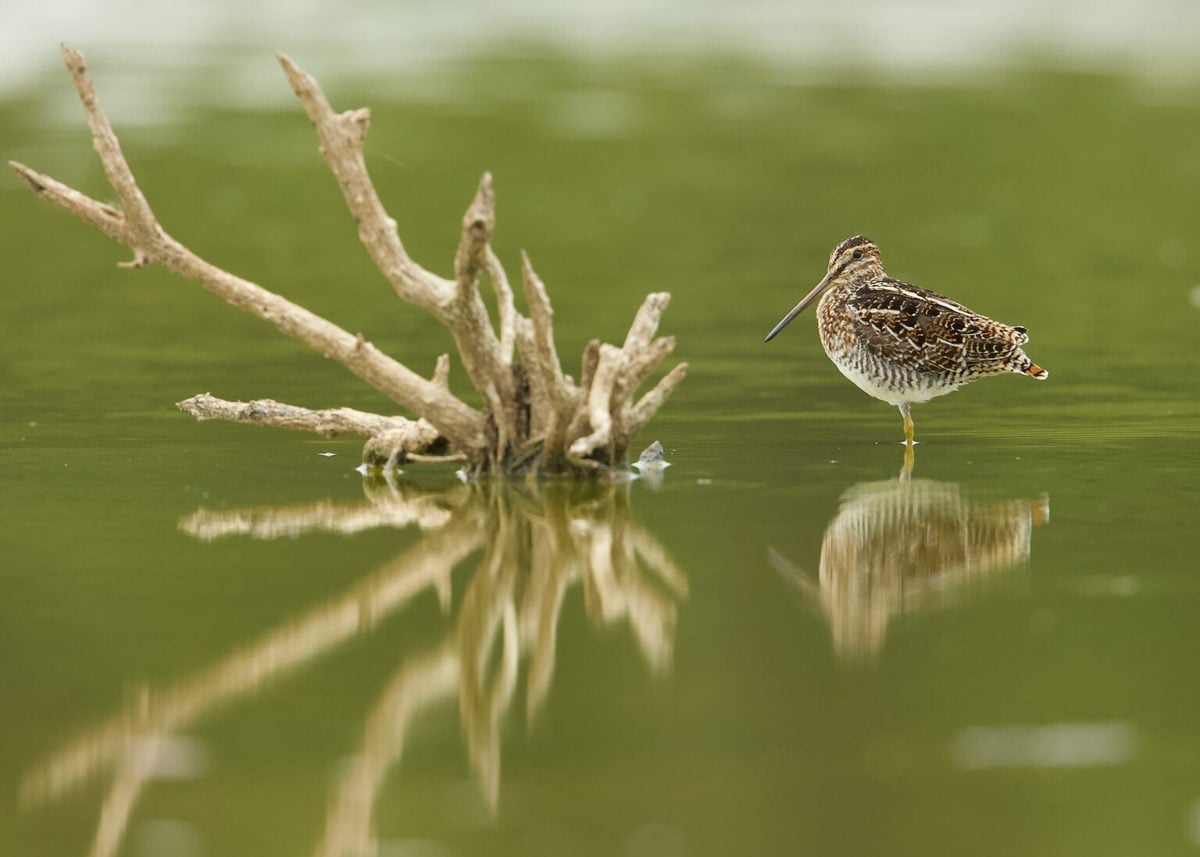
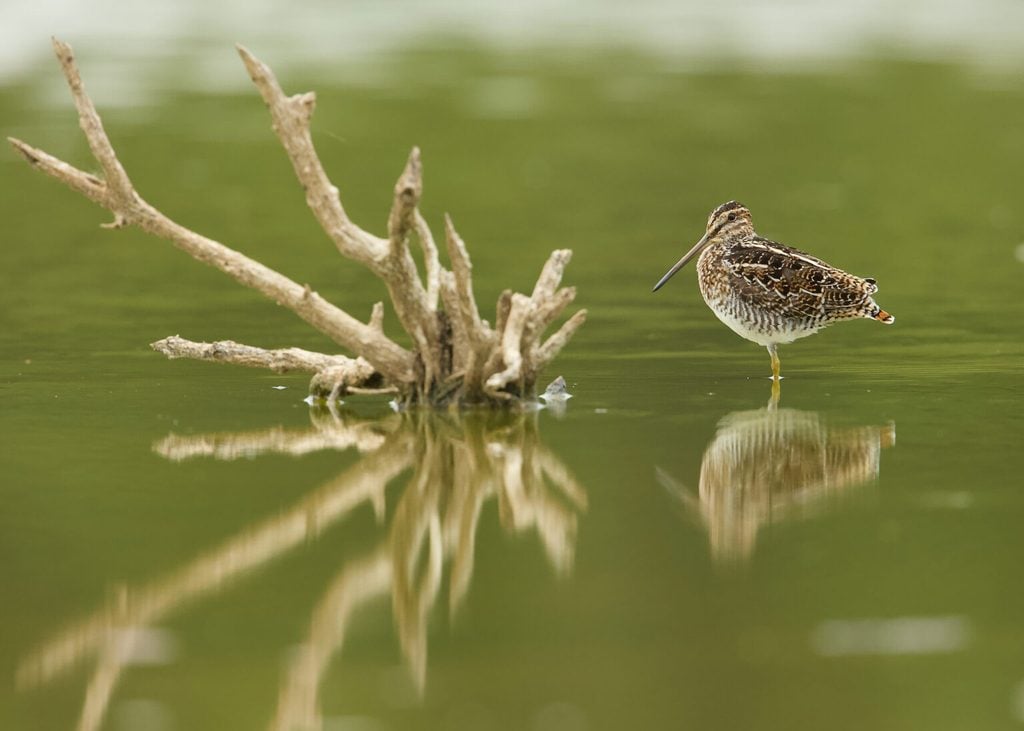
A Wilson’s Snipe is seen in an undated photo published by the U.S. Fish and Wildlife Service. (Larry Pace photo/U.S. Fish and Wildlife Service)

Incorrect information provided by a Google AI overview caused a Kodiak woman to hunt snipe illegally on Sept. 5, according to a citation filed this week at the Kodiak district court.

Writing in an affidavit attached to the citation, Alaska Wildlife Trooper Alex Wick said Weaver called troopers to self-report the violation.

“Christina stated that she Googled ‘Snipe season’ on her phone and that, according to Google, snipe season began on September 1st,” he wrote.

Based on that information, she hunted three snipe but became suspicious after learning that duck season didn’t open until Oct. 8. 

Snipe are small game birds common in Alaska, Canada and the northern Lower 48.

“After conducting her own research, she learned that snipes are not legal to take under the general season until October 8th. Christina then contacted dispatch to turn herself in,” Wick wrote. 

He said he performed a Google search identical to Weaver’s and received identical incorrect information.

Google did not respond to an email seeking comment on the incorrect information provided by its software. The platform provides an immediate artificial intelligence generated summary of search findings. 

“I feel terrible, and I have a lot of shame with it. Obviously, that’s why I immediately self-reported once I got home and dived into the regs,” she said by phone on Friday. “It’s incredibly embarrassing.”

Austin McDaniel, a spokesman for the Alaska Department of Public Safety, said the agency doesn’t keep track of cases involving false information provided by AI software. 

“This is the first time that I think we have seen AI cited,” he said. 

The one source of truth when it comes to hunts is the Alaska Department of Fish and Game’s regulations and emergency orders, McDaniel said.

“I expect we’ll see more of this type of thing in the future,” he said of AI being at fault. 

McDaniel said Weaver acted completely correctly once she learned about the AI-caused mistake. Self-reported hunting violations are punished much less severely than ones uncovered by troopers.

“The potential consequences for self-turning in versus being caught can be pretty dramatic,” he said.

Weaver pleaded no contest to the citation on Friday and was fined $150. 

Categories
Alaska News Featured Juneau News juneau Juneau Local Juneau Local Ketchikan Local News Feeds Sitka Local

A New York Times article claimed hostility by Mary Peltola. Will it affect Alaska’s Senate race?

By: James Brooks, Alaska Beacon

Mary Peltola listens to a question posed by moderator Michelle Egan at a candidate forum held by the Alaska Oii and Gas Association on Aug. 27, 2026. Next to Peltola is i Sen. Dan Sullivan. Peltola, a Democrat and former U.S. House member, is challenging Sullivan. (Photo by Yereth Rosen/Alaska Beacon)

Alaska observers say it is too early to say how reports of bad behavior by Democratic U.S. Senate candidate Mary Peltola might affect the state’s closely watched election, and some supporters suggested this week that she may be subject to a double standard because of her gender.

“While it’s surprising news, I think there’s a very hefty proportion of people who go, ‘It’s a hit job. It’s typical politics,’ and kind of brush it off,” said Ivan Moore of Alaska Survey Research, a political polling firm active in the race.

“It takes a lot to swing someone over from being a Peltola voter to all of a sudden going, ‘Oh, OK, I’ll vote for Sullivan.’ So we’ll see,” Moore said.

On Wednesday, the New York Times published an anonymously sourced article documenting abusive behavior by the former Alaska congresswoman, now a leading candidate for Senate. The article said she was hostile to her staff and used slurs and profanity to privately criticize others.

The article detailed accounts from former staff members who said she required aides to feed her family’s pet chameleon and said that in 2024, she wrote that she hoped a local Planned Parenthood board member would “die of a botched abortion.”

That comment came after the group was slow to endorse Peltola in that year’s election. This year, she does not appear on the group’s endorsement list.

“Planned Parenthood has been called worse and withstood more in its 100+ years; we’ll talk with her about what was reported when she’s Senator-elect,” said Morgan Lim, Alaska state director for Planned Parenthood Alliance Advocates. “Nothing has changed in the stakes of this race and we remain laser-focused on ousting Sullivan from the Senate — making sure Alaska voters know that Dan Sullivan is an anti-abortion, anti-LGBTQ fanatic who will continue to rubber stamp Trump’s judicial nominees.”

Peltola declined to talk to Alaska reporters on Wednesday evening after a meet-and-greet with union members in Anchorage.

Peltola was elected in 2022 to fill the remainder of Congressman Don Young’s term after his death that spring. She subsequently won the general election in November and served a two-year term of her own.

Her time in office coincided with a period of personal loss. Five months after she began her full term, her mother died. Three months after that, her husband died in a plane crash. She sued his employer a year and a half later, and a trial is set to begin in March.

Harry Child, a spokesman for Peltola’s campaign, said by text that the Times article is exaggerated.

“Like any person who has gone through multiple personal tragedies in the span of a few months, Mary sometimes struggled to deal with her grief. But she treats her staff with respect and care, and she maintains close positive relationships with her staff spanning her nearly 30 years in public service,” he said. “Exaggerating and outright lying about moments from the hardest period of her life, and falsely presenting them as a pattern of behavior, is wrong.”

A double standard for judging Peltola?

Polling indicates Peltola, a Democrat, is in a close race against Republican incumbent Dan S. Sullivan for one of Alaska’s two U.S. Senate seats. The winner of that election may decide whether Democrats or Republicans hold a majority of the Senate.

Moore said he doesn’t know whether the Times article will affect the eventual result. 

Readers of the Anchorage Press said they don’t think it will, with some labeling the Times article a “nothingburger.”

The Times found something similar in a followup article of its own. A spokesperson for the Alaska Democratic Party called the initial article “a hit piece.”

“Mary grew up working on a fishing boat and was made in the mold of great Alaskan leaders that came before her. She’s the only candidate in this race who will actually fight to lower costs and put Alaska first, and Alaskans will send her to the Senate this fall because she will deliver,” the spokesperson said.

Nate Adams, a spokesperson for the Sullivan campaign, said by email, “Nearly 30 people close to Mary Peltola were interviewed and more than 100 screenshots informed this reporting. What the Times printed is only a fraction of it, so imagine what was left out, and what else Mary Peltola is hiding from Alaskans.”

Jim Lottsfeldt, a veteran political campaigner who is working on pro-Peltola efforts this year, said he sees somewhat of a double standard in the way she’s being treated.

Her predecessor, Young, was notorious for profane, scurrilous and even violent behavior while in office, and former Sens. Ted Stevens and Frank Murkowski were known for their hot tempers.

“Stevens blew his stack, and we were all like, ‘That’s great, because he blew his stack for our benefit.’ And then you had Don Young saying the most outrageous things occasionally, but got like tons of things passed,” Lottsfeldt said. “So when all this stuff happens with the guys, nobody really clutches their pearls, and now we have little Mary Sunshine, Mary Peltola, who may have said the word f**k when she was mad, and now we’re acting like it’s a major political story, and I don’t think it is.”

Some former staffers back Times reporting, others dispute it

After the Times published its initial article, the Beacon contacted more than a dozen former Peltola aides in an attempt to verify its contents. Some, speaking anonymously, said they could not confirm all the incidents described by the Times but said the article matched the tone and mood of their time in her Congressional office or with her campaign.

They asked to not be named in order to offer frank opinions and because their current jobs may require them to work with Peltola in the future.

But at least some defended their former boss.

Kate Consenstein worked for Peltola in the Alaska Legislature and now runs a communications firm in Anchorage. The Peltola campaign suggested her as someone whose experience doesn’t match the Times article. 

“I wouldn’t want to engage in denying the veracity or the accuracy of those people’s accounts, especially because I don’t know who they are,” she said, “but I would just say the person that I worked for, and the person that I still know, is kind, generous, and not an abusive boss.”

Current U.S. Sen. Lisa Murkowski is a Republican who endorsed Peltola’s 2024 U.S. House run but is backing Sullivan this year. She told reporters in Washington, D.C. on Thursday, “I do acknowledge that while she was here in her first term, she was not only thrown into a very challenging situation immediately running for campaign, but then to lose her husband in that airplane crash and to deal with all of that. That’s pressure that is hard for anybody to bear.”

Sullivan, also interviewed by D.C. reporters on Thursday, said, “I think it’s very sad, very disturbing that so many Alaskans had to get put through that kind of severe abuse, which is very disturbing, but not surprising.”

Tyson Fick, a fisherman from Juneau who worked as a special assistant in Peltola’s congressional office, said there’s no doubt that Peltola would want a “mulligan” for some of the things she said, and he feels she was frequently second-guessed by East Coast staff.

“She never, I thought, was abusive, but also she often got some inadequate staff work,” he said.

“Having been around some operations where they were a little more, you know, systematic and organized, it was hard for me. I had to get out of there. I love Mary. I’ll be with Mary till I die, but I knew I couldn’t sign up for them again,” he said.

Fick and other Alaskans interviewed for this article were particularly critical of Anton McParland, who replaced Alex Ortiz as Peltola’s chief of staff. Ortiz, who declined to comment for this article, had previously worked for Young. When Peltola was elected, McParland did not live in Alaska; he has since registered as an Alaska voter.

In addition to the personal losses that Peltola suffered, there was also a conflict between the people Peltola brought from Alaska and the people she hired from the East Coast.

Peltola and Fick are fishermen and accustomed to salty language, he said. Someone with a trust fund may not understand it, he said.

“Sometimes you say some salty stuff just for effect, and it doesn’t reflect a cultural bias … I get that words mean things, and words hurt, and people get their feelings hurt, and maybe it’s not right, but there’s also times when you’re under super stress, and you’re grieving, that stuff comes out like in inopportune moments, and it’s like, yeah, we could communicate better, we could do better, but also we could have — I could have done better for her,” Fick said.

Categories
Alaska News Featured Juneau News juneau Juneau Local Juneau Local Ketchikan Local News Feeds Sitka Local

Mixed signals for housing costs in Alaska

By: Yereth Rosen, Alaska Beacon

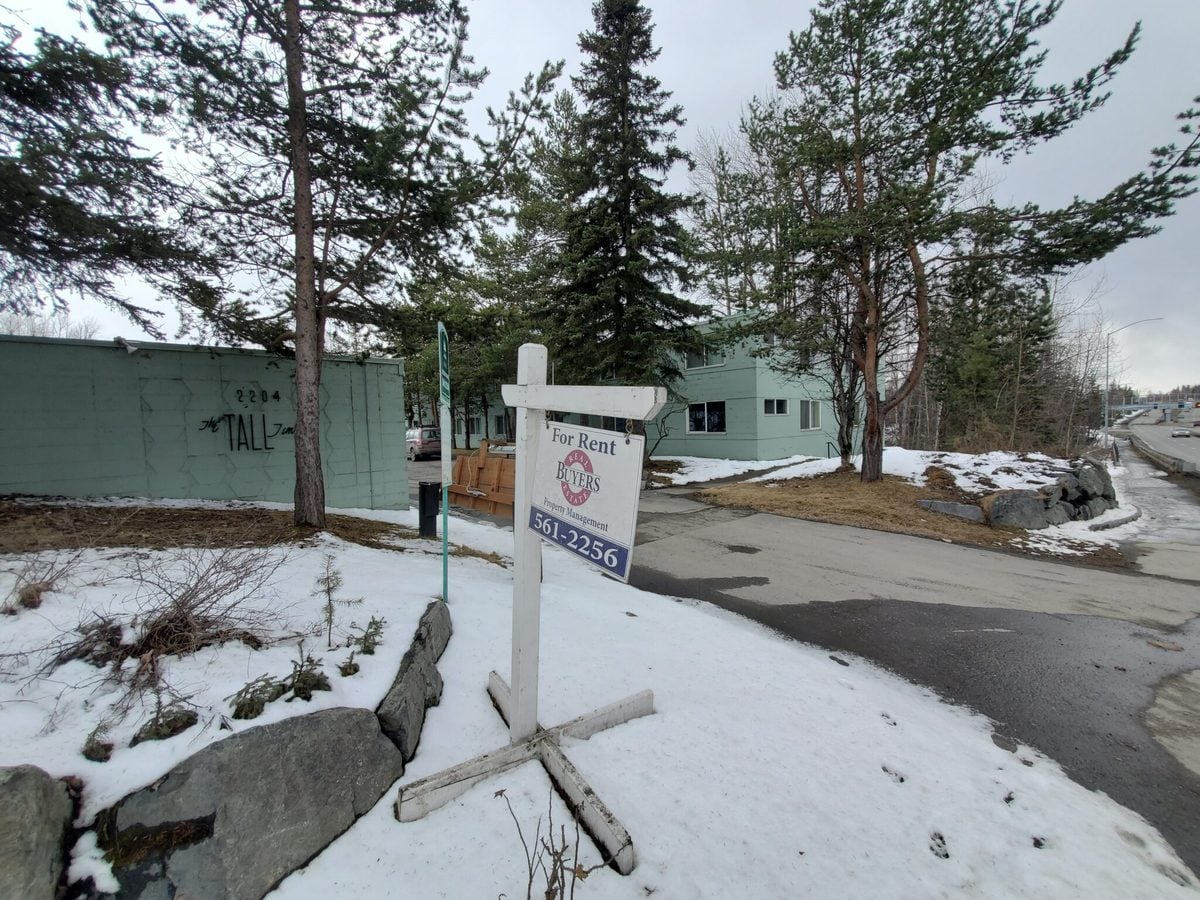
A sign seen on April 9, 2025, advertises rental availability at an apartment building in Anchorage’s Turnagain neighborhood. (Photo by Yereth Rosen/Alaska Beacon)

Apartment rents in Alaska rose 2.1% over the past year, the most modest increase in five years, according to analysis by the state Department of Labor and Workforce Development.

The statistics on rental costs are part of a package of articles about housing costs published in the September issue of Alaska Economic Trends, the monthly magazine of the department’s research section.

Rental statistics, based on prices recorded in March of this year, show some striking geographic differences.

The Wrangell-Petersburg area in Southeast Alaska had the cheapest rent of the 11 cities and areas analyzed, with a median monthly rate of $1,288 for a two-bedroom apartment. Bethel, a rural hub in Western Alaska, had the highest rents, with a median of $2,030 a month for a two-bedroom apartment.

Kodiak, Anchorage, the Fairbanks North Star Borough and Juneau were behind Bethel with monthly median rentals above $1,700.The Matanuska-Susitna Borough, just north of Anchorage, was on the low side for median rents, at $1,567 a month, but it had the biggest yearly increase, measured at 12.8%.

That reflects demographic characteristics in the bustling borough, where many residents are commuters who work in Anchorage, said Gunnar Schultz, a state labor economist and one of the authors of the housing-cost stories.

“Mat-Su obviously has been growing in contrast to most of the rest of the state,” he said. “So I think that that obviously puts upward pressure on price.” Proximity to Anchorage is another contributor because it means money is coming into the borough from the state’s largest city, he said.

The analysis is part of the department’s regular monitoring of housing costs. The rental comparisons covered much but not all of the state; the North Slope Borough and Bering Strait region, for example, were not included.

For homebuyers in Alaska, there are some economic headwinds, according to the economists’ analysis. Mortgage costs are much higher than they used to be, they said.

For a 30-year fixed rate mortgage on a $415,000 Alaska home — the median value — the monthly payment in 2025 was about $2,050. That is 84% higher than the estimated median monthly mortgage payment in 2019, the analysis said.

A big driver is the rise in home values, from an average of about $300,000 in 2019 to an average of $415,000 just six years later. Another factor is the increase in interest rates, from a median under 3% in 2020 to 6.5%in 2023, the analysis said.

But while home values and thus monthly mortgage costs increased, so did wages in Alaska.

The result of all those combined changes was that purchasing a home became marginally more affordable in 2025 than in the two years prior, according to the analysis.

Alaska’s Housing Affordability Index,  the number that represents how many people earning the average monthly are needed to make mortgage payments, dropped a bit in 2025 to 1.37. That is down from last year’s index of 1.39 and from the 2024 index of 1.4, which was the highest in recent years. But it is above the indexes measured in previous years; from 2019 to 2021, the index was below 1, indicating that a single person earning average Alaska wages had enough money to afford monthly mortgage payments.

Despite the slight improvement in the affordability index, buying a house remains a hefty burden in Alaska, Schultz said. “It’s still so much higher than it was during COVID and before,” he said.

A slight decline in interest rates last year was a contributing factor to the small improvement in housing affordability. However, interest rates are now heading up, the analysis pointed out.

Also affecting housing affordability is the availability of homes, and on that subject, there is positive news for would-be buyers, according to the economists’ analysis.

Housing construction in 2025 hit a 10-year high after years of increases that followed the big drop during the COVID-19 pandemic. A total of 2,261 single-family and multifamily housing units were built last year, the analysis said. That compares to 1,747 in 2020 and 1,726 in 2021. Home construction has been steadily rising since those years, according to the data.

The Alaska Economic Trends articles did not compare housing costs in the state to those nationwide, but the U.S. Census Bureau has some U.S. statistics that provide some contest.

Nationally, home ownership costs remained flat from 2020 to 2024, while rents increased by $100 more a month to a median $1,413 during the period, according to the Census Bureau. The analysis considers areas around the nation with populations over 5,000, so most of Alaska’s rural communities are not included.