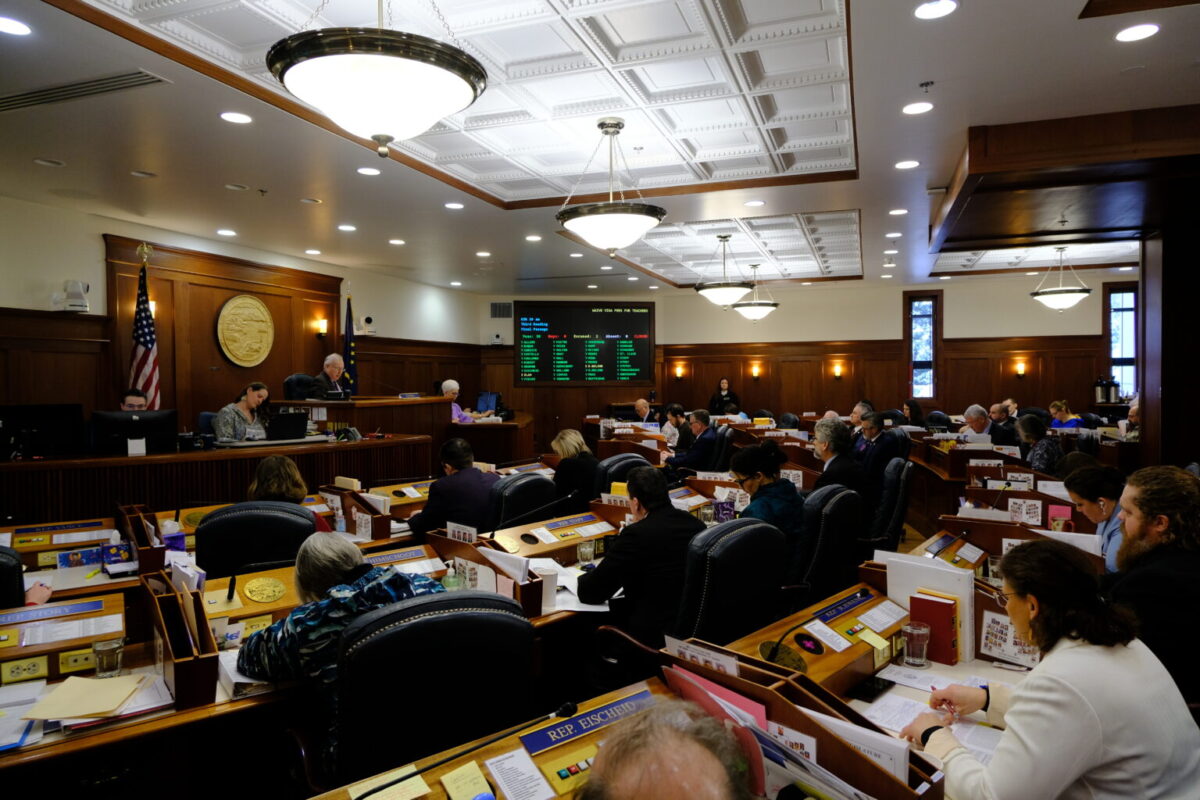
Members of the Alaska House of Representatives convene on the first day of the second session of the 34th Alaska State Legislature on Jan. 20, 2026 (Photo by Corinne Smith/Alaska Beacon)
The Alaska Legislature on Wednesday approved a stopgap budget bill amid an ongoing debate among lawmakers around war-driven oil revenues and whether to draw from state savings.
The stopgap budget bill contains $449.6 million in state spending including for disaster relief, construction, education, correctional officer overtime and some public assistance programs — expenses accrued since the Legislature and Gov. Mike Dunleavy adopted the state budget last year.
But the question of how and when all the items will be funded is still uncertain. Lawmakers chose to rely on anticipated oil revenue to fund the bill rather than drawing from savings.
The Alaska Senate passed the budget bill by a 19 to 1 vote on Wednesday, with Sen. Robert Meyers, R-North Pole opposing. The bill was quickly transferred to the Alaska House where it passed unanimously by all 40 members. The bill now moves to the governor’s desk for his consideration.
The Legislature created a select bicameral conference committee to hammer out differences between House and Senate versions of the budget bill over the last week.
The final bill includes $75 million for disaster relief to cover the state’s response to the Western Alaska storms last fall, and almost $100 million for fire suppression. It contains $20 million for the Alaska Department of Corrections for overtime spending, as well as $34.4 million for Medicaid and $12.8 million for other public assistance programs through the Alaska Department of Health. The bill allocates nearly $130 million toward the Alaska Higher Education Fund which provides grants and scholarships to students.
The spending bill also includes a time-sensitive appropriation for Alaska’s construction industry. It contains $70.2 million in state dollars to unlock roughly $630 million in federal grant funding that industry groups have said is essential for the summer construction season.
But how the nearly $450 million budget bill is funded is still in question.
Legislators have been closely watching oil prices since the start of the Iran war, which state forecasters have projected could potentially generate hundreds of millions in state revenue for Alaska.
Lawmakers agreed that if oil-driven state revenues from now until June 30, the end of the fiscal year, are not sufficient to cover the stopgap budget, then the Legislature will draw from state savings. That roughly pencils out to an average of $74 per barrel of oil through June to cover state spending, according to data provided by the House Finance Committee.
But that vote to confirm drawing from savings again failed in the House on Wednesday — the fourth vote held in the House this year. To draw from Alaska’s main $3 billion savings account requires support from three-quarters of the House and Senate.
The Senate approved the immediate draw from savings on Wednesday by a 16 to 4 vote, but it failed to pass the House by a vote of 22 to 18. It takes 30 votes in the House to spend from the savings reserve.
On Thursday, House Speaker Rep. Bryce Edgmon, I-Dillingham, expressed concern at sending the budget bill to the governor with what he said was no “backstop” funding from savings.
“So if the price of oil goes down, the governor may not have the money ultimately, to finish up or to pay for operations,” he said for this fiscal year.
Edgmon said he is concerned with banking on future oil prices to pay the state’s bills.
“It’s the first time, I think maybe perhaps in Alaska’s history, we’ve ever done it this way,” he said. “It’s going to be very interesting to see how this plays out, because oil prices can certainly go up as well, but they can also go down. And it’s not the way that I like to operate in terms of being fiscally responsible.”
Members of the Republican House minority caucus in opposition from drawing from savings expressed confidence in oil revenues providing enough funding to cover state expenses.
“Everything in this bill the state currently projects enough revenues to fund,” said Rep. Will Stapp, R-Fairbanks on Wednesday. “We still have many days in session, happy to revisit in the event oil price changes and we need to structure something in order to meet our obligations. That is not a requirement at this moment.”
The stopgap budget bill now moves to Dunleavy who can sign or veto the bill or let it pass into law without his signature.
Alaska Gov. Mike Dunleavy delivers the annual State of the State address on Tuesday, Jan. 28, 2025, in the Alaska Capitol. (Photo by James Brooks/Alaska Beacon)
By: Sean Maguire, Alaska Beacon
Alaska Gov. Mike Dunleavy delivers the annual State of the State address on Tuesday, Jan. 28, 2025, in the Alaska Capitol. (Photo by James Brooks/Alaska Beacon)
Alaska Gov. Mike Dunleavy has proposed eliminating property taxes for the Alaska LNG project to incentivize development of the $46 billion gas line and export facilities.
The bill was introduced to the Legislature on Mar. 20 and would exempt the project from local taxes in Alaska, including property and sales taxes. Instead, a volume-based tax would be levied once the pipeline starts producing significant quantities of gas from the North Slope.
In a statement, Dunleavy said his legislation “removes a structural barrier” that would help get the gas line built. The project is expected to create thousands of construction jobs, spur the development of new industries and potentially lower power and heating bills for consumers.
“We bring more gas into Alaska and stabilize supply — that lowers cost for families like yours and businesses,” Dunleavy said Wednesday on social media.
The state of Alaska is expected to collect over $22.5 billion in new revenue from the project over the next 36 years, primarily from production taxes and royalties, according to state economists.
In addition to exempting the project from property and sales taxes during its ramp-up period, the Alaska Department of Revenue estimates Dunleavy’s bill would equate to a 90% reduction in property tax revenue, once the pipeline is at full capacity.
Municipal governments are expected to take the biggest hit from that change. If the project was built under current tax law, they would collect an extra $13 billion in revenue through 2062, or $360 million annually.
Some long-time lawmakers have questioned whether the pipeline will result in reduced gas prices. Others have questioned why such a sharp reduction in property taxes is needed.
‘Industrial renaissance’
An 800-mile pipeline from the North Slope to deliver natural gas to market has been a dream in Alaska for decades. But prior efforts have all fallen short.
Supporters say its prospects have never been stronger. Key permits are in hand, several Asian nations are interested in buying Alaska’s gas, and President Donald Trump has voiced support for the project.
Former Democratic U.S. Sen. Mark Begich has been hired by the Dunleavy administration to help advance the pipeline. He told lawmakers the 1973 oil shock helped spur development of North Slope oil. Now, war in the Middle East has upended LNG production and raised prices, which makes Alaska natural gas more attractive, he said.
“This is our moment,” he said to the House Resources Committee on Monday, calling the gas line “an incredible project.”
Glenfarne, a New York-based company, signed on to develop the pipeline last January. It owns 75% of the project while the Alaska Gasline Development Corp., a state agency, owns the remaining 25%.
But the economics of the $46 billion gas line remain uncertain.
Glenfarne chose to split the project in two. The first phase would see construction of a pipeline for domestic consumption, with delivery of gas targeted for 2029. The second phase would construct a plant and shipping terminal in Cook Inlet for export.
Alaska’s current tax structure means a 2% property tax can be levied on oil and gas infrastructure.
Dunleavy’s tax proposal would impose a volume-based alternative. A new tax would be levied at 6 cents on every thousand cubic feet of gas, which would increase by 1% annually.
The tax would only be imposed once the pipeline delivers an average of 1 billion cubic feet of gas per day or 10 years after gas starts being produced.
Dan Stickel, economist with the Department of Revenue, on Wednesday said reducing property taxes would help with front-end costs. He said the agency is not examining Dunleavy’s bill as a tax cut because it would help spur the pipeline and potentially lead to new state revenue.
Stickel told the House Resources Committee that AGDC and Glenfarne have said the project will not move forward without property tax relief.
At full capacity, the pipeline is expected to deliver 3.5 billion cubic feet of gas per day. Southcentral Alaska’s demand for Cook Inlet gas equates to roughly 70 billion cubic feet of gas per year.
Glenfarne Group CEO and founder Brendan Duval and Alaska LNG President Adam Prestidge stand while Gov. Mike Dunleavy recognizes them during his State of the State address on Jan. 22, 2026. (Photo by Corinne Smith/Alaska Beacon)
Adam Prestidge, president of Glenfarne Alaska LNG, said the project would be an “industrial renaissance” for Alaska. It could create 7,000 jobs during construction and spur new opportunities such as data centers, he said.
Wearing a lapel pin in a House Resources Committee hearing that said “build the line,” Prestidge told lawmakers discussions on gas agreements are ongoing with Alaska utilities. He said agreements could be signed and made public in the next couple of months.
“This is the only way to significantly bring down the cost of energy for Alaskans,” he said.
‘Huge give’
The Alaska Department of Revenue estimates the state would receive $22.5 billion in revenue from the gas line through 2062. The majority of that windfall would come from production taxes and royalties.
Compared to Alaska’s current tax regime, Dunleavy’s proposal would see the state miss out on $200 million per year from property taxes once the pipeline is at full capacity, projections show.
The alternative tax structure proposed by the governor would see $64 million per year collected by municipalities at full gas production and $9 million annually by the state.
For municipalities, there would be a bigger hit.
The gas line is expected to be built through four municipalities that collect property taxes: the North Slope Borough, Denali Borough, Matanuska-Susitna Borough and the Kenai Peninsula Borough.
Under Alaska’s current tax structure, municipal governments would be expected to share in $17.3 billion from the pipeline through 2062. Under Dunleavy’s tax bill, it would be below $4 billion.
Anchorage Democratic Sen. Bill Wielechowski, vice-chair of the Senate Resources Committee, spoke at a Tuesday news conference. He said legislators would look closely at Dunleavy’s proposed tax break and determine whether a 90% cut in property taxes is appropriate.
“I don’t know anybody in the Legislature who doesn’t want a gas pipeline. The question is, what is it going to take to get it?” Wielechowski said.
State projections show that under both tax systems, the owners of the pipeline are expected to collect $60 billion over the next 36 years.
Anchorage Republican Sen. Cathy Giessel, chair of the Senate Resources Committee, estimates Alaska has invested $1.1 billion to build a natural gas pipeline, but nothing has been built.
On Tuesday, Giessel cited costs like public safety that could be borne by communities along the proposed pipeline. She said it would likely take until the second phase of the project before 1 billion cubic feet of gas is produced per day. Meaning, it could take years before municipalities collect Dunleavy’s volume-based tax, she said.
“That’s a long time for these communities to have no property tax,” she said.
State data suggests local governments would take $6.3 billion in property taxes through 2042. Dunleavy’s volume-based tax would net them $1.3 billion over the same period.
“This is a huge give to the company,” Giessel said. “Will it still be enough for them? I don’t know.”
Mayors in impacted communities are set to testify on the governor’s tax proposal on Friday afternoon before the Senate Resources Committee.
A sign hangs outside the director's office of the Alaska Division of Elections, Thursday, March 19. 2026, in Juneau, Alaska. (AP Photo/Becky Bohrer)
A sign hangs outside the director’s office of the Alaska Division of Elections, Thursday, March 19. 2026, in Juneau, Alaska. (AP Photo/Becky Bohrer)
AP- The tiny Alaska Native village of Beaver is about 40 minutes — by plane — from the nearest city. Its roughly 50 residents rely on weekday flights for mail and many of their basic supplies, from groceries to Amazon deliveries of everyday household items.
Air service plays an outsize role in the nation’s most expansive state, where most communities rely on flights for year-round access. Planes also play a critical role in elections, getting voting materials and ballots to and from rural precincts such as Beaver and in delivering ballots for thousands of Alaskans who vote by mail — some in places where in-person voting is not available.
The vast distances and relative isolation of so many communities make Alaska unique and are why its residents have a significant interest in arguments taking place Monday before the U.S. Supreme Court.
Many here worry that a case from Mississippi challenging whether ballots received after Election Day can be counted in federal elections could end Alaska’s practice of accepting late-arriving ballots. Alaska counts ballots if they are postmarked by Election Day and received within 10 days, or 15 days for overseas voters in general elections.
“These processes have been in place for a long time just to ensure that our ballots are counted,” said Rhonda Pitka, a poll worker and first chief in Beaver, which sits along the Yukon River 110 miles (177 kilometers) north of Fairbanks.
If the court decides ballots in all states must be received by Election Day, she said, “They’ll be disenfranchising thousands of people — thousands of people in these rural communities. It’s just basically saying that their votes don’t count, and that’s a real shame.”
Some ballots already arrive late
Alaska is one of 14 states that allow all mailed ballots postmarked by Election Day to arrive days or weeks later and be counted, according to the National Conference of State Legislatures and the Voting Rights Lab. An additional 15 provide grace periods for military and overseas ballots.
But Alaska’s geography, weather and great distances between communities — Alaska is more than twice the size of Texas, the nation’s second-largest state — raise the stakes for voters. The unusual way the state counts its votes also makes a grace period important, advocates say.
Under Alaska’s ranked-choice system for general elections, workers in small rural precincts call in voters’ first choices to a regional election office. All ballots, however, ultimately are flown to the state Division of Elections in the capital, Juneau. There, the races not won outright are tabulated to determine a winner.
Even with Alaska’s current 10-day grace period, ballots from some villages in 2022 were not fully counted because of mail delays. They arrived too late for tabulations in Juneau, 15 days after Election Day.
If the Supreme Court rules that ballots cannot be counted if they arrive at election offices after Election Day, scores of Alaska voters could be affected. About 50,000 Alaskans voted by mail in the 2024 presidential election.
“I think there’s probably no other state where this ruling could have a more detrimental impact than ours,” Alaska’s senior U.S. senator, Republican Lisa Murkowski said in an interview.
Murkowski sees the case — a challenge by the Republican National Committee and others to Mississippi’s allowance of late-arriving ballots — as an effort to end voting by mail nationwide.
‘Seeing a level of voter intimidation’
The RNC argues such grace periods improperly extend elections for federal office, but Mississippi responded that no voting occurs after Election Day — only the delivery and counting of already completed ballots.
The Supreme Court will hear arguments as the U.S. Senate is debating legislation being pushed by President Donald Trump that would require people to show proof-of-citizenship to register to vote and a photo ID to cast a ballot.
Taken together, Murkowski said such efforts could discourage people from voting.
“I think we’re seeing a level of voter intimidation, I’ll just say it,” she said. “I feel very, very strongly that the effort that we should be making at the federal level is to do all that we can to make our elections accessible, fair and transparent for every lawful voter out there.”
Alaska’s other congressional members, Rep. Nick Begich and Sen. Dan Sullivan, both Republican allies of Trump who are seeking reelection this year, support the SAVE America Act now before the Senate. But they also said they want to ensure that ballots properly cast on or before Election Day get counted.
“We’ll see what the courts choose to do on that issue, but I do think that we need to allow for time for ballots to come in from the rural parts of our state,” Begich said during a recent visit to Juneau.
Alaska officials highlight challenges to the court
A court filing in the Mississippi case by Alaska Attorney General Stephen Cox and Solicitor General Jenna Lorence did not take sides but outlined geographic and logistical challenges to holding elections in Alaska.
In Atqasuk, on Alaska’s North Slope, poll workers counted votes on election night in 2024, tallies they would normally relay by phone to election division officials. But the filing said they could not get through and “chose what they saw as the next best solution — they placed the ballots and tally sheets into a secure package and mailed them to the Division, who did not receive them until nine days later.”
The filing seeks clarity from the Supreme Court, particularly around what it means for ballots to be received by Election Day.
While it is clear when a ballot is cast, “when certain ballots are actually ‘received’ is open to different interpretations, especially given the connectivity challenges for Alaska’s far-flung boroughs,” Cox and Lorence wrote.
Effect on Native voters
Lawyers with the Native American Rights Fund and Great Lakes Indigenous Law Center said in filings with the court that limited postal service in rural areas means that some ballots might not be postmarked until they reach Anchorage or Juneau, which can take days.
In the 2022 general election, between 55% and 78% of absentee ballots from the state House districts spanning from the Aleutian Islands up the western coast to the vast North Slope arrived at an election office after Election Day, they wrote. Statewide, about 20% of all absentee ballots in that election were received after Election Day.
Requiring ballots to be received by Election Day, they warned, would “disproportionately disenfranchise” Alaska Native voters. The lawyers represent the National Congress of American Indians, Native Vote Washington and the Alaska Federation of Natives.
Michelle Sparck, director of Get Out the Native Vote, a nonpartisan voting rights advocacy group affiliated with the Alaska Federation of Natives, worries about creating confusion and fear among voters.
She sees the case before the Supreme Court and the Republican SAVE Act as “a multipronged attempt to take control or wrest control of elections away from states.” Alaska, she said, already has enough inherent barriers for many voters.
“There is a minute record of election fraud — not at the rate that requires this heavy-handed response through the legislature and the Supreme Court,” she said.
A polling place sign at the State Office Building in Juneau on Aug. 15, 2022. (Photo by Lisa Phu/Alaska Beacon)
The Alaska House of Representatives passed an elections bill aimed at streamlining the state’s voting process and updating the voter rolls with a bipartisan vote on Monday. If signed into law, the bill would implement a new ballot tracking system, provide paid postage for all absentee mail-in ballots and implement provisions for faster election results, among other changes.
The House passed Senate Bill 64 by a 23 to 16 vote on Monday evening, with Rep. Ashley Carrick, D-Fairbanks, absent. Three members of the House minority caucus joined the majority in supporting the legislation: Rep. Sarah Vance, R-Homer, Rep. Kevin McCabe, R-Big Lake, and Rep. Jeremy Bynum, R-Ketchikan.
Sen. Bill Wielechowski, D-Anchorage, sponsored the legislation as chair of the Senate Rules Committee and said at a news conference on Tuesday the bill was at least a decade in the making and the result of a bipartisan effort.
“We’re going to agree on the things that we can agree on, things that just fundamentally make our elections better. And after 10 years, I think this bill does that,” he said. “It’s not a perfect bill. There are still things that need to be worked on, but this goes a long way towards improving our election system for every single person in the state of Alaska.”
The House made a variety of changes to the bill that the Senate passed last year, and the bill now goes back to the Senate for a concurrence vote on Wednesday. If signed into law by Gov. Mike Dunleavy, some elections changes would be implemented immediately, like a review of the voter rolls. Changes to ballot tracking and curing would go into effect after the August primary.
Lawmakers have focused on updating the state’s voter rolls to make sure voters are currently living in Alaska. Wielechowski said the new system will help the state maintain active voter rolls.
“We have 105% more registered voters than we have eligible citizens in the state of Alaska,” Wielechowski said, calling the discrepancy a “fundamental problem.”
“Everyone in Alaska knows that our elections in Alaska are probably the most difficult elections to conduct in the United States for a variety of reasons, but mostly because of geography, because of weather, because people are just spread out over such a vast area,” he said.
Under SB 64, the Division of Elections would send a notice to confirm address and residency in Alaska if the voter has:
Registered to vote in a another state
Received a driver’s license in another state
Registered a vehicle in another state
Served on a jury in another state
Receives a residential property tax exemption in another state
Receives public assistance in another state
If the bill passes, the Alaska Division of Elections will review the voter rolls and, based on a list of factors, send a postcard by mail to verify a voter’s address and establish residency. Once the notices are sent, voters have a period of 45 days to respond and confirm their Alaska residency to the division — or be moved to an inactive voter list for a period of 28 months or two elections.
Some members of the Republican House minority caucus expressed concern that military members stationed overseas would be kicked off the voter roles.
Rep. Sarah Vance, R-Homer and a member of the minority caucus, spearheaded the House version of the bill and said that even if voters are inactive, they will still be on a master voter list for eight years, under federal law.
“We cannot cancel, according to federal law, someone off of the master register for eight years. So this includes the military voters,” she said. “But I want to make sure that everyone else understands they’re not going to be inadvertently canceled either.”
Under the bill, voters would be able to show identification issued from a federally recognized tribe to register to vote or for voting. To confirm active voting status, voters would be able to contact the division by calling, emailing or by voting.
Under the Senate’s version of the bill, the state would have done away with the requirement of a witness signature for all absentee mail-in ballots, but the House objected to that change and opted to keep the witness signature.
If passed, the bill would also allow voters to fix mistakes on their ballot – a process called ballot curing — by requiring the division to contact the voter by phone or email within 24 hours. Within two to five days, the division would send notification by mail. The voter would have to return a form to correct the ballot with a copy of identification by email or by mail within 10 days of the election for their ballot to be counted.
If passed, the bill would require the state to provide paid postage for all absentee mail-in ballots. The state would also enact a new tracking system so that voters will be notified when their ballot is received and counted.
Wielechowski said that will help with transparency, as will new provisions to get election results published faster. Additionally, the elections department will start reviewing ballots 12 days ahead of Election Day — five days earlier than under current law — to allow more ballots to be counted on Election Day.
Require all absentee ballots to be received within 10 days of Election Day;
Establish a new rural community liaison position within the Division of Elections to support rural districts, including recruitment and training of poll workers;
Require the Permanent Fund Dividend Division to share data to improve the accuracy of the voter rolls’
Require the state to develop a cybersecurity program, and notify the public if there is a data breach;
Require the division to publish results for all rankings in the precinct results.
Require presidential ballots to include a line for write-in votes for president and vice president
Updates crimes of unlawful interference with an election, ballot tampering and election official misconduct
Wielechowski said the new rural liaison established by the bill would be charged with helping small, rural communities prepare to hold their elections, coordinate equipment and polling places, and hire poll workers to improve operations on Election Day.
“That person is responsible for working with the local villages … working with those communities to ensure that all the citizens are able to exercise their fundamental right to vote,” he said.
“The polls never opened in Wales in 2024 in the primary. The polls in Anaktuvuk Pass in 2024 opened up 30 minutes before closing, and roughly seven people out of about 250 were able to vote in that election in person,” Wielowski said.
The changes to Alaska’s process of voting and elections this year could come amid potential sweeping changes to national elections.
The U.S. Supreme Court is considering a case that would require all ballots to be received by Election Day in order to be counted for federal elections.
All ballots received after that deadline would be thrown out, which could potentially disenfranchise thousands of Alaska voters who cast ballots that may be delayed by weather, flight delays or election logistics challenges.
“It’s going to create some havoc in our election system, and it may very well require a special session for us to come in and deal with it,” Wielechowski said. “And so you could get in a situation where you have ballots coming in that don’t count for the federal election, but do count for the state election. And so there would have to be some kind of way that you figure out how to process those ballots in a different manner.”
The Supreme Court is expected to rule next summer.
Meanwhile, the Trump administration is putting pressure on the U.S. Congress to pass the SAVE America Act, which would, in part, require voters to present identification and proof of U.S. citizenship in person when they vote.
Alaska Republican U.S. Sen. Lisa Murkowski has loudly opposed the bill, saying it’s logistically impossible for most Alaskans, as the state only has six in-person elections offices and fewer than a dozen DMV offices. Republicans U.S. Sen. Dan Sullivan and U.S. Rep. Nick Begich III have supported the bill, saying they don’t think it would be hard to comply with its requirements.
The U.S. Senate is currently debating the bill amid another contentious debate around funding for the U.S. Department of Homeland Security and ending a five-week partial shutdown for the department. On Tuesday, Senate Majority Leader John Thune said the Senate may drop the voting bill in order to reach an agreement with Democrats over funding DHS, and return to it after Easter, according to reporting by Politico.
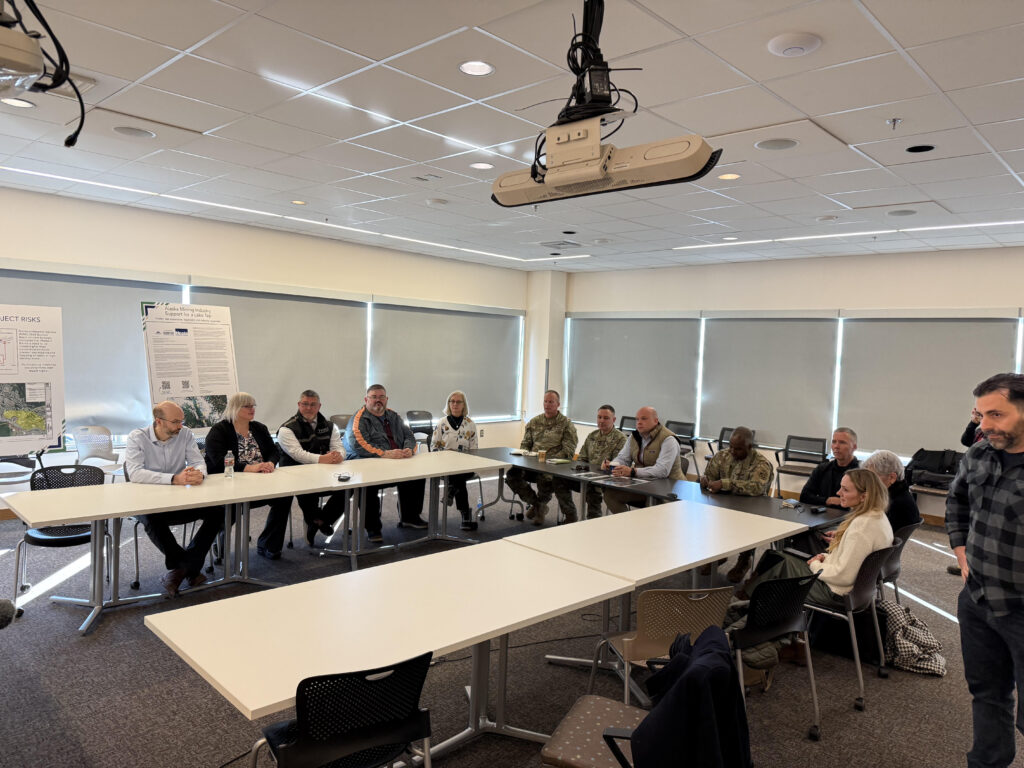
Tuesday morning press briefing with City Officials and the Army Corp of Engineers.
NOTN- Juneau is hosting the U.S. Army Corps of Engineers this week as the community presses for answers on long-term protections against glacial lake outburst flooding.
Mayor Beth Weldon said the Corps arrived in Juneau Monday afternoon, taking a helicopter tour to inspect the basin area and visiting the city’s HESCO barrier installations before holding formal meetings today.
At a Committee of the Whole meeting in February, City and Borough of Juneau leaders detailed new modeling that shows a worst-case glacial lake outburst flood could send an estimated 118,000 cubic feet per second of water down the Mendenhall River, far beyond anything the city has experienced.
Maps presented at the meeting showed that a maximum event could push water beyond the Central valley, crossing Riverside Drive and Mendenhall Loop Road, affecting neighborhoods on both sides of the river.
Scientists from the University of Alaska Southeast, the National Weather Service, the U.S. Forest Service, and Tribal representatives from Tlingit and Haida identified a “lake tap” of Suicide Basin as the preferred enduring solution.
During a press conference this morning, U.S. Army Corps of Engineers leaders outlined plans to expand and reinforce temporary flood barriers along the Mendenhall River while continuing to study more permanent solutions to GLOFs.
“We’re here today because we wanted to make sure that we are in tight, close communication with the local government here, ahead of the 2026 glacial outburst flood that we expect.” Said Assistant Secretary of the Army Office for Civil Works, “This is something that when I was a nominee for this position and going through Senate confirmation, Senator Sullivan called me into his office, and he very effectively impressed upon me the criticality of this issue to this community. Every time I’ve spoken about this publicly, including in a public hearing in September, and most recently in a public hearing last month, I’ve said we have to look at this short term, medium term and long term. And I’ve consistently conveyed that from the very first time I’ve ever spoken about this issue until now, short term, medium and long term. And we’ve had an outstanding discussion this morning with our Senate offices, local community leaders, and then all four levels of our Corps of Engineers organization to make sure that we’re all on the same page in terms of what we’re doing to address this challenge. And so we’ll get into some of that as the questions come but that’s really the reason we’re here.”
Officials said immediate work for 2026 includes raising existing HESCO barriers by 1 to 2 feet and extending the system by roughly 4 to 4.5 miles along both sides of the river, officials also the Corp is adding more armoring along the riverbanks and deploying pumps and technical experts to manage any water that gets behind the barriers.
Telle also mentioned a ‘Medium’ term solution, and here is what he said when asked the clarify.
“In the medium term, we’re looking at more permanent and more survivable barriers that can be implemented, as well as continuing to look at potential channel modifications. Those are all on the turn on the table for the short, medium term, we’re obviously continuing to look at long term options that will require significant technical analysis and engineering. We’re getting down that path every single day.” He said, “In my view, we can’t wait a decade to deliver, or six years, or 15 years, we can’t wait that long to deliver results for the citizens in this community, and so we’re tackling short medium with the same aggression that we’re tackling long.”
Those potential channel modifications could look like dredging or reshaping.
“There’s been conversation within the community for years about straightening the channel. This can be done relatively quickly and for low cost. The question is, does that straightening actually just move the risk to a different part of the community? And so we want to be very careful about that. We’ve got extensive modeling underway right now.” Telle said.
The long-term solution remains under study.
“This is, I’ll just say, glacial outburst flooding is a unique challenge here in Juneau. This phenomenon that we have here is unique to the Corps of Engineers entire portfolio. I think with that uniqueness comes a lot of uncertainty from an engineering and technical perspective, and we’re trying to really reduce that uncertainty as fast as we can.” Telle said.
Telle said that among the “big universe of options” for a long-term solution, a tunnel or lake tap “at this moment appears to be the most viable technically” Still, he emphasized that no option has been taken off the table and that significant technical and cost uncertainties remain.
When asked by The Juneau Independent’s Mark Sabbatini what had changed since last month’s announcement suggesting the Army Corps had “pulled back” from the lake tap solution, officials said their position had remained consistent, saying “nothing has changed other than the reporting.”
“That’s one of the reasons we appreciate the Secretary and the Generals and the Colonel for coming here face to face.” Said Mayor Beth Weldon, “There’s not going to be a miscommunication problem at all. We appreciate their enthusiasm and dedication to a short, medium and long term solution.”
“You know, the HESCO barriers are exactly what needed to happen. They showed they were, but they also showed they were just a triage method.” Said President Richard J. Peterson of Tlingit and Haida, “We’re trying to make sure we come together. We had a charrette last year, we came together all unanimously on an enduring solution, but in the meantime, they have to do their job and look at all solutions. And I think that might have been where the miscommunication came in. It wasn’t pivoting away from this, but the messaging was, ‘we’re doing our due diligence to look at everything’. We have to turn to them. And this meeting was that opportunity for us to understand where we’re at.”
Authorities say they are mindful of the clock the community is under, and said coordination between federal agencies, the City and Borough of Juneau and tribal partners will continue as preparations accelerate in the months ahead.
And for those wondering, despite our recent poor weather, work on flood-protection infrastructure has continued.
Brotherhood Bridge has officially closed starting today for installation of Phase 2 HESCO barriers.
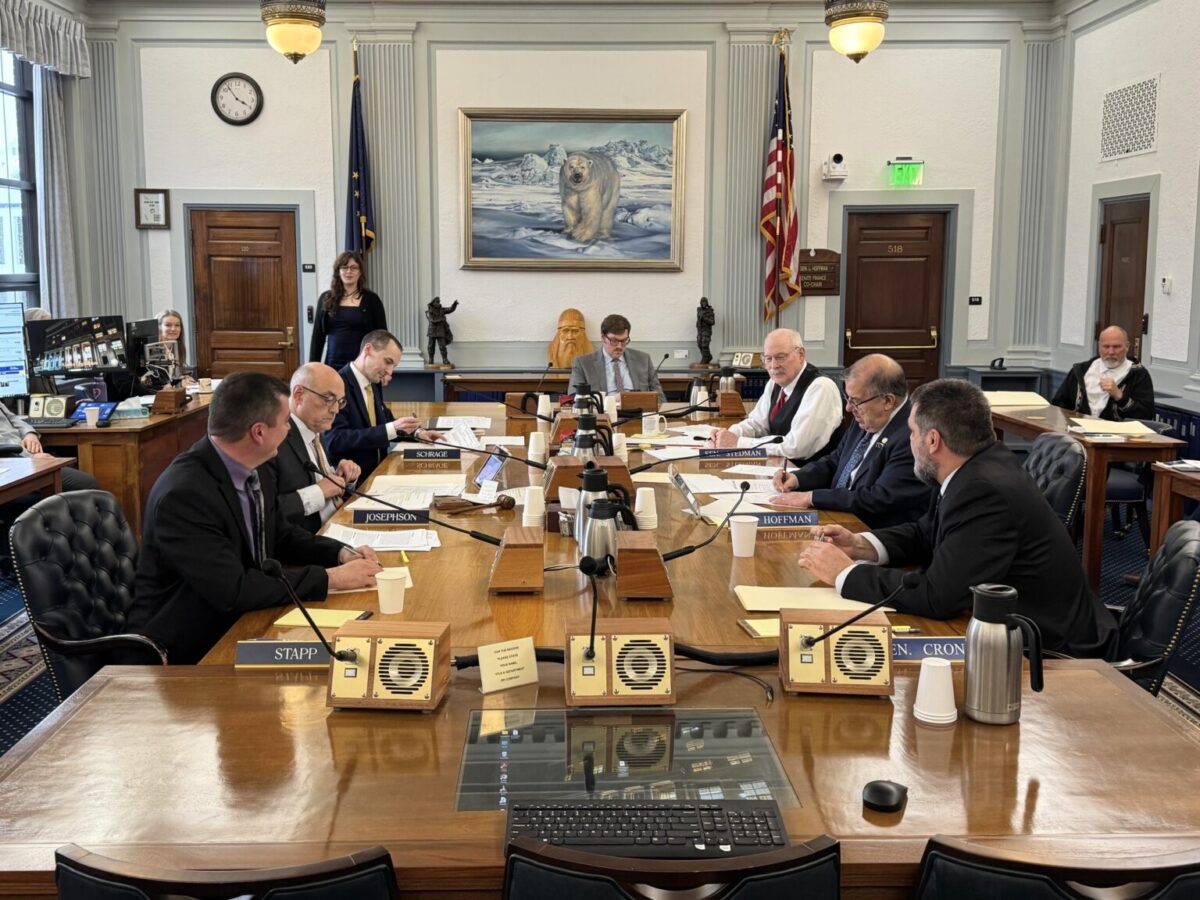
Members of the bicameral conference committee charged with writing a compromise supplemental budget sign the final documents on Monday, March 23, 2026, at the Alaska Capitol in Juneau. (James Brooks photo/Alaska Beacon)
By: James Brooks, Alaska Beacon
Members of the bicameral conference committee charged with writing a compromise supplemental budget sign the final documents on Monday, March 23, 2026, at the Alaska Capitol in Juneau. (James Brooks photo/Alaska Beacon)
The Alaska Legislature is preparing to re-vote on a key spending bill that will cover millions of dollars in disaster response and construction projects in the current fiscal year.
On Monday, a bicameral conference committee voted 5-1 to send an amended version of the bill to final votes in the House and Senate. Those votes may take place Wednesday.
The state’s fast-track supplemental budget contains $449.3 million in spending — expenses accrued since legislators and Gov. Mike Dunleavy adopted the state budget last year.
Legislators are separately working on a budget for the next fiscal year, which begins July 1. A vote on that is expected at the end of the legislative session in May.
The supplemental budget bill includes $70.2 million to unlock grant-funded construction projects principally paid for by the federal government — a major lobbying priority for the state’s construction industry.
It also includes tens of millions for the state response to last year’s wildfire season and millions more as a down payment for the state’s response to ex-Typhoon Halong, which devastated Western Alaska last fall.
The new spending would largely be paid for with new revenue the state expects because of higher oil prices caused by the Iran war.
As long as prices remain high through June 30, the end of the fiscal year, legislators expect there will be enough general-purpose money to cover the expenses, plus a smaller package of budget amendments already proposed by Dunleavy.
Those amendments arrived too late to be added to the supplemental bill.
If oil prices don’t match expectations, the bill contains language that would allow the state to use the Constitutional Budget Reserve, the state’s principal savings account, to cover the difference plus $20 million in “headroom.”
That clause may run into problems in the House, where the 19-person House Republican minority caucus has voted several times against spending from the reserve.
It takes 30 votes in the House and 15 in the Senate to spend from the reserve; while the Senate has met that threshold and is expected to do so again this week, it isn’t clear whether the House will do so.
The 21-person, predominantly Democratic coalition that controls the House would need to attract at least nine minority votes, and in earlier votes, it was unable to do so — something that forced the bill into a bicameral conference committee for further negotiations.
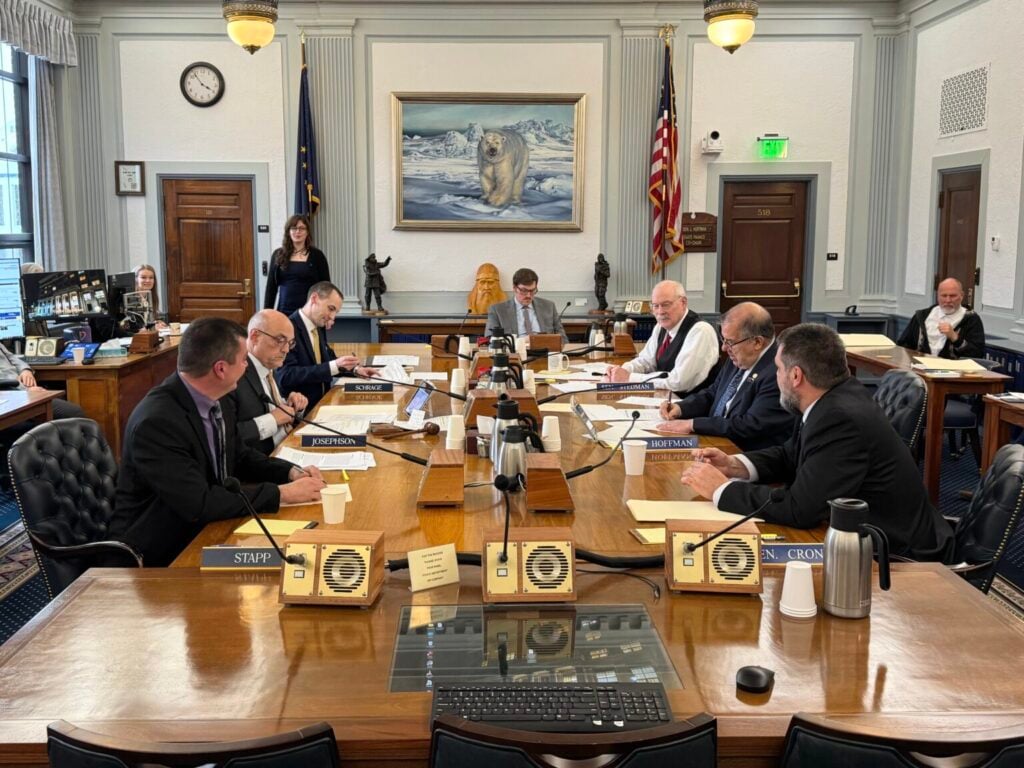
Rep. Will Stapp, R-Fairbanks and the minority’s negotiator on the conference committee, was the only lawmaker to vote against the revised bill on Monday, saying he doesn’t believe any kind of spending from the reserve is necessary at this point.
Members of the House majority have argued that allowing reserve spending — if necessary — would provide surety for construction businesses making summer plans.
They have also argued that time is of the essence: Delaying action on the bill would mean those companies might have to defer purchasing and hiring decisions ahead of the summer construction season.
Members of the House minority argued that as previously written, the bill would have allowed members of the majority to direct the spending of hundreds of millions from the reserve, even if it wasn’t needed to balance the supplemental budget.
That version was cut to less than $375 million in spending, an attempt to attract minority votes, but while that approach worked in the Senate, it did not succeed in the House.
When the House failed to pass the reserve vote, lawmakers there sent the bill to the conference committee for further work.
While that committee was able to finalize a draft compromise, it won’t be clear until later whether that compromise can pass out of the Legislature.
The Alaska House of Representatives passes a resolution to urge the Trump administration waive a $100,000 visa fee for international teachers on Mar. 20, 2026. (Photo by Corinne Smith/Alaska Beacon)
The Alaska House of Representatives approved a resolution urging the Trump administration to waive a steep visa fee for international teachers. The vote comes amid a growing teacher shortage throughout the state.
Lawmakers are calling for the Trump administration to waive the fee for teachers hired through the H-1B visa program, which allows employers to recruit highly-skilled workers from overseas. The federal government raised the fee from $5,000 to $100,000 for each new applicant to the H-1B visa program in September.
The House passed the resolution by a 38-0 vote on Friday, with Reps. Bill Elam, R-Kenai, and David Nelson, R-Anchorage, absent.
Rep. Alyse Galvin, I-Anchorage, sponsored the resolution. The former teacher said the cost is impossible for Alaska school districts.
Rep. Alyse Galvin, I-Anchorage, speaks on the House floor on Mar. 20, 2026. (Photo by Corinne Smith/Alaska Beacon)
“We know it’s a deep concern,” Galvin said on the House floor Friday. “In Alaska, in particular, in our rural areas, we are desperate for more teachers, qualified teachers in the classroom before our students. We have a true need here that can be met, and this is one tool that I hope all of us will raise our voice together and send to our federal delegation so they can use it.”
Rep. Ted Eischeid, D-Anchorage, a former science teacher, noted international teachers are also employed in urban districts like Anchorage.
”At last count, we had 66 teachers that work for the Anchorage School District providing critical education,” Edischied said, referring to the number of international teachers. “So if the most important educational reform is to have a highly qualified teacher in front of kids every day, this resolution moves us in that direction. So I support this.”
Rep. Nellie Jimmie, D-Toksook Bay, said 60% of teachers in the Kuspuk School District in her district are international hires. “The Kuspuk district cannot recruit teachers fast enough off the road system. You can’t train somebody to be a teacher overnight,” she said. “Ten teachers at a $100,000 rate visa, that’s a million dollars. Do we have a million dollars in our budget to spare for these teachers? I don’t think so.”
Jennifer Schmitz is director of the Alaska Center for Recruitment and Retention, a division of the Alaska Council for School Administrators, which supports districts in recruiting and hiring teachers and staff. After the vote, Schmitz said she was glad to hear legislators’ support because districts are hiring now.
“I’m thrilled that it passed, especially that it was unanimous,” Schmitz said. “Legislators all seem to understand that this is an issue and that they’re supportive of helping our international teachers get here more easily.”
There are nearly 600 teachers in Alaska hired through the H-1B visa program, which lasts for five years. Despite that, Schmitz said the center’s job board has over 700 job openings across the state, including for teachers, administration, para-professionals and staff.
“Special education is always at the top and then often harder to fill,” Schmitz said. “Positions can be secondary specialties like math, science, and chemistry, those higher level classes, those are often harder to fill and harder to find qualified candidates. But we have openings in every possible position.”
Schmitz said the center recently held several job fairs, including connecting University of Alaska students with education jobs as well as recruiting from around the United States and internationally.
“We are hopeful that people can find teachers from that. But we’re just really at a standstill,” she said for international hiring because of the visa fee. “And our attorney is looking at ways around that and other kinds of visas, but we just don’t know if they’re going to work… And we need to get their paperwork going now if we want them here by fall.”
The resolution now goes to the Senate where it is expected to garner support. The initiative backs federal action in the U.S. Congress, where Alaska Republican U.S. Sens. Lisa Murkowski and Dan Sullivan are cosponsoring a bill in the Senate to waive the $100,000 visa fee for all public school employees. A similar bill in the U.S. House is urging the Trump administration to waive the visa fee for health care workers.
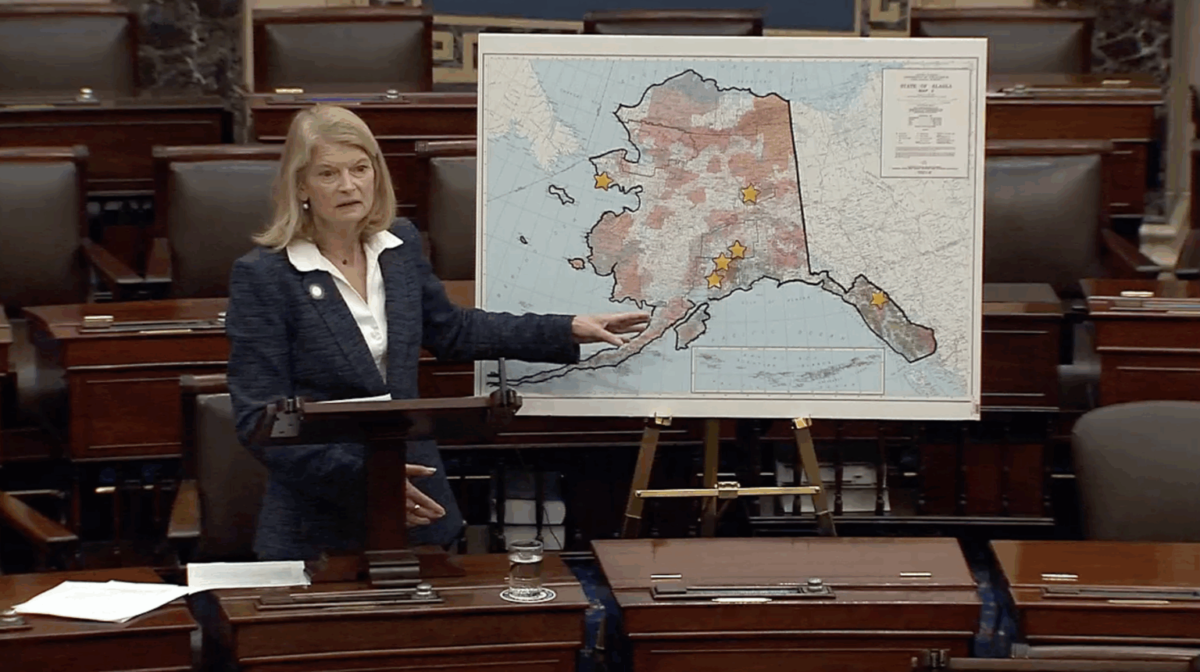
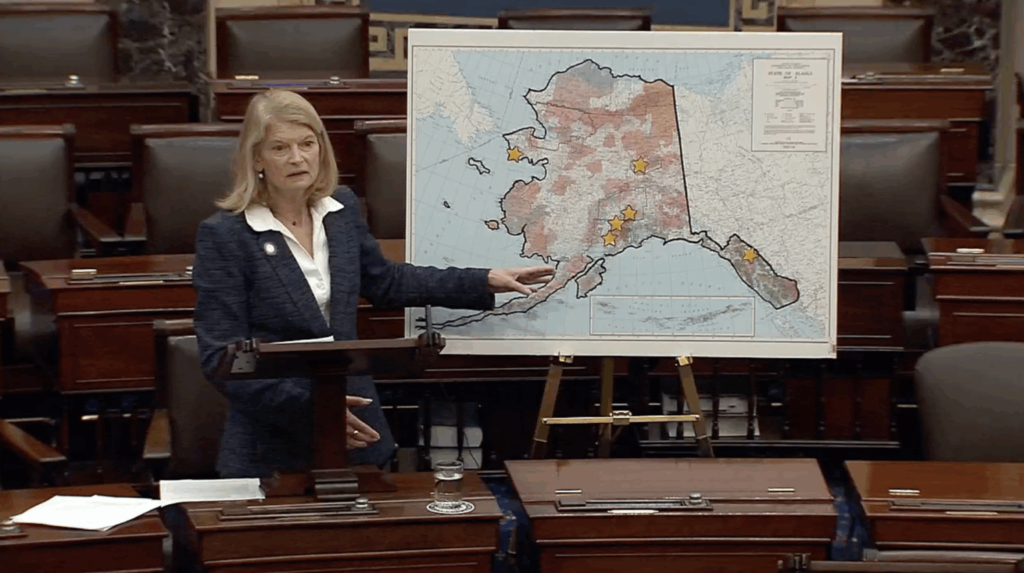
U.S. Sen. Lisa Murkowski, R-Alaska, speaks Thursday, March 19, 2026, on the floor of the U.S. Senate, in this screenshot of a video broadcast by the Senate. (Screenshot)
An elections bill being debated by the U.S. Senate could cost thousands of Alaskans the ability to vote in this year’s elections, Sen. Lisa Murkowski said Thursday in a lengthy speech on Capitol Hill.
The SAVE America Act, supported by President Donald Trump and most congressional Republicans, is ostensibly intended to prevent noncitizens from voting in American elections, but its implementation could prevent many Americans from being able to vote.
“While disenfranchisement may not be the intent of the SAVE America Act … I think that we will see that. In fact, I fully expect it to be an outcome of this,” Murkowski said.
The act would require that voters present photo ID when they vote, and that people present documentary proof of citizenship when they register to vote. That would mean presenting proof of citizenship in person at an elections office or other specially licensed state license.
“This would be a major, major departure from how most Alaskans currently register to vote,” Murkowski said.
In 2024, about 29,000 Alaskans registered to vote. Most of those — 25,000 or so — would have run into problems if the current bill had been law at that time, she said.
Most of Alaska’s voter registrations are done online or through the state’s motor-voter or PFD voter process. The bill could allow citizenship verification, but it’s not clear how that would happen, Murkowski.
Mandating in-person registration would have big effects in Alaska.
Some other state agencies might also be able to accept that proof, but the bill’s requirements take effect immediately, and it contains no funding for states to make changes that would allow remote offices to verify ID.
In practice, that means the bill would require rural residents to fly to urban Alaska, Murkowski said.
In addition, anyone seeking to register would have to have either a passport — roughly 50% of Alaskans don’t have one, Murkowski said — or some other form of appropriate ID.
Alaska driver’s licenses wouldn’t be good enough to register to vote, nor would most tribal IDs, because they don’t specifically label someone as a citizen or not.
The bill allows someone to self-certify their citizenship if they sign an affidavit, but that clause only applies if the person has already made “reasonable efforts” to obtain a copy of a valid ID.
It isn’t clear what that means, Murkowski said.
The bill also would end Alaska’s practice of allowing anyone to cast an absentee ballot for any reason. It would restrict absentee voting to a subset of specifically identified voters, including people living out of the state where they are registered to vote.
Murkowski said she hasn’t seen evidence that these kinds of measures are needed to address a small-scale problem.
Voting by noncitizens is rare in Alaska. A report obtained by the Alaska Beacon through a public records request showed 70 possible cases since 2015. At least 11 people on that list have been charged in state court.
“That’s basically seven a year,” Murkowski said.
“You look at what we’re trying to chase here with this balance — with disenfranchising so many who would be faced with almost insurmountable challenges in order to register or vote — I look at this and on balance, it doesn’t weigh,” she said.
Earlier this year, Rep. Nick Begich III, R-Alaska, voted in support of the bill as it passed out of the House, saying afterward that he doesn’t think it will be hard to comply with the bill.
Sen. Dan Sullivan, R-Alaska, has said he supports the act despite its ramifications for the state.
“I do think that having the ability to show an ID and proof of citizenship to keep elections safe is important, and it’s supported by the vast majority of Americans,” he said in response to a question during a February forum hosted by the Juneau Chamber of Commerce.
At that forum, he was confronted by an angry attendee who questioned how he could speak on Elizabeth Peratrovich Day, a state holiday honoring an Alaska Native civil rights leader, and support a bill that would have detrimental effects on Alaska Native voters.
“I have a very, very, very strong record as it relates to the franchise for our people, in particular, the Alaska Native community,” he said, referring to actions he took during the 2010 Alaska election, when he served as attorney general.
“I think voting, in my view, should be easy, but cheating on voting should not be,” Sullivan said.
While Sullivan has said he supports the bill, he also told reporters last month that he doesn’t support overriding the Senate’s filibuster to pass it.
In practice, the filibuster means that the bill would require 60 votes, not 50 and the vice president, to advance through the Senate.
With all of the Senate’s Democrats and Murkowski opposed to the SAVE Act, the bill — at least as of Friday — lacks the support it needs to become law.
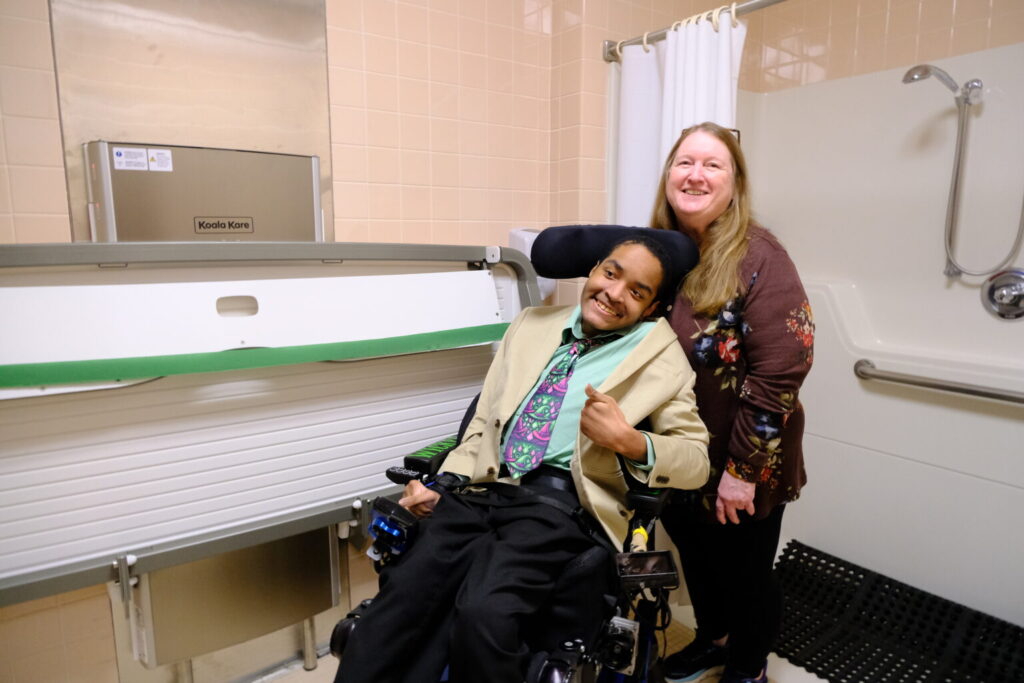
Judy and Eric Edwards pose for a photo at a ribbon cutting ceremony for a new universal changing station installed on the first floor of the Alaska State Capitol on Mar. 19, 2026. (Photo by Corinne Smith/Alaska Beacon)
Judy Edwards and her son Eric traveled from Palmer to advocate for people with disabilities at the Alaska State Capitol in Juneau this week, and now one part of that process is a bit easier.
A newly installed universal changing station on the first floor of the Capitol is a clean, safe space for people who need assistance when using the restroom. The changing station is adult-size and adjustable, for people who use adult diapers and need help changing them. This is an upgrade for Eric, who is 18-years-old and has quadriplegic cerebral palsy with dystonia and uses a power wheelchair.
Previously he and his mother would have had to use the floor.
“This will make life easier for everybody,” Judy said. “Parents, especially younger parents, they just deal with things, but they shouldn’t have to. You know, parents hurt themselves because they’re trying to lift from the floor.”
At a ribbon cutting ceremony on Thursday, lawmakers and advocates with the Key Coalition — a group of people with disabilities, their caregivers, service providers and supporters — gathered to applaud the new installation.
Judy and Eric Edwards gather with Reps. Sara Hannan, D-Juneau and Ashley Carrick, D-Fairbanks, and Capitol facilities manager Serge Lesh for a ribbon cutting ceremony for the installation of a new universal changing station at the Alaska State Capitol on Mar. 20, 2026. (Photo by Corinne Smith/Alaska Beacon)
“I am so sorry that you’ve had to advocate for this and that those of us who are able bodied don’t automatically think about it,” said Rep. Sara Hannan, D-Juneau, who oversees a committee that runs maintenance in the Capitol.
Hannan said the universal changing station cost the state less than $20,000 total, including the cost of the device, shipping and electrical costs for installation. She said the committee is in the process of reviewing and making accessibility upgrades around the Capitol, including plans to widen the door frame and install an automatic door opener for the first floor accessible restrooms.
The Edwards family travel often for medical care. They are among the advocates who have been raising concern and pushing for more changing stations around the state. A new bill now introduced in the legislature, House Bill 141, would require at least one universal changing station be included in construction or renovation of all state or local government owned public buildings.
Rep. Ashley Carrick, D-Fairbanks, sponsored the bill.
“We’re looking at different ways to approach the issue, whether just on a funding level or policy, but ultimately, the goal is to just have types of changing facilities across the state,” Carrick said in an interview. “As legislators, the more we can do to just help all Alaskans have their basic needs met — that’s really where the motivation for this bill came from, and the awareness around this being a major challenge is so important.”
Advocates and lawmakers are focusing first on Alaska airports. The Edwards family was involved in raising awareness around access, resulting in a new universal changing station being installed at the Ted Stevens Anchorage International Airport in 2024.
There is also a changing station at the Mat Su Health Foundation, and a temporary station was installed last summer at the fairgrounds of the Alaska State Fair. Edwards said she also wants to see one installed at Providence Alaska Medical Center hospital in Anchorage.
Advocates with the Key Coalition flew to Juneau for an advocacy day on Wednesday, when they held a march and rally in front of the Capitol and met with lawmakers urging policy changes to increase access and services.
Demonstrators with the Key Coalition march through downtown Juneau to rally at the Alaska State Capitol for disability rights and increased services on Mar. 18, 2026. (Photo by Corinne Smith/Alaska Beacon)Demonstrators with the Key Coalition rally at the Alaska State Capitol calling for disability rights and increased services on Mar. 18, 2026. (Photo by Corinne Smith/Alaska Beacon)
“Having a disability could happen to any one of us,” said Michele Girault, board president for the Key Coalition. “So we’re creating communities where accessibility is at the top of the leaderboard, access to housing and good workforce and all the things that you might need to be supported, are available when you need it.”
Advocates are pushing for the state to eliminate the waitlist for people with disabilities applying for Medicaid services. Girault said they also want to reduce wait times for reimbursements for service providers.
“So that people who provide the service to people with disabilities and elders across the state are reimbursed at a rate that keeps them in business,” Girault said. “Some people have left the state because they were tired of waiting for services, and some families are opting not to even put their names on the wait list.”
Girault said the Key Coalition is continuing to support increased funding and expanded access for infant learning programs and early intervention services for youth experiencing developmental delays, which support families and children from infancy to age three.
Last year, Gov. Mike Dunleavy vetoed a bill to provide $5.7 million to increase funding for the state’s 17 infant learning programs. But lawmakers are trying again this year, with Senate Bill 178, sponsored by the Senate Health and Social Services Committee, to expand eligibility for the programs and increase funding.
A bill to update the state’s guardianship statutes is also supported by the Key Coalition. Girault said Senate Bill 190 would strengthen protections for people involved in the state guardianship system, including for medical guardians, partial guardians and in conservatorship. They’re also pushing for improvements to access to public transportation.
Sara Kveum speaks to the crowd rallying at the Alaska State Capital for disability rights and increased services on Mar 18, 2026. She is beside Michele Girault, director of the Key Coalition of Alaska, which organized the rally as part of an annual legislative fly-in, and includes people with disabilities, their families, service providers, educators and advocates. (Photo by Corinne Smith/Alaska Beacon)
“Transportation is in the top five barriers for people with disabilities. When you think about all the snow we’ve had this winter, how do you get to the bus stop? Once you’re at the bus stop, is the bus stop cleared?” Girault said. The Key Coalition is supporting House Bill 26, which would require a new state transportation plan to include access for people with disabilities.
“This transportation bill requires the state to create a plan that actually thinks about all of the points of access for people across the state of Alaska, not just in major cities, but in rural areas as well,” Girault said.
More than 1 in 4 adults in the U.S. have some type of disability, including mobility, hearing, vision or cognition disabilities, and advocates say they want to see improvements across Alaska to expand access, care and dignity for all.
For the Edwards family, and many advocates and families with disabilities, flying to Juneau isn’t easy, but Judy Edwards said it’s worthwhile — and she wants to see more changes to increase access across Alaska.
“I’m 67, but when I was a kid, you didn’t see people with disabilities out in public, really, much,” Edwards said. “And so today, it’s like, why not? I mean, we’ve come such a far way. Why not? We need to keep going.”
NOTN-The results are in, residents in Juneau have been helping shape the capital city’s long-term future at “Juneau Futures” workshops and with a community survey.
“Juneau’s had Comprehensive Plans on the books for decades, since the 1900s, so it’s basically a big picture guide that helps us decide where and how to develop, usually, over the next 20 to 30 years.” Said Senior Planner Minta Montalbo, “I think it’s important to keep in mind that the Comprehensive Plan reflects community priorities, and it connects our values and goals with CBJ decision makers, with policies and actions. It’s like a reference point for decisions on how to best use our land and where to focus our resources.”
The effort is part of the “Our Juneau, Our Future” comprehensive plan update, which gathered input through 14 in-person workshops and an online survey aimed at guiding development in Juneau over the next 20 years.
The workshops asked residents 3 major questions, Where should Juneau grow? What does Juneau need to do to prepare for the future? And how should Juneau grow?
According to findings released by CBJ, participants outlined several approaches for where that growth should happen. Many supported investing in central areas like downtown Juneau and Lemon Creek.
Quotes in italics will be pulled directly from CBJ’s results.
Downtown Juneau and Lemon Creek were popular development areas with many participants expressing interest in building activity in and around central Juneau.
Others prioritized established neighborhoods such as the Mendenhall Valley, emphasizing investment near current residents.
Investments should focus on infill and areas with existing infrastructure.
Additional support emerged for developing multiple hubs, including Auke Bay, seen by some as an alternative community center, others pointed to North Douglas as a next step for expansion due to its available land.
North Douglas is the next logical step for development in the next 20 years, and then we can focus on West Douglas.
Across all responses, one issue stood out: housing.
Participants consistently identified it as the community’s top priority, even noting that “everything connects to housing.”
Housing was the most important issue for many participants. While approaches differed, it is clear that Juneau needs more housing solutions.
Respondents also stressed the importance of protecting neighborhoods from natural hazards like flooding and avalanches, and called for diversifying Juneau’s economy beyond tourism.
“Folks are focused mainly on flooding and protecting the homes in the valley, but we’re also hearing renewed discussion about landslide dangers and avalanches, so we’re going to want to be looking at that in the new comp plan.” Montalbo said, “Not surprisingly, housing for all definitely remains a huge priority, and when we’re talking about housing, housing options that suit a variety of needs. And then I think the third biggest category is economic diversification. Again, not a new topic, but we’re hearing a lot of concern about trying to strengthen year round industries, and find a balanced approach to tourism. We want to recognize the economic contribution, but people are also asking that we care for Juneau’s unique small town characteristics at the same time.”
Once participants had decided how Juneau should grow, they were asked to see how their scenario would hold up against future conditions, such as potential increase or decrease in tourism, funding, and natural hazards.
Participants said they expect tourism to increase, while state and federal funding may decline and natural hazards may become more severe.
In workshop scenarios, residents adjusted their priorities accordingly, shifting resources toward housing, hazard mitigation, and economic resilience when faced with those challenges, notably when faced with a decrease in federal funds, participants primarily divested from Remote Area Infrastructure and Waterfront Development, viewing them as non-essential “luxuries” without federal support.
According to the findings particpants felt, “no matter the strategy, growth should consider existing investment, current residents, housing needs, and hazard risk.”