Categories
Featured Juneau News Juneau Local Ketchikan Local News Feeds Sitka Local

Former state legislator wins lawsuit that sought to enforce a clause of the Alaska Constitution

By: James Brooks, Alaska Beacon

A copy of the Alaska Constitution is seen on Thursday, July 28, 2022. (Photo by James Brooks/Alaska Beacon)

Former state Rep. David Eastman has won his lawsuit against Gov. Mike Dunleavy and the state of Alaska, successfully challenging the governor’s decision to allow a bill to become law last year.

In the suit, Eastman — a Republican from Wasilla — challenged the constitutionality of Senate Bill 189, citing a clause of the Alaska Constitution that requires lawmakers to limit bills to a single subject.

In the final hours of the 2024 legislative session, lawmakers combined several other bills into SB 189. Dunleavy and the executive branch had no role in the crafting of the bill, but because the governor allowed the bill to become law without his signature, the suit named him as a defendant.

On Tuesday, Juneau Superior Court Judge Larry Woolford signed an order declaring that the bill “was passed by the 33rd Alaska Legislature in violation of Article II, Section 13 of the Alaska Constitution and is therefore void.”

Woolford’s order also awards Eastman $20,250 in costs and attorney fees. Eastman was represented in the suit by attorney Joe Geldhof.

The legal victory has limited immediate impact because lawmakers this year re-passed all the bills that were combined into Senate Bill 189. Woolford’s order “does not address and has no effect on subsequent legislation repealing and reenacting the provisions of SB 189.”

Its biggest impact may be to constrain current and future legislators, preventing them from repeating the kinds of legislative logrolling that have become commonplace in the final days of each two-year legislative cycle. 

Because bills die at the end of the legislative cycle and few bills pass both House and Senate, it has become common for lawmakers to make last-hours amendments that combine bills in an effort to speed them across the legislative finish line.

“We are pleased to have resolved the Eastman v. Dunleavy case, which challenged a bill on the grounds of violating the single subject rule,” Attorney General Treg Taylor said by email on Tuesday. 

“Following the filing of the lawsuit, the Department of Law sought to provide the Legislature with an opportunity to rectify this by breaking the bill into separate pieces of legislation. Fortunately, the Legislature successfully completed their work prior to the conclusion of the case, avoiding confusion on the laws enacted,” Taylor said.

No appeals are expected.

Categories
Featured Juneau News Juneau Local Ketchikan Local News Feeds Sitka Local

Juneau’s new Civic Center: A vision for community spaces

Juneau’s proposed new Civic Center, photo from capitalciviccenter.org

Juneau is actively planning and moving forward with the construction of a new Capital Civic Center, according to the project’s executive director Bob Banghart the Civic Center’s purpose is to provide Alaska’s Capital City with an essential and vibrant community cultural and conference center located within the Áak’w Village Arts and Culture District.

“‘I’ll take us back to the early 80s, when Centennial Hall was first being designed and built.” Said Banghart, “Centennial Hall was built as it is, with an idea that there would be an addition later that would support performing arts and the arts itself. So about 10 years ago, a group of people got together to say, we need to do this.”

According to Banghart, the process of designing the new Civic Center started with an independent standalone building in the vicinity of Centennial Hall, but the group kept running into opposition, “We started listening to the different, diverse voices in the community, and then pandemic hit us.” Said Banghart, “during that process, the city approached us and said, what if we were to join the two buildings together and see about looking for some synergy that could be generated there. So the city put up some money, and we did just that, we designed a facility that conjoined what we had programmatically in the standalone building with Centennial Hall.”

The project has overcome significant challenges in recent years, including high construction costs and community opposition.

“In August last year, we came up with an idea, and we shopped it around. Took a lot of evaluation of it. People were saying, we like this, we don’t like that.” Said Banghart, “predominantly, we were looking at just joining the two buildings together with a large common space that proved to be, again, non-viable because it completely eradicated all the local parking in the area, and the cost to operate was looking like it might be outside the boundaries that we were able to afford.”

The proposed facility, an addition to the existing Centennial Hall, will feature a 299-seat professional theater, expanded lobby space, a gallery, and a flexible “black box” performance area.

Banghart described the project as a strategic response to community needs. “We’ve designed a facility that not only meets current event management challenges but creates new opportunities for community gatherings,” Banghart explained.

The $60 million project has already secured significant community support, with over 140 local donors contributing more than $10,000.

In terms of timeline, Banghart says he’d love to see the Civic Center break ground in 2027, “That’s funding pending right? the city is not on the hook to do any of that, other than what they’ve already contributed, contrary to some people’s beliefs, we are on a full court press to raise the money. We’ve been having some very strong successes.” Banghart said “So we’d love to see it happen in 27, we’ll see the documents completed next year.”

Though Banghart says there’s uncertainty on the federal end of things, he’s optimistic about contributions from the Coast Guard, “they’ve been very positive. They see a lot of application for the building’s use. We’re right across the street from them.”

The City and Project, the founding nonprofit, are jointly managing the Civic Center project, sharing design phase costs.

Interested community members can follow the project’s progress at capitalciviccenter.org.

Categories
Featured Juneau News Juneau Local Ketchikan Local News Feeds Sitka Local

Wrangell had it’s first Totem raising event in 38 years

By: Jonathon Dawe, Wrangell Sentinel

Linda Churchill carefully works on July 10 to finish painting the Bear up the mountain Totem

For the first time in 38 years, the Wrangell Native community has raised new totem poles in town, with four days of events planned Thursday through Sunday, July 17-20.

Unveiling the five new poles marks a significant revival of a centuries-old Tlingit tradition. The event honors the carvers and apprentices who transformed logs into cultural masterpieces, continuing a legacy nearly lost to time.

By the early 1900s, most of the town’s 30 to 40 totem poles had decayed or fallen, and the art of pole carving faded. The last totem pole raised in Wrangell was the Sun House Totem in 1987, carved by Steve Brown and Wayne Price, according to organizers of this week’s events.

Last week’s celebration symbolized a broader cultural resurgence that began with the 2013 rededication of Chief Shakes House and the 2015 completion of the WCA’s Carving Shed on Front Street, the organizers explained.

The new poles were funded in part by the U.S. Army (Gunakaadeit Pole) and organized by the Wrangell Cooperative Association.

The poles and their stories

Each pole tells a story rooted in Tlingit and Haida traditions:

Bear Up The Mountain Pole: A Naanya.aayí X’atgu Hít narrative of survival during a great flood.

Gunakaadeit Pole: A Naanya.aayí X’atgu Naasí Hít tale of a man using a sea monster’s skin to feed his community.

Underwater Sea Bear Pole: A Sik’nax.ádi legend of a mythical good-luck creature.

Killer Whale Grave Marker: A Kayaashkeiditaan tribute to Shx’atoo, who died during the U.S. Army’s 1869 bombardment of the Native village at Wrangell.

Kadashan Pole: A replica of a 1940 pole, originally gifted by Haida relatives to honor intermarriage with Tlingit women in the 1830s.

Master carvers and apprentices

Leading the project are master carvers:

Joe Young (Haida, Yahgw’laanaas clan), who learned from his grandfather Claude Morrison and carved the Bear Up The Mountain and Gunakaadeit poles.

Tommy Joseph (Tlingit, Kaagwaantaan clan), a renowned woodcarver behind the Underwater Sea Bear Pole.

TJ Young (Haida, Yahgw’láanaas clan), lead carver for the Kadashan pole.

Apprentice carvers, including Mike Hoyt, Tony Harding, Linda Churchill and Susie Beebee, also contributed, ensuring the tradition’s future.

“What an incredible experience to witness the community, literally pulling together to stand Kadashan pole in Totem Park.” Tlingit &Haida said in a Facebook post.

“This is more than art – it’s healing,” said Joe Young. “We’re reclaiming our history.”

Categories
Featured Juneau News Juneau Local Ketchikan Local News Feeds Sitka Local

On budget vote, Murkowski says she was ‘hung out to dry’ and stuck between two bad options

By: James Brooks, Alaska Beacon

Sen. Lisa Murkowski, R-Alaska, smiles on Tuesday, March 18, 2025, as she exits the Alaska House of Representatives following her annual address to the Alaska Legislature. (Photo by James Brooks/Alaska Beacon)

Speaking in an interview on Friday, Alaska Sen. Lisa Murkowski said President Donald Trump’s health care-cutting budget plan was destined to pass Congress, and her decisive vote on the package last month represented the best of a bad pair of options.

In a new analysis published Monday by the nonpartisan Congressional Budget Office, Republicans’ “big, beautiful” law is estimated to add almost $3.4 trillion to the federal debt over the next decade and cause 10 million Americans to lose access to health insurance. 

Murkowski said she believes that had she opposed the law, Republican senators would instead have sought a 50th vote from Kentucky Republican Sen. Rand Paul, and the result would have been deeper cuts to the federal budget, including to health care.

“What he was looking for was dramatically more cuts to Medicaid, dramatically greater reductions in spending,” Murkowski said. “And so it was no secret that the bill was going to pass. It was just a question of whether or not it was going to pass with Senator Paul’s vote, or with Senator Murkowski’s vote.”

In a column published July 3 by the Louisville Courier-Journal, Paul wrote, “They could have had my vote and saved money but instead chose more spending and tax and welfare changes targeted at Alaska at the cost of the fiscal sanity of our country.”

Murkowski, echoing comments made previously by Alaska Sen. Dan Sullivan, who also voted for the proposal, said she was disappointed that several provisions benefiting Alaska were stricken by the Senate parliamentarian after objections from Senate Democrats.

Those included large subsidies for the state’s Medicaid program and a new split of oil revenue from federal land on the North Slope, with 90% going to the state and 10% to the federal government. 

Voting on the budget package began before the parliamentarian ruled on all aspects of it.

“And so we didn’t know what was in and we didn’t know what was not in,” Murkowski said.

During the process, the 90-10 split dropped to 70-30, and state-specific benefits for Alaska disappeared.

Afterward, one provision that survived — a concession for wind and solar projects — was quashed by executive orders issued by President Trump. 

Speaking to the Anchorage Daily News on Friday, Murkowski said she feels “cheated” by the maneuver.

Speaking to the Alaska Beacon, she said, “I have been criticized. I have been hung out to dry. But you know what? At the end of the day, I fought for my constituents as best I knew how, and I should never, and I will never, apologize for doing the best that I can by them.”

In her last three Alaska U.S. Senate elections, Murkowski defeated more socially conservative candidates with the support of Democrats and independents.

On social media, after her vote in favor of the Republican budget plan, many of those voters voiced their disapproval.

Asked about that disappointment, Murkowski said she understands and hears that criticism.

“I get the fact that they want me to be principled on this. But if it costs Alaskans — which it would have — then how is that doing my job for them? … At the end of the day, I couldn’t kill it, and I understand that people might not believe that, but again, what I set out to do was try to make improvements to a measure that started out in a place that would have … made it very challenging for too many Alaskans.”

Murkowski said she expects the Trump administration to propose more retroactive budget cuts akin to the one that passed last week involving foreign aid and the Corporation for Public Broadcasting.

Sullivan voted in favor of the cut; Murkowski opposed it.

Afterward, Trump budget director Russ Vought said he wants congressional Republicans to get more partisan in the budget process and that lawmakers should expect more “rescission” votes like last week’s.

Murkowski said she hopes other Republicans will join her in rejecting that call.

“I would like to think that it’s comments like that, that would galvanize us as appropriators, galvanize us as Republicans and Democrats in the United States Senate,” she said. “Our oath is to the Constitution. We would say we’ve got our job to do here, and we know that in order to do it and have it be enduring, it takes 60 votes, and so we need to be more bipartisan and not more partisan. To me, it was absolutely offensive, his statement, and so arrogant.”

Categories
Featured Juneau News Juneau Local Ketchikan Local News Feeds Sitka Local

Juneau Mayor comments on ICE agent rumors in the Capital city

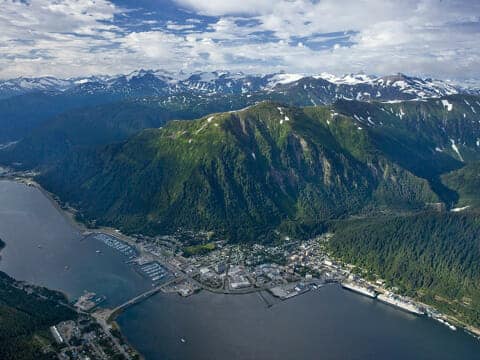
Juneau from above, CBJ file

NOTN- After social media posts have circulated claiming 7 ICE agents checked into hotels in downtown Juneau, Mayor Beth Weldon joined KINY to discuss some of those rumors.

“So far, we haven’t been able to substantiate any of those rumors,” She said, “so, no presence or activity that we are aware of, however, maybe this is where the rumors are coming from, TSA is in town, and they will have a visual intermodal Presence Prevention and Response Team present.”

TSA will be conducting high visibility patrols on cruise ship docks, and they’ll be doing that all this week.

“So if you see lots of uniforms down there, that’s what’s happening.” Said Mayor Weldon “it’s no concern. It’s an annual activity. CBJ is not involved, and we’ve been doing this since 2021.”

While ICE agents may not be in the Capital, recently, the Alaska Department of Corrections has been holding dozens of immigration detainees in Anchorage under conditions that violate federal standards for humane treatment, according to Alaska Public Media, three immigration lawyers said the men were denied phone access to their attorneys and consulates, held in lockdown for long periods and, in one incident, subjected to pepper spray.

Immigration and Customs Enforcement is playing a key role in the Trump administration’s plans to crack down on illegal immigration.

ICE teams are continuing to carry out enforcement operations. And officials have said targeting criminals is a priority, but a key issue to watch is how the term “criminal” is defined. White House spokeswoman Karoline Leavitt said that the administration sees all undocumented immigrants as criminals.

Categories
Featured Juneau News Juneau Local Ketchikan Local News Feeds Sitka Local

Alaska Airlines resumes operations after equipment failure at a data center grounds all flights

FILE – Alaska Airlines aircraft sits in the airline’s hangar at Seattle-Tacoma International Airport, Jan. 10, 2024, in SeaTac, Wash. (AP Photo/Lindsey Wasson, File)

AP- Alaska Airlines has resumed operations after the failure of a critical piece of hardware forced the airline to ground all its flights for approximately three hours, but the effects will linger into Monday, the company announced.

The carrier issued a system-wide ground stop for Alaska Airlines and Horizon Air flights around 8 p.m. Pacific time Sunday. The stop was lifted at 11 p.m., the Seattle-based company said in a social media post. More than 150 flights have been canceled since Sunday evening, including 64 Monday.

The airline said “a critical piece of multi-redundant hardware at our data centers, manufactured by a third-party, experienced an unexpected failure.” That affected several of the airlines key systems, but hacking was not involved, and the airline said the incident was not related to any other events like the attack involving Microsoft’s servers over the weekend or the recent cybersecurity event at its Hawaiian Airlines subsidiary in June.

“We appreciate the patience of our guests whose travel plans have been disrupted. We’re working to get them to their destinations as quickly as we can,” the airline said in a statement.

The airline also said it is working with its vendor to replace the hardware at the data center.

Alaska Airlines led all airlines in cancellations Monday, according to the FlightAware website. Many of the cancellations were at the airline’s major hub of Seattle, but it also canceled flights at airports all over the country.

The Federal Aviation Administration website had confirmed a ground stop for all Alaska Airlines mainline and Horizon aircraft, referring to an Alaska Airlines subsidiary. But the FAA referred all questions to the airline Monday.

The National Transportation Board last month credited the crew of Alaska Airlines flight 1282 with the survival of passengers when a door plug panel flew off the plane shortly after takeoff on Jan. 5, 2024, leaving a hole that sucked objects out of the cabin.

In September, Alaska Airlines said it grounded its flights in Seattle briefly due to “significant disruptions” from an unspecified technology problem that was resolved within hours.

Categories
Featured Juneau News Juneau Local Ketchikan Local News Feeds Sitka Local

A rare whale was spotted for the first time in Southeast Alaska

First sighting of subadult bowhead whale on March 27, 2024 at 11:45 am in Sitka Sound, Alaska, USA (57.06N, 135.53W). Credit: Ellen Chenoweth from the vessel Pioneer. NOAA Fisheries MMPA/ESA Permit No. 24378.

NOTN- Scientists in Sitka Sound observed a Bowhead whale, a first for Southeast Alaska, and only the second documented sighting in the eastern North Pacific.

Bowhead whales are one of the few whale species that reside almost exclusively in Arctic and subarctic waters experiencing seasonal sea ice coverage,.

Of all large whales, the bowhead is the most adapted to life in icy water. Adaptations to this environment include an insulating layer of blubber that can be up to 1.6 feet thick.

according to a scientific paper released by NOAA, the crew was using a 25-foot motorboat in Sitka Sound to photograph and identify humpback whales that had been observed bubble-net feeding in the area. Humpback whales are often present in large numbers in Sitka Sound in March, feeding on pre-spawn herring. 

They also spotted gray whales, likely feeding on herring eggs near shore. After identifying several humpback whales in smaller groups, the crew was heading back to Sitka when they spotted another whale. 

The vessel slowed to photograph this whale, but it didn’t appear to be a humpback. The whale was small, visible only by its head and jaw, which had a distinct arch. The crew took two photos before the whale submerged. 

according to NOAA, the whale, identified by experts through photographs, exhibited unusual behavior. It was only observed with its head and jaw visible as it surfaced to breathe. Over the next month, additional sightings of the whale were reported. No feeding or social behaviors were noted, and on only one occasion was the back—which lacked a dorsal fin—visible.

“This sighting is important because it is a first for a pretty big region,” said Ellen Chenoweth, lead author on the study from the University of Alaska Fairbanks. “This is the first documented sighting of a bowhead whale in Southeast Alaska. It’s not the furthest south they have been seen, but it’s very notable because of how far it is from its typical range. It raises a lot of questions about what was going on with this animal that we can’t answer.” 

NOAA researchers say this rare visit may be linked to ecosystem shifts like sea ice loss, which could push more Arctic species farther south.

“We know of only two previous observations of bowhead whales in the North Pacific,” said Kim Shelden. “In 1969, a subadult male bowhead whale was captured and died in Osaka Bay, Japan. In 2016, a young bowhead whale was photographed skim feeding near British Columbia, Canada. This specific bowhead whale sighting in March 2024 may be an indicator of rapid changes occurring in the Arctic,” said Shelden.

Categories
Featured Juneau News Juneau Local Ketchikan Local News Feeds Sitka Local

Dunleavy violated Alaska Constitution with appointment to judge-picking board, lawsuit alleges

By: James Brooks, Alaska Beacon

Nesbett Courthouse in downtown Anchorage on Oct. 7, 2024. (Photo by Yereth Rosen/Alaska Beacon)

A group that advocates in favor of Alaska’s nonpartisan judicial system has filed a lawsuit against Gov. Mike Dunleavy, alleging that he illegally appointed a member to the board that nominates candidates for the state’s judicial vacancies.

The suit, filed Wednesday in Anchorage Superior Court by Alaskans for Fair Courts, claims Dunleavy violated the constitution and state law when he picked John W. Wood — also named as a defendant — for a public seat on the Alaska Judicial Council.

Under the state constitution, the council consists of three non-attorneys picked by the governor and three attorneys selected by the Alaska Bar Association. In addition, whoever holds the office of chief justice of the Alaska Supreme Court sits as the council’s chair.

The council accepts applications for judicial vacancies, vets those applicants for merit using nonpartisan metrics, then submits a list of nominees to the governor for final selection.

Wood was picked for a non-attorney seat on the board but is a former attorney, making him ineligible to serve, the suit alleges. In addition, the suit says Wood is ineligible because he held a “position of profit” with the state when appointed in May.

State records show Wood has served as a state contractor, receiving more than $132,000 this year. The most recent payment is listed as June 6.

Alaskans for Fair Courts also claims that Wood is ineligible because he has not been confirmed by the Legislature. 

Wood was appointed during this year’s legislative session, but after lawmakers had voted on confirmations for the year, the suit claims, meaning that Wood’s appointment should not be considered a recess appointment subject to confirmation next year.

“If the governor were to appoint a (judge) nominee selected by a judicial council that is not properly constituted … the resulting legal deficiency … could subject actions taken by the new judge to challenge by litigants,” the suit claims.

It asks that the Anchorage Superior Court issue an order declaring that Wood is ineligible, and that his appointment is void.

In a written statement, Attorney General Treg Taylor said the state hasn’t yet been served with the lawsuit and can’t comment on the merits.

About the timing issue, Taylor said, “The Governor has the ability to appoint three members to the Judicial Council, and the Alaska Bar Association appoints the other three members to provide a 50/50 balance on the Council. The Council then nominates judges for the Governor’s selection with any ties on the Council being broken by the Chief Justice. It is important that the Council have this balanced perspective as it moves forward with its work. Having to wait almost a full year before seating a Governor’s appointee, as the Alaskans for Fair Courts argues, upsets that balance and doesn’t seem so fair.”

Dunleavy has seemingly violated the state constitution’s judicial nomination process before. 

In 2019, he failed to appoint a judge under the timeline required by the constitution, which was part of the basis of a failed attempt to recall him from office. In 2021, he called for the council to add a nominee in addition to the three it had forwarded to him for a seat on the Supreme Court. The constitution does not allow governors to appoint someone from outside of the council’s list of nominees. He ultimately did by the constitutional deadline in that instance.

Categories
Featured Juneau News Juneau Local Ketchikan Local News Feeds Sitka Local

New Alaska law establishes quick deadlines for insurers’ decisions on medical care

By: Yereth Rosen, Alaska Beacon

Health care costs. Stethoscope and calculator symbol for health care costs or medical insurance (Photo by Valeriya, provided by Alaska Beacon and Getty Images)

Health insurers must provide speedier responses to prior authorization requests for certain medical treatments and services, under a bill that went into law on Monday without Gov. Mike Dunleavy’s signature.

The measure, Senate Bill 133, requires insurers to notify patients within 72 hours whether the requested services are authorized in cases when requests are sent by fax or by other routine means. In cases of expedited requests, the insurer must provide answers within 24 hours, under the bill.

The bill, which passed unanimously in both the Senate and House, is intended to prevent delays in patient treatment, said the main sponsor, Sen. Jesse Bjorkman, R-Nikiski.

“Alaskans should not have to fight with their insurance company to get the care they need,” Bjorkman said in a statement. “This bill makes the process quicker, clearer, and fairer for everyone.”

The bill was officially sponsored by the Senate Labor and Commerce Committee, which Bjorkman chairs.

It was supported by medical organizations, including the Alaska Hospital and Healthcare Association, the Alaska State Medical Association and the Alaska Native Health Board.

It also got some qualified support from Premera Blue Cross Blue Shield of Alaska, the state’s largest health insurer.

In a March 25 letter to Bjorkman and members of the Senate Labor and Commerce Committee, Premera said that the version that emerged through the committee process had “some reasonable sideboards as well as incentives that will help plans modernize and improve their prior authorization systems so that these systems optimally serve providers, patients and plans alike.”

Premera said in its letter that it requires prior authorizations for care in only about 2% of cases, unlike insurers that “have been exceedingly aggressive in this space,” requiring prior authorization for up to 20% of all claims.

The bill has some exceptions, caveats and special provisions. For example, it does not prevent insurers from requiring generic versions of medicines prescribed by providers. It also has a section giving guidelines for insurers to grant exceptions for cancer patients who are covered by “step therapy” protocols. Those protocols provide patients with the least expensive medications first before advancing to more expensive medications.

Additionally, the bill gives insurers up to 14 working days to obtain more information from providers if they determine that there is a lack of sufficient information for decisions on prior authorization requests.

The new law goes into effect on Jan. 1, except for a portion that directs the state Division of Insurance to start drafting regulations. That portion went into effect immediately.

Categories
Featured Juneau News Juneau Local Ketchikan Local News Feeds Sitka Local

Gov. Dunleavy vetoes bipartisan bill supporting Alaska fishing businesses

Commercial fishing boats are lined up at the dock at Seward’s harbor on June 22, 2024. (Photo by Yereth Rosen/Alaska Beacon)

NOTN- Governor Mike Dunleavy has vetoed a bipartisan bill that aimed to expand loan access for small commercial fishing businesses in Alaska, legislation that passed the Legislature by a vote of 59–1.

Senate Bill 156, sponsored by Senator Jesse Kiehl , would have enabled the Alaska Commercial Fishing and Agriculture Bank (CFAB) to offer low-interest loans for permit holders in the state’s fishing industry. It also authorized the Department of Commerce, Community, and Economic Development to invest in CFAB through the purchase of nonvoting, preferred shares, using funds left over from a now-defunct aviation loan program.

“That’s a weird move. First because it built on work I helped him do last year,” Sen. Kiehl said in a Facebook post Thursday. “I was glad to help Alaskans, and even took pains to share credit with the governor.”

The veto halts what advocates called a targeted solution to help permit-holding fishers refinance debt under more stable terms, a tool supporters say could have strengthened Alaska’s seafood economy and reduced the risk of permit loss in the face of rising interest rates.

“With our fisheries being dominated by outside special interests, this bill was designed to help struggling AK fishermen by providing competitive loans to help them buy permits, vessels and gear.” Senator Bill Wielechowski said in a post on X.

Kiehl expressed disappointment at the veto, noting the bill’s near-unanimous support across party lines. “Strange way to run a state,” he said.

The bill posed little to no costs to the state, according to legislative analysis.

The governor’s office has not yet released a public explanation for the veto.