







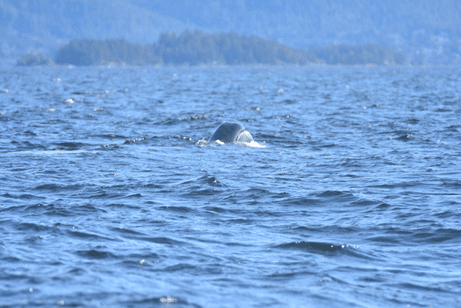
NOTN- Scientists in Sitka Sound observed a Bowhead whale, a first for Southeast Alaska, and only the second documented sighting in the eastern North Pacific.
Bowhead whales are one of the few whale species that reside almost exclusively in Arctic and subarctic waters experiencing seasonal sea ice coverage,.
Of all large whales, the bowhead is the most adapted to life in icy water. Adaptations to this environment include an insulating layer of blubber that can be up to 1.6 feet thick.
according to a scientific paper released by NOAA, the crew was using a 25-foot motorboat in Sitka Sound to photograph and identify humpback whales that had been observed bubble-net feeding in the area. Humpback whales are often present in large numbers in Sitka Sound in March, feeding on pre-spawn herring.
They also spotted gray whales, likely feeding on herring eggs near shore. After identifying several humpback whales in smaller groups, the crew was heading back to Sitka when they spotted another whale.
The vessel slowed to photograph this whale, but it didn’t appear to be a humpback. The whale was small, visible only by its head and jaw, which had a distinct arch. The crew took two photos before the whale submerged.
according to NOAA, the whale, identified by experts through photographs, exhibited unusual behavior. It was only observed with its head and jaw visible as it surfaced to breathe. Over the next month, additional sightings of the whale were reported. No feeding or social behaviors were noted, and on only one occasion was the back—which lacked a dorsal fin—visible.
“This sighting is important because it is a first for a pretty big region,” said Ellen Chenoweth, lead author on the study from the University of Alaska Fairbanks. “This is the first documented sighting of a bowhead whale in Southeast Alaska. It’s not the furthest south they have been seen, but it’s very notable because of how far it is from its typical range. It raises a lot of questions about what was going on with this animal that we can’t answer.”
NOAA researchers say this rare visit may be linked to ecosystem shifts like sea ice loss, which could push more Arctic species farther south.
“We know of only two previous observations of bowhead whales in the North Pacific,” said Kim Shelden. “In 1969, a subadult male bowhead whale was captured and died in Osaka Bay, Japan. In 2016, a young bowhead whale was photographed skim feeding near British Columbia, Canada. This specific bowhead whale sighting in March 2024 may be an indicator of rapid changes occurring in the Arctic,” said Shelden.