The Mendenhall Glacier. (Photo by Becky Bohrer.AP)
By Mark Thiessen, Associated Press
ANCHORAGE, Alaska (AP) — Residents and officials in Alaska’s capital city prepared Friday for the possibility of glacial flooding that in past years has swept away houses, swamped several hundred homes and eroded the river fed by the popular Mendenhall Glacier.
The state, federal, city and tribal officials who would run an incident command center during any flooding held a briefing to outline steps and to issue pleas to the public to be prepared.
The threat of so-called glacier outburst flooding has become an annual concern in parts of Juneau since 2011. The Mendenhall Glacier — a thinning, retreating glacier that is a major tourist attraction in southeast Alaska — acts as a dam for a basin that fills each spring and summer with rainwater and snowmelt.
The basin itself was left behind when a smaller, nearby glacier retreated.
When the water in the basin creates enough pressure, it forces its way under or around the ice dam created by the Mendenhall Glacier, entering Mendenhall Lake and eventually the Mendenhall River.
The water level in the basin as of Friday stood at 1,353 feet and continues to rise, said Nicole Ferrin with the National Weather Service. It’s just 15 feet from topping the ice dam.
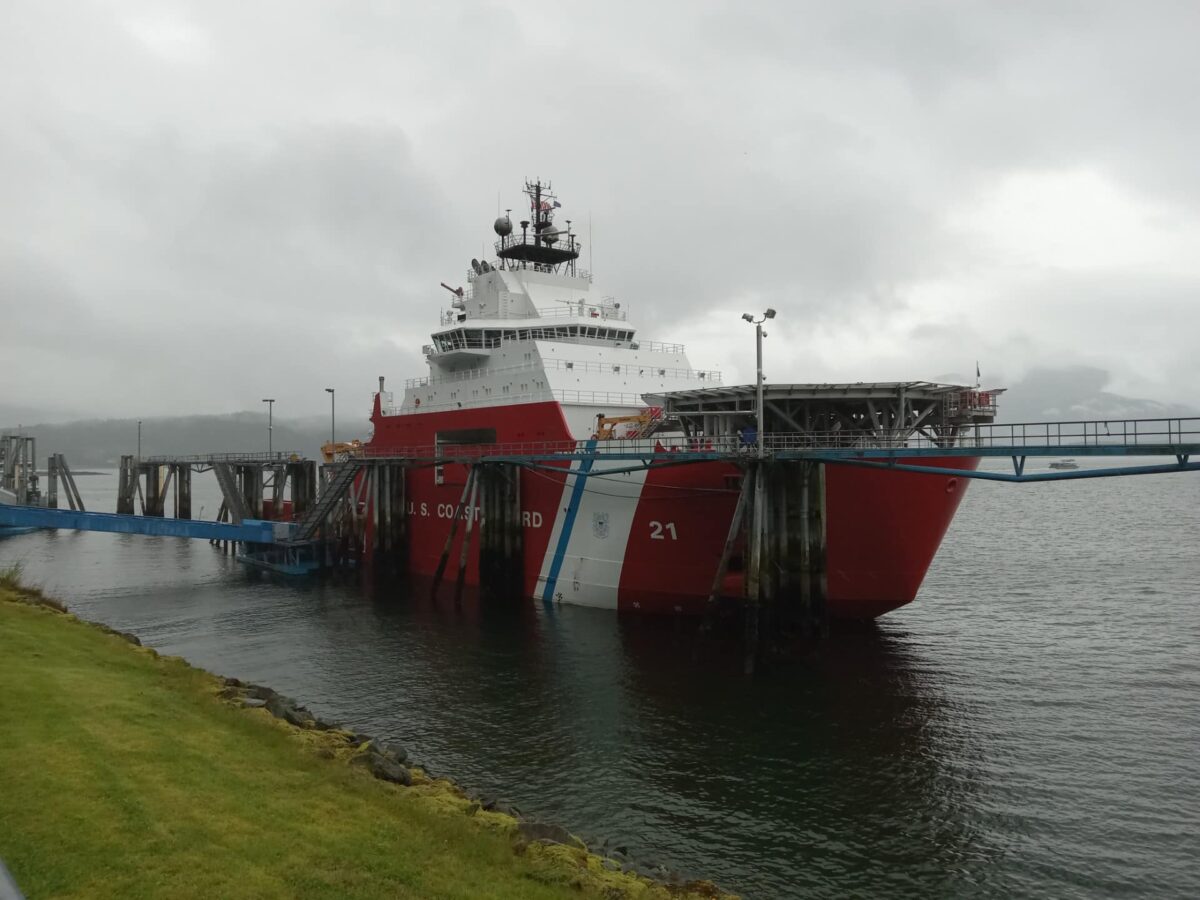
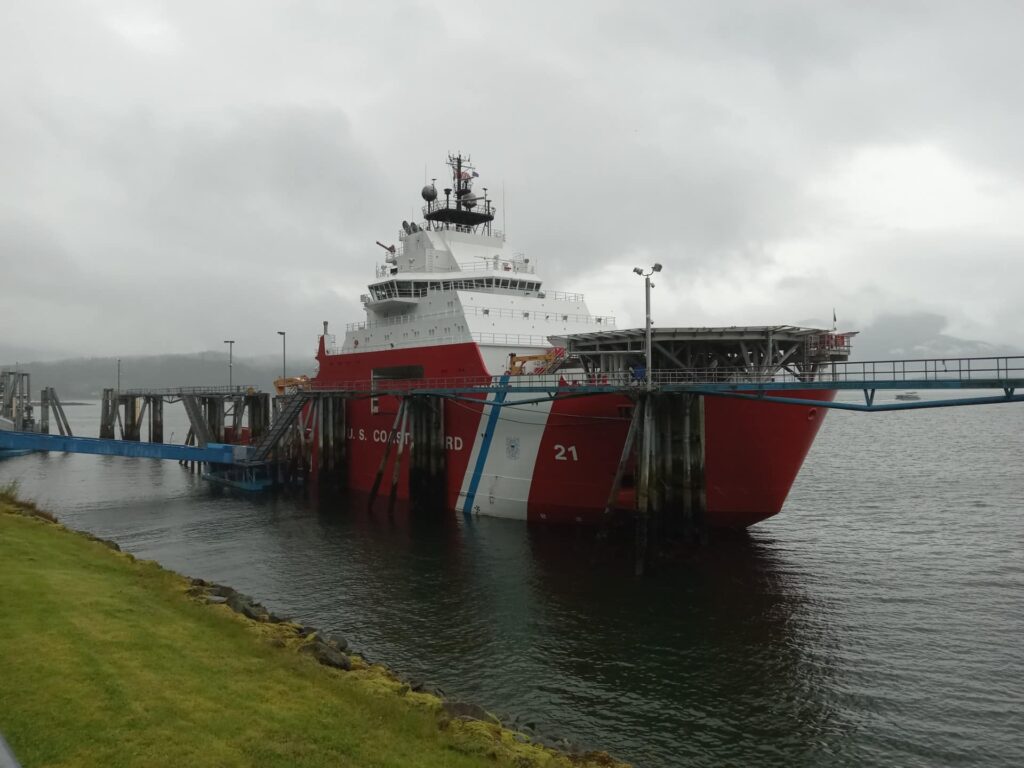
The U.S. Coast Guard cutter Storis, the Coast Guard’s first polar icebreaker acquired in more than 25 years, departed Auke Bay on Saturday for its scheduled transit to downtown Juneau, where it will be permanently berthed.
The vessel expands America’s operational presence in the Arctic and will support Coast Guard missions while the service awaits the delivery of the Polar Security Cutter class of ships. It’s the second vessel in Coast Guard history to bear the name Storis. The vessel is manned with a hybrid crew consisting of military and civilian mariners.
Commander Philip Baxa, aboard the Storis on Saturday, explained to News of the North and Seward Public Media that the vessel was ready from day one to be put into operation for the Coast Guard.
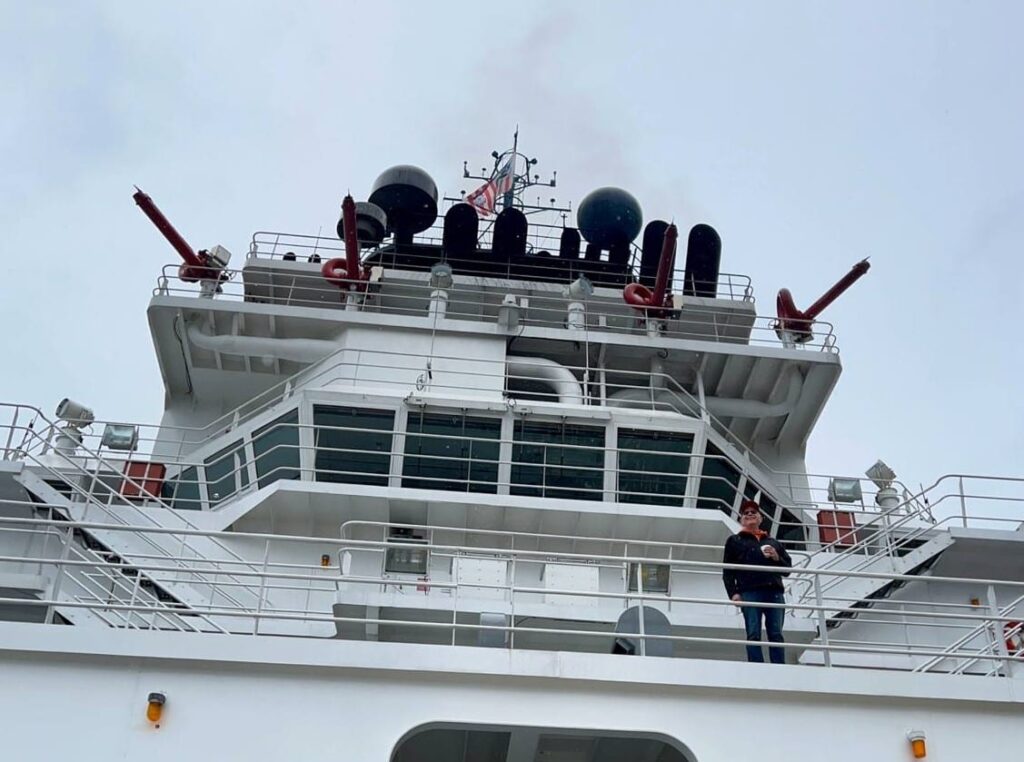
The bridge of the Storis as seen on Saturday, Aug. 9, 2025.
“When we bought her, as is, she was a Coast Guard-worthy ship,” Baxa said. “And I say that because we really did a really good job of our market research. Sailing on board today are some of the folks who actually did some of the major demonstrations of the vessel, put her through her paces as we were doing the negotiation for the purchase. And right from the get go, we were like, hey, this vessel has got some really good capabilities. Likewise, she was a tested vessel. She had gone to Antarctica twice, and broke over six feet of ice at three knots continuously.”
CBJ Port Director Carl Uchytil stands aft of the bridge aboard the Storis.
The acquisition of the Storis was made possible through the Don Young Coast Guard Authorization Act of 2022 and fiscal year 2024 Congressional appropriations.
The Storis is commanded by Captain Corey M. Kerns.
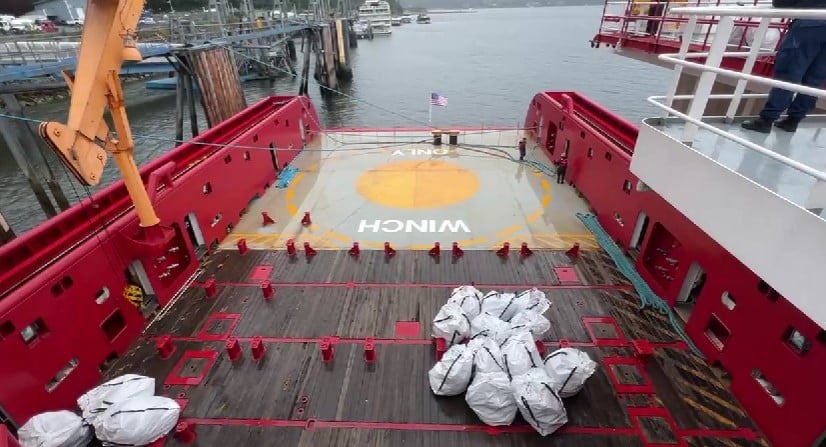
The aft deck aboard the Storis.
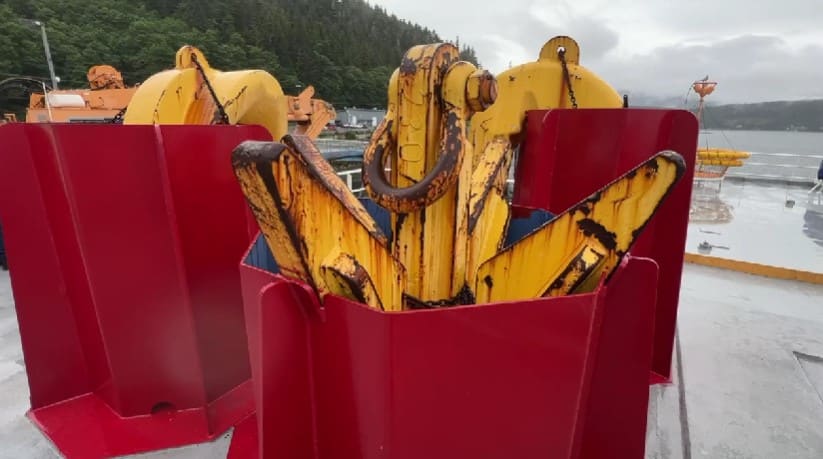
Anchors specially designed for use in ice conditions aboard the Storis.
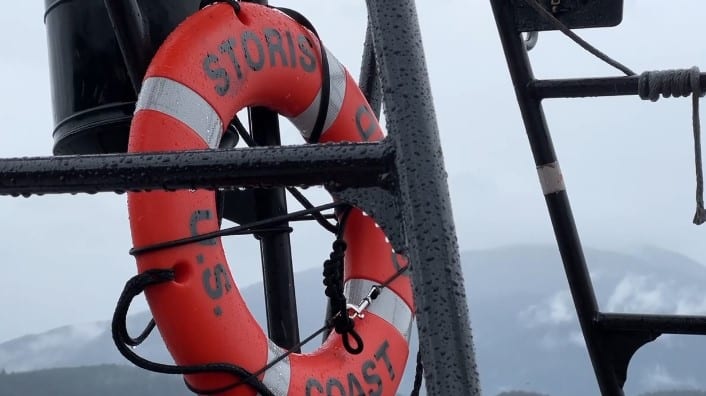
An emergency life ring aboard the Storis.
The vessel will be commissioned Sunday at the dock nearest Peratrovich Plaza in downtown. The ceremony is scheduled to begin at 9:30 a.m.
President Donald Trump delivers remarks during a joint press conference with French President Emmanuel Macron in the East Room at the White House on Feb. 24, 2025, in Washington, D.C. (Photo by Chip Somodevilla/Getty Images)
President Donald Trump delivers remarks during a joint press conference with French President Emmanuel Macron in the East Room at the White House on Feb. 24, 2025, in Washington, D.C. (Photo by Chip Somodevilla/Getty Images)
By James Brooks, Alaska Beacon
President Donald Trump will meet with Russian President Vladimir Putin on Aug. 15 in Alaska, Trump said in a social media post Friday.
The location, timing and other details were not immediately available. Staff for all three members of Alaska’s congressional delegation said they were unaware of the announcement ahead of time.
“The highly anticipated meeting between myself, as President of the United States of America, and President Vladimir Putin, of Russia, will take place next Friday, August 15, 2025, in the Great State of Alaska,” Trump wrote on Truth Social.
Trump has repeatedly said on social media that he is interested in negotiating with Putin in order to bring an end to the Russian invasion of Ukraine.
A drone image shows widespread flooding in the Mendenhall Valley. (Image courtesy of Rich Ross)
A drone image shows widespread flooding in the Mendenhall Valley. (Image courtesy of Rich Ross)
JUNEAU – The City and Borough of Juneau and the Central Council of the Tlingit & Haida Tribes of Alaska have issued coordinated emergency disaster declarations ahead of a potentially historic glacial lake outburst flood from Suicide Basin near the Mendenhall Glacier.
Hydrologic data shows the water level could exceed past records, prompting proactive action to protect lives, property, and infrastructure. Officials say while flood barriers are in place, no risks will be taken.
Tlingit & Haida Vice President Jackie Pata says this step ensures “every tool is in place before the water rises,” following last year’s devastating flood.
The declarations allow emergency teams to mobilize now, activate equipment, establish permitting, and to provide public alerts. City Manager Katie Koester says this year, “We’re not just responding, we’re ready.”
Residents are urged to stay informed and prepared for possible evacuation. Visit JuneauFlood.com or the CBJ website for updates and resources.
JUNEAU – Governor Mike Dunleavy has appointed Janelle Earls as acting commissioner of the Alaska Department of Revenue, effective immediately.
Earls steps in following the resignation of Commissioner Adam Crum, announced two weeks ago.
She currently serves as the department’s administrative services director, overseeing the agency’s budget, and brings over 20 years of state government experience.
Earls spent 13 years in leadership roles at the Department of Health and Social Services and joined Revenue in May 2024.
Earls will lead the department during the transition period until a permanent commissioner is named.
NOTN- The U.S. Coast Guard cutter Storis, the Coast Guard’s first polar icebreaker acquired in more than 25 years, will depart Auke Bay on Saturday for its scheduled transit to downtown Juneau, where it will be permanently berthed.
The Storis hosted free public tours Thursday and Friday and will host a media ride-along Saturday.
The Coast Guard will commission this first new icebreaker in 25 years during a ceremony in Juneau on Sunday.
The Coast Guard Cutter Storis will be officially commissioned at 9:30 a.m. at Peratrovich Plaza, 292 Marine Way, the service said. The event will also be streamed online.
Adm. Kevin Lunday, acting commandant of the Coast Guard, is scheduled to attend and take part in a media availability.
The vessel expands America’s operational presence in the Arctic and will support Coast Guard missions while the service awaits the delivery of the Polar Security Cutter class of ships.
It’s the second vessel in Coast Guard history to bear the name Storis. The vessel is manned with a hybrid crew consisting of military and civilian mariners.
The acquisition of the Storis was made possible through the Don Young Coast Guard Authorization Act of 2022 and fiscal year 2024 Congressional appropriations.
The Coast Guard operates more than 250 cutters, 200 aircraft and 1,600 boats to safeguard U.S. ports, waterways and maritime borders.
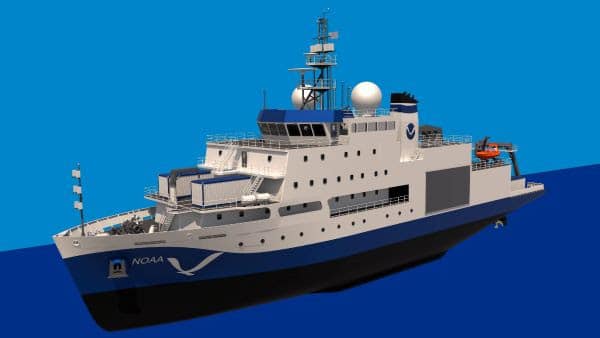
This undated image, provided by the National Oceanic and Atmospheric Administration, shows a mockup of the Surveyor, an ocean-floor-mapping ship under construction and scheduled to be homeported in Ketchikan. (NOAA image)
Next week, the National Oceanic and Atmospheric Administration is planning to host a ceremony in Louisiana to mark the start of construction on the NOAA ship the Surveyor, a new charting and mapping ship scheduled to be homeported in Ketchikan.
NOAA announced the keel-laying ceremony, scheduled for Aug. 14, by email.
The Surveyor is expected to be finished in 2027, and its sister ship, the Navigator, is expected to be finished in 2028.
NOAA operates a fleet of 15 charting, mapping and fisheries ships using an unarmed officer corps like a scientific version of the U.S. military. The Surveyor and Navigator will be used primarily for ocean mapping and nautical charting.
Two other deep-sea ships, the Oceanographer and Discoverer, are also under construction and are expected to be complete in 2026.
All four ships are part of an ongoing effort to keep the NOAA fleet afloat; as of 2023, the fleet’s average age was 30 years old, and six of the fleet’s current ships are expected to reach the end of their service life by 2030.
The ships will be built by Thoma-Sea Marine Constructors in Houma, Louisiana, under a $624.6 million contract that would allow NOAA to construct two more ships if funding is available.
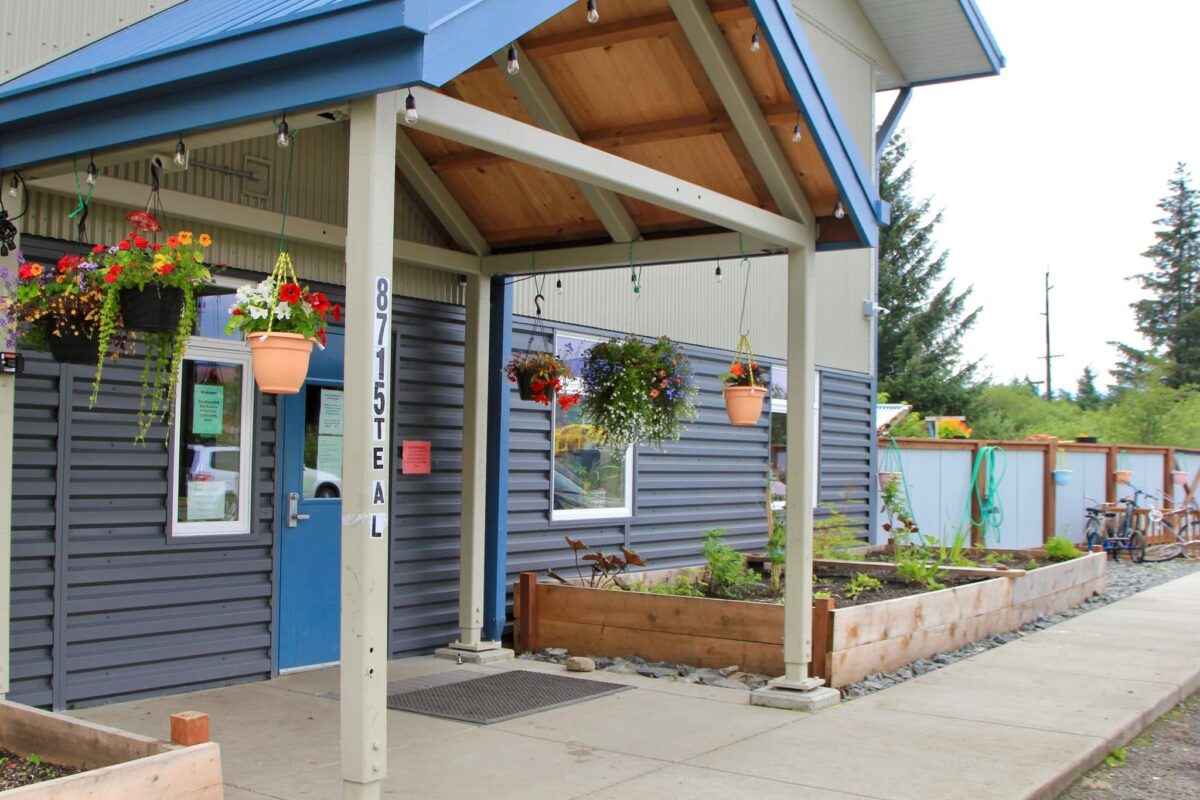
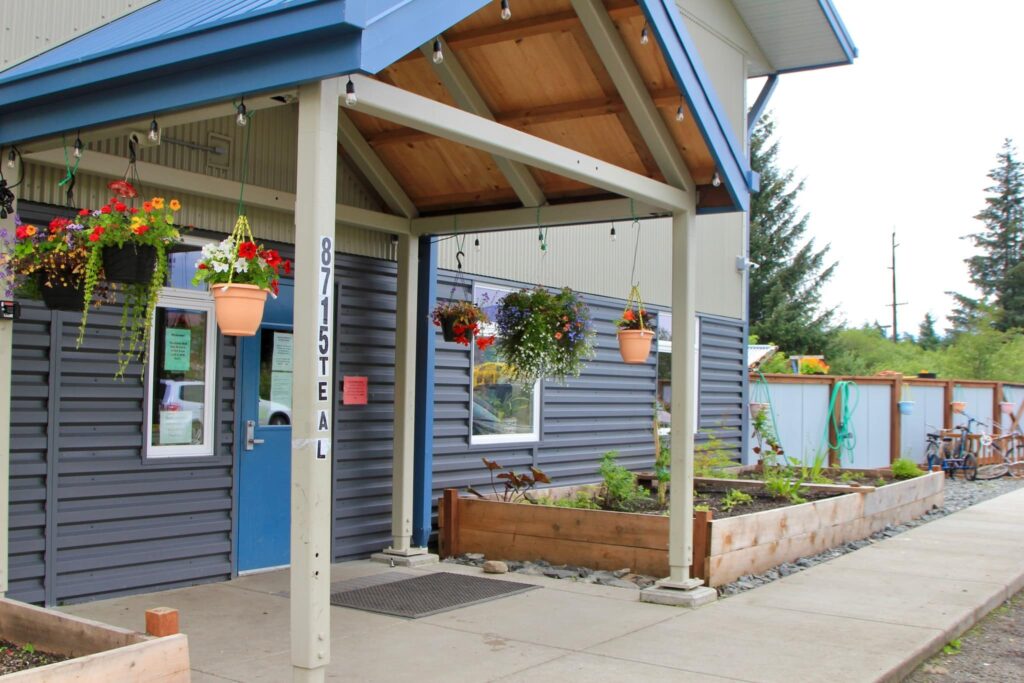
The entrance to the Glory Hall shelter on Teal Street. (Photo courtesy The Glory Hall/Feed Juneau)
The Glory Hall shelter says it will stop offering dayroom services to non-residents starting August 26, citing worsening safety conditions around the facility.
In a letter to patrons, the shelter’s leadership said staff and clients have faced continuing assaults, criminal activity, and “general chaos” near the Teal Street site, including sales of illegal drugs and stolen goods. Despite more than a year of meetings with residents and city officials, the board says the environment is no longer tenable.
Going forward, only individuals staying overnight at the shelter will have access to the dayroom. Others will be allowed inside only when meeting with a case manager, clinician, or outreach worker.
The board says the decision wasn’t made lightly but is necessary to protect patrons, staff, and neighbors.
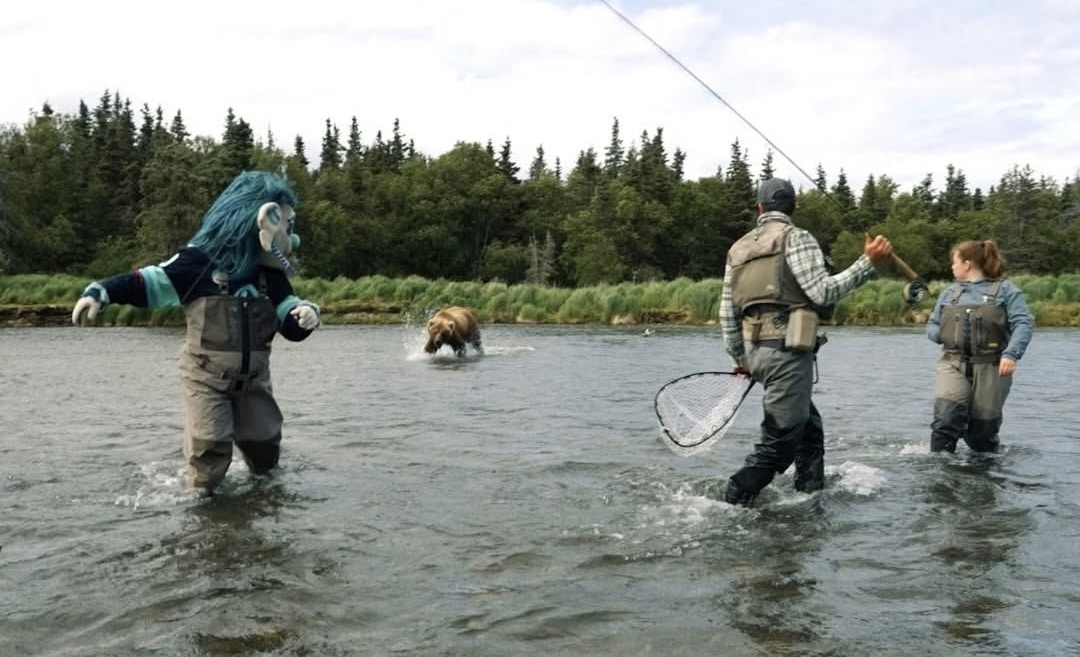
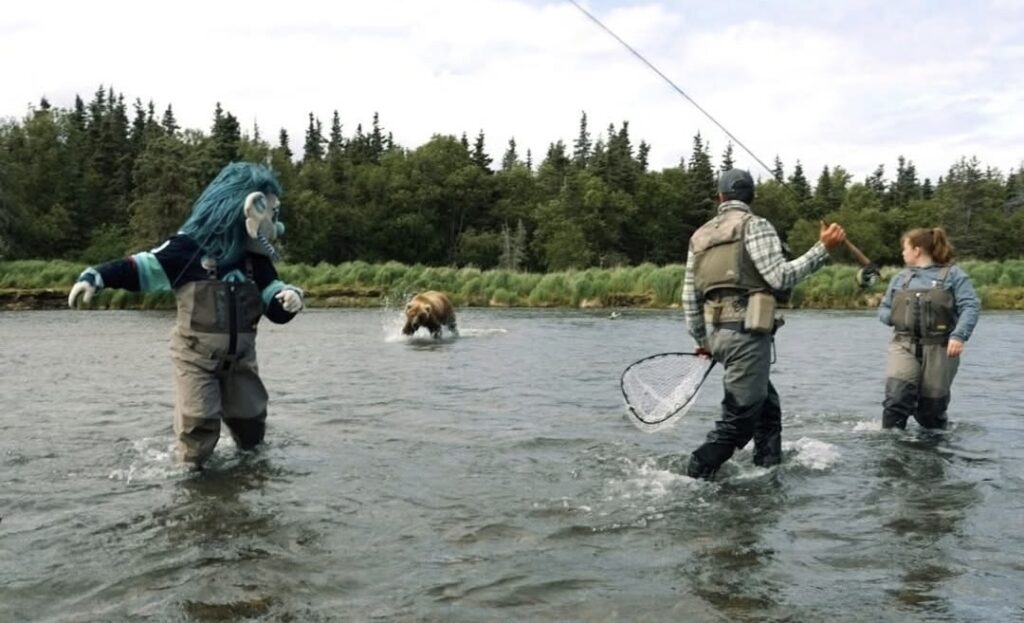
AP- Seattle Kraken forward John Hayden and the team’s blue-haired troll mascot had a close call with a brown bear during a promotional video shoot in Alaska.
Hayden and the mascot named Buoy were on a fly-fishing outing in Katmai National Park as part of a trip promoting youth hockey when the bear approached, video released by the team shows.
Knee-deep in a shallow river, they wore waders and other fly-fishing gear. Hayden had been fishing, but a guide quickly took the rod from him.
The bear charged toward the mascot, splashing water, but turned away before making contact as Hayden, Buoy and the film crew waded back to shore through a gentle current.
Brown bears commonly feast on salmon in the Brooks River in Katmai National Park, gobbling them as they leap upstream over Brooks Falls to spawn. The park, nearly 300 miles (485 km) southwest of Anchorage and inaccessible by road, is home to the annual “Fat Bear Week” contest celebrating the bears as they fatten up for the winter.
The NHL team said it didn’t intend to involve the bear in filming, but included it in a video posted to social media. Organizers had hired guides for safety.
“Bears are everywhere at Brooks Falls and, like, this is their territory,” said Kraken Partnership Marketing Director Melissa O’Brochta, who also recorded the encounter from shore. “They’re also super used to seeing humans. So I wasn’t scared.”
A troll might have been a different story.
“I want to blame it on Buoy,” Hayden said on the video afterward. “They were pretty interested in his look.”
The run-in happened on June 25 as part of an annual trip organized by the Bristol Bay Native Corporation in Anchorage, Alaska, with events that promote youth ice hockey. Alaska does not have its own NHL team; the closest teams are in Seattle and Vancouver, Canada.
FILE - Demonstrators hold signs during a protest outside the annual Alaska Sustainable Energy Conference on Tuesday, June 3, 2025, in Anchorage, Alaska. (AP Photo/Jenny Kane, File)
Demonstrators hold signs during a protest outside the annual Alaska Sustainable Energy Conference on Tuesday, June 3, 2025, in Anchorage, Alaska. (AP Photo/Jenny Kane, File)
AP- Fish camps still dot the banks of the broad Kuskokwim River in southwestern Alaska. Wooden huts and tarped shelters stand beside drying racks draped with bright red strips of salmon, which Alaska Native families have harvested for generations and preserved for the bitter winters ahead.
But the once-abundant salmon populations have declined so sharply in recent years that authorities have severely restricted subsistence fishing on Alaska’s second-longest river. They’ve imposed even tighter restrictions on the longer Yukon River to the north.
Various factors are blamed for the salmon collapse, from climate change to commercial fishing practices. What’s clear is the impact is not just on food but on long-standing rituals — fish camps where elders transmit skills and stories to younger generations while bonding over a sacred connection to the land.
“Our families are together for that single-minded purpose of providing for our survival,” said Gloria Simeon, a Yup’ik resident of Bethel. “It’s the college of fish camp.”
So when Alaska Natives debate proposals to drill, mine or otherwise develop the landscape of the nation’s largest state, it involves more than an environmental or economic question. It’s also a spiritual and cultural one.
“We have a special spiritual, religious relationship to our river and our land,” said Simeon, standing outside her backyard smokehouse where she uses birch-bark kindling and cottonwood logs to preserve this year’s salmon catch. “Our people have been stewards of this land for millennia, and we’ve taken that relationship seriously.”
Trump policies intensify the debates
Such debates are simmering across the state’s vast tundra, broad rivers, sprawling wetlands and towering mountain ranges. Put a pin just about anywhere on the map of Alaska, and you’re likely to hit an area debating a proposed mine, a new wilderness road, a logging site, an oil well, a natural gas pipeline.
Such debates have intensified during President Donald Trump’s second term. His administration and allies have pushed aggressively for drilling, mining and developing on Alaska’s public lands.
More than 1 in 5 Alaskans identify as Alaska Native or American Indian alone or in combination with another racial group, the highest ratio of any state, according to 2020 U.S. Census figures. Alaska Natives include Aleut, Athabascan, Iñupiat, Tlingit, Yup’ik and other groups. For all their diversity, they share a history in the region dating back thousands of years, as well as cultural and spiritual traditions, including those closely associated with subsistence hunting and gathering.
Native leaders and activists are divided about extraction projects. Supporters say they bring jobs and pay for infrastructure. Opponents say they imperil the environment and their traditions.
Tribal members sometimes even find themselves on opposite sides of the same proposal. Native-run corporations — formed to benefit Alaska Native shareholders — are supporting a mine in southwestern Alaska that a regional tribal coalition opposes, a scenario similar to an oil exploration project underway in Interior Alaska.
Trump singled out Alaska as a priority for extraction projects in an executive order signed on his first day in office.
“Unlocking this bounty of natural wealth will raise the prosperity of our citizens while helping to enhance our Nation’s economic and national security,” the order said.
Increasingly, words are turning to action.
Congress, in passing Trump’s budget bill in July, authorized an unprecedented four new sales of oil and gas leases in the coastal plain of the Arctic National Wildlife Refuge, and still more in other locations.
Trump cabinet officials made a high-profile visit in June to Prudhoe Bay in Alaska’s far north — an aging oil field that is one of the largest in North America. They touted goals of doubling the oil coursing through Alaska’s existing pipeline system and building a massive natural gas pipeline as its “big, beautiful twin.”
Trump’s policy shifts came even as he removed one of the most prominent Alaska Native names from the official map. He returned the federal name of “Mount McKinley” to the largest mountain in Alaska and North America. For all their disputes over extraction, Native and Alaska political leaders were largely united in wanting to keep its traditional Athabascan name of Denali, which translates to “the high one.”
‘We need jobs … to stand on our own two feet’
It takes years for proposed extraction projects to unfold, if they ever do. The extent of oil reserves in the Arctic refuge remains uncertain. Limited infrastructure and harsh weather raise costs. No major oil company bid during the only two lease sales offered to date in the Arctic refuge.
But the measures pushed by the new administration and Congress amount to the latest pendulum swing between Republican and Democratic presidents, between policies prioritizing extraction and environmental protections.
The budget bill calls for additional lease sales in the National Petroleum Reserve-Alaska, west of the Arctic refuge, and opening more areas to potential leasing than authorized under recent Democratic administrations.
Alaska’s political leaders generally have cheered on the push for more extraction, including its Republican congressional delegation and its governor, who has called his state “America’s natural resource warehouse.”
So have some Native leaders, who say their communities stand to benefit from jobs and revenues. They say such projects are critical to their economic prospects and self-determination, providing jobs and helping their communities pay for schools, streets and snow removal. They’ve accused the previous administration of President Joe Biden of ignoring their voices.
“We need jobs. Our people need training, to stand on our own two feet. Our kids need a future,” said PJ Simon, first chief of the Allakaket Tribal Council. He said communities can maintain their traditions while benefiting from economic development — but that it’s crucial that public officials and businesses include them in the planning. “Native people want to be heard, not pushed aside,” Simon said.
Mayor Nathan Gordon Jr. of Kaktovik, the only community within the Arctic refuge, applauded the budget bill. It enables Kaktovik “to strengthen our community, preserve our cultural traditions, and ensure that we can remain in our homelands for years to come,” he said in a statement issued by Voice of the Arctic Iñupiat, a group advocating for oil exploration.
A ‘lack of respect’ for Native subsistence traditions
But Native opponents of such projects say short-term economic gains come at the risk of long-term environmental impacts that will reverberate widely.
“We’re kind of viewed as the last frontier, like we have unlimited resources,” said Sophie Swope, executive director of the environmental advocacy group Mother Kuskokwim Tribal Coalition.
She said Alaska’s most renewable resources — such as salmon, deer and other migratory wildlife — are threatened both by overly aggressive ocean fishing and by extractive industries.
“There’s that lack of respect for our traditional subsistence lifestyles,” she said.
Opponents of oil drilling in the Arctic refuge fear it will permanently disrupt the long-range migration of caribou, which Native people have hunted for millennia. The Tanana Chiefs Conference, a coalition representing dozens of tribes in Alaska’s interior south of the refuge, has long opposed the drilling.
A massive caribou herd goes to the refuge’s coastal plain to calve in the spring before fanning out across a wider area, providing a crucial food source for Native hunters in Alaska and Canada.
If the herd’s migration is disrupted, opponents fear an impact similar to the salmon collapse — a loss not just of food but of a focal point of culture and spirituality.
While the source of the salmon crisis is uncertain, researchers say possible causes include the impacts of commercial fishing, disease, warming waters, other environmental changes and competition between wild and hatchery-reared fish. In a June policy brief, Indigenous leaders, scientists and policy experts called for further study and for easing the disproportionate impact of the crisis on subsistence fishermen.
But if the salmon collapse’s cause isn’t clear, its impact is.
It has meant “no fish camps, no traditional knowledge that’s been passed down to our younger generation,” said Kristen Moreland, executive director of the Fairbanks-based advocacy group Gwich’in Steering Committee.
Moreland said she regularly takes her children to her home village in the north to reconnect with traditional festivals and activities, including those centered around the caribou hunt: “They learn all our traditional knowledge that way. What if the caribou doesn’t migrate up there anymore?”
The yearslong battle over the refuge takes its toll, she said. “How long do we have to advocate for our land and our people?”
Chief Brian Ridley of the Tanana Chiefs Conference said he sympathizes with those tribal leaders supporting development, given the shortage of well-paying jobs in many villages.
But concern over potential long-term environmental damage has prompted the conference to oppose projects such as oil drilling in the Arctic refuge and the nearer Yukon Flats, as well as construction of the so-called Ambler Road, which could open access to mining in more remote areas.
Ridley said he recently attended a national conference with other tribal leaders who echoed a common theme — opposing “development projects on our land or near our land that come in and promise jobs and whatnot, and they come and go and then we get stuck with the long-term negative aspects of cleanup and restoration.”
Empty smokehouses, broken spirits
In southwestern Alaska, a proposed major mine, the Donlin Gold project, has long been debated.
The project, planned by private investors in cooperation with Native corporations owning the land and mineral rights, would require a massive dam to hold back millions of tons of mineral and chemical waste in a valley.
Project proponents say the dam will involve state-of-the-art design, with its wide base anchored to bedrock and the surrounding mountain walls incorporated into containing the debris. Proponents tout benefits including jobs, shareholder payments and funds for such things as village services and education.
“This kind of project, since it’s on our lands, is different than most other resource projects,” said Thomas Leonard, vice president of corporate affairs for Calista Corp., a regional Alaska Native corporation involved. “We literally have a seat at the table, have a voice in the project.”
But opponents, such as Mother Kuskokwim and some area tribes, aren’t convinced and say the risk of a failure on the Kuskokwim watershed is too great.
“Protecting the river and the land and the Earth is part of the partnership and the relationship that we have as caregivers,” Simeon said.
That relationship isn’t abstract, Simeon said. She said the disruption of communal hunting and fishing activities leads to a spiritual rootlessness that she believes contributes to alarming rates of addictions and suicide among Alaska Native people.
“What does it do to your heart and soul when you have to look at an empty smokehouse year after year after year, and you can’t provide for your family?” Simeon said.