GRUNDY, VIRGINIA – OCTOBER 07: Patients have their blood pressure checked and other vitals taken at a intake triage at a Remote Area Medical (RAM) mobile dental and medical clinic on October 07, 2023 in Grundy, Virginia. More than a thousand people were expected to seek free dental, medical and vision care at the two-day event in the rural and financially struggling area of western Virginia. RAM provides free medical care through mobile clinics in underserved, isolated, or impoverished communities around the country and world. As health care continues to be a contentious issue in America, an estimated 29 million Americans, about one in 10, lack coverage. An estimated 27 million people — or 8.3 percent of the population of America- were uninsured, according to a report from the Census Bureau. This rate is considerably high in rural and poorer parts of the country. (Photo by Spencer Platt/Getty Images)
A combination of Trump administration policies will make health care coverage more expensive for people who purchase plans from health insurance marketplaces — and rural residents will be hit the hardest, according to a new analysis.
Researchers from the Century Foundation say Trump administration policies — especially its refusal to ask Congress to extend Biden-era tax credits that are set to expire at the end of this year — will boost out-of-pocket premiums by 93% in the 32 states that allow the federal government to operate their Affordable Care Act insurance marketplaces. New rules and tariffs will have a smaller impact.
Rural county residents in those states will see an increase of 107%, while residents of urban counties will pay 89% more, according to the analysis by the Century Foundation, a left-leaning research nonprofit.
Insurers participating in the Affordable Care Act marketplaces are proposing a median premium increase of 18% for 2026 — the biggest jump since 2018 and 11 points more than the growth from 2024 to this year. That bump would come on top of the increase resulting from the expiration of the tax credits and the other policy changes.
About 2.8 million people who are enrolled in marketplace plans in the 32 states live in rural counties, including 776,000 adults between the ages of 55 to 64 and more than 223,000 children, according to the Century Foundation.
“Rural residents tend to be older. They may be more likely to have chronic illness at the same time,” said Jeanne Lambrew, director of health care reform at the foundation. “It costs more, both because they have somewhat greater needs and less access to health care.”
The researchers calculated that average annual premiums for rural residents will increase by $760 — 28% more than the expected average increase for urban residents. States where rural enrollees are expected to see the highest cost increases are Wyoming ($1,943), Alaska ($1,835), and Illinois ($1,700).
Many of the states with a large number of rural residents have chosen not to expand Medicaid under the Affordable Care Act, meaning many people who earn between 100% and 138% of the federal poverty level, between $15,650 and $21,597 for an individual, get their coverage from an insurance marketplace, Lambrew said.
Of the seven states where 10% or more of rural residents are enrolled in marketplace plans (Alabama, Mississippi, Nebraska, North Carolina, South Carolina, Texas and Wyoming), only two — Nebraska and North Carolina — have expanded Medicaid.
State officials in Pennsylvania recently advised residents who use the marketplace that they should closely examine the plans that are available.
“This year, even more than previous years, Pennsylvanians should consider shopping around to find the best plans to meet their individual needs, at a price that makes sense for their current financial situation,” Pennsylvania Insurance Commissioner Michael Humphreys said in a statement released at the beginning of this month.
Lambrew said the increases will force many people to forgo insurance altogether.
“It’s harmful for those individuals in terms of their own health and life expectancy. It’s harmful for our providers, because they’re now dealing with people who are sicker and in the wrong settings, and it’s kind of expensive for our society,” Lambrew said.
“We know health insurance matters, so having these large potential increases on uninsured Americans is distressing.”
Stateline is part of States Newsroom, a nonprofit news network supported by grants and a coalition of donors as a 501c(3) public charity. Stateline maintains editorial independence. Contact Editor Scott S. Greenberger for questions: info@stateline.org.
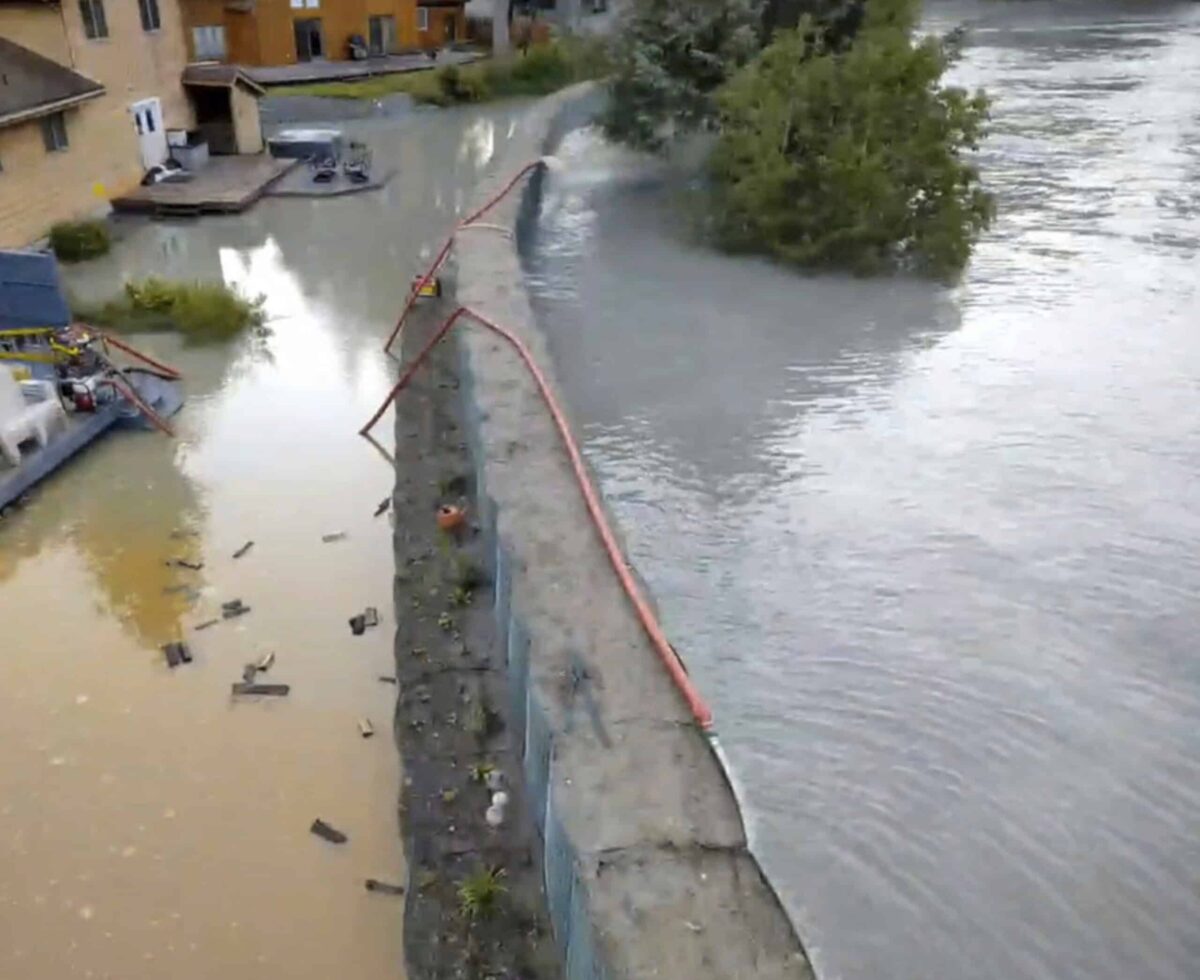
Screenshot of Backloop Bridge Damage, sent to KINY
NOTN- Repairs continue on the Mendenhall River Back Loop Bridge after the record glacier lake outburst flood this month caused severe damage, authorities reported.
The flood scoured an area approximately 16 feet deep, 50 feet long, and 120 feet wide, displacing roughly 3,555 cubic yards of material, equivalent to about 300 dump-truck loads.
Since Saturday, Aug. 16, crews have excavated more than 22 feet to reach stable material and begin rebuilding around the undermined but stable bridge structures. Officials said about 5.7 million pounds of rock have been placed to restore the riverbanks and roadway.
If conditions allow, officials are targeting a reopening of the bridge by tomorrow, Aug. 26, with paving to follow depending on crew availability. Authorities urged motorists to be patient, noting that safety and long-term durability guide the reconstruction effort.
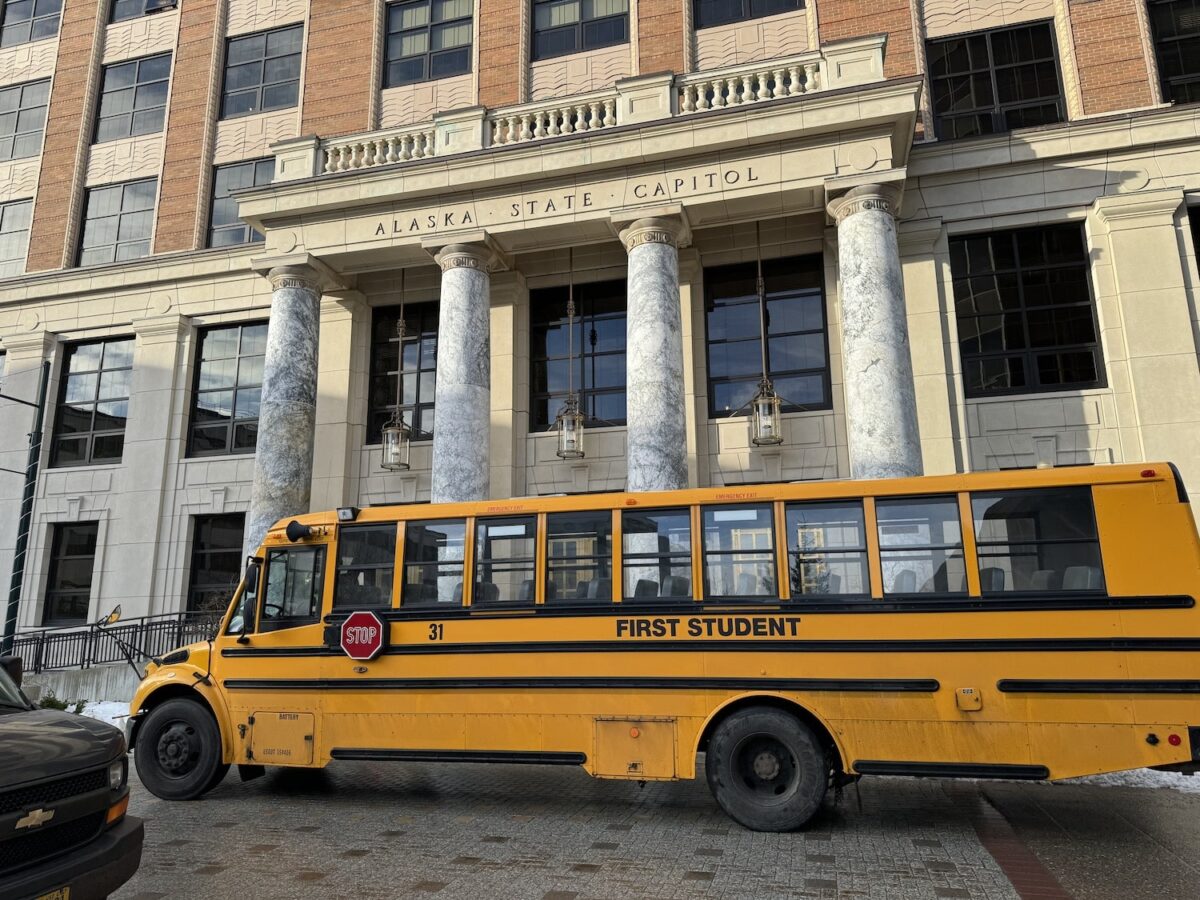
A school bus passes in front of the Alaska Capitol on Tuesday, Feb. 6, 2024. (Photo by James Brooks/Alaska Beacon)
A school bus passes in front of the Alaska Capitol on Tuesday, Feb. 6, 2024. (Photo by James Brooks/Alaska Beacon)
NOTN- Alaska lawmakers will hold the first meeting of the Education Task Force today, beginning a 17-month process to evaluate the state’s approach to school funding and policy.
The task force, is charged with producing a report to the full legislature that will examine education funding formulas as well as policy items championed by the governor and other lawmakers.
“it’s a really broad mandate.” Said Juneau Senator Jessie Kiehl, we’ll look at education funding, look at some policy issues, including several that were on the governor’s wish list, and and really dig in.”
The Education Task force is described as multipartisan, with both democratic and republican leaders starting work this August.
“We’re going to bring in a lot of information, a lot of experts, and see if we can figure out what the state needs to do, to really improve education stability, education funding and outcomes for Alaska kids.” said Kiehl.
The panel’s creation stems from House bill 57, and is part of Alaska’s ongoing political and financial discussions surrounding education.
“This task force was in the bill that the Governor vetoed, that Bill had, of course, most importantly, the funding stabilization, but then it also had a number of education policy things that the governor wanted, some legislators wanted,” Kiehl said,”The governor’s veto, he said, was because he didn’t get all of the policy pieces he wanted. One of the things this task force is going to look into is some of those policy pieces that just did not have support in the legislature.”
Task force members said they will revisit some of those disputed policy proposals while focusing on long-term solutions to strengthen education in Alaska.
Nick Beckage, a graduate researcher, Davin Louangaphay, a research assistant, and Philippe Amstislavski, a professor of health sciences, stand among spruce trees on the University of Alaska Anchorage campus on April 30, 2025, with one of the insulating seafood boxes they created with a cellulose-mycelium blend. (Photo by Yereth Rosen/Alaska Beacon) Philippe Amstislavski, a professor of health sciences, holds a cube of insulating material created with a blend of cellulose from beetle-killed trees and mycelium, the fibers found in fungi. He and his research partners want to use these natural materials as a substitute for plastic foam. (Photo by Yereth Rosen/Alaska Beacon)
Every year, copious amounts of plastic foam boxes are used to ship Alaska seafood.
Instead of using plastics that contribute huge amounts of carbon emissions in their manufacture and huge amounts to pollution after their disposal, could Alaskans use environmentally friendly local materials to ship fish and provide other insulation?
University of Alaska Professor Phillippe Amstislavski, in his lab on June 9, 2025, holds a slab of moist cellulose, derived from spruce pulp, and mycelium, the fibers that cause fungal growth. The combination, once dried and hardened, will form a non-polluting type of insulation intended to be a substitute for Styrofoam and other plastic foam. (Photo by Yereth Rosen/Alaska Beacon)
A team led by a University of Alaska Anchorage professor is tackling that question.
Philippe Amstislavski, a professor of public health at UAA, and his colleagues have created an insulation box from a blend of cellulose and fibers from fungi. To him, it is an appropriate invention for Alaska, where he estimates that more than 1 million plastic foam boxes are used annually to hold fish.
“Our economy is dependent on seafood. And the ability to get fish to markets is really important,” he said. But while Alaskans value sustainable fish harvests, what about sustainable fish shipments? “How do we become materially independent?” he asks.
One solution, he believes, lies in materials that exist in abundance in Alaska’s boreal forest, including the woods on and near UAA’s campus: dead trees and fungi.
The key ingredient is mycelium, the fibrous, vegetative part of fungi. Mycelium creates a strong bond when it is weaved into web-like structures. Amstislavski and his team grow mycelium in their lab in cellulose foam created from wood pulp. The resulting material that, when dried, is durable, insulating and water-repellent. The growth process takes just days.
A beetle-infested spruce tree is seen at Goose Lake Park on July 29, 2025. The park borders the University of Alaska Anchorage campus. (Photo by Yereth Rosen/Alaska Beacon)
For cellulose, they use spruce trees that have been killed by a beetle infestation that has spread over millions of acres in Alaska, including to trees outside the door to the UAA lab building where they work.
The work addresses a global problem with special Alaska significance.
Over its lifetime, Styrofoam and similar plastic insulating foam are carbon intensive.
The product itself is generally made from fossil fuels. Its manufacture uses the energy from more fossil fuels. Though lightweight, it must be transported over long distances to reach Alaska, which also requires fossil fuels. As it ages, plastic foam can release gases known as volatile organic compounds. When it breaks down into debris, the foam crumbles into increasingly small pieces, eventually becoming tiny microplastics swirling in the ecosystem that are difficult to see and nearly impossible to corral but create a big impact.
“It’s this whole, kind of perfect cycle of carbon emissions and pollution that they’re generating every time you use it,” Amstislavski said. “So how do you break it up? How do you challenge it? How do you create alternatives?”
Philippe Amstislavski, a professor at the University of Alaska Anchorage, sits in his biomaterials laboratory on June 9, 2025. Amstislavski, who specializes in environmental health, is leading a project to create a natural, Alaska-grown subtitute for polluting plastic insulation foam. The cellulose-mycelium blend that he and his research partners have created draws on his longtime interest in mushrooms; mycelium is the fiber responsible for fungal growth. (Photo by Yereth Rosen/Alaska Beacon)
Plastic impacts on Alaska
For marine- and fish-dependent Alaska, where disposal or recycling options are limited, plastic pollution is a serious problem, even in remote locations.
Microplastics from distant sources have become concentrated in high latitudes, brought north by ocean and atmospheric currents.
Climate change, which is amplified in the far north, has helped concentrate microplastics in the region because debris previously locked into sea ice or glacier ice is now being released through accelerated melt.
A study by Chinese researchers published earlier this year found microplastics in every single ice sample taken from Elson Lagoon in Utqiagvik, the nation’s northernmost community, and from every sample of Chukchi Sea ice taken nearby off the coast of Point Barrow, the spit of land extending north from town. An earlier study found microplastics in every sample taken from waterways in Anchorage, Alaska’s largest city, and in other waterways in Southcentral Alaska.
Microplastics have been found in the bodies of walruses harvested by Indigenous hunters in the Bering Strait region, in fetuses of spotted seals and in Alaska fish such as pollock.
Polystyrene and other plastics litter a remote beach in Alaska in 2012. (Photo provided by the National Oceanic and Atmospheric Administration)
The abundance of plastic waste that has accumulated in Alaska is striking, said Amstislavski’s research assistants.
“I was driving to Eagle River, and I was looking at the side of the highway, and there was a bunch of plastic trash laying on the side,” said Davin Louangaphay, one of the technicians. “And I was, like, ‘Wow, there’s so much out there.’ And I feel like it’s just been increasing over the years as I’ve grown up.”
Eco-friendly boxes for Alaska seafood
The fish-box project is supported by a grant from the National Oceanic and Atmospheric Administration. The UAA team has partners on the Kenai Peninsula, including the Center for Alaskan Coastal Studies and seafood companies like Kachemak Bay Shellfish Growers Co-Op and Salmon Sisters.
The seafood industry partners are enthusiastic, said Alex Ravelo, a University of Alaska Fairbanks postgraduate researcher working on the project.
“Nobody likes Styrofoam. That’s the reality. Everybody’s well aware of how bad it is for the environment,” she said.
Results from a test conducted over the past winter and spring are promising.
Alex Ravelo, a postgraduate researcher, stands in the University of ALaska Anchorage biomaterial laboratory on June 9, 2025, holding an insulating seafood box made from a cellulose-mycelium mix. The project, led by UAA professor Philippe Amstislavski, aims to develop a natural substitute for plastic foam. The plastic foam used for insulation in Alaska and elsewhere has a big carbon footprint, from its manufacture to its disposal, and it creates widespread pollution that has become embedded in the marine food web. (Photo by Yereth Rosen/Alaska Beacon)
Prototypes of what the team has called “MyghtyBox” were built by Amstislavski, Ravelo and Davin. The Center for Alaskan Coastal Studies put frozen salmon, halibut, shrimp and scallops into them. The filled and sealed boxes were sent from Homer to New York, Kansas and Florida. In addition, a box with live Alaska oysters was sent to Minnesota.
All but one arrived safely and sufficiently chilled, according to federal safety standards. The exception was the shipment to Florida, which was delayed for three days after it was accidentally left on the hot tarmac.
The MyghtyBox project has yet to reach any kind of commercial stage. As of early summer, the number of constructed boxes totaled only about 30, Amstislavski said. Scaling up production is a challenge yet to be cracked.
Home insulation possibilities
The fish-box project is part of a larger mycelium-cellulose vision.
A mobile test lab, set up as a simulated cabin with cellulose-mycelium insulation, is seen on June 5, 2025, at the National Renewable Energy Laboratories site at the Cold Climate Housing Research Center in Fairbanks. (Photo by Yereth Rosen/Alaska Beacon)
A broad goal is to use this all-natural, all-Alaska foam for home insulation, particularly in rural areas. Housing there is notoriously expensive, overcrowded and unsuitable for the environment, especially as the climate continues to change.
Building new homes in rural Alaska is especially difficult because materials must travel over long distances to be used during short summer construction seasons. If materials don’t arrive in time, construction activities can be delayed for a full year.
Mycelium-based board could be a cheaper, faster-delivered, more convenient and higher-quality building material. In partnership with Amstislavski’s team, the National Renewable Energy Laboratory is investigating the possibility.
NREL researchers, operating at their site on the edge of the University of Alaska Fairbanks campus, have been testing different blends of cellulose-mycelium insulation.
There, at the site on the Cold Climate Housing Research Center campus, a mock cabin was set up as a mobile test lab, with panels of mycelium board of varying thicknesses, along with a section of currently used plastic insulation that served as a control. Performance has been measured at each of the panels.
Georgina Davis, a project manager at the National Renewable Energy Laboratory in Fairbanks, holds a sample of cellulose-mycelium insulation on June 5, 2025. Davis is standing in a mobile test lab set up as a mock cabin. It different sets of cellulose-mycelium panels. and instruments are measuring the performance of each. The hope is that the all-natural, all-Alaska materia will be an eco-friendly substitute for plastic insulation foam. (Photo by Yereth Rosen/Alaska Beacon)
The project is about more than eco-friendly building materials, said Georgina Davis, an NREL research project manager working on the experiment.
Mycelium insulation could also address a quality problem that plagues Alaska homes, and particularly those in rural areas, where homes are old and weather-beaten: mold. The materials used widely in the Lower 48 can fare poorly in Alaska’s climate, Davis said.
“If you put two inches of foam around any house in Alaska, you’re going to create prime conditions for mold,” she said. “That’s wrecking a good percentage of homes in rural Alaska.”
Unlike plastic foam, which traps moisture, mycelium insulation can be breathable, she said.
The result of the NREL experiment are now being analyzed.
Interest in mushrooms began in the Russian Arctic
For Amstislavski, the journey to the Alaska cellulose-mycelium project has been something of a circle covering wide geographic and cultural distances.
He grew up in Russia, where his fishery biologist father worked in the Nenets region in theEuropean Arctic. There, as a young boy, he was immersed in Indigenous Nenets culture, which includes mushroom harvesting. There, mushroom harvesting is not just a pastime, but an important subsistence activity, especially in Soviet times, when other foods were scarce.
“I was lucky enough to be in a place with people who understood the landscape and the world, in a deeper, introspective way,” he said.
A mushroom clings to a tree in Anchorage’s Goose Lake Park on July 29, 2025. This type of mushroom, sometimes called a hoof fungus, has been traditionally used by Indigenous tribes for medicinal purposes. (Photo by Yereth Rosen/Alaska Beacon)
After the Iron Curtain fell, he moved with his family to Israel, where he pursued a nursing career. He became interested in architecture, which led him to move to New York. Before he completed his architecture degree, he served as a first responder tending to victims of the Sept. 11 attack on the World Trade Center. That experience gave him first-hand knowledge of respiratory ailments and lung-damaging chemicals. It also further stimulated his interest in environmental health and its relationship to the built environment.
Amstislavski then earned a master’s degree from the Yale School of Forestry and Environmental Studies, where one of his mentors was Tom Siccama, an expert in fungi. “He knew everything about North American mushrooms,” he said.
He then got a Ph.D. in environmental sciences from the City University of New York and taught for a while at the State University of New York before being lured to Alaska. That happened when he presented his research at a circumpolar conference in Fairbanks in 2012, which led to a job as a state public health manager, a position involving travel to rural villages. He came to UAA in 2014, a position that enabled him to study in Finland in 2021 on a Fulbright scholarship.
Amstislavski and his team members are not the only researchers looking at fungus as a solution to plastic problems.
Oyster farmers in Maine, for example, have experimented with buoys made of mycelium. British fashion designer Stella McCartney in 2021 unveiled some faux-leather products crafted from mycelium. A Seattle company is developing a variety of products, from foods to construction materials, out of mycelium.
University of Alaska Professor Philippe checks on June 9, 2025, on the growth in a sample of mycelium-embedded cellulose blocks in a petri dish held by Alex Ravelo, a postgraduate researcher. Ravelo was testing a particular combination of cellulose and mycelium, the fibers that form the root structure of fungi. Mycelium, once dried, forms a strong bond. (Photo by Yereth Rosen/Alaska Beacon)
Alaska challenges
While mycelium development proceeds elsewhere, Alaska projects have some obstacles.
The University of Alaska does not have the type of well-connected business incubators that exist at universities like Harvard, though UAF’s Center for Innovation, Commercialization, and Entrepreneurship has supported the mycelium research.
Alaska, with its remote location and high shipping costs, lacks the type of well-developed manufacturing capacity that exists in most states. Manufacturing in Alaska is dominated by seafood processing, which provides about two-thirds of the sector’s employment, according to the state Department of Labor and Workforce Development.
A new challenge comes from Trump administration decisions to axe funding for environmental research and climate change work.
The $2.5 million U.S. Department of Energy grant awarded in 2023 for the building-insulation project at NREL will not be renewed, the team recently learned.
Funding for NOAA has been drastically cut, though impacts to its marine debris programs and services are yet to be determined.
The Trump administration has resisted attempts to curb plastic pollution, most recently putting up roadblocks that led to the collapse of negotiations on an international plastics treaty.
Amstislavski hopes that entities beyond the federal government, including the private sector, will step in to support mycelium product development.
Aside from its environmental benefits, mycelium could help build Alaska’s workforce, a subject of concern for state officials, he said.
“It’s an opportunity for interesting jobs that are meaningful to people that have positive impacts in the world,” he said.
Mushrooms growing on a trees stump at Anchorage’s Goose Lake are seen on July 29, 2025. In the background are birch and beetle-infested spruce trees. A University of Alaska Anchorage-led project is creating an eco-friendly insulation material from pulped beetle-killed spruce and mycelium, the strong fibers contained in mushrooms. The materials are widely available; Goose Lake Park borders the UAA campus. (Photo byYereth Rosen/Alaska Beacon)
AP- Alaska medical professionals who provide gender-affirming care could risk disciplinary action under a proposal set for review by the state medical board on Friday.
The proposal would deem any professional who uses hormonal and surgical treatments for minors “as being grossly negligent” and subject to sanctions by the board, according to the board’s minutes from a June meeting.
The type and extent of disciplinary actions were not spelled out, and board member Matt Heilala, an Anchorage podiatrist who was helping write the proposed regulations, declined to discuss the details Thursday with The Associated Press ahead of the meeting.
The move comes after the board in March sent a letter to state lawmakers expressing opposition to hormonal or surgical gender-affirming care for minors and urging legislators to enact limits on treatments. The Legislature — controlled by bipartisan majorities in both the House and Senate — didn’t take up the issue before adjourning in May.
Critics worry the board is overstepping its authority in pursuing regulations that could leave medical providers open to possible disciplinary actions. Instead of allowing the legislative process to play out, “they are now becoming the legislators themselves, which is inappropriate,” said state Sen. Löki Tobin, a Democrat who has been outspoken in support of the LGBTQ+ community.
The medical board at a June meeting designated member Heilala to help draft a statement for consideration that would pertain to declaring those providing the care “as being grossly negligent and therefore subject to disciplinary sanctions,” according to the minutes of that meeting.
Heilala declined to discuss the specific language stemming from that directive that the board would consider Friday but told the AP that the proposed rules would go through a deliberate and transparent process for the public. Such processes can take months, he said.
Gender-affirming care includes a range of medical and mental health services to support a person’s gender identity, including when it’s different from the sex they were assigned at birth. It encompasses counseling, medications that block puberty and hormone therapy to produce physical changes as well as surgeries to transform chests and genitals, though those are extremely rare for minors.
Most major medical groups say access to the treatment is important for those with gender dysphoria and see gender as existing along a spectrum. While there’s wide, if not universal, medical consensus, the political situation is contentious.
In Texas, Republican Gov. Greg Abbott had issued an order allowing the state to investigate parents of transgender youth for child abuse. But a Texas judge in 2022 blocked the state from investigating families of transgender youths who have received such care and members of the LGBTQ advocacy group PFLAG Inc. over such medical care.
Tom Pittman, executive director of Identity Inc., an Anchorage-based advocacy and health care organization for the LGBTQ+ community, said about 500 Alaska medical professionals have signed an open letter opposing the changes being considered by the board.
The letter campaign organized by Pittman’s group said gender-affirming care for adolescents, when provided in partnership with families, is evidence-based medicine.
“Labeling it ‘negligence’ is not a medical conclusion. It is a political act with devastating consequences: punishing clinicians, undermining parents, and denying young people lifesaving treatment,” the letter states.
Fewer than 100 youth are receiving such gender-affirming care, Pittman said.
Pittman called Heilala’s actions politically motivated, saying he “has co-opted Alaska’s medical board and institution to launch a bid for governorship, and he’s using scapegoating and discrimination against what is a very small vulnerable population of Alaskans to create a bully pulpit for himself.”
Heilala is one of at least eight Republicans to announce plans to run for governor next year. But he said this is an issue the board has been working on for some time and “has nothing to do with my running at all.”
Former U.S. District Court Judge Joshua Kindred speaks at his Dec. 4, 2019, Senate Judiciary Committee confirmation hearing in Washington, D.C. (U.S. Senate Judiciary Committee video screenshot)
The Alaska Bar Association has voted to recommend that former U.S. District Court Judge Joshua Kindred be disbarred in Alaska.
Kindred, appointed by President Donald Trump to serve as a federal judge here, resigned last year from the federal bench after investigators found that he had a “sexualized relationship” with a clerk who became a prosecutor and lied about it to a senior judge and investigators, and maintained a hostile workplace for law clerks.
Since that investigation, additional improprieties connected to the U.S. attorney’s office have come to light.
On Thursday, the bar association’s board of governors voted without dissent to recommend that Kindred be disbarred, forbidden from practicing law in the state. The bar association regulates attorneys across Alaska.
The board’s recommendation will go to the Alaska Supreme Court, which must make the final determination. No date has been set for when the court will consider the issue.
Kindred, whose law license is “inactive” according to the bar association’s database, did not participate in the investigation that preceded Thursday’s hearing, said Rebecca Patterson, president of the bar association’s board.
Louise Driscoll, assistant counsel for the bar association, said the association received “lots of calls” when the investigation into Kindred was revealed to the public.
Typically, she said, the association prefers to act when a grievance is filed by someone other than the association’s own counsel, but in this case, the association’s counsel filed the grievance itself in November.
The subsequent investigation, she said, was slowed by the fact that Kindred didn’t respond to requests for a response to the grievance. He no longer lived at his address on file. He had left the federal court. Former acquaintances didn’t know where he was.
Eventually, Driscoll said, a process server found Kindred sitting on the couch at his mother’s house.
“It was Mr. Kindred’s mother who answered the door and accepted service, but you could see Mr. Kindred on the sofa, so he was on notice,” she said.
Even then, Kindred didn’t respond, and in June, a committee recommended that Kindred be disbarred.
Driscoll said the committee considered it “very serious” that Kindred had lied to federal investigators about his activities.
“Lawyers are expected to be honest, and the members of the public have a reason to consider that they will be dealing with honest counsel,” she said.
Kindred’s actions, she added, have caused real harm — there are dozens of cases whose outcomes are now in doubt because Kindred failed to disclose conflicts of interest.
In addition, Kindred’s resignation has left only one active judge on Alaska’s district court bench.
“There’s been grievous harm,” Driscoll said of Kindred’s actions.
In a footnote to the disbarment recommendation, the committee said, “We enter our decision not with any joy. It is our collective hope Mr. Kindred can recover emotionally, financially and physically notwithstanding the hardships Mr. Kindred confronts.”
On Thursday, after Driscoll’s suggestion, the board of governors deleted that footnote.
Kindred, they concluded, should receive no more special courtesy than any other attorney facing the same accusations.
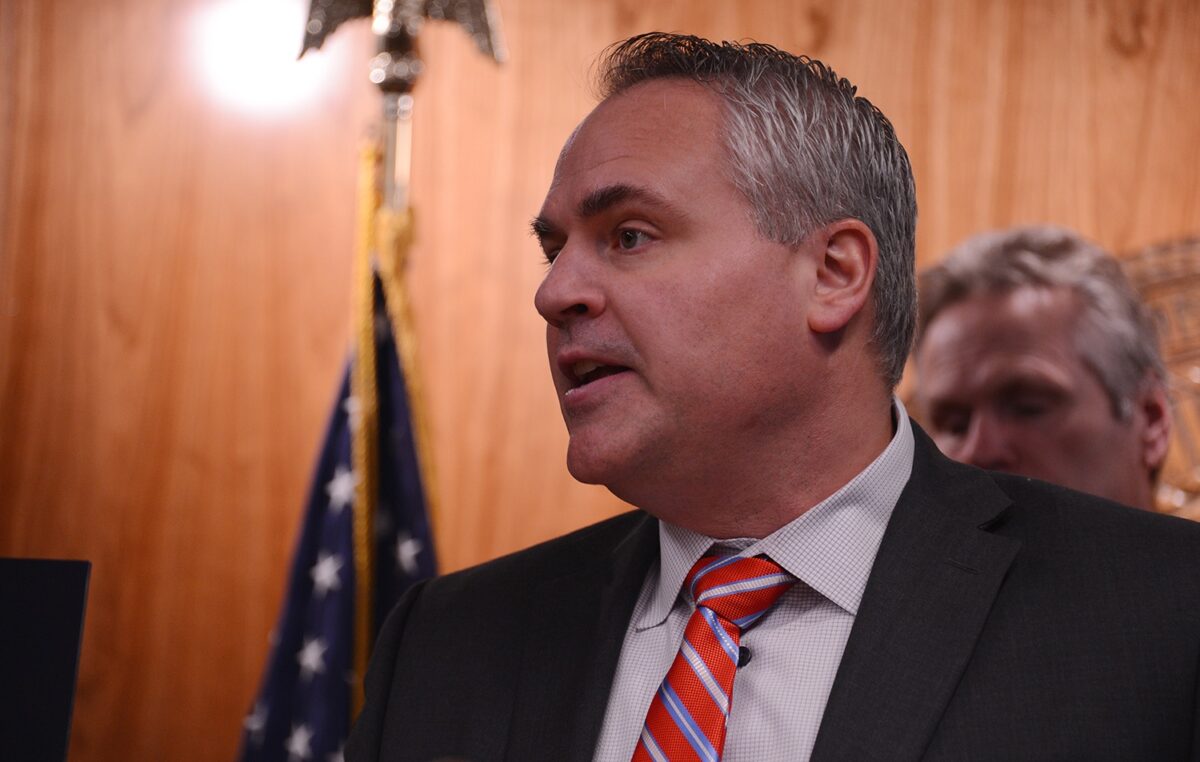
Alaska Attorney General Treg Taylor speaks at a news conference on Thursday, Dec. 15, 2022, at the Alaska State Capitol in Juneau. (Photo by James Brooks / Alaska Beacon)
Alaska Attorney General Treg Taylor speaks at a news conference on Thursday, Dec. 15, 2022, at the Alaska State Capitol in Juneau. (Photo by James Brooks/Alaska Beacon)
JUNEAU – Alaska Attorney General Treg Taylor will resign later this month after more than three years as the state’s top lawyer.
According to a statement from Governor Mike Dunleavy, he accepted the resignation and said Taylor’s final day will be Friday, August 29.
“Attorney General Treg Taylor’s sound legal judgment and dedication to public service have made a meaningful difference for Alaska,” Dunleavy said. “From defending our right to develop Alaska’s natural resources to fighting crime, his legal leadership has helped preserve and advance opportunities for everyday Alaskans.”
Taylor, first appointed in 2021, ranks among the longest-serving attorneys general in Alaska’s history. In a statement, Dunleavy credited him with steering the state through major legal battles, from natural resource development disputes to public safety issues.
“It has been an honor and a privilege to serve as the Alaska Attorney General,” Taylor said. “I am incredibly proud of what the Department has accomplished together fighting federal overreach, making our communities safer, and defending the Alaska way of life. None of these victories would have been possible without the extraordinary attorneys and staff at the Department of Law and the support of the Governor. Their dedication and professionalism inspire me, and I will always be thankful for the opportunity to have served alongside them.”
Dunleavy said he plans to name an interim attorney general before Taylor’s departure.
This drone image provided by the City and Borough of Juneau shows flooding from a release of water and snowmelt at Mendenhall Glacier covered some roads and threatened homes along the Mendenhall River in Juneau, Alaska on Wednesday, Aug. 13, 2025. (City and Borough of Juneau via AP)
This drone image provided by the City and Borough of Juneau shows flooding from a release of water and snowmelt at Mendenhall Glacier covered some roads and threatened homes along the Mendenhall River in Juneau, Alaska on Wednesday, Aug. 13, 2025. (City and Borough of Juneau via AP)
NOTN- City officials in Juneau say flood protection measures largely held during this month’s Suicide Basin release, but the risk of another release later this year remains.
Emergency Programs Manager Ryan O’Shaughnessy said five of the most severely damaged homes were on View Drive.
The barriers prevented widespread destruction but still experienced seepage and minor flooding in some areas.
“Six homes did have that major damage classification, And what that means is that water entered the living space and was generally above the height of a standard electrical outlet.” Said O’Shaughnessy, “At this time, the best professional judgment of the CBJ Engineering and Public Works team does believe that the HESCO barriers are not a viable solution for View Drive, so we’re working to identify any other solutions we can.”
Officials say long-term options for View Drive could include state- or federally sponsored buyouts. Meanwhile, the city is focusing on assessing barrier performance, repairing damaged sections, and moving forward with “Phase Two” of the project, which would extend protection as far as Brotherhood Bridge and Meadow Lane.
“There’s a lot of questions about phase two, and we’re working really hard to answer those, but seeing the effectiveness of the HESCO barriers this year is a great indication and a good reminder that we’re not out of the woods yet,” O’Shaughnessy said.
Last year, Suicide Basin released again in October with a final flood stage of just under 11 feet, and officials warn the glacier-dammed lake is currently refilling at a steady rate of about three feet per day, O’Shaughnessy said. “It is entirely possible we could see another release this year, another great reminder that we have a lot of work to do as a community.”
The city issued evacuation notices to more than 1,000 homes ahead of the flood, which crested at 16.6 feet, the highest on record. O’Shaughnessy credited the unified response involving the City and Borough of Juneau, state agencies, tribal partners, and the U.S. Coast Guard with preventing loss of life.
NOTN- The University of Alaska Southeast says its textbook affordability program has saved students more than $1 million since it began in 2016.
According to national surveys and studies on the affordability of course materials, about 65% of college students did not buy their textbooks because they were too expensive and 77% of students delayed purchasing their textbooks due to high cost. Students who face food insecurity are often the most heavily impacted, having to make a choice between buying meals and purchasing textbooks.
The initiative, encourages faculty to use low-cost or zero-cost course materials in place of traditional commercial textbooks. According to the university, more than 200 faculty have offered 889 “Zero Textbook Cost” courses, saving students an average of $225,000 each semester.
“Offering affordable access to an excellent education is our #1 priority at UAS.” Chancellor Aparna Palmer said in a statement. “Thanks to the leadership of the Egan Library and the hard work of our faculty and staff, we help ensure that our students can learn more deeply, finish their degrees, and achieve their dreams.”
The effort is part of a national shift toward using open educational resources (OER), which are free, adaptable, and often more up-to-date than traditional textbooks.
According to UAS these open educational resources enable both students and faculty to benefit, because the materials can be adapted to fit the needs of today’s students, they also help strengthen student participation.
UAS began marking “Zero Textbook Cost” courses in 2022, allowing students to easily search for affordable options when registering for classes.
By the end of the spring 2025 semester, the university estimates more than 10,000 students have benefited from the program.
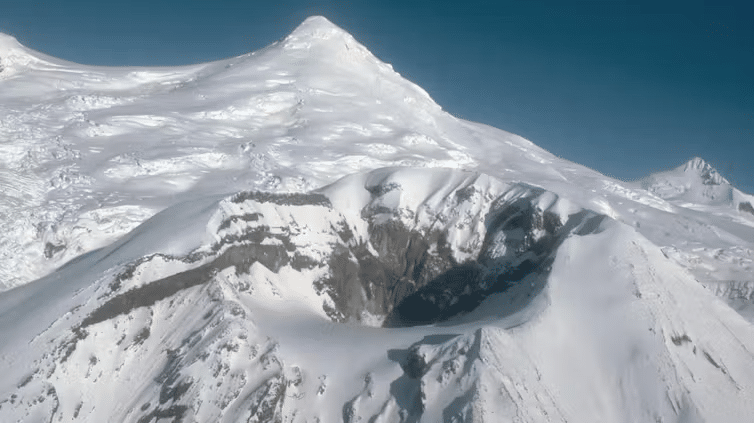
One of two main craters on Alaska’s Mount Spurr, shown in 1991. Earthquake activity suggested the volcano was close to erupting again in 2025. (Photo by R.G. McGimsey/Alaska Volcano Observatory/U.S. Geological Survey, CC BY)
Alaska’s volcano experts no longer expect an eruption anytime soon from Mount Spurr, the closest active volcano to Anchorage.
On Wednesday, the Alaska Volcano Observatory formally lowered the alert level for Mount Spurr from yellow to green after months of declining activity.
“Things are OK right now, and hopefully that continues in the future,” said David Fee, coordinating scientist for the University of Alaska Fairbanks Geophysical Institute, which operates the observatory alongside the U.S. Geological Survey.
While the land immediately around Spurr isn’t inhabited, ash emitted from the volcano has disrupted life in Southcentral Alaska before. In 1953 and 1992, Spurr eruptions dumped ash on Anchorage, disrupting air travel.
Starting in February 2024, scientists had observed large numbers of small earthquakes beneath the volcano, and ground near it was deforming, surging upward. Ice atop the volcano melted, and air samples taken above the volcano showed signs of magma moving beneath the surface.
Scientists had been monitoring Crater Peak, a site south of Mount Spurr’s summit, as the likely spot of an eruption.
In October 2024, they raised the volcano’s alert level, and by March of this year, the volcano observatory said an eruption was “likely.”
But soon after that estimate, the signs of an imminent eruption began to diminish. There were fewer earthquakes, and the ground stopped rising as quickly as it had been.
Earlier this summer, the volcano observatory issued a statement saying that the odds of an eruption had fallen, and Spurr continued to quiet, leading to Wednesday’s announcement.
“What we’re seeing right now is all … really consistent with magma that intruded (beneath the volcano) and then stopped intruding. But it’s still creating some signals such as increased gas emissions and kind of weak seismicity,” Fee said.
While Spurr erupted in 1953 and 1992, darkening the skies over Anchorage with ash, it has also previously signaled an eruption that never came to pass.
In 2004 and 2006, the volcano showed signs of unrest for months but never erupted. The most recent period of unrest seems to resemble those two false starts.
Even though the volcano didn’t erupt, it has the potential to offer a scientific bonanza. AVO staff installed a network of seismic, infrasound and ground-measuring devices around Spurr, making it the most-monitored volcano in the state, according to the number of instruments listed on the AVO’s website.
“As we’re starting to look back now, at the period of unrest, it’s often just as interesting or scientifically valuable to understand why volcanoes don’t erupt, because they don’t, over half the time, approximately. Are there maybe some signals or something in our data that we can kind of tease out to help us understand why it didn’t erupt?” Fee said, looking back at what was learned.
“I think understanding why that occurred will be really important,” he said.
AVO and the Alaska Division of Homeland Security and Emergency Management also spent months educating Southcentral Alaskans about the possibility of ashfall, reminding them that they live in a volcanically active area.
That work will live on, too, Fee said, and people will be better informed the next time an eruption looks likely.
“Because they don’t happen that frequently in Cook Inlet, it was kind of a good reminder for people to be aware, to understand the hazards that are out there,” he said.