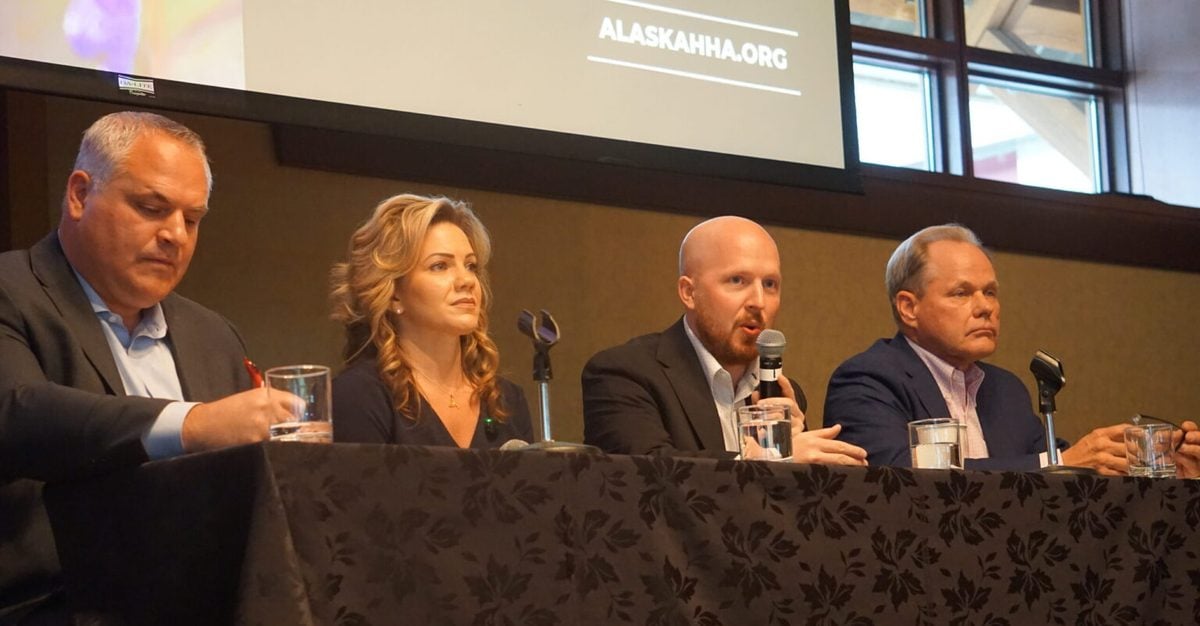
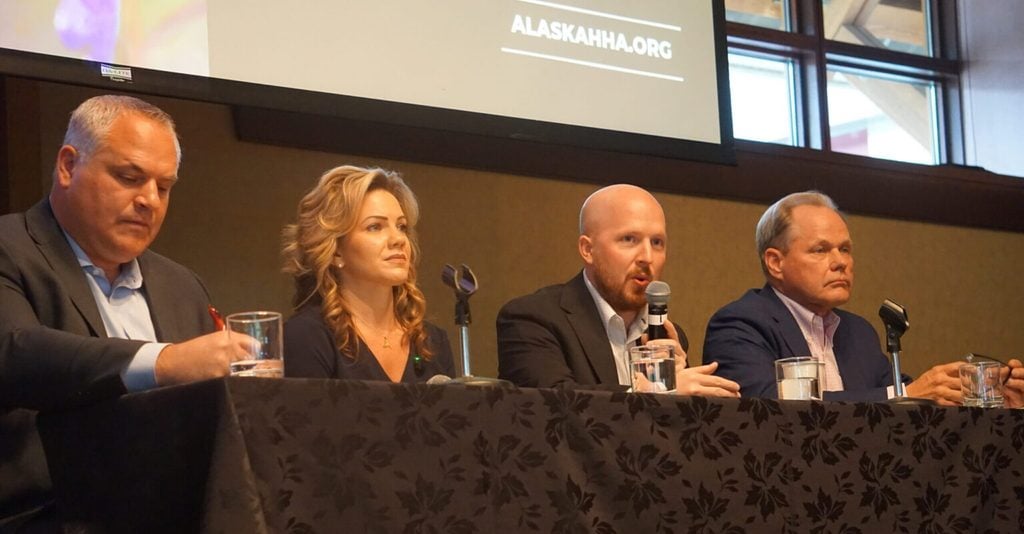
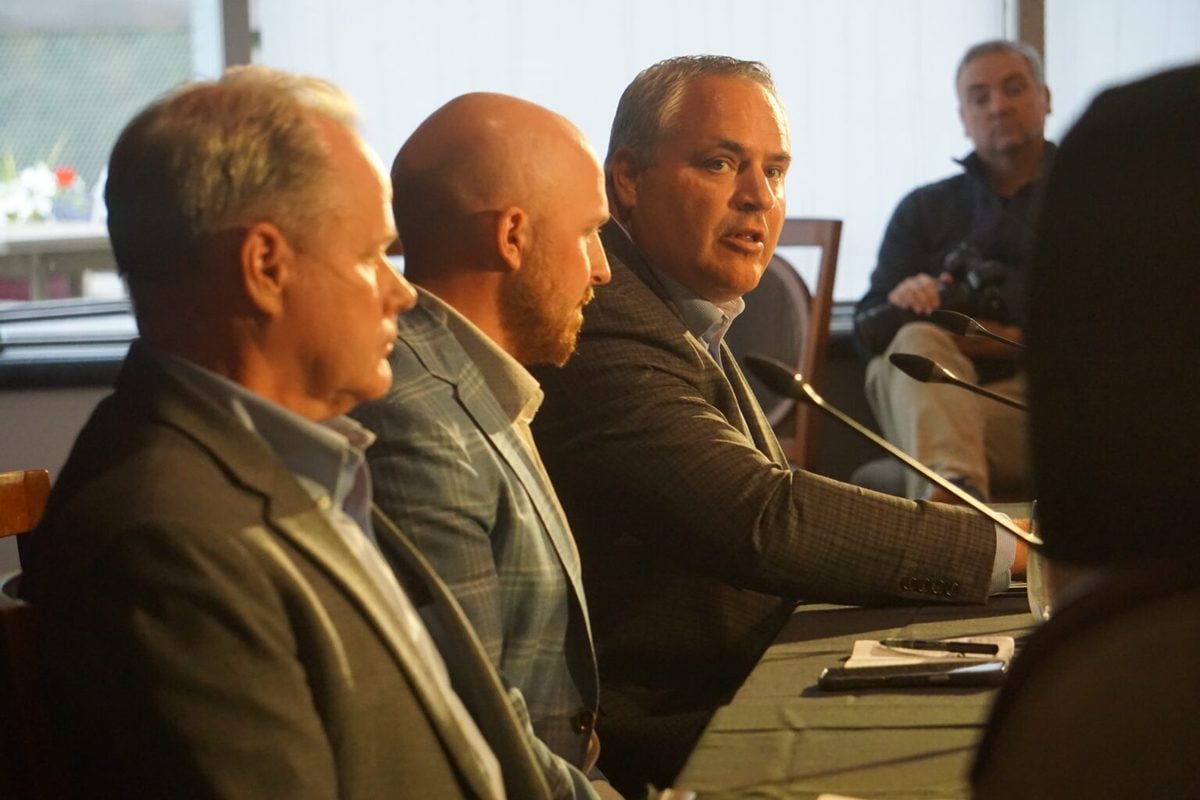
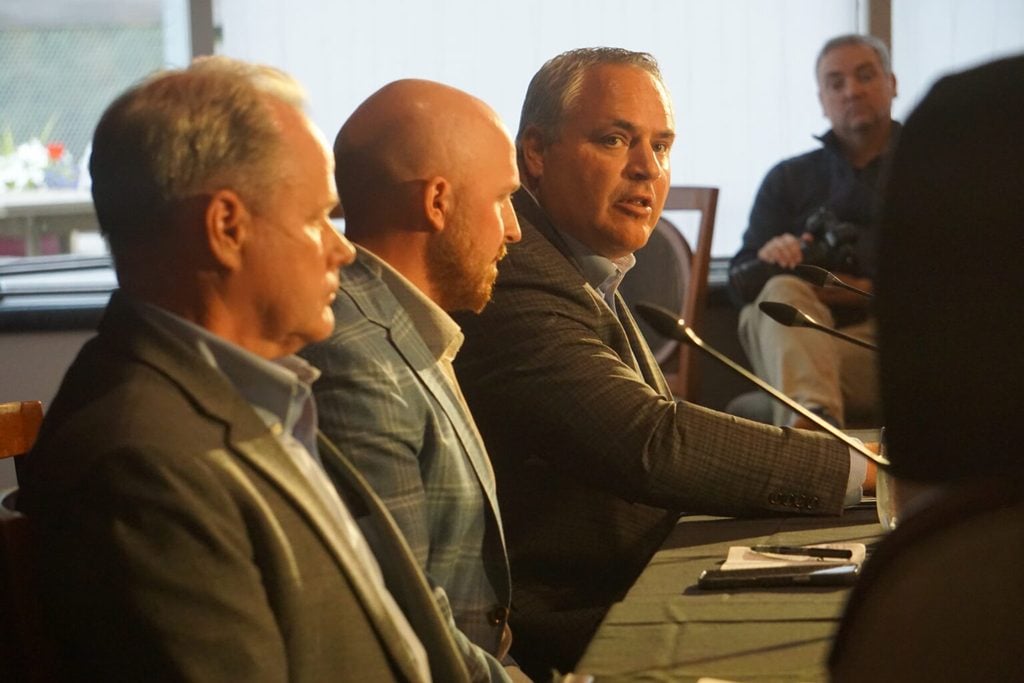
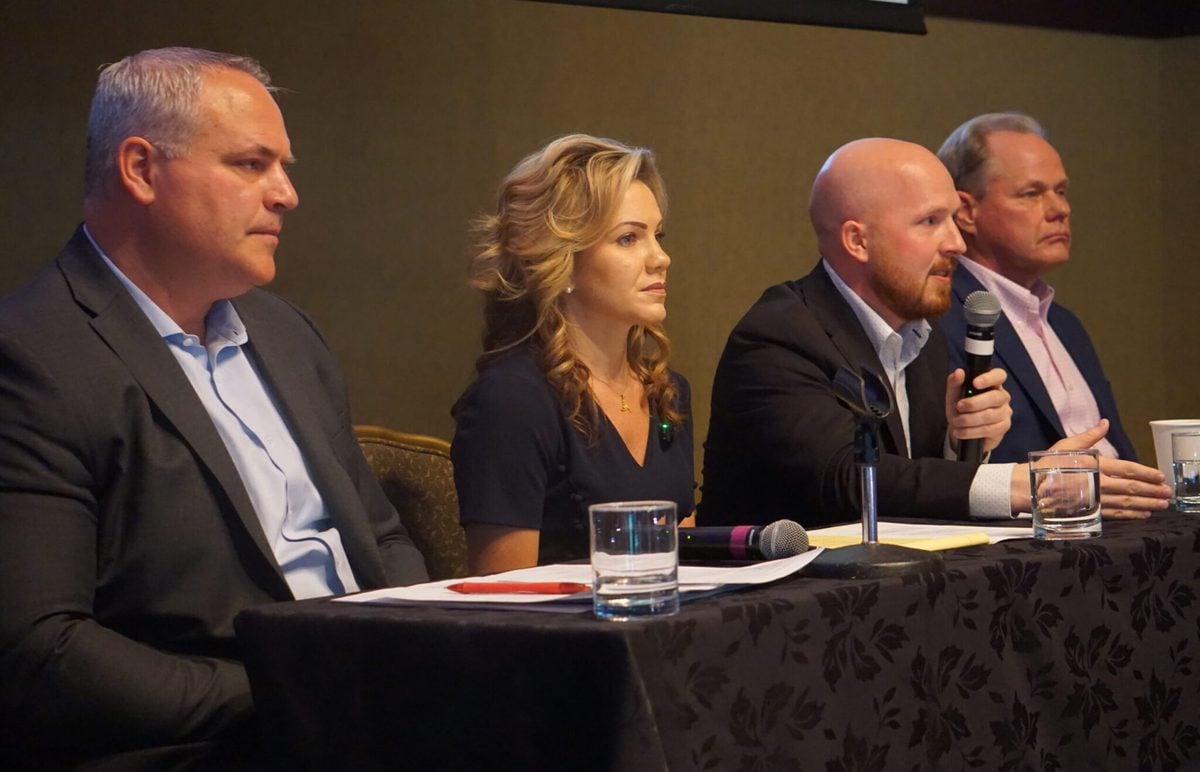
Former state Rep. Jonathan Kreiss-Tomkins, third from left, speaks at a gubernatorial candidate forum on Sept. 16, 2026, while former Attorney General Treg Taylor, Anchorage business owner and talk-show host Bernadette Wilson and former Anchorage Mayor Dave Bronson listen. The forum was held by the Alaska Hospital and Healthcare Association and the organization’s annual conference in Girdwood. Taylor, Wilson and Bronson are Republicans. Kreiss-Tomkins is a Democrat. (Photo by Yereth Rosen/Alaska Beacon)
In a candidate forum Thursday, three of the four candidates to be Alaska’s next governor voiced support for a long-debated plan to restructure the Alaska Permanent Fund in order to permanently cap the amount of money that can be spent from it without a statewide vote.
“You’ve got to protect the Permanent Fund. You simply have to,” said Republican candidate and former Anchorage Mayor Dave Bronson, speaking at the Commonwealth North forum.
Bronson referred to the Permanent Fund as “one of the two big engines” driving the state’s future. The other, he said, is developing Alaska’s natural resources.
Created in 1976, the Alaska Permanent Fund has been the No. 1 source of revenue for state services and the annual Permanent Fund dividend since 2018, when legislators and then-Gov. Bill Walker enacted a law that automatically diverts a portion of the now-$88 billion fund to the state treasury annually.
Even in years like this one, when oil prices are high and the state’s oil revenue booms, the annual transfer is worth more than oil and all other taxes combined and accounts for more than half of the state’s general-purpose revenue.
Currently, the Permanent Fund is divided into two parts. There’s the constitutionally protected corpus, which can only be spent via a statewide vote, and the earnings reserve, which collects the investment earnings of the corpus.
Money in the reserve can be spent by a simple majority vote of the Legislature and the assent of the governor.
Currently, only the 2018 law restricts spending from the earnings reserve, and that law is a flimsy limit — it could be overridden at any time by the Legislature and governor.
The trustees of the Alaska Permanent Fund have advocated that the two funds be combined into one, both to prevent overspending and to eliminate the possibility of the earnings reserve being drained, which would cause an instant state fiscal crisis.
“I think this is arguably the single most important question laying in wait for the next governor and the forthcoming Legislature,” said Democratic candidate Jonathan Kreiss-Tomkins. “I share Mayor Bronson’s belief that the Permanent Fund is a cornerstone of the state, and it is the single most important reform I want to pass as governor, working with the Legislature.”
Merging the two accounts would require a constitutional amendment. That needs the assent of two-thirds of the state House and two-thirds of the state Senate, plus a majority of voters in a statewide general election.
While serving as a member of the state House, Kreiss-Tomkins proposed such an amendment. His proposal passed through two legislative committees but was never voted upon by the full House or the full Senate.
Other, similar amendments have also failed to reach a vote of the House or Senate for two main reasons.
First, legislators would have to agree on the size of the Permanent Fund spending cap. Over the past eight years, the fund has struggled to earn enough money from its investments to make up for the annual transfer.
But reducing the size of the transfer means less money for services and dividends.
In 2025, state budgeters estimated that reducing the transfer by half a percentage point would open a $380 million gap in the budget. Reducing it by a full percentage point — to a level common in trust funds — would require finding $760 million per year in new revenue or cost cuts.
The second issue is the Permanent Fund dividend. Currently, legislators split the annual transfer from the Permanent Fund on an ad hoc basis, deciding each year how much to spend on dividends and services.
In practice, the Legislature has followed a “surplus dividend” strategy, setting the amount of the dividend based on what’s left over after services are paid for.
As operating costs have risen, the amount of money left for the dividend has shrunk. Some legislators now believe that without a policy change, the dividend is on course to disappear by the end of the decade.
State law mandates that dividends be paid using a specific formula in state law, but legislators have ignored that formula since 2016, and the Alaska Supreme Court upheld the legality of that approach.
“I’m going to fight like hell for that Permanent Fund dividend,” Wilson told Alaska Public Media in August.
She said she feels strongly about the issue because resources in Alaska are collectively owned by the state’s residents.
“It has nothing to do with the amount of a check. It has everything to do with the fact that Alaskans own the rights to those resources. And when you concede on that Permanent Fund dividend, you’re not just conceding on the amount of a check. You are conceding on the very idea that Alaskans no longer own those resources,” she said.
While permanently capping spending from the Permanent Fund does not directly alter the amount of the Permanent Fund dividend, it does eliminate a way to pay for larger dividends. Lawmakers who want larger dividends would have to either find new revenue or cut services in order to make money available for the dividend.
Some legislators have proposed that any revised structure for the Permanent Fund transfer reserve a portion of the transfer for dividends specifically, effectively guaranteeing a minimum payment.
Former Alaska attorney general Treg Taylor, speaking at an event in Kodiak, said he sees the Permanent Fund in the same way as the state’s fisheries — a resource that must be handled carefully in order to stay renewable.
Overfishing, or overspending, could endanger it.
“I think we have to lock up the Permanent Fund,” Taylor said, reiterating his position at this week’s Commonwealth North forum. “We have to protect that corpus. If we do not, there’s so much — I mean, JKT had it right. There’s just too much temptation to raid that. We’ve got to lock it up because that is our future.”
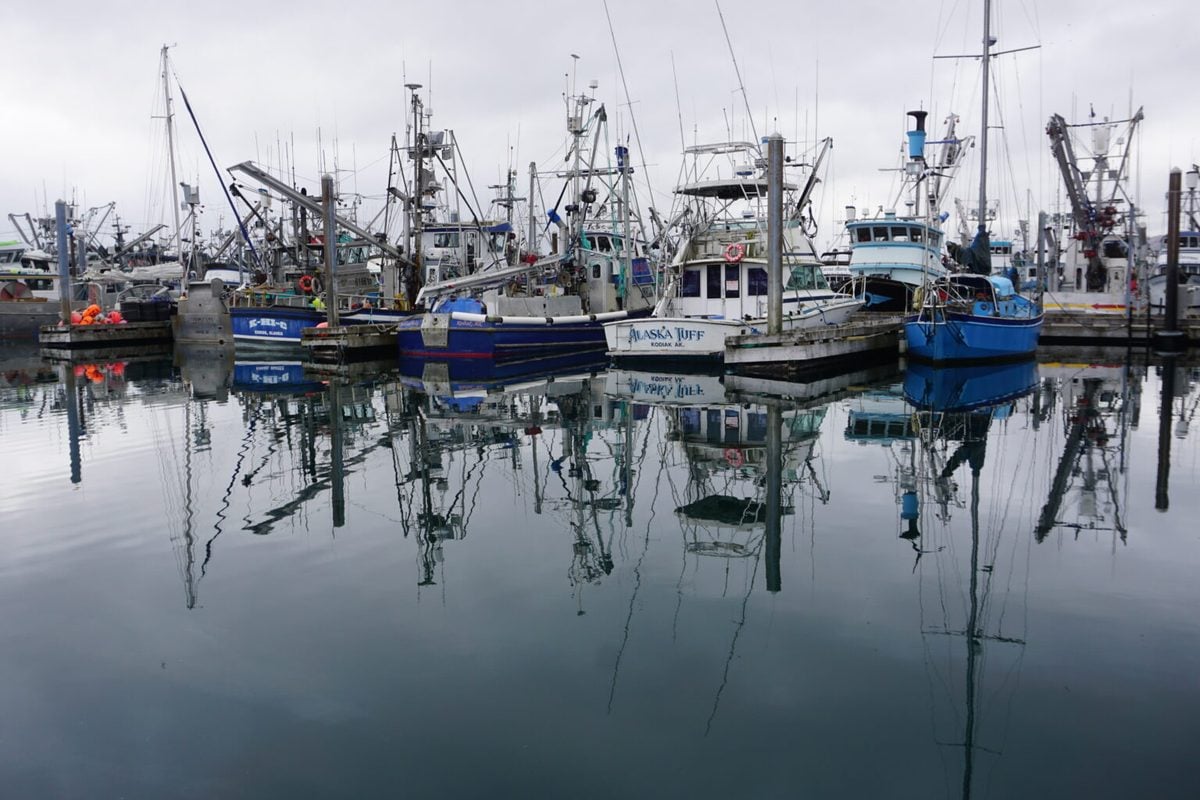
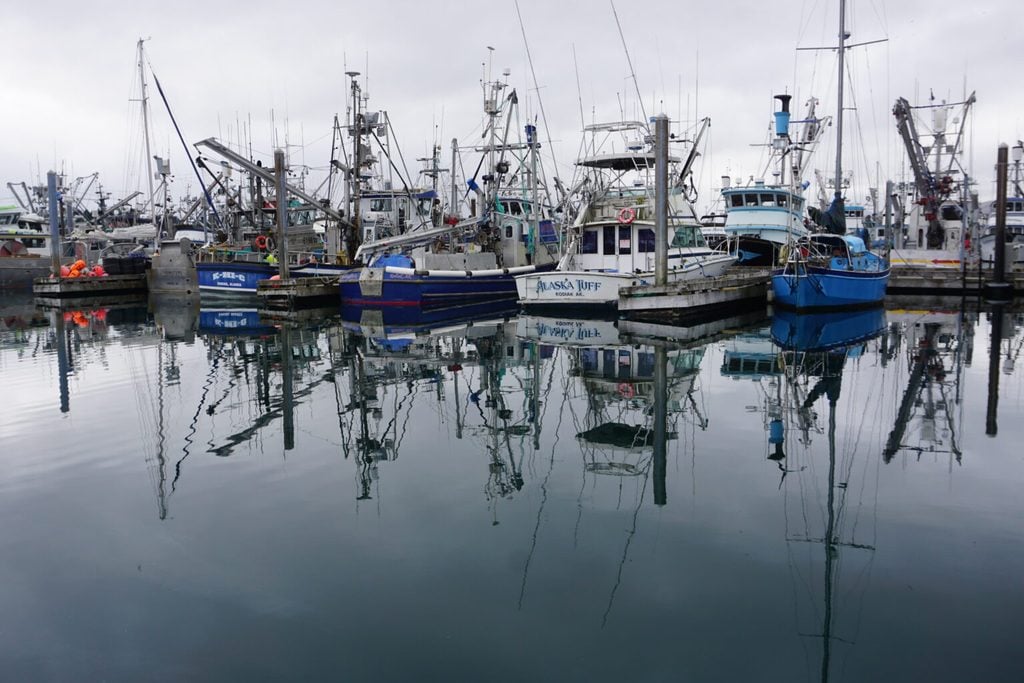
Fishing boats line a dock at Kodiak’s St. Paul Harbor on Oct. 3, 2022. Fishing issues have become a top campaign issue in the race between U.S. Sen. Dan Sullivan, R-Alaska, and his challenger, former U.S. Rep. Mary Peltola, D-Alaska. (Photo by Yereth Rosen/Alaska Beacon)
Fish are central to Alaska’s economy, Indigenous cultures and identity.
With critical salmon runs in Alaska rivers struggling, commercial operators squeezed by higher costs and stiffer market competition, fish are now at the center of the hard-fought campaign for Alaska’s U.S. Senate seat.
For Democratic challenger Mary Peltola, who is seeking to unseat incumbent Republican Sen. Dan Sullivan, the fishing issues are deeply personal.
She is Yup’ik, grew up in rural Western Alaska on the Kuskokwim River and, as she has explained many times, has been fishing since she was 6 years old.
“I’m the only candidate on this stage who’s an Alaskan fisherman. Fish is in my blood, earned over generations on the water,” she said at the Sept. 12 fisheries-focused debate held by the Kodiak Chamber of Commerce.
Sullivan is emphasizing his record after 12 years in the Senate, which he said resulted in 63 bills signed into law so far, many of which concern fisheries, and has secured generous appropriations for agencies that support the industry, like the U.S. Coast Guard.
“Our fishermen deserve relentless focus and action, not just talk,” he said at the Kodiak debate.
According to the information clearinghouse govtrack.us, Sullivan was the prime sponsor on 31 bills that have been signed into law during his tenure. Over his career in the Senate, he has been a cosponsor of more than 1,800 pieces of legislation, according to congress.gov, the online database for the nation’s legislative branch.
In comparison, Peltola was the prime sponsor of two bills that were enacted during her two years in the House, though her bills were converted into provisions that passed as parts of larger legislation, according to govtrack.us. During her tenure, which started with a special election victory in 2022, she was a cosponsor of 348 pieces of legislation, according to congress.gov.
Sen. Dan Sullivan, R-Alaska, shakes hands with former Rep. Mary Peltola, D-Alaska, at the Sept. 12, 2026, fisheries debate held by the Kodiak Chamber of Commerce. (Photo by Brian Venua)
Battle over bycatch
At the top of the Peltola-Sullivan fish fight is the hot-button issue of bycatch, or the interception of salmon and other nontarget species in the nets deployed by the huge trawling vessels that harvest pollock and other groundfish species in the Bering Sea and Gulf of Alaska.
Many in Alaska blame the poor conditions of certain salmon runs and declines in halibut and crab stocks, at least in part, on trawler bycatch. The issue has divided fishery sectors and regions.
For Peltola and Sulivan, the fight over trawl bycatch has been particularly bitter, with attacks on each others’ characters.
As Peltola and her supporters describe it, Sullivan is in the pocket of out-of-state industrial fishing corporations that contribute to his campaign but hurt Alaskans.
“CASHING IN. . .WHILE ALASKANS PAY THE PRICE,” says the website of a political action committee backing Peltola. “Dan Sullivan is looking out for his rich donors – and it’s costing us.”
As Sullivan and his supporters describe it, Peltola, is dishonest, unaccomplished and, despite her Yup’ik heritage, has sold out to Lower 48 liberals.
“When you don’t have a record to run on, YOU BUILD YOUR CAMPAIGN ON LIES,” says a special Sullivan campaign website called peltolalies.com. It features images of two prominent New York Democrats, U.S. Rep. Alexandria Ocasio-Cortez and Senate Minority Leader Chuck Schumer.
The prominence of the fish debate in this year’s Senate race is unusual, said Brett Watson, a University of Alaska Anchorage economist and natural resource expert.
Watson, affiliated with UAA’s Institute of Social and Economic Research, has been working on Alaska natural resource issues for about a decade. “I don’t recall a time over that period where these issues have played such a central role in a statewide or federal campaign,” he said.
He believes that the intensity of the fight over trawlers and bycatch may reflect larger social trends that go beyond fish.
A bumper sticker attached to a pole in downtown Seward, seen on June 27, 2026, carries an anti-trawl message. Bottom trawling, which uses nets that sweep across the bottom of ocean, has drawn particular opposition from small-scale Alaska fishermen and environmentalists. (Photo by Yereth Rosen/Alaska Beacon)
There is widespread skepticism of large corporations, sentiment that coincides with specific concerns of people like Indigenous subsistence fishers on the Yukon and Kuskokwim rivers and some broader concerns about the environment, he said.
“It’s been kind of an emerging theme in populist-type politics maybe over the last 10 years or so that combined with, obviously, issues related to bycatch: subsistence harvest, sport harvest, commercial harvest, etcetera,” he said. “It has increased that issue’s salience to the level that we see it at today. I wonder if that’s maybe the secret sauce here.”
Gunnar Knapp, a retired UAA economist and emeritus ISER professor who is considered the dean of Alaska fishery economics, said he has also been struck by the role the issue is playing in the campaign.
“I think everybody agrees, certainly including these two candidates, that bycatch is undesirable, particularly of halibut and salmon,” Knapp said.
But in the heat of the campaign, “it’s harder to hear what either candidate is specifically saying,” he said.
Peltola, who is reviving her past “Fish, Family, Freedom” campaign slogan, is using some tough rhetoric.
She calls for full ban on factory trawlers, ships that combine harvests with onboard processing at sea, though she has also been careful to distinguish between out-of-state operators, not small Alaska-based operators.
“Our fight is not against small and mid-size boats that keep communities like Kodiak strong. It’s against the out of state corporate greed that leads to wanton waste and damage to our sea floor,” she said at the Kodiak debate this month.
Sullivan has been touting his official actions over the years, most prominently a bill he introduced this year that cleared the Senate Commerce Committee on Wednesday.
In one of his trademark “Hey Alaska” videos, posted Wednesday on social media, Sullivan called his Bycatch Reduction Act “the most comprehensive trawl bycatch reduction bill, really, ever.”
Signs seen Feb. 7, 2026, at a room in the William A. Egan Civic and Convention Center used by tribal organizations attending the North Pacific Fishery Management Council meeting. The groups won a victory at the meeting when the council approved its first-ever numerical caps on bycatch of chum salmon in the Bering Sea trawl harvests. (Photo by Yereth Rosen/Alaska Beacon)
“This is a really important issue we’ve been working on for a long time in different areas,” Sullivan said in the video, which shows him exiting a hearing room and talking as he walks — similar to his other “Hey Alaska” videos. “This bill I think’s going to have a hugely positive impact for Alaskan communities for our fishermen, for our Native populations.”
The bill is among several actions that Sullivan points to as his work to reduce bycatch.
He also takes credit for the first-ever numerical caps on chum salmon bycatch in the Bering Sea pollock fishery that the North Pacific Fishery Management Council approved in February. He “went to the council last year to get the Western Alaskan chum bycatch limit implemented,” he said at the Kodiak debate. “That was another area where I was leading.”
There are areas of overlap between the Sullivan and Peltola bills, notably financial support for bycatch-reducing technology. But Peltola’s bill prioritized smaller operators, with vessels under 65 feet qualifying for the funding. Sullivan’s bill has no such priority.
Peltola’s bill drew opposition from trawling associations, indicating that it was tougher on the industry than Sullivan’s bill, which has drawn no significant industry opposition.
Much of Peltola’s advocacy for bycatch limits focused on her efforts to update the Magnuson-Stevens Fishery Conservation and Management Act, the main law that governs seafood harvests in the nation’s federal waters.
Those efforts predate her election to Congress, and they have been largely from the perspective of subsistence harvesters in Indigenous communities in Western Alaska — like her own family — rather than the commercial industry.
As executive director of the Kuskokwim River Inter-Tribal Fish Commission, she articulated those concerns at a 2021 subcommittee hearing of the U.S. House Resources Committee.
“We are only trying to feed our own families. We’re down to 20% of what we historically harvested. We do not contribute anything to the gross domestic product or ex-vessel value. We’re just trying to feed our families,” Peltola said at the hearing.
Fish-themed posters for Mary Peltola’s Sente campaign are seen on Sept. 16, 2026. (Photo by Yereth Rosen/Alaksa Beacon)
Peltola led the Kuskokwim River Inter-Tribal Fish Commission from 2017 until 2022. The organization focuses on tribal comanagement, research, rural advocacy and fish conservation. At the time Peltola testified in 2021, House members were considering bills sponsored by the late U.S. Rep. Don Young, R-Alaska, and U.S. Rep. Jared Huffman, D-California, to update and reauthorize the Magnuson-Stevens act.
The act passed initially in 1976. It established the 200-nautical mile exclusive economic zone in which foreign-flagged vessels are prohibited from harvesting fish. It has been periodically updated through reauthorization, including with a name change that honors the late U.S. Sen. Ted Stevens, R-Alaska. But the last time that happened was 2006.
When Peltola was in the House, she joined with Huffman to try to pass reauthorization bills. Their legislation had provisions to protect subsistence users.
One such provision would have added tribal seats to both the North Pacific Fishery Management Council and the Pacific Fishery Management council, which has jurisdiction over U.S. West Coast waters. Her approach, as detailed in past bills, would also enshrine protection of subsistence — the traditional harvests for personal consumption — as a duty of the councils. On bycatch, there were provisions in the bill she cosponsored for expanded use of salmon-protection technology and for removal of the phrase “to the extent practicable” in the wording concerning bycatch controls.
Sullivan, however, has warned that an election victory by Peltola would, by helping Democrats take control of the body, elevate the power of senators from Washington state, where the trawling industry is based. He referred obliquely to Sen. Maria Cantwell of Washington, the ranking Democrat on the committee that oversees fishery policy.
“My opponent would empower a Seattle, Washington-based senator to be the next chairman of the Commerce Committee. Any opportunity to get bycatch bills passed, including mine, would be automatically undermined if you had the chairman of the Commerce Committee being from Washington State,” he said at the Kodiak debate.
Knapp said the logic of Sullivan’s argument “cuts a little each way.”
If Democrats win a majority in the Senate, “Alaska might want to have a Democrat in there, influencing how that works, rather than somebody who’s shut out from it,” Knapp said.
Regardless of who is in leadership, bycatch is a concern in all coastal states. In areas from New England to Hawaii, bycatch is described as a major problem. Fishery managers, fish harvesters and conservationists are engaged in numerous projects to prevent incidental harvests of different types of fish, birds, mammals and sea turtles.
Fish-themed mailers urging support for incumbent Sen. Dan Sullivan, R-Alaska, are seen on Sept. 18, 2026. (Photo by Yereth Rosen/Alaska Beacon)
Even in Washington, where large trawling companies are based, there are conflicts over bycatch occurring in the West Coast groundfish harvests. Bottom trawling, the practice of using nets at the sea floor, is banned in internal Washington state waters and in most of the federal waters off Washington, Oregon and California. In Alaska, where bottom trawling does occur in a small percentage of state waters a bill that would have banned the practice in state waters failed to pass the Alaska Legislature this year.
International issues
Sullivan and Peltola also clash on the international aspects of Alaska’s fisheries.
Sullivan is a Marine veteran who has made national defense a major focus of his 12-year tenure in the Senate.
At the Kodiak debate, he took full credit for keeping Russian fish out of U.S. markets, saying his achievement in office included “single-handedly banning Russian seafood imports.”
Knapp said Sullivan deserves some credit for the import ban on Russian seafood that competes with Alaska seafood.
“There have been several issues that are related to Russia, and that, certainly Sullivan has worked hard to address these,” Knapp said.
But the import ban was a group effort, and it was rolled out in stages.
In 2014, President Barack Obama, along with the European Union, imposed sanctions on Russia because of that country’s annexation of Crimea. In 2022, after Russia invaded Ukraine, President Joe Biden issued an executive order banning all imports of Russian seafood into the U.S. In 2023, Bident used a follow-up executive order to close a loophole that had allowed Russian-origin fish to get to U.S. markets through third-party countries, mostly China, where that fish was processed.
The executive order achieved goals spelled out in legislation sponsored by both candidates. Sullivan and Sen. Lisa Murkowski, R-Alaska, sponsored a bill in the Senate that would close the China-processing loophole, and Peltola joined with Rep. Garret Graves, R-Louisiana, in sponsoring a House version.
Alaska’s seafood industry has been battered in recent years by several forces that put it into a “tailspin,” as one state legislative leader put it in 2024. Among the contributing factors have been glutted markets for salmon and other fish, low prices, high costs, climate change-related stock declines and other problems, including problems with salmon markets. The industry lost an estimated $1.8 billion from 2022 to 2023, according to a National Oceanic and Atmospheric Administration analysis.
Russia played only a small part in that, Knapp said.
“What you might call ‘Gunnar’s Rule No. 1 of Salmon Markets’ is that, any given time, there’s about a dozen different factors affecting the salmon market,” he said. That includes exchange rates, tariffs, farmed fish production, the size of runs in Bristol Bay and other Alaska sites and myriad other factors, he said.
Signs for and against Sen. Dan Sullivan, R-Alaska, are seen in South Anchorage on June 9, 2026. Sullivan’s critics have accused him of failing to push back against actions by President Donald Trump that they consider to be bad for Alaska. (Photo by Yereth Rosen/Alaska Beacon)
Sullivan has also singled out China as a threat to Alaska because of what he described as unsustainable fishery practices.
At the Kodiak debate, he cited his work on illegal and unreported fisheries occurring in international waters. A bill Sullivan cosponsored with Sen. Sheldon Whitehouse, D-Rhode Island, Sen. Lisa Murkowski, R-Alaska, and numerous members from both parties addresses what is known as “illegal, unreported and unregulated” fishing, or IUU.
But to Knapp, who listened closely to the Kodak debate, Sullivan’s attacks on China were a bit surprising.
“I was puzzled by what he was referring to,” Knapp said.
Unlike Russia, which is a direct competitor to Alaska, China is a “major market opportunity for all kinds of seafood.”
Watson had similar observations.
China is “not just a place where we send our fish to be reprocessed. That is an opportunity for a new final demand market,” he said. Incomes in China are rising, making Alaska seafood potentially attractive to consumers there, he said.
President Donald Trump’s tariff war with China has disrupted efforts to achieve that, however.
“It’s really when China retaliates against us that causes the most acute pain for the industry,” Watson said.
China in 2023 and 2024 was the largest buyer of raw Alaska fish by volume, but almost all of that was for processing and shipment elsewhere, according to the most recent annual seafood industry report by the McKinley Research Group.
Competing signs in the same Midtown Anchorage yard, seen Aug. 7, 2026, support the candidates for U.S. Senate in Alaska: incumbent Dan Sullivan, a Republican, and challenger Mary Peltola, a Democrat. (Photo by Yereth Rosen/Alaska Beacon)
Tariffs pose big problems for the Alaska seafood industry, the report said. “Alaska seafood’s reliance on global markets leaves the industry acutely vulnerable to the direct consequences of new U.S. import tariffs and, even more so, the indirect consequences of retaliatory actions by trade partners,” it said.
So far, Sullivan has steadfastly supported Trump on tariff policies, even diverging on that subject from Murkowski, his Alaska colleague.
He continues to align himself with Trump. On his campaign website is a photo of himself standing with the president and giving a thumbs-up sign. And Trump is planning to travel to Alaska to campaign for the incumbent senator.
Peltola and the Alaska Democratic Party have faulted Sullivan for his support of both tariffs and the U.S. war in Iran. Those international actions have jacked up costs of fuel and other necessities, pinching fish harvesters and all Alaskans, she argues.
“We are being priced out of petroleum, and we’re being priced out of our lives in Alaska, because of the war in Iran,” she said at the Kodiak debate.
Former U.S. Rep. Mary Peltola speaks to audience members at the Sept. 12, 2026, fisheries debate held by the Kodiak Chamber of Commerce. Peltola is trying to unseat Sen. Dan Sullivan, R-Alaska. (Photo by Brian Venua)
Budgets, jobs and climate change
The Peltola campaign and the Alaska Democratic Party are tying Sullivan to another Trump policy that has been unpopular among fishing-dependent Alaskans: slashes to fishery science and the federal workforce that performs it.
At the Kodiak fisheries debate, Peltola criticized Sullivan for supporting “draconian” cuts to NOAA through an initiative led by billionaire Elon Musk.
The “Department of Governmental Efficiency,” or DOGE, imposed cuts that compromised NOAA’s ability to gather information needed to manage fisheries sustainably, she said.
“We are flying blind without the surveys and the research that NOAA does,” she said at the Kodiak event.
The cuts also affect the National Weather Service, putting Alaskans in danger, she said.
“We live and die by federal agencies and the federal employees who keep those agencies going,” she said. Sullivan “went right along with all these DOGE cuts, mowing down federal employees that we rely on.”
As of the end of 2025, Alaska had lost 101 NOAA employees, according to the state Department of Labor and Workforce Development. That was part of a Trump administration purge that resulted in a federal workforce in Alaska that was about a tenth smaller at the end of 2025 than it had been at the start of the year, according to the department’s analysis.
Watson, who has partnered with NOAA experts for several years, said he has felt the impacts personally. “Many of my contacts that I had prior to 2025 no longer work at the various NOAA offices for which I collaborated with,” he said.
NOAA is not the only fishery-related federal agency in Alaska sustaining deep cuts.
A photo of Sen. Dan Sullivan making a thumbs-up gesture as he stands with President Donald Trump is featured on the incumbent’s campaign website. (Photo from dansullivanforalaska.com website)
The U.S. Forest Service, which is also responsible for fishery research and habitat-protection work, suffered deep cuts as well, according to the state analysis. In recent years, the Tongass and Chugach National Forests provided habitat for about a quarter of Alaska’s commercial salmon harvests, as well as habitat for sport and subsistence harvests, according to a Forest Service study. But the agency lost 180 employees in 2025, according to the state analysis.
In March, Sullivan spoke favorably about the DOGE initiative at his annual speech to the Alaska Legislature. In that address, he said the DOGE cuts were “making some noble progress” in reducing the national debt.
Musk, through his political action committee, is supporting Sullivan’s re-election campaign and those of other Republicans in close Senate races in other states.
While Sullivan’s critics have blasted him for his strong allegiance to Trump, the senator has repeatedly characterized his ties to the president as beneficial to Alaska.
When it comes to fisheries, that resulted in the Trump administration creating an Office of Seafood in the U.S. Department of Agriculture, Sullivan said at the Kodiak event. That seafood office was created in connection with a 2025 Trump executive order aimed at achieving “American seafood dominance.” Much of the executive order directs federal agencies to loosen environmental protections to allow for bigger commercial seafood harvests.
A plan to enshrine the Office of Seafood in the Agriculture Department is proposed in a wide-ranging farm bill pending in Congress, Sulivan said. He took credit for that: “I wrote a lot of this to help our fishermen,” he said.
Sullivan has also defended his record on NOAA funding.
At the Kodiak debate, he said he is “a strong supporter of our surveys” and was able to help secure an additional $10 million in the last budget for NOAA to conduct those. He spoke about supporting over $100 million over the years for NOAA’s ocean acidification research.
He said he “provided pushback on the Trump administration on surveys as it related to the Oscar Dyson,” a NOAA research vessel.
DOGE-related firings put Oscar Dyson operations in jeopardy last year. But the ship managed to conduct its 2025 surveys and is operating again this year. It will go on hiatus after this season and be upgraded through a $95.4 million contract awarded by NOAA in June of 2025, for which Sullivan, at the Kodiak debate, took credit.
Former U.S. Rep. Mary Peltola, D-Alaska, listens to keynote speaker Natasha Singh on Oct. 16, 2025, the first day of the Alaska Federation of Natives convention in Anchorage. At the convention, which was held months before Peltola announced her candidacy for U.S. Senate, the former House member made a speech about subsistence traditions. Peltola, who is Yup’ik, is the first Alaska Native to have been elected to Congress. (Photo by Yereth Rosen/Alaska Beacon)
The Trump administration has consistently sought to make deep cuts to NOAA, but Congress as a whole has resisted those.
The Congressionally approved budget for the current fiscal year includes $6.17 billion for NOAA, $1.67 billion above what the Trump administration had requested. That total was about the same as the previous year’s appropriation, though a reduction from the year before, according to Congressional records.
The Trump administration is still pushing for deep cuts at NOAA.
The administration’s request for the coming fiscal year proposes a $4.54 billion budget for the agency, with elimination of several programs important to Alaska fisheries and coastal communities. Among those are the National Estuarine Research Reserves System, which operates in Kachemak Bay, and the national Sea Grant program, which is important to the University of Alaska. The administration is seeking to cut spending on several other programs related to fisheries, including the marine observer program and a 20-year-old program that provides funding for technology to reduce fishery bycatch.
The Trump administration’s plans for NOAA reflect the president’s approach to climate change. He has repeatedly dismissed it as a “hoax.”
In contrast, both Sullivan and Peltola indicated in a lightning round during the Kodiak debate that they believe climate change is a problem for Alaska fisheries.
To Knapp, Trump looms over the Peltola-Sullivan contest.
“At stake in this election are vastly different ideas about the direction of the country and, and in particular, about the direction that President Trump is taking us,” Knapp said.
Even though he finds the debates about fishing interesting, Knapp said he hopes voters will consider more pressing issues.
That is true in the gubernatorial race, where there are stark differences in candidates’ approaches to budgets, education and other broad subjects. And it may be even more so in the Senate race, which could tip the national balance of power, he said.
“The issues are so much bigger than our Alaska fisheries,” he said.
A fishing vessel is docked in Seward is reflected in the water on June 26, 2026. Economic pressures and environmental disruptions converged in recent years to put the state’s seafood industry into a “tailspin,” as one legislative leader put it. (Photo by Yeeth Rosen/Alaska Beacon)
Former Attorney General Treg Taylor, at right, speaks at a Sept. 9. 2026, forum held by the Last Frontier Republican Club at the Petroleum Club of Anchorage. Next to him, from left, are two of the other three gubernatorial candidates: former Anchorage Mayor Dave Bronson, and former state Rep. Jonathan Kreiss-Tomkins. (Photo by Yereth Rosen/Alaska Beacon)
As Americans grow frustrated with artificial intelligence software and concerned about the side effects of data centers, they have become a major issue in this year’s midterm elections. Alaska’s gubernatorial race is no exception, particularly since the Alaska Industrial Development and Export Authority announced plans for a development that could include data centers in Southcentral Alaska.
All four candidates — Republicans Dave Bronson, Treg Taylor and Bernadette Wilson and the Democratic Kreiss-Tomkins — have staked out different policy positions before Alaskans vote this fall.
Data centers need reliable connections to the internet, cheap electricity and a cooling method. Currently, the North Slope is the most promising location for all three.
Current Gov. Mike Dunleavy has backed data centers, saying they could be an economic driver — they would create construction jobs and demand for infrastructure that would enable further development.
Dunleavy is term-limited and cannot run again this year. Four candidates remain in the race to replace him.
“I’m a big believer in data centers. I know that might be unpopular with some folks here,” said Bronson at a candidate forum hosted by Commonwealth North in Anchorage on Thursday.
A former Anchorage Mayor, retired Air Force pilot and former director of the state’s largest airport, Bronson said he sees economic opportunity if data centers are built in Alaska, and he would like to encourage them.
“The logistics (are) minimal, and there’s a lot of money in data centers, but you’ve got to deal with the noise. You’ve got to deal with the cooling, and you’ve got to deal — certainly — with the electricity. And the groups that I’m talking to, they said we’re not going to take your electricity because it’s not reliable. … We will produce our own, and we will move, and we will build our own data centers. That’s good for us. That’s a very strong revenue source,” Bronson said.
“I think we need to embrace it,” he said of data centers.
“We have all the makings of a great place for a data center to thrive and produce good-paying jobs for Alaskans,” Taylor said.
He added that electricity costs are his biggest concern. Any data center must “bring their own energy,” he said, and if a data center then sells excess power it generates, it could be a benefit to Alaskans if it is cheaper than other power available nearby.
“It doesn’t have to drive up costs if you do it correctly. It can produce a net savings to the ratepayers in Alaska,” he said.
Bronson and Taylor each said they see data centers as the future and fear that Alaska will miss out if it doesn’t embrace them.
“It’s a service everybody’s using and everybody has to adapt to and use, or you’re going to get left behind,” Taylor said.
Kreiss-Tomkins is advocating a temporary pause on data center development in the state.
“I support a moratorium on data center development in Alaska until the Legislature can pass a comprehensive regulatory framework for that development in Alaska,” he said during a Sept. 8 forum in Anchorage.
Any limits on development would be decided by negotiations between himself and the Legislature, he said.
The sponsor of the bill, Sen. Löki Tobin, D-Anchorage, will return to the Legislature next year, and the coalition majority that passed the bill is also likely to return, meaning that the next governor will likely be confronted with similar legislation.
Kreiss-Tomkins has also endorsed legislation that would ban AI-generated fake images intended to mislead the public and a bill that would require political advertisers to disclose AI-generated content.
Wilson, asked about her position by text message, criticized Kreiss-Tomkins’ campaign for accepting large contributions from AI company employees.
“Unlike Democrat Jonathan Kreiss-Tomkins — better known as Chat JKT — our campaign is not funded with hundreds of thousands of dollars from California AI companies hoping to own our governor and exploit our state,” she said before explaining her position. “Our administration will make independent decisions that are in the best interest of Alaska, not big donors from the Lower 48. I will never allow Alaska to be littered with hyperscale data centers that take our resources and spoil our lands. Our natural beauty, environment and quality of life matter to every person who calls Alaska home and my job is to represent them, not big tech liberals.”
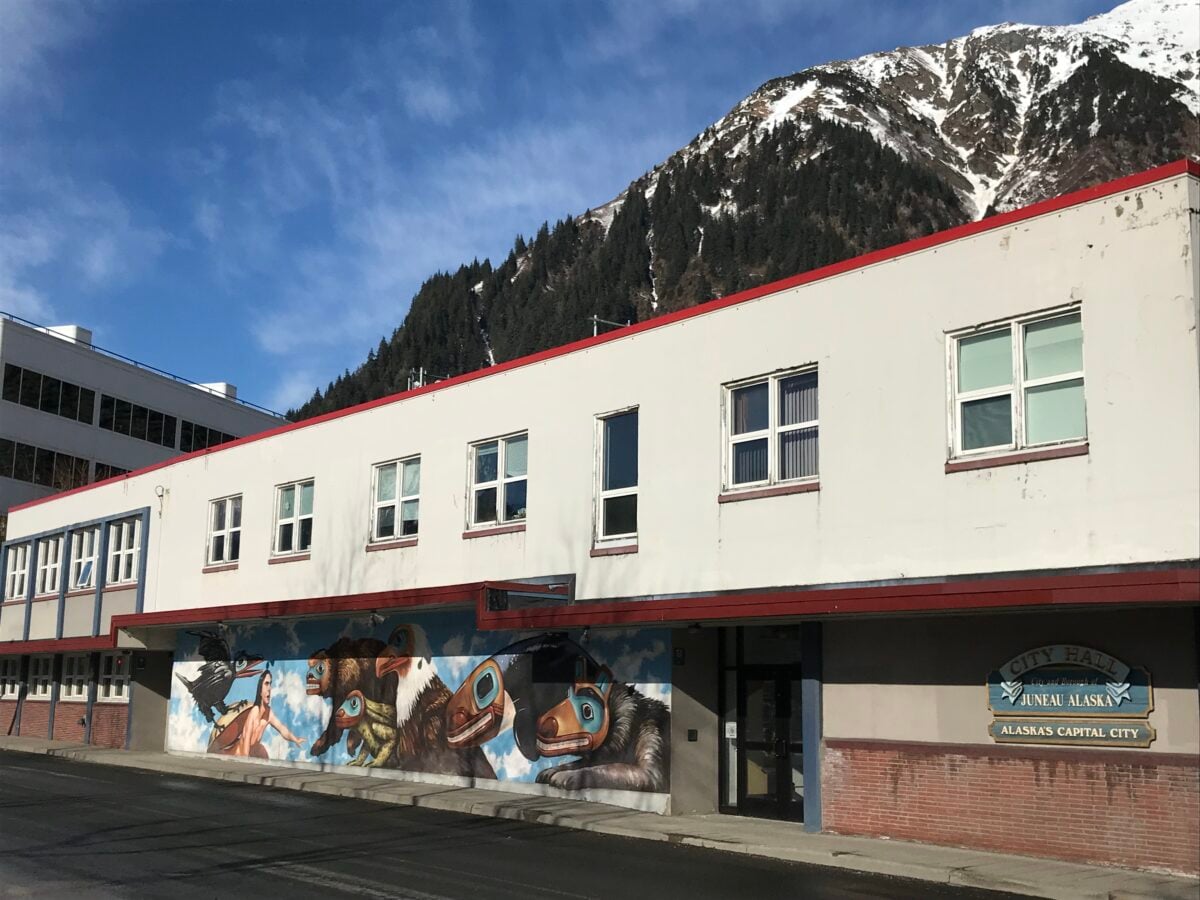
The City Hall vote center will be open from today until Oct. 6 for in-person voting or ballot drop-off. Voters mailing ballots are urged to take them to the counter and request a hand-stamped postmark; ballots must be postmarked by Oct. 6 to be counted.
If voters make a mistake, they should draw a line through the error, write “no,” and mark the correct choice, or request a new ballot at the vote center.
There are three candidates for the one areawide Assembly seat: Paul Roy Kelly, Brad Sapp and James J. McCants.
Mila Cosgrove is the only candidate for the District 1 Assembly seat.
Four candidates are running for the District 2 Assembly seat: Karla Hart, Joyce M. Niven, Malachi Thorington and David Lee Morris.
Three candidates are running for two Board of Education seats: Britteny Cioni-Haywood, David Noon and Christine Johnson.
reliminary unofficial results will begin being posted election night. Updated preliminary results are expected October 9, with final results scheduled for publication October 20 after certification.
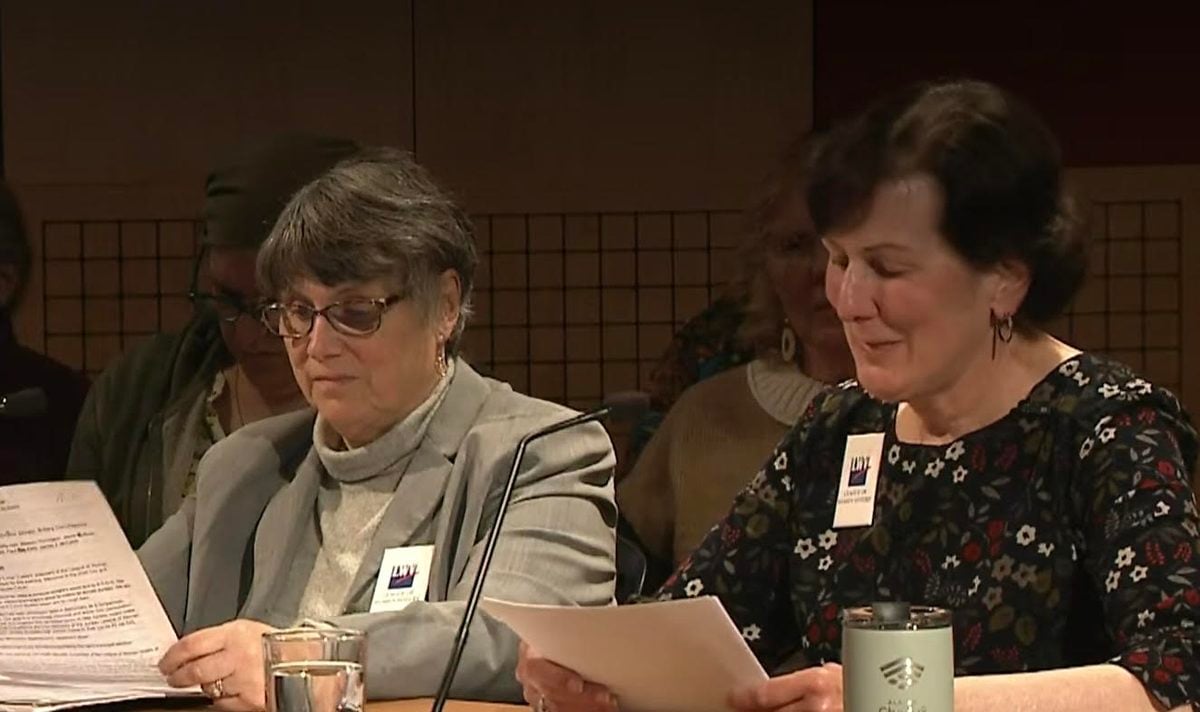
League of Women Voters Juneau municipal candidate forum, 9/16/2026, courtesy of KTOO
The Candidates for school board and city assembly in Juneau’s Oct. 6 municipal election took part in a televised forum Wednesday evening with different positions on taxes, housing and tourism during the 2026 City and Borough of Juneau Municipal Candidate Forum hosted by the League of Women Voters at KTOO.
“Remember, vote like democracy depends on it because it does.” Said Patricia Turner Custard, from League of Women Voters.
Voters will decide three ballot propositions this fall, including whether to extend a temporary 3% sales tax, raise the city’s property tax cap from 9 to 12 mills, and add a new seasonal 1% sales tax to support recreation.
Several assembly candidates, including Malachi Thorington and Joyce Niven, said they support all three measures to shore up city services.
“I will be voting in favor of all three of these tax measures. Juneau… is currently in a funding deficit and a bit of a hole that we need to crawl back out of.” Said Thorington.
While David Morris and Brad Sapp, argued Juneau has a spending problem, not a revenue problem.
“I intend to vote yes on the 3% and no on the seasonal and no on the mill cap… It wasn’t about people being unwilling to pay taxes. It was about: ‘City, stop wasting our money.’” Said Sapp.
On tourism, candidates split over whether proposed cruise ship docks on North Douglas should count toward Juneau’s five‑ship limit. Some urged a data-driven passenger cap and a moratorium on new docks.
“The tour industry accounts for 25% of city revenue right now and 20% of our employees… I fully support the tour industry. I fully support its expansion.” Said Sapp.
“I believe the five‑ship limit should stand… If you do the same thing in Douglas, you’re going to have to have the second crossing… I think five ships is the limit because of the pollution problem and the access problem.” Said David Morris.
Housing and public trust emerged as recurring themes. Multiple candidates called for opening more land for development and streamlining the planning process, and others, like Carla Hart said, “I think we should have houses as homes and not as houses as investments.”
Ballots will be mailed Sept. 18 and must be returned or postmarked by Oct. 6.
Former state Rep. Jonathan Kreiss-Tomkins, third from left, speaks at a gubernatorial candidate forum on Wednesday, while former Attorney General Treg Taylor, Anchorage business owner and talk-show host Bernadette Wilson and former Anchorage Mayor Dave Bronson listen. The forum was held by the Alaska Hospital and Healthcare Association and the organization’s annual conference in Girdwood. Taylor, Wilson and Bronson are Republicans. Kreiss-Tomkins is a Democrat. (Photo by Yereth Rosen/Alaska Beacon)
The three Republicans and one Democrat seeking to become Alaska’s next governor pitched their visions for state healthcare policy on Wednesday to an audience of experts: members of the Alaska Hospital and Healthcare Association.
The organization capped its two-day annual conference in Girdwood with a forum among the gubernatorial candidates who are running under Alaska’s ranked-choice voting system.
Along with addressing healthcare issues, all four candidates repeated talking points they have used at past events.
Former State Rep. Jonathan Kreiss-Thomkins, the only Democrat on the general election ballot, spoke about consensus-building across party lines, and he criticized outgoing Republican Gov. Mike Dunleavy for failing to do so.
Kreiss-Tomkins recounted his experience in a bipartisan coalition focusing on problems rather than party. “That’s a real North Star for me,” he said. “That philosophy of government, that principle has been painfully absent in the governor’s office for the last eight years, and it has really distressed me to see the direction Alaska is going as a consequence of that leadership in our governor’s office the last eight years. And I’m running to change that.”
Former Attorney General Treg Taylor spoke about his desire to cut bureaucratic red tape, including his experience with a real estate license that took a year and a half to transfer, an account he has described at numerous other gubernatorial events.
“We need to have government run at the speed of business,” he said, repeating a slogan he has used elsewhere.
Talk show host and business owner Bernadette Wilson, who has never held public office, pitched herself as an outsider and “the only one up on this stage that has never taken a check from government.” She said she breaks with past practices, including bipartisanship, that she said do not work. The current debates are about many of the same issues that faced gubernatorial candidates in past years, she said.
“And the question that each of us will have to answer is, ‘What are we going to do differently this time?’” she said.
In contrast, former Anchorage Mayor Dave Bronson touted the experience he gained in his three years as chief executive of the state’s largest municipal government.
Former Anchorage Mayor Dave Bronson, a Republican, speaks at a gubernatorial candidate forum held in Girdwood on Sept. 16, 2026, by the Alaska Hospital and Healthcare Association. (Photo by Yereth Rosen/Alaska Beacon)
“I ask you to just look at the resumes. I’ve already held the closest job in this state to the governor’s job. I governed 40% of the population of the state as the mayor,” he said. He “paid in blood” for the hard lessons that he learned, he said, experience that will serve him well as governor, a job for which “there’s no time for on-the-job training.”
Lost Medicaid coverage
On specific health topics, the candidates had many areas of agreement, but the discussion also revealed some key differences.
One divide emerged during a discussion about the loss of Medicaid coverage over the past two years for low-income Alaskans. At least a quarter of those being dropped from enrollment are not losing coverage because of lack of eligibility, Alaska Hospital and Healthcare Association President Jared Kosin said as he posed the question. Rather, they are being dropped because of long wait times and the bureaucratic hurdles they face in getting their applications considered.
Kreiss-Tomkins, who said he is proud of his record as a lawmaker working with the administration of Gov. Bill Walker to expand Medicaid coverage, said staff shortages are causing some of the problems. And he said some are caused by new rules imposed by the Trump administration, such as the work requirement that was embedded in the sweeping budget bill called the “One Big Beautiful Bill Act,”, have exacerbated problems for qualified Medicaid recipients, who are among society’s most vulnerable members.
And he made a veiled jab at U.S. Sen. Dan Sullivan and U.S. Rep. Nick Begich, both Alaska Republicans who voted for the bill and are running for reelection.
It is important to be “very clear about who voted for that legislation that is about to make it harder for Alaskans to get the care they need,” he said. “We need to be very clear-eyed about that.”
Taylor, in contrast, said he supports the bill’s requirement that Medicaid recipients work at least 80 hours a month, either at a paid job or in volunteer service or training.
“It is not unreasonable for an able-bodied adult, without dependents,” he said. Medicaid funds are not infinite,” so stewardship is needed to make sure they are spent properly, he said. Additionally, he said, fewer people on Medicaid could be a good sign. He said unemployment rates in Alaska have dropped.
“So that’s good. That’s the program working,” he said.
Alaska’s unemployment rate, though following a volatile pattern, has been on a long-term decline, according to the Federal Reserve Bank of St. Louis. In recent years, the rate bottomed out at 3.9% in August of 2022, rose to 4.8% in December 2025 and then declined again, falling to 4.3% as of July, according to the Federal Reserve bank’s statistics. Alaska’s rates have been above the national rate for most of the years in the past decade, according to the U.S. Bureau of Labor Statistics.
Former State Rep. Jonathan Kreiss-Tomkins, a Democrat, speaks at a gubernatorial candidate forum held in Girdwood on Sept. 16, 2026, by the Alaska Hospital and Healthcare Association. (Photo by Yereth Rosen/Alaska Beacon)
Wilson said a business-like approach is needed to fix the Medicaid problems.
“We need to treat Medicaid like a business that is failing Alaskans,” she said. “We need to come in and we need to look at how can we hire people from the private sector that know processes and can hold these processes to a more accountable timeline.”
Bronson said Kosin’s statistics show that a large percentage of qualified Alaskans are being dropped from services.
“We are failing at a state level, especially in the Department of Health,” he said. Upon taking office as governor, “I would direct the Department of Health to conduct a review of all operations, and that includes the processing of paperwork for Medicaid,” he said.
Bronson also said that the One Big Beautiful Bill Act is causing extra problems for Alaska, and that he would seek an extension of the national Jan. 1 deadline for states to comply with all of its provisions.
Rural health ideas
On the subject of rual health care in general and, more specifically, what to do with “rural health transformation” funds granted from the federal government to the state, two of the candidates referred to their own family experiences.
Kreiss-Tomkins, who is from Sitka, spoke about his mother, an Indian Health Service doctor who spent her entire career at the Southeast Alaska Regional Health Consortium. He said he got his own health care from that tribal organization.
Wilson, noting that her grandmother was born in the Bristol Bay community of Naknek and that she is of part Aleut ancestry, said she has experience as a patient at the Alaska Native Medical Center.
As for the $272 million in rural health transformation funds that the state got from the federal government and that the Department is disbursing in a series of grants, the candidates offered a variety of suggestions.
Wilson said the state should invest in technology, especially technological advances that might help rural Alaskans avoid the need to travel to Anchorage or elsewhere for care.
Former Attorney General Treg Taylor, a Republican, speaks at a gubernatorial candidate forum held in Girdwood on Sept. 16, 2026, by the Alaska Hospital and Healthcare Association. (Photo by Yereth Rosen/Alaska Beacon)
She sees the travel-related challenges when she is at the Alaska Native Medical Center, she said. “You have people who are pulled out of their community, pulled out of their village, they’re coming into Anchorage. Sometimes it’s for an unknown length of time,” she said. The state needs to try to find ways to ensure that rural patients can be treated at home, she said.
Bronson made similar observations about the need to minimize travel for rural patients, citing “robust telehealth” as one tool.
Kreiss-Tomkins said the state should be seeking to make the rural transformation grants “leverage structural and systems change that will have lasting and enduring benefit to the system” rather than use them for construction or for one-time projects. The state should not count on getting similar money in the future, he said.
Taylor called the funding a “gift” that he hopes will be used “to help reinvent healthcare in Alaska.”
There was a split among the candidates over mandatory staffing ratios for nurses, as proposed in a bill that emerged late in this year’s session, Senate Bill 283. The Alaska Hospital and Healthcare Association opposed the bill, which did not advance out of the Senate Labor Committee.
Three of the gubernatorial candidates said they also opposed the idea of codifying such ratios into law, but Taylor spoke out in support. He cited a 2016 study in Australia that found that for each patient taken off a a nurse’s workload, there was a 7% drop in the likelihood of death and a 3% shorter hospital stay.
However, establishing firm ratio requirements would also necessitate related action to ensure sufficient numbers of nurses in the state, he said.
“You cannot mandate nurses into existence,” he said.
The other three candidates said mandatory staffing ratios would not be workable in Alaska’s diverse healthcare settings.
However, Kreiss-Tomkins said, the idea behind the proposal is laudable. “I appreciate where the impulse comes from,” he said. “I mean, everybody wants safe standards of care for patients, and you don’t want nurses or other practitioners spread thin.”
Complex subjects
Concerning mental and behavioral health, Bronson repeatedly defended his controversial attempt as Anchorage’s mayor to build a huge shelter and “navigation center” in the city’s university-medical district to serve the unhoused.
Anchorage business owner and talk-show host Bernadette Wilson, a Republican, speaks at a gubernatorial candidate forum held in Girdwood on Sept. 16, 2026, by the Alaska Hospital and Healthcare Association. (Photo by Yereth Rosen/Alaska Beacon)
“That facility, I think, was the right answer to dealing with a lot of the healthcare issues we face in the city of Anchorage and across the state because we’re kind of the homeless center for the state,” he said. “We almost had it done. We actually started pouring concrete.”
Bronson’s plan was for a tented facility to house and serve hundreds of people at a site across the street from the Alaska Native Tribal Health Consortium campus. The Anchorage Assembly rejected the plan after it was revealed that the Bronson administration awarded a contract and started construction illegally. The plan had drawn backlash from residents in the area, which currently is the site of ballfields and recreational trails.
Taylor said Alaska’s mental health challenges are daunting, with suicide and alcohol death rates that are twice the national average.
But there has also been positive movement under the Dunleavy administration, he said. He cited a bill that the governor signed in 2022, House Bill 172, that supports the use of crisis centers and teams to treat patients in emergencies.
There are now mobile crisis centers in four communities, Taylor said. “The added effect of that is keeping people out of your emergency rooms,” he said. “Youth suicides are down sharply now.”
It was unclear whether Taylor was referring only to the communities where the mobile crisis teams are operating or to the state as a whole.
Statewide, the rate of youth suicide fatalities reached a 10-year high in 2025, according to the Department of Health’s epidemiology section.
Other subjects discussed at the forum included the rising cost of health insurance in Alaska and qualities that the candidates are seeking in officials they would hire to manage healthcare services.
At the event’s conclusion, Kosin thanked the candidates for delving into healthcare topics that are complex.
“This is not always the most comfortable environment, and you guys were here. And that says a lot about your character,” Kosin said to the candidates.
Former Attorney General Treg Talor speaks at a gubernatorial candidate forum on Sept. 16, 2026, while Anchorage business owner and talk-show host Bernadette Wilson, former state Rep. Jonathan Kreiss-Tomkins and former Anchorage Mayor Dave Bronson listen. At the lecturn is Jared Kosin, president of the Alaska Hospital and Healthcare Association. The organization held the forum in Girdwood, and the event was focused on healthcare issues. (Photo by Yereth Rosen/Alaska Beacon)
On Oct. 1, the Alaska Department of Natural Resources will begin limiting how far in advance reservations can be made to three months, down from six months.
The only exceptions to the three-month reservation window will include the Wood-Tikchik Region and cabins on Afognak and Shuyak Islands in the Kodiak region, which will continue to allow reservations up to six months in advance.
The change is part of a shift to a new online booking system and website that also opens Oct. 1. Cabin-seeking Alaskans will be unable to change, modify or cancel their existing reservations from Sept. 28 through Sept. 30 as part of the transition.
Beginning Oct. 1, reservations for all facilities can be made for Jan. 1, 2027 and the 3-month rolling window will begin.
Wendy Sailors, community engagement manager for Alaska State Parks, said by email that the new shorter reservation window is the result of feedback from Alaskans who said “that it is difficult to plan that far out, often people forget that they had the reservation and have to cancel last minute or just don’t use it, etc. So in addition to the three-month rolling reservation window, we are incorporating a few new features like an email reminder 7 days out.”
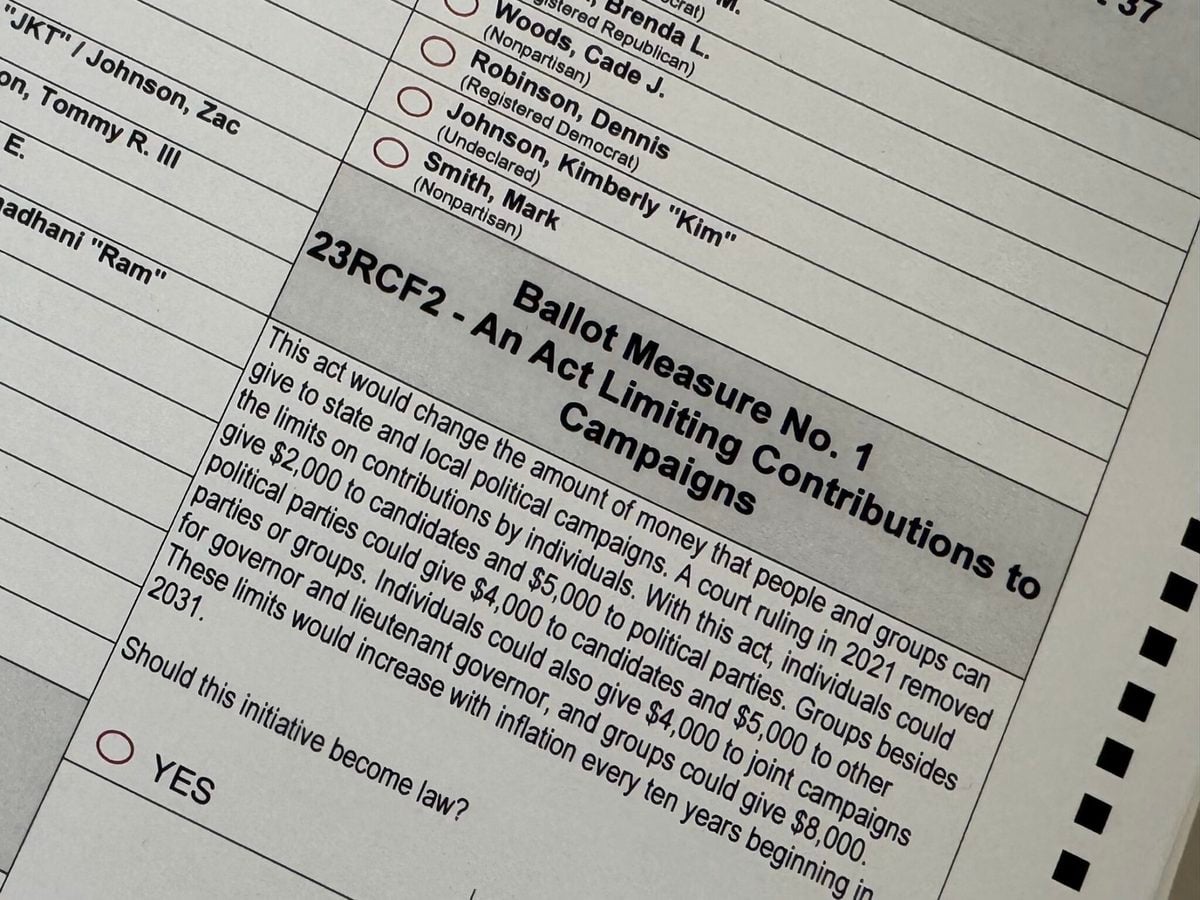
A sample ballot seen at the headquarters of the Alaska Division of Elections on Thursday, July 9, 2026, shows the language for the campaign finance ballot measure. (James Brooks photo/Alaska Beacon)
In August, more than 70% of participating Alaska voters supported Ballot Measure 1, voting to restrict the amount of money that individuals can contribute to campaigns for state office.
On Nov. 3, Alaskans will vote on Ballot Measure 2, and an overlooked section of that measure — intended to roll back the state’s election system to what it was in 2020 — almost certainly would repeal part of Ballot Measure 1.
“I mean, people are like, why didn’t you raise this earlier? I’m like, it’s got 91 sections, and I literally didn’t notice,” said Scott Kendall, the author of Alaska’s existing elections system and an attorney fighting Ballot Measure 2.
In 2020, Alaskans passed a different Ballot Measure 2. It installed three major changes to the state’s election system: An open primary, where all candidates run together, and the top four advance to the general election; a ranked choice general election, where voters sort those four candidates in order of preference; and a disclosure law requiring third-party groups to disclose their donors when the groups donate to political candidates and causes.
This year’s Ballot Measure 2 seeks to repeal all three parts, returning Alaska elections to what they were in 2020.
There’s also a new wrinkle because of this year’s Ballot Measure 1.
That single-ticket system was installed in 2020’s Ballot Measure 2. Ballot Measure 1 limited donations to that single ticket, putting the limits in Alaska Statute 15.13.070(g).
Ballot Measure 2 seeks to get rid of the combined single-ticket campaign, and Section 5 states, “AS 15.13.070(g) is repealed.”
That would get rid of the combined donation limit for governor and lieutenant governor. But some state officials say another law may then come into play.
Because candidates would — if Ballot Measure 2 passes — be running separately, they may be limited by a different part of Ballot Measure 1, AS 15.13.070(b), which applies to individual candidates.
That’s the position held by Alaska Public Offices Commission director Heather Hebdon. APOC is in charge of enforcing Alaska’s campaign finance laws.
By email, Hebdon said that if Ballot Measure 2 passes, “contribution limits for gubernatorial candidates would fall under those found in AS 15.13.070(b)(c) and (f).”
She believes APOC would likely write new regulations to deal with those limits’ applicability to governor and lieutenant governor candidates.
Kendall said he isn’t sure about that.
“I will say it’s really legally tenuous. I think when you have a statute that says a thing and you explicitly repeal that thing, you get what you get,” he said.
Supporters of Ballot Measure 2 said they don’t have a position on the issue.
“Repeal Now wrote Ballot Measure 2 as a full and complete repeal of the 2020 ballot measure that brought ranked choice voting to Alaska. We are unaware of any effect on Ballot Measure 1 and thus can’t comment on that,” said Bethany Marcum, treasurer of Repeal Now, the leading group behind Ballot Measure 2.
Craig Richards, a former attorney general who represented Repeal Now in court, said he was unfamiliar with the issue.
The Alaska Department of Law also declined to make a definitive statement on the topic.
Sam Curtis, a spokesman for the department, said by email that attorneys within the Alaska Legislature would make the final determination of what happens if Ballot Measure 2 passes.
That’s because the revisor of statutes — an obscure staff official — is in charge of mediating disputes between enacted laws.
Emily Nauman, the Legislature’s chief attorney, declined to say how the Legislature might interpret any conflict.
Rep. Calvin Schrage, I-Anchorage and a sponsor of Ballot Measure 1, said earlier this month that he has requested that Nauman’s office deliver a written ruling on the issue, but as of Tuesday afternoon, that memo had not yet been completed.
The Alaska Supreme Court has dealt with similar issues before. In 2021 and in 2006, the court ruled that later laws trump earlier ones.
“In general, if two statutes conflict, then the later in time controls over the earlier, and the specific controls over the general,” the court wrote in a 2006 decision.
On Sept. 11, Schrage said he doesn’t like the idea of repealing a campaign finance limit.
“It seems to fly in the face of what Alaskan voters have time and time again reaffirmed as a priority for them,” he said.
The Alaska Supreme Court had an opportunity earlier this month to address the issue but declined to take it up.
As a result, the final description on the ballot says only that Ballot Measure 2 would “remove the limits on donations to joint campaigns for governor and lieutenant governor.”
It doesn’t say whether anything will replace them.
NOTN- The Juneau Assembly has indefinitely tabled a proposal that would have required nonprofits to collect sales tax on purchases, after a marathon debate that Mayor Beth Weldon described as increasingly confusing for the public.
Speaking on Monday night’s meeting, Weldon said the measure drew intense public interest, but efforts to carve out protections for smaller nonprofits only muddied the policy.
“We were just creating confusion. Just for instance, what’s intermediate fundraising? How do the raffle tickets fit in there? 14 days isn’t long enough for a raffle ticket period, and so at the end, especially after talking with the finance, Ms. Woll proposed an amendment to table it indefinitely. And what that means is, unless we bring it up at our next meeting, it dies at this time.” Weldon said.
At the meeting, 17 nonprofit leaders testified against the measure, raising concerns about fairness, added financial burdens and more confusion over how the ordinance would work.
“What I have a hard time understanding is the policy rationale for carving out certain types of non-profits as ineligible for the sales tax exemption, though we have an important charitable mission, it sends a message that it’s not important enough. Crafting tax law is tricky. Our Internal Revenue Code is 3000 pages. The regs are another 70,000. I get it. I understand interpretations have to be made and lines drawn, and I also understand-I truly do-the desire to protect basic human services, food, and shelter to those who need it most. But I question whether the city should be in a position of determining where to draw that line and what services and missions are important.” Said Bridget Lujan, Executive Director of Juneau Dance Theater.
The proposal was projected to raise closer to $1–2 million in new revenue, down from earlier estimates of $3 million, according to Weldon. She said the financial benefit no longer justified the level of community angst.
The Assembly also approved funding for Hesco barriers and other work related to glacial outburst flood mitigation.
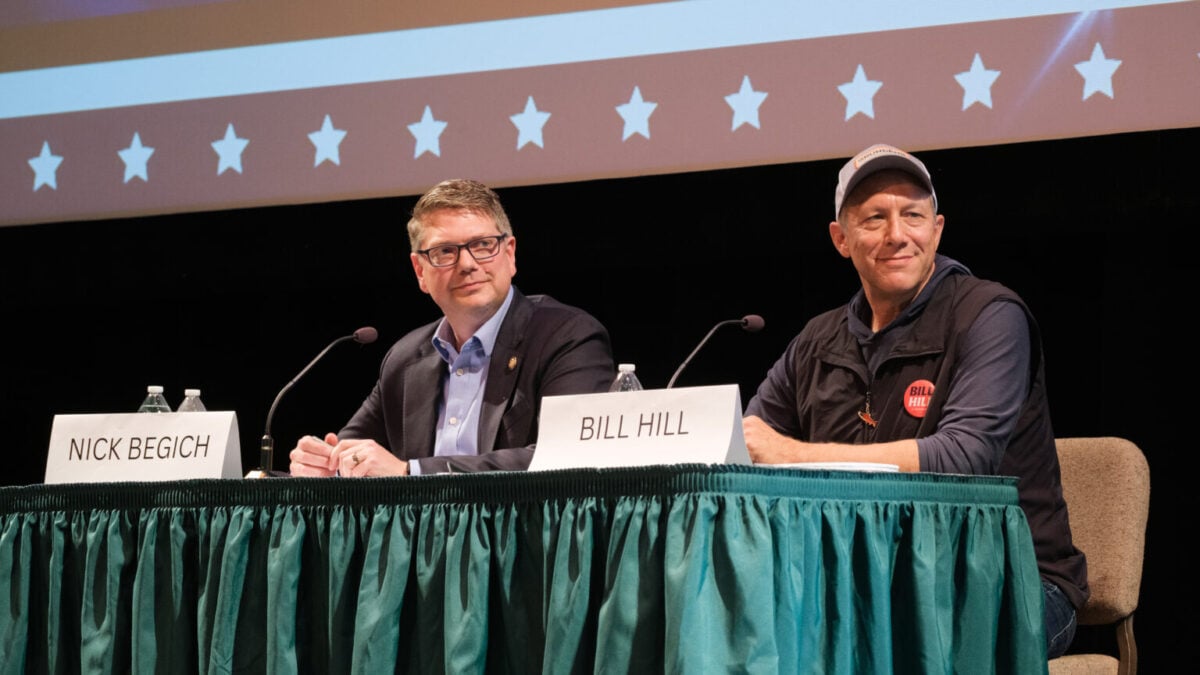
Alaska candidates for the U.S. House race incumbent Republican Nick Begich III (left) and independent challenger Bill Hill (right) squared off at a fisheries debate in Kodiak on Sep. 12, 2026. (Photo by Brian Venua/Alaska Beacon)
Front-runner candidates for Alaska’s sole U.S. House of Representatives seat expressed strong support for the fishing industry and coastal communities at a debate in Kodiak over the weekend.
Incumbent Republican U.S. Rep. Nick Begich III and independent challenger Bill Hill took very similar positions on issues including fisheries bycatch, declining fish stocks and representation in federal fisheries management, but there were some differences.
Begich touted his legislative record in his first two-year term as beneficial to Alaska fisheries, while Hill said his personal history as a lifelong fisherman in Bristol Bay is advantageous for representing Alaska in Congress.
Begich, a technology entrepreneur and business executive, garnered 44.6% of the vote in the primary election, while Hill, a former school superintendent and commercial fisherman, received 32.5% of the vote. Third and fourth place finishers in Alaska’s ranked choice general election include Eric Hafner — a registered Democrat serving a federal prison sentence in New York – with 3.8% of the vote, and Libertarian Jim McDermott of Fairbanks with 1.2%.
The winner of the November election will serve a two-year term as one of the 435 members of the U.S. House of Representatives.
Begich promoted his legislative record as a freshman in the Republican-controlled U.S. House. This spring, six bills he sponsored passed Congress to become law — a tie with another Arizona lawmaker for most bills passed as a freshman — but none of those bills directly address fisheries issues.
“I have passed more legislation than any freshman on record,” Begich said. “And those are good Alaska bills — they are bills that unlock lands for Alaskans, and they are bills that, in many cases, we’ve been working to achieve for decades.”
Hill repeatedly referenced his experience growing up subsistence and commercial fishing in Bristol Bay. “I raised three of my kids on my fishing boat, and understand the importance that state, national and international politics play in what happens on our back decks with our children, what happens in the income that we can take home, what taxation does to us, what tariffs do to us,” he said. “I’ve lived a life of fish.”
Bycatch
Several debate questions focused on bycatch, the accidental harvest of nontargeted fish. Bycatch has raised public concern around Alaska’s industrial trawl fleet, which has many vessels harbored in Kodiak, where the debate took place.
Both candidates said they support broader representation on the North Pacific Fishery Management Council, which oversees fishing policy in federal waters, including bycatch regulations.
Begich said he supports increasing representation for subsistence, sport fishers and small commercial operators, as well as large operators, in council decisions. He pointed to a bill he introduced, the Bycatch Reduction Act, which would require the council to implement gear performance standards to reduce bycatch, to make investments in fishing gear and fisheries research and to increase monitoring and reporting from the industry and the council, among others.
“We need transparency — more transparency for folks who may have conflicts of interest that currently serve on the NPFMC,” Begich said. He also expressed support for a chum bycatch limit established by the council this year for the Bering Sea pollock fishery.
Hill said he supports bycatch limits to protect salmon runs, and additional seats representing subsistence and tribal groups.
“Subsistence is sacred, and the very first thing that needs to happen, and I think you hear it from across the state — this is why there’s such a loud outcry — is because some of our subsistence users have not been able to access their resource, which is more than just protein, for quite a few years now,” he said.
In a question about Congress’ role in reducing bycatch, debate moderators noted all fisheries produce some bycatch harvest and said “a goal of zero bycatch isn’t reasonable.”
But both candidates pushed back on that framing and said that zero bycatch should be the ultimate goal.
The industrial trawl fleet, particularly boats that target pollock, has been the focus of public criticism because it contributes substantially to the state’s bycatch numbers for species including juvenile halibut, cod and salmon returning to spawning grounds throughout Alaska.
Begich said he agreed that every fishery produces some level of bycatch and it’s up to the council to manage each complex fishery. But he said the goal should be “aggressive.”
“I do think the goal should be zero. It’s going to be a long road to get there. But we also have to recognize that in every single fishery, whether it be subsistence, sport, small commercial or large commercial, they have a bycatch responsibility as well,” Begich said.
Hill said the goal should be zero bycatch. “We need to work towards that. We need to work towards a very low-threshold for our trawling industry, especially the out-of-state corporate trawlers,” he said.
And Hill expressed confidence that the trawl industry would be able to meet required limits.
“My perspective is when you set something out for industry to accomplish, they always find a way, and we’ve seen over and over again that our trawl fleet has met the standards that are being set for them. So, can we get to 0%? That would be everybody’s desire, but should we be working towards it? Yes, we should be,” Hill said. “But those who are bad actors, you’ve got to leave the fishery.”
When asked about the primary causes of king and chum salmon run declines, Begich responded it was “largely bycatch related.”
“You look at the Yukon, you look at the Kuskokwim — those runs are way down. We’re seeing some recovery in chums. I think that the cap that we put in with NPFMC is sort of that initial shot saying, ‘Hey, we’re going to be managing these more carefully,’” Begich said. “But I think that historical bycatch is the root cause.”
Hill said he agreed, and added that climate change driven factors are affecting Alaska’s salmon runs. “Climate change is a real thing, and we need to start mitigating for that,” he said. “But yes, we need to end bycatch.”
Processing and protecting Alaska’s fisheries
Both candidates said they would support investments in building the workforce in fishing and processing sectors, as well as more visas for hiring international workers in processing.
In a lightning round of questions, the candidates agreed on every issue. They supported science-based fisheries management, more investment in research and engaging with a wide range of fisheries interest groups prior to introducing new legislation or policies. They also agreed that rural and tribal communities should have more say in decisions affecting fish.
When asked how they would ensure the economic value of federally-managed fisheries would not come at the expense of Alaska communities, Begich said he supports labeling rules for farmed vs. wild-caught fish.
“Alaska seafood is competing with penned fish and farmed fish, and the end consumer doesn’t know it,” Begich said. “And so, when you’re buying an Alaska seafood product, we need to make sure that it’s labeled Alaska. That’s transparent because it gives us the best price for our product and it reduces some of the pressure on our fisheries.”
Hill said he would support more investment in in-state seafood processing to diversify processors to which fishing fleets can sell their harvests. “More processing in our state that’s not a consolidated, vertically integrated type of processing,” he said. “And we need to make sure that we’re legislating to make sure that farmed fishing does not come to our seas and that we keep them off for as long as we possibly can.”
Geopolitics
Both candidates expressed support for tariffs on international seafood to protect Alaska markets.
Hill also condemned the U.S. war in Iran for driving high costs of fuel and affecting fisheries.
“The Iran war is a terrible, terrible thing in terms of how it’s impacted our industry,” he said. “The fuel costs I paid this summer were $2 per gallon more than last year, and they were already high. And then we start talking about things like food and groceries, and the things that allow our crews to do good work for us while we’re fishing hard.”
Begich has expressed support for the Trump administration’s military action against Iran, and voted against a war powers resolution that passed Congress in June calling on President Donald Trump to remove armed forces against Iran, unless authorized by Congress or a declaration of war.