CBJ-The City and Borough of Juneau (CBJ) invites Juneau residents to take a deeper dive and share their city budget priorities by participating in one of three in-person CBJ Community Compass Workshops offered this February and March. Workshops are open to all, however, space is limited, so residents must sign-up in advance at bit.ly/CBJWorkshop to reserve a spot.
At each CBJ Community Compass Workshop, participants will take a hands-on approach to providing input about the city’s upcoming budgeting process in the face of both challenges and opportunities. Participants will respond to different scenarios that impact the city budget in this collaborative activity and small group discussion. Workshops are expected to run 60 to 90 minutes and all input gathered will be shared with the Assembly.
Workshop Dates and Locations:
Wednesday, February 18 at 5:30 p.m. at Filipino Community Hall (251 South Franklin Street)
Tuesday, February 24 at 5:30 p.m. at Mendenhall Valley Public Library (3025 Dimond Park Loop)
Tuesday, March 3 at 5:30 p.m. at Douglas Public Library (1016 3rd Street)
The CBJ Community Compass Workshops are a part of CBJ’s effort to gather community feedback in support of the Assembly’s budgeting process this spring.
Not able to make it to a workshop? Learn more about additional ways provide your input by visiting juneau.org/community-compass or by emailing your comments to boroughassembly@juneau.gov.
For more information, contact the CBJ Communications & Engagement division at communications@juneau.gov.
This chart from the February 2026 edition of Alaska Trends Magazine shows the growth in Alaska’s nonresident workforce since the COVID-19 pandemic emergency. (Alaska Department of Labor and Workforce Development chart)
The number of out-of-state workers in Alaska is continuing to rise and is near an all-time high, according to a new report published this week by the Alaska Department of Labor and Workforce Development.
In 2024, almost 23% of non-federal jobs in Alaska were held by someone who did not live in the state. Nonresidents earned roughly $3.8 billion, or about 17% of every dollar earned from a non-federal job.
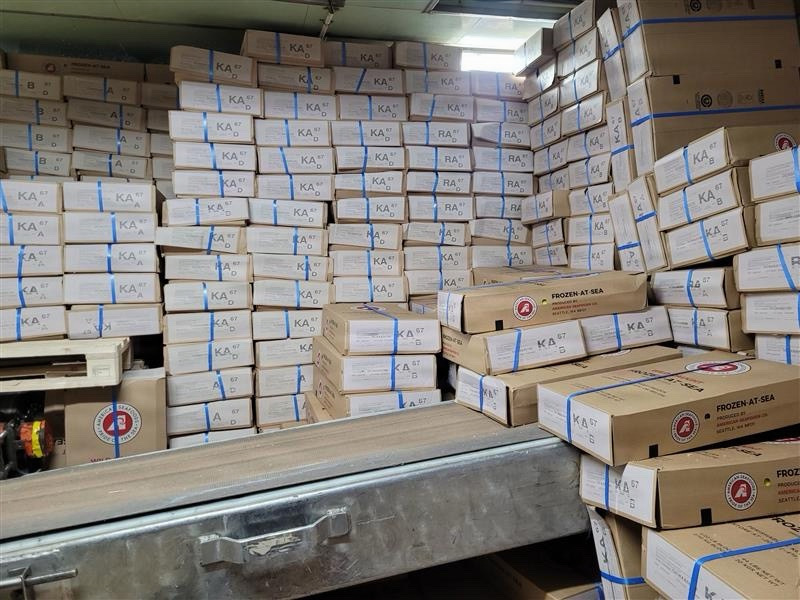
In some industries, the proportion of nonresident workers was much higher: In 2024, more than four in five seafood processing workers were nonresidents. Among oil and gas workers, 40.5% were nonresidents. Among miners, nonresidents made up 44.2% of all workers, and nonresidents averaged higher wages than residents did.
The state has been collecting nonresident worker data since 1990, and the new figures are the second-highest on record, behind only 1992, which used a different job classification system. That year, 23.7% of Alaska workers were nonresidents.
The proportion of nonresident workers has been rising steadily since the COVID-19 pandemic emergency layoffs of 2020.
“It’s pretty clear that is kind of what’s contributing to what we’re seeing with employers having to rely heavily on nonresidents,” he said.
“Every industry now is starting to lean more heavily on nonresidents, including ones that have historically not. Even things like state government and local government, we’re starting to see more nonresidents,” Krieger said.
In most industries, nonresidents earned less than residents did because nonresidents tended to hold seasonal jobs.
Across the state, nonresidents averaged $16,302 in wages for any given quarter of the year. Residents averaged $16,531, indicating that nonresidents and residents were generally paid about the same.
Gunnar Schultz, a Department of Labor analyst who compiled this year’s report, said the numbers are based on unemployment insurance reports filed by employers with the state. Alaska requires employers and employees to pay into the state’s unemployment insurance fund.
Those numbers are then contrasted with Permanent Fund dividend applications.
“Did you apply for a 2024 PFD or 2025 PFD? If you applied for neither, you’re a nonresident,” he said.
Alaska had almost 15,500 federal workers in 2024; those aren’t included in the report, nor are members of the military and self-employed Alaskans.
That last category includes many commercial fishermen.
The report separately analyzed those jobs, and based on permit data and other information, “nonresidents were an estimated 49 percent of the harvesting workforce, which includes permit holders and their crew, and nonresidents took in 57 percent of gross harvesting earnings.”
NOTN- Juneau officials are watching state decisions closely as local government prepares for what could be a difficult budget season.
Christine Woll, chair of the City and Borough of Juneau Assembly’s Finance Committee, said the committee is preparing for the upcoming budget process.
“We’ve been going line by line, through what we typically fund, and asking a lot of questions. And so last night, we invited some of our partner agencies in to talk to us, and did a deep dive into their budget.” She said.
Those groups included Travel Juneau, which handles tourism marketing for the city, and the Juneau Community Foundation, which administers grant programs supporting local social services. The city typically provides about $1.5 million annually to each organization, Woll said.
“Given that, we’ll likely be thinking about cutting some services over the next few months, we want to make sure we understand what they’re up to and the impact of the dollars that we put in.” Woll said.
The committee also heard from the Small Business Development Center, which receives a smaller amount of city funding but provides coaching and support to local small businesses.
The Juneau Assembly has not taken a formal position on the proposed Cascade Point ferry terminal project, which is being considered by state lawmakers today.
“The assembly has not taken a position on Cascade Point. We probably don’t all agree on it is part of the reason. Obviously it’ll have an impact on our city, so we’re interested to see what happens.” Said Woll, “Personally, I’m not convinced that it’s the best use of state resources, especially because we do have a struggling ferry system, but the assembly has basically said, we know this matters, but if we’re not all going to be unanimous in our decision, we’ll wait and see how things play out.”
Questions about state spending priorities extend to Gov. Mike Dunleavy’s proposed fiscal plan, which includes a statewide sales tax. Woll said the Assembly is still deciding whether to take a specific position on the proposal.
“We’re still deciding whether we want to take a specific stance on his fiscal proposal around sales tax. We have taken a position in the past that I think is going to be presented to the Legislature today. We are figuring out how we fund our state budget; it is going to require a broad-based tax of some sort, and so we are supportive of that.” Said Woll, “I know there are folks with some concerns about if it is a sales tax, as proposed by the Governor, because, of course, the city has a sales tax, and that’s usually about 50% of our general income. The challenge is, if the state also has a sales tax that takes away some of our local control, we wouldn’t be able to decide who gets exemptions.”
Woll mentioned the Governor’s proposed sales tax might also make it harder for voters to approve future municipal taxes.
“Voters have to approve our local city sales tax. So if the state puts a tax on top of that, it just makes it less likely that the voters will support a city tax. So that definitely makes me a little nervous.” She said.
The Assembly is expected to continue its budget discussions in the coming weeks.
Rep. Sarah Vance, R-Homer, speaks Friday, April 26, 2024, on the floor of the Alaska House of Representatives. (Photo by James Brooks/Alaska Beacon)
By: Corinne Smith, Alaska Beacon
Rep. Sarah Vance, R-Homer, speaks Friday, April 26, 2024, on the floor of the Alaska House of Representatives. (Photo by James Brooks/Alaska Beacon)
Alaska lawmakers advanced a bill on Friday that would create new state felony charges for the crime of using artificial intelligence to generate child sexual abuse material.
The House Judiciary Committee unanimously passed House Bill 47, sponsored by Rep. Sarah Vance, R-Homer on Friday. CSAM, formerly referred to as child pornography, is any material that visually depicts sexually explicit or obscene conduct involving a child under the age of 18.
Vance told lawmakers that AI-generated CSAM is a growing problem that is already affecting Alaska communities. “AI-generated CSAM poses serious risk to children by enabling perpetrators to produce highly realistic virtual images of child abuse,” Vance said in a presentation to lawmakers ahead of the vote. “These images are often indistinguishable from real ones, complicating identification by experts and overwhelming law enforcement’s ability to identify real victims.”
Additionally, she said AI-generated images can be used as blackmail. “These realistic, synthetic images create new avenues for predators to exploit minors and their families through extortion and financial coercion, significantly escalating harm and trauma,” she said.
Vance said she introduced the legislation after an Army soldier stationed at Joint Base Elmendorf-Richardson was arrested for creating AI-generated CSAM in 2024.
Vance said the case revealed to her that Alaska law does not have a statute addressing AI-generated CSAM. “But that soldier was prosecuted under federal law, not state law,” Vance said. “Currently, Alaska must rely on federal prosecutions due to our lack of a statute addressing this issue.”
She said she has heard from constituents that the state’s lack of AI-specific CSAM laws is a concern.
“I also had some mothers in Homer contact me probably about a year and a half ago now that their 13-year-old daughters had been subject to the use of AI,” Vance added. “They went to law enforcement, and Homer Police Department said, ‘Alaska statutes do not address AI-generated use of images.’ And so this hit really close to home for me.”
Homer Police Department officials said they investigated the case and the Kenai District Attorney’s Office charged two middle school boys with exploitation of a minor after they created AI-generated nude images of classmates.
While there is no Alaska state law specifically addressing AI-generated CSAM, there are statutes that prohibit the viewing, possession or distribution of CSAM.
“Basically, any depiction of photograph, audio, video recording, drawing, anything like that, if it depicts children being involved in certain sexual simulations or exploitation, then that’s considered exploitation of a minor,” said Lt. Ryan Browning with the Homer Police Department. “We felt like that was enough to meet the probable cause for the statute.”
Statewide, the Alaska Department of Public Safety works with local and federal law enforcement agencies to investigate each CSAM case reported, said Austin McDaniel, director of communications for the agency.
McDaniel said the department does not have data available on the number of recent cases involving AI generated materials. By email, he said the department has received reports of AI-generated CSAM, but he said those reports are not “prevalent.”
He said a team of more than ten investigators work in a unit within the Alaska Bureau of Investigation focused solely on CSAM-related crimes.
“All that they do is child sexual abuse material investigations, or CSAM investigations, and they certainly and unfortunately, stay busy throughout the year,” he said. He noted a “vast number” of cases are reported to the Anchorage Police Department.
State public safety officials received 330 reports of alleged CSAM or child exploitation related crimes in 2024, the most recent year of publicly available data. “We go through and investigate those instances, refer charges to state prosecutors, or work very closely with our federal partners when it might be better to pursue federal charges against somebody versus state charges,” McDaniel said.
Sexual violence is prevalent across Alaska — and 51% of reported victims were minors in 2024. McDaniel noted the most common age of victims of sexual offenses is 13 years old.
“So between our CSAM investigations or child sexual abuse investigations, you know, we are certainly kept very busy,” he said. “And we are working across the state, around the clock to investigate those instances and to hold anyone that victimizes Alaska’s kids accountable for their actions.”
Angela Kemp, deputy attorney general for the criminal division of the Alaska Department of Law, said currently the state has to prove that an actual child was used to create the sexual abuse material to prosecute the case. She said investigators use digital forensic tools to determine if the material is AI-generated, or whether there is a child victim.
“For cases where we cannot prove an actual child was used, law enforcement works with our federal partners to determine whether the conduct can be prosecuted under federal law,” she said.
Vance said if the legislation is passed, it would criminalize all possession of AI-generated CSAM. “It’s hard to distinguish if there was a real victim involved, or if it is all generated through AI technology, this bill would allow them to say all of it is prosecutable,” she said.
The bill would also enact new sentencing guidelines for AI-generated CSAM, and depending on the charges and prior felony convictions, offenders could face two to 99 years in prison.
The bill has been referred to the House Rules Committee, which will determine whether it will go to the full House of Representatives for a vote. If passed, the bill would need to be considered and approved by the Senate to become law.
The Anchorage Daily News office in Midtown Anchorage is seen on Sept. 16, 2024. (Photo by Yereth Rosen/Alaska Beacon)
This article was updated at 7:35 p.m. Wednesday with comment from the plaintiff.
Two of Alaska’s largest news organizations and two top reporters did not commit defamation when they described a former state employee’s statements about rape, a state judge ruled on Tuesday in Anchorage.
Jeremy Cubas, a former aide to Gov. Mike Dunleavy, sued Alaska Public Media, the Anchorage Daily News, Nat Herz and Curtis Gilbert last year. American Public Media, a national organization, was also named in the suit.
Cubas resigned in 2023, shortly before the publication of an article that described comments he made in two podcast episodes. He filed suit almost two years later, seeking more than $5 million in damages and lost wages.
Cubas specifically challenged two parts of the article — a paraphrase that said Cubas “said it’s fine for a man to force himself on his wife” and the statement that Cubas “made comments about rape.”
In a 22-page order, Judge Christina Rankin said the second statement “is an accurate quote of Cubas’ own statement” in the podcast.
“Defendants used accurate, direct quotes from Cubas in the article. Therefore, Cubas can prove no set of facts that Statement Two is unfairly abridged, mischaracterized, distorted, or littered with slight inaccuracies,” Rankin said.
For the first statement, which was a paraphrase rather than a direct quote, Rankin concluded that it is “a fair abridgement” of Cubas’ words.
Cubas had argued that his belief that it is impossible to rape one’s wife — something he said during the two podcast episodes — is not the same as saying it is fine to “force yourself” on one’s wife.
Cubas’ core argument, Rankin concluded, was that the wording of the paraphrase was such that it implied Cubas believed it was OK for a spouse to “violently rape one’s own wife.”
“However, it is the alleged defamatory statement itself that the Court needs to review for truth, not the plaintiff’s inflamed version of the statements,” Rankin wrote.
She concluded that given the context given in the article, a reasonable reader would not share Cubas’ perceived implication but would instead “believe what defendants assert he said.”
Because Rankin concluded that the article is accurate, she did not take up Cubas’ other arguments, which included the idea that Cubas was not a public figure and that the reporters had malice against him.
“The court recognizes that this was good, solid journalism,” said Ed Ulman, president and CEO of Alaska Public Media. “The opinion lays things out thoroughly, but in the end it was simple. Truth is a defense in a libel case.”
By text message, Cubas said he will have more to say later.
“This case is in no way over. I’m working on the appeal,” he said.
NOTN- A bill introduced in the Alaska Senate would repeal the state’s voter-approved 90-day limit on regular legislative sessions, arguing the restriction has failed to improve efficiency and has instead led to longer, more costly extended and special sessions.
“This bill repeals a law that was in place, it was a citizen’s initiative.” Said Senator Cathy Giessel, “This table certainly, understands more than anyone the complexity of the issues we face, and adjourning mandatorily by 90 days is unrealistic.”
Senate Bill 34 would eliminate a statute that shortened regular legislative sessions from up to 121 days to 90 days. The bill does not establish a new session length, allowing the Legislature’s flexibility to meet for the full duration allowed under the Alaska Constitution.
In a sponsor statement, the bill argues that the 90-day limit has proven “impractical”.
Since the measure took effect, lawmakers have completed their work within 90 days only a handful of times.
“The Alaska Legislature has completed its work within that timeframe on only three occasions.” The statement reads, “Two of these instances occurred in the early years of the measure’s adoption, and the third took place during the COVID-19 pandemic in 2020. However, these instances were exceptions, not the norm, and have highlighted the inherent flaws of the 90-day restriction.”
In most years, the Legislature has exceeded the 90-day limit and continued work through extended sessions or special sessions, sometimes well beyond the original constitutional limit of 121 days.
The statement says 90 day sessions have not reduced costs or improved productivity. Instead, it argues the deadline has contributed to rushed decision-making, repeated extensions and added expenses associated with convening additional sessions.
SB 34 does not automatically lengthen legislative sessions, but would remove the legal restriction.
“And with that the legislature can adjourn anytime it wants if it gets its business done.” Said Senator Lyman Hoffman.
Jonathan Kreiss-Tomkins is seen on Jan. 17, 2026, in Sitka, Alaska, in this photo provided by Kreiss-Tomkins. (Handout photo)
By: James Brooks, Alaska Beacon
Jonathan Kreiss-Tomkins is seen on Jan. 17, 2026, in Sitka, Alaska, in this photo provided by Kreiss-Tomkins. (Campaign handout photo)Jonathan Kreiss-Tomkins is seen on Jan. 17, 2026, in Sitka, Alaska, in this photo provided by Kreiss-Tomkins. (Handout photo)
Former state legislator Jonathan Kreiss-Tomkins, a Democrat from Sitka, is running for governor, he said Tuesday.
Kreiss-Tomkins, frequently known as “JKT,” served in the Alaska House of Representatives between 2013 and 2023. He becomes the 16th candidate and third Democrat to enter this year’s gubernatorial election.
Incumbent Gov. Mike Dunleavy is term-limited and unable to run for a third term.
In Alaska, the top four vote-getters, regardless of political party, advance from the August primary to the November general election. In November, Alaskans use ranked-choice voting to name their preferences.
Kreiss-Tomkins said he’s running because Alaska has big problems and he’s interested in solving them.
“I really enjoy working with people from diverse backgrounds and different viewpoints and perspectives to try to forge compromise and get things done,” he said.
While in the Legislature, Kreiss-Tomkins was a member of the bipartisan, bicameral fiscal working group that in 2021 drafted a plan intended to bring the state’s finances in line over the long term.
Though that plan was never enacted, its components resemble the fiscal plan introduced this year by Gov. Mike Dunleavy.
“We’re in a perpetual budget uncertainty,” Kreiss-Tomkins said, identifying the state’s fiscal situation as his No. 1 issue.
Since oil prices plunged in 2015, legislators and governors have struggled to balance Alaska’s budget on an annual basis, occasionally bringing the state to the brink of a government shutdown.
“We’re living and dying by the price of oil, and we have a structural budget deficit, so the state’s finances are not especially in order, and that is, I think, probably the highest-order problem,” Kreiss-Tomkins said.
He said Dunleavy hasn’t been able to work across party lines and hasn’t been successful with the Legislature. Kreiss-Tomkins contrasted that with his own experience as a member of a Democratic-independent-Republican coalition majority in the state House.
“I feel like we need that same spirit in the executive branch, and if we could have a governor and an executive with that approach and mindset … there’s a tremendous amount of good that we can get done for Alaska,” he said.
Kreiss-Tomkins said the campaign season will show how he differs from the other two Democrats in the race: former state Sen. Tom Begich, and current state Sen. Matt Claman.
When it comes to the number of other candidates in the race, Kreiss-Tomkins said it’s not a bad thing for Alaskans to have so many choices.
“Seeing so many people willing to run sort of reflects the importance of the election and the gravity of the problems facing Alaska,” he said, adding that he expects “some winnowing of the field as time goes on.”
Cars drive aboard the Alaska Marine Highway System ferry Hubbard on June 25, 2023, in Haines. (Photo by James Brooks)
By: James Brooks, Alaska Beacon
Cars drive aboard the Alaska Marine Highway System ferry Hubbard on June 25, 2023, in Haines. (Photo by James Brooks)
Alaska’s state ferry system is at risk of a partial or total shutdown this summer due to the failure of the federal government to issue a key annual grant.
“Currently right now, we have a shortfall in our budget,” said Dom Pannone, director of program administration and management for the Alaska Department of Transportation and Public Facilities, to members of the Senate Finance Committee during a Monday morning hearing.
Money from the Federal Transit Administration’s rural ferry program pays for almost half of the Alaska Marine Highway System’s operating expenses, but the administration failed to open its annual grant process in fiscal year 2025, which ended Sept. 30.
The ferry system’s budget runs according to the calendar year. Last spring, the Alaska Legislature and Gov. Mike Dunleavy budgeted $171 million for the 2026 ferry budget. Of that, almost $78 million was supposed to come from the rural ferry program.
Without that money, the system could be forced to tie up its ships in midsummer, at the peak of the state’s annual tourist season.
“Right now, we have a federal chaos problem,” said Sen. Jesse Kiehl, D-Juneau and a member of the Senate Finance Committee.
Ryan Anderson, commissioner of the state DOT, said his agency is “looking at several options” to prevent a shutdown of the ferry system.
If a federal grant isn’t delivered, DOT would make significant changes to the summer ferry schedule, which is slated for release in May.
Anderson said the state could “dispose of the Matanuska,” the state’s oldest active ferry, which has been tied up dockside as a “hotel ship” because of maintenance costs.
The ferry Kennicott, coming out of drydock, or the Columbia, another old mainline ferry, could be tied up as a hotel ship instead of the Matanuska, he said.
On Monday, neither DOT officials nor state legislators could say why the Federal Transit Administration has failed to make grants available.
“What is going on in Washington, D.C.? That’s always a tough thing to work with,” Anderson said.
U.S. Sen. Lisa Murkowski, R-Alaska, secured almost $1 billion in the 2021 Infrastructure Investment and Jobs Act bill for the rural ferry program, which was written in a way to steer much of the money to Alaska.
By text after Monday’s hearing, Murkowski spokesman Joe Plesha said the Federal Transit Administration told her office it will release the FY26 ferry grants this spring, but did not give a timeline. “We are directly engaged with the FTA and working to advance the release of this grant funding as soon as possible,” Plesha said.
When Murkowski got the ferry language signed into law, it was the first time the federal government had significantly funded operational expenses for Alaska’s ferry system.
“In this particular case, it can actually pay for the operations of those (ferry) vessels,” Anderson said, noting that includes operating costs like crew and fuel. That billion dollars was to be spread across five years, and the program disbursed more than $252 million nationwide in FY22, $170 million in FY23 and $194 million in FY24.
Alaska received more than five-sixths of the total distribution in that time, something that allowed Gov. Mike Dunleavy to divert state dollars to other parts of Alaska’s annual budget.
Alaska DOT estimates that about $410 million remains available for the federal government to disburse.
In each of the three prior grant years, it took between 152 and 199 days from the time the grant application period opened to the time the grant was awarded.
That timeline means that even if federal transit officials were to open the grant process tomorrow, a decision might not be made before the arrival of the summer ferry schedule in May.
Dunleavy and the Legislature could extend the timeline by changing the ferry system’s budget calendar so that it starts July 1 along with all other state agencies, but if there’s still no federal money, that would just extend operations until January 2027, and then the system would face a $150 million cliff instead of a $78 million one.
Sen. Bert Stedman, R-Sitka, said that finding “backfill” money will be difficult in either case.
“Our budgets are getting tighter and taking away the flexibility the (finance) committee has to backfill some of these holes, and this particular hole could be significant, pushing $80 million,” he said.
The ferry funding issue could persist even if the federal transit authority resumes paying grants, because its ferry operations program is set to expire this year.
“What happens when that grant money is gone?” asked Sen. Mike Cronk, R-Tok.
“This year, the surface transportation reauthorization is up for renewal,” Anderson said. “This, we understand, is part of that discussion: Will the rural ferry program continue over the next subsequent four years?”
Anderson said that even if Congress renews the program, the current Alaska-favorable rules might be rewritten.
“Other states are very interested in this program as well because they have a lot of similar challenges,” he said. “Nationwide, there’s support for a program such as this. The questions that are out: How will the rules be rewritten, and how competitive will the program be? That will be the challenge.”
Augustine Volcano looms on Oct. 22, 2025, behind mist hanging over Lower Cook Inlet. The U.S. Bureau of Ocean Energy Management is soliciting bids for exploration rights in federal waters of Cook Inlet in the first of six scheduled federal lease sales to be held through 2032. (Photo by Yereth Rosen/Alaska Beacon)
The Trump administration is soliciting bids for what it intends to be the first in an annual series of oil and gas lease sales in federal waters of Southcentral Alaska’s Cook Inlet.
The upcoming sale will offer about 1 million acres in Cook Inlet, with bids to be opened on March 4, the U.S. Bureau of Ocean Energy Management said on Friday.
The auction has been named the “One Big Beautiful Bill Act Lease Sale 1” because it is the first of six lease sales mandated under the sweeping tax and budget bill passed by Congress and signed by President Donald Trump last summer. The six sales are to be held by 2032, under the bill.
“Regular and predictable federal leasing is the minimum standard for maintaining domestic energy production,” BOEM Acting Director Matt Giacona said in a statement. “Energy security is national security, and this sale reflects a clear, congressionally mandated path forward for Cook Inlet leasing. By offering predictable terms and a transparent process, we are supporting Alaska’s role in meeting America’s energy needs, strengthening national readiness and creating opportunities for investment and jobs.”
Environmentalists criticized the planned sales.
“The relentless push for more oil drilling in Cook Inlet won’t solve Alaska’s energy problems but it will bring a massive risk to this already stressed and polluted waterway,” Cooper Freeman, Alaska director at the Center for Biological Diversity, said in a statement. “The federal government is required to protect our oceans and the fish and wildlife that call them home, but Trump is ignoring that responsibility. From critically endangered Cook Inlet belugas to salmon and razor clams, this sale puts so many species in the crosshairs of a devastating oil spill,” the statement said.
The federal lease sale coincides with the Alaska Division of Oil and Gas’ scheduled annual lease sale for state territory in the Cook Inlet basin. Results of the state lease sale, which is offering 2.9 million offshore and onshore acres, will also be released on March 4.
The planned “One Big Beautiful Bill Act” Cook Inlet lease sales are in addition to several sales that the administration has proposed for nearly all areas of federal waters off Alaska, from the High Arctic to the Gulf of Alaska waters south of the Kodiak Archipelago and the Aleutian chain. The proposed lease sales are listed in a new five-year draft plan released by BOEM in November.
Cook Inlet oil and gas lease sales, whether conducted by the state or federal government, have drawn little interest in recent years. The state’s 2025 lease sale drew five bids, and the most recent federal sale, held at the end of 2022, drew only one bid.
U.S. Sen. Dan Sullivan stands with acting Coast Guard Commandant Adm. Kevin Lunday during the after the commissioning ceremony for the Coast Guard icebreaker Storis on Sunday, Aug. 10, 2025, in Juneau, Alaska. (Photo by James Brooks/Alaska Beacon)
By: James Brooks, Alaska Beacon
U.S. Sen. Dan Sullivan stands with acting Coast Guard Commandant Adm. Kevin Lunday during the after the commissioning ceremony for the Coast Guard icebreaker Storis on Sunday, Aug. 10, 2025, in Juneau, Alaska. (Photo by James Brooks/Alaska Beacon)
A $300 million project to build a new Coast Guard base in Juneau for the icebreaker Storis likely will not be complete until at least 2029, the service’s top admiral said in a U.S. Senate hearing last week.
The Commandant of the Coast Guard, Adm. Kevin Lunday, testified Thursday in front of the U.S. Senate’s subcommittee on Coast Guard, Maritime, and Fisheries, chaired by Sen. Dan Sullivan, R-Alaska.
During the hearing, Sullivan pushed Lunday on his timeline for work in Alaska. Congress approved almost $25 billion earlier this year for new Coast Guard construction, including hundreds of millions for work in Alaska.
In August, the Coast Guard commissioned the icebreaker Storis, a converted oilfield services ship, at a ceremony in Juneau. The Storis will be based in Juneau, the Coast Guard has said, but not until new facilities are built.
“Are we on time, on schedule?” Sullivan asked.
“We’re moving quickly to be able to execute that funding and have that pier and infrastructure there ready by 2029,” Lunday said.
The Coast Guard had previously said its target was 2028.
“They’ve talked about 2028 before with regard to Juneau and the Storis,” Sullivan said in a phone call with reporters afterward. “He did mention 2029, but part of my job is to make sure we have the money, make sure they make the decisions early, and impress them in oversight hearings like this, to get them to keep their timelines if they put them out there, but also try to move them closer in.”
Lunday was only recently confirmed to his position after President Donald Trump controversially fired Adm. Linda Fagan after the start of his term.
Sullivan said it’s only natural for a new appointee to play it safe.
“I think the default position is to be a little conservative on the timelines,” Sullivan said.
Sullivan also pressed Lunday on his plans for a series of new icebreakers the Coast Guard intends to build in coming years.
Sullivan has been campaigning to have several medium icebreakers based in Alaska in addition to the Storis. Lunday was evasive when Sullivan asked him when he would make a decision and whether he would choose Alaska.
“As (my team) develop options, one of the first ones that I want them to present among a range of options for consideration … is for homeporting of up to four icebreakers in Alaska,” Lunday said. “Although we are still pending a decision, that’s clear guidance I’ve given to the team.”
Afterward, Sullivan said he tried to pin Lunday down on the issue because he sees it as important.
“I love the Coast Guard, but I have had real issues with how slow they are,” he said.
While Lunday didn’t make a firm commitment, Sullivan said he viewed the day as “progress.” Sullivan said he wants to see the ships in Alaska because basing them here has an economic benefit that he termed “a virtuous cycle” — the ships create demand for local shipyard work and stores to sell things to the Coast Guard, members of the Coast Guard and their families.
Housing any new arrivals remains an unsolved issue, he noted. Communities throughout Alaska are experiencing critical shortages of housing and child care.
“In almost every community, housing is an issue, and it’s an issue throughout the whole state,” he said.
“This is where we need to get the state, the cities, the boroughs also, to come to the table and say, ‘Hey, we have land here that we can provide. … We have financing that we can help incentivize housing,’” Sullivan said.
He said the Coast Guard is contributing financially for housing, but that he has encouraged elected officials to look for ways to ease the issue.