NOTN- A 28-year-old Juneau woman was seriously injured early this morning in a single-vehicle crash along Egan Drive, according to the Juneau Police Department.
Police said officers were called at about 6:10 a.m. to the outbound off-ramp near the U-Haul building, where a gray Ford F-150 had gone off the road. The woman, who was the only occupant of the truck, was partially ejected and sustained life-threatening injuries.
She was taken to Bartlett Regional Hospital and later medevaced out of town for further treatment.
The intersection and right outbound lane of Egan Drive were closed for several hours during the investigation but have since reopened.
The cause of the crash remains under investigation. Police said details released so far are preliminary and subject to change as the investigation continues.
AP- The government shutdown is poised to become the longest ever this week as the impasse between Democrats and Republicans has dragged into a new month. Millions of people stand to lose food aid benefits, health care subsidies are set to expire and there are few real talks between the parties over how to end it.
President Donald Trump said in an interview that aired Sunday that he “won’t be extorted” by Democrats who are demanding negotiations to extend the expiring Affordable Care Act subsidies. Echoing congressional Republicans, the president said on CBS’ “60 Minutes” he’ll negotiate only when the government is reopened.
Trump said Democrats “have lost their way” and predicted they’ll capitulate to Republicans.
“I think they have to,” Trump said. “And if they don’t vote, it’s their problem.”
Trump’s comments signal the shutdown could drag on for some time as federal workers, including air traffic controllers, are set to miss additional paychecks and there’s uncertainty over whether 42 million Americans who receive federal food aid will be able to access the assistance. Senate Democrats have voted 13 times against reopening the government, insisting they need Trump and Republicans to negotiate with them first.
Trump said that’s true, but “we’re here right now.”
“Republicans have to get tougher,” Trump told CBS. “If we end the filibuster, we can do exactly what we want.”
With the two parties at a standstill, the shutdown, now in its 34th day and approaching its sixth week, appears likely to become the longest in history. The previous record was set in 2019, when Trump demanded Congress give him money for a U.S.-Mexico border wall.
A potentially decisive week
Trump’s push on the filibuster could prove a distraction for Senate Majority Leader John Thune, R-S.D., and Republican senators who’ve opted instead to stay the course as the consequences of the shutdown become more acute.
Republicans are hoping at least some Democrats will eventually switch their votes as moderates have been in weekslong talks with rank-and-file Republicans about potential compromises that could guarantee votes on health care in exchange for reopening the government. Republicans need five additional Democrats to pass their bill.
Thune told reporters Monday that he was “optimistic” that the Senate could vote to reopen the government by the end of the week.
But he also added, “If we don’t start seeing some progress or some evidence of that by at least the middle of this week, it’s hard to see how we would finish anything by the end of the week.”
Virginia Sen. Tim Kaine, a Democrat, said on ABC’s “This Week” on Sunday there’s a group of people talking about ”a path to fix the health care debacle” and a commitment from Republicans not to fire more federal workers. But it’s unclear if those talks could produce a meaningful compromise.
Far apart on health care subsidies
Trump said in the “60 Minutes” interview that the Affordable Care Act — often known as Obamacare because it was signed and championed by then-President Barack Obama — is “terrible” and if the Democrats vote to reopen the government, “we will work on fixing the bad health care that we have right now.”
Democrats feel differently, arguing that the marketplaces set up by the ACA are working as record numbers of Americans have signed up for the coverage. But they want to extend subsidies first enacted during the COVID-19 pandemic so premiums won’t go up for millions of people on Jan. 1.
Senate Democratic leader Chuck Schumer said last week that “we want to sit down with Thune, with (House Speaker Mike) Johnson, with Trump, and negotiate a way to address this horrible health care crisis.”
No appetite for bipartisanship
As Democrats have pushed Trump and Republicans to negotiate, Trump has showed little interest in doing so. He called for an end to the Senate filibuster after a trip to Asia while the government was shut down.
White House spokeswoman Karoline Leavitt said on Fox News Channel’s “Sunday Morning Futures” that the president has spoken directly to Thune and Johnson about the filibuster. But a spokesman for Thune said Friday that his position hasn’t changed, and Johnson said Sunday that he believes the filibuster has traditionally been a “safeguard” from far-left policies.
Trump said on “60 Minutes” that he likes Thune but “I disagree with him on this point.”
The president has spent much of the shutdown mocking Democrats, posting videos of House Democratic leader Hakeem Jeffries in a Mexican sombrero. The White House website is now featuring a satirical “My Space” page for Democrats, a parody based on the social media site that was popular in the early 2000s. “We just love playing politics with people’s livelihoods,” the page reads.
Democrats have repeatedly said that they need Trump to get serious and weigh in. Virginia Sen. Mark Warner said that he hopes the shutdown could end “this week” because Trump is back in Washington.
Republicans “can’t move on anything without a Trump sign off,” Warner said on “Face the Nation” on CBS.
Record-breaking shutdown
The 35-day shutdown that lasted from December 2018 to January 2019 ended when Trump retreated from his demands over a border wall. That came amid intensifying delays at the nation’s airports and multiple missed paydays for hundreds of thousands of federal workers.
Transportation Secretary Sean Duffy said on ABC’s “This Week” that there have already been delays at several airports “and it’s only going to get worse.”
Many of the workers are “confronted with a decision,” he said. “Do I put food on my kids’ table, do I put gas in the car, do I pay my rent or do I go to work and not get paid?”
As flight delays around the country increased, New York City’s emergency management department posted on Sunday that Newark Airport was under a ground delay because of “staffing shortages in the control tower” and that they were limiting arrivals to the airport.
“The average delay is about 2 hours, and some flights are more than 3 hours late,” the account posted.
The Trump administration indicated in court Monday that it will only partially fund SNAP this month by using a $4.65 billion emergency fund. That left the program in uncertainty with no clear indication of how much beneficiaries will receive or when their cards will be loaded to buy groceries.
House Democratic leader Jeffries, D-N.Y., accused Trump and Republicans of attempting to “weaponize hunger.” He said that the administration has managed to find ways for funding other priorities during the shutdown, but is slow-walking pushing out SNAP benefits despite the court orders.
“But somehow they can’t find money to make sure that Americans don’t go hungry,” Jeffries said in an appearance on CNN’s “State of the Union.”
NOTN -City officials provided an update Monday on the controversial Telephone Hill redevelopment project, as eviction notices for the final tenants took effect on Saturday Nov. 1.
Mayor Beth Weldon said four residents remained on the hill at the end of October, and according to Deputy Mayor Greg Smith the city believes a few residents remain, though one individual was granted an extension for medical reasons.
Weldon said city contractors will next assess the historic homes for asbestos and lead paint before demolition and take geotechnical samples to confirm the stability of the bedrock beneath the site.
“We do have a plan,” Weldon said. “It just might not be the plan that some people want us to have.”
“People had said, why not second and Franklin? or other properties in town, those are significantly smaller than Telephone Hill.” Said Deputy Mayor Smith.
Although other CBJ-owned properties, like 450 Whittier Street, are being evaluated for development, city officials say none have the same size or potential impact.
Demolition and environmental testing are expected to proceed through the winter.
Weldon also mentioned an FAQ on the project attached to the meeting packet, a summary can be found below.
Telephone hill is city-owned and an assessment found the homes ranged from fair to hazardous condition, with likely mold, lead, and asbestos. Officials said the buildings are unsafe and prohibitively expensive to rehabilitate.
The Assembly approved $5.5 million to fund demolition and site preparation, including hazardous materials disposal, grading, excavation, and utility trenching. Most of the funding comes from voter-approved 1% sales tax revenue and the Lands Special Revenue Fund, with $1 million coming from the general fund.
After demolition, site preparation will begin in 2026 to establish buildable lots, utilities, and new subdivisions. The city expects the site to be “ready for vertical construction” in 2027, with a developer partner selected in early 2026.
Plans call for up to 155 housing units across four new buildings, with 20% designated as affordable housing.
The remaining units would be market-rate. Officials said the redevelopment could double the number of affordable units previously available on the hill.
City leaders say the site, one of the largest undeveloped parcels in downtown Juneau , is already zoned for mixed use, with utilities and road access in place.
The Telephone Hill park, switchback trail, and adjacent parking garage will remain unchanged. Developers will be encouraged to include green spaces, pocket parks, and community gathering areas as part of redevelopment.
Officials said no additional parking is required due to the property’s location within Juneau’s downtown “zero-parking zone.”
NOTN- The Juneau Assembly is considering new ways to manage the city’s visitor industry, which saw an increase this summer, including the possibility of formal passenger limits on cruise ship arrivals.
At Monday night’s Committee of the Whole meeting, officials discussed formalizing mooring agreements for docks and potentially advancing caps on visitor numbers, moving beyond current memorandums of agreement with the industry and making it official legislation.
“We will be looking at supporting the community’s ability to assess and manage growth.” Mayor Beth Weldon said Monday morning.
Mayor Weldon also said the Assembly introduced a new Visitor Industry Task Force that will pick up where the previous group left off.
“The task force will basically take up where the last one dropped off, and also continue to look at managing community impacts with infrastructure. And if that’s working well or not.” she said, noting that whale-watching will be a particular focus.
More than 1.7 million cruise visitors arrived in Juneau this season, according to city data.
Why can’t every country get along with each other? – Dale T., age 11, Helena, Montana
Countries often share similar goals, such as peace and prosperity for their citizens, so it might seem strange that they find it hard to get along. Cultural differences may sometimes cause countries such as China and the United States to compete for global influence, but even countries sharing similar values or cultures still find reasons to clash.
So why do countries compete or even go to war? As a political science scholar researching some of the most conflict-prone regions in the world, I find that the answer often comes down to three factors: scarcity, uneven distribution and perception.
Scarcity leads to hard choices
Scarcity is the reality that there are not enough resources – such as food, oil, water and land – to go around. While countries would prefer to pursue all the resources they need, they are forced to prioritize the resources that will make them most secure.
For instance, the Nile River serves as a water resource for more than 300 million people in 11 countries in Africa. However, because water is a scarce resource used for drinking, irrigation farming and hydroelectric power, countries such as Egypt and Ethiopia have often fought about using the river.
Uneven distribution means relying on others
Uneven distribution means that not everyone starts off with the same resources. Nations have different levels of power and capabilities, and this shapes how they calculate risk and opportunity when dealing with each other.
For instance, countries concerned about the United States’ dominant power joined together in a rival international organization known as BRICS+ in 2009. Its founding members include Brazil, Russia, India, China and South Africa, and several other countries have joined over the years.
Perception can lead to misunderstanding
Perception is how countries view each other’s actions. A nation can build up its weapons to be safe from potential attacks, but another nation might view this move as threatening rather than defensive.
For instance, India developed nuclear capability in the 1970s to protect itself, but neighboring Pakistan perceived this as a threat and soon developed its own nuclear weapons. The two countries have since engaged in occasional conflict.
Classroom international relations
Countries have leaders with different personal experiences and backgrounds. To understand how countries interact, it is useful to draw an analogy to a classroom simulation I use in my courses.
Annabelle and Morgan are two good friends who are taking a course in international relations. For a simulation game, their teacher assigns Annabelle and Morgan to lead two different groups. Their classmates are also assigned to be leaders of a handful of other groups. Each group must decide how to spend its resources, build its industries and form partnerships.
In the game, scarcity was represented by a set number of points both groups could use to purchase resources. Since there were not enough points to provide everyone with everything they desired, each group had to prioritize needs. Should they invest more points in defense, social goods or industry?
Annabelle’s team started with 100 points and Morgan’s team started with 30. That uneven distribution mattered. Annabelle’s group could comfortably invest in industry, while Morgan’s had to focus on survival. Morgan’s group had to decide whether to trust more resource-rich groups and grow their industry points through trade, or find allies among groups with lots of military resources to prepare for potential conflict.
Perception came in when Morgan’s team was not sure how Annabelle’s team was spending its points. If they were spending many points on military, they could attack another group and steal its points. To protect her group, Morgan decided to form an alliance with two other groups. In return, Annabelle’s group perceived the alliance as a threat and started spending more points on military.
In the final round of the game, Morgan’s new alliance invaded Annabelle’s group and took most of their resource points. Annabelle felt betrayed, since she assumed her friendship with Morgan would allow their groups to work together. Morgan felt uneasy but also justified. She did not know how other members of Annabelle’s group would decide to act, so she prioritized her own group’s safety.
By the end of the game, Annabelle and Morgan were angry and frustrated with each other and their friendship was strained.
Cooperation turns into conflict
Even countries that share common goals or values sometimes compete, and the motivations are rarely simple.
Nations cooperate because it helps them grow, but they also take actions to protect themselves. When two countries compete over similar resources, and when their power balance is not clear, they can get the wrong idea about each other’s actions and engage in conflict. At the extreme, they may even go to war.
Competition and mistrust can arise even among friends who share similar goals. Similarly, while every country might want peace and stability, the forces of scarcity, uneven distribution and perception make it impossible for everyone to get along all the time.
Still, understanding these realities can help countries to build trust and work toward a shared respect that makes peace more likely.
Hello, curious kids! Do you have a question you’d like an expert to answer? Ask an adult to send your question to CuriousKidsUS@theconversation.com. Please tell us your name, age and the city where you live.
And since curiosity has no age limit – adults, let us know what you’re wondering, too. We won’t be able to answer every question, but we will do our best.
Kaleb Demerew does not work for, consult, own shares in or receive funding from any company or organization that would benefit from this article, and has disclosed no relevant affiliations beyond their academic appointment.
Legislative progress depends on bipartisanship − but amateur lawmakers undermine it with their inexperience as legislators.Bloomberg Creative via Getty Images
The ongoing government shutdown shows how hard it has become for Congress to do its most basic job: keeping the government running. Ending the stalemate will require lawmakers from both parties to strike a deal – a reminder that legislative progress depends on bipartisanship.
Politicians often call for greater cooperation across party lines, and research shows that bills rarely become law without it. Bipartisan deal-making is also popular with the public. Recent polls demonstrate that Americans are twice as likely to favor leaders who compromise to get things done over those who stick to their beliefs and accomplish less.
Yet partisan gridlock continues to stall policymaking.
These “amateur” politicians, with no prior experience in elected office, present themselves as problem-solvers rather than politicians. Many come from outside government entirely – including business owners, military veterans and schoolteachers. Amateurs’ real-world backgrounds are often seen as assets by voters, donors and even politicians themselves – qualities thought to make them more effective in Congress.
As scholars oflegislative politics, we wanted to interrogate that claim. And our new study reaches a different conclusion: Electing amateurs reduces bipartisan cooperation in Congress.
We find that, once in office, political newcomers are less likely than career politicians to work across the aisle. The very outsiders many voters hope will “fix” Congress contribute to the partisan divisions that keep it from functioning.
Amateurs are more likely to view bipartisanship as a concession rather than a tool for advancing policy.
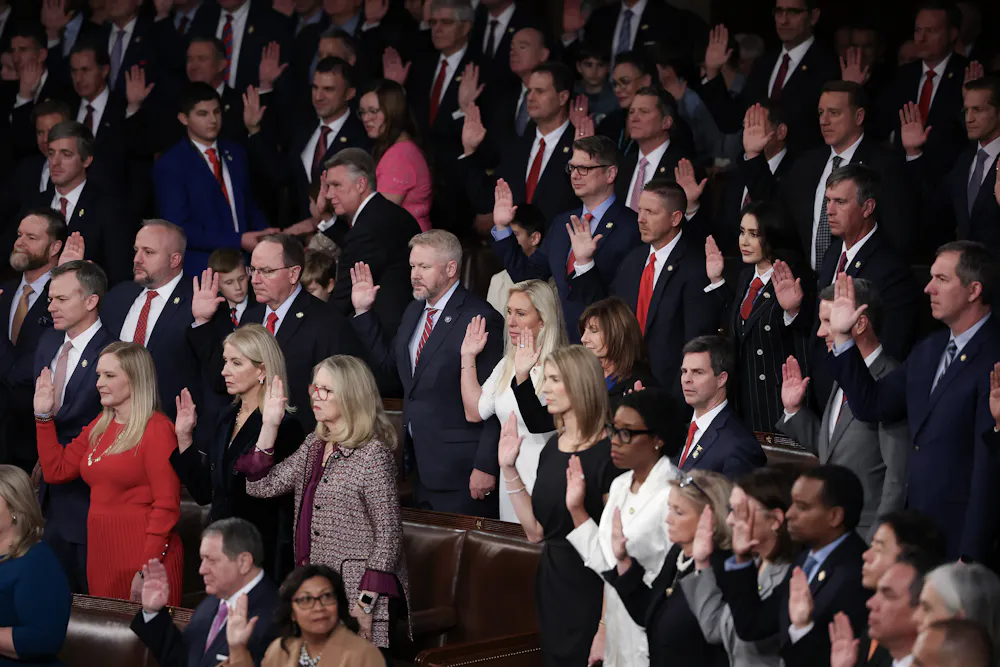
U.S. representatives of the 119th Congress are sworn in during the first day of session in the House chamber of the U.S. Capitol on Jan. 3, 2025. Win McNamee/Getty Images
What the data shows
We analyzed over 2.2 million policymaking actions from 1980 to 2022 to assess how often members of the U.S. House of Representatives worked across the aisle to co-author bills. Legislation developed through bipartisan collaboration is much more likely to become law. We then compared the collaboration patterns of first-term amateurs – legislators who have never held office and were just elected to Congress – against the collaboration patterns of established incumbents.
The difference was clear. Over the past four decades, amateur lawmakers worked across party lines far less often than incumbent lawmakers, both when developing their own legislation and when lending support to other legislators’ proposals.
This finding is not simply a “freshman effect,” observed among all new members of Congress who are still learning its norms and procedures.
First-term representatives who entered Congress with prior elected experience in state or local office engaged in bipartisan cooperation about as frequently as longer-serving incumbents. This suggests that what matters for bipartisan engagement is prior experience in elected office, not a lack of experience in Congress itself.
The impact on democracy
Amateur lawmakers are about 10–20 percentage points less likely to engage in bipartisanship during their first term than experienced officeholders.
To put it in perspective, the size of the amateur effect is roughly on par with the collapse in bipartisan relationships that followed the Jan. 6, 2021, attack on the U.S. Capitol. After some Republican members refused to certify the 2020 presidential election results, Democrats largely stopped working with them in that Congress – a decline in collaboration comparable in scale to what we observe among amateurs.
These effects are likely to continue, with amateurs making up nearly half of all first-term lawmakers in recent years compared to decades past. Notable amateurs elected to Congress include Alexandria Ocasio-Cortez, Lauren Boebert and Marjorie Taylor-Greene. As new cohorts of amateurs enter office each election cycle, this bipartisanship problem will persist.
Learning to value bipartisanship
Our findings show that amateur lawmakers’ approach to bipartisanship evolves as they gain office-holding experience. By their third term in Congress – about six years after first taking office – the gap in bipartisan behavior between amateurs and experienced legislators largely disappears.
However, we show that these backgrounds do not necessarily prepare amateurs for the demands of governing. Experience holding state or local office exposes politicians to the practical realities of policymaking. Lacking that experience, amateurs are more likely to view bipartisanship as giving up on their principles rather than a method for serving the public interest. We find that this tendency diminishes only as newcomers gain firsthand experience in the legislative process.
A global trend with familiar consequences
The U.S. is not alone in this trend toward amateurism. Around the world, political newcomers have surged to power amid frustration with traditional elites.
In each case, widespread outsider success in the legislature delivered disruption – but not necessarily effective governance. These groups often start with promises of pragmatic reform but struggle once in office.
Amateur politicians are once again emerging in response to this discontent, positioning themselves as outsiders who can bring change to Washington. Yet, as our research shows, these newcomers will undervalue the bipartisan relationships needed to govern effectively.
As voters look for change, the challenge will be to balance the desire for fresh perspectives with the experience required to sustain cooperation – and to keep Congress, and democracy, working.
The authors do not work for, consult, own shares in or receive funding from any company or organization that would benefit from this article, and have disclosed no relevant affiliations beyond their academic appointment.
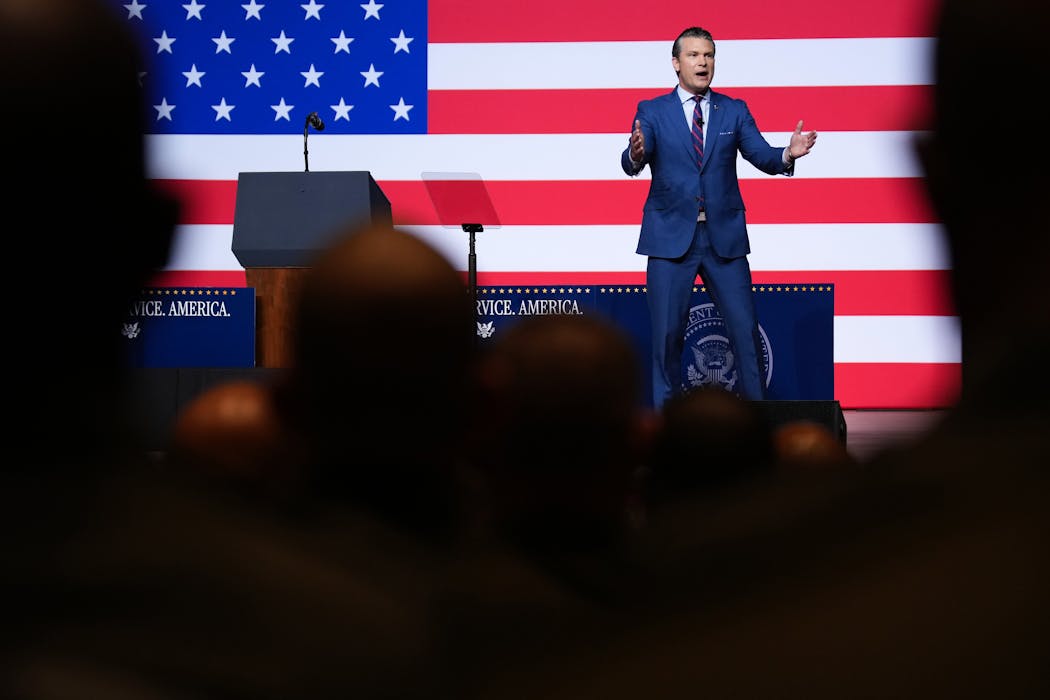
Secretary of Defense Pete Hegseth speaks to senior military leaders in Quantico, Va., on Sept. 30, 2025. Andrew Harnik/Pool via AP
Secretary of Defense Pete Hegseth and President Donald Trump addressed hundreds of military leaders at Marine Corps Base Quantico in Virginia in late September 2025.
Before the meeting, journalists speculated about which urgent issues might require such a costly and unusual gathering, to which the assembled military leaders had been summoned from across the globe.
Rather than a major shift in national security strategy, a loyalty oath or mass firing, Hegseth and Trump railed against what they see as the military’s primary enemy: diversity.
Trump argued that the military “went, in a way, woke” and called for armed forces that would “not be politically correct.” Hegseth similarly called for a shift in military thinking about diversity saying, “No more identity months, DEI offices, dudes in dresses. … As I’ve said before and will say again, we are done with that shit.”
During times of war and between 1948 and 1973, the U.S. military drafted enlistees to fill the ranks. After years of debate, the draft was ended and the U.S. established an all-volunteer force in 1973.
The demographic makeup of the military quickly changed as more Black Americans and women chose to join the military. In a 2007 study of representation in the military, scholars found that Black Americans had been overrepresented in the military for much of the span of the all-volunteer force. And the percentage of Latino service members more than doubled from the late 1980s to the 2000s.
While women remain underrepresented in the military compared with the U.S. population, the shift to the all-volunteer force led to a steady increase in women’s military participation. Women made up 3% of military personnel in 1973 and 17% in 2022.
Men who have signed up to join the U.S. Marines wait to do qualifying pull-ups in New York City on Nov. 16, 2025. Robert Nickelsberg/Getty Images
Expanding the scope
To fully understand how the military became one of the most diverse American institutions, you need to go back to the foundations of the all-volunteer force.
The primary challenge the military faced in the implementation of the all-volunteer force was how to persuade young Americans to enlist. Large budgets were set aside for advertising, and military branches worked with advertisers to reach potential recruits.
One of the first steps advertisers took in the mid-1970s was to identify “vulnerable target groups.” These groups were targeted based on propensity – the likelihood that an individual would serve regardless of their desire to do so.
The likelihood of service increased when people felt they had little opportunity outside of the military – whether that meant financial struggles or an inability to afford higher education.
Based on ideas of recruit quality and the traits the military sees as best suited to success in the ranks, the military has mostly desired to recruit straight and white young men. But these people were more likely to have opportunities outside of the military. So, military leaders had to expand the scope of potential recruits to reach out to groups previously excluded – namely, Black Americans, other people of color and women.
When Hegseth talks about “fixing decades of decay” in a department gone “woke,” and when Trump argues that the military will now be “all based on merit,” they both fail to understand military diversity.
The military didn’t become diverse because it went “woke” or abandoned a merit-based system of promotions.
Military diversity resulted from the exploitative nature of military recruiting. In the all-volunteer force, the most easily persuaded recruits are those in most need of opportunities they can’t find in the civilian world. The very logic behind an all-volunteer force means that the military can’t fill their ranks with white men alone.
A U.S. Army recruiter walks between outdoor posters at a mobile interactive recruiting exhibit on May 21, 2005, in Charlotte, N.C. The U.S. military has had to reach out to the public to communicate a more effective message and compete with other professions to attract potential soldiers. Robert Nickelsberg/Getty Images
Central casting
Hegseth and Trump, additionally, have framed their criticism of the military with an obsessive focus on looks.
Hegseth criticized the “bad look” of the current military, saying “it’s tiring to look out at combat formations, or really any formations, and see fat troops.” He also railed against “an era of unprofessional appearance” indicated by “beards, long hair and superficial individual expression.”
Trump has consistently talked about wanting military leaders to look like they are out of “central casting”, a phrase he uses almost exclusively to talk about white men.
When Trump and Hegseth attack military diversity, they harm individuals who made the choice to serve. They also perpetuate the myth that military diversity was enforced from outside the military by liberal “woke” politics rather than born of necessity for the military’s very survival.
Jeremiah Favara does not work for, consult, own shares in or receive funding from any company or organization that would benefit from this article, and has disclosed no relevant affiliations beyond their academic appointment.
At stake is more than the scope of presidential power. The case highlights a deeper question of accountability: Who should decide what Americans pay for imported goods – the president acting alone, unelected judges reading emergency laws broadly, or the elected representatives who must face voters when prices rise?
When tariffs end up in court, it’s usually because Congress has failed to act. Over the past few decades, lawmakers have ceded much of their trade authority to presidents eager to move quickly – and the courts have been left to clean up the mess. Each new lawsuit makes it seem as though judges are running the economy when, in fact, they’re being pulled into policy questions they’re neither trained nor elected to answer.
As an economist, not a lawyer, I view this as more than a constitutional curiosity. It’s about how the world’s largest economy makes decisions that ripple through global markets, factory floors and family budgets. A duty on steel may help a mill in Ohio while raising bridge-construction and car-buying costs everywhere else. A tariff on electronics might nudge assembly onshore yet squeeze hospital and school budgets that depend on those devices.
These are choices about distribution – who gains, who pays, and for how long – that demand analysis, transparency and, above all, democratic ownership.
How did the US get here?
Congress didn’t exactly lose its tariff power; it gave it away.
The Constitution assigns “Taxes, Duties, Imposts and Excises” to Congress, not the White House. Historically, Congress set tariff lines in law – consider the Smoot–Hawley Tariff Act of 1930. The pivot began with the Reciprocal Trade Agreement Act of 1934, which let presidents adjust rates within limits via executive agreements. In the 1960s and ’70s, Congress passed laws expanding the president’s authority over trade, granting new powers to restrict or adjust imports without a separate congressional vote if certain conditions are met.
In my view, two key incentives drove the drift: blame avoidance and gridlock. Tariffs are redistributive by design: They benefit some sectors and regions while imposing costs on others. Casting a vote that helps steelworkers in one state but raises prices for builders in another is politically risky. Delegating to the White House allowed lawmakers to sidestep the fallout when prices rise or when jobs shift.
Judges interpret statutes and precedent; they don’t run general equilibrium models, forecast inflation paths or map supply chain rerouting. Evidence in court is confined to a single case file. Remedies are blunt: They are either to uphold, strike down or send back. Tariff design, by contrast, is about calibration: how high, how long, which sectors, which exclusions, what off-ramps, what triggers for renewal or repeal.
When lawsuits substitute for legislation, countries drift into policy by injunction. Companies see rules whipsaw; projects are delayed or shelved; households experience price swings that feel arbitrary; trading partners retaliate against policies they see as improvisational.
A matter of accountability
Accountability sits at the center of the problem. Most judges aren’t elected; lawmakers are. Lifetime tenure protects judicial independence – good for rights, bad for setting taxes. No one can vote out a court when tariffs push up the price of a school Chromebook or a contractor’s rebar.
Members of Congress, by contrast, must explain themselves. They can hold hearings, commission impact analyses, hear from unions and small businesses, and then defend the trade-offs. If tariffs save jobs in one town but raise prices nationwide, voters know exactly whom to reward or punish. That democratic link is why the Constitution places “Duties and Imposts” in the hands of Congress.
None of this means paralysis when it comes to trade policy. The United States has done this before – via trade-promotion and fast-track authorities that set clear goals and required renewal votes – while the EU and Japan have paired swift action with built-in legislative oversight.
Congress can be nimble without being reckless. Best practices for tariffs include setting clear targets using accessible language, having independent analysts conduct reviews before and after a tariff is put in place, and having diplomacy baked into a broader trade-security strategy that reports retaliation risks.
The challenge facing the court
In my view, the Supreme Court’s role here is both modest and vital: to enforce the statute and the constitutional line.
If a general emergency law doesn’t clearly authorize sweeping, long-duration tariffs, it’s not activism to say so plainly. It’s boundary-keeping that returns the pen to Congress. What I think the court should avoid is appearing to write the tariff code from the bench. That swaps democratic ownership for judicial improvisation and guarantees more litigation as a strategy.
In theory, a more public, accountable system would also free everyone to focus on what they do best. That means economists measuring who gains and who pays, lawmakers weighing trade-offs and answering to voters, and courts enforcing the rules – not designing the policy.
Bedassa Tadesse does not work for, consult, own shares in or receive funding from any company or organization that would benefit from this article, and has disclosed no relevant affiliations beyond their academic appointment.
We have sad news to report from the world of music today:
Donna Jean Godchaux, the powerhouse vocalist who has performed with such iconic acts as the Grateful Dead and Elvis Presley, has passed away.
She was 79 years old.
Grateful Dead singer Donna Jean Godchaux has passed away at the age of 79. (YouTube)
News of Godchaux’s death comes courtesy of a statement from her family, who explain that she passed away at a Nashville hospice facility “after a lengthy struggle with cancer.”
“She was a sweet and warmly beautiful spirit, and all those who knew her are united in loss,” the statement reads (via People).
“The family requests privacy at this time of grieving. In the words of Dead lyricist Robert Hunter, ‘May the four winds blow her safely home.’”
Born in Alabama in 1947, Godchaux joined the Dead along with her first husband, keyboardist Keith Godchaux, in 1972.
She remained with the band throughout the ’70s and continued performing in the decades since, forming the Donna Jean Godchaux Band in 2006.
Donna Jean Godchaux has passed away following a battle with cancer. (YouTube)
Godchaux also sang backup vocals on number one hits like Percy Sledge’s “When a Man Loves a Woman” and Elvis Presley’s “Suspicious Minds.”
She also recorded with legendary artists such as Cher, Neil Diamond and Dionne Warwick.
“I was singing from pretty much as soon as I could talk,” she told AL.com in 2016.
“I remember very distinctly when I was 6 years old, I knew I was going to be a singer and I would sit out on my back porch and sing to the top of my lungs every day.”
She told the outlet that singing with Elvis was “one of the most amazing times of my life,” and recalled the King being “so kind to us and encouraging and complimentary… And he looked great. I’m telling you, he was the most gorgeous human being I’ve ever seen.”
“It was great fun,” she said, when asked about touring with the Grateful Dead. “I loved singing with those guys and we had an absolute blast.”
She added, however, that the relationship between couple and band soured rather quickly:
“The band knew we had to be out of the band, and Keith and I had been talking about ‘How in the world do you quit the Grateful Dead?’” she told AL.com.
“It was sad, but it was what needed to happen. It was turning into being not profitable for anybody. We needed to go, and they needed for us to go.”
Keith was killed in a car accident not long after he and Donna formed their own band in 1980.
Our thoughts go out to Donna Jean Godchaux’s loved ones during this difficult time.
Kash Patel is defending girlfriend Alexis Wilkins on social media.
Increased scrutiny has fallen upon their relationship after news broke that “Ka$h” had used a government plane to go watch her perform.
To no one’s surprise, Patel has not handled this well. Over the weekend, he threw a tantrum on social media — accusing critics of attacking his much-younger girlfriend.
He has lost the plot. And he has lost the support and respect of outspoken conservatives.
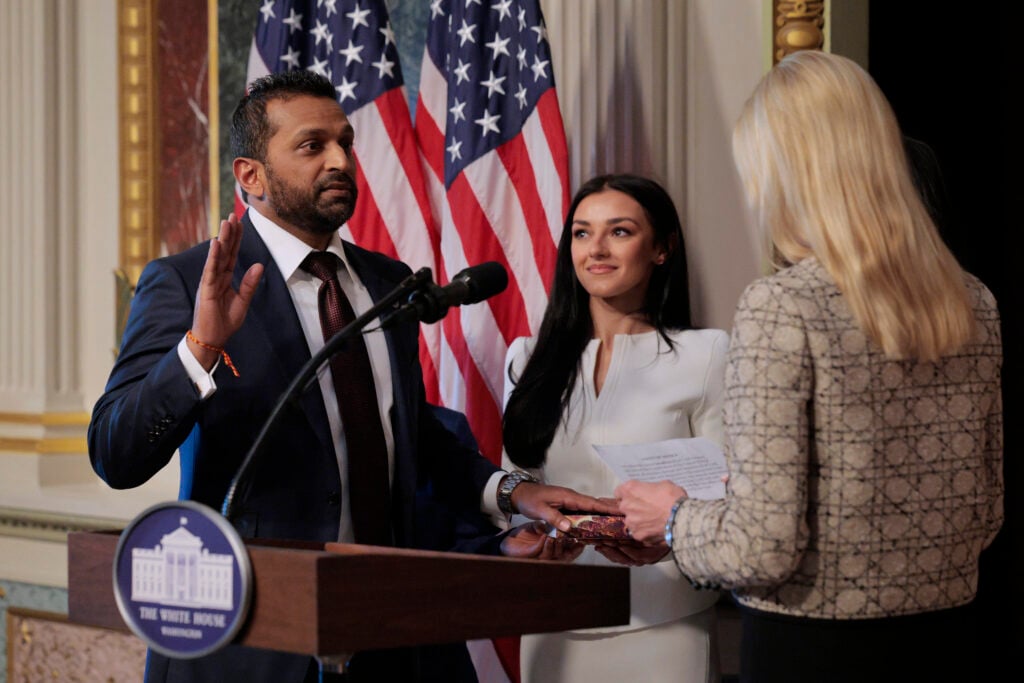
Pam Bondi swears in the new Federal Bureau of Investigation Director Kash Patel as his girlfriend Alexis Wilkins holds the Bhagavad Gita on February 21, 2025. (Photo Credit: Chip Somodevilla/Getty Images)
Do NOT criticize Alexis Wilkins, much younger girlfriend of Kash Patel
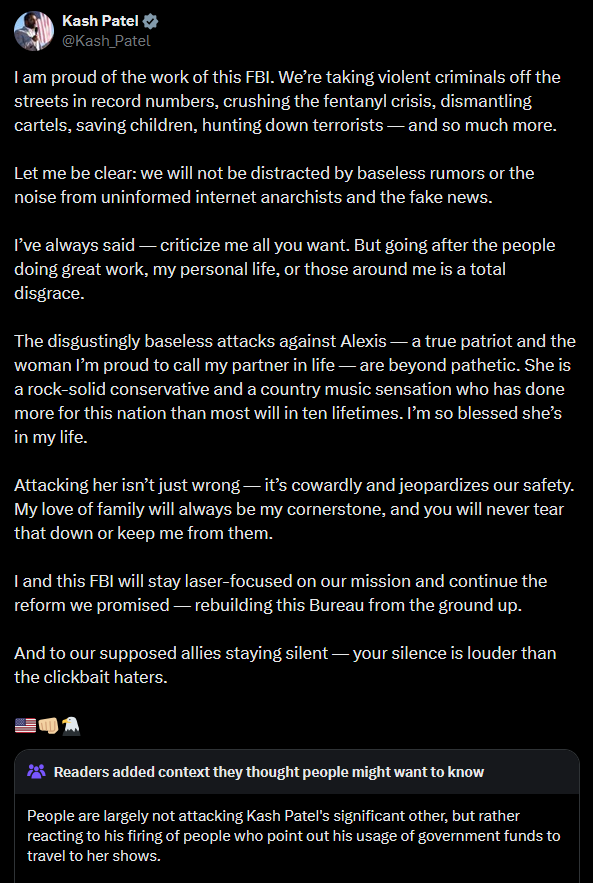
On Sunday, November 2, Kash Patel tweeted a lengthy rant defending girlfriend Alexis Wilkins.
It is a rant that even staunch conservatives who support the regime say is unhinged, unprofessional, and frankly misses the point.
“The disgustingly baseless attacks against Alexis,” Patel whined, “a true patriot and the woman I’m proud to call my partner in life — are beyond pathetic.”
Intending it as praise, he wrote: “She is a rock-solid conservative and a country music sensation.”
Patel then claimed that she is someone “who has done more for this nation than most will in ten lifetimes.”
This lengthy and embarrassing tweet from actual FBI Director Kash Patel attempted to frame criticisms of his misuse of a government plane (and the agents he fired after news got out) as attacks upon girlfriend Alexis Wilkins. (Image Credit: Twitter)
“I’m so blessed she’s in my life,” Kash Patel wrote of Alexis Wilkins.
“Attacking her isn’t just wrong,” he claimed, “it’s cowardly and jeopardizes our safety.”
Patel continued his screed, insisting: “My love of family will always be my cornerstone, and you will never tear that down or keep me from them.”
“I and this FBI will stay laser-focused on our mission and continue the reform we promised — rebuilding this Bureau from the ground up,” he added ominously.
Obviously, these new hires will all have to be purged when America begins its long and expensive post-Trump restoration. Even those who aren’t imprisoned for their many crimes will exist under a cloud of suspicion.
FBI Director Kash Patel speaks during a press conference on October 23, 2025. (Photo Credit: Michael M. Santiago/Getty Images)
He’s sooooo mad
“And to our supposed allies staying silent,” Patel continued menacingly, “your silence is louder than the clickbait haters.”
All of this comes after the scandal of him reportedly using a government jet to watch Wilkins perform a gig at a wrestling match.
Under normal circumstances, this would be a career-ending scandal for an FBI Director. But the deliberate erosion of political norms makes this gross misuse of government resources into much less than it should be.
But instead of losing his job, it appears that Patel has gone on a firing spree within the FBI, including ousting someone who’s been with the Bureau for nearly three decades.
In Trump world, brazen and bold-faced corruption is an intended feature. But even some die-hard conservatives are finding Patel’s hissy-fit embarrassing and unbecoming.
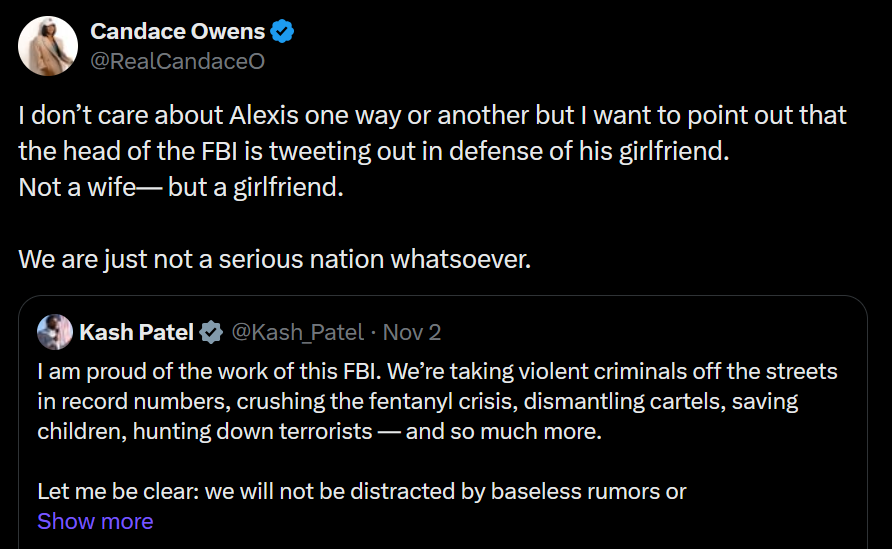
In a tweet, Candace Owens noted how embarrassing Kash Patel’s conduct on social media has become. (Image Credit: Twitter)
In addition to being an embarrassment to the United States, Kash Patel’s ardent defense of Alexis Wilkins has done something almost as bad:
His nonsense has forced us to agree with conservative commentator Candace Owens about something. This is a grim day.
“I don’t care about Alexis one way or another,” she tweeted with bone-chilling relatability.
“But I want to point out that the head of the FBI is tweeting out in defense of his girlfriend,” Owens noted.
“Not a wife — but a girlfriend,” she emphasized. “We are just not a serious nation whatsoever.”
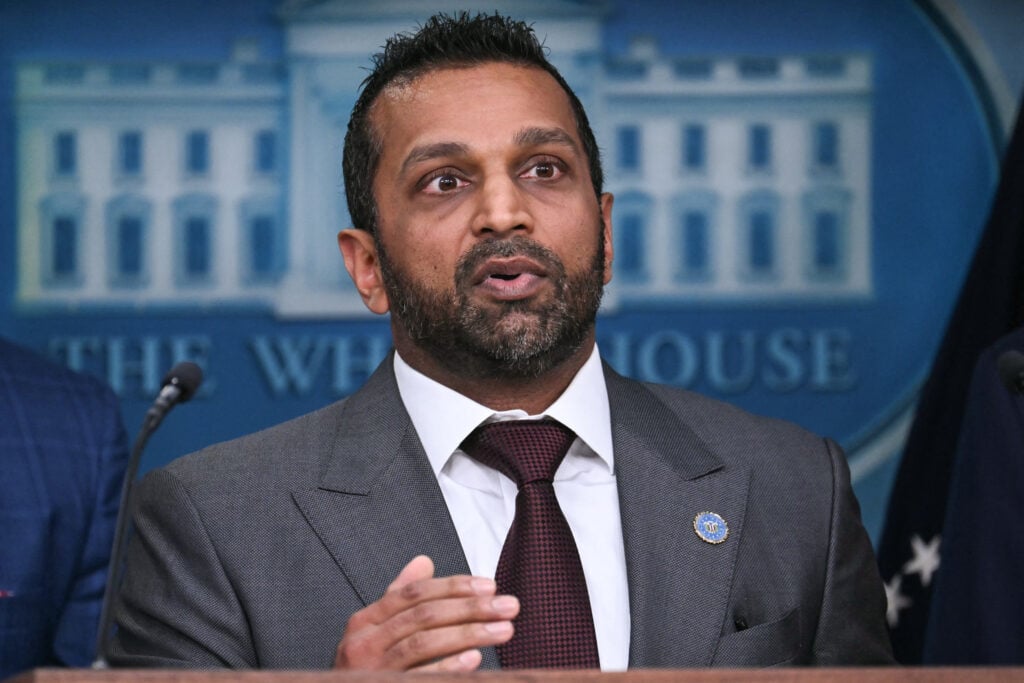
FBI Director Kash Patel speaks during a news conference held by Donald Trump on August 11, 2025. (Photo Credit: ANDREW CABALLERO-REYNOLDS/AFP via Getty Images)
Yes, this is weird and unprofessional (and he should know better)
Kash Patel stands out from many appointments under Donald Trump’s regime in that he arguably has some qualifications for his post as FBI Director.
After starting his career as a public defender, he became a staff member at the DOJ in 2012.
As you might expect from a Trump appointee, he got into trouble and made statements about his career that are inconsistent with existing records. He also left the FBI in 2017 to act as a political aid.
But has actual job experience, unlike the deputy director of the FBI, whose qualification is being a podcaster and conspiracy theorist.
But none of that makes the FBI Director (and, for the usual clown reasons, acting director of the ATF) ranting in defense of his girlfriend, taking dubious flights on a government jet, and then scrambling to hide future flights any more reasonable or professional.
We expect this sort of thing from, say, prosecutors appointed by an addle-brained Trump because he found them pretty.