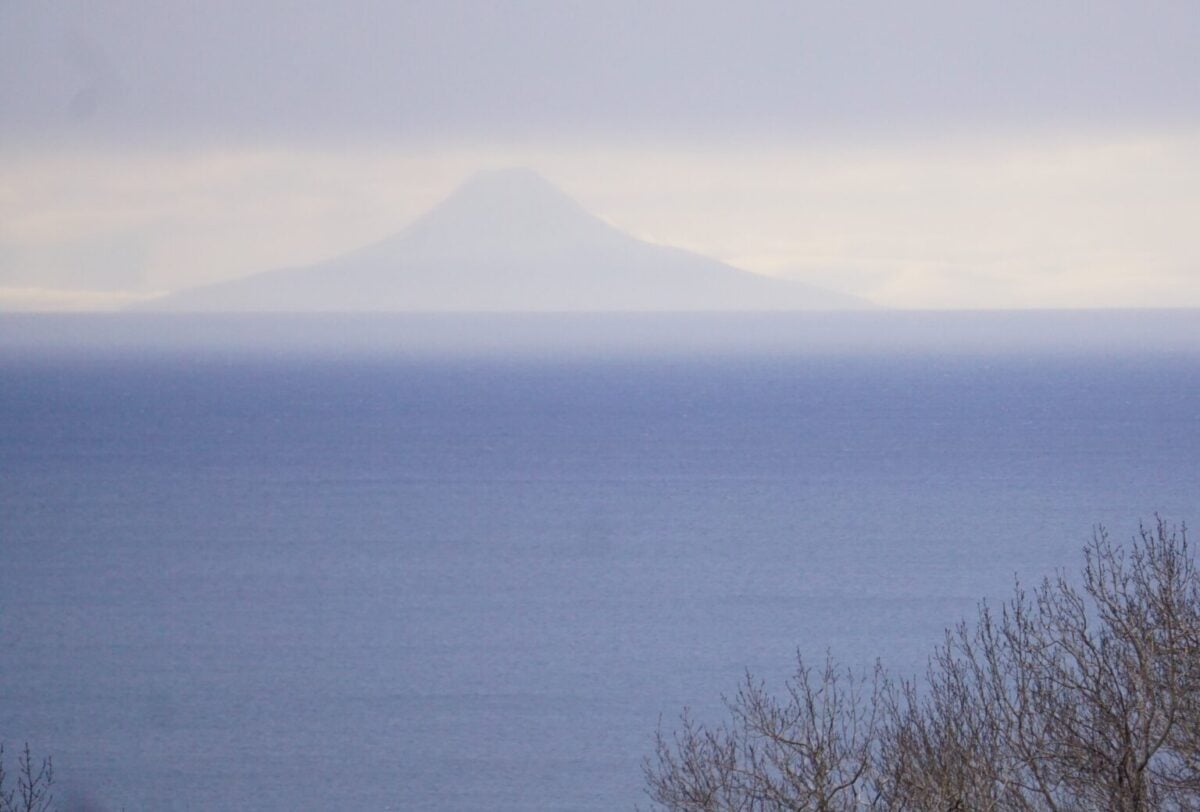
Augustine Volcano looms on Oct. 22, 2025, behind mist hanging over Lower Cook Inlet. The U.S. Bureau of Ocean Energy Management is soliciting bids for exploration rights in federal waters of Cook Inlet in the first of six scheduled federal lease sales to be held through 2032. (Photo by Yereth Rosen/Alaska Beacon)
The Trump administration is soliciting bids for what it intends to be the first in an annual series of oil and gas lease sales in federal waters of Southcentral Alaska’s Cook Inlet.
The upcoming sale will offer about 1 million acres in Cook Inlet, with bids to be opened on March 4, the U.S. Bureau of Ocean Energy Management said on Friday.
The auction has been named the “One Big Beautiful Bill Act Lease Sale 1” because it is the first of six lease sales mandated under the sweeping tax and budget bill passed by Congress and signed by President Donald Trump last summer. The six sales are to be held by 2032, under the bill.
“Regular and predictable federal leasing is the minimum standard for maintaining domestic energy production,” BOEM Acting Director Matt Giacona said in a statement. “Energy security is national security, and this sale reflects a clear, congressionally mandated path forward for Cook Inlet leasing. By offering predictable terms and a transparent process, we are supporting Alaska’s role in meeting America’s energy needs, strengthening national readiness and creating opportunities for investment and jobs.”
Environmentalists criticized the planned sales.
“The relentless push for more oil drilling in Cook Inlet won’t solve Alaska’s energy problems but it will bring a massive risk to this already stressed and polluted waterway,” Cooper Freeman, Alaska director at the Center for Biological Diversity, said in a statement. “The federal government is required to protect our oceans and the fish and wildlife that call them home, but Trump is ignoring that responsibility. From critically endangered Cook Inlet belugas to salmon and razor clams, this sale puts so many species in the crosshairs of a devastating oil spill,” the statement said.
The federal lease sale coincides with the Alaska Division of Oil and Gas’ scheduled annual lease sale for state territory in the Cook Inlet basin. Results of the state lease sale, which is offering 2.9 million offshore and onshore acres, will also be released on March 4.
The planned “One Big Beautiful Bill Act” Cook Inlet lease sales are in addition to several sales that the administration has proposed for nearly all areas of federal waters off Alaska, from the High Arctic to the Gulf of Alaska waters south of the Kodiak Archipelago and the Aleutian chain. The proposed lease sales are listed in a new five-year draft plan released by BOEM in November.
Cook Inlet oil and gas lease sales, whether conducted by the state or federal government, have drawn little interest in recent years. The state’s 2025 lease sale drew five bids, and the most recent federal sale, held at the end of 2022, drew only one bid.
Alaska Gov. Mike Dunleavy greets a child during the governor’s annual holiday open house on Tuesday, Dec. 12, 2022 at the Governor’s Mansion in Juneau. (Photo by James Brooks / Alaska Beacon)
Framed by the fireplace in Alaska’s governor’s mansion earlier this month, Gov. Mike Dunleavy shook hands and posed for pictures in the final holiday open house of his two terms as Alaska’s top elected official.
Dunleavy is prohibited from running for another term, and 14 candidates have already signed up to run for his office in the 2026 elections. One of those candidates, Lt. Gov. Nancy Dahlstrom, stood next to Dunleavy at the open house, smiling alongside her husband.
“It started what I think is going to be a real pipeline,” Dunleavy said. “It’s something that the state has dreamed about for decades, ever since the trans-Alaska oil pipeline came into being.”
Since January, when Glenfarne announced it was buying into the long-pursued Alaska LNG pipeline project, it’s announced a series of preliminary agreements from international companies interested in buying gas.
To date, it doesn’t have firm deals for either buying or selling, and it is expected to make a go/no-go decision on the first phase of the project — a pipeline from the North Slope to Southcentral Alaska for in-state use — within the next month.
“I think in January there’s going to be some major announcements that will solidify that this pipeline as a go,” Dunleavy said.
Dunleavy said he’s also been pleased with rising forecasts for Alaska North Slope oil. In November, the federal Energy Information Administration predicted that North Slope production would grow 13% in 2026, reaching levels that haven’t been seen since 2018.
“That’s good for Alaska as well,” Dunleavy said, “because of the renaissance on the Slope.”
The state’s unemployment rate is holding below 5%, he noted.
“When you look at the turmoil across the country and you look at the turmoil across the world, I think Alaska is in pretty good shape. … We have a lot of resources here, and I think we have a lot of great people,” he said.
Asked for the lowest point of the year on a statewide basis, Dunleavy said: “You’re always dealing with disasters. Under my tenure, there’s been 73 declared disasters … we had the issue out in Western Alaska, and so we have to add now a typhoon to our mix of volcanoes, earthquakes and so forth.”
Dunleavy himself was affected by the recent Matanuska-Susitna Borough windstorm disaster, and his wife couldn’t attend the holiday open house as a result.
“We lost some of our roofing on a building or two out there, and the heat went out,” he said.
While disasters are part of living in Alaska, he said Typhoon Halong was something extra.
“I would say that whenever a disaster impacts people at the visceral level, at the local level, at their household level — we got hit hard with that typhoon,” he said.
For much of the year, as in his conversation with reporters, the governor preferred to focus on the positives.
Earlier this year, Dunleavy said the arrival of the Trump administration was “like Christmas every morning” for Alaska.
Since Trump was sworn into office, his administration has relaxed restrictions on oil and gas drilling on the North Slope. It has advanced the Ambler Access Project, which promises to open a large mining area in Northwest Alaska.
The Interior Department has also pushed forward the road between Cold Bay and King Cove and proposals to explore for oil in the coastal plain of the Arctic National Wildlife Refuge.
The Dunleavy administration has been enthusiastic in its support of those actions, but most have been tied up in federal court and will be for months or years.
The ANWR drilling issue, for example, won’t even come before a federal judge until late 2026, according to a status update published this month in the U.S. District Court for the District of Alaska.
The Trump-backed Big Beautiful Bill Act passed by Congress this year will deliver millions of dollars in construction projects to the state, and other legislation will provide millions more, but other projects — particularly those involving renewable energy and projects intended to deal with climate change — were eliminated.
“Christmas every morning” entailed other metaphorical bits of coal for Alaska this year: The extended government shutdown left thousands of Alaskans unpaid for over a month, and the cuts instituted by the Elon Musk-led Department of Government Efficiency caused significant amounts of uncertainty.
In the long run, DOGE doesn’t appear to have significantly affected the number of federal jobs here: The latest available figures show more federal employees in the state than there were at the start of the year.
While some federal grants targeted by DOGE have since been restored, many were not. Public radio stations and arts organizations laid off staff and curtailed their work.
Tariffs, visa issues and a prolonged dispute with Canada threatened the summer tourist season, but a feared Yukon boycott never appeared, and the number of cruise ship passengers traveling to Alaska increased slightly, to a new record high of more than 1.7 million.
At the holiday open house, Dunleavy said there’s plenty to look forward to in the coming year and in the years once he leaves office.
“There’s just a whole host of things — the possibility of data farms, artificial intelligence, and how that’s gonna revolutionize not just the world, but here in Alaska, I think we could become a data transportation center because of our proximity on the globe. So I think you’re going to see a number of announcements throughout the year that I think will set the stage for a great several decades going forward,” he said.
Cook Inlet near Clam Gulch is seen on Oct. 23, 2025. (Photo by Yereth Rosen/Alaska Beacon)
The Trump administration on Friday affirmed a controversial federal Cook Inlet oil and gas lease sale held at the end of 2022, asserting that impacts to endangered beluga whales and other resources were adequately considered and no changes in the leasing plan are needed.
In a Federal Register notice scheduled to be published on Monday, the U.S. Bureau of Ocean Energy Management announced its decision to uphold Lease Sale 258 as held. The decision “balances the national policies mandated by Congress to expeditiously and safely develop the natural resources of the (Outer Continental Shelf), subject to environmental safeguards, in a manner that is consistent with the maintenance of competition and other national needs,” the notice said.
The lease sale, mandated by Congress in the Inflation Reduction Act of 2022, offered 193 blocks over nearly 1 million acres, but it drew only one bid. The sole bid was from Hilcorp, the dominant oil and gas operator in the inlet.
The auction went through a tumultuous history and remains a subject of debate.
Planning for the sale started in 2020, but two years later, the Biden administration canceled it, citing a lack of industry interest. The sale was resurrected by a provision in the Inflation Reduction Act of 2022 that was inserted by then-Sen. Joe Manchin, D-West Virginia. That provision required Lease Sale 258 to be held by the end of 2022; it was ultimately held on Dec. 30 of that year.
Environmental groups that sued to block the sale secured a victory after it was held. U.S. District Court Judge Sharon Gleason ruled in July 2024 that pre-sale studies failed to properly analyze impacts to endangered Cook Inlet beluga whales and other resources. Gleason ordered BOEM to do the new analysis of beluga and other resource impacts, putting the sole lease that was sold into suspension.
The agency considered three additional alternatives that would have increased protections for belugas and other resources, but it rejected those and kept the original plan in place, according to the document.
“As LS 258 has already occurred, selecting any alternatives other than those described above would not affirm that lease sale and would void the one lease issued as a result of it,” the Federal Register notice said.
In its supplemental environmental impact statement, BOEM asserted that the risks of leasing and the development that would result from it are minor for Cook Inlet belugas and other marine mammals.
“The likelihood of a large oil spill affecting Cook Inlet marine mammals is relatively low, but the consequences could affect some populations. Sea otters face the highest vulnerability from a large spill due to their dependence on fur for insulation, resulting in a moderate impact level. Cook Inlet beluga whales are at risk due to the small population size, but geographic and temporal factors substantially reduce the risk of exposure to a large spill, yielding a minor overall impact level,” the document said.
The agency’s impact statement also describes impacts of noise as minor. While Cook Inlet belugas are highly dependent on hearing other whales’ calls to navigate the murky waters, ship and industrial noise that would drown out those calls “are expected to be temporary, with anticipated localized effects on beluga behavior and no anticipated long-term effect on survival or fitness.” Additionally, no injuries to belugas are expected from lease-related activities, the document said.
A beluga mother, in front, and her darker calf swim in Cook Inlet waters in this undated photo. A federal judge ordered the U.S. Bureau of Ocean Energy Management to do more to analyze oil leasing impacts on the endangered Cook Inlet beluga population. (Photo by Janice Waite/National Oceanic and Atmospheric Administration)
The three new alternatives that BOEM considered would have added new protections for marine mammals and for subsistence and commercial fishing. Those alternatives would have reduced the available leasing territory in different increments, ranging from about one fifth to nearly half, according to the document.
The environmentalists who sued to overturn the lease sale criticized the decision and the lack of public participation leading up to it.
“BOEM’s decision to conduct the whole process in secrecy represents the federal government’s new approach to cutting the public out of decisions about our waters, and favoring the billionaire class and giant corporations over the people who call this place home. We are disgusted by this rushed and sloppy process on this final SEIS,” Bridget Maryott, co-executive director at Cook Inletkeeper, said in a statement, referring to the agency’s just-published supplemental environmental impact statement.
Hannah Foster, an attorney for Earthjustice, the environmental law firm that represented the plaintiffs, called the process leading to the decision a “black box.”
“We won our challenge against this lease sale because Interior failed to adequately consider sale alternatives and the impacts to the endangered beluga whales that will be harmed by blaring vessel noise and other oil industry operations. Yet BOEM has now reaffirmed the sale without seriously considering new alternatives or imposing any new measures to protect belugas,” she said in the statement.
Foster said Earthjustice and its clients are still reviewing the information about BOEM’s decision.
Including the lease sold in 2022, there are currently eight active leases in federal waters of Cook Inlet, all held by Hilcorp.
The Trump administration has already started planning a new Cook Inlet oil and gas lease sale, the first of six nearly annual sales mandates for the inlet through 2032 under the sweeping budget bill that was called the One Big Beautiful Bill Act.
Additionally, the administration included five Cook Inlet lease sales among the 21 it has proposed for federal waters off Alaska through 2031. Those 21 sales are proposed in the administration’s five-year outer continental shelf oil and gas leasing plan, released last month. It envisions oil development in nearly all federal waters off the state’s coasts.
The five-year plan drew praise from Gov. Mike Dunleavy, a Trump ally.
“Once again, the Trump Administration is leading the way to American energy dominance by restoring confidence in the federal government’s offshore leasing policies,” Dunleavy said at the time in a post on the social media site X.
Road construction is seen on March 12, 2017, at ConocoPhillips’ Greater Mooses Tooth Unit in the National Petroleum Reserve in Alaska. (Photo by Sarah LaMarr/U.S. Bureau of Land Management)
Alaska Gov. Mike Dunleavy’s administration is proposing to divert money from a program intended to compensate North Slope communities for the side effects of oil and gas drilling on federal land near them.
As Dunleavy prepares to unveil a long-term fiscal plan, the state is proposing to use at least some of that money across Alaska instead.
“Definitely a big deal,” said Alexei Painter, director of the Legislative Finance Division, which analyzes the budget on behalf of legislators.
It’s funded through revenue generated by oil production on federal land in the North Slope, and it is expected to grow significantly in coming years as more oil is produced from projects like Willow, which is located in the vast petroleum reserve between Utqiagvik and the Prudhoe Bay oil field.
The Willow project alone, for example, is expected to generate $3.1 billion for the grant program between 2029 and 2053, a boon for the borough’s 10,583 residents.
But in documents published recently, the Department of Revenue has reclassified money for the program as “unrestricted,” meaning it could be spent in a variety of ways.
During a Wednesday meeting of the Alaska Permanent Fund Corp. board of trustees, CEO Deven Mitchell told the board that he had just heard “that there’s been a federal law change” that could see more money end up in the Permanent Fund.
Mitchell couldn’t recall where he had read about that change, but it appears in the state’s newly published revenue forecast, which covers the fiscal year that starts July 1.
In several footnotes, the Department of Revenue describes a shift in policy. Currently, revenue from the leasing of federal land in the petroleum reserve is deposited in “a special revenue fund” dedicated to a particular purpose.
That changes with the new fiscal year, when “these payments will be divided between unrestricted revenue (74.5%), the Permanent Fund (25%) and Public School Trust Fund (0.5%).”
That would mean money from NPR-A would end up in the state’s general-purpose accounts, usable for services statewide or the Permanent Fund dividend.
Last year, the department wrote, “The federal government dictates that shared NPR-A revenue must be used for specific purposes, and therefore it is considered restricted revenue in this forecast.”
This year, that sentence doesn’t appear.
Comparing the two forecasts shows the difference. Last year, the department labeled NPR-A revenue as “restricted,” or locked in to a particular purpose. In the new fall forecast, it’s “unrestricted,” or available for general use.
While only $9.6 million in NPR-A revenue is expected in the next fiscal year, the state forecasts that amount will rise significantly after the end of the decade — to more than $200 million per year by 2033.
Speaking to reporters last week, an official with the Office of Management and Budget said the Alaska Department of Law was evaluating how changes to federal law in the Big Beautiful Bill Act will change the distribution of revenue to the state and local communities.
That act, passed with the enthusiastic endorsement of Republicans in Congress and President Donald Trump, calls for the state to receive 70% of revenue from oil and gas leases on federal land in the National Petroleum Reserve, Arctic National Wildlife Refuge and Cook Inlet, starting in fiscal year 2034.
The Department of Revenue concluded that clause will ultimately have little effect.
“Since all current and forecasted production in the NPR-A is located on leases issued before 2025, only a small portion of revenue within the current forecast period is expected to receive the 70% share,” the department wrote in its new forecast.
More important for the short term, the Act contains a clause stating that “for each of fiscal years 2025 through 2033, 50 percent (of federal-land oil revenue) shall be paid to the State of Alaska.”
Previous federal law contained a 50-50 split but also contained a clause stating that “in the allocation of such funds, the State shall give priority to use by subdivisions of the State most directly or severely impacted by development of oil and gas leased under this Act.”
That priority doesn’t appear in the Big Beautiful Bill.
As a result, the Alaska Department of Law is determining whether the state may choose to keep that money for direct uses instead of sending it to communities, the OMB official said.
As a precondition for the interview, reporters agreed to allow the official to speak on background and not be quoted directly.
The Alaska Department of Law did not respond to an emailed inquiry about the effort, nor did staff for any of Alaska’s three members of Congress, who were instrumental in adding that language to the Big Beautiful Bill Act.
The North Slope Borough was unable to comment before deadline Wednesday. Officials from VOICE of the Arctic Inupiat, an organization that has acted as a local booster for oil production, also did not return a message seeking comment.
The trans-Alaska pipeline, seen on Oct. 8, 2008, threads over snow-covered terrain in the Brook Range foothills. A gryfalcon is perched on one of the pipeline’s thermosphyons in the lower center of the photo. (Photo by Craig McCaa/U.S. Bureau of Land Management)
Though the state of Alaska is anticipating more oil production in the fiscal year that starts July 1, money from oil continues to make up a dwindling share of general-purpose state revenue, according to a forecast published Wednesday by the Alaska Department of Revenue.
Altogether, the state expects to earn $6.2 billion in general-purpose dollars between July 1, 2026 and June 30, 2027, the next fiscal year. Officially known as “unrestricted general fund revenue,” it’s the section of the budget where lawmakers and governors focus most of their attention.
Federal money and money designated for specific programs can sometimes be shifted around to different priorities, but not easily. General-fund dollars can (and are) assigned to different priorities each year.
The forecast for next year’s unrestricted general fund revenue is higher by almost $260 million than the current year’s expectation, but most of that increase isn’t coming from oil.
Since 2018, an annual transfer from the Alaska Permanent Fund to the state treasury has been the No. 1 source of general-purpose dollars for services and the Permanent Fund dividend.
That’s more true than ever, according to the state forecast.
In the next fiscal year, just 23% of the state’s general-purpose revenue is expected to come from petroleum revenue — royalties, property taxes and production taxes.
The Permanent Fund transfer would account for almost 66% of the general-purpose money.
That difference comes despite an expectation that oil production will rise significantly between this fiscal year and next — from an average of 457,000 barrels of oil per day to 517,800 per day on average.
According to the Alaska Department of Natural Resources, that’s due to the startup of production in the Pikka oil field and other new production on the North Slope.
Despite that new production, oil revenue is expected to rise only slightly — from $1.43 billion to $1.44 billion.
That’s because the state is expecting North Slope oil prices to average just $62 per barrel during the next fiscal year, down from $65.48 in the current fiscal year.
At the same time, the Permanent Fund transfer is rising by almost $200 million, causing oil to become a still-smaller share of state revenue.
Even though revenue is expected to rise between the current fiscal year and the next one, the projected deficit in Dunleavy’s proposed spending plan stands at more than $1.8 billion.
If oil revenue alone were needed to fill that deficit, average North Slope prices would have to be near $100 per barrel, or the state would have to produce more than 1.2 million barrels of oil per day during the next fiscal year, an amount that is geologically, economically and mechanically unfeasible. The state hasn’t posted an annual average of over 1 million barrels of North Slope oil per day since the turn of the century.
Karmen Monigold, a member of Protect the Kobuk, a Northwest Arctic advocacy group opposed to the Ambler Access Road, poses for a portrait in Kotzebue, Alaska, Saturday, Oct. 4, 2025. (AP Photo/Annika Hammerschlag)
AP- Ice blocks drift past Tristen Pattee’s boat as he scans the banks of Northwest Alaska’s Kobuk River for caribou. His great uncle Ernest steadies a rifle on his lap. It’s the last day of September, and by every measure of history and memory, thousands should have crossed by now. But the tundra is empty, save for the mountains looming on the horizon — the Gates of the Arctic National Park.
Days after Pattee’s unsuccessful hunt, the Trump administration approved construction of the Ambler Access Road — a 211-mile (340-kilometer) route designed to reach massive copper deposits that would cut through that wilderness, crossing 11 major rivers and thousands of streams where salmon spawn and caribou migrate. The approval, which is facing lawsuits though proponents believe construction could start next year, came as record rainfall in Northwest Alaska flooded villages and ripped through fish spawning habitat — the latest climate-driven blow to Indigenous communities already watching caribou and salmon numbers plummet.
As the co-owner of a wilderness guiding company in Ambler, Pattee’s livelihood depends on keeping this landscape intact. An Inupiaq hunter, his ability to feed his family and continue the subsistence traditions of his ancestors depends on healthy caribou and fish populations.
Yet he supports building the road.
“Everything takes money nowadays,” said Pattee, who serves on Northwest Arctic Subsistence Regional Advisory Council, a federal advisory group. Jobs in local villages are scarce, and with gasoline at $17.50 a gallon, the ability to power all-terrain vehicles and boats needed to hunt is out of reach for many. Pattee estimates a single caribou hunting trip from Ambler costs $400. Mining jobs, he believes, would offer a lifeline, and the minerals could slow the climate shifts that are threatening his subsistence way of life.
It’s the irony of climate change in Northwest Alaska: the minerals needed to power the green energy transition sit beneath some of the continent’s last pristine wilderness — a landscape already on the frontlines of the climate crisis, where temperatures are rising four times faster than the rest of the planet.
“I see the climate changing. I’ve been seeing it for years now. It’s scary,” said Pattee. “Losing our culture, our tradition, is very concerning. So let’s do anything we can to help mitigate it.”
The decline before the road
Over the last two decades, the Western Arctic Caribou Herd has plummeted from nearly half a million to some 164,000 — a 66% decline, according to the Alaska Department of Fish and Game. Of those that remain, fewer now cross the Kobuk River during fall migration, where Pattee and other Inupiaq hunters would historically gather in late summer to stockpile meat for winter. While caribou populations naturally fluctuate, scientists say the increasingly delayed cold and snow that triggers the migration south has caused caribou to remain in the Brooks Range, where they are difficult for hunters to access.
The day after Pattee’s unsuccessful hunt, the first snow fell. On Oct. 6 — far later than historical norms — caribou began trickling across the Kobuk. Then the rains came, bringing heavy, late-season downpours that scientists say are becoming more common in the warming Arctic and devastating for salmon. Intense rainfall can damage and dislodge eggs, while rising water temperatures reduce oxygen levels fish need to journey upstream.
One recent study found dozens of clear streams in the Brooks Range have turned orange with toxic levels of metals — changes researchers believe is the result of permafrost thaw — which may help explain recent drops in salmon numbers. Chinook and chum salmon in particular are experiencing “sustained and dramatic declines” with periodic population crashes, which has led to complete closures of some fisheries, according to NOAA Fisheries.
Experts worry about what this year’s record storms will mean for future runs.
“Elders who’ve lived here their entire lives have never seen environmental conditions like this and they’ve never seen fish conditions this poor,” said Alex Whiting, Environmental Program Director for the Native Village of Kotzebue.
Adding pressure to a buckling landscape
The Ambler Road would add its own pressures. Thousands of culverts and nearly 50 bridges would disrupt water flow and fish passages, and more than 100 trucks would traverse the road daily over the decades-long production period. Federal biologists warn the region’s rocks contain naturally occurring asbestos and that heavy traffic would kick up dust that would settle on thousands of waterways as well as the vegetation caribou depend on. The road would also fragment the habitat of the Western Arctic Caribou Herd, potentially hindering migration patterns. The Bureau of Land Management designated some 1.2 million acres of nearby salmon spawning and caribou calving habitat as “critical environmental concern.”
Then there’s the mine. Vast amounts of water would be drawn from rivers and lakes, while groundwater levels and permafrost would be permanently disrupted. The operation would generate enormous quantities of waste rock and require a tailings facility to store toxic slurry, risking spills that could send heavy metals into waterways.
Given the record-breaking rainfall the region has seen in recent years, residents downstream worry about breaches. In Kotzebue, a hub of 3,000 at the mouth of the Kobuk where flooding prompted an emergency declaration this fall, many fear contamination could harm drinking sources and traditional Inupiaq foods like fish and bearded seals, which are already threatened by disappearing sea ice.
Poop “rolls downhill — and that’s where Kotzebue’s at,” said Karmen Monigold, an Inupiaq member of Protect the Kobuk, a grassroots effort working to stop the road, and co-chair of the Kotzebue Sound Subsistence Advisory Council.
Monigold learned to live off the land as a child from her grandparents. Determined to share her connection to nature, she taught her four sons and their cousins to hunt and fish. She’s watched climate change erode the subsistence lifestyle she fought to preserve and fears the road would accelerate that loss.
Like many opponents, she doubts promises that the road would remain private and notes other Alaska roads, such as the Dalton Highway, opened to the public despite similar assurances. An influx of outside hunters and fishers, they fear, would further stress fish and caribou populations. Even Pattee’s support for the road hinges on it being closed.
“We lose so much every generation,” Monigold said. “But right now we still have enough of a culture for it to be worth fighting for.”
In an emailed statement, Kaleb Froehlich, Managing Director of Ambler Metals, the company behind the mining project, said the operation would use proven safety controls for permafrost and will treat all water from the mining process to strict standards. The company also tracks precipitation to size facilities for heavier rainfall and has a binding agreement with NANA, an Alaska Native corporation, to prioritize recruitment from nearby communities.
Ambler Metals declined to comment on concerns specific to the road, including naturally occurring asbestos, traffic impacts, public access and habitat fragmentation, noting the company is not the road developer, though it has contributed to pre-development costs and would be its primary user. The Alaska Industrial Development and Export Authority, the state-owned investment bank developing the road, did not respond to a request for comment.
The carbon footprint of decarbonizing
Critical minerals are becoming increasingly vital — growing demand for green energy technologies could scale production by nearly 500% by 2050, according to a 2020 World Bank report. The Arctic deposit would yield not just copper, but also zinc, lead, silver and gold. At an estimated 46.7 million tons of mineral reserves, it ranks among the largest undeveloped polymetallic deposits in North America.
But there’s no guarantee the minerals would fuel clean energy. President Donald Trump has spoken openly about his disdain for electric vehicles and wind power, and the majority of copper in the U.S. goes to construction projects, according to the Copper Development Association.
The Trump administration has framed the issue as one of national security and deemed reliance on “hostile foreign powers’ mineral production” an acute threat. In March, the White House issued an executive order instructing the Secretary of the Interior to prioritize mineral production and mining as the primary land use on all federal lands known to hold mineral deposits.
Yet even that argument doesn’t quite fit. While the U.S. is heavily reliant on China for some 20 different minerals, the Arctic deposit’s primary minerals — copper and zinc — are not among them, according to the 2025 USGS report. The U.S. sources 45% of its refined copper from Chile, Canada, Mexico and Peru, and 73% of its zinc from Canada and Mexico. The rest is mined domestically.
The real issue isn’t whether the minerals are needed — it’s who gets to decide, said Andrea Marston, an associate professor of geography at Rutgers University who studies mining and Indigenous rights in the Americas. Mining projects like Ambler are sometimes located on Indigenous lands, creating what she calls a false ethical dilemma: mine to save the climate, or protect the land and perpetuate warming. That framing, she argues, obscures other possibilities like investing in mass public transportation, recycling minerals that already exist and designing systems that consume less.
“You cannot justify steamrolling Indigenous lands with a kind of global story of climate change because that just ends up reiterating colonial plunder in a new way,” she said. “The starting point should be: it is their land to decide what to do with.”
A community divided
Ambler mayor Conrad Douglas recognizes the exorbitant cost of living in his village and the desperate need for jobs. But he also knows the Canadian and Australian mining companies that hold the rights to the Ambler deposits may source workers from elsewhere, and he fears what it would all do to the land.
His concerns are layered: fugitive dust, tailings runoff and a cruel cycle where increasingly heavy rains wipe out fish runs, forcing people to rely more on caribou just as the road threatens to further disrupt those herds. With gas prices already putting hunting out of reach for many families, the equation becomes impossible.
“I don’t really know how much the state of Alaska is willing to jeopardize our way of life, but the people do need jobs,” he said, dressed in a pro Ambler Road hoodie.
Douglas worked at Red Dog Mine in the early 1990s and has seen how it benefited neighboring villages with jobs and community support. But he worries the companies behind Ambler won’t take the same approach.
For Pattee, the jobs represent more than income — they would allow people to reconnect with their culture. Young Inupiaq hunters once took immense pride in providing for their families, he said.
“That was their proud moment. That was what they lived for,” he said. “Nowadays, without being able to afford hunting, a lot of that’s been taken away.”
As for impacts on fish and caribou, Pattee believes mining safeguards work. In addition to wilderness guiding, he works as an environmental technical supervisor at Red Dog Mine and has seen good practices firsthand.
Still, “there’s always a worry,” he said.
What would be left
Nick Jans, an author who moved to Ambler in 1979, has watched the landscape transform over 46 years. When he first arrived, permafrost banks held firm against the rivers and caribou poured through by the hundreds of thousands.
The road, he argued, would deliver the final blow to a landscape already stressed by climate change.
“This isn’t about my backyard — this is about your backyard. This is the world’s backyard,” he said, his voice catching. “We have to protect something that was this planet as it was before us. Otherwise, we’re gonna lose our way. And I would say we already have.”
The night after his unsuccessful hunt, Pattee and his family gathered around a table of bowhead whale, beluga, seal and moose — a rare meal all together as relatives had flown in from Anchorage. Like many in Ambler, Pattee’s family members have left over the years to find jobs. In a village this small, each departure is felt — the population has dwindled from 320 in 2010 to some 200 today.
“We’re losing our community. We’re literally losing it,” he said. “People want to be home but they just don’t have the opportunities to keep them there.”
An exploration site at ConocoPhillips’ Willow prospect is seen from the air in the 2019 winter season. Willow is located in the National Petroleum Reserve in Alaska. (Photo by Judy Patrick/provided by ConocoPhillips Alaska Inc.)
The White House announced Friday evening that Trump had signed Senate Joint Resolution 80 into law.
SJR 80 uses the Congressional Review Act to reverse restrictions enacted during the administration of President Joe Biden. Those restrictions, imposed as part of a 2022 activity plan for the reserve, were intended to protect environmentally sensitive areas against harm from oil and gas drilling.
Developers and drilling advocates opposed the restrictions, saying they could deter work that would provide revenue for local residents and Alaskans at large. Trump has also been interested in developing Alaska’s oil reserves as part of a broader effort to increase American energy production and reduce imports.
ConocoPhillips’ Willow project is in the northeast corner of the National Petroleum Reserve-Alaska. (Map by USGS, Department of Interior)
The National Petroleum Reserve-Alaska is approximately 23.5 million acres. Located to the west of Alaska’s vast Prudhoe Bay oil fields it — unlike the Arctic National Wildlife Reserve to the east — has been the subject of interest from oil companies.
ConocoPhillips’ Willow Project, approved during the Biden administration, was the first major project to take place in the reserve, and others are planned.
Friday’s signing was one of several Trump administration actions taking place simultaneously to reduce regulatory obstacles for developers interested in drilling within the reserve.
The Alaska headquarters of Prudhoe Bay operator Hilcorp in Midtown Anchorage is seen on Feb. 7, 2024. The Alaska Oil and Gas Conservation Commission assessed a fine of $695,900 against the company for activities at a Prudhoe Bay satellite field. Hilcorp has the right to appeal the fine. (Photo by Yereth Rosen/Alaska Beacon)
Alaska regulators have assessed a $695,900 fine against Hilcorp for violations at two wells in a North Slope oil field that is a satellite of the giant Prudhoe Bay field.
Hilcorp violated regulations for up to two years when it injected enriched gas into the reservoir at the Polaris Oil Pool, which is part of the Greater Prudhoe Bay Unit, the Alaska Oil and Gas Conservation Commission said in a Nov. 24 decision and order.
Hilcorp is a Texas-based private company that now operates the state’s largest oil field. It is the second-biggest fine for the company ever proposed by the AOGCC.
The highest proposed fine was $720,000, which the commission initially assessed against the company in late 2015 for violations that led to an accident earlier that year that nearly killed three workers at the Milne Point oil field.
Ultimately, the AOGCC in 2017 reduced the fine to $200,000, though the commission assessed other fines at about the same time for other violations at Milne Point. Those fines ranged from $20,000 to $80,000.
In its new enforcement action, the AOGCC said the fine for the Polaris field violations is justified by the company’s pattern of violations.
“Hilcorp’s repeated failure to comply with fundamental injection authorization raises the potential for similar behavior with more serious consequences. Hilcorp’s repeated failure to comply with AOGCC rules and regulations combined with ineffective corrective actions, warrant increased civil penalties to deter similar behavior,” the order said.
Also influencing the fine size is the duration of the offenses. At one well, the unauthorized injection continued for 759 days, the AOGCC said. At the other well, the unauthorized injection went on for 480 days.
Enriched gas is sometimes injected into oil fields to boost oil recovery.
The enforcement action has been in the works for several months.
The AOGCC said that in February, it formally notified Hilcorp that it was investigating the use of enriched gas at the two wells. Hilcorp then conducted an internal investigation, responding to the AOGCC in March with an analysis of the root cause and actions to correct the problem and prevent a recurrence.
Because of that response earlier in the year, the AOGCC said it is not requiring Hilcorp to submit any further written explanation.
Hilcorp has the right to appeal the $695,900 fine. If it does not appeal, Hilcorp must pay within 30 days of the decision, the order said.
A company spokesperson said Hilcorp itself brought the violation to light and that it did not result in any safety or environmental problems.
“This issue involved a highly specific and previously unrecognized authorization gap that neither Hilcorp nor prior Prudhoe Bay operators had identified. We discovered it through an internal review informed by recent AOGCC findings, and we immediately notified the Commission and self-reported all details,” Hilcorp spokesperson Matt Shuckerow said by email.
Shuckerow said the use of enriched gas is safe and permitted on many neighboring wells “as part of an effort to increase resource recovery, which results in increased royalty and revenue to the State of Alaska,” he continued.
“It caused no safety risks, environmental harm or impacts to resource conservation. We have completed a comprehensive review of all wells to ensure no similar gaps exist and will continue working transparently with AOGCC to uphold the highest standards of safety, conservation, and regulatory compliance,” he said.
Shuckerow did not address the question of appealing the fine.
Hilcorp entered Alaska in 2011, focusing first on the Cook Inlet basin, where it is now the dominant operator, before expanding to the North Slope in 2014. In 2020, when BP Exploration (Alaska) Inc. sold its remaining Alaska assets to Hilcorp and ended its activities in the state, Hilcorp became the operator of the Prudhoe Bay unit. Prudhoe Bay is now co-owned by oil companies ConocoPhillips, ExxonMobil and Hilcorp.
Since it began operating in Alaska in 2011, Hilcorp has been the subject of 20 AOGCC enforcement orders, including the latest order, according to the commission’s website. Eleven concerned violations on the North Slope and nine concerned violations at Cook Inlet sites, according to the website.
Five of those orders were issued in 2024, including one that assessed a $452,100 fine for unauthorized injections at Prudhoe Bay of a type of gas used to enhance oil recovery.
Different type of enhanced recovery technique gets OK
Although the AOGCC faulted Hilcorp for its unauthorized use of enriched gas at Polaris, it has approved Hilcorp’s plan to try out a different type of enhanced recovery at the field.
The commission on Nov. 25 gave the go-ahead for Hilcorp to use polymer flooding at a different Polaris well for a 12-month test period.
The approval is unrelated to the Nov. 24 order and decision on the enhanced gas violation.
Polymers are natural or synthetic materials, such as cellulose and nylon, that consist of chains of molecules arrayed in a repeated pattern.
Polymer flooding in oil fields injects water-soluble polymers into reservoirs to increase oil recovery. The injected polymers blend with water to better sweep out oil. Polymer flooding is considered an effective technique to boost oil production, but it does not work in all types of reservoirs, according to scientists. The technique is most appropriate for enhanced recovery of heavier oils, according to the U.S. Department of Energy.
Hilcorp pioneered the use of polymer flooding on the North Slope, starting in 2018 with a test project conducted at Milne Point in collaboration with the University of Alaska Fairbanks and the U.S. Department of Energy.
The pilot project was deemed successful, and Hilcorp now uses the technique more widely at Milne Point, where polymer flooding has allowed for much better recovery of the thicker oil that is within that field.
Hilcorp in 2014 acquired 50% ownership in Milne Point from BP and became the operator that year. Hilcorp took full ownership in 2020, after the acquisition from BP was completed.
The company has for years considered expanding some of the practices that have improved production at Milne Point to the parts of the Greater Prudhoe Bay Unit, which also holds some heavier oil. The now-authorized 12-month test at the Polaris well is part of that strategy.
Research biologists pause among the wetlands of the Arctic National Wildlife Refuge coastal plain, with the Brooks Range in the background. (Photo by Lisa Hupp/USFWS)
AP- Alaska Native tribes and conservation groups sued the federal government Wednesday, seeking in at least three separate lawsuits to overturn a land exchange aimed at allowing a road to be built through a national wildlife refuge.
Legal challenges to the land exchange agreement reached last month between Interior Secretary Doug Burgum and an Alaska Native village corporation include claims that it was not properly analyzed, that it poses risks to sensitive habitats and that it could threaten migratory birds that some Alaska Natives rely on for food.
King Cove, a community of about 870 people near the Izembek National Wildlife Refuge, has for years pushed to have a road built through the refuge for access to an all-weather airport at Cold Bay, about 18 miles (29 kilometers) away.
Alaska’s governor and congressional delegation have supported the cause, calling it a life and safety issue that would allow for emergency medical evacuations. The delegation has said King Cove’s airstrip can frequently be closed for bad weather, and that high seas can make travel by water between King Cove and Cold Bay challenging.
Terms of the agreement include conveyance by the government of about 490 acres (199 hectares) to King Cove Corp. for a potential road corridor, while the corporation would convey about 1,739 acres (703.7 hectares) to the refuge and relinquish selection rights to additional land. A decision document, signed by Burgum, says the proposed road would be about 19 miles, much of which would be within the refuge. It says it would be up to the corporation to obtain the necessary permits and funding for a road.
Elizabeth Peace, an Interior Department spokesperson, said by email Wednesday that the department doesn’t comment on litigation.
One of the lawsuits was filed by the Native Village of Hooper Bay, Native Village of Paimiut, Chevak Native Village and the Center for Biological Diversity, a conservation group. The tribal governments are hundreds of miles north of King Cove but have expressed concern that a road could impact migratory birds they rely on that stop along the way at the refuge.
Angutekaraq Estelle Thomson, traditional council president of the Native Village of Paimiut, in a statement called the refuge’s eelgrass wetlands “a lifeline for emperor geese, black brant and other birds that feed our families and connect us to Indigenous relatives across the Pacific.”
“We are joining this lawsuit because defending Izembek is inseparable from defending our subsistence rights, our food security and our ability to remain Yup’ik on our own lands,” she said.
Lawsuits also were filed by a coalition of conservation groups, represented by Trustees for Alaska, and by Defenders of Wildlife.
A single caribou walks across the treeless tundra in the Arctic National Wildlife Refuge in 2019. (Photo by Alexis Bonogofsky/U.S. Fish and Wildlife Service)
As Kristen Moreland waited for the livestream to buffer, her thoughts drifted to the years she’d devoted to defending Arctic National Wildlife Refuge, the northeastern sweep of Alaska where the mountains give way to the coastal plain. On screen, the chatter of aides stilled as men in dark suits gathered behind a lectern. Then Secretary of the Interior Doug Burgum announced plans to open the area, roughly the size of South Carolina, to drilling.
It marked another round in the decades-long tug-of-war over developing one of the country’s largest remaining protected areas — an effort that came to a head during President Donald Trump’s first term, and ground to a halt when President Joe Biden took office. Burgum also restored seven oil and gas leases that a state-funded corporation bid on during the final days of the first Trump administration, and that his successor later revoked.
Moreland, a Gwich’in leader and executive director of the tribal committee dedicated to protecting the Nation’s sacred coastal plain, sat stunned as the YouTube stream continued. The place she grew up — where generations have lived on the tundra alongside the caribou, weaving their history into the land — had been reduced to a line item on someone’s balance sheet. When Burgum said opening the refuge would benefit northern communities, “it felt like a slap in the face,” she said.
“They’ve never reached out to us to listen to how this would affect our livelihood,” she said. Moreland fears development will drive the herd that the Gwich’in rely on out of range and contaminate rivers in a region where hunting and fishing are a matter of survival. For her, it felt like erasure. “It’s another disrespectful action from decision-makers,” she said. “It ignores our voice as Gwich’in and violates our rights as Indigenous people.”
As the fight over development in the Arctic continues, federal officials are racing to fulfill Trump’s “energy dominance” agenda. Though the government is shut down and many employees are not getting paid, officials continue approving permits for extractive industries. In a wood-paneled Beltway office, Burgum framed his “sweeping package of actions” as a declaration that “Alaska is open for business.”
To that end, the administration also signed permits for the controversial 211-mile Ambler Road to mineral deposits, including one owned by Trilogy Metals — which the Trump administration now holds a 10 percent stake in — and authorized a land exchange that will allow for construction of a road through Izembek National Wildlife Refuge, at the tip of the Alaskan Peninsula. “I told the president it’s like Christmas every morning,” Republican Governor Mike Dunleavy said. “I wake up, I go to look at what’s under the proverbial Christmas tree to see what’s happening.”
Last week’s announcement may not end up being the gift the governor is hoping for.
The fight over drilling in the refuge began almost as soon as President Dwight D. Eisenhower established the site, once called Arctic National Wildlife Range, in 1960. The most recent volley began in 2017, when Trump signed a tax bill requiring two oil and gas lease sales there within seven years. When the first sale was held in 2021, the state corporation Alaska Industrial Development and Export Authority, or AIDEA, was the only major bidder. It hoped to keep drilling prospects in the region alive, despite weak industry interest. The sale ultimately generated less than $12 million — a fraction of the nearly $2 billion projected by the Tax Act for the last decade.
The Biden administration later found the leasing program’s environmental review inadequate. It conducted a new analysis, then canceled the leases in 2023, citing “fundamental legal deficiencies” and its failure to “properly quantify” greenhouse gas emissions. The second mandated sale, in early 2025, received no bidders. Compounding the challenge, major banks and insurers have refused to finance or underwrite projects in the refuge, citing environmental risks. Oil majors have also steered clear: In 2022, Chevron and the company that took over BP’s leases on private land within the refuge paid $10 million to walk away from them. That same year, Exxon Mobil told shareholders it has “no plans for exploration or development” there.
Still, this spring Trump issued an executive order calling for the reinstatement of AIDEA’s leases, and a federal court ruled that their cancellation was handled improperly. The state-funded investment firm remains the sole holder of leases in the refuge.
The problem is AIDEA doesn’t have the capital or technical expertise to build out these areas on its own. It has authorized spending nearly $54 million to develop them and move permitting for Ambler Road forward. That includes hiring consultants for seismic testing to map oil and gas deposits. But first it must get permission from the U.S. Fish and Wildlife Service to harass polar bears, something that has sparked viral protests in the past. AIDEA authorized another $50 million for Ambler following Burgum’s announcement.
Ultimately, the state corporation is spending public money on infrastructure that private firms would normally fund, while sidestepping oversight, said Suzanne Bostrom, a senior staff attorney at Trustees for Alaska. The watchdog legal organization accused AIDEA of having redirected money toward refuge leases and Ambler from accounts within its Arctic Infrastructure Development Fund, and later its Revolving Fund, to avoid the need for legislative approval. Randy Ruaro, AIDEA’s executive director, wrote in an email that it was not legally required to seek authorization.
All of that aside, AIDEA’s track record is pretty grim. Financial records suggest the corporation lost at least $38 million on its last oil and gas venture, the Mustang field on the North Slope west of the refuge. After oil prices fell in 2020, the corporation foreclosed on the project. The state provided another $22 million in a 2023 bailout before AIDEA sold the field for an undisclosed sum. Bostrom says AIDEA has “no actual plan for seeing a return” on its spending in the refuge. In fact, the people of Alaska often lose money in its deals; one analysis found that almost half of the agency’s investments have been written off as worthless. The economists who crunched those numbers found the state would have come out about $11 billion ahead if that money had been put to work elsewhere.
In an email, Ruaro called the analysis a “hit piece” and said the corporation has recorded its best financial performance in six decades over the past two years. He said that analysis “failed to account for the billions of dollars generated in economic benefits” by the Red Dog Mine, which produces lead and zinc in northwest Alaska. The corporation poured $160 million — about one-third of the project’s startup costs — into infrastructure to support the operation. At the same time, AIDEA’s own consultants concluded that the mine would be built regardless, and the investment was unnecessary. “AIDEA loves to point to the Red Dog mine as a shining example of their success,” Bostrom said, but even taking those claims at face-value “doesn’t erase that AIDEA still has no viable financial plan in place to cover the cost of building the Ambler Road.”
Ultimately, any plans for the refuge and Ambler Road — which the Bureau of Land Management has said would harm Indigenous and low-income communities — raise questions about who benefits from such development. AIDEA has, for example, proposed financing the private Ambler road through Gates of the Arctic National Park with bonds repaid by tolls, a plan critics call unrealistic, given the cost could hit $2 billion. “It’s hugely problematic for the state to issue bonds with no viable plan for repayment,” Bostrom said. “That’s not a good investment decision.”
But Ruaro wrote that is only one of several options, and that he is “confident the mines … have billions of dollars in minerals needed by the nation.” He also said AIDEA now estimates the cost at $500 to $850 million, and said the road can be built in phases.
Even with prudent financial strategies, the economics of extraction remain precarious — especially as domestic oil prices dropped below $60 a barrel this summer. Given the average breakeven price of $62, new Arctic production may not be profitable — though it would extend the life of the Trans-Alaska Pipeline that carries crude from the North Slope. The U.S. is already the world’s top producer, and more output won’t necessarily lower consumer fuel prices, says Boston University’s Robert K. Kaufmann, because OPEC and other nations still influence global markets. (As to the “energy emergency” that Trump declared, Kaufmann said, “I want what he’s smoking.”) Instead, the leases will bring more production online when “any rational scientist is calling for reducing carbon emissions.
Despite the risks, some communities in the region support new oil and gas projects. Arctic National Wildlife Refuge sits within North Slope Borough, which is larger than 39 states. Voice of the Arctic Iñupiat — a nonprofit funded by the regional Alaska Native Corporation — notes that 95 percent of the borough’s tax revenue comes from the industry, funding things like schools and clinics. Fossil fuel royalties directly benefit Indigenous communities like Kaktovik, funding essential services. “When Uncle Doug [Burgum] calls, I answer,” Josiah Patkotak, the borough’s mayor, said in a statement praising the Interior secretary’s announcement.
It can be difficult to disentangle genuine local support from efforts quietly backed — or directly compensated — by the industry itself. During a legislative hearing earlier this year, state Representative Ashley Carrick said one person who testified as a community advocate was paid by AIDEA, something Ruaro confirmed to her that it routinely does. This can create the impression these projects are widely embraced.
“There’s this wide consensus that [Iñupiat] people all want the oil and gas projects. It’s not true,” said Nauri Simmonds, executive director of Sovereign Iñupiat for a Living Arctic. Many of those adversely impacted by drilling stay silent for fear of losing work or social standing, she said — and some who have spoken out have faced threats and violence.
Simmonds says what might be lost by developing the refuge can’t be counted in dollars. AIDEA now holds leases in a part of the refuge where the Porcupine caribou herd gathers to bear its young. The Gwich’in name for the region, where cool coastal winds protect the newborns from insects and heat, translates to “the sacred place where life begins.” Beyond its shelter, calves are 19 percent more likely to die. Scientists and Indigenous peoples fear the clamor of development will drive the herd away, severing a bond that has sustained people and animals alike for millenia. Even as climate change reshapes one of the country’s last undisturbed ecosystems, it is political forces that now endanger it most.
“One of the most wounding pieces is that this wouldn’t be something that the companies would have gone after on their own,” Simmonds said. “It is the enticements from Alaska, from the corporations, from the political landscape, that creates the appeal.”