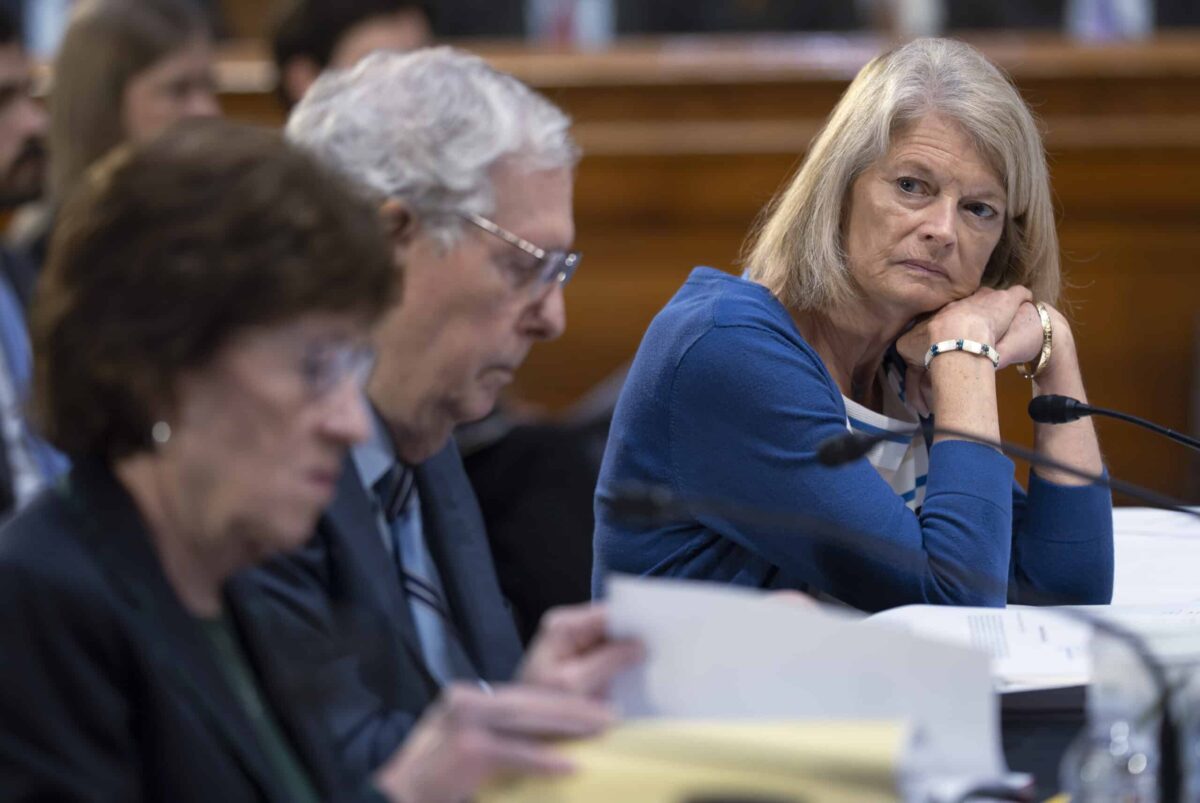
Sen. Lisa Murkowski, R-Alaska, right, listens as the Senate Appropriations Committee marks up the FY2026 spending bill for the Department of the Interior, the Environmental Protection Agency, Department of Transportation, and the Department of Housing and Urban Development, at the Capitol in Washington, Thursday, July 24, 2025. (AP Photo/J. Scott Applewhite)
Sen. Lisa Murkowski, R-Alaska, right, listens as the Senate Appropriations Committee marks up the FY2026 spending bill for the Department of the Interior, the Environmental Protection Agency, Department of Transportation, and the Department of Housing and Urban Development, at the Capitol in Washington, Thursday, July 24, 2025. (AP Photo/J. Scott Applewhite)
AP- Republican U.S. Sen. Lisa Murkowski, speaking with Alaska reporters Monday, toyed with the idea of running for governor and defended her recent high-profile decision to vote in support of President Donald Trump’s tax breaks and spending cuts bill.
Murkowski, speaking from Anchorage, said “sure” when asked if she has considered or is considering a run for governor. She later said her response was “a little bit flippant” because she gets asked that question so often.
“Would I love to come home? I have to tell you, of course I would love to come home,” she said. “I am not making any decisions about anything, because my responsibility to Alaskans is my job in the Senate right now.”
Several Republicans already have announced plans to run in next year’s governor’s race, including Lt. Gov. Nancy Dahlstrom. Republican Gov. Mike Dunleavy is not eligible to seek a third consecutive term. Alaska has an open primary system and ranked choice voting in general elections.
Murkowski is not up for reelection until 2028.
A centrist, Murkowski has become a closely watched figure in a sharply divided Congress. She has at times been at odds with her party in her criticism of Trump and blasted by some GOP voters as a “Republican in name only.” But her decision to support Trump’s signature bill last month also frustrated others in a state where independents comprise the largest number of registered voters. She previously described her decision-making process around the bill as “agonizing.”
On Monday, she said it was clear to her the bill was not only a priority of Trump’s but also that it was going to pass, so it became important to her to help make it as advantageous to the state as she could.
“So I did everything within my power — as one lawmaker from Alaska — to try to make sure that the most vulnerable in our state would not be negatively impacted,” she said. “And I had a hard choice to make, and I think I made the right choice for Alaskans.”
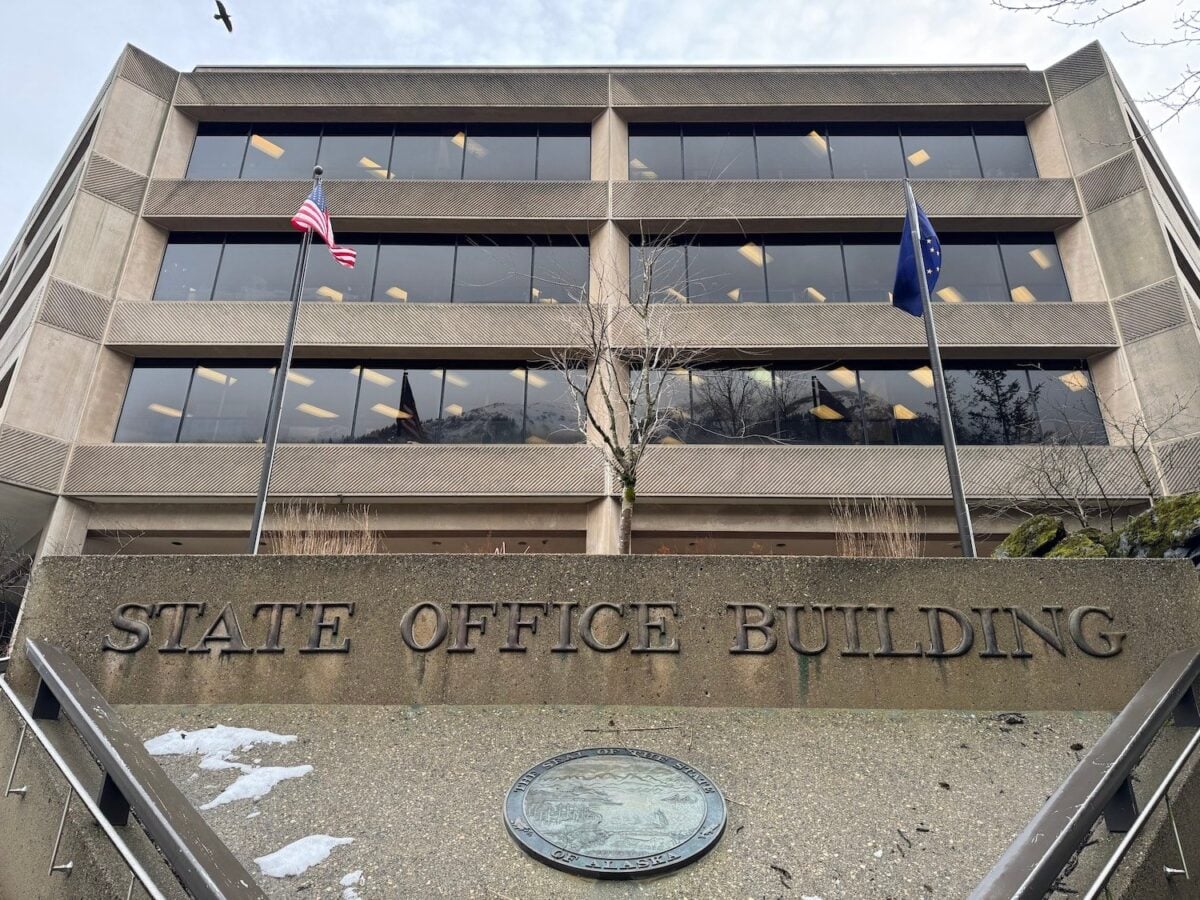
The State Office Building in Juneau is seen on Thursday, Feb. 20, 2025. (Photo by James Brooks/Alaska Beacon)
By: James Brooks, Alaska Beacon
The State Office Building in Juneau is seen on Thursday, Feb. 20, 2025. (Photo by James Brooks/Alaska Beacon)
In a new administrative action, Gov. Mike Dunleavy is ordering “efficiency reviews” of state agencies and asking departments to use artificial intelligence software as part of an effort to identify budget cuts.
The reviews will take place annually, according to Dunleavy’s new administrative order, published Monday, and would become part of the state’s annual budget process.
The reviews will initially focus on “grants to non-State of Alaska entities” and “accounts payable,” according to a copy of the text available online.
The reviews are intended to “identify potential savings” and “improve efficiency of operations” but also will include recommendations for the state to contract out services rather than performing them in-house.
“Alaskans expect their government to deliver essential services in the most efficient and responsible way possible,” Dunleavy said in a written statement announcing the administrative order. “This order ensures we prioritize critical needs, eliminate waste, and safeguard the state’s financial stability.”
Some prior outsourcing efforts by the Dunleavy administration have seen state services assigned to call centers outside Alaska, drawing opposition from union officials and legislators.
A second order, also released Monday, calls for the state to significantly reduce the number of regulations it has on the books.
Notably, the order says that the state should speed permitting for projects regulated by the Alaska Department of Natural Resources, Department of Environmental Conservation and Alaska Department of Fish and Game.
That could mean automatically approving projects even if their environmental review hasn’t been completed according to timelines required by the state, the order says.
Dunleavy leaves office on Dec. 6, 2026. The order says that the state should “reduce the number of regulatory requirements by 15% by Dec. 31, 2026, and 25% (cumulative) by Dec. 31, 2027.”
A liaison with each state department will be required to provide quarterly updates on that goal to the governor’s office.
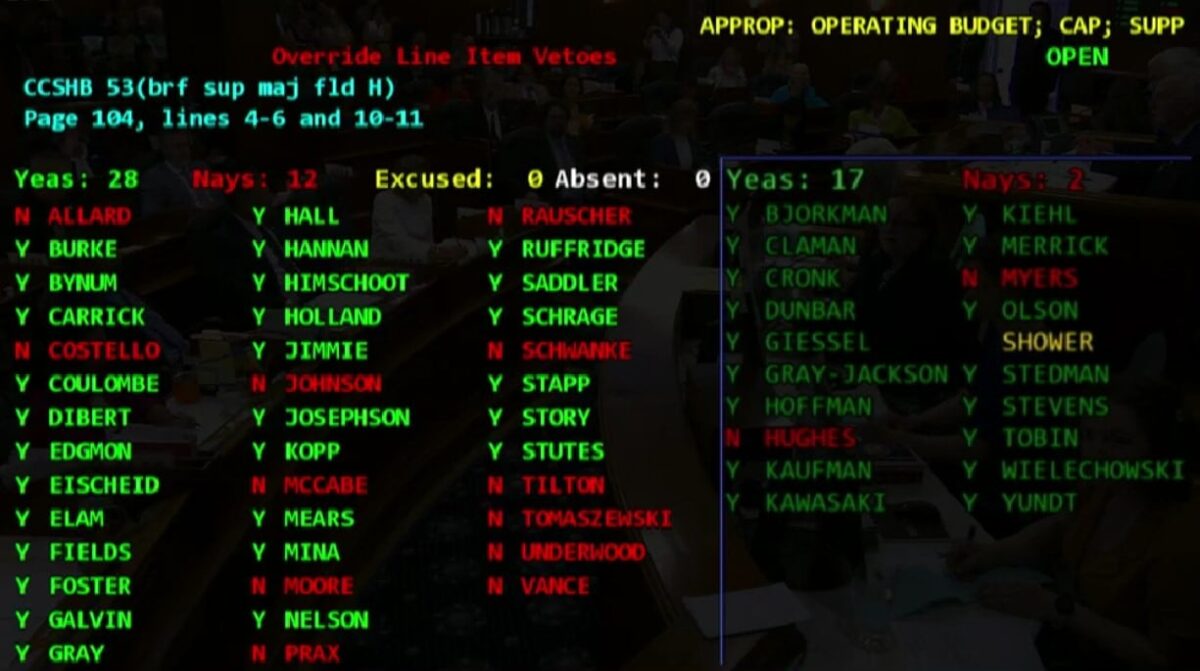
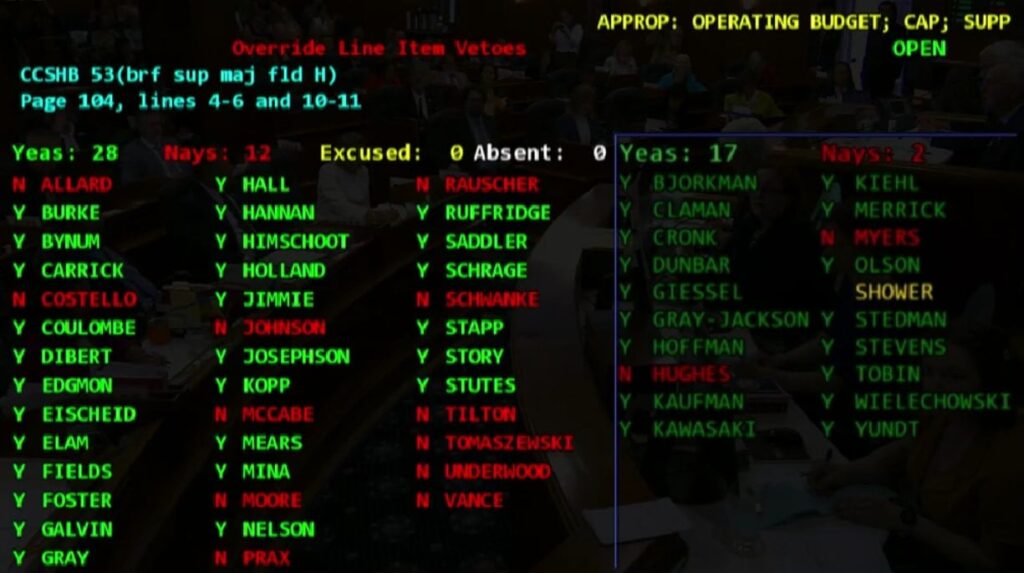
The joint session voted 45-14 in favor of overriding Gov. Mike Dunleavy’s veto of public school funding. (Image courtesy Gavel Alaska)
Meeting in special session, Alaska lawmakers have overridden Governor Mike Dunleavy’s veto of more than $50 million in public school funding.
The 45–14 vote hit the exact threshold needed to override a budget veto, restoring what would have been a 5.6% cut to school districts and providing a modest funding boost.
In Juneau, the veto would have had the effect of a $1.4 million loss.
Lawmakers also overrode Dunleavy’s veto of Senate Bill 183, a measure requiring the Department of Revenue to share details of oil tax settlements with legislative auditors.
The special session was originally called by the governor to press for education reform and create a statewide Department of Agriculture, two ideas lawmakers have already rejected.
Instead, legislative leaders focused solely on the veto overrides and adjourned until August 19.
A peaceful protest was held Saturday outside Juneau Police Department headquarters, following the arrest last week of 49-year-old Chris Williams, Jr.
Williams was medevaced to Anchorage after being taken to the ground by JPD Officer Brandon LeBlanc outside the Douglas Library. Video posted on social media shows LeBlanc taking Williams down during what police say was an arrest after Williams allegedly approached officers aggressively.
Nearly 100 protesters peacefully called for accountability and systemic police reform.
Organizer Jamiann S’eiltin said the incident reflects a broader pattern of violence against Indigenous people.
“This isn’t something new,” S’eiltin said. “This has been going on since almost time immemorial, since the arrival of Western European settlers. So, just want to put that out there that we are brutally attacked 10 times more than the national average, and that’s something to bring forward here today.”
LeBlanc is on administrative leave and an outside agency is conducting an investigation into the incident.
The Central Council of Tlingit and Haida, which confirmed Williams is a tribal citizen, is demanding transparency and a full inquiry.
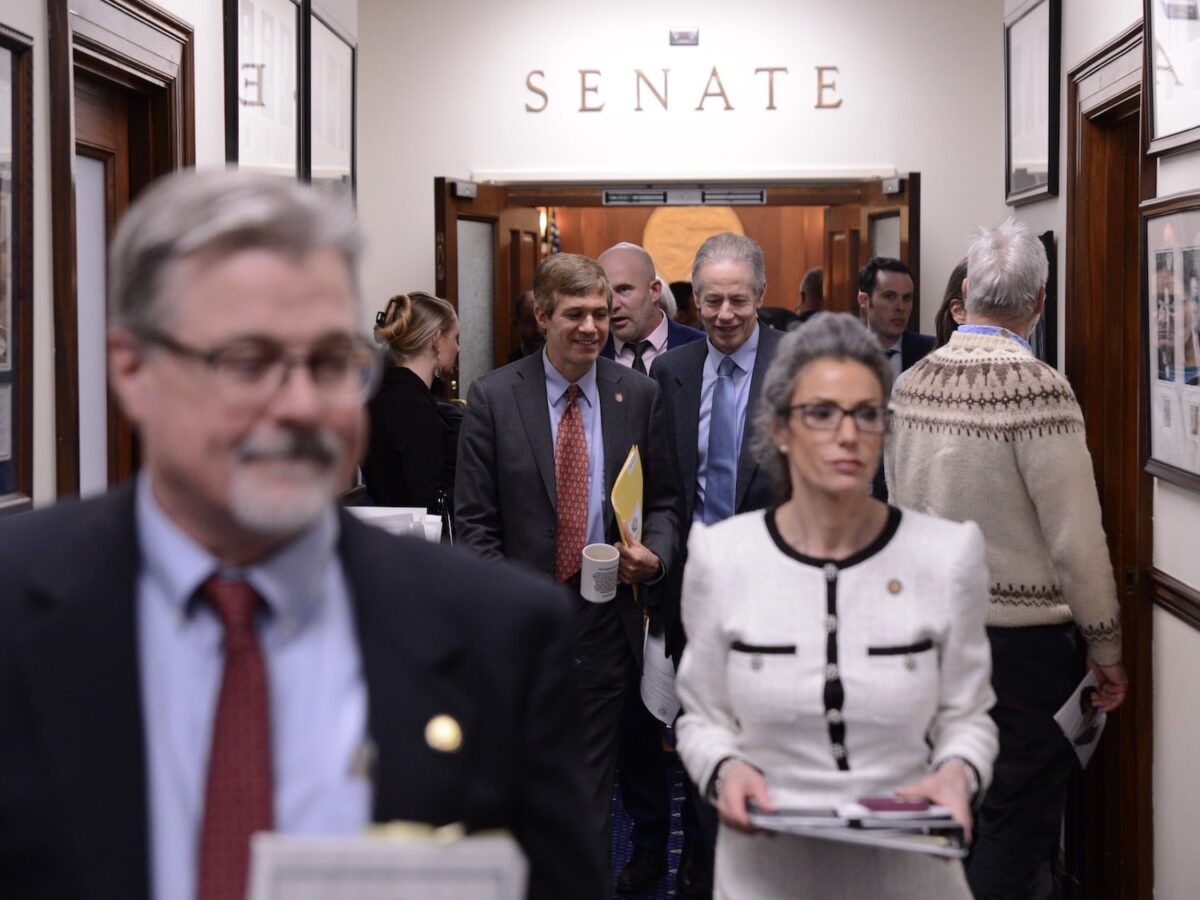
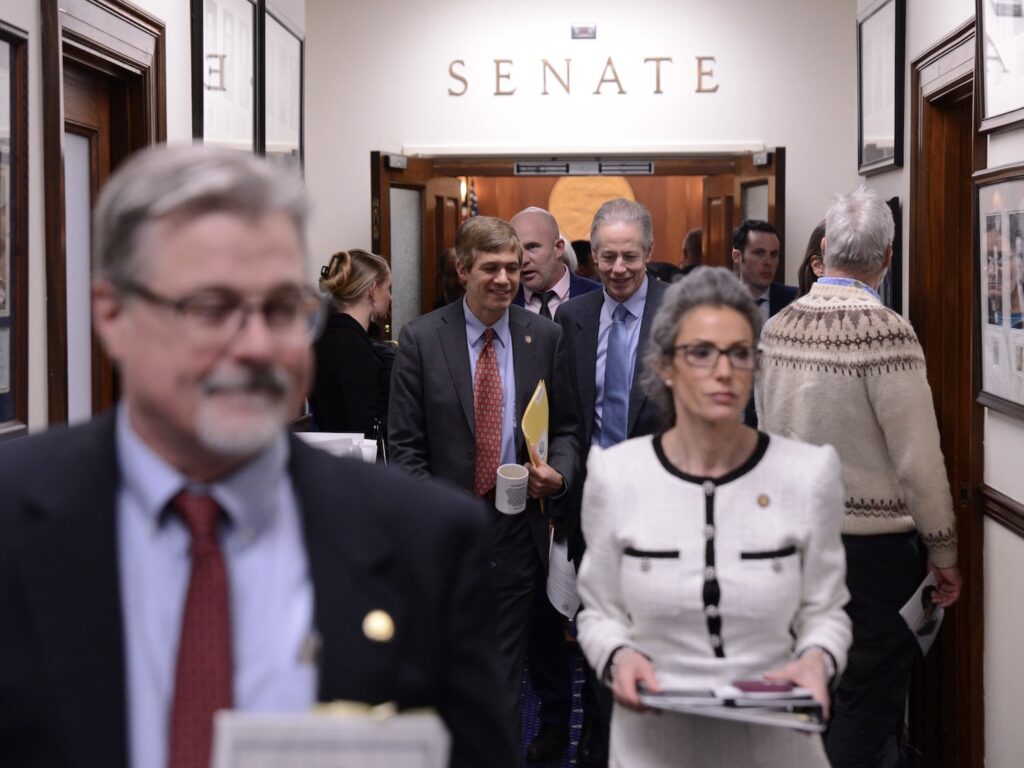
Members of the Alaska Senate leave the Senate chambers on Monday, April 28, 2025. (Photo by James Brooks/Alaska Beacon)
By: James Brooks and Corinne Smith, Alaska Beacon
Members of the Alaska Senate leave the Senate chambers on Monday, April 28, 2025. (Photo by James Brooks/Alaska Beacon)
Alaska lawmakers are scheduled to meet at 10 a.m. in Juneau for a special session of the Alaska Legislature. You can watch live online on Gavel Alaska.
Why is the Legislature meeting in a special session?
Gov. Mike Dunleavy called the special session. The official agenda says that it will involve legislation about education policy and a proposed Alaska Department of Agriculture.
Will legislators actually do that?
No.
What are they doing instead?
They’re going to vote on overriding at least some of the vetoes the governor has made since the regular legislative session ended in May.
No. 1 on the list is the governor’s decision to veto about $51 million in funding for public schools. The No. 2 item is the bill that would require the Alaska Department of Revenue to provide lawmakers with additional information about tax settlements between oil companies and the state. Lawmakers believe the state may be settling tax disputes for far less than they’re worth, costing the state millions.
Some legislators are interested in taking up other vetoes as well, including the governor’s decision to cancel a ban on payday loan lending, his decision to veto money for transportation projects, and his vetoes of bills affecting police dogs and teacher housing, among others.
Will those overrides succeed?
It’s too close to call. The Alaska Constitution says votes from 45 of 60 legislators are needed to override a budget veto. In May, 46 legislators voted in favor of overriding the governor’s decision to veto a bill that increases the state’s public school funding formula.
That was the first time since 2002 that legislators voted to override the veto of a sitting governor.
It isn’t clear whether everyone who voted in favor of that first override will vote in favor of the second.
Overriding a policy bill veto, like the one dealing with the tax settlements, takes 40 votes.
Will everyone be there?
Probably not. Some conservative Republicans had said they would stay away from the session in a show of support for the governor’s vetoes. Immediately after calling the special session, Dunleavy asked them to be absent for the first five days because an absence is as good as a “no” vote when it comes to a veto override.
He later changed his position, asking lawmakers to begin meetings about his stated agenda on Sunday, and some Republicans changed course and said they will attend the session, after all. It wasn’t clear whether all have done so, but it isn’t likely to affect the vote total on the potential override.
Sen. Forrest Dunbar, D-Anchorage, is in favor of an override and had been expected to be unavailable because of military service overseas. He ended up getting a special leave of absence and is flying back from Europe. Sen. James Kaufman, R-Anchorage, is flying back from Vietnam to attend. Other legislators have canceled family plans and postponed business trips.
How long will this take?
On the low end, a few hours. On the high end, a few days. Officially, the special session can last for up to 30 days, but legislators have said they won’t use all that time.
In some previous special sessions, legislators have left Juneau without formally closing the special session, just in case they need to come back. Those special sessions ended after the 30th day.
How much will this special session cost?
Based on historical costs, the estimated cost for a special session is $30,000 per day, according to the Legislative Affairs Agency, the Legislature’s nonpartisan support agency. But that cost depends on the duration and scope of the special session, said Jessica Geary, the agency’s executive director, by email on Tuesday.
“Many legislators had to change summer travel plans to attend the special session, and many of them purchase their own travel and submit for reimbursement. At this point we don’t have any concrete cost estimates and won’t know until the special session concludes,” she said.
Geary said legislators have up to 60 days to submit reimbursements for expenses like hotel lodging, transportation and airfare, staffing, expenses, and so the agency will have a total cost by October.
Legislators receive an annual salary of $84,000 per year. The 57 members that live outside of Juneau are entitled to receive a “per diem” amount of $332 per day to cover expenses.
If lawmakers don’t take up the governor’s ideas, are they dead?
No. Legislators have created a task force to consider education policy changes, including those from the governor. One idea supported by the governor is open enrollment — allowing a student to move between different schools and school districts, regardless of where they live. That will be considered by the task force, which meets Aug. 25.
Legislators are also considering a bill that would create the Alaska Department of Agriculture. That bill is broader than the governor’s initial plans; for example, it would include sea farms (formally known as aquaculture), which are the fastest-growing agricultural sector in Alaska.
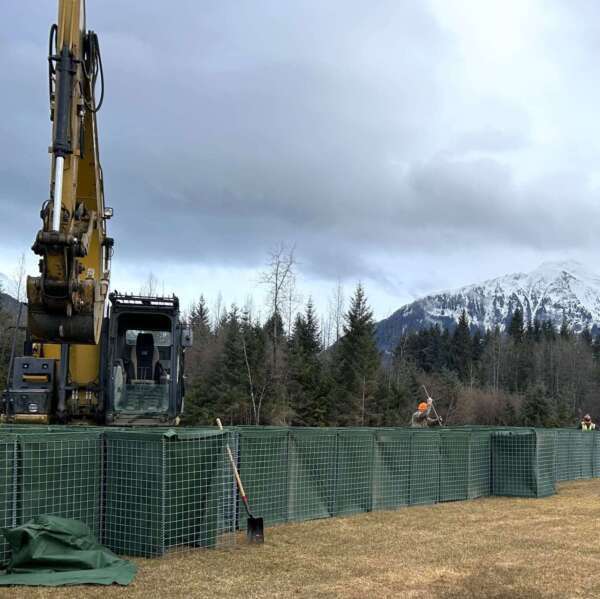
Photo provided by CBJ following the installation of the HESCO barrier project
Photo provided by CBJ following the installation of the HESCO barrier project
NOTN- Deputy Mayor Greg Smith joined KINY’s morning show on Thursday to recap Wednesday’s joint flood initiative meeting, discussing long-term solutions for flooding caused by the Mendenhall Glacier’s Suicide Basin.
In the short term, HESCO barriers remain the primary line of defense for vulnerable neighborhoods.
“We’re approaching historical release times” said Smith, “I mean, of course, everyone is crossing their fingers and just hoping for the best possible outcome.”
The Army Corps emphasized that a more permanent solution—such as a levee around Mendenhall Lake, is likely necessary. But planning and engineering such infrastructure takes time.
“they’re doing studies, but they need to know, you know, what is the risk from Suicide basin, in 5 years, what’s the risk in 50 years? There are more basins back up behind the glacier, and they need to know what those situations could be.” He said, “There’s a lot of factors that go into it. So for them to engineer a viable, long-term solution that will not fail, it does take time. We’ve heard them say it’s probably the top issue for the Army Corps in the state of Alaska.”
A federally funded technical study is underway, and officials hope that data from current modeling and previous floods will help shorten the usual multi-year timeline.
Still, even an expedited timeline might take seven years or more, but Smith says he’s optimistic about that timeline.
“The fact that we just got federal money to do this technical study is tremendous.” Said Smith.
With the Alaska Legislature back in town for the special session, Smith urged residents to take the opportunity to raise the issue with state lawmakers.
“I think some of the takeaways for people, is letting our congressional staff or congressional delegation know the importance.”
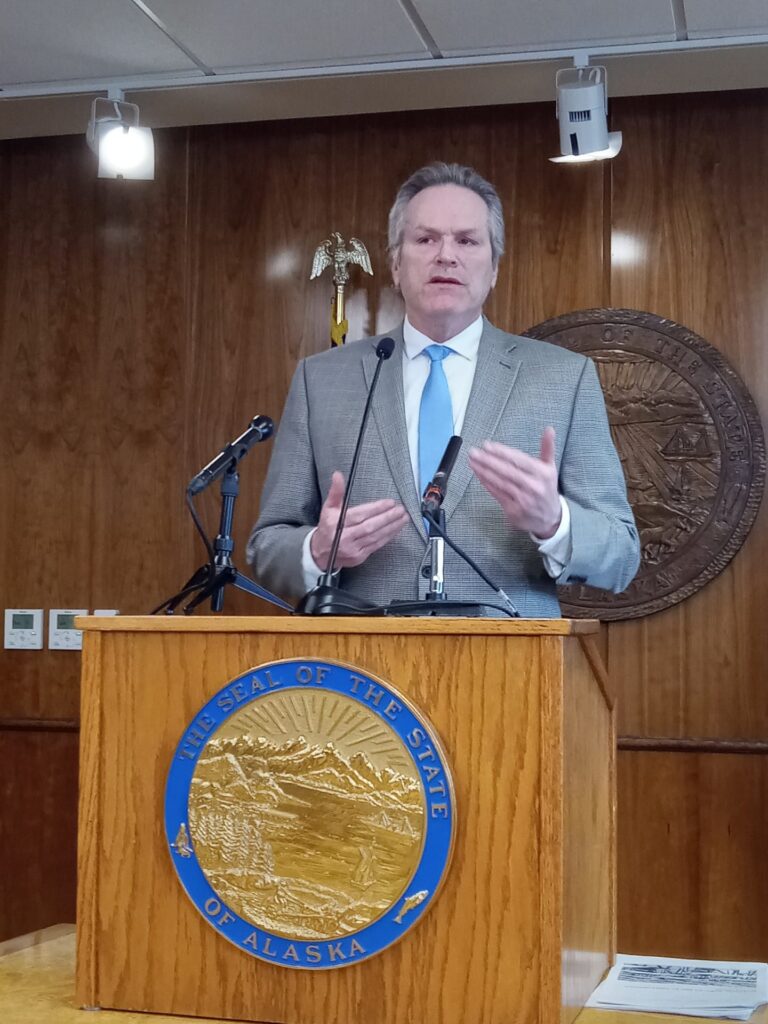
Alaska Gov. Mike Dunleavy speaks during a news conference on Friday, March 15, 2024. (Photo by James Brooks/Alaska Beacon)
Alaska Gov. Mike Dunleavy speaks during a news conference on Friday, March 15, 2024. (Photo by James Brooks/Alaska Beacon)
NOTN- The Alaska Legislature will reconvene in Juneau on Saturday for a special session called by Gov. Mike Dunleavy, with two major items on the agenda: education reform and the creation of a new Department of Agriculture. But lawmakers are also preparing to challenge some of the governor’s recent vetoes, including cuts to public school funding.
Under Alaska’s constitution, when the governor calls a special session, he sets the subjects lawmakers may address.
“He has, apparently, a new education bill. Most of it is stuff that we have seen before, that he’s proposed before, and that has not had a lot of support.” Said Juneau Senator Jessie Kiehl, “And the other thing he wants to take another crack at is creating an Alaska Department of Agriculture. We have a Division of Agriculture. He wants it to be its own State Department.”
But overriding vetoes may take center stage during the first five days of the session, a constitutionally limited window for legislators to reverse the governor’s decisions.
At the top of the list: restoring approximately $51 million in statewide public school funding that Dunleavy vetoed.
That override will require a three-quarters majority, or 45 votes.
“It is the highest, toughest veto override threshold in all 50 states or any of the territories.” Said Senator Kiehl, “I have talked to colleagues all over this state, Republicans, Democrats, rural, urban and the agreement is our schools are hurting, and they need that money.”
Lawmakers are also considering overriding a veto of a bipartisan bill that would empower the Legislative Auditor to review oil tax enforcement practices
That override will require two-thirds of the Legislature, or 40 votes.
In addition to the override votes, lawmakers may consider a commercial fishing bill and discuss items in the governor’s education package through the new legislative Education Task Force.
A recent report suggested that Dunleavy had asked some minority Republicans to stay home in an effort to block override votes. Kiehl said he believes most lawmakers plan to attend.
“My understanding is that in the last week or so, the governor has come the other way and said, everybody, go ahead and be there.” He said, “The Constitution has some rules for how you do your job when you raise your right hand as a legislator elected by the people and take on this duty, I don’t believe in cutting work when I’m on the job, I think the vast majority of my colleagues feel the same way.”
Bill introductions are scheduled for the session’s opening day, August 2, with hearings requested to begin Sunday, Aug. 3.
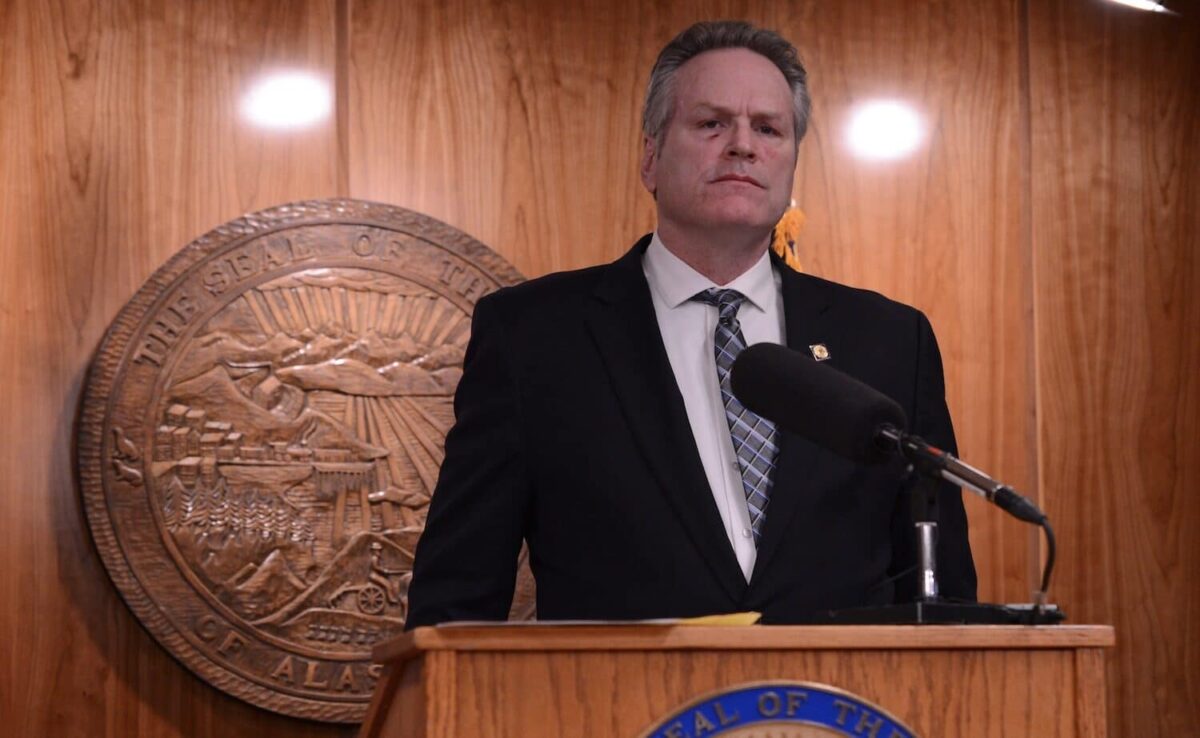
Governor Mike Dunleavy speaks during a press conference on Thursday, April 17 in Juneau. (Photo by Greg Knight/NOTN)
Governor Mike Dunleavy speaks during a press conference on Thursday, April 17 in Juneau. (Photo by Greg Knight/NOTN)
NOTN- Gov. Mike Dunleavy on Monday released the full policy agenda for a special session of the Alaska Legislature, scheduled to begin Saturday, Aug. 2. The session, first announced earlier this month, will focus on a sweeping package of education reforms the Governor says are aimed at improving student outcomes and securing long-term funding for public schools.
“This is an opportunity to address Alaska’s performance issues and funding issues in K-12 education well into the future.” Dunleavy said in the press release. “By addressing this now, school districts, students, parents, teachers, and policymakers will have certainty and will not have to debate this issue during the regular session that begins in January,”
The Governor’s office outlined their key priorities for the session, those include
Executive order creating a Department of Agriculture
Tribal Compacting between the state Department of education and select tribes
Expansion of corporate tax credit program for education.
Authorize the Department of Education as a charter school authorizer in addition to local districts
Open enrollment allowing public school students to enroll in any public school that has room including outside of a student’s resident district.
Grants for reading improvement and for a new after school reading tutoring program
Recruitment retention payments to classroom teachers to reduce turnover
Long-term certainty in funding for K-12 schools if agreement is reached on policy.
Education Commissioner Dr. Deena Bishop, a former teacher and superintendent, said the proposals are evidence-based and modeled after successful policies in other states.
Bill introductions are scheduled for the session’s opening day, with hearings requested to begin Sunday, Aug. 3.
However many lawmakers plan to override Gov. Mike Dunleavy’s decision to veto millions of dollars in public school funding from this year’s state operating budget.
according to the Alaska Beacon, It takes 45 votes to override an Alaska governor’s budget veto, and of the 46 legislators who voted this spring to override the governor’s veto of the education funding formula, all but a handful have committed to supporting a budget veto override as well.
That formula is subject to the state’s annual budget process, and Dunleavy chose to only partially fund it, causing a wave of cuts to services at public schools across the state. Dunleavy had said he would not agree to the full funding increase without the Legislature adopting other policies he’s proposed.
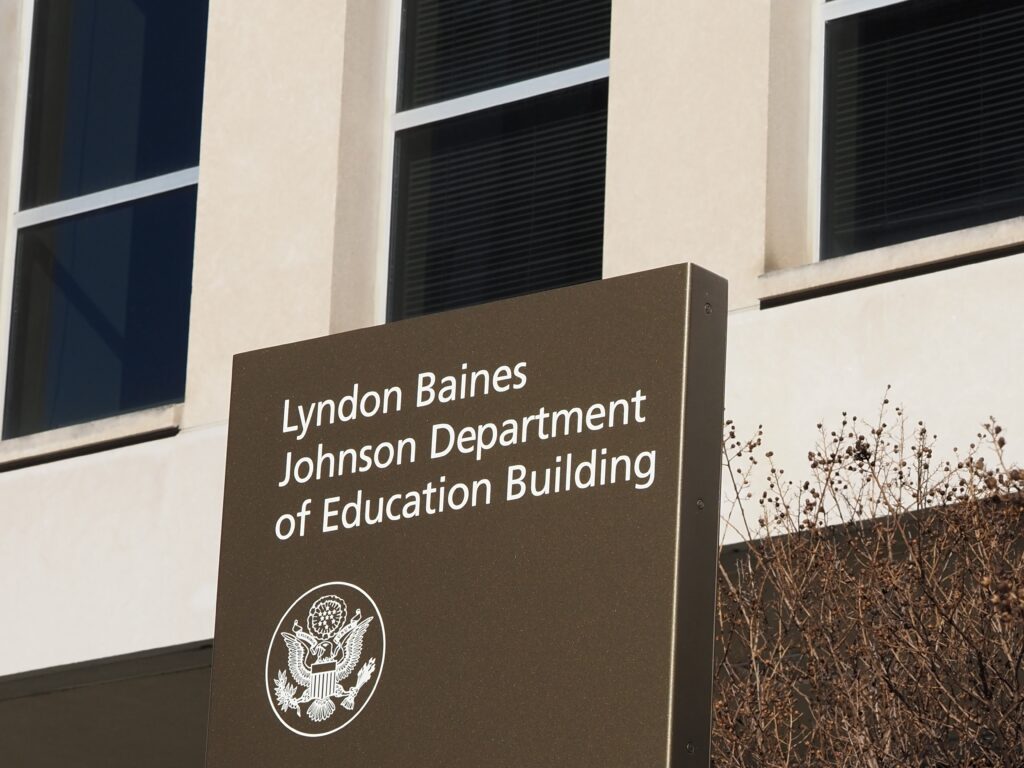
The Lyndon Baines Johnson Department of Education Building in Washington, D.C., in a file photo from November 2024. (Photo by Shauneen Miranda/States Newsroom)
WASHINGTON — The Trump administration said Friday it’ll soon release billions in Education Department funding that has been frozen for weeks, delaying disbursements to K-12 schools throughout the country.
The funding — which goes toward migrant education, English-language learning and other programs — was supposed to go out before July 1, but the administration informed schools just one day before that it was instead holding onto $6.8 billion while staff conducted a review. Members of both parties in Congress objected to the move.
The Education Department released $1.3 billion for before- and after-school programs as well as summer programs in mid-July, but the rest of the funding remained stalled.
Madi Biedermann, a Department of Education spokesperson, wrote in an email to States Newsroom that the White House budget office “has completed its review” of the remaining accounts and “has directed the Department to release all formula funds.”
The administration will begin sending that money to school districts next week, Biedermann wrote.
Appropriators cheer
Maine Republican Sen. Susan Collins, chairwoman of the Appropriations Committee, wrote in a statement the “funds are essential to the operation of Maine’s public schools, supporting everything from classroom instruction to adult education.”
“I am pleased that following outreach from my colleagues and me, the Administration has agreed to release these highly-anticipated resources,” Collins wrote. “I will continue working to ensure that education funds are delivered without delay so that schools have adequate time to plan their finances for the upcoming school year, allowing students to arrive back to class this fall to properly-funded schools.”
Collins and nine other Republican senators wrote a letter to Office of Management and Budget Director Russ Vought earlier this month asking him to “faithfully implement” the spending law Congress approved in March.
“The decision to withhold this funding is contrary to President (Donald) Trump’s goal of returning K-12 education to the states,” the GOP senators wrote. “This funding goes directly to states and local school districts, where local leaders decide how this funding is spent, because as we know, local communities know how to best serve students and families.
“Withholding this funding denies states and communities the opportunity to pursue localized initiatives to support students and their families.”
West Virginia Republican Sen. Shelley Moore Capito, chairwoman of the appropriations subcommittee that funds the Education Department, wrote in a statement released Friday she was glad to see the funding unfrozen.
“The programs are ones that enjoy longstanding, bipartisan support like after-school and summer programs that provide learning and enrichment opportunities for school aged children, which also enables their parents to work and contribute to local economies, and programs to support adult learners working to gain employment skills, earn workforce certifications, or transition into postsecondary education,” Capito wrote. “That’s why it’s important we continue to protect and support these programs.”
Adam Crum, commissioner of the Alaska Department of Revenue, testifies Friday, Jan. 20, 2023, at a meeting of the Alaska Senate Finance Committee in the state Capitol at Juneau, Alaska. (Photo by James Brooks/Alaska Beacon)
By: James Brooks, Alaska Beacon
Adam Crum, commissioner of the Alaska Department of Revenue, testifies Friday, Jan. 20, 2023, at a meeting of the Alaska Senate Finance Committee in the state Capitol at Juneau, Alaska. (Photo by James Brooks/Alaska Beacon)
Adam Crum, commissioner of the Alaska Department of Revenue, will leave his job Aug. 8, according to an announcement published Friday by Gov. Mike Dunleavy’s office.
A person familiar with Crum’s plans said he intends to run for governor in 2026, joining seven other Republican candidates. No independents or Democrats have filed for the primary election, which is 13 months away.
Asked whether he will run for governor, Crum said by text message, “I’ve accomplished a lot to put Alaska on sound economic footing. I’ll have a formal statement on my last day, August 8th. Stay tuned.”
Crum has been part of Dunleavy’s cabinet since the governor took office in 2018. He initially served as commissioner of the Alaska Department of Health and Social Services, occupying that position during the COVID-19 pandemic and during an executive order that split the agency into two separate departments.
In 2022, Dunleavy named Crum as revenue commissioner, and he assumed a seat on the board of the Alaska Permanent Fund Corp., whose revenues are the No. 1 source of general-purpose dollars for state services and the Permanent Fund dividend.
Jason Brune, former commissioner of the Alaska Department of Environmental Conservation, now fills a public seat on the Permanent Fund Corp. board.
Brune said he knows Crum has been considering a run for governor but could not confirm his plans.
“His departure is a big loss for the state,” Brune said by text.
“It was an honor working with him for the five years we served together,” he said, referring to the time they spent on the Dunleavy cabinet.
In a written statement Dunleavy praised Crum’s performance during his time with the state.
“Commissioner Crum has been an exemplary leader whose unwavering dedication and innovative approach have significantly benefited Alaskans,” Dunleavy said. “During his time leading both the Department of Health and Social Services and the Department of Revenue, Adam consistently prioritized Alaska’s economic well-being, public health, and fiscal stability. His collaborative spirit and commitment to serving our communities have made a lasting, positive impact.”
The governor’s office said an acting commissioner will be named soon.