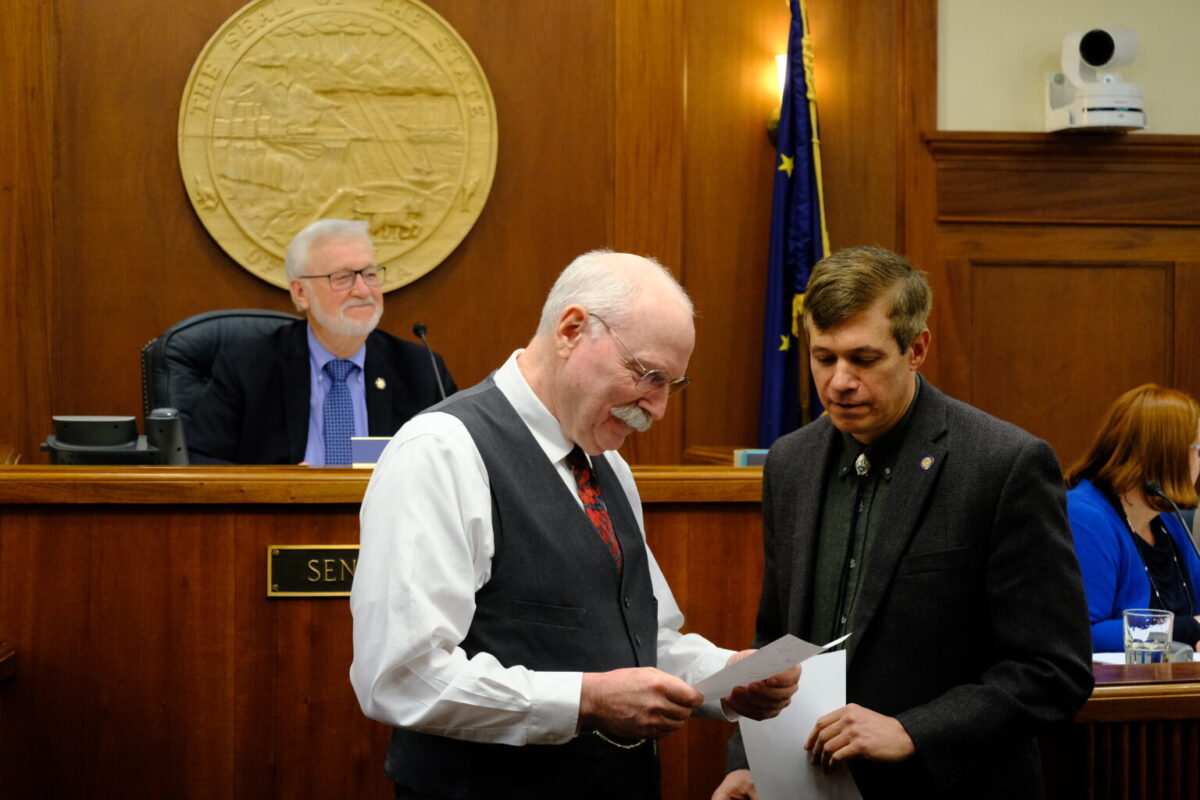
After four years of effort, the Alaska Legislature has passed a bill offering additional support for the underfunded organization that offers free legal help to Alaskans facing civil lawsuits.
“We’re so excited,” said Maggie Humm, executive director of the Alaska Legal Services Corporation.
ALSC is the state’s largest provider of free legal assistance for survivors of domestic violence and abuse. It generally supports Alaskans who are unable to afford an attorney on their own.
Under state law, Alaska must provide criminal defendants with a defense attorney. No such mandate exists in civil cases, so the work falls to the ALSC, a nonprofit that lacks the budget to take on every request for help.
On Wednesday, the state Senate voted 17-3 to pass House Bill 48 and give the corporation 25% of all state court filing fees, up from 10%. The change is worth an extra $400,000 to the corporation.
The change does not affect funding for the Alaska Court System; the fees are otherwise used for general purposes, not the courts specifically.
Humm said earlier this year that ALSC provided legal help to roughly 6,200 Alaskans in 2024. By email on Wednesday, she said she expects another 800-850 people will be helped by the additional money.
Because the House passed HB 48 on a 27-13 vote in February, the Senate’s action on Wednesday will send the bill to Gov. Mike Dunleavy for final approval or veto.
Sen. Forrest Dunbar, D-Anchorage, proposed an identical bill in 2023, and while that bill passed the Senate, it never received a vote in the House before the 33rd Alaska Legislature expired in 2024.
That left Sara Hannan, D-Juneau, to reintroduce the bill last year and restart the legislative process.
By email, Humm said that if signed into law, the bill “helps to ensure that more low-income Alaskans facing issues such as domestic violence, elder fraud, and access to earned benefits receive the legal help they need to protect their safety, stability, and dignity. Investing in legal services benefits all Alaskans by helping resolve problems early, before they become more serious and costly challenges for both individuals and our communities.”
ALSC has been trying since 2011 to pass a bill that reserves 25% of the state’s court fees for the corporation. In 2018, the Legislature passed a measure allocating 10%.
Attorney General designee Stephen Cox answers questions from the House Judiciary Committee during a confirmation hearing on May 4, 2026. (Photo by Corinne Smith/Alaska Beacon)
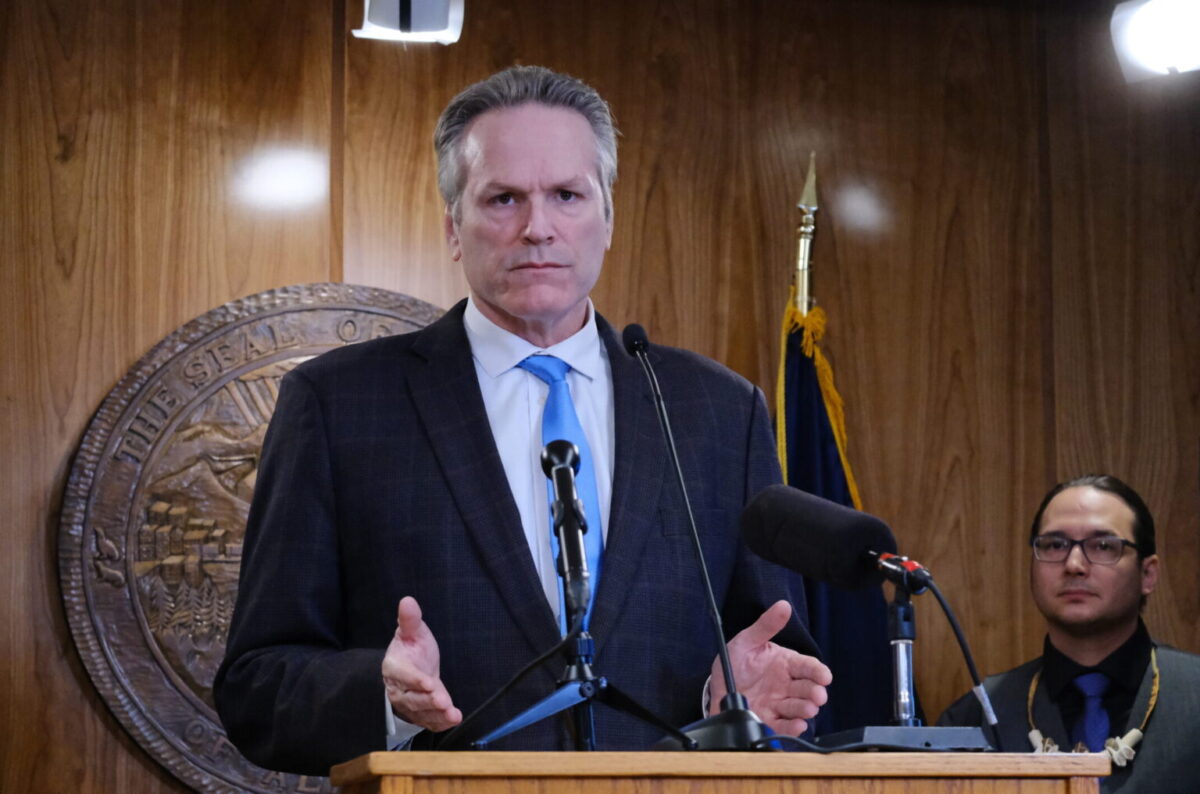
As Alaska state lawmakers consider Gov. Mike Dunleavy’s pick for attorney general, several have questioned a potential conflict between his involvement with a private, religious school and his role in the state’s top legal office.
Stephen Cox currently leads the Alaska Department of Law, which is defending the state in a lawsuit that challenges the constitutionality of spending state homeschool funds on religious and private school tuition.
He is also the treasurer and a founding member of the Thomas More Classical School, a private Christian school for grades Kindergarten through sixth grade, slated to open in Anchorage in the fall, whose website invites the use of state homeschool funding for nonreligious courses.
Cox has served in the role since his appointment in August, and appeared before lawmakers in a series of legislative hearings last week and Monday, ahead of a confirmation vote for attorney general, expected in the next week.
Sen. Löki Tobin, D-Anchorage, who chairs the Senate Education Committee, noted the apparent conflict between the state constitution and the school’s financial plans at a May 1 hearing.
“Our constitution directly says ‘schools and institutions so established shall be free of sectarian control. No money shall be paid from public funds for the direct benefit of any religious or private education institution,’” she read.
She pointed to his role as treasurer as a direct conflict with the state constitution because the school’s “tuition assistance” web page said it anticipates accepting payment through state allotment funds for courses “that do not use religious-based publishers and/or content.”
The lawsuit that will decide whether that spending is constitutional is currently underway.
Cox said he was not aware of the school’s tuition information.
“I am on the board of that school. I am not involved in the day-to-day operations,” he said, adding that he was involved in hiring a headmaster and the formation of the school. “I am not aware of that part of the website and I’m also not aware of any decisions with respect to allotment programs.”
He declined to comment further saying the issue was in active litigation.
Each homeschooled student is eligible for up to $4,500 per year, to be spent on curriculum, supplies or other educational resources. But the question on whether that money can go toward religious or private institutions is currently being decided.
A group of parents brought the lawsuit to prohibit state money from going to such institutions against the state in 2023, and a judge ruled the allotment system unconstitutional in 2024, but that ruling was overturned by the Alaska Supreme Court. The case moved back to a lower court — four school districts were named as defendants — and last fall a judge denied a motion to dismiss the lawsuit, citing need for evidence of how allotments are actually spent. A discovery period for both sides to collect evidence is open until June 1.
At a Monday hearing before the House Judiciary Committee, Rep. Ted Eischeid, D-Anchorage, pressed the question.
“Does that mean that under Alaska ethics law, you would recuse yourself about decisions that might benefit your school, financially related to public money going to private schools?”
Cox answered a slightly different question. He told lawmakers, for background, he had already looked into the question of recusal given his three children are homeschooled through the Anchorage School District’s correspondence program, Family Partnership Correspondence School. He said that he was advised it wasn’t necessary.
“The advice that I received back from my ethics supervisor after an analysis was that it was not a reason for recusal, because I think there are, like, 25,000 Alaskan students that benefit from the allotment, and so the fact that my kids benefit in piano class and tutoring and whatnot wasn’t itself a reason to recuse,” he said.
Cox is Catholic, and is a parishioner at the Holy Family Catholic Church in Anchorage, according to the school’s website.
Cox said he learned that the Thomas More Classical School was anticipating receiving allotment funds during confirmation hearings last week. He said he was not directly involved with the state’s defense in the lawsuit and that he would seek ethics advice about recusing himself from the case.
“I will say that I’m not involved in any of the day-to-day litigation, or even really any of the supervision of the strategic litigation,” he added. “Recently, last week, I learned for the first time that on the website, there was a reference to the school anticipating becoming a vendor of the correspondent school allotment programs. So I have asked my staff to take another look at that from a recusal perspective.”
On Tuesday, the tuition information on the school’s website had been changed. It now says that it still anticipates taking allotment money, but only in accordance with state law.
At the hearing on Monday, Eischeid asked Cox if the school planned to receive public allotment funds.
Cox said the issue is being litigated in court now, and whether it’s constitutional has yet to be determined.
“I want to be very careful, because this is in active litigation, and these are the issues that the judge and the judges ultimately will have to grapple with,” he said. “But as I understand it, the school districts and their correspondence schools — so for example, ASD’s correspondent schools, Family Partnership — the school districts will decide whether or not and to what extent the allotment can be used for private educational or private institutions, and vendors.”
Cox said when a court rules on the question, the Thomas More Classical School will follow the law.
Rep. Andrew Gray, D-Anchorage, noted that the Thomas More Classical school board president is Charles Gartland, who is also working at the Alaska Department of Law as the civil division director.
“Would he need to recuse from any cases dealing with allotments and private schools?” Gray asked?
Cox said he has asked the department’s ethics lawyers to research the question.
“I would assume that the same analysis that existed for me would also apply with respect to Mr. Gartland,” he said. “But I do not have an answer on that question yet.”
Officials with Alaska Department of Law did not return a request for comment on Tuesday on how decisions on recusal are made.
Gray said Monday there appeared to be a conflict of interest.
“Even if it’s all above board, as a member of the public, I see that, and I think that I would be more comfortable if the chairman of the board of a private school and the treasurer of the board of the private school wouldn’t work on those particular cases,” he said.
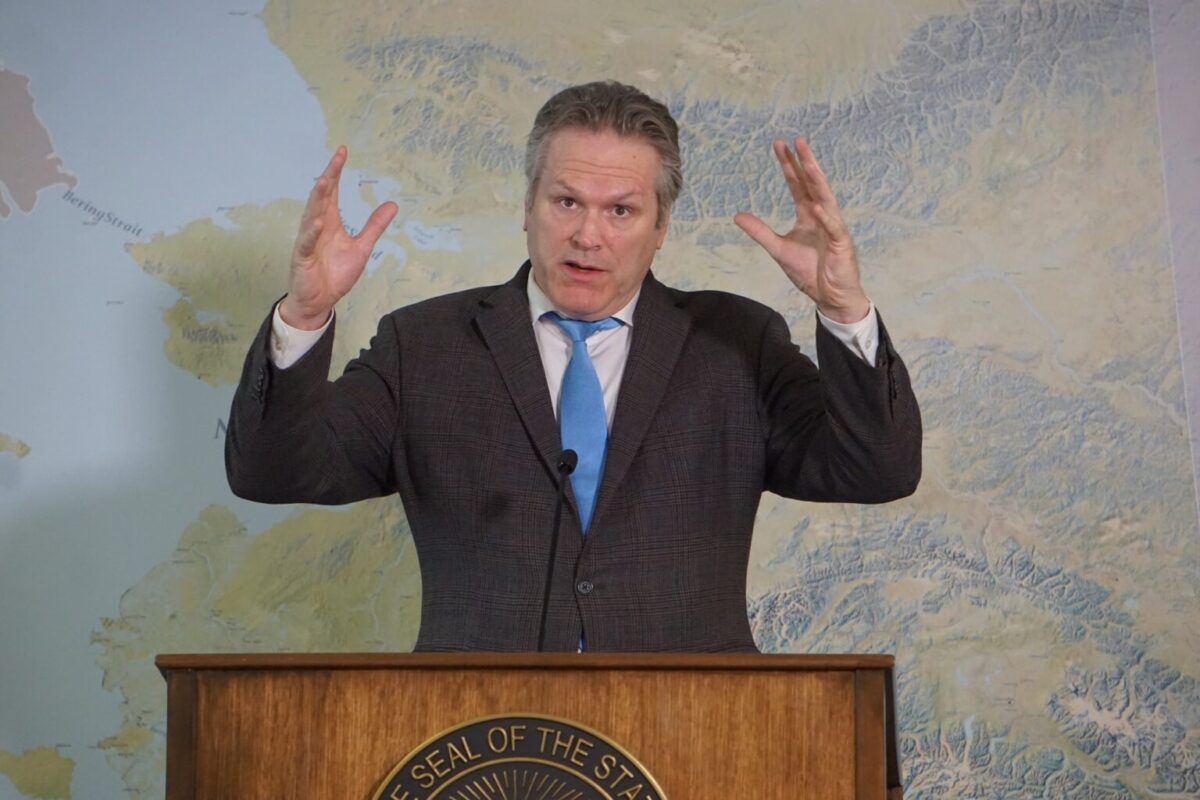
Gov. Mike Dunleavy speaks about at a May 4, 2026, news conference about his property tax bill intended to help draw investment in a massive natural gas pipeline. The news conference was held in his Anchorage office. (Photo by Yereth Rosen/Alaska Beacon)
Alaska Gov. Mike Dunleavy is urging state lawmakers to act on his proposal to cut state taxes by $7.2 billion over the next 36 years to subsidize construction of the proposed trans-Alaska natural gas pipeline.
Failing to act, he said, could keep the pipeline from being built at all.
“This bill is too important. This concept is too important,” Dunleavy said. “This is not setting up a tax for the lemonade stand down here in the corner by the hot dog stand. This is the biggest (natural gas) project on the planet.”
But some state lawmakers are skeptical about the size of the governor’s proposed subsidy. Two alternatives — one in the House and the other in the Senate — are advancing through committees in the final weeks of the session.
Other legislators believe the pipeline already makes financial sense and no change is needed.
As a result, four different paths await state legislators in their last weeks, and it isn’t clear which one they’ll take — or whether the governor will call legislators into special session on the issue.
There’s also been no agreement with cities and boroughs affected by the proposed tax cut. There’s also no public agreement with North Slope gas producers or the state’s labor unions.
At the core of the problem facing lawmakers is how much — if any — subsidy is needed in order to attract investors who would pay for building the pipeline project in two stages.
The first stage would involve a pipeline from the North Slope to Cook Inlet for in-state use. The second stage would construct processing plants at the north and south ends of the pipeline, allowing larger volumes of gas to be exported overseas.
If both phases of the project are built, Department of Revenue economist Dan Stickel told legislators on Tuesday, the result would be cheaper natural gas than currently available from Cook Inlet.
“If the full project goes forward, it’s a significant reduction in cost to Alaskans,” he said.
Rep. Zack Fields, D-Anchorage, noted that Alaskans could be locked into high natural gas prices if the second phase is never built or if both phases are built but no exports take place.
For a hearing last week, the Department of Revenue estimated that under that scenario, prices in Anchorage would exceed $27 per thousand cubic feet by 2033, more than double current prices.
It’s unclear how likely that worst-case scenario is.
The larger the subsidy, the greater the chance that the project is built in full and the lower the price of gas for Alaskans, project proponents say.
“Our objective is to have the lowest cost gas for Alaskans and have certainty on the project,” said Adam Prestidge, president of Glenfarne Alaska, the project’s developer.
A problem, some legislators say, is that they’re working without information. Glenfarne, an international firm that last year bought 75% of the project and became its developer, has not shared its latest estimate for how much the pipeline will cost.
“I think it’s important for us to have starting points on what the actual numbers are, because if it needs tax relief, let’s figure out what the relief is,” said Sen. Bill Wielechowski, D-Anchorage.
Legislators also don’t know how much North Slope gas producers will charge for the gas, or what international buyers will pay for it.
Some of that information is impossible to know — legislators are trying to anticipate the price of natural gas in 2033 and beyond, once the pipeline is up and running.
Other information is being kept confidential until a final investment decision or when proposed prices are submitted to state regulators, something that’s months away at the earliest.
Legislators are being asked to take action within weeks.
“We’re not really competitive in the global market if the (cost) overrun is 40%,” said Rep. Julie Coulombe, R-Anchorage, on Tuesday.
The gas pipeline’s publicly stated cost on Tuesday was $46 billion, but most legislators believe the true figure is higher.
“I think it’s really $57 billion … if not higher,” said Sen. Bill Wielechowski, D-Anchorage, relying on a prior statement from former U.S. Sen. Mark Begich.
Begich, a Democrat, lost to Gov. Mike Dunleavy in the 2018 governor’s election. Now, Begich is a paid adviser, hired by Dunleavy’s administration on a $100,000 contract.
In a Tuesday hearing, Begich said lower taxes would not increase profits for investors or developers and would simply lower the end cost of gas for consumers.
“If you lower the tax, it does not go to the return or the profit or anything of this project,” he said.
“I am just telling you right now, every dollar you save consumers is a dollar in their pocket in an economy that is struggling,” Begich said.
Under his calculations, Wielechowski said, the average Southcentral Alaska family would save $55 per year if the pipeline is built and produces gas according to the latest available cost analysis from the Department of Revenue.
The subsidy needed to create that savings amounts to a loss of $500 per Alaskan per year, he said, money that could be used for the Permanent Fund dividend or state services.
“That’s not a good deal,” he said of the exchange.
The latest available version of the Senate proposal shows an increase in revenue to the state, rather than a subsidy. Instead of earning $27.9 billion through 2062, the state would earn $42.1 billion.
“I would describe that as very burdensome for the project and potentially prohibitively so,” Prestidge said.
“I will characterize that tax at that level as something that would require some real reconsideration of the drawing board of how the project is structured and taken forward,” he said.
In the House, discussions have been less acrimonious. The House Resources Committee on Tuesday morning discussed a proposed a subsidy of less than $5.9 billion, smaller than the governor’s concept but similar in other regards.
“It would be a tax reduction but a smaller tax reduction than proposed by the governor,” Stickel said of the House proposal.
On Tuesday afternoon, the committee worked methodically through a long series of amendments to its plan, frequently consulting Prestidge and Begich about how each might affect financial negotiations.
The House and Senate bills are each in an early stage of development. If passed by the resources committees, each would have to pass through their respective finance committee before advancing to a floor vote and on to the other half of the Legislature.
Speaker of the House Bryce Edgmon, I-Dillingham, and Senate President Gary Stevens, R-Kodiak (at rear) preside over Monday’s joint session of the Alaska Legislature on May 4, 2026. (Corinne Smith photo/Alaska Beacon)
After two southeast Alaska Republicans reversed themselves, the Alaska Legislature on Monday failed to override Gov. Mike Dunleavy’s veto of an elections bill intended to take effect this year.
Forty votes were needed to override the veto. Monday’s vote was 38-22, with Rep. Jeremy Bynum, R-Ketchikan, and Sen. Bert Stedman, R-Sitka, providing the critical votes to sustain the veto. Both previously voted to pass Senate Bill 64 and send it to the governor.
Each said after Monday’s vote that they did not believe state officials would be able to implement the bill in time for this year’s elections.
As written, SB 64 contained a swath of changes to state law that were intended to make it easier for Alaskans to vote and to improve the security of state elections.
Among the proposed modifications: Free postage for absentee ballots, a new system for absentee voters to track their ballots through the counting process, a 10-day period for absentee voters to fix problems that disqualified their ballots, updated procedures for auditing the state’s voter list to remove ineligible people, a requirement that the financial backers of ballot measures disclose their identities and a special liaison intended to fix widespread voting problems in rural Alaska.
Dunleavy vetoed the bill on Thursday. In his veto message to the Legislature, he wrote, “the Division of Elections warns such changes would be extremely difficult if not impossible, to implement securely and reliably in advance of the 2026 elections.”
Sen. Bill Wielechowski, D-Anchorage, supported the bill and the override. Speaking ahead of the vote, he said that in 2022, during a special election held after the death of Rep. Don Young, R-Alaska, the state was able to implement a ballot-tracking system within six weeks.
“I’m not prepared to tell Alaskans, ‘Sorry, it’ll have to wait another year. It’s just too hard,’” Wielechowski said.
Sen. Bill Wielechowski, D-Anchorage, speaks in support of overriding a veto by Gov. Dunleavy of an elections reform bill on May 4, 2026. (Photo by Corinne Smith/Alaska Beacon)
But Bynum said afterward that he was swayed by statements from the Division of Elections, which said it was uncertain about its ability to implement the system so quickly this year.
“I can’t speak to what they may or may not have done in 2022. I can only speak to what the Division of Elections is telling me today. And what they told me is that this timeline is too aggressive for them to effectively put this in the law,” he said.
Bynum said another factor in his vote was the use of tribal IDs by voters at the polls. SB 64 would have mandated the state to accept their use as voter ID. Bynum said that until the past week, he was unaware that tribal IDs could already be used as a matter of policy.
Bynum said the vote was a difficult one for him and that if the bill had taken effect Jan. 1, he would have voted for it.
Stedman was one of the last legislators to vote, and his opposition was significantly less important because Bynum’s decision had already sustained the veto.
“I think they need more time to implement it. That was it, pretty much. I think there’s a lot of good work in this bill and a lot of positive things, but it just needs a little more time,” he said while walking away from Monday’s joint session.
In a joint legislative session, lawmakers in the Alaska House and Senate failed to override Gov. Dunleavy’s veto of an elections reform bill, SB 64, by a vote of 38 to 22, sustaining the veto on May 4, 2026. (Photo by Corinne Smith/Alaska Beacon)
In March, the House voted 23-16 on March 23 to pass the bill. Rep. Ashley Carrick, D-Fairbanks, was excused absent from that vote but later expressed her support. Two days later, the Senate voted 16-4 to approve the House’s changes and send the bill to Dunleavy.
The veto of SB 64 was Dunleavy’s 10th in the two-year 34th Alaska State Legislature. While prior governors have vetoed more bills during a single Legislature, this Legislature has passed relatively few bills, and Dunleavy has vetoed bills at a higher rate than any previous governor.
Legislators overrode two of Dunleavy’s 10 vetoes. Two others, in addition to SB 64, saw override votes fail. The remaining five were never brought up for an override vote despite opportunities to do so.
The veto means a sixth consecutive year will pass without a significant update to the state’s election system. Bipartisan bills failed in 2022, 2024 and now 2026.
This year’s bill appeared to have the most likelihood of success — it was endorsed by Reps. Sarah Vance, R-Homer, and Kevin McCabe, R-Big Lake, two of the most politically conservative members of the state House, and it had support from House and Senate progressives.
The Alaska Federation of Natives issued a statement urging legislators to support an override, as did other groups.
But many Republicans opposed the changes because they wanted a more rigorous cull of the state’s voter list and oppose easier access to absentee voting.
Ahead of the final vote, Republican writer Suzanne Downing lambasted the bill, as did other socially conservative commentators.
Vance, speaking Monday to the Legislature, said she received “threats” and “bullying” because of her support of the bill and an override.
After the vote, she said “there has been slander and an all-out assault to discredit and, frankly, lie to the people about what this bill does.”
Asked whether she was referring to Downing and her website, which has published a series of articles against the bill, she said, “Very clearly — intentionally misleading the people about what’s actually in the bill, what it does, and claiming that I’m no longer a conservative.”
One of the articles was from Rep. Rebecca Schwanke, R-Glennallen, who urged Dunleavy to veto the bill and on Monday asked legislators to sustain the governor’s decision.
Speaking on the floor, she said rural voters in her district need more than 10 days to fix problems that might have disqualified their absentee ballot.
Sen. Mike Cronk, R-Tok, represents Schwanke’s district and another Fairbanks-area House district. He was in favor of the override.
“If I lose an election because a little old lady in Arctic Village had to cure her ballot and have that one ballot cost me my election, so be it,” he said. “Aren’t we here to make sure every vote counts?”
Alaska Attorney General Stephen Cox, with Goov. Mike Dunleavy, speaks at a Feb. 12, 2026, news conference in Anchorage about drug enforcement. (Photo by Yereth Rosen/Alaska Beacon)
State lawmakers raised concerns in a series of legislative hearings while they considered the confirmation of Gov. Mike Dunleavy’s attorney general designee Stephen Cox. At issue were controversial legal actions Cox took in his first eight months in office.
Attorney General designee Stephen Cox appears before the Senate Judiciary Committee for a confirmation hearing on May 1, 2026. (Photo by Corinne Smith/Alaska Beacon)
Cox is an attorney and has served in various roles in federal law enforcement, including as U.S. Attorney for the Eastern District of Texas and other roles in the U.S. Departments of Justice and Homeland Security, as well as in private industry in Texas and Alaska, according to his resume. Cox is a member of the Federalist Society, a national conservative and libertarian legal organization. Prior to being appointed, he worked as legal counsel for Bristol Bay Industrial, LLC, a holding company and investment subsidiary of the Bristol Bay Native Corporation, since 2021.
Dunleavy appointed Cox to the Attorney General’s office in August, after Treg Taylor resigned to run for governor. Cox appeared before lawmakers in Senate and House confirmation committees ahead of a joint session to vote on his appointment next week.
While in Alaska’s top legal post, Cox has taken several controversial actions lawmakers questioned. He defended handing over Alaska’s private voter information at the request of the U.S. Department of Justice, which has prompted a lawsuit by civil rights groups. Cox and the Alaska Department of Law also joined over 110 amicus briefs, or “friends of the court briefs” on a wide variety of federal and state cases, including U.S. Supreme Court cases.
Attorney General designee Stephen Cox answers questions from the Senate Judiciary Committee during a confirmation hearing on May 1, 2026. (Photo by Corinne Smith/Alaska Beacon)
Some lawmakers raised concerns that Cox has taken legal positions with amicus briefs that were highly politicized, aligned with the Trump administration and in some cases contrary to Alaska law and unrelated to Alaskans interests.
That included joining Alaska in cases opposing birthright citizenship, supporting a Christian baker declining to bake a cake for a same-sex wedding, and supporting the most recent case where the U.S. Supreme Court ruled that Louisiana’s congressional maps cannot be drawn based on race — a decision critics say effectively limits the Voting Rights Act.
Senate President Gary Stevens, R-Kodiak, asked why Cox had signed Alaska on to challenge birthright citizenship, which the U.S. Supreme Court is scheduled to decide in June. Stevens became emotional, saying it was a fundamental value to provide refuge to people fleeing war and poverty, or seeking better opportunities — like his own ancestors who escaped the Irish famine.
“It just baffles me. How can you or your department or anyone in the administration argue against birthright citizenship? It’s in our Constitution. It’s a moral issue,” Stevens said.
Senate President Gary Stevens, R-Kodiak, and Sen. Löki Tobin, D-Anchorage listen to Attorney General designee Stephen Cox at a confirmation hearing on May 1, 2026. (Photo by Corinne Smith/Alaska Beacon)
Cox said he believes that birthright citizenship should not be granted for children of those visiting or temporarily in the United States, but only for those who intend to stay.
“My view of the Constitution under the 14th Amendment is that it is not simply birth on the territory, that you also have to be not subject to the foreign jurisdiction, and that there has to be some kind of allegiance,” Cox replied.
“But I also recognize, like everything, I could be wrong,” he added. “But again, we will hear what the US Supreme Court decides on that issue.”
Lawmakers in the Senate Judiciary and State Affairs Committees pressed Cox on his reason for signing on to cases that they said would be contrary to Alaskan’s interests.
Sen. Matt Claman, D-Anchorage, asked if Cox would sign on to cases challenging abortion rights in another state, while Alaska’s Constitution protects the right to abortion within the right to privacy.
“What is your perspective with respect to filing amicus briefs and requests for amicus briefs regarding the right to abortion, that the courts have found is specifically protected in Alaska?” Claman asked.
After several minutes of back and forth, Cox finally said he would have to consider the specific case and consult with the governor.
“I would look hard at the law. I would consult the experts within the Department of Law. I would get their expertise. If I felt that the state of Alaska did not have an interest, I wouldn’t bring it,” he said. “If I thought that there was an interest in that the state of Alaska did have, notwithstanding what the Alaska Supreme Court has ruled in in its prior cases, I would have a conversation with the governor.”
Sen. Bill Wielechowski, D-Anchorage, questioned Cox on why he didn’t oppose a lawsuit before the U.S. Supreme Court that would require mail-in ballots to be received by Election Day, which would be a challenge for many rural Alaska precincts. Alaska law currently allows ballots to be received within 10 days, or 15 days if mailed overseas.
Sen. Bill Wielechowski, D-Anchorage, questions Alaska Attorney General designee Stephen Cox during his first legislative confirmation hearing before the Senate State Affairs Committee on Apr. 30, 2026. (Photo by Corinne Smith/Alaska Beacon)
“Why didn’t you stand up for Alaska and say to the court: this is a bad law for Alaska. We want you to strike this down. We want you to say no to this,” Wielechowski said.
Cox defended the decision to submit an amicus brief declaring no support for either party as a “strategic choice.”
“I actually like briefs in support of neither party that are very fact-based. And I think, and again, I realize people might disagree, but I think sometimes they get noticed the most, but that was a strategic choice,” he said.
Lawmakers also questioned the time and resources expended by the Alaska Department of Law on amicus briefs, versus prosecutions and law enforcement in Alaska. “Why would we spend that money when we have this crisis on domestic violence and sexual assault, when that money is better spent on prosecution in state?” Claman asked.
Cox defended the initiative, and the creation of a new Alaska State Solicitor General role focused on multistate litigation in October. He said his goal in office is to pursue more amicus briefs.
“Going forward, I’d like Alaska to take more of a leadership role, offering more of our own briefs, and shaping the arguments directly, as opposed to just being a joiner,” he told lawmakers.
Senators question Cox on sharing confidential voter information
Several senators questioned Cox on his role in the Dunleavy’s administration’s decision to share confidential voter information at the request of the U.S. Department of Justice last year. Critics and plaintiffs in new lawsuit against the state say the sharing of voter information — including full name, birth dates and partial social security numbers — was a violation of voters’ privacy. The state also signed an agreement to remove voters the DOJ flags as ineligible.
Alaska Attorney General designee Stephen Cox is questioned by Sen. Bill Wielechowski, D-Anchorage, during his first legislative confirmation hearing before the Senate State Affairs Committee on Apr. 30, 2026. (Photo by Corinne Smith/Alaska Beacon)
Cox said he believed the request was lawful, and noted the federal government had threatened to sue.
“One, was there a statute that authorized disclosure of confidential information? There was, for lawful government purposes,” Cox said. “And two, we took the posture of cooperation. Alaska has a long standing history of cooperating with the U.S. Department (of Justice) Civil Rights Division.”
“And I will be candid with you,” he added. “I have a disposition of cooperating with law enforcement.”
Sen. Scott Kawasaki, D-Fairbanks, pressed Cox on the decision to share the voter information, which he and other lawmakers stressed is protected by Alaska’s Constitution.
Sen. Scott Kawasaki, D-Fairbanks, questions Alaska Attorney General designee Stephen Cox during his first legislative confirmation hearing before the Senate State Affairs Committee on Apr. 30, 2026. (Photo by Corinne Smith/Alaska Beacon)
“The state also has a constitutional right of privacy. It’s one of the, I think, bedrocks and one of the most important things I think some people recognize in the state constitution,” Kawasaki said. “Why was that not your first thought, is that Alaska has got a constitutional right to privacy. Let’s take a pause before we do anything more that the Department of Justice has requested?”
Cox defended the decision as lawful: “I will concede I am learning about the right to privacy. And the Legislature has far better expertise on the right to privacy,” Cox said. “And the law department’s position is that that statute is a valid statute and that it is not unconstitutional.”
Sen. Jesse Bjorkman, R-Kenai, also questioned the purpose of sharing Alaska’s voter information, which Cox defended as under “lawful government purpose” in the agreement. But Bjorkman raised doubts that the reasons the federal government may deem voters to be ineligible is clear.
“If we are releasing the data for a lawful purpose, but we can’t positively identify what the purpose is, and then judge that according to whether or not it is indeed lawful,” Bjorkman said. “I have a concern about that.”
Cox outlines AG office priorities
Cox told lawmakers that while in the Attorney General’s office his priorities include a new “quality of life” initiative working with the municipality of Anchorage to prosecute retail theft and public disorder infractions.
“We’ve cross-designated prosecutors so that state and municipal attorneys can use each other’s authorities. We’re looking at civil tools like abatement actions to go after drug houses or even using data from retailers to identify patterns and repeat offenders,” he said.
Cox said prosecuting violent crime like domestic violence and sexual assault is always the No. 1 priority of the office, and added he’s focused on resource development and consumer protection as well.
“Alaska has some of the strongest consumer protection laws in the country, and I think we can be enforcing them more aggressively,” he said.
“At bottom, this job is about the rule of law, what the law requires, how it is applied and how we exercise the state’s power within those limits. I’ve spent much of my career in law enforcement settings where the stakes are real. Decisions affect liberty, public safety and public trust. That experience shapes how I approach this office,” he said.
Cox is scheduled to appear before the House Judiciary Committee on Monday. A joint session on state appointments was scheduled for May 7 but was postponed and likely will be set for early next week.
Gov. Mike Dunleavy discusses proposed education legislation at a news conference on Jan. 31, 2025. (Photo by Corinne Smith/Alaska Beacon)
Alaska Gov. Mike Dunleavy vetoed a bipartisan bill aimed at streamlining the state’s elections process on Thursday, just seven months ahead of high-stakes state and federal elections in November.
Leaders with the multipartisan House Majority caucus said there will be a joint legislative veto override vote within the next few days.
In a prepared statement announcing the veto, Dunleavy said while there are many provisions in the bills he supports, the bill contained “legal and operational challenges and could jeopardize the election process.” He told lawmakers his two main issues with the bill are related to when it would go into effect and voters’ signature verification.
“The Division of Elections warns such changes would be extremely difficult if not impossible, to implement securely and reliably in advance of the 2026 elections,” he wrote in a transmittal letter to the Legislature. He said the Division needs sufficient time to make necessary changes.
The Alaska House passed the bill in March along caucus lines, following passage by the Senate last year. It contained a variety of changes to the state’s elections system, which supporters say is years overdue and needed to update and strengthen the elections process and expand voter access.
The governor said that the bill would impose “significant operational hurdles” for the Alaska Division of Elections in administering state and federal elections in November.
Sen. Bill Wielechowski, D-Anchorage, who carried the legislation in the Senate, condemned the decision in a written statement following the announcement.
“Governor Dunleavy has said, by his veto, that Alaska’s elections are secure enough,” Wielechowski said. “Unfortunately, they are not, and even his supporters confirm that. Our voter rolls stood at 114% of the voting-age population in 2022. Ballots are being rejected over technical errors. Tampering with a voting machine is not explicitly a crime under current law. This bill addressed every one of those concerns. The Governor had every reason to sign it.”
The bill would have authorized checks to update Alaska’s voter rolls. Officials have said managing an updated voter registration list is a continuous challenge with Alaska’s transitional environment and many residents moving in and out of state, resulting in the number of registered voters currently outnumbering actual eligible voters in state.
The bill would also have enacted a new ballot tracking system, provided paid postage for all absentee mail-in ballots, strengthened security protocols, and implemented provisions for faster elections results, among others.
The Legislature has five days to convene in a joint session to consider an override of Dunleavy’s veto. A majority of 40 votes of the Legislature’s 60 members are needed for an override.
“There will be a veto override vote. I don’t think it will come as a surprise to the governor,” said House Speaker Rep. Bryce Edgmon, I-Dillingham, in a call Thursday evening.
On Thursday afternoon, members of the House Majority caucus slammed the decision Thursday following the announcement, saying in a joint statement the veto is “a significant setback for election integrity and a direct blow to voting access for Alaskans living in rural and off-road communities.”
Edgmon called the decision “deeply disappointing.”
“This was a bipartisan effort to address the real challenges of voting in a state as vast, rural and remote as Alaska. We worked in good faith to improve access, strengthen transparency, and maintain the integrity of our elections,” Edgmon said. “Alaskans deserve a system that reflects our unique geography, not one that ignores it. This veto does exactly that.”
Rep. Nellie Unangiq Jimmie, D-Toksook Bay, said that rural Alaska “is the hardest place in the state” to vote.
“Everyone who has looked at the data knows that. We passed a bill to clean up our rolls and remove barriers. It will not become law today,” she said. “My people have been patient with systems that were not built for us, distances that were not considered, delays inevitable in rural areas beyond our control. So today, the problem doesn’t go away. Neither do we.”
Dunleavy also took issue with provisions to establish a ballot tracking system and to allow voters to fix mistakes on their ballot — a process called ballot curing — by requiring the division to contact the voter by phone or email within 24 hours. Under the bill, voters would have been allowed to return a form to correct the ballot with a copy of identification by email or by mail within 10 days of the election for their ballot to be counted.
“The ballot-tracking and ballot-curing provisions are especially problematic,” Dunleavy wrote. “The ballot-curing provisions create tension with Alaska’s witness requirement by allowing a voter to cure a missing witness signature after the ballot has already been returned, even though Alaska’s absentee-ballot framework requires the voters certificate to be signed in the presence of a qualified attesting official or witness.”
The governor sent a letter following a meeting with presiding officers of the Legislature on Thursday with technical changes he’d like to see in legislation for fixing ballots, evaluating and verifying signatures.
Dunleavy said the potential Alaska gas line is his main priority, but he’s open to continuing negotiations on the elections bill this session.
“While the Alaska gas line bill is the most important bill this session, I am open to a conversation with lawmakers on how we can address the legal and operational issues this session.”
Other provisions in the now vetoed bill would have included:
Require all absentee ballots to be received within 10 days of Election Day;
Establish a new rural community liaison position within the Division of Elections to support rural districts, including recruitment and training of poll workers;
Require the Permanent Fund Dividend Division to share data to improve the accuracy of the voter rolls’
Require the state to develop a cybersecurity program, and notify the public if there is a data breach;
Require the division to publish results for all rankings in the precinct results.
Require presidential ballots to include a line for write-in votes for president and vice president
Updates crimes of unlawful interference with an election, ballot tampering and election official misconduct
Dunleavy said he applauded the Legislature’s efforts, but said the state needs more time to make changes to the state’s elections system.
“I appreciate the efforts made to improve Alaska’s elections. Going forward, I encourage those who wish to continue this work to use this bill as a starting point; ensure that any proposed changes comply with state and federal law; and pass any election legislation on a timeline that allows the Division of Elections to implement the necessary systems properly,” he said.
Edgmon said that the issues Dunleavy raised were “highly subjective” and lawmakers had heard from the division and the lieutenant governor, who is charged with overseeing state elections, that the timeline for implementing the bill was doable.
Edgmon said it’s unclear if there are the votes to override.
“You never know until the votes are tallied. You just never know,” he said. “And I know there will be plenty of votes. Will there be enough? I’m not going to hazard a guess at this point, because I’ve been proven wrong before.”
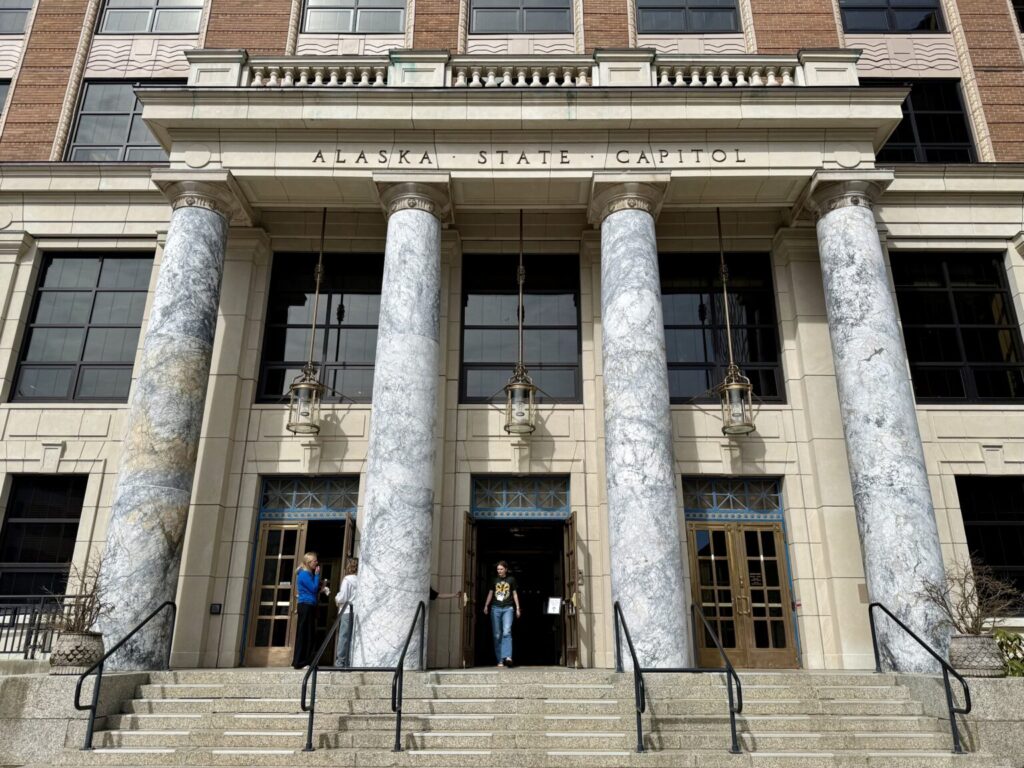
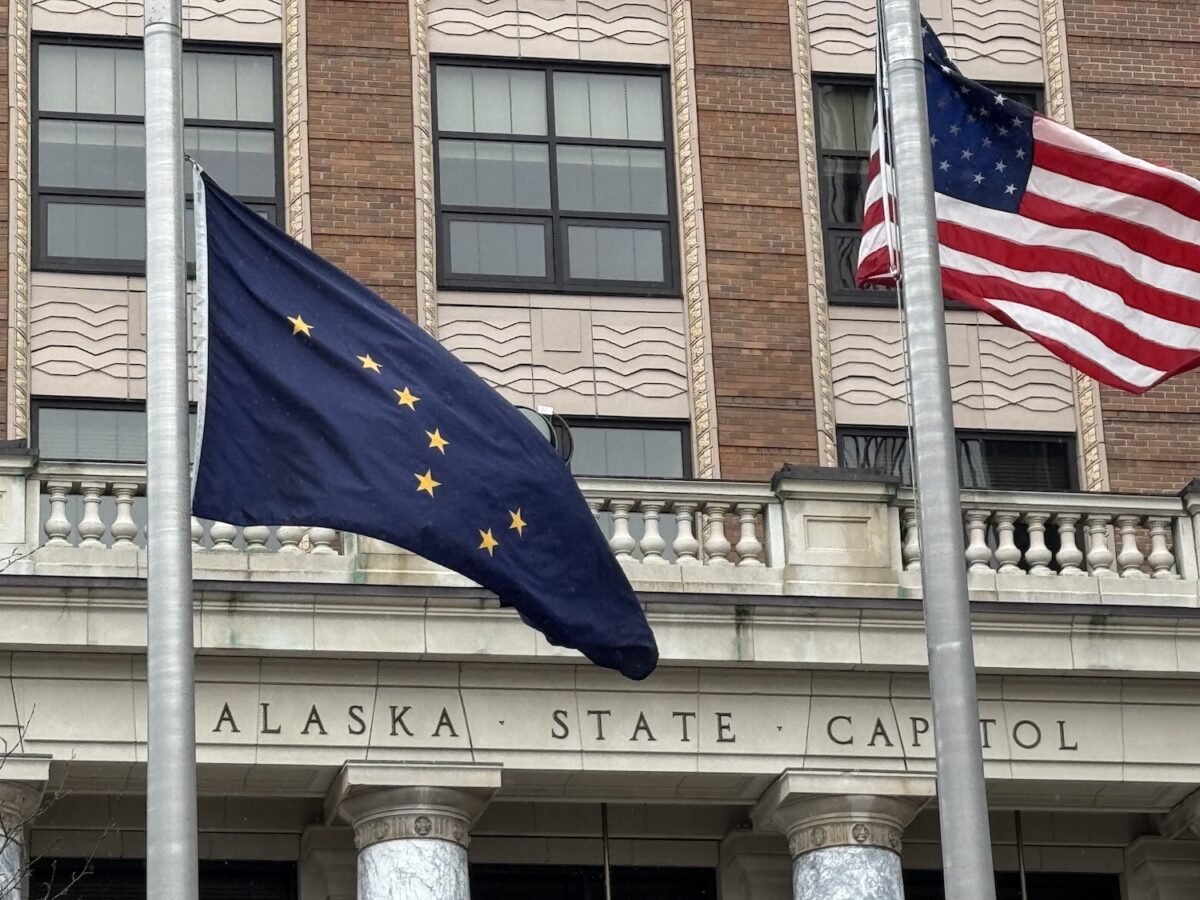
The Alaska and American flags fly in front of the Alaska State Capitol on Tuesday, April 22, 2025. (Photo by James Brooks/Alaska Beacon)
Corinne Smith, Alaska Beacon
The Alaska and American flags fly in front of the Alaska State Capitol on Tuesday, April 22, 2025. (Photo by James Brooks/Alaska Beacon)
The Alaska House of Representatives voted to approve a revised bill to reinstate a pension system for all Alaska public sector employees, following passage by the Senate on Tuesday. The bill now heads to Gov. Mike Dunleavy’s desk for consideration.
With just 21 days to go in the second year of the 34th Legislature, the governor has 15 days, excluding Sundays, to approve or veto the bill, or allow it to become law without his signature.
A spokesperson with Dunleavy’s office declined to comment on the governor’s position on lawmakers’ pension plan on Wednesday.
If enacted, the bill would revive the state’s defined benefit retirement system that was eliminated in 2006, a top priority of both the multipartisan Senate Majority and House Majority caucuses.
The proposed defined benefit system would be open to all state employees, including teachers, public safety workers and public employees of cities and boroughs statewide. Those municipal employers have six months to decide whether to participate in the program or opt out beginning in January, and the new program would be launched in July 2027.
Within the new plan, retirement for teachers and public employees would be possible at age 60 or any age after 30 years of service. For public safety officers, including police and firefighters, it would be age 50 with 25 years of service, or age 55 with 20 years of service.
The House narrowly passed the bill along caucus lines by a vote of 21 to 19 on Wednesday. The Senate passed the bill with significant revisions the day before, by a vote of 12 to 8.
Sen. Cathy Giessel, R-Anchorage, a longtime proponent of reviving the plan, said it took two decades of work in the Legislature and praised the House vote at a news conference on Wednesday.
Sen. Cathy Giessel, R-Anchorage, smiles at the news that the House concurred with the Senate’s bill and approved a new state pension plan at a news conference on Apr. 29, 2026. (Photo by Corinne Smith/Alaska Beacon)
“We are pleased that it was successful. And it was designed to be a modest, and yet secure, pension for retirement. And it had some amendments made on the floor that kind of made it a little bit more moderated. Choice was put in for employers, which is a big deal,” she said.
But she pointed out that the governor has yet to weigh in: “We still have one more stop, though. We have the big red pen potentially. So we’ll see what happens.”
House Majority Leader Rep. Chuck Kopp, R-Anchorage, carried House Bill 78, and told the Anchorage Daily News that he’s discussed the proposed plan with Dunleavy and members of his staff and is “encouraged” by those conversations.
House Majority Leader Rep. Chuck Kopp, R-Anchorage, speaks in support of a state pension plan on Apr. 29, 2026. (Photo by Corinne Smith/Alaska Beacon)
Kopp, speaking on the House floor Wednesday, said the new plan is entirely separate from the old plan, and has been revised with safeguards to prevent future unfunded liabilities.
“Do we want to continue down this path, with high turnover, constant vacancies and a growing strain on public services?” he added. “Or do we want to move forward with the plan that’s been vetted, improved and supported by both chambers, a plan that’s involved a lot of collaboration and compromise, and a plan that reflects Alaska’s long term interests.”
State lawmakers voted to axe the state’s defined benefit contribution plan in 2006, after the system accrued a multi-billion dollar shortfall that was misreported by a state actuary. Alaska sued the actuary, Mercer, for $1.8 billion in damages for miscalculating liabilities and settled in 2010 for $500 million. But, opponents of the bill noted, the state still owes billions of dollars on the old system and is on track to pay it off in 2039.
Proponents of the bill say the new pension system is structured differently to avoid repeating the same mistakes — it includes mechanisms to adjust contributions up and down, safeguards in the form of three actuaries checking each other’s work and no healthcare insurance benefits — to prevent the pension system from going underfunded.
Health insurance benefits, a major driver of ballooning costs of the old pension system, isn’t included in the new proposal. Under the new plan, employers would pay into a health reimbursement fund of up to 3% of teachers salaries and 4% of public sector workers’ salaries to supplement Medicare for those over age 65.
On Wednesday, members of the all-Republican House minority put up a potential technical hurdle by voting against the effective date clause of the bill, which needed a two-thirds majority vote to pass. That sets up a potential conflict between the effective date written in the bill and the Alaska Constitution, which says that the bill would be enacted within 90 days after the governor’s signature without a two-thirds majority vote to do otherwise.
Sens. Bert Stedman, R-Sitka, Bill Wielechowski, D-Anchorage, discuss a proposed pension bill, with Sen. President Gary Stevens, R-Kodiak, seen in the background on Apr. 28, 2026. (Photo by Corinne Smith/Alaska Beacon)
Members of the Alaska Senate voted to approve a long-awaited pension bill on Tuesday, amid debate on the cost of the new public retirement benefits system and responsibilities of the state and local community employers.
The Senate passed a revised version of a pension plan approved by the House last year. The vote was 12 to 8. Twenty years after lawmakers eliminated a public pension system, the vote marks the closest lawmakers have come to restoring a defined retirement benefit for thousands of Alaska’s public sector employees.
Sen. Cathy Giessel, R-Anchorage, speaks about Senate Bill 88, the Senate majority’s public employee pension proposal, on Wednesday, March 1, 2023. (Photo by James Brooks/Alaska Beacon)
“It strikes me as a historic day,” said Sen. Cathy Giessel, R-Anchorage, after the vote. She has been working on the issue for several years. “When you figure 33 different offerings to correct this over the years — yeah, we’ve been trying for a long time.”
If enacted, the bill would reinstate a defined benefit retirement system for Alaska state employees, as well as teachers, public safety workers and municipal employees statewide.
Supporters said the retirement benefit is crucial for hiring and retaining a skilled public sector workforce in Alaska for the long-term, while detractors say the uncertainty around the cost to the state and local municipalities isn’t worth the risk.
Sen. Mike Cronk, R-Tok, is seen at a Senate Finance Committee meeting on Apr. 24, 2026. (Photo by Corinne Smith/Alaska Beacon)
Senate Minority Leader Sen. Mike Cronk, R-Tok, said he opposes increasing state spending.
“We look at our federal government, we’re going to be $40 trillion upside down. That’s totally unacceptable,” he added. “And for adding this kind of burden for the future, generated cost is something that I just can’t be a part of. I know we have a problem. I think there are other solutions out there that can help this problem.”
The move was applauded by the state’s largest public employees union, the Alaska State Employees Association, which represents roughly 8,500 public employees.
“The impact is almost difficult to overstate,” said Heidi Drygas, its executive director, by phone on Tuesday. “Our membership overwhelmingly supports a defined benefit pension. And I think this will mean security for them, so that they can feel comfortable staying in their state jobs. It will attract more employees to work for the state.”
The bill passed the House last May, and the revised version now goes back to the House for a concurrence vote, before heading to Gov. Dunleavy’s desk for consideration.
The governor has been critical of previous pension proposals. Dunleavy receives a state pension for his previous employment as an educator and superintendent.
If the bill becomes law, current state employees would be allowed to switch from a defined contribution or a 401(k) style retirement plan to the new system. Retirement for teachers and public employees would be possible at age 60 or any age after 30 years of service. For public safety officers, including police and firefighters, it would be age 50 with 25 years of service, or age 55 with 20 years of service.
“Every other state offers a pension for at least some of the public servants. We do not,” Giessel said on the Senate floor. “And we are seeing the results. We ask our public employees to do difficult work, often in the hardest conditions. The question is whether we will give them a reason to build a career here.”
After several hours of debate, the Senate approved several amendments, including a change to allow cities and boroughs to choose whether to opt out of the new defined benefit retirement plan, instead of opt in.
“It’s better policy for local governments to follow the state’s lead,” said Sen. Matt Claman, D-Anchorage, who sponsored the provision. “If they don’t like our choice, they’re certainly allowed to make their own choice and opt out, but if they don’t take any action, they’re in.”
That means local cities and boroughs can choose whether to opt out of the plan, if enacted, between January and June of 2027, and then the new system would begin July 1 next year.
Under the revised bill, employees would contribute 8% of their pay to the pension plan. Employers would pay up to 22.5% for public sector employees, and up to 12.5% for teachers. Senators debated the cap and arrived at 22.5%, noting municipality officials public testimony and concern about cost.
Employers would also pay into a health reimbursement fund of up to 4% of workers’ salaries to supplement Medicare for those over age 65. Disability and death benefits would be included.
If passed, the bill would revive Alaska’s state pension that was eliminated in 2006, after the state ran into a multi-billion dollar shortfall and unfunded liabilities in the retirement system.
Sen. Bert Stedman, R-Sitka, a co-chair of the Senate Finance Committee, opposed the bill, citing the risk that the state will repeat the mistakes of the early 2000s.
Sen. Bert Stedman, R-Sitka, speaks against a bill to revive the state’s pension system on the Senate floor on Apr. 28, 2026. (Photo by Corinne Smith/Alaska Beacon)
“This proposal in front of us today diminished the benefit to the retired employee when it goes underfunded. Yeah, it won’t go unfunded until people retire. Normally, it takes about 30 years, but we’ve got 20 years already with the current defined contribution. So about 10 years out,” he said.
A recent estimate by the state’s actuary, Gallagher, projected state costs to total $467 million for the first 13 years, until FY 2039.
Stedman said the state is also still on the hook to pay billions to account for the old pension system. But Giessel said the new pension system has built in safeguards to prevent it from going underfunded, according to the actuary’s analysis.
“Even with a never before seen ‘black swan’ event of three consecutive years with zero investment returns, even then this pension holds up,” she said.
Giessel and other lawmakers cited the state’s current ballooning costs paying state employee overtime to cover vacancies and essential public services, called “premium pay.”
“It is costing us over $200 million a year in premium pay,” she said. “Just to keep basic services running — that number has grown nearly 80% in the past five years. We have, in effect, turned Alaska into a training ground, a place where people come, gain experience and then leave.”
Sen. Bill Wielechowski, D-Anchorage, described a crisis of families leaving the state, in part due to a lack of stable retirement. Alaska has seen more than a decade of consistent outmigration, according to state data.
“There has been a quiet, heavy crisis unfolding all across Alaska, in our schools, in our state office buildings, in our courts, in our communities all across Alaska, it’s the sound of a door slamming shut. Another family packs up to leave,” Wielechowski said on the Senate floor.
“We talk a lot about fiscal responsibility in this chamber, but I ask you, what is responsible about watching our most precious resource, our people walk out the door?”
Supporters of the pension plan also pointed to the state’s struggle with high turnover rates, including up to 30% of teachers in urban and rural districts alike each year.
Sen. Löki Tobin, D-Anchorage, and chair of the Senate Education Committee, said the high unseen costs of turnover of educators is magnified throughout the state.
Sen. Löki Tobin, D-Anchorage, speaks in support of a new state pension plan on Apr. 28, 2026. (Photo by Corinne Smith/Alaska Beacon)
“Because of high teacher turnover, we’re already paying $20 to $30 million a year,” she said. “We can either continue to pay that in turnover costs, or we can fund a quality retirement program that retains our quality educators, attracts new quality educators, and ensures that our kids get the best education they deserve.”
Senators in support of the pension plan noted a recent state audit of Alaska state government that reported hundreds of millions lost in federal reimbursements or incorrectly accounted for due to a variety of factors, including “staff turnover,” “competing priorities” or “inadequate supervisory review.”
Wielechowski pointed to one example of the Alaska Department of Military and Veterans Affairs underreported disaster spending for federal reimbursement by $297 million. The error was corrected once identified by auditors, according to the report.
“Dozens of projects incorrectly reported. And that’s just that’s just a fraction of the inaccuracies and the mistakes,” Wielechowski said.
Opponents of the pension bill pointed to other factors contributing to high turnover like work environment, leadership and a need to raise salaries.
That included Cronk who said he receives a pension after teaching for 25 years. “I would say focus should be on our pay,” he said.
Drygas, with the state’s public employees union, said while the pension plan is one important part of Alaska’s workforce issues, she sees it as crucial for stemming the tide of outmigration from the state.
“I cannot tell you how many people, just personal, friends and acquaintances that I know, that are leaving state service in particular because they can’t retire here. They can’t live on the retirement that our state offers,” she said. “So I think a lot of us are hopeful that, you know, five or 10 years in the future, if this legislation should pass and become law, we’ll see a turnaround in our state workforce again.”
A school bus drives in front of the Alaska State Capitol on Monday, Feb. 3, 2025. (Photo by James Brooks/Alaska Beacon)
By: Corinne Smith, Alaska Beacon
A school bus drives in front of the Alaska State Capitol on Monday, Feb. 3, 2025. (Photo by James Brooks/Alaska Beacon)
While many school districts across Alaska are facing severe budget shortfalls, several bills to provide a sustained increase to education funding appear to have stalled in the Legislature. But a bill to add nearly $82 million one-time funding and education policy changes is moving forward with bipartisan support.
On Monday, the Senate Education Committee introduced a revised version of House Bill 28, that adds one-time funds for energy relief, transportation, reading and vocational training, to a bill that would establish a loan forgiveness program for Alaska teachers. It also includes a variety of policy changes related to home school programs and others.
Chair Sen. Löki Tobin, D-Anchorage, described it as a “mini-bus” bill on Wednesday, saying the new omnibus bill includes specific education funding to areas sought by the governor and lawmakers on both sides of the aisle.
“We heard that there is a deep concern about education reform still being left on the table, and so in those discussions we focused the new version of House Bill 28 on codifying some of the best practices that we know are going to improve education outcomes across the state,” Tobin said.
The underlying bill establishes a new three-year student loan forgiveness program to incentivize teachers to stay in Alaska. It’s focused on teachers specializing in special education, English as a second language, science, technology, engineering and math. It would provide up to $15,000 to pay off student loans for those who go out of state and return to work in Alaska. The House passed the bill last May.
“We need to incentivize teachers to stay here,” said Rep. Andi Story, D-Juneau, who sponsored the bill. “We’ve had such tremendous turnover, and we’ve got this tremendous shortage. And so I think the bill will help.”
The bill moved to the Senate this year, and education committee members tagged on a variety of items on Apr. 21. According to data provided by Tobin’s office, it contains an additional $21.8 million for reading proficiency grants, $9.7 million for career and technical education, $7.3 million for transportation, and $43 million to offset rising energy costs for school districts.
“We do not want to divert operating costs, dollars that should be in the classroom, to just keeping the lights on and buildings warm,” Tobin said.
Meanwhile many Alaska school districts are in the midst of budget negotiations and grappling with cuts to staff and programs to address large budget shortfalls.
Tobin said at a Senate Majority caucus news conference on Wednesday the goal of the education policy bill is to garner enough support on both sides of the aisle to be able to override a potential veto by the governor.
“It is obviously the hope for all of us that we will continue to increase stable and predictable funding for our schools and ensure that they have the resources they need,” she said. “However, at the end of the day, our goal is to get dollars into the classroom and to get support into our schools, and I will work diligently to do that with the number of people that I can guarantee will be there to get that bill across the finish line.”
Gov. Mike Dunleavy has been a staunch opponent of increasing funding for schools, saying that education policy changes are needed to improve student outcomes. Last year, he issued three vetoes of additional funding for K-12 schools sustained through the state’s funding formula, the base student allocation, and the last was narrowly overridden by the Legislature last summer.
This year, legislators introduced bills to again provide a sustained increase per student funding statewide. Rep. Rebecca Himschoot, I-Sitka, introduced a bill to add $158 million to boost the per student formula, but so far it hasn’t moved out of the House Education Committee.
Earlier in the session, Tobin introduced a bill that would add nearly $100 million in education funding. A portion of that money would go to per student funding through the BSA, and additional reading proficiency grants and transportation funding. But her bill proposed policy changes to enact reporting and testing requirements for homeschool programs that drew public criticism from homeschool proponents, so the Senate Education Committee stripped the provision and held the bill.
The new draft Senate bill also institutes more reporting requirements from school districts to the state on their homeschool programs, including how many students are enrolled by grade, where they live across the state and how their annual allotment is spent, among others.
The draft bill would commission a state audit to evaluate Alaska’s funding for schools, and make recommendations for changes or for alternative methods of education funding. There is no cost estimate yet for the study, or the entire bill.
Tobin said the funding adequacy study is a top priority of the joint Task Force on Education Funding. “We know that our foundation formula needs some reform, and it also needs some additional attention on particular components that have changed significantly in the last few years, the pandemic really showcased that,” she said.
Story said she supports the changes to the bill. “There’s some really good things that got put in there,” she said. “It’s the end of the session, lots of things are happening, so we’ll just see. But I’m hoping good things happen for teachers and families and for our kids to get more attention next year.”
The draft “mini-bus” bill was approved by the Senate Education Committee and now moves to the Senate Finance Committee for consideration.
Meanwhile, senators are debating the draft operating budget for next year that includes up to $100 million in additional funding for schools, but only if oil prices remain high. The House passed a draft operating budget with nearly $158 million in one-time funding for K-12 schools earlier this month.
A select group of lawmakers from both chambers will negotiate and reconcile a compromise between the two budget bills — and a final allocation for Alaska schools next year — in a conference committee in the last days of the legislative session, by May 20.
An Alaska State Trooper's shoulder patch is seen on Thursday, Jan. 25, 2024. (Photo by James Brooks/Alaska Beacon)
Corinne Smith, Alaska Beacon
An Alaska State Trooper’s shoulder patch is seen on Thursday, Jan. 25, 2024. (Photo by James Brooks/Alaska Beacon)
Members of the Senate Judiciary committee put questions to a governor’s nominee for the Alaska Police Standards Council about her social media posts during a confirmation hearing Wednesday.
Veronica Lambertsen defended conspiracy theories around the Holocaust, blood-harvesting from children and the Jan. 6 insurrection at the U.S. Capitol.
Lambertsen has been nominated by Gov. Mike Dunleavy to serve a three-year term representing one of four public seats on the 13-member Alaska Police Standards Council, which oversees law enforcement standards across the state.
Lambertsen has served on the council since being nominated in August, but her name was removed from the council’s website Thursday afternoon, following the hearing and media coverage of the posts.
Dunleavy’s office did not respond to a request for comment about her nomination, her social media posts and the removal of her name from the website on Thursday.
Lambertsen is the owner and operator of a motel in Birch Creek, a small neighborhood in Turnagain Arm that is part of the municipality of Anchorage. She also serves as a voluntary member of the local Turnagain Arm Community Council, according to her resume.
Lawmakers in the House expressed skepticism in a hearing earlier this month and questioned Lambertsen’s experience, connections with law enforcement and eligibility for the seat.
Sens. Matt Claman, D-Anchorage, and Löki Tobin, D-Achorage, are seen in a Senate Judiciary Committee hearing on Apr. 20, 2026. (Photo by Corinne Smith/Alaska Beacon)
In a second confirmation hearing on Wednesday, following questions about her background, chair Sen. Matt Claman, D-Anchorage, asked about several social media posts going back many years.
“One of the postings that I saw was a posting that you didn’t believe the Holocaust was real,” Claman said. “Do you believe the Holocaust occurred during World War II?”
Lambertsen said it was a tragedy, but that she has questions. “Do I believe something happened at the Holocaust, and a tragedy and a lot of people died?” she said. “Yes, I believe that actually happened. Are we being told the true story about it all? No, I don’t believe we’re being told the true story about it all.”
“What do you believe is the true story?” Claman asked.
“That I don’t know yet,” she replied.
The Alaska Police Standards Council is charged with setting and enforcing standards for law enforcement, including police, probation, parole and correctional officers. They’re also tasked with reviewing regulation and investigating misconduct, like officer discipline and use of force.
A zip drive of selected posts from Lambertsen’s public Facebook page compiled by legislative staff and reviewed by the Alaska Beacon includes posts going back to 2021 related to a variety of conspiracy theories — questioning the shape of the Earth, the moon landing, the 2020 election results and the Jan. 6 insurrection, as well as posts related to the far-right internet conspiracy theory movement QAnon.
Claman asked about a QAnon claim that children are being harvested for a chemical called adrenochrome from their blood.
After a long pause, Lambertsen responded similarly that she had questions. “From information I have seen and documentation that was provided the question that should be asked,” she said.
Claman said in an interview Thursday that he found the hearing troubling. “For this position, which really means you’re providing some degree of supervision and regulation of our public safety officers, I just have a lot of concerns, given her perspective,” he said.
Lambertsen did not respond to a request for comment on Thursday. She told the Juneau Independent that what she posts on social media is separate from what’s involved in serving on the council.
Sen. Löki Tobin, D-Anchorage, raised the issue that Lambertsen may not be eligible to serve on a seat reserved for a member of the public from a rural district. Two of the four public seats are reserved for members representing communities with a population of 2,500 people or less.
“I think this is unfortunately a situation of where Ms. Lambertsen has been put into a seat that she is not qualified to hold based on statute and practice,” she said. “I would encourage Ms. Lambertsen to consider withdrawing her own name, as she is, in my estimation and read of the statute, not legal to sit in the seat.”
The Senate Judiciary Committee forwarded Lambertsen’s nomination on Wednesday to a vote by a joint session of the Legislature. But whether she will be considered is uncertain, as her name is no longer listed on the state website describing the council.
A joint session for state appointments to boards and commissions, including for Attorney General Stephen Cox, is scheduled for May 7.