Categories
Featured Juneau News Juneau Local Ketchikan Local News Feeds Sitka Local

Senate approves bill to end the shutdown, sending it to the House

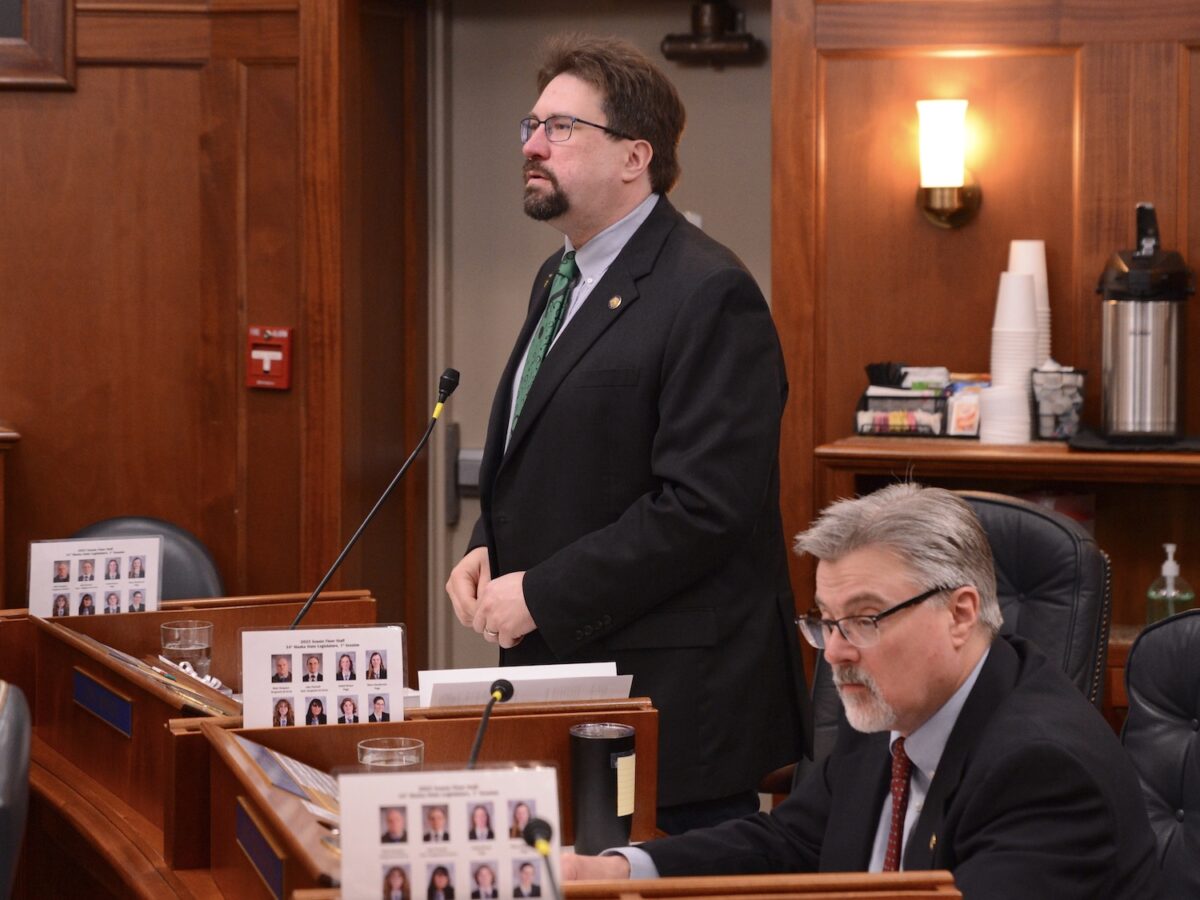
AP-The Senate passed legislation Monday to reopen the government, bringing the longest shutdown in history closer to an end as a small group of Democrats ratified a deal with Republicans despite searing criticism from within their party.

The 41-day shutdown could last a few more days as members of the House, which has been on recess since mid-September, return to Washington to vote on the legislation. President Donald Trump has signaled support for the bill, saying Monday that “we’re going to be opening up our country very quickly.”

The final Senate vote, 60-40, broke a grueling stalemate that lasted more than six weeks as Democrats demanded that Republicans negotiate with them to extend health care tax credits that expire Jan. 1. The Republicans never did, and five moderate Democrats eventually switched their votes as federal food aid was delayed, airport delays worsened and hundreds of thousands of federal workers continued to go unpaid.

House Speaker Mike Johnson urged lawmakers to start returning to Washington “right now” given shutdown-related travel delays, but an official notice issued after the Senate vote said the earliest the House will vote is Wednesday afternoon.

“It appears our long national nightmare is finally coming to an end,” said Johnson, who has kept the House out of session since mid-September, when the House passed a bill to continue government funding.

How the stalemate ended

After weeks of negotiations, A group of three former governors — New Hampshire Sen. Jeanne Shaheen, New Hampshire Sen. Maggie Hassan and Independent Sen. Angus King of Maine — agreed to vote to advance three bipartisan annual spending bills and extend the rest of government funding until late January. Republicans promised to hold a vote to extend the health care subsidies by mid-December, but there was no guarantee of success.

Shaheen said Monday that “this was the option on the table” after Republicans had refused to budge.

“We had reached a point where I think a number of us believed that the shutdown had been very effective in raising the concern about health care,” she said, and the promise for a future vote “gives us an opportunity to continue to address that going forward.”

The legislation includes a reversal of the mass firings of federal workers by the Trump administration since the shutdown began on Oct. 1. It also protects federal workers against further layoffs through January and guarantees they are paid once the shutdown is over.

In addition to Shaheen, King and Hassan, Democratic Sen. Tim Kaine of Virginia, home to tens of thousands of federal workers, also voted Sunday in favor of moving forward on the agreement. Illinois Sen. Dick Durbin, the No. 2 Democrat, Pennsylvania Sen. John Fetterman and Nevada Sens. Catherine Cortez Masto and Jacky Rosen also voted yes. All other Democrats, including Senate Democratic leader Chuck Schumer of New York, voted against it.

The moderates had expected a larger number of Democrats to vote with them as 10 to 12 Democratic senators had been part of the negotiations. But in the end, only five switched their votes — the exact number that Republicans needed. King, Cortez Masto and Fetterman had already been voting to open the government since Oct. 1.

Many Democrats call the vote a “mistake”

Schumer, who received blowback from his party in March when he voted to keep the government open, said he could not “in good faith” support it after meeting with his caucus for more than two hours on Sunday.

“We will not give up the fight,” Schumer said, adding that Democrats have now “sounded the alarm” on health care.

Independent Sen. Bernie Sanders of Vermont, who caucuses with the Democrats, said giving up the fight was a “horrific mistake.” Sen. Chris Murphy, D-Conn., agreed, saying that voters who overwhelmingly supported Democrats in last week’s elections were urging them to “hold firm.”

House Democrats swiftly criticized the Senate.

Texas Rep. Greg Casar, the chairman of the Congressional Progressive Caucus, said a deal that doesn’t reduce health care costs is a “betrayal” of millions of Americans who are counting on Democrats to fight.

Others gave Schumer a nod of support. House Democratic leader Hakeem Jeffries had criticized Schumer in March after his vote to keep the government open. But he praised the Senate Democratic leader on Monday and expressed support for his leadership throughout the shutdown.

“The American people know we are on the right side of this fight,” Jeffries said Monday, pointing to Tuesday’s election results.

Health care debate ahead

It’s unclear whether the two parties would be able to find any common ground on the health care subsidies before a promised December vote in the Senate. House Speaker Mike Johnson, R-La., has said he will not commit to bringing it up in his chamber.

On Monday, Johnson said House Republicans have always been open to voting to reform what he called the “unaffordable care act” but again did not say if they would vote on the subsidies.

Some Republicans have said they are open to extending the COVID-19-era tax credits as premiums could skyrocket for millions of people, but they also want new limits on who can receive the subsidies. Some argue that the tax dollars for the plans should be routed through individuals.

Senate Appropriations Committee Chairwoman Susan Collins said Monday that she’s supportive of extending the tax credits with changes, like new income caps. Some Democrats have signaled they could be open to that idea.

“We do need to act by the end of the year, and that is exactly what the majority leader has promised,” Collins said.

Other Republicans, including Trump, have used the debate to renew their yearslong criticism of the law and called for it to be scrapped or overhauled.

In a possible preview, the Senate voted 47-53 along party lines Monday not to extend the subsidies for a year. Majority Republicans allowed the vote as part of a separate deal with Democrats to speed up votes and send the legislation to the House.

Categories
Featured Juneau News Juneau Local Ketchikan Local News Feeds Sitka Local

US flight cancellations expected to drag on even after the government shutdown ends

Alaska Airlines planes are shown parked at gates with Mount Rainier in the background on March 1, 2021, at Seattle-Tacoma International Airport in Seattle. (AP Photo/Ted S. Warren, File)

AP- The flight cancellations at airports across the U.S. are expected to persist even after the government shutdown ends.

The Federal Aviation Administration has reduced flights as some air traffic controllers — unpaid for weeks — have stopped showing up for work.

The Senate took a first step toward ending the shutdown Sunday, but final passage could still be several days away. Transportation Secretary Sean Duffy made clear last week that flight cuts will remain in place until the FAA sees safety metrics improve.

Over the weekend, airlines canceled thousands of flights to comply with the order to eliminate 4% of flights. The cancellations are scheduled to rise to 6% of all flights at 40 of the nation’s busiest airports on Tuesday. By the end of the week, flight cancellations are scheduled to reach 10% of all flights at those airports.

Already, travelers are growing frustrated.

“All of this has real negative consequences for millions of Americans, and it’s 100% unnecessary and avoidable,” said Todd Walker, whose flight from San Francisco to Washington state was canceled over the weekend, causing him to miss his mom’s 80th birthday party.

As of Monday morning, airlines had already canceled 1,600 flights for Monday and nearly 1,000 for Tuesday. International flights have not been affected.

Beyond the mandated cuts, flight delays have been rippling through airports nationwide at times ever since the shutdown began. That’s because the FAA slows air traffic anytime it’s short on controllers at one of its facilities to ensure flights remain safe.

Tuesday will be the second missed payday for air traffic controllers and other FAA employees. It’s unclear how quickly they might be paid once the shutdown ends. The head of the controllers union, Nick Daniels, plans a news conference Monday morning to address the shutdown’s toll.

“More controllers aren’t coming to work day by day, the further they go without a paycheck,” Duffy said.

The government has struggled for years with a shortage of air traffic controllers, and Duffy said the shutdown has worsened the problem, prompting some controllers to retire early or quit. Before the shutdown, Duffy had been working to address the shortage by hiring more controllers, speeding up training and offering bonuses to retain experienced controllers.

Duffy warned over the weekend that if the shutdown drags on, the situation could deteriorate further as the U.S. heads into the busy holiday travel season. He said air travel may “be reduced to a trickle” by the week of Thanksgiving.

Categories
Featured Juneau News Juneau Local Ketchikan Local News Feeds Sitka Local

Alaska Division of Elections begins reviewing petition to repeal election reform law

By: James Brooks, Alaska Beacon

“I voted” stickers are seen on display in the headquarters offices of the Alaska Division of Elections in Juneau on Tuesday, Nov. 12, 2024. (Photo by James Brooks/Alaska Beacon)

State elections officials have begun reviewing signatures gathered by people opposed to Alaska’s system of open primary elections and ranked-choice general elections to determine whether a repeal ballot measure will appear before voters in 2026.

Alaskans enacted the state’s existing elections system via a ballot measure in 2020, and a repeal measure last year failed by only 737 votes out of 320,985 cast. 

Proponents of the repeal vowed at that time to renew their effort and began gathering signatures in February to force another vote. 

Based on state law and the number of people who voted in the 2024 statewide election, repeal supporters needed to collect signatures from at least 34,099 registered voters, including a certain minimum number in at least 30 of the 40 state House districts.

This week, supporters of the repeal measure said they were submitting more than 48,000 signatures to the Alaska Division of Elections for review. 

If the repeal petition is deemed to have enough signatures, it would go before voters in either the 2026 primary or the 2026 general election, depending upon the length of next year’s state legislative session.

If voters approve the measure in 2026, all three components of the 2020 ballot measure would be repealed. 

That would have three main results. Financial donors to political campaigns would be able to conceal their identity by contributing to a political nonprofit, which could donate money to causes on their behalf. 

The 2020 law, currently in effect, requires campaigns to disclose the “true source” of their money.

The second effect would be the repeal of the state’s open primary system, in which all candidates, regardless of political party, run in the same race. Under the current law, the top four vote-getters in a given race advance to the general election.

If that is repealed, political parties would be able to determine the rules for deciding which of their candidates advance to the November general election.

The third change is to general election. Instead of voters being allowed to rank all candidates in order of preference, voters would be able to choose only one candidate, and the candidate with the most votes would win.

One other ballot measure, which would reimpose a limit on financial donations to political candidates, has already been certified and is slated for the 2026 ballot.

Two other ballot measures remain in the signature-gathering process. One would decriminalize several psychedelic substances, and the other would reinforce the state’s existing prohibition on noncitizen voting. 

Backers of those measures must gather sufficient signatures before the start of the January legislative session in order to force a vote in 2026.

Categories
Featured Juneau News Juneau Local Ketchikan Local Music News Feeds Sitka Local

States face uncertainty as Trump administration tries to reverse SNAP food payments

AP- States administering a federal food aid program serving about 42 million Americans faced uncertainty Monday over whether they can — and should — provide full monthly benefits during an ongoing legal battle involving the U.S. government shutdown.

President Donald Trump’s administration over the weekend demanded that states “undo” full benefits that were paid under the Supplemental Nutrition Assistance Program during a one-day window between when a federal judge ordered full funding and a Supreme Court justice put a temporary pause on that order.

A federal appeals court in Boston left the full benefits order in place late on Sunday, though the Supreme Court order ensures the government won’t have to pay out for at least 48 hours.

“The record here shows that the government sat on its hands for nearly a month, unprepared to make partial payments, while people who rely on SNAP received no benefits a week into November and counting,” Judge Julie Rikleman of the U.S. 1st Circuit Court of Appeals wrote.

The Supreme Court gave the Trump administration until 11 a.m. EST Monday to say whether it wanted to keep the full payments on hold. The pause the court imposed last week will expire Tuesday night without further court action. Congress is considering whether to fund SNAP as part of a proposal to end the government shutdown.

Some states are warning of “catastrophic operational disruptions” if the Trump administration does not reimburse them for those SNAP benefits they already authorized. Meanwhile, other states are providing partial monthly SNAP benefits with federal money or using their own funds to load electronic benefit cards for SNAP recipients.

Millions receive aid while others wait

Trump’s administration initially said SNAP benefits would not be available in November because of the government shutdown. After some states and nonprofit groups sued, judges in Massachusetts and Rhode Island each ruled the administration could not skip November’s benefits entirely.

The administration then said it would use an emergency reserve fund to provide 65% of the maximum monthly benefit. On Thursday, Rhode Island-based U.S. District Judge John J. McConnell said that wasn’t good enough, and ordered full funding for SNAP benefits by Friday.

Some states acted quickly to direct their EBT vendors to disburse full monthly benefits to SNAP recipients. Millions of people in those states received funds to buy groceries before Justice Ketanji Brown Jackson put McConnell’s order on hold Friday night, pending further deliberation by an appeals court.

Millions more people still have not received SNAP payments for November, because their states were waiting on further guidance from the U.S. Department of Agriculture, which administers SNAP.

“Continued delays deepen suffering for children, seniors, and working families, and force nonprofits to shoulder an even heavier burden,” Diane Yentel, President and CEO, National Council of Nonprofits, one of the plaintiffs in the lawsuit, said in a statement Monday. “If basic decency and humanity don’t compel the administration to assure food security for all Americans, then multiple federal court judges finding its actions unlawful must.”

Trump’s administration has argued that the judicial order to provide full benefits violates the Constitution by infringing on the spending power of the legislative and executive branches.

States are fighting attempt to freeze SNAP benefits

On Sunday, the Trump administration said states had moved too quickly and erroneously released full SNAP benefits after last week’s rulings.

“States must immediately undo any steps taken to issue full SNAP benefits for November 2025,” Patrick Penn, deputy undersecretary of Agriculture, wrote to state SNAP directors. He warned that states could face penalties if they did not comply.

Wisconsin, which was among the first to load full benefits after McConnell’s order, had its federal reimbursement frozen. As a result, the state’s SNAP account could be depleted as soon as Monday, leaving no money to reimburse stores that sell food to SNAP recipients, according to a court filing submitted by those that had sued.

Some Democratic governors vowed to challenge any federal attempt to claw back money.

In Connecticut, Democratic Gov. Ned Lamont said “those who received their benefits should not worry about losing them.”

“No, Connecticut does not need to take back SNAP benefits already sent to the 360,000 people who depend on them for food and who should have never been caught in the middle of this political fight,” Lamont said. “We have their back.”

Categories
Featured Juneau News Juneau Local Ketchikan Local News Feeds Sitka Local

Senate takes first step toward ending the government shutdown

AP-The Senate took the first step to end the government shutdown on Sunday after a group of moderate Democrats agreed to proceed without a guaranteed extension of health care subsidies, angering many in their caucus who say Americans want them to continue the fight.

In a test vote that is the first in a series of required procedural maneuvers, the Senate voted 60-40 to move toward passing compromise legislation to fund the government and hold a later vote on extending Affordable Care Act tax credits that expire Jan. 1. Final passage could be several days away if Democrats object and delay the process.

The agreement does not guarantee the health care subsidies will be extended, as Democrats have demanded for almost six weeks. Senate Democratic leader Chuck Schumer of New York voted against moving ahead with the package, along with all but eight of his Democratic colleagues.

A group of three former governors — New Hampshire Sen. Jeanne Shaheen, New Hampshire Sen. Maggie Hassan and Independent Sen. Angus King of Maine — broke the six-week stalemate on Sunday when they agreed to vote to advance three bipartisan annual spending bills and extend the rest of government funding until late January in exchange for a mid-December vote on extending the health care tax credits.

The agreement also includes a reversal of the mass firings of federal workers by the Trump administration since the shutdown began on Oct. 1 and would ensure that federal workers receive back pay.

Senate Majority Leader John Thune quickly endorsed the deal and called an immediate vote to begin the process of approving it as the shutdown continued to disrupt flights nationwide, threaten food assistance for millions of Americans and leave federal workers without pay.

“The time to act is now,” Thune said.

Returning to the White House on Sunday evening after attending a football game, President Donald Trump did not say whether he endorsed the deal. But he said, “It looks like we’re getting close to the shutdown ending.”

Five Democrats switch votes

In addition to Shaheen, King and Hassan, Democratic Sen. Tim Kaine of Virginia, home to tens of thousands of federal workers, also voted in favor of moving forward on the agreement. Illinois Sen. Dick Durbin, the No. 2 Democrat, Pennsylvania Sen. John Fetterman and Nevada Sens. Catherine Cortez Masto and Jacky Rosen also voted yes.

The moderates had expected a larger number of Democrats to vote with them as 10-12 Democratic senators had been part of the negotiations. But in the end, only five Democrats switched their votes — the exact number that Republicans needed. King, Cortez Masto and Fetterman had already been voting to open the government since Oct. 1.

The vote was temporarily delayed on Sunday evening as three conservatives who often criticize spending bills, Republican Sens. Mike Lee of Utah, Rick Scott of Florida and Ron Johnson of Wisconsin, withheld their votes and huddled with Thune at the back of the chamber. They eventually voted yes after speaking to Trump, Lee said.

Another Republican, Sen John Cornyn of Texas, had to fly back from Texas to deliver the crucial 60th vote.

Schumer votes no

After Democrats met for over two hours to discuss the proposal, Schumer said he could not “in good faith” support it.

Schumer, who received blowback from his party in March when he voted to keep the government open, said that Democrats have now “sounded the alarm” on health care.

“We will not give up the fight,” he said.

Independent Sen. Bernie Sanders of Vermont, who caucuses with the Democrats, said giving up the fight was a “horrific mistake.”

Sen. Chris Murphy, D-Conn., agreed, saying that in last week’s elections people voted overwhelmingly Democratic “to urge Democrats to hold firm.”

A bipartisan agreement

Democrats had voted 14 times not to reopen the government as they demanded the extension of tax credits that make coverage more affordable under the Affordable Care Act. Republicans said they would not negotiate on health care, but GOP leaders have been quietly working with the group of moderates as the contours of an agreement began to emerge.

The agreement includes bipartisan bills worked out by the Senate Appropriations Committee to fund parts of government — food aid, veterans programs and the legislative branch, among other things. All other funding would be extended until the end of January, giving lawmakers more than two months to finish additional spending bills.

The deal would reinstate federal workers who had received reduction in force, or layoff, notices and reimburse states that spent their own funds to keep federal programs running during the shutdown. It would also protect against future reductions in force through January and guarantee federal workers would be paid once the shutdown is over.

House Democrats push back

House Democrats swiftly criticized the Senate.

Texas Rep. Greg Casar, the chairman of the Congressional Progressive Caucus, said a deal that doesn’t reduce health care costs is a “betrayal” of millions of Americans who are counting on Democrats to fight.

“Accepting nothing but a pinky promise from Republicans isn’t a compromise — it’s capitulation,” Casar said in a post on X. “Millions of families would pay the price.”

Rep. Angie Craig of Minnesota posted that “if people believe this is a ‘deal,’ I have a bridge to sell you.”

House Democratic leader Hakeem Jeffries blamed Republicans and said Democrats will continue to fight.

“Donald Trump and the Republican Party own the toxic mess they have created in our country and the American people know it,” Jeffries said.

Health care debate ahead

It’s unclear whether the two parties would be able to find any common ground on the health care subsidies before a promised December vote in the Senate. House Speaker Mike Johnson, R-La., has said he will not commit to bring it up in his chamber.

Some Republicans have said they are open to extending the COVID-19-era tax credits as premiums could skyrocket for millions of people, but they also want new limits on who can receive the subsidies and argue that the tax dollars for the plans should be routed through individuals.

Other Republicans, including Trump, have used the debate to renew their yearslong criticism of the law and called for it to be scrapped or overhauled.

Shutdown effects worsen

Meanwhile, the consequences of the shutdown have been compounding. U.S. airlines canceled more than 2,000 flights on Sunday for the first time since the shutdown began, and there were more than 7,000 flight delays, according to FlightAware, a website that tracks air travel disruptions.

Treasury Secretary Sean Duffy said on CNN’s “State of the Union” that air travel ahead of the Thanksgiving holiday will be “reduced to a trickle” if the government doesn’t reopen.

At the same time, food aid was delayed for tens of millions of people as Supplemental Nutrition Assistance Program benefits were caught up in legal battles related to the shutdown.

And in Washington, home to tens of thousands of federal workers who have gone unpaid, the Capital Area Food Bank said it is providing 8 million more meals ahead of the holidays than it had prepared for this budget year — a nearly 20% increase.

Categories
Featured Juneau News Juneau Local Ketchikan Local News Feeds Sitka Local

USDA revises SNAP benefit amounts during shutdown after admitting miscalculation

By: Jacob Fischler, States Newsroom

A sign in a convenience store along Barlowe Road in Hyattsville, Maryland, on Oct. 28, 2025, advertises that it accepts SNAP benefits. (Photo by Ashley Murray/States Newsroom)

The U.S. Department of Agriculture will reduce the largest monthly food assistance payments by about 35% in November, a smaller decrease than the department initially estimated, according to a court filing late Wednesday.

That means the maximum monthly benefit likely would be roughly two-thirds of the usual benefit flowing to recipients, rather than the half initially projected.

USDA miscalculated how to adjust benefit payments for the Supplemental Nutrition Assistance Program, or SNAP, to account for a lack of full funding during the government shutdown, a department official said in a filing to the U.S. District Court for Rhode Island. 

The formula the government initially used and sent to states Tuesday would have resulted in about a 50% cut to the maximum monthly benefits, and left some households without benefits. 

SNAP pays benefits on a sliding scale depending on the size of a household, the household’s income and other expenses such as housing. By cutting the maximum benefit by one-half, the department would have spent about $3 billion from a SNAP contingency fund instead of the full $4.65 billion in the fund, which is what the court ordered it to spend.

The error was first reported to U.S. District Chief Judge John J. McConnell Jr. by the coalition of cities and nonprofit organizations that sued to force the government to pay SNAP benefits this month. 

An analysis submitted by Sharon Parrott, a former White House budget officer who now leads the left-leaning think tank Center for Budget and Policy Priorities, showed that the table the department submitted to the court and sent to states on Tuesday would fall short of the court’s order to spend the entire contingency fund.

The groups said the department’s error was another reason the court should compel the government to transfer funds to pay out full benefits for November.

“Defendants’ approach means that only around $3 billion—out of the $4.65 billion Defendants have said is available—will be spent on SNAP benefits in November, leaving more than $1.5 billion in contingency funds unspent,” they wrote in a Wednesday brief. “Defendants opted for partial (and delayed) SNAP payments, but even then, did not manage to do that correctly.”

The department said in its filing later Wednesday that it independently discovered its miscalculation and worked to fix it before Parrott’s declaration hit the court docket.

“Defendants realized this error and worked to issue new guidance and tables as soon as it was discovered, not in response to Plaintiffs’ notice filed earlier this evening,” USDA’s brief said.

The parties are scheduled to argue before McConnell again Thursday afternoon.

This report will be updated.

Categories
Featured Juneau News Juneau Local Ketchikan Local News Feeds Sitka Local

Number of Alaska fishers and seafood workers hits record low, state report finds

By: James Brooks, Alaska Beacon

 Commercial fishing boats are lined up at the dock at Seward’s harbor on June 22, 2024. (Photo by Yereth Rosen/Alaska Beacon)

The number of people working in Alaska’s famed seafood industry has set a new record low, surpassing last year’s record low, according to figures published this month by the Alaska Department of Labor and Workforce Development in its magazine, Alaska Economic Trends.

In 2024, an average of 5,393 people were employed as fishers, processors or other seafood workers each month in Alaska, wrote analyst Joshua Warren. That’s down by 443 jobs from the same figure in 2023.

Alaska remains the No. 1 seafood producer among U.S. states, according to federal statistics, and produces more seafood than every other state combined.

The state department of labor has kept a monthly tally of seafood jobs in the state since 2001, and industry employment has been in a steady decline since 2019 due to a variety of factors, including a lack of available fish, competition from cheaper international sources, and high operating costs that can make fishing uneconomic. 

Since the start of 2001, the high point of fishing employment was in 2015, when an average of 8,501 people were employed in the seafood industry each month.

Historically, seafood employment was significantly higher due to reduced rates of automation and the fact that Alaska seafood tended to be processed and packaged locally. 

The modern trend has been toward direct export and processing internationally, where wages are lower.

Seafood employment in Alaska is extremely seasonal, with a peak in June and July during the salmon season and a low ebb in December, before a new season of fishing in federal waters offshore.

In July 2024, only 17,361 people worked in the Alaska seafood industry, the lowest annual peak on record since January 2021. In July 2013, the highest peak, more than 25,000 people were employed in the state’s seafood industry.

Categories
Featured Juneau News Juneau Local Ketchikan Local News Feeds Sitka Local

Democratic leaders fresh from election wins demand Trump meeting over shutdown


By: Ariana Figueroa, States Newsroom

WASHINGTON — Following major Democratic wins in local and state elections across the country on Election Day, top Democratic congressional leaders pushed for a meeting with the president to end the federal government shutdown, which on Wednesday became the longest in U.S. history at day 36.

“The election results ought to send a much-needed bolt of lightning to Donald Trump that he should meet with us to end this crisis, his shutdown,” Senate Minority Leader Chuck Schumer said on the Senate floor Wednesday. “It’s time to hold a bipartisan meeting. The takeaway from last night was simply unmistakable.” 

Schumer and House Minority Leader Hakeem Jeffries, both New York Democrats, sent a Wednesday letter to President Donald Trump, calling for a bipartisan meeting at the White House to end the government shutdown and to address the spike in individual health care premiums.

“Last night, Republicans felt political repercussions,” Schumer said after Tuesday’s Election Day wins for Democrats. They included passage of a redistricting measure in California to offset partisan gerrymandering by GOP states, governorships in New Jersey and Virginia and local races across the country.

For more than a month, Democrats have voted against approving the House-passed GOP stopgap spending measure over concerns that health care tax subsidies will expire at the end of the year. As open enrollment begins, people who buy their health insurance through the Affordable Care Act Marketplace are seeing a drastic increase in premium costs. 

Sanders pushes back on dealmaking

Schumer did not detail what kind of deal Democrats would accept, but said any negotiation “must address the health care needs of the American people.”

However, independent Sen. Bernie Sanders of Vermont said that Democrats should not accept any agreement with the GOP unless there is a commitment from House Speaker Mike Johnson and the president to pass legislation to extend those tax credits.

“Bottom line is, we need to be successful in protecting the health care of the American people, and if it’s just a piece of legislation that passes the Senate … so what? Where does it go? Then it becomes just a meaningless gesture,” Sanders said. 

Republicans have maintained that they will only have a discussion on health care after Democrats agree to resume government funding. 

This week, the Senate failed for the 14th time to pass a stopgap spending measure that would fund the government until Nov. 21. 

Lawmakers have acknowledged that a new stopgap spending bill will need to be extended past the Nov. 21 deadline, but have not come to an agreement on a new deadline.

Thune plays down Democratic victories

Senate Majority Leader John Thune told reporters Wednesday that he was skeptical the government shutdown played into major wins for Democrats across the country. 

“The shutdown doesn’t benefit anyone,” he said.

The South Dakota Republican noted the shutdown may have played a role in suburban Virginia, where a large share of federal workers live and are furloughed due to the government shutdown.

“In Northern Virginia, that has a lot of federal workers, so it certainly could have been a factor in the elections,” Thune said. “But I think it’s hard to draw conclusions.”

But Thune said he’s focused on ending the government shutdown, and hopes progress can continue to be made before senators are scheduled to be out next week for recess due to the Veterans Day holiday. 

Transportation Secretary Sean Duffy this week warned that if the shutdown continues into next week, it could lead to certain airspace needing to be closed due to a shortage of air traffic controllers who have continued to work amid the shutdown.

Trump, in a social media post, blamed two factors for Republicans not performing well on Tuesday: his absence from the ballot, and the government shutdown.

“I think if you read the pollsters, the shutdown was a big factor, negative for the Republicans, and that was a big factor, and they say that I wasn’t on the ballot was the biggest factor,” Trump said during a Wednesday press conference.

Withholding SNAP benefits

As the government shutdown has continued, the Trump administration has tried to get Senate Democrats to agree to the stopgap spending measure by directing the U.S. Department of Agriculture to not tap into its contingency fund to provide food assistance to 42 million people.

Two federal courts found that the Trump administration acted unlawfully in holding back those Supplemental Nutrition Assistance Program, or SNAP, benefits, and USDA agreed that it would partially release SNAP benefits. 

Trump earlier this week wrote on his social media platform that SNAP benefits would only be released when Democrats vote to reopen the government, a move that would likely violate the two court orders.

“SNAP BENEFITS, which increased by Billions and Billions of Dollars (MANY FOLD!) during Crooked Joe Biden’s disastrous term in office (Due to the fact that they were haphazardly ‘handed’ to anyone for the asking, as opposed to just those in need, which is the purpose of SNAP!), will be given only when the Radical Left Democrats open up government, which they can easily do, and not before!,” he wrote.

However, White House press secretary Karoline Leavitt seemed to walk back that statement on Tuesday, arguing that the president’s social media post did not refer to the court order, but to future SNAP payments.

“The president doesn’t want to tap into this (contingency) fund in the future and that’s what he was referring to,” Leavitt said.

Categories
Featured Juneau News Juneau Local Ketchikan Local News Feeds Sitka Local

The number of debt collection cases in Alaska state courts is soaring, following national trends

By: James Brooks, Alaska Beacon

100 US dollars. Macro photo of banknotes of money in the US currency one hundred dollars.

Every morning, Alaska’s court system publishes an updated list of new civil lawsuits filed across the state during the past week.

And every morning, that list is dominated by debt collection cases, newly filed by credit card companies, debt collection firms or businesses seeking repayment. On Tuesday, of the 115 listed cases, 84 were for debt collections.

In the first nine months of 2022, the court system saw 1,869 debt collection cases filed. Every year since then, the number has risen. Through the first nine months of this year, there were 3,447, almost double the figure filed in 2022. 

“It’s pretty wild, the rise of them,” said attorney Stacey Stone, who practices in Alaska and is familiar with the issue.

Alaska isn’t alone in the upward trend — nationally, the number of collection lawsuits is rising after an ebb during the COVID-19 pandemic emergency.

January Advisors, a national data consulting firm that noted the rising trend in August, concluded that multiple factors may be driving it.

During the COVID-19 emergency, many Americans received financial aid that helped them pay down debt and build savings. Those programs have now ended, and American consumer debt is now at record highs, according to figures published by the Federal Reserve Bank of New York.

The number of people who are behind on their credit card payments is also on the rise, the Federal Reserve Bank of St. Louis reported earlier this year, and the number of car repossessions is rising.

Automated software programs also are making it easier for companies to more easily file large numbers of debt collection cases.

In June, the National Center on State Courts concluded that easier access to generative AI software is likely to increase filings in contract cases, like debt collections. 

Typically, a credit card company or medical provider will try first to get payment on an overdue bill directly. But if a bill still goes unpaid, many companies will deem the debt uncollectable. At that point, they sell the rights to the debt to a collections company.

The sale means the company with the unpaid bill will get at least some money, and then it becomes the collections company’s job to try to recoup the debt and earn money for itself.

Court filings in Alaska and elsewhere indicate that debt collection companies are filing more cases in an attempt to collect on the unpaid debts they’ve bought. 

Two researchers with Pew Research Center, in a September analysis, said that can have significant consequences for regular people.

People who are sued for consumer or medical debt rarely hire attorneys, they noted, and in many cases, people may not even be aware that they are being sued.

The Debt Collection Lab — a research group that includes Princeton University — found that in Oregon, private collection agencies filed the bulk of lawsuits on behalf of credit card companies, health care providers and utilities.

Only four percent of debt defendants responded to the cases filed against them, and as a result, Oregon courts awarded default judgments in favor of the debt collectors in almost seven of 10 debt cases filed between 2017 and 2023. 

Data on the result of Alaska cases was not immediately available, but a preliminary examination of court dockets and filing patterns by the Alaska Beacon shows that the trends in Alaska are similar to those in other states.

A frequent filer in Alaska courts, a national debt-buying company called LVNV Funding, increased its filings by 350% in a handful of states between 2019 and 2024, January Advisors found. 

In Connecticut, the top 10 most frequent filers in debt cases accounted for more than 80% of all debt cases filed in that state last year, January Advisors found, indicating that the most frequent filers are stepping up their aggressiveness.

“More people are defaulting on their debt right now because people are living paycheck to paycheck for various reasons, so I think you do have an organic process happening, but also there’s an aggressive process happening that’s uncharacteristic,” Stone said.

In Alaska, even a state representative has faced a debt-collection lawsuit whose details appear typical of the kinds of cases being filed here.

On Oct. 27, a debt collection firm known as Jefferson Capital Systems filed suit in Anchorage District Court against Rep. Jamie Allard, R-Eagle River.

According to the complaint, Allard took out a loan from Celtic Bank in 2023 and didn’t fully repay it. Celtic Bank subsequently transferred the debt — just $1,075 — to Jefferson Capital, which filed the lawsuit. 

The attorney who filed the lawsuit didn’t respond to a request for comment.

Allard didn’t know about the suit until she was contacted by the Alaska Beacon, which was already writing this article.

“Oh my God; I had no idea what this was about,” she said.

Stone is Allard’s attorney and said cases like these seem to come out of left field. She said they tend to be filed in bulk, and as a result, they may be inaccurate, especially when a case is filed by a third-party firm that has purchased debt from another source.

Allard has an attorney; most Alaskans named as defendants in a debt-collection case don’t have that, according to a review of online court records. 

Unlike in criminal cases, the state is not required to assign someone an attorney.

In most instances, that leaves the defendant to represent themselves or to seek help from a group like the Alaska Legal Services Corporation, a nonprofit that provides legal help to many Alaskans in civil lawsuits.

Maggie Humm, the corporation’s director, said it doesn’t have enough funding to take on every request for help that it receives, but it is seeing a surge in the number of requests for help on debt collection cases.

From 2022 through 2024, “there was a 61% increase in applications for all consumer protection matters,” which includes debt collections, said Humm.

Though the group hasn’t closed out this year, Humm said the number of people seeking help is about the same as last year.

If an Alaskan doesn’t respond to a debt collection lawsuit and a court issues a default judgment on behalf of a debt collection agency, a judge could order the garnishment of part of their income.

“Here in Alaska, we know that collectors file more cases because we have the Permanent Fund dividend … and they can garnish a percentage of it if they get a default judgment,” Humm said.

A court order also might allow a debt collector to go after someone’s checking account, other assets or — in the case of a member of the military — their military pay.

Humm said Alaskans who receive a legal complaint for debt collection should do their best to respond. She suggested they ask for help from the corporation, or get other help via online resources.

In September, the New York Times analyzed the surge of debt collection lawsuits and noted that part of the reason for the surge is that people don’t bother to defend themselves in court. 

A court defense may make someone less attractive as a target, the Times found, and if more people defended themselves, debt collectors might begin seeing lawsuits as an unprofitable way to do business.

Categories
Featured Juneau News Juneau Local Ketchikan Local News Feeds Sitka Local

Trump vows no SNAP payments until Democrats cave on shutdown

By: Jacob Fischler, States Newsroom

The Alaska and American flags fly in front of the Alaska State Capitol on Tuesday, April 22, 2025. (Photo by James Brooks/Alaska Beacon)

President Donald Trump backtracked Tuesday on a pledge by his administration in court filings to partially fund November food assistance during the government shutdown, posting on social media that benefits “will be given only when the Radical Left Democrats open up government, which they can easily do, and not before!” 

White House press secretary Karoline Leavitt said later Tuesday that Trump was referring to future uses of a food assistance contingency fund and that the administration was complying with the court order, though that description did not match Trump’s post.

Trump’s declaration appeared to have little effect on the federal court case over food aid. The U.S. Department of Agriculture wrote in a court filing late Tuesday it would continue with a plan to provide partial November payments. 

The benefits usually are provided to some 42 million Americans and, at the moment, are shut off pending the partial payments. 

Before Trump’s post Tuesday, a coalition of cities and nonprofits suing the USDA said the delayed partial payments were not enough.

The coalition that filed suit, led by the Rhode Island State Council of Churches, just prior to Trump’s social media post Tuesday asked a Rhode Island federal court to compel the government to pay full benefits. 

The USDA’s promise Monday that it would provide partial payments to households who use the Supplemental Nutrition Assistance Program, or SNAP, from a roughly $4.5 billion contingency fund, was an insufficient response to a court order, the groups said.

USDA officials said Monday they could not complete partial payments for November benefits by Chief District Court Judge John J. McConnell Jr.’s deadline of Wednesday, and warned it could take several months for beneficiaries to receive the funding because of the administrative difficulties of recalculating and processing partial benefits.

The groups suing said Tuesday that if paying partial benefits created such delays, McConnell should force the government to pay full benefits instead.

“If Defendants cannot comply with the Court’s command to expeditiously resolve the hurdles to making ‘timely’ partial payments, then that is a problem of their own making,” the groups wrote. 

“They chose—unlawfully and contrary to past agency precedent and guidance—to withhold all funding for SNAP,” they continued. “That this unlawful decision may have made it impossible for them to clear the administrative hurdles now is no excuse. They still have a straightforward path to meeting the directives in the Court’s order.”

The department could legally and relatively easily tap into a separate child nutrition program account that holds $23 billion, the groups said. That would more than cover the $9 billion needed for a month of SNAP benefits, they said. 

McConnell ordered the government to respond to the challengers’ motion, and set a hearing on the issue for Thursday afternoon. 

Trump changes course

Within an hour of the groups’ filing, Trump, who had said he was eager to restore SNAP benefits, responded on social media with his defiant message that he would only release any SNAP funding once Democrats in Congress agreed to end the government shutdown that began Oct. 1.

Trump had said Friday he told government lawyers to seek clarification on how the government could legally send out benefits during the shutdown, adding he did not want Americans to go hungry.

“If we are given the appropriate legal direction by the Court, it will BE MY HONOR to provide the funding,” he wrote Oct. 31, following an oral order by McConnell.

McConnell issued a written order the next day that benefits be provided either in full by Monday or partially by Wednesday. 

The USDA responded Monday that it would provide partial benefits from the contingency fund that held about half of a month’s worth of benefits, but that the process could take weeks or even months for states to recalibrate the amount each beneficiary would receive and to process those payments.

Agriculture Secretary Brooke Rollins echoed that commitment just before the challengers submitted their motion to compel full payments.

“This morning, @USDA sent SNAP guidance to States,” Rollins wrote on X. “My team stands by to offer immediate technical assistance. This will be a cumbersome process, including revised eligibility systems, State notification procedures, and ultimately, delayed benefits for weeks, but we will help States navigate those challenges.”

Spokespeople for the USDA did not return messages seeking an explanation for the course change Tuesday morning.

At the White House press briefing Tuesday afternoon, Leavitt said she had just spoken with Trump and sought to clarify his statement.

“We are digging into a contingency fund,” she said. “The president doesn’t want to tap into this fund in the future and that’s what he was referring to.” 

Skye Perryman, the president and CEO of Democracy Forward, an advocacy group representing the groups challenging the administration, said in a Tuesday post to social media that Trump’s post was “immoral” and that the group would make use of it.

“See you in court,” Perryman said.

Shutdown lingers

The dispute over SNAP benefits stems from the lapse in government funding that began when Congress failed to appropriate money for federal programs by the start of the fiscal year on Oct. 1.

The USDA said in a plan published just ahead of the shutdown — and since deleted — that it would use the contingency fund, which then held $6 billion, to cover SNAP benefits if needed.

But the department reversed itself within weeks, telling states in an Oct. 10 letter that benefits would not be paid in November if the government remained shut down on the first of the month.

Members of each party have blamed the other for the lack of SNAP benefits. 

Democrats have demanded the administration reshuffle funds to cover the program, as it has with other federal funding during the shutdown, while Republicans have called on Democrats to approve a stopgap spending bill to reopen the government at fiscal 2025 spending levels.

Democrats in Congress have blocked Republicans’ “clean” continuing resolution to reopen the government in a bid to force negotiations on expiring tax credits for people who buy insurance on the Affordable Care Act marketplace.

As of Tuesday, the parties showed little sign of softening their positions.

Ariana Figueroa contributed to this report.