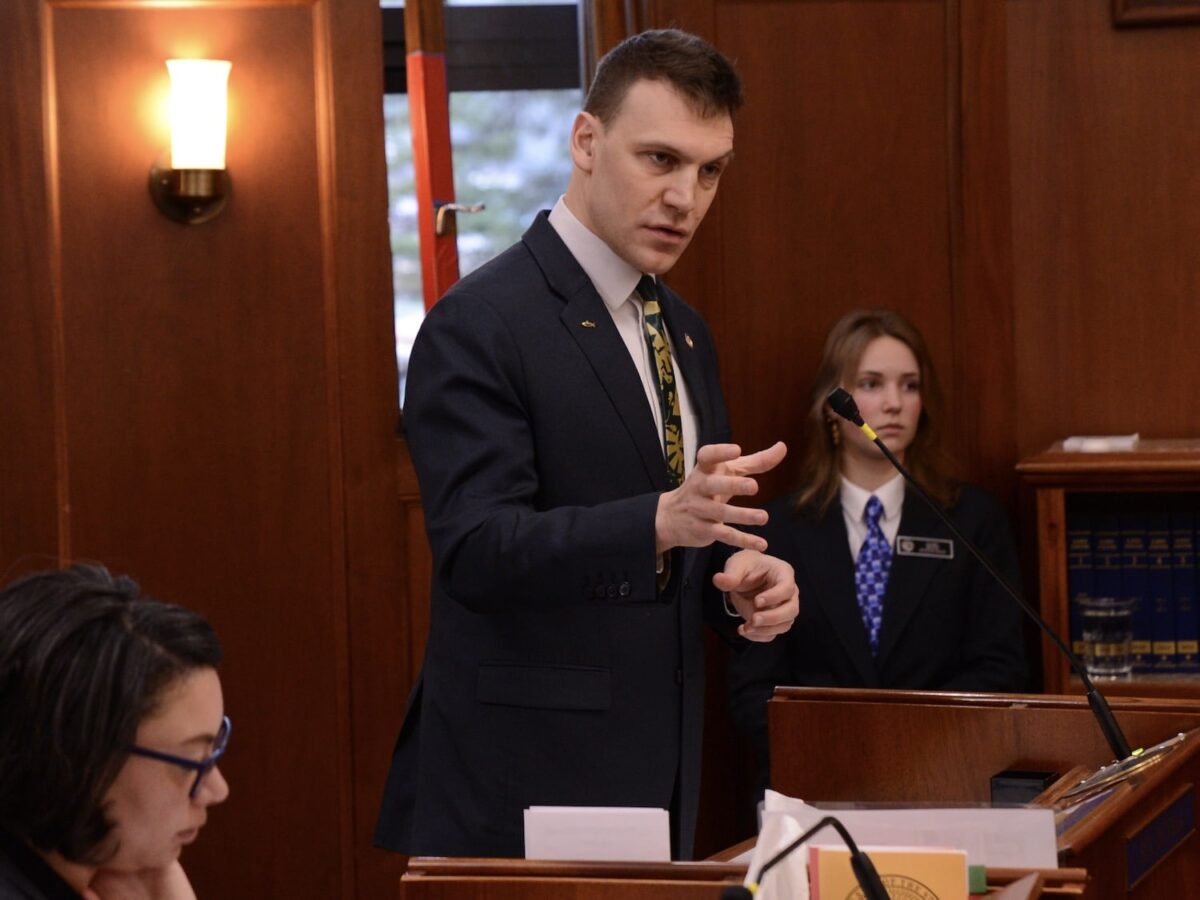
Adam Crum, commissioner of the Alaska Department of Revenue, testifies Friday, Jan. 20, 2023, at a meeting of the Alaska Senate Finance Committee in the state Capitol at Juneau, Alaska. (Photo by James Brooks/Alaska Beacon)
By: James Brooks, Alaska Beacon
Adam Crum, commissioner of the Alaska Department of Revenue, testifies Friday, Jan. 20, 2023, at a meeting of the Alaska Senate Finance Committee in the state Capitol at Juneau, Alaska. (Photo by James Brooks/Alaska Beacon)
Adam Crum, commissioner of the Alaska Department of Revenue, will leave his job Aug. 8, according to an announcement published Friday by Gov. Mike Dunleavy’s office.
A person familiar with Crum’s plans said he intends to run for governor in 2026, joining seven other Republican candidates. No independents or Democrats have filed for the primary election, which is 13 months away.
Asked whether he will run for governor, Crum said by text message, “I’ve accomplished a lot to put Alaska on sound economic footing. I’ll have a formal statement on my last day, August 8th. Stay tuned.”
Crum has been part of Dunleavy’s cabinet since the governor took office in 2018. He initially served as commissioner of the Alaska Department of Health and Social Services, occupying that position during the COVID-19 pandemic and during an executive order that split the agency into two separate departments.
In 2022, Dunleavy named Crum as revenue commissioner, and he assumed a seat on the board of the Alaska Permanent Fund Corp., whose revenues are the No. 1 source of general-purpose dollars for state services and the Permanent Fund dividend.
Jason Brune, former commissioner of the Alaska Department of Environmental Conservation, now fills a public seat on the Permanent Fund Corp. board.
Brune said he knows Crum has been considering a run for governor but could not confirm his plans.
“His departure is a big loss for the state,” Brune said by text.
“It was an honor working with him for the five years we served together,” he said, referring to the time they spent on the Dunleavy cabinet.
In a written statement Dunleavy praised Crum’s performance during his time with the state.
“Commissioner Crum has been an exemplary leader whose unwavering dedication and innovative approach have significantly benefited Alaskans,” Dunleavy said. “During his time leading both the Department of Health and Social Services and the Department of Revenue, Adam consistently prioritized Alaska’s economic well-being, public health, and fiscal stability. His collaborative spirit and commitment to serving our communities have made a lasting, positive impact.”
The governor’s office said an acting commissioner will be named soon.
In preparation for a possible glacial lake outburst flood (GLOF) this summer, local, tribal, and state agencies have formed a joint communications initiative aimed at improving public safety and emergency response in Juneau.
The City and Borough of Juneau (CBJ), Central Council of the Tlingit & Haida Indian Tribes of Alaska (Tlingit & Haida), and the Alaska Department of Transportation & Public Facilities (DOT&PF) are coordinating with several federal and state partners to streamline flood messaging and improve community readiness.
The collaborative effort stems from increased awareness of the growing risks posed by the Mendenhall Glacier’s Suicide Basin and recent flood events that have affected homes, infrastructure, and traditional lands. With the basin approaching capacity, agencies are taking proactive steps to minimize confusion, provide timely updates, and improve response coordination in the event of a flood.
The new effort, called the Joint Information Center (JIC), was established under the Incident Command System and includes coordination from the National Weather Service, U.S. Coast Guard, Alaska Division of Homeland Security & Emergency Management, and the Alaska Department of Environmental Conservation.
“This partnership will allow us to pool our resources to make sure our residents receive accurate, timely information—especially during high-stress situations like a flood,” said CBJ City Manager Katie Koester.
The JIC will provide consistent emergency alerts, preparedness tips, and flood status updates through email, social media, media briefings, and partner websites. The group will release email updates twice a week and near-daily social media posts to help keep the public informed.
“Community emergencies such as flood events do not recognize jurisdictional boundaries,” said Tlingit & Haida President Chalyee Éesh Richard J. Peterson. “That’s why collaboration between tribal, municipal, state, and federal partners is critical as we prepare our community, pool our resources, knowledge and coordinate response. Together, we are building a framework that prioritizes public safety and ensures that no one is left behind when it matters most.”
Key Ways Residents Can Stay Informed:
Sign up for emergency alerts at bit.ly/CBJAlerts
Check in with the Juneau Flood Ready website at bit.ly/JuneauFloodReady
View road closure leading up to and during an event at 511.Alaska.gov
Stay tuned to the National Weather Service Suicide Basin monitoring page (link) 5 Review the interactive flood inundation maps available at JuneauFlood.com.
NOTN- Goldbelt, Inc., Juneau’s urban Alaska Native corporation, has launched the permitting process for its new West Douglas cruise ship port, according to a news release from Goldbelt.
The site for Goldbelt Aaní, Tlingit for “land”, sits on the corporation’s Alaska Native Claims Settlement Act (ANCSA) lands on the west side of Douglas Island, approximately 12 minutes from downtown Juneau.
Goldbelt met with the City and Borough of Juneau’s Planning and Zoning Department to discuss the early requirements for what would be the municipality’s first cultural cruise destination.
Conceptual plans include a recreated 1800s-era Tlingit village, Indigenous art installations, local foods, and cultural attractions.
According to Goldbelt, infrastructure designs call for two single-berth cruise ship docks with tour boat access, piers connected to the shore by arching transfer spans, and a 32,000-square-foot welcome center. Additional amenities proposed in initial meetings include onsite housing for ship crew members and a childcare center.
“This is not a new plan—we’re activating a vision developed with the City and Borough of Juneau more than 25 years ago,” said Goldbelt President and CEO McHugh Pierre. “Goldbelt Aaní will strengthen infrastructure, disperse tourism in a balanced way, and create meaningful, lasting value for both Goldbelt shareholders and the community.”
City records show that planning efforts between the city and Goldbelt for West Douglas date back three decades. In 1999, the city allocated $600,000 to hire an engineering firm to design a master plan for the area. The current concept closely mirrors elements from that original plan, including a Tlingit cultural village, tour boat harbor with floatplane slips, a retail promenade called Goldbelt Way, a 28,000-square-foot restaurant, a spa, and waterfront lodging such as bungalows and elevated treehouses.
While the proposal does not directly address road development along Pioneer Road, it does incorporate plans for growth in utilities and supporting infrastructure.
Anchorage-based Solstice Environmental and Juneau-based Northwind Architects are leading the permitting and design process. Goldbelt plans to hold a series of public meetings to gather input from Juneau residents.
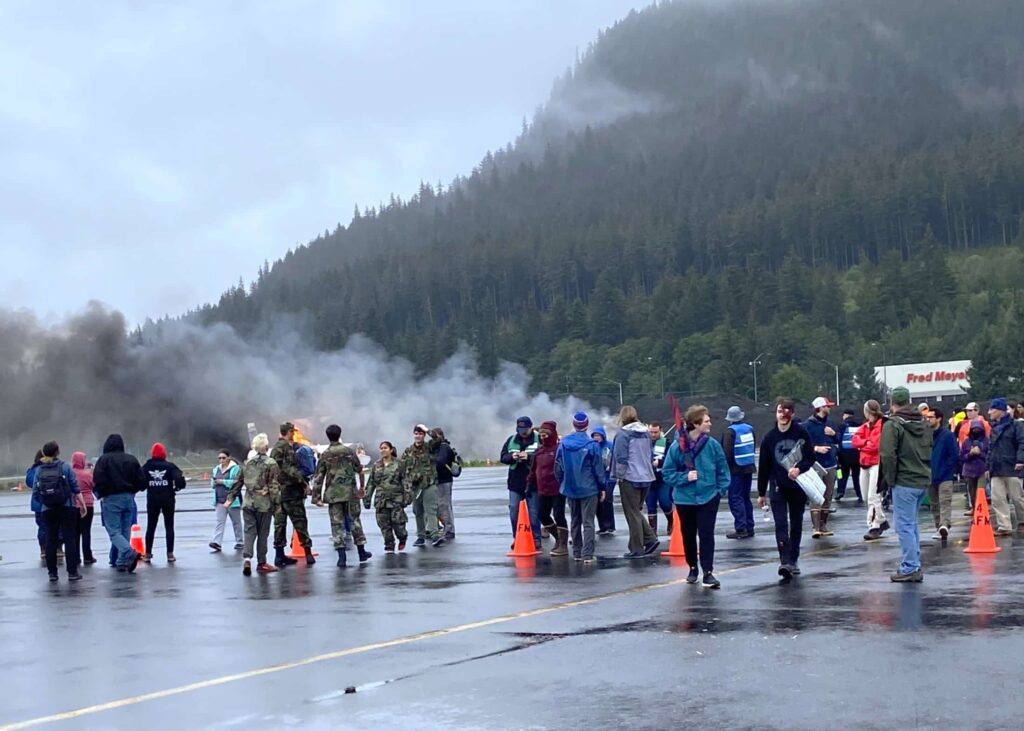
training exercise at the Juneau International Airport, Photo provided by CBJ
NOTN- The Juneau International Airport will conduct a full-scale emergency response exercise on Saturday, July 26, simulating an aircraft crash and live fire response. The exercise will run from approximately 10 a.m. to 1 p.m. and is part of required Federal Aviation Administration (FAA) safety training.
Juneau Mayor Beth Weldon says residents can expect to see visible black smoke and flames on the airport grounds as part of the simulation.
“They’ll be conducting a simulated airport crash and live fire training to allow everybody to get a chance to play all their roles. So this will be controlled burning of fuel, which will produce black smoke to replicate a real world aircraft fire, and so there will be a lot of emergency response vehicles in and around the airport. But again, there’s no danger to the public.”
The exercise is being conducted in coordination with local emergency response agencies and the burning complies with Alaska Department of Environmental Conservation (DEC) open burning guidelines, which allow limited black smoke emissions for firefighter training purposes. Airport officials say all reasonable efforts are being made to limit environmental impact and minimize the duration of smoke.
To support the drill, Mayor Weldon says the Airport Dike Trail parking lot off Radcliffe Road will be closed to the public, “airport dyke trail parking lot will be closed from 5pm on Friday, July 25 to 1pm on Saturday, July 26 So, and that’s usually one of their staging areas. So just be aware, if you’d like to walk that trail, you might pick a different trail to walk Saturday morning or walk in the afternoon.”
Airport authorities thank the public for their cooperation and understanding as they conduct this important safety training.
Seven people have been indicted and arrested in connection with a large-scale drug trafficking operation that funneled methamphetamine into Juneau from California, following a months-long investigation by state and federal law enforcement agencies, according to a press release by the Juneau Police Department.
Beginning in October 2024, Task Force Officers from the Alaska State Troopers’ Statewide Drug Enforcement Unit (SDEU) and Southeast Alaska Cities Against Drugs (SEACAD), working with the U.S. Postal Inspection Service (USPIS), launched an investigation into a drug trafficking organization operating out of Juneau.
The initial investigation began when task force members obtained evidence that showed that 41-year-old Juneau residents Patrick Iler, and 39-year-old Juneau resident Erika Porter were involved with the distributing methamphetamine throughout Juneau. 46-year-old Juneau resident Timothy Miller was identified as a distributor of methamphetamine working with Iler and Porter in Juneau.
Over the course of the investigation, law enforcement seized a combined 1.32 kilograms of methamphetamine, with an estimated street value of $130,000.
Investigators traced one of the drug sources to Highland, California. In May 2025, Alaska-based task force officers traveled to California and arrested 67-year-old Kinarla Miles, who is accused of supplying methamphetamine to the Juneau network.
Three other Juneau residents, 51-year-old Jerome Larue, 38-year-old Travis Lind, and 60-year-old Edie Seslar, were also arrested as co-conspirators.
Authorities estimate the drug ring distributed approximately 7 kilograms of methamphetamine in total, with an approximate street value of $700,000.
In May 2025, the U.S. Attorney’s Office in Anchorage indicted Miles, Larue, Lind, and Seslar on charges of drug conspiracy, money laundering conspiracy, and possession with intent to distribute controlled substances.
In July 2025, additional indictments were filed against Miller, Porter, and Iler for drug conspiracy and possession with intent to distribute methamphetamine. Porter and Miller were arrested in Juneau on July 23 and 24 and booked into Lemon Creek Correctional Center on federal warrants.
The investigation is ongoing and involves coordination between the Alaska State Troopers, USPIS, and the U.S. Attorney’s Office in Anchorage.
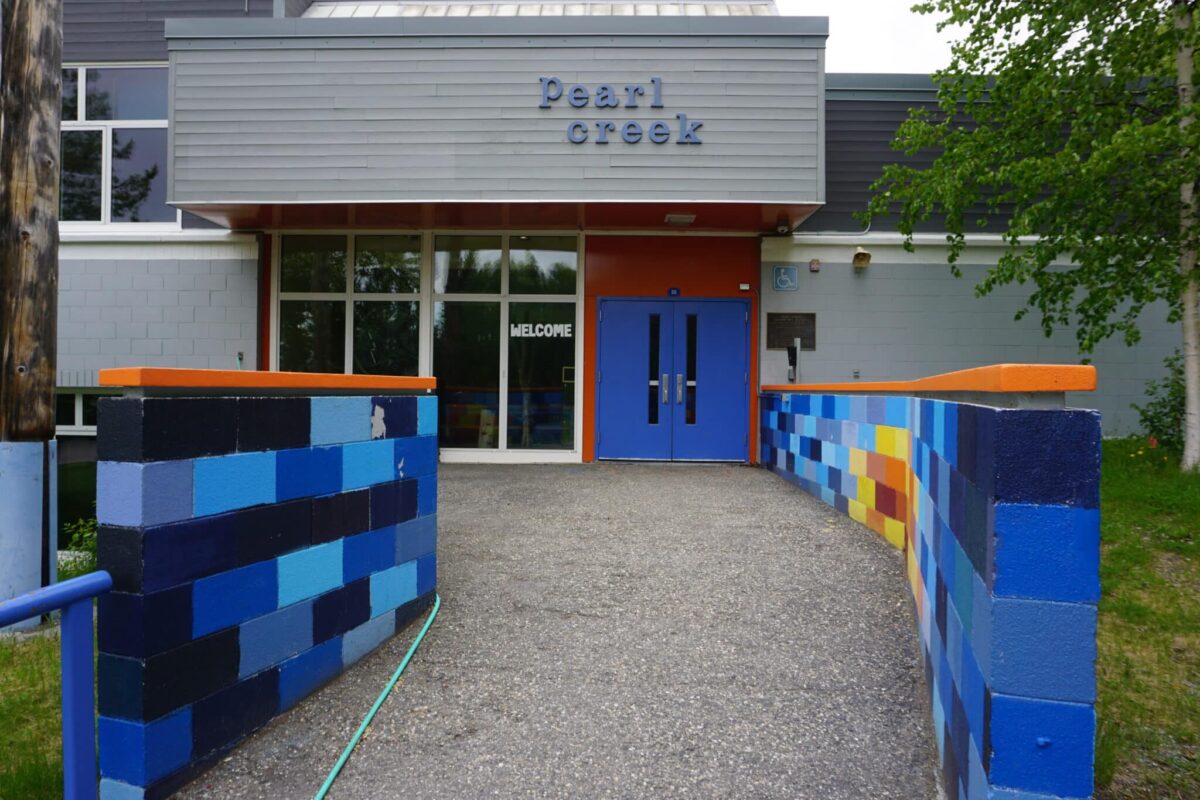
Pearl Creek Elementary School is seen on June 3, 2025. The Fairbanks North Star Borough School District decided to close the school at the end of the academic year due to budget cuts. (Photo by Yereth Rosen/Alaska Beacon)
Three Alaska school districts have joined a coalition from across the country — including school districts, teachers unions, parents and advocacy groups — suing the Trump administration for blocking $6.8 billion in congressionally approved education funding.
The Anchorage, Fairbanks North Star Borough, and the Kuspuk school districts joined the lawsuit filed Monday in federal court. The suit challenges the withholding of funds as unlawful and unreasonable, as well as violating Congress’ authority and the separation of powers.
“The lawless and last-minute withholding of federal education funds is not just a bureaucratic failure—it is a direct attack on our most vulnerable students. Less than a month before school starts, we’ve been forced to plan for cuts instead of preparing to serve children,” said Fairbanks Superintendent Luke Meinert in a statement announcing the lawsuit.
The Trump administration has said it’s withholding the funds pending a review of the grant programs to ensure they align with the Republican president’s priorities, and to “prevent them from promoting a ‘left-wing’ agenda,” according to the lawsuit.
For Alaska, an estimated $46.4 million was allocated across five grant programs, according to the Alaska Department of Education and Early Development. That includes funding to support migrant education, academic enrichment, English language learning, and other types of instruction, as well as teachers’ professional development. In addition, an estimated $1.1 million was withheld for adult education programs.
According to the lawsuit, school districts nationwide are facing millions in budget shortfalls, and have had to “cancel orders for new curriculum, delay critical teacher training, pause contracts for services for English language learners, or take other actions to avoid incurring expenses that they cannot afford to pay without the money normally provided by the Formula Grant Programs.”
The Fairbanks North Star Borough School District serves more than 12,000 students across 33 schools, and has seen over $2.57 million frozen, according to the lawsuit.
“Without these Title program funds, nearly 200 education jobs are in jeopardy,” Meinert said. “Our classrooms will be less supported, and students will be left behind. This isn’t just fiscal irresponsibility—it’s a moral failure that jeopardizes the future of the very students federal law is meant to protect.”
The Kuspuk School District serves 320 students in nine schools across 12,000 square miles in Western Alaska — and has received national attention for its deteriorating school buildings and severe maintenance needs. It is facing over $180,000 in frozen funds.
Students attend class in a Kuspuk elementary school. (Photo provided by the Kuspuk School District)
Among the grants frozen was funding to support teacher training, school supplies, enrichment programs and English language learning, including for over 130 staff. “Because English is not the first language for more than 60% of the district’s teaching staff, sustained … training has been critical to ensuring educators can effectively support English Learners across subjects and grade levels,” according to the lawsuit.
Superintendent Madeline Aguillard said in a statement the programs are “not line items, they are lifelines” for students.
“These are not extras. These are the programs that give our students a chance,” she said. “When funding is blocked, it does not just stall services. It dismantles the systems we have built to reach those most in need. When the federal government walks away from its obligation, it is not a delay. It is denial. Denial of access. Denial of progress. Denial of the futures our students have a right to pursue.”
For Anchorage, the state’s largest district by population at more than 43,000 students in 94 schools, the frozen funds are estimated at $11.8 million.
In an interview last week on the district’s budget challenges ahead of the lawsuit, Superintendent Jharrett Bryantt said the funding freeze on July 1, at the start of the fiscal year was “severe,” particularly having just signed new contracts for teachers and staff. “If you offer somebody a role and no longer have the funds for it — it’s so unprecedented that the federal government would not essentially pay its bills on time because these monies were appropriated. This is not a budget reduction conversation. This is a executing the will of the Congress of conversation,” he said.
Anchorage Superintendent Jharrett Bryantt (Photo provided by the Anchorage School District)
The freeze comes amid an ongoing state education funding debate with the Alaska State Legislature meeting for a special session on Aug. 2, as well as a dispute over local contributions to school funding. School officials said this combination of issues is devastating to public education in Alaska. Earlier this year, the Anchorage School District reported it had to lay off 42 staff positions, and cut more than $30 million in salaries, benefits and services.
Bryantt said the district had to immediately lay off five staff members following the funding freeze announcement, and transfer about a dozen more to alternate roles. “We can make sure that folks are employed. That’s my top priority, in addition to the continuity of our students’ learning,” he said, and recruiting and hiring teachers is an ongoing challenge.
“Teachers are a national commodity,” he added.
The lawsuit, filed in a federal court in Rhode Island, names the U.S. Office of Management and Budget, its director Russ Vought, the U.S. Department of Education and Secretary of Education Linda McMahon. It asks a judge to compel the department to release the funds.
Alaska U.S. Sen. Lisa Murkowski joined nine other Republican senators in a letter to the Office of Management and Budget urging the department to release K-12 funds, as well as over $700 million for adult education programs.
Last week, the U.S. Department of Education announced it will release some of the withheld grants, an estimated $1.3 billion that goes to support after-school care and summer school programs, though it’s unclear when those funds will be received by districts.
The Alaska State Capitol in downtown Juneau.
(Photo by Greg Knight/News of the North)
The Alaska State Capitol in downtown Juneau.
(Photo by Greg Knight/News of the North)
A recent actuarial analysis presented to the Alaska House Finance Committee has renewed focus on legislation to restore a defined benefit pension for public employees, the analysis shows the plan could help retain workers despite a higher upfront price tag.
For years, efforts to reinstate pensions for state workers have faced a hurdle in Alaska law, which requires an actuarial review of any retirement legislation before it can advance to a floor vote. These reviews are often expensive and time-consuming, delaying legislative progress.
But advocates argue these studies are critical to ensuring any proposed pension system is fiscally sound.
This year, the state’s actuary delivered its report on House Bill 78 to lawmakers, outlining costs and potential long-term benefits of shifting from a defined contribution system similar to a 401(k), back to a traditional pension plan. The analysis found that defined benefit pensions provide more value to employees and improve workforce retention, which in turn raises overall payroll and long-term staffing stability.
“The actuary said That’s going to, almost single-handedly solve your retention problem.” Said Juneau Senator Jessie Kiehl.
The fiscal note for HB 78 estimates the pension plan would cost the state about $40 million in the first year, with expenses growing as more vacant state jobs are filled and employees remain longer.
But Kiehl says the predicted $76 million annual savings and increased revenues for public employers far outweighs the price tag up front.
“In the end, we save money. ” Kiehl said. “The state of Alaska is actually going to come out ahead, not only by having better trained, more effective public workers, but by having a more efficient government.”
Kiehl also specifically noted Juneau Police Department, who face poaching from Washington State Patrol, “when police officers at JPD have a pension, they don’t get poached by Washington State Patrol who come up here just about every summer, take our JPD officers to dinner and say, Hey, come on down. We’ll hire you, bring your experience and all the training the taxpayers of Juneau paid for, and by the way, you can earn a Washington state pension.”
The legislature is expected to take up the measure during the 2026 legislative session.
The offices of the Alaska Department of Health and Social Services are seen in Juneau on Friday, July 1, 2022. (Photo by Lisa Phu/Alaska Beacon)
A new federal law signed by President Donald Trump on July 4, 2025, enacts wide-ranging changes to public policy, including major revisions to Medicaid, the Supplemental Nutrition Assistance Program (SNAP), and federal tax laws.
According to officials, Alaska’s Medicaid funding is more stable than other states because Alaska is not subject to some of the structural changes affecting others.
Medicaid is a joint federal and state public health insurance program for people with low incomes, including children, pregnant women, older adults, and individuals with disabilities. 1 in 3 Alaskans are enrolled in Medicaid. While not all enrollees use services every year, about 40% received care in FY25. Most Medicaid enrollees in Alaska are children or adults under the age of 65.
According to current information, the State cannot reliably say how many Alaskans will be affected.
According to the Department of Health, The One Big Beautiful Bill (the bill) establishes new community engagement requirements and requires states to check Medicaid eligibility twice a year for some Medicaid enrollees.
The requirements primarily apply to the Medicaid expansion population – able bodied adults ages 19 to 65 who qualify for Medicaid based on their income.
Many Alaskans will be exempted from the new requirements, making the full impact of the changes complicated to project, they say further analysis is underway.
The bill requires that most able-bodied adults ages 19–64 enrolled through Medicaid expansion must complete 80 hours per month of work or other qualifying activities to qualify for Medicaid coverage. These activities include job training, education, or volunteer service. Individuals must show they met the requirements at least one month before applying and must meet the same requirements when they renew.
Advocates say individuals who use these programs already work, or are unable to do so, and adding qualifying work requirement paperwork could make it more difficult for recipients to apply.
According to the Department of Health, The bill includes mandatory exemptions for individuals who are:
Meet SNAP or TANF work requirements
Pregnant or within the postpartum coverage period
Alaska Native or American Indian
Have a significant physical, intellectual, or developmental disability
Are blind or disabled
Have a substance use disorder or disabling mental health condition
Have a serious or complex medical condition
Veterans with a total disability rating
Enrolled in Medicare
A parents or caregiver for a child under 14 or someone with a disability
Recently incarcerated (within 90 days)
Under age 26 and formerly in foster care
The Department of Health also notes the creation of the Rural Health Transformation Fund, a $50 billion initiative aimed at improving health care in rural communities across the country.
Funds may be used for a wide variety of activities to improve rural health care, including technology modernization, workforce development, innovative care models, and prevention measures for chronic disease and substance use disorder.
Officials say the state is “well-positioned” to secure a strong share of those dollars, helping improve access to health care and supporting long-term improvements to health outcomes in underserved areas.
Deena Bishop, commissioner of the Alaska Department of Education and Early Development, at a news conference with Gov. Mike Dunleavy on education funding on Friday, Jan. 31, 2025. (Photo by Corinne Smith/Alaska Beacon)
The state of Alaska has filed an appeal with the U.S. Department of Education after federal officials said the state failed a test measuring the differences in funding between school districts, which put more than $80.8 million in federal aid at risk.
Each year, the state receives federal funding called “impact aid” intended to compensate districts with federally owned lands, which reduce the tax base to support schools. The state can put that funding toward its own funding for schools — which the state has done in the past — but only if it can pass what’s known as a disparity test.
Federal law requires there to be no more than a 25% gap between per-student revenue in districts near the highest in funding and districts near the lowest. The department found Alaska’s disparity to be 26.88%, given the state’s complex funding formula.
But Alaska has rejected the finding, filing a formal appeal on July 14 and submitting districts’ finance data to argue their expenditures meet the standard. The test puts federal funding at stake, according to the state, which this year amounts to an estimated $80.8 million.
Deena Bishop, commissioner of the Alaska Department of Education and Early Development, said in an interview last week that she feels good about the state’s accounting and a successful appeal.
“I’m confident that we did meet it,” Bishop said of the requirements. “If I base it off of the last appeal and how Alaska was able to share how transportation costs are truly that disparate, then I think we will do fine.”
The state failed the same disparity test in 2021, based on 2019 state data, and successfully appealed. This time, the state submitted 2024 data for evaluation.
“So a little bit of it is a huge math problem at the beginning,” Bishop said of the appeal process. “We wrapped our arms around it and figured that out, and then made an argument on … why we did it that way, given the background of those costs in Alaska.”
Bishop said Alaska sees high costs in rural school districts — especially for transportation, but also basic supplies and operating costs.
“The cost to do business is highly diverse in Alaska. If you just took the cost of a head of lettuce or a gallon of milk, you know, in Anchorage, as compared to Teller, it’s not just three times (higher in Teller). It could be up to five times. And really building and construction materials, supplies, all of those are such a significant increase due to the way you can only get in by barge or plane. So it’s just … again, understanding why we pay such large differences in different places in Alaska.”
The U.S. Department of Education notified the state that it failed the test on May 16, as first reported by KTOO. Bishop said it will take time to resolve. The 2021 appeal was resolved at the end of that fiscal year, in 2022.
“It is a long process, because I think they’re very careful at it,” she said. “You want to spend the time on it. They did spend the time to understand Alaska.”
In the meantime, the federal impact aid payments will continue to school districts.
DEED spokesperson Bryan Zadalis said by email those funds will continue through the appeal process. “School districts will continue to receive Impact Aid funding directly from US-ED through their regular processes of application approval and funding availability,” he said.
Added uncertainty for education funding
The results of the disparity tests add uncertainty for the state, and for Alaska schools.
That’s based on the state’s complex funding formula for schools – which includes federal, state and local contributions.
Alexei Painter, who directs the division of state government that analyzes the budget for the Legislature, said the Legislature passed a budget that funds whatever the state’s portion is in that funding formula. If the state passes the disparity test, it allows the state to deduct the federal impact aid dollars from the state school funding.
But if the state fails the test, Painter said, “that money doesn’t go away. It just goes directly to those districts.”
If the federal impact aid isn’t flowing through the state government, it no longer is distributed based on the state funding formula. That’s potentially a big problem for the state.
“If we fail, we can’t make that deduction,” Painter said in an interview Wednesday. “The result of that is that what the state would owe to pay the full formula would go up by $80 million.”
That’s because the state would still be required to distribute the remaining state aid according to formula, but it would have less revenue to do it.
Painter explained that the issue is further complicated by Gov. Mike Dunleavy’s budget veto of $50 million for the state’s education funding this year.
Under the original budget bill passed by the Legislature, the state had an open-ended commitment to provide school funding according to the formula. But in issuing the veto, Dunleavy crossed out the language, replacing it with a dollar amount.
“The governor vetoed that appropriation from an open-ended one to a fixed dollar amount,” Painter said. That means that if the state fails the disparity test, “that cost goes up by $80 million, and now the veto impact is $130 million.”
The Legislature is set to take a vote on whether to override Dunleavy’s veto of school funding during a special session, scheduled for Aug. 2.
Painter said that if the Legislature votes to override the veto, it would fund the education formula – including the $80.8 million.
Depending on the override vote and the appeal, the impacts to school districts could vary widely across the state, he said. The division issued a memo in June on the potential impacts.
Some districts that receive the federal impact aid because they include federal lands, like the Lower Kuskokwim or Fairbanks school districts, could see millions more. But others, like the Matanuska-Susitna or Anchorage districts could see millions less, as the state would not have enough money to fully balance its part in the funding formula.
“I would just assume the Legislature will address this in some way,” Painter said. A veto override would be one way to address it. Another way would be to provide more money for school districts after the Legislature reconvenes for its next regular session, in January, in a supplemental budget bill.
If the state loses its appeal and the Legislature doesn’t act, it could be a problem for districts.
“Otherwise there’s just a lot of uncertainty for districts,” Painter said. “Even if the department’s ultimately successful, in the meantime, it just adds uncertainty for districts.”
Sen. Löki Tobin, D-Anchorage and chair of the Senate Education Committee, said in a phone interview that she was glad the state has appealed. But she argued that the disparity is being driven by a lack of funding on the state’s part for public schools.
“That is ultimately on the shoulders of our state and also of our local communities, and with a decade of flat funding, it is clear why our school districts’ budgets are getting tighter, the deficits are getting larger,” and the disparity is growing, Tobin said.
Zadalis said no date has been set yet for a hearing on the appeal.
Sen. Forrest Dunbar, D-Anchorage, speaks in favor of Senate Bill 39, the payday loans bill, on Tuesday, April 15, 2025. (Photo by James Brooks/Alaska Beacon)
Sen. Forrest Dunbar, D-Anchorage, speaks in favor of Senate Bill 39, the payday loans bill, on Tuesday, April 15, 2025. (Photo by James Brooks/Alaska Beacon)
Anchorage Democratic Sen. Forrest Dunbar will be able to attend the Aug. 2 special session of the Alaska Legislature, he said late Tuesday in a post on Facebook.
Dunbar, a member of the National Guard, is deployed to Poland on active-duty service but received a federal waiver that will allow him to return to Alaska for legislative work.
Dunbar’s attendance is critical for lawmakers who hope to override Gov. Mike Dunleavy’s decision to veto millions of dollars in public school funding from this year’s state operating budget. Despite his attendance, the outcome remains uncertain, and Dunleavy has the option of canceling the session.
That formula is subject to the state’s annual budget process, and Dunleavy chose to only partially fund it, causing a wave of cuts to services at public schools across the state. Dunleavy had said he would not agree to the full funding increase without the Legislature adopting other policies he’s proposed.
Many legislators hoped to override that second veto in January, when the regular legislative session reconvenes, but Dunleavy called a special session for Aug. 2, forcing an early vote.
Writing on Facebook, Dunbar noted that he had previously requested to be excused from the Legislature during his National Guard service, “however, the Legislature obviously does not control the actions of the governor.”
Dunbar said he began seeking a formal waiver that would allow him to use his personal leave, pay for his own plane ticket, and return to the state for the special session.
“I am pleased to report that the commanding general to whom our unit now reports has indeed granted that request,” Dunbar wrote. “I plan to return to Alaska for the start of the special session, and I will be voting yes to override, so that our students have the funds they need to avoid catastrophic cuts to their schools.”
For weeks, it hadn’t been clear whether Dunbar would be able to obtain the rare dispensation needed to return to Alaska.
“In general, a service member on federal Title 10 mobilization orders is required to complete the full term of their deployment,” said Dana Rosso, a spokesperson for the Alaska National Guard, by email. “Any early release or temporary return would require approval through Department of Defense and U.S. Army channels and is only considered under exceptional circumstances — such as serious medical or family emergencies — while taking mission requirements and federal law into account.”
Rosso said there was no way for a state official — such as the governor or adjutant general — to issue the waiver.
“Any early release or temporary return would require approval through Department of Defense channels, typically at the Secretary of the Army or Secretary of Defense level,” he said. “These waivers are rare and only considered under extraordinary circumstances, such as serious medical issues, family emergencies, or extreme humanitarian situations.”
Dunbar’s chief of staff, Arielle Wiggin, said by email that it wasn’t clear until recently whether the commanding general of the U.S. Army’s V Corps — Lt. Gen. Charles Costanza — would grant the waiver.
Even with Dunbar’s attendance, it isn’t clear whether the governor’s budget veto will be overridden or sustained.
In a closed-door meeting shortly after issuing a proclamation that called the session, Dunleavy asked members of the House’s Republican minority caucus to stay away from the first five days of the special session, the period when the Alaska Constitution requires any override vote to take place.
The date of the special session also coincides with the National Conference of State Legislatures, which several lawmakers were expected to attend.
Other legislators were scheduled to work or attend family events during the period.
Since the governor’s announcement, many have said they will be canceling their plans in order to attend the special session. Sen. James Kaufman, R-Anchorage, will return from a trip to Vietnam, he said, and vote in favor of the override.
Some Republicans aligned with Dunleavy on the issue, including Reps. Jamie Allard, R-Eagle River, and Kevin McCabe, R-Big Lake, have said they will follow his wishes and stay away.
Of the 46 legislators who voted this spring to override the governor’s veto of the education funding formula, all but a handful have committed to supporting a budget veto override as well.
Rep. Dan Saddler, R-Eagle River, said he will attend the special session but declined to say how he would vote on the budget issue. House Minority Leader Mia Costello, R-Anchorage, said she has not made up her mind.
Republican Reps. Julie Coulombe and David Nelson of Anchorage, and Bill Elam of Nikiski, could not be reached by phone on Wednesday.
The governor’s legislative director is keeping close track of the number of potential “yes” and “no” votes for a veto override, and it is possible that the governor could cancel the special session.
After Dunbar’s announcement, Alaska Democratic Party chair Eric Croft issued a statement calling the timing of the Dunleavy-called special session “one of Dunleavy’s many dirty tricks.”
“There is nothing Dunleavy won’t try to further his anti-education political agenda, including taking advantage of a legislator’s active commitment to the military. We’re grateful for Senator Dunbar’s service to our country’s security and Alaska. If not for his dedication to his constituency, we may have seen our persistent efforts to fund education fail yet again,” Croft said.
Asked about Croft’s comments, Dunleavy spokesperson Jeff Turner reiterated a statement that Dunleavy made on July 2, when he declared that the special session would be devoted to education reform and an executive order creating the new Alaska Department of Agriculture.
“Enacting a few necessary reforms to our public education system can elevate those children struggling in Alaska’s school system,” Dunleavy said at the time. “As elected officials we must do all we can to put the next generation on the path to a successful and prosperous future, and that starts with a solid public education.”