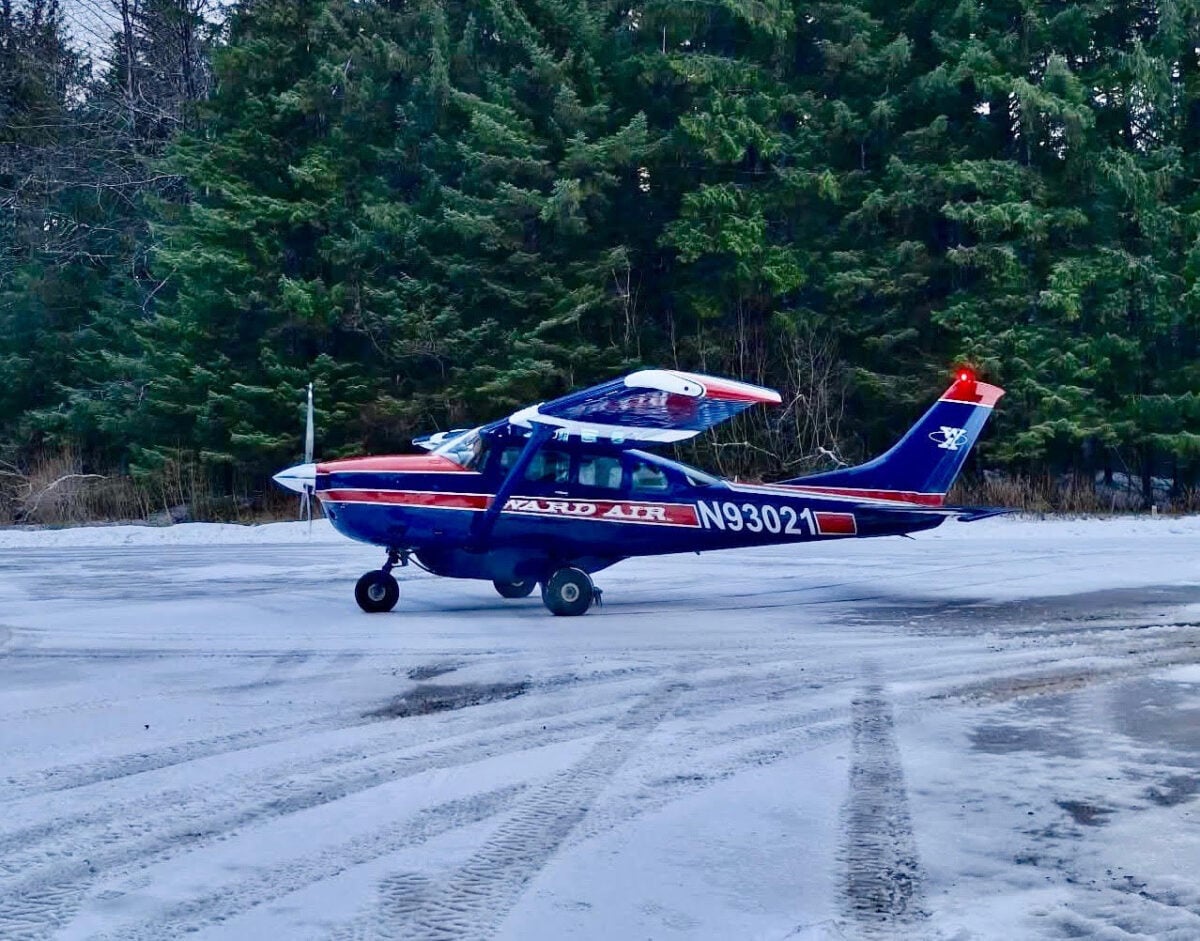
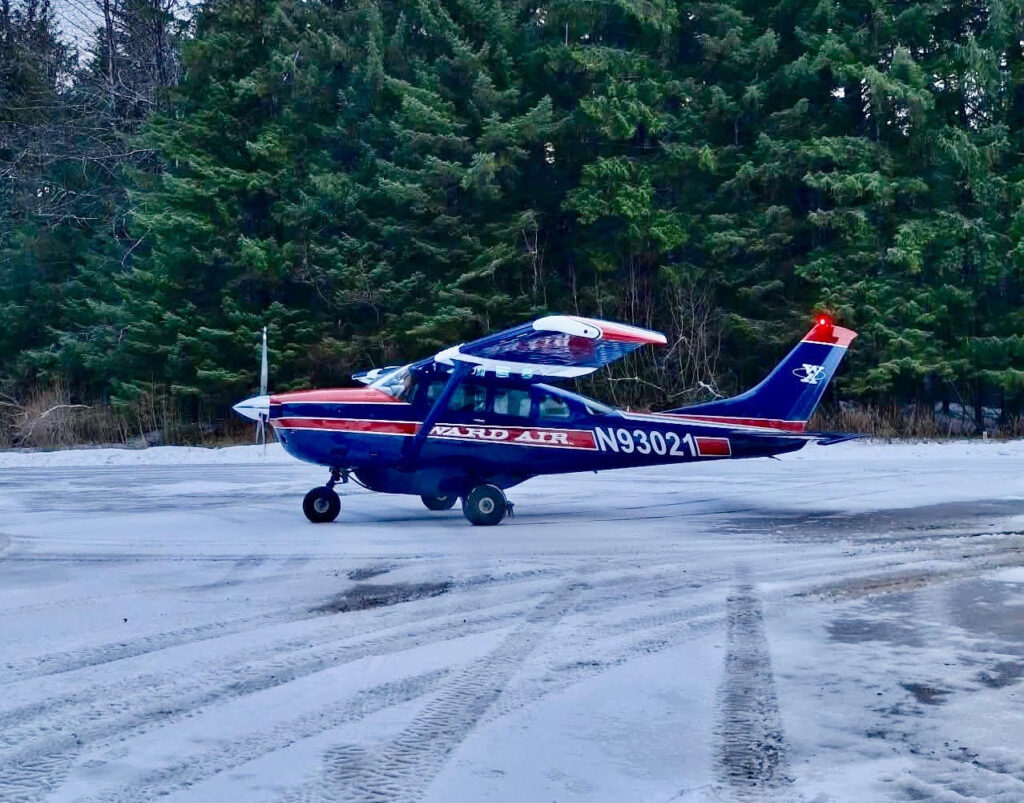
NOTN- A plane crash in Southeast Alaska sent one person to the hospital Thursday morning.
The U.S. Coast Guard received a report just after 10 a.m. of a downed aircraft near Shelter Island in Lynn Canal, KINY was sent a note from an internal source close to 12:00 p.m., as of yet the pilot’s condition has not yet been released.
The plane, operated by Ward Air, was carrying only the pilot.
The pilot was pulled from the water by another Ward Air seaplane and taken to a hospital for treatment, there are unconfirmed claims that the pilot may have suffered a head injury, though this is currently hearsay.
It’s been reported the plane was a float plane, but an unnamed source has said it was a Wheel Plane, specifically a CESSNA 206, KINY is unable to substantiate that claim, Ward Air representatives declined to comment when contacted by phone this afternoon.
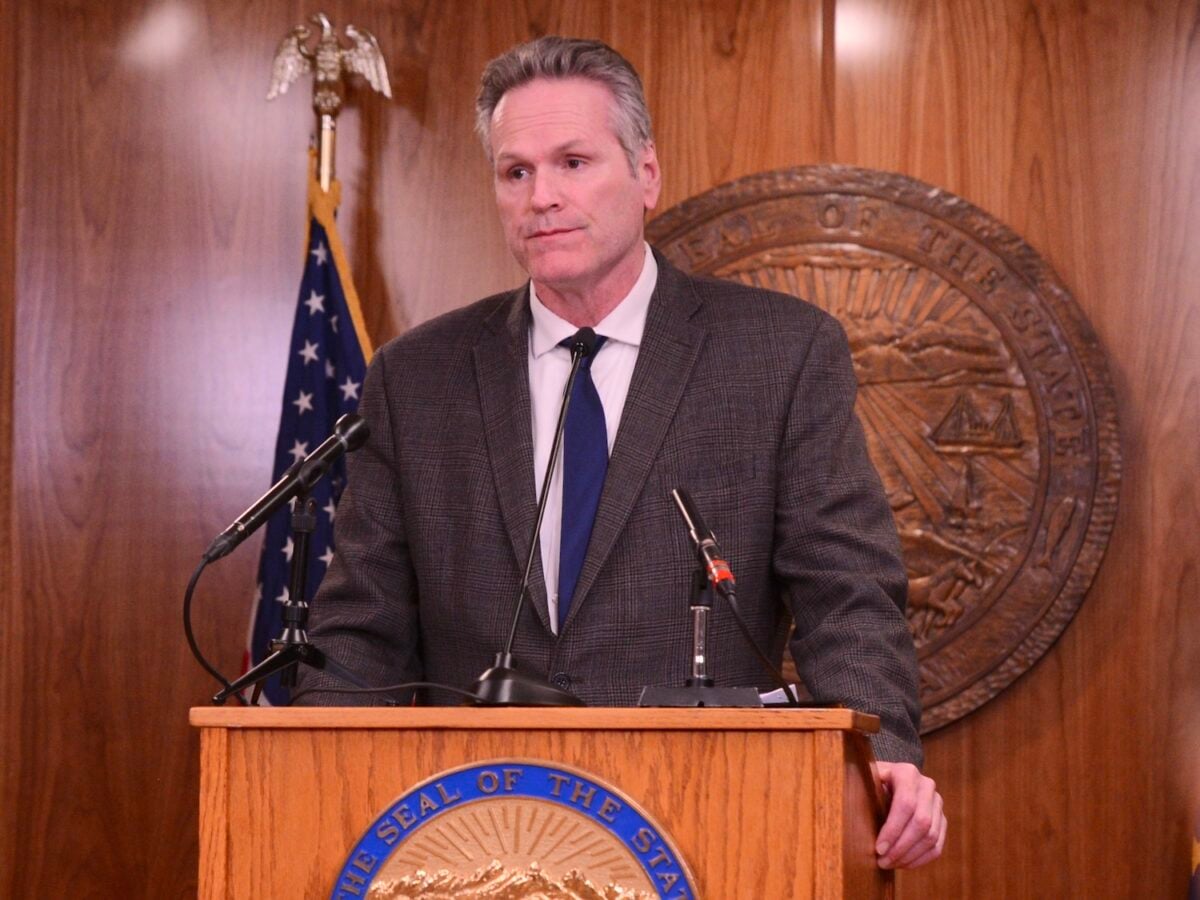
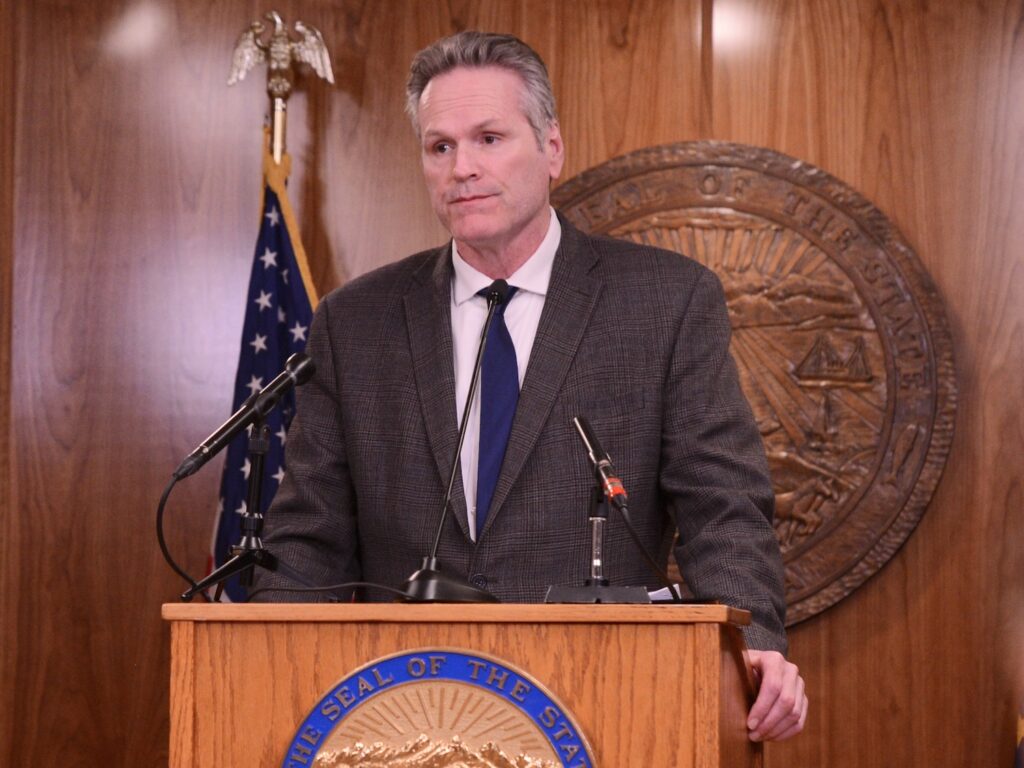
Alaska Gov. Mike Dunleavy talks to reporters during a news conference on Monday, May 19, 2025. (Photo by James Brooks/Alaska Beacon)
Yereth Rosen, Alaska Beacon
Alaska Gov. Mike Dunleavy talks to reporters during a news conference on Monday, May 19, 2025. (Photo by James Brooks/Alaska Beacon)
Alaska Gov. Mike Dunleavy has been appointed to the U.S. Arctic Research Commission at a time when the federal agency is pivoting from its longtime focus on environmental science to more emphasis on military defense and economic development.
Dunleavy is an ally of President Donald Trump. Dunleavy’s presidential appointment, announced by the commission this week, comes five months after Liz Qaulluq Cravalho’s position on the commission was terminated. Cravalho is vice president of lands at NANA Regional Corporation, the Alaska Native corporation for the state’s northwest region. She was initially appointed by then-President Joe Biden in 2021 and reappointed in 2024.
The commission, created in 1984, advises the president and Congress on research policy. Its seven commissioners are appointed by the president.
Dunleavy is the first sitting governor to be appointed to the commission, which advises the president and Congress on Arctic research. Past Alaska lieutenant governors have served on the commission, but not during their time in state office. Mead Treadwell chaired the commission prior to being elected in 2010 as lieutenant governor in the Parnell administration, and Fran Ulmer chaired it after serving as lieutenant governor in the Knowles administration and after serving as chancellor of the University of Alaska Anchorage.
In 2019, his first year in office, Dunleavy used his veto powers to cut state funding of the University of Alaska system by 41%, an action that at the time was characterized as devastating to the university’s Arctic research, among other activities. Much of the funding was later restored through a compromise Dunleavy made with the university.
In a statement released by the commission, Dunleavy praised the role of Arctic research, saying it helps Alaskans.
“Alaska sits at the forefront of the Arctic, and our communities, resources, and strategic position make us essential to advancing responsible research, economic development, and national security in the region,” he said in a statement released by the commission. “I look forward to working with fellow commissioners to ensure that Arctic research reflects the needs of Alaskans while strengthening America’s leadership in the Arctic.”
The Trump-appointed chair of the commission, speaking Wednesday at the Arctic Encounter Summit in Anchorage, said the organization is “tremendously thrilled” to have Dunleavy as a member.
Thomas Emanual Dans, appointed by President Donald Trump as chair of hte U.S. Arctic Research Commission, speaks at the Arctic Encounter Summit in Anchorage on April 15, 2026. (Photo by Yereth Rosen/Alaska Beacon)
“We’re super excited about that,” said Thomas Emanual Dans, appointed in December. “We’ve got the very experienced hand and voice at our commission, and we’re looking to do big things here.”
A pivot to security needs
Dans, who also served on the commission during the first Trump administration, expressed an expansive view of the Arctic that he likened to that of 19th century explorers.
“We want to create the conditions that really unleash human flourishing. We want more. We want human life. We want people to have big dreams,” he said.
Rather than focusing on pure science, the commission is focused on security, as Dans described it.
“Security is probably the overriding, overarching theme of things,” he said.
But security has several facets, he said. It includes military security, international security, energy security and community security, “which can be interpreted broadly in terms of health and well-being” for Arctic residents and others in the nation and the world, he said.
Dans, who lives in Texas and spent most of his career in finance, served on the U.S. Arctic Research Commission during the first Trump administration. But his comments on Wednesday indicated some gaps in his Arctic and Alaska knowledge.
He mentioned Russia’s Wrangel Island, off the northern coast of Siberia, as a security threat. Wrangel island “is close to Alaska here,” he said in his speech. “And for a long time it was incorporated as part of the United States. Today we face missiles pointing at us from Wrangel Island.”
Canadian government brochures and fliers, displayed April 15, 2026, at the Arctic Encounter Summit in Anchorage, describe that country’s countribution to U.S. national defense. U.S. Arctic policy now has a stronger emphasis on national security. (Photo by Yereth Rosen/Alaska Beacon)
Wrangel Island was never part of the United States. There is a place with a similar name – Wrangell Island – that is located in Southeast Alaska. Since 2004, Russia’s Wrangel Island, located 300 miles from the nearest point in Alaska, has been designated as a UNESCO World Heritage Site. It is famous for its Arctic biodiversity, including the world’s largest concentration of Pacific walruses.
A decade ago, Russia built a military base on the island with a focus on radar systems to monitor airspace. The military use of the island is part of Russia’s military buildup in the Arctic, which has worried U.S. officials, and it is also considered to pose a potential threat to the natural resources there.
In his Arctic Encounter Summit comments, Dans hailed the planned expansion of the U.S. Coast Guard’s icebreaker fleet, saying the fleet has “gone from zero to maybe 14.” However, the Coast Guard for decades has operated two polar-class icebreakers: the Healy, which performs annual missions in Alaska and the wider Arctic, and the Polar Star, which usually sails in the Antarctic. The Coast Guard recently acquired another icebreaker for Arctic operations. Originally an oil industrial vessel called the Aiviq, the ship was renamed Storis and commissioned in a Juneau ceremony in August. The fleet is poised to expand: there was funding for more than a dozen new icebreakers in the Trump administration spending bill known as the One Big Beautiful Bill Act.
Concerning Russia, which holds more Arctic coastline and land than any other nation, Dans urged more cooperation and communication. “I’d love to have the younger generation in Alaska learn Russian,” he said.
Within a few miles from the Dena’ina Civic and Convention Center, where Dans spoke at the Arctic Encounter Summit, classes were being conducted in Russian language at elementary, middle and high schools through the Anchorage School District’s Russian immersion program. It was launched as a full-time program in 2024, according to the school district.
Family Fun Night at Dimond Park Field House, photo courtesy of Juneau Parks and Recreation
NOTN- The Juneau Assembly held a special budget listening session last night as the city faces a steep drop in revenue following last fall’s municipal election.
Assembly and staff said voter-approved changes, including a property tax mill rate cap and new sales tax exemptions on essential food and residential utilities. have created a larger-than-expected budget gap.
“As I’m sure most of or all of you know, we’re in a difficult position of having to come up with a balanced budget after significant revenue loss.” Finance Chair Christine Woll said, “People are paying less in taxes, which is a good thing. The flip side is we have less resources available to fund city services.”
Finance staff now project roughly a $14 million reduction in sales tax revenue heading into fiscal year 2027.
The Assembly is searching for $2-4 million in service cuts and potential new revenue.
“No question, there’s reduced revenue, but we’re really trying to be measured in how they approach it, which means you will be hearing from us and having this conversation over the course of two years, and you’ll get very tired of it, but expect us to be in this conversation of, ‘how do we live within our means for a couple of years?’ Because he certainly wants to make sure that it’s done thoughtfully and with lots of engagement.” Said City Manager Katie Koester.
Public testimony at the listening session focused largely on protecting Parks and Recreation services, including the Treadwell Arena, Diamond Park Field House, pools, and the Jensen-Olson Arboretum.
Testifiers told heartwarming stories about their experiences, memories and use of these city facilities emphasizing to the assembly their importance to Juneau life year round but especially during long winters like this one.
“I understand that the city has some tough decisions to make regarding funding, and while fields, playgrounds and a field house may not seem vital parts to our community, I’m here to tell you they are.” Said one testifier, Lexi, “Parks and Rec is vital to the Juneau community because it organizes sports for youth to participate in, without the high price tag of club teams. It also provides facilities that youth can play organized or pick up games. Any large cuts to Parks and Rec will substantially hurt the youth of Juneau, the parents that support them and the adults that still feel like they’re youths on the field.”
Residents argued those facilities are critical to Juneau’s physical and mental health, youth opportunities and community retention, especially through long winters.
“I made the possibly questionable decision to start playing hockey at 59 years of age.” Said testifier Kieth, “Since I started I have found a community that is incredible. What’s important to our community is what’s going to keep young people and families here in Juneau, and I’m afraid that recreation opportunities are underestimated in their value there. It’s hard to quantify. People make decisions about whether they’re going to stay here or not based upon what kind of opportunities there are. There’s a wide range of people that I’ve met there, from all across the community that I would never have met before, spans all generations. And during the dark, wet winter months, it’s always light and dry, well lit. And so, I just think it’s a very important place to maintain and I hope we can keep the full funding for the for the rink.”
Some speakers urged the city to raise or revisit certain tax exemptions, while others called for expanded use of user fees, volunteers, and public‑private partnerships rather than deeper cuts to specific city entities.
“Maintain existing services within your existing revenue stream. I don’t think that you ought to adjust taxes, particularly sales tax. I do think that reasonable adjustments to fees are acceptable to users, if they enjoy the service that you’re providing, or the community is providing, then they ought to pay for those and they should understand that we’re in tough times.” Said testifier Don.
Assembly members repeatedly warned, that even with strong public support, some services are still likely to be reduced as they work to balance the budget over the next two years.
Budget discussions will continue, with more public input opportunities expected before the city passes next year’s budget.
Rep. Alyse Galvin, I-Anchorage, speaks on the House floor on Apr. 13, 2026. (Photo by Corinne Smith/Alaska Beacon)
The Alaska House of Representatives on Monday rejected a bill passed by the Senate that would have applied state corporate income taxes to privately owned oil and gas companies that currently do not pay them. Supporters said the bill would have generated up to $100 million in new revenue for Alaska.
The proposal would have required companies licensed as S corporations or as limited liability companies to pay state corporate income taxes for profits earned in the state, which they currently do not pay. The largest company affected would have been Hilcorp, a privately run Texas-based company that operates the Prudhoe Bay oil fields as well as most of the oil and gas operations in Cook Inlet.
The state does not levy a tax on income earned by S corporations and LLCs because their profits go to owners or shareholders. In many states, those people would pay personal income tax on the money, but Alaska does not have a personal income tax, so such companies avoid taxation on profits. Traditional corporations, or C corporations, are publicly traded and already subject to existing state tax law.
Four members of the multipartisan House majority caucus objected to the proposal, and split to join the all-Republican minority members to reject the Senate’s version of House Bill 194 by a 23 to 17 vote.
House Majority Leader Rep. Chuck Kopp, R-Anchorage, was among those to oppose the bill.
House Majority Leader Chuck Kopp, R-Anchorage, speaks on Monday, March 24, 2025, in favor of House Joint Resolution 11. (Photo by James Brooks/Alaska Beacon)
“This policy creates uncertainty at the exact moment Alaska needs more energy development,” Kopp said on Monday on the House floor. “These are the people that are actually keeping our energy crisis at bay right now.”
Kopp argued the change would potentially hamper new oil and gas development. “It’s been a cold winter in Southcentral and along the Railbelt, and this is at the same time we’re asking these folks to drill more, to produce and store more gas, to explore more and to sign long term gas contracts. So it seems shortsighted to hamstring gas producers when we need them to invest a lot more right now, just to keep our schools warm, our homes heated and our businesses going,” he said.
Anchorage Independent Rep. Alyse Galvin, and Democratic Reps. Carolyn Hall of Anchorage and Robyn Frier of Utqiagvik also joined the minority caucus to oppose the bill on Monday.
Anchorage Democrat Sen. Forrest Dunbar sponsored the amendment to levy the corporate tax on privately owned oil and gas companies on a bill that would have been a routine renewal of a state oil royalty lease agreement, which passed the Senate last month.
Dunbar criticized the House decision in a Wednesday interview, saying it was a missed opportunity to bring in revenues for Alaska.
“They took potentially $100 million or more and rather than put it towards schools or the state of Alaska, they hand it to a billionaire in Texas. I think that was a mistake,” Dunbar said. “This is some of the lowest of low hanging fruit.”
“So I’m very disappointed in their actions,” he added. “And frankly, I’m surprised that some of the members of my party voted the way they did.”
On Monday, Big Lake Republican Rep. Kevin McCabe argued against the bill saying a tax focused on specific corporations that could result in lawsuits against the state. “I would suspect that this will lead directly to the courts,” he said. “This is just plain wrong. We shouldn’t be doing this.”
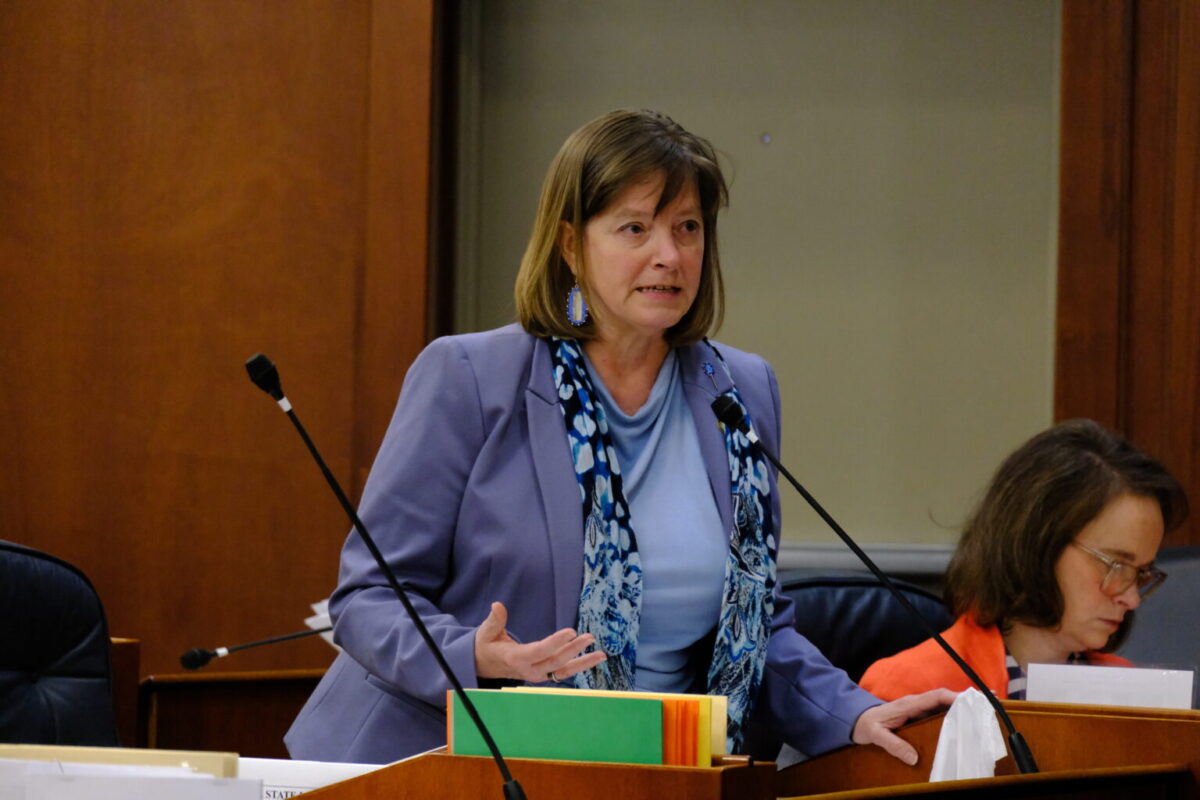
Galvin, a member of the multipartisan majority caucus, said she opposed that the measure was added to the underlying bill, but said she sees the need for more revenue. “I do think that it’s confusing when we add one bill to another, and haven’t properly vetted (it),” she said.
Galvin said she has proposed legislation, House Bill 152, which would include the corporate income tax provision, as well as a 4% state income tax on individuals earning more than $150,000 and an annual $150 tax per Alaskan to help pay for state services like education. It’s now being considered by the House Finance Committee.
“In a bill that I’m working on, I’m certainly careful to not call out one company,” she said. “But we do need to look at fairness also in all of our taxation. And I think that there is a place for us to address this.”
Galvin also requested to be excused from the vote citing a conflict of interest, but there was an objection on the House floor and she was required to vote. She told the Anchorage Daily News her husband works for Great Bear Pantheon, an Alaska subsidiary of Pantheon Resources, a Texas-based oil and gas exploration company.
Several members argued in support of strengthening corporate income taxes to provide much-needed revenues for Alaska.
Rep. Ky Holland, I-Anchorage is seen during debate on the operating budget on Apr. 13, 2026. (Photo by Corinne Smith/Alaska Beacon)
Rep. Ky Holland, I-Anchorage, supported the provision saying it was a defining moment for the Legislature to take action to address what he called the “Alaska disconnect” — being a resource rich state without capturing the economic value and benefits for residents.
“I believe this is a defining question for many of us, who I think, recognize that our state has moved past looking for the fiscal cliff and is now out beyond it,” he said. “And it’s now time for us to decide, are we willing to take some difficult votes and take some difficult action?”
Holland said failing to change the tax code could create a scenario where other businesses incorporate as S corporations or LLCs to avoid corporate income taxes. “This bill offers a way to address a point of fairness in the taxation that we have,” he said.
The amended bill now returns to the Senate, which can remove or change the provision. Those acts could result in a conference committee made up of representatives from both chambers to reach agreement on the bill.
The original legislation was introduced by the governor and passed the Alaska House last year. It would renew a three-year oil royalty agreement between the state and Marathon Petroleum Corporation, for state owned oil to be processed at its refinery in Nikiski, on the Kenai Peninsula, valued at between $4 million and $18 million in state revenue.
Several lawmakers in the House, including Kopp, said the company was no longer interested in the state contract, voiding the need for the legislation. A spokesperson for Marathon declined to comment on Wednesday, saying the company does not comment on its crude oil sourcing.
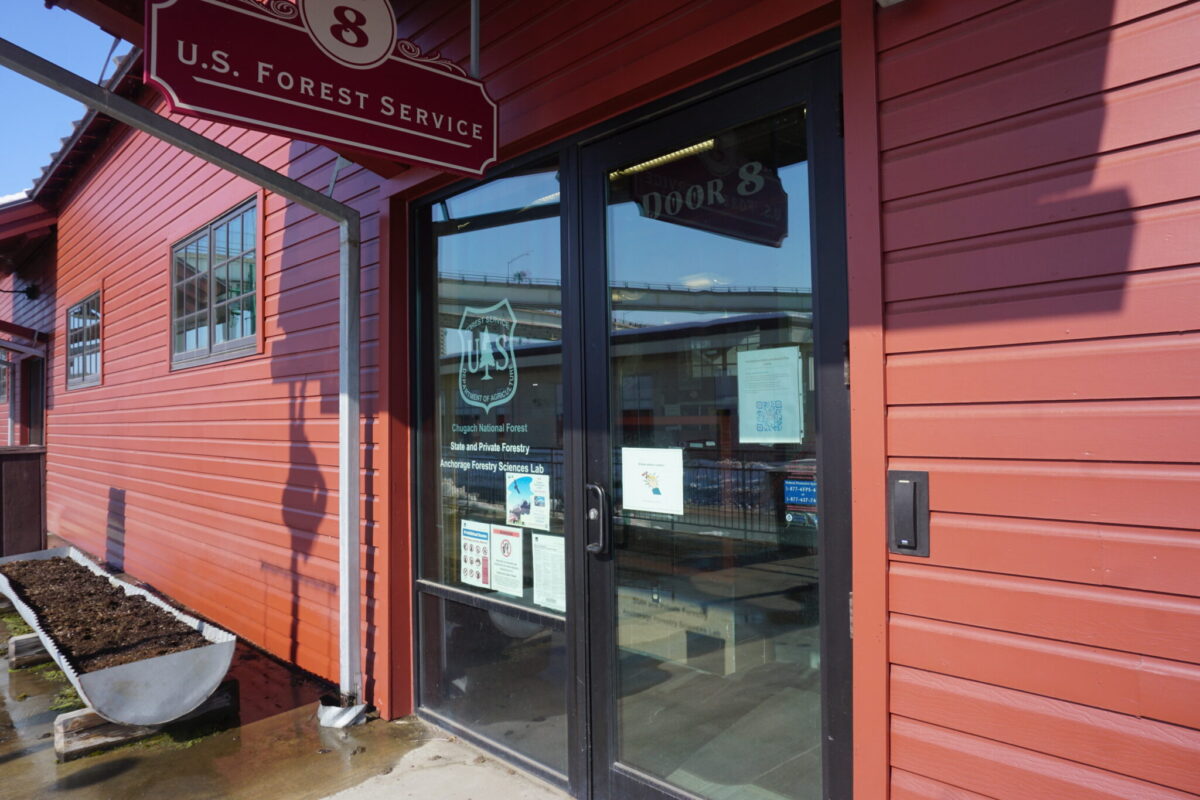
The entrance to the Anchorage Forestry Science Laboratory is seen on April 2, 2026. The lab serves state agencies, Native corporations and private industry as well as federal agencies. The lab, in Anchorage’s Ship Creek neighborhood, is on a list of U.S. Forest Service facilities that the Trump administration plans to close. (Photo by Yereth Rosen/Alaska Beacon)
Two weeks after the Trump administration announced a U.S. Forest Service “restructuring” that would close regional offices and most of the agency’s research facilities, impacts to Alaska – home to the two largest U.S. national forests – remain unclear.
The U.S. Department of Agriculture announced on March 31 that the Forest Service’s national headquarters will move to Utah and that many of its facilities will be shuttered. Among the facilities on the closure list were two that are important to Alaska: the and the Oregon-based in Portland.
But other impacts on the 17-million-acre Tongass National Forest and the 5.4-million-acre Chugach National Forest were not disclosed.
A statement from the Forest Service headquarters provided few details about the Tongass, the Chugach or the visitor and recreational facilities located in either forest.
“The transition will occur in phases. Employees will receive clear information about relocation timelines, available options, and resources to support their decisions,” the statement said. “The number of relocations beyond those already identified in the National Capital Region is unknown at this time.”
U.S. Agriculture Department Secretary Brooke Rollins, whose department oversees the Forest Service, outlined the restructuring plan last year. In a July 24, 2025, memo, she said the plan included the replacement of the Alaska regional office with “a reduced state office in Juneau.” The state capital is currently the site of the Alaska regional office managing both the Tongass and the Chugach.
Three people at Begich, Boggs Visitor Center in the Chugach National Forest look out at Portage Lake on Aug. 30, 2025. The U.S. Forest Service’s visitor center, a popular tourist destination, used to provide a close-up view of Portage Glacier’s ice. Now the glacier has retreated so much that it is around the right corner, requiring a boat ride or mountain hike to see it in summer. A bit of Burns Glacier, which has also retreated dramatically, is visible from the visitor center. (Photo by Yereth Rosen/Alaska Beacon)
Alaska has Forest Service facilities throughout the Tongass and Chugach regions, from the southern tip of the Southeast to Anchorage.
Sen. Lisa Murkowski, R-Alaska, is also trying to learn about impacts to Alaska, a spokesperson said.
The senator and her staff are in a “fact-finding” mode and preparing to mount a “defense of the Forest Service in Alaska and make sure the employees are able to continue the good work that they’re currently doing,” said Murkowski spokesperson Joe Plesha.
The issue is expected to be managed through the Congressional appropriations process, Plesha said.
Murkowski is on the Senate Appropriations Committee and chairs the appropriations subcommittee on the Department of the Interior, Environment and Related Agencies.
The Anchorage lab that is scheduled for closure is located in the Ship Creek district of downtown Anchorage. It supports research in the Tongass National Forest, which is the nation’s largest, and the Chugach National Forest, the second largest. It also supports research on forests elsewhere, from the boreal forests of Interior Alaska to those on tiny tropical Pacific islands like Guam and Micronesia.
The lab is used not just by Forest Service scientists but by other federal agencies, state agencies, Native corporations, University of Alaska researchers and private industry, according to its website.
Tourists walk to and from a viewpoint at the Mendenhall Glacier visitor center on May 14, 2025. The visitor center in the Tongass National Forest is a top tourist destination. (Photo by Yereth Rosen/Alaska Beacon)
Up to now, the lab has had a year-round staff of about 22 scientists and administrative workers, but the numbers increase during summer field seasons.
The planned closure of the century-old Pacific Northwest Research Station in Oregon is part of a consolidation of research functions into a single site in Fort Collins, Colorado.
The Pacific Northwest facility, with about 250 employees, has an affiliated lab in Juneau. The fate of the Juneau lab remains unknown.
Among the Alaska projects undertaken by the Pacific Northwest Research station, sometimes with partner organizations, is study of the decline of yellow cedar in the Tongass and adjacent regions in the southeastern part of the state; the status of birds and rare plants in the Tongass; the study of rural Alaskans’ access to wild foods in the Chugach National Forest and the surrounding region; and the monitoring of human recreation’s impacts on brown bears.
The Forest Service closure plans follow deep cuts already made by the Trump administration’s Department of Government Efficiency, or DOGE. In the first half of 2025, the Forest Service lost 5,860 of its 35,550 employees, according to a Dec. 17, 2025, report by the Agriculture Department’s inspector general.
That includes losses in Alaska. As of January, Alaska’s Forest Service workforce was down to 467 from the total of about 700 before the DOGE-imposed cuts began, KTOO reported in January.
NOTN- The City and Borough of Juneau is moving to terminate its revenue sharing agreement with Goldbelt, as discussed at a Committee of the Whole work session Monday night, over the proposed gondola project at Eaglecrest.
Mayor Beth Weldon said the Assembly’s Committee of the Whole voted to end the existing Revenue Sharing Agreement (RSA) with Goldbelt, citing mounting interest costs and concerns over the city’s fund balance.
At Monday night’s meeting City Manager Katie Koester introduced the Gondola issue, saying, “We have a 99% designed gondola, and all the parts and pieces for this mountain, and marketing that to an outside investor is certainly something that this body has expressed interest in. As a reminder repayment on May 1 is a little over $12 million. We have about $3.3 million left in the project account. However, there’s lots of moving pieces and encumbrances, and I’d like to leave at least, you know, half a million dollars in that account to cover some of those.”
“Goldbelt still wants to negotiate, but in the meantime, the revenue sharing agreement that we have keeps collecting interest, so we moved an ordinance to terminate the RSA with Goldbelt forward to the full assembly, accompanied by an appropriate ordinance for 9.5 million from fund balance and 2.7 million in the remaining gondola project. So we’re going to terminate the RSA agreement, but that doesn’t mean that we still won’t negotiate with Goldbelt or another entity to move forward.” Weldon said.
The city is advancing an ordinance to appropriate $9.5 million from its fund balance and $2.7 million from remaining gondola project funds. Those dollars would be used to satisfy the city’s obligations under the RSA.
“There was quite a bit of conversation that this will take our fund balance down considerably, but we have yet to do all of our work, and so we’re working on trying to put stuff back in the fund balance, and we have a ways to go.” She said.
The refund to Goldbelt could go out soon after the Assembly’s next regular meeting, Weldon said. “it will come in our next assembly meeting, if that passes, it will go through.” She added.
Weldon said she has already submitted budget-cutting ideas to help replenish reserves, though it will be up to the Assembly to decide what to adopt.
The gondola was one of three major financial and development topics discussed at the Assembly Committee of the Whole work session, alongside Telephone Hill development and child care funding.
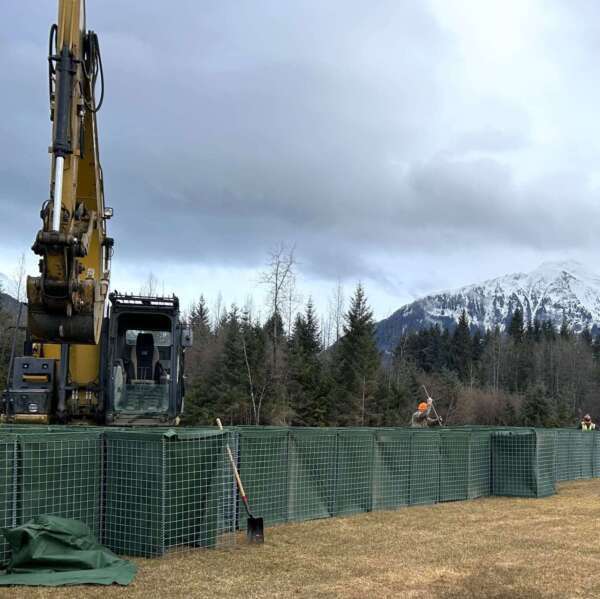
Photo provided by CBJ following the installation of the HESCO barrier project
Photo provided by CBJ following the installation of the HESCO barrier project
CBJ- As the snow melts, City and Borough of Juneau (CBJ) crews and contractors are now moving quickly to repair, raise and reconstruct the Phase 1 HESCO barrier project ahead of a 2026 glacial lake outburst flood (GLOF) event.
CBJ’s Engineering and Public Works department has spent months documenting damage, analyzing impacts and vulnerabilities, and utilizing the latest available hydrologic and hydraulic modeling to develop plans for the reconstruction of existing Phase 1 HESCO barriers. The CBJ Assembly has identified GLOF response, mitigation & preparedness as a top priority. The goal of this ongoing work, done in coordination with the U.S. Army Corps of Engineers (USACE), is to ensure that these flood fighting projects provide as much protection as practicable until a longer-term solution is in place.
The project includes additional bank armoring and raising HESCO barriers to protect Mendenhall Valley residents from future floods up to 90,000 cubic feet per second or approximately a 20-foot lake stage flood. A map showing planned reinforcements and raising of Phase 1 is available at juneau.org.
“The HESCO barriers proved their value in 2025, but we had some close calls, we’ve learned a lot, and we aren’t taking any chances in 2026,” explains CBJ City Manager, Katie Koester. “By doing this major reconstruction work in 2026, we can have confidence in the protection of the HESCO barriers against larger flood events, with less future disruption to residents and lower annual maintenance costs to the community.”
The 90,000 CFS flow rate represents a 50-year GLOF event and is the number the USACE is using in their evaluation of mid-term flood fighting solutions for Juneau. Constructing to the 50-year event now, instead of annual incremental increases, will reduce future annual costs and minimize annual disruption to property owners. The “50-year event” is a probability-based number that represents the comparatively higher likelihood that a flood of 90,000 CFS may occur. Based on projections, it is possible that the Mendenhall River could experience a 90,000 CFS (20 ft) event within the operational life of the HESCO barriers. The 2026 Phase 1 reconstruction and fortification will not impact the Local Improvement District (LID) assessments for the original Phase 1 construction. This year’s project is a separate scope that is fully funded by CBJ funding and Alaska Department of Conservation State Revolving Loan funds. CBJ and agency partners are also actively seeking grant funding to support this project.
CBJ project managers have and will continue to coordinate directly with property owners and impacted residents along the Phase 1 and Phase 2 project areas. More information about flood fighting, flood emergency preparedness and the pursuit of an enduring solution is available at bit.ly/CBJGLOF. In addition to barrier reinforcement and fortification, CBJ is making improvements to drainage and stormwater management in the area. CBJ is coordinating with USACE to acquire over 40 industrial-grade pumps to deploy to strategic staging locations based on anticipated water intrusion risks. These pumps will be deployed to serve the community as a whole rather than individual properties. Importantly, they can operate for up to 24 hours do not require refueling during an event, allowing both staff and residents to safely evacuate inundation areas.
Phase 2 HESCO Barriers USACE – Alaska District, in partnership with CBJ, began the first phases of the Phase 2 HESCO barrier project installation along the Mendenhall River last month. USACE contractor Sealaska Constructors is leading the work. The Advance Measures scope includes riverbank armoring and installation of temporary (HESCO) flood barriers to construct a fortified, complete temporary flood barrier along the unprotected, populated riverbank areas of the Mendenhall River – referred to as Phase 2 – prior to July 15, 2026. For questions about the Phase 2 HESCO Barrier Project, please contact public.affairs3@usace.army.mil.
Safety CBJ and USACE are on a tight timeline to complete construction before the next GLOF. We ask that the public avoid the construction area for your safety and the safety of workers, residents and property owners, and to allow for efficient and expedient operations.
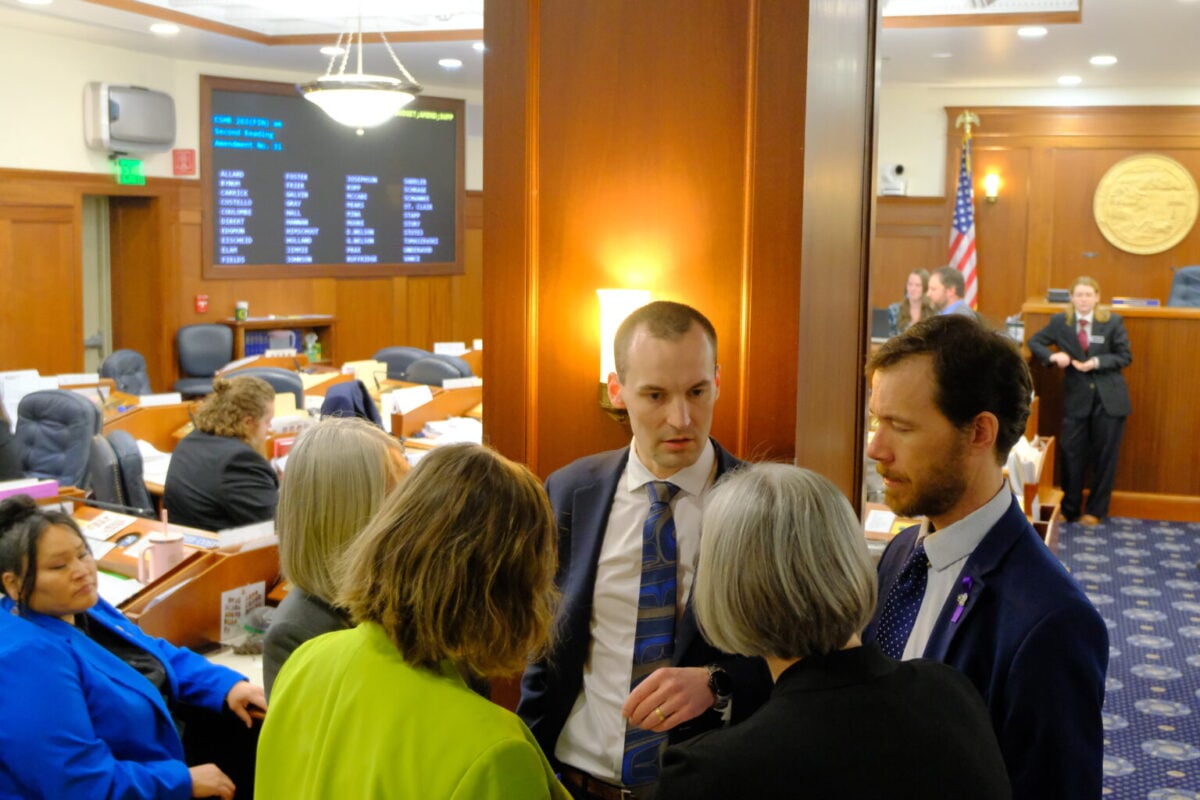
Reps. Calvin Schrage, I-Anchorage, Zack Fields, D-Anchorage huddle with members of the House majority caucus during a break in debates on the operating budget on Apr. 9, 2026. (Photo by Corinne Smith/Alaska Beacon)
The Alaska House of Representatives advanced a draft budget for the state’s operations next year, with a $1,500 Permanent Fund dividend for eligible Alaskans. It includes a nearly $158 million one-time funding boost for public schools and tens of millions for disaster relief, transportation and public assistance programs.
Members passed House Bill 263, the operating budget bill, along caucus lines by a 21 to 19 vote on Tuesday.
Lawmakers spent four days debating amendments — additions, cuts and reallocations to the draft budget — on the House floor, amid deep political divides around state priorities, war-driven oil revenues and how to balance paying for government services versus distributing cash to Alaskans through the dividend.
The draft budget now moves to the Senate for consideration, where it’s likely to be further revised.
“I feel relieved,” said Rep. Andy Josephson, D-Anchorage and co-chair of the House Finance Committee that drafted the budget, after the vote on Monday.
Rep. Andy Josephson, D-Anchorage and co-chair of the House Finance Committee which drafted the operating budget, speaks to what’s included in the budget on the House floor on Apr. 13, 2026. (Photo by Corinne Smith/Alaska Beacon)
“But the difficulty we’re in is that overall, the war in Iran, which is most unfortunate, is very helpful to budgeting,” he said. “But the Alaska people are hurting more, right, particularly when it comes to fuel prices. So that’s a problem as well.”
As Alaska has no personal income tax or state sales tax, more than 60% of funds for the general purpose budget comes from an annual draw from the Alaska Permanent Fund and roughly 30% comes from state oil revenues.
Lawmakers have been closely watching Alaska oil prices, as they surged in recent weeks due to the Trump administration’s war on Iran. State forecasters project a potential $500 million boost in state revenues next year, but lawmakers are divided on what that should mean for state spending.
The all-Republican House minority caucus advocated for putting money towards a statutory Permanent Fund dividend, but the multipartisan majority coalition pushed the balance towards spending on state services.
Members of the all-Republican minority caucus Reps. DeLena Johnson, R-Palmer, Justin Ruffridge, R-Soldotna, Dan Saddler, R-Eagle River, Frank Tomaszewski, R-Fairbanks are seen in the House during a break in the debate on the operating budget on Apr. 13, 2026. (Photo by Corinne Smith/Alaska Beacon)
The House draft operating budget made revisions to Gov. Mike Dunleavy’s proposed $7.75 billion budget unveiled in December, which included a $3,800 Permanent Fund dividend and a $1.8 billion draw from state savings.
The House draft opted not to tap into the state savings account. The House draft does include a deficit of roughly $180 million, but that total may change depending on revisions in the Senate.
Fairbanks Republican Will Stapp criticized the deficit as an “unfunded” budget. “It’s underwater,” he said Monday.
The draft budget contains increased funding across divisions: nearly $158 million in a one-time funding increase for public education, including nearly $11 million earmarked for student transportation; $33.3 million for Medicaid rate increases; nearly $55 million for fire suppression and $38 million for disaster relief; $17.5 million in heating assistance; $23 million for Alaska Department of Corrections staffing and tens of millions in transportation, public assistance programs like child care, infant learning programs, senior services, public health and public safety grants, among others.
House lawmakers rejected a roughly $3,800 Permanent Fund dividend proposed by the House Finance committee, which would have cost nearly $2.5 billion and was contingent on a draw from state savings, which requires approval of three-quarters of lawmakers.
House lawmakers instead approved a $1,500 Permanent Fund dividend that will cost the state $992 million.
Members of the multi-partisan House majority caucus expressed support for the draft budget that focused on public programs and services to enhance future benefits.
“Education, child care, parents-as-teachers, Head Start — moving upstream to try and give our youngest, our most precious resource in the state of Alaska, the best start that we can give them,” said Rep. Calvin Schrage, I-Anchorage, acknowledging that it is a balancing act for lawmakers.
Republican minority legislators also proposed spending increases, which included $2 million for the Alaska Department of Public Safety to establish a new Trooper post in Talkeetna, and $2 million for a sport fish hatchery in Fairbanks. Both failed along caucus lines by a 21 to 19 vote.
Minority Leader Rep. DeLena Johnson, R-Palmer, criticized the House draft budget in a statement following its initial approval on Monday.
House Minority Leader Rep. DeLena Johnson, R-Palmer, speaks on the House floor on Apr. 13, 2026. (Photo by Corinne Smith/Alaska Beacon)
“The budget passed by the Majority is a betrayal of the Alaskans we were sent here to represent,” said Johnson. “While Alaskans face one of the most unaffordable years of their lifetimes, this Majority has chosen to fund government agencies at record levels, while leaving families and communities behind.”
Minority lawmakers introduced nearly 50 amendments on the House floor over three days, which varied from cutting additional funding for education, funds for teacher recruitment and for community and regional jails, to cutting travel budgets and reallocating public employee salaries for vacant positions to add funding for school maintenance. Most of them failed along caucus lines.
The minority’s most strident call was for a maximum Permanent fund dividend.
“The removal of the statutory dividend that equates to removing $42.5 million dollars from the economy of my district,” said Rep. Sara Vance, R-Homer.
While lawmakers refer to the statutory dividend of roughly $3,800 per Alaskan, in 2017 the Alaska Supreme Court ruled lawmakers may ignore the formula since it’s not in the state Constitution. Since then, legislators have typically reduced the dividend to balance state expenses and avoid drawing from savings.
Boost to education funding
The House draft adds $158 million in one-time funding for Alaska schools, equivalent to an additional $630 per student.
That’s in the case that various education bills that provide a sustained increase to per student funding, through state’s formula boosting the base student allocation, fail to pass this year. Those bills are currently under consideration in education committees.
Lawmakers said they decided on the additional $630 per student after assessing the current deficits of the five largest school districts by student population. Many districts are grappling with decisions on school closures, staff cuts and increasing class sizes to address large budget shortfalls this month — including the potential closure of three schools in Anchorage, three schools in the Matanuska Susitna Borough, four schools on the Kenai Peninsula and two of the four elementary schools in Ketchikan.
Josephson said one-time funding this year for schools seems to be more viable than an attempt to permanently raise the per student funding formula, given the governor’s history of vetoing education funding increases — including three vetoes last year alone, one which the Legislature overrode in a special session last August.
Members of the House majority huddle with staff members in deliberations on the operating budget on Apr. 9, 2026. (Photo by Corinne Smith/Alaska Beacon)
“It’s far from a panacea, right? It’s far from anything that is the real solution. But I think if superintendents had it, they’d be delighted to have it,” he said.
Members of the House approved an amendment to earmark $10.9 million of that $158 million for school districts’ transportation for students, to help offset rising costs due to a war-driven rise in fuel prices.
Representatives from Northwest and Western Alaska objected to the transportation earmark, saying they were unsure if the funding would be allowed for student flights in their rural districts, which are off the road system. Rep. Jeremy Bynum, R-Ketchikan, sponsored the amendment, and said all districts would be eligible for their transportation of students, whether by road, air or ferry. It was approved by a 33 to 7 vote.
Lawmakers also debated earmarking an additional $10 million from the remaining one-time education funding for career and technical education grants for school districts, but the proposal narrowly failed by a 20 to 20 vote.
With a little over a month left in the legislative session, the House draft budget now goes to the Senate for consideration and likely further revisions.
On Monday, the Senate Finance Committee introduced a draft capital budget, a proposed $247 million for state facilities maintenance and construction projects, including for deferred maintenance of schools. The draft will go to the House for consideration in the coming weeks.
The legislative session is set to conclude on May 20.
House Minority Leader Rep. DeLena Johnson, R-Palmer discusses procedure with House Speaker Rep. Bryce Edgmon, I-Dillingham and House clerks during debate on the operating budget on Apr. 13, 2026. (Photo by Corinne Smith/Alaska Beacon)
Correction: A previous version of this story incorrectly stated the governor’s budget proposal, it was $7.75 billion not million.
People shop for groceries at a Walmart store in Ohio. New research suggests SNAP work requirements won’t enhance employment and will push more people off of food assistance. (Photo by Marty Schladen/Ohio Capital Journal)
As states enact stricter work requirements for the federal food stamp program, a new analysis suggests those requirements won’t enhance employment and will push more people off of food assistance.
The researchers conducted a review of studies on work requirements and concluded that “the best evidence shows they do not increase employment. Moreover, this research finds work requirements cause a large decrease in participation in SNAP.”
The research from The Hamilton Project, an economic policy initiative at the left-leaning Brookings Institution, comes at a time of major upheaval for the Supplemental Nutrition Assistance Program, or SNAP. Participation is already declining as states implement changes mandated by the president’s major tax and domestic policy law enacted last summer.
Since the fall, states and counties that administer SNAP have been notifying residents who rely on food stamps that they must meet work requirements or lose their food assistance. Those changes affected exemptions to work requirements for older adults, homeless people, veterans and some rural residents, among others.
Known as the One Big Beautiful Bill Act, the law mandated cuts to social service programs, including Medicaid and food stamps.
While SNAP enrollment is declining nationally, more people will likely lose food assistance as states continue to implement the work requirements and recertify participants, said Lauren Bauer, a fellow in economic studies at Brookings Institution and the associate director of The Hamilton Project.
“Everything that we know about work requirements is that they do not increase employment among the groups that are subject to them,” she told Stateline. “All they do is make it more likely that they are disenrolled from the program. And so, should these work requirements continue to be rolled out and implemented, we would expect to see declining enrollment and no changes in employment.”
Bauer said the growing body of research on SNAP has changed her mind about its ability to affect employment. While food stamps reach millions of people each year, the program’s work requirements have proven ineffective, confusing and burdensome, she said.
“I am now of the mind that SNAP should be an anti-hunger program, and there are many, many ways to do workforce development, career ladders, career training, job search — all of those things. That’s not an anti hunger program and it shouldn’t be associated with it.”
What’s more concerning to her is how the stricter work requirements will affect people who lose jobs in an economic downturn. Traditionally, SNAP has been one of the most effective social supports for the unemployed, helping people who lose their jobs quickly gain food assistance. But laid-off workers will increasingly be told they cannot receive benefits without working.
“It’s just this dissonant, unhelpful interaction that you have with the government,” Bauer said. “I lost my job, I need food benefits. Well, you can only get food benefits if you have a job.”
At least 2.5 million low-income people, or 6% of those enrolled, have lost SNAP benefits since the legislation was signed into law, according to a study by the left-leaning Center on Budget and Policy Priorities published Wednesday.
Bauer said it’s unclear how much of that decline is directly related to the federal legislation. That’s because SNAP participation generally declines during times of economic prosperity and increases during downturns.
But the program is facing unprecedented changes: Under the new law, states have also lost funding for nutrition education programs, must end eligibility for noncitizens such as refugees and asylees, and will lose work requirement waivers for those living in areas with limited employment opportunities. States are also forced to cover more of the costs of the program.
Earlier this week, a USDA spokesperson applauded the drop in SNAP participation, noting the program’s rolls had fallen below 40 million for the first time since the pandemic. The spokesperson told States Newsroom the program would continue “to serve those with the greatest need while also strengthening program integrity.”
Republicans, including U.S. House Speaker Mike Johnson of Louisiana, have defended the legislative changes to SNAP, arguing they will help eliminate waste and fraud in the program.
In a June news release, he characterized SNAP as a “bloated, inefficient program,” but said Americans who needed food assistance would still receive it.
“Republicans are proud to defend commonsense welfare reform, fiscal sanity, and the dignity of work,” Johnson said in the release.
This story was originally produced by Stateline, which is part of States Newsroom, a nonprofit news network which includes Alaska Beacon, and is supported by grants and a coalition of donors as a 501c(3) public charity.
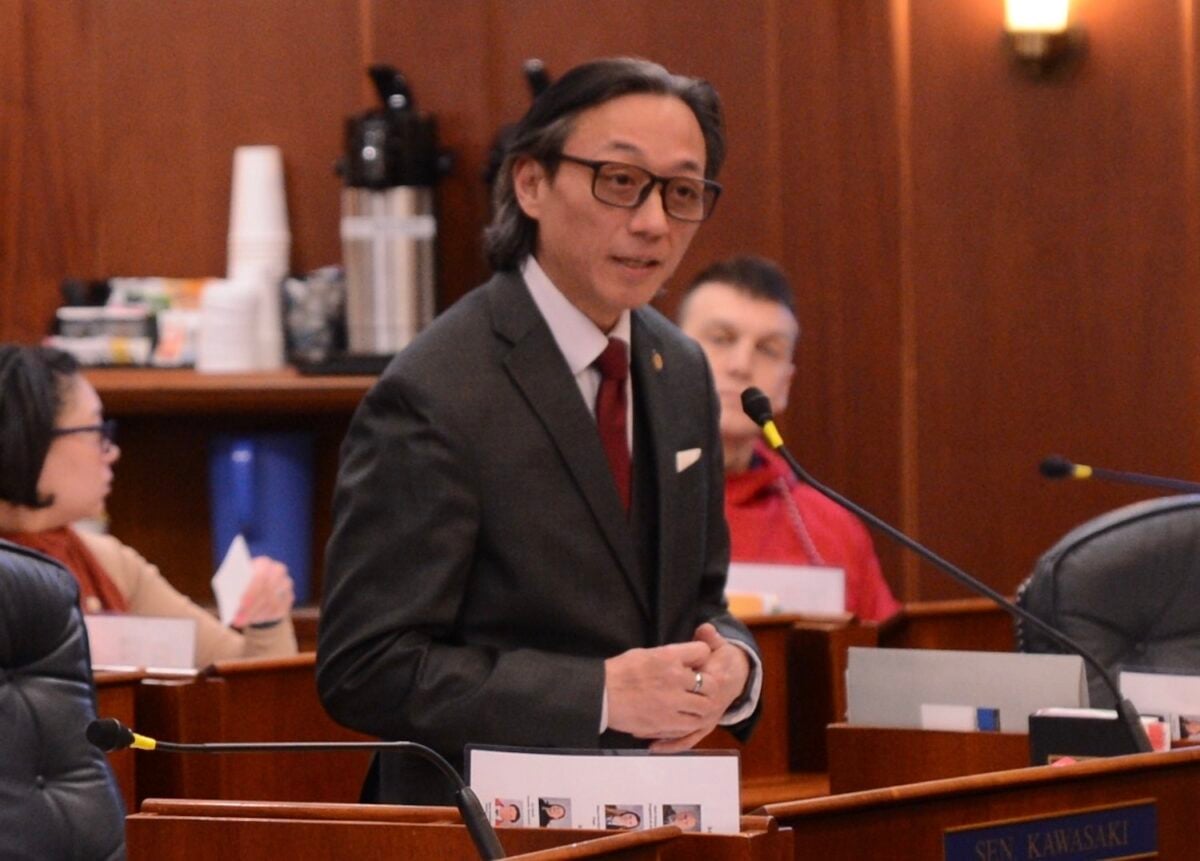
Sen. Scott Kawasaki, D-Fairbanks, speaks Friday, Feb. 7, 2025, on the floor of the Alaska Senate. (Photo by James Brooks/Alaska Beacon)
By: Haley Lehman, Alaska Beacon
Sen. Scott Kawasaki, D-Fairbanks, speaks Friday, Feb. 7, 2025, on the floor of the Alaska Senate. (Photo by James Brooks/Alaska Beacon)
The Alaska Senate unanimously passed a bill Monday that would grant back Permanent Fund dividends to Alaskans whose convictions are vacated, reversed or dismissed.
Under current Alaska law, people who were sentenced or incarcerated as a result of a felony conviction or certain combinations of multiple misdemeanors forfeit their dividends that year and any following years of incarceration. An amount equivalent to the incarcerated person’s dividend is deposited into a restorative justice account.
Sen. Scott Kawasaki, D-Fairbanks, the sponsor of Senate Bill 167, said Monday, “The state has a duty and obligation to rectify harm done to those who might have been wrongfully convicted and to those who have been exonerated of a crime.”
The bill would grant past dividends to people whose charges were later dismissed or if their conviction was vacated, their case was retried and they were acquitted. Individuals who qualify would have one year after their charges were reversed or dismissed to apply. Individuals whose charges were dropped as part of a plea agreement in another criminal case would not qualify for back payment of dividends.
When Kawasaki served in the House of Representatives, he sponsored a similar bill in 2017 that passed in that chamber 38-1.
Kawasaki told the Senate that this change would impact “very few people annually,” and would provide a “modest, essential source of income.”
The Department of Revenue was not able to determine the fiscal impact of the proposed legislation since the Permanent Fund Dividend Division does not know how many Alaskans with past vacated sentences will apply for a past year’s dividends. Funding for past PFDs comes from a reserve for prior years’ dividends in the budget.
The bill received support from Tanana Chiefs Conference and the nonprofit After Innocence.
Kawasaki estimated last year that Marvin Roberts, Eugene Vent, George Frese and Kevin Pease, known as the Fairbanks Four, would receive approximately $103,450 in back PFDs after they were wrongfully incarcerated in connection with the 1997 death of John Hartman.