Categories
Alaska News Featured Juneau News juneau Juneau Local Juneau Local Ketchikan Local News Feeds Sitka Local

In Alaska Legislature’s last days, a key question: How much to subsidize the gas pipeline?

By: James Brooks, Alaska Beacon

Gov. Mike Dunleavy speaks about at a May 4, 2026, news conference about his property tax bill intended to help draw investment in a massive natural gas pipeline. The news conference was held in his Anchorage office. (Photo by Yereth Rosen/Alaska Beacon)

Alaska Gov. Mike Dunleavy is urging state lawmakers to act on his proposal to cut state taxes by $7.2 billion over the next 36 years to subsidize construction of the proposed trans-Alaska natural gas pipeline.

Failing to act, he said, could keep the pipeline from being built at all. 

“This bill is too important. This concept is too important,” Dunleavy said. “This is not setting up a tax for the lemonade stand down here in the corner by the hot dog stand. This is the biggest (natural gas) project on the planet.”

But some state lawmakers are skeptical about the size of the governor’s proposed subsidy. Two alternatives — one in the House and the other in the Senate — are advancing through committees in the final weeks of the session.

Other legislators believe the pipeline already makes financial sense and no change is needed.

As a result, four different paths await state legislators in their last weeks, and it isn’t clear which one they’ll take — or whether the governor will call legislators into special session on the issue.

There’s also been no agreement with cities and boroughs affected by the proposed tax cut. There’s also no public agreement with North Slope gas producers or the state’s labor unions.

At the core of the problem facing lawmakers is how much — if any — subsidy is needed in order to attract investors who would pay for building the pipeline project in two stages. 

The first stage would involve a pipeline from the North Slope to Cook Inlet for in-state use. The second stage would construct processing plants at the north and south ends of the pipeline, allowing larger volumes of gas to be exported overseas.

If both phases of the project are built, Department of Revenue economist Dan Stickel told legislators on Tuesday, the result would be cheaper natural gas than currently available from Cook Inlet.

“If the full project goes forward, it’s a significant reduction in cost to Alaskans,” he said.

Rep. Zack Fields, D-Anchorage, noted that Alaskans could be locked into high natural gas prices if the second phase is never built or if both phases are built but no exports take place.

For a hearing last week, the Department of Revenue estimated that under that scenario, prices in Anchorage would exceed $27 per thousand cubic feet by 2033, more than double current prices.

It’s unclear how likely that worst-case scenario is.

The larger the subsidy, the greater the chance that the project is built in full and the lower the price of gas for Alaskans, project proponents say.

“Our objective is to have the lowest cost gas for Alaskans and have certainty on the project,” said Adam Prestidge, president of Glenfarne Alaska, the project’s developer.  

A problem, some legislators say, is that they’re working without information. Glenfarne, an international firm that last year bought 75% of the project and became its developer, has not shared its latest estimate for how much the pipeline will cost.

“I think it’s important for us to have starting points on what the actual numbers are, because if it needs tax relief, let’s figure out what the relief is,” said Sen. Bill Wielechowski, D-Anchorage.

Legislators also don’t know how much North Slope gas producers will charge for the gas, or what international buyers will pay for it. 

Some of that information is impossible to know — legislators are trying to anticipate the price of natural gas in 2033 and beyond, once the pipeline is up and running. 

Other information is being kept confidential until a final investment decision or when proposed prices are submitted to state regulators, something that’s months away at the earliest.

Legislators are being asked to take action within weeks.

“We’re not really competitive in the global market if the (cost) overrun is 40%,” said Rep. Julie Coulombe, R-Anchorage, on Tuesday.

The gas pipeline’s publicly stated cost on Tuesday was $46 billion, but most legislators believe the true figure is higher.

“I think it’s really $57 billion … if not higher,” said Sen. Bill Wielechowski, D-Anchorage, relying on a prior statement from former U.S. Sen. Mark Begich.

Begich, a Democrat, lost to Gov. Mike Dunleavy in the 2018 governor’s election. Now, Begich is a paid adviser, hired by Dunleavy’s administration on a $100,000 contract.

In a Tuesday hearing, Begich said lower taxes would not increase profits for investors or developers and would simply lower the end cost of gas for consumers.

“If you lower the tax, it does not go to the return or the profit or anything of this project,” he said. 

“I am just telling you right now, every dollar you save consumers is a dollar in their pocket in an economy that is struggling,” Begich said.

Under his calculations, Wielechowski said, the average Southcentral Alaska family would save $55 per year if the pipeline is built and produces gas according to the latest available cost analysis from the Department of Revenue. 

The subsidy needed to create that savings amounts to a loss of $500 per Alaskan per year, he said, money that could be used for the Permanent Fund dividend or state services.

“That’s not a good deal,” he said of the exchange.

The latest available version of the Senate proposal shows an increase in revenue to the state, rather than a subsidy. Instead of earning $27.9 billion through 2062, the state would earn $42.1 billion.

“I would describe that as very burdensome for the project and potentially prohibitively so,” Prestidge said. 

“I will characterize that tax at that level as something that would require some real reconsideration of the drawing board of how the project is structured and taken forward,” he said.

In the House, discussions have been less acrimonious. The House Resources Committee on Tuesday morning discussed a proposed a subsidy of less than $5.9 billion, smaller than the governor’s concept but similar in other regards. 

“It would be a tax reduction but a smaller tax reduction than proposed by the governor,” Stickel said of the House proposal.

On Tuesday afternoon, the committee worked methodically through a long series of amendments to its plan, frequently consulting Prestidge and Begich about how each might affect financial negotiations.

The House and Senate bills are each in an early stage of development. If passed by the resources committees, each would have to pass through their respective finance committee before advancing to a floor vote and on to the other half of the Legislature.

Categories
Alaska News

In Alaska Legislature’s last days, a key question: How much to subsidize the gas pipeline?

Gov. Mike Dunleavy speaks about at a May 4, 2026, news conference about his property tax bill intended to help draw investment in a massive natural gas pipeline. The news conference was held in his Anchorage office. (Photo by Yereth Rosen/Alaska Beacon)

Gov. Mike Dunleavy speaks about at a May 4, 2026, news conference about his property tax bill intended to help draw investment in a massive natural gas pipeline. The news conference was held in his Anchorage office. (Photo by Yereth Rosen/Alaska Beacon)

Alaska Gov. Mike Dunleavy is urging state lawmakers to act on his proposal to cut state taxes by $7.2 billion over the next 36 years to subsidize construction of the proposed trans-Alaska natural gas pipeline.

Failing to act, he said, could keep the pipeline from being built at all. 

“This bill is too important. This concept is too important,” Dunleavy said. “This is not setting up a tax for the lemonade stand down here in the corner by the hot dog stand. This is the biggest (natural gas) project on the planet.”

But some state lawmakers are skeptical about the size of the governor’s proposed subsidy. Two alternatives — one in the House and the other in the Senate — are advancing through committees in the final weeks of the session.

Other legislators believe the pipeline already makes financial sense and no change is needed.

As a result, four different paths await state legislators in their last weeks, and it isn’t clear which one they’ll take — or whether the governor will call legislators into special session on the issue.

There’s also been no agreement with cities and boroughs affected by the proposed tax cut. There’s also no public agreement with North Slope gas producers or the state’s labor unions.

At the core of the problem facing lawmakers is how much — if any — subsidy is needed in order to attract investors who would pay for building the pipeline project in two stages. 

The first stage would involve a pipeline from the North Slope to Cook Inlet for in-state use. The second stage would construct processing plants at the north and south ends of the pipeline, allowing larger volumes of gas to be exported overseas.

If both phases of the project are built, Department of Revenue economist Dan Stickel told legislators on Tuesday, the result would be cheaper natural gas than currently available from Cook Inlet.

“If the full project goes forward, it’s a significant reduction in cost to Alaskans,” he said.

Rep. Zack Fields, D-Anchorage, noted that Alaskans could be locked into high natural gas prices if the second phase is never built or if both phases are built but no exports take place.

For a hearing last week, the Department of Revenue estimated that under that scenario, prices in Anchorage would exceed $27 per thousand cubic feet by 2033, more than double current prices.

It’s unclear how likely that worst-case scenario is.

The larger the subsidy, the greater the chance that the project is built in full and the lower the price of gas for Alaskans, project proponents say.

“Our objective is to have the lowest cost gas for Alaskans and have certainty on the project,” said Adam Prestidge, president of Glenfarne Alaska, the project’s developer.  

A problem, some legislators say, is that they’re working without information. Glenfarne, an international firm that last year bought 75% of the project and became its developer, has not shared its latest estimate for how much the pipeline will cost.

“I think it’s important for us to have starting points on what the actual numbers are, because if it needs tax relief, let’s figure out what the relief is,” said Sen. Bill Wielechowski, D-Anchorage.

Legislators also don’t know how much North Slope gas producers will charge for the gas, or what international buyers will pay for it. 

Some of that information is impossible to know — legislators are trying to anticipate the price of natural gas in 2033 and beyond, once the pipeline is up and running. 

Other information is being kept confidential until a final investment decision or when proposed prices are submitted to state regulators, something that’s months away at the earliest.

Legislators are being asked to take action within weeks.

“We’re not really competitive in the global market if the (cost) overrun is 40%,” said Rep. Julie Coulombe, R-Anchorage, on Tuesday.

The gas pipeline’s publicly stated cost on Tuesday was $46 billion, but most legislators believe the true figure is higher.

“I think it’s really $57 billion … if not higher,” said Sen. Bill Wielechowski, D-Anchorage, relying on a prior statement from former U.S. Sen. Mark Begich.

Begich, a Democrat, lost to Gov. Mike Dunleavy in the 2018 governor’s election. Now, Begich is a paid adviser, hired by Dunleavy’s administration on a $100,000 contract.

In a Tuesday hearing, Begich said lower taxes would not increase profits for investors or developers and would simply lower the end cost of gas for consumers.

“If you lower the tax, it does not go to the return or the profit or anything of this project,” he said. 

“I am just telling you right now, every dollar you save consumers is a dollar in their pocket in an economy that is struggling,” Begich said.

Under his calculations, Wielechowski said, the average Southcentral Alaska family would save $55 per year if the pipeline is built and produces gas according to the latest available cost analysis from the Department of Revenue. 

The subsidy needed to create that savings amounts to a loss of $500 per Alaskan per year, he said, money that could be used for the Permanent Fund dividend or state services.

“That’s not a good deal,” he said of the exchange.

The latest available version of the Senate proposal shows an increase in revenue to the state, rather than a subsidy. Instead of earning $27.9 billion through 2062, the state would earn $42.1 billion.

“I would describe that as very burdensome for the project and potentially prohibitively so,” Prestidge said. 

“I will characterize that tax at that level as something that would require some real reconsideration of the drawing board of how the project is structured and taken forward,” he said.

In the House, discussions have been less acrimonious. The House Resources Committee on Tuesday morning discussed a proposed a subsidy of less than $5.9 billion, smaller than the governor’s concept but similar in other regards. 

“It would be a tax reduction but a smaller tax reduction than proposed by the governor,” Stickel said of the House proposal.

On Tuesday afternoon, the committee worked methodically through a long series of amendments to its plan, frequently consulting Prestidge and Begich about how each might affect financial negotiations.

The House and Senate bills are each in an early stage of development. If passed by the resources committees, each would have to pass through their respective finance committee before advancing to a floor vote and on to the other half of the Legislature.

SUPPORT: YOU MAKE OUR WORK POSSIBLE

Categories
Alaska News

Alaska school district considers allowing teachers and staff to carry handguns at work

Matanuska-Susitna Borough Administration Building in Palmer (Photo by Amy Bushatz/Mat-Su Sentinel)

Matanuska-Susitna Borough Administration Building in Palmer (Photo by Amy Bushatz/Mat-Su Sentinel)

The Matanuska-Susitna Borough School District is scheduled to consider a proposal that would pay teachers, staff and contractors to carry handguns at schools in the borough.

The move, billed as a security measure, would be the first of its kind by a school district in Alaska. 

Current state law forbids anyone from carrying a concealed firearm on school grounds without the permission of a district’s chief administrative officer.

Board Policy 3515, as the concept is formally known, would set up a formalized policy for the Mat-Su school district’s superintendent to grant that permission. It is scheduled for initial discussion Wednesday evening. No vote is expected. 

As written, the draft policy proposes that the district will pay a stipend to “certain qualified individuals to carry a concealed handgun (including other authorized non-lethal security device) on school property in accordance with the provisions of this policy.”

The draft goes on to state that “participating authorized individuals will receive a stipend for this additional duty.” 

It does not state how much the district will pay participants, but that the stipend is expected to cover mandatory training and not a handgun, holster or ammunition.

The proposal is similar to a bill proposed by former Sen. Shelley Hughes, R-Palmer, last year. That legislation did not advance, and Hughes has since resigned from the Legislature to run for governor.

If adopted as written, interested staff would be required to undergo safety training, a physical, a psychological evaluation and random drug and alcohol screening.

“This policy change is driven first and foremost by a commitment to student and staff safety,” the district said in a description of the proposed policy. 

The Mat-Su school district covers an area the size of West Virginia. North of Anchorage, it is the state’s second-largest, with 19,518 students in the 2024-2025 school year, according to state figures.

“In many of our schools, particularly those in geographically large or remote areas, immediate access to law enforcement may be limited. This policy recognizes that reality and seeks to responsibly bridge that gap in emergency response time,” the description states.

Under the text of the policy, the list of employees approved to carry handguns will be kept secret.

“Any employee who discloses the identity of an authorized individual — except as permitted by this policy or as required by law — may be subject to disciplinary action, up to and including Termination,” the policy states.

SUBSCRIBE: GET THE MORNING HEADLINES DELIVERED TO YOUR INBOX

Categories
Alaska News

Columbia delayed two more weeks coming back to work

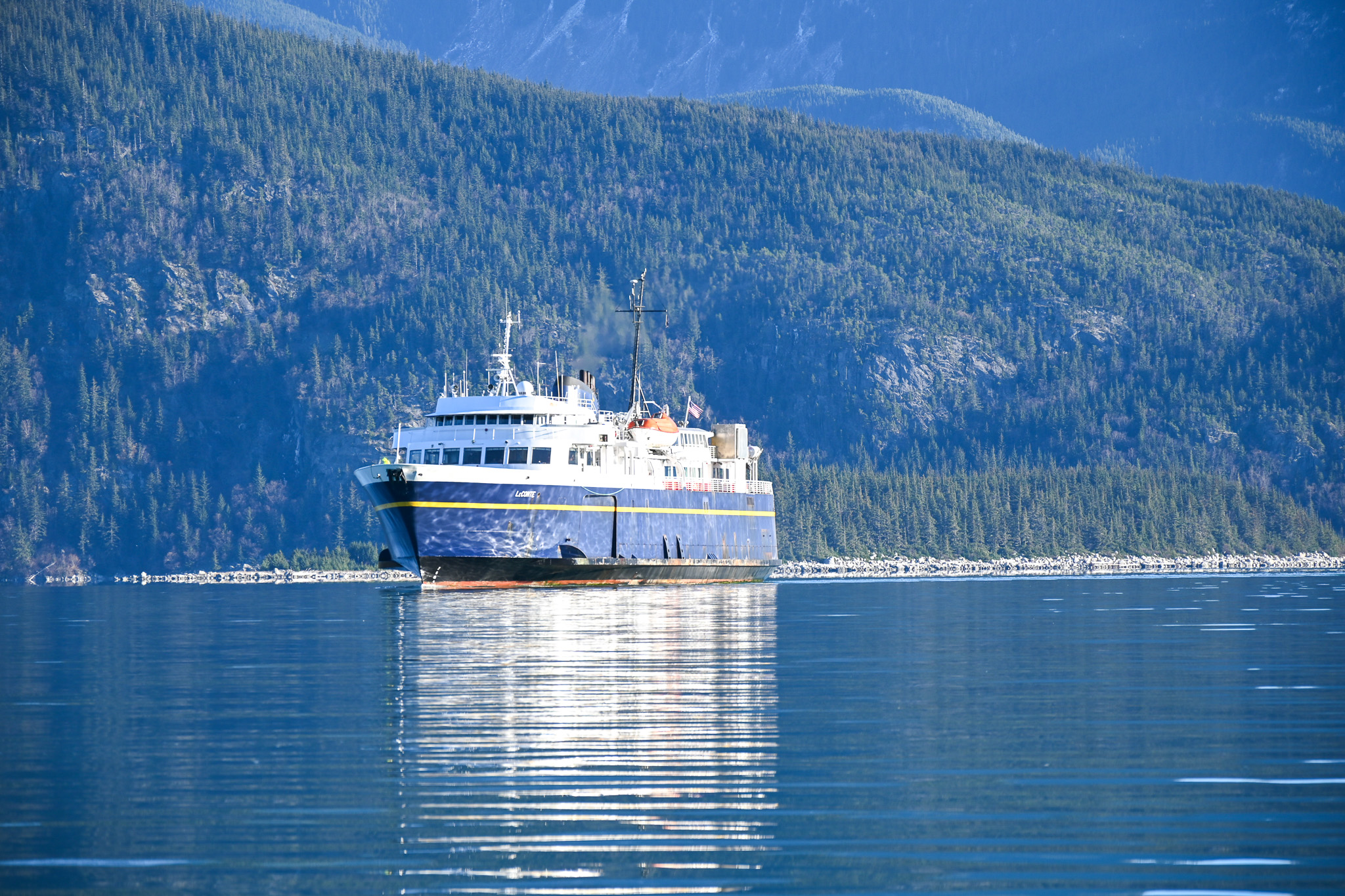
The state ferry Columbia, the largest vessel in the fleet, has been delayed a second time coming back to work on the busy summer route between Bellingham, Washington, and Southeast Alaska.

The ship is now scheduled to make its first northbound run from Bellingham on June 5, according to the Alaska Marine Highway System’s online reservations site.

The state will keep the Kennicott on the route until the Columbia is ready to go back into service.

When the Columbia returns, the Kennicott will tie up at the dock in Ketchikan. The Marine Highway System — for the fourth year in a row — says it lacks enough crew to run both vessels during the busy summer season.

As of May 4, the online reservations system showed no availability on the Columbia until the July 24 northbound sailing for a traveler who wanted to take their car or truck or RV from Bellingham to Wrangell.

The Columbia, which has served the popular route since going into service in 1973, has about twice the vehicle deck space as the smaller Kennicott.

In November, the Columbia went into the shipyard in Ketchikan for winter layup and annual maintenance. It originally had been expected back on the route May 6. That date was first pushed back to May 20.

The latest delay to June 5 is due to a couple of reasons, said Gabe Strong, public information officer for the Alaska Marine Highway System.

“The dry docking of the Columbia was delayed because the Lituya had to have the bow repaired. … The Lituya took the Columbia’s scheduled dry dock time and that set the Columbia work back a couple weeks,” Strong said in an email on April 30.

“Luckily, we had the Kennicott available to take over the mainline run for the Columbia.”

The Lituya, which shuttles between Ketchikan and Metlakatla, was damaged when it ran aground after leaving the Metlakatla dock in late December 2025 and spent much of March at the Ketchikan shipyard for repairs.

In addition to losing time in the dry dock, the other reason for the Columbia’s delayed return to service was mechanical.

“During the Columbia bow thruster overhaul, it was discovered that the shaft that drives the turbine had saltwater intrusion, so the shaft was sent south to get flame-sprayed and re-machined,” Strong said.

A single turbine powers the bow thruster, which aids in the ship’s maneuverability. “It’s an omni-thruster that sucks water in from the sides and shoots it out the displacer plate on the keel of the vessel,” he explained.

The post Columbia delayed two more weeks coming back to work appeared first on Chilkat Valley News.

Categories
Alaska News

33-Mile Roadhouse closed

Another Chilkat Valley restaurant has closed. 

The 33-Mile Roadhouse has not opened to the public for several days and now has one sign on the front reading “Closed” and another reading “For Sale.”

Reached in person Monday, Roadhouse owner Robert Harris said he wasn’t interested in talking about the circumstances around the closure and that the signs speak for themselves. 

Harris took over the popular upper valley restaurant and gas station in 2011, after he purchased it from Kathi and Jerry Lapp. 

He owns the nearly eight acres of parcels around the roadhouse, which included a home behind it, and four cabins.

His is the second restaurant to close in just over a month. Alpenglow Woodfired Pizza announced its closure at the end of March after lease negotiations collapsed. 

The post 33-Mile Roadhouse closed appeared first on Chilkat Valley News.

Categories
Alaska News

Haines receives offer from world’s largest cruise port operator

The Bahamas, Saint Lucia, Cabo Verde, Casablanca, and now, maybe, Haines? The world’s largest cruise port operator wants to lease Haines’ Port Chilkoot dock and add it to a portfolio of global holdings. 

Haines Borough officials said last week they had been approached by representatives from Global Ports Holding, a Turkey-based company, that reported hosting 17.6 million passengers at its more than 30 global cruise ports last year.

Former Skagway mayor Andrew Cremata, acting as a paid representative of the company, first broached the possible dock lease last fall, according to multiple borough officials. Cremata did not respond this week to a request for comment. 

Borough manager Alekka Fullerton said she met late last month with Cremata and Colin Murphy, Global Ports Holding’s regional head of business development. Murphy this week did not comment on the potential deal. 

Exact lease details were not discussed during that meeting, Fullerton said, but she and the assembly intend to hold a public meeting later this month.Theoretically, the company would present more information to residents at that meeting.

Based on the company’s other dealings, it’s likely the borough would see two major impacts from a lease: more cruise ship passengers and more borough revenue.  

The company’s nearest port is in Prince Rupert, British Columbia, where it signed a long-term lease in 2022. That deal followed a failed bid to lease Ketchikan’s municipal cruise dock in 2020. 

Under the Ketchikan proposal, the company would have taken on control, management, and maintenance of the facility. 

The twenty and thirty year leases on the table offered large sums of money to Ketchikan: at least according to the company’s pitch, compensation to the city could have totaled $140-212 million over the length of the lease. Ketchikan’s city council ended up voting down the lease, 4-3, maintaining the dock’s public ownership.

There are other considerations, too, besides just the total amount of compensation. 

With public ownership, Ketchikan was charging cruise lines a per-passenger berth tax, bringing revenue into city coffers. Haines currently does the same, with fees at the Port Chilkoot Dock expected to bring in $818,500 this year. 

Federal law requires those revenues be spent on cruise-ship related improvements, and Haines’ revenue is restricted to a fund that only spends on the dock itself. 

During its 2020 negotiations with Ketchikan, Global Ports Holding argued that if it collected those fees and then shared them with the municipality, those funds could be freed up to use for any purpose. 

The additional millions for Ketchikan likely would have been fueled by an increase in total visitors. 

According to Global Ports Holding’s annual report from 2025, passenger volume “underpins, directly or indirectly, most of our revenue and is the key to successfully delivering organic growth.” 

Despite being a global behemoth, the company isn’t on the public-facing side of things; it has a grand total of one google review — a one star review from a Spanish user — which reads “Worst company to work with, go away! Run!”

Rather, the company’s dealings would likely be with the cruise lines themselves, advocating for Haines as a more frequent destination. 

“They can grow the cruise ship industry here, with their connections, in a way I can’t do,” said Haines tourism director Rebecca Hylton. 

The annual report talks about big picture dealings — “the global cruise ship order book,” for instance — as determinants of which ships go where. Getting into that game, Hylton said, would require the borough government take on duties like sending staff to Miami. 

Whether residents want more cruise ship volume is an open-ended question. A 2025 survey found a majority of Haines residents supported cruise ship volume holding steady, or increasing slightly. Only 16% of respondents preferred a “much higher” amount of cruise ship business. There was, however, a spread of opinions, including a higher rate of support for the cruise industry among younger survey respondents. 

Haines currently lags well behind its nearest neighbors, Juneau and Skagway, in terms of cruise business. Some see a larger cruise industry as a potential boon for the local economy.

Right now, it’s difficult for local tour operators to run a business solely on cruise ship passengers docking in Haines, said Barbara Nettleton, owner of tour-company Takshanuk Mountain Trail. 

Now, Nettleton’s business relies heavily on the Haines-Skagway fast ferry, which delivers a predictable stream of customers to Haines from Skagway cruise dockings. But in the past, when Nettleton was targeting Haines cruise and independent travelers, the flow of customers wasn’t reliable enough to hire staff. 

“Last year we decided to go back into the Skagway market, and now we have crew that have complete weekly schedules,” she said. “If we had ships regularly calling into Haines, it would be easier to hire appropriately. Skagway could be more of a supplemental market.”

Hylton acknowledged that many residents would likely only support an increase to a certain point, if at all. But broader industry trends may force a change, regardless of local preference. 

“I think the cruise ship industry is moving toward a Caribbean model, with complete control over cruise ship guests at private islands,” Hylton said. According to Hylton, in Mexico or Belize, that might look like a gated-off shopping area at a port guarded by private security. Closer to home, it looks more like Huna Totem Corporation’s Icy Strait Point or Port Klawock, she said. 

Cruise visitation is currently trending up in Southeast overall, which has to some extent masked movement away from ports like Haines to the specialty, private ports, Hylton said. But if the trend continues, she warned, Haines could lose the industry. 

Earlier this year Haines lost an offer from American Cruise Lines that would have seen the cruise line contribute money to Letnikof Dock repairs in exchange for long-term guaranteed use of the facility. 

Soon after withdrawing its offer to Haines, American Cruise Lines finalized similar deals with the Chilkoot Indian Association and the Wrangell and Petersburg boroughs. 

Fullerton said that in her recent meeting with Global Ports Holding, the company’s representatives “intimated” that they were discussing similar possible deals with other communities in the region. 

That introduces some time pressure, said assembly member Gabe Thomas. 

“I know these port companies looking at Klawock, all these other small places, so we can’t sit on it too long,” he told other assembly members at last Tuesday’s meeting.

With little solid information yet, the near-universal answer on the issue from borough officials has been, “it depends.” 

Said Hylton this week, “it’s all going to be about how the lease looks and if it’s the right fit for the community.” 

The post Haines receives offer from world’s largest cruise port operator appeared first on Chilkat Valley News.

Categories
Alaska News Featured Juneau News juneau Juneau Local Juneau Local Ketchikan Local News Feeds Sitka Local

Alaska National Guard to deploy 25 service members to Washington DC

By: Corinne Smith, Alaska Beacon

Alaska Organized Militia members from across the Alaska Army National Guard, and the Alaska State Defense Force, prepare for departure from Joint Base Elmendorf-Richardson as they travel to Bethel, Alaska, while supporting storm response operations, Oct. 13, 2025. (Alaska National Guard photo by Capt. Balinda O’Neal)

Alaska will deploy 25 National Guard soldiers and airmen to Washington D.C. this month, according to a Friday update from the Alaska Department of Military and Veteran Affairs.

The deployment is part of a response to President Trump’s August declaration of a “crime emergency” in the nation’s capital. In the nine months since, 2,500 troops remain, according to NBC4 Washington. Guard members have assisted with medical emergencies, arrests and beautification projects, as well as snow removal.

The division announcement said the Alaska service members will be focused on public safety: “Guard members provide support functions such as crowd management, perimeter security, and logistical and communications support.”

Alaska National Guard members will deploy for 60 days, according to the division, as part of a joint task force with the Metropolitan Police Department and federal law enforcement partners.

Gov. Mike Dunleavy approved a verbal request in November from the U.S. Secretary of the Army for Alaska to deploy 100 service members, following a national directive by the Pentagon to all 50 states to prepare National Guard service members to train for “civil disturbance operations.”

A spokesperson for Dunleavy’s office did not respond to a request for comment on the smaller deployment, the purpose and timing of the mission on Monday.

Lawmakers had raised concerns about the Pentagon’s national directive for an estimated 20,000 National Guard service members to be trained and prepared to deploy in U.S. cities within 24 hours. Alaska was initially charged with preparing 350 service members as part of a “quick reaction force” by Jan. 1.

Rep. Andrew Gray, D-Anchorage, co-chair of the Alaska Joint Armed Services Committee, and a veteran of the Alaska National Guard, was among those who had raised concerns.

On Monday, Gray said the smaller deployment for 60 days is less of an issue.

“I don’t think it’s in the best interest of the American taxpayer to be flying service members from Alaska to D.C. to do what I don’t believe is of grave consequence,” he said. 

“At the end of the day, to me, it’s sort of a nothing burger. I do think that it shows that the Dunleavy administration and General (Torrence) Saxe are in alignment with Trump. They’re showing that they support Trump’s agenda. But again, this is just not that big of a deal, in my opinion.”

Categories
Alaska News

Alaska National Guard to deploy 25 service members to Washington DC

Alaska Organized Militia members from across the Alaska Army National Guard, and the Alaska State Defense Force, prepare for departure from Joint Base Elmendorf-Richardson as they travel to Bethel, Alaska, while supporting storm response operations, Oct. 13, 2025. (Alaska National Guard photo by Capt. Balinda O’Neal)

Alaska Organized Militia members from across the Alaska Army National Guard, and the Alaska State Defense Force, prepare for departure from Joint Base Elmendorf-Richardson as they travel to Bethel, Alaska, while supporting storm response operations, Oct. 13, 2025. (Alaska National Guard photo by Capt. Balinda O’Neal)

Alaska will deploy 25 National Guard soldiers and airmen to Washington D.C. this month, according to a Friday update from the Alaska Department of Military and Veteran Affairs.

The deployment is part of a response to President Trump’s August declaration of a “crime emergency” in the nation’s capital. In the nine months since, 2,500 troops remain, according to NBC4 Washington. Guard members have assisted with medical emergencies, arrests and beautification projects, as well as snow removal.

The division announcement said the Alaska service members will be focused on public safety: “Guard members provide support functions such as crowd management, perimeter security, and logistical and communications support.”

Alaska National Guard members will deploy for 60 days, according to the division, as part of a joint task force with the Metropolitan Police Department and federal law enforcement partners.

Gov. Mike Dunleavy approved a verbal request in November from the U.S. Secretary of the Army for Alaska to deploy 100 service members, following a national directive by the Pentagon to all 50 states to prepare National Guard service members to train for “civil disturbance operations.”

A spokesperson for Dunleavy’s office did not respond to a request for comment on the smaller deployment, the purpose and timing of the mission on Monday.

Lawmakers had raised concerns about the Pentagon’s national directive for an estimated 20,000 National Guard service members to be trained and prepared to deploy in U.S. cities within 24 hours. Alaska was initially charged with preparing 350 service members as part of a “quick reaction force” by Jan. 1.

Rep. Andrew Gray, D-Anchorage, co-chair of the Alaska Joint Armed Services Committee, and a veteran of the Alaska National Guard, was among those who had raised concerns.

On Monday, Gray said the smaller deployment for 60 days is less of an issue.

“I don’t think it’s in the best interest of the American taxpayer to be flying service members from Alaska to D.C. to do what I don’t believe is of grave consequence,” he said. 

“At the end of the day, to me, it’s sort of a nothing burger. I do think that it shows that the Dunleavy administration and General (Torrence) Saxe are in alignment with Trump. They’re showing that they support Trump’s agenda. But again, this is just not that big of a deal, in my opinion.”

SUPPORT: YOU MAKE OUR WORK POSSIBLE

Categories
Alaska News Featured Juneau News juneau Juneau Local Juneau Local Ketchikan Local News Feeds Sitka Local

Modeling shows rising long-term flood risk in Mendenhall Valley as HESCO barrier work continues

A drone image shows widespread flooding in the Mendenhall Valley on Tuesday morning. (Image courtesy of Rich Ross)
A drone image shows widespread flooding in the Mendenhall Valley in 2024. (Image courtesy of Rich Ross)

NOTN- City officials and U.S. Army Corps of Engineers representatives outlined ongoing and proposed flood-mitigation work last night.

The Committee of the Whole work session focused on HESCO barriers and river armoring installed after the series of glacial lake outburst floods in recent years.

Mike Records, the Technical Lead for the Army Corp of Engineers, outlined the hydrology of the system, how the flood water moves.

His presentation estimated flood risk. those estimations will be used to design short, medium and long-term protections.

Engineers discussed “Annual Exceedance Probability” or AEP, which was once referred to as “100 Year Flood.”

This means the chance that a flood of a certain size will happen in any given year. For example, a “1% AEP” flood has a 1% chance of happening each year.

But according to officials, those odds add up over time. Even a rare flood becomes much more likely if you look over many years. A flood with a 1% yearly chance has about a 40% chance of happening at least once over 50 years.

“A 1% annual exceedance probability event would be the equivalent of a 100-year event, there is a low chance of that happening, but over time, those chances compound.” Records said, “The annual exceedance probability events that we developed are peak discharge events that we then used in hydraulic modeling to inform decision making on design. You’ll see that a lot of these events are significantly larger in magnitude than anything that’s been experienced at this point.”

In most places, engineers rely on decades of historical data to estimate flood risk, but in this case, there are only about three years of major data available.

“There’s flooding all over the country, it’s rare that it develops so suddenly like this.” Records said, “So normally, you might have like a 60 year period of record of flood events that you could use to develop your AEPS. In this case, there’s basically three years of full drainage events.”

Because of limited data and a changing environment, there is a lot of uncertainty in these estimates, so engineers are planning for the worst-case scenario.

According to officials, Suicide Basin is expanding. This is because the glacier is melting and retreating, which opens up more space for water to collect. Ice is breaking off (calving), melting, and adding to the lake, so overall the basin can hold more water than it used to. On the other side, the spillway,, the pathway where water drains out beneath or around the glacier, is also changing. As the glacier thins and melts, the outlet is getting lower, which can allow water to start draining sooner.

Cubic-feet-per-second or CFS, is the rate at which water flows. Last year’s flood reached about 50,000 CFS. Officials said work aims to reach a 63,500 CFS flood scenario threshold by mid-July.

Assembly Member Nano Brooks asked Records about the service life of the HESCO barriers, to which Records responded, “They have a warranty of five years. I think that’s primarily for fabric degradation. Of course, those parts can be replaced, but that is kind of the maximum expectation without significant ongoing maintenance.”

Three options were presented for the coming season: the status-quo-plus build, upgrades to protect to 63,500 CFS (the staff recommendation), or a larger, more costly build to protect to 90,000 CFS. According to officials, that type of flood has an 18% chance of occurring in the next 10 years. 

Officials said the 63,500-CFS option would leave an estimated $3 million funding gap and the 90,000-CFS option about $8 million short of current funding. 

The city is pursuing State Revolving Fund assistance that would forgive half the loan and could cover much of the cost if approved.

Ultimately The City and Borough Assembly voted 7-2  to authorize work to reinforce and raise HESCO flood barriers to protect against a 63,500 CFS event ahead of the 2026 flood season .

An ordinance to formalize the appropriation is expected for introduction May 18.

Categories
Alaska News

With one of two wells drilled, Hilcorp to pull out of Yukon Flats

A Hilcorp drilling rig operates on the shore of Cook Inlet, not far outside Anchorage. The company used a different rig for its exploratory well in the Yukon Flats in summer 2025. (Photo by Nathaniel Herz/Northern Journal)

A major oil exploration effort in the Yukon River watershed that prompted tribal opposition is coming to an end without an announcement of any major petroleum discoveries — and after the completion of only one of the two wells originally planned.

Oil and gas company Hilcorp was set to drill both wells last summer on land held by Indigenous-owned corporations, including the regional corporation for Alaska’s Interior, Doyon, Limited.

But Hilcorp only ended up drilling one well in the summer of 2025. Toward the end of the season, Doyon said that exploration at both planned drill sites in the region known as the Yukon Flats was “expected to continue into 2026.”

But now, before the exploration season gets started, Hilcorp says it’s finished its exploration program and will begin demobilizing work in the coming months.

“We are honored to once again work with Doyon, tribal governments, and regional organizations during the 2026 season and extend our sincere gratitude for their partnership, trust and collaboration throughout this multi-year effort,” spokesman Matt Shuckerow said in a prepared statement Friday.

Data and analysis from the well that was drilled “represent a meaningful geological contribution to the broader understanding of the Yukon Flats basin and will help inform future exploration in the region,” he added.

Hilcorp’s oil exploration efforts had drawn support from Doyon and a smaller Indigenous village corporation that also owns land where the wells were planned — as well as from the tribal government in the village, Birch Creek.

Oil development on Native-owned land, Doyon executives said previously, could produce jobs and royalty checks for the corporation’s more than 20,000 shareholders, generate business for its subsidiary companies that work in the oil business, and pump low-cost natural gas to heat local villages.

But in a rare split with Doyon, tribal leaders along the Yukon River broadly opposedthe drilling effort, saying it was too risky in a watershed that’s already seen sharp declines in salmon runs in recent years.

Advocates opposed to Hilcorp’s exploration work celebrated the news that the company would not drill this summer.

“Our expectation was that they were going to move forward with that second exploration well,” said Rhonda Pitka, first chief of the Yukon River village of Beaver and vice president of Tanana Chiefs Conference, a regional tribal government that had opposed the drilling effort. The news that Hilcorp is pulling out, she added, is a “very happy surprise.”

Pitka said she hopes that Doyon and Hilcorp ultimately provide a “full and transparent report” on the full extent of their removal of drilling infrastructure, and on their future intentions. Hilcorp, in its statement, did not directly state whether it plans further exploration or development in future years.

A spokesperson for Doyon, Sarah Obed, said the company is “pleased with the progress to date on the Yukon Flats exploration project, which has been done in consultation with local communities at every step.”

Doyon, Obed added, “continues to see promise” in its lands for the betterment of its shareholders.

In an community mailer, Doyon said Hilcorp’s test well was part of a “very limited project, with more than 1.6 million acres of our lands still unexplored.”

“Future development opportunities may be pursued by Hilcorp or another operator as opportunities allow, with Doyon shareholders, local villages, and partners closely involved in the process,” the update said.

Nathaniel Herz welcomes tips at natherz@gmail.com or (907) 793-0312. This article was originally published in Northern Journal, a newsletter from Herz. Subscribe at this link.

SUBSCRIBE: GET THE MORNING HEADLINES DELIVERED TO YOUR INBOX