The Haines Volunteer Fire Department recently completed an intensive ice rescue course that resulted in certification of 10 members and our state park ranger.
I would like to take the time to thank a few people and organizations that made this class possible:
Luc Mehl, Triple Point Training – He delivered an outstanding course with professionalism, knowledge, and realistic training scenarios that challenged our team.
Southeast Road Builders – Without your donation of plowing the road to Chilkoot Lake, we could not have accessed the lake with our equipment and vehicles.
Southeast Region EMS Council, Inc. – The Code Blue grant that we received supported the purchase of the ice rescue craft.
Firefighter/Advanced EMT Jenn Walsh – Her organization, coordination, and persistence all made this class possible.
Assemblymember Eben Sargent – For housing his friend Luc and allowing him to borrow a vehicle for the weekend.
Jennifer Motes – For providing some delicious breakfast for the class on both days.
Our dedicated volunteers filled in on-call duty shifts during the days so this crew could focus on training and ensure a timely response to any emergencies in town.
Thank you to all! Your support directly strengthens the safety and resilience of our community.
If you are interested in learning more or joining the fire department to serve your community, visit our website, social media pages, stop by the firehall, or give us a call.
Zachary Overmyer, Haines Volunteer Fire Department Fire Chief
Members of the Alaska House minority talk strategy during a break in the Wednesday, March 18, 2026, session of the Alaska House of Representatives. (James Brooks photo/Alaska Beacon)
Alaska legislators have sidetracked a bill originally intended for the legislative fast track.
In a pair of votes Wednesday, the Alaska House and Senate voted to send House Bill 289, the state’s supplemental budget bill, to a conference committee empowered to iron out differences between two different versions respectively enacted by the House and Senate.
Lawmakers took that unusual action after the House failed to approve a Senate-passed plan to pay for the bill with more than $373 million from the state’s principal savings account, the Constitutional Budget Reserve.
The committee is scheduled to hold its first meeting at 3:45 p.m. Thursday.
HB 289 is intended to fund expenses in the current state fiscal year that were incurred after lawmakers adjourned last year’s legislative session.
That includes money needed to respond to last summer’s wildfires and ex-Typhoon Halong, which devastated Western Alaska in the fall.
One key item in the bill — $70.2 million intended to unlock federal construction grants — is time sensitive. For months, the state’s construction industry has been lobbying for fast action on that money, saying that without surety on federal grants, they cannot make hiring and purchasing decisions for this summer’s construction season.
In February, the House passed a version of HB 289 with more than $500 million in expenses and proposed to pay for it by spending from the reserve.
It takes 30 votes in the House and 15 votes in the Senate to unlock the reserve. This month, in order to meet the threshold in the Senate, lawmakers there cut the bill to slightly over $373 million.
For more than a week, that caucus has been united in opposition to spending from savings, saying that a forecast boon to state finances — caused by higher oil prices amid the Iran war — should be enough to pay for the extra spending.
Members of the House majority, meanwhile, have been just as adamant in their position that it is unwise to rely on war-driven oil prices.
Sens. Lyman Hoffman, D-Bethel; Bert Stedman, R-Sitka; and Mike Cronk, R-Tok, were appointed to represent the Senate on the committee. Reps. Andy Josephson, D-Anchorage; Calvin Schrage, I-Anchorage; and Will Stapp, R-Fairbanks; will represent the House.
Cronk and Stapp are members of their respective minority caucuses; the other four lawmakers are representing their respective majority caucuses.
Additional meetings are expected after Thursday’s initial organizational hearing.
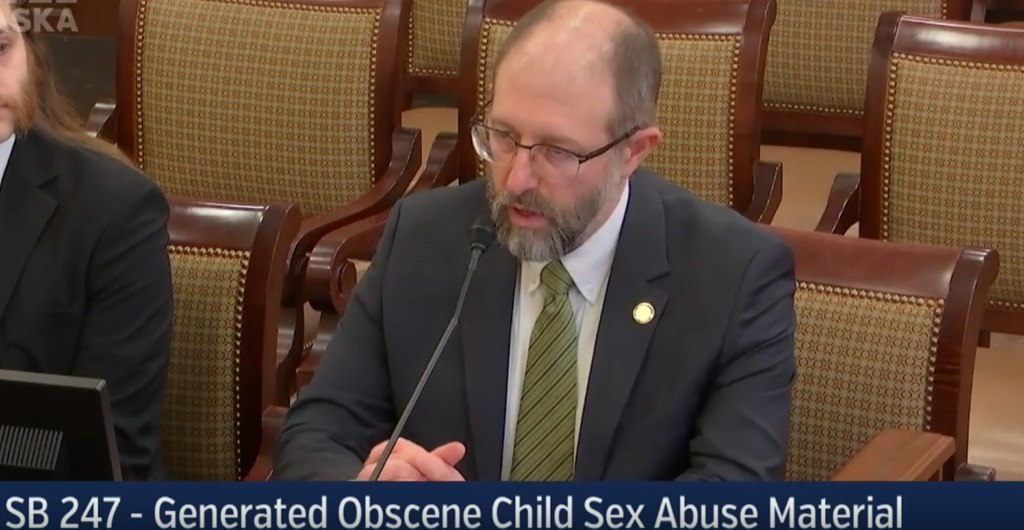
Senator Jesse Kiehl presenting SB 247 to the Senate Community and Regional Affairs Committee on Tuesday March 17, Photo courtesy of Gavel Alaska
Lawmakers are considering legislation that would expand criminal penalties for child sexual abuse material to include images generated using artificial intelligence and other digital tools.
Senate Bill 247, Sponsored by Juneau Sen. Jesse Kiehl, would create new crimes for the possession and distribution of “generated” child sexual abuse material, also known as CSAM, including images that appear to depict minors but may not involve real children.
Under the bill, distributing such material would be a felony, with harsher penalties for repeat offenders. Possession of generated CSAM would also be a felony offense.
Distribution under this bill is relatively broad and includes sharing or posting such content online.
United Nations, just this January released a warning on escalating AI threats to children.
The staggering amount of harmful AI-generated online content has prompted an urgent call from across the UN system for a raft of measures to protect children from abuse, exploitation and mental trauma.
This is a new form of sexual exploitation, the rapid progression of AI means lawmakers are struggling to craft legislation to prevent such harm from happening.
“Artificial intelligence is leading to the ability to generate images, generate videos, generate vast amounts of content, and that ability is growing fast, unfortunately, along with the ability to modify or create your own cute cat videos, some people use these technologies to terrible effect.” Said Kiehl, ” Senate Bill 247 addresses computer generated or otherwise generated Child Sexual Abuse materials. It amends Alaska law to create parity between generated Child Sexual Abuse materials and non generated Child Sexual Abuse materials, what we think of as photos or videos that have not been modified of real children. We know that artificial intelligence is, when it comes to images, a highly sophisticated collage machine, and that those images are made ultimately from things that are real, those are the data sources of millions, often billions, of real images on which these large language models, these artificial intelligences, are trained. The bill sets the punishments for generated Child Sexual Abuse materials on par with, and equal to non-generated CSAM that avoids overburdening bogging down law enforcement resources, court system resources, with the difficulty of proving that an amalgamated image has a real child under the age of 18 in it.”
The proposal also updates existing laws to include manipulated or altered images of real minors, even if the material was digitally created or modified.
In addition to criminal penalties, the bill would require the permanent revocation of teaching certificates for individuals convicted of certain sex offenses involving minors, including those tied to generated materials. It would also prohibit people convicted of those crimes from obtaining school bus driver licenses.
“The real prevalence of child sexual abuse is not known because so many victims do not disclose or report their abuse. However, adult representative or retrospective studies by the CDC has shown that one in four women and one in six men were sexually abused before the age of 18, and we know Alaska has one of the highest rates per capita of child sexual abuse in the nation.” Said Trevor Storrs, the President and CEO of the Alaska Children’s Trust, “Ai generated CSAM represents one of the most urgent and fast moving threats facing children today. In 2023 the National Center for Missing Exploited Children, received 4700 reports of AI related CSAM, by 2024 that number had grown to 67,000 and in the first half of 2025 alone, they received more than 400,000 such reports, an average of over 2000 every single day. At the same time, extortion, where offenders use real or AI generated images to blackmail children, continues to surge.”
Lawmakers say the bill is part of a broader effort to modernize Alaska law while technology continues to evolve, it’s one of several bills currently making their way through the legislature meant to strengthen protections for children.
SB 247 is set to be heard again in the legislature on Thursday.
A road sign marks the road towards the Lower Kuskokwim School District offices and the Bethel High School. October 9, 2023. (Photo by Claire Stremple/Alaska Beacon)
In Alaska’s rural communities, the school budget conversation no longer starts with new ideas but with what we must give up next. I see this firsthand as a school principal in Kotzebue.
For years, districts across rural Alaska have trimmed budgets, delayed expenses, and stretched every dollar they could find. Programs have been reduced. Positions have gone unfilled. Class sizes have crept upward. Staff members wear more hats each year. What remains is a system held together by dedication and grit rather than stable funding. There comes a point where there is nothing left to trim.
The costs of rural education are fundamentally different from those in urban Alaska: dramatically higher energy costs, unpredictable and expensive transportation costs, and a recruitment model that requires travel and relocation costs. In most communities, districts must also provide housing for teachers simply to make staffing possible. These are not luxuries. They are the basic conditions required to operate a school in remote Alaska.
Meanwhile, inflation has driven up nearly every operational expense. Fuel, food service supplies, maintenance materials, shipping and insurance all cost significantly more than they did only a few years ago. Yet the base level of education funding has not kept pace with those realities. Small adjustments do not solve a structural gap.
The result has been deep cuts across rural districts that students see immediately. We have fewer programs, larger classes, less individualized instruction and fewer adults available to support students who are struggling academically or behaviorally. Teachers and staff are working harder than ever, but the margin to meet student needs continues to shrink. As morale suffers, turnover increases, compounding the issue.
For rural schools, consolidation is not an option. Schools serve as the center for community life, language preservation, and opportunity for future generations. Students should not have to leave their community to receive a quality education.
Alaska can demonstrate that it values our rural schools by taking three practical steps.
First, education funding would have to increase at a level that reflects the real cost of operating schools today. Incremental increases that lag behind inflation simply force districts to continue cutting.
Second, Alaska would have to forward fund our schools. Districts cannot responsibly plan staffing, housing, and transportation logistics when they do not know their budget until the end of summer break just as the school year begins.
Third, Alaska would have to strengthen educator retention. One of the most powerful tools the state once had was a defined benefit pension system that encouraged experienced teachers to build long careers in Alaska’s schools. Rural districts feel the loss of that stability every year as recruitment becomes harder and turnover increases.
Rural Alaska school districts are at the point where every cut removes an opportunity. Every unfilled position reduces support for students. Every year of uncertainty makes it harder to recruit the teachers our communities depend on. Rural schools are not asking for excess. They are asking for the resources necessary to provide the constitutionally mandated education Alaska’s children deserve.
The question now is whether the state will choose to invest in those communities or continue asking them to do more with less until there is nothing left to give.
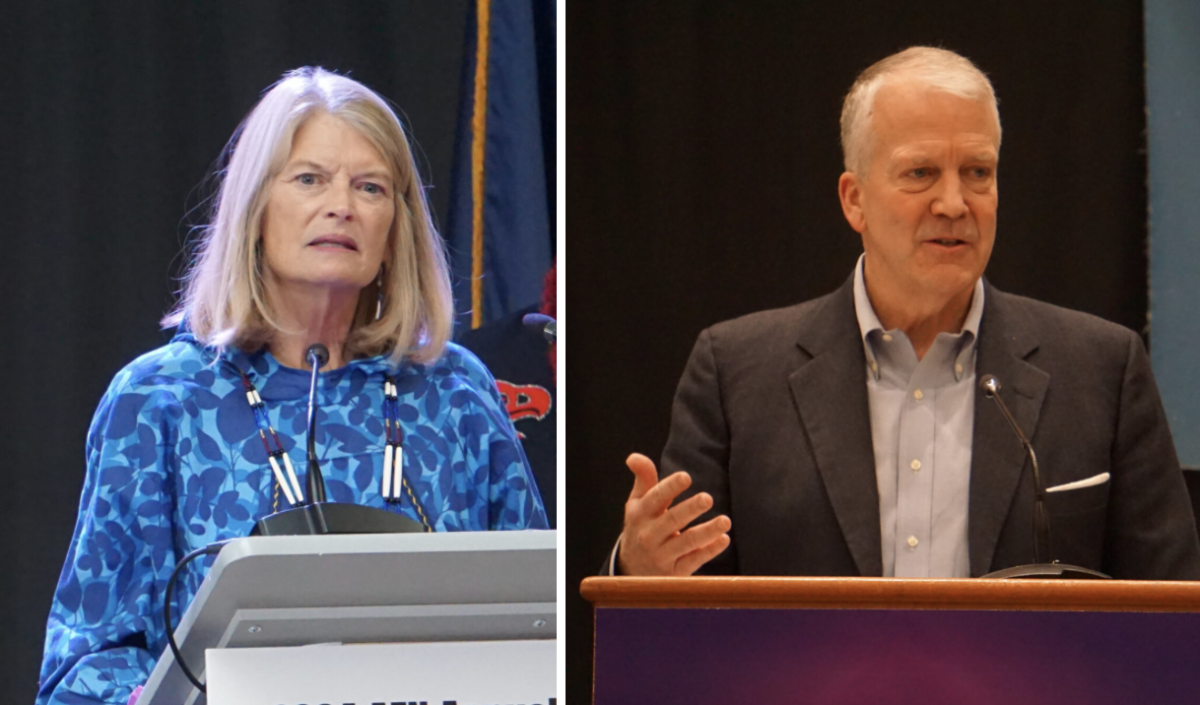
Alaska U.S. Senators Lisa Murkowski and Dan Sullivan (Alaska Beacon file photos)
Alaska’s Republican U.S. senators are pushing the Trump administration to waive a recently hiked visa fee for all public school employees.
The Trump administration raised the fee for highly skilled workers visas, known as the H-1B visa program, from $5,000 to $100,000 per visa in September. That has consequences for Alaska school districts, which have grown to rely on international hiring to fill teaching and staff positions.
“As soon as this proclamation was released last year, I have been sounding the alarm with the administration about the importance of the H-1B visa program to Alaska’s school districts,” U.S. Sen. Lisa Murkowski said in a prepared statement announcing the bill.
Murkowski introduced legislation in the U.S. Senate on Mar. 12, saying it would help alleviate financial strain for Alaska’s school districts. U.S. Sen. Dan Sullivan signed on as a cosponsor of the bill on Tuesday.
The H-1B visa program provides non-immigrant visas for U.S. employers to recruit highly skilled workers, with at least a bachelor’s degree, in fields such as healthcare, technology or education. The visa is valid for up to six years.
“Our public school classrooms have been facing a staffing crisis for years, but teachers in Alaska on H-B visas have been instrumental in bridging that shortage and serving our students with talent and care,” Murkowski wrote. “This legislation offers a commonsense exemption that will ensure Alaska’s schoolchildren have access to more high-quality educators while keeping class sizes reasonable.”
The Alaska House of Representatives introduced a resolution this month urging the visa waiver for teachers.
There are close to 600 international teachers working in Alaska and 341 of them use H-1B visas, according to data provided by the Alaska Council of School Administrators, which assists districts in recruitment and hiring.
“In some rural districts, visa teachers make up 50% to nearly 80% of the teaching staff,” said Lisa Parady, the council’s director, in a statement with the bill’s announcement. “School districts already invest $6,000 to $12,000 per teacher to recruit and sponsor educators through the H-1B visa process. Adding a $100,000 federal visa fee has made it financially impossible for many districts to continue hiring the teachers their students depend on.”
Alaska districts are also in the process of hiring teachers for next year, and officials say the fee imposes an impossible financial barrier.
Cyndy Mika, superintendent of the Kodiak Island Borough School District, said in a written statement with the bill’s announcement that nearly 20% of teachers district wide — and 75% of village teachers — are international hires through visa programs.
“These educators are not replacing American teachers—we simply do not have applicants for these positions,” she said. “Without access to international educators, districts like Kodiak will struggle to fill classrooms and provide consistent learning environments for students.”
The situation is exacerbated in Alaska’s rural districts by recent additional restrictions on the J-1 visa program, which requires visa-holding teachers to be placed in areas with access to health care services, transportation and other public services.
Tammy Dodd, superintendent of the Bering Strait School District, said in a statement the new J-1 visa restrictions put rural districts at a unique disadvantage.
“So the H-1B visa is the only choice,” she said. “The Bering Strait School District employs 86 international teachers, which is roughly 40% of certified staffing. With the new fee in place, the district would be unable to replace those positions with international hires.”
Murkowski sent a letter of concern to the former U.S. Sec. Kristi Noem with the Department Homeland Security, which administers the visa program. Noem responded in a letter on Dec. 15 shared by the senator’s office. Noem wrote that some exemptions are possible.
“Exceptions to the $100,000 payment are extremely rare and are granted only in extraordinarily compelling circumstances. Petitioning employers may seek an exception by sending their request,” Noem wrote.
“Evidence should support the alien worker’s presence in the United States as an H-1B worker is in the national interest, no American worker is available for fill the role, the alien worker does not pose a threat to security or welfare of the United States, and requiring the petitioning employer to pay the $100,000 payment would significantly undermine the interests of the United States,” she wrote.
Jennifer Schmitz, director of the Alaska Educator Retention and Recruitment Center, a division of the Alaska Council of School Administrators, said by email Monday that some districts have sought individual exemptions from DHS for teachers with pending H-1B visa applications, but have received no response and no timeline from the department.
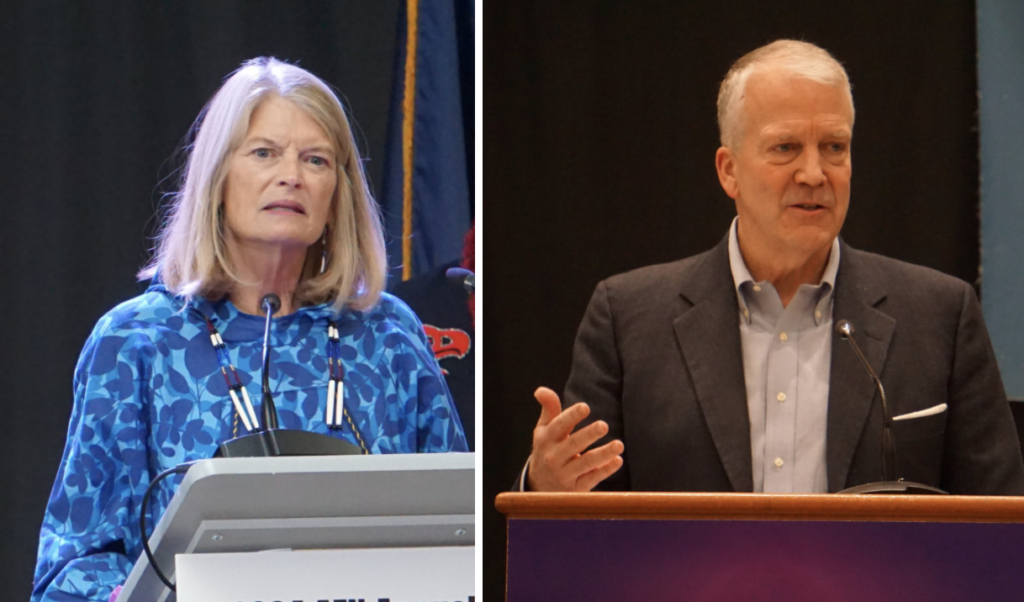
Alaska U.S. Senators Lisa Murkowski and Dan Sullivan (Alaska Beacon file photos)
Alaska’s Republican U.S. senators are pushing the Trump administration to waive a recently hiked visa fee for all public school employees.
The Trump administration raised the fee for highly skilled workers visas, known as the H-1B visa program, from $5,000 to $100,000 per visa in September. That has consequences for Alaska school districts, which have grown to rely on international hiring to fill teaching and staff positions.
“As soon as this proclamation was released last year, I have been sounding the alarm with the administration about the importance of the H-1B visa program to Alaska’s school districts,” U.S. Sen. Lisa Murkowski said in a prepared statement announcing the bill.
Murkowski introduced legislation in the U.S. Senate on Mar. 12, saying it would help alleviate financial strain for Alaska’s school districts. U.S. Sen. Dan Sullivan signed on as a cosponsor of the bill on Tuesday.
The H-1B visa program provides non-immigrant visas for U.S. employers to recruit highly skilled workers, with at least a bachelor’s degree, in fields such as healthcare, technology or education. The visa is valid for up to six years.
“Our public school classrooms have been facing a staffing crisis for years, but teachers in Alaska on H-B visas have been instrumental in bridging that shortage and serving our students with talent and care,” Murkowski wrote. “This legislation offers a commonsense exemption that will ensure Alaska’s schoolchildren have access to more high-quality educators while keeping class sizes reasonable.”
The Alaska House of Representatives introduced a resolution this month urging the visa waiver for teachers.
There are close to 600 international teachers working in Alaska and 341 of them use H-1B visas, according to data provided by the Alaska Council of School Administrators, which assists districts in recruitment and hiring.
“In some rural districts, visa teachers make up 50% to nearly 80% of the teaching staff,” said Lisa Parady, the council’s director, in a statement with the bill’s announcement. “School districts already invest $6,000 to $12,000 per teacher to recruit and sponsor educators through the H-1B visa process. Adding a $100,000 federal visa fee has made it financially impossible for many districts to continue hiring the teachers their students depend on.”
Alaska districts are also in the process of hiring teachers for next year, and officials say the fee imposes an impossible financial barrier.
Cyndy Mika, superintendent of the Kodiak Island Borough School District, said in a written statement with the bill’s announcement that nearly 20% of teachers district wide — and 75% of village teachers — are international hires through visa programs.
“These educators are not replacing American teachers—we simply do not have applicants for these positions,” she said. “Without access to international educators, districts like Kodiak will struggle to fill classrooms and provide consistent learning environments for students.”
The situation is exacerbated in Alaska’s rural districts by recent additional restrictions on the J-1 visa program, which requires visa-holding teachers to be placed in areas with access to health care services, transportation and other public services.
Tammy Dodd, superintendent of the Bering Strait School District, said in a statement the new J-1 visa restrictions put rural districts at a unique disadvantage.
“So the H-1B visa is the only choice,” she said. “The Bering Strait School District employs 86 international teachers, which is roughly 40% of certified staffing. With the new fee in place, the district would be unable to replace those positions with international hires.”
Murkowski sent a letter of concern to the former U.S. Sec. Kristi Noem with the Department Homeland Security, which administers the visa program. Noem responded in a letter on Dec. 15 shared by the senator’s office. Noem wrote that some exemptions are possible.
“Exceptions to the $100,000 payment are extremely rare and are granted only in extraordinarily compelling circumstances. Petitioning employers may seek an exception by sending their request,” Noem wrote.
“Evidence should support the alien worker’s presence in the United States as an H-1B worker is in the national interest, no American worker is available for fill the role, the alien worker does not pose a threat to security or welfare of the United States, and requiring the petitioning employer to pay the $100,000 payment would significantly undermine the interests of the United States,” she wrote.
Jennifer Schmitz, director of the Alaska Educator Retention and Recruitment Center, a division of the Alaska Council of School Administrators, said by email Monday that some districts have sought individual exemptions from DHS for teachers with pending H-1B visa applications, but have received no response and no timeline from the department.
Economist Dan Stickel talks to the Alaska House Finance Committee on Monday, March 16, 2026. (James Brooks photo/Alaska Beacon)
By: James Brooks, Alaska Beacon
Economist Dan Stickel talks to the Alaska House Finance Committee on Monday, March 16, 2026. (James Brooks photo/Alaska Beacon)
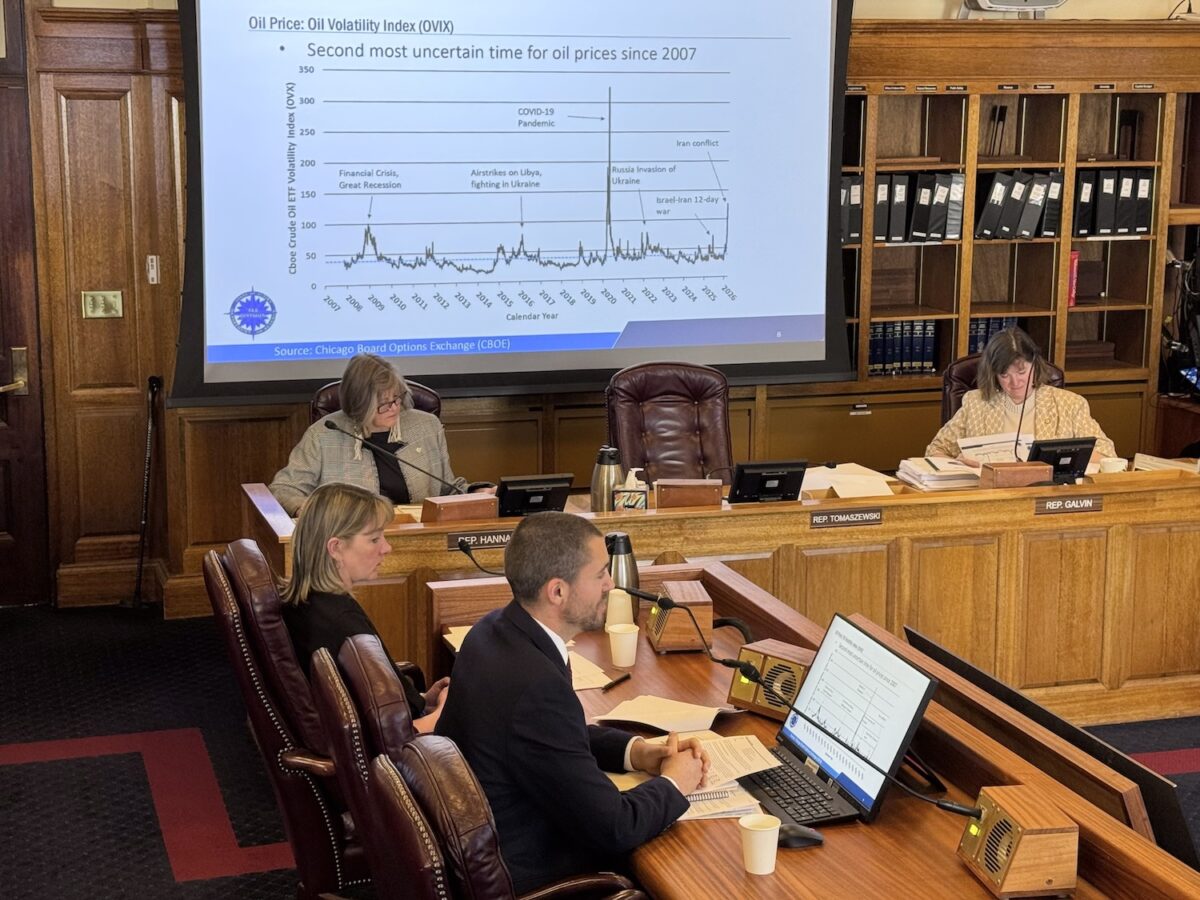
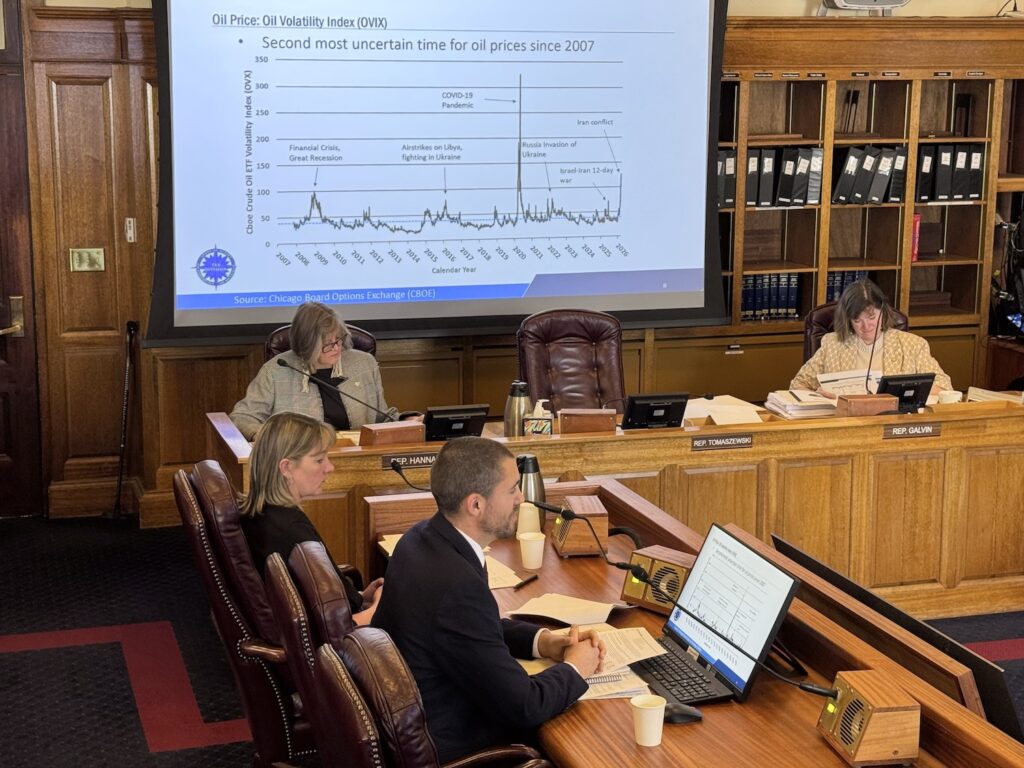
The U.S.-Israeli war against Iran has left oil markets more uncertain than they were during the Great Recession, a state expert told the Alaska Legislature on Monday.
In a pair of hearings, Alaska Department of Revenue economist Dan Stickel told state legislators that the volatility of global oil markets is the second-highest on record, leaving future forecasts particularly unreliable.
“The level of uncertainty around future prices in the oil markets now is higher than during the peaks of the Great Recession in 2008-2009 and it’s higher than the Russian invasion of Ukraine, and it’s higher than any of the COVID spikes other than the initial April 2020 spike,” he said during a Monday morning hearing of the Senate Finance Committee.
“The message here is to plan for the possibility that revenue doesn’t come in exactly at what we forecast for the next couple of years,” Stickel said.
Oil is the second-largest source of general-purpose revenue for the Alaska state budget, and Stickel’s testimony came days after the department released a new Alaska revenue forecast showing $545 million more in current-year revenue than projected in the fall. Most of that higher prediction is due to the price of oil.
That forecast has snarled relations in the Alaska House of Representatives, which has repeatedly postponed discussion of a bill that would fund a variety of amendments to the fiscal year 2026 budget passed by lawmakers and Gov. Mike Dunleavy last spring.
On Monday, after more than two hours of acrimonious debate, House legislators again declined to take up the bill.
Soon after the House adjourned its floor session, Stickel testified in front of the House Finance Committee, and told lawmakers that “the level of certainty that we will hit our exact forecast is low.”
As he spoke, on the other end of the Capitol’s fifth floor, the Senate Finance Committee was simultaneously hearing from Office of Management and Budget director Lacey Sanders, who said the governor’s office was requesting another $18 million in spending for the current fiscal year.
Altogether, the governor has requested almost $427 million in additions to the budget. Add in additional spending proposed by lawmakers, and there’s only about a $30 million difference between the new revenue forecast and the additions proposed by the governor and legislators.
At the latest forecast prices, said Rep. Calvin Schrage, I-Anchorage, a $2 change in the average price of a barrel of North Slope oil is worth $30 million.
He asked Stickel what the odds were that the forecast misses low by more than $2.
“Roughly a slightly less than 50% chance that we come in more than $2 below the forecast,” Stickel said, then alluded to the fact that there’s a similar chance of coming in above the forecast.
“The level of certainty that we will hit our exact forecast is low in either direction,” he said.
Currently, members of the House majority are advocating that legislators unlock the state’s principal savings account to provide surety for some of those budget additions.
Doing so would avoid problems if oil prices turn out to be lower than forecast.
But spending from the Constitutional Budget Reserve, the state’s principal savings account, requires 30 votes in the House and 15 votes in the Senate.
The House’s multipartisan coalition majority has 21 members, which means they need support from the all-Republican House minority caucus.
Members of that group have been arguing against unlocking the budget reserve right now, saying that the new forecast and the current balance of the state’s general-purpose accounts demonstrate it isn’t needed.
In addition, as currently written, the supplemental budget bill in the House would allow spending from savings regardless of the price of oil. That could allow the majority to dictate extra spending even if prices stay high.
The Senate has already approved spending from the Constitutional Budget Reserve, and on Monday morning, Sen. Bert Stedman, R-Sitka and co-chair of the Senate Finance Committee, said a draw from the reserve would act as a “safety net.”
Sen. Lyman Hoffman, D-Bethel, said senators don’t intend to spend dollars from savings unless it is needed.
“If they are not needed, they will stay in the CBR,” he said, adding that without permission to spend from savings, there’s a chance that lawmakers would need to return in August to fix budget problems in a special session.
Emily Brubaker, age 15 and a 9th grader at West Anchorage High School and a member of Alaska Youth for Environmental Action testified in support of a bill to increase per student funding, the base student allocation, before members of the House Education Committee on Mar. 12, 2026. (Photo by Corinne Smith/Alaska Beacon)
Lawmakers are considering new legislation to increase state funding for Alaska schools, and heard public comment on Wednesday evening that showed overwhelming support for more funding for public education.
The legislation comes on the heels of a historic increase to per pupil student funding last year — after political debate between lawmakers and Gov. Mike Dunleavy resulted in three governor’s vetoes and two override votes by the Legislature.
House Bill 374 would increase per student funding, known as the base student allocation, by $630 per student. The bill would take per student funding from $6,660 to $7,290 — totalling $158.6 million additional dollars for schools next year.
Sponsors of the legislation said they calculated that increase by assessing the current budget deficits of the state’s five largest school districts by student population — Anchorage, Matanuska-Susitna Borough, Kenai Peninsula Borough, Fairbanks North Star Borough and Juneau School Districts are all facing millions in budget shortfalls, and looking at cutting teachers and programs, increasing class sizes and potentially closing schools.
Members of the House Education Committee hear public testimony on HB 347, a bill to increase per student funding, on Mar 11, 2026. (Photo by Corinne Smith/Alaska Beacon)
Dozens of Alaska students, parents, grandparents, teachers, nurses and superintendents from across the state called in and spoke in-person at the Capitol to the House Education Committee for two hours on Mar. 11, urging support for the legislation. There were no testifiers against the bill.
Sixteen-year-old Claire Tallis testified in person on behalf of her hometown school in Tok, and as a current student at the state-run boarding school, Mt. Edgecumbe High School.
“My personal experience with the education system has been challenging. When I was attending Tok school, it was blatantly apparent that I would not gain the level of education I wanted. There were constant funding issues, inconsistent hiring of teachers and lowered expectations based on the background of students. This forced me to choose between the best of two bad options,” she said.
Tallis said she ultimately chose to move 680 miles away from family to Sitka to attend Mt. Edgecumbe, which is also experiencing funding and management issues. She said the BSA needs to keep up with inflation.
“When the BSA stays frozen while the cost keeps rising, it feels like my generation is being asked to carry the burden. It feels like our future is being cut at the knees before we even had the chance to stand. Mt. Edgecumbe is my home away from home, and my last option for a fruitful education,” she said. “Please consider this when you make the decision whether or not to fund Alaskan futures.”
Emily Brubaker, a ninth grader at West High School in Anchorage, testified that her district is facing a $90 million budget shortfall, which could mean deeper cuts to student programs and opportunities.
“Countless extracurriculars in ASD, like sports and clubs, are getting completely cut, opportunities that the youth of today will never get to experience. On top of this, educational classes like art and music are being eliminated, as well as the educators who teach them,” Brubaker said. “School districts are doing all of this cutting. They are trying their best, and it isn’t enough.”
Several students and parents spoke about how budget cuts and school closures result in unmanageable class sizes.
“Right now, my school will lose four teachers,” said Audrey Brower, a fourth grader at W. L. Bowman Elementary School in Anchorage. “Which means classrooms will start at 40 to 45 students per class with combos of two to three grade levels. It’s not okay for me and my friends. We can’t even fit that many kids in one classroom.”
Several testifiers expressed frustration — some to the point of tears — that school funding is up for debate in the Legislature each year, rather than considered a state mandate.
Nancy Bale, a school nurse in the Anchorage School District, testifies in support of a school funding increase and HB 374. She says the district is proposing cutting nurses next year, to address a budget shortfall, which will negatively impact students. (Photo by Corinne Smith/Alaska Beacon)
Fairbanks resident Sarah Lewis said she’s frustrated at watching agencies like the Alaska Department of Corrections overspend by millions, while the level of school funding is debated each year.
“Schools are community hubs. They are evacuation points. They are a place where many kids can depend on breakfast and lunch, and they’re even hostels, whether for a single visitor in remote areas, or for several dozen students from everywhere in the state,” she said.
“Our schools and the people who fill them are doing remarkable, important work that keeps Alaskan kids secure, sheltered, fed and informed. They’re the front lines in the system that keeps our kids safe,” she said. “But somehow we support them so poorly that buildings are literally crumbling around them and resources are few and far between.”
Superintendents called in from around the state to share their support for increased funding. They described continually having to make difficult cuts to staff and programs to offset increasing operational costs.
Cyndy Mika, superintendent of the Kodiak Borough School District, said her district is considering how to make at least $1 million in budget reductions ahead of next year — including potential cuts to counseling, nursing, special education and gifted support, instructional coaching and classroom aides.
“Last year, we closed an elementary school, and if our fiscal outlook does not improve, our community is already preparing for the possibility of closing another school in the 2027-2028 school year,” she said. “Stable and adequate funding through the BSA is essential.”
Lily Boron is superintendent of the Haines Borough School District, which serves an elementary, middle and high school, plus a homeschool program. She said the district could not afford a new bus contract this year, continues to struggle with hiring teachers and had to cut its library program. She said she worries about the district’s future solvency.
“We’ve cut, we’ve consolidated, we’ve deferred maintenance, and at this point, there simply is no more breathing room without a BSA increase. Without adequate funding for student transportation, major maintenance and mandated programs like the Alaska Reads Act, our school will not be able to remain solvent,” she sai.
Lon Garrison, executive director of the Association of Alaska School Boards, was one of several school officials who pointed out that last year’s increase was only $20 per student more than the one-time funding schools got the year prior. He said last year’s BSA increase did not fill the inflation gap, where the cost of goods and services is rising faster than state funding.
Garrison said state investment in students is well worth it.
“Ultimately, those student opportunities translate directly into community opportunity and strong schools help communities, large and small, attract families, develop workforces and sustain healthy economies,” he said.
The House Education Committee is now considering the bill. Members of the House majority caucus have discussed spending more on schools since the Alaska Department of Revenue is forecasting that the Iran war will prompt a surge in oil prices and state revenues, but that will be up for debate in the Legislature in the coming weeks and months.