FILE – Clouds and fog hang in the area near and along Mount Roberts trail on Sept. 22, 2012, in Juneau, Alaska. (AP Photo/Becky Bohrer, File)
AP- One man is dead and another injured after falling from a trail in the mountains above downtown Juneau, authorities said. Both men were cruise ship passengers who were visiting Alaska’s capital city.
Alaska State Troopers said they were notified late Tuesday about a search and rescue involving two men who had fallen from a trail and slid down the mountainside. One of the men was found with minor injuries. The body of the other man, a 36-year-old from Texas, was located by drones farther down the mountain, according to troopers, who said he died from injuries sustained in the fall.
One of the men had called 911 for help, troopers’ spokesperson Tess Williams said by email. She said the men had mistakenly followed a path that was not the actual trail and is in the vicinity of a tram. The tram shuttles people between the downtown area where cruise ships dock and a developed site about 1,800 feet (548.6 meters) up a mountainside; it’s popular with cruise passengers. The Mount Roberts trail passes through that area and heads up toward a ridgeline and peaks that tower over downtown.
Williams said at the time of the incident it was dark with dense fog and periods of light rain. She said the ground was soggy and wet, and conditions off trail were slick.
In July, another cruise passenger, a Kentucky woman, also was found dead in the mountains above downtown Juneau. Authorities had initiated a search for her after she did not return to her cruise ship following a hike.
The campus of the University of Alaska Fairbanks is seen from the air on Sept. 20, 2022. (Photo by James Brooks/Alaska Beacon)
Officials at the University of Alaska said this week that previously announced cuts to federally funded programs for Alaska Native and Native Hawaiian students will be worse than initially thought.
At the University of Alaska Fairbanks, the canceled funding will amount to an estimated $8.8 million, and University of Alaska Southeast programs will also be affected but to a lesser degree.
“It was quite a shock, because there was no forewarning to this,” said Bryan Uher, interim vice chancellor for rural, community and Native education at UAF in a phone interview Wednesday.
Uher said the elimination of the grant funding for the University of Alaska Fairbanks affects programs at the Bristol Bay campus in Dillingham and in Fairbanks at the Community and Technical College focused on career training and workforce development, as well as student services.
In total, for the five-year grant programs, Uher said the cancellation is estimated at $8.8 million of $12.9 million in grant funding previously awarded.
“This award funding is unique in that it funds faculty for new program development, and then it also funds staff for student support — so advisors, outreach, individual wellness coordinators, admissions, graduation – student services, essentially,” he said.
Uher said new programs in development that will be impacted — for students in person or through distance education — include American Sign Language, information technology technician training and private pilot ground school, helping students train for their pilot’s license.
Uher said those programs will continue through this academic year, and then the university will evaluate whether or how to continue them. University officials say they were given one year to close out grant-funded programs.
UAF includes campuses in Fairbanks, Dillingham, Bethel, Nome and Kotzebue. Uher said while these programs must have at least 20% Native students to be eligible for the funding, they serve a wider student population, especially student services at rural campuses that serve wider regions of rural Alaska.
“They provide follow-ups, financial aid support like, how do you apply for financial aid? Are there scholarships out there?” Uher said. “They provide financial literacy to students. So it really is a comprehensive service that we provide to these students who are not living in or located in urban centers like Fairbanks or Anchorage.”
An estimated 17% of the University of Alaska student population identified as Alaska Native in 2024, or 3,254 students statewide, and roughly 1.3% or 266 students identified as Native Hawaiian.
UAA and UAS expect less impact
University of Alaska Anchorage has grant-funded programs for Native students, but officials say they are not expecting them to be affected.
University of Alaska Southeast Chancellor Aparna Palmer said in a university-wide email Monday that a grant-funded program on its Sitka campus to support student services is already set to end this month, and the university is authorized to continue to spend remaining funds for another year.
“I want to assure you that we will continue to support the many ways in which we are rooted in Alaska Native culture, history, language, and arts,” Palmer said, adding emphasis by underlining her statement.
Palmer said programs and courses in Indigenous studies, as well as support for Indigenous students, will continue. “Our programs and courses in Indigenous Studies at UAS are strong and will continue to thrive and grow. The UA President, Pat Pitney, and I are fully aligned on this,” she said. “Our Native and Rural Student Center will continue to be a space that provides support for Alaska Native students while welcoming all students.”
Faculty union president Jill Dumesnill, professor of mathematics at UAS, said by email on Monday that the announcement also disrupts future programs, faculty positions and student services.
“Writing these grant applications takes an enormous amount of faculty time and effort, and the Sitka proposal would have provided two additional faculty on the Sitka campus. That loss is significant because there are currently no Alaskan Native faculty members on the Sitka campus,” she said. “You don’t make campuses welcoming simply by calling them welcoming.”
Alaska’s U.S. Senators say they’re working to fund higher education
U.S. Sen Lisa Murkowski, R-Alaska, said in a statement Wednesday that the funds are already legally authorized by Congress, and support students as well as address workforce shortages in the state.
Alaska Republican U.S. Sens. Lisa Murkowski and Dan Sullivan (Alaska Beacon file photos)
“I am working with my colleagues to reinforce to the administration that these are statutory grant programs authorized and appropriated by Congress that align with the President’s goal of providing career technical education to the next generation for high-impact workforce needs such as fisheries, healthcare, skilled trades, and energy,” Murksowski said.
“As Alaska partners with this administration on several large-scale and exciting projects that can help transform our state, we need a local workforce trained to meet this moment,” she said. “Cancelling these funds takes us further away from that objective.”
A spokesperson for U.S. Sen. Dan Sullivan, R-Alaska, also repeated the impact on career training and workforce development education.
“Senator Sullivan and his team are in touch with the Department of Education regarding these grants. The University of Alaska serves thousands of students across the state, including Alaska Natives, and provides critical programs, such as job training and technical education, that build up Alaska’s trained workforce. President Trump’s Day 1 executive order to ‘Unleash Alaska’s Extraordinary Resource Potential’ makes it clear we must be training the next generation to power projects like the Alaska LNG pipeline and keep these good-paying jobs in Alaska,” said spokesperson Amanda Coyne by email on Tuesday.
“Senator Sullivan will continue to work with the administration to fund secondary education and job training to continue building up Alaska’s economy and workforce,” she said.
Alaska’s U.S. House Representative Nick Begich did not respond to a request for comment on Wednesday.
The announcement follows the Trump administration’s move to cancel $350 million in congressionally approved grant funding for minority-serving institutions last week, saying the funds will be allocated elsewhere.
There are an estimated 5 million students enrolled in 800 minority-serving institutions nationwide. The grant funding is aimed at supporting students of color and from low-income backgrounds to pursue and complete higher education.
A copy of the Alaska Constitution is seen on Thursday, July 28, 2022. (Photo by James Brooks/Alaska Beacon)
In Anchorage Superior Court on Wednesday, attorneys for the state of Alaska defended Gov. Mike Dunleavy’s decision to name a former attorney to a public seat on Alaska’s judge-picking board, saying the choice was within the governor’s powers under the Alaska Constitution.
The governor’s choice of John W. Wood has been challenged by lawsuits filed by Juneau resident James Forrer and Alaskans for Fair Courts, a group devoted to the defense of the court system as an independent, apolitical branch of government.
They argue that if Wood’s appointment stands, it would give attorneys four of the six seats on the Alaska Judicial Council, the state board that accepts applications for judicial vacancies, selects nominees and forwards them to the governor for final selection.
Under the Alaska Constitution, the council consists of three attorneys picked by the Alaska Bar Association and three non-lawyer members of the public appointed by the governor and confirmed by the Legislature. In ties, the chief justice of the Alaska Supreme Court may cast a seventh vote.
The state contends that Wood is no longer an attorney and that he was a valid pick for an open seat. Both sides have asked for summary judgment, allowing Judge Yvonne Lamoureux to decide the case short of trial.
Wood’s appointment has been challenged on three main points. First, was the governor’s choice a valid recess appointment? Second, is Wood an attorney? Third, was he employed by the state at the time of the appointment?
Dunleavy appointed Wood in a letter dated May 29, filling a position that had been vacant since March, when a prior appointment expired. That was after the Legislature had adjourned for the year.
Under the Alaska Constitution and state law, a governor may fill vacant positions on boards and commissions when the Legislature is out of session, but the appointee will be subject to confirmation during the next regular legislative session.
Attorney James Reeves, arguing on behalf of Alaskans for Fair Courts, said his group contends that because a position on the Judicial Council became vacant during the legislative session, Wood may not begin serving until a confirmation vote takes place.
That contradicts existing practice, and Alaska Department of Law attorney Claire C. Keneally said in court on Wednesday that “it’s also not supported by the history of the (Alaska) Constitution” or the clause of the constitution that deals with appointments that take place when the Legislature is out of session.
“This is not a new or novel practice,” Keneally said of Dunleavy’s decision to not fill a March vacancy until May.
In 2015, then-Gov. Bill Walker filled a public seat on the Alaska Judicial Council in October; that seat had also been vacant since March, when the Legislature was in session.
Because of that timing issue, Keneally argued both in court and in writing, the case should be dismissed. Other arguments would be ripe for discussion only if the Legislature approves Wood’s appointment.
Wood was granted a law license in 1972, but it was suspended in 2000 because of a failure to pay dues to the Alaska Bar Association. Under a sworn affidavit, Wood said he has not practiced law since 2000 and has no intention of practicing law.
But in court on Wednesday, Reeves with Alaskans for Fair Courts said, “the Constitutional Convention history, which both sides have cited, indicates that the framers who discussed this understood the word non-attorney to mean layman or lay member. Is a lawyer who chooses not to practice law a layman?”
Reeves and attorney Joseph Geldhof, who was representing James Forrer in a separate but combined lawsuit also challenging Wood’s appointment, argued that because Wood held a state consulting contract at the time of his appointment, he was ineligible to serve on the Judicial Council.
The contract calls for Wood to advise the Alaska Department of Law on labor relations matters and to provide advice to the governor’s office when needed.
The Alaska Constitution states that no member of the Judicial Council may hold “any other office or position of profit under the United States or the state.”
But Keneally noted that the Alaska Supreme Court has previously interpreted that phrase to mean “salaried, non-temporary employment” with the state, and that other members of the Alaska Judicial Council, including some current members, have also held state contracts while serving on the council.
Lamoureux, who heard Wednesday’s arguments, said she intends to issue a written order within 30 days, the timeline requested by both sides of the case in order to allow a speedy appeal.
Alaska Attorney General Treg Taylor speaks at a news conference on Thursday, Dec. 15, 2022, at the Alaska State Capitol in Juneau. (Photo by James Brooks / Alaska Beacon)
Treg Taylor, the former Alaska attorney general, is running for governor, he announced Wednesday morning.
“I have a four-and-a-half-year proven record as the attorney general of fighting crime, fighting Biden, and fighting for Alaska,” he said by phone.
In a campaign video and written statement, Taylor promoted himself as a “fearless conservative” who is the best successor to incumbent Gov. Mike Dunleavy, who is term-limited and unable to run for another four years in office.
Taylor is the 10th Republican and 11th candidate overall to enter the 2026 Alaska governor’s race.
The lone non-Republican in the race is former state Sen. Tom Begich, an Anchorage Democrat.
The other Republicans are Anchorage business owner Bernadette Wilson; former state Sen. Click Bishop of Fairbanks; former Alaska Revenue Commissioner Adam Crum; current state Sen. Shelley Hughes of Palmer, Lt. Gov. Nancy Dahlstrom of Eagle River; Matanuska-Susitna Borough Mayor Edna DeVries; podiatrist Matt Heilala of Anchorage; former teacher James William Parkin IV of Angoon; and Bruce Walden of Palmer.
“That is a ridiculous number of people in the race,” Taylor said when asked how he distinguishes himself from the other Republicans. “My answer is that I am the only candidate that has a proven record of fighting on behalf of Alaska. When I was the attorney general for four and a half years, I fought crime, I fought Biden, I fought for Alaska’s economic future. I’ve been heavily involved with the Trump administration. I helped draft Trump’s first day Executive Order unleashing Alaska’s extraordinary resource potential. And I’ve worked hard with the Trump administration, with (Department of the Interior), (Department of Justice), to see fulfillment of that executive order, which is going to push Alaska’s economic future.”
Asked about his campaign plans, Taylor said, “over the next few months, I’ll be hard at work, visiting with groups, visiting with individuals, working up support, fundraising. Obviously, I think the biggest tell in this race is going to be when everybody divulges their fundraising and our goal is to be at the top of that list, and I think we’ve got a good plan for getting there.”
Taylor, a longtime attorney with a degree from the Brigham Young University law school, worked in private practice and for Arctic Slope Regional Corp. before joining the Alaska Department of Law in 2018. He was head of the department’s civil division in 2021 when Dunleavy picked him as attorney general following the resignations of two other men amid sexual misconduct scandals.
Taylor, who has never held publicly elected office before, ran unsuccessfully for the Anchorage School Board in 2011 and for that city’s Assembly in 2016.
Taylor’s entry into the governor’s race marks an unusually early start for an Alaska campaign. Eight years ago, when now-Gov. Dunleavy launched his campaign in July 2017, he was the first high-profile candidate to challenge then-Gov. Bill Walker. This time around, three candidates had entered the race before June.
While the race is unusually crowded, additional candidates are still possible. Republican U.S. Sen. Lisa Murkowski has not ruled out a campaign, and a run by former U.S. Rep. Mary Peltola, a Democrat, is also possible.
The Harvard controversy began when the Trump administration announced plans to cut off billions in federal research funds because it objected to the university’s public positions, campus culture and some of its academic scholarship. No one contended that Harvard had mismanaged money or failed to meet grant requirements.
Instead, the White House said the school had done too little to eliminate so-called woke diversity, equity and inclusion – DEI – policies and alleged that antisemitism proliferated on campus, as evidenced by student demonstrations against Israel’s conduct in the Gaza war.
White House Press Secretary Karoline Leavitt on April 15, 2025, spoke about President Donald Trump’s moves against Harvard.
Protection for dissent and disagreement
In striking down the funding cut, Burroughs ruled that the administration’s move violated the First Amendment. The First Amendment protects freedom of speech, press, religion and assembly by limiting government intrusion. While government officials may disagree with Harvard’s speech – whether that means faculty scholarship, public statements or the culture of campus debate – they cannot retaliate by pulling federal support, the judge wrote.
The principle at work in the Harvard case is simple: Free speech protections don’t just apply to individuals in the town square or in places where public decisions are being made.
First Amendment rights extend to private institutions, even when their views or policies contravene official government opinions, and even when they receive funding from the government. Government reprisal does more than chill speech – it sets up a system where only state-approved viewpoints can flourish.
Supreme Court has seen this before
The ruling in Harvard’s favor follows a long legal tradition of Supreme Court rulings that bar the government from demanding ideological acquiescence in exchange for support.
In the case Speiser v. Randall that was decided in 1958, the court struck down a California law requiring veterans to sign loyalty oaths to receive tax exemptions. The decision created the doctrine of unconstitutional conditions, a principle that forbids government from making the receipt of a government benefit or entitlement conditional in a way that interferes with the exercise of a constitutional right.
In Perry v. Sindermann, a 1972 decision, a professor was denied reappointment at a state college after criticizing administrators. Even without tenure, the court held, the government could not retaliate against him for protected speech.
And in Legal Services Corp. v. Velazquez, the court in 2001 invalidated restrictions that barred federally funded legal aid lawyers from challenging welfare laws. Justice Anthony Kennedy wrote that such limits “distort the legal system” by preventing some members of the bar from making arguments on behalf of their clients, while the government would face no similar restriction in promoting their own views.
The government, Chief Justice John Roberts wrote, could not make program funds dependent on grant-seeking groups adopting particular political or moral beliefs. In this case, that meant the Alliance for Open Society did not have to condemn sex work in order to qualify for public health funding.
Likewise, in Janus v. AFSCME from 2018, the court struck down an Illinois law that required public employees who chose not to join a union to still pay fees to support it. The state had argued that these “fair-share fees” were necessary because unions bargain on behalf of all workers. But the court said that forcing nonmembers to pay was a form of compelled speech – subsidizing union political organizing – that abridged the First Amendment.
While the context is very different from Harvard’s funding dispute, both cases highlight the same principle: The government cannot use money – whether through subsidies, grants or mandatory fees – as a way to compel or suppress expression. These rulings show that the First Amendment protections apply to government funding and policy questions that quietly shape who gets heard and who does not.
In each of those episodes, dissent was framed as dangerous to national security or social stability. And in each case, the tools of government – whether criminal law, congressional investigations or funding threats – were used to discipline voices that strayed from the party line. The impulse to punish institutions for perceived ideological deviance is part of a recurring American story.
What’s distinctive today is how the tactic has been folded into the culture wars.
These are not just fiscal decisions; they are symbolic moves aimed at disciplining institutions seen by conservatives as too liberal or too critical.
President John Adams supported the 1798 Alien and Sedition Acts, which criminalized criticism of him but not opposition leader and Vice President Thomas Jefferson. Library of Congress
Why this matters beyond the courts
The latest ruling may protect Harvard in this instance, but the larger conflict is not going away.
The legal decision confirms that retaliation violates the First Amendment, but political leaders may continue to test the boundaries. And among the public, the idea that universities should play along with official doctrine in exchange for continued government funding may eventually gain traction. That possibility feels especially real given Trump’s promises, echoed by Vice President JD Vance and White House Deputy Chief of Staff Stephen Miller, to wield federal power against universities and civic groups they portray – often inaccurately – as leftist, radical or violent.
A society where public funding flows only to institutions aligned with those in power is not a free society. It’s one where government can shape the landscape of knowledge and debate to its own ends.
The Harvard decision offers a reminder: The First Amendment is not just about the right to speak without fear of jail. It’s also about ensuring that the government cannot punish speech indirectly by threatening livelihoods and institutions. That’s why this case matters to the future of free expression in American democracy.
Stephanie A. (Sam) Martin does not work for, consult, own shares in or receive funding from any company or organization that would benefit from this article, and has disclosed no relevant affiliations beyond their academic appointment.
Some school librarians in Florida have found themselves in the midst of controversy over complaints of “obscene” titles in their libraries.Trish233/iStock via Getty Images
When a junior at an Orange County public high school in Florida visited the school library to check out a copy of “On the Road” by Jack Kerouac, it wasn’t in its Dewey decimal system-assigned location.
It turns out the title had been removed from the library’s shelves because of a complaint, and in compliance with Florida House Bill 1069, it had been removed from the library indefinitely. Kerouac’s quintessential chronicle of the Beat Generation in the 1950s, along with hundreds of other titles, was not available for students to read.
Gov. Ron DeSantis signed the bill into law in July 2023. Under this law, if a parent or community member objected to a book on the grounds that it was obscene or pornographic, the school had to remove that title from the curriculum within five days and hold a public hearing with a special magistrate appointed by the state.
On Aug. 13, 2025, Judge Carlos Mendoza of the U.S. Middle District of Florida ruled in Penguin Random House v. Gibson that parts of Florida HB 1069 are unconstitutional and violate students’ First Amendment right of free access to ideas.
The plaintiffs who filed the suit included the five largest trade book publishing houses, a group of award-winning authors, the Authors Guild, which is a labor union for published professional authors with over 15,000 members, and the parents of a group of Florida students.
I’ve spent the past 26 years training English language arts teachers at Arizona State University, and 24 years before that teaching high school English. I understand the importance of Mendoza’s ruling for keeping books in classrooms and school libraries. In my experience, every few years the books teachers have chosen to teach come under attack. I’ve tried to learn as much as I can about the history of censorship in this country and pass it to my students, in order to prepare them for what may lie ahead in their careers as English teachers.
Legal precedent
The August 2025 ruling is in keeping with legal precedent around censorship. Over the years, U.S. courts have established that obscenity can be a legitimate cause for removing a book from the public sphere, but only under limited circumstances.
In the 1933 case of United States v. One Book Called Ulysses, Judge John Munro Woolsey declared that James Joyce’s classic novel was not obscene, contradicting a lower court ruling. Woolsey emphasized that works must be considered as a whole, rather than judged by “selected excerpts,” and that reviewers should apply contemporary national standards and think about the effect on the average person.
In 1957, the Supreme Court further clarified First Amendment protections in Roth v. United States by rejecting the argument that obscenity lacks redeeming social importance. In this case, the court defined obscenity as material that, taken as a whole, appeals to a prurient – that is, lascivious – interest in sex in average readers.
The Supreme Court’s 1973 Miller v. California decision created the eponymous Miller test for jurors in obscenity cases. This test incorporates language from the Ulysses and Roth rulings, asking jurors to consider whether the average person, looking at the work as a whole and applying the contemporary standards in their community, would find it lascivious. It also adds the consideration of whether the material in question is of “serious literary, artistic, political, or scientific value” when deciding whether it is obscene.
Another decision that is particularly relevant for teachers and school librarians is 1982’s Island Trees School District v. Pico, a case brought by students against their school board. The Supreme Court ruled that removing books from a school library or curriculum is a violation of the First Amendment if it is an attempt to suppress ideas. Free access to ideas in books, the court wrote, is sacrosanct: “If there is any fixed star in our constitutional constellation, it is that no official, high or petty, can prescribe what shall be orthodox in politics, nationalism, religion or other matters of opinion.”
These 23 books were removed from Florida school libraries under Florida HB 1069. In his ruling in Penguin Random House v. Gibson, Judge Carlos Mendoza named them and stated, ‘None of these books are obscene.’ Illustration by The Conversation
What this ruling clarifies
In his ruling in August 2025, Mendoza pointed out that many of the removed books are classics with no sexual content at all. This was made possible in part by the formulation of HB 1069. The law allows anyone from the community to challenge a book simply by filling out a form, at which point the school is mandated to remove that book within five days. In order to put a book back in circulation, however, the law requires a hearing to be held by the state’s appointed magistrate, and there is no specified deadline by which this hearing must take place.
Mendoza did not strike down the parts of HB 1069 that require school districts to follow a state policy for challenging books. In line with precedent, he also left in place challenges for obscenity using the Miller test and with reference to age-appropriateness for mature content.
The Florida Department of Education argued that HB 1069 is protected by Florida’s First Amendment right of government speech, a legal theory that the government has the right to prevent any opposing views to its own in schools or any government platform. Mendoza questioned this argument, suggesting that “slapping the label of government speech on book removals only serves to stifle the disfavored viewpoints.”
What this means for schools, in Florida and across the US
In the wake of Mendoza’s decision, Florida schools are unlikely to pull more books from the shelves, but they are also unlikely to immediately return them. Some school librarians have said that they are awaiting the outcome of the appeal before taking action.
States with similar laws on the books or in the works will also be watching the appeal.
James B. Blasingame does not work for, consult, own shares in or receive funding from any company or organization that would benefit from this article, and has disclosed no relevant affiliations beyond their academic appointment.
After the Sept. 10, 2025, assassination of conservative political activist Charlie Kirk, President Donald Trump claimed that radical leftist groups foment political violence in the U.S., and “they should be put in jail.”
“The radical left causes tremendous violence,” he said, asserting that “they seem to do it in a bigger way” than groups on the right.
Top presidential adviser Stephen Miller also weighed in after Kirk’s killing, saying that left-wing political organizations constitute “a vast domestic terror movement.”
“We are going to use every resource we have … throughout this government to identify, disrupt, dismantle and destroy these networks and make America safe again,” Miller said.
But policymakers and the public need reliable evidence and actual data to understand the reality of politically motivated violence. From our research on extremism, it’s clear that the president’s and Miller’s assertions about political violence from the left are not based on actual facts.
Based on ourown research and a review of related work, we can confidently say that most domestic terrorists in the U.S. are politically on the right, and right-wing attacks account for the vast majority of fatalities from domestic terrorism.
Trump aide Stephen Miller says the administration will go after ‘a vast domestic terror movement’ on the left.
Political violence rising
The understanding of political violence is complicated by differences in definitions and the recent Department of Justice removal of an important government-sponsored study of domestic terrorists.
This follows other politically motivated killings, including the June assassination of Democratic Minnesota state Rep. and former House Speaker Melissa Hortman and her husband.
These incidents reflect a normalization of political violence. Threats and violence are increasingly treated as acceptable for achieving political goals, posing serious risks to democracy and society.
But different agencies and researchers use different definitions of political violence, making comparisons difficult.
The FBI and Department of Homeland Security define domestic violent extremism as threats involving actual violence. They do not investigate people in the U.S. for constitutionally protected speech, activism or ideological beliefs.
Domestic violent extremism is defined by the FBI and Department of Homeland Security as violence or credible threats of violence intended to influence government policy or intimidate civilians for political or ideological purposes. This general framing, which includes diverse activities under a single category, guides investigations and prosecutions.
Datasets compiled by academic researchers use narrower and more operational definitions. The Global Terrorism Database counts incidents that involve intentional violence with political, social or religious motivation.
These differences mean that the same incident may or may not appear in a dataset, depending on the rules applied.
The FBI and Department of Homeland Security emphasize that these distinctions are not merely academic. Labeling an event “terrorism” rather than a “hate crime” can change who is responsible for investigating an incident and how many resources they have to investigate it.
Right-wing extremist violence has been deadlier than left-wing violence in recent years.
Based ongovernment and independent analyses, right-wing extremist violence has been responsible for the overwhelming majority of fatalities, amounting to approximately 75% to 80% of U.S. domestic terrorism deaths since 2001.
By contrast, left-wing extremist incidents, including those tied to anarchist or environmental movements, have made up about 10& to 15% of incidents and less than 5% of fatalities.
A memorial outside Emanuel AME Church in Charleston, S.C., on June 19, 2015, after a white supremacist killed nine Black parishioners there. Brendan Smialowski/AFP via Getty Images
Hard to count
There’s another reason it’s hard to account for and characterize certain kinds of political violence and those who perpetrate it.
The U.S. focuses on prosecuting criminal acts rather than formally designating organizations as terrorist, relying on existing statutes such as conspiracy, weapons violations, RICO provisions and hate crime laws to pursue individuals for specific acts of violence.
The State Department’s Foreign Terrorist Organization list applies only to groups outside of the United States. By contrast, U.S. law bars the government from labeling domestic political organizations as terrorist entities because of First Amendment free speech protections.
Rhetoric is not evidence
Without harmonized reporting and uniform definitions, the data will not provide an accurate overview of political violence in the U.S.
But we can make some important conclusions.
Politically motivated violence in the U.S. is rare compared with overall violent crime. Political violence has a disproportionate impact because even rare incidents can amplify fear, influence policy and deepen societal polarization.
Trump and members of his administration are threatening to target whole organizations and movements and the people who work in them with aggressive legal measures – to jail them or scrutinize their favorable tax status. But research shows that the majority of political violence comes from people following right-wing ideologies.
The authors do not work for, consult, own shares in or receive funding from any company or organization that would benefit from this article, and have disclosed no relevant affiliations beyond their academic appointment.
Ned Fulmer and his wife are separating 3 years after his affair upended his career.
Back in 2022, the Try Guys ousted the self-branded “wife guy” after his cheating scandal erupted.
He didn’t just betray his wife. His mistress was an employee, dealing damage to the entire company and his marriage at the same time.
Now, he’s back, and threatening to launch a podcast. He and his wife are also finally splitting up.
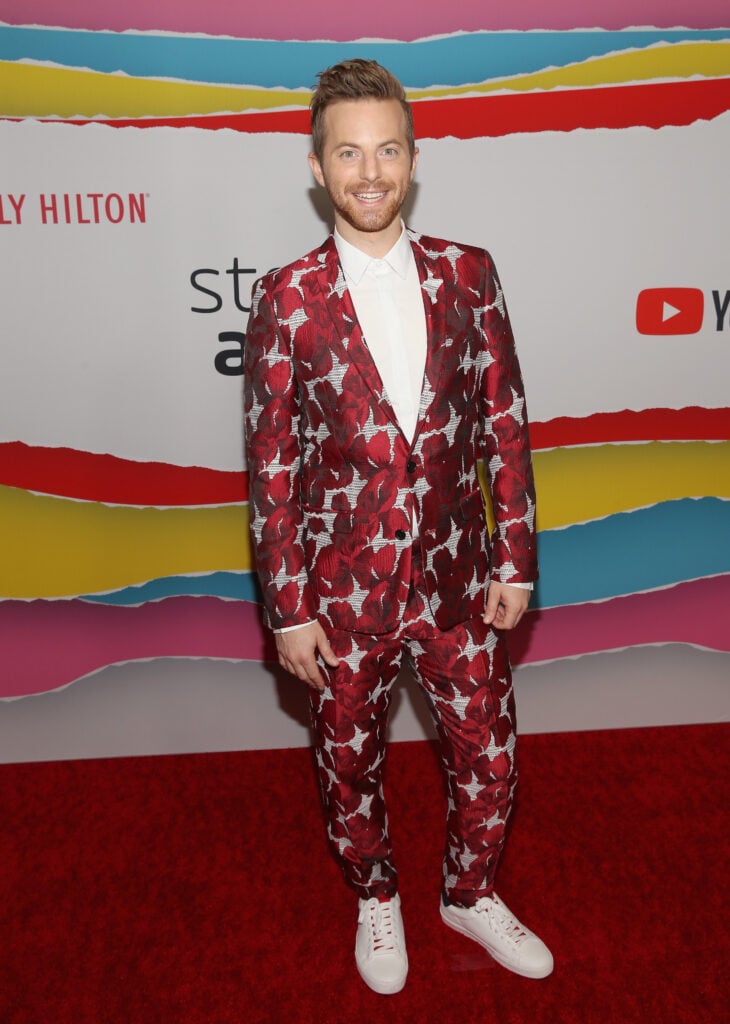
Ned Fulmer (L) attends The 9th Annual Streamy Awards on December 13, 2019. (Photo Credit: Presley Ann/Getty Images for dick clark productions)
Somehow, Ned Fulmer has returned
In 2022, Ned Fulmer admitted to having an extramarital affair.
He was cheating with an employee (who was herself engaged).
He and the other Try Guys — formerly of Buzzfeed before spinning off with their own production company — parted ways after the fact.
An affair is a personal choice that harms a marriage and family and even the other party.
In this case, fishing in the company pond (what a strange metaphor) meant that it cost Fulmer his career.
Ned and Ariel did not immediately file for divorce in 2022.
Now, however, they have separated.
This confirms other reporting that they were no longer together romantically.
A spokesperson for Ned toldPeople that he “cares deeply” for his wife.
This summer, they apparently traveled to Greece with their two children.
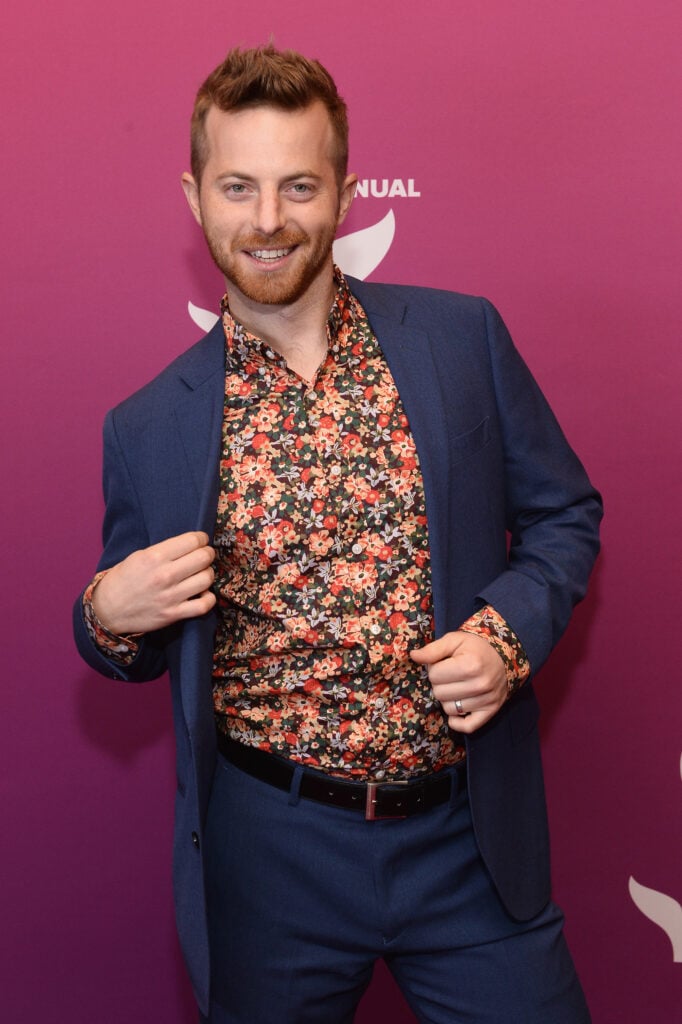
Ned Fulmer of The Try Guys attends the 11th Annual Shorty Awards on May 05, 2019. (Photo Credit: Noam Galai/Getty Images for Shorty Awards)
Of course, he’s sharing this news to promote his new podcast
Ned Fulmer is launching a new podcast, Rock Bottom.
On the very first episode, he and Ariel will be holding their first-ever public discussion about his affair.
They will not be the first couple to monetize an affair.
And they won’t be the last.
Zach Kornfeld, Keith Habersberger, Ned Fulmer, and Eugene Lee Yang pose with their award during the 11th Annual Shorty Awards on May 05, 2019. (Photo Credit: Astrid Stawiarz/Getty Images for Shorty Awards)
“For a long time, I wanted nothing to do with social media or the internet,” Fulmer told People this week.
“I didn’t think it was particularly beneficial to my mental health,” he admitted.
The affair came to light because he (a very internet-famous person) and his former mistress were going out and partying and dancing publicly.
This summer’s Coldplay cheating scandal (no members of the band were involved) reminded many of Ned’s infidelity.
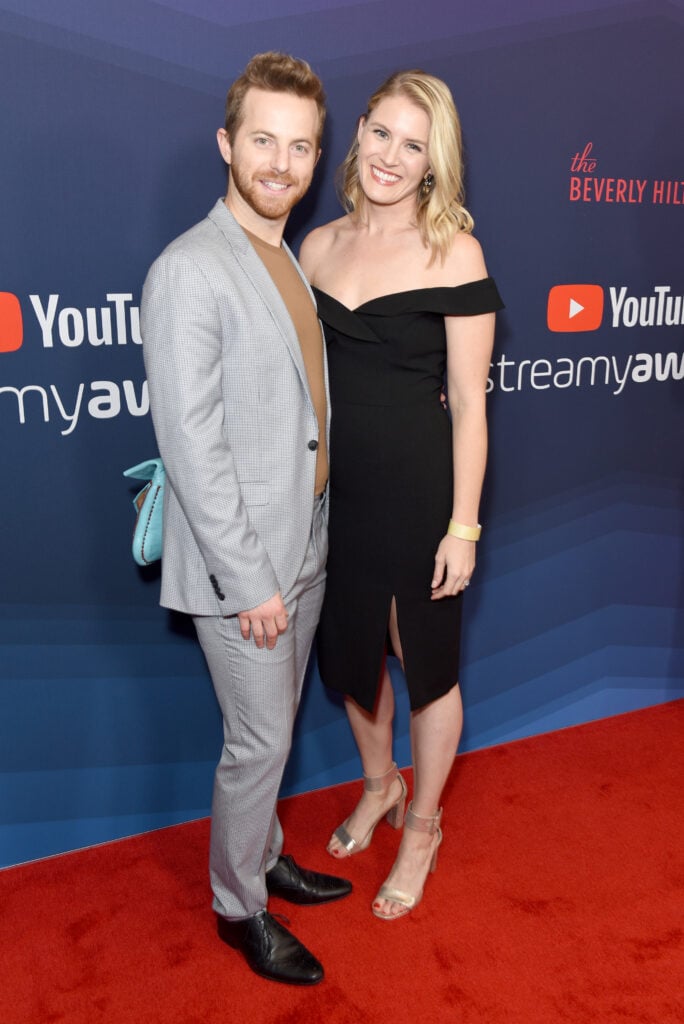
Ned Fulmer attends The 8th Annual Streamy Awards at The Beverly Hilton Hotel on October 22, 2018. (Photo Credit: Jesse Grant/Getty Images for Streamy Awards)
Why wait three whole years and suddenly announce a split and tell all?
Online, some Try Guys fans (former fans of Ned Fulmer himself) have speculated that perhaps he signed an NDA that has now expired.
It was, after all, in September 2022 when the scandal erupted and he parted ways with his former colleagues.
We’re not sure what Ariel is getting out of this.
Perhaps, if the podcast does well, some substantial alimony payments. She has shown more patience with Ned than most.
Amanda Seyfried is the latest public figure to come under fire for her remarks about the murder of Charlie Kirk.
Earlier this week, Seyfried responded to an Instagram post about Kirk in a way that drew the ire of some of the late pundit’s supporters.
“‘Ask yourself, why is exposing the flaws of MLK’s life and character — something he said we should judge others by — so controversial?’ – Charlie Kirk, January 2024,” the post read.
Amanda Seyfried attends the premiere of “The Testament of Ann Lee” during the 2025 Toronto International Film Festival at TIFF Lightbox on September 09, 2025 in Toronto, Ontario. (Photo by Leon Bennett/Getty Images)
Seyfried’s Charlie Kirk comments draw backlash
Seyfried replied to the comment with “He was hateful” (per Page Six).
The actress also shared a text post reading, “You can’t invite violence to the dinner table and be shocked when it starts eating.”
Not surprisingly, many of her followers assumed she was referring to Kirk.
And quite a few X users reacted with outrage:
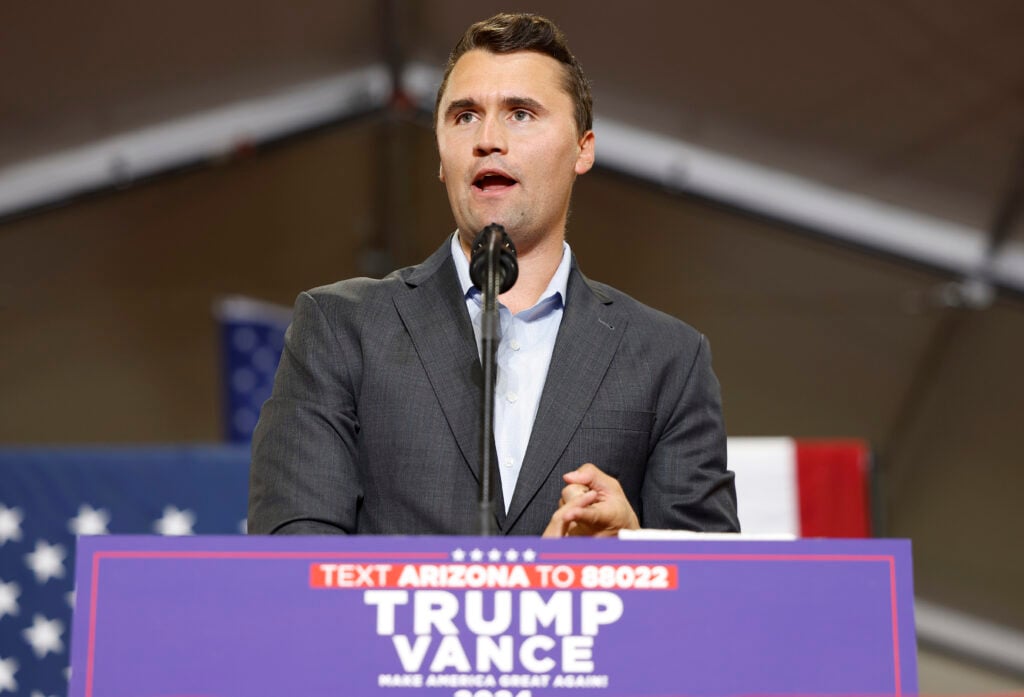
Charlie Kirk, who founded Turning Point USA, speaks before Republican vice presidential nominee U.S. Sen. JD Vance gives remarks at a campaign rally at Arizona Christian University on July 31, 2024 in Glendale, Arizona. (Photo by Anna Moneymaker/Getty Images)
“Amanda Seyfried believes Charlie Kirk assassination was justified. Make sure to never see another one of her movies,” said one critic.
“I am not watching any More Movies with Amanda Seyfried SHE IS SPREADING THE LIE THAT CHARLIE Kirk was Hateful She should lose her Job. HAS SHE ACTUALLY WATCHED ANY OF CHARLIE KIRK VIDEOS,” another chimed in.
Of course, at no point did Seyfried condone Kirk’s murder or any sort of political violence, for that matter.
She took to Instagram today to defend and clarify her remarks.
“We’re forgetting the nuance of humanity,” Seyfried wrote from her verified account.
“I can get angry about misogyny and racist rhetoric and ALSO very much agree that Charlie Kirk’s murder was absolutely disturbing and deplorable in every way imaginable,” she continued, adding:
“No one should have to experience this level of violence. This country is grieving too many senseless and violent deaths and shootings. Can we agree on that at least?”
Amanda Seyfried attends Best Friends Animal Society’s Benefit to Save Them All at The Glasshouse on September 26, 2024 in New York City. (Photo by Jamie McCarthy/Getty Images for Best Friends Animal Society)
Clearly, this is an emotionally charged issue, the sort of thing that benefits best from nuance and sensitivity –two qualities that are generally in short supply on social media.
Thus, every conversation about the recent rise in politically motivated violence will be a landmine for the foreseeable future.
The “spirited discourse” Amanda called for her in one of her posts seems an awfully long way off.
Earlier this month, grisly human remains in an abandoned Tesla created a tragic mystery for investigators.
The remains of the late teenage girl have now been identified. Her loved ones are grieving.
The vehicle registration belonged to the singer, D4vd. Will knowing this poor girl’s name bring anyone closer to answers?
On stage, D4vd sings for the audience. (Image Credit: YouTube)
The body in D4vd’s Tesla has been identified
On September 8, Los Angeles authorities discovered human remains within a Tesla vehicle.
The dubious electronic car is registered to singer David Anthony Burke, best known as D4vid from his TikTok fame.
The remains were heavily decomposed. There were signs of possible dismemberment, with multiple pieces of the body wrapped in plastic within the car’s front trunk.
At first, the world only knew that the deceased appeared to have been a girl with black hair.
She was in her early teens, with a tattoo on her right index finger.
LAPD finds decomposing bodies in two vehicles, one in a Tesla linked to singer D4vd
As far as anyone can tell, there were no reports of the Tesla being stolen.
Instead, it seemed that someone had abandoned the car in the Hollywood Hills five days earlier.
The remains had apparently been in the car for some time before they were discovered. It was, to understate matters, a grim find.
d4vd performs at Gobi Tent during the 2025 Coachella Valley Music and Arts Festival on April 20, 2025. (Photo Credit: Arturo Holmes/Getty Images for Coachella)
Celeste Rivas’ loved ones are mourning
Now, authorities have identified this poor girl as 15-year-old Celeste Rivas.
She went missing from Lake Elsinore, California in April of 2024.
That was nearly a year and a half before this horrific find in the Hollywood Hills.
Singer D4vd speaks about how he became famous accidentally — because his dream was to play Fortnite professionally. (Image Credit: YouTube)
TMZ spoke to Celeste’s mother, who shared that she believed that the body might be her daughter’s due to one key detail.
In addition to matching the same age, the body in the Tesla had a finger tattoo reading “Shhh…” that she suspected matched her daughter’s.
It seems that the LAPD’s Robbery Homicide division is continuing to work the case.
What happened?
It is important that we emphasize that D4vd has been on tour. He has exactly one studio album, Withered.
Never reporting the vehicle as stolen may simply mean that the 20-year-old did not know that the vehicle had gone missing.
By all accounts, he is cooperating fully with investigators.
We hesitate to speculate about what befell Celeste before her passing.
In time, investigators will uncover more information. Until then, speculation — or worse, theorizing about the culprit — can be downright dangerous.