Categories
Featured Juneau News Juneau Local Ketchikan Local News Feeds Sitka Local

The Salvation Army’s Christmas support programs are underway for Juneau families in need

NOTN- The Salvation Army in Juneau is gearing up for a busy holiday season that includes Christmas food boxes, and the annual Angel Tree and Red Kettle programs.

Major Peter Janousek said the organization is continuing its Angel Tree program, which provides gifts to children from families who may be struggling this holiday season.

“The Angel Tree program is designed for families with low income or those who struggle to get gifts for their children.” Said Janousek.

Parents can apply online at saangeltree.org. Community members can pick up anonymous gift tags at Fred Meyer, Western Auto Marine, First Bank’s valley branch and the Mendenhall Mall, then return purchased items to the drop sites.

Those gifts will be distributed Dec. 20.

Holiday food boxes will also be available, containing a full Christmas dinner including ham or turkey.

“Fair to say that I’m not American. We came from the Czech Republic, so our traditional dinner is absolutely different.” Said Janousek, ” It is in partnership with Women of the Moose Club, it’s a thing which has been done many years. And last year, when I saw it for the first time, I was amazed. It’s like very well oiled machine. The distribution day is amazing, when people come, and they can collect all those things, and they are thankful, it’s great.”

The Salvation Army is also seeking volunteers for its Red Kettle bell-ringing campaign, which runs starting today until December 24, at stores throughout Juneau, including Foodland, Safeway, Fred Meyer and Super Bear.

“People can register to ring at the web page, which is registertoring.com, and they just need to put Juneau, and then they will see the schedule for all those places, and they can find an empty spot. Sign up for 2,4,6, or 8, hour shifts if they want to, and we will do all the rest.” Janousek said.

The organization emphasized that these initiatives rely on the generosity and volunteerism of the local Juneau community to make the holidays brighter for everyone.

Categories
Featured Juneau News Juneau Local Ketchikan Local News Feeds Sitka Local

Shoppers spend billions on Black Friday to snag holiday deals, despite wider economic uncertainty

Shoppers browse through stores at Mall of America for Black Friday deals, Friday, Nov. 28, 2025, in Bloomington, Minn. (AP Photo/Adam Bettcher)

AP- Despite wider economic uncertainty hovering above this year’s holiday season, shoppers turned out in big numbers for Black Friday — spending billions of dollars both in stores and online.

Adobe Analytics, which tracks e-commerce, said U.S. consumers spent a record $11.8 billion online Friday, marking a 9.1% jump from last year. Traffic particularly piled up between the hours of 10 a.m. and 2 p.m. local time nationwide, when $12.5 million passed through online shopping carts every minute.

Consumers also spent a record $6.4 billion online on Thanksgiving Day, per Adobe. Top categories that saw an uptick in sales across both days included video game consoles, electronics and home appliances. Shopping services powered by artificial intelligence and social media advertising have also particularly influenced what consumers choose to buy, the firm said.

Meanwhile, software company Salesforce — which tracks digital spending from a range of retailers, including grocers — estimated that Black Friday online sales totaled $18 billion in the U.S. and $79 billion globally. And e-commerce platform Shopify said its merchants raked in a record $6.2 billion in sales worldwide on Black Friday. At its peak, sales reached $5.1 million per minute — with top categories including cosmetics and clothing, according to the Canadian company.

Mastercard SpendingPulse, which tracks in-person and online spending, reported that overall Black Friday sales excluding automotive rose 4.1% from a year ago. The retail sales indicator, which is not adjusted for inflation, showed online sales jumped by double digits (10.4%), while in-store purchases inched up 1.7%.

Michelle Meyer, chief economist at the Mastercard Economics Institute, said consumers are “navigating an uncertain environment” this holiday season “by shopping early, leveraging promotions, and investing in wish-list items.”

Black Friday is far from the sales event that created midnight mall crowds or doorbuster mayhem just decades ago. More and more consumers have instead turned to online deals to make post-Thanksgiving purchases from the comfort of their own homes — or opt to stretch out spending across longer promotions now offered by retailers.

In-store traffic has dwindled over the years. Initial data from RetailNext, which measures real-time foot traffic in physical stores, found that U.S. Black Friday traffic fell 3.6% compared to 2024. Still, the firm noted that was “notably better” than a sharper 6.2% decline it saw in the days leading up to Thanksgiving.

Sensormatic Solutions, which also tracks store traffic, found that in-store retail visits dipped 2.1% — but said that was in line with expectations and trends already seen this year. Traffic over the week of Black Friday was up nearly 57% compared to the week prior, per Sensormatic.

“Black Friday has really turned into like a full week event, or even further,” said Grant Gustafson, head of retail consulting and analytics at Sensormatic Solutions. And “Black Friday is really the start of just a really and critical stretch for retailers,” he added — noting that the weekend following Thanksgiving, as well as the days leading up to Christmas next month, will also be some of the busiest in terms of in-store traffic.

Meanwhile, in terms of e-commerce, Adobe expects U.S. shoppers to spend another $5.5 billion Saturday and $5.9 billion on Sunday — before reaching an estimated $14.2 billion peak on Cyber Monday, which would mark yet another record.

Still, rising prices could be contributing to some of those numbers. U.S. President Donald Trump’s barrage of tariffs on foreign imports have strained businesses and households alike over the last year. And despite spending more overall, Salesforce found U.S. shoppers purchased fewer items at checkout on Black Friday (down 2% from last year). Order volumes also slipped 1%, the firm noted, as average selling prices climbed 7%.

This year’s holiday spending rush arrives amid heightened economic uncertainty for consumers. Beyond tariffs, workers across public and private sectors are also struggling with anxieties over job security — amid both corporate layoffs and the after-effects of the 43-day government shutdown.

An uptick in budget-conscious behavior can also be seen in store traffic. While Sensormatic doesn’t track spending, “we do track consumer footsteps,” Gustafson notes — and “consumers are thinking a little bit harder about their purchases” this year, he explains, “to make sure that they’re getting their very best deals.”

For the November-December holiday season overall, the National Retail Federation estimates U.S. shoppers will spend more than $1 trillion for the first time this year. But the rate of growth is slowing — with an anticipated increase of 3.7% to 4.2% year over year, compared to 4.3% in 2024’s holiday season.

At the same time, credit card debt and delinquencies on other short-term loans have been rising. And more and more shoppers are turning to “buy now, pay later” plans, which allows them to delay payments on holiday decor, gifts and other items.

Categories
Featured Juneau News Juneau Local Ketchikan Local News Feeds Sitka Local

Pebble Mine, halted by EPA order, gets support from national development groups

By: James Brooks, Alaska Beacon

Kaskanak Creek in the Bristol Bay’s Kvichak watershed is seen from the air on Sept. 27, 2011. The Kvichak watershed would be damaged by the Pebble mine project, the Environmental Protection Agency has determined. (Photo provided by Environmental Protection Agency)

Developers’ efforts to overturn the cancellation of a vast gold and copper mine planned for southwest Alaska are getting a boost from national mining and pro-business groups, including the U.S. Chamber of Commerce.

On Nov. 24 and Nov. 25, the Chamber and the National Mining Association filed separate friend-of-the-court briefs in the lawsuit brought by the developers of the proposed Pebble Mine against the Environmental Protection Agency, which vetoed the mine.

Neither group has intervened in the case against the EPA, but the briefs represent the groups’ support for the proposed mine and offer legal arguments that Judge Sharon Gleason could consider as she debates whether to move the project forward.

In 2023, the EPA invoked a rarely used “veto” clause of the Clean Water Act to say that there was no way that the proposed Pebble Mine could be developed without significant harm to the environment. The large mineral deposit is located at the headwaters of Bristol Bay, the most abundant sockeye salmon fishery in the world.

The administration of Gov. Mike Dunleavy, which supports the project, and the proposed mine’s developers, filed separate lawsuits in federal court to overturn the rejection, as did two Native corporations that work as contractors for the developers. Those cases have since been combined.

The U.S. Supreme Court declined to hear the case directly, which has left the issue in front of Judge Sharon Gleason in the U.S. District Court for the District of Alaska.

Another lawsuit filed by the state claims that if the veto is upheld, the federal government will owe Alaska $700 billion, the state’s estimate for the value of the mine if built as planned. That case has been put on hold until the District Court rules.

In July, the administration of President Donald Trump indicated that it might try to settle the suit and withdraw the veto. If that occurs, it could come before Jan. 2, when the EPA is slated to file a written response to the plaintiffs’ motions for summary judgment. 

If the EPA continues to fight the case, the last written arguments are scheduled to be finished by the end of February. Any oral argument would take place afterward.

If the federal government drops the case, it doesn’t mean a free path for Pebble: Several environmental organizations, fishing groups, tribal organizations and Bristol Bay locals have also intervened in the case and intend to fight in court. 

The Alaska Legislature is also expected to consider a bill that would block both Pebble and any successor projects that might emerge.

In its brief, the National Mining Association — joined by the American Exploration and Mining Association and the Alaska Miners Association — call the EPA’s veto “overly broad” and say that if it is upheld, the act “will almost certainly chill investment in domestic mining activities” because other proposed mines could also be subject to a veto.

The Chamber of Commerce, which has backed the Pebble Mine project since at least 2022, said that if the veto is upheld, it has the potential of encouraging other vetoes, which would “disrupt important industries in which many of the Chamber’s members participate.”

Categories
Featured Juneau News Juneau Local Ketchikan Local News Feeds Sitka Local

Alaska regulators order Hilcorp to pay nearly $700,000 for gas injections at North Slope field

By: Yereth Rosen, Alaska Beacon

The Alaska headquarters of Prudhoe Bay operator Hilcorp in Midtown Anchorage is seen on Feb. 7, 2024. The Alaska Oil and Gas Conservation Commission assessed a fine of $695,900 against the company for activities at a Prudhoe Bay satellite field. Hilcorp has the right to appeal the fine. (Photo by Yereth Rosen/Alaska Beacon)

Alaska regulators have assessed a $695,900 fine against Hilcorp for violations at two wells in a North Slope oil field that is a satellite of the giant Prudhoe Bay field.

Hilcorp violated regulations for up to two years when it injected enriched gas into the reservoir at the Polaris Oil Pool, which is part of the Greater Prudhoe Bay Unit, the Alaska Oil and Gas Conservation Commission said in a Nov. 24 decision and order.

Hilcorp is a Texas-based private company that now operates the state’s largest oil field. It is the second-biggest fine for the company ever proposed by the AOGCC.

The highest proposed fine was $720,000, which the commission initially assessed against the company in late 2015 for violations that led to an accident earlier that year that nearly killed three workers at the Milne Point oil field.

Ultimately, the AOGCC in 2017 reduced the fine to $200,000, though the commission assessed other fines at about the same time for other violations at Milne Point. Those fines ranged from $20,000 to $80,000.

In its new enforcement action, the AOGCC said the fine for the Polaris field violations is justified by the company’s pattern of violations.

“Hilcorp’s repeated failure to comply with fundamental injection authorization raises the potential for similar behavior with more serious consequences. Hilcorp’s repeated failure to comply with AOGCC rules and regulations combined with ineffective corrective actions, warrant increased civil penalties to deter similar behavior,” the order said.

Also influencing the fine size is the duration of the offenses. At one well, the unauthorized injection continued for 759 days, the AOGCC said. At the other well, the unauthorized injection went on for 480 days.

Enriched gas is sometimes injected into oil fields to boost oil recovery.

The enforcement action has been in the works for several months.

The AOGCC said that in February, it formally notified Hilcorp that it was investigating the use of enriched gas at the two wells. Hilcorp then conducted an internal investigation, responding to the AOGCC in March with an analysis of the root cause and actions to correct the problem and prevent a recurrence.

Because of that response earlier in the year, the AOGCC said it is not requiring Hilcorp to submit any further written explanation.

Hilcorp has the right to appeal the $695,900 fine. If it does not appeal, Hilcorp must pay within 30 days of the decision, the order said.

A company spokesperson said Hilcorp itself brought the violation to light and that it did not result in any safety or environmental problems.

“This issue involved a highly specific and previously unrecognized authorization gap that neither Hilcorp nor prior Prudhoe Bay operators had identified. We discovered it through an internal review informed by recent AOGCC findings, and we immediately notified the Commission and self-reported all details,” Hilcorp spokesperson Matt Shuckerow said by email.

Shuckerow said the use of enriched gas is safe and permitted on many neighboring wells “as part of an effort to increase resource recovery, which results in increased royalty and revenue to the State of Alaska,” he continued.

“It caused no safety risks, environmental harm or impacts to resource conservation. We have completed a comprehensive review of all wells to ensure no similar gaps exist and will continue working transparently with AOGCC to uphold the highest standards of safety, conservation, and regulatory compliance,” he said.

Shuckerow did not address the question of appealing the fine.

Hilcorp entered Alaska in 2011, focusing first on the Cook Inlet basin, where it is now the dominant operator, before expanding to the North Slope in 2014. In 2020, when BP Exploration (Alaska) Inc. sold its remaining Alaska assets to Hilcorp and ended its activities in the state, Hilcorp became the operator of the Prudhoe Bay unit. Prudhoe Bay is now co-owned by oil companies ConocoPhillipsExxonMobil and Hilcorp.

Since it began operating in Alaska in 2011, Hilcorp has been the subject of 20 AOGCC enforcement orders, including the latest order, according to the commission’s website. Eleven concerned violations on the North Slope and nine concerned violations at Cook Inlet sites, according to the website.

Five of those orders were issued in 2024, including one that assessed a $452,100 fine for unauthorized injections at Prudhoe Bay of a type of gas used to enhance oil recovery.

Different type of enhanced recovery technique gets OK

Although the AOGCC faulted Hilcorp for its unauthorized use of enriched gas at Polaris, it has approved Hilcorp’s plan to try out a different type of enhanced recovery at the field.

The commission on Nov. 25 gave the go-ahead for Hilcorp to use polymer flooding at a different Polaris well for a 12-month test period.

The approval is unrelated to the Nov. 24 order and decision on the enhanced gas violation.

Polymers are natural or synthetic materials, such as cellulose and nylon, that consist of chains of molecules arrayed in a repeated pattern.

Polymer flooding in oil fields injects water-soluble polymers into reservoirs to increase oil recovery. The injected polymers blend with water to better sweep out oil. Polymer flooding is considered an effective technique to boost oil production, but it does not work in all types of reservoirs, according to scientists. The technique is most appropriate for enhanced recovery of heavier oils, according to the U.S. Department of Energy.

Hilcorp pioneered the use of polymer flooding on the North Slope, starting in 2018 with a test project conducted at Milne Point in collaboration with the University of Alaska Fairbanks and the U.S. Department of Energy.

The pilot project was deemed successful, and Hilcorp now uses the technique more widely at Milne Point, where polymer flooding has allowed for much better recovery of the thicker oil that is within that field.

With the help of polymer flooding and other actions, Hilcorp has increased Milne Point production from about 18,400 barrels per day in late 2014 to about 50,000 barrels per day now.

Hilcorp in 2014 acquired 50% ownership in Milne Point from BP and became the operator that year. Hilcorp took full ownership in 2020, after the acquisition from BP was completed.

The company has for years considered expanding some of the practices that have improved production at Milne Point to the parts of the Greater Prudhoe Bay Unit, which also holds some heavier oil. The now-authorized 12-month test at the Polaris well is part of that strategy.

Categories
Featured Juneau News Juneau Local Ketchikan Local News Feeds Sitka Local

Alaska state utility regulators approve secrecy orders for billionaire’s takeover of GCI

By: James Brooks, Alaska Beacon

The Regulatory Commission of Alaska has unanimously approved a series of requests for financial secrecy filed by attorneys representing John Malone, the telecom billionaire seeking to take a controlling interest in Alaska’s largest internet firm.

The approval means Malone will not be required to publish his personal finances and that the financial condition of three GCI-related subsidiaries will also remain secret. The finances of GCI Liberty, the parent company, are already public due to required filings with the U.S. Securities and Exchange Commission.

In October, Malone, 84, told the Wall Street Journal that he would be stepping away from day-to-day operations of his various companies but would retain his controlling interests. Bloomberg has estimated his net worth to be approximately $10.6 billion.

The approval was published just before 4 p.m. on Black Friday. The five governor-appointed commissioners said they were granting the requests because they were in line with the commission’s prior practices, because they don’t have the power to regulate much of GCI Liberty’s business, and because “the public interest in disclosure of the financial information of (the three subsidiaries) is outweighed by the potential competitive financial disadvantages demonstrated in the petition.”

The chair of GCI’s parent company, GCI Liberty, Malone holds shares controlling 53.5% of GCI Liberty’s voting power. But Malone’s personal power has been restricted until recently to 49.32% of the company’s voting power, regulatory filings state.

Now, Malone is seeking to increase his voting power above 50%. 

The commission’s Friday order does not decide that request; it addressed the combined requests for financial secrecy on behalf of Malone and the three GCI Liberty subsidiaries.

Alaskans submitted a combined 67 comments across three dockets related to Malone’s proposal. Almost all were opposed to the request for secrecy. 

In a response to those comments, Malone’s attorneys said “no legitimate public interest will be served by requiring (Malone) to file his personal financial information.”

The response also said that “the acquisition … will be seamless and transparent to customers because the GCI companies will continue to provide the same services to Alaska customers under their same experienced management. There will be no operational or management changes to the GCI companies as a result of the acquisition.”

GCI’s attorneys had argued that the financial statements of the three subsidiaries should stay confidential because GCI’s competitors were not required to reveal their finances, and it would be unfair for them to open their books.

“We find that disclosure … might create a competitive or financial disadvantage,” the regulators concluded.

In addition, unlike the way that water and power utilities’ rates are regulated by the RCA, GCI’s prices are not regulated by state law. 

For that reason, plus the fact that GCI Liberty’s combined financial statements are publicly available, regulators concluded, “public interest in disclosure … is outweighed by the potential competitive financial disadvantages demonstrated in the petition.”

On the request for secrecy covering Malone himself, Malone’s attorneys argued that he isn’t legally obligated to provide financial support to GCI Liberty, and thus, “requiring the submission of his personal financial information would not advance a public interest objective.”

They also argued that in 2018, when wealthy telecom entrepreneur Jane Eudy obtained full control of several Interior Alaska telecom companies by taking 100% control of American Broadband, a national firm, the RCA did not require her to publicize her finances.

Members of the public argued that disclosure is in the best interests of Alaskans. 

Megan Johnson, one of dozens of people who offered public comments, said, “Telecommunications in Alaska are not just about convenience, they are lifelines for education, healthcare, emergency services, and economic development, especially in rural and Indigenous communities. Decisions made by owners unfamiliar with our terrain, seasonal challenges, and cultural values risk undermining the progress we’ve made in closing the digital divide.”

Kirsa Hughes-Skandijs of Juneau wrote, “I am gravely concerned about the idea of concealing financial information, particularly when it comes to consolidating control of a public good like an ISP, broadcast and telecommunications company.”

Commissioners ultimately sided with Malone.

“We find the circumstances presented in these dockets similar to those we considered (in 2018),” they wrote.

“We find that under the circumstances … no legitimate public interest will be served by requiring Dr. Malone to provide a statement of financial condition.”

Commissioners are scheduled to make a final determination on Malone’s takeover by April 1.

Categories
Featured Juneau News Juneau Local Ketchikan Local News Feeds Sitka Local

Alaska timber industry says it needs more supply to survive

By: Larry Persily, Wrangell Sentinel

U.S. Forest Service workers clear a fallen tree from a trail in the Tongass National Forest. (U.S. Forest Service photo)

It was no surprise that everyone on the timber panel at this month’s Alaska Resource Development Council conference had the same message: The industry needs a larger supply of trees to cut.

And a steady, bankable supply, said Joe Young, of Tok, who started Young’s Timber in Alaska’s Interior more than 30 years ago.

Without long-term timber sales to supply a mill, “bankers will laugh you out of the room” when a mill owner asks for a business loan, Young said.

The Nov. 13 industry panel at the annual conference held in Anchorage also talked about demand for their product and the challenges in meeting that demand.

Juneau attorney Jim Clark, who has spent much of his life representing timber and wood pulp companies, said the Trump administration’s move to rescind the Roadless Rule, which has been around since 2001, could help open areas of the Tongass National Forest to logging.

The ban on road building has bounced between presidential administrations, like a ping pong ball, Clark said. “We’ll see if we can get this over with,” he said of the U.S. Department of Agriculture effort to rescind the rule, which will require an environmental impact statement.

In addition to the Tongass, the Roadless Rules affects tens of millions of acres of national forest lands in western states.

The lack of timber sales, financial pressures and opposition from conservation groups have knocked down Alaska timber industry jobs from almost 4,000 in 1990 to about 700 in 2015 and just 360 in 2024, according to Alaska Department of Labor statistics.

The timber industry in Southeast is getting only one-third of the log supply it needs, said Sarah Dahlstrom, public relations manager for Viking Lumber, which has operated a sawmill in Klawock for about 30 years.

Viking, the second-largest employer on Prince of Wales Island, needs more timber sales on federal, state and municipal lands, she said, contending that the U.S. Forest Service has failed to meet its commitment under a 2016 land management plan.

The mill cuts Sitka spruce, hemlock, red and yellow cedar, Dahlstrom said, and is a leading supplier of wood for piano soundboards and guitars.

“Steinway pianos would not exist if not for old-growth timber from the Tongass,” she said.

In addition to supplying the prized, tight-grain wood to Steinway & Sons’ factory in New York City, Viking supplies piano makers Kawai and Yamaha, and guitar manufacturers Gibson and Martin.

Steinway is worried enough about its wood supply that the company has written Alaska elected officials to advocate for the mill. “We use the top 1% of the top 1% of spruce,” company Chief Executive Ben Steiner told The Wall Street Journal this summer.

Dahlstrom said there are other small operators on Prince of Wales Island, cutting wood for pianos and musical instruments. And they all have the same problem of insufficient and unpredictable supply.

Viking also supplies manufacturers of doors, trim, fences, staircases, railing and window trim nationwide.

She complimented efforts by Wrangell Borough Manager Mason Villarma, who has been working to coordinate timber sales on the island between the state Department of Natural Resources, Alaska Mental Health Trust land office and the borough.

“I was born into a timber family,” she said of her dad and uncle, who built a mill in Hoquiam, Washington, more than 40 years ago, milling timber from the Olympic National Forest. She said she was not happy when her family moved to Klawock in 1994 and her dad and uncle took over the bankrupt mill.

In addition to lumber and boards, Viking sends wood chips south to be used in making corrugated boxes and supplies chips to the Craig School District which burns the wood waste to generate electricity and heat the swimming pool.

“Growing up, I didn’t know how cool it was,” she said of the industry she now calls home after resisting it when she was younger.

Categories
Featured Juneau News Juneau Local Ketchikan Local News Feeds Sitka Local

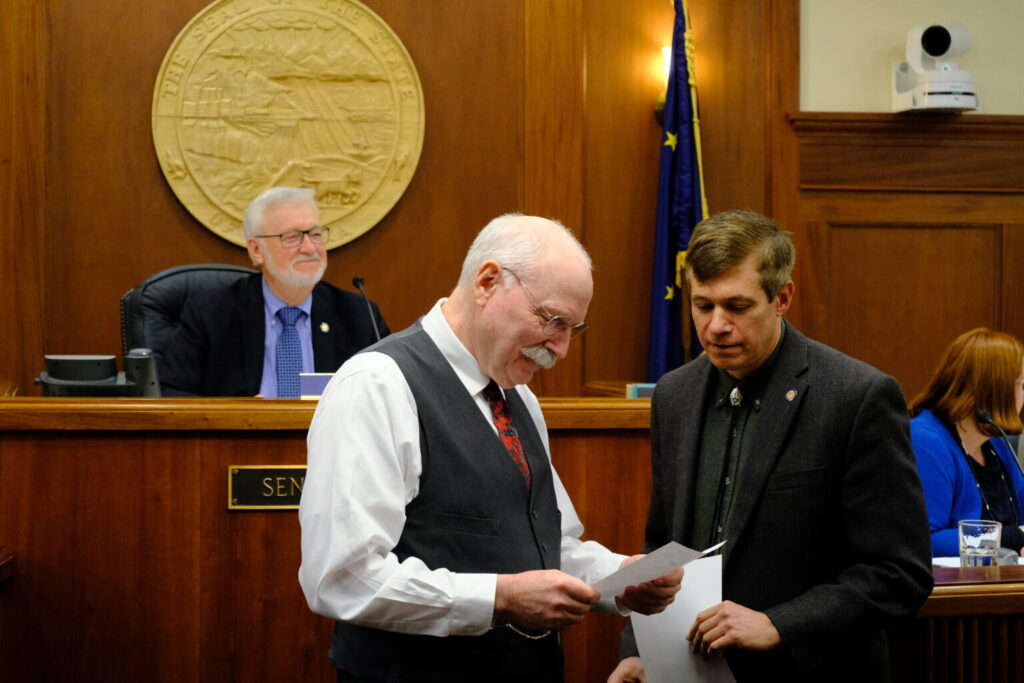
Dunleavy appoints Rauscher and Tilton to Alaska Senate, opening two House vacancies

By: James Brooks, Alaska Beacon

Speaker of the House Cathy Tilton, R-Wasilla, talks to fellow lawmakers about rules for debate on House Bill 183 on Saturday, May 11, 2024. (Photo by James Brooks/Alaska Beacon)

Gov. Mike Dunleavy has appointed state Reps. George Rauscher, R-Sutton, and Cathy Tilton, R-Wasilla, to two vacancies in the Alaska Senate.

Each nomination will become effective if at least five of the Senate’s nine other Republicans approve them. Senate President Gary Stevens, R-Kodiak, said the votes will take place by secret ballot at 10 a.m. Saturday in Anchorage.

“Honestly, I think both of them are excellent candidates,” Stevens said on Wednesday, adding that he expects both to be confirmed.

If Rauscher and Tilton are confirmed, their House seats would become vacant, and Dunleavy would be required to appoint replacements within 30 days of their resignations. 

The two Senate seats became vacant after Sen. Mike Shower, R-Wasilla, resigned to run for lieutenant governor and Sen. Shelley Hughes, R-Palmer, resigned to run for governor.

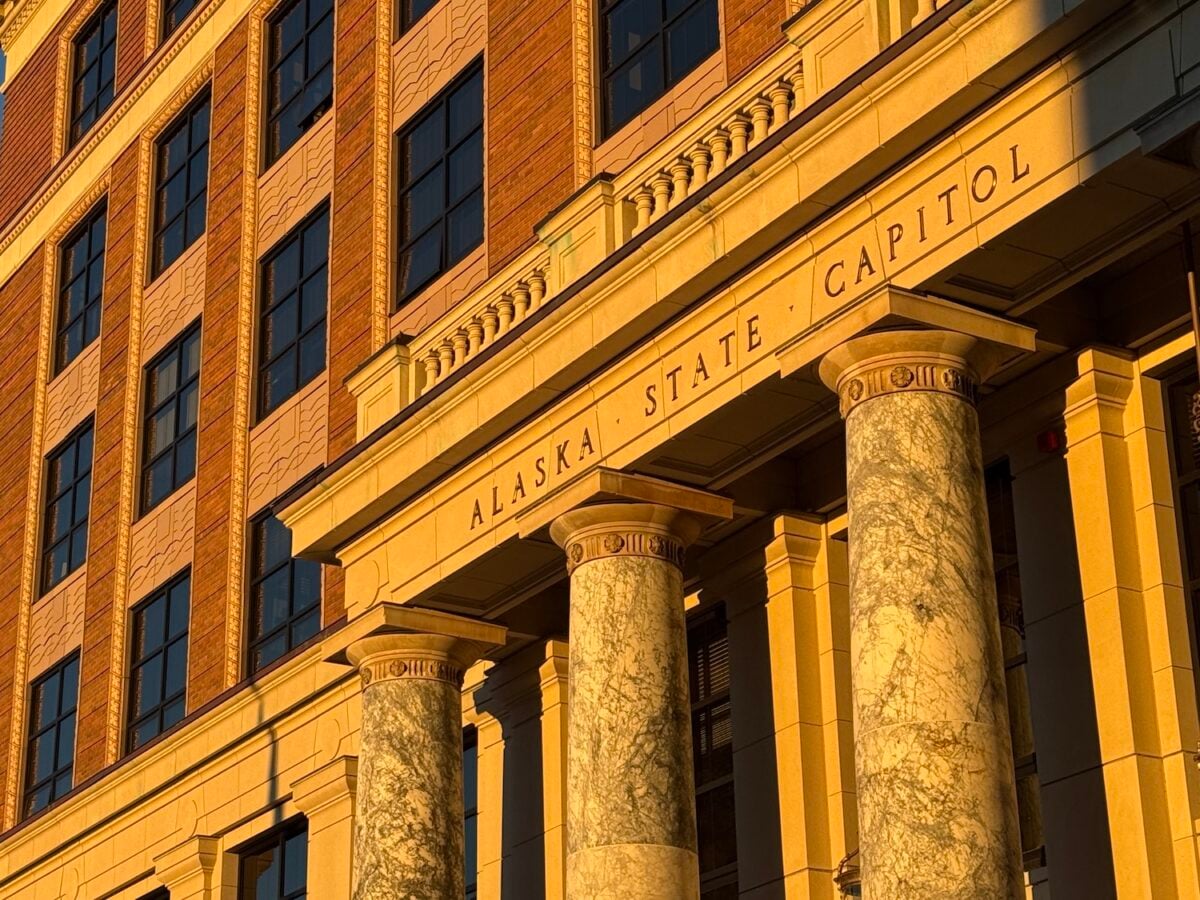
The office of former Sen. Mike Shower, R-Wasilla, is seen in the Alaska state Capitol on Tuesday, Nov. 25, 2025. Shower's nameplate has been removed from beside the door, but a sticker commemorating Shower's time as an F-22 fighter pilot remains on the door. (Photo by James Brooks/Alaska Beacon)
The office of former Sen. Mike Shower, R-Wasilla, is seen in the Alaska state Capitol on Tuesday, Nov. 25, 2025. Shower’s nameplate has been removed from beside the door, but a sticker commemorating Shower’s time as an F-22 fighter pilot remains on the door. (Photo by James Brooks/Alaska Beacon)

Dunleavy’s picks were due no more than 30 days after their resignations, but he acted earlier, which will allow the replacement legislators to take office before the regular legislative session convenes in January.

“I can’t think of two Alaskans more qualified and committed to public service to serve in the Alaska Senate than Representatives Rauscher and Tilton,” Dunleavy said in a statement announcing the selections. “I have known and worked with both for as long as I have been in public office and I look forward to working collaboratively with them as senators. I also want to thank the local Republican district committees for taking the time to meet, deliberate, and send forward names for these seats. This process works best when the people closest to the communities are involved.”

Tilton, first elected to the House in 2014, was Speaker of the House from 2023 through 2024. Reached by phone on Wednesday in the middle of Thanksgiving shopping, she referred to a statement on her Facebook page.

“I look forward to collaborating with my Senate colleagues to advance sensible policy solutions, foster an energy renaissance, and usher in an era of renewed prosperity for all Alaskans,” the statement said in part. 

Rep. George Rauscher, R-Sutton, speaks in favor of the creation of an Alaska Department of Agriculture by executive order on Wednesday, March 19, 2025. (Photo by James Brooks/Alaska Beacon)

Rauscher said he’s already at work on a letter thanking Dunleavy for his appointment, but he declined to say what he thinks his confirmation chances are.

“It’s an honor,” Rauscher said of the appointment, “and I feel like it was quite the undertaking — the process — and to have it this close to seeing what the final outcome is, is always a relief in some ways, but it’s also very exciting that I am this close. So I appreciate the fact that the governor did consider me and thought highly enough of me to appoint me.”

Several senators said they expect Rauscher and Tilton to be confirmed, but each declined to say how he or she will vote, citing the need to work with them regardless.

Of the nine Republican senators who will be voting on this weekend’s confirmations, five are members of the Senate’s bipartisan majority caucus, and four are members of the Senate’s all-Republican minority.

Shower and Hughes were members of the House minority, and their replacements are expected to be as well.

Stevens said he’s conducting the confirmation vote by secret ballot in order to avoid the possibility of hurt feelings.

“I don’t want to have anybody have bad feelings when we start working together in January,” he said.

Stevens said he wants to give the House’s replacement process as much time as possible, since that will involve the appointment of two people new to the Legislature who will need to hire staff and uproot their lives in order to arrive in Juneau in January and be ready to work.

“I just want to make sure the House has all the time they need,” he said.

Categories
Featured Juneau News Juneau Local Ketchikan Local News Feeds Sitka Local

Murkowski offers support to Democratic senator targeted for retribution by Trump administration

By: James Brooks, Alaska Beacon

 The U.S. Capitol on the evening of Tuesday, Sept. 30, 2025, just hours before a federal government shutdown. (Photo by Ashley Murray/States Newsroom)

Alaska Republican Sen. Lisa Murkowski denounced the Trump administration’s targeting of Arizona Democratic Sen. Mark Kelly on Tuesday, saying on social media that its actions are “reckless and flat-out wrong.”

Kelly, a retired astronaut and U.S. Navy officer, was one of six Democratic senators who appeared in a video directed to members of the U.S. military. In that video, they say members of the military are being subject to political pressure and should uphold the Constitution and ignore “illegal orders.”

Afterward, President Donald Trump took to social media to call for all six to be executed for treason. The FBI has begun to make inquiries about the video, and the Department of Defense have vowed to investigate. Secretary of Defense Pete Hegseth has been particularly critical of Kelly.

“Senator Kelly valiantly served our country as an aviator in the U.S. Navy before later completing four space shuttle missions as a NASA astronaut,” Murkowski said. “To accuse him and other lawmakers of treason and sedition for rightfully pointing out that servicemembers can refuse illegal orders is reckless and flat-out wrong. The Department of Defense and FBI surely have more important priorities than this frivolous investigation.”

It has become unusual for elected Republican officials to speak in defense of elected Democrats, particularly when it places them at odds with President Donald Trump, who remains popular among Republican voters, even if his approval overall is low.

Alaska Republican Sen. Dan Sullivan previously expressed concerns about the possible politicization of the military during the presidency of Democrat Joe Biden. 

Asked about the situation with Kelly, Sullivan criticized the Democratic video and the administration’s response to it. 

“The Democrats in the video have offered no explanation of what they considered to be an illegal order, sowing confusion and politicizing the ranks in a way that risks undermining military discipline, lethality and readiness,” his office said in a written statement.

The statement went on to say that “he does not believe it is a good use of the Pentagon’s time to investigate Senator Kelly” because “such an investigation has the potential to turn into a major distraction for our military.”

The office of Rep. Nick Begich, R-Alaska, did not return a text message or email seeking comment.

Sullivan’s office requested that his statement be printed in full. Because it has not been published elsewhere, we think there is news value in reprinting it, so it is published below.

“Senator Sullivan strongly disagreed with many actions taken by the Pentagon under Presidents Obama and Biden — such as President Biden’s use of enlisted Marines as political props standing behind him in a very partisan speech in Philadelphia in 2022. But he would never have put out a video — like the one released by Senator Mark Kelly and five other Democratic lawmakers — implying that troops should question orders from their superiors. The Democrats in the video have offered no explanation of what they considered to be an illegal order, sowing confusion and politicizing the ranks in a way that risks undermining military discipline, lethality and readiness. 

Instead of using our troops as political pawns, members of Congress should press top Pentagon officials directly on issues over which they have concerns. Senator Sullivan does this regularly in Senate Armed Services Committee hearings and in meetings and phone calls with top Pentagon leaders regardless of which party controls the White House.

While Senator Sullivan believes the message in the video was irresponsible and politically driven, he does not believe it is a good use of the Pentagon’s time to investigate Senator Kelly — who served honorably in the Navy — under the UCMJ, particularly given that the Constitution’s Speech or Debate Clause would likely take precedence over any UCMJ provision. Such an investigation has the potential to turn into a major distraction for our military. After four years of Biden’s woke military, the Department of War needs to stay laser focused on lethality and war fighting.”

Categories
Featured Juneau News Juneau Local Ketchikan Local News Feeds Sitka Local

Free Thanksgiving community dinners happening across Southeast tomorrow

NOTN- Free Thanksgiving Dinners are being offered across Southeast on Thursday, offering warm meals and a place to gather for those who need it.

In Juneau, the Salvation Army will serve a Community Thanksgiving Dinner from 11 a.m. to 1 p.m. at the Juneau Yacht Club.

Resurrection Lutheran Church will hold its annual Thanksgiving Dinner from 6 p.m. to 8:30 p.m. in the church’s community cafeteria and dining room.

The Eagle River United Methodist Camp will open its lodge at 10 a.m., with dinner service beginning around 1:30 p.m. The camp is located at Mile 28 of Glacier Highway, just before Eagle Beach State Park.

The Haines Ministerial Association will host a free holiday meal at the Haines School from noon to 2 p.m. at 604 Main Street.

In Gustavus, the community is invited to a Thanksgiving gathering at the Gustavus Chapel, otherwise known as the Red Church. Dinner will be served from 1 p.m. to 4 p.m.

Organizers say all are welcome, and no reservations are required.

“Happy Thanksgiving.” Said Juneau Mayor Beth Weldon, “We can be thankful for family and friends, but most important, we can be thankful for a great community we live in, even though we disagree at times, we still have each other’s backs. we’ll get through everything this year together.”

Categories
Featured Juneau News Juneau Local Ketchikan Local News Feeds Sitka Local

National Parks to raise fees for millions of international tourists to popular US parks

Photo of the Mendenhall Glacier courtesy of the Forest Service

The National Park Service said Tuesday it is going to start charging the millions of international tourists who visit U.S. parks each year an extra $100 to enter some of the most popular sites, while leaving them out of fee-free days that will be reserved for American residents.

The announcement declaring “America-first entry fee policies” comes as national parks deal with the strain of a major staff reduction and severe budget cuts, along with recovering from damage during the recent government shutdown and significant lost revenue due to fees not being collected during that time.

The fee change will impact 11 national parks, including the Grand Canyon, Yellowstone and Yosemite, according to the U.S. Department of the Interior.

As part of the changes, which are set to take effect Jan. 1, foreign tourists will also see their annual parks pass price jump to $250, while U.S. residents will continue to be charged $80, according to the department’s statement.

Interior Secretary Doug Burgum said in a post on the social platform X that the changes make sure U.S. taxpayers who support the park service “continue to enjoy affordable access, while international visitors contribute their fair share to maintaining and improving our parks for future generations!”

A White House post on X laying out the increased fees ended with the phrase, “AMERICANS FIRST.”

The announcement follows a July executive order in which President Donald Trump directed the parks to increase entry fees for foreign tourists.

“There’s a lot to unpack in this announcement, including many questions on its implementation – all which NPCA will raise with the Department of Interior,” Kati Schmidt, a spokesperson for National Parks Conservation Association, said in an email.

The U.S. Travel Association estimated that in 2018, national parks and monuments saw more than 14 million international visitors. Yellowstone reported that in 2024, nearly 15% of its visitors were from outside the country, which was down from 30% in 2018.

The money made off the new fees will help support the national parks, including with upgrading facilities for visitors and maintenance, according to the statement.

The “resident-only patriotic fee-free days” next year include Veterans Day, which was one of the parks’ eight free days open to everyone in 2025. The Department of the Interior had announced those days by saying they wanted to ensure that “everyone, no matter their zip code, can access and enjoy the benefits of green spaces and our public lands.”