By: James Brooks, Alaska Beacon
Members of the Alaska Senate’s majority coalition said on Tuesday that a tax break for the proposed trans-Alaska natural gas pipeline currently lacks the votes to advance in the Senate.
Because lawmakers are meeting in a special session that ends on Friday, even a short delay could kill the bill containing the tax break. Gov. Mike Dunleavy could also call legislators back into another special session on the issue.
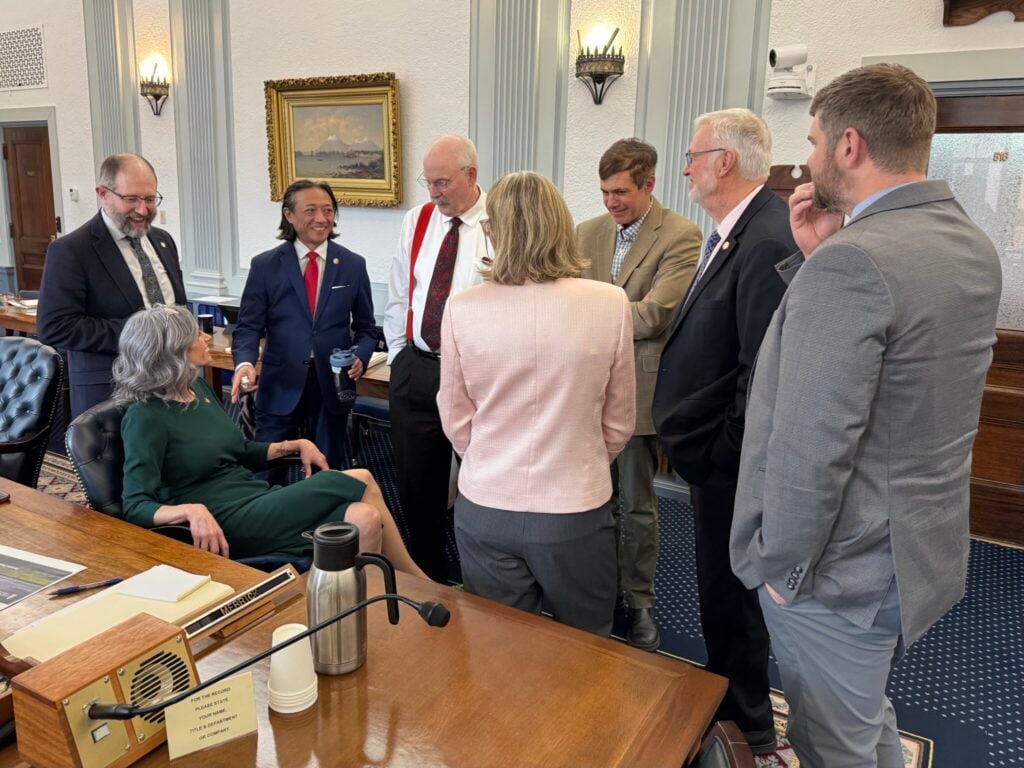
The Senate is led by a 14-person coalition of Republicans and Democrats. An internal rule states that 11 of the coalition’s members must agree before a bill comes to the floor.
“We are not to the point of having 11 votes to get to the floor yet,” said Sen. Jesse Kiehl, D-Juneau.
On Tuesday evening, members of the Senate majority coalition met behind closed doors to discuss their next steps.
Senate President Gary Stevens, R-Kodiak, said that while some members of the majority are willing to support the bill as currently written, others are asking for significant amendments.
Sen. Bill Wielechowski, D-Anchorage and a noted critic of the bill, said he sees several points of contention, including basic things like the length and size of the proposed tax break.
The Senate Finance Committee, which is hearing the bill, could amend it to win over some reluctant senators, but that runs the risk of making the bill unacceptable to Glenfarne, the pipeline project’s lead developer.
Glenfarne officials have said that a tax break is necessary for it to obtain the financing for a project that it publicly expects to cost as much as $54.5 billion.
On Friday, the Alaska House voted 34-5 to replace the state’s 2% petroleum property tax for 30 years with a smaller tax on gas sent through the pipeline.
Speaking to the Senate Finance Committee on Tuesday morning, Glenfarne Alaska President Adam Prestidge warned senators to not shorten the terms of that tax break.
“If there were to be a shorter-term abatement that then ended and reverted back to 20 mills, it would severely challenge the economics of the project,” he said.
Under current laws, according to an analysis by the Alaska Department of Revenue, the state of Alaska would net $29.7 billion through 2062 if the gas pipeline and supporting infrastructure are built as planned. Boroughs along the route would share another $17.3 billion.
Under the House-passed bill, the state’s take drops to $23.4 billion, a decline of $6.3 billion. Boroughs’ share of the revenue drops to $7.5 billion, a drop of $9.8 billion.
Stevens said he doesn’t expect the bill to advance from the Senate Finance Committee to a vote of the full Senate before noon Thursday, the penultimate day of the special session.
On Tuesday evening, the committee scheduled a hearing for Thursday afternoon.
Senate Finance co-chair Lyman Hoffman, D-Bethel, said noon Thursday is “probably the earliest” time a bill could advance from the Finance Committee to the full Senate.
That’s a challenging timeline, said Sen. Forrest Dunbar, D-Anchorage, because lawmakers outside the finance committee can’t begin writing proposed amendments until they see what the finance committee does with the bill.
Dunbar said he doesn’t think the bill does enough to guarantee that the state’s oil revenue — the No. 2 source of general-purpose money for services and the Permanent Fund dividend — would be held harmless if the pipeline is built.
“I think the current version of the bill does not protect Alaska’s financial interests enough to get to the floor,” he said.
Sen. Jesse Bjorkman, R-Nikiski, is a member of the majority and generally supports the House-passed bill but thinks it needs some technical changes.
He’s not certain whether the majority will hold to the 11-vote rule.
If the 11-vote rule becomes a permanent obstacle, legislators who support the tax break could try to bring the bill to the floor for a vote with procedural motions. That would involve members of the majority cooperating with the six Republican members of the Senate’s all-Republican minority coalition, which has generally been supportive of the House bill.
If the bill advances to the floor and all six minority senators vote for the bill, only five majority senators would need to vote for it in order for it to pass.
Dunbar cautioned against that kind of maneuver, saying it could harm relationships between senators.
“It would make organizing another bipartisan majority less likely next year,” he said.
Gov. Mike Dunleavy has previously expressed support for Glenfarne’s positions. Thursday is the deadline for the governor to decide whether or not to veto several bills unassociated with the pipeline project.
Stevens declined to answer questions asking whether the governor’s actions on those bills could affect the majority’s decision on the pipeline project.
“Hopefully the governor’s getting the message that we want to see very few vetoes,” Stevens said.
The leaders of the House and Senate are tentatively planning a joint session on Friday morning to take up any veto overrides that lawmakers want to bring forward.
Sen. Scott Kawasaki, D-Fairbanks and a supporter of the pipeline, said no senator is explicitly saying that they will vote for the pipeline tax break if the governor allows their other bills to become law.
Still, there’s an implication in the Senate’s actions.
“Folks need to realize that if you want goodwill, you don’t veto everything that’s on the governor’s desk,” Kawasaki said.