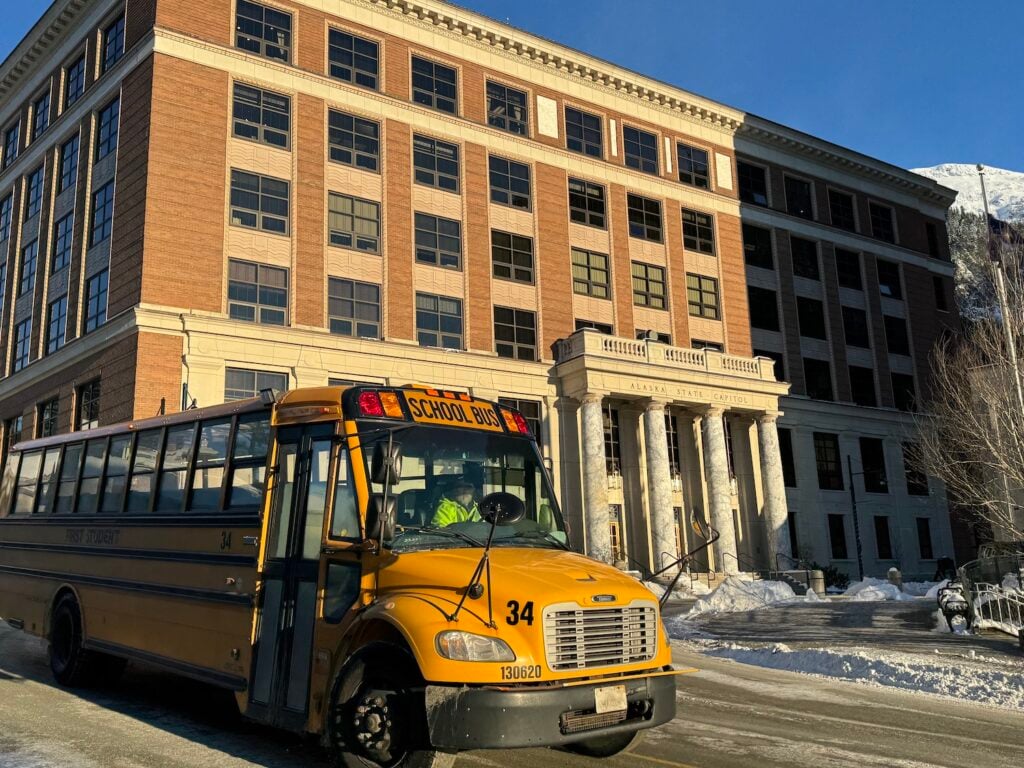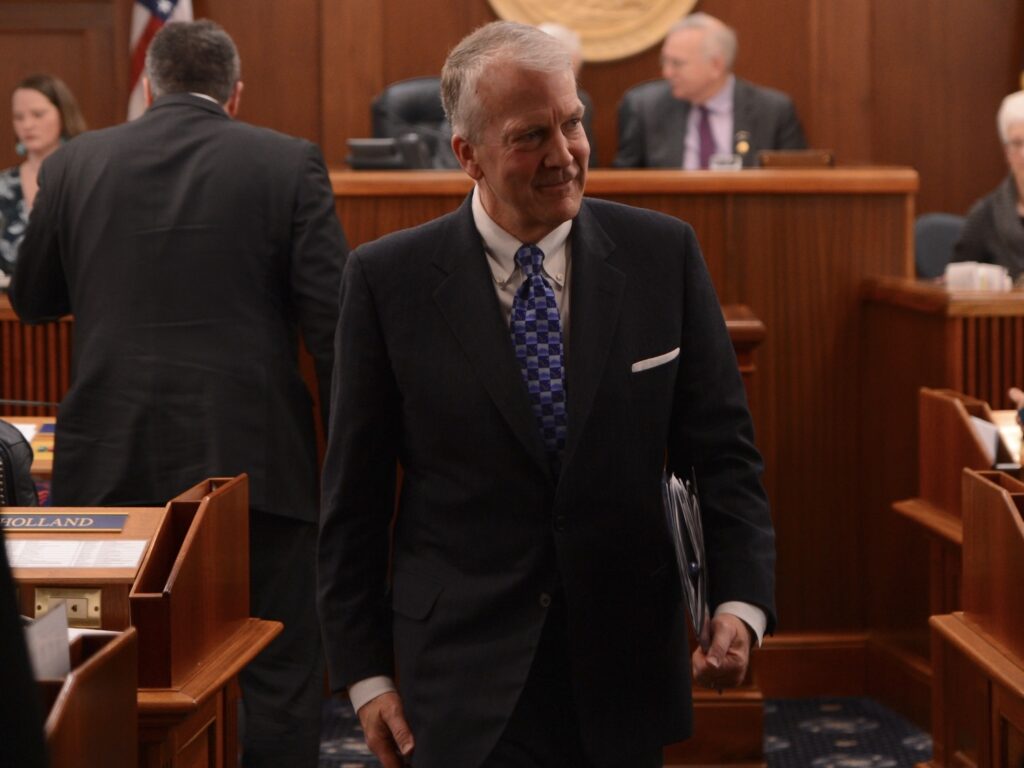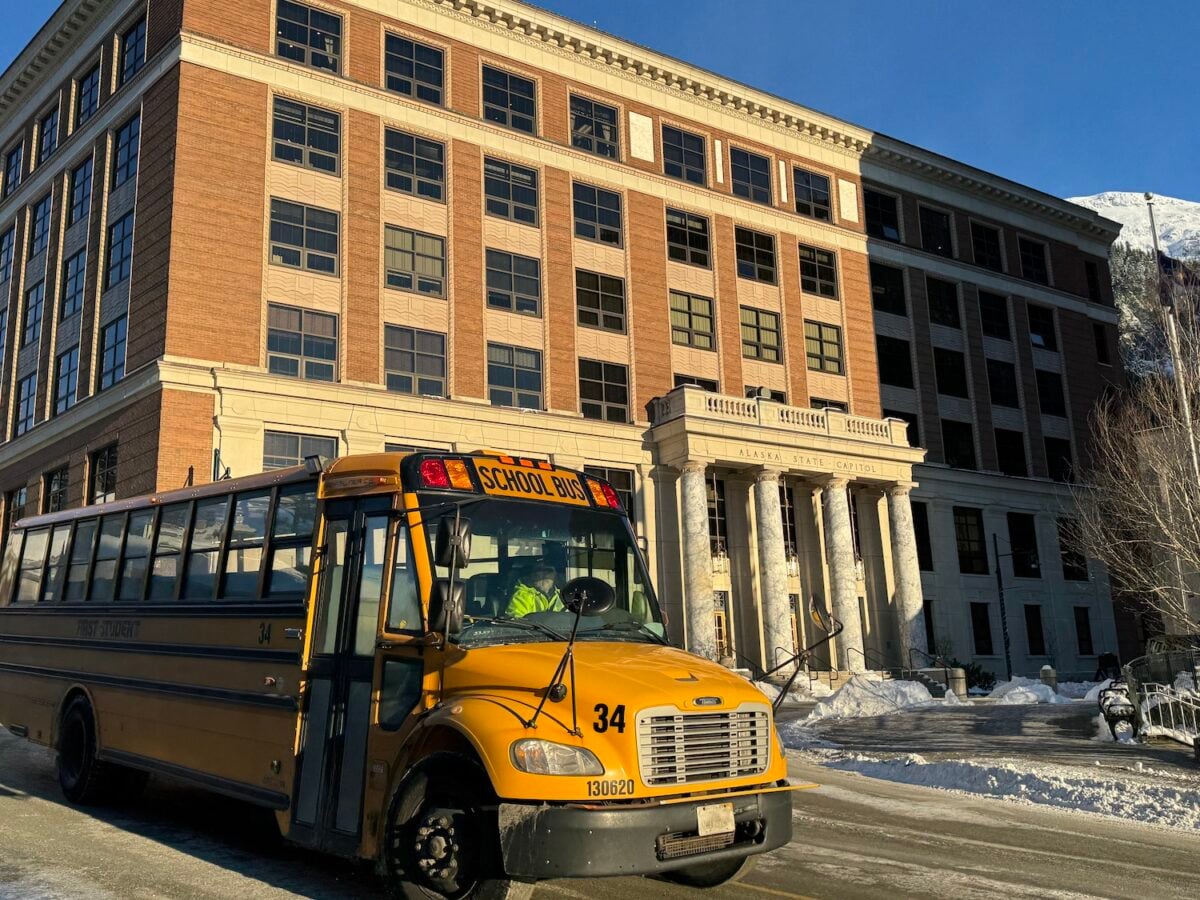
The Alaska Governor’s Mansion is seen on Tuesday, Dec. 14, 2022 during the annual holiday open house. (Photo by James Brooks / Alaska Beacon)
Holiday music, decorations and thousands of cookies are ready at the Governor’s Residence for the annual Holiday Open House today, from 3:00 p.m. to 6:00 p.m.
Students from the Thunder Mountain Middle School Carolers, the Juneau Douglas High School Band, Faith Christian School, and Juneau Alaska Music Matters (JAMM) will perform holiday music, while Alaska’s 15 state commissioners will serve up hot apple cider to all visitors.
Cookies and other holiday treats will be provided 17,050 cookies, 35 pounds of toffee and 90 pounds of fudge and chocolate will be served in the dining room. This year’s Christmas tree was donated by the U.S. Forest Service and was harvested from the Tongass National Forest.
The first open house was held by Territorial Governor Walter Eli Clark and his family on New Year’s Day 1913. The annual tradition has been held every year since, apart from two years during World War II and in 2020 due to COVID-19. Individuals with special accessibility needs can contact Maxine Lucero at (907) 465-3500, to arrange entry from 2:15-2:30 p.m.
An exploration site at ConocoPhillips’ Willow prospect is seen from the air in the 2019 winter season. Willow is located in the National Petroleum Reserve in Alaska. (Photo by Judy Patrick/provided by ConocoPhillips Alaska Inc.)
The White House announced Friday evening that Trump had signed Senate Joint Resolution 80 into law.
SJR 80 uses the Congressional Review Act to reverse restrictions enacted during the administration of President Joe Biden. Those restrictions, imposed as part of a 2022 activity plan for the reserve, were intended to protect environmentally sensitive areas against harm from oil and gas drilling.
Developers and drilling advocates opposed the restrictions, saying they could deter work that would provide revenue for local residents and Alaskans at large. Trump has also been interested in developing Alaska’s oil reserves as part of a broader effort to increase American energy production and reduce imports.
ConocoPhillips’ Willow project is in the northeast corner of the National Petroleum Reserve-Alaska. (Map by USGS, Department of Interior)
The National Petroleum Reserve-Alaska is approximately 23.5 million acres. Located to the west of Alaska’s vast Prudhoe Bay oil fields it — unlike the Arctic National Wildlife Reserve to the east — has been the subject of interest from oil companies.
ConocoPhillips’ Willow Project, approved during the Biden administration, was the first major project to take place in the reserve, and others are planned.
Friday’s signing was one of several Trump administration actions taking place simultaneously to reduce regulatory obstacles for developers interested in drilling within the reserve.
Students swing on a playground at Meadow Lakes Head Start in Wasilla, Alaska. It closed in 2024 due to funding and staffing challenges. (Image by Lela Seiler, courtesy of CCS Early Learning)
The Alaska Supreme Court has ruled that the state’s child support system has first priority when a foreclosed property is sold to pay multiple debts.
The court issued its opinion on Nov. 28, resolving a long-running lawsuit brought by Global Federal Credit Union (formerly Alaska USA) against the state and several other defendants.
“This is a pretty important case from my client’s perspective,” said Jonathan Clement, a senior assistant attorney general who represented Alaska’s child support system.
“This is the first time that a court has actually decided that child support gets priority over all other judgment lien holders, even liens recorded earlier, when there’s surplus funds at issue,” he said.
The case decided by the court involved property in Eagle River that was mortgaged by Wells Fargo. In 2017, Global levied a lien against the property for unpaid debt. Shortly afterward, the state’s child support division recorded another lien against the property for unpaid debt.
Typically, liens are repaid in chronological order: First filed, first paid.
In 2018, a law firm sold the property through foreclosure and paid off the remaining Wells Fargo mortgage. There was money left over, but not enough to pay both Global and the state.
The state protested the law firm’s plans to pay Global first, and the firm complied with a state order that required it to pay the state first.
Global sued in state court, but a district court judge and a superior court judge each ruled against the credit union before it appealed to the supreme court.
Writing on behalf of the court, Justice Jude Pate concluded, “Our interpretation of (state law) provides an effective priority for CSSD liens over competing judgment liens.”
Alaska’s Child Support Services Division (CSSD) is now known as the Child Support Enforcement Division (CSCD).
That priority doesn’t put the state above a bank holding a mortgage or “deed of trust” but it does give the state priority over other liens on the property.
“The important thing for this case is that it gives CSCD another tool where they can try to collect money that’s owed by the obligors,” Clement said.
“I would say of all the cases I’ve worked on, this is the one that will have the most impact in my career going forward,” he said.
An attorney representing Global declined comment on behalf of the credit union.
In a footnote attached to the case, Pate wrote that the court’s ruling could cause people to behave differently during foreclosure auctions.
He suggested that if the Legislature disagrees with the court’s interpretation, it might want to pass a law clarifying two conflicting statutes interpreted by the court.
“If our interpretation is contrary to the legislature’s intent,” he wrote, “amendments to the relevant child support statutes could clarify the interaction between child support liens, other liens, and mortgages.”
A commercial bowpicker is seen headed out of the Cordova harbor for a salmon fishing opener in June 2024 (Photo by Corinne Smith)
One of Alaska’s smallest telecommunications companies is about to provide a critical backup for the entire state.
On Wednesday, Cordova Telecom Cooperative and GCI announced a partnership to lay an undersea fiber optic cable from Juneau to Cordova and a second cable from Cordova to Seward.
When open for service in fall 2027, the two cables will provide high-speed internet to small communities in Prince William Sound and northern Southeast Alaska.
The development matters to the rest of the state as well, because when combined, they will provide a route for internet traffic between the Railbelt and Outside. Currently, four undersea cables through the Gulf of Alaska are the principal routes for internet and phone traffic between Alaska and the rest of the world.
Matanuska Telecom Association opened the state’s first overland fiber connection in 2020 as an alternative, and the new route will give the state another redundant option, said Cordova Telecom CEO Jeremiah Beckett.
“With what we’ve built out, scalability wise, we could put all the current Alaska traffic on our network if needed,” Beckett said.
This map, provided by Cordova Telecom Cooperative, shows the route of the proposed FISH in SEAK cable that will come online in fall 2027. Cordova’s existing fiber route is shown in green. (Image courtesy Cordova Telecom Cooperative)
While satellite internet services like Starlink have transformed life in rural Alaska, ground-based fiber internet remains the backbone of worldwide telecommunications, delivering service faster and in volumes that satellites can’t provide.
“It’s kind of like rural communities that don’t have the ferry,” Beckett said. “Places without fiber don’t have the same access that folks with fiber do. So this is really to help connect those rural areas and give them the same access to the digital economy and marketplace as the rest of the world.”
Despite their advantages, fiber-optic cables can be vulnerable.
“Up north, it’s ice scouring … and in our area, it’s typically ship anchors and earthquakes,” Beckett said.
Alaskans have become intimately familiar with the consequences of broken cables in recent years.
Northern and northwest Alaska are particularly familiar: Quintillion’s fiber-optic cable has been severed three times in two years. The latest break wasn’t fixed for more than seven months because sea ice precluded repairs. That caused widespread problems in areas served by the cable.
In March, a break in a subsea cable left the Alaska Legislature to do business on paper for a day and knocked out both cellphone and internet service for much of Juneau. Juneau had alternatives; a temporary fix was in place within days.
Adding a backup fiber route reduces the odds of blackouts like those. Currently, Cordova is served by a single undersea fiber line through Prince William Sound to Valdez.
When the project is complete, internet and phone traffic will have three possible routes: north, west, and east.
The two cables will cost roughly $88 million combined, according to figures provided by Beckett, and the project is principally funded through two federal grants. Cordova Telecom is paying for part of the project, as is GCI, which will be what Beckett calls an “anchor tenant and partner.”
“It was a good matchup for both of our long-term goals,” he said.
In a prepared statement, GCI senior vice president Billy Wailand praised the plan, which is formally known as Fiber Internet Serving Homes in Southeast Alaska, or FISH in SEAK.
“Critical state services require network diversity,” he said. “GCI turned up the first subsea cable to Alaska in 1999 and landed a second diverse fiber in 2008. We are thrilled to partner with CTC on its FISH in SEAK project, which includes a next-generation cable that ensures Alaska and its capital city continue to benefit from the newest technologies and adds another crucial layer of redundancy to the network.”
Communities along the cable route will see huge changes, Beckett said. Residents of Pelican on Chichagof Island in Southeast Alaska, who use boardwalks instead of roads and four-wheelers instead of cars, will be able to get fiber internet access directly to their homes.
The island village of Chenega in Prince William Sound, which has about 50 year-round residents, likewise will have new access to fiber internet.
Alaska’s Lost Coast, between Glacier Bay and Yakutat, could be dotted with cellphone towers.
Beckett, who grew up in Cordova, returned to the town with his spouse 12 years ago, “basically when Cordova got its subsea fiber,” he said. “We were both teleworkers, and that created the opportunity for us to move back to Alaska, essentially.”
Since then, he’s seen internet service improve and has become head of his local telecom, which has just 20 employees.
Because it’s a cooperative, it’s run as a nonprofit, he said. That means the telecom’s goal is to deliver faster service and low rates, not necessarily generate a profit.
In Yakutat, “a few years ago, you couldn’t get cell service anywhere,” Beckett said.
“We’ve upgraded the cell service there to 4G and outside of the fishermen complaining because their wives can get hold of them, it was a huge boost for the community,” he said.
“If someone gets hurt, they can call the paramedics and not have to drive 20 miles before they get to service. … It’s giving people reasons to think about moving home, because it’s one less inhibitor to be back in Alaska,” Beckett said.
“Yakutat actually got a new clinic a couple years ago, and then with this, I think they’re going to see some good growth. Everyone likes core services, right?”
The scales of justice are seen in an undated photo. (Getty Images)
The Alaska Court of Appeals has rejected an appeal from a man who received one of the highest prison sentences ever given in Alaska to a juvenile convicted of murder.
In an order published Friday, the court concluded that the recantation of a key witness is not enough to warrant a retrial for Brian Hall, who was 17 at the time. In 1995, Hall was sentenced to 159 years in prison for the killing of two men in Anchorage, Mickey Dinsmore and Stanley Honeycutt.
Despite the rejection, wrote Judge Marjorie Allard on behalf of the court, Hall is eligible for resentencing as part of a wave of juvenile punishments being reconsidered by state courts.
“At sentencing, the court sentenced Hall to 159 years to serve, one of the highest sentences — if not the highest sentence — that a juvenile tried as an adult in Alaska has ever received,” she wrote. “As a juvenile sentenced in 1995 to a de facto life without parole sentence, Hall has been granted the opportunity for a resentencing in which his youth and the unique attributes of youth will be appropriately considered.”
In 2012, the U.S. Supreme Court ruled that the Eighth Amendment prohibits courts from sentencing children to life in prison without the possibility of parole, except in homicide cases.
Two years ago, the state appeals court said the Alaska Constitution imposes further limits in addition to those provided by the U.S. Constitution.
Since then, Alaska courts have resentenced several former juveniles who were sentenced to long terms in prison. In September, Alaska’s youngest convicted female murderer was released from prison on parole after 40 years behind bars.
Hall, who has been in prison for 30 years, could receive similar treatment.
At the time of his trial, Hall claimed he acted in self-defense and that he believed, based on a statement from then-15-year-old Monica Shelton, that Dinsmore and Honeycutt — the people he killed — were armed.
At trial, Shelton denied telling Hall that the two were armed. Hall was convicted and sentenced with that testimony.
While in prison, Hall married Angela Diaz (now Angela Hall), and Angela hired a defense investigator who got in contact with Shelton. In a recorded interview, Shelton said she was scared at trial and lied in her testimony.
In an interview with the Anchorage Daily News, Hall said he is full of remorse about his crime and isn’t the same person he was at 17.
Years of legal arguments followed the investigator’s interview as Hall first requested a new trial, then asked for post-conviction relief.
Superior Court Judge Adolf Zeman dismissed that request, siding with state prosecutors who had raised procedural errors, including the idea that Hall’s filings were too late.
He also concluded that Hall failed to show that Shelton’s recantation would “probably result in an acquittal,” the standard that applies to timely filings for post-conviction relief.
Allard, writing on behalf of the appeals court, overruled Zeman on the procedural elements of Hall’s argument but concluded that even with the recanted testimony, it wasn’t clear that a new trial would result in a new outcome.
“The problem that Hall still faces, notwithstanding Shelton’s recantation, is that the rest of the evidence from trial indicates that Hall’s mistaken belief that he had to use deadly force … was not objectively reasonable,” she wrote.
“Hall was required to show that, viewing all the well-pleaded facts in the light most favorable to Hall, it is “highly probable” that Shelton’s recantation would result in an acquittal at any retrial,” Allard said.
“But while Shelton’s recantation constitutes important new evidence that sheds more light on Hall’s motivations and the reasons for his subjective fear, it does not alter the fact that his actions in shooting both men still appear overly impulsive and objectively unreasonable under the circumstances.”
Even with that finding, Hall is eligible for resentencing, Allard said.
“As part of that resentencing, the court should take into account Shelton’s recantation and the effect of that recantation on Hall’s level of culpability.”
Solar panels at the Cold Climate Housing Research Center campus in Fairbanks are seen on June 5, 2025. The Cold Climate House Research Center, which became part of the National Renewable Energy Labortory system in 2020, is focused on designing sustainable and energy efficient housing that is resilient to climate change in the far north. (Photo by Yereth Rosen/Alaska Beacon)
The federal government research organization that has been devoted for half a century to renewable energy development has had the word “renewable” stripped from its name.
The Trump administration, which broadly opposes renewable energy projects, changed the name of the Colorado-based National Renewable Energy Laboratory to “National Laboratory of the Rockies.”
The U.S. Department of Energy announced the name change on Monday, effective immediately.
“The energy crisis we face today is unlike the crisis that gave rise to NREL,” Assistant Secretary of Energy Audrey Robertson said in a statement. “We are no longer picking and choosing energy sources. Our highest priority is to invest in the scientific capabilities that will restore American manufacturing, drive down costs, and help this country meet its soaring energy demand. The National Laboratory of the Rockies will play a vital role in those efforts.”
NREL has a prominent presence in Alaska. The agency in 2020 joined into a partnership with the Cold Climate Housing Research Center at the University of Alaska Fairbanks. The UAF facility is one of four NREL centers; two campuses are in Colorado and there is an office in Washington, D.C.
Jud Virden, the laboratory’s director, said the new name “embraces a broader applied energy mission entrusted to us by the Department of Energy to deliver a more affordable and secure energy future for all,” according to the statement.
However, the name change is a troubling sign to one Alaska organization involved in projects promoting renewable energy and energy affordability.
“Removing ‘Renewable’ and ‘Energy’ from NREL’s name raises concerns. Renewables are key to affordable, secure energy and deliver long-term economic benefits, especially for rural communities,” Bridget Shaughnessy Smith, communications director for the Alaska Public Interest Research Group, a non-profit consumer advocacy group, said by email.
“While it’s not yet clear if this name change signals a broad mission shift, any refocus cannot come at the expense of renewable energy or by prioritizing already well-funded fossil fuel industries. Remote microgrid communities in Alaska are working with NREL to innovate toward affordable, reliable energy, and this name change must not disrupt that critical work,” Shaughnessy Smith continued.
NREL’s history started in 1974, when the organization was established as the Solar Energy Research Institute. In 1991, President George H.W. Bush elevated it to national lab status and changed the name to the National Renewable Energy Laboratory.
The Cold Climate Housing Research Center was established in 1999 with a mission of improving housing and building conditions in Alaska’s extreme climate. The center has focused on renewable energy, along with energy efficiency, structural integrity for buildings on permafrost, indoor air quality and designs that are sustainable in the far north. The center headquarters is the world’s farthest-north building with a platinum rating, the highest possible, bestowed by the U.S. Green Building Council Leadership in Energy and Environmental Design.
The NREL-Cold Climate Housing Research Center partnership has participated in numerous recent energy and environmental innovations, including the development of non-plastic housing insulation made from a fungi-wood pulp blend.
The NREL name change adds to a list of government agencies and geographic sites changed by the Trump administration this year to align with the president’s agenda.
On the day he was inaugurated for his second term, President Trump issued an executive order directing that the Gulf of Mexico be renamed “Gulf of America” and that Denali, North America’s tallest peak, revert to its previous federal name, Mount McKinley.
The Denali name comes from the traditional name for the Alaska peak used by the Koyukon people, the region’s Indigenous residents. The name, which translates to “the high one,” has been the official state of Alaska name since the 1970s. The McKinley name, for former president and Ohioan William McKinley, has been widely panned in Alaska, and state lawmakers passed a resolution asking for the Denali name to be restored for federal government use.
In September, Trump issued an executive order directing that the U.S Department of Defense be renamed “Department of War.” That resurrected a department name that was dropped in 1947.
Members of the Alaska Air and Army National Guard, Alaska Naval Militia, and Alaska State Defense Force work together to load plywood onto a CH-47 Chinook helicopter, in Bethel, Alaska, Nov. 2, 2025, bound for the villages of Napaskiak, Tuntutuliak, and Napakiak. The materials will help residents rebuild homes and restore community spaces damaged by past storms. (U.S. Army National Guard photo by Spc. Ericka Gillespie)
Gov. Mike Dunleavy has approved a U.S. Defense Department request for Alaska National Guard service members to assist the U.S. Immigration and Customs Enforcement office in Anchorage with “administrative support,” the guard office announced Tuesday.
The Alaska National Guard said five service members will assist with “administrative and logistical” duties at the Anchorage ICE office for up to a year.
“The Alaska National Guard members are administratively supporting the Enforcement & Removal Operations section and Homeland Security Investigations section, ensuring seamless operations at the Anchorage ICE office. Their mission includes a wide range of duties, from vehicle fleet management and safety compliance to office support and processing purchase orders,” the Guard statement said.
The announcement included a list of clerical duties, including data entry and creating reports, answering phones, managing fleet vehicles and checking fire extinguishers. Officials said the partnership is authorized by Title 32 Section 502(f) of the U.S. Code, which enables National Guard members to perform additional duties under the direction of the President or Secretary of Defense.
Grant Robinson, Dunleavy’s deputy press secretary, confirmed the governor approved the request.
“The Alaska National Guard members joined the guard to serve our nation. This support they are providing the Anchorage ICE office is in service of the nation,” he said by email Tuesday.
Grant did not say whether the National Guard would provide further assistance with immigration enforcement actions.
“Any future requests for administrative and logistical support will be considered on a case by case basis,” he said.
The Trump administration has continued to accelerate immigration enforcement operations, and officials have promised to “limit legal and illegal immigration,” after the shooting of two National Guard service members in Washington, D.C. last week. The Trump administration has also continued to roll back humanitarian programs for immigrants, including ending the temporary protected status of 330,000 nationals from Haiti last week.
While ICE has been conducting mass raids, court house arrests and large-scale detentions and deportation operations across the United States, in Alaska ICE has focused enforcement efforts on specific individuals identified through the U.S. Citizenship and Immigration Services or having interactions with law enforcement, according to the ACLU of Alaska.
Rep. Andrew Gray, D-Anchorage is the co-chair of the Alaska Joint Armed Services Committee and has been outspoken about his concerns about the Alaska National Guard being deployed domestically for “civil disturbance operations.”
“I see it’s a long list of boring, banal administrative tasks that are in no way controversial or concerning in and of themselves,” he said of the National Guard announcement. “What’s concerning is that Alaska ICE is requesting additional support, and the assumption that I make is that it’s because Alaska ICE intends to be doing more detainments, and intends to be doing more field operations in which they’re going to need this administrative support behind them. So that’s my concern.”
Gray was reached by phone Tuesday leaving a meeting with U.S. Sen. Dan Sullivan in Washington, D.C. Gray said he expressed his concerns at the meeting about the leadership of U.S. Department of Defense, which the Trump administration has renamed the “Department of War,” and Secretary Pete Hegseth.
Gray said he’s also concerned about a wider chilling effect of ICE activity and increased immigration enforcement in Alaska.
“It’s going to increase fear, not only in the undocumented folks that might be in Anchorage and the rest of Alaska, but also fear in people who are here legally, and even U.S. citizens who might be mistaken for someone who might be undocumented,” he said.
An October investigation by ProPublica found that more than 170 U.S. citizens were detained by ICE in raids and at protests, and the government does not track how many citizens are held by immigration agents.
Dunleavy’s office did not respond to requests for comment on the concern around ICE overreaching its authority, and arresting and detaining U.S. citizens.
“It seems that Alaska’s notorious SNAP backlog caused by a lack of workforce doing many of the tasks in this memo would be much better use of our Guard,” Gray added. “Why not deploy Guard members to feed Alaskans instead of deploying them to earn brownie points with the Trump administration?”
Cindy Woods, senior staff attorney on immigration rights with the ACLU of Alaska, said they have tracked at least 70 ICE arrests this year, as reported in the custody of the Alaska Department of Corrections. That’s an almost 500% increase from last year.
“We have been seeing a growing ICE presence in the state and a growing trend of ICE enforcement,” she said. The ICE activity has been largely in Anchorage, she said.
“We are very concerned about what this signals in relation to our state government’s willingness to cooperate with federal law enforcement, specifically in relation to ICE enforcement operations,” she said of the National Guard announcement. “I think it can’t be overstated the negative impact that increased enforcement has had across the country and Alaska, unfortunately, is not immune to that.”
An estimated 7.7% of the population, or more than 57,000 people, in Alaska are foreign-born, Woods pointed out, and the Trump administration’s continued restrictions on paths to legal immigration and citizenship, as well as humanitarian and refugee resettlement programs are impacting Alaskans.
“It’s kind of an assault from both sides, and so we’re really concerned about that as well,” she said.
Woods said the ACLU is not aware of any U.S. citizens being detained by ICE in Alaska, but there is heightened scrutiny.
“One case that we have heard of recently is of a longtime Anchorage resident who has been happily married and was going to their interview for their green card based on that marriage, and being arrested with basically accusations of marriage fraud,” she said. “And so we’re seeing folks who are in affirmative applications, who are not in any sort of civil enforcement proceedings, who are also being subject to heightened scrutiny and enforcement actions.”
John Crowther, center, listens during a Nov. 13, 2025, panel discussion at the annual Resource Development Council for Alaska conference in Anchorage. At the time, Crowther was the acting commissioner of the Alaska Department of Natural Resources. At left is Kara Moriarity, senior adviser for Alaska Affairs at the U.S. Department of the Interior, and at right is Kevin Pendergast, Alaska state director for the U.S. Bureau of Land Management. Gov. Mike Dunleavy has selected Crowther to lead the department on a permanent basis. (Photo by John Whipple/State of Alaska)
John Crowther, who stepped in as acting commissioner of the Alaska Department of Natural Resources last month after John Boyle, the previous commissioner, resigned abruptly, is the governor’s choice for the more permanent position.
Gov. Mike Dunleavy announced Friday he will ask the Legislature to confirm Crowther as the commissioner once the 2026 session gets underway.
John Crowther, formerly serving as the deputy commissioner of the Alaska Department of Natural Resources, was tapped by Gov. Mike Dunleavy as acting head in October and commissioner-designee on Nov. 28, 2025. (Photo courtesy of the Alaska Department of Natural Resources)
“John Crowther brings a deep understanding of Alaska’s natural resources and a proven commitment to responsible stewardship. His balanced approach to development and conservation makes him an exceptional choice to lead the Department of Natural Resources and serve the long-term interests of Alaskans,” Dunleavy said in a statement.
Crowther is a department veteran, having joined DNR in 2012. Prior to being named acting commissioner, he served as deputy commissioner managing the department’s oil and gas project permitting and geological survey divisions.
After his first years working for DNR, Crowther served from late 2017 to January 2019 as Alaska’s director of state and federal relations under then-Gov. Bill Walker, according to his professional biography. From January 2019 to January 2021, he served as a U.S. Senate Natural Resources Committee aide to Sen. Lisa Murkowski, R-Alaska. After that, he returned to DNR, the governor’s statement said.
“The Department’s constitutional mission to develop, conserve and maximize the use of Alaska’s natural resources is critical to our state,” Crowther said in the governor’s statement. “I will continue working as hard as I can to advance this mission and improve Alaska’s future through stewardship and responsible use of our resources. I am honored and humbled to accept the Governor’s designation and enthusiastic to lead the dedicated professionals of DNR.”
Crowther is a graduate of Dartmouth College and Georgetown University Law School.
U.S. Forest Service workers clear a fallen tree from a trail in the Tongass National Forest. (U.S. Forest Service photo)
It was no surprise that everyone on the timber panel at this month’s Alaska Resource Development Council conference had the same message: The industry needs a larger supply of trees to cut.
And a steady, bankable supply, said Joe Young, of Tok, who started Young’s Timber in Alaska’s Interior more than 30 years ago.
Without long-term timber sales to supply a mill, “bankers will laugh you out of the room” when a mill owner asks for a business loan, Young said.
The Nov. 13 industry panel at the annual conference held in Anchorage also talked about demand for their product and the challenges in meeting that demand.
Juneau attorney Jim Clark, who has spent much of his life representing timber and wood pulp companies, said the Trump administration’s move to rescind the Roadless Rule, which has been around since 2001, could help open areas of the Tongass National Forest to logging.
The ban on road building has bounced between presidential administrations, like a ping pong ball, Clark said. “We’ll see if we can get this over with,” he said of the U.S. Department of Agriculture effort to rescind the rule, which will require an environmental impact statement.
In addition to the Tongass, the Roadless Rules affects tens of millions of acres of national forest lands in western states.
The lack of timber sales, financial pressures and opposition from conservation groups have knocked down Alaska timber industry jobs from almost 4,000 in 1990 to about 700 in 2015 and just 360 in 2024, according to Alaska Department of Labor statistics.
The timber industry in Southeast is getting only one-third of the log supply it needs, said Sarah Dahlstrom, public relations manager for Viking Lumber, which has operated a sawmill in Klawock for about 30 years.
Viking, the second-largest employer on Prince of Wales Island, needs more timber sales on federal, state and municipal lands, she said, contending that the U.S. Forest Service has failed to meet its commitment under a 2016 land management plan.
The mill cuts Sitka spruce, hemlock, red and yellow cedar, Dahlstrom said, and is a leading supplier of wood for piano soundboards and guitars.
“Steinway pianos would not exist if not for old-growth timber from the Tongass,” she said.
In addition to supplying the prized, tight-grain wood to Steinway & Sons’ factory in New York City, Viking supplies piano makers Kawai and Yamaha, and guitar manufacturers Gibson and Martin.
Steinway is worried enough about its wood supply that the company has written Alaska elected officials to advocate for the mill. “We use the top 1% of the top 1% of spruce,” company Chief Executive Ben Steiner told The Wall Street Journal this summer.
Dahlstrom said there are other small operators on Prince of Wales Island, cutting wood for pianos and musical instruments. And they all have the same problem of insufficient and unpredictable supply.
Viking also supplies manufacturers of doors, trim, fences, staircases, railing and window trim nationwide.
She complimented efforts by Wrangell Borough Manager Mason Villarma, who has been working to coordinate timber sales on the island between the state Department of Natural Resources, Alaska Mental Health Trust land office and the borough.
“I was born into a timber family,” she said of her dad and uncle, who built a mill in Hoquiam, Washington, more than 40 years ago, milling timber from the Olympic National Forest. She said she was not happy when her family moved to Klawock in 1994 and her dad and uncle took over the bankrupt mill.
In addition to lumber and boards, Viking sends wood chips south to be used in making corrugated boxes and supplies chips to the Craig School District which burns the wood waste to generate electricity and heat the swimming pool.
“Growing up, I didn’t know how cool it was,” she said of the industry she now calls home after resisting it when she was younger.
Speaker of the House Cathy Tilton, R-Wasilla, talks to fellow lawmakers about rules for debate on House Bill 183 on Saturday, May 11, 2024. (Photo by James Brooks/Alaska Beacon)
Gov. Mike Dunleavy has appointed state Reps. George Rauscher, R-Sutton, and Cathy Tilton, R-Wasilla, to two vacancies in the Alaska Senate.
Each nomination will become effective if at least five of the Senate’s nine other Republicans approve them. Senate President Gary Stevens, R-Kodiak, said the votes will take place by secret ballot at 10 a.m. Saturday in Anchorage.
“Honestly, I think both of them are excellent candidates,” Stevens said on Wednesday, adding that he expects both to be confirmed.
If Rauscher and Tilton are confirmed, their House seats would become vacant, and Dunleavy would be required to appoint replacements within 30 days of their resignations.
The office of former Sen. Mike Shower, R-Wasilla, is seen in the Alaska state Capitol on Tuesday, Nov. 25, 2025. Shower’s nameplate has been removed from beside the door, but a sticker commemorating Shower’s time as an F-22 fighter pilot remains on the door. (Photo by James Brooks/Alaska Beacon)
Dunleavy’s picks were due no more than 30 days after their resignations, but he acted earlier, which will allow the replacement legislators to take office before the regular legislative session convenes in January.
“I can’t think of two Alaskans more qualified and committed to public service to serve in the Alaska Senate than Representatives Rauscher and Tilton,” Dunleavy said in a statement announcing the selections. “I have known and worked with both for as long as I have been in public office and I look forward to working collaboratively with them as senators. I also want to thank the local Republican district committees for taking the time to meet, deliberate, and send forward names for these seats. This process works best when the people closest to the communities are involved.”
Tilton, first elected to the House in 2014, was Speaker of the House from 2023 through 2024. Reached by phone on Wednesday in the middle of Thanksgiving shopping, she referred to a statement on her Facebook page.
“I look forward to collaborating with my Senate colleagues to advance sensible policy solutions, foster an energy renaissance, and usher in an era of renewed prosperity for all Alaskans,” the statement said in part.
Rep. George Rauscher, R-Sutton, speaks in favor of the creation of an Alaska Department of Agriculture by executive order on Wednesday, March 19, 2025. (Photo by James Brooks/Alaska Beacon)
Rauscher said he’s already at work on a letter thanking Dunleavy for his appointment, but he declined to say what he thinks his confirmation chances are.
“It’s an honor,” Rauscher said of the appointment, “and I feel like it was quite the undertaking — the process — and to have it this close to seeing what the final outcome is, is always a relief in some ways, but it’s also very exciting that I am this close. So I appreciate the fact that the governor did consider me and thought highly enough of me to appoint me.”
Several senators said they expect Rauscher and Tilton to be confirmed, but each declined to say how he or she will vote, citing the need to work with them regardless.
Of the nine Republican senators who will be voting on this weekend’s confirmations, five are members of the Senate’s bipartisan majority caucus, and four are members of the Senate’s all-Republican minority.
Shower and Hughes were members of the House minority, and their replacements are expected to be as well.
Stevens said he’s conducting the confirmation vote by secret ballot in order to avoid the possibility of hurt feelings.
“I don’t want to have anybody have bad feelings when we start working together in January,” he said.
Stevens said he wants to give the House’s replacement process as much time as possible, since that will involve the appointment of two people new to the Legislature who will need to hire staff and uproot their lives in order to arrive in Juneau in January and be ready to work.
“I just want to make sure the House has all the time they need,” he said.