NOTN- Lawmakers, their families and members of the public are invited to gather today at Centennial Hall for the annual legislative welcome, marking the opening day of the Alaska Legislature.
The reception is hosted by the Alaska Committee with support from Travel Juneau, the City and Borough of Juneau and dozens of local businesses. Organizers say the event has been held for nearly three decades and is intended to offer a bipartisan welcome to legislators arriving in the state’s capital for the session.
“The Alaska committee was formed in 1995 and we’ve been doing the reception just about since the very beginning.” Said Wayne Jensen from the Alaska Committee, ”We want all the local community members to come and say hi and welcome to the Capital City. It’s their Capital City.”
According to Jensen, being the Capital City is both a privilege and a responsibility.
“’That responsibility is to be as friendly as we can, and as hospitable as we can and make everything work well for the legislators and the State government.” Said Jensen.
Travel Juneau, the city’s marketing organization, assists with coordination for the event, including catering and use of Centennial Hall, according to Liz Perry of Travel Juneau.
“What we do is, we’re your front and center alongside the Alaska committee, to help make those invitations for people to come down and visit the Capitol, take a look at the building itself. The building is historic, and have a chance to talk with their legislators, if they have not had the opportunity to do so in their hometowns, and promote this as a great Capital City.” Perry said.
Organizers said the welcome also serves as an opportunity to promote in-state travel, noting that many Alaskans from other regions, even Anchorage and Fairbanks, have never visited Southeast Alaska or the Capitol.
Local businesses and organizations will contribute food, gift bags and promotional items for legislators and staff. The city also participates by providing passes to local amenities such as Eaglecrest Ski Area, city pools and public transit.
“We prepare a bag for each one of the offices, and it’s just a way to say welcome to Juneau.” Perry said, “So it can be anything from artwork to books to candy, or an offer of some kind. And we look forward just to saying thank you to our legislators.”
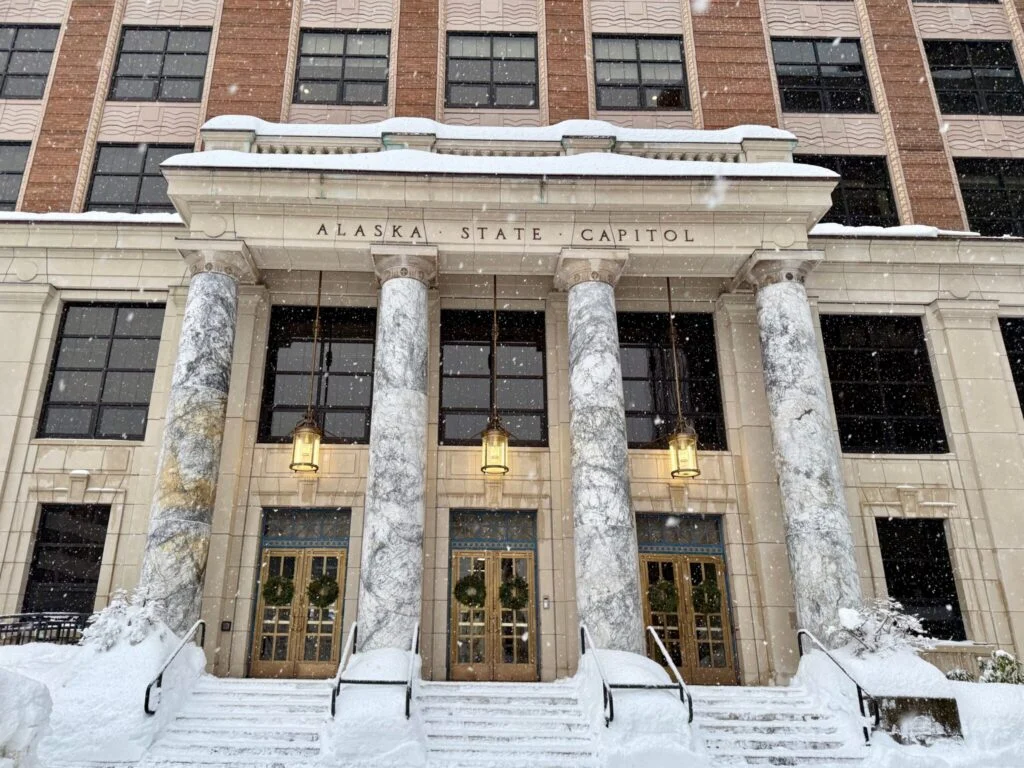
Snow falls around the Alaska State Capitol in Juneau on Dec. 31, 2025. (Photo by Claire Stremple/Alaska Beacon)
Alaska schools, students and education funding will continue to be in focus in the 2026 legislative session set to begin on Jan. 20, but early signs show they are unlikely to be at the center of the political spotlight as they were last year.
Gov. Mike Dunleavy will not be pursuing education policy changes this year, according to a spokesperson with his office on Friday. Instead, he will focus on a state fiscal plan and the proposed development of the Alaska LNG gas pipeline, his office said.
Those policy changes were at the heart of Dunleavy’s objection to increased education funding last year, and he said they were essential to boosting student achievement. He called a special session in August for lawmakers to address his policy items, but legislators took no action other than overriding two of his vetoes.
One of those veto overrides was an historic win for education advocates: it restored a $700 increase to per student funding, known as the base student allocation, adding $50.6 million in education funding to the state’s budget.
Yet many Alaska school districts continue to face steep budget deficits, and struggle to address the rising cost of operations, school maintenance, teacher retention and lost of federal funding. The Anchorage School District — the state’s largest district — is grappling with an $80 million shortfall, however the district and the union representing teachers reached a tentative agreement over the weekend on a new three-year contract. There may also be changes on the federal level because the Trump administration has promised to dismantle the U.S. Department of Education.
Sen. Löki Tobin, D-Anchorage, and chair of the Senate Education Committee, said it is still unclear whether lawmakers will again take action this year to increase education funding through the base student allocation. Tobin also co-chairs the special task force on education funding created this year.
“It is difficult to know what the body is willing to do at this point in time,” Tobin said, as lawmakers are in transit back to Juneau this week, and caucuses are meeting to discuss policy priorities.
But Tobin said she anticipates some kind of funding increase to help districts keep up with inflation. “Inflation continues to be a pressing issue in the state, and we don’t want the gains we made by increasing the basic allocation by $700 this last budget cycle to diminish because of inflation,” she said.
Rep. Andi Story, D-Juneau is co-chair of the House Education Committee and agreed an inflation adjustment is a major priority. “We don’t want to lose any ground,” she said in an interview Friday, pointing out the increase to the BSA only added $20 per student more than the year before.
Dunleavy told reporters in December he hoped the legislature would pass a bill to launch a pilot program for schools run by Alaska Native tribes, known as tribal compacting, introduced last year. Tobin said the initiative is a priority, and said she supports tribal compacting statewide and wants to see greater tribal consultation and engagement throughout all districts.
Tobin said members of the task force recently made a visit to a school in Fairbanks with one of three boilers working — in subzero temperatures — and a plan to evacuate students if the last one failed. “That’s 726 students that will be displaced. It will be a huge hit to the Fairbanks education community,” she said. “It has the potential to really harm our students’ learning and what we need to do in Juneau, during this 34th legislature, to set us up for a long term solution on rebuilding our schools, is very much at the forefront of my mind.”
Tobin co-chairs the task force on education funding, which was established this spring to conduct an 18-month study and create policy recommendations for how the state funds schools. Members have expressed interest in a wide variety of policy initiatives: from revisiting the school funding formula, to investigating chronic absenteeism, to student performance and accountability measures, and policy changes sought by the governor like open enrollment and reading incentive programs. They are slated to deliver their recommendations at the start of the next legislative session in 2027.
Tobin said task force members have made visits to schools in Fairbanks, the Matanuska-Susitna, Anchorage and Kenai Peninsula boroughs, and have plans to visit Skagway, Juneau, Bethel and Western Alaska.
Republican leaders of the Senate and House minority caucuses did not respond to interview requests on their priorities for education.
Veto override for additional education funding still in question
Lawmakers could also take up another veto override vote within the first five days of the session. Last year, lawmakers passed a corporate tax bill tied to online sales in Alaska that could generate up to $65 million in revenue that would go to fund career and technical education and K-12 reading improvement programs. Dunleavy vetoed it in September.
Whether lawmakers will take up the override vote next week is unclear. At least 40 of 60 legislators are needed to override the governor’s veto within the first five days of the legislative session.
Tobin and Story, as education committee chairs, said the override vote and restoring additional education dollars is essential, especially for reading, and funding programs instituted by the Alaska Reads Act.
House Speaker Rep. Bryce Edgmon, I-Dillingham, said via text that the Majority caucus is meeting to discuss legislative priorities this weekend. “Protecting education and public safety items in the budget along with other core services will be a priority in an environment that will be fiscally constrained,” he said.
Edgmon did not confirm whether an override vote would take place, as of Thursday.
People gather near the post office during a protest, Sunday, Jan. 18, 2026, in Minneapolis. (AP Photo/Yuki Iwamura)
AP- The Pentagon has ordered about 1,500 active duty soldiers to be ready in case of a possible deployment to Minnesota, where federal authorities have been conducting a massive immigration enforcement operation, two defense officials said Sunday.
The officials, who spoke on condition of anonymity to discuss sensitive military plans, said two infantry battalions of the Army’s 11th Airborne Division have been given prepare-to-deploy orders. The unit is based in Alaska and specializes in operating in arctic conditions.
One defense official said the troops are standing by to deploy to Minnesota should President Donald Trump invoke the Insurrection Act, a rarely used 19th century law that would allow him to employ active duty troops as law enforcement.
The move comes just days after Trump threatened to do just that to quell protests against his administration’s immigration crackdown.
In an emailed statement, Pentagon chief spokesman Sean Parnell did not deny the orders were issued and said the military “is always prepared to execute the orders of the Commander-in-Chief if called upon.”
ABC News was the first to report the development.
On Thursday, Trump said in a social media post that he would invoke the 1807 law “if the corrupt politicians of Minnesota don’t obey the law and stop the professional agitators and insurrectionists from attacking the Patriots of I.C.E., who are only trying to do their job.”
He appeared to walk back the threat a day later, telling reporters at the White House that there wasn’t a reason to use it “right now.”
“If I needed it, I’d use it,” Trump said. “It’s very powerful.”
Trump has repeatedly threatened to invoke the Insurrection Act throughout both of his terms. In 2020 he threatened to use it to quell protests after George Floyd was killed by Minneapolis police, and in recent months he threatened to use it for immigration protests.
The law was most recently invoked by President George H.W. Bush in 1992 to end unrest in Los Angeles after the acquittal of four white police officers in the beating of Rodney King.
Minnesota Gov. Tim Walz, a Democrat and frequent target of Trump, has urged the president to refrain from sending in more troops.
“I’m making a direct appeal to the President: Let’s turn the temperature down. Stop this campaign of retribution. This is not who we are,” Walz said last week on social media.
From left, Greenland Foreign Minister Vivian Motzfeldt, Danish Foreign Minister Lars Løkke Rasmussen, Sen. Ruben Gallego, D-Ariz., Sen. Lisa Murkowski, R-Alaska, and Sen. Angus King, I-Maine, begin a meeting on Capitol Hill as officials from Denmark and Greenland meet with lawmakers from the Arctic Caucus, at the Capitol in Washington, Wednesday, Jan. 14, 2026. (AP Photo/J. Scott Applewhite)
Ap- A top Danish official said Wednesday that a “fundamental disagreement” over Greenland remains with President Donald Trump after holding highly anticipated White House talks with Vice President JD Vance and Secretary of State Marco Rubio.
“The group, in our view, should focus on how to address the American security concerns, while at the same time respecting the red lines of the Kingdom of Denmark,” Danish Foreign Minister Lars Løkke Rasmussen told reporters after joining Greenland’s foreign minister, Vivian Motzfeldt, for the talks. He added that it remains “clear that the president has this wish of conquering over Greenland.”
Trump is trying to make the case that NATO should help the U.S. acquire the world’s largest island and says anything less than it being under American control is unacceptable.
Denmark, meanwhile, announced plans to boost the country’s military presence in the Arctic and North Atlantic as Trump tries to justify his calls for a U.S. takeover of the vast territory by repeatedly claiming that China and Russia have their designs on Greenland, which holds vast untapped reserves of critical minerals.
The president, who did not take part in Wednesday’s meeting, told reporters he remained committed to acquiring the territory.
“We need Greenland for national security,” Trump said. “We’ll see how it all works out. I think something will work out.”
Landry, following Trump’s latest comments, posted on X that Trump was “absolutely right” about acquiring Greenland and the territory “is a critical component of our nation’s national security portfolio.”
Before the meeting, Trump took to social media to make the case that “NATO should be leading the way” for the U.S. to acquire the territory. NATO Secretary General Mark Rutte has sought to keep an arms-length away from the dispute between the most important power and the other members of the 32-country alliance unnerved by the aggressive tack Trump has taken toward Denmark.
Both Løkke Rasmussen and Motzfeldt offered measured hope that the talks were beginning a conversation that would lead to Trump dropping his demand and create a path for tighter cooperation with the U.S.
“We have shown where our limits are and from there, I think that it will be very good to look forward,” Motzfeldt said.
Denmark bolstering presence in Arctic
In Copenhagen, Danish Defense Minister Troels Lund Poulsen announced a stepped-up military presence in the Arctic “in close cooperation with our allies,” a necessity in a security environment in which “no one can predict what will happen tomorrow.”
Several of the country’s allies, including Germany, France, Norway and Sweden, announced they were arriving in Greenland along with Danish personnel to take part in joint exercises or map out further military cooperation in the Arctic.
NATO is also looking at how members can collectively bolster the alliance’s presence in the Arctic, said a NATO official who was not authorized to comment publicly and spoke on condition of anonymity.
Greenlanders want the US to back off
Greenland is strategically important because, as climate change causes the ice to melt, it opens up the possibility of shorter trade routes to Asia. That also could make it easier to extract and transport untapped deposits of critical minerals which are needed for computers and phones.
Trump says Greenland is also “vital” to the United States’ Golden Dome missile defense program. He also has said Russia and China pose a threat in the region.
But experts and Greenlanders question that claim, and it has become a hot topic on the snow-covered main street in Greenland’s capital, where international journalists and camera crews have descended as Trump continues his takeover talk.
In interviews, Greenlanders said the outcome of the Washington talks didn’t exactly evince confidence that Trump can be persuaded.
“Trump is unpredictable,” said Geng Lastein, who immigrated to Greenland 18 years ago from the Philippines.
Maya Martinsen, 21, said she doesn’t buy Trump’s arguments that Greenland needs to be controlled by the U.S. for the sake maintaining a security edge in Arctic over China and Russia. Instead, Martinsen said, Trump is after the plentiful “oils and minerals that we have that are untouched.”
Greenland “has beautiful nature and lovely people,” Martinsen added. “It’s just home to me. I think the Americans just see some kind of business trade.”
Denmark has said the U.S., which already has a military presence, can boost its bases on Greenland. The U.S. is party to a 1951 treaty that gives it broad rights to set up military bases there with the consent of Denmark and Greenland.
Bipartisan concern from U.S. senators
Løkke Rasmussen and Motzfeldt also met with a bipartisan group senators from the Arctic Caucus. The senators said they were concerned Trump’s push to acquire Greenland could upend NATO and play into the hands of Russian President Vladimir Putin.
Republican Sen. Lisa Murkowski of Alaska, who has introduced legislation to try to block any U.S. action in Greenland, said it was “stunning” to her that they were even discussing the matter. “We are operating in times where we are having conversations about things that we never even thought possible,” Murkowski said.
Sen. Angus King, I-Maine, said it is “nonsense” to say that the U.S. needs to control Greenland to protect national security. The officials were “very open to additional national security assets in Greenland in order to meet whatever risks there are.”
A bipartisan delegation of U.S. lawmakers plans to show their solidarity by traveling to Copenhagen this week.
The emergency shelter at Centennial Hall closed this morning after days of continuous operation during the avalanche and evacuation advisories, with city officials and relief organizations offering thanks to the staff and volunteers who provided round-the-clock support for more than 50 displaced residents.
The shelter was opened last Friday as a precaution for the elevated avalanche risk, and volunteers and staff worked hard to create a safe place to stay for community members affected by evacuation advisories. Operations were supported through a partnership between the City and Borough of Juneau, the American Red Cross of Alaska, Juneau Arts and Humanities, and numerous volunteers.
“The Red Cross is the sheltering partner for this disaster,” said Britta Tonnessen, community disaster program manager with the American Red Cross of Alaska in a statement release on social media by CBJ, they were also able to accommodate pets through collaboration with Juneau Animal Rescue.
The shelter remained open 24 hours a day throughout the advisory period, staffed by volunteers and professionals who coordinated meals, sleeping arrangements and general care for the community..
“We’re continuing to actively monitor the avalanche risk and all the slide pass in close partnership with the DOT.” Said emergency Manager for CBJ, Ryan O’Shaughnessy, “Right now, we believe that the risk is acceptable for folks to return to their homes.”
Information about ongoing avalanche conditions and emergency preparedness remains available through the City and Borough of Juneau
NOTN- Juneau officials are urging residents living within the Behrends avalanche path to continue evacuating and are advising the public to limit activity in the area as avalanche risk remains elevated.
Deputy City Manager Robert Barr said the city continues to recommend that people avoid stopping or parking within the Behrends avalanche path, citing ongoing uncertainty about snowpack stability and limited visibility at higher elevations due to the rainy and windy weather conditions.
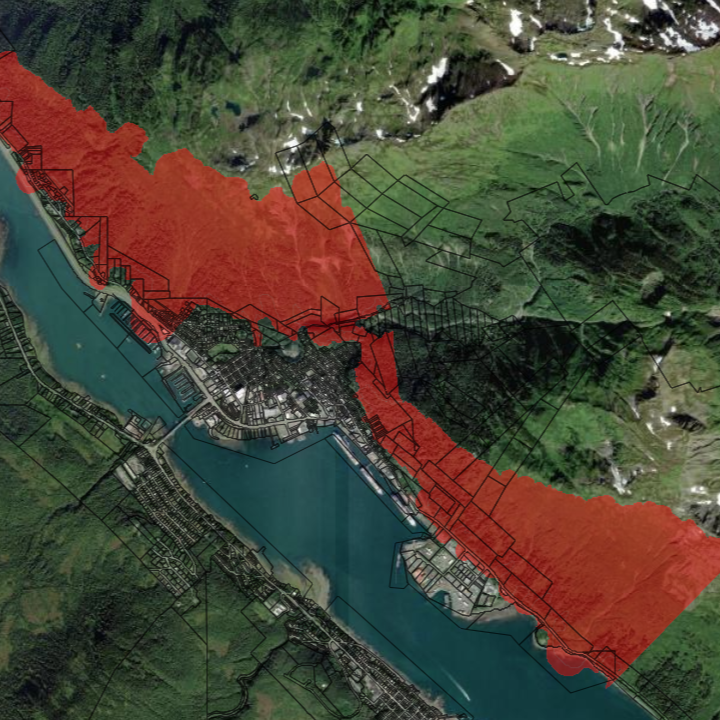
Barr emphasized that the avalanche path shown on CBJ maps represents the maximum modeled extent of a worst-case avalanche event.
“It is important to note that the Behrends avalanche slide path, as shown in the CBJ avalanche maps, represents the maximum extent of the largest model avalanche event, meaning it is unlikely than an avalanche would reach the outer reaches of the map, that includes Egan drive.” Barr Said.
While officials say it is unlikely that an avalanche would reach Egan Drive, emergency planners prepare for the most severe scenario.
“Our emergency programs and responders prepare for the worst.” Barr said, “That means having critical resources staged on both sides of town, as well as having plans for their partners to respond and care for emergency medical transportation and other needs, we also want to make sure that the public has all the information we have so that they can make their own decisions about their potential risk.”
Barr noted that forecasting avalanche risk remains complex, particularly because weather conditions have prevented crews from visually inspecting the snowpack near the top of the Behrends slide path. Barr said information about the volume and stability of snow in the upper reaches of the slide zone is limited.
“Predicting and forecasting risk is complicated and can be an exercise in making decisions with incomplete information.” Barr said.
City teams were monitoring conditions overnight, so far there has been no major release, and the evacuation advisory remains in effect this morning.
Officials said additional information will be shared once crews are able to safely access and visually inspect the snowpack, which could happen later this week depending on weather conditions.
U.S. Rep. Mary Peltola, D-Alaska, speaks on Jan. 4, 2024, at a town hall meeting on the possible Albertsons-Kroger grocery merger. The meeting was held at the Teamsters Local 959 headquarters in Anchorage. Peltola said on Tuesday she has not decided whether to support her party's likely candidate, Vice President Kamala Harris. (Photo by Yereth Rosen/Alaska Beacon)
U.S. Rep. Mary Peltola, D-Alaska, speaks on Jan. 4, 2024, at a town hall meeting on the possible Albertsons-Kroger grocery merger. (Photo by Yereth Rosen/Alaska Beacon)
AP-Democratic former U.S. Rep. Mary Peltola said Monday that she would challenge Republican Sen. Dan Sullivan in this year’s midterm elections, vowing to shake up the establishment to make life more affordable for Alaskans.
“Life is difficult here, and we know that we have to take care of each other,” Peltola said in a video announcement.
Peltola, who is Yup’ik, was the first Alaska Native to serve in Congress. She won special and regular elections in 2022, defeating a field that included Republican former Gov. Sarah Palin. In 2024, she lost to Republican Nick Begich, who had also run in 2022.
Peltola focused on local concerns in her announcement, saying Alaska’s future depends on fixing the “rigged system in D.C. that’s shutting down Alaska, while politicians feather their own nests.”
She said the salmon and migratory birds that once filled the freezers of Alaska Native subsistence hunters are now harder to find, forcing families who live far from the state’s limited road system to rely on grocery stores for pricey staples, driven up by high transportation costs.
“It’s not just that politicians in D.C. don’t care that we’re paying $17 for a gallon of milk in rural Alaska,” she said. “They don’t even believe us. They’re more focused on their stock portfolios than our bank accounts.”
Although Democrats are hopeful about picking up seats in this year’s midterms, Alaska could prove to be difficult political terrain. Sullivan, a former state attorney general and natural resources commissioner, defeated the state’s last Democratic senator in 2014.
The Republican National Committee said Peltola became “a rubber stamp for the far-left the second she got to Washington.”
“Alaskans saw through her empty promises then showed her the door, and she’ll lose to Dan Sullivan who fights for Alaskans every day,” RNC spokesperson Nick Poche said in a statement.
While serving in Washington, Sullivan has been involved in military and resource development issues, and he was endorsed by then-President Donald Trump in the 2020 election.
“Senator Sullivan has spent years delivering real results for Alaska: historic investments in our state’s health care, major funding for our Coast Guard, helping protect those who can’t protect themselves and policies that are finally unleashing Alaska’s energy potential,” his campaign spokesperson, Nate Adams, said in an email to The Associated Press.
“His opponent,” Adams said, “served a term and a half in Congress where she didn’t pass a single bill. Alaskans deserve a senator with a proven record of getting things done, and the contrast couldn’t be clearer in this race.”
Peltola has long touted her ability to work across party lines, such as supporting the large Willow oil project on Alaska’s North Slope. She angered some Democrats in 2024 when she refused to endorse then-Vice President Kamala Harris in the presidential race won by Trump.
Peltola said Alaska’s Republican congressional delegation used to ignore partisanship and do what was right for the state, such as backing public media and disaster relief, and even invoked Republican former Sen. Ted Stevens.
“It’s about time Alaskans teach the rest of the country what Alaska First and, really, America First looks like,” Peltola said.
Alaska has open primaries and ranked choice voting in general elections. The top four vote-getters in the August primary regardless of party affiliation will advance to the November general election.
NOTN- City officials issued a high-risk avalanche evacuation advisory today as worsening weather conditions raised the likelihood of avalanches across all known slide paths.
The advisory, updated at 10:30 a.m., urges residents in at-risk areas to evacuate as increased snowfall, warmer temperatures and several inches of rain forecast at higher elevations are significantly heightening avalanche danger.
Officials stressed that the situation is rapidly evolving and could escalate further as weather conditions deteriorate.
Emergency response crews are staged and prepared to respond in the event of an avalanche at Thane road where DOT was scheduled to close the road at the avalanche gates at noon.
An emergency shelter is available at Centennial Hall, where the American Red Cross is prepared to provide mass care services, including meals, once formally activated. City officials said resources are in place to support evacuees should conditions worsen.
Pet sheltering is also available at Centennial Hall. Juneau Animal Rescue is offering additional emergency pet sheltering through its Safe-Keeping Program, and JAR and KTOO have created resources to help pet owners prepare for emergencies.
“‘It’s a substantial portion of downtown.” Said Deputy City Manager Robert Barr, “Downtown is the area that that we’ve been able to map. That doesn’t mean avalanche doesn’t exist elsewhere. folks should just be aware.”
Authorities urged residents to take precautions during the period of elevated avalanche risk, including avoiding travel beneath known avalanche paths, following all road and trail closures, and not stopping in avalanche runout zones. Residents were also advised to closely monitor official alerts and updates.
After storms or avalanche activity, officials warned people to stay clear of debris piles and runout areas and to wait for official reopening notices before resuming normal travel. Any observed avalanche activity should be reported to authorities.
Rep. Nick Begich, R-Alaska, speaks during the commissioning ceremony for the Coast Guard icebreaker Storis on Sunday, Aug. 10, 2025, in Juneau, Alaska. (Photo by James Brooks/Alaska Beacon)
The U.S. House of Representatives voted 230-196 on Thursday to extend Affordable Care Act subsidies for three years and reverse massive cost increases that went into effect with the new year.
The reversal must still be approved by the U.S. Senate and President Donald Trump before becoming effective.
Alaska’s lone member of the House, Republican Rep. Nick Begich III, voted against the extension, as did 195 other Republicans.
Seventeen Republicans voted for the extension of subsidies that were enacted during the COVID-19 pandemic emergency, joining all of the chamber’s Democrats.
The House’s Republican leaders opposed the extension, but a handful of Republicans signed a petition in December to force a vote.
Begich did not sign that petition, and on Wednesday, he joined other Republicans in an unsuccessful procedural vote intended to block Thursday’s decision.
In a written statement explaining his vote on Thursday, Begich said extending subsidies would not fix the problems he sees with the Affordable Care Act, commonly known as Obamacare. “The health insurance system created by Democrats under Obamacare has proven completely unaffordable for the American healthcare customer,” the statement said. “An extension of Obamacare COVID subsidies does not fix what is broken.”
He said he would like to see reforms to the Affordable Care Act, without which he said the extension “has no credible pathway forward in the Senate.”
In December, Begich voted in favor of a Republican-proposed alternative to the extension. That alternative, which focuses on drug costs, would not stop or reverse the new cost increases and has thus far been rejected by the Senate.
The Congressional Budget Office reported that the alternative would reduce health insurance premiums for insured Americans but would also reduce the number of Americans who are insured.
“I remain committed to working on reforms that lower costs, expand access, and improve outcomes for all Americans,” Begich said in his statement. “Temporary extensions without meaningful reform are not the solution. Real reform that puts patients first is.”
In December, Alaska’s two U.S. Senators, Lisa Murkowski and Dan Sullivan — both Republicans — joined Senate Democrats in an unsuccessful attempt to advance a condition-free extension similar to the one passed by the House on Thursday.
That was a change in position for Sullivan, who had previously opposed extensions that were not coupled with changes to the Affordable Care Act.
Begich and Sullivan are each up for election this fall. Sullivan does not have a Democratic Party-backed opponent yet, but former U.S. House Rep. Mary Peltola is widely expected to enter the race this month.
Begich is being opposed by Anchorage pastor Matt Schultz. Alaska Democratic Party Chair Eric Croft said by email that Thursday’s vote will be a campaign issue in the fall.
“After allowing lifesaving ACA tax credits to expire on December 31, Nick Begich doubled down on his betrayal of Alaska families and blocked the extension of these credits,” he wrote. “We cannot afford these health care price hikes, and we won’t forget about Nick Begich’s betrayal this November.”
NOTN-Eaglecrest Ski Area officials say the resort continues to operate even with the extreme winter weather, closures, infrastructure problems and leadership turnover.
One of the most significant operational challenges for Eaglecrest has been a major water system failure beneath Fish Creek Lodge. Officials said the break was caused by aging infrastructure, not freezing, but repairs were complicated when a separate heating-system water line was damaged during initial work.
Contractors are now scheduled to install a supplemental water line, with hopes of restoring service next week. Water testing will be required before potable use can resume.
Mountain operations crews are continuing grooming and trail preparation as the snowfall allows, though mechanical issues with snowcats have slowed the progress.
Contractors are on site assisting with repairs. Plans are also being developed for snowmaking improvements and the possible return of night skiing.
According to the managers report released after the meeting last night, Eaglecrest has seen access improvements. For the 2025-26 season, the City and Borough of Juneau assumed responsibility for maintaining Fish Creek Road.
City crews are currently widening the road to improve traffic flow to the ski area.
Despite the continuous operational hurdles, the report discussed strong participation in snowsports programs. The ski area hosted three holiday camps with 125 students and launched its first multi-week programs in early January.
Thursdays meetings also brought notable leadership changes.
First reported by the Juneau Independent, General Manager Craig Cimmons resigned, after taking up the position on September 30 of 2024.
Board chair Hannah Shively stepped down for health reasons. Erin Lupro, a longtime employee and former acting general manager, was appointed interim general manager, with Cimmons assisting in the transition for up to 30 days.
Eaglecrest has faced financial strain as well, including a reported 40% drop in season pass sales and major projected deficits in the years leading up to the proposed gondola project.
On January 5, a report was presented during a Special Finance Committee Planning Meeting that shows Eaglecrest is facing mounting budget deficits.
Eaglecrest entered the current fiscal year with a budget deficit of $691,600, with the lowest previous fund balance in fiscal year 2006.
Under the current projections, the report estimates the fund balance could reach between negative $2.5 million and negative $3.0 million at the start of fiscal year 2027.
The mountain’s long-term financial planning is tied heavily to the proposed gondola project, but the first potential gondola related revenue is only expected in the final two months of fiscal year 2028.
Officials said additional updates on operations, infrastructure repairs and leadership transitions will be shared as the season continues.