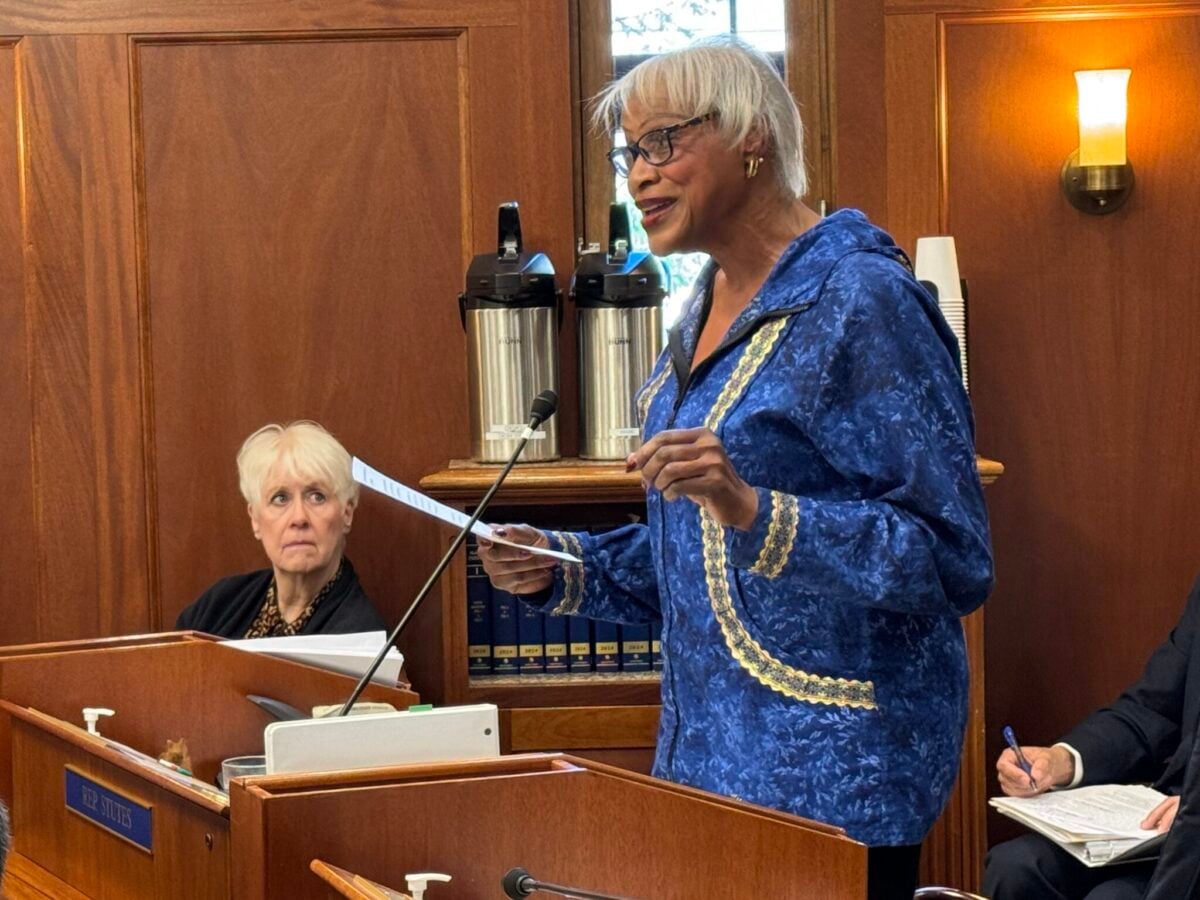
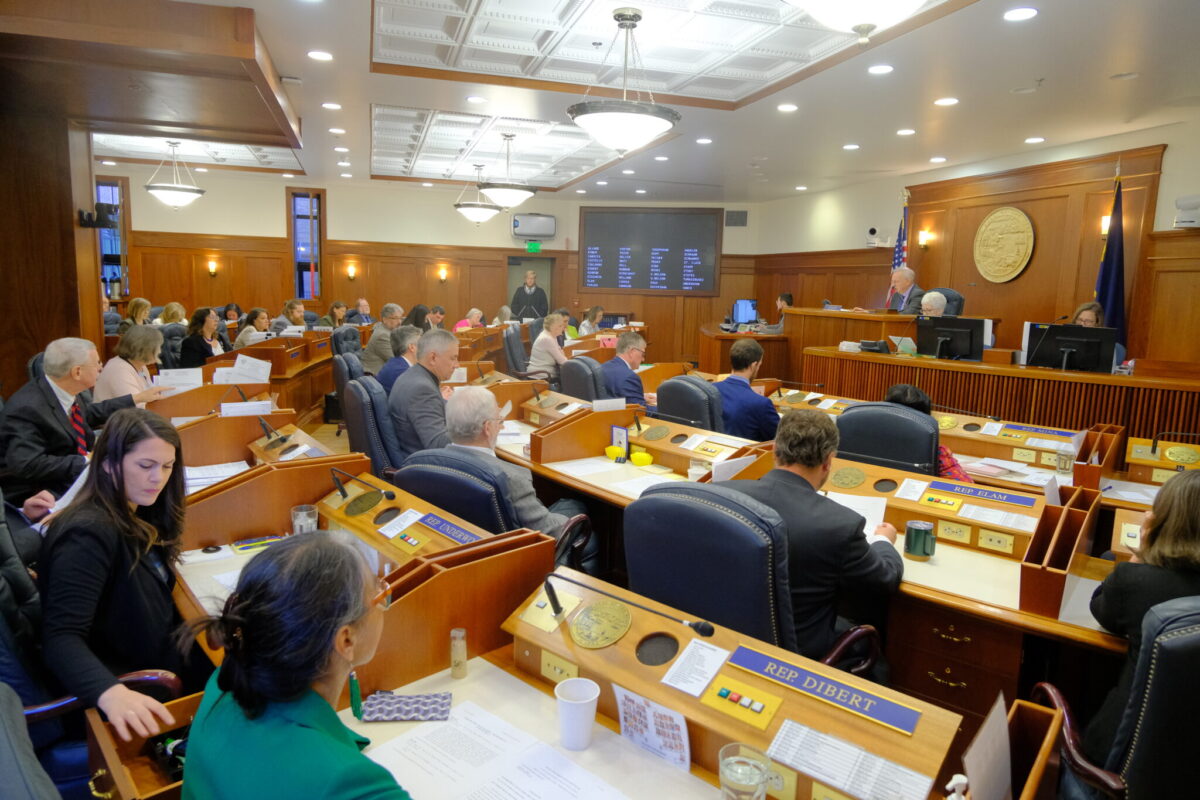
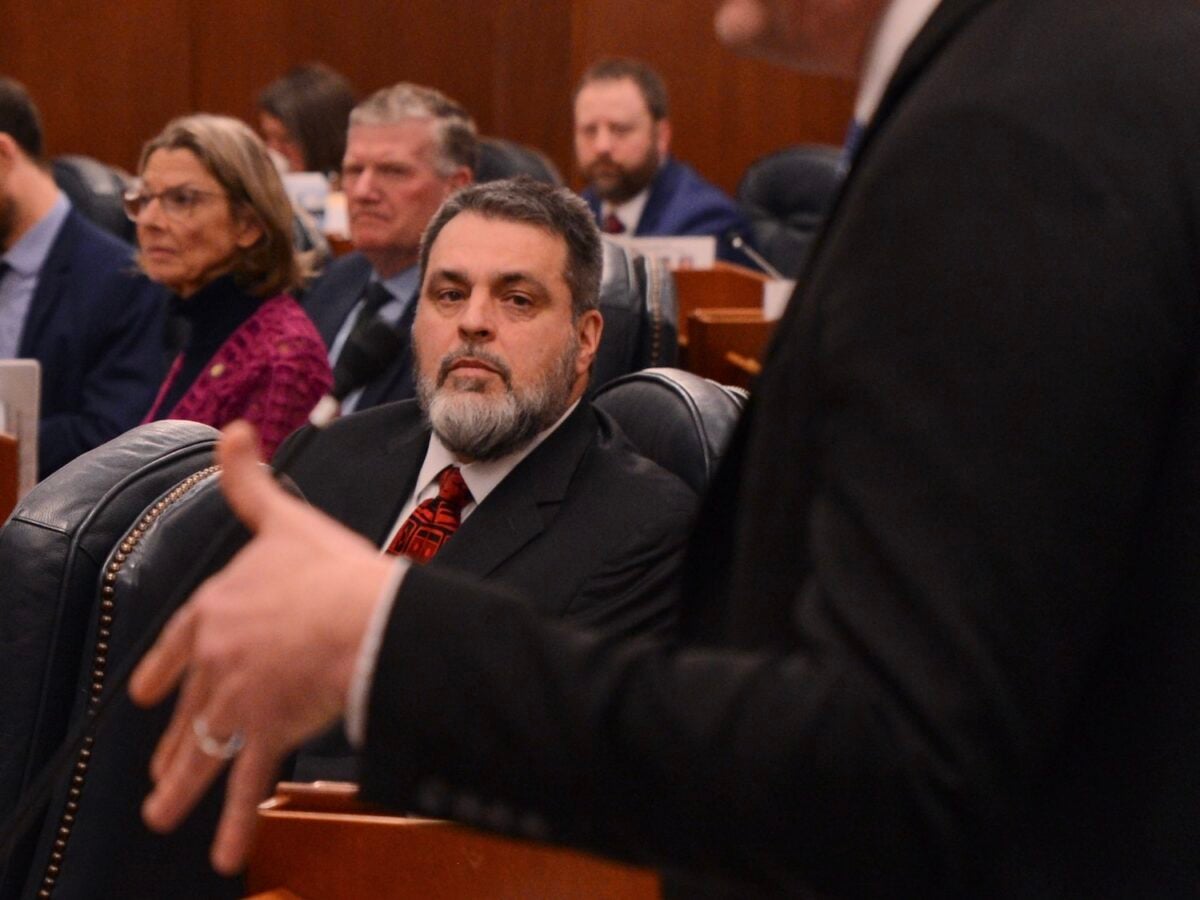
Sen. Elvi Gray-Jackson, D-Anchorage, speaks in favor of the veto override on Senate Bill 41 on Friday, June 19, 2026. Watching at left is Rep. Louise Stutes, R-Kodiak. (James Brooks photo/Alaska Beacon)
By: James Brooks, Alaska Beacon
Sen. Elvi Gray-Jackson, D-Anchorage, speaks in favor of the veto override on Senate Bill 41 on Friday, June 19, 2026. Watching at left is Rep. Louise Stutes, R-Kodiak. (James Brooks photo/Alaska Beacon)
Alaska Gov. Mike Dunleavy extended his record-high veto rate Thursday by vetoing nine of the 82 bills passed by lawmakers in the second year of the 34th Alaska State Legislature.
Two of the vetoed bills — one expanding the power of pharmacists and the other covering the state’s board of engineers and architects — were put into law Friday after lawmakers overrode the governor.
Dunleavy has now vetoed or attempted to veto almost one-fifth of all bills passed by the 34th Legislature. Other governors have issued more vetoes, but none have vetoed a higher proportion of bills than Dunleavy.
Pharmacists’ powers expanded
State legislators voted 43-17 on Friday to override Dunleavy’s veto of House Bill 195, which gives pharmacists more authority to prescribe medicines and conduct simple medical tests. Forty votes were needed.
Rep. Genevieve Mina, D-Anchorage, spoke in favor of the override, saying the bill will enable Alaskans to get cheaper medical care from pharmacists instead of more expensive providers.
Rep. Zack Fields, D-Anchorage, offered an example: For a parent with a child suffering from strep throat after their pediatrician had closed for the day, going to an urgent care clinic might cost hundreds of dollars, and an emergency room visit could cost thousands.
“This bill allows a parent to take their child to a pharmacy” and get a strep throat test, he said.
“We have a growing number of families in Alaska that cannot afford health insurance. If they can’t take their kid to a pharmacy, they’re just not going to get treated,” he said.GET THE MORNING HEADLINES.SUBSCRIBE
Some antiabortion advocates lobbied against the bill, saying they believe the bill could allow pharmacists to more easily dispense abortion-inducing drugs.
Rep. Jamie Allard, R-Eagle River, spoke to that point, but Rep. Mike Prax, R-North Pole and a strong antiabortion advocate himself, said that information is incorrect.
Alaska law limits who may perform an abortion in the state, Prax said.
“It just simply isn’t an issue, and therefore the benefits of this bill clearly outweigh any of the risks,” he said.
Interior designers added to architecture board
Lawmakers also overrode Dunleavy’s veto of House Bill 314 by a 45-15 margin. Forty votes were needed.
A revised version of a bill Dunleavy vetoed last year, HB 314 will regulate some aspects of interior design in the state by adding them to the State Board of Architects, Engineers, and Land Surveyors.
The bill also renewed the board’s legal authority, and when Dunleavy vetoed HB 314, it could have at least temporarily eliminated the board as a side effect. While the duties of the board would have been assumed by the Alaska Department of Commerce, Community and Economic Development, lawmakers said they did not want to eliminate the board just as the state considers a state-spanning natural gas pipeline.
No extra oversight for for kids’ psychiatric facilities
Forty of the Legislature’s 60 members are needed to override the veto of a policy bill, and legislators failed to reach that threshold on three votes Friday due to the opposition of Republican lawmakers.
If enacted, the bill would have required unannounced state inspections of facilities like North Star and reports on the use of physical and chemical restraints on children, among other items.
In his veto message, the governor said that while he supports oversight, he believes the bill duplicates what the state is already empowered to do.
Local districts would have been responsible for implementing that curriculum.
The override vote was 38-22, two votes short of what was needed.
The issue, Gray-Jackson told legislators Friday, is nothing short of a matter of life and death.
Alaska has the highest suicide rate in the nation, she said, and “in many rural communities, suicide rates are nearly four times that the national average. Teaching our students how to recognize mental health challenges, to seek help and support one another, is one of the most basic and meaningful steps we can take to address this crisis.”
In his veto message, the governor said, “this bill places the state in the role of imposing upon school districts to mandate the development of mental health education at a time when districts are already working to meet existing requirements.”
“Decisions about sensitive classroom instruction, especially instruction involving a student’s mental and emotional health, should remain as close as possible to parents, local school boards, and communities,” he said.
Gray-Jackson lambasted that statement, saying it repeated “false” and “harmful” misinformation from “online blogs and commentators.”
“SB 41 didn’t remove parents from the conversation, it didn’t strip authority from local school boards, it didn’t replace community values with a one-size-fits-all mandate,” she said.
“The reality is much simpler,” Gray-Jackson said. “The governor vetoed a bill with the potential to save lives in every community represented in this chamber, and I can’t emphasize that enough.”
No retirement plans for minimum-wage workers
Legislators failed by a single vote to override Dunleavy’s veto of Senate Bill 21, which would have provided state-run retirement plans for workers in businesses that do not currently offer retirement benefits.
The program under SB 21, similar to efforts already launched by other states, would have principally affected minimum-wage workers and those in small businesses. Unless they opt out, eligible workers would have had 5% of their paychecks automatically deducted and deposited into an investment account managed by the state.
In his veto message, the governor said he opposes a mandate, even with an opt-out provision.
“Although employees may opt out, the bill relies on automatic enrollment and places employers in the middle of a state-run investment program. Alaska businesses should not be required to
administer or facilitate retirement savings accounts created by the State when private retirement
and investment options are already available,” Dunleavy wrote.
The vote on an override was 39-21, with Rep. Kevin McCabe, R-Big Lake, casting the last and decisive vote to sustain the governor’s decision.
No updates to corporate or tobacco taxes
Of the governor’s nine vetoes, legislators declined to vote on four, permitting them to stand without a vote.
Dunleavy vetoed two bills — House Bill 280 and Senate Bill 24 — saying that he is unwilling to approve tax changes without a comprehensive fiscal plan that brings state expenses and revenue into line over the long-term.
Both bills had been passed in different forms by prior editions of the Legislature and were also previously vetoed by Dunleavy. If SB 24 had been enacted, it would have imposed Alaska’s first tax on e-cigarette products. HB 280 would have modernized the state’s corporate income tax system, taking tax revenue for online sales from other states to the Alaska treasury by declaring that sales to Alaskans take place in Alaska, not at the location of a warehouse or computer server operated by the seller.
House Bill 23, also vetoed by the governor, would have subjected nonprofit businesses to the authority of the Alaska State Commission for Human Rights, which handles discrimination complaints against employers.
“While I support protecting Alaskans from unlawful discrimination, this bill expands the commission’s reach over nonprofit employers, including charitable, educational, and religious organizations. That expansion creates uncertainty for small community organizations and risks unnecessary administrative proceedings and litigation,” the governor wrote in his veto message.
The last of the vetoes, Senate Bill 258, would have forbidden the state from signing computer software deals that lock in the state to a particular company or limit the software to a particular geographic area.
The governor’s veto message said in part that the “bill places rigid statutory limits on how the State and political subdivisions may contract for software in a highly technical and rapidly changing marketplace.”
“Software licensing, cybersecurity requirements, cloud services, support, hosting, and pricing
models are complex and often negotiated together. Restricting those negotiations in statute could reduce flexibility, limit access to needed products, and increase costs for agencies and local governments,” he wrote.
The Alaska House convened for a third special session and voted to reject a Senate version of a tax break bill for the proposed AK LNG gas line project on June 20, 2026. (Photo by Corinne Smith/Alaska Beacon)
The Alaska House of Representatives on Saturday rejected a Senate-drafted multibillion-dollar tax break for a proposed trans-Alaska natural gas pipeline project, as members of the House declined to abandon a different proposal they drafted.
Members of the House voted down the Senate’s revised bill 12-28, nine votes short of what was needed to adopt the Senate plan. In a separate 0-16 vote, the Senate declined to abandon its version in favor of the House’s plan. Lawmakers will now convene a conference committee with representatives from both bodies to hammer out a compromise agreement.
In an interview following the House vote, House Speaker Bryce Edgmon, I-Dillingham, said objections within the House varied, and lawmakers with the conference committee need time to evaluate the changes.
“Given the breadth and just the wide range of things that happened to House Bill 381 in the Senate last night, you know, we’re going to take that vehicle and use it as a starting point going forward, and we’re going to work very diligently and also with a strong sense of resolve to try to bring it all to an agreement,” Edgmon said.
Lawmakers agreed to reconvene for potential final votes on July 1.
Members of the all-Republican House Minority Caucus huddle outside the House chamber behind the Capitol ahead of a vote to reject the Senate’s version of a tax break bill for the proposed AK LNG gas line project on Saturday, June 20, 2026. (Photo by Corinne Smith/Alaska Beacon)
While conference committees typically negotiate behind closed doors, Edgmon said there will be public meetings as well.
Lawmakers said negotiations would begin soon but there was no confirmed schedule for the conference committee.
From the House, the conference committee will include Edgmon, Reps. Calvin Schrage, I-Anchorage, and Justin Ruffridge, R-Soldotna. From the Senate, the committee includes Sens. Lyman Hoffman, D-Bethel, Bert Stedman, R-Sitka, and Mike Cronk, R-Tok.
At issue is the size and scope of a tax break for the proposed trans-Alaska natural gas pipeline project, known as Alaska LNG.
As currently proposed, the project would include construction of a 807-mile gas line from the North Slope to Cook Inlet, in phase one. In phase two, it would include a new large gas-treatment plant on the North Slope and an export facility on the Kenai Peninsula to export gas internationally.
The House passed the bill with a larger tax break on June 12. The Senate revised the bill, reducing the size of the tax break and passed a variety of changes on Friday, with a smaller tax break on the gas tax, known as the alternative volumetric gas tax, and a plan for gradual increases in tax over time.
Senators also included a variety of changes to the bill, including a previously contentious provision voted down by the House this spring to levy corporate income taxes on privately-owned oil and gas companies that currently do not pay them. That would apply to Hilcorp and Glenfarne, the company developing the LNG project.
The Senate also included amendments to the bill seeking more protections for the state and Alaskans: one an amendment would limit the gas price cap for residents in Southcentral Alaska to rise with inflation and prohibiting developers from passing on cost overruns to Alaskans; a labor-related proposal would require the pipeline builders to pay prevailing wages in the state and employ Alaskans and apprentices. An amendment would require Glenfarne and developers to disclose their ties to foreign companies. Another amendment declared that if pipeline developers abandon their efforts, the project will return to the state at no cost. Currently Glenfarne owns 75% of the project while the remaining 25% is held by the state-owned Alaska Gasline Development Corp. Glenfarne could not seek a buyout from the state if it failed to move forward with the project.
The Senate imposed deadlines on the project, mandating construction of the pipeline and phase one to be completed no later than 2032, and phase two to be done no later than 2036.
The Alaska Senate convened for the third special session on June 20, 2026, voting to move a tax break bill for the proposed AK LNG gas line project to a conference committee. (Photo by Corinne Smith/Alaska Beacon)
Late Friday night, Gov. Mike Dunleavy voiced objections to the Senate’s version of the bill, saying there were “serious questions about all the amendments.”
Friday was the last day of a 30-day special session devoted to the gas pipeline project. Dunleavy has proclaimed another 30-day special session, which began Saturday, and legislators spent the morning taking procedural actions that allow them to resume work without interruption.
Dunleavy urged lawmakers to work quickly, but four senators were excused absent from Saturday’s votes, and members of the House rapidly left the Capitol on Saturday afternoon in order to catch flights home from Juneau.
Edgmon said he expects negotiations with the governor’s office to continue.
“If he’s not involved, and that’s going to make the pathway ahead problematic,” he said.
A spokesperson for Dunleavy’s office said on Saturday that the governor supports the bill moving forward to a conference committee.
“Governor Dunleavy is encouraged by House and Senate leadership’s decision to send HB 381 to a conference committee,” said Jeff Turner, Dunleavy’s communications director, by email. “It’s an opportunity for both bodies to agree on a version of the bill that can incentivize the Alaska LNG Project while still providing steady, predictable revenue to communities along the pipeline corridor using a volumetric tax mechanism.”
The governor and members of the House were particularly opposed to the corporate income tax provision.
House Majority Leader Chuck Kopp, R-Anchorage, joined a news conference with Gov. Mike Dunleavy on June 19, 2026. (Photo by Claire Stremple/Alaska Beacon)
“It is considered economically counterproductive at the moment the state is trying to attract final investment decisions on phase one and phase two of the gas pipeline,” House Majority Leader Rep. Chuck Kopp, R-Anchorage, said on the House floor ahead of Saturday’s vote, adding that he believes the provision undercuts certainty and competitiveness of the project.
“These amendments were not vetted or extensively explained on the other body’s floor, and we do not yet know their full impact,” Kopp added.
But Sen. Bert Stedman, R-Sitka, who co-chairs the Senate Finance Committee said lawmakers still need more financial information from Glenfarne to determine if that’s the case, and to determine the project’s economic viability.
“They still haven’t clearly delineated how much benefit or burden the property tax existing structure actually is on it,” Stedman said after the Senate vote. “Even if we made no property tax on the gas line, it does not make it economic. It helps economics, it does not get it over the hurdle.”
“We gotta protect the treasury, that’s our job,” Stedman added. “If you’re going to give concessions, they need to show us why they need them, and the impact.”
If legislators do not adjourn early, the new special session is set to end on July 19.
Dion McCabe, photo provided by family to the Juneau Police Department
NOTN- Juneau police say a body discovered in a wooded area near the end of Sherwood Lane has been identified as 29-year-old Dion McCabe, who had been reported missing earlier this month.
The full press release can be found below;
the Juneau Police Department received a report that the deceased body of Dion McCabe had been located in a wooded area near the end of Sherwood Lane. Officers responded to the scene and confirmed the presence of the deceased individual. The area was secured, and an investigation into the circumstances surrounding the death was initiated.
The next of kin has been notified. The body will be transported to Anchorage, Alaska, where an autopsy will be conducted to assist investigators in determining the cause and manner of death.
At this time, the investigation remains ongoing. Anyone with information related to this case is encouraged to contact the Juneau Police Department. Anonymous tips can also be submitted through Juneau Crime Line at JuneauCrimeLine.com.
**********************
On June 5, 2026, the family of 29-year-old Dion McCabe reported him missing to the Juneau Police Department. Family members reported they had not seen or heard from Dion for approximately a week and a half. Dion was last seen by family on May 26, 2026, at Safeway in Juneau.
Dion is described as a 29-year-old white male, approximately 6 feet tall and 186 pounds, with brown hair and blue eyes. He was last seen wearing Rock Revival blue jeans, a white T-shirt, and UGG slipper-style shoes.
A photograph of Dion is being posted on the Juneau Police Department Facebook page to assist in locating him.
Anyone with information regarding Dion McCabe’s whereabouts is encouraged to contact the Juneau Police Department at (907) 586-0600. Anonymous tips may also be submitted through Juneau Crime Line.
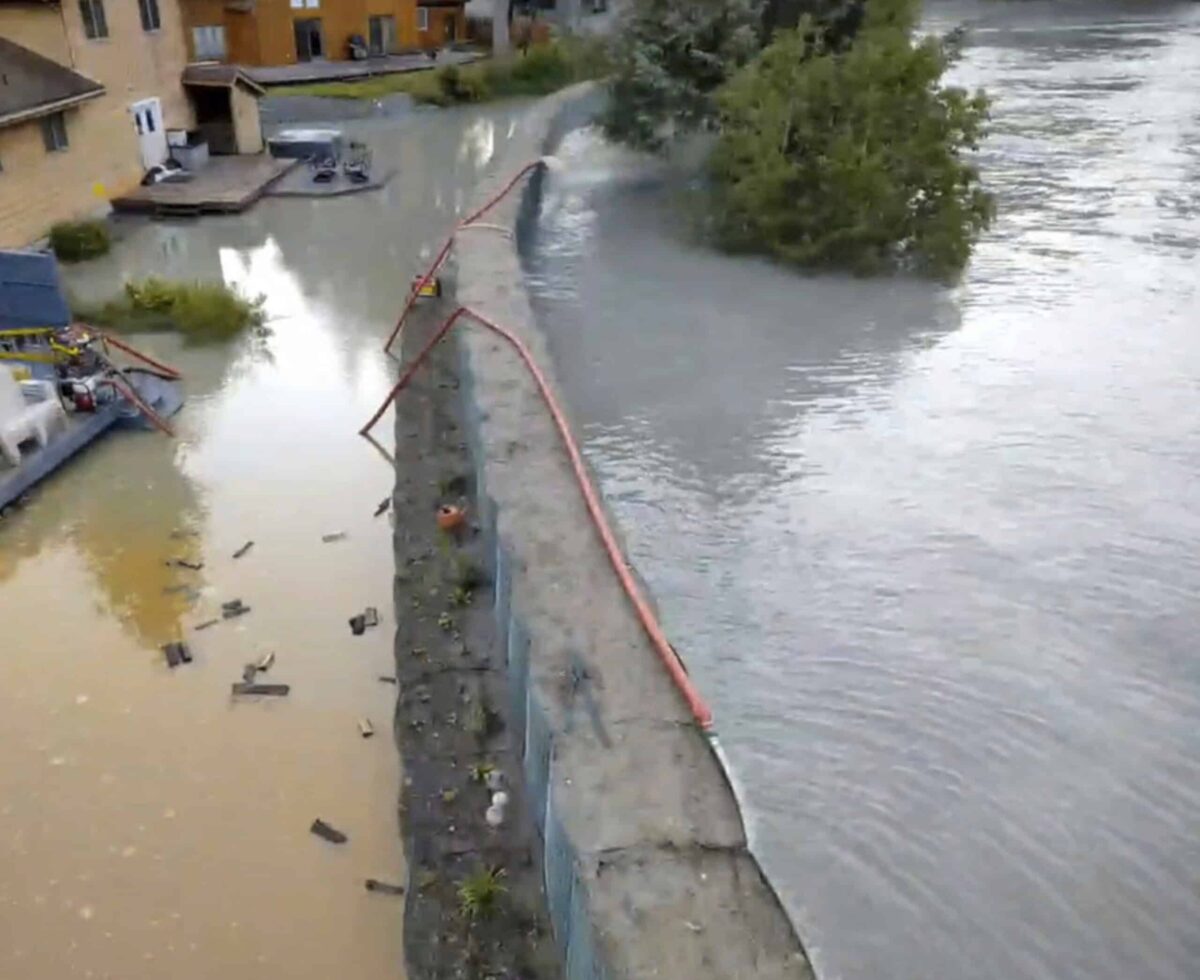
This drone image provided by the City and Borough of Juneau shows flooding from a release of water and snowmelt at Mendenhall Glacier covered some roads and threatened homes along the Mendenhall River in Juneau, Alaska on Wednesday, Aug. 13, 2025. (City and Borough of Juneau via AP)
This drone image provided by the City and Borough of Juneau shows flooding from a release of water and snowmelt at Mendenhall Glacier covered some roads and threatened homes along the Mendenhall River in Juneau, Alaska on Wednesday, Aug. 13, 2025. (City and Borough of Juneau via AP)
NOTN- The Juneau Assembly approved three measures in a brief special meeting, declaring a local emergency over the glacier outburst flood, setting aside $3.5 million for school roof repairs and backing the homeporting of two major U.S. Coast Guard cutters.
The three resolutions were bundled into a single consent agenda and passed without objection at the noon meeting.
One resolution declares a local emergency tied to the glacier outburst flood, clearing the way for a faster response and potential access to additional resources.
A second measure appropriates $3.5 million for school roof repairs, aimed at addressing priority maintenance needs across the district.
The third resolution throws the city’s support behind the homeporting of two major Coast Guard cutters in Juneau, including the CGC Storis, signaling local backing for an expanded federal maritime presence.
CBJ- The City and Borough of Juneau (CBJ) posted a solicitation for bids to perform construction work on the first two floors of the Michael J. Burns building. The project will accommodate an accessible Assembly Chambers, central public service counter and office space for 147 personnel. The cost-based bid solicitation materials include a summary of work, site layout and list of project alternates should budget allow. The solicitation period closes on July 13.
The primary scope of work addresses critical updates to the building’s mechanical and electrical systems which are out of code and at risk of needing constant repairs if not updated. There will also be limited renovations to the first floor to provide an Assembly Chambers and public service counter. Some office spaces will receive minor renovations, including moving partitions to accommodate CBJ departments. At this time, the current budget does not include paint and flooring updates for staff spaces, however, should bids come in below budget, these items are included among several items that could be added as project alternates.
“We took a very frugal approach to this project,” explains CBJ City Architect Liam Knecht who has been leading the project. “The end result may not include updated paint or flooring, but this scope will get us to a safe, consolidated, and cost-effective workspace for municipal employees.”
The current City Hall houses about 40% of CBJ office staff and faces major renovation and repair costs estimated at nearly $10 million for immediate health and safety repairs. Approximately $45 million is required to complete all needed health, safety, mechanical and structural repairs to the building. Additional CBJ offices are spread throughout the city in private commercial buildings and are subject to increasing lease costs and needed repairs. In the current arrangement, annual operating costs–including for maintenance, utilities and lease–total approximately $1.3 million. Annual operating costs for municipal services to operate out of the Burns Building will be approximately half that at $650,000 and include utilities, maintenance, and capital reinvestment costs.
In September 2025, the Juneau Assembly formally approved the purchase of two floors of the Burns Building (801 W. 10th Street) for use as the new CBJ Municipal facility. The plan structures the arrangement as a condominium association, with CBJ purchasing the first two floors while the Alaska Permanent Fund Corporation retains the top floor. The building plans prioritize public accessibility and services, with the new Assembly Chambers being 3,530 square feet (versus 1,929 in the current City Hall) and a larger public counter to better receive and direct inquiries for all departments. The space will function as a one-stop shop for residents to interface with city government.
The total budget to move and consolidate CBJ offices in the Burns Building is $20.5 million. This total cost includes the purchase of 46,000 square feet of commercial office space for $9.3 million and an upfront capital investment fund contribution of $2.7 million (similar to a deferred maintenance fund, to save for future capital project needs).
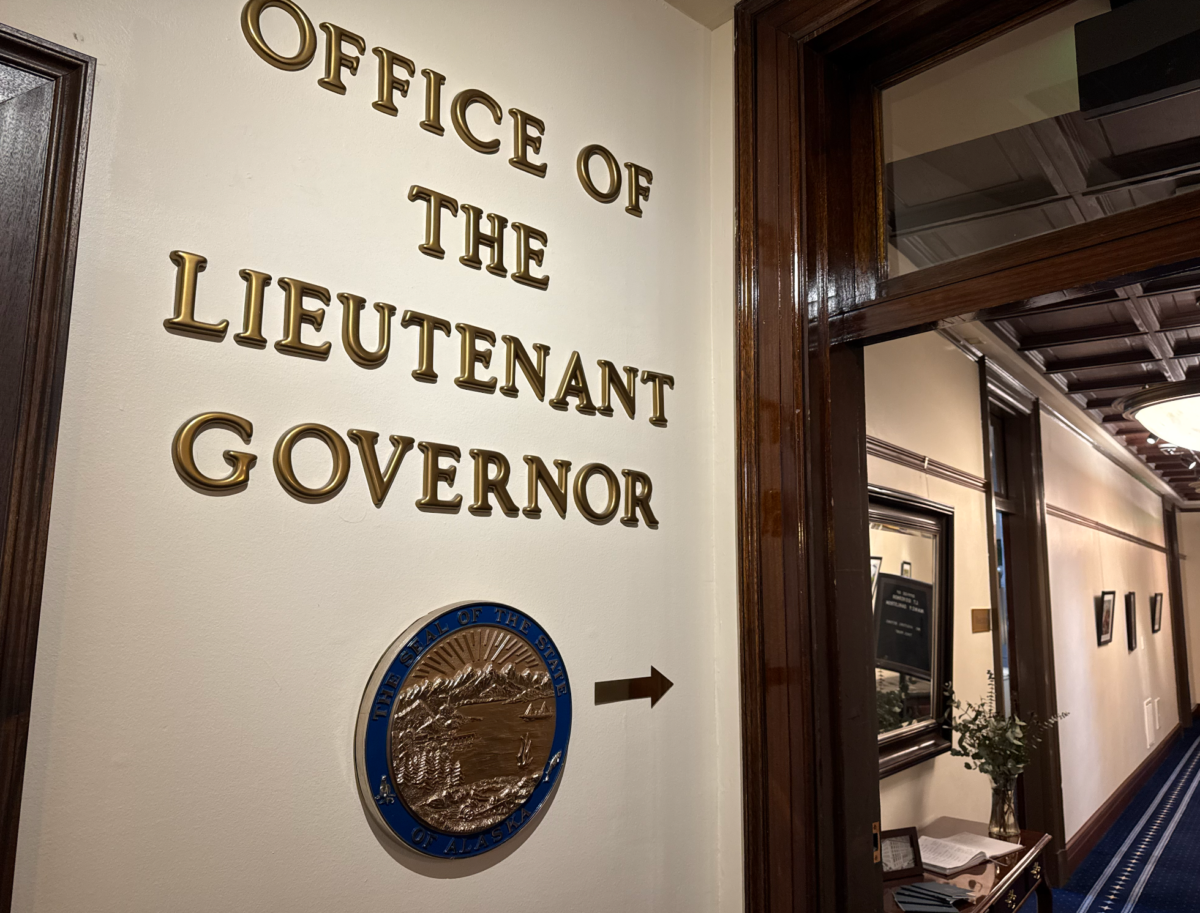
Alaska’s lieutenant governor maintains an office at the state Capitol in Juneau on the same floor as the governor. (Photo by James Brooks for Northern Journal)
Rep. Andrew Gray, D-Anchorage and chair of the House Judiciary Committee has scheduled a legislative hearing on Monday to discuss the disqualification.
In a memo to Gray, attorney Andrew Dunmire said “the Lieutenant Governor was likely not legally justified in her decision to reject Mr. Sullivan’s declaration of candidacy.”
Dan J. Sullivan of Petersburg has the same first and last name as incumbent Sen. Dan S. Sullivan.
The Alaska Republican Party filed twocomplaints against the Petersburg Sullivan, saying his candidacy was merely intended to confuse voters and he was not acting as a candidate in good faith.
Dahlstrom ultimately agreed with those complaints and disqualified Dan. J. Sullivan under a state regulation that forbids the Division of Elections from listing a candidate’s name “in a manner that is confusing or misleading to voters or compromises the fairness or neutrality of the ballot.”
Dunmire, analyzing the situation, said Dahlstrom was incorrect because state regulations cannot trump the U.S. Constitution’s requirements for candidates.
“As a general matter, the U.S. Constitution is supreme in all areas of law, and an administrative regulation cannot override or contravene a constitutional requirement. Therefore, if Daniel J. Sullivan is constitutionally entitled to be recognized as a candidate for U.S. Senate, then no regulation can prevent him from appearing on the ballot,” Dunmire wrote.
Amber Lee, a consultant working with Dan J. Sullivan, said by text message on Wednesday that the Petersburg Sullivan is still deciding what he will do after the lieutenant governor’s decision.
Students perform during a final spring concert on May 13, 2026 at Meadow Lakes Elementary, one of three schools closed by the Matanuska-Susitna Borough School District this year to address a budget deficit. (Photo by Elise Giordano/Mat-Su Sentinel)
Alaska saw an unprecedented wave of school closures this year. District officials grappling with severe budget shortfalls have opted to close 12 elementary and middle schools across the state — in Anchorage, Wasilla, Sutton, Seward, Sterling, Soldotna, Kasilof and Ketchikan.
With those closures, hundreds of students and staff will bus or commute to new schools next year, class sizes will grow as grades are combined and districts across the state are cutting programs, teachers, health aides, custodians, sports, library services and extracurriculars like music.
Officials in four districts say the closures were incredibly complex and difficult decisions but necessary to combat millions in budget shortfalls and years of state funding not meeting districts’ surging costs to operate schools.
“It was an incredibly trying time,” said Randy Trani, superintendent of the Matanuska-Susitna Borough School District that closed three elementary schools this year to address a $28 million budget shortfall. “Non-winnable… we did this to save teaching positions,” he said.
“This is devastating to everyone,” said Kylie Wilcox, a Soldotna mother of five. Her middle and high schoolers attended River City Academy, one of four schools closed on the Kenai Peninsula. “The district does not want to do this, the administration doesn’t want to do this, we just, it’s the reality of what we’re working with.”
At the same time, superintendents said it’s still unclear whether the closures and cuts have balanced district budgets because Gov. Mike Dunleavy has yet to sign off on next year’s increased budget for education funding. Last year, lawmakers flew back to Juneau for a special session, overruled Dunleavy’s veto and restored an education funding increase in a historic override vote in August, just weeks ahead of the first day of school.
This year, the Alaska Legislature approved one-time additional funding of $144 million for K-12 schools, including $29 million to offset rising energy costs, to total $1.8 billion approved for education next year. Lawmakers passed a budget with higher-than-expected state oil revenues driven by the Iran war, which is now before Dunleavy for his consideration.
Education Commissioner Deena Bishop said that the state has seen declining enrollment for more than 15 years, and as a result districts close schools due to what she called “excess capacity.” Bishop has served as commissioner under the Dunleavy administration since August 2023.
Deena Bishop, commissioner of the Alaska Department of Education and Early Development, speaks at a news conference Friday, March 15, 2024, with Gov. Mike Dunleavy. (Photo by James Brooks/Alaska Beacon)
“We’ve had several schools at 50% capacity, 55% capacity, that were within two miles of each other. And understanding that you want to use the majority of your money, you don’t want to put into facilities — the majority of your money you want to put into classrooms,” she said. “And so decisions, you know, things were weighed, and districts, hopefully working with their parents and communities, made decisions that they felt were the correct ones.”
Bishop said more families are opting for homeschool programs, and districts need to figure out how to provide education services for families that want choices for more flexibility.
Nearly one in six Alaska students were homeschooled last year, totaling an estimated 23,600 students, according to data compiled by the Association of Alaska School Boards.
“So we can’t really be upset that, you know, ‘Oh no, they’re not going to our schools,’” Bishop said. “Obviously they’re going to a school that their needs are met, if they’ve chosen that, so how do we work with it? You know, what does education look like, and what does it look like in serving a community? And more and more we’ll find that one size doesn’t fit all that schools really want to offer, and districts are starting to offer different programs.”
Alaska students have the option to enroll in homeschool or correspondence programs across the state, not necessarily with the district where they reside. While district officials say they are working to adapt and provide homeschool education services, districts receive less state funding per homeschool student which is contributing to district-wide deficits.
Matanuska-Susitna Borough School District closes three schools
The Matanuska-Susitna Borough School District, the state’s second largest district with almost 20,000 students, faced a $28 million budget deficit this year, prompting cuts across the district.
The school board closed Meadow Lakes and Larson elementary schools in Wasilla and Glacier View School in Sutton, affecting roughly 415 students and dozens of staff.
That comes after the district cut roughly 160 staff positions last year, said Superintendent Randy Trani. He said the district would have had to cut an additional 225 positions this year, which was unworkable.
“The very last thing that we wanted to do was lay off teachers, and the second last thing we wanted to do was close schools, but we’re to the point where if we didn’t close schools, it was only going to result in more teacher layoffs,” he said.
Trani said the district went through a process of evaluating schools based on a number of metrics, including number of students, costs to maintain and opportunities to bus students to schools nearby, in order to decide which schools to close. “The schools that we were forced to shut down were fantastic schools. This wasn’t a decision on academic merit. This was a decision about logistics and being forced into a really impossible choice,” he said.
Trani said closing the three schools wasn’t even enough to make up for the budget shortfall and the district had to cut deeper.
The school board considered various scenarios from cutting sports programs to transitioning to a four-day school week, Trani said, which were rejected by the school board. “These are all horrible choices,” he said.
While the Matanuska-Susitna Borough continues to have the fastest growing population in the state, Trani said declining birth rates combined with an ongoing wave of families opting to homeschool is leaving the district with declining enrollment of full-time students and reduced funding for the district. Roughly 3,200 students, or 16% of the district’s students, were enrolled in Mat-Su correspondence programs this year.
Trani said another cost driver had been double digit increases to healthcare insurance costs resulting in roughly $6 million more to the deficit, bumping it to $28 million.
But he emphasized the largest driver of the deficit was insufficient state funding. “State funding has not kept up with inflationary pressures, and it is by far the biggest driver,” he said. “Unless there is a long term fix to how K-12 education is funded this problem is going to continue.”
Ketchikan closes two of four elementary schools, with more cuts to come
Ketchikan serves roughly 1,800 students in the Southeast Alaska island community that is only accessible by plane or boat. This year, the district enacted major cuts, including 76 staff positions across the district to address a $3 million budget shortfall, plus $5 million in debt to the local borough. It closed two of the four elementary schools.
Point Higgins Elementary School was one of the two elementary schools closed this year in Ketchikan due to budget cuts. Staff and volunteers helped move out the school in early June 2026. (Photo by Niki Suomala)
The district closed Point Higgins and Fawn Mountain elementary schools, leaving one elementary, one middle and one high school in the community.
Niki Suomala, a third generation Ketchikan resident, attended Point Higgins elementary school, located 15 miles north of town. She said it was a special experience for her two children to go there — until the closure.
Her kids will be in the second and sixth grades next year, and they plan to commute into town for school. She said there were some tears at the news, but she said her children are adapting. She said she’s disappointed overall, but feels compassion for the district.
“It’s like, gosh, couldn’t we see this? Couldn’t we have seen this coming, and couldn’t we have tried to do something different?” she said. “But I also feel compassion, because I don’t know the answer to that question.”
Sheri Boehlert, the interim superintendent of Ketchikan Gateway Borough School District, also served as the principal of Point Higgins, spoke by phone after a full week of packing up and clearing out the schools. She said the reaction to the closures has been mixed: while there’s some in the community who want to see deeper cuts to balance budgets, there’s also a lot of grief in saying goodbye to neighborhood schools.
“It’s hard to dismantle something that was a big part of your career,” she said. “But on the flip side of that, the staff and community has really, by and large, been overwhelmingly supportive. We have tons of volunteers that are helping teachers pack and move, and they’re going to make something great at the next school for students, and there’s optimism out there.”
Class sizes will be effectively doubling in Ketchikan, Boehlert said, from about 15 students to class numbers in the twenties for elementary school and thirty students or more in the middle and high schools.
Boelert said the district has seen rising costs to operate, including for fuel, utilities and special education services. She said in particular the cost of staff health insurance is up 112% this year. Previous cost overruns for health insurance discovered last year created the over $5 million debt to the borough which the district will pay over over the next several years. “That is a unique situation,” Boehlert said. “They need their money back.”
Boehlert said with essentially flat state funding not meeting cost increases, the district cut roughly 26% of staff this year: “So it’s teachers, it’s principals, it’s custodians, health aides, like maintenance staff. No work group was unaffected.”
Even so, with the debt repayment, and this year’s state budgets still uncertain, Boehlert said Ketchikan faces more cuts across the district — unless there’s a significant population increase.
“We have a difficult road ahead of us in Ketchikan,” she said.
Four schools closed across the Kenai Peninsula
In the Kenai Peninsula Borough, the state’s third largest school district stretches across roughly 25,000 square miles — an area about the size of West Virginia — and serves nearly 8,400 students.
This year, the district faced an $8.5 million budget shortfall, after an $17 million deficit last year. The district is still in the midst of budget negotiations and determining cuts. An additional $3.3 million from the local borough and yet-to-be-determined one-time state funding this year may restore some programs, but officials opted to close four schools.
The district closed River City Academy in Soldotna, Tustumena Elementary School in Kasilof and Sterling Elementary School, sending students to other schools in Soldotna and Kenai. On the eastern side, the district closed Seward Middle School where classes will be consolidated into the elementary and high schools.
“The response was overwhelmingly that parents do not want these schools to close down. Communities did not want the schools to close down,” said Kari Dendurent, assistant superintendent of the Kenai Peninsula School District.
One of those parents is Kylie Wilcox, a mother of five living in Soldotna. Two of her children attended River City Academy, which was a standards-based school serving grades seven through 12. She said they liked the supportive environment and had hoped to continue through high school there.
River City Academy, a standards-based school serving grades 7 through 12 in Soldotna, was one of four schools closed by the Kenai Peninsula School District in May 2026. (Photo courtesy of Kylie Wilcox)
“They were starting to make friends at River City, and so they were really sad, like ‘I’ve got to start over again.’” she said. “And they were angry. They talked a lot about, you know, ‘why can’t they just give money to schools? Don’t they think that we’re worth it?’ My oldest was upset enough that they were willing to testify in the district meeting as well. I was really, really proud of them for doing that.”
Dendurent, the assistant superintendent, said the district worked through a transition plan to help students and families plan where to attend schools next year. She said some teachers from River City Academy transferred to Skyview and will be in homerooms with former students. She said it’s a difficult process with cuts across the district, including reading programs, library aides, English language learning programs, swimming pools and others.
“It’s very, very difficult, and it impacts everybody, and the other part that also makes it difficult is we are in contract negotiations right now with our certified and our classified employees as well,” she said.
Dendurent said the district has seen more students and families opt for homeschool programs, resulting in less state funding for the district. “It’s a borough issue, it’s a state issue, and it’s a national issue with declining enrollment,” she said.
She said rising health care costs is also a major factor for the district budget, as well as fuel and utilities costs. Even with the school closures, Dendurent said the district’s financial picture is still uncertain. “Predictable, sustainable funding is what I think all of us are looking for,” she said.
Wilcox said she has empathy for district officials and they handled the process fairly well, but wishes there was more support from the Kenai Peninsula Borough and from state leaders. She said her family is still evaluating options, but will likely homeschool her two middle and high school age students, with her 10th grader also pursuing classes at the Kenai Peninsula College.
“Honestly it feels sometimes like there are people in our state government that would rather see public schools fail, and rather see more homeschool and private school options happen for kids. And I feel like that’s not going to serve all of Alaska’s kids,” she said.
“Like, homeschool is a great option for a lot of people. I am a homeschool graduate,” she added. “But I know that there are families where that’s just simply not an option, and they deserve the support of the state for their child’s education, that’s one of our rights.”
Anchorage closes three elementary schools, with deep cuts across the district
In the state’s urban center, the Anchorage School District made severe cuts this year to address a $90 million deficit and opted to close three elementary schools. It is the largest school district that serves nearly 42,000 students.
The closures were at Fire Lake, Lake Otis and Campbell STEM elementary schools. A parent group filed a lawsuit challenging the district’s decision to close Campbell STEM, which is still under dispute. It’s the only one of the three schools without plans to move a charter school into the building.
Andy Ratliff, the district’s financial officer, said closing the three schools accounted for just a fraction of the deficit, and cuts were made across the district — including almost 500 staff positions, or about 10% of the district’s staff.
“We reduced millions of dollars in administrative costs. We’ve increased our class sizes by four. We reduced a lot of our IT positions, maintenance, everything,” he said. “Mental health, our teaching and learning department was cut by like 45 or 55%. Yeah, I mean it’s just kind of all across the board, even into our special education realm.”
Ratliff said the district has spent down its savings, and the small increase in state funding last year didn’t meet the district’s rising costs. He said health insurance rose in the double digits and now is about 20% of the total budget. “It’s really just this inconsistent funding that’s really just kind of dictated by the state that has put us in this position,” he said.
Ratliff noted the state’s energy relief funds are contingent on oil revenues and likely won’t reach districts until September. He said the uncertainty of funding this late in the year is challenging for staffing and determining what cuts if any can be restored.
“They did approve money, but we don’t have it yet,” he said. “So it’s hard for districts to do any sort of restoring of the cuts that they’ve made at this point.”
State legislature approves $144M in one-time next year, but funding still uncertain
District officials said the Legislature’s boost of $700 per student in the state’s funding formula last year was welcome, but did not significantly affect districts’ overall financial challenges.
A school bus drives by the Alaska State Capitol on Jan. 21, 2026. (Photo by James Brooks/Alaska Beacon)
The 12 school closures this year comes after five schools were closed last year in Kodiak, the Kenai Peninsula Borough and Fairbanks.
Many district officials, education advocates and lawmakers have emphasized that state funding has not kept pace for years with school districts’ needs and costs for providing public education.
But Bishop, education commissioner for the Dunleavy administration, rejected the notion that school funding has been flat.
“Over time in our state, because of the fluctuations of how we get resources to provide to schools, I think that’s exactly why money is either in the formula or out of the formula, but over time you will see that generally there’s been an increase in funds every year,” she said.
She acknowledged the rising costs of school districts, and said at the same time the governor and Legislature have competing priorities for the state budget. “Everybody in the state has to look at the picture as a whole,” she said.
“Hopefully when we can create new revenue, continue to really thrive in schools and innovate programs to match needs that families are seeking, that we’ll be able to move into the future,” she said.
This year, lawmakers seemed to have less appetite for taking on another education funding battle with Dunleavy, particularly among competing priorities of election reform and reviving the state’s pension system. Both initiatives were vetoed by Dunleavy and a legislative veto override effort failed for both. Citing increased oil revenues due to the Iran war, the Legislature passed $144 million in additional one-time funding and nearly $150 million for K-12 school maintenance and repairs.
Rep. Rebecca Himschoot, I-Sitka, speaks in favor of a veto override on House Bill 69 on Tuesday, April 22, 2025. (Photo by James Brooks/Alaska Beacon)
Rep. Rebecca Himschoot, I-Sitka, is a former teacher and vocal proponent of increasing education funding. She co-chairs the bipartisan task force on education funding launched last year.
“Closing a school feels like a death, and it is,” Himschoot said.
Himschoot pointed to budget problems, loss of enrollment and the shift to homeschool, but said the state, in her view, is not funding education as it should.
Himschoot said the task force is investigating short and long term funding solutions. The state approved an adequacy study this year to determine how much funding is needed to support schools, to be completed in the next few years. Another bill to allow districts to budget based on a three year average of student counts, failed in the Legislature this year, but Himschoot said the policy is likely to be revived next year to allow districts to set budgets earlier in the year. “It would take some of the uncertainty out and I think that’s going to have an impact on outcomes,” she said.
She said the task force is continuing its work looking at the problems and funding mechanisms, gathering input and evaluating solutions to address issues in the funding formula, major maintenance and rising costs like health care. Recommendations are due next January.
“The pain is felt by the students. That’s a straight line from state funding to what students get or don’t get,” she said. “It keeps me awake at night.”
Senate Minority Leader Mike Cronk, R-Tok, listens to a speech by Rep. Will Stapp, R-Fairbanks, on Thursday, Jan. 22, 2026, during a joint session of the Alaska Legislature. (James Brooks photo/Alaska Beacon)
By: James Brooks, Alaska Beacon
Senate Minority Leader Mike Cronk, R-Tok, listens to a speech by Rep. Will Stapp, R-Fairbanks, on Thursday, Jan. 22, 2026, during a joint session of the Alaska Legislature. (James Brooks photo/Alaska Beacon)
The 14 members of Alaska’s Senate coalition majority met behind closed doors twice on Wednesday to decide the fate of a multibillion-dollar tax break for the proposed trans-Alaska natural gas pipeline.
The state House voted 34-5 on Friday to approve the break, which also has the approval of Gov. Mike Dunleavy and pipeline developer Glenfarne, but the tax break won’t become law unless it also has the approval of the Senate.
As of Wednesday afternoon, there were not 11 majority votes for the bill, which would replace a 2% property tax on the project with a tax on gas pumped through the line.
Under current law, the pipeline would generate $47 billion for the state and boroughs along the route through 2062, according to figures from the Alaska Department of Revenue.
The House-passed bill would drop that figure to about $31 billion. The $16 billion difference is the result of the switch from a property tax to a gas tax. The state would still collect production taxes, royalties and other fees.
Lawmakers are also interested in lowering natural gas costs for Alaska residents. If built as planned, the pipeline would provide in-state gas to the Railbelt at a rate cheaper than imports.
In a newsletter, Sen. Loki Tobin, D-Anchorage, became the latest lawmaker to voice opposition to the House’s version of the bill.
“A 90% tax cut for Glenfarne raises concerns that our state and local governments may not have enough funds to support essential services such as sanitation, schools, and roads, which directly impact our communities and families,” she wrote in part, referring to the property tax cut.
Glenfarne has said the bill is critical in order to obtain financing for the Alaska LNG project, which would build an 807-mile pipeline from the North Slope to Cook Inlet and major processing plants at either end of the line.
Senators are considering amendments to the House bill that could ease the bill’s passage in the Senate, but Glenfarne has warned the Senate Finance Committee against making big changes.
“We’re encouraged by the House progress and strong outcome and are optimistic the Senate will pass a bill that works for Alaska by helping enable this project,” said Tim Fitzpatrick, a spokesperson for Glenfarne.
On Wednesday, the Senate majority canceled a scheduled meeting of the full Senate and two scheduled meetings of the Senate Finance Committee, which is considering changes to the bill.
The next meeting of the full Senate is scheduled for 11 a.m. Thursday.
Lawmakers are in a 30-day special session that ends at 11:59 p.m. Friday. If they don’t pass the tax-break bill by that deadline, the bill will die.
Dunleavy could call legislators into another special session, and while the governor’s office declined to say whether he is prepared to do so, the six members of the Senate’s all-Republican minority caucus said they have seen a draft special-session proclamation.
In separate interviews, all six said they support the House version of the bill, with only minor technical fixes needed.
Sen. Robb Myers, R-North Pole, said that while the pipeline isn’t guaranteed to happen if the bill passes, it’s guaranteed to not happen if the bill doesn’t pass.
Sen. George Rauscher, R-Sutton, offered a similar position.
“Glenfarne has to have numbers that work, or they can’t build it. We can ask for anything we want — we can demand all the taxes — but in the end, if it isn’t built, we don’t get anything,” he said.
Senate Minority Leader Mike Cronk, R-Tok, called the majority’s 11-vote rule “pathetic.”
“We should all have the ability to cast a yes or no vote on this,” he said, noting that collectively, the minority’s six members represent more than 180,000 Alaskans.
Cronk said he believes the Senate will ultimately vote on the issue.
“I’m hoping we all get our chance to say yes or no. That’s what Alaskans expect. It shouldn’t be dictated by 11 people,” he said.
Cronk and Sen. Cathy Tilton, R-Wasilla, observed that the Senate Majority already broke its 11-vote rule during the regular session by calling up a pension bill, a medical licensing bill and a bill pertaining to gambling.
Despite Wednesday’s lack of action, Sen. Robert Yundt, R-Wasilla, remained optimistic, saying he believes the Senate will ultimately bring the pipeline issue to a vote.
“A majority of the state depends on natural gas. We’re either going to be using our own or importing, and when all is said and done, I think we’re going to be using our own,” he said.
CBJ- The Municipal Clerk’s Office is currently reviewing petition booklets and signatures submitted for the proposed Mill Rate Cap Change Charter Amendment Petition.
On June 17, the petitioners committee returned petition books containing 2,986 initial signatures. Under the CBJ Charter, 2,566 certified signatures are required for the petition to be certified. Clerk’s Office staff are now verifying signatures and reviewing petition booklets to determine whether the petition meets the certification requirements.
For the latest petition status and related documents, visit the https://juneau.org/clerk/elections or contact the Municipal Clerk’s Office at 907-586-5278 (Option 1).
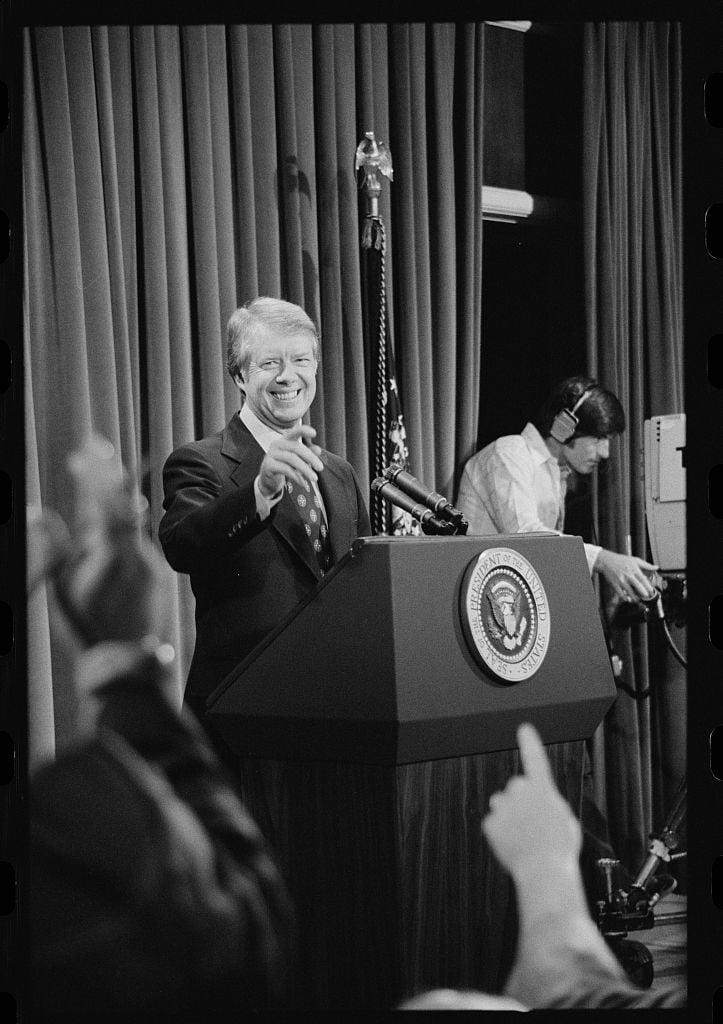
President Jimmy Carter takes questions at a press conference on June 30, 1977. (Photo by Marion Trikosko/Provided by the Libarary of Congress)
The president of the United States urged lawmakers to do everything they can to make the long-desired Alaska natural gas pipeline a reality.
“It is in the national interest to bring Alaskan gas reserves to market at the lowest possible price for consumers,” the president said in an official message. “Every effort must be made to ensure timely completion of the pipeline at the lowest possible cost consistent with Federal regulatory policies.”
The president was Jimmy Carter. The year was 1979. The Alaska natural gas pipeline project was already several years old, with official presidential approval issued two years earlier. The 4,748-mile pipeline project, which Carter touted as “the largest privately financed energy project ever undertaken,” was to be completed by 1984 at a cost of $10 billion to $15 billion, according to the approved plans.
That project never happened, nor did any of the other iterations of an Alaska natural gas pipeline plan that followed.
Now, five decades later, Gov. Mike Dunleavy is describing an alternate version of the yet-unbuilt pipeline as an imminent megaproject.
“For decades and decades and decades, this gasline project has been a dream of many Alaskans. And we’re closer today than we ever have been,” he said in comments posted on Facebook on May 29.
As Carter did, Dunleavy uses superlatives to describe the plan. “That project will be the largest on the face of the earth, probably the largest in terms of investment ever,” he said in opening remarks on May 19 at the Alaska Sustainable Energy Conference in Anchorage.
Dunleavy has called the legislature into a special session to consider sweeping tax concessions that he says are necessary to make the project work economically. His plan, which the legislature is considering, would eliminate nearly all of its state and municipal property taxes on project-related infrastructure in exchange for the promise of a share of the revenues once gas starts flowing through the line.
The current project sponsor is Glenfarne LLC, a New York- and Houston-based company founded in 2011. Glenfarne, a privately held investment and management company specializing in energy, entered the Alaska gas pipeline history last year when it acquired 75% of a project promoted by the state-owned and state-financed Alaska Gasline Development Corp. It has never built or operated a major natural gas pipeline or LNG facility.
Glenfarne says the project would cost between $44.5 billion and $54.5 billion.
Decades of proposals
The Glenfarne plan, for a phased-in pipeline to carry natural gas from the North Slope to a liquefaction plant in Cook Inlet, is the latest in a long series of pipeline plans and campaigns that emerged over the past half century.
The oil fields on Alaska’s North Slope that have been producing since 1977 also hold vast quantities of natural gas, as is common in petroleum basins. Known natural gas reserves on the North Slope, mostly at Prudhoe, total about 35 trillion cubic feet, and experts say there is certainly more natural gas to be discovered.
So far that gas has been considered “stranded” — too isolated to be marketable. Instead of being sold to utilities or other users, the gas that is brought to the surface with oil produced on the North Slope is reinjected into the reservoirs, where it helps build pressure that will enable more oil recovery. Each day, about 8 billion cubic feet of natural gas has to be reinjected, an amount equivalent to the daily natural gas consumption in Japan in 2024.
A map shows various Alaska natural gas pipeline routes proposed as of 2011. (Map from the Congressional Research Service publication, “The Alaska Natural Gas Pipeline: Background, Status, and Issues for Congress,” by Paul W. Parfomak, Specialist in Energy and Infrastructure Policy, June 9, 2011)
The prospect of selling that gas tantalized Alaskans and the energy industry and inspired a wide range of proposals that have come and gone over the past decades.
Some proposals were for overland pipelines through Canada, as the Carter-approved plan proposed. The main alternatives to the Canada route have been plans for an “all-Alaskan” line taking gas from Prudhoe to Valdez, the site of the trans-Alaska oil pipeline marine terminal, or to Cook Inlet for processing into liquefied natural gas to be transported by tanker vessel. Other plans proposed shorter lines delivering to in-state markets and an over-the-top route that would skim the Arctic coast before connecting with a Mackenzie Delta pipeline in the Northwest and Yukon Territories — a Canadian project that, like Alaska gasline, never materialized.
There have been plans for projects that would skip the pipeline construction altogether. In the early 2000s, BP experimented with a gas-to-liquids technology that might produce synthetic oil that could be shipped down the existing trans-Alaska pipeline. BP set up a facility in Nikiski for the project but closed it in 2009. Two pending proposals, one from a company called Qilak and another from a company called Polar LNG, call for natural gas deliveries directly from the North Slope by icebreaker. Even those are not new; the icebreaker idea was considered in the 1980s by Arco Alaska.
Gas pipeline records filing shelves in the Alaska Resources Library and Information Services, seen on June 8, 2026, inlude the multi-volume draft environmental impact statement and final environmental impact statement on the Alaska Stand Alone Gas Pipeline, known as ASAP. (Photo by Yereth Rosen/Alaska Beacon)
Also dating back to the mid-20th century are various task forces, commissions, coordinating offices, approved state and federal legislation, enthusiastic support from presidents, completed environmental impact statements and completed permits. There were various tentative agreements with oil producers, major corporations and Asian governments for participation the project. There were numerous special sessions of the Alaska Legislature — and, at the urging of project sponsors, financial inducements assembled by the state and federal governments.
A list of projects that surfaced through 2021 is available from the Alaska State Library, though it comes with a caveat: “It does not purport to be complete.”
Not one foot of gas pipeline has been laid, but plenty of space is taken up on Alaska library shelves by rows and rows of studies and reports produced since the 1970s.
Records from 1975 Federal Power Commission proceedings on the porposed El Paso Alaska Company natural gas pipeline project fill several shelves in the Alaska Resources Library nad Information Services at the University of Alaska Anchorage campus. Even before the trans-Alaska oil pipeline was completed, El Paso was seeking to build a parallel pipeline to carry North Slope natural gas to a liquefaction facility at tidewater. President Jimmy Carter chose an overland pipeline plan to run through Canada instead of El Paso’s LNG project. (Photo by Yereth Rosen/Alaska Beacon)
Dunleavy insists that the Glenfarne project is different, though he conceded in a May 21 presentation that “people have heard about this project forever.”
In a presentation at the Sustainable Energy Conference in Anchorage, Dunelavy cited numerous factors that he said made the current plan different from past failed plans.
He listed energy disruptions caused by the war in Iran and Russia’s invasion of Ukraine, the rise of technologies that have dramatically increased the need for energy, the impending shortage of Cook Inlet natural gas that has long fueled Southcentral Alaska, the permits that the Alaska Gasline Development Authority already secured — plus the ardent support of President Donald Trump, who has pushed for aggressive resource development in Alaska since he returned to the White House in January of 2025.
“When you get all the geopolitical stuff that’s changed the world and then you get Trump 2.0 in here and data farms and cryptocurrency and electrification, it’s a different project,” Dunleavy said at the conference.
But Larry Persily, a veteran Alaska journalist and past head of the federal gas pipeline coordinating office that was originally established by President George W. Bush in 2004, sees a lot of wishful thinking surrounding the Glenfarne plan.
“We want to think it’s different. We want the pipeline. We want the revenues. We want the jobs. And we want the promise of affordable energy,” Persily said.
He cited ongoing “pep rallies” to help convince people that things are different this time, like the June 2 event hosted by the Greater Fairbanks Chamber of Commerce.
“We have a sales job, and it’s ginned up a lot of enthusiasm — misplaced, I believe,” he said.
Past optimism
A folding map that was part of a Yukon Pacific promotional flier shows the planned route for a pipeline from Prudhoe Bay to Valdez, where natural gas was to be liquefied. The map was published in the 1990s. (Photo by Yereth Rosen/Alaska Beacon)
Of the past plans, Persily said, the most similar to Glenfarne’s proposal was the Yukon Pacific plan for a LNG project, which emerged in the 1980s.
Yukon Pacific’s Trans-Alaska Gas System, also referred to as TAGS, envisioned a gas pipeline paralleling the trans-Alaska oil pipeline to a liquefaction plant in Valdez, from where tanker vessels would take LNG to Asian markets. The estimated price tag was $12 billion.
The Yukon Pacific plan was vetted through two environmental impact statements, one for the pipeline and one for the terminal. The company had permits in hand, including long-term federal and state right of way authorizations.
It had backing of the Bush and Clinton administrations. It had popular support, including from two-time Gov. and former U.S. Interior Secretary Wally Hickel, who founded Yukon Pacific in 1981 but relinquished his shares in the company to avoid any conflict of interest. It had some major corporate backing; in 1988, Yukon Pacific became a subsidiary of the CSX Corp., a major railway, transportation and real estate owner and operator.
What it lacked was economics to justify construction. The project was never built.
‘My way is the highway’
In the late 1990s and early 2000s, the spotlight shifted from the LNG option back to the overland route through Canada.
Democrat Tony Knowles, elected in 1994 and reelected in 1998, concluded that the route through Canada was the most likely. He used a catchy phrase to describe his choice: “My way is the highway.”
Gov. Tony Knowles, a Democrat, served from 1994 to 2002. Knowles concluded that an overland pipeline through Canada to deliver North Slope natural gas to the Lower 48 states was the most viable gasline option. (Photo provided by the Alaska State Library)
He championed legislation and issued executive orders to encourage development. He proposed using $17 billion in railroad bonds for the project. And, like others before, he spoke confidently about the prospects for bringing the pipeline to reality.
“I believe Alaskans can be on the working end of a shovel building a natural gas pipeline within two years. After two decades of false starts and broken dreams, the economic and political stars are finally aligned in our favor. Natural gas is the fuel of the 21st century,” Knowles said in his Jan. 10, 2001, state of the state address.
Industry officials made similarly optimistic statements.
A month prior to Knowles’ state of the state speech, Dick Olver, then chief executive of BP Exploration and Production, predicted gas deliveries within seven years.
“It is no longer a question of ‘if’ North Slope gas will be commercialized, but ‘when’ and ‘how,’” Olver said in a Dec. 5, 2000, speech to the Alaska Support Industry Alliance, a trade group for oilfield service companies. “We believe ‘when’ will be no later than 2007, and there are three exciting options for bringing North Slope gas to market at the present time,” he said, going on to summarize the overland pipeline, LNG concept and gas-to-liquids options being considered by BP at the time.
Frank Murkowski, who served for 22 years in the U.S. Senate before becoming the governor who succeeded Knowles, exuded similar optimism.
“This administration has brought the long-held dream of construction of an Alaska natural gas pipeline to the threshold of reality,” Murkowski said in a Jan. 20, 2006, speech to the Alaska Support Industry Association’s Meet Alliance conference.
Gov. Frank Murkowski, a Republican who served from 2002 to 2006 after a long career in the U.S. Senate, pushed for a deal with the North Slope oil producers that would keep oil taxes unchanged for decades. He said that was to provide “fiscal certainty” needed to make the gas pipeline a reality. (Photo provided by the Alaska State Library Historical Collection)
Murkowski’s efforts focused on a deal with the three North Slope producers — BP, ConocoPhillips and Exxon Mobil — for what was then a $20 billion project. Murkowski said the producers needed “fiscal certainty,” not just on natural gas taxes but on oil taxes.
Like Dunleavy, Murkowski called the legislature into special session to approve tax concessions he said were urgently needed to make the gas pipeline a reality. “We have been waiting 30 years,” he said in a speech at the start of what turned out to be two special sessions on the topic.
The idea of locked-in oil taxes was not popular and, according to several legislators, contrary to the Alaska constitution.
Sarah Palin, elected governor later that year, took a different approach, a state license for which companies would compete. She sponsored a bill called the Alaska Gasoline Inducement Act, or AGIA, which lawmakers approved in 2007. Lawmakers meeting in a special session the following year approved the Palin administration’s proposal to award the license — which came with a pledge of up to $500 million in state cost reimbursement — to TransCanada. Palin signed the bill on Aug. 27, 2008, officially granting the license.
The following week, after she was selected as the vice presidential candidate on the national Republican ticket, Palin portrayed the gas pipeline as a fait accompli.
“I fought to bring about the largest private-sector infrastructure project in North American history. And when that deal was struck, we began a nearly $40 billion natural gas pipeline to help lead America to energy independence,” Palin said at her Sept. 3, 2008, acceptance speech at the Republican National Convention in Minneapolis. “That pipeline, when the last section is laid and its valves are opened, will lead America one step farther away from dependence on dangerous foreign powers that do not have our interests at heart.”
Gov. Sarah Palin delivers her acceptance speech on Sept. 3, 2008, at the Republican National Convention at the Xcel Energy Center om Minneapolis. In her speech, she said the Alaska natural gas pipeline project was underway. (Photo by Toni L. Sandys/The The Washington Post via Getty Images)
TransCanada’s AGIA plan fizzled, as did a competing plan pursued by ConocoPhillips and BP called Denali.
The fracking resolution that flooded the Lower 48 with cheap natural gas made an overland route through Canada less attractive than an LNG project delivering to Asian markets.
The iterations that rose from the ashes of AGIA, pursued through the administrations of Gov. Sean Parnell and Gov. Bill Walker, were new versions of the previously proposed LNG plans, including some attempts involving TransCanada and the major oil producers. The idea of keeping the project entirely in Alaska had some popular appeal in the state, as encapsulated in a bumper sticker seen in the early 2000s that proclaimed “CANADA my ass/it’s ALASKA’s GAS.”
Leadership of the project ultimately fell to the Alaska Gasline Development Corp., a state entity created by the legislature in 2010 in response to concerns about dwindling Cook Inlet gas supplies. AGDC’s takeover came in spite of a 2002 Department of Revenue report concluding that state ownership “would not likely improve the feasibility of the project or be valued by private sector project sponsors.”
AGDC in 2020 won authorizations from the Federal Energy Regulatory Commission to build and operate the LNG project, the same approval that Yukon Pacific received decades earlier.
State concessions demanded
As with Glenfarne, past project sponsors have argued that tax or other financial concessions are needed to make massive investment in a gasline worthwhile.
Those arguments date back to the 1970s, when the Northwest Alaska Pipeline Co., the main sponsor of the Carter administration-approved overland gas pipeline through Canada, requested that the state issue $1 billion in bonds to pay for the project.
John McMillan, the company’s chief executive, was dissatisfied at the time with the administration of then-Gov. Jay Hammond.
Glenfarne CEO Brendan Duval speaks on May 21, 2026, at the Alaska Sustainable Energy Conference in Anchorage, while Gov. Mike Dunleavy listens. (Photo by Yereth Rosen/Alaska Beacon)
“Regarding the State of Alaska, we must confess to a sense of frustration. While the State is the principal beneficiary of this project and will realize more direct and indirect benefits from its construction and the sale of the Prudhoe Bay gas than anyone else, we have been unable to develop any positive progress with the State which would materially assist in the development of a financial plan to move the project forward,” McMillan said in prepared statements delivered on Oct. 15, 1979, to a U.S. Congressional committee.
While lawmakers in the Frank Murkowski era rejected the governor’s idea of linking oil taxes to the long-desired gas pipeline, their changes to the oil tax system led to federal bribery and political corruption convictions and jail time for several lawmakers and others, including Bill Allen, the chief executive of what was at the time the state’s largest oilfield service company.
BP, a party to the Murkowski negotiations and, later, a partner with ConocoPhillips in the Denali gas pipeline proposal, left the state in 2020 after selling off all its Alaska assets to Hilcorp.
Matt Kissinger and Frank Richards of the Alaska Gasline Develoment Corp. prepare to testify to the House FInance Committee on May 27, 2026, in Anchorage. Richards is AGDC’s president and Kissinger is AGDC’s venture develoment manager. The hearing was conducted as part of a special session called by Gov. Mike Dunleavy. Kissinger and Richards tesified in favor of property-tax concessions sought by Glenfarne, now the majority partner in the Alaska natural gas pipeline project. Dunleavy has argued that the tax concessions are the needed to make the pipeline project viable. (Photo by Yereth Rosen/Alaska Beacon)
Because of the AGIA provisions, the state wound up reimbursing TransCanada about $327 million from 2010 to 2015, accoring to one legislative tally. The state paid out another $65 million in late 2015 to acquire the company’s remaining share in the project. The buyout gave the Alaska Gasline Development Corp. access to the Canadian company’s engineering studies and other documents.
Altogether, Persily said, the state has spent more than $1 billion in the past 25 years on the yet-to-be-built gas pipeline.
That does not include items like the cost of the current special legislative session or the $500,000 that the just-passed state budget for the next fiscal year appropriated to the Department of Revenue to adjust the tax system to accommodate Glenfarne’s desired near-elimination of property taxes.
Sen. Bill Wielechowski, D-Anchorage, is among the lawmakers considering whether additional financial concessions that Glenfarne is seeking are justified. The deliberations follow a long history of unfulfilled gasline promises, he noted.
“I don’t think anyone’s opposed to giving them the tax break as long as they need it,” Wielechowski said of Glenfarne’s plan. “We’re just struggling with the lack of information and the feeling that we’ve been burned in the past.”
James Brooks contributed to this story.
The sun sets at Prudhoe Bay on March 23, 2018. The North Slope holds vast amounts of known natural gas reserves that have inspired numerous plans for natural gas megaprojects over the decades. (Photo provided by the U.S. Bureau of Land Management)