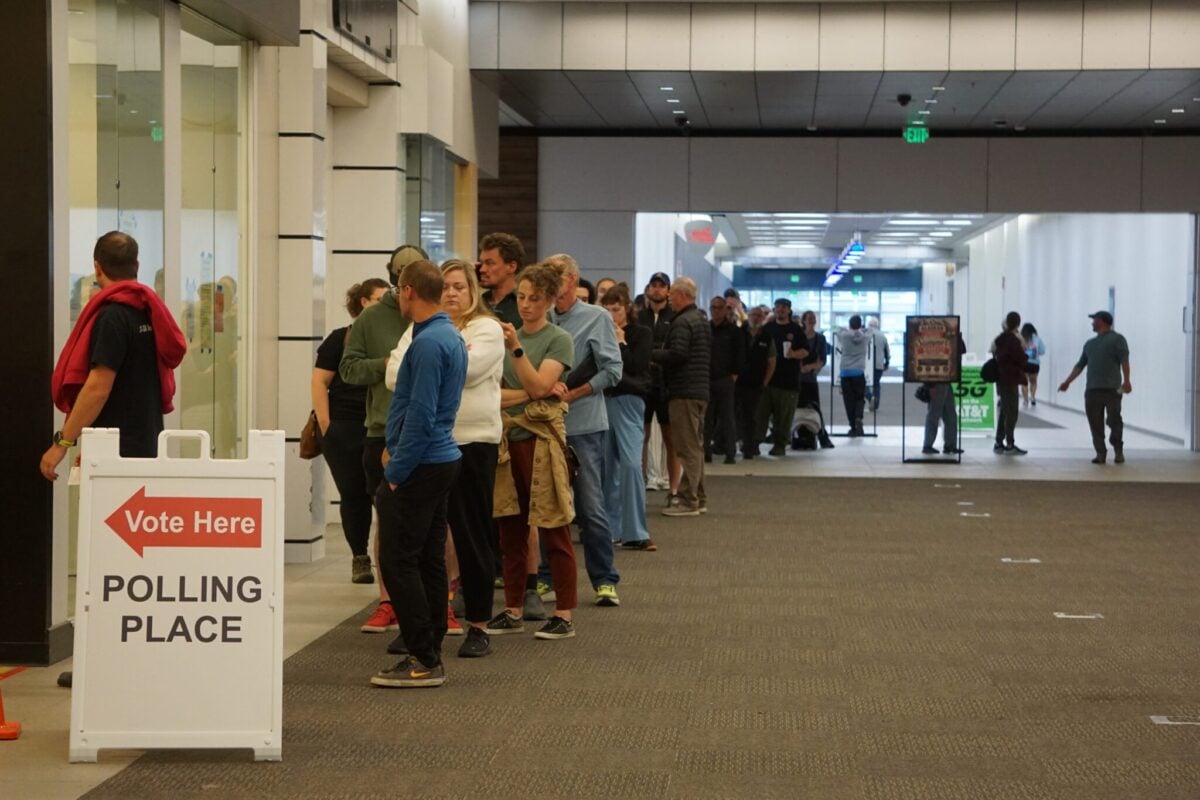
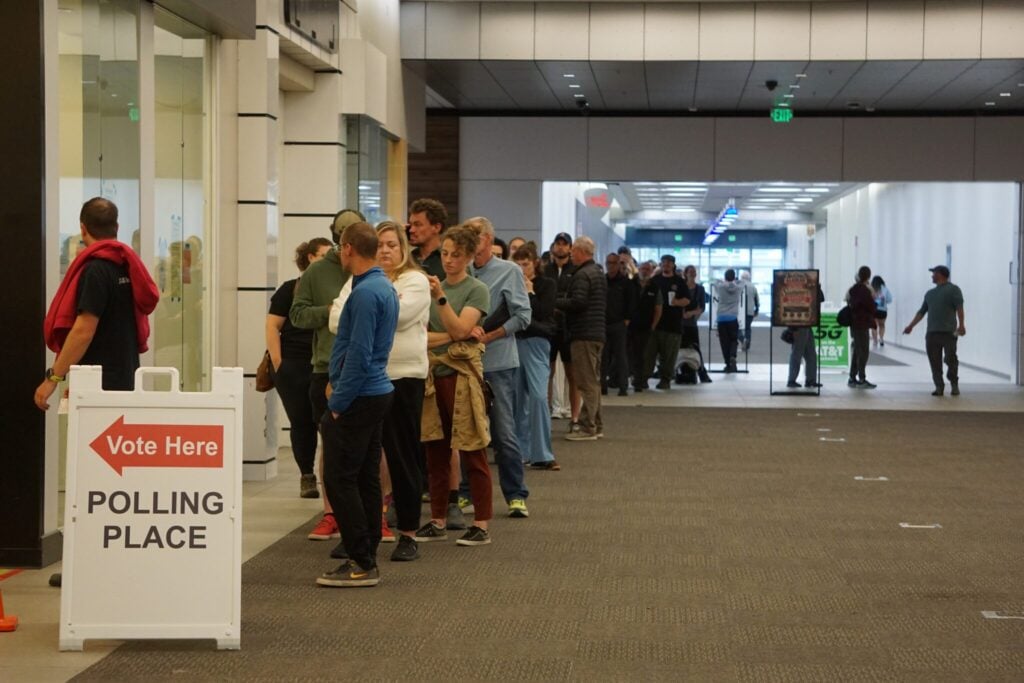
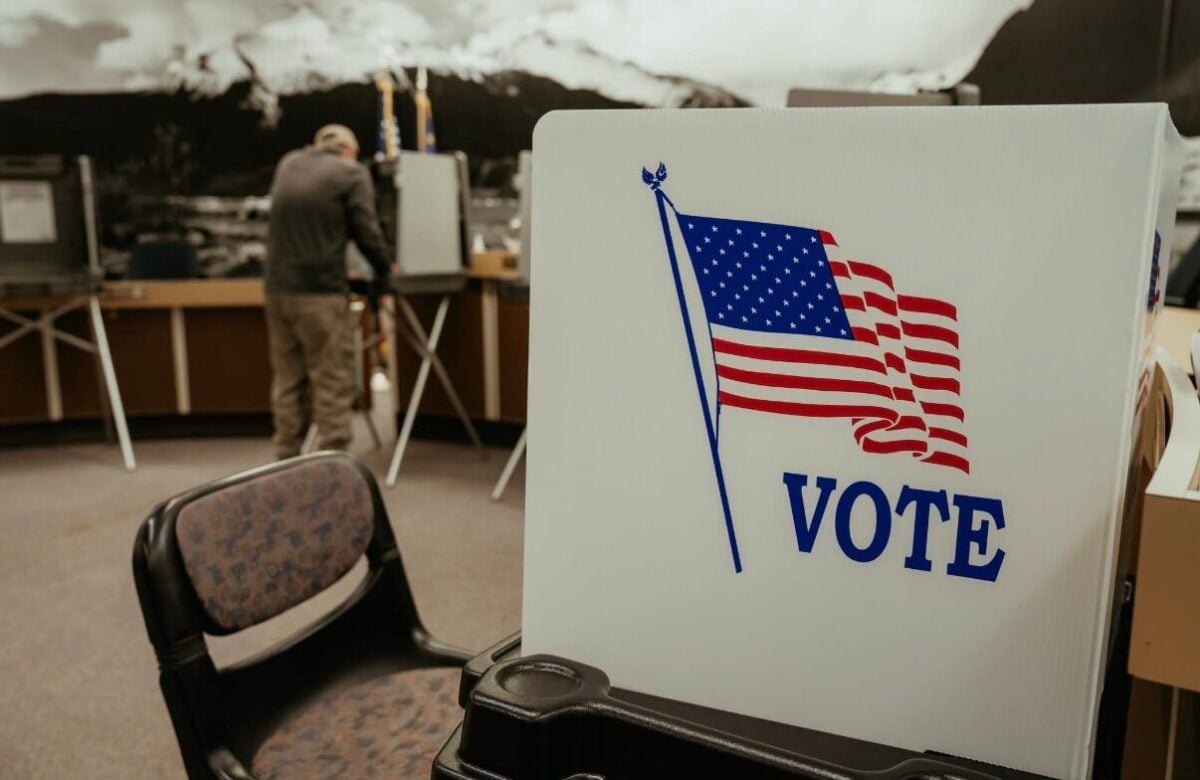
Voters line up on Aug. 17, 2026, at the early voting station set up in Anchorage’s Midtown Mall. Voters reported waiting about an hour to cast their primary election ballots. (Photo by Yereth Rosen/Alaska Beacon)
Most state offices may be closed on Monday for Alaska Day, but officials with the Alaska Division of Elections are planning to be at work for the first day of early in-person voting in the 2026 general election.
In Anchorage, early voting will be open from 8 a.m. to 5 p.m. Monday at Midtown Mall and Anchorage City Hall.
Other voting locations will be open in Eagle River, Fairbanks, Juneau, Kenai, Nome, Palmer and Wasilla.
A full list of locations and operating days and times has been posted online by the division. All votes must be cast before or on Election Day, Nov. 3.
Dozens of in-person absentee voting locations will also open starting Monday across the state, but there is a key difference between early voting and absentee voting, which has also been taking place by mail and fax for weeks.
In early voting, the voter’s identity is checked up front, before voting, so the ballot is guaranteed to count. With absentee voting, whether in person, by mail or fax, the voter’s ID isn’t checked until the ballot reaches the Division of Elections.
If the voter’s identity can’t be verified, or if there’s another procedural problem, the ballot may be rejected and not counted. Alaska doesn’t offer a way for absentee voters to fix procedural problems.
The division said it has changed its procedures for the general election in order to prevent that problem.
But mail delays may still keep some absentee ballots from being counted.
Under state law, a mailed ballot must arrive within 10 days after Election Day if mailed from within the United States,or 15 days afterward, if mailed from outside the country. Those ballots will be counted as long as they were postmarked on or before Election Day.
Any ballots that arrive after that deadline will not be counted.
National polling has indicated that Democrats are more enthusiastic about voting in this year’s elections than Republicans are, and control of the U.S. House and U.S. Senate is at stake in the election. If Democrats take control of one or both bodies, Trump and members of his administration likely will face investigations and could be impeached.
“So vote early, vote by mail, or vote on Election Day, Nov. 3rd,” Trump said at a rally in Wasilla on Tuesday, urging voters to track their mailed ballot to ensure it is received.
Alaska has a limited ballot tracking service online; voters cannot tell until after the election whether their ballot was counted or rejected, and current state law does not allow voters to fix any technical problems that cause a ballot to be rejected.
“Sort of follow your vote if you’re going to do mail-in,” Trump said.
Trump’s comments in Alaska followed a video he posted Oct. 3 that urged Republicans to vote early and by mail.
“If your state has early voting, do not wait. Go out and vote. Vote early, vote by mail or vote in person on Election Day, Nov. 3rd, so we can defeat the radical left Dumb-ocrats in a midterm victory that is too big to rig,” Trump said in the video.
A week later, in New York on Oct. 9, Trump again urged voters to cast ballots by mail.
“We’re in the golden age of America. And if you’re voting by mail, make sure that you request your ballot by Oct. 24th, remember that, and have it postmarked by Election Day. I don’t know, I always like Election Day better, but what do I know about things like that?” he said.
While Trump has repeatedly tried to deter Americans from voting by mail, a voting method he attributes to his loss in 2020, he has also reversed course before. In 2024, he urged Republicans to vote by mail ahead of that year’s election despite denigrating mail-in voting for months beforehand.
Last week in Tennessee and in Ohio on Monday for a rally, Trump didn’t mention mail-in voting but noted that early voting is underway. “So get out and vote. And if you have to, you do it Nov. 3rd. I don’t care how you do it, but we have to do it,” he said in Ohio.
At rallies in Montana and Arizona on Wednesday, Trump did not mention mail-in voting but did note that early voting is already under way in both states. He did not say, as in Ohio, that supporters should vote early.
“For some reason, when you have a president, Republican or Democrat, it’s just brutal,” Trump said on Oct. 10 in Tennessee. “They don’t seem to win the midterms. But we’re gonna turn that tradition around.”
NOTN- The City and Borough of Juneau is asking residents affected by this year’s glacial lake outburst flood to share their experiences and provide feedback on the city’s emergency response.
Residents can complete an online survey at here . Responses must be submitted by 5 p.m. today, Oct. 16.
The city says feedback will help officials evaluate and improve emergency preparedness and response efforts for future floods.
The survey is intended for people impacted by the 2026 glacial lake outburst flood, which threatened communities in the Mendenhall Valley.
City officials thanked residents for their participation and encouraged those affected to share their perspectives.
President Donald Trump speaks at a rally Tuesday, Oct. 13, 2026, at the Menard Center in Wasilla. (James Brooks photo/Alaska Beacon)
By: James Brooks, Alaska Beacon
President Donald Trump speaks at a rally Tuesday, Oct. 13, 2026, at the Menard Center in Wasilla. (James Brooks photo/Alaska Beacon)
In a surprise announcement Tuesday, President Donald Trump said he is endorsing Republican Alaska gubernatorial candidate Bernadette Wilson in the four-way race to replace term-limited Republican Gov. Mike Dunleavy.
Polls indicate Wilson and two other Republicans — Dave Bronson and Treg Taylor — are trailing the lone Democratic candidate, Jonathan Kreiss-Tomkins.
In a rally at Wasilla’s Curtis D. Menard Memorial Sports Center, Trump offered his support for Wilson, urged Alaskans to vote for a ballot measure repealing Alaska’s current elections system and encouraged votes for incumbent Republicans U.S. Sen. Dan Sullivan and U.S. Rep. Nick Begich III.
Tuesday’s rally made Trump just the third American president to visit the Matanuska-Susitna region and was part of a nationwide campaign by the President, who was in Ohio on Monday. He’s expected to be in Nevada and Arizona on Wednesday, with other stops in Montana and Georgia this week.
In 90 minutes of rambling remarks, the President made his goal clear: He wants to motivate Republicans to turn out at the midterms and vote.
“Pretend that I’m on the ballot because here’s what happens. Every time I’ve been on the ballot, we win,” he said.
Attendees of President Donald Trump’s rally on Tuesday, Oct. 16, 2026, fill the stands of the Menard Center in Wasilla. (James Brooks photo/Alaska Beacon)
Nationally, polling indicates that Republicans are trailing in key elections that may determine whether Republicans or Democrats control the U.S. House and U.S. Senate.
Polls indicate Begich is ahead of Democratic Party-backed independent Bill Hill in a four-way race that also includes imprisoned Democrat Eric Hafner and Libertarian Jim McDermott.
Sullivan, meanwhile, is in a tight race against Democratic challenger Mary Peltola in a four-way election that also includes Dan J. Sullivan of Petersburg and Republican candidate Gerald Heikes. Polling indicates Peltola holds a small lead.
It isn’t clear how much Trump’s visit will affect those races.
In a representative statewide survey of registered voters conducted Oct. 1-3, Alaska Survey Research found 58% of respondents had a negative view of Trump.
“We’ve asked this exact question maybe 50 times on surveys dating back to 2015. This is the worst rating we’ve ever recorded,” said company director Ivan Moore on social media. “58% is an all-time high negative.”GET THE MORNING HEADLINES.SUBSCRIBE
But among voters in the Matanuska-Susitna Borough, the site of Tuesday’s rally, Trump had a positive rating, with 44% of voters approving and 43% disapproving.
“You are here in the heart of Republican Alaska,” Sullivan told the President.
Trump landed at Joint Base Elmendorf-Richardson Tuesday afternoon before taking a helicopter to Wasilla’s airport and a car to the nearby Menard Center. He was met by a cheering crowd that filled the Menard Center’s seats before returning to his helicopter and an eventual flight to Las Vegas.
The Menard Center has a capacity of about 3,500 people, and the Mat-Su Sentinel reported that some potential attendees were turned away at the door for lack of space.
Trump was interrupted about 10 minutes into his remarks by a protester who was rapidly rushed out of the rally by security.
Alaska Republican governor candidate Treg Taylor talks with reporters on Tuesday, Oct. 13, 2026, at the Menard Center in Wasilla. (James Brooks photo/Alaska Beacon)
Trump backs Wilson in crowded gubernatorial race
Of Alaska’s four candidates for governor, three were present in Wasilla on Tuesday.
Democratic candidate Jonathan Kreiss-Tomkins was in Fairbanks, attending a forum hosted by the local chamber of commerce.
Before the rally, Republican gubernatorial candidates Dave Bronson and Treg Taylor each said they didn’t expect Trump to make an endorsement.
But about one hour before he took the stage, Trump took to social media and endorsed the leading Republican in the primary election, Bernadette Wilson.
Trump called Bronson and Taylor “lesser candidates” and said Bronson begged Trump for an endorsement.
“I wouldn’t do it because he didn’t win the Primary and, therefore, wasn’t deserving of it. I then asked him to get out of the Race, and he agreed! … He agreed to get out, but three days later, without notification, quickly jumped back in, along with a third ‘Republican’ Candidate, who I never heard of, named Treg Taylor,” Trump wrote in a post on Truth Social.
Afterward, Bronson said, “My recollection is different than the president’s of that meeting.”
Bronson said that when he spoke to Trump, he agreed to leave the governor race if Treg Taylor did so but warned Trump that if both left the race, they would simply be replaced by other Republicans.
Taylor never withdrew, “so there was no deal,” Bronson said.2026 Voter Guide
The candidates, the ballot measures, and the tools you need to cast your vote.
On stage in Wasilla, Trump said that “now is the time for all Republicans to unite behind Bernadette” and wished her luck.
“It ain’t gonna be easy, Bernadette,” he said.
Trump’s endorsement came hours after the Cook Political Report, one of the nation’s top election prognosticators, said Alaska’s race for governor now leans Democratic, in large part because the Republican vote is being split among three candidates.
Alaska uses ranked choice voting in general elections, which could eliminate vote-splitting, but election results since 2022 have shown that Republican voters are much less likely to rank multiple candidates than independents and Democrats are.
Incumbent Gov. Mike Dunleavy, a Republican who is term-limited and cannot run again this year, spoke at the rally about three hours before Trump took the stage.
“The only way we’re going to win is if we all vote for the Republican candidates for governor, and that’s very important,” Dunleavy said.
Bronson and Taylor have urged Republicans to rank all three candidates, but Trump spoke against that appeal, calling ranked choice voting a “scam.”
In a text message, Kreiss-Tomkins’ campaign said the President is in Alaska “because national Republicans know that we’re neck-and-neck in this race, and electing a Democratic governor for the first time in a generation would send shockwaves across the country.”
Alaska hasn’t elected a Democratic governor since Tony Knowles, in 1994 and 1998.
As she left the Menard Center, Wilson said she was thrilled by the endorsement.
“I think it signals, you know, a lot of excitement on our side, a lot of momentum on our side. You’re seeing everyone come together. They’re unifying behind us. We could not be more excited,” she said.
U.S. Sen. Dan Sullivan talks with reporters on Tuesday, Oct. 13, 2026, at the Menard Center in Wasilla. (James Brooks photo/Alaska Beacon)
Trump offers warnings about a Democratic Congress
Speaking in support of Sullivan and Begich, Trump insulted their leading opponents and the Democratic Party, and he predicted dire consequences for Alaska if Democrats win control of the U.S. House and U.S. Senate.
“Alaska is a special place to be, a very important place to be. And nobody’s done more for Alaska than Donald J. Trump,” he said. “With your support, just 21 days from now, Alaska is going to defeat the radical left Democrats.”
Later in his remarks, Trump said, “If the Democrats win, we will have a 1929-style economic depression. And I don’t like saying it, but they don’t know what the hell they’re doing.”
A relative handful of the seats in the U.S. House and Senate are considered competitive, and Alaska’s two federal races fall into that category, even though Republican presidents have won Alaska each election since 1964.
Senate Minority Leader Chuck Schumer, D-New York, recruited Peltola to run against Sullivan and has said that her victory would be a step toward becoming Majority Leader and thus in control of the Senate agenda.
At Tuesday’s rally, Sullivan said he thinks that would be a disaster for the state because a Democratic Senate would seek to block oil and gas drilling.
“This would be horrible for Alaska,” Sullivan said of Schumer becoming Majority Leader. “The D.C. Democrats don’t have a positive agenda for Alaska. They have a target on Alaska. But this would also be horrible for the country we love, for the great United States of America. So, ladies and gentlemen, especially here in the Mat-Su Valley, you need to understand Alaska is the firewall for freedom for the entire country.”
An attendee of President Donald Trump’s rally on Tuesday, Oct. 13, 2026, in Wasilla, holds up a sign urging a yes vote on Ballot Measure 2. (James Brooks photo/Alaska Beacon)
President urges Alaska to repeal top-four primary, ranked choice general
In addition to boosting Republican candidates, Trump urged attendees of the rally to vote yes on this year’s Ballot Measure 2 and eliminate the state’s top-four primary election system and ranked choice general election.
That system was installed in a 2020 ballot measure and retained after a 2022 repeal effort narrowly failed.
Trump has repeatedly called ranked choice voting a “scam” and has urged states to not adopt it.
Under Alaska’s system, all candidates for an office run together, and the top four vote-getters, regardless of party, advance to the general election.
In the general election, voters rank the four remaining candidates in order of preference. If one candidate gets the majority of the first-choice votes, they win.
If no candidate has a majority, the candidate with the fewest first choices is eliminated and that candidate’s votes are redistributed to the voters’ second choice candidates.
The process continues until only two candidates are left, and the person with the most votes wins.
“Vote against the ranked choice. Vote yes for the elimination of ranked choice,” Trump said.
Pardons signed for two diesel mechanics
During the rally, Trump signed presidential pardons for two local diesel mechanics who pleaded guilty to Clean Air Act violations during the Biden administration.
Zachary Czubak and Patrick Fleming were convicted in 2022 of removing anti-pollution equipment from dozens of vehicles.
Sullivan had championed the pardons, saying the removals were justified because the anti-pollution equipment can cause poor performance at low temperatures.
“The Trump dividend that you get, you’ll get it very quickly after the election,” he said.
That payment would cost $1.2 trillion, significantly increase the national debt and likely would increase the national rate of inflation, an independent analysis concluded last month.
At the Menard Center, Trump said he would restrict the dividend so that it could only be spent in the United States. He did not say how he would track Americans’ use of the money.
“I don’t want you to go to Japan. I don’t want you to go to China. You’ve got to spend it in the United States of America,” he said.
Visit makes local history
Trump became just the third President to visit the Matanuska-Susitna region. The first, Warren Harding, died on his return home after ceremonially opening the Alaska Railroad in 1923. The second was Jimmy Carter, who restricted his visit to a remote mountain lake for fishing.
Trump has repeatedly visited Alaska aboard Air Force One, which frequently stops in Anchorage to refuel during trans-Pacific flights.
Trump visited Alaska for a campaign rally in 2022 to endorse Dunleavy, U.S. Senate candidate Kelly Tshibaka and U.S. House candidate Sarah Palin. Of the three candidates, only Dunleavy won that year’s election.
President Donald Trump speaks at a rally Tuesday, Oct. 13, 2026, at the Menard Center in Wasilla. (James Brooks photo/Alaska Beacon)
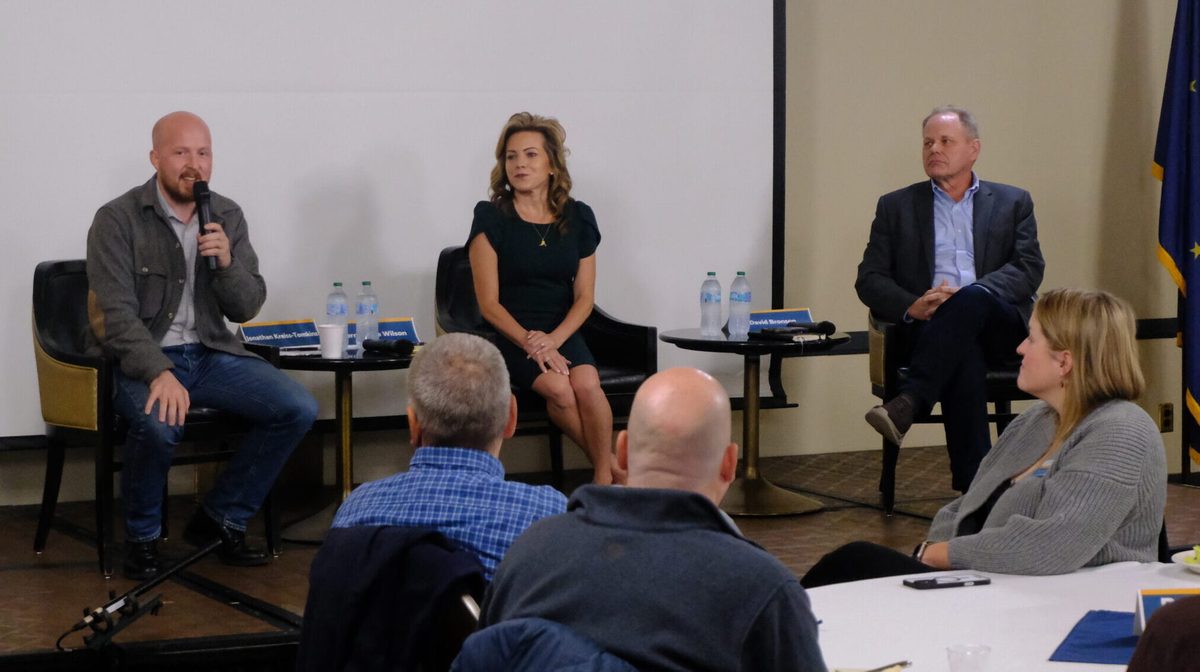
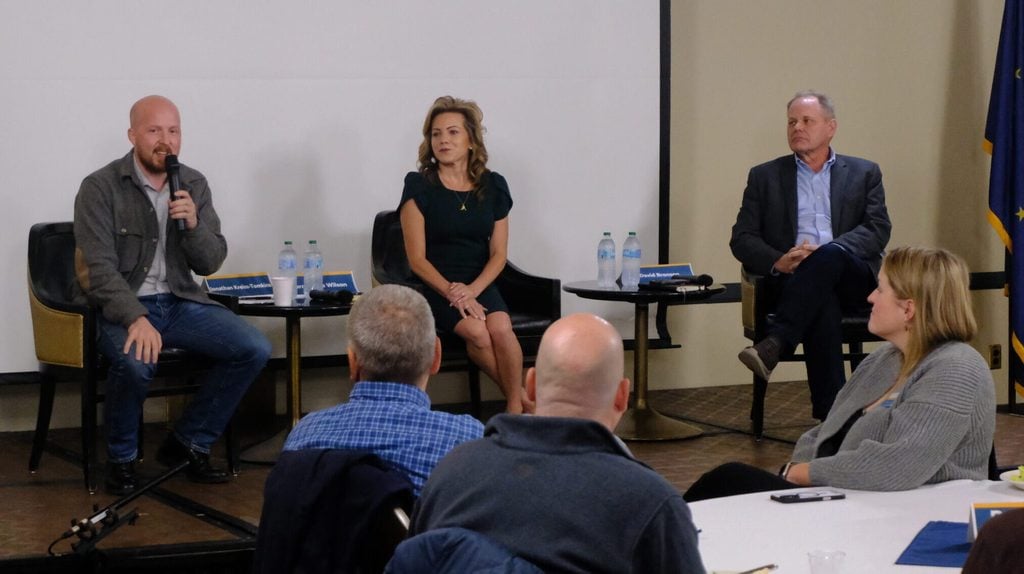
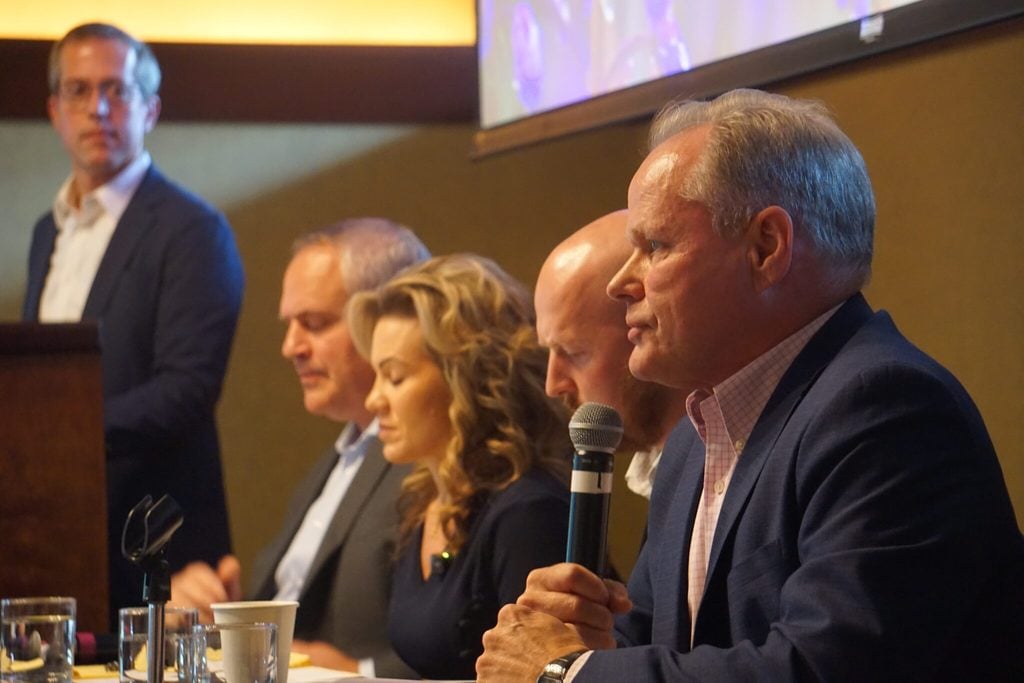
Alaska gubernatorial candidates Democrat Jonathan Kreiss-Tomkins (left), and Republicans Bernadette Wilson (center) and Dave Bronson (right) attend a forum hosted by the Juneau Chamber of Commerce in Juneau on October 7, 2026. (Photo by Corinne Smith/Alaska Beacon)
If elected, Republican governor candidates Dave Bronson and Bernadette Wilson said they would seek to roll back Alaska’s mandatory sick leave law and eliminate a minimum wage increase approved by voters in 2024.
The two spoke at a forum hosted Wednesday in Juneau by the Juneau Chamber of Commerce, which is in favor of rolling back the sick leave law.
Four candidates are running for governor in this year’s general election — Wilson, Bronson, Democratic candidate Jonathan Kreiss-Tomkins, and Republican candidate Treg Taylor. All except Taylor attended Wednesday’s event.
Seasonal employers — particularly in the seafood and tourism industries — are seeking to roll back the law because they said some seasonal workers have begun using sick leave as terminal leave at the end of the summer.
This spring, the Alaska House voted 22-18 on a bill to end sick leave immediately for seasonal workers and employers with nine or fewer workers. The rollback bill failed to pass the Senate before the end of the legislative session but is expected to return in 2027.
“I absolutely support an exemption for seasonal workers,” said Wilson.
“I would support introducing legislation to go back and repeal that ballot measure. It did not have the effect that it needed,” she said.
The 2024 ballot measure included both mandatory sick leave and a minimum wage increase. Under the law, Alaska’s minimum wage increased from $11.73 per hour to $13 per hour in 2025, and $14 this year. It will rise to $15 per hour in 2027, then rise with inflation each year after that.
Wilson said after Wednesday’s event that she does support repealing both the sick leave requirement and the minimum wage increases prescribed by the 2024 ballot measure.
So did Bronson, who said that while he isn’t proposing to eliminate the state’s minimum wage altogether, he wouldn’t mind doing so.
“In most small businesses, as you know, there’s no greater cost really than your employees, and to raise the cost of your greatest cost is prohibitive. My belief is that government shouldn’t be in the business of telling small business and private enterprise what to be doing in this regard, in the first place,” he said. “Mandatory sick leave, minimum wage — I would repeal them both because small business will figure this out.”
Kreiss-Tomkins, sharing the stage with Wilson and Bronson, was more moderate on the sick leave issue but said he does support changes to what voters enacted.
“Broadly speaking, I support paid sick leave,” Kreiss-Tomkins said. He added that he has heard from seafood and tourism trade organizations, “and I do think it is appropriate to look at amendments to the paid sick leave law.”
“I don’t know if that’s a wholesale exemption, but certainly making adjustments to the law that recognize the unique dynamics around seasonal industries and seasonal businesses is something that makes sense,” he said.
After the debate, Kreiss-Tomkins said he opposes lowering the minimum wage.
Taylor, by text message afterward, said he also supports amending the sick leave law.
“Yes, I agree!” he said in a text message sent through his campaign manager, April Gettys, “139,534 Alaskans work for small businesses, and I want to fix this law so those businesses can keep hiring and keep their doors open – Alaska should lead the nation in job opportunities. That means working with the Legislature to adjust the statute so it works for the corner café, the seasonal operator and the rural business. More jobs, more paychecks, more families staying in Alaska.”
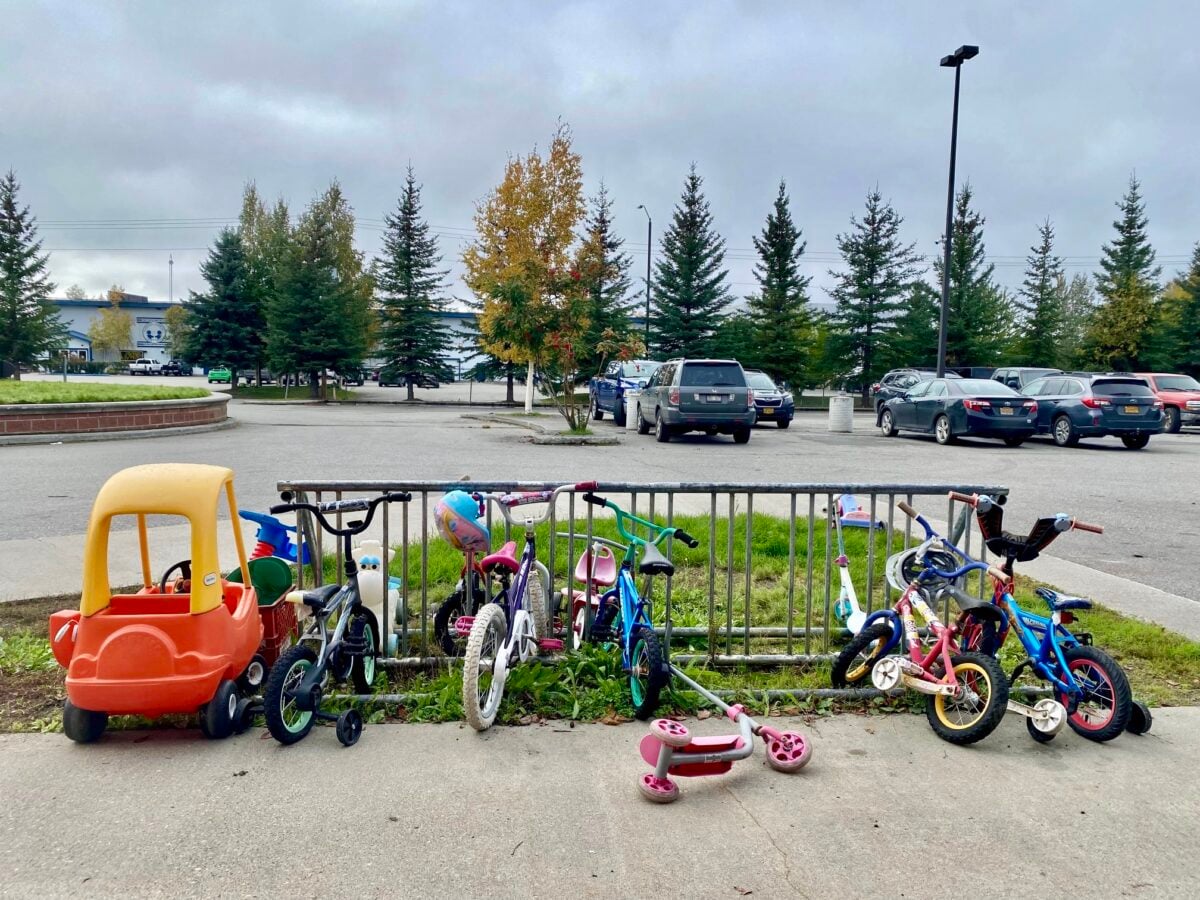
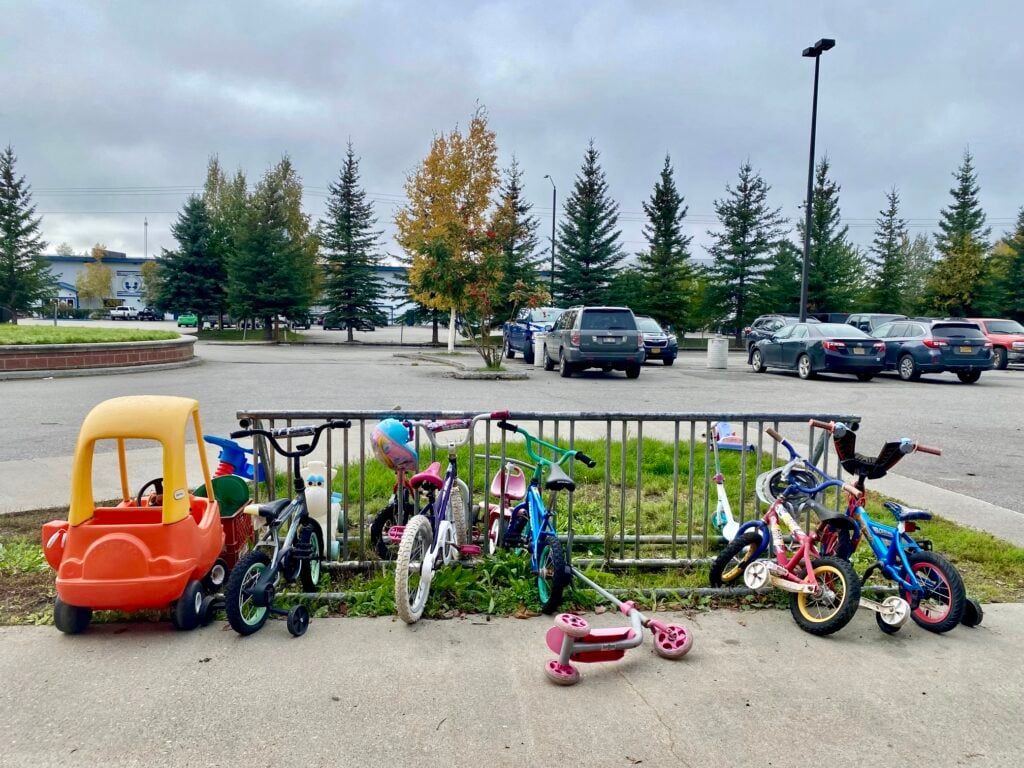
Children’s bicycles are parked outside of the Interior Alaska Center for Non-Violent Living in Fairbanks, Alaska on September 14, 2023. (Photo by Claire Stremple for the Alaska Beacon)
One of the many issues before the next governor of Alaska will be the growing gap between available providers and the demand for childcare, which some advocates are calling a “childcare crisis.”
Many Alaska families are grappling with finding reliable care due to a lack of childcare facilities and workers that contributes to fewer slots, long waitlists and rising costs for families.
An estimated half of Alaskan families cannot fully participate in the workforce because they lack access to childcare, according to thread, a statewide childcare resource and referral organization. The organization estimates that’s more than 25,000 Alaskans that could be more active in the workforce.
The average cost to Alaska families is estimated at over $14,000 per year, thread estimates, sometimes surpassing the monthly cost of rent.
Advocates say a patchwork system of federal, state and local funding is insufficient in providing Alaska families with adequate childcare, with childcare providers reporting struggles to complete licensing requirements to open new facilities, provide competitive wages to workers and keep daycare operations going.
Democrat Jonathan Kreiss-Tomkins and Republicans Dave Bronson and Treg Taylor said they would seek to reduce state regulations for childcare providers and promote incentives for employers to provide childcare, if elected.
Kreiss-Tomkins and Bronson also said they would support recurring state funding for childcare.
The three are among four candidates running for governor in the November election, along with Republican Bernadette Wilson. Wilson’s campaign declined to comment on her platform on childcare issues after numerous calls, texts and emails over the course of a week.
Kreiss-Tomkins, Bronson and Taylor said their administrations would prioritize expanding access to childcare, especially in rural Alaska.
Bronson called childcare “essential infrastructure” for the state’s economy. “I would work with local communities, tribes, employers, school districts, and existing providers to expand the options that fit each community. So whether that’s a licensed center, a home-based provider, a cooperative, or an employer-supported program,” Bronson said. “Rural Alaska needs solutions designed locally, because a model that works in Anchorage may not work in a village.”
Kreiss-Tomkins also said he would support opening smaller, home-based providers and for childcare workers in rural areas, which would also boost rural employment opportunities. “Making training available to providers creates jobs for people who already live and work in rural communities and lets parents go to work, go hunting, or back to school,” he said.
Currently, only some Alaskan families receive childcare assistance based on available funding and eligibility. The non-profit thread estimates that 23% of children receive a subsidy from the government or employer.
Kreiss-Tomkins cited a true cost study commissioned by the Dunleavy administration in 2024 that showed a wide gap between childcare assistance and the cost of care — which is significantly larger in rural areas — in his support for boosting state childcare funding.
“Besides direct investment in programs like Child Care Assistance at the state level, I think one aspect we should clearly do more with is investment in the child care workforce, and partner with unions, tribes and universities to make those investments,” Kreiss-Tomkins said.
Bronson also said he supports recurring state funding, as well as “targeted employer partnerships” and pursuing federal grant programs.
But Taylor disagreed, saying before more state funding he would look to federal funding and tax credits for families and employers. “Any state support would come from the existing budget, not new taxes, and be tied to one result: more open slots for Alaska families,” he said.
All three candidates said they would pursue state incentives, like tax credits, for employers to provide childcare.
The three candidates split in views on expanding statewide childcare through implementing a statewide “universal” pre-Kindergarten program. Currently some Alaska school districts provide preschool and early education programs, but not all.
Kreiss-Tomkins said it would be a long-term intention of his administration to “get to a place where pre-K is something all parents in Alaska can count on.”
“That’s a lofty goal, and maybe a ways away, but I want to bring local governments, the state government, and other partners to the table to work toward it,” he said. Kreiss-Tomkins said he would also aim to expand paid family leave to reduce the demand for infant childcare.
Bronson and Taylor said they do not support a statewide pre-K program. Bronson said instead he supports families’ choices for public, private, tribal and community-based options. Taylor said he supports existing pre-K for children who qualify and choices for families, including homeschool programs.
Likewise the Democratic and Republican candidates split on their approaches to supporting childcare worker recruitment and retention.
Kreiss-Tomkins said he would support childcare workers through loan forgiveness programs, and “robust” apprenticeship programs. Bronson also said his administration would “work with employers and training institutions to recruit and prepare new workers.” Taylor said his administration would “lower barriers to entry” by reducing credential and education requirements for childcare jobs.
The Trump administration has announced plans to roll back regulatory requirements for Head Start programs, which serve children ages three to five years old, including changing provider ratios to allow more children per adult.
Bronson said he opposes an increase in ratios “as a quick fix,” citing safety. Kreiss-Tomkins did not say directly that he was in opposition of a ratio increase, but said he wants to be “thoughtful” with changing staffing ratios. “I think for infants, especially, there should be reasonable ratios on the number of infants any one caregiver is responsible for,” he said.
Taylor said he supports increasing staff ratios, in order to expand childcare programs, “with safety as the line I won’t cross,” he said. “The bigger threat to providers today is rules that make it impossible to staff a room or make the business pencil out. More flexibility helps them stay open.”
All three candidates who responded to the Alaska Beacon expressed support for reducing regulations for childcare providers licensed under the Alaska Department of Health to help ease barriers and help expand new childcare centers.
Wilson also indicated at an October candidate forum in Juneau that she would focus on cutting regulations in order to expand childcare capacity.
“For this administration, our first day in office, we’re going to come back and we’re going to roll those pages of bureaucratic regulations off the books. If they shouldn’t have been there, and the governor’s got the ability to do it, then by God, we’re going to get in there, and we’re going to do it,” she said. “We’ve got to roll those back and get them out of the way.”
Congratulations to Kenny Solomon-Gross and Dorian Gross of Gross-Alaska Theatres, who accepted the Business of Distinction award at this weekend’s Juneau Chamber of Commerce dinner, and to Charlie Williams of Valley Paint Center, who received the Lifetime Achievement award for his outstanding work in our community. Gross-Alaska Theatres has brought people together at the movies since 1897, and Charlie’s recognition shows the difference a local business owner can make in his neighbors’ lives.
Screenshot
Juneau has so many local business owners and employees who give their time, support community events, and help each other through the tough stretches. There was a lot to celebrate this weekend, and we were grateful to be included.
Lisa and I want to express our sincere thanks to the Juneau Chamber of Commerce for recognizing us as Citizens of the Year. We were genuinely touched by this honor.
While our names may be on the award, we see it as a reflection of the people we’re fortunate enough to work alongside every day.
Our Alaska First Media teams in Juneau, Ketchikan, and Sitka are an extraordinary group of people who care about their communities, their listeners, and the work they do. They’re the ones who show up every day, keep our radio stations connected to the communities they serve, and make us proud to be part of it all.
We especially want to recognize Angel Montgomery, Charlee Quintal, Grace Dumas, Steven Allwine, Devon Stickler, Jason Palmer, Mike Clasby, Justin Miller, Scott Mills, Chuck Geiger, Dan (Dano) Ondrejka, Tori Peck, Conner Lendrum, Krystal Rose, Kevin Allen, Lance Mitchell, Kelly Peres, Brittany Rickard, Mason Hightower, Garrett Leighton, Julie Lekwauwa, Ted Ellis, Pratik Patel, AJ, Alfred Zagloul, Wade Bryson, Nano Brooks, Tracy Brown, Russell Wodehouse, Rally Wolford and Phoenix Lampkin, along with everyone else who contributes to our stations across Southeast Alaska.
Screenshot
We’re proud of the work being done across our Juneau stations, KINY, Mix 106, TAKU 105, KXJ, The Hawk and KJNO, as well as our stations serving Ketchikan and Sitka.
We’re also grateful for the local businesses, community organizations, friends, and listeners who have welcomed us and supported what we’re trying to build.
Juneau is home. We’re proud to be part of this community, grateful for the friendships and relationships we’ve built here, and fortunate to have the opportunity to help ensure these radio stations continue serving Southeast Alaska for generations to come.
Thank you again to the Juneau Chamber of Commerce for this very kind recognition. We share it with a lot of good people.
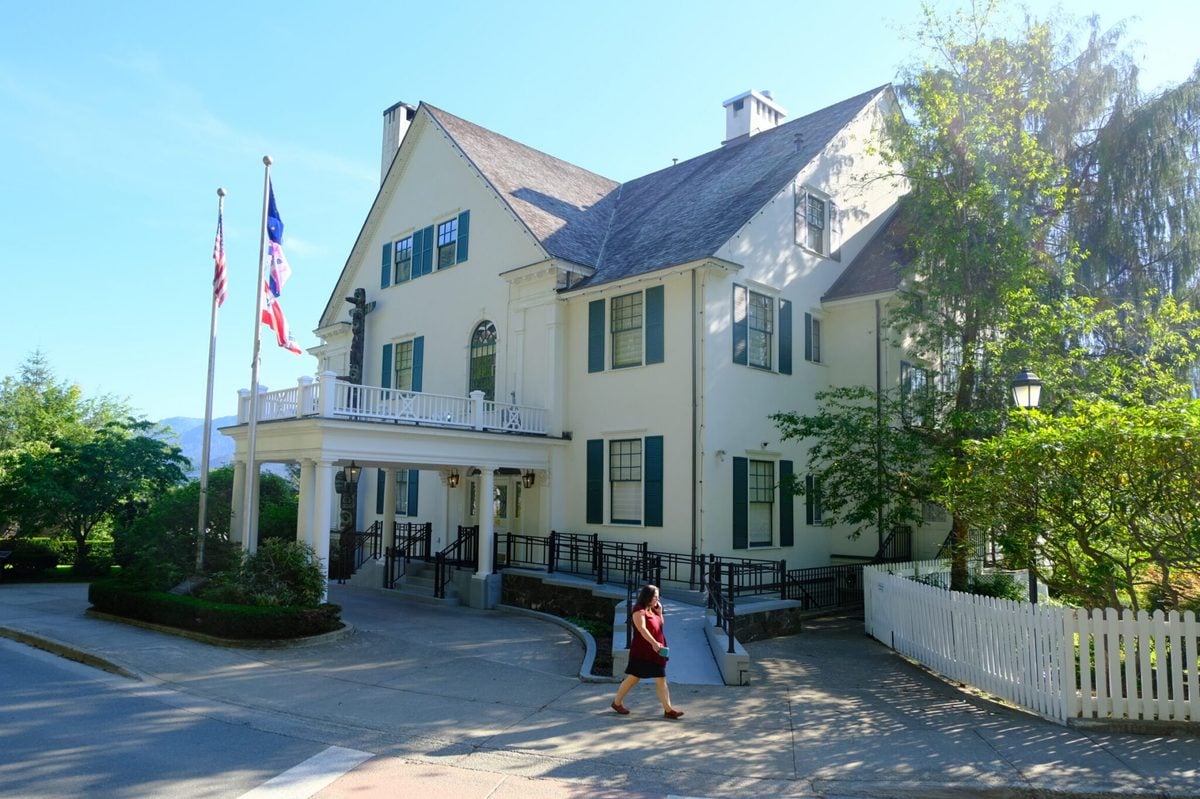
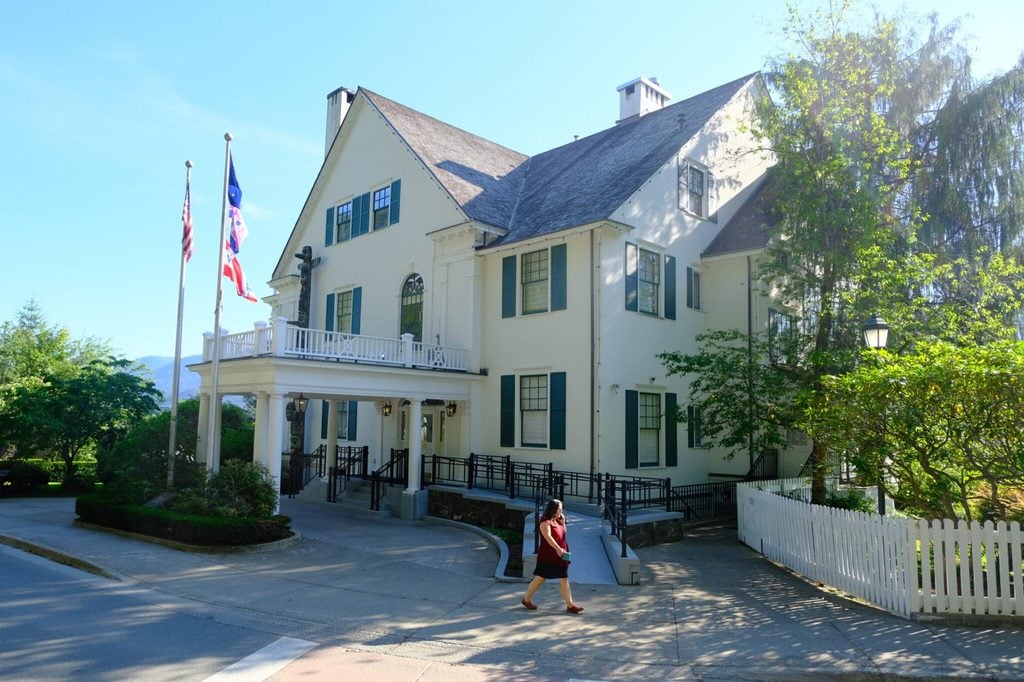
The Alaska governor’s mansion in Juneau is seen on Aug 14, 2026. (Photo by Corinne Smith/Alaska Beacon)
Three of the four Alaska candidates for governor told a Juneau crowd they would live and maintain the seat of government in the state’s Southeast Alaska capital city at a forum in Juneau on Wednesday.
The candidates’ commitment signals the potential for a significant shift. Gov. Mike Dunleavy, who has served for eight years and cannot run again because of term limits, has maintained his primary residence in Wasilla and conducted state business primarily from Southcentral, with periodic trips to Juneau.
Democrat Jonathan Kreiss-Tomkins and Republicans Bernadette Wilson and Dave Bronson expressed their commitment to Juneau while answering questions from the Juneau Chamber of Commerce about their views on the economy, business and state government relationships with private industry.
Republican Treg Taylor did not attend the forum due to scheduling conflicts, according to organizers. Taylor’s campaign did not respond to questions Wednesday about whether he would live and maintain his administration from Juneau, if elected.
The location of Alaska’s capital has long been debated and there have been many attempts over the years to relocate the capital to the state’s population center of Anchorage. Juneau is landlocked and only accessible by plane or boat. Some say the state’s government would be more accessible to the rest of Alaska if it were located on the road system. Others say Juneau should remain the capital because it has been so since statehood, with state offices, workers and administrative functions established in Southeast. Many also say the cost of relocating the capital to Anchorage is impractical.
Democratic gubernatorial candidate Jonathan Kreiss-Tomkins speaks at a candidate forum hosted by the Juneau Chamber of Commerce in Juneau on October 7, 2026. (Photo by Corinne Smith/Alaska Beacon)
Moderators asked candidates what executive leadership, state agencies and investments would be maintained or expanded in Juneau, and whether their cabinet and commissioners would be expected to be based in the capital.
Kreiss-Tomkins alluded to Dunleavy’s lack of presence in Juneau, saying he would govern from Southeast. “I want to restore Juneau’s position as the seat of government, and have as many commissioners as possible living here,” he said.
“(In) Governor (Frank) Murkowski’s administration, and Governor (Tony) Knowles’s administration, that was a reality in Juneau, and people felt it. There was a degree of camaraderie and a degree of connectivity that I think have been lost in the years and administration since, and I want to restore that,” he said.
Bronson said he would require his commissioners to live in Juneau if their department is based in the capital. But he noted that he would be flexible for commissioners who may live elsewhere if they are well qualified: “If the talent says, ‘I live in Anchorage, I live in Fairbanks’ — our commissioner right now of DOT, Ryan Anderson, who was my former boss, he lives in Fairbanks. Are you going to lose talent to compel them to live here and change, uproot their lives that much? I don’t think so.”
Republican gubernatorial candidates Bernadette Wilson speaks at a candidate forum hosted by the Juneau Chamber of Commerce in Juneau on October 7, 2026. (Photo by Corinne Smith/Alaska Beacon)
Wilson joked that the left-leaning capital city would get a new registered Republican voter if her campaign prevails, and she noted the “gravitas” of hosting at the governor’s mansion. “There is a lot of influence within the four walls of that building that I think have very much been underutilized across the state of Alaska, and quite frankly, for the benefit of all of Alaska,” she said.
Republican gubernatorial candidate Dave Bronson speaks at a candidate forum hosted by the Juneau Chamber of Commerce in Juneau on October 7, 2026. (Photo by Corinne Smith/Alaska Beacon)
Wilson and Kreiss-Tomkins said they would plan to live in the governor’s mansion and host public events, guests and state business there. Bronson said he would commit to living there during the regular legislative session.
“I will live here, but I won’t be here all year,” Bronson said. “Because a lot of government is spread out throughout the state. And I’ve learned as a young lieutenant in the military — it’s called leadership by walking around — and walking around for government means getting in the car and driving around and visiting people throughout the state.”
Former Anchorage Mayor Dave Bronson speaks at a gubernatorial candidate forum on Sept. 16, 2026, while former Attorney General Treg Taylor, Anchorage business owner and talk-show host Bernadette Wilson and former state Rep. Jonathan Kreiss-Tomkins listen. (Photo by Yereth Rosen/Alaska Beacon)
All four of the candidates in Alaska’s gubernatorial election this year support construction of a trans-Alaska natural gas pipeline and increased, state-backed drilling for natural gas in Cook Inlet.
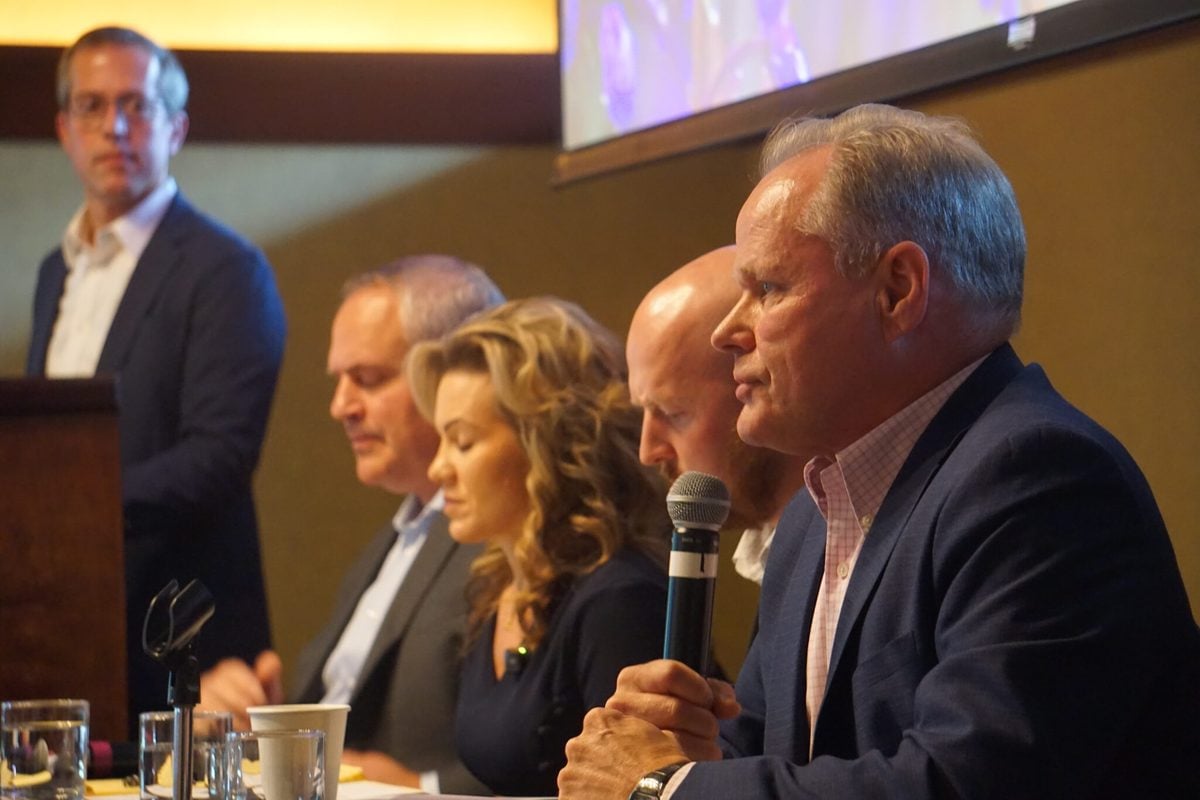
But in a pair of forums held Sept. 21 and Oct. 2 in Anchorage, the four differed on a variety of other topics pertaining to the state’s energy policy, and one said he plans to borrow hundreds of millions of dollars in order to invest in projects that could pay off over decades.
Republicans Dave Bronson, Treg Taylor and Bernadette Wilson, together with Democratic candidate Jonathan Kreiss-Tomkins are each competing to replace Republican Gov. Mike Dunleavy, who is term-limited and cannot run again.
With Southcentral Alaska facing a shortage of cheap natural gas-fired electricity and rural Alaska continuing to experience high utility costs, the cost of energy is likely to be a major issue over the next four years.
“The difference between prosperity and decline in Alaska is often measured in cents per kilowatt-hour. That’s the bottom line,” Taylor said at the REAP forum. “Without affordable, reliable energy, Alaskan families are going to struggle.”
Absentee voting by mail and fax is underway, and early voting in person will begin Oct. 19. Election Day is Nov. 3.
Cook Inlet natural gas
Southcentral Alaska relies on natural gas for electricity and heating, but production from oil and gas deposits beneath and near Cook Inlet hasn’t kept up with demand.
After a cold 2025-2026 winter, utilities are worried that regionwide supplies could run short. Even if this year’s winter passes without incident, the long-term production trend is downward, and utilities are planning to import natural gas as soon as the end of the decade.
“I think we need to immediately incentivize more exploration and capital projects in the Cook Inlet,” Taylor said on Sept. 21.
“We’ve also got to prepare — because of where we’ve put ourselves — for importing LNG, and that’s a horrible place to be when you’re an energy-rich state,” Taylor said.
Currently, the state of Alaska is directly and indirectly subsidizing natural gas production. The Alaska Industrial Development and Export Authority — the state’s development financer — has provided loans to HEX, a company drilling in the region, and the state is foregoing royalties on gas leases in the area.
“I think it is appropriate for the state to offer royalty relief to Cook Inlet natural gas producers, as is currently the case,” said Kreiss-Tomkins at the APA forum, adding that he believes “getting every last molecule out of the Cook Inlet natural gas basin is a state priority.”
Speaking after Kreiss-Tomkins, Bronson said the state needs to somehow encourage a second jack-up drilling rig in Cook Inlet to allow the drilling of more wells in Cook Inlet.
“The most important stuff is natural gas production in the near term, to provide our immediate needs as we plan on more generation and transmission going forward,” he said.
Wilson said she believes structural changes are needed to boost Cook Inlet gas.
“We most certainly need to incentivize production in Cook Inlet,” she said on Sept. 21.
“Yes, whatever we can do to incentivize HEX, whatever we can do to incentivize Hilcorp,” she said, referring to two of the three companies currently drilling for gas in Cook Inlet.
In the room at the time of the debate were some sitting state legislators who supported a proposal to raise business taxes on Hilcorp, HEX and other privately owned oil and gas firms.
Wilson said she believes the threat of a tax increase deterred those companies from drilling.
“We have to pay very close attention that when we complain and — quite frankly — bitch and moan about the gas shortage, who has brought this on? We brought it upon ourselves, and we have to change the outlook,” she said.
On the gas pipeline
If Cook Inlet natural gas is the answer for the immediate future, Bronson said on Oct. 2, “for the long-term future, it is the gas line.”
The proposed Alaska LNG project envisions a pipeline from the North Slope to Cook Inlet, bookended by a pair of industrial processing plants. The project would bring abundant gas to Southcentral and to foreign customers via an export terminal.
According to official estimates, the project is expected to cost between $44.5 billion and $54.5 billion, but skeptics — including some state legislators — believe it will cost $65 billion or more.
For now, it isn’t certain how that project will be funded, who would sell natural gas into it, or who will buy that natural gas.
“We definitely need to have a sustainable energy system. But what we can do right now — what we have to do — the first three things we’re going to do is build a gas line, build a gas line, build a gas line,” Bronson said on Sept. 21.
Earlier this year, the Alaska Legislature took up — but failed to pass — a tax cut that would have benefited the project.
“I strongly support the natural gas pipeline and support restructuring property taxes for the state of Alaska if it helps us get to yes,” Kreiss-Tomkins said on Oct. 1.
Taylor said he thinks that on energy, the state needs to “think big, like the Alaska gas line, for example, a $50 billion project that would put a lot of Alaskans to work and solve a lot of our energy needs along along the Railbelt, and with the potential to export that energy to our our allies.”
Wilson said she ultimately hopes Alaska will be able to boast about having the lowest energy prices in the country.
“A gas line obviously is front and center of that conversation,” she said on Sept. 21.
“For 40 years, we have debated if we were going to make enough money from a gas line, and in 40 years, we have made precisely $0 from a gas line, because we’re debating on ‘Are we going to get our fair share?’ Enough,” she said.
A pipeline isn’t currently expected before the end of the decade, and the first phase of the project involves building a gas import facility that would later be turned around to export gas.
“I think it’s pretty much inevitable that there are going to be LNG imports in Cook Inlet and the Railbelt. That’s obviously incredibly unfortunate,” Kreiss-Tomkins said.
Borrowing for power
Speaking about energy more broadly, Kreiss-Tomkins said that if elected, he would ask the Alaska Legislature for permission to borrow money for projects across the state.
“I believe we need to pass a statewide energy bond in Alaska and make a generational investment in energy infrastructure and transmission infrastructure,” he said on Oct. 1.
When it comes to picking which projects would be funded by that bond, Kreiss-Tomkins said he would consult experts.
“I think we can take some big swings in some projects that can set up Alaska for the next 50 to 75 years,” he said on Sept. 21.
The Democrat said he believes Alaska is too reliant on natural gas alone and wants to see the state adopt a variety of power sources.
“Diversification is a key principle I have,” he said on Oct. 2, explaining that he believes the state should be funding projects through its existing renewable energy fund. He also wants to preserve the $1 billion trust fund that subsidizes rural prices through a program known as Power Cost Equalization.
Taylor said he also supports diversification but didn’t endorse Kreiss-Tomkins’ idea of borrowing money to build projects.
“We have to approach this problem with an all-of-the-above approach. We have to pursue all the avenues, and then let the market decide the winners and the losers,” Taylor said on Sept. 21.
Taylor said he believes the state needs to think big, with both the gas pipeline and the long-shelved Susitna-Watana hydroelectric project, which would put one of the largest dams in the United States between Anchorage and Fairbanks.
While the project would have a large up-front cost, the federal government is offering large tax credits for hydroelectric projects that begin construction before 2033.
Taylor said what he’d like to see is “a unified electric grid with a dispatcher to dispatch the lowest-cost energy to Alaskans along the Railbelt.”
It was a sentiment echoed by Kreiss-Tomkins, who said, “we need to coordinate our utilities.”
Wilson did not specify her plans for rural energy or energy in general but reiterated that she wants to see fewer restrictions on development and construction.
In both forums, Bronson said he supports the construction of large-scale computing data centers because he believes they will bring their own electricity generators.
“They’ll create their own electricity. They’ll deal with the cooling and the noise problems, and I think that’ll be good for us,” Bronson said on Sept. 21.
If the state requires datacenter owners to produce more power, that electricity could be sold locally, Bronson said.
“That’s how you drive down the cost of electricity. Let private enterprise come in and invest, and you compel them to produce more than they actually need,” he said.
In the short term, he believes the state should fund the replacement of older diesel generators in rural Alaska.
“A lot of the diesel generators out there are older than the people that maintain them. I think that’s unacceptable, and the cost of electricity with the newer-generation diesel generators goes down considerably,” he said on Oct. 1.
“I’m not a big fan of wind because it’s not reliable. It’s not base load electricity. Solar isn’t either,” Bronson said.
In the longer term, Bronson said he wants to see small-scale nuclear power plants in rural Alaska away from the Railbelt. The U.S. military is already planning so-called “microreactors” at some of its Alaska bases.
Kreiss-Tomkins didn’t agree with Bronson on nuclear power.
“I think micro-nuclear is compelling … but I think by any measure, it’s still an immature technology and not anything that we can bank on,” he said.
NOTN- Preliminary results from last night’s municipal election have been released, and according to the unofficial results, incumbent Paul Roy Kelly leads the areawide Assembly seat, Mila Cosgrove is the sole candidate for the Assembly seat representing District 1 and Joyce M. Niven leads a four-way race for the District 2 seat.
Kelly received 3,421 votes, or 63%, followed by Brad Sapp with 1,687 votes and James J. McCants with 322.
Cosgrove was unopposed and received 4,233 votes.
In the District 2 Assembly race, Niven leads with 1,829 votes, or 33.55%. Malachi Thorington has 1,394 votes, Karla Hart has 1,326 and David Lee Morris has 903.
The race for two Juneau Board of Education seats has David Noon leading with 3,548 votes, followed by Britteny Cioni-Haywood with 3,264 and Christine Johnson with 1,984.
Voters are also approving Proposition A, extending Juneau’s 3% temporary sales tax for another five years, with 4,694 yes votes, or 80.54%, compared with 1,134 no votes.
Proposition B, which would have restored the city’s mill rate cap to 12 mills, is currently trailing. The measure received 2,842 yes votes and 3,068 no votes, with 51.91% voting against it.
Proposition C, a proposed 1% seasonal sales tax, is passing with 3,369 yes votes, or 56.8%, compared with 2,562 no votes.
The preliminary results showed 5,962 voters cast ballots, representing 21.47% of Juneau’s 27,768 registered voters. The results were reported Tuesday evening and remain unofficial, results are expected to be certified October 20.