Late-afternoon sunlight bathes the ConocoPhillips building in downtown Anchorage on March 10, 2026. A legal dispute over confidentiality of data from exploratory wells drilled by ConocoPhillips in the National Petroleum Reserve in Alaska came down to interpretations of the federal Naval Petroleum Reserves Production Act. The Alaska Oil and Gas Conservation Commission is seeking to release the information publicly, and an appeals court ruled in the state’s favor. (Photo by Yereth Rosen/Alaska Beacon)
The state of Alaska has the right to make public data from exploration wells drilled by ConocoPhillips in the National Petroleum Reserve in Alaska, an appeals court has ruled.
The 9th Circuit Court of Appeals ruling, issued Wednesday, overturns a 2023 decision by U.S. District Court Judge Sharon Gleason that allowed well data to remain under wraps.
At issue is a collection of wells drilled in the reserve, which is federal territory. ConocoPhillips argued that data confidentiality is explicitly guaranteed in federal law and that federal law supersedes state law, but the appeals justices disagreed.
On the National Petroleum Reserve, “Alaska has its own authority to gather — and disclose — data collected from oil and gas exploration, authority that it exercised even before Congress opened the Reserve to private exploration,” the appeals court ruling said.
The Indiana-sized National Petroleum Reserve is of keen interest to energy companies. It is underlain by a formation called the Nanushuk, the source of oil for ConocoPhillips’ huge Willow project, which is under development, the Santos-operated Pikka project, which recently started production, and other prospects. A lease sale held in the reserve in March, the first since 2019, drew a record $163 million in high bids.
Under state law, data from exploratory oil and gas wells is to be disclosed publicly after those wells are completed. State law provides for a 24-month period of confidentiality, after which the AOGCC is to make the data publicly available, unless the Department of Natural Resources commissioner grants an exemption to keep the information confidential for a longer period.
After ConocoPhillips’ request for a DNR exemption was denied, the company in 2022 sued the Alaska Oil and Gas Conservation Commission to keep the data confidential.
ConocoPhillips argued that the federal Naval Petroleum Reserves Production Act expressly prevents the AOGCC and Gas Conservation Commission from disclosing data from the wells, which were drilled on federal leases.
Gleason’s March 8, 2023, ruling came to a slightly different conclusion that nonetheless backed ConocoPhillips. She found that the federal law implicitly protects data confidentiality, despite state law.
The appeals court judges agreed that the federal law has no explicit restriction on state release of well data, but they drew a different conclusion from that finding than Gleason did.
For the state, the appeals court ruling is a victory that is good for future development, Acting Attorney General Cori Mills said in a statement.
“Alaska relies heavily on our resources and resource development. We are also stewards of those resources for the citizens of Alaska. Alaska’s law both allows resource development now, and encourages further development and exploration in the future. We’re pleased that the Ninth Circuit recognized that federal law has not overridden Alaska’s balanced approach,” Mills said.
ConocoPhillips is still considering its next steps, a company spokesperson said. “ConocoPhillips Alaska, Inc. has received the court’s decision and is evaluating it. ConocoPhillips Alaska, Inc. has not decided on whether to appeal the decision,” company spokesperson Megan Olson said by email.
The well data that is the subject of the case remains confidential, according to court documents. Confidentiality has been maintained all the time that the court case has been active.
CBJ- The City and Borough of Juneau Assembly is nearing the end of the Fiscal Year 2027 budgeting process. Below is an update on the budget actions that took place last week, as well as the next steps required before the Assembly’s June 15 deadline to finalize the budget.
The Assembly reviewed, discussed and took action on 21 proposed expenditure reductions to get to a final budget for FY2027.
The nearly $4.7M in reductions includes a combination of one-time and recurring reductions to partner agency grants, capital projects and CBJ services and programming, including:
$770,000 in cuts to Partner Agency Grants
Reductions to Travel Juneau, Juneau Economic Development Council, the Alaska Committee and Alaska Heat Smart
$1M in cuts to Capital Projects
The Gastineau Avenue Widening & Turnaround project
$507,1000 in cuts to CBJ Services, Operations and Programming
Operational reductions to the City Museum, Parks & Recreation’s Landscaping division and Arboretum, and Administration.
$2.7M in cuts to the Restricted Budget Reserve
$247,000 added as a one-time subsidy to Gastineau Human Services through Bartlett Regional Hospital
These reductions are not final. They were included in the amended FY2027 budget and moved to the June 8 Assembly Meeting. The public can provide testimony at the June 8 meeting before the Assembly adopts the final budget.
The Assembly Finance Committee also took action on the following:
An ordinance establishing the Mill Levy (9.92 mills including debt service) for property taxes was moved to the June 8 Assembly Meeting for public hearing and adoption.
CBJ’s independent auditors will provide the FY25 Audit Presentation, including their findings and recommendations. The Assembly will also discuss the proposed sales tax ordinances and general obligation bonds on schools and utilities. There will be an update on the Cost Allocation Plan.
The Assembly will host its final public hearing on the FY 2027 budget. To testify, participants can come to the Assembly Chambers and sign-up. For remote participation, testifiers will need to call the Clerk’s Office at 907-586-5278 by 4 p.m. on the day of the meeting and indicate the topic they will speak on.
The Assembly will make any needed amendments and adopt a CBJ Budget Ordinance, Mill Levy Ordinance and Capital Improvement Project Resolution (as amended).
Speaker of the House Bryce Edgmon, I-Dillingham, presides over the Alaska House of Representatives on Monday, May 18, 2026. (James Brooks photo/Alaska Beacon)
Civics education would be included among graduation requirements for all Alaska high schoolers, under a bill passed by the Alaska Legislature in the final hours of the legislative session last week.
The new requirement aims to bolster Alaska students’ knowledge and understanding of the U.S. government and civic responsibilities. It comes amid declining public trust in government, the bill’s sponsor, Senate President Gary Stevens, R-Kodiak, told the Alaska Beacon last month.
Senate President Gary Stevens, R-Kodiak, is seen ahead of a vote on the operating budget on May 7, 2026. (Photo by Corinne Smith/Alaska Beacon)
Students would have three options to choose from to complete the requirement: complete and pass a semester of civics curriculum, pass a civics exam or complete a civics project-based assessment.
Lawmakers passed Senate Bill 23 by a combined vote of 57 to 3. The bill now goes before Gov. Mike Dunleavy to sign, veto or allow it to pass into law without his signature.
Under the proposal, school districts would be able to develop civics curriculums based on open-access, no cost resources provided by the Alaska Department of Education and Early Development across 14 areas of government and public affairs:
the founding history of the United States, including foundational documents and the principles of government of the United States; federalism, including the role and operations of local, state and national governments;
the institutions of the United States government, including the responsibilities of the executive, legislative and judicial branches;
the rights and responsibilities of United States citizenship;
civil liberties and civil rights;
the Constitution of the State of Alaska and the Constitution of the United States;
political parties and interest groups;
campaigns and elections;
the United States Congress;
domestic policy;
foreign policy;
comparative systems of governments used globally and by Alaska Native people;
international relations; and
major issues facing local, state and the United States governments.
The initiative comes at a time when the United States is seeing a growing public distrust in government and deepening political polarization. A survey last year by the non-partisan Pew Research Center found public distrust is at one of its lowest points in the nation’s history, with just 17% of respondents saying they trust the federal government to “do what is right.”
Stevens declined to comment on the bill passing the Legislature when asked at the Capitol on Wednesday. He said he would wait to comment after the governor’s decision on the bill. Lawmakers have passed 114 bills in this two-year legislative term. But Dunleavy has vetoed 12 bills so far and will consider dozens more in the next few weeks.
Lawmakers are in a high-stakes 30-day special session called by Dunleavy to discuss potential state property tax relief for the proposed Alaska LNG gas line project. The special session is expected to go to June 21.
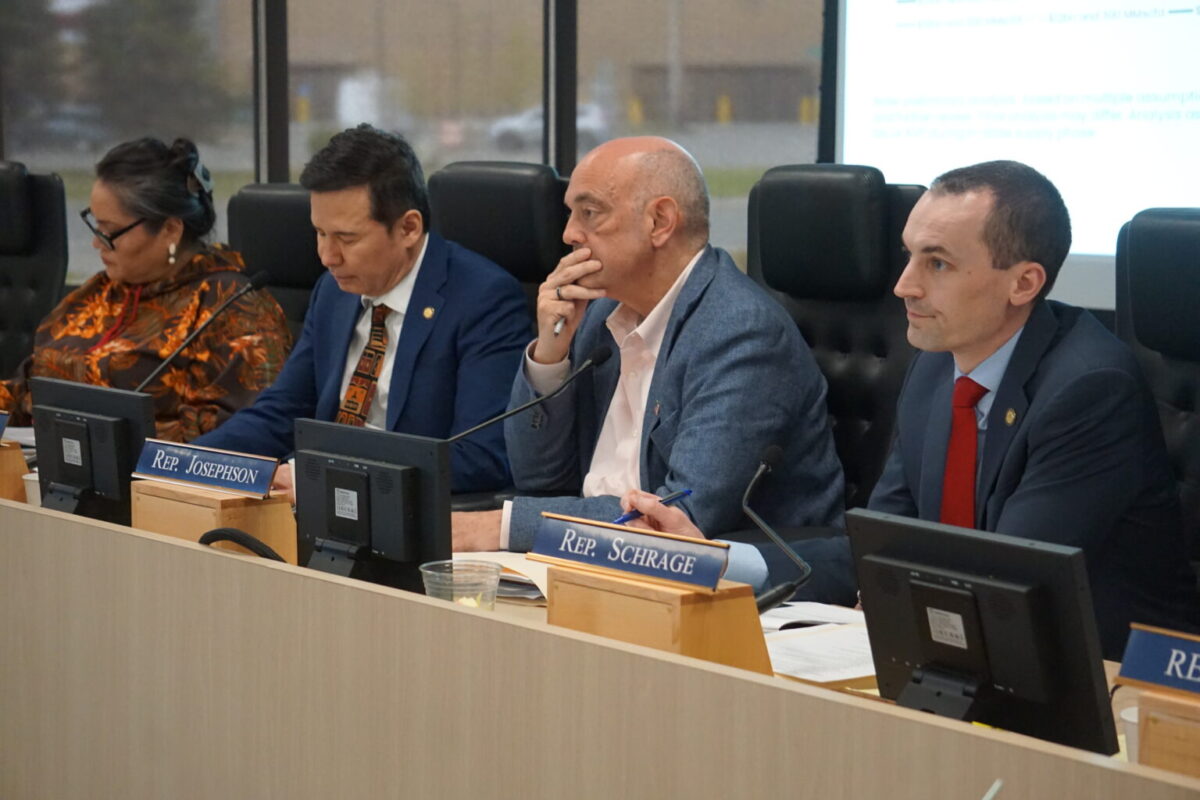
Rep. Nellie Unangiq Jimmie, D-Toksook Bay, Rep. Neal Foster, D-Nome, Rep. Andy Josephson, D-Anchorage, and Rep. Calvin Schrage, I-Anchorage, listen to Nick Fulford, senior director for gas, LNG and energy transition at GaffneyCline Energy Advisory, at a May 26, 2026, House Finanance Committee hearing in Anchorage. (Photo by Yereth Rosen/Alaska Beacon)
The proposed trans-Alaska natural gas line faces a narrow road to profitability, even with Gov. Mike Dunleavy’s proposed multibillion-dollar tax break, according to estimates presented to state legislators.
The more the pipeline costs, the more its builders will need to charge for gas shipped through it in order to make money. But if the cost of Alaska gas is too high, it isn’t competitive with gas from other sources around the world.
On Tuesday, members of the House Finance Committee met for the second time in a 30-day special session devoted to discussing the tax break.
Nick Fulford of GaffneyCline, the Legislature’s hired analyst for the pipeline project, said previously published financial modeling by the Alaska Department of Revenue remains the best public look at whether the project pencils out financially.
“The main question really is: How much bigger and how much more capital cost can the project support before it becomes uneconomic,” he said.
Nick Fulford, senior director for gas, LNG and energy transition at GaffneyCline Energy Advisory, speaks to the House Finance Committee at a May 26, 2026, hearing in Anchorage. (Photo by Yereth Rosen/Alaska Beacon)
In 2018, officials with the Alaska Gasline Development Corp. suggested that building a pipeline from the North Slope to Cook Inlet — plus large industrial processing plants on either end — would cost roughly $43.4 billion, including money earmarked for possible cost overruns.
Since then, the official cost has risen only slightly, to $46.2 billion, but many state lawmakers have said they are skeptical of that figure, because it does not seem to account for inflation.
Glenfarne, a multinational corporation that now owns 75% of the pipeline project, has not disclosed an updated figure.
Rep. Alyse Galvin, I-Anchorage, said that when she uses the Consumer Price Index to judge how much the cost has grown, it’s significant.
“When I look at cost adjustment, just using CPI, just a straight cut through, that brings us to $57 (billion) to $60 billion,” she said during Tuesday’s hearing.
“I would say it seems highly likely that it would be more than $46 billion given the general inflation that we’ve seen,” Fulford said.
Rep. Alyse Galvin, I-Anchorage, poses a question to Nick Fulford, senior director for gas, LNG and energy transition at GaffneyCline Energy Advisory, at a May 26, 2026, House Finanance Committee hearing in Anchorage. Next to her is Rep. Frank Tomaszewski, R-Fairbanks. Photo by Yereth Rosen/Alaska Beacon)
Publicly available estimates suggest gas could be bought from North Slope producers between $1 and $2 per thousand cubic feet. That’s what’s technically known as the “upstream price.”
In a scenario where the pipeline costs Galvin’s suggested figure, the state’s tax laws don’t change to help the project and the upstream price is $1.50 per thousand cubic feet of gas, the Department of Revenue estimates that an end buyer in Japan could expect to pay more than $11 per thousand cubic feet.
That’s likely a problem for the pipeline project, because according to GaffneyCline’s estimates, the average contract price in Japan over the past 10 years has been $10.41 per thousand cubic feet — less than what the Alaska project would have to charge to earn its expected profit target.
Under a tax change proposed by the governor, the end buyer’s price would drop to about $10.40, using Galvin’s cost estimate and the $1.50 upstream price.
But if the cost of upstream gas rises, or if the cost of the pipeline rises, even the governor’s proposed tax break isn’t enough to keep the project economically competitive.
Fulford, speaking to the House Finance Committee, said he thinks Asian LNG prices will rise in the coming years, possibly offsetting any rising costs and keeping the project viable.
But he also acknowledged that with so many unknowns, it’s not clear where the project becomes uneconomic.
“The question is … if the price of LNG goes up and if the capital cost goes up, then where’s that sort of tipping point where the project can still go ahead, even if it’s a much higher capital cost?” he said.
Under Dunleavy’s proposal, the state’s existing petroleum property tax would be largely replaced by a tax on gas that moves through the pipeline.
Speaking last week in Anchorage, Glenfarne CEO Brendan Duval said the governor’s proposed change is necessary for Glenfarne to get financing for the project.
“It won’t be financeable in the form that we’re trying to do it without the tax stabilization law,” he told the Anchorage Daily News.
Legislators appear favorable to the general idea, but they don’t know what tax rate to use for the “alternative volumetric tax,” as it is formally known.
Dunleavy has proposed 6 cents per thousand cubic feet of gas. House and Senate lawmakers are each considering different, higher rates.
They’re also considering mandatory impact payments to compensate cities and boroughs that collectively would lose out on $14 billion in property taxes through 2063 if the governor’s plan is adopted. A mandatory natural gas spur line to Fairbanks is also being discussed. As currently planned, the pipeline runs to the west of Fairbanks.
Rep. Calvin Schrage, speaking Tuesday, said legislators are working with a large amount of uncertainty, and that is slowing their work.
“If we could eliminate some of these variables and have it known, it would really help us in figuring out where this might be going, but we don’t have that right now,” he said. “What this is ultimately showing is that under our current tax structure, there’s a very small window of break-even profitability for a developer.”
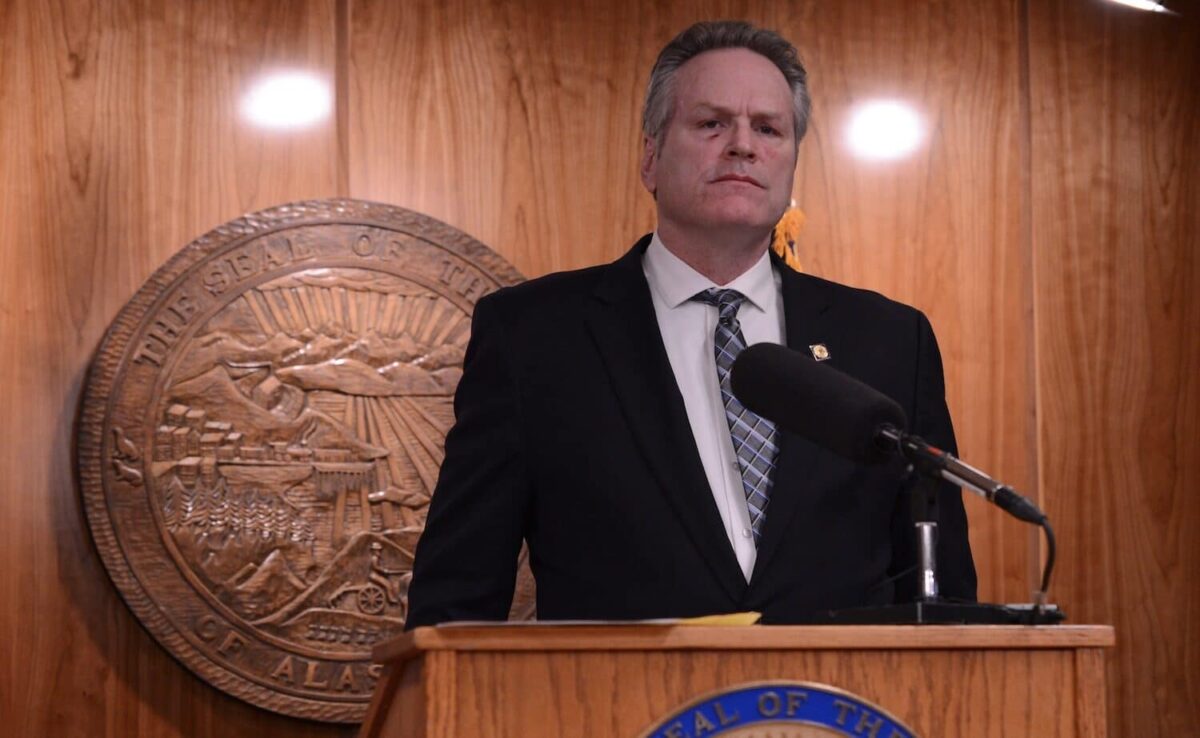
Alaska Gov. Mike Dunleavy speaks during a news conference on Friday, March 15, 2024. (Photo by James Brooks/Alaska Beacon)
Alaska Gov. Mike Dunleavy speaks during a news conference on Friday, March 15, 2024. (Photo by James Brooks/Alaska Beacon)
NOTN- Alaska lawmakers will continue holding hearings this week during a 30 day special session on Senate Bill 2001, and separately House Bill 381, the governor-backed gas pipeline tax proposal tied to the proposed Alaska LNG project.
The Alaska State Senate Finance Committee is scheduled to meet today, Thursday and Friday at 9 a.m. in Juneau to hear presentations and discussion on the bill.
Today and Thursday’s hearings will include presentations from consulting firm GaffneyCline. Friday’s meeting is also focused on continued review of the legislation.
The House met yesterday, and will continue work this week in Anchorage.
Governor Mike Dunleavy called the special session after lawmakers failed to pass a gasline bill during the regular session, lawmakers received the governor’s proposal on day 80 of 120.
The governor is pushing for larger tax breaks and incentives for the project’s developers.
According to reporting from the Alaska Beacon following an Energy Conference in Anchorage, state and local governments would eliminate 90% of the property tax that would be levied on gasline-related infrastructure in exchange for future opportunities to tax natural gas as it moves through the yet-to-be-built system.
Though legislators are currently sitting on both sides of the fence, some argue the proposal would reduce future revenue for both the state and local governments along the pipeline route.
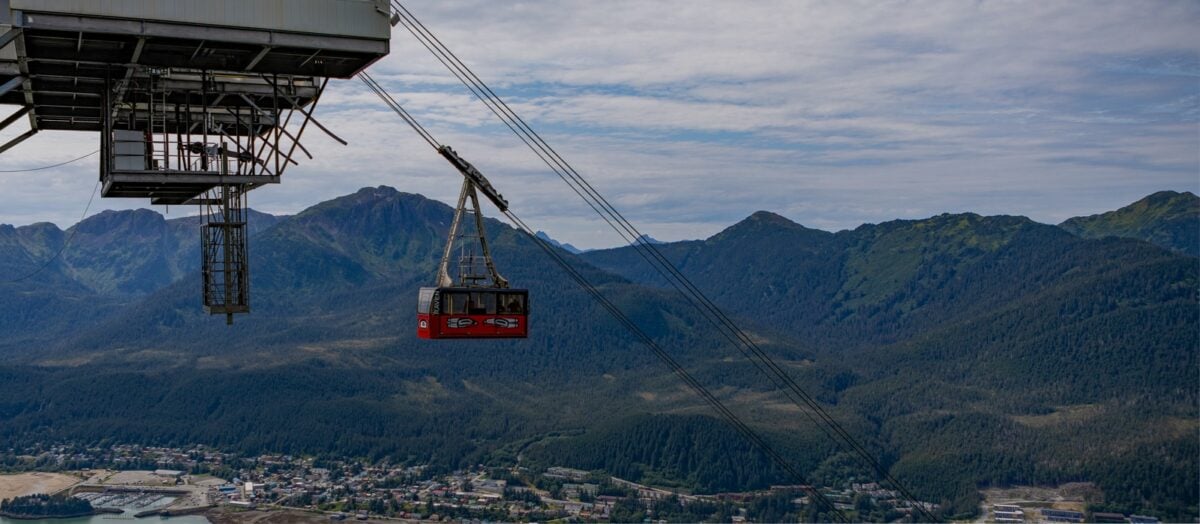
Goldbelt Tram overlooking Juneau, courtesy of Goldbelt.
NOTN- Goldbelt Inc. will not reopen the Goldbelt Tram until a full round of safety testing and recertification is complete following an April 30 mechanical incident that injured several employees, the company’s president and CEO said.
McHugh Pierre said an internal investigation found “an operational event” triggered the tram’s emergency stop system, causing both cars to contact infrastructure near the lower terminal and skybridge.
“I want to make sure that everybody knows that safety is the core component at the Goldbelt Tram, and at all Goldbelt operations.” Said Pierre, “We take events like what happened April 30th at the tram very seriously, and so we’ve completed a rigorous investigation. We’ve identified an operational event that occurred that triggered the emergency stop system at the tram, and because of the proximity of where the cars were to the lower terminal in the sky bridge, each one of those cars made contact with that infrastructure. We are going through very serious testing and evaluation of all of our equipment before we reopen to make sure that we continue to stay focused, and have a very clear mandate on safety across all of our systems.”
Pierre said the tram, which is marking its 30th year of operation, undergoes rigorous annual inspections before each season, including non-destructive testing of welds on aluminum and steel for stress fractures, and evaluation of the haul and tow cables. The manufacturer also participates in reviewing the electric and diesel motor systems.
Because of the April incident, the full inspection is being repeated.
“We will go through it before we reopen this summer, and there’s been some confusion, and I understand, you know, people are looking for some answers. We will reopen when we are safe and certified to reopen.” Pierre said.
All season pass holders have been refunded but will still receive their usual benefits once the tram resumes service.
“I’m committed to being the first person to ride a tram car up the mountain,” he said, adding he wants to personally demonstrate the system’s safety and reliability, “I want to make sure that I can personally demonstrate the certainty that our loyal local customers have, and our visiting customers have as well.”
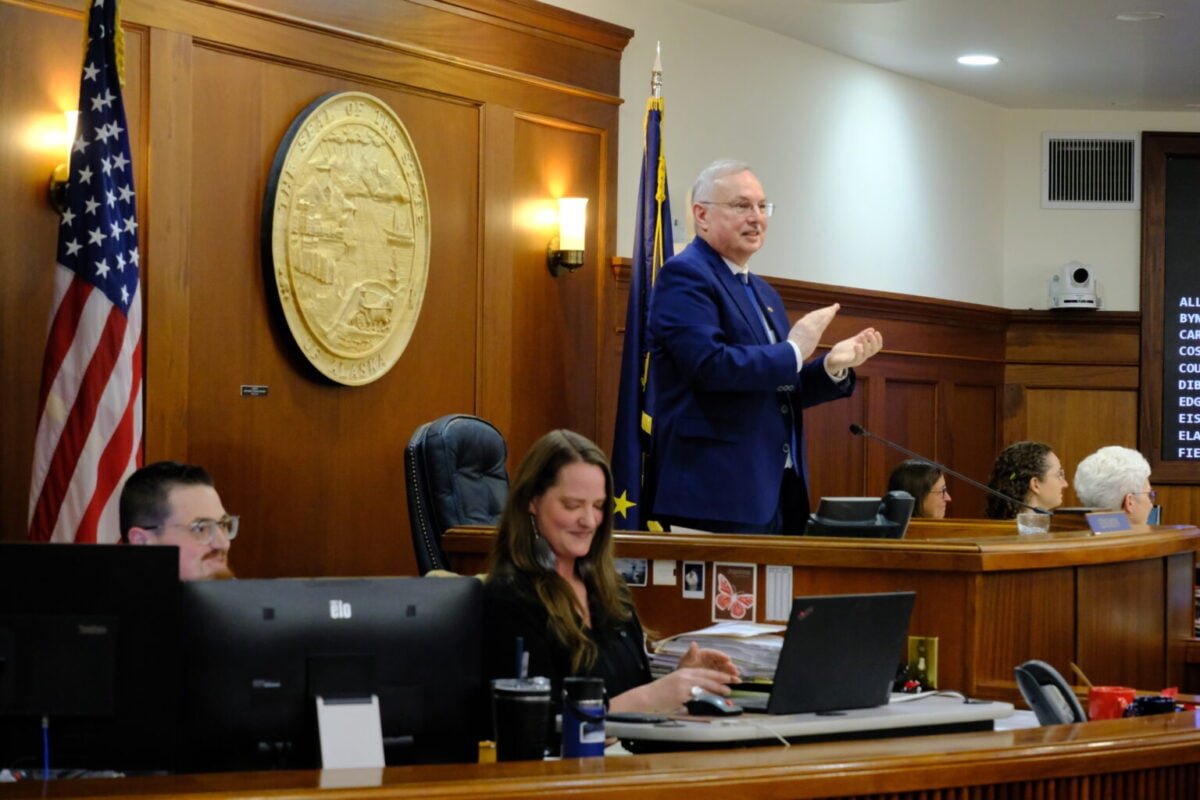
House Speaker Bryce Edgmon, I-Dillingham, stands to applaud the House pages, staff and clerks at the end of the 34th Legislative session on May 20, 2026. (Corinne Smith/Alaska Beacon)
An Alaska Legislature defined by its conflicts with Gov. Mike Dunleavy came to an end at 9:43 p.m. Wednesday night as legislators officially adjourned their second regular session.
Lawmakers will return to work Thursday as they open a special session focused on the planned trans-Alaska natural gas pipeline. As with other topics, the Legislature and the governor appear far apart on the issue.
“I would say farewell, except I get to see you at 10 a.m.,” said Speaker of the House Bryce Edgmon, I-Dillingham, shortly before final adjournment.
Before adjourning, the 34th Alaska State Legislature passed a large, multi-part crime bill that raises the state’s age of consent and criminalizes the act of using AI to create child sexual abuse material. Lawmakers voted to ban foam food containers, named the giant cabbage the state vegetable, approved a fast lane through airport security and passed dozens of small bills that were priorities for local communities and individuals across Alaska.
Bills that fail to pass before adjournment die and must be reintroduced at the start of the next Legislature. Among this year’s casualties were a proposal to offer paid leave for new parents, a bill to stabilize public school budgets, a right-to-repair bill, and all of the proposed constitutional amendments.
This fall is an election year and many incumbents are retiring, which means that when lawmakers return next year, the House and Senate will include many new faces. They also will work with a new governor: Because of term limits, Dunleavy may not run for re-election.
The Alaska Legislature is the only one in the United States controlled by multipartisan coalitions in both the House and Senate.
“The Senate majority and the House majority have worked extremely well together. We’ve been on the same page through this entire two years,” said Senate President Gary Stevens, R-Kodiak.
Senate President Gary Stevens, R-Kodiak, Sens. Cathy Giessel, R-Anchorage, and Bill Wielechowski, D-Anchorage are seen at a news conference after the Senate adjourned on May 20, 2026. (Photo by Corinne Smith/Alaska Beacon)
In their two-year term, the 34th Legislature passed 111 bills, on par with the 33rd Legislature, which passed 101 bills, and the 32nd Legislature, which passed 112.
Of the 111 bills passed by the 34th Legislature, Dunleavy has vetoed 12, including one he vetoed less than three hours before lawmakers adjourned on Wednesday.
Dunleavy is vetoing bills at a higher rate than any governor since statehood. Though other governors have issued more vetoes, Dunleavy’s represent a higher proportion of the number of bills passed through the Capitol.
At the start of the 34th Legislature, the House and Senate majority coalitions set education funding as their top priority.
Last year, they voted to permanently increase the core of the state’s public school funding formula, putting themselves at odds with the governor and setting up a historic set of veto override votes with the help of some Republicans from the House and Senate minority caucuses.
This year, the majorities passed a significantly less ambitious package of education policy reforms but also approved $144 million in one-time bonus payments to public schools and millions more in funding for maintenance and construction projects across the state. Some of the bonus payments are contingent on oil prices remaining high through July 1.
Rep. Andy Josephson, D-Anchorage, thanks his staff and colleagues in remarks on the House floor acknowledging he will retire from the Legislature this year and not seek reelection on May 20, 2026. (Photo by Corinne Smith/Alaska Beacon)
They were less successful with other stated priorities, including pension legislation. Alaska has been without a public pension program since 2006, and the 34th Legislature was the first since then to pass a bill creating a new pension plan.
The governor’s veto came after legislators failed to reach agreement with him on one of their other stated priorities, energy.
Dunleavy has urged lawmakers to cut the state’s petroleum property tax in order to incentivize the proposed trans-Alaska natural gas pipeline. Building the pipeline, the governor has said, is critical for lowering energy prices and improving the state’s economy.
Many legislators are skeptical of those claims.
This week, Dunleavy and House Majority Leader Chuck Kopp, R-Anchorage, had negotiated a deal in which the governor would allow the pension bill to become law if legislators approved a gas pipeline bill that aligned with his vision.
The Senate Majority also prioritized elections reform and passed a bill on the topic earlier this year, but Dunleavy vetoed it.
Legislators fell two votes short of an override because two Republican supporters flip-flopped and voted to sustain the governor’s choice. They had previously voted in favor of the bill.
“We passed the bills, and that’s all we can really get. It’s out of our hands at that point,” said Senate Majority Leader Bill Wielechowski, D-Anchorage.
The House Majority’s fourth priority was balancing the state’s budget, and while lawmakers successfully did so this year, the budget was balanced on the back of high oil prices caused by the Iran war, not because of a particular legislative action.
“In the beginning, we were worried about just keeping the (Permanent Fund dividend) alive and getting a balanced budget,” said Sen. Bert Stedman, R-Sitka, “and talking about how long our (Constitutional Budget Reserve) is going to last. Then, within a period of a couple of months, things totally changed, and the revenue forecast jumped up.”
When oil prices recede, legislators expect the state will again face major budget deficits.
“Next year will be a very, very difficult session,” Wielechowski said.
In the meantime, the state treasury is reaping wartime rewards, and lawmakers were able to balance the budget without spending from savings.
“Folks, this is what we accomplished, and we accomplished it on time and under budget,” said Rep. Andy Josephson, D-Anchorage, as he presented the final version of the operating budget bill on the House floor.
Members of the Republican House minority criticized the adopted budget for not spending more wartime oil revenue on the dividend.
“My primary objection to this budget is that in FY26, the state is absolutely swimming in money,” said Rep. Will Stapp, R-Fairbanks.
“We should have waterfalled that extra money into the Permanent Fund dividend,” he said.
Both the operating budget and the capital budget are subject to the governor’s line-item veto powers. The governor can eliminate or reduce individual items, but he cannot add or increase them.
Kopp gave the majority coalition a “B” for its performance. Senate President Gary Stevens, R-Kodiak, thought the majority coalition there warranted an “A,” while Senate Minority Leader Mike Cronk, R-Tok, thought the Legislature overall merited a “B”.
The last day of the session saw several lawmakers offer their goodbyes, including some who had not previously announced their retirement.
“I am not planning on being back here for the 35th Alaska Legislature,” said Rep. Dan Saddler, R-Eagle River. Saddler has served for 12 nonconsecutive years in the House.
Rep. Dan Saddler, R-Eagle River, tears up after an emotional speech announcing his retirement from the Legislature and declining to run for re-election, on the House floor at the conclusion of the 34th Legislature on May 20, 2026. (Photo by Corinne Smith/Alaska Beacon)
Rep. Andy Josephson, D-Anchorage, is retiring after 14 years in the House and received multiple rounds of applause. Rep. Louise Stutes, R-Kodiak, is leaving the House as well, but for a state Senate run rather than retirement.
Speaker of the House Bryce Edgmon, I-Dillingham, has not announced plans to leave the House, but he has been repeatedly named as a possible replacement for Sen. Lyman Hoffman, D-Bethel. Hoffman is retiring as the longest-serving state legislator in Alaska history.
Senate President Gary Stevens, R-Kodiak and the oldest member of the Legislature, is also retiring. The Legislature’s youngest member is also leaving — Rep. David Nelson, R-Anchorage, is getting married this summer.
After the final gavel fell, staff and legislators cheered and filed out of the chambers.
Within an hour, Saddler was leading a group of them in songs that echoed up and down the Capitol’s stairwell.
Corinne Smith contributed reporting from Juneau.
Rep. Dan Saddler, R-Eagle River, serenades legislators and staff in the Capitol stairwell shortly after the 34th Legislature adjourned on May 20, 2026. (Photo by Corinne Smith/Alaska Beacon)
Juneau’s Assembly Finance Committee is staring down a major budget deficit for fiscal year 2027.
They inched their way through a long night of budget cutting at a work session last night, trimming around the edges while sparing some of the city’s most debated programs.
Finance Director Angie Flick warned the city cannot afford to end the year in the red.
“You should be projected to be at zero at worst case scenario,” Flick told the committee, “I think my predecessor and the prior city manager had some conversations with the assembly at the time and suggested $5 or $7 million as a fund balance, and that was based on the spending and the projects that the assembly liked to do. When I went back and looked over the last three years, I would, if I were making a recommendation based on your past to predict your future, I would say you would want $11 to $12 million in your fund balance. There were some significant general fund dollars that went to support the school district when it was in need, there’s been significant one-time dollars that have gone to flood fighting, and then there have been other community priorities that the body has decided to fund, and so you know, based on how the body has approached spending in the past, that would be the kind of fund balance that I would suggest. I think the real pressing concern that’s going to be hard to get around, would be flood fighting as we move forward, and that’s just going to be a tricky one to deal with.”
The current draft budget uses about $8 million in fund balance to cover operating costs, leaving Juneau projected at negative $1.7 million in unrestricted fund balance. Even if a package of fast‑tracked sales tax changes passes, that only improves the outlook modestly.
Members were split over strategy.
Some pushed for deeper cuts now and said they were aiming to leave roughly $5 million in fund balance. Others favored relying more on one‑time project cuts until they know whether new revenue measures or fall ballot initiatives will pass.
In terms of action taken, prior to the June 8 public hearing, members voted 5-4 to cut $75,000 a year from the city’s landscape budget.
Assembly member Neil Steininger was one of those who objected to the cuts saying, “I feel like when we just call this the landscaping budget, it’s kind of a misnomer, because so many other things fit in there. This is a parks maintenance budget, it’s not the flowers downtown, it is not beautification landscape, it is safety considerations, it is cleanliness, it is all of those things. I don’t think when people hear landscape budget they think about trail maintenance. I think it’s an important thing that we spend money on to keep Juneau safe.”
Supporters, said the cut will make residents more aware of what those services cost.
The Assembly also approved a $261,000 recurring cut to the Juneau City Museum, staff said this will mean two layoffs and reduced public access.
Members also voted 5-4 for a one‑time $300,000 cut to the city’s grant for the Juneau Economic Development Council.
A $300,000 cut to staff travel and training was rejected.
Assembly members rejected a deeper, one‑time $250,000 cut to the Affordable Housing Fund, but later agreed to a smaller $150,000 reduction. Several members argued this is the wrong time to pull back on housing dollars.
“It is very hard for me to look at our actions and look at our process and look at where we are trying to go, and the things that people have said no to for cuts, speaking to the importance of their value to the community, and then turn around and say that we can afford a cut like this to the affordable housing fund.” Said Assembly member Alicia Hughes-Skandijs, “It does not make sense to me that rationale.”
The Assembly also kept a subsidy in place for Bartlett Regional Hospital’s home health and hospice program, while directing Bartlett to cover a separate, one‑time $247,000 substance use treatment grant for Gastineau Human Services.
They also approved a $20,000 one‑time cut to the city’s accessory dwelling unit grant program and voted to eliminate general fund support for the Jensen‑Olson Arboretum.
The Assembly declined to reduce funding for the Juneau Arts and Humanities Council or the Small Business Development Center.
A proposal to lease out the Douglas Fire Station failed after the fire chief warned it would worsen the island’s insurance rating and emergency response.
Committee members repeatedly emphasized that none of the reductions are final.
“These are not final decisions, what we are trying to do tonight is come to a holistic budget that we can pass to the full Assembly so that the public can get one more opportunity to give us feedback on it.” Said Finance Director Christine Woll, “Nothing is set in stone until we vote as a full Assembly on June 8.”
A complete budget, including any service cuts and use of savings is expected to go to the full Assembly and the public for a final vote June 8.
Sen. Scott Kawasaki, D-Fairbanks, speaks Friday, Feb. 7, 2025, on the floor of the Alaska Senate. (Photo by James Brooks/Alaska Beacon)
By James Brooks, Alaska Beacon
Sen. Scott Kawasaki, D-Fairbanks, speaks Friday, Feb. 7, 2025, on the floor of the Alaska Senate. (Photo by James Brooks/Alaska Beacon)
The Alaska Legislature has approved a state driver’s license data-sharing bill that would allow some travelers to speed through security at airports in Alaska.
On Wednesday, the Alaska Senate voted unanimously to approve Senate Bill 237, from Sen. Scott Kawasaki, D-Fairbanks. Because the House voted to pass the bill 40-0 on Tuesday, the Senate’s vote sends the bill to Gov. Mike Dunleavy for final approval or veto.
As originally drafted by Kawasaki, SB 237 would have only allowed the state Division of Motor Vehicles to share driver’s license information with “a nonprofit organization, governmental, or tribal entity.”
Alaska is the only state that does not allow residents to get a replacement card online.
In the House, Rep. Steve St. Clair, R-Wasilla, proposed an amendment that would allow the state to share driver’s license data with “an entity participating in the Transportation Security Administration’s Registered Traveler Programs.”
That includes CLEAR, a for-profit company that offers fast-lane service at airport security checkpoints across the country.
“There’s actually a contract between CLEAR and the (Anchorage) airport right now, they just can’t do anything or share data until we pass legislation saying that they can,” St. Clair said.
House lawmakers approved that amendment unanimously.
At the urging of Rep. Andrew Gray, D-Anchorage, lawmakers also amended the bill with a section that will allow Alaskans to store digital copies of their driver’s licenses on their smartphones.
If a police officer performs a traffic stop, that digital copy would be valid ID.
That amendment was originally a separate bill, House Bill 180, from the Office of the Governor.
“For anyone who lives their life on their phone, this would be a wonderful convenience that the administration would like to offer,” Gray said.
That amendment passed the House by a 38-2 vote, and SB 237 proceeded toward a final vote in the Legislature without opposition.
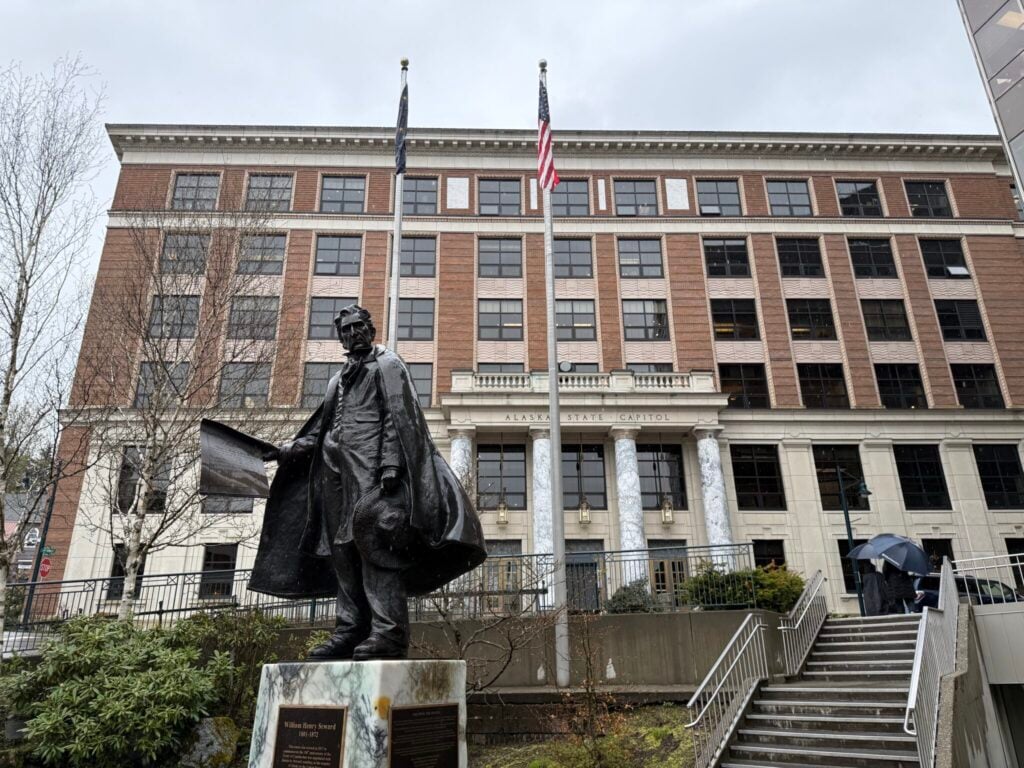
The Alaska State Capitol is seen on the last day of the legislative session on May 20, 2026. (Photo by Claire Stremple/Alaska Beacon)
The Alaska Legislature approved a broad omnibus crime bill that will increase criminal penalties for a variety of offenses and streamline victims services. The bill includes over a dozen pieces of legislation and garnered bipartisan support.
The Alaska Senate unanimously passed House Bill 239 on Tuesday, after assembling the combination bill package over the last several weeks. Lawmakers in the House concurred with the Senate’s changes by a vote of 39 to 1 on Wednesday morning. It now advances to Gov. Mike Dunleavy for consideration.
The omnibus crime bill includes provisions to create stricter criminal penalties for AI-generated child sexual abuse material, hit-and-run incidents and sexual assault by a healthcare worker. It also raises the age of consent from 16 to 18 years old and restructures the Alaska Board of Parole, among other items.
Sen. James Kauffman, R-Anchorage, spoke in support of the omnibus bill on Tuesday. “We hear of sausage-making in the legislative process — this is a big piece of sausage,” he said. “And having seen it in Senate Finance, I was impressed with the content, the quality of how so many things came together, and it came together so well.”
Sen. Matt Claman, D-Anchorage, speaks at a March 19, 2024, news conference held by the Senate majority caucus. (Photo by Yereth Rosen/Alaska Beacon)
Sen. Matt Claman, D-Anchorage, who chairs the Senate Judiciary Committee, carried the omnibus bill in the Senate. He noted that the state will carry some fixed and indeterminate costs for enacting the changes across several state departments, but said it’s worth the price tag to protect public safety and improve protections for victims.
“Changing the statutes is not enough. Sometimes it calls on us to have more prosecutors, more police and more people in the field to actually enforce these crimes,” he said on the Senate floor.
“I hear consistently from the public, when we look at these public safety measures, is ‘Who’s going to be there to enforce these laws?’ This is an example in which the fiscal notes reflect that this bill will cost money, but the public really believes in it, and they want these measures to take place, and they want our public safety professionals to go and do the things they need to enforce these laws,” he said.
Rep. Sarah Vance, R-Homer, speaks Friday, April 26, 2024, on the floor of the Alaska House of Representatives. (Photo by James Brooks/Alaska Beacon)
Rep. Sarah Vance, R-Homer, sponsored the bill to enact state criminal penalties for AI-generated child sexual abuse material, and spoke in support ahead of the vote. She spoke in favor of concurrence on Wednesday morning.
“There’s a couple of windows that I would like tighter, however we have to get agreement with every region of the state. And I think this bill does that. This bill prioritizes justice. And this is justice for all of those who have not had a voice,” she said.
Some members of the House all-Republican minority caucus raised concerns at the number of bills included in the omnibus bill and the need for more public discussion and hearing on the individual bills. But Rep. Andy Josephson, D-Anchorage, argued that hearing each bill would take legislators hundreds of hours and an omnibus bill was the best way to pass and enact needed criminal policy changes.
Rep Andrew Gray, D-Anchorage, backed a bill to raise the age of consent from 16 to 18 years old, aimed at prosecuting sexual violence against 16 and 17 year olds. “For years we were collaborating on this, whether we knew we were collaborating or not,” he said on Wednesday on the omnibus crime bill.
“We have the highest rate of sexual assault in the country, and the majority of victims being young. Being younger is a risk factor,” he said. “What we are doing today is telling predators that 16 and 17 year olds are off limits.”
The omnibus crime bill now includes:
House Bill 239 — would increase criminal penalties for hit and run incidents by drivers that cause a death and knowingly fail to stop and render assistance, and it establishes mandatory sentencing of four to seven years for a first hit and run felony conviction.
House Bill 101 — would raise the age of consent from 16 to 18 years old, with provisions to allow minors to consent to sex with someone up to six years older than them. The draft bill also allows 16 and 17 year olds to consensually exchange sexual or explicit messages within the six year close-in-age gap without penalties.
House Bill 62 — would establish a statewide tracking system for sexual assault examination kits, expedite processing times and ensure that survivors can privately monitor the status of their own kit. The bill was sponsored by the governor.
Senate Bill 100 — would establish the crime of organized theft, including mail theft and medical record theft.
House Bill 242 — would redefine criminal law to prohibit any sexual contact or assault by a healthcare worker during professional treatment, a change to the current law that only applies to patients being unaware of sexual contact or assault for criminal charges to apply.
Senate Bill 17 — would establish the crime of airbag fraud for knowingly selling, installing or manufacturing a counterfeit airbag in a vehicle.
House Bill 81 — would establish that minor marijuana related convictions remain confidential on individuals’ personal records, under certain criteria.
House Bill 384 — would expand confidentiality agreements between victims and service providers by updating the definition of “victim counseling center” to include tribal organizations.
Senate Bill 233 — would reassign the administration of the Controlled Substances Advisory Committee from the Department of Law to the Department of Commerce, Community and Economic Development.
Changes to the Board of Parole
The provision to restructure the Alaska Board of Parole was originally introduced by Sen. Löki Tobin, D-Anchorage, as Senate Bill 62 last year. The provision expands the Board of Parole from five to seven members, enacts term limits of no more than two five-year terms and implements new criteria for board seats.
The Board of Parole is appointed by the governor, and is charged with reviewing applications and eligibility for parole, for which there were 199 applicants last year. Advocates and lawmakers have raised concerns around Alaska’s parole approval rates dropping significantly in recent years — to some of the lowest rates in the nation.
Tobin and proponents of the changes to the parole board said the board’s workload was a reason to expand the board and said the added criteria for the board seats is important for fairness and accountability to those under review for parole.
The new criteria for board seats would require that one member be a licensed physician, psychologist or psychiatrist, one member have experience in the field of criminal justice, one member have experience in providing drug or alcohol addiction recovery support or who has personal experience with addiction, and one member of a federally recognized tribe in the state.
The entrance to the Anchorage Correctional Complex is seen on Aug. 29, 2022. (Photo by Yereth Rosen/Alaska Beacon)
Senators also added criteria for parole eligibility so that parole board members consider an applicant’s age at the time of offense.
While the officials with the Alaska Department of Corrections have said rising costs across the prison system are in part due to an aging population and increasing medical needs, the Board of Parole has not granted anyone geriatric or medical parole in the last five years, according to state data.
Senators included a new provision to allow the corrections commissioner to authorize medical parole of a prisoner, with electronic monitoring, if that prisoner has a terminal, permanent or progressively degenerative disease and is deemed to not pose a threat to public safety. Senators also included legislation introduced last year, Senate Bill 31, to establish an address confidentiality program to help protect victims of domestic violence or stalking and police or correctional officers and their families. Individuals enrolled in the program will have their mail forwarded to a designated post office box to help keep their home address private.