Looking for an easy way to increase the flavor of your mashed potatoes without modifying your ingredient list? It all comes down to how you prepare your spuds.

Food Republic – Restaurants, Reviews, Recipes, Cooking Tips









Looking for an easy way to increase the flavor of your mashed potatoes without modifying your ingredient list? It all comes down to how you prepare your spuds.
Food Republic – Restaurants, Reviews, Recipes, Cooking Tips

By: Corinne Smith, Alaska Beacon

Alaska saw an unprecedented wave of school closures this year. District officials grappling with severe budget shortfalls have opted to close 12 elementary and middle schools across the state — in Anchorage, Wasilla, Sutton, Seward, Sterling, Soldotna, Kasilof and Ketchikan.
With those closures, hundreds of students and staff will bus or commute to new schools next year, class sizes will grow as grades are combined and districts across the state are cutting programs, teachers, health aides, custodians, sports, library services and extracurriculars like music.
Officials in four districts say the closures were incredibly complex and difficult decisions but necessary to combat millions in budget shortfalls and years of state funding not meeting districts’ surging costs to operate schools.
Schools closed this year include:
“It was an incredibly trying time,” said Randy Trani, superintendent of the Matanuska-Susitna Borough School District that closed three elementary schools this year to address a $28 million budget shortfall. “Non-winnable… we did this to save teaching positions,” he said.
“This is devastating to everyone,” said Kylie Wilcox, a Soldotna mother of five. Her middle and high schoolers attended River City Academy, one of four schools closed on the Kenai Peninsula. “The district does not want to do this, the administration doesn’t want to do this, we just, it’s the reality of what we’re working with.”
At the same time, superintendents said it’s still unclear whether the closures and cuts have balanced district budgets because Gov. Mike Dunleavy has yet to sign off on next year’s increased budget for education funding. Last year, lawmakers flew back to Juneau for a special session, overruled Dunleavy’s veto and restored an education funding increase in a historic override vote in August, just weeks ahead of the first day of school.
This year, the Alaska Legislature approved one-time additional funding of $144 million for K-12 schools, including $29 million to offset rising energy costs, to total $1.8 billion approved for education next year. Lawmakers passed a budget with higher-than-expected state oil revenues driven by the Iran war, which is now before Dunleavy for his consideration.
Education Commissioner Deena Bishop said that the state has seen declining enrollment for more than 15 years, and as a result districts close schools due to what she called “excess capacity.” Bishop has served as commissioner under the Dunleavy administration since August 2023.

“We’ve had several schools at 50% capacity, 55% capacity, that were within two miles of each other. And understanding that you want to use the majority of your money, you don’t want to put into facilities — the majority of your money you want to put into classrooms,” she said. “And so decisions, you know, things were weighed, and districts, hopefully working with their parents and communities, made decisions that they felt were the correct ones.”
Bishop said more families are opting for homeschool programs, and districts need to figure out how to provide education services for families that want choices for more flexibility.
Nearly one in six Alaska students were homeschooled last year, totaling an estimated 23,600 students, according to data compiled by the Association of Alaska School Boards.
“So we can’t really be upset that, you know, ‘Oh no, they’re not going to our schools,’” Bishop said. “Obviously they’re going to a school that their needs are met, if they’ve chosen that, so how do we work with it? You know, what does education look like, and what does it look like in serving a community? And more and more we’ll find that one size doesn’t fit all that schools really want to offer, and districts are starting to offer different programs.”
Alaska students have the option to enroll in homeschool or correspondence programs across the state, not necessarily with the district where they reside. While district officials say they are working to adapt and provide homeschool education services, districts receive less state funding per homeschool student which is contributing to district-wide deficits.
The Matanuska-Susitna Borough School District, the state’s second largest district with almost 20,000 students, faced a $28 million budget deficit this year, prompting cuts across the district.
The school board closed Meadow Lakes and Larson elementary schools in Wasilla and Glacier View School in Sutton, affecting roughly 415 students and dozens of staff.
That comes after the district cut roughly 160 staff positions last year, said Superintendent Randy Trani. He said the district would have had to cut an additional 225 positions this year, which was unworkable.
“The very last thing that we wanted to do was lay off teachers, and the second last thing we wanted to do was close schools, but we’re to the point where if we didn’t close schools, it was only going to result in more teacher layoffs,” he said.
Trani said the district went through a process of evaluating schools based on a number of metrics, including number of students, costs to maintain and opportunities to bus students to schools nearby, in order to decide which schools to close. “The schools that we were forced to shut down were fantastic schools. This wasn’t a decision on academic merit. This was a decision about logistics and being forced into a really impossible choice,” he said.
Trani said closing the three schools wasn’t even enough to make up for the budget shortfall and the district had to cut deeper.
The school board considered various scenarios from cutting sports programs to transitioning to a four-day school week, Trani said, which were rejected by the school board. “These are all horrible choices,” he said.
While the Matanuska-Susitna Borough continues to have the fastest growing population in the state, Trani said declining birth rates combined with an ongoing wave of families opting to homeschool is leaving the district with declining enrollment of full-time students and reduced funding for the district. Roughly 3,200 students, or 16% of the district’s students, were enrolled in Mat-Su correspondence programs this year.
Trani said another cost driver had been double digit increases to healthcare insurance costs resulting in roughly $6 million more to the deficit, bumping it to $28 million.
But he emphasized the largest driver of the deficit was insufficient state funding. “State funding has not kept up with inflationary pressures, and it is by far the biggest driver,” he said. “Unless there is a long term fix to how K-12 education is funded this problem is going to continue.”
Ketchikan serves roughly 1,800 students in the Southeast Alaska island community that is only accessible by plane or boat. This year, the district enacted major cuts, including 76 staff positions across the district to address a $3 million budget shortfall, plus $5 million in debt to the local borough. It closed two of the four elementary schools.

The district closed Point Higgins and Fawn Mountain elementary schools, leaving one elementary, one middle and one high school in the community.
Niki Suomala, a third generation Ketchikan resident, attended Point Higgins elementary school, located 15 miles north of town. She said it was a special experience for her two children to go there — until the closure.
Her kids will be in the second and sixth grades next year, and they plan to commute into town for school. She said there were some tears at the news, but she said her children are adapting. She said she’s disappointed overall, but feels compassion for the district.
“It’s like, gosh, couldn’t we see this? Couldn’t we have seen this coming, and couldn’t we have tried to do something different?” she said. “But I also feel compassion, because I don’t know the answer to that question.”
Sheri Boehlert, the interim superintendent of Ketchikan Gateway Borough School District, also served as the principal of Point Higgins, spoke by phone after a full week of packing up and clearing out the schools. She said the reaction to the closures has been mixed: while there’s some in the community who want to see deeper cuts to balance budgets, there’s also a lot of grief in saying goodbye to neighborhood schools.
“It’s hard to dismantle something that was a big part of your career,” she said. “But on the flip side of that, the staff and community has really, by and large, been overwhelmingly supportive. We have tons of volunteers that are helping teachers pack and move, and they’re going to make something great at the next school for students, and there’s optimism out there.”
Class sizes will be effectively doubling in Ketchikan, Boehlert said, from about 15 students to class numbers in the twenties for elementary school and thirty students or more in the middle and high schools.
Boelert said the district has seen rising costs to operate, including for fuel, utilities and special education services. She said in particular the cost of staff health insurance is up 112% this year. Previous cost overruns for health insurance discovered last year created the over $5 million debt to the borough which the district will pay over over the next several years. “That is a unique situation,” Boehlert said. “They need their money back.”
Boehlert said with essentially flat state funding not meeting cost increases, the district cut roughly 26% of staff this year: “So it’s teachers, it’s principals, it’s custodians, health aides, like maintenance staff. No work group was unaffected.”
Even so, with the debt repayment, and this year’s state budgets still uncertain, Boehlert said Ketchikan faces more cuts across the district — unless there’s a significant population increase.
“We have a difficult road ahead of us in Ketchikan,” she said.
In the Kenai Peninsula Borough, the state’s third largest school district stretches across roughly 25,000 square miles — an area about the size of West Virginia — and serves nearly 8,400 students.
This year, the district faced an $8.5 million budget shortfall, after an $17 million deficit last year. The district is still in the midst of budget negotiations and determining cuts. An additional $3.3 million from the local borough and yet-to-be-determined one-time state funding this year may restore some programs, but officials opted to close four schools.
The district closed River City Academy in Soldotna, Tustumena Elementary School in Kasilof and Sterling Elementary School, sending students to other schools in Soldotna and Kenai. On the eastern side, the district closed Seward Middle School where classes will be consolidated into the elementary and high schools.
“The response was overwhelmingly that parents do not want these schools to close down. Communities did not want the schools to close down,” said Kari Dendurent, assistant superintendent of the Kenai Peninsula School District.
One of those parents is Kylie Wilcox, a mother of five living in Soldotna. Two of her children attended River City Academy, which was a standards-based school serving grades seven through 12. She said they liked the supportive environment and had hoped to continue through high school there.

“They were starting to make friends at River City, and so they were really sad, like ‘I’ve got to start over again.’” she said. “And they were angry. They talked a lot about, you know, ‘why can’t they just give money to schools? Don’t they think that we’re worth it?’ My oldest was upset enough that they were willing to testify in the district meeting as well. I was really, really proud of them for doing that.”
Dendurent, the assistant superintendent, said the district worked through a transition plan to help students and families plan where to attend schools next year. She said some teachers from River City Academy transferred to Skyview and will be in homerooms with former students. She said it’s a difficult process with cuts across the district, including reading programs, library aides, English language learning programs, swimming pools and others.
“It’s very, very difficult, and it impacts everybody, and the other part that also makes it difficult is we are in contract negotiations right now with our certified and our classified employees as well,” she said.
Dendurent said the district has seen more students and families opt for homeschool programs, resulting in less state funding for the district. “It’s a borough issue, it’s a state issue, and it’s a national issue with declining enrollment,” she said.
She said rising health care costs is also a major factor for the district budget, as well as fuel and utilities costs. Even with the school closures, Dendurent said the district’s financial picture is still uncertain. “Predictable, sustainable funding is what I think all of us are looking for,” she said.
Wilcox said she has empathy for district officials and they handled the process fairly well, but wishes there was more support from the Kenai Peninsula Borough and from state leaders. She said her family is still evaluating options, but will likely homeschool her two middle and high school age students, with her 10th grader also pursuing classes at the Kenai Peninsula College.
“Honestly it feels sometimes like there are people in our state government that would rather see public schools fail, and rather see more homeschool and private school options happen for kids. And I feel like that’s not going to serve all of Alaska’s kids,” she said.
“Like, homeschool is a great option for a lot of people. I am a homeschool graduate,” she added. “But I know that there are families where that’s just simply not an option, and they deserve the support of the state for their child’s education, that’s one of our rights.”
In the state’s urban center, the Anchorage School District made severe cuts this year to address a $90 million deficit and opted to close three elementary schools. It is the largest school district that serves nearly 42,000 students.
The closures were at Fire Lake, Lake Otis and Campbell STEM elementary schools. A parent group filed a lawsuit challenging the district’s decision to close Campbell STEM, which is still under dispute. It’s the only one of the three schools without plans to move a charter school into the building.
Andy Ratliff, the district’s financial officer, said closing the three schools accounted for just a fraction of the deficit, and cuts were made across the district — including almost 500 staff positions, or about 10% of the district’s staff.
“We reduced millions of dollars in administrative costs. We’ve increased our class sizes by four. We reduced a lot of our IT positions, maintenance, everything,” he said. “Mental health, our teaching and learning department was cut by like 45 or 55%. Yeah, I mean it’s just kind of all across the board, even into our special education realm.”
Ratliff said the district has spent down its savings, and the small increase in state funding last year didn’t meet the district’s rising costs. He said health insurance rose in the double digits and now is about 20% of the total budget. “It’s really just this inconsistent funding that’s really just kind of dictated by the state that has put us in this position,” he said.
Ratliff noted the state’s energy relief funds are contingent on oil revenues and likely won’t reach districts until September. He said the uncertainty of funding this late in the year is challenging for staffing and determining what cuts if any can be restored.
“They did approve money, but we don’t have it yet,” he said. “So it’s hard for districts to do any sort of restoring of the cuts that they’ve made at this point.”
District officials said the Legislature’s boost of $700 per student in the state’s funding formula last year was welcome, but did not significantly affect districts’ overall financial challenges.

The 12 school closures this year comes after five schools were closed last year in Kodiak, the Kenai Peninsula Borough and Fairbanks.
Many district officials, education advocates and lawmakers have emphasized that state funding has not kept pace for years with school districts’ needs and costs for providing public education.
But Bishop, education commissioner for the Dunleavy administration, rejected the notion that school funding has been flat.
“Over time in our state, because of the fluctuations of how we get resources to provide to schools, I think that’s exactly why money is either in the formula or out of the formula, but over time you will see that generally there’s been an increase in funds every year,” she said.
She acknowledged the rising costs of school districts, and said at the same time the governor and Legislature have competing priorities for the state budget. “Everybody in the state has to look at the picture as a whole,” she said.
“Hopefully when we can create new revenue, continue to really thrive in schools and innovate programs to match needs that families are seeking, that we’ll be able to move into the future,” she said.
This year, lawmakers seemed to have less appetite for taking on another education funding battle with Dunleavy, particularly among competing priorities of election reform and reviving the state’s pension system. Both initiatives were vetoed by Dunleavy and a legislative veto override effort failed for both. Citing increased oil revenues due to the Iran war, the Legislature passed $144 million in additional one-time funding and nearly $150 million for K-12 school maintenance and repairs.

Rep. Rebecca Himschoot, I-Sitka, is a former teacher and vocal proponent of increasing education funding. She co-chairs the bipartisan task force on education funding launched last year.
“Closing a school feels like a death, and it is,” Himschoot said.
Himschoot pointed to budget problems, loss of enrollment and the shift to homeschool, but said the state, in her view, is not funding education as it should.
Himschoot said the task force is investigating short and long term funding solutions. The state approved an adequacy study this year to determine how much funding is needed to support schools, to be completed in the next few years. Another bill to allow districts to budget based on a three year average of student counts, failed in the Legislature this year, but Himschoot said the policy is likely to be revived next year to allow districts to set budgets earlier in the year. “It would take some of the uncertainty out and I think that’s going to have an impact on outcomes,” she said.
She said the task force is continuing its work looking at the problems and funding mechanisms, gathering input and evaluating solutions to address issues in the funding formula, major maintenance and rising costs like health care. Recommendations are due next January.
“The pain is felt by the students. That’s a straight line from state funding to what students get or don’t get,” she said. “It keeps me awake at night.”
By: James Brooks, Alaska Beacon
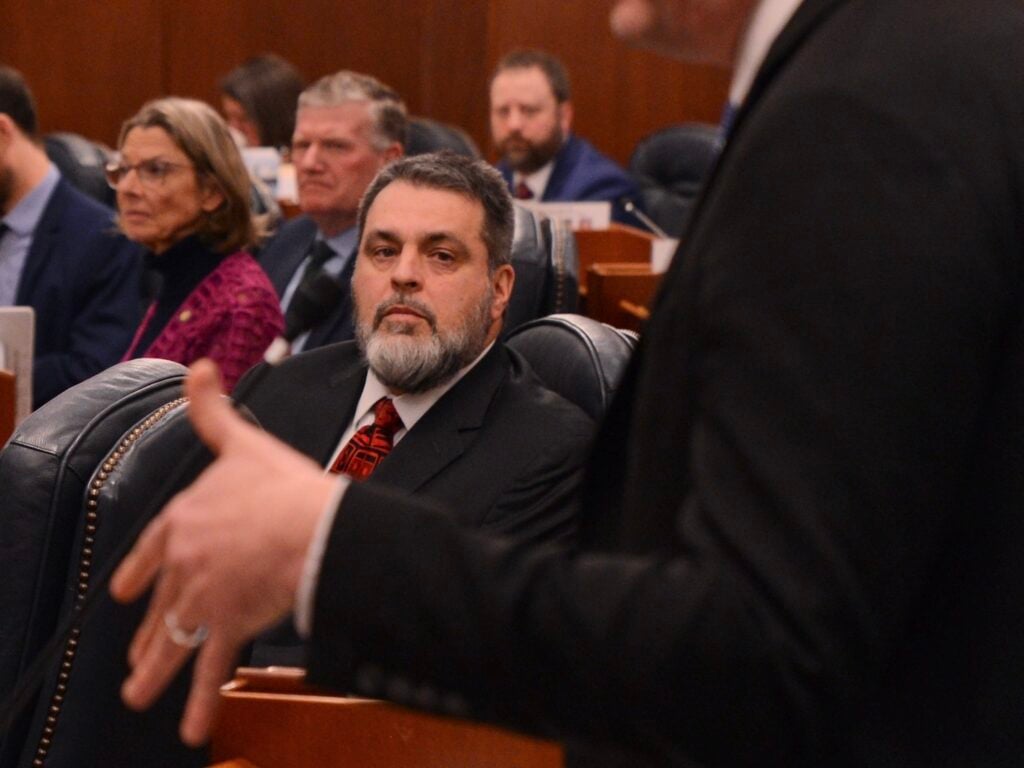
The 14 members of Alaska’s Senate coalition majority met behind closed doors twice on Wednesday to decide the fate of a multibillion-dollar tax break for the proposed trans-Alaska natural gas pipeline.
The state House voted 34-5 on Friday to approve the break, which also has the approval of Gov. Mike Dunleavy and pipeline developer Glenfarne, but the tax break won’t become law unless it also has the approval of the Senate.
For several days, the Senate’s majority has been stymied by an internal rule that requires 11 of the majority’s 14 members to agree on a bill before it is presented to the full Senate.
As of Wednesday afternoon, there were not 11 majority votes for the bill, which would replace a 2% property tax on the project with a tax on gas pumped through the line.
Under current law, the pipeline would generate $47 billion for the state and boroughs along the route through 2062, according to figures from the Alaska Department of Revenue.
The House-passed bill would drop that figure to about $31 billion. The $16 billion difference is the result of the switch from a property tax to a gas tax. The state would still collect production taxes, royalties and other fees.
Lawmakers are also interested in lowering natural gas costs for Alaska residents. If built as planned, the pipeline would provide in-state gas to the Railbelt at a rate cheaper than imports.
In a newsletter, Sen. Loki Tobin, D-Anchorage, became the latest lawmaker to voice opposition to the House’s version of the bill.
“A 90% tax cut for Glenfarne raises concerns that our state and local governments may not have enough funds to support essential services such as sanitation, schools, and roads, which directly impact our communities and families,” she wrote in part, referring to the property tax cut.
Glenfarne has said the bill is critical in order to obtain financing for the Alaska LNG project, which would build an 807-mile pipeline from the North Slope to Cook Inlet and major processing plants at either end of the line.
Senators are considering amendments to the House bill that could ease the bill’s passage in the Senate, but Glenfarne has warned the Senate Finance Committee against making big changes.
“We’re encouraged by the House progress and strong outcome and are optimistic the Senate will pass a bill that works for Alaska by helping enable this project,” said Tim Fitzpatrick, a spokesperson for Glenfarne.
On Wednesday, the Senate majority canceled a scheduled meeting of the full Senate and two scheduled meetings of the Senate Finance Committee, which is considering changes to the bill.
The next meeting of the full Senate is scheduled for 11 a.m. Thursday.
Lawmakers are in a 30-day special session that ends at 11:59 p.m. Friday. If they don’t pass the tax-break bill by that deadline, the bill will die.
Dunleavy could call legislators into another special session, and while the governor’s office declined to say whether he is prepared to do so, the six members of the Senate’s all-Republican minority caucus said they have seen a draft special-session proclamation.
In separate interviews, all six said they support the House version of the bill, with only minor technical fixes needed.
Sen. Robb Myers, R-North Pole, said that while the pipeline isn’t guaranteed to happen if the bill passes, it’s guaranteed to not happen if the bill doesn’t pass.
Sen. George Rauscher, R-Sutton, offered a similar position.
“Glenfarne has to have numbers that work, or they can’t build it. We can ask for anything we want — we can demand all the taxes — but in the end, if it isn’t built, we don’t get anything,” he said.
Senate Minority Leader Mike Cronk, R-Tok, called the majority’s 11-vote rule “pathetic.”
“We should all have the ability to cast a yes or no vote on this,” he said, noting that collectively, the minority’s six members represent more than 180,000 Alaskans.
Cronk said he believes the Senate will ultimately vote on the issue.
“I’m hoping we all get our chance to say yes or no. That’s what Alaskans expect. It shouldn’t be dictated by 11 people,” he said.
Cronk and Sen. Cathy Tilton, R-Wasilla, observed that the Senate Majority already broke its 11-vote rule during the regular session by calling up a pension bill, a medical licensing bill and a bill pertaining to gambling.
Despite Wednesday’s lack of action, Sen. Robert Yundt, R-Wasilla, remained optimistic, saying he believes the Senate will ultimately bring the pipeline issue to a vote.
“A majority of the state depends on natural gas. We’re either going to be using our own or importing, and when all is said and done, I think we’re going to be using our own,” he said.


CBJ- The Municipal Clerk’s Office is currently reviewing petition booklets and signatures submitted for the proposed Mill Rate Cap Change Charter Amendment Petition.
On June 17, the petitioners committee returned petition books containing 2,986 initial signatures. Under the CBJ Charter, 2,566 certified signatures are required for the petition to be certified. Clerk’s Office staff are now verifying signatures and reviewing petition booklets to determine whether the petition meets the certification requirements.
For the latest petition status and related documents, visit the https://juneau.org/clerk/elections or contact the Municipal Clerk’s Office at 907-586-5278 (Option 1).

Save time in your kitchen – without necessarily sacrificing flavor – with these popular new frozen food options that reviewers are praising.

Mashed – Fast Food, Celebrity Chefs, Grocery, Reviews

Reading Time: 2 minutes
As fans continue to process the surprising Jelly Roll-Bunnie Xo split, another troubling detail has emerged from the couple’s difficult month.
Just days before news of his divorce became public, Jelly Roll revealed that he had been hospitalized while on tour with Post Malone.
Fortunately, the medical scare does not appear to have been too serious. But it was enough to force the singer offstage during a concert, something that rarely happens.
In a TikTok video shared on June 11, Jelly Roll — whose real name is Jason DeFord — explained that he spent time in a Charlotte-area hospital after battling a severe sinus infection.
“So, I went to the hospital last night in Charlotte, North Carolina,” the singer told fans.
According to Jelly Roll, the infection left him visibly swollen and struggling to perform.
“I was puffy-faced,” he explained, adding that doctors treated him with steroids before helping him return to the stage.
The singer praised the hospital staff for getting him healthy enough to continue the tour.
He also revealed that Post Malone reached out with an unexpected gesture after learning about his condition.
According to Jelly Roll, his tourmate sent a large bouquet of flowers along with a note wishing him a speedy recovery.
The singer was clearly touched by the act of kindness.
The hospitalization came just one week before news surfaced that Jelly Roll had filed for divorce from Bunnie.
Court documents show that the singer filed in Tennessee on May 18, citing irreconcilable differences. The filing reportedly lists May 9 as the couple’s date of separation.
The split stunned many fans, particularly because the couple was still gushing about their relationship as recently as a few months ago.
In recent months, Jelly Roll and Bunnie had discussed their marriage, their shared faith, and even their plans to expand their family through IVF and surrogacy.
Sources have since claimed that growing lifestyle differences and mounting tensions contributed to the breakup.
Neither Jelly Roll nor Bunnie XO has publicly addressed the divorce filing in detail.
For now, fans are left hoping that both can navigate this painful chapter — and that Jelly Roll’s recent health issues are firmly behind him.
Jelly Roll Says He Was Hospitalized Days Before Bunnie Xo Split News: Why? was originally published on The Hollywood Gossip.
The Hollywood Gossip

Reading Time: 2 minutes
Slowly but surely, she’s coming back out of her shell.
For the past decade, Angelina Jolie’s life has existed under the specter of her miserable split from her miserable ex.
Between the financial cost and the excruciating mental anguish, her career was partially on hiatus.
Now, she’s healing and acting and living again. And she credits her amazing children for encouraging her.
In an interview with Variety, Angelina shared that her “fighting spirit” is back in multiple ways.
She did acknowledge that much of her energy had been “lost for a bit” over the past decade.
“I kind of got taken down a little,” Angelina acknowledged.
That is, perhaps, a bit of an understatement.
Angelina and Brad married in 2014 after roughly a decade together and began divorcing in 2016. Their divorce lasted a full eight years — ending in December 2024.
Notably, Angelina left out some key words — such as “Brad Pitt” and “marriage” and “divorce” — from this statement.
We’re sure that there were both legal and personal reasons behind that omission.
Angelina focused, rather than upon the awful man who turned her life upside down, upon her amazing children.
She shared that her kids have helped her to heal and are “encouraging” her to get her groove back.
Angelina warmly stated that “know me more than anybody, and they still like me, which says a lot.”
In addition to her acting career, Angelina’s role in humanitarian work may be her best known quality.
However, her divorce (and litigation over the chateau where she and Brad tied the knot a dozen years ago) has been expensive.
Additionally, she explained that humanitarian work keeps her away from her kids for too long.
Acting, on the other hand, provides ample pay and allows her to see her children with a freer schedule.
Very soon, the twins will turn 18. Not only will this sever an important legal link with Brad, but it will make her an empty-nester — with more personal freedom of movement.
For years, reports seemed to try to frame the Jolie-Pitt divorce with Jolie as some sort of bitter ex who was maliciously keeping the children from Pitt.
Hey, that does happen. Not in this case, but sure, some divorces have cruel exes who play twisted games with custody, finances, and more.
The reality is that child after child has moved to drop the Pitt name, informally with classmates and peers or formally through court documents.
Knox and Vivienne were born in 2008. Their shared birthday is in mid-July, which will make them both 18.
Right now, it appears that Pitt has successfully alienated all of his children. And he has no one to thank but himself.
Angelina Jolie Reclaims ‘Fighting Spirit’ After Brad Pitt Divorce was originally published on The Hollywood Gossip.
The Hollywood Gossip

For the second time in as many 2026 World Cup games, I expect the USA will have the majority of possession on Friday against Australia. The looks that the team will see, though, will be very different. The way Australia will defend the USA will be very different compared with Paraguay. It will be up to head coach Mauricio Pochettino to make sure his team is flexible in how it can attack the Aussies in Seattle. Here’s what to expect from USA vs. Australia. There will be a similar defensive approach from Australia on Friday, like what the USA saw against Paraguay in its opening game, but it will be slightly different. Paraguay played in more of a mid-block. What does that mean? While the team had plenty of numbers behind the ball, its focus was more on defending the middle of the field. Australia will play a lower block and sit even deeper than Paraguay. The Socceroos will defend in a back five compared with Paraguay’s back four. With that, the Aussies will sit further back and be very content to soak up pressure. I’d expect that there’s only going to be about 20 to 25 yards of space between the Australia defense and its striker. One way to look at that is the cut of grass. Usually, those are about six yards long. Player To Watch Souttar was absolutely immense in Australia’s win over Türkiye. His positioning was flawless, and he won everything in the air. He was very much leading the defensive line as it moved up and down the field and kept the team in very good shape. Given how I expect Australia to play and defend Friday, the player in the center of defense, the anchor, will be crucial. If the Australians are going to get a result and stay strong defensively, it will start with him. I think Australia is going to be harder for the USA to break down than Paraguay was. It’s much more difficult to break down a low block compared to a mid-block, which Paraguay used. Türkiye struggled to create quality chances against Australia, despite having more than 25 shots. There were few clear-cut scoring chances where you’d expect someone to score. For the USA, adapting to how Australia plays and figuring out what works will be crucial. Is it getting the ball wide and swinging crosses into the box? Is it trying to overload Australia in wide areas? Türkiye struggled to adapt and find solutions, so the USA will have to learn from that. I expect that USA head coach Mauricio Pochettino will have training sessions this week that will very much be focused on breaking down a low block. Player To Watch Dest was quietly effective but didn’t get too much attention against Paraguay. That makes sense with Folarin Balogun scoring twice and Christian Pulisic thriving on the left wing during his 45 minutes in the first half. Dest was positionally disciplined against Paraguay. If he maintains that, I think we’ll see a couple more moments of him getting one-on-one opportunities against a defender in wide positions. If Dest is able to attack his defender and beat the first man in front of him, he’ll be able to unbalance the Australian backline. He’ll also be responsible for either putting in good service from the right wing or fighting to find position at the back post if the attack is coming from the left.Latest Sports News from FOX Sports

Wendy’s is known for a few things, like its square burgers and baked potato sides, but there’s also a myth that has floated around for years about its logo.

Food Republic – Restaurants, Reviews, Recipes, Cooking Tips

Janeese Lewis George is on track to become the next mayor of Washington, D.C., after winning the Democratic primary on Thursday.
Lewis George faces no major challenger in November’s general election, putting her on a glide path to take the reins from Mayor Muriel Bowser next year and giving Washington a change in executive leadership for the first time since Bowser took office in January 2015. Her victory will usher in a new era for the district and put her on a collision course with President Donald Trump for the final years of his term.
Earlier Thursday, her opponent Kenyan McDuffie conceded the race and said he had called Lewis George “to congratulate her on her victory.”
In a primary stacked with anti-Trump Democrats, Lewis George presented herself as a candidate unafraid to oppose the president. She has pledged to rescind the order allowing the city’s police to coordinate alongside federal immigration agents and take a hard legal stance against any attempts by Trump to encroach on the District’s autonomy.
Lewis George told POLITICO in an interview last week that she would “actively tell our employees to resist” if Trump again attempted to federalize the Metropolitan Police Department.
Her position is likely to pit the democratic socialist directly against a president who has attempted to tighten his grip on the district, taking extraordinary measures to crack down on crime and cut through bureaucratic red tape to pursue a slate of ambitious beautification and construction projects around the city.
When Trump was asked in the Oval Office about the possibility of Lewis George winning the primary and becoming mayor, he told reporters: “I wouldn’t like it.” “Maybe we’ll take back Washington, run it on a federal basis,” Trump said. “We won’t put up with it. We’re not gonna lose our businesses.”
A third-generation Washingtonian, the 38-year-old Lewis George has represented the district’s 4th Ward on the D.C. Council since 2021. She ran a progressive campaign, promising change from Bowser’s tenure and casting herself as a champion of the working class who would stand up to Trump. Her platform — including universal child care, social housing and public safety reforms — galvanized a coalition of voters that skewed young, white, college-educated and newer to Washington, according to polling.
McDuffie, her main opponent in the race, pitched himself as a more pro-business pragmatist who gained Bowser’s tacit support.
The change in leadership for Washington comes at a time of tumult in the city.
D.C. is facing a $1.1 billion budget gap, which Bowser has argued should be covered by cuts to social services. The Trump administration’s government funding cuts and decimation of the federal workforce hit Washington especially hard — resulting in the greatest number of job losses of any metro region in the country in 2025. And Trump’s moves to wrest control of the city by temporarily taking over the MPD and indefinitely calling on the National Guard to patrol the District’s streets were deeply unpopular among Washingtonians.
Washington is also dependent on the federal government for multiple high-profile projects that have the potential to accelerate a sluggish economy, including upgrades to Union Station and the redevelopment of the RFK Stadium campus. Lewis George told POLITICO that “there are avenues I want to work with this administration,” including those projects — but she also promised to “stand up to anyone who harms our communities or threatens home rule.”
The race between Lewis George and McDuffie — whose base skewed toward voters who are Black, older and lifelong District residents, polls showed — had grown increasingly fraught in its final weeks. Lewis George collected endorsements from several top unions, while McDuffie found support among establishment Democrats, including former Mayors Sharon Pratt and Tony Williams, and former DNC Chair Jaime Harrison.
Lewis George leaned into a campaign focused on affordability, blaming rising prices on Trump and proposing that she would bring down sky-high housing costs by constructing 72,000 new units, compared to McDuffie’s proposed 12,000. McDuffie argued that imposing greater taxes on businesses to pay for more ambitious social programs would drive them away from the district, exacerbating its economic woes.
The candidates also differed on public safety, a marquee issue in light of Trump’s crime crackdown. Lewis George, who was first elected to the Council following the social justice protests of 2020, argued for public safety reform with a holistic approach to crime prevention that includes bolstering community programs and nonpolice response.
Politics