Jelly Roll said that life is ‘about who you do it with’ after his divorce news broke, but Bunnie got even more specific. Continue reading…The Boot – Country Music News, Music Videos and Songs
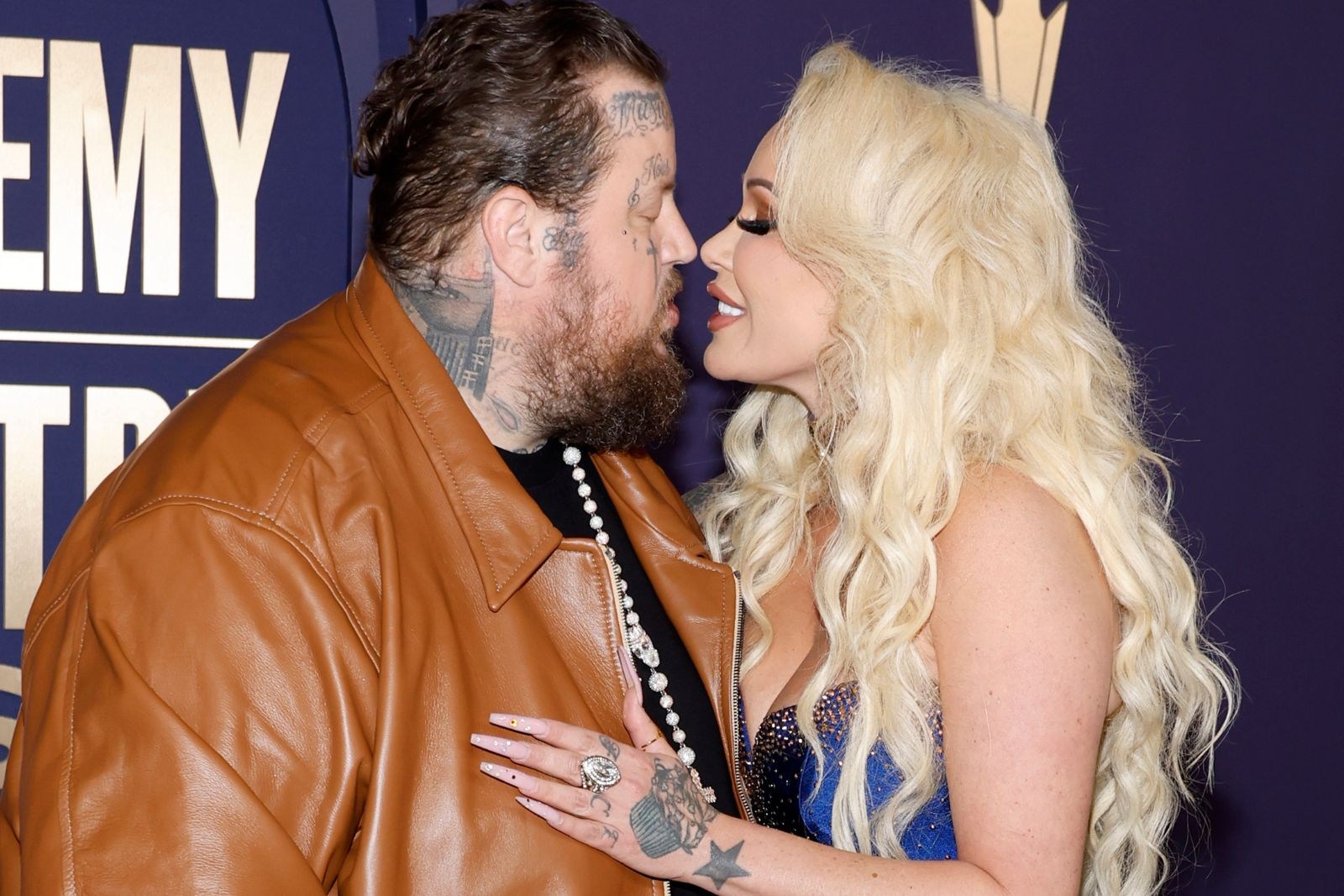








Jelly Roll said that life is ‘about who you do it with’ after his divorce news broke, but Bunnie got even more specific. Continue reading…The Boot – Country Music News, Music Videos and Songs
Jelly Roll said that life is ‘about who you do it with’ after his divorce news broke, but Bunnie got even more specific. Continue reading…Country Music News – Taste of Country

Alaska’s lieutenant governor maintains an office at the state Capitol in Juneau on the same floor as the governor. (Photo by James Brooks for Northern Journal)
An attorney advising the Alaska Legislature said Wednesday that Lt. Gov. Nancy Dahlstrom may have violated the U.S. Constitution when she disqualified Petersburg’s Daniel J. Sullivan from this year’s U.S. Senate race in Alaska.
Rep. Andrew Gray, D-Anchorage and chair of the House Judiciary Committee has scheduled a legislative hearing on Monday to discuss the disqualification.
By email, the Alaska Division of Elections said it will not have someone attend the hearing.
In a memo to Gray, attorney Andrew Dunmire said “the Lieutenant Governor was likely not legally justified in her decision to reject Mr. Sullivan’s declaration of candidacy.”
Dan J. Sullivan of Petersburg has the same first and last name as incumbent Sen. Dan S. Sullivan.
The Alaska Republican Party filed two complaints against the Petersburg Sullivan, saying his candidacy was merely intended to confuse voters and he was not acting as a candidate in good faith.
Alaska Division of Elections disqualifies challenger to U.S. Sen. Dan Sullivan with same name
Dahlstrom ultimately agreed with those complaints and disqualified Dan. J. Sullivan under a state regulation that forbids the Division of Elections from listing a candidate’s name “in a manner that is confusing or misleading to voters or compromises the fairness or neutrality of the ballot.”
Dunmire, analyzing the situation, said Dahlstrom was incorrect because state regulations cannot trump the U.S. Constitution’s requirements for candidates.
“As a general matter, the U.S. Constitution is supreme in all areas of law, and an administrative regulation cannot override or contravene a constitutional requirement. Therefore, if Daniel J. Sullivan is constitutionally entitled to be recognized as a candidate for U.S. Senate, then no regulation can prevent him from appearing on the ballot,” Dunmire wrote.
Amber Lee, a consultant working with Dan J. Sullivan, said by text message on Wednesday that the Petersburg Sullivan is still deciding what he will do after the lieutenant governor’s decision.
SUBSCRIBE: GET THE MORNING HEADLINES DELIVERED TO YOUR INBOX.
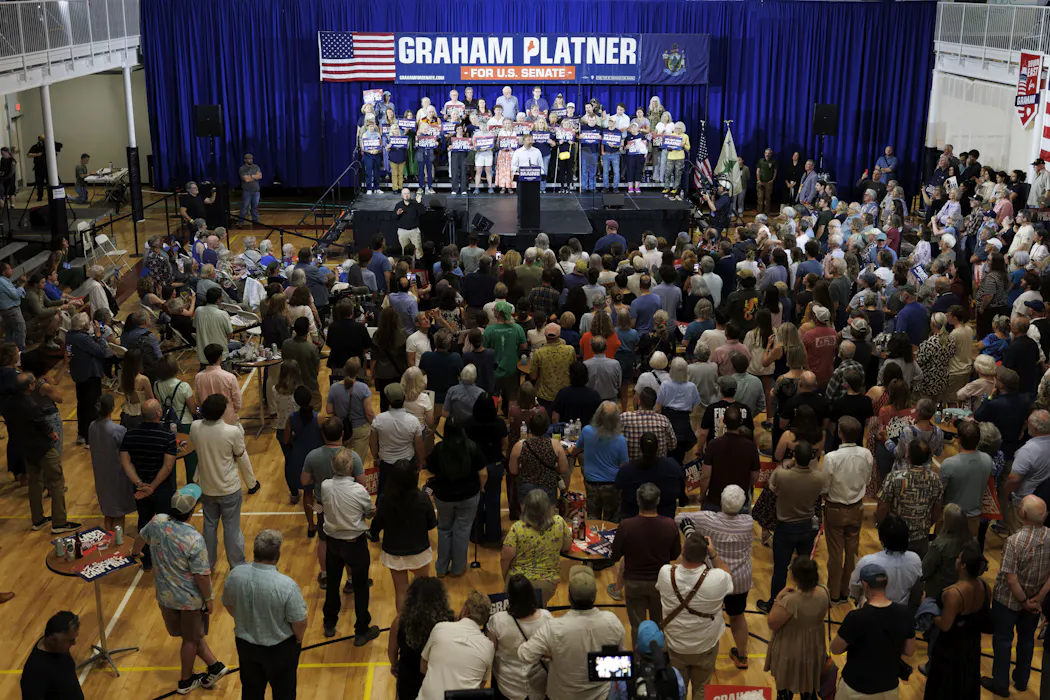
Every election cycle sees its share of controversial, scandal-plagued candidates running for office. But the 2026 midterm elections will feature two such candidates – one from each party – in two of the highest-profile U.S. Senate races.
In Texas, the state’s attorney general, Ken Paxton, recently secured the Republican Party’s nomination over incumbent Sen. John Cornyn.
Cornyn and others have insisted that Paxton’s substantial legal and personal baggage – including corruption and bribery accusations that got him impeached by the GOP-led state House of Representatives – might lose Republicans a seat they’ve held for decades.
Democrats in Maine, meanwhile, have nominated Graham Platner, a political novice whose grassroots campaign and brash communication style propelled him to a decisive victory over the state’s Democratic governor, Janet Mills, who remained on the ballot but suspended her campaign in April.
This, despite Platner facing a series of personal scandals ranging from alleged sexual misconduct to a tattoo that turned out to be an emblem of Hitler’s paramilitary Schutzstaffel, or SS. Platner has claimed he was unaware of the symbol’s origins and has since covered it up.
Both Paxton and Platner won resounding victories in their primaries over more establishment candidates who were comparatively free of scandal.
As a scholar who studies Congress and elections, and the co-host of a podcast about political scandals, I believe political science offers answers about how Paxton and Platner pulled off victories in their states’ primaries – and why they might win in November.
Both Paxton’s and Platner’s flaws were well known prior to primary voting.
Early polling indicates that most of Texas’ Republican voters are likely to back Paxton in November. Polling also shows that Platner will continue to consolidate his party’s support in Maine.
Both parties’ leadership in Congress and beyond have also rallied behind their respective candidates. And both parties have used the opposing candidate’s scandals against them in the campaign, despite propping up flawed candidates themselves.
These actions can coexist thanks to two forces that political science has much to say about, precepts that have been steadily increasing in relevance over the past few decades: party polarization – or the distance between the two parties – and negative partisanship, voters’ tendency to vote based on negative feelings toward the other party.

Democrats and Republicans are far away from each other on policy preferences, issue positions and culture. They are also distant in terms of where they live, whom they support, how they feel and even whom they love.
Political science tells us that this polarized distance has increased feelings of personal animus between members of the two parties. Political psychology says the more different Americans are from each other, the easier it is for them to not just disagree with the other side but to dislike the other side to the point of viewing them as a threat.
These are trends Americans frequently see reflected in public opinion studies, many of which use the “feeling thermometer” to ask respondents to rate their personal feelings toward a person or party on a scale of zero degrees, or coldest/most unfavorable, to 100 degrees, or warmest/most favorable.
In the late 1970s, the average voter in each party was more or less neutral toward the opposing party, with scores hovering just below 50 degrees. By 2024, the average voter sentiment toward the other party had plummeted to 19 degrees.
In 1978, only 9% of Democrats and 7% of Republicans had a very negative opinion of the opposing party. By 2024, vast majorities in both parties – 64% apiece – reported such negative opinions.
Political science also tells us that these negative feelings about the other party are not simply prevalent. They are the driving force behind many voters’ election choices.
In other words, Americans are increasingly making voting decisions based not on who should win elections but rather on who shouldn’t. The opposing party is not just the less preferred option – it’s a threat that must be stopped at all costs.
When feelings about the other side are this negatively polarized, then winning – even with a less-than-ideal candidate as your standard-bearer – becomes more crucial than ever.
In fact, researchers have found that scandals involving candidates in a voter’s own party trigger a “defensive partisanship” that increases their hostility toward the other side. That is, scandals in a voter’s own party can make them more – not less – loyal to their team.
Polarization and negative partisanship are not the only factors at work. The tight competition for control over major political institutions such as Congress and the presidency have raised the stakes of elections higher than ever. And, in the process, it has lowered standards for whom Americans are willing to support.
In her 2016 book, “Insecure Majorities,” political scientist Frances Lee found that partisan control over the federal government is more in question now that it has been in over a century. Lee says that closely fought elections that determine control of government help explain changing governing strategies in Congress.
But Lee’s findings also help explain our choices in elections and how – even in closely fought, high-profile races such as the 2026 Senate contests in Texas and Maine – voters end up nominating such blemished candidates.
In theory, closely fought competition should drive a “race to the top” in terms of candidate selection. Because control over institutions rests constantly on a knife’s edge, Americans might expect both sides to put forward their best, brightest and most electorally compelling candidates to try to win.
But thanks to polarization and negative partisanship, it isn’t always so. Instead, hard-fought elections among a closely divided electorate mean that individual votes matter more; that power hangs by a thread; and as a result, that one’s personal and political enemies are inches away from controlling the government.
Thus, closely divided elections only raise the stakes of one’s vote, along with the cost of defecting from your party’s candidate, however flawed they might be.
Voters constantly report feeling the need to “hold their noses” and vote for the “lesser of two evils.” The alternative – the other party taking power – is too grave to permit a truly principled stand. As a result, the race to the bottom continues, because the other side will always be worse.
These trends can help explain why, for example, Republicans circled the wagons around Donald Trump in 2016 despite his many scandals and serious misgivings within the party. They also illustrate why Democrats rallied around Joe Biden well into 2024, even as serious questions were raised about his physical age and mental fitness for office.
Whether Paxton’s or Platner’s partisan voters end up coalescing around them despite their scandals remains to be seen. Regardless, the reappearance of such imperfect candidates each cycle tells a bitter story about what voters will put up with to win.

Charlie Hunt does not work for, consult, own shares in or receive funding from any company or organization that would benefit from this article, and has disclosed no relevant affiliations beyond their academic appointment.
Politics + Society – The Conversation
As the race to build data centers across the United States accelerates, local governments worry that the tech industry mantra of “move fast and break things” means their communities are at risk of being broken.
I’m a Harvard researcher studying the relationship between data centers and energy. I’ve closely monitored how local governments respond to proposals or even just concerns about the potential for data centers in their communities. What I’ve found is a complex story of community needs, political tensions and corporate power – all interacting with local, state and national democratic processes.
Technology companies stay competitive by being ready to provide data and communications services even before customer demand rises. Data centers already power online communications, shopping and banking systems. Now, expanding demand for artificial intelligence has led to over 1,000 pending data center proposals across the country.
Federal actions also drive development. The Trump administration has identified data center build-out as a strategic priority. The administration has promoted data center capacity as a measure of American strength and signaled that federal regulations on data centers may be eased.
At the community level, technology companies claim that data centers bring jobs, economic revitalization, digital connectivity and economic growth to local communities.
So far, however, data centers’ benefits are overshadowed by more visible harms.
Nearby residents experience higher air pollution and excess noise. Data processing also uses a lot of water to cool the buildings and their equipment.

Simultaneously, electricity prices continue to outpace inflation, burdening families across the country. These trends reflect, in part, the costly infrastructure investments needed to power data centers.
My research has found that local governments across the U.S. are trying to avoid or reduce these harms.
Some counties and cities that don’t have specific zoning rules and regulations for data center development are using short-term moratoriums. These pauses in data center permitting and construction give communities time to consider how to define new laws and regulations about the facilities’ location, electricity use, water conservation and noise buffering.
Speaking about his town’s decision to impose a one-year data center moratorium, Rick Bella, the town council president in Merrillville, Indiana, about 40 miles southeast of Chicago, stressed a desire to “evaluate real-world impacts and learn from a project developing right next door before determining what may or may not be appropriate for Merrillville.”
Other places want to block data centers altogether. In April 2026, for example, the Ypsilanti Community Utilities Authority near Detroit, Michigan, passed a yearlong halt to the “delivery, commitment, reservation, extension, or approval of water and sewer services” for data centers. The move blocks data centers, including one under development by the University of Michigan and Los Alamos National Laboratory, from getting the water they need to operate.
Separately, towns across Ohio, Wisconsin, Maryland, Nevada and California have put questions related to data centers on their local ballots. Through these referendums, voters can weigh in on construction bans, tax incentives and zoning ordinances.

While public attitudes around data centers have remained largely nonpartisan, local and state officials don’t always see eye to eye.
Officials in Hood County, Texas, for example, rejected a proposal for a six-month moratorium after a state senator urged the Texas attorney general to intervene and prevent the measure.
In 2025, West Virginia passed a bill that reduces local governments’ zoning and regulatory powers in relation to data centers and microgrids. A similar bill in New Hampshire’s legislature was defeated in May 2026.
Tech companies are also flexing their legal and financial muscles. For example, data center developers sued Saline Township, Michigan, and Chatham County, North Carolina, seeking to overturn their local zoning decisions, to be able to proceed with data center construction.
Local pushback comes at a pivotal moment for artificial intelligence technology itself.
As seen in objections to the internet’s expanding AI “slop,” backlash over AI-generated Super Bowl ads, worries about an AI-related financial bubble and complaints about Google’s pivot to AI-directed search, Americans are reckoning with AI’s role in society.
Further, many people are questioning the role of technology broadly. Increasing numbers of teens and adults are addicted to their smartphones, emotionally and psychologically dependent on their availability. Parents and teachers are questioning the usefulness of various types of digital technologies in classrooms. Even the pope has warned that technology must serve humanity – and not the other way around.
Americans are responding to this moment through the power of their voices and votes.

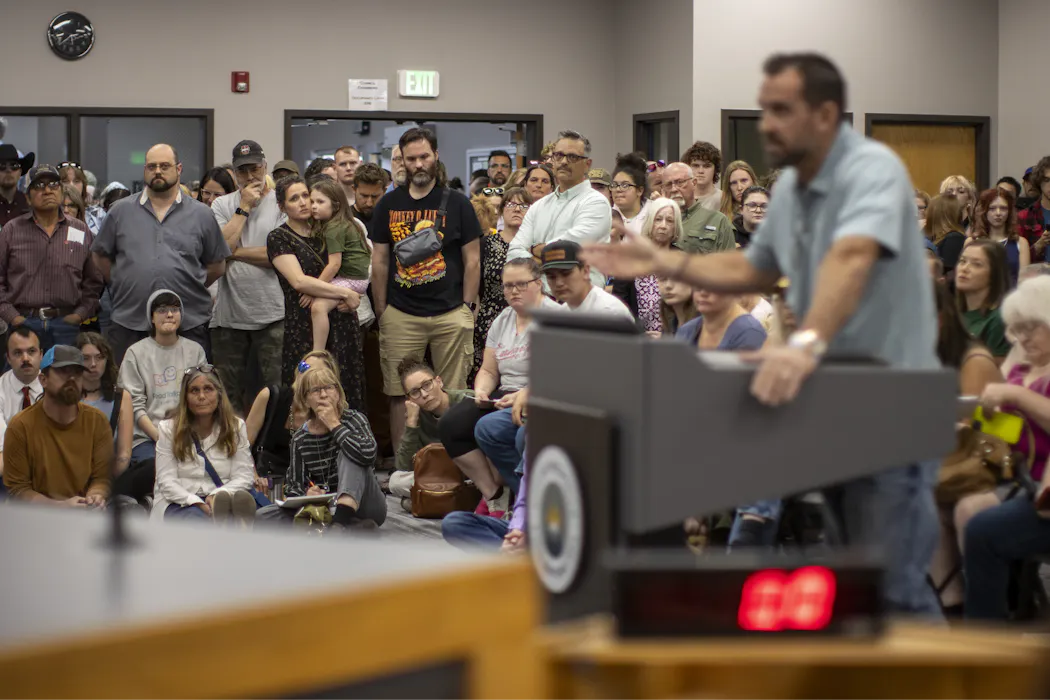
Technology companies may view moratoriums and new regulations as delays in project development. But the town hall discussions, community coalitions, public petitions and even farmers’ unions reflect American democracy at work.
In Sunbury, Ohio, local officials considered a moratorium only after witnessing the scope of public protest over a proposed data center.
In April 2026, voters in Festus, Missouri, removed several City Council members after they supported a new data center despite resident pushback.
The question of whether a community wants or should have a data center does not have a universal answer. I believe it’s a question that deserves deliberate processes, transparency and consideration.
To me, these local-level actions reflect a desire to slow down. There is little question that data centers and AI will be part of our collective future. Today, communities are asking for a fair say in what their futures will be.

Rachel Mural does not work for, consult, own shares in or receive funding from any company or organization that would benefit from this article, and has disclosed no relevant affiliations beyond their academic appointment.
Politics + Society – The Conversation

Princess Diana used to have a bad hygiene habit that would kick in during times of extreme stress or anxiety — one that she was reportedly happy to overcome.

Health Digest – Health News, Wellness, Expert Insights

Opting for wine over a shot of liquor seems like the conservative move, but that depends on how many glasses you drink of either one. This is how they compare.

Mashed – Fast Food, Celebrity Chefs, Grocery, Reviews

Whether it’s to benefit the customer or to keep the company nimble for future growth, Culver’s has made some major modifications over the years.

Mashed – Fast Food, Celebrity Chefs, Grocery, Reviews

If you’ve ever seen the fork and wine glass symbol on a kitchen item, like a plate or glass, you might have wondered just what it meant. We’ve got the answer.

Food Republic – Restaurants, Reviews, Recipes, Cooking Tips

You may have heard about the benefits of a Japanese diet, but what makes it healthy? This is what the numbers say and how you can eat like you’re from Japan.

Mashed – Fast Food, Celebrity Chefs, Grocery, Reviews