 Lamar Odom didn’t take Khloe Kardashian’s words lightly.
After The Kardashians star slammed the former NBA player for downplaying her role following his drug overdose, a source close to Lamar…
E! Online (US) – Top Stories









Lamar Odom didn’t take Khloe Kardashian’s words lightly.
After The Kardashians star slammed the former NBA player for downplaying her role following his drug overdose, a source close to Lamar…
E! Online (US) – Top Stories

Sure, we’re biased, but this was television gold. Continue reading…Country Music News – Taste of Country

Ty Gibbs won his first Cup race in his 131st start. Many would have thought it would be sooner, but it’s not rare for a driver to need around 100 starts to earn his first win. Of the 26 full-time Cup drivers who have a win, their average first career win came in their 91st start. There are 10 full-time drivers in Cup who don’t have a win. Only one has fewer than 50 starts and that’s Connor Zilisch. And yet, when looking at the drivers who might get their first career Cup win, he’s near the top of the list. But he’s not at the top. Here’s how I’d rank the drivers who haven’t won and their chances to get their first Cup win this season. 10. Cody Ware (150 starts)Rick Ware Racing No. 51 Chevrolet With one career top-five finish and four consecutive finishes of 31st or worse, Ware’s focus isn’t on winning as much as trying to improve performance. 9. Ty Dillon (289 starts)Kaulig Racing No. 10 Chevrolet With no manufacturer support in Cup, it would take an amazing set of circumstances for Dillon to win a race. He has two career top fives and like Nemechek, he’s looking for his first top-15 finish of the season. 8. John Hunter Nemechek (121 starts)Legacy Motorsports No. 42 Toyota Nemechek has two career top-five finishes but more importantly, for these rankings, the Legacy organization is struggling. Nemechek hasn’t cracked the top 15 this year. 7. Noah Gragson (119 starts)Front Row Motorsports No. 4 Ford Gragson has three career top fives and if he was out front at the end of a drafting-style race, he’d have a shot to win. But he’s still looking for his first top 10 of the season. 6. Todd Gilliland (152 starts)Front Row Motorsports No. 34 Ford Gilliland might have snapped out of a slump with a sixth-place finish at Bristol. He has two career top-five finishes. He’d still be a long shot to win any race. 5. Riley Herbst (52 starts)23XI Racing No. 35 Toyota Herbst doesn’t have a top-five finish in his career, but he is driving arguably the best equipment of any driver on this list. And it did appear he had a shot (albeit a long shot) to win the Daytona 500. 4. Zane Smith (89 starts)Front Row Motorsports No. 38 Ford Smith has shown flashes of brilliance and has consistently performed the best among the Front Row cars. He has three career top-five finishes. 3. Connor Zilisch (11 starts)Trackhouse Racing No. 88 Chevrolet Zilisch will be a threat on the road courses. And he certainly knows how to win; he had 10 victories last year in what is now the O’Reilly Series. He showed he could still win at Bristol when he won the race in that series the day prior to the Cup event. But overall, Trackhouse appears to be a step behind this year and Zilisch’s best career Cup finish is 11th. 2. Ryan Preece (231 starts)RFK Racing No. 60 Ford Preece won the Clash at Bowman Gray and if there were more tracks like that on the schedule, he’d be first on this list. He’s running well, but his teammates (Brad Keselowski and Chris Buescher) are, too. And if his organization lands on something at the intermediate or superspeedways, he’s going to have to beat two solid drivers to capture the victory. But with his experience (Preece has seven career top-five finishes), he is the most likely to capitalize on a potential winning moment than any driver on this list. 1. Carson Hocevar (89 starts)Spire Motorsports No. 77 Chevrolet Hocevar and Preece are tied for the most points this year for a driver who has never won a Cup race. If there were more short tracks on the schedule coming up, Preece might be here, but Hocevar appears to have the potential to run closer to the front at more styles of tracks. He has five career top-five finishes. In Second Thoughts, Bob Pockrass offers his opinion on a burning motorsports topic.Latest Sports News from FOX Sports

Monday, April 6
Caller on PIedad Road reported a stolen car battery. An officer responded.
A caller on Deishu Drive reported a person trespassing on their property. Officers responded.
Tuesday, April 7
A caller on the 800 block of Main Street reported a moose in the area.
A caller in the 400 block of Main Street reported a verbal altercation. An officer was advised.
Wednesday, April 8
A caller on Third Avenue at Main Street left an item description for a lost wallet and contact information with dispatch.
A Haines police officer placed a 72-hour notice sticker on a vehicle in the 600 block of the Haines Highway.
Thursday, April 9
A caller on Mud Bay Road turned in a pair of prescription glasses they found.
A driver on Tower Road received a verbal warning for speeding.
A driver at Second Avenue at Mission Street received a verbal warning for failure to stop at a stop sign and not meeting turn signal requirements.
Friday, April 10
A caller on Small Tracts Road reported a utility cover in the roadway. An officer responded and replaced the cover.
A property owner on Second Avenue reported an accidental alarm activation.
A caller left information about his lost keys and contact information with the dispatcher.
A driver received a verbal warning for basic speeding at 1.5 mile of the Haines Highway.
A driver received a citation for speeding on the Haines Highway.
A caller reported a vehicle struck an animal on Deishu Drive. The fire department responded.
A driver received a verbal warning for license plate display requirements on the Haines Highway at Second Avenue.
A driver received a verbal warning for failure to stop at a stop sign on Mud Bay Road.
Saturday, April 11
A caller reported almost getting hit by a speeding vehicle on the Haines Highway near Second Avenue. Officers responded.
A caller turned into dispatch a debit card they found on Second Avenue.
A caller reported leaving their vehicle in a parking lot because it would not start. Caller reported that they’d pick up their vehicle in the 50 blok of the Haines Highway later.
A driver in the 50 block of the Haines Highway was ticketed for not having proof of insurance.
A driver received a verbal warning for speeding in the 30 block of Blacksmith Road.
An officer saw an open door in the 300 block of First Avenue. He closed it and the homeowner was notified.
A driver was given a verbal warning for failing to meet headlight requirements at Mile 1 of the Haines Highway.
There were 3 9-11 hangup calls, 12 EMS calls and 17 burn permits issued during this reporting period.
The post Blotter: April 6 – April 11 appeared first on Chilkat Valley News.

By: Yereth Rosen, Alaska Beacon

Two weeks after the Trump administration announced a U.S. Forest Service “restructuring” that would close regional offices and most of the agency’s research facilities, impacts to Alaska – home to the two largest U.S. national forests – remain unclear.
The U.S. Department of Agriculture announced on March 31 that the Forest Service’s national headquarters will move to Utah and that many of its facilities will be shuttered. Among the facilities on the closure list were two that are important to Alaska: the and the Oregon-based in Portland.
But other impacts on the 17-million-acre Tongass National Forest and the 5.4-million-acre Chugach National Forest were not disclosed.
A statement from the Forest Service headquarters provided few details about the Tongass, the Chugach or the visitor and recreational facilities located in either forest.
“The transition will occur in phases. Employees will receive clear information about relocation timelines, available options, and resources to support their decisions,” the statement said. “The number of relocations beyond those already identified in the National Capital Region is unknown at this time.”
U.S. Agriculture Department Secretary Brooke Rollins, whose department oversees the Forest Service, outlined the restructuring plan last year. In a July 24, 2025, memo, she said the plan included the replacement of the Alaska regional office with “a reduced state office in Juneau.” The state capital is currently the site of the Alaska regional office managing both the Tongass and the Chugach.

Alaska has Forest Service facilities throughout the Tongass and Chugach regions, from the southern tip of the Southeast to Anchorage.
Sen. Lisa Murkowski, R-Alaska, is also trying to learn about impacts to Alaska, a spokesperson said.
The senator and her staff are in a “fact-finding” mode and preparing to mount a “defense of the Forest Service in Alaska and make sure the employees are able to continue the good work that they’re currently doing,” said Murkowski spokesperson Joe Plesha.
The issue is expected to be managed through the Congressional appropriations process, Plesha said.
Murkowski is on the Senate Appropriations Committee and chairs the appropriations subcommittee on the Department of the Interior, Environment and Related Agencies.
The Anchorage lab that is scheduled for closure is located in the Ship Creek district of downtown Anchorage. It supports research in the Tongass National Forest, which is the nation’s largest, and the Chugach National Forest, the second largest. It also supports research on forests elsewhere, from the boreal forests of Interior Alaska to those on tiny tropical Pacific islands like Guam and Micronesia.
The lab is used not just by Forest Service scientists but by other federal agencies, state agencies, Native corporations, University of Alaska researchers and private industry, according to its website.

Up to now, the lab has had a year-round staff of about 22 scientists and administrative workers, but the numbers increase during summer field seasons.
The planned closure of the century-old Pacific Northwest Research Station in Oregon is part of a consolidation of research functions into a single site in Fort Collins, Colorado.
The Pacific Northwest facility, with about 250 employees, has an affiliated lab in Juneau. The fate of the Juneau lab remains unknown.
Among the Alaska projects undertaken by the Pacific Northwest Research station, sometimes with partner organizations, is study of the decline of yellow cedar in the Tongass and adjacent regions in the southeastern part of the state; the status of birds and rare plants in the Tongass; the study of rural Alaskans’ access to wild foods in the Chugach National Forest and the surrounding region; and the monitoring of human recreation’s impacts on brown bears.
The Forest Service closure plans follow deep cuts already made by the Trump administration’s Department of Government Efficiency, or DOGE. In the first half of 2025, the Forest Service lost 5,860 of its 35,550 employees, according to a Dec. 17, 2025, report by the Agriculture Department’s inspector general.
That includes losses in Alaska. As of January, Alaska’s Forest Service workforce was down to 467 from the total of about 700 before the DOGE-imposed cuts began, KTOO reported in January.

NOTN- The City and Borough of Juneau is moving to terminate its revenue sharing agreement with Goldbelt, as discussed at a Committee of the Whole work session Monday night, over the proposed gondola project at Eaglecrest.
Mayor Beth Weldon said the Assembly’s Committee of the Whole voted to end the existing Revenue Sharing Agreement (RSA) with Goldbelt, citing mounting interest costs and concerns over the city’s fund balance.
At Monday night’s meeting City Manager Katie Koester introduced the Gondola issue, saying, “We have a 99% designed gondola, and all the parts and pieces for this mountain, and marketing that to an outside investor is certainly something that this body has expressed interest in. As a reminder repayment on May 1 is a little over $12 million. We have about $3.3 million left in the project account. However, there’s lots of moving pieces and encumbrances, and I’d like to leave at least, you know, half a million dollars in that account to cover some of those.”
“Goldbelt still wants to negotiate, but in the meantime, the revenue sharing agreement that we have keeps collecting interest, so we moved an ordinance to terminate the RSA with Goldbelt forward to the full assembly, accompanied by an appropriate ordinance for 9.5 million from fund balance and 2.7 million in the remaining gondola project. So we’re going to terminate the RSA agreement, but that doesn’t mean that we still won’t negotiate with Goldbelt or another entity to move forward.” Weldon said.
The city is advancing an ordinance to appropriate $9.5 million from its fund balance and $2.7 million from remaining gondola project funds. Those dollars would be used to satisfy the city’s obligations under the RSA.
“There was quite a bit of conversation that this will take our fund balance down considerably, but we have yet to do all of our work, and so we’re working on trying to put stuff back in the fund balance, and we have a ways to go.” She said.
The refund to Goldbelt could go out soon after the Assembly’s next regular meeting, Weldon said. “it will come in our next assembly meeting, if that passes, it will go through.” She added.
Weldon said she has already submitted budget-cutting ideas to help replenish reserves, though it will be up to the Assembly to decide what to adopt.
The gondola was one of three major financial and development topics discussed at the Assembly Committee of the Whole work session, alongside Telephone Hill development and child care funding.

“Being president’s a tough job,” Cyrus reflects. “I pray for our country, I pray for our president and I pray for our world.” Continue reading…Country Music News – Taste of Country

Reading Time: 2 minutes
Just because Farrah Abraham’s daughter is homeschooled, that doesn’t mean she can’t get invited to prom.
Yes, a human child was educated by Farrah Abraham, but try to put those horrors out of your mind, so we can focus on the prom aspect of this story.
Sophia marked a major milestone this week, and she did it while rocking her signature style.
She showed off her look in an Instagram post in which she thanked her mom for helping make prom night memorable.
“Thank you so much mother for making this prom such an amazing, fun experience,” Sophia wrote (via Page Six).
“I’m so grateful for my beautiful, caring friends for making this very memorable night so fun. I had a blast, although as a homeschooled person i did expect prom to be a little more than just people watching with a side of dance floor.”
Farrah’s always had expensive taste, so we shouldn’t be surprised that Sophia rocked Dolce & Gabbana.
Not to be outdone as a poster, Farrah also penned a lengthy tribute to the occasion.
“The journey of being a present parent for @sophialabraham 2026 Prom was fun! Unexpected since she’s home schooled & much different then my prom ( in my book),” Farrah wrote, adding:
“I’m very proud of Sophia & the ladies in her group (no new friends & no broke boys) just being the Queens of value you are! Being you is enough.”
Warning teenagers about the dangers of “new friends” and “broke boys” probably isn’t the greatest thing, but if you made a list of Farrah’s biggest parenting fails, it wouldn’t even crack the top 1,000.
“As a teen mom to give Sophia ‘the prom experience’ (better then I had & more fun then the actual prom ), dress shopping, beauty prep days, shoe shopping, nails, limo, the best prom slumber party Lux 2 bedroom suite, best dinner view, pictures, and Support means the world,” Farah continued, adding:

“Sheers and excited for young adulthood it’s here — LFG!”
Yes, even in the age of AI, Farrah is still posting her semi-coherent word salads on social media.
We respect it, but she might be the one person who actually should use a bot to write her posts.
Like Sophia’s permanent fangs, her goth prom look received quite a bit of criticism on Instagram, but when you grow up as Farrah Abraham’s daughter, we’re sure you grow accustomed to the haters at a young age.
But that doesn’t mean it’s okay for strangers to bash a teenage girl.
We should all be saving our criticism for people who actually deserve it — like Farrah.
Farrah Abraham’s Daughter Sophia Rocks Expensive Goth Look for Prom, Divides … was originally published on The Hollywood Gossip.
The Hollywood Gossip
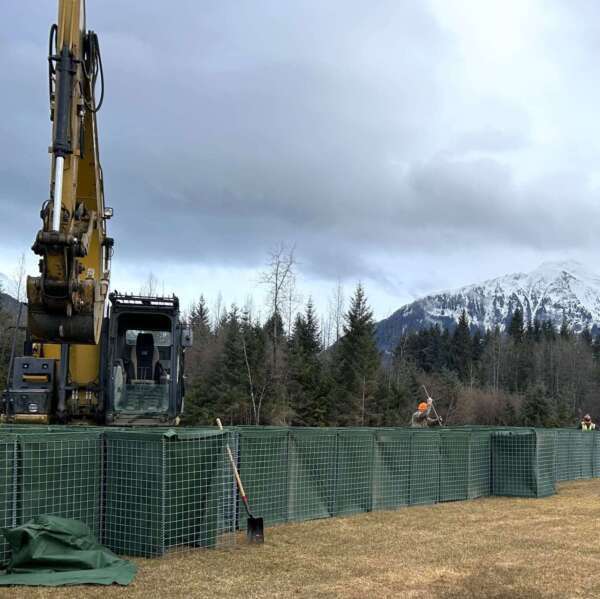
CBJ- As the snow melts, City and Borough of Juneau (CBJ) crews and contractors are now moving quickly to repair, raise and reconstruct the Phase 1 HESCO barrier project ahead of a 2026 glacial lake outburst flood (GLOF) event.
CBJ’s Engineering and Public Works department has spent months documenting damage, analyzing impacts and vulnerabilities, and utilizing the latest available hydrologic and hydraulic modeling to develop plans for the reconstruction of existing Phase 1 HESCO barriers. The CBJ Assembly has identified GLOF response, mitigation & preparedness as a top priority. The goal of this ongoing work, done in coordination with the U.S. Army Corps of Engineers (USACE), is to ensure that these flood fighting projects provide as much protection as practicable until a longer-term solution is in place.
The project includes additional bank armoring and raising HESCO barriers to protect Mendenhall Valley residents from future floods up to 90,000 cubic feet per second or approximately a 20-foot lake stage flood. A map showing planned reinforcements and raising of Phase 1 is available at juneau.org.
“The HESCO barriers proved their value in 2025, but we had some close calls, we’ve learned a lot, and we aren’t taking any chances in 2026,” explains CBJ City Manager, Katie Koester. “By doing this major reconstruction work in 2026, we can have confidence in the protection of the HESCO barriers against larger flood events, with less future disruption to residents and lower annual maintenance costs to the community.”
The 90,000 CFS flow rate represents a 50-year GLOF event and is the number the USACE is using in their evaluation of mid-term flood fighting solutions for Juneau. Constructing to the 50-year event now, instead of annual incremental increases, will reduce future annual costs and minimize annual disruption to property owners. The “50-year event” is a probability-based number that represents the comparatively higher likelihood that a flood of 90,000 CFS may occur. Based on projections, it is possible that the Mendenhall River could experience a 90,000 CFS (20 ft) event within the operational life of the HESCO barriers.
The 2026 Phase 1 reconstruction and fortification will not impact the Local Improvement District (LID) assessments for the original Phase 1 construction. This year’s project is a separate scope that is fully funded by CBJ funding and Alaska Department of Conservation State Revolving Loan funds. CBJ and agency partners are also actively seeking grant funding to support this project.
CBJ project managers have and will continue to coordinate directly with property owners and impacted residents along the Phase 1 and Phase 2 project areas. More information about flood fighting, flood emergency preparedness and the pursuit of an enduring solution is available at bit.ly/CBJGLOF.
In addition to barrier reinforcement and fortification, CBJ is making improvements to drainage and stormwater management in the area. CBJ is coordinating with USACE to acquire over 40 industrial-grade pumps to deploy to strategic staging locations based on anticipated water intrusion risks. These pumps will be deployed to serve the community as a whole rather than individual properties. Importantly, they can operate for up to 24 hours do not require refueling during an event, allowing both staff and residents to safely evacuate inundation areas.
Phase 2 HESCO Barriers
USACE – Alaska District, in partnership with CBJ, began the first phases of the Phase 2 HESCO barrier project installation along the Mendenhall River last month. USACE contractor Sealaska Constructors is leading the work. The Advance Measures scope includes riverbank armoring and installation of temporary (HESCO) flood barriers to construct a fortified, complete temporary flood barrier along the unprotected, populated riverbank areas of the Mendenhall River – referred to as Phase 2 – prior to July 15, 2026. For questions about the Phase 2 HESCO Barrier Project, please contact public.affairs3@usace.army.mil.
Safety
CBJ and USACE are on a tight timeline to complete construction before the next GLOF. We ask that the public avoid the construction area for your safety and the safety of workers, residents and property owners, and to allow for efficient and expedient operations.

Six weeks of U.S. and Israeli bombardment have served to degrade Iran’s nuclear facilities and cripple parts of its military.
But the Islamic Republic’s offensive capabilities have been built up over nearly 50 years, during which Iran has been either at war or under the threat of conflict.
As an expert in military history and theory, I believe that to understand what may come next in Operation Epic Fury, it’s valuable to grasp the development of Iran’s modern military structure, capabilities and international activities.
Prior to the establishment of the Islamic Republic of Iran in 1979, Iran’s military was largely supplied by Western powers, particularly the United States.
It entered the Iran-Iraq war in 1980 with a substantial amount of then-modern equipment. That included nearly 80 F-14 fighter aircraft, over 200 F-4 and F-5 aircraft and thousands of tanks.
But Iran’s military was exhausted when the war ended in 1988. And the government had by then become a world pariah, making resupply all but impossible.
Although Iran imported some military equipment from the Soviet Union and China in 1990, its economy could not support substantial military spending.
Ironically, the arms embargoes that Iran faced during and after its war with Iraq made the regime self-reliant on its weapons stockpiles. And that triggered the development of a substantial domestic arms industry.
Most modern Iranian military equipment consists of reverse-engineered American and Soviet equipment, much of it obsolete. Since 1990, however, Iranian missile technology has substantially improved. That’s due to domestic production and importing expertise from other marginalized states, such as North Korea.

Starting in the 1990s, Iran also innovated a series of one-way attack drones, a relatively inexpensive way to attack distant targets.
The Iranian military is split into the regular military, or “Artesh,” and the Islamic Revolutionary Guard Corps. The Artesh plays a domestic defense role akin to a militia, while the Revolutionary Guard serves as the more professional military force.
The Revolutionary Guard projects regional power. During the 2003 U.S.-Iraq war, for instance, it provided improvised explosive devices to insurgents targeting American forces.
The Revolutionary Guard tends to receive the bulk of Iranian military resources, including the best personnel and equipment. Quds Force, the unconventional warfare wing of the Revolutionary Guard, has long played a role in exporting the revolutionary beliefs of the Iranian rulers. The Quds Force provides arms and guidance to proxies throughout the Middle East, primarily by fomenting insurrections against Arab Sunni governments.
Iran has long been the patron of Hezbollah, based in Lebanon, whose primary goal is the eradication of Israel. More recently, Iran has also engaged in substantial support of Hamas in Gaza, despite the fact that Hamas is a Sunni organization, while the rulers of Iran are members of the Shiite branch of Islam.
Iran has constantly sought means of exerting military influence beyond its borders, without risking external attack. It has embraced the use of cyber warfare, a method of attack with a relatively low cost for participation and a potentially outsized influence on the world stage.
Iranian hackers have attacked Western military and government networks, including a hack of FBI Director Kash Patel’s personal emails. Iranian-backed hackers have also launched attacks on infrastructure and cultural institutions, including U.S. wastewater treatment plants and electrical grids.

Iran’s government has relentlessly pursued nuclear weapons since at least the 1980s.
The Iranian government has always maintained that its nuclear program is to provide power for the developing nation, rather than weaponry. But definitive evidence of uranium enrichment far beyond the requirements of power generation have caused Western states to demand an end to the Iranian nuclear program.
In 2010, cybersecurity researcher Sergey Ulasen discovered an incredibly complex malware program, dubbed Stuxnet, that was created to undermine the Iranian nuclear program by disrupting the function of enrichment centrifuges. No nation has ever taken responsibility for the attack, which set back Iranian uranium enrichment efforts by years.
In 2015, after negotiations with the five permanent members of the U.N. Security Council and Germany, Iran agreed to halt its uranium enrichment program in exchange for relief from economic sanctions and the release of frozen Iranian assets. The negotiations resulted in the Joint Comprehensive Plan of Action, or JCPOA.
Although the Trump administration withdrew the U.S. from the JCPOA in 2018, the agreement continued to function, and Iran seemed poised to reenter the global economy.

However, in 2020 the Iranians restarted their nuclear program. They also ramped up production of ballistic missiles and one-way attack drones.
In June 2025, the United States and Israel launched a massive aerial attack on Iranian nuclear facilities, an effort that Trump characterized as having destroyed Iran’s nuclear facilities.
Iran responded by launching a wave of ballistic missiles and drones toward Israel, most of which were intercepted before entering Israeli airspace.
Prior to Operation Epic Fury, analysts estimated that Iran possessed 3,000 ballistic missiles and tens of thousands of one-way attack drones. They also concluded that Iran had a substantial production capacity to increase its stockpiles.
In the first six weeks of the current conflict, Iran expended at least 650 missiles in attacks on Israel and hundreds more against other targets in the region.
The U.S. has placed a heavy emphasis on attacking missile production and storage facilities. But it’s difficult to ascertain how many missiles and drones the Iranian military might still possess.
Iranian production and transportation has almost certainly sustained substantial losses in capacity. And U.S. and Israeli aircraft prowl the skies over Iran seeking signs of mobile launchers or attempts to transport missiles to firing locations.
The rate of Iranian missile fire has substantially declined since the first days of the conflict, but it has never dropped to zero. That has led some analysts to suspect that Iran maintains a significant cache of long-range weaponry in reserve, while U.S. Secretary of Defense Pete Hegseth argues that it has lost the capacity to launch major barrages.

Paul J. Springer is a Senior Fellow of the Foreign Policy Research Institute. His comments represent his own opinion and do not reflect the official policy of the United States Government, the U.S. Department of Defense, or the U.S. Air Force.
Politics + Society – The Conversation