Categories
Featured Juneau News Juneau Local Ketchikan Local News Feeds Sitka Local

How Alaska’s pivotal Republican senator decided to vote for Donald Trump’s bill

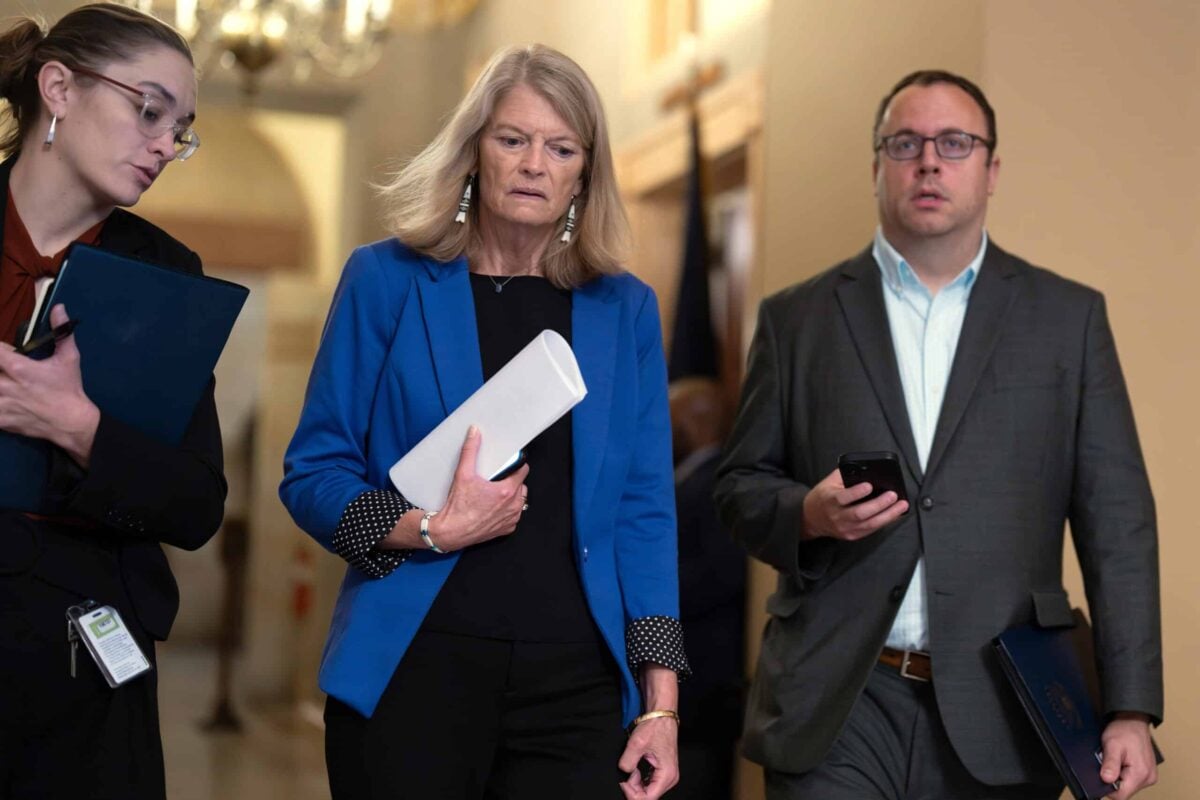
Sen. Lisa Murkowski, R-Alaska, center, a member of the Senate Appropriations Committee, arrives for a closed-door Republican meeting to advance President Donald Trump’s sweeping domestic policy bill, at the Capitol in Washington, Friday, June 27, 2025. (AP Photo/J. Scott Applewhite)

AP- Just after midnight, Alaska Sen. Lisa Murkowski was pacing in a Senate hallway, alone and looking concerned.

It had suddenly become clear to all her Republican colleagues that her vote would be their best chance of passing President Donald Trump’s sweeping bill of tax and spending cuts. Had she decided whether she would support the bill? “No,” Murkowski said, shaking her head and putting her hand up to signal that she didn’t want to answer any questions.

Around 12 hours later, after she had convinced Senate leaders to change the bill to benefit her state and voted for the legislation, ensuring its passage, Murkowski said the last day had been “probably the most difficult and agonizing legislative 24-hour period that I have encountered.”

“And you all know,” she told reporters after the vote at midday Tuesday, “I’ve got a few battle scars underneath me.”

This isn’t Murkowski’s first tough vote

Murkowski has been in the Senate for nearly 23 years, and she has taken a lot of tough votes as a moderate Republican who often breaks with her party. So she knew what she was doing when she managed to leverage the pressure campaign against her into several new programs that benefit her very rural state, including special carveouts for Medicaid and food assistance.

“Lisa can withstand pressure,” said Maine Sen. Susan Collins, a fellow Republican moderate and longtime friend. Collins said she spoke to Murkowski on Monday when she was still undecided, and “I know it was a difficult decision for her, and I also know how much thought she put into it.”

Texas Sen. John Cornyn, R-Texas, who has also served with Murkowski for two decades, was more blunt: “She knows how to use her leverage,” he said.

The 887-page bill narrowly passed by the Senate on Tuesday — and now headed back to the House for possible passage — mentions California three times, Texas twice and New York not at all. But Alaska is in the bill 19 times, from new oil and gas lease sales in the state to tax breaks for Alaska fisheries and whalers to tribal exemptions for work requirements.

Even with all the provisions for Alaska, Murkowski was deeply torn up until the hours just before the vote, when the entire Senate was focused on what she would do — and as Republicans were pressuring her to support the bill and move the party one step closer to giving Trump a win.

She had always supported the bill’s tax cuts and extensions, but she had serious concerns about the repercussions of cutting Medicaid in her state and around the country.

She got much of what she wanted

Murkowski eventually decided to support the legislation in the hours after the Senate parliamentarian approved language to allow several states with the worst error rates in the food stamp program — including Alaska — to put off having to pay a greater portion of the cost of federal benefits, and after Republicans added a $50 billion fund proposed by Collins to help rural hospitals that might otherwise be hurt by Medicaid cuts.

Even with the fund included, Collins was one of three Republicans who voted no on the bill, arguing that the cuts to Medicaid and food stamps would hit her small rural state especially hard. But she said she understands why Murkowski would support it and negotiate special treatment for her state. “The fact is, Alaska is unique from every other state,” Collins said.

Nearly one-third of Alaska’s total population is covered by Medicaid, and the state has long struggled with high health care costs and limited health services in many communities. Most Alaska communities are not connected to the state’s main road system, meaning that many residents, particularly those in small, remote villages, need to fly to a larger city for certain kinds of care. Food security is also a longstanding concern, as the remote nature of many communities means food often is barged or flown in, and options can be limited and expensive.

“I had to look on balance, because the people in my state are the ones that I put first,” Murkowski said immediately after the vote. “We do not have a perfect bill by any stretch of the imagination.”

Some of her colleagues who voted against the bill were critical. “They chose to add more pork and subsidies for Alaska to secure that vote,” said Republican Sen. Rand Paul of Kentucky.

Minnesota Sen. Amy Klobuchar, the top Democrat on the Senate Agriculture Committee, which oversees the food stamp benefits, said that the food stamp provision would incentivize states with the worst oversight, which was the opposite of what Republicans originally intended. The provision would “expand the graft,” Klobuchar said.

Lots of eyes have been on Murkowski

Murkowski, often accompanied by Collins, has been under a microscope for almost every major vote in the Senate in recent years. In February 2021, she joined six other Republicans and all Democrats in voting to convict Trump for inciting the Jan. 6, 2021, attack of his supporters on the Capitol after the House impeached him for a second time. In 2018, she opposed the confirmation of Supreme Court Justice Brett Kavanaugh amid sexual misconduct claims, ultimately voting “present.”

So as Murkowski was wooed for days by Republican leaders and many of her colleagues to vote for the tax and spending cuts package, it was somewhat familiar territory — and an ideal environment for her to win some concessions in favor of her state.

On Monday evening and early Tuesday, Senate Majority Leader John Thune, R-S.D., and Sen. John Barrasso of Wyoming, the No. 2 Senate Republican, spent hours on the Senate floor talking to Murkowski — who was sometimes wrapped in a blanket to stay warm in the frigid chamber. Alaska Sen. Dan Sullivan, a Republican, would sometimes join the group, as did Senate Budget Committee Chairman Lindsey Graham, R-S.C.

As she mulled her vote, Murkowski sorted through drafts of amendments and talked to aides. And despite longstanding criticism of Trump, she communicated with White House officials who made the case that the measure would ultimately be a positive for her state and constituents.

Thune had said for weeks that he would hold a vote as soon as he had 51 senators supporting the legislation. And after days of delays, it became clear Tuesday morning that Murkowski had decided to support it when Thune told senators to come to the floor and scheduled a vote within the hour.

Murkowski, still looking a bit worried, voted “aye.” After the vote, she said: “I haven’t slept in a long, long while now.”
Categories
Featured Juneau News Juneau Local Ketchikan Local News Feeds Sitka Local

Senate Republicans haul Trump’s big bill to passage after a turbulent all-night session

AP- Senate Republicans hauled President Donald Trump’s big tax breaks and spending cuts bill to passage Tuesday on the narrowest of votes, pushing past opposition from Democrats and their own GOP ranks after a turbulent overnight session.

The outcome capped an unusually tense weekend of work at the Capitol, the president’s signature legislative priority teetering on the edge of approval, or collapse.

The difficulty it took for Republicans, who have the majority hold in Congress, to wrestle the bill to this point is not expected to let up. The package now goes back to the House, where Speaker Mike Johnson had warned senators not to deviate too far from what his chamber had already approved. But the Senate did make changes, particularly to Medicaid, risking more problems as they race to finish by Trump’s Fourth of July deadline.

The outcome is a pivotal moment for president and his party, which have been consumed by the 940-page “One Big Beautiful Bill Act,” as it’s formally titled, and invested their political capital in delivering on the GOP’s sweep of power in Washington.

Trump acknowledged it’s “very complicated stuff,” as he departed the White House for Florida.

“I don’t want to go too crazy with cuts,” he said. “I don’t like cuts.”

What started as a routine but laborious day of amendment voting, in a process called vote-a-rama, spiraled into a round-the-clock slog as Republican leaders were buying time to shore up support.

The droning roll calls in the chamber belied the frenzied action to steady the bill. Grim-faced scenes played out on and off the Senate floor, amid exhaustion.

Senate Majority Leader John Thune of South Dakota was desperately reaching for last-minute agreements between those in his party worried the bill’s reductions to Medicaid will leave millions without care, and his most conservative flank, which wants even steeper cuts to hold down deficits ballooning with the tax cuts.

The GOP leaders have no room to spare, with narrow majorities. Thune can lose no more than three Republican senators, and already two — Sen. Thom Tillis of North Carolina, who warned that millions of people will lose access to Medicaid health care, and Sen. Rand Paul of Kentucky, who opposes raising the debt limit by $5 trillion — had indicated opposition.

Attention quickly turned to two key senators, Lisa Murkowski of Alaska and Susan Collins of Maine, who also raised concerns about health care cuts, as well as a loose coalition of four conservative GOP senators pushing for even steeper reductions.

Murkowski in particular became the subject of the GOP leadership’s attention, as they sat beside her for talks. She was huddled intensely for more than an hour in the back of the chamber with others, scribbling notes on papers.

Then all eyes were on Paul after he returned from a visit to Thune’s office with a stunning offer that could win his vote. He had suggested substantially lowering the bill’s increase in the debt ceiling, according to two people familiar with the private meeting and granted anonymity to discuss it.

Senate Democratic Leader Chuck Schumer of New York said “Republicans are in shambles because they know the bill is so unpopular.”

An analysis from the nonpartisan Congressional Budget Office found 11.8 million more Americans would become uninsured by 2034 if the bill became law. The CBO said the package would increase the deficit by nearly $3.3 trillion over the decade.

And on social media, billionaire Elon Musk was again lashing out at Republicans as “the PORKY PIG PARTY!!” for including the $5 trillion debt ceiling in the package, which is needed to allow continued borrowing to pay the bills.

Senators insist on changes

Few Republicans appeared fully satisfied as the final package emerges, in either the House or Senate.

Collins had proposed bolstering the $25 billion proposed rural hospital fund to $50 billion, offset with a higher tax rate on those earning more than $25 million a year, but her amendment failed.

And Murkowski was trying to secure provisions to spare people in her state from some food stamp cuts, which appeared to be accepted, while she was also working to beef up federal reimbursements to hospitals in Alaska and others states, that did not comply with parliamentary rules.

“Radio silence,” Murkowski said when asked how she would vote.

The conservative senators demanding a vote on their steeper health care cuts, including Rick Scott of Florida, Mike Lee of Utah, Ron Johnson of Wisconsin and Cynthia Lummis of Wyoming, filed into Thune’s office near-midnight.

What’s in the big bill

All told, the Senate bill includes $4.5 trillion in tax cuts, according to the latest CBO analysis, making permanent Trump’s 2017 rates, which would expire at the end of the year if Congress fails to act, while adding the new ones he campaigned on, including no taxes on tips.

The Senate package would roll back billions of dollars in green energy tax credits, which Democrats warn will wipe out wind and solar investments nationwide. It would impose $1.2 trillion in cuts, largely to Medicaid and food stamps, by imposing work requirements on able-bodied people, including some parents and older Americans, making sign-up eligibility more stringent and changing federal reimbursements to states.

Additionally, the bill would provide a $350 billion infusion for border and national security, including for deportations, some of it paid for with new fees charged to immigrants.

Democrats fighting all day and night

Unable to stop the march toward passage, the Democrats tried to drag out the process, including with a weekend reading of the full bill.

A few of the Democratic amendments won support from a few Republicans, though almost none were passing. More were considered in one of the longer such sessions in modern times.

One amendment overwhelmingly approved stripped a provision barring states from regulating artificial intelligence if they receive certain federal funding.

Sen. Patty Murray of Washington, the ranking Democrat on the Appropriations Committee, raised particular concern about the accounting method being used by the Republicans, which says the tax breaks from Trump’s first term are now “current policy” and the cost of extending them should not be counted toward deficits.

She said that kind of “magic math” won’t fly with Americans trying to balance their own household books.

Categories
Featured Juneau News Juneau Local Ketchikan Local News Feeds Sitka Local

Alaska Legislature launches education funding task force to address finances and future of schools

 The Alaska State Capitol is seen during the last week of the 2025 session on May 19, 2025. (Photo by Corinne Smith/Alaska Beacon)

By: Corinne Smith, Alaska Beacon

As many Alaska school districts grapple with steep budget deficits, and in the wake of Gov. Mike Dunleavy’s partial veto of an increase to per-student funding, the Alaska State Legislature has launched a joint bipartisan task force to focus on education funding.

The Legislature approved a $700 increase per student to the funding formula, but earlier this month the governor vetoed more than $50 million in education-related funding from the state’s budget, including a portion of the per-student increase, pushing it down to $500 per student.

Some lawmakers and education officials have expressed outrage and disappointment at the governor’s budget cuts, with leadership of both the House and Senate promising to hold a vote to override the budget veto to partially restore funding to schools, in the first five days of the January 2026 session. The Legislature previously overrode Dunleavy’s veto of a separate bill that enshrined the $700 increase as policy in state law; it required funding in the budget bill to put the increase into practice.

In the meantime, the task force, created by House Bill 57, will look at a wide range of financial challenges and school policies. It’s charged with making recommendations before the 35th Alaska State Legislature convenes in January 2027.

“This is a ‘yes, and’ moment,” said task force co-chair Rep. Rebecca Himschoot, I-Sitka, in a phone interview.  “Is there a way by looking more globally at issues, that we can help contain some of those rising costs that districts have? But the fact remains that we haven’t given a significant increase to education in over 10 years.”

 Rep. Rebecca Himschoot, I-Sitka, speaks in favor of a veto override on House Bill 69 on Tuesday, April 22, 2025. Himschoot also serves as co-chair of the House Education Committee and now co-chair of the education funding task force. (Photo by James Brooks/Alaska Beacon)

Education funding has been at the heart of Alaska’s ongoing political and financial debates among Dunleavy and the Legislature — as well as school officials, families and local municipalities — around state funding, policy changes, and how to improve students’ performance and learning outcomes. In a short video released the day of the line-item budget veto, Dunleavy cited declining state revenues and repeated his conviction that increasing education funding will not necessarily improve outcomes without policy changes. 

The joint task force is set to start work in August, Himschoot said, and will not only look at how the state funds school districts, but also how it can address rising costs of transportation, energy, health insurance and school maintenance. 

“We’re seeing double-digit increases in insurance costs, we’re seeing double-digit increases in energy costs. Is there something we can do to either arrest those increases, or a separate funding stream we should use?” she said.

“There’s been a lot of interest in trying to create some sort of an insurance pool to help with those costs,” she said, adding of the task force’s goals: “In general, examine the big picture to try to get down to that, so to speak, smaller picture of the annual funding cycle.”

Himschoot said solutions will vary as widely as Alaska’s 54 school districts, and the task force can take time on issues not afforded during the fast-paced legislative session. 

“We can tweak individual levers of funding during the session. We can look at how we’re funding career and technical education and say, ‘We want to fund it more. We want to fund it less. We want to use this other mechanism or this other fund source,’” she said. “So by doing this work during the interim over the next two years, it gives us time to ask questions, which often lead to more questions, and during the session, it can be very difficult, on a very tight timeline, and bring in all the different perspectives that need to be heard.”

The task force is planning to meet monthly and meetings will be open to the public, Himschoot said. “It’s super important that this is a process that anyone and everyone can participate in,” she said. “That’s the only way that it has any real value.”

Republican member Sen. Mike Cronk, a former teacher and representative for the large Interior District R that includes nine school districts, said he sees participation from school officials as mandatory. “I’ve already talked to numerous superintendents in my district, and I am going to require some of their input on certain things, because they’re the experts,” he said, in a phone interview. “I believe that’s the buy-in. I don’t believe ‘legislators’ singular, should be making these decisions. We need buy-in from everybody.”

 Then-Rep. Mike Cronk, R-Tok, speaks to a fellow lawmaker on Wednesday, Feb. 21, 2024. Cronk, now a senator, was appointed to the new education funding task force. (Photo by James Brooks/Alaska Beacon)

Cronk said he wants the task force to create an ongoing, stable fiscal plan for funding schools. 

“We’re spinning our wheels. We just continue to not actually solve anything as a Legislature. We just prolong it to the next year, and the next year,” he said, after five years in the Legislature. “So that’s my desire, is to make sure that we have a fiscal plan in place where, if education needs more funding, we have the ability to get that. Or if roads need more attention, we have the ability to get more funding for that versus this. Just, ‘hey, oil prices are great, we could fund everything.’ Or ‘oil prices aren’t so good. Oh boy, we’re in a crisis situation.’ We shouldn’t be there. We should be working together, you know, for the betterment of Alaska.” 

Cronk said he understands the governor’s concerns but disagreed with his partial veto of the school funding increase. “I respect the governor: He’s a separate office than the Legislature, so he has the ability to make decisions what he feels best, you know, and I feel the more we respect that, the better off we’ll all be working together,” he said. “But again, the override vote of the initial bill, I think, was pretty strong and showed that for the most part, most of us supported the increase.”

The task force will also examine student performance and accountability measures, including absenteeism, as well as policy changes sought by the governor throughout the session, like open enrollment, easing the application process for charter schools, and reading incentive grants. 

Cronk said he’s open to looking at all policy changes to improve outcomes. “It’s not just straight up, how do we fund better? It’s, ‘How do we make our education system better for all students?’ So that’s what I hope to focus on,” he said. 

Task force member Rep. Justin Ruffridge, R-Soldotna, said he’s interested in looking at the school funding formula. “So from some of the issues in the formula itself, like school size factor and district cost factor, which some of those haven’t been updated in decades, as well as some of the issues from the federal government, things like the disparity test,” he said, referring to the state failing a federal test and now proposing capping local municipalities’ contributions to their schools.

Rep. Justin Ruffridge, R-Soldotna, addresses the House during the debate on the school funding bill on Mar 10, 2025 (Photo by Corinne Smith/Alaska Beacon)
 Rep. Justin Ruffridge, R-Soldotna, addresses the House during the debate on the school funding bill on Mar 10, 2025. He is a member of the House minority caucus and was appointed to the education funding task force. (Photo by Corinne Smith/Alaska Beacon)

“A task force is well suited to come out with some recommendations,” he said. “I think that we also need to discuss accountability measures, so things like testing, how we test, how we talk about testing … open enrollment, how does that affect Alaska schools? How does it affect military bases? There’s a lot that we have to look at.”

Ruffridge said he’s also focused on teacher recruitment and retention, and incentives for local residents to become certified teachers. “So developing an apprenticeship track to be engaged with teachers, and really growing some of our teachers in their homes and in their communities, I think, is a really good idea,” he said. 

He and Cronk both said they hope the task force will be less of a political and more of an advisory body, “where … you take the time to understand these deeper, complex funding elements or other policy measures and bring forward a draft recommendation of ways that we could make things better — and then that would need to go through the political process,” Ruffridge said. “So, trying to be a little more apolitical.”

The task force also includes co-chair Sen. Löki Tobin, D-Anchorage; Sen. Jesse Kiehl, D-Juneau; and Rep. Andi Story, D-Juneau.

Many school districts are facing millions in budget shortfalls, and with Dunleavy’s budget veto, school boards are going back into budget meetings this summer to make further cuts to programs and staff.

Himschoot addressed criticism of the Legislature not calling an emergency special session this summer to override the line-item veto, saying some legislators are out of the country and unavailable and there is more of a possibility of having the votes to override in January. 

“So the problem is, can we get everyone together? And if we do, will their votes hold? We know for sure we can get everyone together in January. We don’t know that we’ll have the votes, not now and not in January,” she said. “And so we are working on it.”

The task force will present recommendations in a report on the first day of the January 2027 session, the same month the task force sunsets.

Categories
Politics

Universities in every state care for congressional papers that document US political history − federal cuts put their work at risk

The papers of members of Congress are fertile ground for research into Congress’ role in shaping U.S. history. cunfek, iStock/Getty Images Plus

In 1971, the president of Mississippi State University, Dr. William L. Giles, invited President Richard Nixon to attend the dedication of U.S. Sen. John C. Stennis’ papers to the university library’s archives.

Nixon declined, but the Republican president sent a generous note in support of the veteran Democrat Stennis.

“Future students and scholars who study there will … familiarize themselves with the outstanding record of a U.S. Senator whose … judgment in complex areas of national security have been a source of strength and comfort to those who have led this Nation and to all who are concerned in preserving the freedom we cherish.”

Nixon’s prediction came true, perhaps ironically, considering the legal troubles over his own papers during the Watergate crisis. Congress passed the Presidential Records Act of 1978 after Nixon resigned.

Stennis’ gift to his alma mater caused a windfall of subsequent congressional donations to what is now the Mississippi Political Collections at Mississippi State University Libraries.

Now, 55 years later, Mississippi State University holds a body of records from a bipartisan group of officials that has positioned it to tell a major part of the state’s story in national and global politics. That story is told to over 100 patrons and dozens of college and K-12 classes each year.

The papers are fertile ground for scholarly research into Congress’ role in shaping U.S. history, with its extraordinary powers over lawmaking, the economy and one of the world’s largest militaries.

Mississippi State University, where I work as an assistant professor and director of the Mississippi Political Collections, is not alone in providing such a rich source of history. It is part of a national network of universities that hold and steward congressional papers.

But support for this stewardship is in jeopardy. With the White House’s proposed elimination of independent granting agencies such as the National Endowment for the Humanities and the Institute of Museum and Library Services, it is unclear what money will be available for this work in the future.

A typed letter on the letterhead of the U.S. Congress, Committee on Armed Forces begins 'Dear Walter:'
A 1963 letter from Sen. John Stennis to a constituent about agricultural legislation and also Russians in Cuba.
Mississippi State University

From research to public service

Mississippi State University’s building of an expansive political archive is neither unique nor a break from practices by our national peers:

The Richard Russell Library for Political Research and Studies at the University of Georgia – named after the U.S. senator from Georgia from 1933 to 1971 – has grown since its founding in 1974 into one of America’s premier research libraries of political history, with more than 600 manuscript collections and an extensive oral history collection.

• Iowa Sen. Tom Harkin donated his papers to Drake University to form The Harkin Institute, which memorializes Harkin’s role as chief sponsor of the Americans with Disabilities Act through disability policy research and education.

• Sens. Robert and Elizabeth Dole’s papers are the bedrock of the Dole Institute of Politics at Kansas University.

• In 2023, retiring Sens. Richard Shelby and Patrick Leahy donated their archives – Shelby to the University of Alabama and Leahy to the University of Vermont.

By lending their papers and relative political celebrity, members of Congress have laid the groundwork for repositories like these to promote policy research to enable local and state governments to shape legislation on issues central to their states.

More complete history

When the repositories are at universities, they also provide educational programming that encourages public service for the next generations.

At Mississippi State University, the John C. Stennis Institute for Government and Community Development sponsors an organization that allows students to learn about government, voting, organizing and potential careers on Capitol Hill with trips to Washington, D.C.

Depositing congressional papers in states and districts, to be cared for by professional archivists and librarians, extends the life of the records and expands their utility.

When elected officials give their papers to their constituents, they ensure the public can see and use the papers. This is a way of returning their history to them, while giving them the power to assemble a more complete, independent version of their political history. While members of Congress are not required by law to donate their papers, they passed a bipartisan concurrent resolution in 2008 encouraging the practice.

Users of congressional archives range from historians to college students, local investigative journalists, political memoirists and documentary filmmakers. In advance of the 2020 election, we contributed historical materials to CNN’s reporting on Joe Biden’s controversial relationship with the Southern bloc of segregationist senators in his early Senate years.

A yellowed letter from 1947 about Indian resource rights from a congressman to a Native American constituent in Oklahoma.
A copy of a letter from U.S. Rep. Carl Albert of Oklahoma, who ultimately became the 46th speaker of the U.S. House of Representatives.
Carl Albert Center Congressional and Political Collections, University of Oklahoma

Preserving the archives

While the results contribute to the humanities, the process of archival preservation and management is as complex a science as any other.

“Congressional records” is a broad term that encompasses many formats such as letters, diaries, notes, meeting minutes, speech transcripts, guestbooks and schedules.

They also include ephemera such as campaign bumper stickers, military medals and even ceremonial pieces of the original U.S. Capitol flooring. They contain rare photographs of everything from natural disaster damage to state dinners and legacy audiovisual materials such as 8 mm film, cassette tapes and vinyl records. Members of Congress also have donated their libraries of hundreds of books.

Archival preservation is a constantly evolving science. Only in the mid-20th century was the acid-free box developed to arrest the deterioration of paper records. After the advent of film-based photographs, archivists later learned to keep them away from light and heat, and they observed that audiovisual materials such as 8mm tape decompose from acid decay quickly if not stored in proper conditions.

Alongside preservation work comes the task of inventorying the records for public use. Archivists write finding aids – itemized, searchable catalogs of the records – and create metadata, which describes items in terms of size, creation date and location.

Future congressional papers will include born-digital content such as email and social media. This means traditional archiving will give way to digital preservation and data management. Federal law mandates that digital records have alt-text and transcription, and they need specialized expertise in file storage and data security because congressional papers often contain case files with sensitive personal data.

With congressional materials often clocking in at hundreds or thousands of linear feet, emerging artificial intelligence and automation technologies will usher this field into a new era, with AI speeding metadata and cataloging work to deliver usable records for researchers faster than ever.

No more funding?

All of this work takes money; most of it takes staff time. Institutions meet these needs through federal grants – the very grants at risk from the Trump administration’s proposed elimination of the agencies that administer them.

For example, West Virginia University has been awarded over $400,000 since 2021 from the National Endowment for the Humanities for the American Congress Digital Archives Portal project, a website that centralizes digitized congressional records at the university and a growing list of partners such as the University of Hawaii and the University of Oklahoma.

Past federal grants have funded other congressional papers projects, from basic supply needs such as folders to more complex repair of film and tape.

The Howard Baker Center for Public Policy at the University of Tennessee used National Endowment for the Humanities funds to purchase specialized supplies needed to store the papers of its namesake, the Republican senator who also served as chief of staff to President Ronald Reagan.

National Endowment for the Humanities funds helped process U.S. Rep. Pat Williams’ papers at the University of Montana, resulting in a searchable finding aid for the 87 boxes of records documenting the Montana Democrat’s 18 years in Congress.
President Franklin D. Roosevelt said, “I have an unshaken conviction that democracy can never be undermined if we maintain our library resources and a national intelligence capable of utilizing them.”

With the current threat to federal grants – and agencies – that pay for the crucial work of stewarding these congressional papers, it appears that these records of democracy may no longer play their role in supporting that democracy.

The Conversation

Katherine Gregory received funding from the National Endowment for the Humanities and is a member of the Society of American Archivists.

​Politics + Society – The Conversation

Categories
Politics

What’s at risk for Arctic wildlife if Trump expands oil drilling in the fragile National Petroleum Reserve-Alaska

Teshekpuk caribou graze in the National Petroleum Reserve-Alaska. Bob Wick/BLM, CC BY

The largest tract of public land in the United States is a wild expanse of tundra and wetlands stretching across nearly 23 million acres of northern Alaska. It’s called the National Petroleum Reserve in Alaska, but despite its industrial-sounding name, the National Petroleum Reserve-Alaska, or NPR-A, is much more than a fuel depot.

Tens of thousands of caribou feed and breed in this area, which is the size of Maine. Migratory birds flock to its lakes in summer, and fish rely on the many rivers that crisscross the region.

The area is also vital for the health of the planet. However, its future is at risk.

The Trump administration announced a plan on June 17, 2025, to open nearly 82% of this fragile landscape to oil and gas development, including some of its most ecologically sensitive areas. The government is accepting public comments on the plan through July 1.

Some of the extraordinary wildlife in the wetlands around Teshekpuk Lake, a fragile “special area” in the National Petroleum Reserve-Alaska that the Trump administration would open to further drilling.

I am an ecologist, and I have been studying sensitive ecosystems and the species that depend on them for over 20 years. Disturbing this landscape and its wildlife could lead to consequences that are difficult – if not impossible – to reverse.

What is the National Petroleum Reserve-Alaska?

The National Petroleum Reserve-Alaska was originally designated in 1923 by President Warren Harding as an emergency oil supply for the U.S. Navy.

In the 1970s, its management was transferred to the Department of Interior under the Naval Petroleum Reserves Production Act. This congressional act requires that, in addition to managing the area for energy development, the secretary of the interior must ensure the “maximum protection” of “any significant subsistence, recreational, fish and wildlife, or historical or scenic value.”

The Bureau of Land Management is responsible for overseeing the reserve and identifying and protecting areas with important ecological or cultural values – aptly named “special areas.”

A map of the NPR-A shows five large areas currently set aside as
The Trump administration plans to open parts of the ‘special areas,’ shown here, that were designated to protect wildlife in the National Petroleum Reserve-Alaska, including in the fragile Colville River and Teshekpuk Lake regions.
U.S. Bureau of Land Management

The Trump administration now plans to expand the amount of land available for drilling in the NPR-A from about 11.7 million acres to more than 18.5 million acres – including parts of those “special areas” – as part of its effort to increase U.S. oil drilling and reduce regulations on the industry.

I recently worked with scientists and scholars at The Wilderness Society to write a detailed report outlining many of the ecological and cultural values found across the reserve.

A refuge for wildlife

The reserve is a sanctuary for many Arctic wildlife, including caribou populations that have experienced sharp global declines in recent years.

The reserve’s open tundra provides critical calving, foraging, migratory and winter habitat for three of the four caribou herds on Alaska’s North Slope. These herds undertake some of the longest overland migrations on Earth. Infrastructure such as roads and industrial activity can disrupt their movement, further harming the populations’ health.

The NPR-A is also globally significant for migratory birds. Situated at the northern end of five major flyways, birds come here from all corners of the Earth, including all 50 states. It hosts some of the highest densities of breeding shorebirds anywhere on the planet.

An estimated 72% of Arctic Coastal Plain shorebirds – over 4.5 million birds – nest in the reserve. This includes the yellow-billed loon, the largest loon species in the world, with most of its U.S. breeding population concentrated in the reserve.

A black and white bird with a yellow bill sits on a nest mostly surrounded by water.
A yellow-billed loon sits on a nest in the National Petroleum Reserve-Alaska. These migratory birds, along with many other avian species, summer in the reserve.
Bob Wick/BLM, CC BY

Expanding oil and gas development in the National Petroleum Reserve-Alaska could threaten these birds by disrupting their habitat and adding noise to the landscape.

Many other species also depend on intact ecosystems there.

Polar bears build dens in the area, making it critical for cub survival. Wolverines, which follow caribou herds, also rely on large, connected expanses of undisturbed habitat for their dens and food. Moose browse along the Colville River, the largest river on the North Slope, while peregrine falcons, gyrfalcons and rough-legged hawks nest on the cliffs above.

A large stretch of the Colville River is currently protected as a special area, but the Trump administration’s proposed plan will remove those protections. The Teshekpuk Lake special area, critical habitat for caribou and migrating birds, would also lose protection.

Two brown bears walk through low-level brush. The big one looks back at the camera.
Brown bears, as well as polar bears, rely on the National Petroleum Reserve-Alaska for habitat and finding food.
Bob Wick/BLM, CC BY

Indigenous communities in the Arctic, particularly the Iñupiat people, also depend on these lands, waters and wildlife for subsistence hunting and fishing. Their livelihoods, food security, cultural identity and spiritual practices are deeply intertwined with the health of this ecosystem.

Oil and gas drilling’s impact

The National Petroleum Reserve-Alaska is vast, and drilling won’t occur across all of it. But oil and gas operations pose far-reaching risks that extend well beyond the drill sites.

Infrastructure like roads, pipelines, airstrips and gravel pads fragment and degrade the landscape. That can alter water flow and the timing of ice melt. It can also disrupt reproduction and migration routes for wildlife that rely on large, connected habitats.

Networks of winter ice roads and the way exploration equipment compacts the land can delay spring and early summer thawing patterns on the landscape. That can upset the normal pattern of meltwater, making it harder for shore birds to nest.

Caribou migrating
The Western Arctic Caribou herd population has fallen significantly in recent years. Here, some of the herd cross a river outside the NPR-A.
Kyle Joly/NPS

ConocoPhillips’ Willow drilling project, approved by the Biden administration in 2023 on the eastern side of the reserve, provides some insight into the potential impact: An initial project plan, later scaled back, included up to 575 miles (925 kilometers) of ice roads for construction, an air strip, more than 300 miles (nearly 485 kilometers) of new pipeline, a processing facility, a gravel mine and barge transportation, in addition to five drilling sites.

Many animals will try to steer clear of noise, light and human activity. Roads and industrial operations can force them to alter their behavior, which can affect their health and how well they can reproduce. Research has shown that caribou mothers with new calves avoid infrastructure and that this impact does not lessen over time of exposure.

Industrial buildings in the snow have several roads and pipelines running to them and three wells with flares and blackened areas around them.
Oil production facilities, like this one in Prudhoe Bay, require miles of road and pipeline, in addition to the wells and facilities.
Simon Bruty/Anychance/Getty Images

At Alaska’s Prudhoe Bay, the largest oilfield in the U.S., decades of oil development have led to pollution, including hundreds of oil spills and leaks, and habitat loss, such as flooding and shoreline erosion, extensive permafrost thaw and damage from roads, construction and gravel mining. In short, the footprint of drilling is not confined to isolated locations — it radiates outward, undermining the ecological integrity of the region. Permafrost thaw now even threatens the stability of the oil industry’s own infrastructure.

Consequences for the climate

The National Petroleum Reserve-Alaska and the surrounding Arctic ecosystem also play an outsized role in regulating the global climate.

Vast amounts of climate-warming carbon is currently locked away in the wetlands and permafrost of the tundra, but the Arctic is warming close to three times faster than the global average.

Roads, drilling and development can increase permafrost thaw and cause coastlines to erode, releasing carbon long locked in the soil. In addition, these operations will ultimately add more carbon dioxide to the atmosphere, further warming the planet.

The public comment period on the White House’s plan to open more of the National Petroleum Reserve-Alaska to oil and gas drilling closes at the end of the day on July 1.

The decisions made today will shape the future of the Arctic – and one of the last wild ecosystems in the United States – for generations to come.

The Conversation

Mariah Meek has received funding from the National Science Foundation, the US Fish and Wildlife Service, and several state agencies. In addition to being a professor, she is also the director of research for The Wilderness Society, where she supervises a team of scientists doing research to understand ecological interactions in the Alaskan Arctic.

​Politics + Society – The Conversation

Categories
Politics

Who’s the most American? Psychological studies show that many people are biased and think it’s a white English speaker

Some people have a narrow view of who is American. The Good Brigade/DigitalVision via Getty Images

In the U.S. and elsewhere, nationality tends to be defined by a set of legal parameters. This may involve birthplace, parental citizenship or procedures for naturalization.

Yet in many Americans’ minds these objective notions of citizenship are a little fuzzy, as social and developmental psychologists like me have documented. Psychologically, some people may just seem a little more American than others, based on factors such as race, ethnicity or language.

Reinforced by identity politics, this results in different ideas about who is welcome, who is tolerated and who is made to not feel welcome at all.

How race affects who belongs

Many people who explicitly endorse egalitarian ideals, such as the notion that all Americans are deserving of the rights of citizenship regardless of race, still implicitly harbor prejudices over who’s “really” American.

In a classic 2005 study, American adults across racial groups were fastest to associate the concept of “American” with white people. White, Black and Asian American adults were asked whether they endorse equality for all citizens. They were then presented with an implicit association test in which participants matched different faces with the categories “American” or “foreign.” They were told that every face was a U.S. citizen.

White and Asian participants responded most quickly in matching the white faces with “American,” even when they initially expressed egalitarian values. Black Americans implicitly saw Black and white faces as equally American – though they too implicitly viewed Asian faces as being less American.

Similarly, in a 2010 study, several groups of American adults implicitly considered British actress Kate Winslet to be more American than U.S.-born Lucy Liu – even though they were aware of their actual nationalities.

Importantly, the development of prejudice can even include feelings that disadvantage one’s own group. This can be seen when Asian Americans who took part in the studies found white faces to be more American than Asian faces. A related 2010 study found that Hispanic participants were also more likely to associate whiteness with “Americanness.”

an image of white british actress kate winslet sits next to one of asian-american actress lucy liu
Who’s the American?
AP Photo

Language and nationality

These biased views of nationality begin at a young age – and spoken language can often be a primary identifier of who is in which group, as I show in my book “How You Say It.”

Although the U.S. traditionally has not had a national language, many Americans feel that English is critical to being a “true American.” And the president recently released an executive order claiming to designate English as the official language.

In a 2017 study conducted by my research team and led by psychologist Jasmine DeJesus, we gave children a simple task: After viewing a series of faces that varied in skin color and listening to those people speak, children were asked to guess their nationality. The faces were either white- or Asian-looking and spoke either English or Korean. “Is this person American or Korean?” we asked.

We recruited three groups of children for the study: white American children who spoke only English, children in South Korea who spoke only Korean, and Korean American children who spoke both languages. The ages of the children were either 5-6 or 9-10.

The vast majority of the younger monolingual children identified nationality with language, describing English speakers as American and Korean speakers as Korean – even though both groups were divided equally between people who looked white or Asian.

As for the younger bilingual children, they had parents whose first language was Korean, not English, and who lived in the United States. Yet, just like the monolingual children, they thought that the English speakers, and not the Korean speakers, were the Americans.

As they age, however, children increasingly view racial characteristics as an integral part of nationality. By the age of 9, we found that children were considering the white English speakers to be the most American, compared with Korean speakers who looked white or English speakers who looked Asian.

Interestingly, this impact was more pronounced in the older children we recruited in South Korea.

Deep roots

So it seems that for children and adults alike, assessments of what it means to be American hinge on certain traits that have nothing to do with the actual legal requirements for citizenship. Neither whiteness nor fluency in English is a requirement to become American.

And this bias has consequences. Research has found that the degree to which people link whiteness with Americanness is related to their discriminatory behaviors in hiring or questioning others’ loyalty.

That we find these biases in children does not mean they are in any way absolute. We know that children begin to pick up on these types of biased cultural cues and values at a young age. It does mean, however, that these biases have deep roots in our psychology.

Understanding that biases exist may make it easier to correct them. So Americans celebrating the Fourth of July perhaps should ponder what it means to be an American – and whether social biases distort your beliefs about who belongs.

This is an updated version of an article originally published on July 2, 2020.

The Conversation

Katherine Kinzler receives funding from the National Science Foundation.

​Politics + Society – The Conversation

Categories
Entertainment

Rosie O’Donnell Skewers Jeff Bezos & Lauren Sánchez Over Obscene $50 Million …

Reading Time: 3 minutes

Rosie O’Donnell is calling out Jeff Bezos and Lauren Sánchez.

The couple’s Venice wedding was deservedly controversial.

Rosie was one of the voices condemning the obscene display of wealth at a time of glaring inequality — especially with Americans poised to suffer more poverty in the coming months and years.

However, she also took particular aim at Sánchez. Did she go too far?

Lauren Sanchez and Jeff Bezos on June 25, 2025.
Lauren Sanchez and US founder of Amazon, Jeff Bezos, leave the Aman Hotel in Venice on June 25, 2025. (Photo Credit: STEFANO RELLANDINI/AFP via Getty Images)

Rosie O’Donnell is calling out Jeff Bezos and Lauren Sánchez

According to reports, Jeff Bezos spent $50 million on his wedding to Lauren Sánchez in Venice, Italy.

He apparently also rented out every public space in the city, as if renting the city itself.

While this did not quite turn one of the most famous cities in the world into a ghost town, it was definitely a vulgar display of financial power.

Every billionaire is a policy failure. But, in the past, Bezos seemed to pride himself upon making positive investments in the future.

In recent years, his priorities and values have seemed to shift, and this gauche destination wedding seems to reflect that.

Rosie O'Donnell on November 19, 2024.
Comedian and producer Rosie O’Donnell attends the 2024 Elle Women in Hollywood celebration at the Four Seasons Hotel in Los Angeles, November 19, 2024. (Photo Credit: MICHAEL TRAN/AFP via Getty Images)

On Monday, June 30, Rosie O’Donnell took to her Instagram page to call out Jeff Bezos’ and his new wife, Lauren Sánchez.

“It turned my stomach,” she commented in her caption, writing in a poetic form.

“Seeing all these billionaires gathering in the gross excess of it all. The show of it.” Many felt this way.

“Is Oprah friends with Jeff Bezos?” she asked. “Really — how is that possible? He treats his employees with disdain. By any metric he is not a nice man.”

Then, Rosie O’Donnell got personal with Jeff Bezos’ wife Lauren Sánchez

“And his fake fem bot wife,” Rosie O’Donnell commented, referring to Lauren Sánchez.

“Who looks like that? Why would he choose her After the salt of the earth Mackenzie?”

Bezos’ ex-wife, Mackenzie Scott, is one of the most charitable people in human history. Possibly the most charitable person.

“Sold his soul,” O’Donnell wrote of Jeff Bezos. “Is what it looks like from here.”

A dark mode screenshot of the poem that Rosie O'Donnell wrote to condemn Jeff Bezos and his wedding to Lauren Sanchez.
Taking to Instagram, Rosie O’Donnell shared a poetic caption disparaging a controversial wedding. (Image Credit: Instagram)

In a series of other posts, she shared other messages that pointed out the obscenity of Bezos’ wedding.

Millions of Americans are poised to lose basic assistance in the form of Medicaid and SNAP.

Bezos, meanwhile, will benefit from the same legislation that Congress is set to inflict upon the American people.

O’Donnell boosted a message calling out the contrast and more.

Lauren Sanchez and Jeff Bezos on June 25, 2025 in Venice.
Lauren Sanchez and founder of Amazon, Jeff Bezos, leave the Aman Hotel in Venice on June 25, 2025. (Photo Credit: STEFANO RELLANDINI/AFP via Getty Images)

Is she being unfair?

One could argue that Rosie O’Donnell is being unfair … to Lauren Sánchez, but not to Jeff Bezos.

Bezos contributed financially to Donald Trump’s inauguration and killed The Washington Post‘s endorsement during the election. Even if that did not change the outcome, there is proverbial blood on his hands.

Could he do things to redeem himself? Absolutely. Will he? Only time will tell.

We don’t think that Sánchez, a former journalist, is a “fem bot,” no matter what facial treatments she undergoes.

When you go after someone’s appearance — even Trump’s, let alone the wife of a man sucking up to Trump — you always miss the point.

Rosie O’Donnell Skewers Jeff Bezos & Lauren Sánchez Over Obscene $50 Million … was originally published on The Hollywood Gossip.

​The Hollywood Gossip

Categories
Entertainment

Diddy Jury Deliberations Get Off to Rocky Start; One Juror Says He Can’t Follow …

Reading Time: 3 minutes

Deliberations got underway today in the Sean “Diddy” Combs sex trafficking trial.

Naturally, the press is keeping an eye on every aspect of the process, including how long it lasts (a jury that deliberates longer is more likely to find in favor of the defendant).

And courtroom reporters are currently having a field day with an unexpected twist that began with a note to the judge:

Sean "Diddy" Combs attends the 2018 Fox Network Upfront at Wollman Rink, Central Park on May 14, 2018 in New York City.
Sean “Diddy” Combs attends the 2018 Fox Network Upfront at Wollman Rink, Central Park on May 14, 2018 in New York City. (Photo by Dia Dipasupil/Getty Images)

Judge responds to unexpected problem among jurors

According to a new report from TMZ, earlier this afternoon, jurors sent word to Judge Arun Subramanian that one of them was having trouble performing his duty.

“We have received a note from the jury,” read the note, as quoted by Judge Subramanian at around 1 pm on Monday. “We have a juror, Juror 25, who we believe cannot follow your honor’s instructions,”

The note came just about two hours after deliberations began. Judge Subramanian consulted with lawyers from both sides, and for once, they agreed on something.

Both parties felt that jurors should press on and continue trying to reach a verdict.

Honoree Sean "Diddy" Combs attends the Pre-GRAMMY Gala and GRAMMY Salute to Industry Icons Honoring Sean "Diddy" Combs on January 25, 2020 in Beverly Hills, California.
Honoree Sean “Diddy” Combs attends the Pre-GRAMMY Gala and GRAMMY Salute to Industry Icons Honoring Sean “Diddy” Combs on January 25, 2020 in Beverly Hills, California. (Photo by Gregg DeGuire/Getty Images for The Recording Academy)

Diddy trial lawyers deal with unexpected difficulty

Defense attorney Marc Agnifilo suggested that the jurors be reminded that it’s early in the process and that the best thing they can do now is persevere.

“It is important not to include any information about what is going on in the jury room,” prosecutor Maureen Comey suggested instructing jurors.

It’s not clear if this minor uproar in the jurors’ room is more likely to favor the defense or the prosecution.

But obviously, prosecutors were hoping for an open-and-shut case — and it looks they’re not going to get one.

Sean Combs attends the 'Killing Them Softly' Premiere during 65th Annual Cannes Film Festival at Palais des Festivals on May 22, 2012 in Cannes, France.
Sean Combs attends the ‘Killing Them Softly’ Premiere during 65th Annual Cannes Film Festival at Palais des Festivals on May 22, 2012 in Cannes, France. (Photo by Gareth Cattermole/Getty Images)

The disacreement likely means that the juror in question is leaning toward a not guilty verdict on one or more of the charges, and he may be at odds with the other 11 jurors as a result of that stance.

According to TMZ, Juror 25 has been identified as a 51-year-old gay white man with a Ph.D. in molecular biology who’s studied veterinary science.

This is not the first time that there have been problems with the jury on this very complex case.

Earlier this month, a juror was dismissed after the judge began to suspect that he was discussing the trial with outsiders.

Honoree Sean ‘Diddy’ Combs accepts the BET Lifetime Achievement Award onstage during the 2022 BET Awards at Microsoft Theater on June 26, 2022 in Los Angeles, California.
Honoree Sean ‘Diddy’ Combs accepts the BET Lifetime Achievement Award onstage during the 2022 BET Awards at Microsoft Theater on June 26, 2022 in Los Angeles, California. (Photo by Leon Bennett/Getty Images for BET)

That situation led the defense to call for a mistrial, a request that was eventually shot down by the judge.

The request led many legal analysts to speculate that defense attorneys are not confident in their case. But today’s developments have led many to theorize that Diddy might actually beat the odds and be acquitted.

Whatever the case, the jury is soon to conclude today’s deliberations without a verdict.

And while a full acquittal is still unlikely, Team Diddy is likely feeling optimistic at the moment.

We’ll have further updates on this developing story as new information becomes available.

Diddy Jury Deliberations Get Off to Rocky Start; One Juror Says He Can’t Follow … was originally published on The Hollywood Gossip.

​The Hollywood Gossip

Categories
Entertainment

Justin & Hailey Bieber Dance, Make Big Show of Having Fun Despite Reports of Fights

Reading Time: 3 minutes

Justin and Hailey Bieber are doing just fine, allegedly.

Fans have seen Justin’s volatile emotional outbursts themselves. Report after report has described the Biebers as “struggling” to remain married.

A fun new video is telling a very different story.

Are the Biebers are carefree as they appear? Or did they make a conscious effort to go and have fun in public to quash the divorce rumors?

Justin Bieber and Hailey Bieber at the 2024 Super Bowl.
Singer-songwriter Justin Bieber and his wife US model Hailey Bieber watch Super Bowl LVIII between the Kansas City Chiefs and the San Francisco 49ers at Allegiant Stadium in Las Vegas, Nevada, February 11, 2024. (Photo Credit: PATRICK T. FALLON/AFP via Getty Images)

On Sunday, June 29, Justin Bieber and Hailey Bieber attended Martin Garrix’s concert.

The concert was at LA State Historic Park.

We know that the two were in attendance because they are famous and recognizable … and because a fan caught the pair on video.

@offmybieber

Justin with Hailey Bieber and Major at Martin Garrix’s concert in Los Angeles (06/29) | #justinbieber #jailey #haileybieber #bieberfever #blowthisup #justinbieber | ⊹ ࣪ ˖ their smiles 🥺🥺

♬ Give Me Everything – 𝑙𝑦𝑟𝑖𝑐𝑠 ♡

The TikTok video shows Justin and Hailey clearly enjoying themselves.

Hailey casually dances to the music.

Justin removes his shirt, wrapping an arm around his gorgeous wife.

Hailey Bieber on June 10, 2025.
Hailey Bieber, Founder & Creative Director, Rhode speaks onstage at “Connection in the Age of Disruption” during The Business of Beauty Global Forum 2025 presented by The Business of Fashion at Stanly Ranch on June 10, 2025. (Photo Credit: Amy Sussman/Getty Images for The Business of Fashion)

Are the Biebers ‘struggling’ to stay married?

As we previously reported, an inside source told Entertainment Tonight that “things have been rocky” for the Biebers.

“Justin has been super moody,” the insider acknowledged.

That much, fans have witnessed for themselves.

“And,” the insider continued, “they’ve had a lot of unpleasant conversations and arguments.”

Justin Bieber and Hailey Bieber together in 2022.
Justin Bieber and Hailey Bieber attend the 64th Annual GRAMMY Awards at MGM Grand Garden Arena on April 03, 2022. (Photo Credit: Frazer Harrison/Getty Images for The Recording Academy)

“Hailey has been frustrated by Justin’s antics on Instagram … and feels unsupported by him,” the source illuminated.

That same insider dished: “Justin has been getting irritated easily and feels like Hailey can be superficial about the way their relationship looks in the public eye.”

In other words, Hailey wishes that her husband (a grown man in his 30s) had more emotional maturity.

Justin, meanwhile, has reportedly felt unhappy that his wife cares about what the world thinks of them.

Hailey Bieber at the 2025 Met Gala.
Model Hailey Bieber arrives for the 2025 Met Gala at the Metropolitan Museum of Art on May 5, 2025. (Photo Credit: ANGELA WEISS/AFP via Getty Images)

So, what is the truth?

Are Justin and Hailey Bieber on the verge of divorce? Or does this dance at a concert show the true state of their marriage?

The answer probably isn’t both. But it might be neither.

It is entirely possible that Justin and Hailey have good moments and bad moments with great frequency.

That doesn’t sound healthy or fun, and likely makes things much more complex than if things were miserable all of the time.

But with the Biebers being reportedly a little too fervently devout to divorce, maybe they’ll trap each other in this limbo for many years.

Justin & Hailey Bieber Dance, Make Big Show of Having Fun Despite Reports of Fights was originally published on The Hollywood Gossip.

​The Hollywood Gossip

Categories
Entertainment

Post Malone Breaks Up With Girlfriend Christy Lee

Reading Time: 3 minutes

Post Malone is officially post-relationship!

TMZ is reporting today that the musician has parted ways with girlfriend Christy Lee.

Fans just found out about the relationship in March, when Posty shocked the world by packing on the PDA with Christy during a night on the town.

Under normal circumstances, a rock star showing affection for his lady wouldn’t be a very big deal. But Post-heads were under the impression that he was engaged to the mother of his daughter.

@gabbyzcool

successful side quest @Post Malone

♬ I Had Some Help – Post Malone

And no, the mother of his daughter is not Christy Lee.

The confusion began when Malone appeared in the viral TikTok video posted above. That’s Christy seated beside him, and it’s not the first time they were spotted acting friendly.

They were also spotted together in Rome in January, heading to dinner at the Mascagni Hotel.

What’s going on with Post Malone’s love life?

We don’t know exactly what’s happening here, as Post does an impressive job of keeping a tight lid on his love life.

He has never publicly identified the mother of his child, but on a 2023 episode of Alex Cooper’s “Call Her Daddy” podcast, he did reveal that they were engaged.

Post Malone attends the 2019 American Music Awards at Microsoft Theater on November 24, 2019 in Los Angeles, California.
Post Malone attends the 2019 American Music Awards at Microsoft Theater on November 24, 2019 in Los Angeles, California. (Photo by Matt Winkelmeyer/Getty Images for dcp)

“We’re not married — it was just a proposal,” he said during the interview.

“I had lost a significant amount of money at the table. We go upstairs and I’m off my rocker hammered and I was like, ‘Hey, you wanna marry me?’ I got a ring and all this stuff,” he continued.

“And she said ‘no.’ She’s like, ‘Ask me tomorrow’ and I was like, ‘Alright.’ And then I did, and I was sober, and it was nice.”

He went on to say that he knew he and his unidentified baby mama would be very happy together.

American rapper and singer Post Malone performs prior to Super Bowl LVIII between the San Francisco 49ers and Kansas City Chiefs at Allegiant Stadium on February 11, 2024 in Las Vegas, Nevada.
American rapper and singer Post Malone performs prior to Super Bowl LVIII between the San Francisco 49ers and Kansas City Chiefs at Allegiant Stadium on February 11, 2024 in Las Vegas, Nevada. (Photo by Jamie Squire/Getty Images)

“I could tell… her heart is so massive,” the “Rockstar” singer said.

“I’ve always wanted kids and a big family. And I could tell she was going to be a really good mama. And she’s like, No. 1 mom in the f—ing universe.”

As for Christy, TMZ has discovered that she’s a student at New York City’s Parsons School of Design.

According to her LinkedIn account, she recently scored an internship with celebrity stylist Kristina Askerova.

Post Malone attends the "Road House" World Premiere during SXSW at The Paramount Theater on March 08, 2024 in Austin, Texas.
Post Malone attends the “Road House” World Premiere during SXSW at The Paramount Theater on March 08, 2024 in Austin, Texas. (Photo by Greg Doherty/Getty Images for Amazon MGM Studios)

So it sounds like she’s got a creative background and a promising career. She’s very much a non-celeb, but that seems to be Posty’s dating preference.

And now, just as we were beginning to learn more about her, it seems that she and Posty have called it quits.

It’s still strange that we know more about Christy than about Post’s previous fiancée. But that’s just the way things go sometimes.

Breakups are always sad, but the silver lining there is that Post is a country singer now, so he’ll have a ton of material for his next album!

Post Malone Breaks Up With Girlfriend Christy Lee was originally published on The Hollywood Gossip.

​The Hollywood Gossip