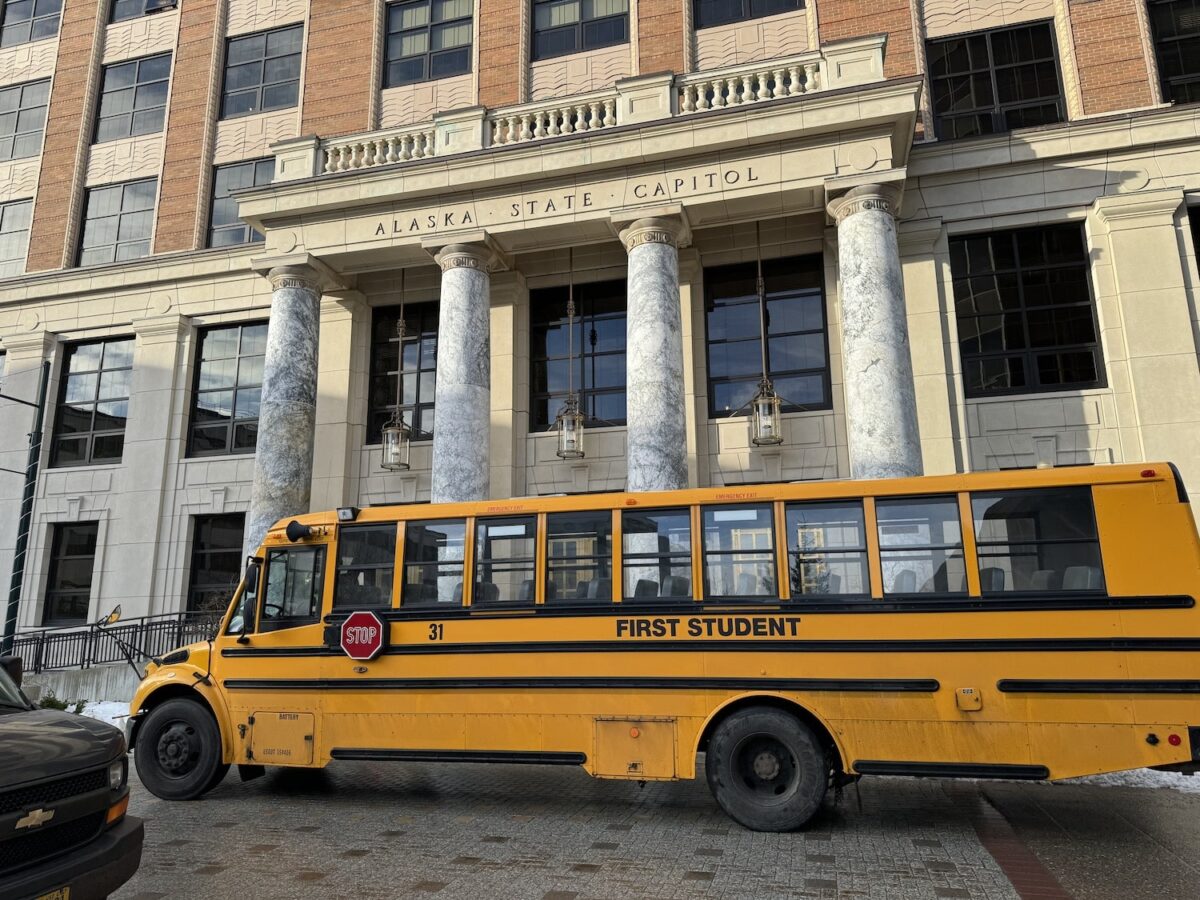
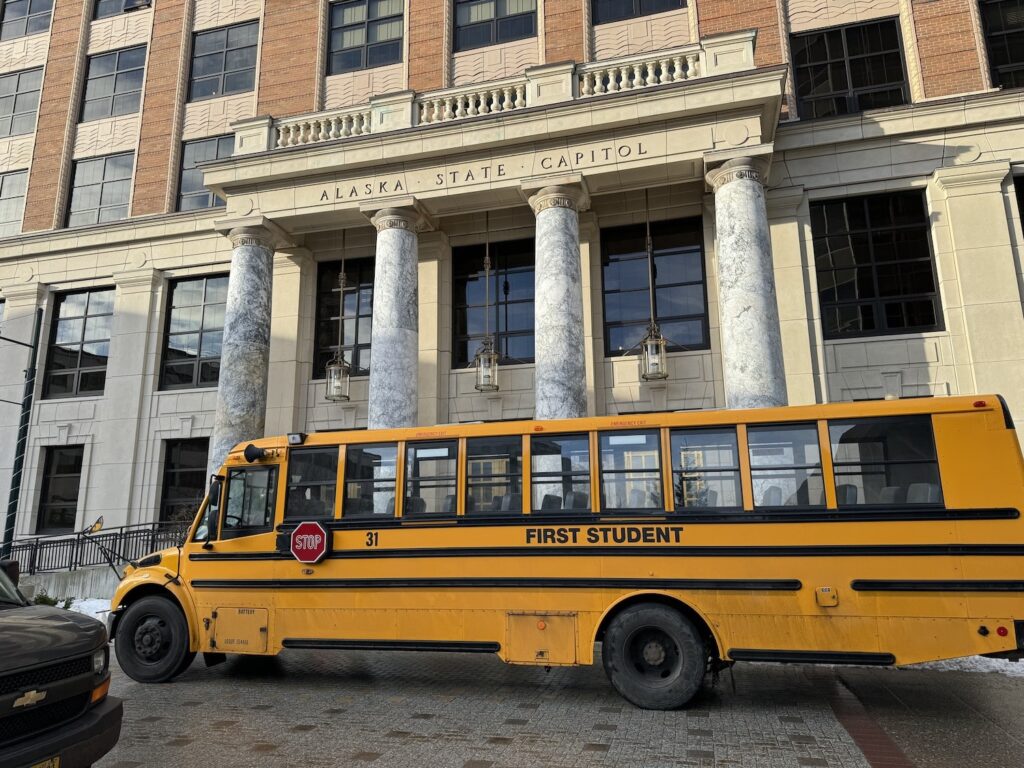
A school bus passes in front of the Alaska Capitol on Tuesday, Feb. 6, 2024. (Photo by James Brooks/Alaska Beacon)
A school bus passes in front of the Alaska Capitol on Tuesday, Feb. 6, 2024. (Photo by James Brooks/Alaska Beacon)
By: Shauneen Miranda, States Newsroom
Republican members of the U.S. Senate called on Office of Management and Budget Director Russ Vought in a letter Wednesday to release the $6.8 billion in funds for K-12 schools that the Trump administration is withholding.
The letter marked a major friction point between President Donald Trump and influential lawmakers in his own party as his administration tests the limits of the executive branch’s authority in clawing back federal dollars Congress has already appropriated. Every state has millions in school funding held up as a result of the freeze.
Wednesday’s letter came after the Supreme Court temporarily cleared the way earlier this week for the administration to carry out mass layoffs and a plan to dramatically downsize the Department of Education that Trump ordered earlier this year.
Just a day ahead of the July 1 date when these funds are typically disbursed as educators plan for the coming school year, the Education Department informed states that it would be withholding funding for several programs, including before- and after-school programs, migrant education and English-language learning, among other initiatives.
“Withholding these funds will harm students, families, and local economies,” wrote the 10 GOP senators, many of them members of committees that make decisions on spending. Sen. Shelley Moore Capito, a West Virginia Republican and chair of the Senate Appropriations Subcommittee on Labor, Health and Human Services, Education, and Related Agencies, led the letter.
Sen. Susan Collins of Maine, chair of the broader Senate Appropriations Committee, also signed onto the letter, along with: Sens. Katie Britt of Alabama, Lisa Murkowski of Alaska, John Boozman of Arkansas, Mitch McConnell of Kentucky, Deb Fischer of Nebraska, John Hoeven of North Dakota, Mike Rounds of South Dakota and Jim Justice of West Virginia.
“The decision to withhold this funding is contrary to President Trump’s goal of returning K-12 education to the states,” the senators wrote. “This funding goes directly to states and local school districts, where local leaders decide how this funding is spent, because as we know, local communities know how to best serve students and families.”
States Newsroom has asked the Office of Management and Budget for comment on the letter.
Meanwhile, a slew of congressional Democrats and one independent — 32 senators and 150 House Democrats — urged Vought and Education Secretary Linda McMahon in two letters sent last week to immediately release the funds they say are being withheld “illegally.”
Democratic attorneys general and governors also pushed back on these withheld funds when a coalition of 24 states and the District of Columbia sued the administration earlier this week.
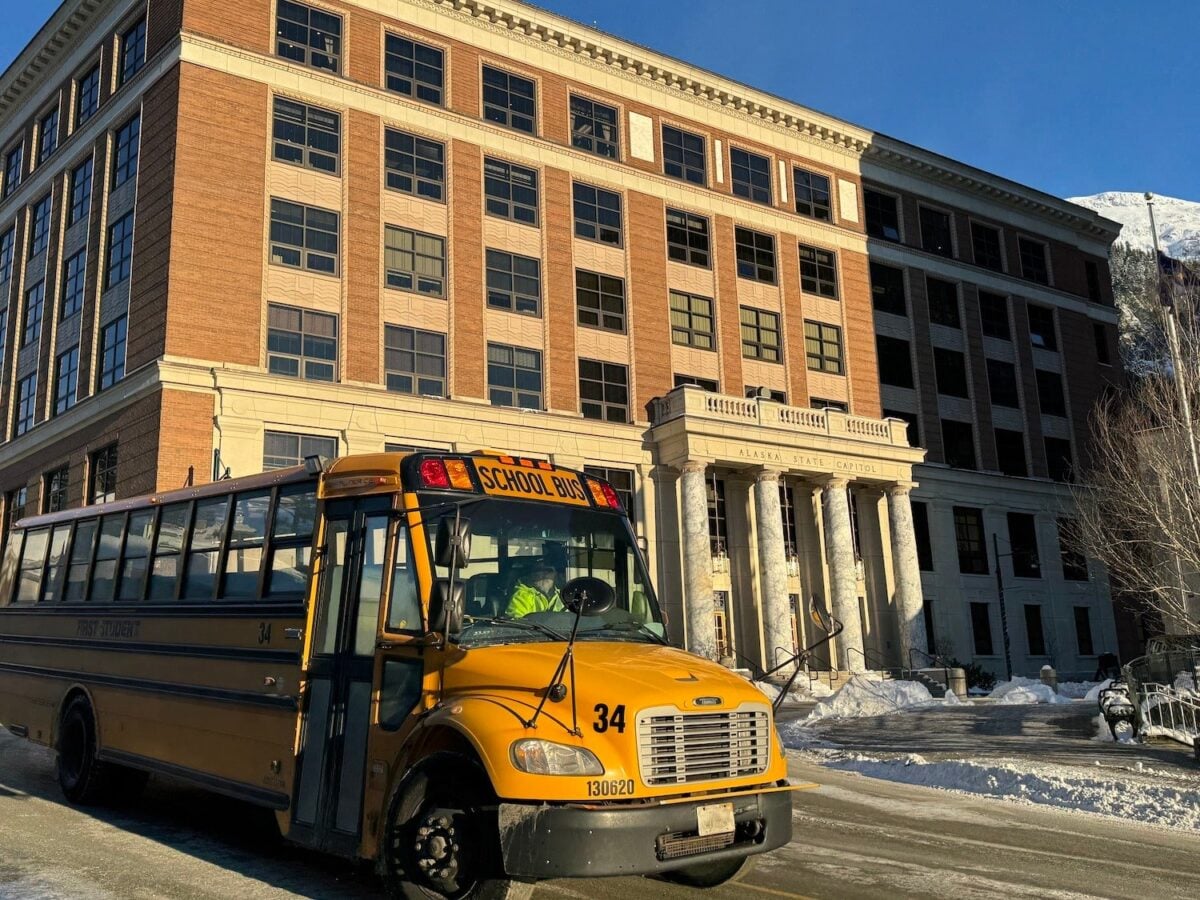
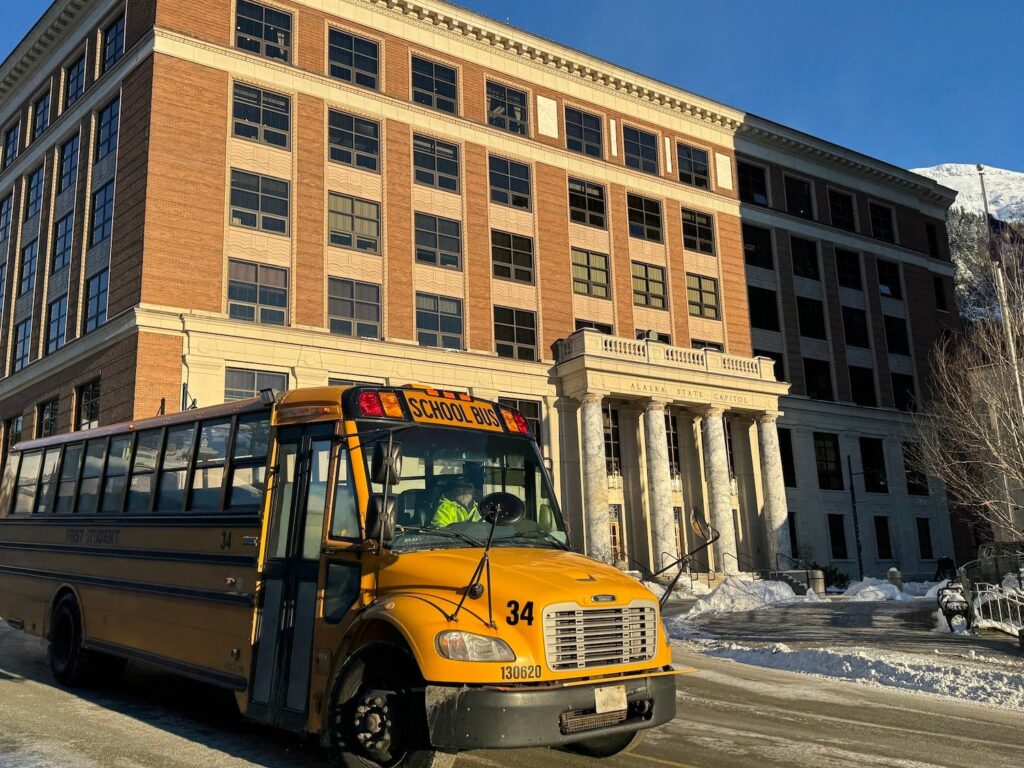
A school bus drives in front of the Alaska State Capitol on Monday, Feb. 3, 2025. (Photo by James Brooks/Alaska Beacon)
A school bus drives in front of the Alaska State Capitol on Monday, Feb. 3, 2025. (Photo by James Brooks/Alaska Beacon)
Governor Mike Dunleavy has called a special legislative session beginning Saturday, August 2, in Juneau.
The session will focus on two issues, education reform and the creation of a new Alaska Department of Agriculture.
The Governor’s recent budget vetoes have been raising concerns, the Governor cut over $122 million from the state budget, including $50 million from per student funding and major school maintenance projects. Juneau Senator Jesse Kiehl spoke with News of the North about the Base Student Allocation and had this to say, “when we look at the budget issues and the Governor’s special session coming up, what that really has to do with is, are we going to fund the BSA that we passed? it took an override to get that $700 per kid increase, and of course, the Governor vetoed that down, actually below a level that he proposed at one point during the session.”
Senator Kiehl is also a part of an education task force created by House Bill 57 which will look at a wide range of financial challenges and school policies, It’s charged with making recommendations before the 35th Alaska State Legislature convenes in January 2027.
When asked if the governor’s vetoes would affect the Education Task Force, Senator Kiehl said “I think those are going to be pretty separate issues. The task force has a lot of work ahead of us, to look both at the adequacy of how much we’re putting into schools and whether we’re doing it as well as we can be- Are there better ways to fund? are there more fair ways to fund? And then some other education policy issues.”
The group will dig into rising costs in transportation, energy, insurance, and school maintenance, along with accountability and student outcomes. The task force will present recommendations in a report on the first day of the January 2027 session.
The Alaska State Capitol is seen during the last week of the 2025 session on May 19, 2025. (Photo by Corinne Smith/Alaska Beacon)
By: Corinne Smith, Alaska Beacon
As many Alaska school districts grapple with steep budget deficits, and in the wake of Gov. Mike Dunleavy’s partial veto of an increase to per-student funding, the Alaska State Legislature has launched a joint bipartisan task force to focus on education funding.
The Legislature approved a $700 increase per student to the funding formula, but earlier this month the governor vetoed more than $50 million in education-related funding from the state’s budget, including a portion of the per-student increase, pushing it down to $500 per student.
Some lawmakers and education officials have expressed outrage and disappointment at the governor’s budget cuts, with leadership of both the House and Senate promising to hold a vote to override the budget veto to partially restore funding to schools, in the first five days of the January 2026 session. The Legislature previously overrode Dunleavy’s veto of a separate bill that enshrined the $700 increase as policy in state law; it required funding in the budget bill to put the increase into practice.
In the meantime, the task force, created by House Bill 57, will look at a wide range of financial challenges and school policies. It’s charged with making recommendations before the 35th Alaska State Legislature convenes in January 2027.
“This is a ‘yes, and’ moment,” said task force co-chair Rep. Rebecca Himschoot, I-Sitka, in a phone interview. “Is there a way by looking more globally at issues, that we can help contain some of those rising costs that districts have? But the fact remains that we haven’t given a significant increase to education in over 10 years.”
Rep. Rebecca Himschoot, I-Sitka, speaks in favor of a veto override on House Bill 69 on Tuesday, April 22, 2025. Himschoot also serves as co-chair of the House Education Committee and now co-chair of the education funding task force. (Photo by James Brooks/Alaska Beacon)
Education funding has been at the heart of Alaska’s ongoing political and financial debates among Dunleavy and the Legislature — as well as school officials, families and local municipalities — around state funding, policy changes, and how to improve students’ performance and learning outcomes. In a short video released the day of the line-item budget veto, Dunleavy cited declining state revenues and repeated his conviction that increasing education funding will not necessarily improve outcomes without policy changes.
The joint task force is set to start work in August, Himschoot said, and will not only look at how the state funds school districts, but also how it can address rising costs of transportation, energy, health insurance and school maintenance.
“We’re seeing double-digit increases in insurance costs, we’re seeing double-digit increases in energy costs. Is there something we can do to either arrest those increases, or a separate funding stream we should use?” she said.
“There’s been a lot of interest in trying to create some sort of an insurance pool to help with those costs,” she said, adding of the task force’s goals: “In general, examine the big picture to try to get down to that, so to speak, smaller picture of the annual funding cycle.”
Himschoot said solutions will vary as widely as Alaska’s 54 school districts, and the task force can take time on issues not afforded during the fast-paced legislative session.
“We can tweak individual levers of funding during the session. We can look at how we’re funding career and technical education and say, ‘We want to fund it more. We want to fund it less. We want to use this other mechanism or this other fund source,’” she said. “So by doing this work during the interim over the next two years, it gives us time to ask questions, which often lead to more questions, and during the session, it can be very difficult, on a very tight timeline, and bring in all the different perspectives that need to be heard.”
The task force is planning to meet monthly and meetings will be open to the public, Himschoot said. “It’s super important that this is a process that anyone and everyone can participate in,” she said. “That’s the only way that it has any real value.”
Republican member Sen. Mike Cronk, a former teacher and representative for the large Interior District R that includes nine school districts, said he sees participation from school officials as mandatory. “I’ve already talked to numerous superintendents in my district, and I am going to require some of their input on certain things, because they’re the experts,” he said, in a phone interview. “I believe that’s the buy-in. I don’t believe ‘legislators’ singular, should be making these decisions. We need buy-in from everybody.”
Then-Rep. Mike Cronk, R-Tok, speaks to a fellow lawmaker on Wednesday, Feb. 21, 2024. Cronk, now a senator, was appointed to the new education funding task force. (Photo by James Brooks/Alaska Beacon)
Cronk said he wants the task force to create an ongoing, stable fiscal plan for funding schools.
“We’re spinning our wheels. We just continue to not actually solve anything as a Legislature. We just prolong it to the next year, and the next year,” he said, after five years in the Legislature. “So that’s my desire, is to make sure that we have a fiscal plan in place where, if education needs more funding, we have the ability to get that. Or if roads need more attention, we have the ability to get more funding for that versus this. Just, ‘hey, oil prices are great, we could fund everything.’ Or ‘oil prices aren’t so good. Oh boy, we’re in a crisis situation.’ We shouldn’t be there. We should be working together, you know, for the betterment of Alaska.”
Cronk said he understands the governor’s concerns but disagreed with his partial veto of the school funding increase. “I respect the governor: He’s a separate office than the Legislature, so he has the ability to make decisions what he feels best, you know, and I feel the more we respect that, the better off we’ll all be working together,” he said. “But again, the override vote of the initial bill, I think, was pretty strong and showed that for the most part, most of us supported the increase.”
The task force will also examine student performance and accountability measures, including absenteeism, as well as policy changes sought by the governor throughout the session, like open enrollment, easing the application process for charter schools, and reading incentive grants.
Cronk said he’s open to looking at all policy changes to improve outcomes. “It’s not just straight up, how do we fund better? It’s, ‘How do we make our education system better for all students?’ So that’s what I hope to focus on,” he said.
Task force member Rep. Justin Ruffridge, R-Soldotna, said he’s interested in looking at the school funding formula. “So from some of the issues in the formula itself, like school size factor and district cost factor, which some of those haven’t been updated in decades, as well as some of the issues from the federal government, things like the disparity test,” he said, referring to the state failing a federal test and now proposing capping local municipalities’ contributions to their schools.
Rep. Justin Ruffridge, R-Soldotna, addresses the House during the debate on the school funding bill on Mar 10, 2025. He is a member of the House minority caucus and was appointed to the education funding task force. (Photo by Corinne Smith/Alaska Beacon)
“A task force is well suited to come out with some recommendations,” he said. “I think that we also need to discuss accountability measures, so things like testing, how we test, how we talk about testing … open enrollment, how does that affect Alaska schools? How does it affect military bases? There’s a lot that we have to look at.”
Ruffridge said he’s also focused on teacher recruitment and retention, and incentives for local residents to become certified teachers. “So developing an apprenticeship track to be engaged with teachers, and really growing some of our teachers in their homes and in their communities, I think, is a really good idea,” he said.
He and Cronk both said they hope the task force will be less of a political and more of an advisory body, “where … you take the time to understand these deeper, complex funding elements or other policy measures and bring forward a draft recommendation of ways that we could make things better — and then that would need to go through the political process,” Ruffridge said. “So, trying to be a little more apolitical.”
The task force also includes co-chair Sen. Löki Tobin, D-Anchorage; Sen. Jesse Kiehl, D-Juneau; and Rep. Andi Story, D-Juneau.
Many school districts are facing millions in budget shortfalls, and with Dunleavy’s budget veto, school boards are going back into budget meetings this summer to make further cuts to programs and staff.
Himschoot addressed criticism of the Legislature not calling an emergency special session this summer to override the line-item veto, saying some legislators are out of the country and unavailable and there is more of a possibility of having the votes to override in January.
“So the problem is, can we get everyone together? And if we do, will their votes hold? We know for sure we can get everyone together in January. We don’t know that we’ll have the votes, not now and not in January,” she said. “And so we are working on it.”
The task force will present recommendations in a report on the first day of the January 2027 session, the same month the task force sunsets.