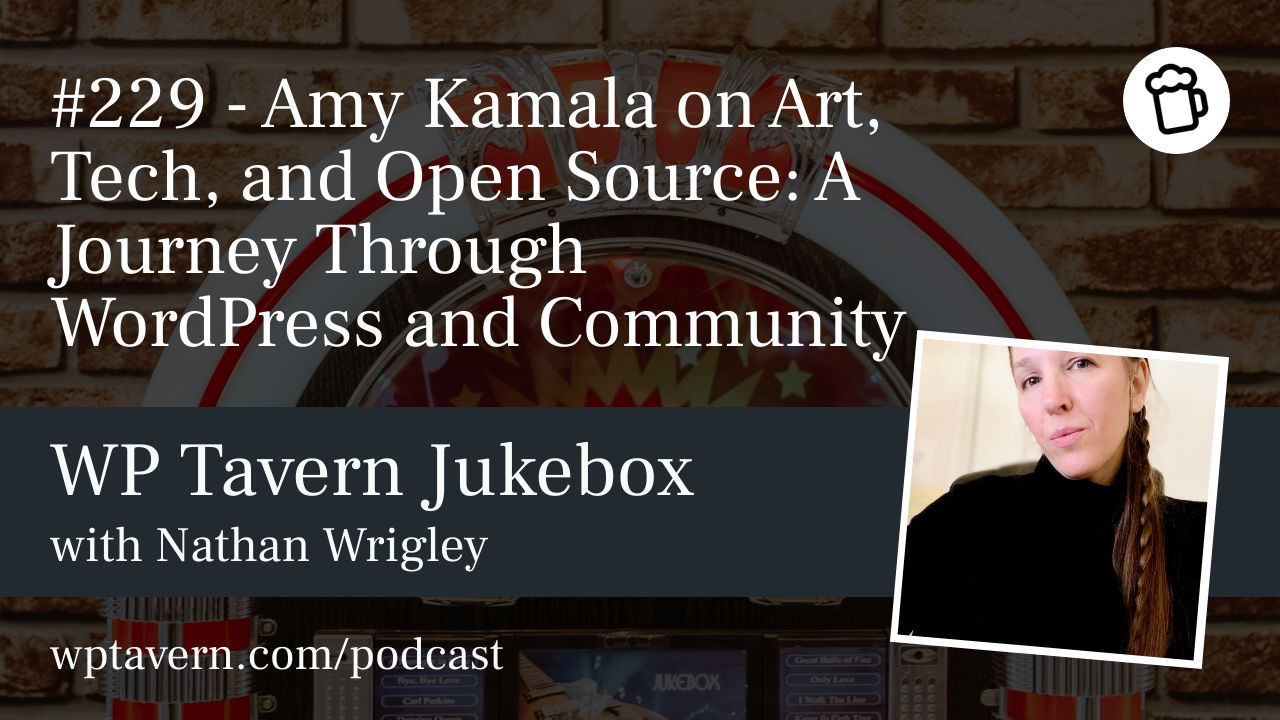
[00:00:19] Nathan Wrigley: Welcome to the Jukebox Podcast from WP Tavern. My name is Nathan Wrigley.
Jukebox is a podcast which is dedicated to all things WordPress. The people, the events, the plugins, the blocks, the themes, and in this case, what draws people into the work of open source projects.
If you’d like to subscribe to the podcast, you can do that by searching for WP Tavern in your podcast player of choice, or by going to wptavern.com/feed/podcast, and you can copy that URL into most podcast players.
If you have a topic that you’d like us to feature on the podcast, I’m keen to hear from you and hopefully get you, or your idea, featured on the show. Head to wptavern.com/contact/jukebox and use the form there.
So on the podcast today, we have Amy Kamala.
Amy’s journey into tech is anything but conventional, starting with a master of fine arts from UCLA, and a passion for art that eventually bled into, and was overtaken by technology. Since 2018, she’s been an active contributor to WordPress, serving multiple teams such as the Hosting and Core Teams.
Her career zigzags through key roles at DreamHost, InMotion Hosting, Pantheon, Canopy Studios, and local government. Picking up everything from technical support and web development, to managing teams of designers and DevOps staff. Along the way, Amy has organised WordCamps, led teams, and is currently being sponsored by Elementor for her open source work.
Today’s conversation gets into the chaotic, creative, overlap between art and tech and how those different mindsets can feed one another, especially in the world of WordPress. We talk about the blend of creative and logical thinking needed in web development and why skills like user experience, curiosity, and even willingness to fail publicly can set you apart.
We then turn to contribution. What draws people to volunteer in an open source community? What Amy gets out of participating far beyond her paid hours, and the messy journey from being an eager helper to an essential part of the team.
She explains the unique feeling of the WordPress community, the importance of being welcoming to new contributors, and why being outgoing and not afraid to ask questions can be your biggest asset.
If you’ve ever wondered about the blurred lines between arts and code, why people throw themselves into volunteer work in the WordPress ecosystem, or what’s really at the heart of this global community, this episode is for you.
If you’re interested in finding out more, you can find all of the links in the show notes by heading to wptavern.com/podcast, where you’ll find all the other episodes as well.
And so without further delay, I bring you Amy Kamala.
I am joined on the podcast by Amy Kamala. Hello, Amy.
[00:03:22] Amy: Hello. Thank you for having me.
[00:03:24] Nathan Wrigley: You’re very welcome. Amy was introduced to me by Jonathan Desrosiers, who’s been on this podcast many, many times before. I don’t exactly recall the nature of that introduction, but I’m very glad to have you on the podcast today. The intention really is to have a broad, wide-ranging, no-holds-barred conversation, I think about contribution, why people do it, and the community in general. So we’ll see where it takes us.
Amy, firstly, thank you for joining us, and I wonder if you wouldn’t mind just telling the listeners a little bit about yourself. Honestly, you can go in any direction you like with that. Maybe if you, I don’t know, bind it to WordPress or contribution or whatever it may be, that would be good.
[00:03:59] Amy: Thank you too. Thank you so much for having me. I’m happy to be here. So I’m from Venice Beach, California, and I’m actually an artist and my background is in art. I have a Master of Fine Arts degree from UCLA. But a lot of my artwork was supported by technology, and at some point, technology crossed over, took over, and now my technology is supported by artwork.
I’ve been contributing to WordPress since 2018. In 2019, I became a team rep for the hosting team, and I am now on my sixth non-consecutive year as a team rep. And this year I’m also a Core team rep, which has been really fun and I love working with both teams.
I started working in the tech industry in 2015 in social support for web host, DreamHost. I was there for about five years, a little bit less than five years. I worked my way up from social support to technical support to live chat, and then helped form a specialised WordPress support team. And I was taking escalations, training team members, devising and documenting team processes. And while I was there, I helped strategise and implement new WordPress products which made revenue in beta, and that was really fun. I got to work directly with the CEO and the VP of product, and I learned a lot doing that.
Then I left, and I became a tech lead at a web dev agency, and then the pandemic hit, and we all know how that went. And then in 2020, I started working for InMotion Hosting as their web development manager. I was responsible for over 23 online corporate assets, five web servers, multiple Jira projects, and also the supporting infrastructure, the DevOps pipeline, GitLab, so on and so forth. And I loved that. It’s actually, that was one of the best jobs I’ve ever had. They’re a great company. It was amazing working there. I had an amazing boss. Totally great. I still have friends from there, and from DreamHost for that matter. And DreamHost was also great. I have a special love in my heart for DreamHost. I’ve known those guys for a really long time.
And then I was recruited by Pantheon to be a solutions architect for their professional support team. That didn’t work out for me as I had hoped, and I left a little bit less than a year later and started being a web developer for my local government. Again, I was recruited. I didn’t pursue these jobs. I may have gone in a different direction if I had. And that was a year-long contract. It ended in the end of 2023, and I’ve actually just been freelancing ever since then. I have a contract with a company called Swishtech. They’re not a WordPress company. They’re not even a web development company. They are an AutoCAD. They train and sell AutoCAD software. And they’re great too. And I also am sponsored by Elementor to contribute to the WordPress open source project.
[00:06:58] Nathan Wrigley: Gosh, you really have done the whole lot, haven’t you? There’s just almost no stone that you haven’t turned over and looked at the underside of. That really is a fascinating story, yeah.
[00:07:09] Amy: Thank you. There is, I considered completely abandoning both of those careers, art and tech and going into psychology and becoming a therapist at some point recently over the past few years.
[00:07:22] Nathan Wrigley: Right, okay. Well I could definitely talk about that. There’s somebody very close to me in my family who does that kind of work.
Can I ask, this is a complete segue, the fact that you pursued art at such a high level tells me that there must be some yearning inside of you for that side of life, you know, the artistic side, the creative side and what have you. I’m wondering if there’s any bit of technology that satisfies that, or do you find that you have to go back to the art to sate that craving? Or are there creative pockets inside of tech that allow you to sate that sort of desire to be creative?
[00:08:00] Amy: So that’s a great question and very insightful of you. Yes, so in 2015 when I started working for DreamHost, I’ve known the founders and some of the managers of DreamHost since like 1999-ish. That’s a different story, but I had just finished grad school and I was kind of in a bad living situation and I just needed a job, any job. I didn’t care what job. And so I hit them up and I found like a entry-level social support, entry-level job that I qualified for. It’s pretty easy to qualify for that. Hit them up and said, “Will you recommend me for this job at your company?” And of course they did. I still went through the interview process and like did typing tests and so on and so forth. But that’s how I ended up.
So it was kind of just circumstantial that I started working in tech. And then once I was there, I tend to get really hyper-focused, and I really hyper-focused on my work at DreamHost on moving up and learning technical things. I’ve always kind of had an aspect of technical. When I was doing art, strictly art, just art, I was still doing technical things. In undergrad I got into, well, so I started, I learned HTML when I was like 18 years old in the year 2000. I was an HTML programmer. It was one of my first jobs. The other job, my first job was working at Venice Beach at one of the stores down there. But like first real job, HTML programmer for a web development agency and graphic design.
And then I went to undergrad and I did a lot of fine art, sculpture, video installations. And working with video is pretty technical. You’re using computers. I also learned Photoshop at Otis where I went to undergrad. I still use it. It’s like one of my primary mediums for making art. But working with video is pretty technical. You’re doing editing, you’re working on a computer, there’s definitely a technical aspect to it.
And I also, I had a boyfriend at the time who was doing web development, and so I started learning PHP and Perl. And I started using PHP as a tool to make my animations. I was making little animations at the time, and video art interactive. So I did some installations that utilised interactive elements that actually used web technology.
Then I was working at an animation studio on a Red Hat box. So I had to, I learned Linux, and I also was introduced to Avid which is a high-end, professional video editing software or film editing software. And then I was working at a film post-production facility where I was using DOS, which is Command Line. And also I was working in the tape room transferring tape formats from one to the other. It was pretty technical. And I was also helping their web team manage the online video assets, uploading and downloading with FTP and so on and so forth. So there’s always been an element of tech integrated in my art.
And to answer your question, working in tech primarily, there’s definitely an element of art that supports, that has supported my career in tech. UI/UX design and graphic design rely on the same fundamentals as fine art. Composition, colour, so on and so forth. And so my training there, and I have some, I don’t like doing graphic design. I, like, actually really hate it, but I do have some professional experience doing it. And that led me to be able to lead teams of designers and developers. At InMotion Hosting, I had five developers and three UI/UX designers on my team, who I was the manager of.
So it wasn’t just development that I was doing there. It was also user experience, very user experience-focused. And so my experience with art has definitely supported my experience with tech and vice versa.
Yes, there’s definitely a yearning that, you know, I wanted to do, I wanted to make weird, cute, maybe a little dark experimental films. And I haven’t been doing that for the past 10 years or so.
[00:11:54] Nathan Wrigley: I always think that the motto for WordPress is code is poetry. I think if you peel back the curtain on that just a little bit, obviously, it may be that you’re just trying to create a website, but there are creative ways of doing that. But also code code really does unlock something, but still it’s quite a logical thing. And I’ve always found those two things difficult to overlap. The sort of Venn diagram of logic meets creativity that, I don’t know how well they fit together. But it sounds from what you’re saying that you feel that the two things have married well in your career.
They’ve enabled you to do things because, I don’t know, maybe it’s thinking outside of the box or something like that. Your capacity to think differently to other people. But I’ve always found that curious. I’ve never had a particularly artistic grain of anything in me. I’m much more logical than I am creative. So I’ve always sort of struggled to see how those two things marry up.
[00:12:49] Amy: Oh, well, you know, that’s actually something that I’ve thought about a lot. And the too long, didn’t read, answer for me about that is, so art is experiential. It’s not about the object necessarily. It’s not even about your skills. It’s about creating an experience. The viewer, relationship between the viewer and the item that they’re looking at. Books, movies, music, all of that, it’s experiential. It creates an experience. And so do websites, so does software, so does using the software.
One of the reasons that Apple is so successful is because of the user experience, because they focus on it being an easy, intuitive, fast experience to use their products. And so when you think about it in terms of user experience, and in terms of just human experience, there’s a lot of crossover.
[00:13:41] Nathan Wrigley: When you worked at some of those companies that you mentioned, I presume that you were surrounded by lots and lots of people, in an office environment. So this question, I hope it lands correctly. I’m certainly not trying to put anybody in a box or stereotype anybody. But did there tend to be a fairly interesting split between the kind of character that you would find on the, I don’t know, making the website look nice, let’s say. You know, putting the pixels on the page, the design and what have you, and then the people who are writing the code in order to make those designs a reality.
I just wonder what, if there’s an aisle down the middle of those two camps where, okay, the artistic people, they’re all over there, look at them being artistic, and over there, there’s all the coders, look at them crouched over their computers being logical. I don’t know if there’s a there there, but I’ve always found that curious too.
[00:14:25] Amy: Well, it crosses over in web development. A lot of web developers are doing, as a web developer, you have to do CSS, SAAS, you have to style the front end. If you’re on a, you know, a big professional team, you’re going to have designers, and then you can just pull the styles from software. But if you’re on a smaller team, which, you know, the majority of people end up working at some point on very small teams or even, like, a one-person team, you do it. And so there’s quite a bit of crossover in web development.
In software development, you’re probably always going to have a bigger team, and so you’re going to need designers. But web development, there’s always web developers that like have a history in graphic design, have a history in UI/UX design that ended up also coding. And those designers don’t necessarily tend to be really great at like PHP and JavaScript, but they do tend to be phenomenal at CSS.
[00:15:18] Nathan Wrigley: Oh, interesting. Yeah, okay. Thank you. I took us on a total detour there. That was really not intentional, but it was kind of fun peeling back the curtain a little bit there.
[00:15:27] Amy: Well as a team lead, it really helps to know people’s strengths and talents, that you’re likely to have developers who are more logical and who, like, they can bang out some code. It’s going to function. It’s probably going to have all of the crosses and the dots and the so forth. But then you also have developers who are more visual, but they just kind of like ended up working in development. And that’s who you would want to tap to make something look really nice but still be functional.
[00:15:52] Nathan Wrigley: Yes. It’s a rare and wonderful thing when you encounter that character who can do all of it. I have a friend, a very dear friend who, it doesn’t matter what task you put in front of him, he just excels at all of it immediately. And it’s rare, you know, because there is this sort of, most poeple get into a niche, don’t they, and they become good at a particular thing. And as the world requires us more and more to be specialised in one thing or another thing, we do tend to lean into, I don’t know, I’m a CSS person, or I’m a PHP person, or I’m into JavaScript, graphic design or whatever it may be. And when you encounter that one character that can do literally all of it, I’m a bit in awe, frankly. Quite a lot of my jealous genes kick in and.
[00:16:31] Amy: That’s very interesting. I am the one character, you know, I’ve had my hands in, DevOps, system administration, but also design, art, user experience, accessibility, so on and so forth, which has served my career, you know, being a web development manager, it was absolutely necessary to have that range of skill set. But I will say that I don’t specialise in any of those things. I’m not like a, you know, JavaScript specialist or anything like that. I’m not the SMC on all of those technologies, but have a good umbrella overview that allows like cross-functionality.
I wouldn’t mind specialising in something like that, but I just haven’t really found a niche. I kind of ended up in leadership roles because I’m outgoing and chatty. And so that reads as leadership ability. And I’m good at organising. So those are some leadership skills. And so I kind of ended up, but I ended up in leadership roles before I had mastered anything other than like drawing and maybe video editing. And so in a way that’s been really good and it’s led me on this career path, and also in a way it’s been really bad because I’ve not been able to focus on any specific skills to excel in those. I guess I’ve excelled in team management.
[00:17:50] Nathan Wrigley: It sounds like you’ve not done too badly. It also sounds from, I mean I’m reading between the lines here, and forgive me if I’ve misconstrued what you were saying. It also sounds like from the go, since you finished your arts program, it sounds like you’ve been quite intentional. You know, when opportunities have arisen, the way you’ve described it makes me feel that you can sense an opportunity and you grasp it with both hands, and you’re willing to learn something which maybe last week you’d never heard of, but this week, okay, that’s a thing. Let’s give that a go. Again, forgive me if I’ve got that wrong, but it sounds like you’re quite a force of nature. Let’s go with that.
[00:18:23] Amy: Thank you. That’s correct. I love learning new things, new skills. I’m never like, well, I’m only going to focus, that’s part of it too. It’s a conscious choice to not focus on just one thing. I did at one point kind of like sit down and say to myself, we have to make a decision, art or coding? And I actually determined that I should just stick with tech, the technical end of things because that makes more money than art, even like with a full-time job.
[00:18:53] Nathan Wrigley: Yes. It is difficult, isn’t it, to become an artist in whatever field of art that may be. I think the chances of you making that work from an economic point of view are much more unlikely than they are.
[00:19:06] Amy: Well, I could tell you as a fine artist, I have made $0.
[00:19:10] Nathan Wrigley: Right. Okay. Well there you go. That puts it into stark relief. That gives us some idea.
It also sounds from what you’re doing that you’re on more of a journey than you are arriving at a destination. And what I mean by that is, it feels like maybe if I chatted to you in a decade’s time, who knows where you’re going to be. It’s more of a, this is where I am now. Tomorrow might present something entirely different. Again, I could have that wrong.
[00:19:32] Amy: No, I think that’s actually totally correct. I’ve kind of, I haven’t really been that intentional with my direction. I tried to be when I, you know, made a decision, art versus tech, to go with tech. Secondary decision, I had already decided to go with art and then, you know, switch careers. But at this point I don’t have, like I don’t dream to be a product manager or dream to be, you know, a coder or a specific thing, a software engineer.
I’m not quite sure to be honest. I do know that I love working in the tech industry, that I love working on teams, I love working on software, I love collaborating and focusing on user experience. And I even, I really actually, I loved being in technical support. Being social and chatty is both a blessing and a curse because my entire career exists because I’m outgoing and social and chatty, and I just randomly message people and start talking to them or randomly walk up to people. You know, and that’s how I ended up in all of it pretty much, and even working on releases.
And that’s also helped me to be able to do those roles because I will randomly message anyone and be like, hi, blah, blah, blah. So that really works to my benefit. But it also, like sometimes I say too much, or I definitely talk too much, way too much, way too frequently. And I might like be bothering people. And I’ll ask them. But at DreamHost, Kira Schroder and Mika Epstein both worked at DreamHost at the same time as me. And because I’m not shy and I am apparently not afraid to talk to people, I started messaging them and asking them questions. And not just them, but the other developers and leads, and the VP of product and so on. It helped that I already knew them, but just started asking them questions.
And also, being willing to be embarrassed and to look stupid is a huge plus because you learn a lot from making mistakes. If you make those mistakes in front of people, you’re going to remember. You’re going to remember the answer to those mistakes. And that’s kind of what I’ve been doing. I’ve kind of stumbled up, and asked a lot of stupid questions, which I’m still doing.
[00:21:46] Nathan Wrigley: I’m just going to interrupt you there very quickly because I love when I meet people who have no shame about failure. I’m being really serious. You know when you meet that character who literally doesn’t have the capacity to feel shame for their inability to do a thing that they’ve never done before? I don’t know, you see somebody who’s picked up a tennis racket for the first time and clearly can’t do anything useful with it, whatever it may be. Just imagine almost any scenario. But they are absolutely happy to do it in front of other people.
I know for me that’s not a gift I possess. I could be racked with sort of, oh, shame and all sorts of other things because I haven’t managed to achieve this level of competency out of the gate. And when I see people doing that, you know, failing willingly in front of other people, I’m always, always thinking, I really should be more like that.
Because I’m glancing around thinking, where are the people that are pouring scorn on them? And the answer is, they’re never anywhere to be seen. There’s nobody, generally speaking, looking and going, look at you. You messed up with the tennis racket. No, there’s just people looking going, oh, hang on a minute. No, what you need to do is this.
[00:22:58] Amy: Right, try this technique and.
[00:22:59] Nathan Wrigley: Right, people around to support. And yet I seem to have, that is a thing in me which I suspect I’ll take to my grave, to my great cost. So well done for being that characteristic.
[00:23:11] Amy: Thank you. Well, I do have shame and fear of, I don’t prefer to fail in front of, for example, 54,000 people in the Core Slack channel. But I’ve done it so many times at this point, I’m like, yeah, I’m going to. I’m going to. I’m going to learn and I’m going to do better next time.
Also in, way back in the day had a brief stint with performing. I was in a theater group, and one of the things that I learned in that theater group, and it really, really stuck with me, is that when you have an audience, the audience is rooting for you. They want you to win. They want you to succeed. They want to hear what you have to say. They want to see you do your whatever it is you’re there to do.
And so when you think about it, I have horrible stage fright, so this doesn’t fix my stage fright but it does kind of fix the mentality of like being embarrassed potentially, or being afraid of failing in front of people. But you go into a room to lead a meeting, or to do whatever it is that you’re doing and you are going to be nervous, but it’s inevitable that you’re going to mess up because you’re human. And to look at it in the way that like, I’m going to mess up and everyone’s on this journey with me and they support me and they want me to win, you know? We’ll fix it together, we’ll learn together, we’ll.
[00:24:23] Nathan Wrigley: We need more of that. Don’t know how many times I’ve preached that gospel to my own children, only to not be able to actually carry it on myself.
I’m going to pivot us slightly. I’m going to sort of draw us into the WordPress space because it’s a WordPress podcast after all. You found yourself in some fairly, I don’t know, important decision-making processes, sort of like contributing to Core and what have you. Can you just chart the journey for that? Like, how did you get to the point where you were contributing your own, presumably free time in some cases? Maybe it was on the company dollar, you know, maybe you were sponsored to do that. I think you implied earlier that that was the case. How did you end up picking WordPress and whichever team that you’ve spent most of your time in? Just chart that journey for us.
[00:25:04] Amy: So that leads us back to DreamHost. DreamHost back in the late, around 2017, DreamHost was, they’re a regular web host, and they were putting in a concerted effort to become a WordPress, a quote unquote, WordPress host. So they were looking into contributing and actively contributing to the project, you know, looking for more PR and marketing opportunities and being a sponsor, so on and so forth. And the hosting team, which has been my main team, was born directly of that.
The hosting team was originally a, primarily DreamHost / wordpress.org project. There have been many other hosts that have been involved. But primarily, at the very beginning, it was spearheaded dramatically by DreamHost and wordpress.org. And so DreamHost was telling its employees, hey guys, we want to be a WordPress host. Hop into WordPress Slack and go to meetings and, like, represent. So they weren’t offering to like any special contribution contracts or anything like that. They were just encouraging people to check it out and get involved in whatever capacity they felt inclined to.
And so I did. I hopped in the hosting channel. I went to a hosting meeting, and I wasn’t expecting this because I didn’t know at the time. I know now. So the hosting team originally was trying to do video meetings. The first meeting I went to was a video meeting, and I knew everyone in the room already. It was a bunch of DreamHost people, but there were also people from other web hosts who I knew from, you know, mutual contacts. So I knew everybody in the room already in one way or another, and so it was a very, very soft landing for me.
It was easy to get involved because I had an in with all those people and with the team reps. Kira Schroder was one of the team reps. It also helps when the people in the project are really friendly and welcoming. And that has been my experience, that the other contributors, the team reps, and the team leads are very welcoming. Might be a different story on the development end. But in terms of just being involved with community and team happenings, usually you’ll get a very warm welcome.
And certainly the hosting team, if anybody wants to hop in and contribute to the hosting team or participate as a team rep, we’re going to be very welcoming. We’re going to want you to come. We’re going to be encouraging. We’re going to help guide you. We’re going to be super patient and we expect confusion, questions, stupid questions, mistakes, and so forth because that’s just how it goes. And so having someone on the other end receiving you really can make all the difference.
So the contributors that are listening today that can receive new contributors, be as warm and welcoming as you possibly can be. And it does kind of take a lot of extra effort to guide people, but I think it’s worth it, and you build relationships and strong ties along the way. And you never know what that person can do and what they will do and how that later on benefits you.
So I got a really warm welcome. The hosting team didn’t even exist until I think it was 2017. 2018 I joined and started contributing. I became a team rep in 2019. And a lot of that is because I’m really outgoing, and I just was like blah, blah, blah-ing in the meetings all the time. And so that also makes me visible. In a remote, a fully remote space, I’m actually less chatty in person, although I think people would probably argue with that.
But it really, really helps to be outgoing and to jump in, like throw yourself in the fire. Throw yourself in the fire because you may or may not be thrown into the fire by someone else. It’s a really good way to learn. It’s very intimidating. I actually, I prefer more hand-holding onboarding than being thrown into the fire. But you can throw yourself into the fire in a gentle capacity. Like, hey, I volunteer to take team meeting notes, or volunteer to update some documentation. These are really kind of low-pressure things that you just need to know English, and how to type to do it. And, you know, it starts the ties between people and your presence in the project and so forth.
So I was really just hosting team for a very long time. At some point, I think it was, I joined Ladies of WordPress, I think the Slack community is, which is just like women who are involved in, women contributors basically, and befriended a couple people in that space. And one of those people I befriended was Francesca, or Francina is her Slack name, who is a Core contributor. I branched out and started going to Core meetings, like waving in at the new contributor meetings and so forth. I wasn’t quite as chatty in there because at the time it was like 30,000 people, which is a lot of people still. Now I think it’s 54,000 people in that channel.
So Francesca roped me in to, and I volunteered. You know, being not shy is really, really the key in this scenario. Being not shy led me to befriend people who then roped me into these projects, and I started contributing to Core, running release model working group meetings to kind of examine and improve the release process. And then at some point, so before every release, there’s a call for volunteers. And anyone can volunteer, you just need a wordpress.org account. Anyone can. And then of those volunteers, they form the release squad.
So I started volunteering. 5.6 is the first Core release that I was involved in. I was also working at InMotion Hosting at the time as a web development lead. And so I was working really, really, really long days. So I wasn’t quite as engaged in that release as I would have liked to been, or as I was with 6.9 and 7.0. But it was a good like backend release squad experience. And I learned a lot and made connections.
And the other contributors are really, really supportive. If you ask them for help, they’re going to help. And if they think you need help, they’ll offer to help even if you don’t ask. And so it’s kind of, there is some competition, and there is some criticism that happens, but for the most part everybody is really, really, really supportive.
So how I ended up being sponsored though, so I was joining from DreamHost on the clock. I was pretty much always working when I worked at DreamHost. I was working like these insane, like, 50, 60, 70 hour weeks. So I was pretty much always working. So I was joining on the clock. I was wearing many hats with them, and that was one of them. So I was not officially sponsored by them, but I do credit them as a past sponsor because of obvious reasons.
And thereafter I became a tech lead at a web dev agency called Canopy Studios. And they market themselves as being an open source contributor. They contribute to WordPress and they contribute to Drupal. And so they’re looking for their employees to be contributors, and they set aside three hours per week to contribute to your project. So they were sponsoring me for three hours per week. At the time I was doing way more than three hours per week. I was doing meetups, I was helping with WordCamp LA, I was helping with the Release Model Working Group, and I was a Hosting Team rep, and I was speaking at Camps.
So it’s a lot. It was really, like way more than three hours a week. But they, because of that sponsorship it kept me inclined to continue engaging with the project. And then InMotion Hosting had never officially sponsored a contributor, but one of my fellow hosting team reps was a developer at InMotion. That’s how I kind of ended up there. And so they were familiar, obviously they’re familiar with the WordPress project, and they’re familiar with contributing. I just straight up asked them if they would be willing to sponsor me. I was just like, hey, I do this thing. You guys want to use this thing for your marketing and PR, and how about you officially sponsor me? So they sponsored me for 10 hours a week. But again, I was working really, really long days, and I wasn’t able to fully dedicate myself to it as much as I would like to.
Also, that was around pandemic time. So the pandemic definitely affected my ability and everybody’s ability to contribute and engage. And then after that, I didn’t have a sponsor. I kept contributing because it was kind of like part of my thing. The Hosting Team had become special to me, and I guess that the element of me getting hyperfocused is probably key also to why I might contribute for free. Because I like will get involved in something, and then it becomes important to me, and I’m focused on it, and I’m going to carry it probably, hopefully carry it through whether I’m paid or not.
So I wasn’t sponsored for a while there. And then in 2023, I did a talk at WordCamp Europe. So I have family that lives in Israel. My brother lives in Israel. That context is important for this story. But WordCamp Europe that year was in Greece. I had been to Greece before. I love Greece. It’s like one of my favorite places. I’m going buy a house on an island there someday. But Greece is really close to Israel, so after WordCamp Europe, I went to Israel and visited my family.
Before WordCamp Europe, I had done some podcasts and written some articles, and in those conversations, at some point it was brought up that I’m Jewish, and Jewish American, obviously. And I don’t know any other contributors that are Jewish. At that time, zero. I didn’t know a single one. I thought there weren’t any. And Jews are a world minority, so there aren’t that many that I know of, but there are a few.
So somebody directed me to Miriam, Miriam Schwab, who is, I didn’t even care who she was. I was like, yay, I get to make a new friend. But she’s the community manager for Elementor. And so I contacted Miriam trying to make a new friend. I was like, yay, another Jewish person that I could be friends with that contributes to WordPress. Little did I, I didn’t even, like I knew what her job role was, but it never occurred to me that Elementor might want to sponsor me, or that they’re looking for contributors to sponsor or anything like that.
And so she invited me when I was in Israel to go to their headquarters, you know, meet their CEO, be shown around, meet other staff members, play on their, in their little old school arcade and so forth. And I was there like, yay, I’m making new friends. Totally naive completely to the fact that there was any professional interest whatsoever, which was silly. I was just so excited to make a new friend, or multiple new friends. And so then Miriam started talking to me about sponsoring me, and that’s how I ended up being sponsored by Elementor. So really kind of what you said, like a very unintentional chain of events that sort of just ended up working out the way it did.
[00:35:47] Nathan Wrigley: Yeah, looking back, there’s a thread there, isn’t there? But it’s only with the benefit of hindsight looking back that you can probably see the thread. On a day-to-day basis, it probably doesn’t quite feel like that. Are you currently sponsored by Elementor? Are you, in fact, are you sponsored by anybody currently? Yeah, okay.
[00:36:00] Amy: I am. So I’m sponsored part-time, 10 hours a week by Elementor. And again, I’ve been spending way more than 10 hours per week. So if anyone wants to sponsor me on top of them, please contact me.
[00:36:10] Nathan Wrigley: Can I ask about that though. Why? I mean the question is probably obvious to you, but I don’t know on what level you’ve inspected that part of you. Obviously there’s a why. You’ve alluded to it. You know, there’s friendship there and there’s habit, and you’ve been accustomed to it and, you know, you like being in that community, and the people there are nice.
But just sort of drawing the veil back a little bit more. Why do you give more time than your allocation, let’s say, from Elementor? Why does the 10 hours not stop on the clock like you would do for a regular job? You know, 5 o’clock winds along and exactly 5 o’clock you put your tools down, and you go off, and you go home, and what have you. What do you get out of it? What’s the thing that is satisfied by this?
[00:36:49] Amy: Well, so it’s part personal and part professional. So I tend to not draw clear boundaries when it comes to work. I tend to like, if my shift is over, but the task isn’t complete, I will finish that task. Depending on, you know, details and so forth. So I guess there’s a bit of a level of dedication that maybe doesn’t even need to be there, but that’s fueled me in a lot of ways.
Why do I contribute to wordpress.org specifically, even if I’m not paid? I do find it personally meaningful. Working with other people, making new friends, contributing to something bigger than me, participating in something bigger than me, giving to the world in one way or another, I find that personally meaningful. And it’s kind of kept my life a little bit more full and more rich over the past eight, nine years. And so it brings value to me in that way.
I have friends of a decade now from, you know, engaging with WordPress. It’s led me to jobs, and it’s led me to other opportunities and to meet really interesting people. And so there is a personal element to that for me personally. And I think that probably a lot of people also, maybe if somebody is more of an introvert, they might not have that same level of benefit that I, as not an introvert, have. Because I get a, the personal connection benefit and the meeting people is really rewarding to me.
But there’s also a lot of professional benefit being a team lead. We don’t say team lead, we say team rep, but it is a leadership position. So leading a team for a major software project has been pretty beneficial to getting jobs, getting opportunities, and just kind of a general professional portfolio. The Hosting Team is a bit of a red-headed stepchild and is kind of like quiet and nobody really knows that it exists. Except for maybe recently because of me talking about it. And it has been for a long time.
It started to blow up a lot, like way back in 2020-ish, 2019, 2020. And the pandemic kind of really threw a wrench in that. And then some other things over the years have also thrown wrenches in that. There was the whole hosting page debacle, and rift between .org and web hosts, that’s still currently affecting. So the Hosting Team is pretty, pretty quiet. It’s not like a big, Core is not quiet, Hosting Team is really quiet.
So that makes it easier to engage. But there’s definitely professional benefit that a lot of my jobs have been because of WordPress, or because of someone I met through WordPress, or my experience with contributing to WordPress just boosts my appeal to employers. So there’s that too.
And on top of that, you build skills. You know, I now have multiple repos that I’ve been a maintainer for, for years. And I had those skills to begin with, but you refine and define your skills more through experience and through working on teams and so forth.
[00:40:03] Nathan Wrigley: Do you know, it’s really interesting the order in which you stack those answers. I feel, I could be entirely wrong about this. I feel like in the corporate world where everything is out and out profit, imagine, I don’t know, evilcorp.com or whatever it may be. I feel like the calculation there might be exactly the opposite. You know, you put them the other way round. You get the skills, which allow you to then advance your career, and the meaningful bit is just maybe there, maybe not.
But the way that you stack that with the meaningful coming first is really interesting because I have that suspicion as well that the majority of the people in the WordPress project, if they were to truly ask themselves that same question, would probably arrive at a similar answer. That meaningfulness bit, it often doesn’t get talked about. It’s just kind of, oh, we all understand, we’re here, we’re having a nice time and what have you.
But that meaningful bit, I can’t put my hands on it. I can’t explain what that is, but that’s the same for me. There is something significant and meaningful about being involved in something, like you said, bigger than you, that has the capacity to improve people’s lives. And you don’t often get the chance to elucidate that thought and say it out loud. But when you do, it’s nice to know that that’s a part of your character, I think. That that that bit matters apparently more any other bit, because that’s the bit that tumbled out of your mouth first of all.
[00:41:26] Amy: Actually way more. Honestly way more than it because I am smart, I’ve taken many IQ tests. I might do and say stupid things, but nonetheless I have a high IQ, and very capable, and I have numerous different talents. I could do any variety of things. I think that if I were to be dropped in any work environment, I would excel, or at least be competent in that work environment. It doesn’t quite matter what it is. That’s, you know, my perception of myself, and I’m also a huge advocate of learning on the job. I think that companies should be hiring people who don’t know what they’re doing, and then teaching them what to do. That’s personally my take on it.
And so the meaningfulness is, it’s way more powerful than, I could make money and I could, obviously we all have to survive, but it kind of all folds into itself. That you get involved in something because it’s meaningful, and then you like learn and build skills and make connections and end up making money from it.
If people come to WordPress trying to make money, I think that you can absolutely, and probably a lot of it, but it’s the wrong values. It’s not a match for open source values and for WordPress values. And the WordPress values are one of the, probably the thing that attracts me to the WordPress open source project the most.
[00:42:52] Nathan Wrigley: Right. And I think me too. I think that was what drew me in the first place. But again, I can’t get my hands around it. I can’t sum it up. But there is a there there. There is a thing. There’s this ephemeral, non, you know, you can’t quite make contact with it, but there’s a certain feeling.
When you go to these events and you see that, you know, this whole thing has been put on by a bunch of volunteers, and the underlying code, which is what we’re all there for anyway, that equally has been largely created by a bunch of volunteers.
Where’s the profit motive for that? Well in many cases, there isn’t much of a profit motive obviously, as you said, for some people there is. That is a curious characteristic. I don’t know, there’s just something about those people that I would like to be in proximity to. Finding it very hard to describe what I’m saying, but there is something about that characteristic that I like to be in proximity to. That’s kind of it, I think.
[00:43:42] Amy: It’s very authentic and genuine. You can feel it as a human being. You can feel it when somebody wants something from you, or maybe I can’t. But most people can feel it, if somebody wants something from you, and that’s their intention. Versus if someone’s interested in you, or compelled towards you for some subconscious or other underlying reason that they’re just like, oh, you seem nice. You seem interesting. You touched on this topic and I like that topic, you know? There’s something very rewarding, and deeply fulfilling, on a human, spiritual. It covers our basic needs as humans for interaction and for community.
And I think that at events it’s even stronger. Like in Slack, you’re all in different locations. There’s definitely, you know, social interaction happening, and friendships being formed, and bonds being built. But at events it’s kind of like that on steroids. There’s a really strong sense of community, really strong sense of belonging together, a really strong sense of doing something meaningful, and contributing to something meaningful, and being part of something meaningful. And I think that’s really powerful. And it satisfies a core human need.
[00:44:54] Nathan Wrigley: Yeah, that is so interesting. I’d love to put a survey together and actually ask intelligent questions which drill down specifically into that. Because I think there would be a correlation between the things that you’ve just described, the characteristics that you’ve described, the feelings that you like to be associated with, the events that you enjoy and what have you. I think there’s a correlation between that and the community that we have. I can’t quite prove it.
But time and again, that intuition has proved itself in the real world. You know, you get into conversations like this, and this kind of subject emerges. Why do you do it? Because it’s meaningful. Because I get a great sense of satisfaction from it, and I know that I’m doing something which will be bigger than me, longer living than me, and so on and so forth. So, gosh, that’s really interesting. I’m glad that you share that same opinion.
[00:45:38] Amy: It’s beautiful.
[00:45:39] Nathan Wrigley: Yeah. Yeah it is, isn’t it? And that’s the basis upon which the whole project is built.
[00:45:44] Amy: Right. Without the community there’s, it would be a much different thing.
[00:45:48] Nathan Wrigley: Yeah, really so. Sadly, we’re going to have to end it because of the time constraints that we’ve got. But what a fascinating, I think we were just peeling back something really interesting there, but there we go. That’s the time that is allowed for this particular episode.
So anything that you wanted to get out that you didn’t get a chance to? Is there any intelligent question that you wish I had asked you?
[00:46:06] Amy: No, not at all. Thank you so much for inviting me. I’ve really enjoyed chatting with you, and I found it very interesting.
[00:46:13] Nathan Wrigley: Yeah, thank you. It’s been a pleasure. Thank you so much. This will go out on the wptavern.com podcast, the Jukebox podcast, so if you want to go and check it out over there, wptavern.com.
So all that it remains for me to do is say thank you very much, Amy Kamala, for chatting to me today. Really appreciate it
[00:46:30] Amy: Likewise. Thank you too, and thank you to all your listeners.













 WordPress 7.0’s AI connectors and wp_ai_client_prompt() give any plugin a provider-agnostic way to talk to LLMs. Learn the API and build a working plugin.