Categories
Uncategorized

Democrats don’t get why they’ve lost most working class voters

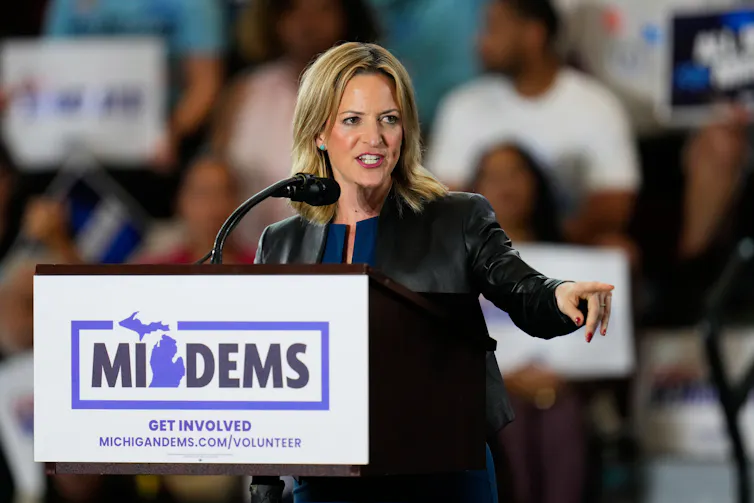
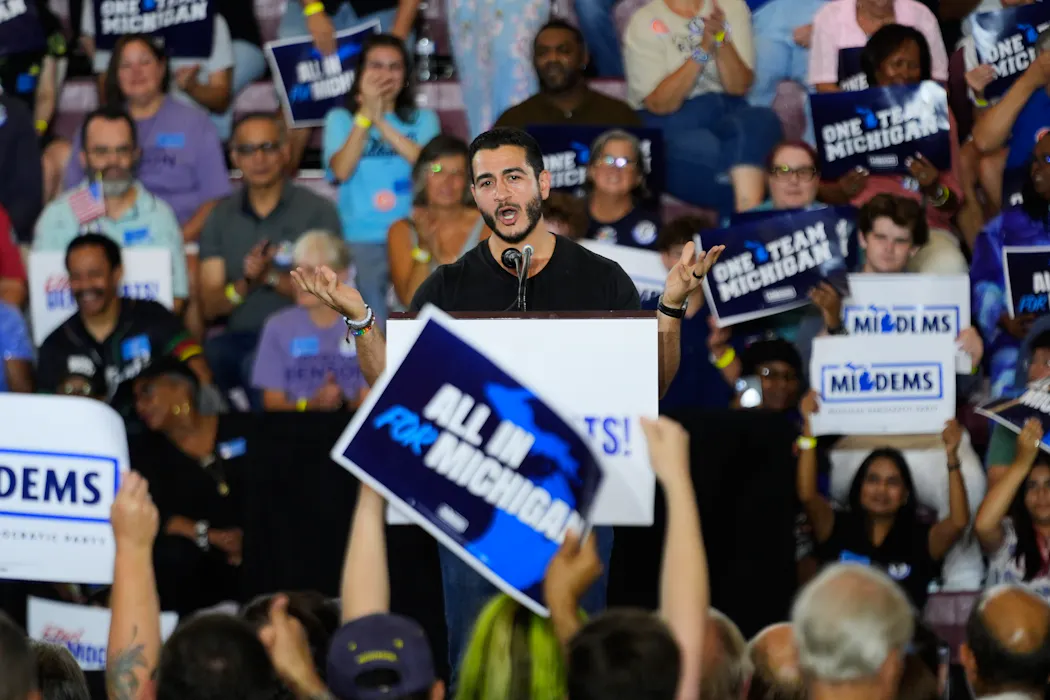
Graham Platner, Democratic candidate for U.S. Senate, speaks at an event hosted by U.S. Sen. Bernie Sanders in Orono, Maine, on May 24, 2026. AP Photo/Robert F. Bukaty

Since 2016, when Donald Trump shattered the Democrats’ blue wall by winning working-class voters across the Midwest, a cottage industry has sprung up on the left dedicated to answering a single question: How can Democrats win back the working class?

The answers come in different forms. Sometimes it is veteran Vermont Sen. Bernie Sanders – barnstorming red districts, railing against oligarchy and corporate greed.

Or it’s Connecticut Sen. Chris Murphy, who after the 2024 election declared, “Democrats must reclaim our identity as the party of the working class.”

Or the answer comes from a new generation of candidates – tattooed veterans, mechanics, bartenders – whose biography is supposed to do the political work that policy has not.

Graham Platner, the Maine Senate candidate who has become the left’s latest blue-collar savior, put the theory in its most unguarded form.

We are in a form of class war,” he says. “And if the Democratic Party is going to have a future with working people, it needs to pick the side of working people.”

How does he define the working class? “Essentially everybody who isn’t making all their money on an immense amount of wealth.”

The theory is all the same: Somewhere out there is a latent working-class majority, held together by shared economic grievances, waiting to be politically reassembled to vote for Democrats. The New Deal did it – Democrats can do it again.

I’m a political scientist who has written extensively about rural and working-class communities. I believe it is an open question whether these reformist Democrats are really interested in understanding working-class voters on their own terms. Because working-class voters, as they tell us themselves, are not simply waiting to be activated by the right program, the right messenger, the right phrase. “Fight the oligarchy” probably isn’t going to do it.

Working-class voters have a worldview. For 50 years, it has been growing less compatible with the Democratic Party’s – not because working-class voters changed, but because Democrats did.

Working-class identity

Since the early 1950s, the American National Election Studies has asked respondents whether they think of themselves as members of the working class. This article uses my analysis of that data.

While a larger proportion of the electorate has obtained a college degree and household incomes have risen, the share of Americans who consider themselves working class has remained remarkably stable: roughly 35% of voters for the past 70 years, 38% in 2024.

Working-class identity is something more durable and culturally grounded than a description of who isn’t a billionaire. It is a specific way of looking at the world.

There are conventional ways to define the working class, but they often miss how people understand their own place in society. In the 2024 American National Election Studies, for example, 21% of those who identify as working class have a college degree, only 5% belong to a private-sector union, and 37% own stocks. Conversely, most Americans without a college degree do not identify as working class.

Working-class voters have never been a predominantly Democratic group – not even at the height of the New Deal coalition. Based on the American National Election Studies self-report measure, the working-class share of the Democratic coalition peaked around 56% in 1960 and has fallen more or less continuously since, sitting at just about 30% today.

Meanwhile, the share of working-class voters who identify as Democrats has been declining for half a century: A majority did so in 1958, but not since.

Working-class voters have not become Republicans. Only in 2020 and 2024 – the first time in the survey’s history – did more working-class voters identify as Republican than Democrat, and even then by narrow margins.

The data shows a working class that is politically homeless: estranged from the Democrats, not captured by the Republicans, stuck in the middle with diminishing attachment to either party.

Economic abandonment

So what drove them out?

A segment of the progressive left has a ready answer: Democrats abandoned working-class voters economically – on trade, wages and industrial policy. Working-class voters responded rationally. Fix the economics and the coalition comes back.

Trade is where the argument is strongest. In 1988, roughly 74% of both Democrats and working-class voters groups favored limits on imports to protect American jobs.

By 2024, only 26% of Democrats favored limits, while a majority – 54% – of working-class voters continued to do so.

Unlike most Democrats, many working-class communities do not see globalization in their interest. Running alongside the trade gap is a widening divide over values that no tariffs can fix.

What fairness requires

In 1984, Democrats and working-class voters broadly agreed that treating people more equally would mean fewer social problems. A divergence opened after 2008 and accelerated after 2016, with Democrats now 28 points more likely than working-class voters to think we should worry more about equality.

In 1986, half of mainstream Democrats and a slightly smaller percentage of working-class voters agreed with the idea that Black Americans don’t succeed because they don’t try hard enough. By 2024, Democratic agreement had collapsed to 13%. Working-class voters declined too, but to 32%.

The gap that opened between them is not primarily a story about rising working-class racial resentment. It is a story about the Democratic Party’s rapid post-2008 shift toward a worldview that places far greater explanatory weight on structural barriers and far less on individual effort and personal responsibility.

Working-class voters, who historically have understood their own lives through a framework of hard work and earned reward, did not shift so dramatically.

Alignment becomes division

On cultural questions, the pattern persists: Working-class voters did not move right in reactionary revolt. Democrats moved left.

In 1986, similar levels of Democrats and working-class voters agreed with the statement “This country would have many fewer problems if there were more emphasis on traditional family ties.” By 2024 a 25-point gap emerged.

On whether religion is an important part of their life: a near-zero gap through the early 1990s, but 17 points by 2024. On abortion, a 3-point gap in 1980 became 30 points in 2024. Regarding whether immigration levels should be increased, the two groups were virtually identical in 2000 – around 8% support – but by 2020 Democrats were at 48%, working-class voters at 24%.

But even where working-class voters nominally agree with a Democratic policy goal, they don’t trust the institution being asked to deliver it – a distrust decades in the making.

How the ‘system’ plays

In 1958, working-class voters and Democrats were within 5 points of each other on whether government wastes a lot of tax money. By 2024 that gap reached 27 points – not because working-class voters lurched toward anti-government extremism, but because mainstream Democrats became dramatically more trusting of government as an instrument of social change.

Working-class voters are 17 points more likely than Democrats to say people like them have no say in what government does. In 2024, 88% of working-class voters and 75% of Democrats said government is run by a few big interests. Both groups agree the system is captured.

Yet the Democratic policy response, invariably, is to expand the system.

On support for expanding government – from healthcare to jobs to environmental programs – Democrats and working-class voters have diverged dramatically since the 1980s. By 2024, there were approval gaps of between 20 and 30 points on providing government health insurance, environmental spending and a guaranteed jobs program.

On every major plank of the progressive economic agenda, Democrats are now substantially to the left of the workers they claim to champion.

Not all class war

Working-class voters have been telling pollsters for 60 years that the political system doesn’t hear them. Democrats, over the same period, have grown more comfortable with the institutions working-class voters have increasingly less faith in.

This distrust is the accumulated residue of specific experiences: deindustrialization that happened on government’s watch, trade deals that economists endorsed and workers paid for, a 2008 financial crisis response that saved the banks and foreclosed on their homes, an opioid epidemic that regulators missed entirely.

To be fair, this is precisely what the new crop of reform candidates say they want to fix. The argument that the right candidate can move the needle is not crazy. Candidate quality matters. Personal trust can substitute for institutional trust, at least at the margins.

But economic grievance politics is a very small slice of what working-class voters are telling us. The data documents a comprehensive, decades-long divergence in how working-class voters and mainstream Democrats understand fairness, government, personal responsibility and social change.

Reducing that to class war jams working-class voters into a prefabricated progressive agenda rather than taking seriously what they are actually saying.

The Conversation

Nicholas Jacobs does not work for, consult, own shares in or receive funding from any company or organization that would benefit from this article, and has disclosed no relevant affiliations beyond their academic appointment.

​Politics + Society – The Conversation

Categories
Uncategorized

How Fox News viewership increases belief in the anti-immigrant great replacement theory

House Speaker Nancy Pelosi speaks on Capitol Hill on June 8, 2022, about a resolution condemning the great replacement theory. AP Photo/Manuel Balce Ceneta

During a Washington Nationals baseball game on May 17, 2026, three people unfurled a large banner from the upper deck of Nationals Park displaying a link to a white nationalist website.

The website, warning of the replacement of whites by people of color, called for the deportation of 100 million people from the United States.

The disturbing incident reflects the broader ascendance of the “great replacement theory,” the xenophobic conspiracy theory asserting that shadowy elites are embracing permissive immigration policies to replace native-born white Americans with immigrants of color.

Prominent Republicans, including President Donald Trump, Speaker of the House Mike Johnson and conservative podcaster Tucker Carlson, have echoed ideas associated with the great replacement theory. And conservative media outlets, such as Fox News, have disseminated them to millions of viewers.

But are the xenophobic ideas recently expressed at Nationals Park limited to a small number of extremists, or are they also endorsed by the broader public? If the latter, how do political and media elites contribute to their spread?

To answer these questions, our team has conducted several nationally representative surveys that ask Americans about their support for key tenets of the great replacement theory.

New immigrants as a threat

We consistently found that a substantial minority of Americans agree with the sentiment that new immigrants threaten the political, cultural and economic power of white Americans. In our latest poll of 1,000 Americans fielded in March 2026, 36% agreed with the statement: “Native-born Americans are losing their economic, political, and cultural influence in this country because of the growing population of immigrants.”

A notable number of Americans – 26% – also believed political elites are trying to “replace” the existing white population, agreeing with the statement: “There are people who secretly work to make sure immigrants will eventually replace real Americans.”

Support for these beliefs is concentrated most heavily among white Americans, Republicans, conservatives and self-identifying members of Donald Trump’s Make America Great Again movement. Indeed, more than 3 in 4 members of the MAGA movement and close to 6 in 10 Republicans agreed with the statement: “Immigrants invade and colonize the United States.”

But what explains this spread of the great replacement theory?

In our newly published, peer-reviewed study, we used nationally representative panel survey data that tracked over 500 white Americans over time to attempt to answer this question.

We found that white Americans who identified as Republican, who are conservatives and who have negative views of people from other racial backgrounds are all more likely to express support for key tenets of the great replacement theory. Moreover, we uncovered clear evidence that white Americans who watch Fox News are also more likely to agree with the conspiracy theory.

Given the popularity of Fox News, we believe this latter point deserved further investigation. As detailed in our paper, while 39% of all white Americans agree that immigrants invade and colonize the U.S., 61% of white Americans who watch Fox News agree with this view. Even when taking into account partisan identification, ideology, racial attitudes and demographic characteristics, Fox News viewership remains significantly associated with more support for the great replacement theory.

Additionally, because we tracked white Americans over time, we could observe changes in their support for the conspiracy theory in response to variations in their viewership of Fox News. Simply put, the more Fox News programming that a white American watches, the more likely they are to adopt the conspiracy theory.

A Black man wearing sunglasses speaks outdoors in front of a lecturn.
House Majority Whip Jim Clyburn delivers remarks on the mass shooting at the Tops Grocery Store in Buffalo, N.Y., and the rise in replacement theory rhetoric, on May 19, 2022, in Washington, D.C.
Anna Moneymaker/Getty Images

Links to political violence

Our research builds on decades of work showing that public opinion is strongly influenced by media consumption. Recent scholarship, in particular, highlights the influence of Fox News on public opinion. It shows how exposure to Fox News leads Americans to express more conservative attitudes about the COVID-19 pandemic, immigration policies and criminal justice issues.

Given the attention that Fox News hosts, elected officials and pundits dedicate to the great replacement theory, our results suggest that this coverage has indeed influenced the views of white Americans. The great replacement theory is no longer purely on the fringes of society.

In our view, this is troubling, not only because the conspiracy theory treats immigration as an existential issue — where the stakes are framed as the very preservation of one’s self and country — but also because the theory is also linked to numerous instances of political violence directed at people of color and religious minorities.

As America approaches its 250th birthday, the nation will no doubt continue to grapple with the topic of immigration, race and what it means to be an American.

While there’s plenty of room for disagreement over immigration policy, conspiracy theories make it much harder to find common ground or craft political compromises. What we’ve found is that when prominent media embrace conspiracy theorizing, increased public endorsement of conspiracies will follow.

The Conversation

Jesse Rhodes receives funding from the National Science Foundation, the Spencer Foundation, and Demos.

Tatishe Nteta receives funding from the Russell Sage Foundation.

Adam Eichen does not work for, consult, own shares in or receive funding from any company or organization that would benefit from this article, and has disclosed no relevant affiliations beyond their academic appointment.

​Politics + Society – The Conversation

Categories
Uncategorized

How out-of-work fishermen saved the American Revolution

Ships like these played a vital role in the American Revolution. wynnter/iStock via Getty Images Plus

George Washington knew his forces could not win the American Revolutionary War without some measure of sea power. “It follows then as certain as that night succeeds the day,” he later wrote in a letter, “that without a decisive naval force we can do nothing definitive, and with it everything honorable and glorious.”

The problem was that the American commander did not have a navy.

As a professor of early American history, I have taught courses on the American Revolution for more than 20 years and have written two books on its maritime dimensions. Washington’s solution wouldn’t come from a French shipyard or a congressional committee. It would come from a group of angry, out-of-work New England fishermen.

Supplying the army from the sea

In 1775, American ground forces managed to lay siege to the British army in Boston, but Washington needed provisions and military stores to sustain pressure on this key commercial hub. Looking out across the Atlantic Ocean, he noticed supply ships arriving in droves from Great Britain – unescorted – to supply the British army in Boston with guns and ammunition.

Unbeknownst to them, the British had already handed the American commander the ships and mariners he needed to capture those resources.

The Sons of Liberty, a network of political activists, had angered the British government by resisting taxes and commercial regulations – from the 1765 Stamp Act, which taxed printed documents, to the 1773 Tea Act, which controlled what tea leaves made their way into North American cupboards.

To punish rebels for their treason, Parliament passed the Restraining Act of 1775, banning New Englanders from fishing on the Atlantic Ocean. Overnight, thousands of skilled mariners – men who spent their lives wrestling 100-pound cod out of the freezing, storm-tossed North Atlantic – were out of a job. They weren’t just unemployed; they were furious. These fishermen left their work tools and ships behind, picked up weapons and joined the siege of Boston alongside American farmers.

Ashley Bowen, who lived and worked in Marblehead, Massachusetts, the principal fishing port in America at the time, recorded in his journal on May 22, 1775, “the fishermen are enlisting quite quick.”

A letter from a French diplomat to the foreign minister in Paris confirmed the news a couple of weeks later: “4,800 sailors seeing they were going to be deprived of their fishing rights, deserted their ships and joined their compatriots under arms.”

A black-and-white image shows John Paul Jones standing in the midst of a battle on a ship
John Paul Jones, known as the Father of the American Navy, commanded sailors during the American Revolutionary War.
Christine Kohler/iStock via Getty Images Plus

Creating the first navy

Washington, commissioned by Congress as commander in chief of all American armed forces in June 1775, saw an opportunity. He didn’t wait for Congress to build new frigates. Instead, he reached out to John Glover, a fish merchant from Marblehead and a commissioned officer under his command.

Washington’s plan was simple: Take the sturdy, salt-stained schooners used for fishing and turn them into armed, seagoing predators.

The first of these was Glover’s own fishing vessel and trade ship, Hannah. She wasn’t a formidable man-of-war but a 78-ton workhorse that spent summers at the Grand Banks and winters hauling rum and sugar from the Caribbean. Washington armed the trade ship with a few cannons, manned her with fishermen and sent her out to hijack British supply ships to help his army win the siege of Boston.

Just two days after the Hannah was underway, her crew captured the Unity, a sloop loaded with naval stores and lumber, supplies sorely needed by British forces in Boston.

Between August and October 1775, Washington outfitted a fleet of schooners at Congress’ expense to intercept British supply ships off the coast of New England. These vessels and crews, whose wages were paid by the American government, constituted what many historians consider America’s first navy. Washington reminded each captain that they sailed “at the Continental Expense.” These orders from Washington and the payments made by Congress made these ships official American warships, operating under the authority of what would become the federal government.

These recruits didn’t need nautical training; they were seasoned seafarers who had battled rough waters and gale force winds. On Oct. 13, 1775, George Washington wrote to his brother, John Augustine Washington, that the fishermen were “soldiers … who have been bred to the sea.”

In 1776, Washington informed the governor of Connecticut, who had asked to draft seamen from Washington’s regiments for his own naval expedition, that he could not spare any. “I must depend chiefly upon them for a successful opposition to the Enemy,” Washington explained.

A black-and-white image shows two ships at battle
An American navy ship defeats a British navy ship, 1779.
Christine Kohler/iStock via Getty Images Plus

Keeping the Revolution alive

This fleet of converted fishing boats punched above its weight: In the early years of the war they captured 55 British vessels. One such prize, the Nancy, was transporting 2,000 muskets, 30 tons of musket balls and a massive 15-inch brass mortar – supplies the American army desperately needed for the war effort.

Because the British navy was spread too thin, with too few warships available to police the Atlantic coastline, the armed fishing vessels were able to disrupt supply lines and keep the Revolution alive through its infancy. By the time the British realized the threat, the damage was done.

On Feb. 26, 1776, just a few months after Washington launched his fleet, British Admiral Molyneux Shuldham wrote in a report to his superiors that his forces in Boston were low on everything from naval supplies to weapons. What little they could find had to be purchased “at the most extravagant prices.”

The British government had not assigned military convoys to trans-Atlantic shipments at the start of the conflict in 1775. Now, Shuldham recommended arming the supply ships themselves, since valuable stores were being intercepted by rebels in small vessels, “however attentive our Officers to their Duty.”

He concluded the report with an ominous note, explaining that he simply did not have the resources to do everything that was being asked of him – support the army, blockade rebel ports and protect British ships bound for Boston: “I must beg leave to observe to you the very few Ships I am provided with to enable Me to Co-operate with the Army, Cruize off the Ports of the Rebels to prevent their receiving Supplies, or protect those destined to this place from falling into their hands.”

The Conversation

Christopher Magra does not work for, consult, own shares in or receive funding from any company or organization that would benefit from this article, and has disclosed no relevant affiliations beyond their academic appointment.

​Politics + Society – The Conversation

Categories
Uncategorized

The World Cup and human trafficking: What the research reveals about the real risks at major sporting events

Houston rolls out a human trafficking awareness campaign ahead of the 2026 FIFA World Cup. Ropnaldo Schemidt/AFP via Getty Images

As U.S. cities prepare to host the FIFA World Cup, familiar warnings about human trafficking “spikes” at major sporting events have reemerged.

Media outlets point to elevated risks, advocacy groups roll out awareness campaigns, and city authorities and law enforcement ramp up anti-trafficking efforts.

This is all well intentioned. But as experts in human trafficking and the commercial sexual exploitation of children, we believe the talk of an increased risk might be misplaced. Two decades of empirical research across events such as the Super Bowl, Olympic Games and prior World Cups show no consistent evidence that human trafficking increases because of large sporting events. Further, framing trafficking as episodic and event-based can be counterproductive.

The ‘flashlight effect’

The belief that major sporting events produce spikes in human trafficking has circulated for more than two decades, gaining international prominence around the 2004 Olympic Games and reappearing consistently during subsequent FIFA World Cup tournaments, Olympic Games and Super Bowls.

The narrative persists largely because it appears intuitively plausible: Large influxes of tourists, temporary workers, nightlife activity and commercial spending are assumed to increase demand for commercial sex generally and also exploitative labor.

While these events do temporarily increase tourism and commercial sex markets, trafficking itself is not event-driven.

Studies examining arrest records, hotline calls and social service engagement during major events find fluctuations consistent with increased visibility and reporting, but not necessarily increased victimization.

Research shows that while some major sporting events correspond with increases in online commercial sex advertisements, those increases are not unique to the event and are comparable to other large conventions, holiday weekends or tourism-driven gatherings. For example, a National Institute of Justice-supported study analyzing escort advertisements during large public events concluded that Super Bowls “did not stand out” relative to other events in terms of changes in the commercial sex market.

Similarly, anti-trafficking organizations within the United States such at the Polaris Project and Anti-Trafficking Review
have noted that increases in calls to the National Human Trafficking Hotline during major sporting events likely reflect intensified publicity campaigns and greater hotline visibility rather than confirmed increases in trafficking itself.

Scholars have described this phenomenon as a “flashlight effect,” in which increased media attention, specialized law enforcement operations and public awareness efforts generate more reports, arrests and detections because more people are actively looking for trafficking indicators – not necessarily because more exploitation is occurring.

In other words, heightened awareness campaigns may produce detection effects rather than there actually being more incidents. Conflating the two leads to misinterpretation of trends and misallocation of resources.

The human trafficking myths

The narrative that people face an increased risk of becoming the victims of trafficking at big sporting events is based on a number of myths and misconceptions. One is that traffickers will travel to host cities to abduct or exploit unknown victims.

In reality, most trafficking – both sex and labor – involves recruitment through existing relationships: intimate partners, family members, acquaintances or trusted community ties. Grooming, coercion and economic dependence unfold over time, often long before any event occurs. Event-focused enforcement strategies therefore risk targeting the wrong mechanisms of exploitation while neglecting root problems.

Another common myth is that trafficking tied to these events primarily involves the sex trafficking of women and girls by organized criminal networks. This framing obscures the prevalence of labor trafficking and the diverse nature of victims. Evidence from several national datasets shows that labor trafficking occurs across industries likely to scale up during major events such as hospitality, construction, food service and cleaning services.

However, labor trafficking often gets overlooked. Moreover, victims can include men, boys, LGBTQ+ people and U.S. citizens – many of whom do not fit the sensationalized narrative that dominates event-related discourse.

These myths are not benign. Rather, they have measurable consequences. First, they distort policy by shifting resources toward short-term, high-visibility enforcement – through law enforcement stings, raids and temporary task forces. This comes at the expense of more sustained investment in trauma-informed care and programs that address root causes, such as housing stability.

Second, they contribute to victim misidentification. Individuals who do not resemble the “typical victim” portrayed in media – such as those with convicted of violent crime, substance use or complex trauma histories – may be overlooked or even criminalized.

In addition, these myth-driven campaigns can inadvertently increase surveillance and policing of marginalized communities, including immigrants, sex workers and unhoused individuals, without improving safety or access to services.

Limiting the field

While it could be argued that any increased attention to human trafficking is welcomed, there is a downside: Treating the problem as episodic and event-based can obscure the developmental and cumulative nature of trafficking.

Trafficking is closely linked to adverse childhood experiences, poly-victimization – that is, being exposed to multiple different forms of victimization across one’s lifespan – and structural inequities.

Focusing on high-profile events like the World Cup limits the ability of communities fighting human trafficking to build longitudinal, prevention-oriented strategies that intervene early and across child welfare, education, healthcare and housing systems.

To bolster prevention, we believe public attention and resources must move from panic to precision. That means aligning interventions with evidence. It also means investing in cross-sector identification and referral systems, expanding labor trafficking detection, supporting survivor-led services and addressing the structural conditions that create vulnerability at all times – not just every four years.

The Conversation

Kathleen Murray Preble has received funding in the past and/or currently from the Missouri Foundation for Health (MFFH), the Missouri Collaborative Against Human Trafficking (MCAHT), and DOJ Bureau of Justice Assistance. The opinions expressed in this article represent those of the author and do not reflect the views of the DOJ, MFFH, the MCAHT, UTA, or the University of Texas System.

Jennifer E. O’Brien has received funding from the Centers for Disease Control, National Institutes of Health, and the National Institute of Justice. She is affiliated with The University of Texas at Arlington School of Social Work.

The opinions expressed in this article represent those of the author and do not reflect the views of The CDC, NIH, NIJ, The University of Texas at Arlington, or the University of Texas System.

​Politics + Society – The Conversation

Categories
Uncategorized

Getting disability benefits got harder after the Social Security Administration’s staff was slashed and program rules were changed by Trump

The agency has cut more than 13% of its workforce. AP Photo/Nam Y. Huh

A rapid series of administrative, staffing and policy changes the Social Security Administration underwent early on in the second Trump administration are making it much harder to get disability benefits that millions of Americans rely on to make ends meet.

The agency cut more than 7,100 jobs – more than 13% of its workforce and its largest staffing cut ever. It closed six of its 10 regional offices, moved more services online and expanded the use of automated and artificial intelligence systems on its public phone lines.

Some rules changed and changed back again. For instance, Social Security officials announced in March 2025 that people would no longer be able to apply for benefits on the phone, only to reverse course a month later.

We’re social work professors at California State University, Sacramento, Binghamton University in New York and the University of Wisconsin-Madison who study these programs. And we have each independently found that even before 2025, it was hard to get disability benefits.

Now, we’ve found that the process has become even harder.

Missing metrics

In June 2025, the agency removed key customer service metrics, such as phone wait times and disability claim processing times, from its website. This data had provided the public with critical transparency about the agency’s performance.

Lacking insight into the impacts of the many changes underway, we launched a project to study how they were affecting access to disability benefits. We interviewed benefits representatives – lawyers, social workers and other kinds of advocates who help applicants and beneficiaries navigate Social Security systems.

We conducted in-depth interviews with 52 advocates at 32 nonprofits, such as legal aid agencies and disability organizations. These organizations collectively assist over 8,000 people every year.

We’re referring to these advocates by pseudonyms to maintain their privacy. Many insisted that neither they nor their employers be identified due to fear of retaliation by the Trump administration.

We published our findings in collaboration with two national disability advocacy organizations, the Disability Rights Education and Defense Fund and the American Association of People with Disabilities, in March 2026. We took the step of publishing with these organizations before submitting our work to academic journals because we wanted to share these findings with the public as soon as possible.

16 million people get these benefits

The Social Security Administration is a federal agency that runs some of the country’s biggest social safety net programs, including benefits for more than 60 million retired workers, as well as survivor benefits for the spouses of workers who have died and their children who are under 18.

In addition, the agency administers two kinds of disability benefits to a total of 16 million people.

Supplemental Security Income, or SSI, is a public assistance program for low-income older adults and people with disabilities under age 65. In 2026, it provides a maximum of US$994 per month for any one person getting benefits.

Social Security Disability Insurance, or SSDI, provides a limited pension for those who have worked long enough to qualify and now have disabilities that prevent them from working any longer. Payments vary based on one’s past wages, but the monthly average in 2026 is about $1,634.

To receive either kind of benefits, Americans must meet the Social Security Administration’s strict definition of disability, which considers health status, past education and employment and age to determine if a physical or mental disability makes someone unable to work.

There are no time limits on how long you can receive SSI benefits. But children and adults under age 65 are subject to periodic assessments of their eligibility and must adhere to the program’s rigid rules. For example, they can’t have more than $2,000 in assets at any time while receiving benefits, must submit their pay stubs for any earned income monthly, and must report any changes in their living situation, marital status or bank accounts.

People engage at a meeting, where many of them appear to be over 65.
Ray Render, left, a staffer for Rep. John Rose, meets with constituents in Gallatin, Tenn., about their concerns related to changes to Social Security Administration practices in March 2025.
AP Photo/George Walker IV

Encountering long wait times and chatbots

The Trump administration made no formal changes to eligibility criteria for SSI or SSDI, despite considering proposals that could have narrowed eligibility rules and potentially excluded millions who qualify for these benefits today or reduced the size of benefits payments for many people with disabilities.

But when the Urban Institute, a nonpartisan research center, analyzed state-level data from the first half of 2025, it found that 7% fewer claims for disability benefits were submitted to the Social Security Administration than during the same period a year earlier.

We got more insight into these changes during our interviews.

We heard that with fewer employees, the agency had fewer people available to answer phone calls, contributing to long waits. Customer service protocols also changed so that phone calls to the Social Security Administration were routed to field offices the callers hadn’t dialed, where staff couldn’t help them.

Other benefits representatives encountered AI chatbots that did not answer their questions, or found that staffers with specialized knowledge had been reassigned to perform other tasks.

“I just have so many cases that are stuck in purgatory because they don’t have enough workers to work them,” said Jane, a paralegal we interviewed in Social Security’s Kansas City region. “They don’t have enough workers to answer the phone to tell me what’s happening to them.”

Field office frustrations

Another source of friction emerged around visits to Social Security Administration field offices.

The agency has more than 1,200 field offices across the nation where people can seek services. Shortly before Trump took office in 2025, the agency began moving from walk-in services to requiring appointments. But the Social Security Administration had promised in 2024 that it would “not turn people away” if they couldn’t or didn’t want to make an appointment.

And yet benefits representatives told us in 2025 that many field offices did require appointments, and turned people away if they arrived without them.

This was especially frustrating because it was hard to make those appointments over the phone anymore, said Freddie, a benefits representative in the Denver region. “Now, we can’t reach anybody at Social Security,” she told us. “We can’t get through to make an appointment.”

As of May 2026, 10 offices in nine states are either open on an appointment-only basis or closed to the public until further notice.

Obstacles online and in person

The Social Security Administration’s push to conduct business online assumed that everyone could easily use digital platforms. But that’s simply not true for many of the most vulnerable low-income people with disabilities who have or are applying for SSI and SSDI benefits.

As Michael, an attorney in the Atlanta region, explained, it’s not reasonable to assume that “someone who’s in their 20s, but unhoused” or “someone in their 70s and having issues with memory loss” can handle an online application process.

Another challenge is the Trump administration’s crackdown on immigration, which has now extended to people who are authorized to live in the United States. Many immigrants who get disability benefits, or who support their relatives with SSI and SSDI benefits, are no longer sure it’s safe for them to visit Social Security offices.

Those fears were reinforced in February 2026, as reports emerged that some Social Security workers had been told to share appointment data with Immigration and Customs Enforcement agents.

Several benefits specialists told us they no longer know how to advise such clients about the potential risks of interacting with the Social Security Administration, including whether it was safe to visit field offices or whether the agency might share their information with immigration authorities.

Dying while waiting

Staff cuts meant that the problem-solvers who advocates had once turned to had left, taking years of expertise with them. The agency’s remaining staff members were harder to reach than ever. Some were less familiar with the intricacies of the Social Security Administration’s policies and procedures than their senior colleagues who had left.

As disability benefits have become harder to obtain, many people are suffering. We heard multiple accounts of terminally ill clients dying before receiving benefits for which they were eligible.

For example, Anne, an attorney in the agency’s Philadelphia region, described the case of a homeless, seriously ill client who couldn’t move forward because Social Security Administration staff told her that they couldn’t locate paperwork she had submitted three years earlier.

“This woman is dying,” Anne said. “All you have to do is push a little button to get this moving, and you’re telling me you can’t.”

Miranda, an attorney in the Philadelphia region, explained that in the past, she advocated for clients over complex legal issues. During the second Trump administration, that’s changed.

Now, her clients may find that they need an attorney simply “to make sure something gets off someone’s desk and then faxed into the system.”

Faxing, rarely necessary for most everyday business transactions, is commonly used during the disability benefits application process.

“It is taking more of my time to do the same amount of work, which then means we’re not able to take as many cases” said Megan, a paralegal in the Boston region.

Suggesting possible improvements

Our report includes recommendations for improving how the Social Security Administration responds to applications for disability benefits.

In our view, the agency should employ enough people to handle all applications and appeals in a timely and accurate manner while protecting the data privacy and accessibility for all applicants – including those from immigrant families.

We also believe that the agency’s leaders would be wise to listen seriously to feedback from professional benefits representatives who help people with disabilities apply for SSI and SSDI benefits, such as those we interviewed, and their clients.

The Conversation

Katie Savin is the Ford Fellow in Disability Policy Research at the National Academy of Social Insurance and a Benefits Futures Innovator at the Benefits Futures Studio, a project from the Aspen Institute Financial Security Program and the National Academy of Social Insurance. They have received prior funding from the Retirement and Disability Research Consortium, funded by the Social Security Administration.

Callie Freitag receives funding from the Disability Economic Policy Consortium via The Roosevelt Institute and the National Academy of Social Insurance.

Matthew Borus previously received funding from the Social Security Administration through the Analyzing Relationships between Disability, Rehabilitation, and Work (ARDRAW) small grant program.

​Politics + Society – The Conversation

Categories
Uncategorized

Maps are powerful political tools shaping a nation’s past, present and future – counter maps allow everyday people to reclaim the narrative

Turtle Island is what some Indigenous peoples call North America. This counter map is oriented to the east, the direction of the rising sun. The Decolonial Atlas, CC BY-NC-ND

Throughout time, maps have been useful tools for those in power to stake their claim over territories and markets. Politicians start nationwide redistricting battles to ensure partisan control, weakening the power of voters. The Trump administration’s geopolitical posturing over Greenland builds on a long history of imperialism aided by maps. And in ancient Rome, the Peutinger map depicted vast ideas of empire by placing Rome at the center of the world.

But maps can also tell hidden stories about politics and power that help people reclaim access to their own spaces and futures. These include counter maps – that is, maps that rework existing assumptions – to expand on the dominant narratives about a place to include viewpoints that were previously excluded.

As an urban and architectural designer, mapper and spatial politics researcher, I’ve seen how maps shape urban spaces and the stories told about them. I’ve also seen how maps have the power to question these stories, opening up other meanings a place can have that are shared by everyday residents and workers.

More than just digital wayfinding aids, maps are strategic tools of world-building. Maps show how certain ideas and boundaries that people may think are fixed can be rendered flexible. Anyone can make a map, and because maps are instruments of spatial storytelling, the possibilities they reveal about places are actually endless.

Who makes the maps?

Geographer Mark Monmonier famously described how to lie with maps. He pointed out that mapmakers who have power, like governments and companies, use selective editing to advance specific goals or disseminate a brand.

The Shell Oil road maps of the 1950s are a useful example of maps as marketing. With a large logo on the front and the Shell north star compass on the inside, these maps were provided free in gas stations across the country. They advertised the brand while facilitating auto travel by delineating roads and major features, including mileage charts on the backs so motorists could plan gas stops. The maps omitted competing transit systems like bus routes.

Vintage map with San Diego street names listed and marked, the Shell Oil logo placed in the center of a compass
This 1956 Shell Oil road map of San Diego notably excludes public transit lines.
Shell Oil Company/David Rumsey Map Collection, David Rumsey Map Center, Stanford Libraries, CC BY-NC-SA

Public agencies and public-private partnerships also advance agendas via maps. The Home Ownership Loan Corporation redlined maps of the 1930s show even more directly how the government and real estate industry used maps to exclude certain communities. These maps were made for almost every major American city, and the zones they marked as risky for lenders coincided with neighborhoods where African Americans lived, thus taking them out of the home ownership market.

One can look today to gerrymandering efforts in states like Texas and Florida to see how maps are used to control who has access to the levers of democracy. These redistricting cases were done outside of a typical census year in order to win more congressional seats in the 2026 elections.

Remapping the ‘behind the scenes’

If maps are used to systematically shut minority neighborhoods out of property markets, then remapping these systems can reveal how the strings of government and private industry are pulled to exclude these neighborhoods, and whom this exclusion benefits.

In my book “Radical Atlas of Ferguson, USA,” I remap this American city to show what happens behind the scenes in regional and municipal planning, revealing why such stark conditions of inequality persist there.

The suburb of Ferguson, in North St. Louis County, Missouri, made it into the national spotlight in 2014 after a white police officer shot and killed Michael Brown Jr., an unarmed Black teenager. The community response to this injustice helped to spur the Black Lives Matter movement.

With the maps in this book, I layered in new stories to unpack the strained political and economic context underlying Ferguson. For example, historian Walter Johnson points out that there are several major Fortune 500 companies located just blocks from where Brown was killed. While those companies receive heavy tax subsidies and public development incentives for their physical growth, the rest of the municipality’s spending for necessities like public schools and sidewalks remains underfunded. By highlighting these facets of the landscape, maps can show who actually controls the imaginations of urban planners and politicians.

Map of Missouri with Ferguson highlighted, showing property crime grades
While financial institutions also commit property crimes (red hashmarks) through subprime mortgages, these are rarely included in property crime maps that typically only highlight property and vehicle theft, burglary and arson.
Patty Heyda/Radical Atlas of Ferguson, USA via Belt Publishing

Remapping helps policymakers become more aware of biases within the data they use for mainstream neighborhood assessments and municipal map-making. Maps showing seemingly objective crime data, for example, often reinforce ideas of risk in minority neighborhoods. But when property crime in North St. Louis County, where a majority of Black residents live, is overlaid with the white-collar mortgage fraud crimes of 2008 – a dataset not readily available in typical municipal catalogs – it becomes evident how this area was targeted by subprime mortgage lenders. Broadening how people evaluate data and its sources can shift attention to the underlying forces shaping the statistics.

Remapping can also combine layers of seemingly unrelated information to discover new links between spatial details. For example, why is voter turnout so low in the ward where Brown was killed? A map of racial demographics combined with polling locations reveals there is not only no polling place in the majority African American ward, but also physical barriers – including an elevated rail line and stream corridor – that prevent residents from easily accessing City Hall and other polling places.

Map of Ferguson showing voting locations, public transit lines and majority Black communities by ward.
Maps reveal the physical barriers behind low voter turnout in Ferguson, Mo., including a lack of polling places and no public transit to City Hall.
Patty Heyda/Radical Atlas of Ferguson, USA via Belt Publishing

Maps for the people

As those in power continue to politicize maps, the practice of remapping can serve the broader public by making those systems of power more visible to everyone.

Counter maps have inspired activists to edit previously omitted information back into mainstream accounts. Mapmaker Andrew Middleton introduced me to one example: a petrofuturist view of the Shell Oil maps. These counter maps show the roads documented in the Shell Oil maps underwater based on projected sea level rise due to climate change – which is caused predominantly by the burning of fossil fuels produced by companies including Shell.

Maps are scaled geographical projections, ensuring legibility and usefulness. They are understood by people of all ages. They communicate graphically across languages, and they’re portable. When maps and counter maps uncover and layer the otherwise unseen relationships that shape a place, they assert new forms of collective memory, offering more meaningful versions of public authority.

The Conversation

Patty Heyda does not work for, consult, own shares in or receive funding from any company or organization that would benefit from this article, and has disclosed no relevant affiliations beyond their academic appointment.

​Politics + Society – The Conversation

Categories
Uncategorized

Colorado voted to end forced prison labor in 2018 – so why are incarcerated people in the state still working for less than $2 an hour?

Incarcerated people in Colorado make less than $2 an hour for their labor. Hari Sucahyo/Getty Images

Colorado voters passed Amendment A, a ballot measure touted as an end to slavery in state prisons in 2018. The amendment eliminated the penal exception clause, which allowed the state to use forced labor in addition to incarceration as a punishment for crime.

Colorado was the first of eight states to repeal its penal exception clause. Advocates for the policy change hoped it would prevent forced labor for little pay. Colorado pays incarcerated workers between US$0.33 and $1.61 per hour for maintenance jobs such as cooking, cleaning and groundskeeping.

Nationally, the elimination of state penal exception clauses has had little impact on incarcerated workers. Lawsuits in Colorado and Alabama have alleged that forced labor continues despite the policy change.

My research examines prison conditions and programming, including work programs. I wrote my doctoral dissertation on state and federal prison industries, which sell goods produced by incarcerated workers to government agencies.

Colorado lawsuit alleges abuse

In 2022, the plaintiffs who brought a class action lawsuit, Mortis v. Polis, alleged that the Colorado Department of Corrections violated the amended state constitution by punishing incarcerated people who refused mandatory work programs. The punishments included solitary confinement and use of force.

Incarcerated people also reported the loss of good time and earned time credit, which are two sentence reduction incentives based on participating in work programs. Additionally, they reported loss of privileges like phone calls and family visits.

Colorado prisoners say the state is violating an antislavery law by requiring forced labor, according to an August 2023 CBS Colorado report.

During the trial, David Lisac, deputy director of the Colorado Department of Corrections prison operations, testified. He said the department had neither changed its policies in response to the amendment nor attempted to ascertain whether the department was in compliance with the amendment.

In February 2026, the court ruled that the department and Gov. Jared Polis violated the state constitution by forcing people to work. The ruling specified that use of force and isolation for failure to work were unconstitutional. On the other hand, the court dismissed the plaintiffs’ claims that withholding privileges or credits constituted involuntary servitude.

Whether the decision will have an impact on work conditions in Colorado prisons remains to be seen.

History of the penal exception clause

When the 13th Amendment to the U.S. Constitution abolishing slavery passed in 1865, the penal exception clause allowed for slavery only as punishment for a crime. Along with Jim Crow laws that criminalized Blackness, the loophole allowed for the legal re-enslavement of Black Americans to financially benefit the state. The penal exception clause also allowed prisons to continue to operate as they had prior to the 13th Amendment. Historically, prisons in Colorado and across the U.S. used the labor of incarcerated workers and paid them little to nothing.

This included the establishment of state penal farms on former slave plantations and widespread convict leasing of incarcerated workers’ labor to private companies. Chain gangs to build railroads were also established during this time.

A black-and-white photo of men in striped clothing shoveling the ground.
A group of incarcerated men, known as a prison chain gang, work on a railroad in Florida. The photo was taken sometime around 1920.
FPG/Hulton Archive/Getty Images

The Colorado Constitution, drafted and approved a decade later in 1876, included a provision that mirrored the 13th Amendment. Article II, Section 26, Colorado’s penal exception clause, stated: “Slavery prohibited. There shall never be in this state either slavery or involuntary servitude, except as a punishment for crime, whereof the party shall have been duly convicted.”

Opposition to forced labor in prison took many forms. Those include the Attica uprising in 1971, attempts to unionize incarcerated workers and prison labor strikes.

Colorado’s penal exception clause was eliminated in 2018. Following Colorado, legislation and ballot measures were introduced in many states and at the federal level.

Incarcerated people need work

Colorado and states across the country use incarcerated workers to do almost all the jobs of running the prison. Paying prevailing wages would significantly increase operating expenses. A cost-benefit analysis of paying incarcerated workers full wages for their work, by Edgeworth Economics, an economic consultancy firm, estimated the increase of expenses to fall between $8.5 billion to $14.5 billion nationwide.

Incarcerated people use earnings from their work to purchase food and hygiene products from the commissary. In addition, many derive meaning and purpose from work, which is important for mental health.

Incarcerated workers produce $2 billion in goods and $9 billion in services every year, but those workers are often underpaid or not paid at all, according to a March 2025 CBS News report.

Refusing to work can also lead to harsh consequences. The Colorado lawsuit plaintiffs alleged that they experienced solitary confinement, isolation in their cells, loss of phone calls and visits, and loss of good time and earned time credits for failure to work. Solitary confinement harms mental health, and phone calls and visits are essential for family connectedness. Good time and earned time credits accrued through work can speed up release and are an important motivator to work, regardless of working conditions.

Simultaneously, incarcerated people risk retaliation for speaking out about prison conditions. For example, the incarcerated men who started the Free Alabama Movement to end forced labor in 2013, and featured in the popular 2025 documentary film “The Alabama Solution,” were later transferred to solitary confinement.

Incarcerated workers rarely considered employees

Some prison labor is recognized as employment and paid the minimum wage – in theory. Nationally, private-sector Prison Industry Enhancement Certification Program and work release employers are required to pay the prevailing minimum wage to their incarcerated employees. However, states always take deductions for room and board, transportation, victims services, court fees and the like. In some cases, up to 80% of an incarcerated person’s wages are deducted. That means take-home pay often remains low.

But 97.4% of incarcerated workers labor for government entities directly and are paid less than a dollar an hour.

They also lack protections. They are not covered by the Fair Labor Standards Act, which provides minimum wage rights and provisions for overtime pay. Nor are they covered by the Occupational Safety and Health Administration, which enforces worker’s compensation and rights to safe working conditions. If an incarcerated worker is injured on the job, they are entitled to medical care, like anyone else in prison, but they have no right to financial compensation or sick days.

Adapting the private-sector pay structure for all work in prison could result in fair wages – that’s if deductions are revised to be fair as well. Researchers estimate that paying fair wages to incarcerated workers could produce up to $20.3 billion annually in income to them directly, and benefits to families, crime victims and the economy through child support payments, restitution payments and taxes. Furthermore, fair wages would allow people to support themselves during incarceration and save for when they are released, which could have a meaningful impact on well-being during and after incarceration.

Reforms, such as adjusting pay structures or removing the penal exception clause, may improve working conditions for incarcerated people. But researchers have asserted that prison labor will always be inherently coercive. Incarcerated workers have limited options to earn money and work toward an earlier release date, which undoubtedly influences their choice to work.

Read more of our stories about Colorado.

The Conversation

Julia Bowling does not work for, consult, own shares in or receive funding from any company or organization that would benefit from this article, and has disclosed no relevant affiliations beyond their academic appointment.

​Politics + Society – The Conversation

Categories
Uncategorized

To ‘86’ occasionally means to kill but usually doesn’t: A linguistic investigation into the Instagram threat charge against James Comey

A federal grand jury indicted former FBI Director James Comey in April 2026 over a social media photo of seashells. Brendan Smialowski/AFP via Getty Images

A federal grand jury in April 2026 charged James Comey with making a threat against President Donald Trump and transmitting a crime across state lines.

The charges came after Comey, the former FBI director, posted an image of seashells on a North Carolina beach, arranged in the form of the numerals “86” and “47.” Forty-seven was an ostensible reference to Trump, the 47th U.S. president, and 86 to a colloquial expression conveying a sense of “getting rid of” or “casting aside.”

But is “86 47” really a threat? And if so, is it a criminal one amounting to a threat to assassinate the president, as prosecutors have suggested?

In contrast to crimes such as murder or arson, which can be committed without uttering – or writing – a single word, threats are inherently crimes of language. They don’t exist without the linguistic symbols used to convey them.

Linguists like me who work in the field of language and the law understand these types of crimes to be “speech acts,” utterances that perform the action they name. What is a promise if not the words “I promise” or an apology if not the words “I’m sorry”?

The law is full of speech acts. Rulings, verdicts and arrests are all speech acts. So, too, are the crimes of language: solicitation, perjury, bribery and threats.

What is a threat?

Threats are language that states or implies the intent to intimidate or create harm. As a speech act, they need not be direct but often are.

In December 1984, the White House mail room received a letter with the message, “Ronnie, Listen Chump! Resign or You’ll Get Your Brains Blown Out,” referring to President Ronald Reagan. Below these words was a drawing of a pistol with a bullet being ejected from the barrel.

The Secret Service conducted a handwriting comparison analysis of the words, which led to the arrest of David Hoffman. He stated that “he didn’t know it was against the law to threaten the President.”

But Hoffman did commit a language crime. Although he didn’t use the words “I threaten to blow your brains out if you don’t resign,” the passive construction “you’ll get your brains blown out” accompanied by a drawing of a pistol constituted a direct threat that expressed a clear intent to intimidate and harm the president.

The scientific process of dictionaries

This brings us to the Comey case. Can a photo of 38 seashells arranged in the numerals “86” and “47,” and broadcast over Instagram, constitute a threat against Trump?

In theory, “86 47” could be an indirect threat, but the interpretation of Comey’s message really hinges on the meaning of “86” when used as a verb.

Three men stand behind a lectern as one man speaks.
Acting Attorney General Todd Blanche speaks on April 28, 2026, in Washington, D.C., as charges are brought against former FBI Director James Comey.
Tasos Katopodis/Getty Images

This is where tools of forensic linguistics, which helps solve crime and resolve matters of language and the law, can help.

The first tool is lexicography, the academic study of creating dictionaries. A classic maxim of lexicography is that dictionaries are out of date before they are printed. It’s a nod to the fact that words’ meanings change and new words enter the language quickly.

Although dictionaries are imperfect, their definitions are the result of the rigorous study of word meaning and adherence to the scientific process of lexicography, the practice of writing and editing dictionaries and other reference materials.

In the Comey case, we would expect to find “86” listed as a noun. But the inclusion of the nonstandard verb form – “to 86” – would tell us that what may seem mysterious and cryptic actually has a conventionalized and well-recognized meaning.

Of the five major dictionaries of contemporary English I consulted, all had entries for “86” as a verb. The Oxford English Dictionary, for example, includes: “to eject or debar (a person) from premises; to reject or abandon; (in earliest use) to refuse to serve (a customer).”

Oxford also offers this second entry: “In restaurants and bars, an expression indicating that the supply of an item is exhausted.” This may explain why many restaurant workers across the country have strong reactions to the Comey indictment.

The American Heritage Dictionary definition includes “to refuse to serve (an unwelcome customer) at a bar or restaurant; to throw out, eject; to throw away, discard.” Merriam-Webster provides a similar definition: “to refuse to serve (a customer); to eject or ban (a customer); broadly, to eject, dismiss or remove (someone).”

Collins Dictionary offers two entries, the first in line with the others – “ to reject from, or to refuse to serve at” – and the second: “to cut off, eject, cancel, eliminate, kill, etc.”

The dictionary evidence is therefore mixed: Most definitions convey a sense of “kicking out” or “refusing service,” but Collins does include “kill” as a secondary definition.

How ordinary speakers of English use ‘86’

More evidence is needed, so I turned to the second tool: linguistic corpora. A corpus – plural: corpora – is a collection of texts chosen to represent language as it is actually produced by speakers and writers across genres and time periods. Linguistic corpora are useful because they show us usage in context, while providing enough data to conduct quantitative analysis of word meaning.

With over 1 billion words, the Corpus of Contemporary American English is the largest corpus of spoken and written American English available today. I analyzed usage of the word “86” in the corpus and found 372 attestations in full form – “eighty-six,” not “86.”

Seashells are arranged on a beach in the form of the numerals '86' and '47.'
Comey posted an image of seashells on a beach arranged in the form of the numerals ‘86’ and ‘47.’
James Comey/Instagram

The vast majority of the attestations had nothing to do with “ejecting.” But in a random sample of 100 cases of “eighty-six,” 20% were the verb form conveying the sense of “discard” or “eject.” Of those, two attestations meant “to kill,” and both came from fictional television and film. Far more common were expressions such as “Definitely 86 the coat, it sends the wrong message” and “Can we 86 the flags, please?”

When the direct object of the verb was a human subject, “86” still overwhelmingly meant “to discard” or “eject,” including this example when the subject was another sitting U.S. president: “Obama’s going to lose this election … they will blame his one term on a homophobic electorate who chose to eighty-six him because of his SSM stance,” in reference to his support for gay marriage.

In the Obama case, “86” clearly meant “vote him out.”

User-generated dictionaries are a third tool linguists use to analyze word meaning in the context of language crimes. They are less reliable than dictionaries written by professional lexicographers, but – like corpora – they give us a sense of the pulse of the language as it’s happening now.

Although they often contain factual errors, they tell us what English speakers think they know about the origins and meanings of words – a useful tool for analyzing language crimes.

I studied the entries provided by users for “86” on Urban Dictionary, where the highest-ranked definition is “to remove, end usage, or take away.” Of the 63 entries, only seven mention killing, one of those in reference to the Comey seashells. The vast majority of other entries align with the dictionary evidence: 86 means to get rid of something, or to have run out of a key ingredient.

The Comey indictment states that “a reasonable recipient who is familiar with the circumstances would interpret” Comey’s post “as a serious expression of an intent to do harm to President Trump.”

Looking across dictionaries, linguistic corpora and user-generated dictionaries, “eighty-six” could mean to kill but probably doesn’t. A general speaker of contemporary American English would interpret Comey’s post as an expression of opinion, a desire to “eject” the president from office.

The Conversation

Phillip M. Carter does not work for, consult, own shares in or receive funding from any company or organization that would benefit from this article, and has disclosed no relevant affiliations beyond their academic appointment.

​Politics + Society – The Conversation

Categories
Uncategorized

Chilling effects of Trump’s war on free speech extend far beyond campus walls – and that’s the point

Police clear the campus of Brooklyn College on May 8, 2025, after students established an encampment to protest the Gaza war. Michael Nigro/Pacific Press/LightRocket via Getty Images

Younger Americans have soured on the second Donald Trump presidency, but they are not protesting it.

Despite an unpopular Iran war and an even more unpopular Trump administration, college campus protests nationwide have gone silent. And at many schools, student activism is virtually nonexistent.

This silence comes in the wake of a relentless Trump administration war on campus speech that has involved lawsuits, arrests, deportations and expulsions.

Reports cite a range of complicated factors for the restraint, from apathy to technology-induced incapacity. But as public policy and law and social science experts, we believe students aren’t protesting for a very simple reason: They are afraid. They are self-censoring and disengaging from campaign activism to avoid punitive measures.

In law and social science, we call this impact a chilling effect – the behavioral tendency for people in face of a threat to self-censor and restrain their activities for self-protection.

It’s increasingly clear to us that these impacts are not incidental or ancillary to Trump administration policy. Rather, the chilling effects are the point. This is the closest thing to a consistent governing strategy in Trump’s second term.

The broader chill of Trump threats

Chilling effects can be subtle, but today they are everywhere. And it’s not just students who are chilled by Trump administration threats.

Professors are censoring themselves in lectures and rewriting syllabuses. Researchers are stripping grant applications of words that might attract federal scrutiny, or abandoning the topics entirely. Media outlets are modifying their news coverage to avoid Trump lawsuits or sanctions.

Law enforcement and regulatory agencies are refusing to investigate Trump-aligned actors inside or outside government, and major national law firms are declining cases challenging Trump administration policies.

Publishers are “stepping back” from LGBTQ+ books and other progressive subjects. Many in targeted immigrant communities are afraid to leave home to go to work or school.

In most cases, these people and institutions are not being specifically targeted or threatened by Trump. But they are afraid, and their fear is doing the administration’s work for it. They stay silent, avoid attention and confrontation, and look the other way. In other cases, they change their speech and behavior to accommodate or conform to the administration’s worldview.

Of course, there are counterexamples, such as the winter protests in Minneapolis in response to brutality by agents with U.S. Immigration and Customs Enforcement, and the recent “No Kings” rallies. But even here, the broader but less visible trend – chilling effects – is evident.

A man dressed in black faces dozens of police officers.
Minneapolis police officers arrest and scatter protesters on the campus of the University of Minnesota in Minneapolis on Feb. 5, 2026.
Richard Tsong-Taatarii/The Minnesota Star Tribune via Getty Images

For instance, in recent reporting on the latest No Kings rallies, many media outlets observed that students were noticeably missing, despite the Trump administration’s unpopularity among younger Americans.

A persistent strategy

We believe none of this is by accident.

In a new book, “Chilling Effects: Repression, Conformity, and Power in the Digital Age,” one of us – Jon Penney – explains how law, technology, and state and corporate power are weaponized to chill and repress, and the dangers this poses for the United States and other democratic societies. The other – Bruce Schneier – has extensively studied the security infrastructure enabling this.

What we see isn’t gratuitous government cruelty, chaos or vengeance. Instead, we see a persistent strategy to maximize fear and chilling effects in ways that are corrosive to freedom and democracy.

Research suggests that surveillance, personal threats, uncertainty and abuse of power are key factors in doing so. The federal government has a clear and systematic pattern of employing these very mechanisms across a number of domains far beyond campuses.

They are evident in militarized raids by Immigration and Customs Enforcement and in journalists being arrested and indicted for reporting on protests. They are made clear in the long list of political enemies the Trump administration has investigated or threatened, including the Federal Reserve chairman. And they can also be seen in the weaponization of technology, including ramping up surveillance to target critics and protestors.

Corrosive to freedom and democracy

History offers some guidance on impacts.

During the McCarthy era, overreaching laws, surveillance, and public and private sector reprisals ostensibly targeted alleged communists. But the real aim was often to suppress progressive journalists, trade unions and political opposition.

In the 1960s, these same tactics were reused by Southern states to chill the Civil Rights Movement. Historians have written about how the widespread fear and conformity of these periods reshaped American society in enduring ways, including the destruction of progressive political movements and both delaying and muting the Civil Rights Movement itself.

When such state threats are systematized, they can foment a broader climate of fear, self-censorship and conformity. In that climate, dissenting speech, political opposition, democratic mobilization and other checks on power become increasingly difficult, even dangerous. It is no surprise, for instance, that Trump critics regularly admit to self-censorship, fearing for their safety.

Chilling effects are thus not only repressive – causing self-censorship – but productive. They produce conforming and compliant speech and behavior, which can have longer-term social impacts. They not only undermine protected rights and suppress accountability but can promote social change – even without a popular mandate to do so.

Police stand on the grounds of a college campus.
University of Chicago police patrol the campus after dismantling a pro-Palestine encampment on May 7, 2024.
Alex Wroblewski/AFP via Getty Images

This latter point is often missed. It explains Trump’s assaults on universities and cultural institutions such as the Kennedy Center for the Arts and the Smithsonian. Often dismissed as peculiar Trump obsessions, they are fully consistent with Project 2025 – the sweeping policy blueprint for Trump’s second term authored by a coalition of conservative groups and its call to target the “institutions of American civil society” and “wield federal power” to “reverse” decades of progressive cultural advancements.

In the near term, this means an increasingly weakened democratic society, with the government and its patrons enjoying freedom to pursue their objectives. Over the long term, this can mean a changed society as more conformist and compliant speech and culture become more widely accepted and entrenched.

Not inevitable

In our view, this future is not inevitable, just as the McCarthy era “Red Scare” and violent civil rights era repression were not. In both cases, fear and chilling effects were resisted in law and civil society, as they can be today.

But the central mechanisms – surveillance, uncertainty, personal threats and abuse of power – would need to be addressed. For instance, new legislation could ensure justice for lawless government actors and constrain surveillance. Courts can block abuses of federal power, including illegal arrests, detentions and mass citizen databases.

The media, lawyers and civil society can hold the government accountable. And students, teachers, universities and cultural institutions can resist the tendency to self-censor and conform.

The citizen mobilization in Minnesota and the No Kings rallies are examples of that. But to resist chilling effects and their dangers over the long term, this would have to be the norm, not the exception.

The Conversation

Jon Penney has acted as an expert witness, on a pro bono basis, for the American Civil Liberties Association in litigation challenging the legality of government surveillance.

Bruce Schneier does not work for, consult, own shares in or receive funding from any company or organization that would benefit from this article, and has disclosed no relevant affiliations beyond their academic appointment.

​Politics + Society – The Conversation

Categories
Uncategorized

From the San Luis Valley to Vail, Latino labor powers every sector of Colorado’s economy

Migrant workers from Mexico make up a large portion of the agricultural labor needed across the state. John Moore/Getty Images

In Colorado, a national debate about the role of Latinos in American society has deep roots in the state’s history, current identity — and future.

I’m a professor of ethnic studies at Colorado State University. I recently published a book titled “Latino Colorado: The Struggle for Equality in the Centennial State.” In it, I explore how Latinos in Colorado have bridged Old West and New West industries to help our state grow. As a longtime resident of the state, I have witnessed many of these socioeconomic phenomena firsthand and through my research.

Latinos have always been a part of the Colorado story. Let’s look at some ways Latinos help drive the state’s economy and contribute to its unique culture and lifestyle.

Latino labor in Colorado

Latinos were the first Coloradans.

San Luis was founded in 1851 by Hispanic settlers from northern New Mexico. It is the oldest continuously inhabited town in the state. In the late 19th century, Hispanic Coloradans and immigrants from Mexico fanned across the territory and later the state to work in mining, the railroad industry and the emerging agricultural sector.

A black and white photo of a field with people picking potatoes and loading them into a horse drawn carriage.
Workers harvesting potatoes in the San Luis Valley of southern Colorado in 1939.
GHI/Universal Images Group via Getty Images

In the fist decades of the 20th century, Colorado’s sugar beet industry relied heavily on Latino workers. Those workers then established Hispanic neighborhoods in cities along the Front Range and the Eastern Plains.

Colorado’s geographic diversity has led to the development of numerous economic sectors from so-called Old West industries like agriculture, cattle ranching and mining to New West industries like tourism, real estate and tech startups.

The running thread of Colorado’s diverse economic picture is its reliance on Latino labor, whether from U.S.-born or immigrant workers. The state has relied on this labor practically since the territory was acquired from Mexico in 1848. The region known as the Western Slope is a good example of this trend.

In the Western Slope, Latino workers were the muscle behind the building of railroad lines and the growth of the sugar beet industry in the early 20th century. Latino immigrants still work in the oil and gas industry and the fruit orchards that dot the region. But, more recently, their descendants have moved into the middle class. They’ve opened small businesses and some have even become white collar professionals.

As tourism began to flourish in the Western Slope in the 1990s, Latinos quickly became the indispensable labor force that kept the ski resorts, hotels and restaurants running. And as Baby Boomers began to retire and move to the region, Latino labor supported the construction boom fueled by this demographic shift. There is practically no sector of the Western Slope’s — and the state’s — economy that does not rely on Latino labor.

Latino demographic shifts

Latinos have also driven the Western Slope’s demographic growth. The expansion of the real estate and tourism sectors around the turn of the 21st century attracted tens of thousands of Latinos to the region. They came from Colorado’s Front Range, other U.S. states and Mexico and Central America.

Their presence has revitalized towns historically afflicted by the woes of the boom-and-bust cycles of the oil and gas industry. For example, along the west I-70 corridor, towns such as Eagle, Edwards and Gypsum in Eagle County, and towns like Glenwood Springs, Parachute, Rifle and Silt in Garfield County, have seen their Latino populations soar with the arrival of families attracted to job opportunities in resort destinations like Vail and Aspen. By 2020, Latinos made up more than a third of these counties’ total populations compared to the 1990s when Latinos made up less than 10% of the population in the region.

Further west, Montrose’s Latino population has grown in tandem with the popular resort town Telluride’s economic expansion. Nowadays, Latinos represent more than 20% of the Montrose County population compared to 12% three decades ago. Mesa County has the largest number of Latinos on the Western Slope, about 25,000, which make up 15% of the population. Latinos are mostly clustered in and around Grand Junction, the largest metro hub between Denver and Salt Lake City.

Like most working-class Coloradans, these Latino families typically cannot afford to live in the ritzy communities where they work. Many make long commutes over treacherous mountain roads to get to their workplace. Some juggle multiple jobs and rely on carpooling because they don’t own cars and don’t make enough money to afford their long, potentially dangerous commutes.

Cost of living among top concerns for Hispanics in Colorado, a 9News report.

While the first-generation immigrants who came to Colorado’s Western Slope in the 1990s-2000s have a limited educational background and speak little English, their second-generation children are trying to realize the American Dream by moving into the middle class. This second generation benefits from a public education, command of the English language and greater knowledge of American society than their parents.

The U.S.-born descendants of Latino immigrants represent a tip-of-the-iceberg phenomenon. They currently make a large component of the school-age population in these counties. In another decade or two, they will join the labor force, pay taxes, vote and likely transform the demographics, culture and political status quo of these mountain communities.

Challenges facing Latino Coloradans

Latino Coloradans’ story is fraught with challenges, too.

First-generation Latino laborers often endure long work hours for low pay, a high cost of living, occupational hazards and the stigma of racial discrimination. Moreover, shifting political winds represent a significant challenge for Latinos concerned about changes in U.S. immigration policies.

President Donald Trump’s recent immigration dragnet has reached the Western Slope, where Latino individuals have been routinely arrested and Latino families fear deportation. Many Latino families in Colorado are mixed-status families, in which some family members may lack U.S. citizenship or work visas and are subject to deportation. They feel targeted for the color of their skin, their accent or the jobs they do. The immigration operations are having an impact on the economy and social fabric of the communities where Latinos live and work.

Still, Latinos have grown deep roots in Western Slope communities. Grand Junction has a thriving Latino middle class and is home to the Western Colorado Latino Chamber of Commerce. Latinos, such as State Rep. Elizabeth Velasco, are running for office in the region and getting elected. Velasco represents House District 57, which covers Glenwood Springs and Aspen.

Latinos have always been an intrinsic feature of the Western Slope’s socioeconomic landscape, as ubiquitous as the area’s mountains, mesas and canyons. In cities like Grand Junction and Durango, and ski towns like Aspen, Telluride and Vail, they enrich the region’s economy, society and culture.

Read more of our stories about Colorado.

The Conversation

Ernesto Sagás does not work for, consult, own shares in or receive funding from any company or organization that would benefit from this article, and has disclosed no relevant affiliations beyond their academic appointment.

​Politics + Society – The Conversation