Categories
Alaska News

Alaska’s embattled economic development agency approves $700,000 PR budget

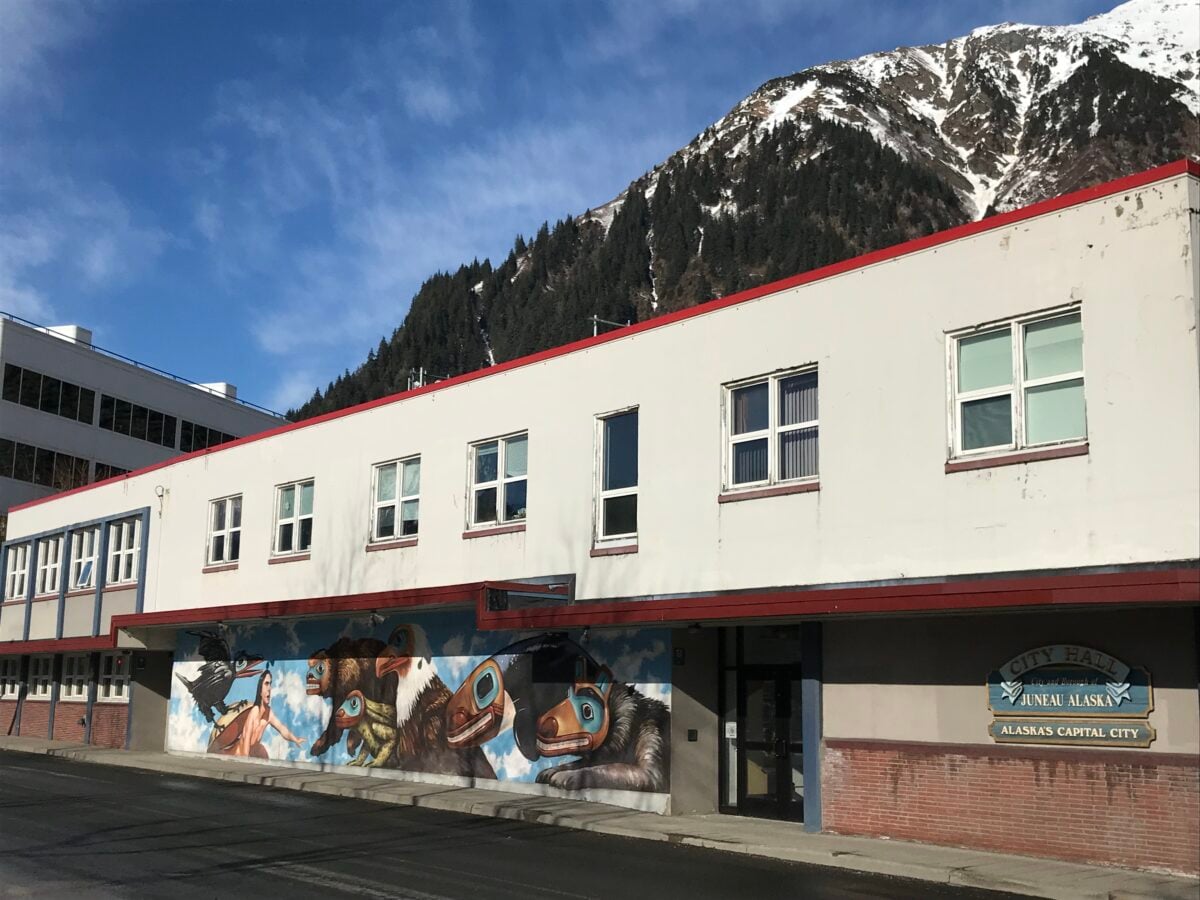
The Alaska Industrial Development and Export Authority, whose headquarters are pictured here, is leading state efforts to develop oil leases in the Arctic National Wildlife Refuge and to build roads to mining deposit in the Mat-Su and Northwest Alaska. (Photo by Nathaniel Herz/Northern Journal)

The state agency leading some of Alaska’s most polarizing development projects has approved a new communications budget, saying it needs to do a better job telling its own story amid attacks from critics.

The state-owned Alaska Industrial Development and Export Authority is run by a former chief of staff to Gov. Mike Dunleavy and is charged with promoting economic growth and expanding natural resource extraction and exports.

A screengrab from an anti-AIDEA ad campaign from the 907 Initiative advocacy group.

It is leading work to develop state-owned oil leases in the Arctic National Wildlife Refuge and also hopes to build two controversial new roads to access mining prospects in Northwest Alaska and outside of Anchorage.

Those projects have drawn sharp opposition from conservation organizations and other critics, including lawsuits, critical op-eds and campaigns that have labeled the agency “Bad AIDEA” and caricatured its leaders.

At a meeting in Ketchikan this month, board members, with no public discussion, authorized AIDEA’s staff to spend up to $700,000 a year on a new communications budget — formalizing a plan that the agency says was previously budgeted inconsistently through spending on individual projects.

The new communications plan, the agency said in its formal resolution authorizing the spending, will “ensure proper public engagement, transparency, and stewardship of the authority’s mission.” The money could go toward trade shows and conferences, responding to media inquiries and “other communications-related needs,” according to the resolution.

The agency’s executive director, Randy Ruaro, referred questions about the plan to Dave Stieren, an AIDEA employee who ran an advertising agency and hosted a conservative talk radio show before joining the Dunleavy administration.

Randy Ruaro, AIDEA’s executive director, toured a state-owned shipyard when his agency’s board met in Ketchikan earlier this month. (Alaska Industrial Development and Export Authority)

Stieren said he could not provide exact figures on AIDEA’s past communications spending, but he acknowledged that the new plan should allow the agency to meaningfully boost its public profile.

The $700,000 a year, he added, is a limit, and the agency will set a final budget through a request for proposals process.

“Mothership AIDEA has done, frankly, little to nothing on a consistent basis to tell our story,” Stieren said in an email — particularly when it comes to its loan programs that have helped finance tourism and hospitality businesses, like the Alaska Club fitness chain and Anchorage’s Bear Tooth pizza restaurant and theater.

“We’re far more than roads,” Stieren said. “But since we’ve really not promoted or showcased our efforts in traditional finance areas, I understand the narrative or lack thereof that folks may have.”

Stieren has also personally defended AIDEA on social media, including over the weekend — when he posted a conservative news website’s positive story about an agency-owned shipyard and said that “when commie libs attack AIDEA, they attack projects like this.”

AIDEA’s board chair, Bill Kendig, declined to answer questions about approval of the new communications budget when reached by phone.

At the Ketchikan meeting, one AIDEA critic, Melis Coady, credited the agency with formalizing communications spending as a “step toward accountability.” But she said that the plan doesn’t “deliver the transparency it describes” because it gives Ruaro, the executive director, authority to approve communications spending, and only requires that he report it to the board if asked.

“The authorization is broad, the dollar amount is undefined, and expenditures are approved solely by the executive director,” said Coady, who leads a conservation group called the Susitna River Coalition.

Ruaro, in an email, said AIDEA will issue reports on communications to board members “whether requested or not.”

Stieren’s social media post

SUBSCRIBE: GET THE MORNING HEADLINES DELIVERED TO YOUR INBOX

Categories
Alaska News Featured Juneau News juneau Juneau Local Juneau Local Ketchikan Local News Feeds Sitka Local

Alaska Senate advances bill to ban certain food dyes in school meals

By: Haley Lehman, Alaska Beacon

 Children pick up their school lunches. (Photo by Amanda Mills/Centers for Disease Control and Prevention)

The Alaska Senate passed a bill Monday that would ban public schools in Alaska from serving certain food dyes in school breakfasts or lunches.

Lawmakers expressed concerns that certain petroleum-based food dyes in processed foods have unhealthy side effects on children.

Sen. Bill Wielechowski, D-Anchorage, the sponsor of Senate Bill 187, said Monday, “We like to sell our petroleum to fuel our cars and generate our power plants, not to feed our kids.”

Wielechowski pointed to studies that suggested that artificial dyes are linked to increased hyperactivity, inattentiveness and allergic reactions in children.

The bill would ban red dyes Nov. 3 and No. 40, yellow dyes No. 5 and No. 6, blue dyes No. 1 and No. 2 and green dye No. 3.

The U.S. Department of Health and Human Services and the U.S. Food and Drug Administration announced a campaign in April 2025 to eliminate synthetic dyes from the U.S. food supply by the end of 2027 and to authorize natural color alternatives. Alaska proposes banning the same food dye in schools that HHS and the FDA are working with the food industry to eliminate.

The bill received strong support from Alaska Community Action on Toxics and opposition from the International Association of Color Manufacturers, which maintains that synthetic dyes are safe for consumers.

Carlee Johnson McIntosh, Petersburg School District food service director, wrote in a letter to legislators that the bill aligns with work the school district is already doing to remove synthetic dyes from school meal programs. She said the bill would not create a significant burden for the school district.

“Schools should be environments where students are set up for success, and access to nutritious meals plays an important role in that success,” Johnson McIntosh wrote. “Establishing these standards in state law would demonstrate Alaska’s ongoing commitment to student health, regardless of potential shifts at the federal level.”

The bill passed the Senate with 19 yes votes. Sen. Donny Olson, D-Golovin, was excused absent. 

If it passes the House and becomes law, it would go into effect in January 2028. Alaska would join states including Arizona, California, Delaware, Louisiana, Virginia and West Virginia in banning artificial food dyes in schools.

Categories
Alaska News Featured Juneau News juneau Juneau Local Juneau Local Ketchikan Local News Feeds Sitka Local

Alaska Senate advances resolution asking federal policymakers to protect visa programs

By: Haley Lehman, Alaska Beacon

Sen. Loki Tobin, D-Anchorage, speaks in the Alaska Senate on Monday, April 28, 2025. (Photo by James Brooks/Alaska Beacon)

The Alaska Senate advanced a resolution Monday to preserve three work visas to support Alaska’s economic security.

Alaska relies on J-1 visas to fill teacher positions, H-1B visas for highly skilled workers and the H-2B program for temporary nonagricultural workers in tourism, health care and seafood processing industries and for teachers.

Sen. Löki Tobin, D-Anchorage, said that Senate Joint Resolution 28, “puts Alaska on the record in support of these programs to fill jobs here in our state.”

The Trump administration raised the fee for highly skilled worker visas from $5,000 to $100,000 in September 2025.

Tobin said Monday that school districts in Alaska cannot absorb those costs and utilize the H-1B visa program to hire international teachers.

The Alaska House of Representatives passed a resolution in March urging the Trump administration to waive the $100,000 visa fee for international teachers. It was sponsored by Rep. Alyse Galvin, I-Anchorage.

According to Jennifer Schmitz, director of the Alaska Educator Retention and Recruitment Center, 20 school districts in Alaska employed 232 educators with J-1 visas and 341 educators with H-1B visas in 2025.

Alaska’s senior U.S. Senator, Republican Lisa Murkowski, introduced legislation in March that would exempt teachers from non-processing related fees for H-1B visas. U.S. Republican U.S. Sen. Dan Sullivan is a cosponsor. 

The visa programs support other jobs, too. Marilyn Usibelli, owner of Black Diamond Resort Co. in Healy, wrote to legislators in March that J-1 visa holders play an essential role in staffing seasonal jobs in Alaska with lawful, reliable temporary workers.

“Despite extensive local recruitment, the small year-round population in the Denali Borough simply cannot meet the seasonal demand. J-1 participants fill critical roles that allow us to maintain safe, high-quality operations, support other local businesses, and contribute to the broader Denali-area economy,” Usibelli wrote.

The resolution passed the Senate with 19 yes votes with Sen. Donny Olson, D-Golovin, absent

Categories
Alaska News

Alaska Senate advances resolution asking federal policymakers to protect visa programs

Sen. Loki Tobin, D-Anchorage, speaks in the Alaska Senate on Monday, April 28, 2025. (Photo by James Brooks/Alaska Beacon)

Sen. Loki Tobin, D-Anchorage, speaks in the Alaska Senate on Monday, April 28, 2025. (Photo by James Brooks/Alaska Beacon)

The Alaska Senate advanced a resolution Monday to preserve three work visas to support Alaska’s economic security.

Alaska relies on J-1 visas to fill teacher positions, H-1B visas for highly skilled workers and the H-2B program for temporary nonagricultural workers in tourism, health care and seafood processing industries and for teachers.

Sen. Löki Tobin, D-Anchorage, said that Senate Joint Resolution 28, “puts Alaska on the record in support of these programs to fill jobs here in our state.”

The Trump administration raised the fee for highly skilled worker visas from $5,000 to $100,000 in September 2025.

Tobin said Monday that school districts in Alaska cannot absorb those costs and utilize the H-1B visa program to hire international teachers.

The Alaska House of Representatives passed a resolution in March urging the Trump administration to waive the $100,000 visa fee for international teachers. It was sponsored by Rep. Alyse Galvin, I-Anchorage.

According to Jennifer Schmitz, director of the Alaska Educator Retention and Recruitment Center, 20 school districts in Alaska employed 232 educators with J-1 visas and 341 educators with H-1B visas in 2025.

Alaska’s senior U.S. Senator, Republican Lisa Murkowski, introduced legislation in March that would exempt teachers from non-processing related fees for H-1B visas. U.S. Republican U.S. Sen. Dan Sullivan is a cosponsor. 

The visa programs support other jobs, too. Marilyn Usibelli, owner of Black Diamond Resort Co. in Healy, wrote to legislators in March that J-1 visa holders play an essential role in staffing seasonal jobs in Alaska with lawful, reliable temporary workers.

“Despite extensive local recruitment, the small year-round population in the Denali Borough simply cannot meet the seasonal demand. J-1 participants fill critical roles that allow us to maintain safe, high-quality operations, support other local businesses, and contribute to the broader Denali-area economy,” Usibelli wrote.

The resolution passed the Senate with 19 yes votes with Sen. Donny Olson, D-Golovin, absent. 

SUPPORT: YOU MAKE OUR WORK POSSIBLE

Categories
Alaska News

Overturning of mining ban in Minnesota has Southeast Alaska tribal leaders worried about similar actions

A U.S. Senate vote overturning a mining ban on U.S. Forest Service land near Minnesota’s Boundary Waters has local tribal leaders worrying it sets a precedent for similar actions in the Tongass National Forest.

The 50-49 vote on Thursday puts the validity of all U.S. Forest Service management plans enacted over several decades into question, according to critics. President Donald Trump is expected to sign the legislation, which had already passed the U.S. House.

House Joint Resolution 140 reverses a 20-year mining moratorium enacted in 2023 by the Biden administration for about 350 square miles of Minnesota’s Superior National Forest. The resolution applies a first-ever use of a provision known as the Congressional Review Act (CRA) — which can overturn federal agency rules and regulations on a majority vote of Congress and the president’s approval — to a management decision on Forest Service land.

Concerns about the resolution’s impact on tribal sovereignty were expressed by White Earth Nation located within Minnesota, which stated the legislation “ignores both science and treaty obligations.” Similar worries about the policy implications in Alaska — and transboundary mining issues involving Canadian and First Nations governments — were expressed during a Central Council of the Tlingit and Haida Indian Tribes of Alaska’s executive council on Friday.

“I do think this sets a precedent that is quite concerning,” said Ku.seen Jacqueline Pata, the tribe’s first vice president.

Among the concerns, said Will Micklin, the council’s fourth vice president, is “it was pushed by Sen. (Dan) Sullivan as the champion of this legislation in the Congress.” Sen. Lisa Murkowski and U.S. Rep. Nick Begich III, the other members of Alaska’s all-Republican congressional delegation, also voted for the resolution.

“It’s a test case for what could be applied in other areas, like Alaska in particular, and what this involved was the ceded lands of White Earth, so this is just the example of the extent that the Congress is now willing to withdraw protections that affect tribal interests,” Micklin said.

An 1854 land cession treaty opened an area along the shore of Lake Superior to mining while creating several reservations where tribal citizens retained exclusive land-use rights. Micklin said Tlingit and Haida’s efforts to seek environmental safeguards for waterways affected by transboundary mining activity and full scrutiny of large-scale proposed mining projects “could be fruitless if, in fact, the CRA theory of the Congress is that they can use that act to strip away environmental protections.”

Amanda Coyne, a spokesperson for Sullivan, stated in an email Friday that “it’s important to note that H.J. Res. 140 did not authorize any particular mine, and any proposed project would go through state and federal environmental permitting processes.” A Chilean mining company, Antofagasta, which has long sought the mine near the Boundary Waters Canoe Area Wilderness, still needs extensive permits to proceed with the project.

“Senator Sullivan sided with building trades, local leaders, and people who live in the area in support of Rep. Stauber’s legislation to overturn the Biden administration’s preemptive unilateral lock up of 225,504 acres in the Superior National Forest in Minnesota for any mineral production,” Coyne wrote. “Alaska is all too familiar with these kinds of sweeping, preemptive actions. The Biden Administration actions — over 70 in Alaska alone — stopped responsible resource development and negatively impacted Alaska’s economy over the objections of those who live closest to those projects.”

Concerns expressed by tribal and other officials about mining impacts and cleanup — notably of the long-abandoned Tulsequah Chief Mine where decades of efforts have lingered — also have been a focus of Sullivan’s, Coyne stated.

“He has raised this issue with successive Canadian prime ministers and continues to push British Columbia to take concrete steps to clean-up the Tulsequah Chief mine site,” she wrote. “He continues to (work) closely with tribal organizations, including Tlingit & Haida, nonprofits and the State of Alaska to pressure both the Canadian government and Canadian mining companies to clean up their toxic mess at Tulsequah Chief and prevent any new pollution.”

This story was first published by the Juneau Independent.

The post Overturning of mining ban in Minnesota has Southeast Alaska tribal leaders worried about similar actions appeared first on Chilkat Valley News.

Categories
Alaska News

Alaska LNG export project requires further massive public subsidy

On the Kenai Peninsula, a dormant liquefied natural gas export plant could be repurposed to receive cargoes of imported LNG under a plan being studied by Harvest, an affiliate of oil and gas company Hilcorp. The fuel would be transferred from ships to the tanks on the left, still in liquid form, before being converted back into gas and sent into a pipeline. (Courtesy Harvest)

Sponsors for the proposed 807-mile Alaska gas pipeline and liquefied natural gas processing and export facilities are seeking additional massive public subsidies to make the project viable. Even fallout from the largest “oil disruption in history” isn’t enough to overcome the need.

Although President Trump initially boasted that the Alaska LNG export project would be a signature accomplishment of his administration, the project appears vastly over budget and shrouded in secrecy. 

The project is being advanced by a partnership of the private firm Glenfarne Group, which has a 75% share, and 8 Star Alaska LLC, a private subsidiary of the state-owned Alaska Gasline Development Corporation, with a 25% share. AGDC gave 75% of 8 Star Alaska’s assets, including permits, rights of way, research and data, to Glenfarne in exchange for a commitment to pursue the project to a “final investment decision” on whether to build it. The final investment decision, due at the end of 2025, is still pending and months behind schedule.

Legislation introduced by Republican Gov. Mike Dunleavy would institute a massive tax break for the project and forgo billions in future revenues for the State of Alaska and local municipalities.

The Alaska Department of Revenue estimated Dunleavy’s proposal would equate to a roughly 90% reduction in property tax revenue, once the pipeline is at full capacity. Dan Stickel, an economist with the Department of Revenue, told the House Resources Committee on March 25 that AGDC and Glenfarne have said the project will not move forward without property tax relief. 

The often cited $44 billion cost estimate for the 807-mile pipeline from the North Slope to Cook Inlet is 10 years out-of-date. Efforts to build it have been unsuccessful for decades due to high costs and competition from sources of gas closer to tidewater. The Alaska Department of Revenue recently updated its cost estimate to $46 billion, a number still far below what observers expect the true cost to be. Project sponsors have updated cost estimates but refuse to release them. 

Recent surges in inflation mean the already expensive project is now much more costly; sales prices for the gas are also likely much higher, as high as $20 per thousand cubic feet or about ​​​double today’s import prices and even more uneconomic compared to alternatives. Despite the recent cease fire, the war in Iran is further driving up prices of everything. 

Letters of Intent from potential purchasers of Alaska LNG continue to be signed but are not binding commitments. A Letter of Intent by TotalEnergies to purchase 2 million tons per year of Alaska LNG for 20 years is subject to the final investment decision. Although Glenfarne still maintains that construction will begin this year, it doesn’t have a single binding contract with buyers. Thus, imminent construction appears unlikely except possibly as a photo op. 

Legislators are concerned, Alaskans should be too

The Alaska Senate Resources Committee recently introduced Senate Bill 275 that makes significant revisions to the statutes governing AGDC. The bill would enact a surcharge on exported LNG and put new conditions on any direct state investment in projects.

Sen. Resources Chair Cathy Giessel, the author of the bill, said in a newsletter to constituents: 

“Glenfarne was unknown until 18 months ago. They have not completed N. America projects. But they want a 92% reduction in our local property taxes. They are holding all financial information about the project confidential. This is not a good business position for our state to be in. We get to find out the cost of the gas for Alaskans after the project sets the price in secret.”

Even AK LNG proponent, Alaska House Majority Leader Chuck Kopp, R-Anchorage, who recently urged Alaskans to speak with a unified voice in support of the project, noted growing ambivalence.  “What [investors] cannot model is political incoherence. From the perspective of Washington and Wall Street, confusing or contradictory signals from Alaska’s elected leadership are more destabilizing than permitting hurdles. No financier commits billions into a jurisdiction that sounds ambivalent. No federal partner prioritizes a state that publicly undercuts itself,” Kopp wrote in a recent op-ed in the Anchorage Daily News.

More than four decades of effort to build a North Slope gas line for export have produced only failure, exorbitant costs and public subsidies of almost a billion dollars. This deal is bad for the climate and bad for Alaska. Alaska’s leaders should call it what it is, an uneconomic pipe dream, and walk away. 

SUBSCRIBE: GET THE MORNING HEADLINES DELIVERED TO YOUR INBOX

Categories
Alaska News

Alaska Beacon reporters take home journalism awards

Alaska Beacon reporter Corinne Smith and editor Claire Stremple pose withe the outlet’s awards at the Alaska Press Club banquet on April 18, 2026.

The Alaska Beacon team took home five awards from the Alaska Press Club contest for our coverage in 2025.

As we cover statewide news with a government and politics lens, we are especially honored that James Brooks’ reporting earned a first place award in the Reporting on Government and Politics category. His story uncovered that the U.S. Department of Homeland security sped up the timeline for implementing a new rule that would expose protesters to additional fines and penalties for activities taking place near federal buildings.

Yereth Rosen hauled in awards on all facets of her beat: two first place awards in the science and environment reporting categories and a second place win in the reporting on health category.

Brooks and Corinne Smith took first prize in the Education Reporting category for their story about Alaska lawmakers’ override of Gov. Mike Dunleavy’s veto of historic education funding increases.

You can check out our award-winning coverage here:

SUPPORT: YOU MAKE OUR WORK POSSIBLE

Categories
Alaska News

Alaska Senate advances bill to ban certain food dyes in school meals

Children pick up their school lunches. (Photo by Amanda Mills/Centers for Disease Control and Prevention)

Children pick up their school lunches. (Photo by Amanda Mills/Centers for Disease Control and Prevention)

The Alaska Senate passed a bill Monday that would ban public schools in Alaska from serving certain food dyes in school breakfasts or lunches.

Lawmakers expressed concerns that certain petroleum-based food dyes in processed foods have unhealthy side effects on children.

Sen. Bill Wielechowski, D-Anchorage, the sponsor of Senate Bill 187, said Monday, “We like to sell our petroleum to fuel our cars and generate our power plants, not to feed our kids.”

Wielechowski pointed to studies that suggested that artificial dyes are linked to increased hyperactivity, inattentiveness and allergic reactions in children.

The bill would ban red dyes Nov. 3 and No. 40, yellow dyes No. 5 and No. 6, blue dyes No. 1 and No. 2 and green dye No. 3.

The U.S. Department of Health and Human Services and the U.S. Food and Drug Administration announced a campaign in April 2025 to eliminate synthetic dyes from the U.S. food supply by the end of 2027 and to authorize natural color alternatives. Alaska proposes banning the same food dye in schools that HHS and the FDA are working with the food industry to eliminate.

The bill received strong support from Alaska Community Action on Toxics and opposition from the International Association of Color Manufacturers, which maintains that synthetic dyes are safe for consumers.

Carlee Johnson McIntosh, Petersburg School District food service director, wrote in a letter to legislators that the bill aligns with work the school district is already doing to remove synthetic dyes from school meal programs. She said the bill would not create a significant burden for the school district.

“Schools should be environments where students are set up for success, and access to nutritious meals plays an important role in that success,” Johnson McIntosh wrote. “Establishing these standards in state law would demonstrate Alaska’s ongoing commitment to student health, regardless of potential shifts at the federal level.”

The bill passed the Senate with 19 yes votes. Sen. Donny Olson, D-Golovin, was excused absent. 

If it passes the House and becomes law, it would go into effect in January 2028. Alaska would join states including Arizona, California, Delaware, Louisiana, Virginia and West Virginia in banning artificial food dyes in schools.

SUPPORT: YOU MAKE OUR WORK POSSIBLE

Categories
Alaska News Featured Juneau News juneau Juneau Local Juneau Local Ketchikan Local News Feeds Sitka Local

Investigation into massage parlors in Alaska leads to arrests on felony sex trafficking charges

By: Haley Lehman, Alaska Beacon

An FBI Evidence Response Team collects and documents evidence at an alleged illicit massage parlor. (Image Courtesy of the FBI Anchorage Field Office)

Multiple law enforcement agencies arrested seven people in Anchorage and the Matanuska-Susitna Valley last week on charges of sex trafficking after a yearlong investigation found that multiple massage parlors were fronts for criminal enterprises.

“Human trafficking criminal enterprises operate in plain sight while victims are exploited for labor, services and commercial sex acts through force, fraud or coercion,” Matthew Schlegel, special agent in charge of the FBI Anchorage Field Office, said during a press conference Thursday.

Anchorage Police Department, Alaska State Troopers, the FBI Anchorage Field Office are part of a task force that investigates sex and human trafficking. Homeland Security Investigations, U.S. Customs and Border Protection, Army Criminal Investigation Division, the U.S. Coast Guard, Wasilla Police Department and the Anchorage Airport Police Department assisted in the investigation.

Officers searched Jasmine Spa, Zen Massage, Stream Health Spa of Wasilla, Phoenix Health Spa, Owl Health Spa, Renew Day Spa, Red House Massage of Anchorage and two Anchorage residences in connection with the investigation.

Law enforcement arrested Lee Merrill Van Ness, 72, of Anchorage, Terry Allen Volkman, 53, of Anchorage, Hui Zhang, 44, Hong Zhen Li, 51, of New York, Guoguo Zhang, 54, of Wasilla, Tuan Huynh, 34, of Anchorage, and Xiaotian Xiong, 40, of New York, on felony charges of sex trafficking.

Investigators collect evidence during an investigation into alleged illicit massage parlors. (Image courtesy of the Alaska State Troopers)

Alaska State Troopers Colonel Maurice Hughes said during a press conference Thursday that they targeted these illegitimate operations because they were exploiting individual and vulnerable adults. 

Hughes said that the victims were offered support and connected with resources.

“These individuals were not the focus of the investigation. They were the reason for the investigation,” he said.

Law enforcement identified massage parlors that advertised commercial sexual services online during the investigation. The investigation entailed undercover officers visiting various massage parlors and posing as customers looking for sex in exchange for money, a criminal complaint stated. Law enforcement allege that the seven people arrested harbored victims of human and sex trafficking and forced them to pose as masseuses.

The massage parlors may be linked to international organized crime organized out of Flushing, New York, and Monterey Park, California, according to charging documents. Law enforcement may file additional charges as the investigation continues.

Anchorage Police Chief Sean Case attributed the length of the investigation to the complex nature of the allegations.

Alaska Bureau of Investigation Commander Tony Wegrzyn said that investigators have “a mountain of evidence to go through.”

According to Wegrzyn, all victims were from outside of Alaska.

Categories
Alaska News

Investigation into massage parlors in Alaska leads to arrests on felony sex trafficking charges

An FBI Evidence Response Team collects and documents evidence at an alleged illicit massage parlor. (Image Courtesy of the FBI Anchorage Field Office)

Multiple law enforcement agencies arrested seven people in Anchorage and the Matanuska-Susitna Valley last week on charges of sex trafficking after a yearlong investigation found that multiple massage parlors were fronts for criminal enterprises.

“Human trafficking criminal enterprises operate in plain sight while victims are exploited for labor, services and commercial sex acts through force, fraud or coercion,” Matthew Schlegel, special agent in charge of the FBI Anchorage Field Office, said during a press conference Thursday.

Anchorage Police Department, Alaska State Troopers, the FBI Anchorage Field Office are part of a task force that investigates sex and human trafficking. Homeland Security Investigations, U.S. Customs and Border Protection, Army Criminal Investigation Division, the U.S. Coast Guard, Wasilla Police Department and the Anchorage Airport Police Department assisted in the investigation.

Officers searched Jasmine Spa, Zen Massage, Stream Health Spa of Wasilla, Phoenix Health Spa, Owl Health Spa, Renew Day Spa, Red House Massage of Anchorage and two Anchorage residences in connection with the investigation.

Law enforcement arrested Lee Merrill Van Ness, 72, of Anchorage, Terry Allen Volkman, 53, of Anchorage, Hui Zhang, 44, Hong Zhen Li, 51, of New York, Guoguo Zhang, 54, of Wasilla, Tuan Huynh, 34, of Anchorage, and Xiaotian Xiong, 40, of New York, on felony charges of sex trafficking.

Investigators collect evidence during an investigation into alleged illicit massage parlors. (Image courtesy of the Alaska State Troopers)

Alaska State Troopers Colonel Maurice Hughes said during a press conference Thursday that they targeted these illegitimate operations because they were exploiting individual and vulnerable adults. 

Hughes said that the victims were offered support and connected with resources.

“These individuals were not the focus of the investigation. They were the reason for the investigation,” he said.

Law enforcement identified massage parlors that advertised commercial sexual services online during the investigation. The investigation entailed undercover officers visiting various massage parlors and posing as customers looking for sex in exchange for money, a criminal complaint stated. Law enforcement allege that the seven people arrested harbored victims of human and sex trafficking and forced them to pose as masseuses.

The massage parlors may be linked to international organized crime organized out of Flushing, New York, and Monterey Park, California, according to charging documents. Law enforcement may file additional charges as the investigation continues.

Anchorage Police Chief Sean Case attributed the length of the investigation to the complex nature of the allegations.

Alaska Bureau of Investigation Commander Tony Wegrzyn said that investigators have “a mountain of evidence to go through.”

According to Wegrzyn, all victims were from outside of Alaska.

SUBSCRIBE: GET THE MORNING HEADLINES DELIVERED TO YOUR INBOX