Thanks for helping keep the Chilkat Valley informed and engaged. It’s the basis of our families, neighborhoods, cities and society. Your funds are used to directly support our local news reporting.
Thank you, The staff of the Chilkat Valley News.
Please enable JavaScript in your browser to complete this form.
Please enable JavaScript in your browser to complete this form.
NOTN-The results are in, residents in Juneau have been helping shape the capital city’s long-term future at “Juneau Futures” workshops and with a community survey.
“Juneau’s had Comprehensive Plans on the books for decades, since the 1900s, so it’s basically a big picture guide that helps us decide where and how to develop, usually, over the next 20 to 30 years.” Said Senior Planner Minta Montalbo, “I think it’s important to keep in mind that the Comprehensive Plan reflects community priorities, and it connects our values and goals with CBJ decision makers, with policies and actions. It’s like a reference point for decisions on how to best use our land and where to focus our resources.”
The effort is part of the “Our Juneau, Our Future” comprehensive plan update, which gathered input through 14 in-person workshops and an online survey aimed at guiding development in Juneau over the next 20 years.
The workshops asked residents 3 major questions, Where should Juneau grow? What does Juneau need to do to prepare for the future? And how should Juneau grow?
According to findings released by CBJ, participants outlined several approaches for where that growth should happen. Many supported investing in central areas like downtown Juneau and Lemon Creek.
Quotes in italics will be pulled directly from CBJ’s results.
Downtown Juneau and Lemon Creek were popular development areas with many participants expressing interest in building activity in and around central Juneau.
Others prioritized established neighborhoods such as the Mendenhall Valley, emphasizing investment near current residents.
Investments should focus on infill and areas with existing infrastructure.
Additional support emerged for developing multiple hubs, including Auke Bay, seen by some as an alternative community center, others pointed to North Douglas as a next step for expansion due to its available land.
North Douglas is the next logical step for development in the next 20 years, and then we can focus on West Douglas.
Across all responses, one issue stood out: housing.
Participants consistently identified it as the community’s top priority, even noting that “everything connects to housing.”
Housing was the most important issue for many participants. While approaches differed, it is clear that Juneau needs more housing solutions.
Respondents also stressed the importance of protecting neighborhoods from natural hazards like flooding and avalanches, and called for diversifying Juneau’s economy beyond tourism.
“Folks are focused mainly on flooding and protecting the homes in the valley, but we’re also hearing renewed discussion about landslide dangers and avalanches, so we’re going to want to be looking at that in the new comp plan.” Montalbo said, “Not surprisingly, housing for all definitely remains a huge priority, and when we’re talking about housing, housing options that suit a variety of needs. And then I think the third biggest category is economic diversification. Again, not a new topic, but we’re hearing a lot of concern about trying to strengthen year round industries, and find a balanced approach to tourism. We want to recognize the economic contribution, but people are also asking that we care for Juneau’s unique small town characteristics at the same time.”
Once participants had decided how Juneau should grow, they were asked to see how their scenario would hold up against future conditions, such as potential increase or decrease in tourism, funding, and natural hazards.
Participants said they expect tourism to increase, while state and federal funding may decline and natural hazards may become more severe.
In workshop scenarios, residents adjusted their priorities accordingly, shifting resources toward housing, hazard mitigation, and economic resilience when faced with those challenges, notably when faced with a decrease in federal funds, participants primarily divested from Remote Area Infrastructure and Waterfront Development, viewing them as non-essential “luxuries” without federal support.
According to the findings particpants felt, “no matter the strategy, growth should consider existing investment, current residents, housing needs, and hazard risk.”
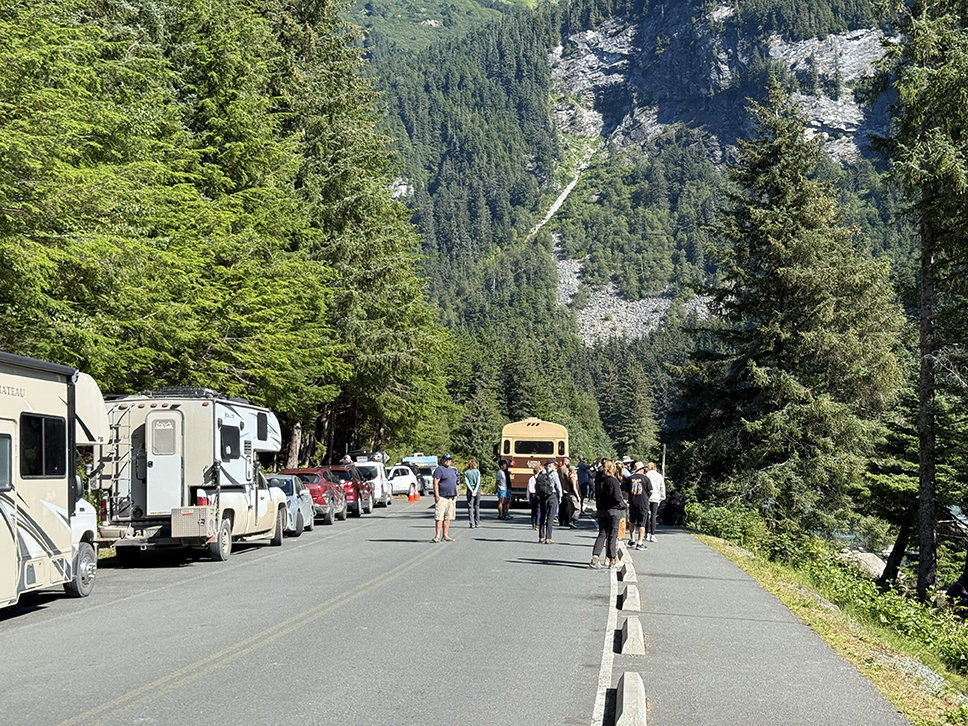
(Rashah McChesney/Chilkat Valley News) After a tour bus parked in the street, a crowd gathers in the road along the Chilkoot River to watch a sow and her four cubs on Sunday, August 24, 2025, near Haines, Alaska.
Alaska Division of Parks managers will enforce a tour-permit regulation prohibiting large buses in the Chilkoot Corridor this year.
The change dates back two years, when the Alaska Division of Parks announced a new commercial tour-permit regulation prohibiting buses with capacity over 15 passengers in the Chilkoot Lake State Recreation Site.
Regional parks superintendent Brady Garasky said this week that state parks told permit holders the enforcement would begin in 2025, but decided to extend the sunset period an additional year because of “feedback from operators.”
That meant last year, tour operators like Alaska Mountain Guides and the Chilkoot Indian Association’s Alaska Nature Tours could continue to run school buses through the popular tourist destination, with the understanding that in 2026 the vehicles would be prohibited.
Garasky said all commercial operators were notified of the initial permit stipulation and of the extension.
The Chilkoot area has long been a point of contention with multiple user groups, both local and tourists, vying for limited space.
The corridor, from the bridge at the mouth of the Chilkoot River up to the lake, is also a popular, but unofficial, bear-viewing area.
Last summer a sow with four cubs drew big crowds, including instances of tour buses stopping in the road to let passengers out for bear-viewing, which Garasky at the time said was a permit violation.
The stated rationale for the change, however, isn’t just about bears, Garasky said, and the goal won’t be to lower the overall number of visitors at the park. Rather, state parks staff hope requiring smaller vehicles will disperse visitors along the corridor and ease congestion issues.
Large buses dropped off big crowds in concentrated areas, and the vehicles themselves took up multiple parking spaces and area on the road. In some instances those vehicles blocked access for other users like anglers, who were unable to find parking, Garasky said.
Parking could yet be a challenge if tour operators replace buses with multiple smaller vehicles.
Large bus operators have not said what their plans are.
The Chilkoot Indian Association’s Zach Wentzel, who heads CIA’s tourism initiative Discover Deishu, said he would not talk about the permit stipulation or plans for the Alaska Nature Tours vehicle fleet.
Alaska Mountain Guides also declined to comment.
Other local tour operators said they would be unaffected. Karen Hess said she and her husband Duck would no longer be operating tours, and Joe Ordonez of Rainbow Glacier Adventures said all of his company’s existing vehicles were below the size limit.
In addition to the congestion challenge, the change is also being pitched as a benefit for the road infrastructure itself, which Garasky said was not built for heavy vehicles and shoulders and culverts are showing signs of wear.
The large-vehicle ban only applies to commercial tour permit holders. Non-commercial users can still drive personal-use large vehicles into the recreation site.
Garasky said that for the time being, the large-vehicle ban is likely to be the only major change to area regulations.
“This is a fairly significant change to the commercial operating stipulations so we want to give it time to monitor it and see if it has the intended impact,” Garasky said.
Education Commissioner Deena Bishop and David Langford, superintendent of Mt. Edgecumbe High School give an update to the State Board of Education, which administers the state boarding school at their annual in-person meeting in Juneau on Mar. 10, 2026. (Photo by Corinne Smith/Alaska Beacon)
The Alaska State Board of Education moved to establish a special committee to review ongoing issues and make recommendations to improve operations at the state-run boarding school, Mt. Edgecumbe High School.
After a turbulent year of budget cuts, staff and administrative changes and more than 100 students disenrolling this year, a delegation of lawmakers made an impromptu visit to the school in February to investigate. Legislators have pressed school officials and the Alaska Department of Education and Early Development, which operates the school, for explanations and improvements. Their interest has spotlighted the school’s ongoing maintenance needs and sparked a conversation about ways to increase support for remaining students.
Members of the State Board of Education, Kimberley Bergey (left), Kathryn McCollum, Sally Stockhausen, education commissioner Deena Bishop (center), Pamela Dupras, and Lt. Col. James Fowley (right) are seen in a board meeting in Juneau on Mar. 11, 2026. (Photo by Corinne Smith/Alaska Beacon)
The state Board of Education is charged with administering the school, along with DEED. The school normally serves roughly 400 students, the majority of whom are Alaska Native and from rural communities across the state.
After hearing a presentation about the issues at Mt. Edgecumbe at their annual meeting in Juneau on Mar. 10, board members voted unanimously to establish an ad-hoc committee. The committee will be tasked with reviewing concerns related to student disenrollment, student services, academic performance and school climate before it presents recommendations to the full board in October.
After the vote, board chair Sally Stockhausen said the new committee will interface with the board and the current local Mt Edgecumbe High School Advisory Board — a local board that advises the superintendent. The specifics will be negotiated in the coming weeks and months.
“This is brand new. We’re going to figure it out,” Stockhausen said. “My basic understanding is they will come to us with recommendations, and then we’ll decide how that’s going to work, and if and what type of action we’ll take based on that.”
Within the next 30 days, officials with DEED will be tasked with assembling the new committee. It may include representatives from the local advisory board, parents, students, staff members, alumni, an education expert and tribal representatives.
On Monday, Stockhausen appeared before members of the House Education Committee as part of the confirmation process for her reappointment for another five year term on the state board. She answered some questions about the board’s oversight of Mt. Edgecumbe High School, and said board members are working to improve communication with the school.
“We used to always have the superintendent come and give a verbal report. And at some point it kind of just shifted, and it became, we would get written reports. So we did ask for that to come back,” she said.
Stockhausen said she’s also requested updates from the local advisory board to the full state board of education.
“The advisory board’s role is to advise the superintendent, but it would be good, I think, to add a component where that could come back to us,” Stockhausen said. “We just need some communication improvements.”
Board hears update on conditions at Mt. Edgecumbe
Mt. Edgecumbe High School Superintendent David Langford and Deena Bishop, state education commissioner, have given a series of presentations to lawmakers in recent weeks following legislator’s visit to the school on the conditions and improvements being made at the high school.
Education Commissioner Deena Bishop (right) and David Langford, superintendent of Mt. Edgecumbe High School give a presentation to the Alaska State Board on recent issues with students dis-enrolling, maintenance personnel and budget changes on Mar. 10, 2026. (Photo by Corinne Smith/Alaska Beacon)
On Mar. 10, they gave a similar presentation to the state board, which is charged with managing the school.
Langford and Bishop described the state’s recent efforts to address the school’s budget deficit and maintenance needs at the school this year, after budget cuts, reductions to staff and a change in administration last year.
Langford said those efforts include significant upgrades to the kitchen, dorms and common areas, and more facilities upgrades are planned for this summer, including replacing dorm roofs and ventilation systems. DEED also hired a new contractor to run the residential dorms, and have created more opportunities for student input and leadership in school operations.
Mt. Edgecumbe High School Superintendent David Langford and Deena Bishop, education commissioner gave a series of presentations on maintenance needs, including upgrading student dorm living spaces in the summer of 2025. They presented to the state Board of Education at their meeting in Juneau on Mar. 10, 2026. (Screenshot from DEED presentation)Recent upgrades and improvements made to the Mt. Edgecumbe High School student dorms in the summer 2025 are shared in a presentation to the state Board of Education at their meeting in Juneau on Mar. 10, 2026. (Screenshot from DEED presentation)
“This is a problem decades in the making of funding not coming through, projects not being managed, maintenance not being kept up, and funding being cut. I think six, seven years ago, we had seven maintenance people, and today we have one-and-a-half,” Langford told the board on Mar. 10. “And keeping up with a campus that size, with one and a half people, they do an amazing job, but they just can’t do everything that needs to be done. So it is a funding issue for Mt. Edgecumbe.”
Bishop emphasized that the administration is making improvements, and the school is moving in a positive direction.
“A lot of school issues are adult issues and not children issues,” Bishop told the board, pointing to management of the school. “I would say a lot of these concerns were more about adults than they were students and what they were receiving. So I do believe that you know that we’re moving forward with sorting out the adult issues, and moving forward in the right direction for kids.”
Following the board meeting, board member and Mt. Edgecumbe alumni Pamela Dupras said she was shocked by the photos Langford presented of school facilities before some upgrades were made in August, including rusted kitchen appliances, leaks, and broken and worn dorm furniture.
“A picture is worth a thousand words, and I was shocked to see the condition of the dormitory, the kitchen, and within a short period of time that has been resolved,” Dupras said. “So I’m curious to see, I want to know what the deeper story is and why this is necessary. So I am glad that we will have an ad hoc committee that can look further into it.”
Stockhausen said in an interview at the meeting only that the maintenance needs had been “longstanding,” and that the ad-hoc committee will be reviewing them. She said she has confidence in Langford managing improvements. “I think Mr. Langford is doing an outstanding job addressing all of those, and it’s just a steady, steady improvement,” she said.
Lawmakers and the local advisory board have raised concerns about Langford being superintendent of both Mt. Edgecumbe and the Chatham School District, which serves approximately 175 students across rural schools in Southeast Alaska, particularly considering the challenges at Mt. Edgecumbe.
Langford has maintained he is able to fulfill the duties of both roles of superintendent. At the board meeting, Langford said in an interview he is looking forward to working with the new ad-hoc committee.
“I’m very, very hopeful that all the attention is going to result in really good things for the school and for the students,” he said. “One of their directives is to investigate academic performance, which I think is really important, and maybe something really good can come from that. And they’re also tasked with looking at buildings and funding and all the current issues that we’re addressing. So I don’t see any problem with it at all. So looking forward to having people come and visit and go through the school and give recommendations.”
But Langford admitted reporting to four school boards is a challenge. He currently reports to the state board of education, the local advisory board, the new ad-hoc committee, as well as the Chatham school board.
“All these boards, that’s probably the hardest part of my job,” Langford said, and added that he was attending the two-day state board meeting and also attending the Chatham school board meeting taking place online in the evening. “So yeah, that part of it is a bit much. But okay, it’s part of the job. I’m up for it. People have a right to have their voices heard and be a part of the process. So I’m happy for that.”
Education Commissioner Deena Bishop (right) and David Langford, superintendent of Mt. Edgecumbe High School give a presentation to the Alaska State Board on recent issues with students dis-enrolling, maintenance personnel and budget changes on Mar. 10, 2026. (Photo by Corinne Smith/Alaska Beacon)
Members of Mt. Edgecumbe High School’s local advisory board are urging the state to re-open hiring for the superintendent of the state-run boarding school.
In a Mar. 6 letter, the local board asked the Alaska State Board of Education and the education commissioner to immediately re-open the superintendent position. The state board is responsible for overseeing the school, and the Alaska Department of Education and Early Development is charged with operating the high school.
Last year, DEED launched a superintendent hiring search after a group of Mt. Edgecumbe teachers and staff wrote a letter of no confidence in the former superintendent, who then resigned. DEED hired David Langford to serve as superintendent starting in July.
Local advisory board members said in the letter they were not consulted in DEED’s hiring process, as required by policy. “We believe the position should be filled through a thorough, equitable and transparent hiring process,” they wrote.
In the year since Langford’s hire, the school officials made significant budget and staff cuts, hired a new contractor running the student dorms, and seen a wave of student disenrollments prompting lawmakers to make an impromptu visit and spotlight maintenance needs, student services and public attention on the school.
The local board also raised concerns that Langford is superintendent of both the Chatham School District and Mt. Edgecumbe High School at the same time. That means he is directing Mt. Edgecumbe High School through a period of change and challenges, while at the same time managing the Chatham School District, which serves approximately 175 students across four Southeast Alaska communities.
“Additionally, we believe that it is imperative to assert that the Superintendent for MEHS remain a sole and dedicated role and not have shared leadership responsibilities of any other schools or districts, so that the full attention and undivided professional focus needed can be committed to this position,” the letter said.
Members of the local board did not immediately respond to an interview request on Thursday.
Sally Stockhausen, chair of the state board of education, responded to the local board in a letter on Mar. 13, and said that a new special committee created by the board will be reviewing its concerns, gathering input and reviewing options including issues related to governance and leadership.
At the state board meeting in Juneau on Mar. 10, board member Pamela Dupras, also a Mt. Edgecumbe High School alumni, asked Deena Bishop, education commissioner Langford to address the request and ongoing concerns.
“Because we have been receiving emails, and the emails ask for recall for the superintendent, and then the second part of that was the committee,” Dupras said, referring to the new committee to focus on the school.
Langford acknowledged the local board had wanted to have input in his hiring process. He said he was first hired by the Chatham School District and later learned about the issues at Mt. Edgecumbe and wanted to help. Last month, Langford testified to lawmakers that he was approached by former Wasilla Sen. Mike Shower to run both districts.
Langford said he only agreed to sign on to both superintendent roles with the permission of the board of Chatham School District.
“From my perspective, it’s worked out very, very well. I think Chatham has a lot of benefits, having me being closely connected to DEED and all of you,” he told the state board. “Just being the superintendent of Chatham, I probably wouldn’t be sitting here right now. So that’s been a really big benefit.”
Bishop told the state board she addressed some of the local advisory board’s concerns at their last meeting on Feb. 26. But she said re-opening superintendent hiring would be a “critical error,” and defended Langford’s experience and leadership.
“Folks that know me know when there’s time to hire we do engage a larger group. But this was critical. School needed to be opened,” she said.
Bishop said the department rushed to hire Langford and make several needed facilities improvements in order to open the school in August, including upgrades to the kitchen and student dorms.
“So mistakes were made. We rushed on some things, not on others, but I think we’re moving forward in a great place. And I respect people’s opinions. I’ve read that letter as well,” she said.
Bishop said she understands the local advisory board’s concerns, and acknowledged that they had no input in hiring, but asked for time and trust in Langford to continue as superintendent.
“I would just ask parents, I would ask community members, I would ask legislators, as I have, to investigate a little bit more and see — are we moving forward with good things for young people? And we are. Are we working through the issues adults have? We are. But I don’t want adult concerns and issues to overshadow what we do for children, and what we are held to do with this mission of education.”
This screenshot shows part of a map published by the Alaska Department of Natural Resources showing the Dalton Highway corridor between the Yukon River and the North Slope Borough’s southern boundary. (Screenshot)
The state of Alaska is starting to plan where new trails or roads may branch off the Dalton Highway in Interior Alaska.
The choices made during the process likely have implications for hunting, fishing and tourism access, as well as the hundreds of people who live in the sparsely populated area.
On Wednesday, the Alaska Department of Natural Resources announced that it will take public input through late June about “public access routes to and across state selected lands” near the Dalton Highway.
The proposed Ambler Road intersection with the Dalton Highway is authorized under a separate program and is not being considered in this new effort, a DNR employee said.
This week’s announcement comes after the federal government withdrew claims to more than 2.1 million acres of land along portions of the highway. That withdrawal would allow the state to claim the land under the Alaska Statehood Act and take ownership.
Environmental groups have filed suit to stop the transfer, and the case remains in court.
No public meetings on potential intersections and trail access have been scheduled yet, but DNR said they will be subject to public notice and listed online.
The Dimond Courthouse building, home to the Juneau offices of the Alaska Department of Law, is seen across the street from the Alaska State Capitol on Friday, May 27, 2022. (Photo by Lisa Phu/Alaska Beacon)
Reporter James Brooks regularly requests public information under the Freedom of Information Act and uses public documents, including those available through Alaska’s Court system, to do his job. As we observe Sunshine Week, an annual event that highlights the importance of open records and transparency in government, he shares a few thoughts.
These are big cases with major national implications.
They’re also going to be difficult to follow.
The Alaska Court System does an excellent job of listing new cases — it publishes lists of new civil and criminal cases daily — but when it comes to automatically notifying people about ongoing civil proceedings, there’s room for improvement.
There’s no way to be automatically notified when there are updates to civil cases, such as when someone files a motion, makes a written argument or schedules oral arguments.
That might seem like a niche problem, but it’s one that has implications across the state.
An individual Alaskan might be able to keep track of a case they care about by checking Courtview on a daily or weekly basis, but that process is physically impossible for a reporter who might want to follow dozens or hundreds at a time.
If a reporter doesn’t know about something, they can’t report on it. While court rules set specific timelines for some filings, it’s impossible to predict the unexpected, and a reporter can’t ask for a file if they don’t know it exists.
In a perfect world, there would be enough reporters to make regular checks on all cases of interest. We don’t live in that perfect world.
Alaskans filed 2,569 civil cases in Alaska superior courts during the last fiscal year. There were more than 7,500 civil cases in district courts during the same period.
The Alaska court system has a useful system, TrueFile, for following criminal cases. There isn’t a similar system for civil cases, and there’s a reason for that: Civil courts deal with things like divorces and similar actions that are normally kept confidential.
Alaska has a constitutional right to privacy, after all.
But what about issues of public concern? Without a notification system, it’s impossible to stay abreast of what’s happening.
We know the court system is working on this problem — at the Beacon, we’ve certainly pestered them enough — but because it’s Sunshine Week, we thought we should shed a little light on a problem we’ve been dealing with for a long time.
The court system has been doing a good job of improving access. When we asked for a list of newly filed cases, they added it to their website.
At courthouses, there are now public terminals where reporters and members of the public can examine documents immediately, in any case, without cost. That lets us easily keep an eye on things across the state.
But for all those improvements, there’s still room for things to be better.
The lack of automatic notification is a problem for accused and accuser alike. If a business is accused of violating Alaska’s law requiring good faith and fair dealing, it’s easy for a reporter to know about and report on the accusation.
But under the current system, it’s much harder to know if that accusation is dismissed or withdrawn, which makes it less likely to be reported upon.
Reporters can ask the court to add a case to a list of most requested case files, but it’s a manual process that requires a lot of work by court staff.
The court system’s goal is to provide equal access to justice, but we note that equal access isn’t possible without information.
If the court system is reluctant to create an automatic notification system because of privacy concerns, an alternative would be to allow reporters and members of the public to ask to be added to existing email distribution lists for individual cases.
Judges might be reluctant to do this, so instead of asking for voluntary compliance, it would be better to enact a court rule change and require them to comply.
Attorneys involved in cases are already notified automatically by email about filings in cases that they are involved in.
If members of the public and reporters can be added to those distribution lists, it would fix the issue and lead to better reporting.
That’s in the interest of all Alaskans, not just those of us here at the Beacon.
Revelers dance during Whitehorse band Speed Control’s set at Beerfest, Saturday May 24, 2025. (Will Steinfeld/Chilkat Valley News)
At least one Canadian brewery, Yukon Brewing, is skipping this year’s Great Alaska Craft Beer and Home Brew Festival.
Yukon Brewing marketing coordinator Kateryna Osypova said the reason was simple: “We are not sure if we can guarantee the safety of our employees,” Osypova said, pointing out the ongoing tension between the U.S. and Canada. Brewer Paul Wheeler and local Chilkat Valley residents say it’s a sign of declining Canadian tourism numbers at local events that they expect to see continue for a second year.
Wheeler, who owns Haines Brewing, said in previous years three Whitehorse breweries – Yukon Brewing, Woodcutter’s Blanket and Winterlong Brewing – would typically come to Brew Fest.
Woodcutter’s Blanket co-founder Scott Shailer said that the brewery was still planning to attend the festival. Winterlong Brewing staff were traveling and could not be reached by press time.
Wheeler said he has noticed a decline in visitors to the Haines brewery last year.
“We were 30 percent down here at the brewery,” he said. “Our friendly neighbor won’t come to visit us.”
In previous years, registration and ticket sales for local events has been a metric for measuring local tourism numbers.
However, this year Southeast Alaska State Fair director Jessie Sanders refused to share how many tickets have been sold for Brewfest events so far and would not provide details about how many breweries had registered. He said he did not want to share numbers for fear that they would be “interpreted by some audiences as a direct response to the current political climate.”
According to Haines tourism director Rebecca Hylton, Brew Fest typically sells around 1,700 general admission tickets. She said that attendance at both Brew Fest and the Kluane to Chilkat International Bike Relay were down approximately 20 percent in 2025 compared to previous years.
However, registration has also opened for the fifth annual Chilkat Challenge Triathlon, which is scheduled for the morning of May 23, before Brewfest festivities are set to begin. Steering committee member Gershon Cohen said that, so far, 35 people have registered. Last year’s triathlon had 60-65 participants.
“We would have had more, but we had more than 20 people cancel registrations who were from Canada, because of all the political craziness,” Cohen said.
There are currently seven Canadians signed up for the event, which is fewer than in previous years when Cohen said a third or even half of race participants were from Whitehorse or Haines Junction.
Most of the people who have registered thus far are from around Alaska, including Fairbanks and Sitka.
“There are still, obviously some tensions between our country and theirs, which it’s unfortunate that it spills over into something like this,” Cohen said.
Wheeler echoed Cohen, saying “It’s just going to be less people coming to town, supporting… any of the events Haines puts on.”
He said he hopes the Canadian breweries return; it might just take a little while.
Two animals in the Teshekpuk Caribou Herd are seen on June 27, 2014, in the National Petroleum Reserve in Alaska. A right-of-way agreement reinstated through a federal court order protects the Teshekpuk Lake area and the habitat used by the caribou herd named for the lake. But in an oil and gas lease sale, the Trump administration auctioned off tracts in that right-of-way area nonetheless. (Photo by Bob Wick/U.S. Bureau of Land Management)
A controversial oil and gas federal lease sale in the National Petroleum Reserve in Alaska generated a new bidding record, according to results released on Wednesday. It was the first auction held in that Arctic Alaska territory since 2019.
The lease sale produced $163 million in high bids, beating the $104 million mark set during the first competitive oil and gas lease sale in the Indiana-sized reserve, which was held in 1999 during the Clinton administration.
Eleven companies submitted bids for more than 1.3 million acres of the nearly 5.5 million acres offered in the auction.
Kevin Pendergast, Alaska state director for the U.S. Bureau of Land Management, called the results “historic.”
“This is the strongest sale we have ever had in the National Petroleum Reserve in Alaska by nearly every measure. It makes clear that for the NPR-A, despite all the successes to date, the best days are still ahead,” Pendergast said at the conclusion of the bid opening, which lasted about two hours.
In statements issued after the bid reading, federal and state officials hailed the results.
“Today’s lease sale underscores the National Petroleum Reserve in Alaska’s vital role in strengthening America’s energy security while fueling economic growth across Alaska,” Secretary of the Interior Doug Burgum said in a statement. “The Reserve was created to support our nation’s energy needs, and this successful sale demonstrates what’s possible when we align responsible development with that original purpose.”
Gov. Mike Dunleavy celebrated the results in a Facebook post that thanked President Donald Trump “for believing in the great State of Alaska.”
“Today’s record setting NPR-A lease sale is a major win for our state and our country. It reinforces Alaska’s role as a reliable energy producer, supports high-paying jobs for our families, generates additional revenue for the state, and strengthens American energy security at a time when energy security is more important than ever,” he said in the post. “Alaskans have demonstrated that we know how to unlock our vast resources while protecting the land for future generations. This is exactly the kind of balanced, commonsense progress Alaskans have been calling for.”
The lease sale was one of five mandated in the reserve over the next 10 years by the sweeping budget and tax bill called the “One Big Beautiful Bill Act.” That mandate calls for lease sales to be conducted under a Trump administration management plan that opened 82% of the reserve to oil development. Previously, the Obama administration held annual lease sales in the petroleum reserve, but that administration’s management plan protected about half of the land through the designation of “special areas” considered important to wildlife and to Native cultural practices.
Prominent bidders were energy giants ConocoPhillips and Repsol, which are already active in the area. ConocoPhillips is developing a huge project within the reserve, the Willow Ppoject, that is expected to produce up to 180,000 barrels a day after its expected startup in late 2029. Repsol is a partner in another huge oil field, Pikka, which is on state land bordering the reserve and is set to start production this year.
Late-afternoon sunlight bathes the ConocoPhillips building in downtown Anchorage on March 10, 2026. ConocoPhillips, long active in the National Petroleum Reserve in Alaska, was a major bidder in the lease sale held Wednesday. (Photo by Yereth Rosen/Alaska Beacon)
The petroleum reserve and adjacent state and Native-owned lands along its eastern border are considered highly prospective for new oil finds because of a geological feature called the Nanushuk Formation that underlies it.
Federal officials auctioned tracts of protected land
Much of the bidding in Wednesday’s sale was for territory that was previously off-limits to oil development under protections that date as far back as the Reagan administration.
The inclusion of long-protected land in the sale, predominantly the area around ecologically sensitive Teshekpuk Lake, made the lease sale contentious. It is the subject of two lawsuits filed by Native and environmental groups.
Bids were accepted even for tracts within an area encircling Teshekpuk Lake, the North Slope’s largest lake, despite a federal court order issued Monday that reinstated development prohibitions there.
U.S. District Court Judge Sharon Gleason on Monday issued an injunction reinstating a right-of-way agreement with Nuiqsut Trilateral Inc., a partnership of Nuiqsut’s city and tribal governments and Kuukpik Corp., the village for-profit Native corporation.
Nuiqsut, an Inupiat village of about 500, is the community closest to oil development occurring in the reserve, including the Willow project. Under the agreement, oil development is banned within the right-of-way territory, though the Nuiqsut Trilateral Inc. has the right to waive that ban.
The court ruling was not mentioned Wednesday when BLM officials in Alaska opened the bids.
But in a statement issued later in the day, the U.S. Department of the Interior acknowledged that BLM did sell tracts that lie within the Nuiqsut right of way and that legal issues concerning those tracts remain.
“We can confirm that lease offerings within the right of way are included in today’s sale. Any lease issuance for tracts within the right of way will be consistent with the court’s order,” the statement said.
DOI officials did not elaborate on how they would follow the court order.
Criticism of expanded lease offerings, but praise as well
The Trump administration’s decision to auction off long-protected land, and especially its decision to press forward with leasing of tracts within the Nuiqsut right of way, dismayed critics.
A map shows the tracts within the National Petroleum Reserve in Alaska that are at issue in two lawsuits targeting the Trump administration’s management of the land unit. The orange tracts are in previously protected areas that were off-limits to leasing. Some tracts are within the Nuisuit Trialateral Inc. right of way and the subject of that organization’s lawsuit. A lawsuit filed by the Native organization Grandmothers Growing Goodness and The Wilderness Society is seeking to prevent development in all of the tracts colored orange. (Map provided by Layla Hughes, one of the plaintiff attorneys)
Among them was Rosemary Ahtuangaruak, leader of one of the plaintiff groups suing the Department of the Interior over its management of the petroleum reserve. She criticized the Trump administration for abandoning protections deemed important for several generations of Indigenous North Slope residents.
She cited in particular a narrow corridor of land northeast of the lake that is important to migration of the Teshekpuk Caribou Herd. The BLM accepted a $2 million bid from a company called Epoch Oil and Gas LLC for a large block within that migration corridor.
“It’s very concerning that they’re not putting a better foot forward in protecting what’s important about this area,” said Ahtuangaruak, a resident of Nuiqsut and leader of the group Grandmothers Growing Goodness. “For me, it’s really important that we push back on the activities that are encroaching around us.”
She said it was hard for her to watch the latest lease sale unfold because it added to a pattern of development encroaching on the village and resulting problems like air pollution and the January accident that overturned a huge drill rig intended for ConocoPhillips work in the area.
“It’s painful every time I watch these because these are important traditional land use areas. And the further they get into the Teshekpuk Lake area, the more traditional land use areas are going to be impacted,” Ahtuangaruak said.
The Trump administration’s decision to press ahead with auctioning land within the area protected by the Nuiqsut Trilateral right-of-way agreement drew particular ire from critics.
A plain reading of the right-of-way agreement shows that leasing in that area is not allowed without a waiver from the Nuiqsut group, said Andy Moderow of the Alaska Wilderness League.
“For the administration to not even acknowledge that is absurd,” he said.
In contrast, a different organization representing Indigenous people of the North Slope, Voice of the Arctic Iñupiat, praised the Trump administration’s management of the lease sale and celebrated its results.
“Today’s lease sale proves what we have been saying for years: when there is meaningful policy in place supporting responsible onshore development, industry interest will follow,” Nagruk Harcharek, Voice of the Arctic Iñupiat’s president and chief executive, said in a statement. “Over the past year, we have supported the Trump-Vance administration and Congress’s efforts to build more durable policies affecting our homelands. This successful NPR-A lease sale is a gratifying reminder (of) our work that will strengthen our self-determination for generations to come.”
Half of the royalties derived from oil production in the National Petroleum Reserve are designated for North Slope communities through a grant program established in federal law.
A competitive auction
Lease sale bidding was competitive, with some tracts receiving as many as six different offers. ConocoPhillips focused much of its bidding on tracts near the eastern border of the lease sale area and closest to its Willow project.
A pair of tundra swans swim on a lake on June 25, 2014, in the northeastern part of the National Petroleum Reserve in Alaska. The northeastern part of the reserve is highly prospective for oil, But it also has wetlands, including Teshekpuk Lake and various smaller lakes, that are important to birds that migrate from as far away as Antarctica. (Photo by Bob Wick/U.S. Bureau of Land Management)
ConocoPhillips did not bid for any tracts within the Nuiqsut Trilateral right of way, however,
Exxon Mobil was among the companies that bid for tracts within the right-of-way area, emerging as the apparent winner of tracts along the southern shore of the lake.
The lease sale marks a return to Alaska of sorts for Exxon.
While it maintains part ownership of the Prudhoe Bay field and the trans-Alaska oil pipeline, Exxon pared down its Alaska presence in recent years. In 2021, it transferred the operator position at the Point Thomson field to Hilcorp. Earlier that year, the company dropped its longtime corporate sponsorship of the Iditarod Trail Sled Dog Race.
Also returning to Alaska through the lease sale is Royal Dutch Shell. The bids submitted by Repsol were in partnership with Shell Frontier Oil and Gas Inc., a company subsidiary. Several of those Repsol-Shell winning bids were for over $2 million per tract.
Shell engaged in an expensive Arctic offshore exploration program in past years that turned out to be a failure. After spending at least $7 billion and wrecking a drill ship, Shell in 2015 abandoned its Arctic offshore program and eventually dropped its leases in the Chukchi and Beaufort Seas. The company in 2024 relinquished leases in state offshore territory.
Another active bidder was North Slope Exploration LLC, which is a unit of Denver-based Armstrong Oil and Gas. The company was the high bidder on over 70 tracts, according to preliminary results, adding to acreage in the reserve acquired during the 2019 lease sale.
The debate continues
While there is excitement among development supporters about the big sale, legal questions about the lease sale and the management plan under which it was conducted persist.
While Gleason on Monday issued the preliminary injunction reinstating the Nuiqsut Trilateral right of way, thus erecting a roadblock to any oil development in that approximately 1-million-acre area, on Wednesday she rejected the request from Ahtuangaruak’s group for a broader injunction that would have barred leasing in a wider region around Teshekpuk Lake.
Gleason, in her Wednesday ruling, said the Grandmothers Growing Goodness-Wilderness Society plaintiffs could try for another injunction should the BLM authorize any surface-disturbing activities in the formerly protected area.
That lawsuit remains active, as does the lawsuit filed by Nuiqsut Trilateral Inc., which is seeking a permanent reinstatement of the right-of-way agreement.
Members of the Alaska House minority talk strategy during a break in the Wednesday, March 18, 2026, session of the Alaska House of Representatives. (James Brooks photo/Alaska Beacon)
By: James Brooks, Alaska Beacon
Members of the Alaska House minority talk strategy during a break in the Wednesday, March 18, 2026, session of the Alaska House of Representatives. (James Brooks photo/Alaska Beacon)
Alaska legislators have sidetracked a bill originally intended for the legislative fast track.
In a pair of votes Wednesday, the Alaska House and Senate voted to send House Bill 289, the state’s supplemental budget bill, to a conference committee empowered to iron out differences between two different versions respectively enacted by the House and Senate.
Lawmakers took that unusual action after the House failed to approve a Senate-passed plan to pay for the bill with more than $373 million from the state’s principal savings account, the Constitutional Budget Reserve.
The committee is scheduled to hold its first meeting at 3:45 p.m. Thursday.
HB 289 is intended to fund expenses in the current state fiscal year that were incurred after lawmakers adjourned last year’s legislative session.
That includes money needed to respond to last summer’s wildfires and ex-Typhoon Halong, which devastated Western Alaska in the fall.
One key item in the bill — $70.2 million intended to unlock federal construction grants — is time sensitive. For months, the state’s construction industry has been lobbying for fast action on that money, saying that without surety on federal grants, they cannot make hiring and purchasing decisions for this summer’s construction season.
In February, the House passed a version of HB 289 with more than $500 million in expenses and proposed to pay for it by spending from the reserve.
It takes 30 votes in the House and 15 votes in the Senate to unlock the reserve. This month, in order to meet the threshold in the Senate, lawmakers there cut the bill to slightly over $373 million.
For more than a week, that caucus has been united in opposition to spending from savings, saying that a forecast boon to state finances — caused by higher oil prices amid the Iran war — should be enough to pay for the extra spending.
Members of the House majority, meanwhile, have been just as adamant in their position that it is unwise to rely on war-driven oil prices.
Sens. Lyman Hoffman, D-Bethel; Bert Stedman, R-Sitka; and Mike Cronk, R-Tok, were appointed to represent the Senate on the committee. Reps. Andy Josephson, D-Anchorage; Calvin Schrage, I-Anchorage; and Will Stapp, R-Fairbanks; will represent the House.
Cronk and Stapp are members of their respective minority caucuses; the other four lawmakers are representing their respective majority caucuses.
Additional meetings are expected after Thursday’s initial organizational hearing.