Categories
Alaska News

Governor’s race survey: Should Alaska spend millions more on its huge LNG project? Plus, Alaska books.

We’re back with the next edition of our recurring survey of the more than a dozen candidates running to be Alaska’s next governor.

This week’s questions revolve around a huge — and hugely expensive — LNG export project pushed by Alaska’s current governor, Mike Dunleavy. We also asked for some book recommendations. Full questions and answers are below. Republican candidates Bernadette Wilson and Treg Taylor did not respond to the survey; Northern Journal sent multiple messages to each.

The previous edition of the survey, on oil taxes and fish recipes, is here.

Have suggestions for future survey questions? Email nat[at]northernjournal[dot]com.

Question 1

The Alaska LNG export project has been discussed and debated for decades, but in spite of huge sums of state money spent on it, construction has not begun.

Gov. Mike Dunleavy says the project is as close to a final investment decision as it’s ever been; skeptics point out that no customers have signed binding contracts to purchase gas and that the project’s cost would exceed $40 billion.

To support the state’s continued participation in the export project, which is now majority owned by a private developer, Glenfarne, Dunleavy has proposed budgeting $2.3 million in general funds for the state-owned Alaska Gasline Development Corp., known as AGDC, in the next fiscal year.

Do you support this expenditure, and would you make development of the LNG export project a priority for your administration? Why, or why not?

Question 2

What’s your favorite book that’s set in Alaska, and why?


Former Anchorage mayor Dave Bronson, a Republican

  1. I support the $2.3 million appropriation and making Alaska LNG a priority. Alaska has some of the largest proven gas reserves in North America, yet families and businesses pay among the highest energy costs. Alaska LNG is not just an export project; it is the backbone of a statewide gas system that would lower heating, power, housing, and grocery costs while strengthening the private sector. This is a 50- to 100-year infrastructure investment built for the next generation, not short-term prices. The state is not funding a $40 billion project, but keeping it viable as private capital finalizes contracts. Walking away now would cost little in savings but kill long-term opportunity.
  2. Alaska Bear Tales by Larry Kaniut is a classic and very Alaska. It’s a collection of real-life bear encounters told through hunters, bush pilots, fishermen, troopers, and longtime Alaskans. Great read.

Republican James William Parkin IV

  1. Not as is; however, LNG could work for Alaska, if negotiated properly. We are not getting good deals on any of our resources development projects. I am 100% in support of corporations and companies in Alaska. I don’t fault them for negotiating the best deals they can for themselves. Alaska needs to do the same. For Alaska to be able to negotiate on equal footing with corps, we need a citizen owned cooperative state corporation that can develop our resources if necessary. With this kind of leverage, we could negotiate much more attractive deals for Alaska.
  2. Alaska Bear Tails for its gruesome, true stories of bear attacks in Alaska.

Anchorage Democratic state Sen. Matt Claman

  1. I support a reasonable budget for AGDC, and $2.3 million appears reasonable.
    I support developing the Alaska LNG pipeline if it is economically viable, and developing alternative North Slope gas delivery and sales if the Alaska LNG pipeline is not economically viable. I continue to have questions about the $44 billion estimate, but the most important information is confidential.
  2. John McPhee, Coming into the Country. It’s a detailed account about an important period in Alaska history.

Anchorage doctor Matt Heilala, a Republican

  1. If Glenfarne is putting millions on the line this early, the state should match that momentum with the governor’s proposed $2.3M by ensuring AGDC has the capacity to be a strong partner and deliver this long-awaited asset.
    Alaskans need affordable, reliable, abundant energy, and we need it now. Affordable and abundant energy is the fertile soil that allows everything else to grow: lower heating and power bills for families, stronger local businesses, new jobs, and an economy that can thrive in every region of our state. Alaska’s gas pipeline must be a top priority of any administration, and it will be at the forefront of mine.
  2. My favorite Alaska book is Fifty Years Below Zero by Charles Brower. It is a classic memoir every Alaskan should read. Brower’s firsthand stories from late 19th century Alaska show the harsh toll industrial whaling took on Iñupiaq communities, yet he writes with deep respect for their resilience and rich culture. These are lessons and history modern Alaskans need to know. Packed with gripping survival tales and the shift from sailing to airplanes, it captures the changes that shaped Alaska.

Matanuska-Susitna Borough Mayor Edna DeVries, a Republican

  1. Yes and yes. We have resources that need to get to market plus making gas available to many of our residents who don’t currently have it available.
  2. The latest read is Homeless by Ric Davidge. No favorite because more coming every week.

Former Anchorage state Sen. Tom Begich, a Democrat

  1. I’m unsure — so my answer is, “I don’t know.” The proposal is subject to legislative approval — after they hold hearings to determine if this cost is justified. As Dermot Cole pointed out, recent announcements by the developers and governor have not filled in the blanks on this project. That said, the proposed project, as described, is the most promising yet. I will watch those hearings and see if the project meets my criteria: that the project 1) prioritizes a spur to Fairbanks to ensure Alaskans get the benefit of the gas; 2) that, along with taxes, the project pay us in units of gas provided to us to ensure a steady supply of gas that meets projected Alaska demand; finally, 3) that the developer foot the bulk of the bill — not the state.
  2. My first thought was the “Bush Blues” detective series set in Western AK by Sitka’s Sheldon Schmidt — but that may be because I’m a named character in the books. But my favorite is either Charles Wohlforth’s “The Fate of Nature” or “The Whale and the Super Computer”. The latter captures the dichotomy — and synchronicity — between western and Indigenous “science” on the North Slope and the impact of climate change on culture. The first does the same in Prince William Sound. Both are beautiful.

Republican former state Sen. Shelley Hughes

  1. Because many details are confidential, to weigh the expense, we can consider the work and long list of interested companies who’ve signed preliminary agreements. We can look to Dunleavy’s and Sullivan’s recent positive remarks.
    Although judging fully and prudently isn’t possible when information is limited, considering the pressing need for gas and rising utility costs, if the expenditure is necessary to bring gas into production, then I am all for it.
    Anything that diversifies revenue and makes energy and heat less expensive is a win. My administration will be focused on achieving cheap energy — on the gasline if it goes forward, on big and small hydro, our clean coal, small modular reactors, and any other economically feasible options.
  2. The Snow Child. Author Eowyn Ivey is a lifelong Alaskan who went to Palmer High and is from the area — and that local aspect was an automatic draw. A novel is always a nice escape, so that also was a draw. But what I really liked was the quietness I felt when I read it. Loved too the connection with the remote setting — reminded me of when I lived in villages away from rushing traffic, sirens, the hustle and bustle. Doesn’t hurt that book is incredibly well-written and highly acclaimed either!

Republican former state Sen. Click Bishop

  1. My priority is ensuring affordable, reliable gas for Alaskans and creating the conditions for a financeable project. The Alaska North Slope gas pipeline project represents a generational opportunity. As a state senator I worked within SB138 to advance Alaska LNG with guardrails, workforce training, and off-ramps if economics didn’t work — ensuring Alaskans benefit first. I support limited, disciplined state participation that protects taxpayers, and leverages private capital.  LNG exports can be an opportunity, but only if they are market-driven with purchase commitments, fiscally responsible, and deliver tangible benefits to Alaskans.
  2. Etok: A Story of Eskimo Power has always stuck with me because it’s a reminder of what real strength looks like in Alaska. Etok isn’t loud or flashy—he’s steady, responsible, and puts his people first. That kind of leadership feels familiar to anyone who’s lived up here.

Former state health and revenue commissioner Adam Crum, a Republican

  1. Alaska LNG has long been discussed because Alaska’s energy future matters. But the state must be clear-eyed and disciplined. I support a limited, well-defined state role focused on permitting, alignment, and protecting Alaska’s interests — not putting taxpayers on the hook for construction risk. A modest AGDC appropriation can be appropriate to preserve momentum and optionality, provided it is tied to clear milestones, private capital commitments, and enforceable off-ramps. As governor, I would support Alaska LNG if it provides jobs for Alaskans, delivers affordable in-state energy, and strengthens Alaska’s long-term economy.
  2. The Call of the Wild by Jack London. I loved it as a kid because it’s a great story about dogs. As an adult, it hits differently — you come to appreciate the incredible settings and the powerful sense of adventure and longing to explore Alaska that runs through every page.

Republican Lt. Gov. Nancy Dahlstrom

  1. I support continued state participation in the Alaska LNG export project and agree it’s closer to a final investment decision than at any point in the past. This project has the potential to create thousands of good-paying jobs, strengthen Alaska’s economy, and provide long-term energy security. Alaska must be powered first, and this project should help deliver reliable, affordable in-state energy for generations of Alaskans. At the same time, the state must act responsibly and protect taxpayers from undue financial risk. Continued funding should be focused on advancing firm commercial commitments and ensuring private capital, not Alaskans, bears the primary financial responsibility.
  2. Number two is easy. My favorite book that takes place in Alaska is Johnny’s Girl, by Kim Rich. I’ve read it several times and hope I’ll have an opportunity to meet Kim one day.

Republican Bruce Walden

  1. No. Liquefication requires cold temps. Liquefy on the Slope, extend the rail there, extend the rails to Point Mack, and ship from there. This would cost around an even $1 Billion. I speak Korean as a second language and can talk to the people in Pohang and Pusan eye to eye and get the money to extend the tracks without sending the bill to Alaskans.
  2. The Sacred Relics. Weaves Alaskan, and Biblical history into a Christian Adventure such as Indiana Jones would envy. Plus, I wrote it.

The post Governor’s race survey: Should Alaska spend millions more on its huge LNG project? Plus, Alaska books. appeared first on Chilkat Valley News.

Categories
Alaska News

‘No consent!’ Third nationwide No Kings protest draws thousands across Alaska

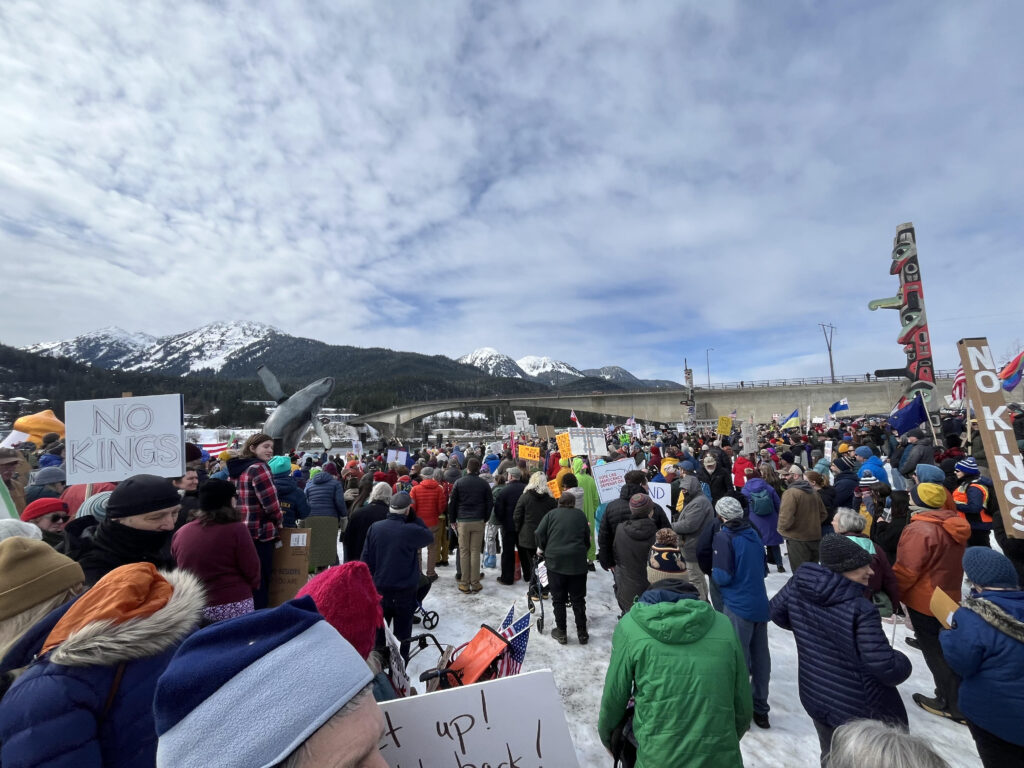
Demonstrators rally at the third No Kings protest in Juneau on Mar. 28, 2026. (Photo by Corinne Smith/Alaska Beacon)

Demonstrators rally at the third No Kings protest in Juneau on Mar. 28, 2026. (Photo by Corinne Smith/Alaska Beacon)

Alaskans across the state came out to protest on Saturday as part of the third No Kings nationwide day of action against the Trump administration. Crowds braved icy weather to demonstrate with signs, songs and speeches to condemn President Donald Trump and foreign wars, and called for protections of equal rights and democracy.

Demonstrators rally at the third No Kings protest in Juneau on Mar. 28, 2026. (Photo by Corinne Smith/Alaska Beacon)

In Juneau, a large crowd gathered at Overstreet Park by the iconic whale statue, under winter sunshine to protest.

“No Kings, No Consent is a peaceful day of mass mobilization in response to this regime’s brutality and their attempts to control us,” said Gina Chalcroft, an organizer with Juneau Indivisible, to cheers from the crowd. “We join with, that we know of, 25 other Alaskan No Kings rallies today, because we know that we can overcome this repression when we unite, because there is power in community.”

The crowd yelled “no consent!” in a call and response style, including to U.S. Immigration and Customs Enforcement patrolling American cities, separating families and killing protesters; Congress cutting health care benefits, and the US invading Venezuela and bombing Iran. 

Many signs in the crowd condemned the Iran war, including from veterans, reading “I served for freedom, not fascism” and “war leads to more war, more death, more suffering.”

Heidi Drygas, executive director of the Alaska State Employees Association AFSCME Local 52, the largest public employees union in Alaska, addressed the crowd and urged worker unity. She said rising costs and cuts to social services are pushing Alaskans to the brink. 

“Right now, it’s not just the poor and underprivileged who are struggling. Our middle class is vanishing before our very eyes,” Drygas said. “In times like these, silence is not an option. Billionaires are driving up the cost of living for working families, then they go cash in their massive tax breaks at our expense,” she said. 

Drygas pointed to cuts in public assistance programs like Medicaid and Medicare as undermining working families, as well as the Trump administration’s immigration enforcement crackdown. 

“ICE’s efforts are a direct attack on workers’ fundamental freedoms to work with dignity, to raise our families without the threat of violence from our government and safely return home to our loved ones at the end of a working day,” she said.

Juneau resident Dune Rothman helped attendees register to vote or check their voter registration at the No Kings rally on Mar. 28, 2026. (Photo by Corinne Smith/Alaska Beacon)

Speakers condemned the Alaska Division of Elections for sharing a detailed list of Alaskans voter information with the U.S. Department of Justice. At the event, volunteers staffed a voter registration table for attendees to register to vote or check their information. 

Juneau resident Dune Rothman said he volunteered to support voter registration at each of the No Kings events.

“I’ve been doing voter registration, non-partisan, for about 40 years, on and off,” he said. “I think it’s really critical now that everybody is checking on their voter registration regularly to make sure that nothing untoward has happened.”

Rothman said he was forced into early retirement last year from the National Oceanic and Atmospheric Administration due to the Trump administration’s mass firings with DOGE, or the Department of Government Efficiency. Now he spends his time on volunteer work. 

“It’s really important that all of the citizens now really stand forward and do their civic duty in the country,” he said.

Demonstrators rally in Seldovia, Alaska for the third No Kings protest on Mar. 28, 2026 (Photo courtesy of Mark Janes)

More than 3,000 No Kings protest events were planned on Saturday nationwide. Social media posts and an online map of events show No Kings rallies in at least 25 communities across Alaska from Kotzebue to Bethel, to Seldovia to Ketchikan. Several participants spoke with the Alaska Beacon after events wrapped on Saturday afternoon.

Nicole Collins is a member of Ketchikan Mayday for Democracy which holds monthly protests and events to protect democracy and raise awareness around local issues in the community. In Ketchikan, she said roughly 250 people of all ages participated in a rally and march, followed by a tailgate party, food donation and voter registration drives. 

“Today seemed different than any other times that we’ve been out here. It felt a little more subdued,” she said, and people shared concerns about the Iran war.

“We were promised no new wars,” she said. “We’re putting our troops in danger, and we’re not really sure why, and that there’s a lot of distrust in this administration…. So there’s just a lot of confusion and concern, really just for our country.”

On the Kenai Peninsula, Michele Vasquez, an organizer with the non-partisan community group Many Voices, said it was the largest turnout in Soldotna she’s seen yet, with roughly 400 participants.

Demonstrators rally at the third No Kings protest in Soldotna on Mar. 28, 2026. (Photo courtesy of Michele Vasquez)
Demonstrators are seen at the third No Kings protest in Soldotna on Mar. 28, 2026. (Photo courtesy of Michele Vasquez)
Demonstrators rally at the third No Kings protest in Soldotna on Mar. 28, 2026. (Photo courtesy of Michele Vasquez)

“The folks that are protesting today, it is from the far left to the right. I mean, there is no set political spectrum here,” she said. “These are people from all backgrounds.”

She said in the wake of ICE arrests of a family and immediate deportation to Mexico, many protest signs and speakers focused on the Trump administration’s overreach and abuse of power. She said local organizing efforts are also focused on “know your rights” training,  outreach and support to local immigrant families. 

“I’m just personally overwhelmed by my community and the love and care that each of them have for their country, and want to see it get back on track,” she said. 

In Matanuska Susitna Borough community of Wasilla, Dave Musgrave, an organizer with Mat Su United for Progress said approximately 650 people came out to protest on Saturday. He said the event was uncertain due to strong winds throughout the region this week, but people turned out.

“The vibe was upbeat. Everybody was happy to be together,” he said. “We continually have new people show up, and they are so appreciative that, especially here in a very conservative part of the state, they are so appreciative that they found some community that they can connect with that shares their values.” 

Musgrave said demonstrators shared concerns about rising prices for daily necessities, tariffs, and U.S. wars abroad. He said while usually there has been a small group of pro-Trump counter protesters at past No Kings events, they didn’t show up on Saturday.

Demonstrators rally at the third No Kings protest in Wasilla on Mar. 28, 2026. (Photo courtesy of Dave Musgrave)

“I’ve always told them they are welcome to be here, that they had their First Amendment rights also, and they’ve always understood it. And we’ve always gotten along pretty well,” he said. “But they weren’t even here today for whatever reason.”

Organizers said protests are ongoing, and they are focused on resisting the Trump administration, and mobilizing voters to win Democratic seats and flip the U.S. Congress to a Democratic majority at the midterm elections in November. 

Categories
Alaska News Featured Juneau News juneau Juneau Local Juneau Local Ketchikan Local News Feeds Sitka Local Uncategorized

‘Action is the antidote to despair’ 3rd No Kings protest takes place at the Whale

By: Grace Dumas, News of the North

No Kings Protest, March 28, 2026

The No Kings movement returned for a third nationwide day of action today at Overstreet Park.

‘No Kings’ Juneau is just one of more than 3,000 events across the United States, including roughly 23 in Alaska alone, according to Anjuli Grantham From Juneau for Democracy, who has organized this protest alongside the Re-Sisters and Juneau Indivisible.

The demonstrations are aimed at denouncing what participants see as a slide toward authoritarianism and demanding the protection of democratic institutions.

“The first (No Kings Rally) was one of the largest protests in American history.” Grantham said, “The second was as well. The statement, ‘No Kings’ means that we refuse to live in tyranny, and we refuse to live in a society in which the rule of law is not being upheld, and so by saying ‘No Kings’, we’re reminding everyone that we are indeed a democracy. We are not a dictatorship. And that’s a fundamental value of what it is to be an American.”

This year, participants are demanding no war, no more funding for ICE, and protection of the Constitution and the rule of law.

“This really is a community that cares, and also, because we’re the capital, we’re also a community that understands the value of government and of of good governance. Because since we’re the capital, we also experience the effects of bad governance pretty rapidly.” Said Grantham, “So much of what’s happening right now can feel very isolating, and there’s so much about what it is to be alive today which is isolating in general, but then to be living under this growing authoritarian regime…isolation is one of the tactics of authoritarianism. So by coming together, we show one another that we are not alone.”

Grantham also emphasized that the rally is only one part of a broader strategy.

Beginning next week, Juneau groups will host a weeklong series of workshops under the banner “How We Resist,” aimed at training community members in nonviolent resistance and democratic engagement. The Workshops will include information on general strike preparedness, noncooperation tactics like boycotts and sit-ins, and an ACLU Alaska immigration bystander training watch party and Q&A.

For those skeptical that their presence at a rally or workshop makes any difference, organizers argue civic participation is essential.

“We need to practice the muscle of democracy. By showing up, we are practicing what it means to be democratic citizens. That matters greatly.” Grantham said, “We have these rights, and we will have these rights as long as we practice them, as long as we use them. That’s what the scholars and the experts tell us, we have to use all the tools that we have available to us as long as we have them, because those tools become whittled away by authoritarianism, so when we show up together to put into practice, number one, our First Amendment rights and our ability to petition the government when we are dissatisfied with it, we are living our democracy.”

Protests, she says, strengthen organizational skills and help sustain networks that can respond to future crises.

If there is one message Grantham hopes people take away from the Juneau rally, it’s – “I hope people feel that by taking part in an event like this and by doing these other actions as well, that we are living our values, and we are going to be able to tell our grandchildren in confidence that we had an important role to play in preserving American democracy. Action is the antidote to despair. It’s really easy to feel overwhelmed and depressed right now, but for me, when I show up and I do things, those feelings go away.”

Categories
Alaska News

Independent Anchorage attorney files as 18th candidate for Alaska governor

Gregg Brelsford is seen in an undated photo. (Photo courtesy of Gregg Brelsford)

Gregg Brelsford is seen in an undated photo. (Photo courtesy of Gregg Brelsford)

Anchorage attorney Gregg Brelsford on Tuesday announced that he is running as an independent for Alaska governor. 

Republican Alaska Gov. Mike Dunleavy is in his final year of office. He is prevented by the Alaska Constitution from running for a third consecutive four-year term. 

Eighteen candidates have filed paperwork to run for Alaska governor at the Nov. 3 election. 

Brelsford, 75, has had a long career practicing law. He served as an assistant municipal attorney in Anchorage and as manager of Bristol Bay Borough and Dillingham’s interim city manager during the COVID-19 pandemic.

Brelsford states on his campaign website that he wants to be Alaska’s “education governor” and that he would make education funding his top priority.

He was previously a Republican before leaving the party in 2022. He ran for the Alaska House in 1994 and the U.S. House in 2022. Brelsford garnered 241 votes in that year’s primary election. 

Alaska’s primary election will be held Aug. 18. Under Alaska’s open primary system, the top four vote-getters, regardless of party affiliation, will advance to November’s general election. 

Categories
Alaska News Featured Juneau News juneau Juneau Local Juneau Local Ketchikan Local News Feeds Sitka Local

Agreement launches effort to create School of Indigenous Studies in Juneau

Photo Courtesy of UAS, from their Alaska Native Arts, Language and Studies program.

NOTN- The Central Council of the Tlingit & Haida Indian Tribes of Alaska and the University of Alaska Southeast are launching a collaborative effort to develop a School of Indigenous Studies in Southeast Alaska.

Leaders from both organizations signed a memorandum of understanding at the Andrew Hope Building in downtown Juneau this morning, marking what officials describe as an initial step toward building a new academic program grounded in Indigenous knowledge.

This is only the biggening of the collaboration.

The agreement signed, outlines a shared vision between Tlingit and Haida and UAS, of an education model that reflects Indigenous languages, traditions and values, that supports workforce development, research and economic opportunities.

“We are really excited to have a formal relationship with the tribe to create a school of Indigenous Studies at UAS.” Said UAS Chancellor Aparna Palmer, “This is one of the few times where a university has worked with a tribe to co-create a vision for this school, and the school is so important and transformative and amazing because it will honor the values of the tribe, while at the same time giving us a chance to bring together all of the disciplines that we already offer.”

As part of the effort, a working group, with representatives from both Tlingit & Haida and the university will be formed to develop a roadmap for the School of Indigenous Studies.

“We already offer classes on the language and the culture and the history of the indigenous peoples of Southeast Alaska, and now they will be housed at a school that is specific and integrated within UAS.”

Categories
Alaska News

Six federal scientists run out by Trump talk about the work left undone

Sylvia Chou quit her job at the National Cancer Institute in January, after working for the agency for more than 15 years. She says the Trump administration took a “sledgehammer” to the agency. (Eric Harkleroad/KFF Health News)

Marc Ernstoff, a physician who has pioneered immunotherapy research and treatments for cancer patients, said his work as a federal scientist proved untenable under the Trump administration.

Philip Stewart, a Rocky Mountain Laboratories researcher focused on tick-borne diseases, said he retired two years earlier than planned because of hurdles that made it too challenging to do his job well.

Alexa Romberg, an addiction prevention scientist focused on tobacco, said she “lost a great deal” of the research she oversaw when federal grants vanished.

“If one is thinking about the ‘Make America Healthy Again’ agenda and the prevention of chronic disease,” Romberg said, “tobacco use is the No. 1 contributor to early morbidity and mortality that we can prevent.”

The National Institutes of Health is the largest public funder of biomedical research in the world, with a mission statement to “enhance health, lengthen life, and reduce illness.”

Over decades, the value of the NIH may be the one thing everyone in Washington has agreed on. Lawmakers have routinely boosted its funding.

“I’m so pleased to be associated with NIH,” former Sen. Roy Blunt, a Missouri Republican and one of the NIH’s biggest champions in Congress, said in 2022 shortly before he retired.

But in President Donald Trump’s second term, the NIH has seen an exodus of scientists like Ernstoff, Stewart, and Romberg. Federal data shows the NIH lost about 4,400 people — more than 20% of its workforce. Scientists say the departures harm the U.S.’ ability to respond to disease outbreaks, develop treatments for chronic illnesses, and confront the nation’s most pressing public health problems.

“People are going to get hurt,” said Sylvia Chou, a scientist who worked at the National Cancer Institute in Rockville, Maryland, for over 15 years before she left in January. “There’s going to be a lot more health challenges and even deaths, because we need science in order to help people get healthy.”

Why They’re Leaving

KFF Health News interviewed a half dozen scientists who said they quit their jobs years before they’d planned to because of the tumult of 2025.

Only a few years ago, the NIH workforce was steadily growing, from roughly 17,700 employees in fiscal year 2019 to around 21,100 in fiscal 2024, federal data shows. Under Trump, those gains have been slashed.

The Trump administration enacted a campaign to purge government workers perceived as disloyal to the president. People were fired or encouraged to leave. Officials instituted a months-long freeze on hiring.

The NIH workforce has plummeted to about 17,100 people — its lowest level in at least two decades. Most who left weren’t fired. Roughly 4 in 5 either retired, quit, had appointments that expired, or transferred to a different job, according to federal data.

Physician Marc Ernstoff joined the National Cancer Institute in 2020 to shepherd research on how the immune system responds to cancer, to advance the development of drugs that help patients live longer. Ernstoff said he left his job in October because, under President Donald Trump, the National Institutes of Health had turned into a “hostile work environment” and he was denied permission to work remotely. “I was not ready at all to retire,” Ernstoff says. (Rob Strong for KFF Health News)

Scientists watched with dread as their colleagues were forced to terminate research funds for topics the Trump administration deemed off-limits. Across NIH labs, routine work stalled. They said they faced major delays in accessing equipment and supplies. Travel authorizations were slowed or denied.

Agency staff were instructed not to communicate with anyone outside the agency. When they could talk again, they were subject to greater constraints on what they could present to the public.

And under the administration’s agenda to eliminate “diversity, equity, and inclusion,” references to minorities or health equity were purged from NIH-funded research. Initiatives to protect Americans’ health were gutted. Among them: support for early-career scientists, ways to prevent harm from HIV or substance use, and efforts to study how different populations’ immune systems respond to disease.

In a January op-ed, Chou and Romberg were among a group of NIH scientists who said they resigned in protest of an administration “that treats science not as a process for building knowledge, but as a means to advance its political agenda.”

Alexa Romberg says she thought she would spend the rest of her career at the NIH before the Trump administration made it untenable. “It took a long time to really decide to give up on that, and that that wouldn’t be the future for me,” she says.(Eric Harkleroad/KFF Health News)

A ‘Fundamental Destruction’

Health and Human Services spokesperson Emily Hilliard said in a statement that the agency had shifted to focus on evidence-based research over “ideological agendas.” She said the NIH is still recruiting “the best and brightest” and advancing high-quality science to “deliver breakthroughs for the American people.” The federal health department oversees NIH.

“A major reset was overdue. HHS has taken action to streamline operations, reduce redundancies, and return to pre-pandemic employment levels,” Hilliard said.

Many scientists, however, question whether the NIH can still fulfill its public mission.

“There’s been a fundamental destruction,” said Daniel Dulebohn, a researcher who spent nearly two decades at Rocky Mountain Laboratories in Hamilton, Montana. It’s going to “take a very, very long time to rebuild.”

Dulebohn left the NIH’s infectious disease and allergy institute in September.

He analyzed how molecules and proteins interact in diseases, such as Lyme disease, HIV, and Alzheimer’s — information that’s key for new treatments. Dulebohn was a resource for scientists when they hit walls trying to understand, for example, if molecules could prevent infection or react to a treatment.

Now he and his wife are living off savings in Mexico with their three young kids. Dulebohn’s thinking about what’s next. One option: real estate.

The expert in biochemical analysis operated equipment few others know how to use. His exit further depletes resources in the specialty.

“It’s clear when someone comes out with a drug and now you’ve just cured a disease. But you never know which ones could have been cured,” Dulebohn said. “We don’t know what we’ve lost.”

Laura Stark, a Vanderbilt University associate professor who specializes in the history of medicine and science, said wiping out NIH staff will propel a shift toward private-industry research, with its profit motives, “as opposed to actually helping American health.”

“We just don’t have people who are now able to pursue research for the public good,” Stark said.

From Support to Scrutiny

Stark said the seeds of the present-day NIH were planted during World War II when the U.S. government spearheaded an effort to mass-produce the antibiotic penicillin to save soldiers from infections.

The agency has played a central role in lifesaving discoveries and treatments — including for heart disease, cancer, diabetes, and genetic diseases such as cystic fibrosis.

With bipartisan backing from Congress, the NIH budget has grown significantly over time, sitting at $48.7 billion for fiscal 2026. The NIH allocates roughly 11% of its budget for agency scientists. About 80% is awarded to universities and other institutions.

The money may be there, but the people who get it out the door are not, scientists said.

Jennifer Troyer left the National Human Genome Research Institute in Bethesda, Maryland, on Dec. 31, after working in various positions at the NIH for about 25 years. The division she led reviews research and oversees grants to organizations studying the human genome — or a person’s complete set of genes — and how it can be used to benefit health.

Last year, she said, her division lost about two-thirds of its staff. “There really are not enough people there right now to actually get the work done,” Troyer said. “It’s extreme harm.”

She decided to quit the day Trump issued an executive order in August that prohibited the use of grants to “fund, promote, encourage, subsidize, or facilitate” what it described as “anti-American values.” It also allowed political appointees to review all funding decisions.

“I wasn’t going to operate a division under those orders,” Troyer said. She hasn’t figured out her next career steps.

Jennifer Troyer left her job at the National Human Genome Research Institute in December, after working at the NIH as a contractor or civil servant for more than two decades.(Eric Harkleford/KFF Health News)

‘Enough Is Enough’

Research aligned with the administration’s stated priorities has suffered.

HHS Secretary Robert F. Kennedy Jr. has called the diagnosis and treatment of Lyme disease — a tick-borne infection that can cause debilitating lifelong symptoms — a priority. In December, Kennedy said the government had long dismissed patients burdened with a disease that nearly 500,000 people in the U.S. are diagnosed with annually.

Philip Stewart says the Trump administration had created too many hurdles over the past year for him to do his job well.(Katheryn Houghton/KFF Health News)

That same month, Stewart, who had dedicated his career to ticks and Lyme disease as a federal scientist, retired early. He’d worked for the government for 27 years. Stewart said workforce cuts and travel delays stalled his efforts to confirm how far Lyme-carrying ticks had spread — information that could help doctors recognize symptoms sooner.

Stewart was a lead scientist on research published last year identifying a black-legged tick, or deer tick, in Montana. It was the first time the tick best known for transmitting Lyme disease had been confirmed in the state. He wanted to determine if the discovery was a fluke or an indicator that the species was gaining ground.

“The advice we’ve been getting is, ‘Put your head down below the trench line. Don’t look. Don’t peek over and risk getting shot,’” Stewart said. “At what point do you finally say, ‘Enough is enough’ and ‘We’re not being effective anymore’?”

Scientists said those early in their careers are looking abroad for jobs and training. People who want to stay in the U.S. are running into problems getting hired because of cuts to research grants and uncertainty about funding.

Collectively, people studying diseases warn the U.S. could lose its long-held position as the global leader in biomedical research, with devastating impact.

Stanley Perlman, a University of Iowa virologist who studies pediatric infectious diseases, said that title earned the nation more than prestige; it drew top scientists from the world over to the U.S. to study diseases that particularly affect people here.

There’s no guarantee halted research will be picked up elsewhere, whether by private industry or other countries. If others are doing that work, Americans could face delays in seeing benefits, he said.

“If you don’t have access to how the work was done,” Perlman said, “it’s harder to reproduce and adapt it for your country.”

KFF Health News data editor Holly K. Hacker contributed to this report.

KFF Health News is a national newsroom that produces in-depth journalism about health issues and is one of the core operating programs at KFF—an independent source of health policy research, polling, and journalism. Learn more about KFF.

Subscribe to KFF Health News’ free Morning Briefing.

This article first appeared on KFF Health News and is republished here under a Creative Commons Attribution-NoDerivatives 4.0 International License.

SUBSCRIBE: GET THE MORNING HEADLINES DELIVERED TO YOUR INBOX

Categories
Alaska News Featured Juneau News juneau Juneau Local Juneau Local Ketchikan Local News Feeds Sitka Local

Alaska Legislature passes stopgap budget, amid uncertainty around war-driven oil revenues

By: Corinne Smith, Alaska Beacon

Members of the Alaska House of Representatives convene on the first day of the second session of the 34th Alaska State Legislature on Jan. 20, 2026 (Photo by Corinne Smith/Alaska Beacon)

The Alaska Legislature on Wednesday approved a stopgap budget bill amid an ongoing debate among lawmakers around war-driven oil revenues and whether to draw from state savings.

The stopgap budget bill contains $449.6 million in state spending including for disaster relief, construction, education, correctional officer overtime and some public assistance programs — expenses accrued since the Legislature and Gov. Mike Dunleavy adopted the state budget last year.

But the question of how and when all the items will be funded is still uncertain. Lawmakers chose to rely on anticipated oil revenue to fund the bill rather than drawing from savings. 

The Alaska Senate passed the budget bill by a 19 to 1 vote on Wednesday, with Sen. Robert Meyers, R-North Pole opposing. The bill was quickly transferred to the Alaska House where it passed unanimously by all 40 members. The bill now moves to the governor’s desk for his consideration.

The Legislature created a select bicameral conference committee to hammer out differences between House and Senate versions of the budget bill over the last week. 

The final bill includes $75 million for disaster relief to cover the state’s response to the Western Alaska storms last fall, and almost $100 million for fire suppression. It contains $20 million for the Alaska Department of Corrections for overtime spending, as well as $34.4 million for Medicaid and $12.8 million for other public assistance programs through the Alaska Department of Health. The bill allocates nearly $130 million toward the Alaska Higher Education Fund which provides grants and scholarships to students.

The spending bill also includes a time-sensitive appropriation for Alaska’s construction industry. It contains $70.2 million in state dollars to unlock roughly $630 million in federal grant funding that industry groups have said is essential for the summer construction season.

But how the nearly $450 million budget bill is funded is still in question. 

Legislators have been closely watching oil prices since the start of the Iran war, which state forecasters have projected could potentially generate hundreds of millions in state revenue for Alaska. 

Lawmakers agreed that if oil-driven state revenues from now until June 30, the end of the fiscal year, are not sufficient to cover the stopgap budget, then the Legislature will draw from state savings. That roughly pencils out to an average of $74 per barrel of oil through June to cover state spending, according to data provided by the House Finance Committee. 

But that vote to confirm drawing from savings again failed in the House on Wednesday — the fourth vote held in the House this year. To draw from Alaska’s main $3 billion savings account requires support from three-quarters of the House and Senate.

The Senate approved the immediate draw from savings on Wednesday by a 16 to 4 vote, but it failed to pass the House by a vote of 22 to 18. It takes 30 votes in the House to spend from the savings reserve. 

On Thursday, House Speaker Rep. Bryce Edgmon, I-Dillingham, expressed concern at sending the budget bill to the governor with what he said was no “backstop” funding from savings.

“So if the price of oil goes down, the governor may not have the money ultimately, to finish up or to pay for operations,” he said for this fiscal year. 

Edgmon said he is concerned with banking on future oil prices to pay the state’s bills. 

“It’s the first time, I think maybe perhaps in Alaska’s history, we’ve ever done it this way,” he said. “It’s going to be very interesting to see how this plays out, because oil prices can certainly go up as well, but they can also go down. And it’s not the way that I like to operate in terms of being fiscally responsible.”

Members of the Republican House minority caucus in opposition from drawing from savings expressed confidence in oil revenues providing enough funding to cover state expenses.

“Everything in this bill the state currently projects enough revenues to fund,” said Rep. Will Stapp, R-Fairbanks on Wednesday. “We still have many days in session, happy to revisit in the event oil price changes and we need to structure something in order to meet our obligations. That is not a requirement at this moment.” 

The stopgap budget bill now moves to Dunleavy who can sign or veto the bill or let it pass into law without his signature.

Categories
Alaska News Featured Juneau News juneau Juneau Local Juneau Local Ketchikan Local News Feeds Sitka Local

Alaska governor pitches big tax break to spur $46B gas line

By: Sean Maguire, Alaska Beacon

Alaska Gov. Mike Dunleavy delivers the annual State of the State address on Tuesday, Jan. 28, 2025, in the Alaska Capitol. (Photo by James Brooks/Alaska Beacon)

Alaska Gov. Mike Dunleavy has proposed eliminating property taxes for the Alaska LNG project to incentivize development of the $46 billion gas line and export facilities. 

The bill was introduced to the Legislature on Mar. 20 and would exempt the project from local taxes in Alaska, including property and sales taxes. Instead, a volume-based tax would be levied once the pipeline starts producing significant quantities of gas from the North Slope. 

In a statement, Dunleavy said his legislation “removes a structural barrier” that would help get the gas line built. The project is expected to create thousands of construction jobs, spur the development of new industries and potentially lower power and heating bills for consumers.

“We bring more gas into Alaska and stabilize supply — that lowers cost for families like yours and businesses,” Dunleavy said Wednesday on social media. 

The state of Alaska is expected to collect over $22.5 billion in new revenue from the project over the next 36 years, primarily from production taxes and royalties, according to state economists. 

In addition to exempting the project from property and sales taxes during its ramp-up period, the Alaska Department of Revenue estimates Dunleavy’s bill would equate to a 90% reduction in property tax revenue, once the pipeline is at full capacity.  

Municipal governments are expected to take the biggest hit from that change. If the project was built under current tax law, they would collect an extra $13 billion in revenue through 2062, or $360 million annually.

Some long-time lawmakers have questioned whether the pipeline will result in reduced gas prices. Others have questioned why such a sharp reduction in property taxes is needed. 

‘Industrial renaissance’

An 800-mile pipeline from the North Slope to deliver natural gas to market has been a dream in Alaska for decades. But prior efforts have all fallen short. 

Supporters say its prospects have never been stronger. Key permits are in hand, several Asian nations are interested in buying Alaska’s gas, and President Donald Trump has voiced support for the project.

Former Democratic U.S. Sen. Mark Begich has been hired by the Dunleavy administration to help advance the pipeline. He told lawmakers the 1973 oil shock helped spur development of North Slope oil. Now, war in the Middle East has upended LNG production and raised prices, which makes Alaska natural gas more attractive, he said.

“This is our moment,” he said to the House Resources Committee on Monday, calling the gas line “an incredible project.” 

Glenfarne, a New York-based company, signed on to develop the pipeline last January. It owns 75% of the project while the Alaska Gasline Development Corp., a state agency, owns the remaining 25%.

But the economics of the $46 billion gas line remain uncertain.

Glenfarne chose to split the project in two. The first phase would see construction of a pipeline for domestic consumption, with delivery of gas targeted for 2029. The second phase would construct a plant and shipping terminal in Cook Inlet for export. 

Alaska’s current tax structure means a 2% property tax can be levied on oil and gas infrastructure. 

Dunleavy’s tax proposal would impose a volume-based alternative. A new tax would be levied at 6 cents on every thousand cubic feet of gas, which would increase by 1% annually.

The tax would only be imposed once the pipeline delivers an average of 1 billion cubic feet of gas per day or 10 years after gas starts being produced. 

Dan Stickel, economist with the Department of Revenue, on Wednesday said reducing property taxes would help with front-end costs. He said the agency is not examining Dunleavy’s bill as a tax cut because it would help spur the pipeline and potentially lead to new state revenue.

Stickel told the House Resources Committee that AGDC and Glenfarne have said the project will not move forward without property tax relief. 

At full capacity, the pipeline is expected to deliver 3.5 billion cubic feet of gas per day. Southcentral Alaska’s demand for Cook Inlet gas equates to roughly 70 billion cubic feet of gas per year.

Glenfarne Group CEO and founder Brendan Duval and Alaska LNG President Adam Prestidge stand while Gov. Mike Dunleavy recognizes them during his State of the State address on Jan. 22, 2026. (Photo by Corinne Smith/Alaska Beacon)

Adam Prestidge, president of Glenfarne Alaska LNG, said the project would be an “industrial renaissance” for Alaska. It could create 7,000 jobs during construction and spur new opportunities such as data centers, he said.

Wearing a lapel pin in a House Resources Committee hearing that said “build the line,” Prestidge told lawmakers discussions on gas agreements are ongoing with Alaska utilities. He said agreements could be signed and made public in the next couple of months.

“This is the only way to significantly bring down the cost of energy for Alaskans,” he said.

‘Huge give’

The Alaska Department of Revenue estimates the state would receive $22.5 billion in revenue from the gas line through 2062. The majority of that windfall would come from production taxes and royalties. 

Compared to Alaska’s current tax regime, Dunleavy’s proposal would see the state miss out on $200 million per year from property taxes once the pipeline is at full capacity, projections show. 

The alternative tax structure proposed by the governor would see $64 million per year collected by municipalities at full gas production and $9 million annually by the state.

For municipalities, there would be a bigger hit.

The gas line is expected to be built through four municipalities that collect property taxes: the North Slope Borough, Denali Borough, Matanuska-Susitna Borough and the Kenai Peninsula Borough.  

Under Alaska’s current tax structure, municipal governments would be expected to share in $17.3 billion from the pipeline through 2062. Under Dunleavy’s tax bill, it would be below $4 billion. 

Anchorage Democratic Sen. Bill Wielechowski, vice-chair of the Senate Resources Committee, spoke at a Tuesday news conference. He said legislators would look closely at Dunleavy’s proposed tax break and determine whether a 90% cut in property taxes is appropriate. 

“I don’t know anybody in the Legislature who doesn’t want a gas pipeline. The question is, what is it going to take to get it?” Wielechowski said. 

State projections show that under both tax systems, the owners of the pipeline are expected to collect $60 billion over the next 36 years.

Anchorage Republican Sen. Cathy Giessel, chair of the Senate Resources Committee, estimates Alaska has invested $1.1 billion to build a natural gas pipeline, but nothing has been built. 

On Tuesday, Giessel cited costs like public safety that could be borne by communities along the proposed pipeline. She said it would likely take until the second phase of the project before 1 billion cubic feet of gas is produced per day. Meaning, it could take years before municipalities collect Dunleavy’s volume-based tax, she said.

“That’s a long time for these communities to have no property tax,” she said. 

State data suggests local governments would take $6.3 billion in property taxes through 2042. Dunleavy’s volume-based tax would net them $1.3 billion over the same period.

“This is a huge give to the company,” Giessel said. “Will it still be enough for them? I don’t know.” 

Mayors in impacted communities are set to testify on the governor’s tax proposal on Friday afternoon before the Senate Resources Committee. 

Categories
Alaska News Featured Juneau News juneau Juneau Local Juneau Local Ketchikan Local News Feeds Sitka Local

Today in History; Great Alaska Earthquake shook Alaska 62 years ago

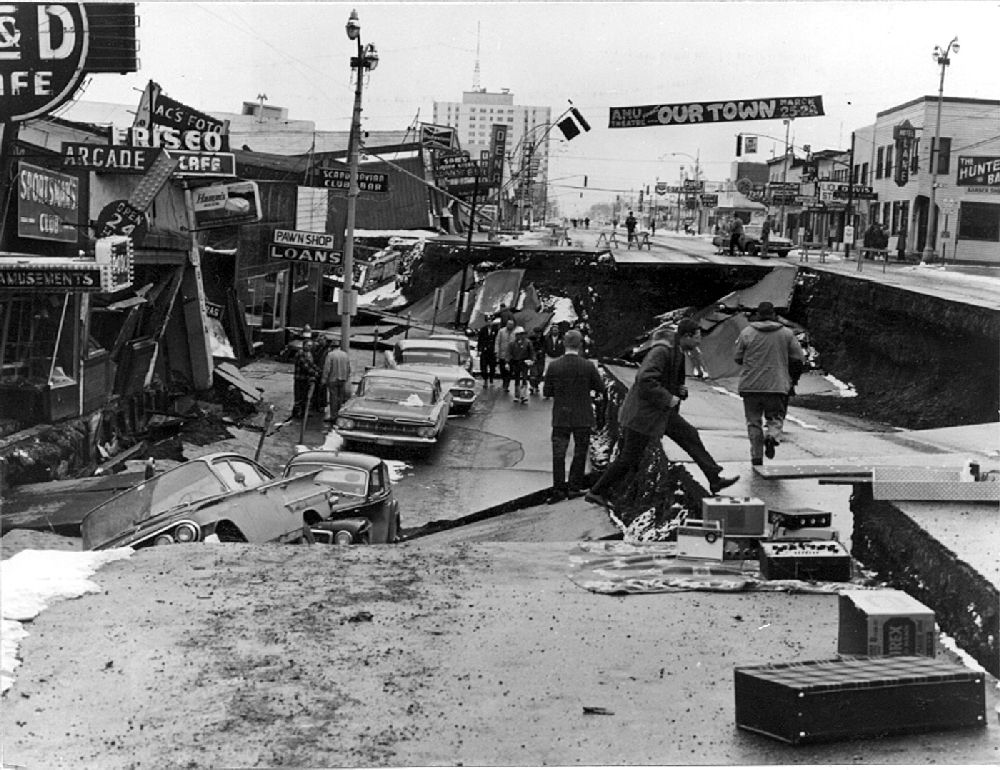
Fourth Avenue in Anchorage, Alaska, looking east from near C Street. The southern edge of one of several landslides in Anchorage, this one covered an area of over a dozen blocks, including five blocks along the north side of Fourth Avenue. Most of the area was razed and made an urban renewal district.

AP-Electric clocks on walls in Anchorage shut down at 5:36 p.m. on March 27, 1964. Time stopped at the start of the ’64 Great Alaska Earthquake, the second largest ever recorded at magnitude 9.2.

The ground shook for four to five minutes, roughly twice through “I Want to Hold Your Hand,” the Beatles No. 1 song that year. With the U.S. and the USSR facing off in the Cold War, some thought the Russians had attacked. The quake produced a tsunami that wreaked havoc along the West Coast. Overall damage was estimated at $2.3 billion in 2014 dollars. The quake and tsunamis killed 131 people.

Though now a distant memory, it helped make experts better prepared for future quakes. It played a role in the formation of the West Coast and Alaska Tsunami Warning Center and taught the U.S. Geological Survey what evidence to look for of previous great quakes, such as events in the Cascadia Subduction Zone off Oregon and Washington.

Geologists have a name for such strong earthquakes — megathrusts.

Plate tectonic theory says the Earth’s crust is made up of about a dozen major plates that rest on hot mantle. The thin, dense, Pacific Plate at Alaska’s southern edge moves at a shallow angle beneath the North American Plate at average rate of 2.3 inches (5.8 centimeters) per year and eventually is reabsorbed by mantle. Strain builds up until there’s a slip.

The Moment Magnitude scale rates quakes by the energy they release by calculating the area of fault rupture, the average amount of slip, and the force required to overcome the friction sticking the rocks together, according to the USGS. Every whole number higher on the scale represents 30 times the energy of the previous number.

More energy was released in the 1964 magnitude 9.2 quake than all other recorded Alaska quakes combined, said USGS research geologist Peter Haeussler. And drilling showed evidence of nine such megathrusts in south-central Alaska in 5,500 years. The average time span between them: 600 years.

The temblor caused two kinds of waves: local and trans-ocean tsunamis.

Eighty-five of the 106 Alaska tsunami deaths were caused by waves generated by underwater landslides. Rivers flowing into Alaska fjords build up huge deltas of unstable sediment on deep, underwater slopes, said USGS research geologist Rob Witter. Slides generate waves like a rock dropped in a pond.

During local tsunamis, water can at first retreat from shore in response to the underwater slide, then rush back. That’s what happened at Port Valdez. When the water swept back in, it smashed a freighter into the city dock. Longshoremen and children who had assembled to catch oranges or candy tossed down from the crew were killed. Thirty-two people died.

The great quake also rumpled the ocean floor like a rug, creating a trans-ocean tsunami. The deadly waves traveled down the West Coast. Four campers on a beach died at Newport, Ore. A dozen died in the northern California community of Crescent City.

Categories
Alaska News

Alaska villagers evacuated during ex-Typhoon Halong plan for new homes

Rayna Paul, environmental manager for the Native Village of Kipnuk, speaks on March 24, 2026, at the Alaska Tribal Conference on Environmental Management, while Amy Hendricks, Lucy Martin, Dustin Evon and Francis Sipary listen. Hendricks is with the Association of Village Council Presidents; Martin and Evon are with the tribal government in Kwingillingok; and Sipary is from Toksook Bay. The five spoke at the event about ex-Typhoon Halong and how the storm affected their coommunities. (Photo by Yereth Rosen/Alaska Beacon)

Rayna Paul, environmental manager for the Native Village of Kipnuk, speaks on March 24, 2026, at the Alaska Tribal Conference on Environmental Management, while Amy Hendricks, Lucy Martin, Dustin Evon and Francis Sipary listen. Hendricks is with Association of Village Council Presidents’ climate adaptation and emergency management program manager; Martin and Evon work for the tribal government in Kwingillingok; and Sipary is from Toksook Bay. The five spoke at the event about ex-Typhoon Halong and how the storm affected their communities. (Photo by Yereth Rosen/Alaska Beacon)

Residents of the two Western Alaska communities hardest hit by the remnants of Typhoon Halong have reached a consensus about their futures: they want to move their villages entirely.

In the Yup’ik village of Kipnuk, where almost all of the approximately 700 residents were airlifted after storm waters swallowed their community last October, tribal members have voted overwhelmingly to relocate.

An outreach campaign that contacted nearly all adult tribal members, now dispersed into temporary living quarters in Anchorage, Bethel or elsewhere, resulted in a 92% vote in favor of moving.

“We got a really big number,” said Rayna Paul, environmental manager for the Native Village of Kipnuk, the tribal government.

Paul summarized the results at a panel discussion Tuesday at the annual Alaska Tribal Conference on Environmental Management.

Most of those voting also showed preference for a relocation site near a higher-elevation place farther inland. The preferred site was used by the ancestors of Kipnuk residents until about a century ago, when the federal government chose the current village site for its ship access.

Deciding on relocation creates “another burden,” especially since the federal and state governments have a contrary message, Paul said. “They are saying ‘No, you have to rebuild in place,’” she said.

For Kwigillingok, a Yup’ik village of about 400 residents, a consensus was reached in February in favor of moving, said Dustin Evon, tribal resilience coordinator, and Lucy Martin, the tribal government’s resilience assistant.

More details about the plans should be released in April or May, Evon said.

Pollution response teams from the U.S. Coast Guard conduct post-storm assessments in Kipnuk on Oct. 22, 2025, after the community was impacted by severe flooding from ex-Typhoon Halong. (Photo by Petty Officer 1st Class Shannon Kearney/U.S. Coast Guard)

“We’re looking at two sites right now,” he said. “We’re in the process of making maps.”

Several remote communities, far from road networks or other infrastructure, were slammed by ex-Typhoon Halong. More than 1,600 residents were evacuated from the remote region of the Yukon-Kuskowim Delta. Impacts were most severe in Kipnuk and Kwigillingok, both of which are low-lying communities located on the Bering Sea coast.

In Kipnuk, 90% of homes were destroyed, while in Kwigillingok, about a third of the houses were knocked off their foundations and set afloat, said James Benzschawel, an Alaska Native Tribal Health Consortium emergency preparedness manager who gave a presentation at the conference.

Representatives of those two communities described harrowing experiences and storm damage conditions that appear to make the sites uninhabitable, at least for now.

In Kipnuk, Paul said, one man jumped from his floating and rocking house and tried to swim to safety, Paul said. He managed to climb aboard a piece of floating boardwalk, struggled for hours and watched dislodged coffins flow by on the river before he was rescued. About 100 of those gravesite contents have since been recovered, but “some are still unaccounted for,” she said.

Similar scenes played out in Kwigillingok, Martin said.

“When I looked out the window right before the power went out, it was like a real-life horror movie. You could see graves rolling. You could see buildings floating away, boardwalks floating before it hit our house,” she said.

Her own house was set adrift sometime after 2 a.m., shortly after the same thing happened to her parents’ house, she said. Houses sent afloat sometimes hit each other; that happened a few times to her house before it finally came to rest upstream several hours later, she said.

Now, at the insistence of her parents, who wanted to be as close as possible to their traditional fishing and hunting areas, the family is living in Bethel, Martin said. Though the hub community of roughly 6,500 people is much bigger than Kwigillingok, it has a housing shortage that affected evacuated families like hers.

Paul is now living in Anchorage, along with hundreds of other displaced Kipnuk residents. She said one challenge is addressing stress and mental health problems, exacerbated by easier access to alcohol and drugs. She suggested that some kind of central gathering place be set up to help evacuees strengthen their sense of community and culture.

Federal changes

In a keynote address at the conference, the state’s top emergency manager called ex-Typhoon Halong the worst event he has experienced in the 32 years he has been responding to disasters in the state. 

Damage in Kwigillingok from ex-Typhoon Halong is seen on Oct. 16, 2025. (Photo provided by the Alaska National Guard)

“This is the most severe disaster that I’ve responded to in my entire career,” Bryan Fisher, director of the Alaska Division of Homeland Security and Emergency Management,  told the conference audience on Tuesday.

Damages were worse than those inflicted in 2022 by another ex-typhoon, Merbok, which reached a wider region, he said. The Halong response required “the largest domestic evacuation of Alaskans in state history, even more, we believe, than evacuations that were accomplished during World War II.”

Fisher acknowledged that the residents’ ongoing displacement puts them in a degree of limbo and adds several daily challenges. And he acknowledged that the general U.S. disaster-assistance system, designed for the nation as a whole, is not always suited to rural Alaska needs.

That is particularly the case for traditional subsistence needs, he said. The Federal Emergency Management Agency can provide money to replace gear lost from subsistence camps, “but they can’t provide funding to rebuild the cabin,” he said.

But there is some good news out of Washington, D.C., about disaster response and prevention efforts.

FEMA has now reinstated the Building Resilient Infrastructure and Communities program, known as BRIC, which dispersed grants for projects aimed at preparing for and mitigating disaster impacts. That reinstatement was in compliance with a March 6 order issued by a federal court in Massachusetts.

That is a big victory for Alaska, Fisher said, even though Alaska was not among the 22 states that sued over cancellation of the BRIC program and the grants made by it. The lawsuit, filed last year, was led by officials in the state of Washington.

“Without that funding, my agency was really at a loss,” Fisher said. “We really relied on that funding. So it’s great news that that has been turned back on.”

With Kristi Noem as secretary of the U.S. Department of Homeland Security, FEMA canceled the entire BRIC program, including already awarded grants to states and tribal governments. Noem was particularly critical of grants aimed at providing resilience to climate change effects.

“Under Secretary Noem, DHS is eliminating waste, fraud and abuse. The BRIC program was yet another example of a wasteful and ineffective FEMA program. It was more concerned with political agendas than helping Americans affected by natural disasters,” said a statement issued by FEMA on April 4, 2025.

Now, under new department leadership and at the court’s direction, FEMA has committed to paying grants. On Wednesday, FEMA announced the availability of $1 billion in funding for resilience projects.

Fisher said Alaska will benefit from another change: the appointment of Markwayne Mullin to replace controversy-plagued Kristi Noem as secretary of the U.S. Department of Homeland Security.

Mullin, who served for three years as a U.S. senator representing Oklahoma, is an enrolled citizen of the Cherokee Nation.

“I think it’s an incredible win for the state of Alaska, that we have somebody with a Native background that’s going to be the Secretary of Homeland Security,” Fisher told the conference audience. “He understands the reality of doing business as sovereign tribal governments with the federal government, and I think he’s going to be a great advocate for all of you, for all of us, moving forward.”