Forrest Wolfe is seen in an undated campaign photo for his run for the Alaska House of Representatives for District 21, in East Anchorage, in 2022. (Campaign photo provided by Wolfe)
A legislative aide to Alaska Gov. Mike Dunleavy, and a former candidate for the Alaska House of Representatives, was arrested and charged with driving under the influence of alcohol on Thursday in Juneau.
Forrest Wolfe, 40, was pulled over by Juneau Police at about 10:30 p.m. on Mar. 26, according to court documents, after driving erratically through a busy area of downtown Juneau. Wolfe was the sole occupant of the vehicle, a red Chevrolet Tahoe, when he was pulled over on Franklin Street.
Wolfe exhibited a strong odor of alcohol and gave conflicting stories of his previous activities, then stopped answering questions, according to the police report. Wolfe failed a field sobriety test and then later a chemical test for alcohol, showing his breath alcohol level at 0.10, which is above the legal limit of 0.08. He was arrested and charged with a criminal misdemeanor.
Wolfe serves as deputy legislative director for Dunleavy, a role he began in January, according to his public LinkedIn profile.
A spokesperson for Dunleavy’s office declined to comment on the arrest or any penalties by his employer on Monday, citing privacy as a personnel matter.
Wolfe ran for the Alaska House in 2022 as a Republican representing District 21 in East Anchorage, and narrowly lost to Rep. Donna Mears, D-Anchorage, by just 150 votes.
Prior to serving in the governor’s office, Wolfe served as a legislative liaison for the Alaska Department of Administration for about a year, in 2025. He worked as legislative staff for more than a decade, since 2012, for various Republican representatives.
Wolfe posted a $500 bail and was released from Lemon Creek Correctional Center on Friday morning, according to Alaska Public Media.
Wolfe has had previous run-ins with Juneau Police for minor infractions, and was arrested and convicted for drunk driving in 2011.
(Lizzy Hahn/ Chilkat Valley News) No Kings protesters stand in silence on Main Street on Saturday in Haines.
Five dogs and more than 100 protestors gathered at the Tlingit Park Longhouse on Saturday to participate in the nationwide No Kings Protest. This was the third demonstration, organized by Haines AKtive.
Like other local protests, this one included a silent march – this one from the park to Main and Third.
“We just feel like maybe it makes more of a statement,” said one organizer, Nelle Jurgeleit-Greene.
Burl Sheldon welcomed the crowd and then he and Tom Heywood played a few songs, including Bruce Springsteen’s Streets of Minneapolis.
(Lizzy Hahn/ Chilkat Valley News) Debbie Gravel shares a passage of resistance with the crowd before the No Kings protest on Saturday in Haines.
Other speakers read from the First Amendment and an excerpt of Anne Frank’s Diary of a Young Girl. Debbie Gravel told people about the paperclip resistance movement that launched in Norway during World War II when students at Oslo University began wearing paper clips to demonstrate their resistance to German occupiers.
As the crowd of protesters started their trek to Main Street, Gravel handed out red paper clipsfor protesters to clip onto their jackets or scarves. “Sometimes when you’re resisting times of oppression, solidarity is everything,” Gravel said. Gravel said she keeps coming to rallies because “I realize we can’t affect change from Haines but it’s such a mood booster to feel unity and solidarity with other people of like minds.”
(Lizzy Hahn/ Chilkat Valley News) Nancy Nash sings with the crowd after the No Kings protest on Saturday, in Haines.
John Norton carried a sign saying “Justice for all.” He said he hoped that “this participation here adds to the many voices across America that are speaking out against the injustices that we see happening, not only in our own country but in other nations around the globe.”
Jurgeleit-Greene said she has attended “five or six” No Kings protests, including some in the Lower 48.
“To come out in this freezing weather shows our resolve to stick to upholding democracy,” Jurgeleit-Greene said. “We want justice for all, no matter who is here we believe in our constitution and we want it upheld.”
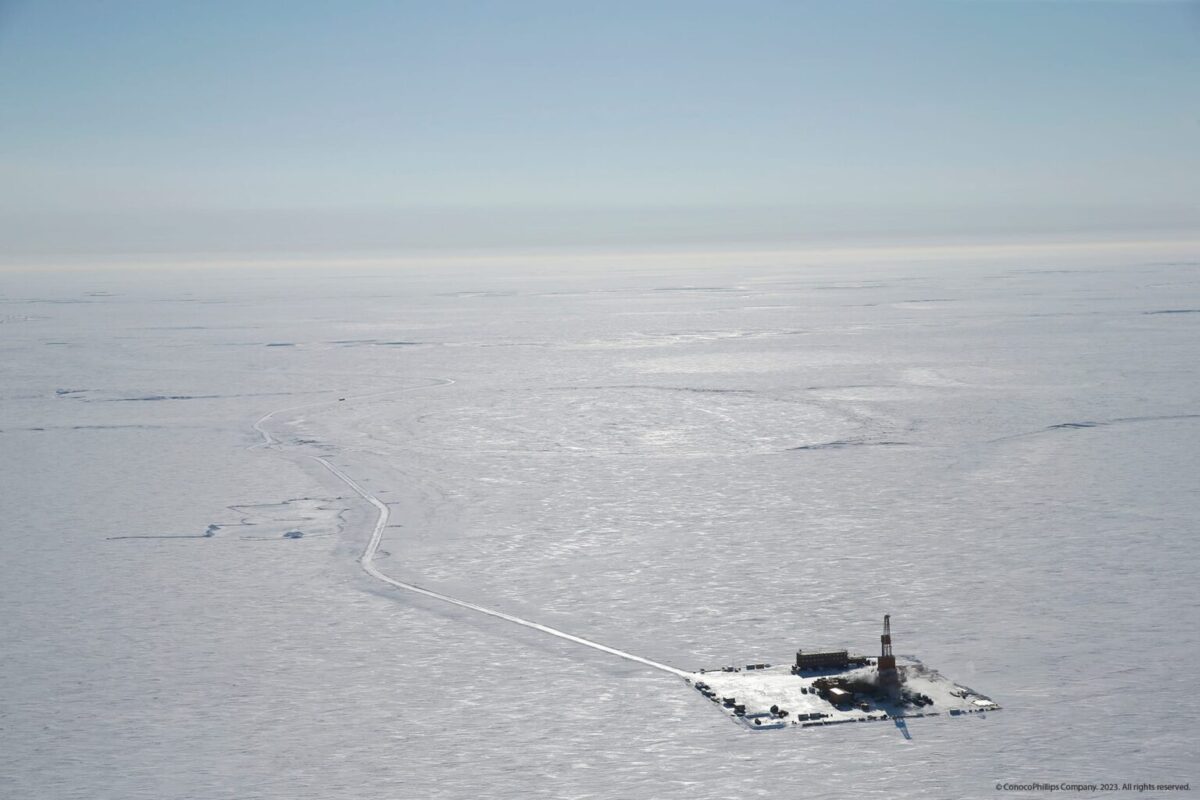
The vast National Petroleum Reserve-Alaska extends west of ConocoPhillips’ massive Willow oil project. (ConocoPhillips)
Global energy leaders have convened here this week, spiffed up in dark suits and polished shoes, to discuss the industry’s most pressing issues: war in the Middle East, Venezuela, artificial intelligence.
But behind the scenes at this annual conference of industry executives — known formally as CERAWeek by S&P Global but nicknamed the “Super Bowl of energy” — a big story about Alaska oil is unfolding.
It involves a massive lease sale in the Arctic, a remarkable show of interest from global oil giants that had faded from Alaska’s frontlines and an emerging race to find deposits potentially worth billions of dollars. Industry proponents say a flood of crude from the largely undeveloped western Arctic, if companies can locate and produce it, could open a new era for the state’s industry.
In what was by far the highest-value federal lease sale in the vast National Petroleum Reserve–Alaska in more than two decades, oil companies last week snatched up more than 1 million acres across the western Arctic.
The scale of interest, with 11 companies participating and a record $163 million spent on bids, was itself notable. But so were the identities of some of the bidders. Two, in particular, surprised even industry insiders: ExxonMobil and Shell.
Both supermajors have a history in Alaska.
ExxonMobil still owns shares of existing Arctic oil fields and the trans-Alaska pipeline. But Shell no longer operates in the state and hasn’t drilled a well in Alaska since its failed offshore exploration campaign more than a decade ago. And ExxonMobil hadn’t bid on leases in years.
Energy historian Dan Yergin, left, speaks with Wael Sawan, chief executive of Shell, at the CERAWeek oil industry conference in Houston this week. (Grant Miller Photography/CERAWeek by S&P Global)
Their renewed interest — along with continued investment from established players like ConocoPhillips and Colorado-based wildcatter Bill Armstrong — accelerates an industry revival that was already playing out on the North Slope.
Just a few years ago, new production and investment in the region lagged as some companies struggled to raise money and even pulled out of Alaska amid successful advocacy campaigns against Arctic drilling.
But major geologic discoveries by Armstrong — and a pair of big new oil fields now under construction — have made the North Slope a more attractive investment. And the industry also has political tailwinds coming from a Trump administration keen to boost resource extraction in Alaska.
“This sale absolutely shows the world the potential for Alaska,” Armstrong, one of the primary bidders, said in an interview at CERAWeek. “This could be a game-changer for the state.”
Bill Armstrong (Max Graham/Northern Journal)
The region still faces obstacles to development, like high costs and competition from other basins where drilling is cheaper.
And the lease sale is just a preliminary step, far from an assurance of future production: No new wells have been drilled yet, and companies often spend years doing exploratory work before deciding whether to start pumping oil.
Conservation groups, meanwhile, continue to fight the industry’s expansion in the reserve — where, they note, federal law instructs policymakers to not only to oversee oil development but also to protect the environment and cultural values. Multiplelawsuits are challenging the Trump administration’s oil-friendly policies in the Arctic, and advocates have asked a judge to invalidate leases set to be awarded after last week’s sale.
Four small lakes sit on the northwestern side of Teshekpuk Lake, a key wildlife habitat within the National Petroleum Reserve – Alaska that’s also seen interest from oil companies. (Craig McCaa/U.S. Bureau of Land Management)
“What we saw last week were companies pushing into some of the most sensitive areas of the reserve,” said Suzanne Bostrom, an attorney with a conservation-focused Anchorage law firm, Trustees for Alaska, that represents some of the organizations suing the administration. “We and the groups that we work with are going to continue to fight for this area, and fight for the protections that it deserves,” Bostrom added.
But even amid the pending legal questions, the sale’s results are still a step toward new development; further investment and competition in the petroleum reserve are likely to follow, conference participants told Northern Journal in Houston this week.
A surprising sale
Leading up to the sale, there were signs that oil companies could show up in force.
It was the first auction in NPR-A in seven years, and more acreage was up for grabs than in many previous sales. The offerings included large swaths of tundra and wetlands that Democratic administrations had designated off-limits to drilling.
And after years of comparatively tepid industry interest, recent oil discoveries have expanded the known resources on the North Slope, said Bob Fryklund, a top oil and gas analyst at S&P Global Energy, a research firm.
“It’s kind of been a sleeper basin,” he said.
This map of Alaska’s North Slope shows the National Petroleum Reserve – Alaska and the Arctic National Wildlife Refuge. Two oil companies are building large developments near the reserve’s eastern edge, and a major lease sale recently auctioned off land deeper into the reserve. Prudhoe Bay is the hub of existing North Slope development.
A decade ago, the petroleum reserve was beyond the western edge of the North Slope’s oil infrastructure, making it more expensive to bring in equipment and drill.
But the industry has been moving in its direction: Construction is now underway at two big new oil fields in the area — ConocoPhillips’ Willow project and Santos’ Pikka project. Both will tap into a long-overlooked oil-rich geologic formation, known as the Nanushuk, that Armstrong initially discovered near the reserve’s eastern boundary.
It was no surprise, then, that ConocoPhillips, Santos and Armstrong all showed up at the recent auction, analysts said.
An exploration rig drills for oil at ConocoPhillips’ Willow prospect in the National Petroleum Reserve – Alaska. (ConocoPhillips)
Few people, however, predicted that so many other companies would put in bids, or that major corporations like ExxonMobil and Shell would participate.
ExxonMobil, committing more than $7 million on some 138,000 acres, came as a particularly big surprise.
That company, headquartered in Houston, owns shares in the existing Point Thomson and Prudhoe Bay oil fields on the North Slope. But it doesn’t manage either field, and the company has not been active in exploration and new development in the state: Until last week, ExxonMobil had not bid on a federal or state oil and gas lease in Alaska in more than a decade, according to data provided by Welligence, an industry research firm.
Meanwhile, Shell, in a partnership with a Spanish company, Repsol, submitted some of the highest bids. The two companies offered more than $2 million on many individual tracts, and committed more than $90 million in total.
A map produced by the U.S. Bureau of Land Management shows winning bids from last week’s lease sale.
Experts said the return of those players was likely influenced by the ongoing development in the area.
Although neither the Willow nor Pikka project is producing yet, the multibillion-dollar investments by ConocoPhillips and Santos may have given other companies more faith in the surrounding geology and the ability to pump oil in the area, analysts said.
“What you saw Shell do, and even Exxon, was validation of the work done by other players on the North Slope in recent years,” an oil company executive said in Houston, speaking on the condition of anonymity because he was not authorized to speak publicly.
Industry headwinds subside
Shell’s interest represents a reversal from its announcement a decade ago that it was pulling out of Alaska. The company had spent some $7 billion on its failed effort to drill for oil offshore in the Chukchi Sea, citing Obama administration policies and high costs when it departed the state.
In 2020, another major, BP, also pulled out of Alaska, selling its assets to Hilcorp, a privately owned Texas business.
Those decisions both seemed like signals of the industry’s decline in the state, as the daily flow through the trans-Alaska pipeline shrank to 500,000 barrels from a high of 2 million decades earlier. An era of oil giants spending freely on big new projects was giving way to one of smaller companies wringing the last drops of crude out of aging fields.
An oil and gas rig drills at a Hilcorp development in the Cook Inlet basin in Southcentral Alaska. (Nathaniel Herz/Northern Journal)
At the time, companies were contending not only with the usual impediments to drilling in Alaska, like high costs and opposition from environmental groups, but also with growing political pressure from climate-minded shareholders and activists opposed to expanding fossil fuel production. Even oil executives acknowledged that advocacy against the oil industry, which is a major driver of climate change, was deterring investment in Alaska.
But even as the burning of fossil fuels continues to warm the planet, global demand for oil remains high — and industry confidence in the North Slope’s potential appears only to be growing.
The newly discovered oil deposits there “have proven that Alaska is not over,” Fryklund said.
ConocoPhillips, ExxonMobil and Santos declined to make officials available for on-record interviews. Shell did not respond to a request for comment.
“This marks an important step in our continued commitment to responsible energy development in Alaska and the U.S.,” an Exxon spokesperson said in an emailed statement.
Once the company’s leases are finalized, ExxonMobil will work with the state and local communities as it evaluates “potential next steps for the area,” the statement said.
“I wish I were 30 years younger”
For those who work in the oil industry, the central plank of Alaska’s economy, the sale stirred excitement, and some relief: New activity in the federal reserve could bring more gigs for contractors that have long wondered if there would be enough development on the North Slope to sustain their businesses.
“We’ve all had this little worry of, ‘Well, what’s next?’” said Greg Miller, vice president of operations at Cruz Construction, a Palmer-based company with oil-related contracts on the Slope. “Now, there’s a little bit of reason to be a little bit more hopeful and positive about the next 10, 20 years.”
The sale won’t lead to immediate growth for Miller’s business, he said. But new exploration activity, if and when it happens, will create jobs: A single project can provide a year’s worth of wages for as many as 100 employees at Cruz, Miller added.
For the president of another Alaska oil services company, Kevin Durling, the hype around the petroleum reserve is reminiscent of the boom days when oil started flowing through the trans-Alaska pipeline, in the 1970s and 1980s.
The trans-Alaska oil pipeline pumps some 500,000 barrels a day. (Nathaniel Herz/Northern Journal)
“I wish I was 30 years younger,” he said.
The state’s conservation community, meanwhile, has reacted with disappointment, and concern for the western Arctic ecosystem.
The vast, largely undeveloped region contains important habitat for migratory birds, and it sustains tens of thousands of caribou, some of which calve around Teshekpuk Lake, a major water body in the northern part of the petroleum reserve.
“I’ve had better weeks at work. No question about that,” said Andy Moderow, senior policy director at Alaska Wilderness League, one of the environmental groups suing the Trump administration. But, he added: “The war is still well in front of us.”
One potential hurdle for development is a legally disputed conservation area around Teshekpuk Lake. The protections, across about 1 million acres, were set aside by the Biden administration for the nearby Iñupiaq village of Nuiqsut, where many people still depend on caribou and other wildlife for food.
The Trump administration canceled the protections late last year, touting the area’s oil and gas potential and aiming to authorize leasing there. Nuiqsut’s leaders then sued, saying the move violated a prior agreement and threatened the village’s subsistence traditions.
Two days before the lease sale results were announced, a federal judge restored the Teshekpuk protections while the lawsuit played out.
But the area still attracted bids from a few companies — including ExxonMobil.
The administration has not said whether it plans to award leases in the disputed area to high bidders — or how, exactly, it intends to navigate the apparent conflict between the sale results and the court ruling.
Nathaniel Herz contributed reporting from Anchorage.
Northern Journal contributor Max Graham can be reached at max@northernjournal.com. He’s interested in any and all mining related stories, as well as introductory meetings with people in and around the industry.
This article was originally published in Northern Journal, a newsletter from Nathaniel Herz. Subscribe at this link.
Members of the Alaska House’s all-Republican minority caucus pose for photographs on Tuesday, Jan. 20, 2026, the first day of the second session of the 34th Alaska State Legislature. (Photo by James Brooks/Alaska Beacon)
At the Alaska Beacon, we’re constantly trying to figure out where we should put our attention. There’s always more news than there are people to report it.
Every Thursday, the Alaska Legislature publishes its committee schedule for the coming week. Public notices alert us to meetings and events. The governor’s office occasionally lets us know ahead of time that something’s coming down the pike, too.
Here’s what we know about for the coming week. If you know of something that’s coming up that you should think we should pay attention to, email us at info@alaskabeacon.com.
We can’t cover everything on this list, but we’re interested in them and we think you should know about them in case you’re interested in them, too.
This list is ripped from our notebooks, and it is likely to change over the course of the week. We’ll update it when we can.
Are you trying to keep track of when to testify on a bill? The Legislature has a website for that.
Monday, March 30
House/Senate floor sessions in the morning
8 a.m. – The House and Senate Education Committees hold a joint session on the state of pre-K – 12 education in Alaska with invited testimony from the Alaska Council of School Administrators
9 a.m. – Senate Finance Committee hears a bill related to the practice of naturopathy
1 p.m. – House Judiciary hears a resolution on voter privacy, and expressing concern at the state sharing confidential voter data with the federal government
1 p.m. – House Resources hears a bill related to fish and game wildlife refuges
1:30 p.m. House Finance continues work on next year’s operating budget, and begins hearing proposed amendments
3:30 p.m. – Senate Resources hears the governor’s bill related to tax breaks for the AK LNG gas line
5:30 p.m. – Fairbanks Fish & Game Advisory Committee – Game and Trapping Subcommittee Meeting, see event info here.
Tuesday, March 31
Filing deadline to apply for the Alaska Permanent Fund dividend is 11:59 p.m. on Mar. 31
Paper applications can be mailed and must be postmarked by Mar. 31.
Paper applications can be delivered to PFD office locations in Anchorage, Fairbanks or Juneau by Mar. 31 during office hours of 10:00 AM – 4:00 PM.
8 a.m. – House Community and Regional Affairs Committee hears a bill related to costs for public records
9 a.m. – Senate Finance considers the governor’s appointee John Crowther as commissioner of the Alaska Department of Natural Resources
10:15 a.m. – House Military and Veterans Affairs Committee hears a bill to update the focus and structure of the Joint Armed Services Committee
11 a.m. – Joint session of the House and Senate gathers to hear the annual address by U.S. Sen. Lisa Murkowski
1 p.m. – House Energy Committee hears a presentation on the Chugach Hydroelectric Program
1 p.m. – House Transportation hears a presentation on trails and local access from the Alaska Department of Transportation and Public Facilities
1:30 p.m. – Senate Natural Resources hears a presentation on the Division of Forestry and Fire Protection
1:30 p.m. – House Finance continues working on the operating budget
1:30 p.m. – Senate transportation hears a presentation on the Port of Seward
3:15 p.m. – House Health and Social Services hears a bill to prioritize keeping siblings together in foster care; and a bill to establish an opioid litigation settlement fund
3:30 p.m. – Senate Health and Social Services Committee related to medical compacts for grants allocated by the federal Rural Health Transformation Program
6:30 p.m. – Middle Nenana River Fish & Game Advisory Committee Meeting in Healy, see event info here.
6:30 p.m. – Alaska Common Ground, a non-profit, non-partisan public policy organization, hosts ‘Just what is the Permanent Fund, and who’s in charge? see event info here.
7 p.m. Upper Tanana Fortymile Fish & Game Advisory Committee Meeting in Tok, see event info here.
Wednesday, April 1
House/Senate Floor sessions in the morning
8 a.m. – House Education continues hearing bills related to increasing education funding, residential school funding, and civics education
9 a.m. – House Finance continues work on next year’s operating budget and hears proposed amendments
9 a.m. – Senate Finance hears a bill on mental health education in public schools
12 p.m. – Lunch & Learn presentation on outmigration of limited entry fishing permits
1 p.m. – House Judiciary Committee considers a bill related to social media use of minors, and bill to establish safe devices for surrendering infants
1 p.m. – House Resources Committee continues hearing the governor’s tax break proposal for the Alaska LNG gas line project
3:30 p.m. – Senate Education Committee hears a presentation from the University of Alaska Fairbanks chancellor on the Alaska Native Language Center
3:30 p.m. – Senate Resources Committee will hear a resolution urging support for the proposed Alaska LNG gas line project, with public testimony invited
5 p.m. – House Finance continues to hear proposed amendments on next year’s operating budget
Thursday, April 2
8 a.m. – House Community and Regional Affairs hears a bill related to ensuring the right to repair digital; a bill related to emergency first responders; a bill related to birth certificates and identification for unhoused young adults; and a bill related to autonomous vehicles
8 a.m. – House Tribal Affairs Committee hears a presentation on the Council of Alaska Native Language
9 a.m. – House Finance Committee hears a bill related to marijuana taxes and retail stores
10:15 a.m. – House Military and Veterans Affairs Committee hears a bill to update the focus and structure of the Joint Armed Services Committee
1:30 p.m. – House Finance Committee hears an update on the University of Alaska and deferred maintenance needs
3:30 p.m. – House Health and Social Services hears a bill to to prioritize keeping siblings together in foster care; a bill to expand early intervention services; and a bill related to regulating the sale of weight-loss and muscle-building supplements
3:30 p.m. – House State Affairs hears a bill related to establishing a welcome office in Alaska; and a bill related to regulating PFAS chemicals, remediation and water testing
Friday, April 3
All committee meetings cancelled ahead of the Easter holiday
The vast National Petroleum Reserve-Alaska extends west of ConocoPhillips’ massive Willow oil project. (ConocoPhillips)
HOUSTON — Global energy leaders have convened here this week, spiffed up in dark suits and polished shoes, to discuss the industry’s most pressing issues: war in the Middle East, Venezuela, artificial intelligence.
But behind the scenes at this annual conference of industry executives — known formally as CERAWeek by S&P Global but nicknamed the “Super Bowl of energy” — a big story about Alaska oil is unfolding.
It involves a massive lease sale in the Arctic, a remarkable show of interest from global oil giants that had faded from Alaska’s frontlines and an emerging race to find deposits potentially worth billions of dollars. Industry proponents say a flood of crude from the largely undeveloped western Arctic, if companies can locate and produce it, could open a new era for the state’s industry.
In what was by far the highest-value federal lease sale in the vast National Petroleum Reserve–Alaska in more than two decades, oil companies last week snatched up more than 1 million acres across the western Arctic.
The scale of interest, with 11 companies participating and a record $163 million spent on bids, was itself notable. But so were the identities of some of the bidders. Two, in particular, surprised even industry insiders: ExxonMobil and Shell.
Both supermajors have a history in Alaska.
ExxonMobil still owns shares of existing Arctic oil fields and the trans-Alaska pipeline. But Shell no longer operates in the state and hasn’t drilled a well in Alaska since its failed offshore exploration campaign more than a decade ago. And ExxonMobil hadn’t bid on leases in years.
Energy historian Dan Yergin, left, speaks with Wael Sawan, chief executive of Shell, at the CERAWeek oil industry conference in Houston this week. (Grant Miller Photography/CERAWeek by S&P Global)
Their renewed interest — along with continued investment from established players like ConocoPhillips and Colorado-based wildcatter Bill Armstrong — accelerates an industry revival that was already playing out on the North Slope.
Just a few years ago, new production and investment in the region lagged as some companies struggled to raise money and even pulled out of Alaska amid successful advocacy campaigns against Arctic drilling.
But major geologic discoveries by Armstrong — and a pair of big new oil fields now under construction — have made the North Slope a more attractive investment. And the industry also has political tailwinds coming from a Trump administration keen to boost resource extraction in Alaska.
“This sale absolutely shows the world the potential for Alaska,” Armstrong, one of the primary bidders, said in an interview at CERAWeek. “This could be a game-changer for the state.”
Bill Armstrong (Max Graham/Northern Journal)
The region still faces obstacles to development, like high costs and competition from other basins where drilling is cheaper.
And the lease sale is just a preliminary step, far from an assurance of future production: No new wells have been drilled yet, and companies often spend years doing exploratory work before deciding whether to start pumping oil.
Conservation groups, meanwhile, continue to fight the industry’s expansion in the reserve — where, they note, federal law instructs policymakers to not only to oversee oil development but also to protect the environment and cultural values. Multiplelawsuits are challenging the Trump administration’s oil-friendly policies in the Arctic, and advocates have asked a judge to invalidate leases set to be awarded after last week’s sale.
Four small lakes sit on the northwestern side of Teshekpuk Lake, a key wildlife habitat within the National Petroleum Reserve – Alaska that’s also seen interest from oil companies. (Craig McCaa/U.S. Bureau of Land Management)
“What we saw last week were companies pushing into some of the most sensitive areas of the reserve,” said Suzanne Bostrom, an attorney with a conservation-focused Anchorage law firm, Trustees for Alaska, that represents some of the organizations suing the administration. “We and the groups that we work with are going to continue to fight for this area, and fight for the protections that it deserves,” Bostrom added.
But even amid the pending legal questions, the sale’s results are still a step toward new development; further investment and competition in the petroleum reserve are likely to follow, conference participants told Northern Journal in Houston this week.
A surprising sale
Leading up to the sale, there were signs that oil companies could show up in force.
It was the first auction in NPR-A in seven years, and more acreage was up for grabs than in many previous sales. The offerings included large swaths of tundra and wetlands that Democratic administrations had designated off-limits to drilling.
And after years of comparatively tepid industry interest, recent oil discoveries have expanded the known resources on the North Slope, said Bob Fryklund, a top oil and gas analyst at S&P Global Energy, a research firm.
“It’s kind of been a sleeper basin,” he said.
This map of Alaska’s North Slope shows the National Petroleum Reserve – Alaska and the Arctic National Wildlife Refuge. Two oil companies are building large developments near the reserve’s eastern edge, and a major lease sale recently auctioned off land deeper into the reserve. Prudhoe Bay is the hub of existing North Slope development.
A decade ago, the petroleum reserve was beyond the western edge of the North Slope’s oil infrastructure, making it more expensive to bring in equipment and drill.
But the industry has been moving in its direction: Construction is now underway at two big new oil fields in the area — ConocoPhillips’ Willow project and Santos’ Pikka project. Both will tap into a long-overlooked oil-rich geologic formation, known as the Nanushuk, that Armstrong initially discovered near the reserve’s eastern boundary.
It was no surprise, then, that ConocoPhillips, Santos and Armstrong all showed up at the recent auction, analysts said.
An exploration rig drills for oil at ConocoPhillips’ Willow prospect in the National Petroleum Reserve – Alaska. (ConocoPhillips)
Few people, however, predicted that so many other companies would put in bids, or that major corporations like ExxonMobil and Shell would participate.
ExxonMobil, committing more than $7 million on some 138,000 acres, came as a particularly big surprise.
That company, headquartered in Houston, owns shares in the existing Point Thomson and Prudhoe Bay oil fields on the North Slope. But it doesn’t manage either field, and the company has not been active in exploration and new development in the state: Until last week, ExxonMobil had not bid on a federal or state oil and gas lease in Alaska in more than a decade, according to data provided by Welligence, an industry research firm.
Meanwhile, Shell, in a partnership with a Spanish company, Repsol, submitted some of the highest bids. The two companies offered more than $2 million on many individual tracts, and committed more than $90 million in total.
A map produced by the U.S. Bureau of Land Management shows winning bids from last week’s lease sale.
Experts said the return of those players was likely influenced by the ongoing development in the area.
Although neither the Willow nor Pikka project is producing yet, the multibillion-dollar investments by ConocoPhillips and Santos may have given other companies more faith in the surrounding geology and the ability to pump oil in the area, analysts said.
“What you saw Shell do, and even Exxon, was validation of the work done by other players on the North Slope in recent years,” an oil company executive said in Houston, speaking on the condition of anonymity because he was not authorized to speak publicly.
Industry headwinds subside
Shell’s interest represents a reversal from its announcement a decade ago that it was pulling out of Alaska. The company had spent some $7 billion on its failed effort to drill for oil offshore in the Chukchi Sea, citing Obama administration policies and high costs when it departed the state.
In 2020, another major, BP, also pulled out of Alaska, selling its assets to Hilcorp, a privately owned Texas business.
Those decisions both seemed like signals of the industry’s decline in the state, as the daily flow through the trans-Alaska pipeline shrank to 500,000 barrels from a high of 2 million decades earlier. An era of oil giants spending freely on big new projects was giving way to one of smaller companies wringing the last drops of crude out of aging fields.
An oil and gas rig drills at a Hilcorp development in the Cook Inlet basin in Southcentral Alaska. (Nathaniel Herz/Northern Journal)
At the time, companies were contending not only with the usual impediments to drilling in Alaska, like high costs and opposition from environmental groups, but also with growing political pressure from climate-minded shareholders and activists opposed to expanding fossil fuel production. Even oil executives acknowledged that advocacy against the oil industry, which is a major driver of climate change, was deterring investment in Alaska.
But even as the burning of fossil fuels continues to warm the planet, global demand for oil remains high — and industry confidence in the North Slope’s potential appears only to be growing.
The newly discovered oil deposits there “have proven that Alaska is not over,” Fryklund said.
ConocoPhillips, ExxonMobil and Santos declined to make officials available for on-record interviews. Shell did not respond to a request for comment.
“This marks an important step in our continued commitment to responsible energy development in Alaska and the U.S.,” an Exxon spokesperson said in an emailed statement.
Once the company’s leases are finalized, ExxonMobil will work with the state and local communities as it evaluates “potential next steps for the area,” the statement said.
“I wish I were 30 years younger”
For those who work in the oil industry, the central plank of Alaska’s economy, the sale stirred excitement, and some relief: New activity in the federal reserve could bring more gigs for contractors that have long wondered if there would be enough development on the North Slope to sustain their businesses.
“We’ve all had this little worry of, ‘Well, what’s next?’” said Greg Miller, vice president of operations at Cruz Construction, a Palmer-based company with oil-related contracts on the Slope. “Now, there’s a little bit of reason to be a little bit more hopeful and positive about the next 10, 20 years.”
The sale won’t lead to immediate growth for Miller’s business, he said. But new exploration activity, if and when it happens, will create jobs: A single project can provide a year’s worth of wages for as many as 100 employees at Cruz, Miller added.
For the president of another Alaska oil services company, Kevin Durling, the hype around the petroleum reserve is reminiscent of the boom days when oil started flowing through the trans-Alaska pipeline, in the 1970s and 1980s.
The trans-Alaska oil pipeline pumps some 500,000 barrels a day. (Nathaniel Herz/Northern Journal)
“I wish I was 30 years younger,” he said.
The state’s conservation community, meanwhile, has reacted with disappointment, and concern for the western Arctic ecosystem.
The vast, largely undeveloped region contains important habitat for migratory birds, and it sustains tens of thousands of caribou, some of which calve around Teshekpuk Lake, a major water body in the northern part of the petroleum reserve.
“I’ve had better weeks at work. No question about that,” said Andy Moderow, senior policy director at Alaska Wilderness League, one of the environmental groups suing the Trump administration. But, he added: “The war is still well in front of us.”
One potential hurdle for development is a legally disputed conservation area around Teshekpuk Lake. The protections, across about 1 million acres, were set aside by the Biden administration for the nearby Iñupiaq village of Nuiqsut, where many people still depend on caribou and other wildlife for food.
The Trump administration canceled the protections late last year, touting the area’s oil and gas potential and aiming to authorize leasing there. Nuiqsut’s leaders then sued, saying the move violated a prior agreement and threatened the village’s subsistence traditions.
Two days before the lease sale results were announced, a federal judge restored the Teshekpuk protections while the lawsuit played out.
But the area still attracted bids from a few companies — including ExxonMobil.
The administration has not said whether it plans to award leases in the disputed area to high bidders — or how, exactly, it intends to navigate the apparent conflict between the sale results and the court ruling.
Nathaniel Herz contributed reporting from Anchorage.
Northern Journal contributor Max Graham can be reached at max@northernjournal.com. He’s interested in any and all mining related stories, as well as introductory meetings with people in and around the industry.
This article was originally published in Northern Journal, a newsletter from Nathaniel Herz. Subscribe at this link.
Sitka Sound sac roe herring fishery opened at noon today, with about 20 seiners fishing an area that includes Crescent Bay and Jamestown Bay east of town, the Alaska Department of Fish and Game said.
Aaron Dupuis, area management biologist, estimated the fishery would last until fishermen caught the processors’ capacity, which is about 500 to 600 tons for the day.
Dupuis spoke to the Daily Sitka Sentinel briefly while managing the fishery aboard the vessel Eric C.
“It’s the first opening of the year, and it’s going pretty well,” he said.
The guideline harvest level (GHL) for this year’s fishery is 35,015 tons, which is 15% of the 233,433 tons of mature herring that managers expect to return this year. That forecast is a 6% decrease from the 2025 mature pre-fishery biomass estimate of 247,081 tons, ADF&G said.
The department has been conducting vessel sonar and aerial surveys and doing test sets for the last few days, including near Bieli Rocks, two miles west of Sitka then increasingly closer to town.
Thursday’s 77th annual Juneau Lions Club Gold Medal Basketball Tournament action saw five teams earn semifinal wins and a day of rest before playing in their respective bracket championships on Saturday.
The Klukwan masters were the first team of the day to punch their ticket to the finals on Saturday with an 87-60 win over Hoonah. Klukwan was led by 15 points from Stuart Dewitt, 13 from Michael Ganey and 12 from Andrew Friske. Hoonah’s Arthur Campbell and Andy Gray scored 11 apiece and Jimmy Refuerzo 10. Klukwan plays at 11 a.m. Saturday for the title. Hoonah plays Sitka at 11 a.m. Friday in an elimination game with the winner advancing to face Klukwan in Saturday’s 11 a.m. Masters championship.
Hoonah punched their ticket into the C bracket finals with a 75-65 win over Hydaburg behind 31 points from Joseph Coronell JR and 22 from Tavis Dybdahl. Hoonah advances to the 5 p.m. title game on Saturday. Hydaburg was led by 25 points from Darren Edenshaw. Hydaburg plays an elimination game at 5 p.m. Friday against Kake with the winner getting a shot at Hoonah for the C bracket title. Kake eliminated Metlakatla from the C bracket 70-57 behind 22 points from Rudy Bean and 16 from Dean Cavanaugh. Metlakatla was led by 34 points from Mace Hayward and 11 from Clifton Guthrie.
Juneau’s AML defeated Metlakatla 92-84 in the A bracket semifinal behind 20 points from Kolby Hoover, 18 from Kaleb Tompkins and 15 from Chase Saviers. Metlakatla was led by 26 points from Clay Olstad and 24 from Nate Yockey. AML held an 83-73 lead with two minutes to play and Metlakatla’s Olstad hit three free throws to pull to 83-78. Forced to foul to gain possession, Metlakatla put AML’s Kaleb Tompkins on the line and he hit six in a row and Chase Saviers notched 3-4. Metlakatla’s Yockey and Olstad closed out the scoring in the loss. AML advances to the 3 p.m. championship game on Saturday and will play the winner of today’s elimination game between Metlakatla and FILCOM. Metlakatla previously defeated FILCOM 86-74 to open their tournament play on Tuesday.
Haines improved to a 3-0 record with an 81-52 win over Yakutat (2-1) in the B bracket semifinal behind 24 points from Kaleb Tompkins and 20 from Kyle Fossman. Yakutat was led by 18 points from Arthur Adams and 12 from Christian Adams. Haines advances to the 7 p.m. championship game on Saturday. Yakutat plays an elimination game against Angoon at 7 p.m. Friday with the winner earning a shot at Haines for the B bracket title. Angoon defeated Kake 80-68 in an elimination game behind 34 points from Clayton Edwin and 24 points from Tajaun Jamestown. Kake was led by 21 points from Simon Friday, 16 from Dominic Ross and 13 from Tristan Ross.
In the women’s bracket semifinal Craig defeated Yakutat 56-50 behind 18 points from Nani Weimer and 15 from Michaela Demmert to earn the 1 p.m. championship game on Saturday. Yakutat was led by 20 points from Kim Armendariz. Yakutat trailed 15-1 after the first quarter, then stepped up defensively to trail 19-16 at the half. Craig led 38-26 starting the fourth quarter and held off their opponents in the final 10 minutes. Yakutat plays an elimination game at 1 p.m. Friday against Metlakatla, a 54-37 elimination game winner over Angoon on Thursday. Metlakatla was led by 17 points from Ryley Booth and 10 apiece from Alexis Russell and Ashley Huffine. Angoon was led by 8 points from Frances Mills and 6 apiece from Tasha Heumann and Carmaleeda Estrada.
FRIDAY GAMES
11 a.m. Masters elimination – Hoonah (1-1) vs. Sitka (1-1)
1 p.m. Women’s elimination – Yakutat (2-1) vs. Metlakatla (2-1)
3 p.m. A bracket elimination – FILCOM (1-1) vs. Metlakatla (1-1)
5 p.m. C bracket elimination – Hydaburg (2-1) vs. Kake (2-1)
7 p.m. B bracket elimination – Yakutat (2-1) vs. Angoon (3-1)
SATURDAY GAMES
11 a.m. Masters Championship – Klukwan (2-0) vs. winner of Friday’s 11 a.m. Hoonah (1-1) vs. Sitka (1-1) elimination game.
1 p.m. Women’s Championship – Craig (2-0) vs. winner of Friday’s 1 p.m. Yakutat vs. Metlakatla elimination game.
3 p.m. A Championship – AML (2-0) vs. winner of Friday’s 3 p.m. Metlakatla (1-1) vs. FILCOM (0-1) elimination game.
5 p.m. C Championship – Hoonah (3-0) vs. winner of Friday’s 5 p.m. Hydaburg (2-1) vs. Kake (2-1) elimination game.
7 p.m. B Championship – Haines (3-0) vs. winner of Friday’s 7 p.m. Yakutat vs. Angoon elimination game.
Leaders of the University of Alaska Southeast and the Central Council of the Tlingit and Haida Indian Tribes of Alaska took their first steps together down “a pathway for healing” on Friday morning.
“This is a historic moment,” said Chalyee Éesh Richard Peterson, president of Tlingit and Haida. “This is us talking about strengthening our relationship to build something that’s enduring and brings our culture to the forefront in ways that it often hasn’t been.”
Sitting side by side in the executive council chambers of the Andrew Hope Building, Peterson and UAS Chancellor Aparna Palmer signed a memorandum of understanding to formally initiate the process of developing a School of Indigenous Studies. Tlingit and Haida Executive Council members and UAS staff clapped and cheered, with many embraces following the signing.
Palmer called it an honor to affirm the shared commitment to strengthen educational opportunities for Indigenous communities, in support of student growth and vitality.
“Rarely is it the case that a tribe and a university come together as equal partners to create a vision for education,” she said. “We are honored and humbled to have the trust of the Central Council of the Tlingit and Haida Tribes of Alaska, and we proudly stand with them on the precipice on this journey. We realize as a university that this is a sacred trust with the tribe that we hold.”
The University of Alaska Fairbanks has a College of Indigenous Studies, but Palmer said this new journey is unique since the tribe is an equal partner.
She said the school “is an opportunity to continue to integrate, celebrate and shape the education that we offer at UAS with the values and the traditions of Indigenous peoples” across Southeast Alaska. She added the school could have relationships with the School of Education, the School of Arts and Sciences, and the School of Career Education.
“I also think that it’s a model,” she said. “I think that collaboration, where the tribe and a university are equal partners, walking together on this journey, is incredibly unique and very, very precious.”
Palmer said UAS has a model it can build upon to grow its existing Indigenous Studies programs and form them into a school.
The university offers a Bachelor of Arts in Indigenous Studies, certificates in Indigenous language teaching and speaking, and an occupational endorsement in Northwest Coast Art. A minor is also available for undergraduate degrees in Northwest Coast Art, the Tlingit language and Alaska Native studies. Various courses in these fields of languages, arts and culture are also available.
The university and tribe will work together to create a structure, and the school will eventually have to be approved by the University of Alaska Board of Regents and the tribe. Since Tlingit and Haida is a recognized form of government, Peterson said the board of regents’ directive last year for universities to remove language around diversity, equity and inclusion from campus websites and communications should not be a hurdle in creating the school.
Peterson said conversations about a School of Indigenous Studies ebbed and flowed in the past, and he was thankful for Palmer’s efforts in bringing the partnership to fruition. He also recognized his friend’s efforts, X̱’unei Lance Twitchell, a professor of Alaska Native Languages at UAS.
In an interview, Peterson and Twitchell recalled the idea of a tribal college surfacing in their conversations with Dennis Demmert nearly 30 years ago. They were in Sitka at the now-closed Sheldon Jackson College. The college hosted a village management institute and workshops on grant writing and policy to expand leadership skills.
“I remember Dennis even saying then, what an idea to have a tribal college where we can build out our next leaders,” Peterson said.
Demmert served over 20 years as the director of Native Studies at UAF. His dedication to improving education for Alaska Native students is recognized through the Dennis Demmert Appreciation and Recognition Award.
“It’s been a really long time coming,” Twitchell said. “And so it’s really fabulous to hear the visions and dreams of people who have been in education for a long time, like Dennis Demmert was one of our mentors and I think of him when things like this happen, and then to be able to take their vision and to make it into a reality — that’s the really exciting part.”
After the signing, Chalyee Éesh Richard Peterson, president of the Central Council of the Tlingit and Haida Indian Tribes of Alaska, hugs X̱’unei Lance Twitchell, a professor of Alaska Native Languages at UAS, on Friday, March 27, 2026. (Jasz Garrett / Juneau Independent)
Twitchell said the vision is an Indigenous university. The school now being developed would include areas of Indigenous study such as languages, arts, governance and Indigenous sciences. He said the idea is students could have a cross-disciplinary agenda or focus on one area, but the benefit is these options will be available locally for “future leaders.”
Additionally, the school would offer certificates, a bachelor’s degree, or a master’s degree in Indigenous studies. The first master’s program currently being developed is a Master of Arts in Teaching Indigenous Languages.
“The goal is to have those upper-level degrees for all of them,” Twitchell said, meaning there would be a Master of Arts in Indigenous Arts, Tribal Administration and Indigenous Sciences.
The signed memorandum identifies opportunities for pilot programs, joint grant initiatives, and collaborative events or learning experiences, and forms a working group with representation from both Tlingit and Haida and UAS.
Twitchell said for Indigenous peoples, education requires not only transformation, but entire pathways “that are Indigenous in their being.”
“When we look at what the intention of education was for Indigenous peoples, it was to destroy us,” Twitchell said. “It was to destroy our languages, it was to make us be servants of the population. And I think now we look at education as a way to bring us back to strength.”
“Let’s change that. Let’s take that tool against us and make it a tool for us,” Peterson said. “And I really believe we can.”
He said the tribe has already taken steps to do so by operating programs in early childhood and K-12 education. A new 12-acre tribal education campus is also being developed behind Fred Meyer. Just this week, the tribe obtained licensing for its early childhood education and youth programs at the largely vacant Floyd Dryden building. The tribe plans to relocate three Head Start classrooms, its LEARN childcare program, and several youth engagement programs to the former middle school.
“I always say healthy tribes make healthy communities, and that’s for everybody,” Peterson said. “That’s not just for us, but when we’re healthy, we’re going to be thriving in these communities. And I believe education is at that core.”
Northern Journal’s survey of Alaska’s many gubernatorial hopefuls is back — this time, asking how much money candidates would budget for Permanent Fund dividends.
We also find out when each candidate last rode on Alaska’s state ferry system — a publicly funded network that’s been the subject of polarizing budget debates in recent years.
Starting in this edition, we’ve narrowed the surveyed candidates to those who reported raising at least $3,000 in the latest round of campaign finance reports — as well as those who announced their candidacies after the latest reporting deadline.
Republicans Bernadette Wilson, Adam Crum, Treg Taylor and Nancy Dahlstrom did not respond to our questions; we sent them multiple requests.
Have suggestions for future survey questions? Email nat[at]northernjournal[dot]com.
Gov. Mike Dunleavy proposed a Permanent Fund dividend amount for the coming fiscal year based on the historical statute tied to investment returns.
Dunleavy is budgeting some $2.365 billion for PFDs, which equals a payment of roughly $3,800 per Alaskan. That would leave an overall deficit of $1.5 billion — depleting a little less than half of Alaska’s primary savings account, the Constitutional Budget Reserve, according to legislative fiscal projections from earlier this year.
If you were governor, what’s the overall spending on Permanent Fund dividends that you would have proposed for the upcoming fiscal year? For reference, some 620,000 dividends were paid last year, so a $1,000-per-person PFD would equate to some $620 million in overall spending.
Question 2
When is the last time you rode an Alaska state ferry, where did you go, and what was the purpose of your trip?
Dave Bronson, Republican and former mayor of Anchorage
$2.4 billion.
The Permanent Fund dividend is a return of value to Alaskans, created to share the value of our natural resources with the people who own them. It is important to follow the law. A statutory dividend today is about $2.4 billion. However, the state cannot absorb that cost overnight or reduce spending by that amount, and Alaskans do not support spending down the principal of the fund. What they want is a sustainable, long-term formula-driven approach like we once had.
I would begin by proposing the statutory dividend and working with the Legislature to reach a responsible compromise that restrains spending growth, identifies targeted reductions, and focuses on economic growth so Alaska can return to a sustainable dividend in the future.
I have never been on an Alaska state ferry.
Former Anchorage state Sen. Tom Begich, a Democrat
$620 million to $910 million
I believe the statute should be rewritten; a new amount should be set by the Legislature as a starting amount somewhere in the range of the average over that last eight years (between $1,000 and $1,500) and tied to the earnings or losses of the fund over a one to three year average. Rising or falling with the earnings.
The Governor proposes the original amount, so I would likely propose the higher of those two amounts, but be clear when announcing the budget that I would be open to the Legislature’s number.
Outside of the Gravina ferry in Ketchikan (airport), which I rode today, I rode the (ferry) to Metlakatka on March 9th.
Democratic state Sen. Matt Claman
$620 million/$1,000
Alaskans tell us that we need improved investment in public education, public safety, and long-delayed capital projects without depleting $1.5 billion from our constitutional savings account. They know from the last eight years that a dividend based on the historical statute is not affordable.
Step one with increased oil revenue is proposing a common-sense budget that protects the Permanent Fund and has similar funding for all departments as this year, including a $1,000 dividend and taking no money from savings. Step two is working together with the Legislature for a balanced budget with improved investment in our schools and communities, an affordable dividend, and economic growth. Working together, Alaska’s future is strong and bright.
In about 2016, I rode the ferry as part of a wonderful circle trip in Southcentral Alaska. Drive from Anchorage to Sheep Mountain Lodge on the Glenn Highway, bike 200 miles from Sheep Mountain Lodge to Valdez, overnight in Valdez, ride the ferry from Valdez across Prince William Sound to Whittier, and drive home to Anchorage. Glorious!
Anchorage doctor Matt Heilala, a Republican
Proposing the full statutory PFD simply isn’t feasible amid $1.5-2 billion operating deficits which would continue to deplete the CBR. Until the statutory formula can be adjusted constitutionally, we must compromise. Past full-PFD efforts failed due to these concerns, causing volatile dividends and calls for new taxes, which I strongly oppose. As governor I’d propose a PFD based on the immediate prior year legislative precedent: This year, $1,000 per Alaskan (the same as the original PFD), totaling roughly $620 million. This would help better align the executive and legislative efforts with less finger pointing and vitriol. I’d launch a parallel transparency initiative with Palantir’s Foundry.
I’ve ridden Alaska ferries like the Columbia on family trips across the coast. At 8, on Valdez-Whittier with my aunt & uncle, I wandered to the pilot house. They heard over PA: “Visitor here, what’s your name?” “Matt!” Captain let me blow the horn to trigger a glacier calving. Last: 15 yrs ago, Valdez-Whittier ferry with RV, kids, looped from ANC.
Jonathan Kreiss-Tomkins, Democratic former state representative
$1,500 PFD
The PFD is a critical lifeline for many Alaskans who depend on it for fuel, food, and other essentials. I believe it’s a good program that helps Alaskans.
I’m also not crazy about the either-or choices that have been forced on Alaskans: either we fund the PFD *or* we fund schools, ferries, and troopers.
As governor, I would make several no-brainer budget moves like closing the Hilcorp tax loophole and extending the corporate income tax to out-of-state online businesses that operate in Alaska (a bill that passed the legislature with 42 out of 60 votes, but got vetoed by Gov. Dunleavy).
Once we get that done, we can prioritize K-12 schools, public safety, roads and ferries, *and* distribute a PFD that makes a difference for Alaska families.
About 2 months ago. I took the M/V Kennicott from Sitka to Juneau. I was helping two friends in Juneau get their cars over from Sitka, and I was heading over myself to catch the start of legislative session. The combination of Starlink wifi and strong black coffee in the cafeteria let me do some serious damage to my email inbox on the sailing over.
Shelley Hughes, Republican former state senator
Aim: half draw
When Walker cut the PFD, I’d been fighting to reduce the 50% spending growth from the prior decade. I fought for a full PFD not only because its design was to empower families and the private sector but because of the unaddressed budget growth.
I’ll establish a Sunset Audit Commission to draft legislation aimed at efficiencies, fraud elimination, mandatory vs discretionary spending. I’m committed to rebuilding the PFD so it’s no longer an issue; we’ll pull out the stops to build a diversified economy to ensure steady, adequate revenue via a cheap energy portfolio, lands in Alaskan hands, and infrastructure. Other “dividends” as a result? Great jobs, better schools, affordable living, new routes, and real opportunities for our young people.
A Palmer girl with SE Alaska roots, I’m on the ferry every couple years. In last three summers, I round-tripped twice (Juneau/Haines) for two nephews’ weddings – outdoors along the water (gorgeous couples, spectacular settings!). Years prior, I’d take the ferry to Hoonah where I used to live and my mother lived until recently (she’s now in Juneau).
Matanuska-Susitna Borough Mayor Edna DeVries, a Republican
$2.365 billion
If we as political elected officials make laws for others to follow, it is important that we follow the laws that are set before us.
April 11, travelling from Juneau to Whittier, coming back from session.
Republican former state senator Click Bishop
It depends.
Alaska’s Constitution under Article 9 outlines how the governor shall submit a budget to the Legislature, and essentially requires the budget to be balanced at the end of the year.
As governor, I will proposed a balanced budget every year. We will pay dividends in every budget at the greatest amount possible in accordance with a balanced budget.
Whatever amount the governor proposes for the dividend, there are two things certain: 1) the state revenue forecast will change over the following 16 months; and 2) the Legislature will amend the budget.
We’re all in this together. It’s the public’s money for today’s basic needs that must be protected for tomorrow’s generations.
In September, I traveled aboard the AMHS Tustumena, Rusty Tusty, visiting coastal communities like Chignik, Sand Point, King Cove, and Cold Bay. Despite rough seas and fall storms, the trip offered time to meet local residents, tour the Izembek Refuge, and see firsthand how the Marine Highway serves as a lifeline for Alaska’s coastal towns.
Traditional healer Meda DeWitt, an independent
$1,300-$1,800
Gov. Dunleavy has proposed $6,700-$3,650 for eight years running, and it has been rejected by the Legislature each year because it would create a $1.5 billion deficit, draining half of our last savings account.
My approach: start with the POMV draw, deduct inflation-proofing first (skipped two years, eroding the fund’s real value), deduct operations, split the remainder 50/50 between dividends and the government. That produces a PFD of roughly $1,300–$1,800 per person, higher than last year’s historic low, lower than an unfunded promise, and honest about what the fund can sustain. Total dividend spending: approximately $800 million to $1.1 billion. No CBR drawdown required.
Alaska needs a formula, not an illusion.
Born in Klawock, I often rode the ferry. My earliest memory riding on the ferry, was during a storm, and a jellyfish hit the window. The last ferry trip memory was at seven years old. My grandmother passed away from a heart attack on that trip. Today, I ship vehicles, or large tools, to Yakutat. As a Tlingit, we fondly call the ferry the big blue canoe.
We’re back with a new edition of our recurring survey of the more than dozen candidates running to be Alaska’s next governor.
This week’s survey explores a subject that has commanded huge amounts of political debate and discussion at Alaska’s Capitol in recent years: How much money should the state share with school districts on a per-student basis?
We also asked about what kind of car each candidate drives — because a car can tell you a lot about a person.
Republicans Bernadette Wilson, Nancy Dahlstrom, Adam Crum, Treg Taylor and independent Jessica Faircloth did not respond to the survey despite multiple requests.
Have suggestions for future survey questions? Email nat[at]northernjournal[dot]com.
Question 1
The Alaska Legislature last year passed a law boosting the state’s baseline per-student schools spending by some 12% to $6,660, up from $5,960, and overrode Republican Gov. Mike Dunleavy’s veto of the law. Lawmakers also overrode a separate line-item veto by Dunleavy of some of their added schools spending.
A pair of school districts, meanwhile, sued the Dunleavy administration last month month, alleging that spending on schools is inadequate even after last year’s increase — which came after the baseline spending level rose barely 2% during the preceding decade. Inflation eroded purchasing power by some 37% during that same period, the districts said.
As governor, what specific amount would you have proposed for per-student spending — known as base student allocation, or BSA — in the budget for the upcoming fiscal year? Response must be a whole number. Then, please explain your answer.
Question 2
What kind of vehicle do you drive (make/model/color), and why did you choose it? If you don’t drive a car/truck, how do you get around?
Jonathan Kreiss-Tomkins, Democratic former state representative
$6,900.
With the Permanent Fund, all we care about — and *should* care about — is the “real” value of the fund, in inflation-adjusted terms, in order to protect the fund for future generations of Alaskans. It’s why accounting for inflation (and not relying on “nominal,” non-inflation-adjusted figures) is so important for making the Permanent Fund permanent.
It’s no different for public education: in “real” terms, we have cut funding for our schools over the last decade (by flat-funding in nominal terms). I haven’t math’d out where $6,900 would put us in real, inflation-adjusted terms, but we should get back to levels of education funding where families feel confidence in their neighborhood school and their kids’ future in Alaska.
2001 Toyota Rav4, manual transmission. 227,000 miles and going strong!
Shelley Hughes, Republican former state senator
$6,660.
K-12 education is of utmost importance. Tying any increase to $6,660 to policies to increase student outcomes is the right thing to do when 70% of students are below grade level. Alaska ranks high in spending, yet student performance lags at the very bottom. Per pupil costs range from $6,200 for correspondence to over $60,000 in some districts, but this increase doesn’t correlate with an increase in outcomes. An inflation adjustment and/or BSA increase in law should go hand in hand with laws re: accountability, funds routed to teachers and proven approaches (like the Reads Act), expansion of proven, cost-effective educational choices, admin/instruction cost ratio reductions, and districts joining state’s health insurance pool to save money.
Our vehicles are simply to get us from point A to point B safely, nothing fancy, just functional. My husband and I share our 2010 Ford Ranger and 2020 Acura RDX. The must-haves when it comes to a vehicle? They have to hold the road well in winter (and that means 4-wheel drive – and sandbags in truck bed) and have space to haul gear for summer fun.
Anchorage doctor Matt Heilala, a Republican
$6,660.
Should the need for additional funding arise after last year’s BSA showdown, I would work directly with legislators to set clear, achievable student outcome standards tied to any future funding such as reading proficiency by 3rd grade and algebra proficiency by 9th grade. Public schools deserve adequate support, and increased funding must come with accountability for measurable results, not unchecked spending. I’d also emphasize that public education is rapidly decentralizing and will look very different in the coming decades. This shift can benefit families and communities by using technology to find efficiencies, making more learning possible in less time and at lower cost through modern, decentralized teaching platforms.
I drive a Toyota Land Cruiser for Alaska’s tough winters. When weather permits, I drive my Tesla Model S Plaid. It’s exhilarating to drive, and its Full Self-Driving AI is remarkably advanced, proven 6-10x safer than human driving. As a technophile, I love its 90% well-to-wheel efficiency (vs. ~25% for gas), the forefront of innovation.
Dave Bronson, Republican and former mayor of Anchorage
$6,000.
Alaska already spends among the most per student in the nation, yet our student outcomes rank near the bottom.
Continuing to raise spending without demanding clear educational improvement is not responsible to students, parents, or taxpayers. Any future increase must be directly tied to specific, measurable reforms that improve reading proficiency, math performance, graduation rates, and career readiness.
Our priority must be measurable results, not just higher budgets. Before asking Alaskans to spend more, we must ensure existing education dollars are being used effectively.
Funding increases should be tied to proven progress in the classroom, not just throwing money at administrative bloat.
Red 2024 Ford F-350 – I chose it for functionality and towing capacity.
Republican James William Parkin IV
$10,000.
Alaska’s “spend it or lose it” budget is a system that breeds short-sighted, wasteful spending! For over 30 years I have witnessed the waste that this kind of directive has caused. No more! Clear directives, one page budget accountability, and allowances for saving, investing and long term financial decisionmaking without future budget penalties will guide funding to where it rightfully belongs. To the children and their teachers and not to administrative costs. Alaska was once a magnet state for the nation’s best teachers and brightest students! Alaska’s education funding is ranked 6th highest in the nation! A lawsuit is unwarranted. A budget system that gives the ed department more control over funding will solve the problems. Much more.
Whatever is running at the time. My fun car (not drivable most of the year) is my red 2007 Saturn Sky Redline Turbo convertible. Not practical but sometimes you need to just enjoy life. My kids enjoy driving it too.
Matanuska-Susitna Borough Mayor Edna DeVries, a Republican
$0.
I believe my answer is pretty clear. I am not proposing or supporting any amount until public education in the state of Alaska completes some reforms.
2022 SUV
Former Anchorage state Sen. Tom Begich, a Democrat
$7,360.
This would be the 1st of 2 increases to bring us to $1,200 over 2 years. According to Legislative Finance, this covers erosion from inflation over the last 2 decades. I was instrumental in both the Kasayulie and Moore lawsuits ensuring that our state would fully and adequately fund education. The Reads Act set out good policy, but good policy – universal PreK, Reading, Math – must be fully funded. This administration has not done that. If reform is going to work, you have to pay for it. Coupled with early funding and inflation indexing of education, this would stabilize our education budget and would be paid for by 1) adopting the internet fee; 2) eliminating the Hilcorp exemption; and 3) eliminating oil and gas tax credits on our 3 legacy fields.
Tom Begich’s car.
Grey All Wheel Drive MiniCooper Countryman (2013) — bought in Portland when my old car died. Drove up the Alcan Dec. 2012 at -40 F. The car wasn’t happy, but heated seats worked for me. It continues to carry me — well over 100,000 miles — up and down the Alcan in Winter and Summer. Good mileage, reliable, warm — and surprisingly high clearance.
Republican former state senator Click Bishop
$7,894.
As senator, I would have voted to override Governor Dunleavy’s veto of education funding. As governor, I will bring together stakeholders and experts to craft a durable solution to Alaska’s long-term education funding challenges. The $6,660 per-student figure was a compromise focused on one number, but districts across organized boroughs and REAAs face different realities. We must revisit the district cost factor, stagnant for 20 years, to ensure safe, reliable schools for every child. I would also add career and technical education to the formula. Alaska needs a predictable funding system so educators can focus on students—not politics in Juneau.
Blue Ford F-350 diesel crew cab. It’s my “do-it-all” truck— perfect for hauling my grandkids and Ruby, my dog. It has 340,000 miles and still running, but I do spend the money to keep it up in shape. It fits me like a glove!!!
Democratic state Sen. Matt Claman
$7,000.
A bright future for Alaska starts with education. For too long, we’ve undermined our schools, asking for more while funding less. $7,000 is an increase higher than inflation, and it must come with better results. Schools must work smarter to improve performance for students, the workforce, and our communities. Accountability is key to improving K-12 education, keeping young people working in Alaska, and growing the economy so the next generation can succeed. And we must start now. As senator, I introduced SB 46 to shift the focus from the flawed Base Student Allocation to a comprehensive budget approach that ensures predictability, transparency, and effective student-teacher ratios for our children to thrive. Our families deserve no less.
2007 Subaru Tribeca. It’s a great car for us—all-wheel drive, reliable, and room to carry gear for our Alaska adventures. Plus it has comfortable seating for Lucy, our dog, to join the journey!
Republican commercial fisherman Henry Kroll
$10.
We have a 7% inflation of the dollar, and everything costs more. Some schools could be consolidated, and the buildings could be either rented or shared with other schools.
I drive a Ford 150 for my fishing business and a Ford car to get around because it is economical.