The state ferry Columbia, the largest vessel in the fleet, has been delayed a second time coming back to work on the busy summer route between Bellingham, Washington, and Southeast Alaska.
The ship is now scheduled to make its first northbound run from Bellingham on June 5, according to the Alaska Marine Highway System’s online reservations site.
The state will keep the Kennicott on the route until the Columbia is ready to go back into service.
When the Columbia returns, the Kennicott will tie up at the dock in Ketchikan. The Marine Highway System — for the fourth year in a row — says it lacks enough crew to run both vessels during the busy summer season.
As of May 4, the online reservations system showed no availability on the Columbia until the July 24 northbound sailing for a traveler who wanted to take their car or truck or RV from Bellingham to Wrangell.
The Columbia, which has served the popular route since going into service in 1973, has about twice the vehicle deck space as the smaller Kennicott.
In November, the Columbia went into the shipyard in Ketchikan for winter layup and annual maintenance. It originally had been expected back on the route May 6. That date was first pushed back to May 20.
The latest delay to June 5 is due to a couple of reasons, said Gabe Strong, public information officer for the Alaska Marine Highway System.
“The dry docking of the Columbia was delayed because the Lituya had to have the bow repaired. … The Lituya took the Columbia’s scheduled dry dock time and that set the Columbia work back a couple weeks,” Strong said in an email on April 30.
“Luckily, we had the Kennicott available to take over the mainline run for the Columbia.”
The Lituya, which shuttles between Ketchikan and Metlakatla, was damaged when it ran aground after leaving the Metlakatla dock in late December 2025 and spent much of March at the Ketchikan shipyard for repairs.
In addition to losing time in the dry dock, the other reason for the Columbia’s delayed return to service was mechanical.
“During the Columbia bow thruster overhaul, it was discovered that the shaft that drives the turbine had saltwater intrusion, so the shaft was sent south to get flame-sprayed and re-machined,” Strong said.
A single turbine powers the bow thruster, which aids in the ship’s maneuverability. “It’s an omni-thruster that sucks water in from the sides and shoots it out the displacer plate on the keel of the vessel,” he explained.
The 33-Mile Roadhouse has not opened to the public for several days and now has one sign on the front reading “Closed” and another reading “For Sale.”
Reached in person Monday, Roadhouse owner Robert Harris said he wasn’t interested in talking about the circumstances around the closure and that the signs speak for themselves.
He owns the nearly eight acres of parcels around the roadhouse, which included a home behind it, and four cabins.
His is the second restaurant to close in just over a month. Alpenglow Woodfired Pizza announced its closure at the end of March after lease negotiations collapsed.
The Bahamas, Saint Lucia, Cabo Verde, Casablanca, and now, maybe, Haines? The world’s largest cruise port operator wants to lease Haines’ Port Chilkoot dock and add it to a portfolio of global holdings.
Haines Borough officials said last week they had been approached by representatives from Global Ports Holding, a Turkey-based company, that reported hosting 17.6 million passengers at its more than 30 global cruise ports last year.
Former Skagway mayor Andrew Cremata, acting as a paid representative of the company, first broached the possible dock lease last fall, according to multiple borough officials. Cremata did not respond this week to a request for comment.
Borough manager Alekka Fullerton said she met late last month with Cremata and Colin Murphy, Global Ports Holding’s regional head of business development. Murphy this week did not comment on the potential deal.
Exact lease details were not discussed during that meeting, Fullerton said, but she and the assembly intend to hold a public meeting later this month.Theoretically, the company would present more information to residents at that meeting.
Based on the company’s other dealings, it’s likely the borough would see two major impacts from a lease: more cruise ship passengers and more borough revenue.
The company’s nearest port is in Prince Rupert, British Columbia, where it signed a long-term lease in 2022. That deal followed a failed bid to lease Ketchikan’s municipal cruise dock in 2020.
Under the Ketchikan proposal, the company would have taken on control, management, and maintenance of the facility.
The twenty and thirty year leases on the table offered large sums of money to Ketchikan: at least according to the company’s pitch, compensation to the city could have totaled $140-212 million over the length of the lease. Ketchikan’s city council ended up voting down the lease, 4-3, maintaining the dock’s public ownership.
There are other considerations, too, besides just the total amount of compensation.
With public ownership, Ketchikan was charging cruise lines a per-passenger berth tax, bringing revenue into city coffers. Haines currently does the same, with fees at the Port Chilkoot Dock expected to bring in $818,500 this year.
Federal law requires those revenues be spent on cruise-ship related improvements, and Haines’ revenue is restricted to a fund that only spends on the dock itself.
During its 2020 negotiations with Ketchikan, Global Ports Holding argued that if it collected those fees and then shared them with the municipality, those funds could be freed up to use for any purpose.
The additional millions for Ketchikan likely would have been fueled by an increase in total visitors.
According to Global Ports Holding’s annual report from 2025, passenger volume “underpins, directly or indirectly, most of our revenue and is the key to successfully delivering organic growth.”
Despite being a global behemoth, the company isn’t on the public-facing side of things; it has a grand total of one google review — a one star review from a Spanish user — which reads “Worst company to work with, go away! Run!”
Rather, the company’s dealings would likely be with the cruise lines themselves, advocating for Haines as a more frequent destination.
“They can grow the cruise ship industry here, with their connections, in a way I can’t do,” said Haines tourism director Rebecca Hylton.
The annual report talks about big picture dealings — “the global cruise ship order book,” for instance — as determinants of which ships go where. Getting into that game, Hylton said, would require the borough government take on duties like sending staff to Miami.
Whether residents want more cruise ship volume is an open-ended question. A 2025 survey found a majority of Haines residents supported cruise ship volume holding steady, or increasing slightly. Only 16% of respondents preferred a “much higher” amount of cruise ship business. There was, however, a spread of opinions, including a higher rate of support for the cruise industry among younger survey respondents.
Haines currently lags well behind its nearest neighbors, Juneau and Skagway, in terms of cruise business. Some see a larger cruise industry as a potential boon for the local economy.
Right now, it’s difficult for local tour operators to run a business solely on cruise ship passengers docking in Haines, said Barbara Nettleton, owner of tour-company Takshanuk Mountain Trail.
Now, Nettleton’s business relies heavily on the Haines-Skagway fast ferry, which delivers a predictable stream of customers to Haines from Skagway cruise dockings. But in the past, when Nettleton was targeting Haines cruise and independent travelers, the flow of customers wasn’t reliable enough to hire staff.
“Last year we decided to go back into the Skagway market, and now we have crew that have complete weekly schedules,” she said. “If we had ships regularly calling into Haines, it would be easier to hire appropriately. Skagway could be more of a supplemental market.”
Hylton acknowledged that many residents would likely only support an increase to a certain point, if at all. But broader industry trends may force a change, regardless of local preference.
“I think the cruise ship industry is moving toward a Caribbean model, with complete control over cruise ship guests at private islands,” Hylton said. According to Hylton, in Mexico or Belize, that might look like a gated-off shopping area at a port guarded by private security. Closer to home, it looks more like Huna Totem Corporation’s Icy Strait Point or Port Klawock, she said.
Cruise visitation is currently trending up in Southeast overall, which has to some extent masked movement away from ports like Haines to the specialty, private ports, Hylton said. But if the trend continues, she warned, Haines could lose the industry.
Earlier this year Haines lost an offer from American Cruise Lines that would have seen the cruise line contribute money to Letnikof Dock repairs in exchange for long-term guaranteed use of the facility.
Soon after withdrawing its offer to Haines, American Cruise Lines finalized similar deals with the Chilkoot Indian Association and the Wrangell and Petersburg boroughs.
Fullerton said that in her recent meeting with Global Ports Holding, the company’s representatives “intimated” that they were discussing similar possible deals with other communities in the region.
That introduces some time pressure, said assembly member Gabe Thomas.
“I know these port companies looking at Klawock, all these other small places, so we can’t sit on it too long,” he told other assembly members at last Tuesday’s meeting.
With little solid information yet, the near-universal answer on the issue from borough officials has been, “it depends.”
Said Hylton this week, “it’s all going to be about how the lease looks and if it’s the right fit for the community.”
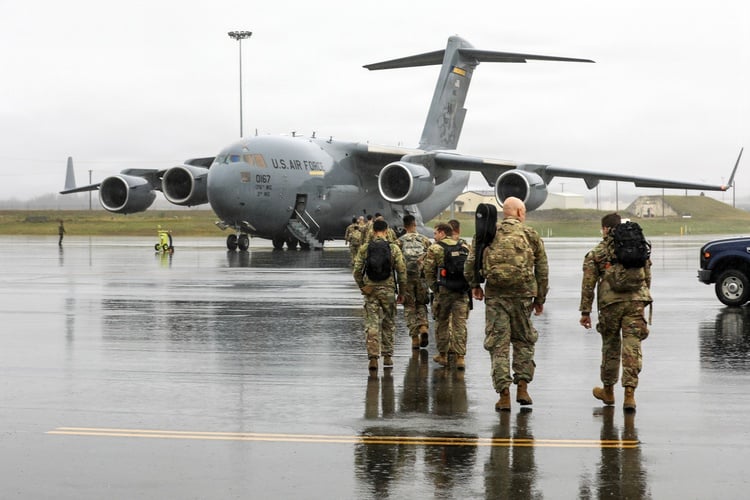
Alaska Organized Militia members from across the Alaska Army National Guard, and the Alaska State Defense Force, prepare for departure from Joint Base Elmendorf-Richardson as they travel to Bethel, Alaska, while supporting storm response operations, Oct. 13, 2025. (Alaska National Guard photo by Capt. Balinda O’Neal)
Alaska will deploy 25 National Guard soldiers and airmen to Washington D.C. this month, according to a Friday update from the Alaska Department of Military and Veteran Affairs.
The deployment is part of a response to President Trump’s August declaration of a “crime emergency” in the nation’s capital. In the nine months since, 2,500 troops remain, according to NBC4 Washington. Guard members have assisted with medical emergencies, arrests and beautification projects, as well as snow removal.
The division announcement said the Alaska service members will be focused on public safety: “Guard members provide support functions such as crowd management, perimeter security, and logistical and communications support.”
Alaska National Guard members will deploy for 60 days, according to the division, as part of a joint task force with the Metropolitan Police Department and federal law enforcement partners.
Gov. Mike Dunleavy approved a verbal request in November from the U.S. Secretary of the Army for Alaska to deploy 100 service members, following a national directive by the Pentagon to all 50 states to prepare National Guard service members to train for “civil disturbance operations.”
A spokesperson for Dunleavy’s office did not respond to a request for comment on the smaller deployment, the purpose and timing of the mission on Monday.
Lawmakers had raised concerns about the Pentagon’s national directive for an estimated 20,000 National Guard service members to be trained and prepared to deploy in U.S. cities within 24 hours. Alaska was initially charged with preparing 350 service members as part of a “quick reaction force” by Jan. 1.
Rep. Andrew Gray, D-Anchorage, co-chair of the Alaska Joint Armed Services Committee, and a veteran of the Alaska National Guard, was among those who had raised concerns.
On Monday, Gray said the smaller deployment for 60 days is less of an issue.
“I don’t think it’s in the best interest of the American taxpayer to be flying service members from Alaska to D.C. to do what I don’t believe is of grave consequence,” he said.
“At the end of the day, to me, it’s sort of a nothing burger. I do think that it shows that the Dunleavy administration and General (Torrence) Saxe are in alignment with Trump. They’re showing that they support Trump’s agenda. But again, this is just not that big of a deal, in my opinion.”
A drone image shows widespread flooding in the Mendenhall Valley. (Image courtesy of Rich Ross)
A drone image shows widespread flooding in the Mendenhall Valley in 2024. (Image courtesy of Rich Ross)
NOTN- City officials and U.S. Army Corps of Engineers representatives outlined ongoing and proposed flood-mitigation work last night.
The Committee of the Whole work session focused on HESCO barriers and river armoring installed after the series of glacial lake outburst floods in recent years.
Mike Records, the Technical Lead for the Army Corp of Engineers, outlined the hydrology of the system, how the flood water moves.
His presentation estimated flood risk. those estimations will be used to design short, medium and long-term protections.
Engineers discussed “Annual Exceedance Probability” or AEP, which was once referred to as “100 Year Flood.”
This means the chance that a flood of a certain size will happen in any given year. For example, a “1% AEP” flood has a 1% chance of happening each year.
But according to officials, those odds add up over time. Even a rare flood becomes much more likely if you look over many years. A flood with a 1% yearly chance has about a 40% chance of happening at least once over 50 years.
“A 1% annual exceedance probability event would be the equivalent of a 100-year event, there is a low chance of that happening, but over time, those chances compound.” Records said, “The annual exceedance probability events that we developed are peak discharge events that we then used in hydraulic modeling to inform decision making on design. You’ll see that a lot of these events are significantly larger in magnitude than anything that’s been experienced at this point.”
In most places, engineers rely on decades of historical data to estimate flood risk, but in this case, there are only about three years of major data available.
“There’s flooding all over the country, it’s rare that it develops so suddenly like this.” Records said, “So normally, you might have like a 60 year period of record of flood events that you could use to develop your AEPS. In this case, there’s basically three years of full drainage events.”
Because of limited data and a changing environment, there is a lot of uncertainty in these estimates, so engineers are planning for the worst-case scenario.
According to officials, Suicide Basin is expanding. This is because the glacier is melting and retreating, which opens up more space for water to collect. Ice is breaking off (calving), melting, and adding to the lake, so overall the basin can hold more water than it used to. On the other side, the spillway,, the pathway where water drains out beneath or around the glacier, is also changing. As the glacier thins and melts, the outlet is getting lower, which can allow water to start draining sooner.
Cubic-feet-per-second or CFS, is the rate at which water flows. Last year’s flood reached about 50,000 CFS. Officials said work aims to reach a 63,500 CFS flood scenario threshold by mid-July.
Assembly Member Nano Brooks asked Records about the service life of the HESCO barriers, to which Records responded, “They have a warranty of five years. I think that’s primarily for fabric degradation. Of course, those parts can be replaced, but that is kind of the maximum expectation without significant ongoing maintenance.”
Three options were presented for the coming season: the status-quo-plus build, upgrades to protect to 63,500 CFS (the staff recommendation), or a larger, more costly build to protect to 90,000 CFS. According to officials, that type of flood has an 18% chance of occurring in the next 10 years.
Officials said the 63,500-CFS option would leave an estimated $3 million funding gap and the 90,000-CFS option about $8 million short of current funding.
The city is pursuing State Revolving Fund assistance that would forgive half the loan and could cover much of the cost if approved.
Ultimately The City and Borough Assembly voted 7-2 to authorize work to reinforce and raise HESCO flood barriers to protect against a 63,500 CFS event ahead of the 2026 flood season .
An ordinance to formalize the appropriation is expected for introduction May 18.
A Hilcorp drilling rig operates on the shore of Cook Inlet, not far outside Anchorage. The company used a different rig for its exploratory well in the Yukon Flats in summer 2025. (Photo by Nathaniel Herz/Northern Journal)
A major oil exploration effort in the Yukon River watershed that prompted tribal opposition is coming to an end without an announcement of any major petroleum discoveries — and after the completion of only one of the two wells originally planned.
Oil and gas company Hilcorp was set to drill both wells last summer on land held by Indigenous-owned corporations, including the regional corporation for Alaska’s Interior, Doyon, Limited.
But Hilcorp only ended up drilling one well in the summer of 2025. Toward the end of the season, Doyon said that exploration at both planned drill sites in the region known as the Yukon Flats was “expected to continue into 2026.”
But now, before the exploration season gets started, Hilcorp says it’s finished its exploration program and will begin demobilizing work in the coming months.
“We are honored to once again work with Doyon, tribal governments, and regional organizations during the 2026 season and extend our sincere gratitude for their partnership, trust and collaboration throughout this multi-year effort,” spokesman Matt Shuckerow said in a prepared statement Friday.
Data and analysis from the well that was drilled “represent a meaningful geological contribution to the broader understanding of the Yukon Flats basin and will help inform future exploration in the region,” he added.
Hilcorp’s oil exploration efforts had drawn support from Doyon and a smaller Indigenous village corporation that also owns land where the wells were planned — as well as from the tribal government in the village, Birch Creek.
Oil development on Native-owned land, Doyon executives said previously, could produce jobs and royalty checks for the corporation’s more than 20,000 shareholders, generate business for its subsidiary companies that work in the oil business, and pump low-cost natural gas to heat local villages.
But in a rare split with Doyon, tribal leaders along the Yukon River broadly opposedthe drilling effort, saying it was too risky in a watershed that’s already seen sharp declines in salmon runs in recent years.
Advocates opposed to Hilcorp’s exploration work celebrated the news that the company would not drill this summer.
“Our expectation was that they were going to move forward with that second exploration well,” said Rhonda Pitka, first chief of the Yukon River village of Beaver and vice president of Tanana Chiefs Conference, a regional tribal government that had opposed the drilling effort. The news that Hilcorp is pulling out, she added, is a “very happy surprise.”
Pitka said she hopes that Doyon and Hilcorp ultimately provide a “full and transparent report” on the full extent of their removal of drilling infrastructure, and on their future intentions. Hilcorp, in its statement, did not directly state whether it plans further exploration or development in future years.
A spokesperson for Doyon, Sarah Obed, said the company is “pleased with the progress to date on the Yukon Flats exploration project, which has been done in consultation with local communities at every step.”
Doyon, Obed added, “continues to see promise” in its lands for the betterment of its shareholders.
In an community mailer, Doyon said Hilcorp’s test well was part of a “very limited project, with more than 1.6 million acres of our lands still unexplored.”
“Future development opportunities may be pursued by Hilcorp or another operator as opportunities allow, with Doyon shareholders, local villages, and partners closely involved in the process,” the update said.
Nathaniel Herz welcomes tips at natherz@gmail.com or (907) 793-0312. This article was originally published in Northern Journal, a newsletter from Herz. Subscribe at this link.
State lawmakers raised concerns in a series of legislative hearings while they considered the confirmation of Gov. Mike Dunleavy’s attorney general designee Stephen Cox. At issue were controversial legal actions Cox took in his first eight months in office.
Attorney General designee Stephen Cox appears before the Senate Judiciary Committee for a confirmation hearing on May 1, 2026. (Photo by Corinne Smith/Alaska Beacon)
Cox is an attorney and has served in various roles in federal law enforcement, including as U.S. Attorney for the Eastern District of Texas and other roles in the U.S. Departments of Justice and Homeland Security, as well as in private industry in Texas and Alaska, according to his resume. Cox is a member of the Federalist Society, a national conservative and libertarian legal organization. Prior to being appointed, he worked as legal counsel for Bristol Bay Industrial, LLC, a holding company and investment subsidiary of the Bristol Bay Native Corporation, since 2021.
Dunleavy appointed Cox to the Attorney General’s office in August, after Treg Taylor resigned to run for governor. Cox appeared before lawmakers in Senate and House confirmation committees ahead of a joint session to vote on his appointment next week.
While in Alaska’s top legal post, Cox has taken several controversial actions lawmakers questioned. He defended handing over Alaska’s private voter information at the request of the U.S. Department of Justice, which has prompted a lawsuit by civil rights groups. Cox and the Alaska Department of Law also joined over 110 amicus briefs, or “friends of the court briefs” on a wide variety of federal and state cases, including U.S. Supreme Court cases.
Attorney General designee Stephen Cox answers questions from the Senate Judiciary Committee during a confirmation hearing on May 1, 2026. (Photo by Corinne Smith/Alaska Beacon)
Some lawmakers raised concerns that Cox has taken legal positions with amicus briefs that were highly politicized, aligned with the Trump administration and in some cases contrary to Alaska law and unrelated to Alaskans interests.
That included joining Alaska in cases opposing birthright citizenship, supporting a Christian baker declining to bake a cake for a same-sex wedding, and supporting the most recent case where the U.S. Supreme Court ruled that Louisiana’s congressional maps cannot be drawn based on race — a decision critics say effectively limits the Voting Rights Act.
Senate President Gary Stevens, R-Kodiak, asked why Cox had signed Alaska on to challenge birthright citizenship, which the U.S. Supreme Court is scheduled to decide in June. Stevens became emotional, saying it was a fundamental value to provide refuge to people fleeing war and poverty, or seeking better opportunities — like his own ancestors who escaped the Irish famine.
“It just baffles me. How can you or your department or anyone in the administration argue against birthright citizenship? It’s in our Constitution. It’s a moral issue,” Stevens said.
Senate President Gary Stevens, R-Kodiak, and Sen. Löki Tobin, D-Anchorage listen to Attorney General designee Stephen Cox at a confirmation hearing on May 1, 2026. (Photo by Corinne Smith/Alaska Beacon)
Cox said he believes that birthright citizenship should not be granted for children of those visiting or temporarily in the United States, but only for those who intend to stay.
“My view of the Constitution under the 14th Amendment is that it is not simply birth on the territory, that you also have to be not subject to the foreign jurisdiction, and that there has to be some kind of allegiance,” Cox replied.
“But I also recognize, like everything, I could be wrong,” he added. “But again, we will hear what the US Supreme Court decides on that issue.”
Lawmakers in the Senate Judiciary and State Affairs Committees pressed Cox on his reason for signing on to cases that they said would be contrary to Alaskan’s interests.
Sen. Matt Claman, D-Anchorage, asked if Cox would sign on to cases challenging abortion rights in another state, while Alaska’s Constitution protects the right to abortion within the right to privacy.
“What is your perspective with respect to filing amicus briefs and requests for amicus briefs regarding the right to abortion, that the courts have found is specifically protected in Alaska?” Claman asked.
After several minutes of back and forth, Cox finally said he would have to consider the specific case and consult with the governor.
“I would look hard at the law. I would consult the experts within the Department of Law. I would get their expertise. If I felt that the state of Alaska did not have an interest, I wouldn’t bring it,” he said. “If I thought that there was an interest in that the state of Alaska did have, notwithstanding what the Alaska Supreme Court has ruled in in its prior cases, I would have a conversation with the governor.”
Sen. Bill Wielechowski, D-Anchorage, questioned Cox on why he didn’t oppose a lawsuit before the U.S. Supreme Court that would require mail-in ballots to be received by Election Day, which would be a challenge for many rural Alaska precincts. Alaska law currently allows ballots to be received within 10 days, or 15 days if mailed overseas.
Sen. Bill Wielechowski, D-Anchorage, questions Alaska Attorney General designee Stephen Cox during his first legislative confirmation hearing before the Senate State Affairs Committee on Apr. 30, 2026. (Photo by Corinne Smith/Alaska Beacon)
“Why didn’t you stand up for Alaska and say to the court: this is a bad law for Alaska. We want you to strike this down. We want you to say no to this,” Wielechowski said.
Cox defended the decision to submit an amicus brief declaring no support for either party as a “strategic choice.”
“I actually like briefs in support of neither party that are very fact-based. And I think, and again, I realize people might disagree, but I think sometimes they get noticed the most, but that was a strategic choice,” he said.
Lawmakers also questioned the time and resources expended by the Alaska Department of Law on amicus briefs, versus prosecutions and law enforcement in Alaska. “Why would we spend that money when we have this crisis on domestic violence and sexual assault, when that money is better spent on prosecution in state?” Claman asked.
Cox defended the initiative, and the creation of a new Alaska State Solicitor General role focused on multistate litigation in October. He said his goal in office is to pursue more amicus briefs.
“Going forward, I’d like Alaska to take more of a leadership role, offering more of our own briefs, and shaping the arguments directly, as opposed to just being a joiner,” he told lawmakers.
Senators question Cox on sharing confidential voter information
Several senators questioned Cox on his role in the Dunleavy’s administration’s decision to share confidential voter information at the request of the U.S. Department of Justice last year. Critics and plaintiffs in new lawsuit against the state say the sharing of voter information — including full name, birth dates and partial social security numbers — was a violation of voters’ privacy. The state also signed an agreement to remove voters the DOJ flags as ineligible.
Alaska Attorney General designee Stephen Cox is questioned by Sen. Bill Wielechowski, D-Anchorage, during his first legislative confirmation hearing before the Senate State Affairs Committee on Apr. 30, 2026. (Photo by Corinne Smith/Alaska Beacon)
Cox said he believed the request was lawful, and noted the federal government had threatened to sue.
“One, was there a statute that authorized disclosure of confidential information? There was, for lawful government purposes,” Cox said. “And two, we took the posture of cooperation. Alaska has a long standing history of cooperating with the U.S. Department (of Justice) Civil Rights Division.”
“And I will be candid with you,” he added. “I have a disposition of cooperating with law enforcement.”
Sen. Scott Kawasaki, D-Fairbanks, pressed Cox on the decision to share the voter information, which he and other lawmakers stressed is protected by Alaska’s Constitution.
Sen. Scott Kawasaki, D-Fairbanks, questions Alaska Attorney General designee Stephen Cox during his first legislative confirmation hearing before the Senate State Affairs Committee on Apr. 30, 2026. (Photo by Corinne Smith/Alaska Beacon)
“The state also has a constitutional right of privacy. It’s one of the, I think, bedrocks and one of the most important things I think some people recognize in the state constitution,” Kawasaki said. “Why was that not your first thought, is that Alaska has got a constitutional right to privacy. Let’s take a pause before we do anything more that the Department of Justice has requested?”
Cox defended the decision as lawful: “I will concede I am learning about the right to privacy. And the Legislature has far better expertise on the right to privacy,” Cox said. “And the law department’s position is that that statute is a valid statute and that it is not unconstitutional.”
Sen. Jesse Bjorkman, R-Kenai, also questioned the purpose of sharing Alaska’s voter information, which Cox defended as under “lawful government purpose” in the agreement. But Bjorkman raised doubts that the reasons the federal government may deem voters to be ineligible is clear.
“If we are releasing the data for a lawful purpose, but we can’t positively identify what the purpose is, and then judge that according to whether or not it is indeed lawful,” Bjorkman said. “I have a concern about that.”
Cox outlines AG office priorities
Cox told lawmakers that while in the Attorney General’s office his priorities include a new “quality of life” initiative working with the municipality of Anchorage to prosecute retail theft and public disorder infractions.
“We’ve cross-designated prosecutors so that state and municipal attorneys can use each other’s authorities. We’re looking at civil tools like abatement actions to go after drug houses or even using data from retailers to identify patterns and repeat offenders,” he said.
Cox said prosecuting violent crime like domestic violence and sexual assault is always the No. 1 priority of the office, and added he’s focused on resource development and consumer protection as well.
“Alaska has some of the strongest consumer protection laws in the country, and I think we can be enforcing them more aggressively,” he said.
“At bottom, this job is about the rule of law, what the law requires, how it is applied and how we exercise the state’s power within those limits. I’ve spent much of my career in law enforcement settings where the stakes are real. Decisions affect liberty, public safety and public trust. That experience shapes how I approach this office,” he said.
Cox is scheduled to appear before the House Judiciary Committee on Monday. A joint session on state appointments was scheduled for May 7 but was postponed and likely will be set for early next week.
Juneau’s Goldbelt Tram is scheduled to remain closed until May 24 following an accident last Thursday when one of the two passenger cars docked at the base station at an accelerated rate of speed, injuring employees in the car, Goldbelt Inc. announced Monday.
The closure is to “investigate the issue and take any necessary corrective measures to ensure the safety of our guests and employees,” the Juneau-based Alaska Native corporation stated in a post on its Facebook page.
“The Tram is in the process of refunding all pre-paid tickets for visits scheduled during the closure period that were purchased through our website. If you purchased tickets through a third party, such as a cruise line, please contact that vendor directly for refund assistance.”
The Goldbelt Tram on Thursday, April 30, 2026, shortly after one of its two cable cars docked at the base station at an accelerated rate of speed, resulting in two employees in the car being treated at Bartlett Regional Hospital. (Mark Sabbatini / Juneau Independent)
The accident occurred at about 9 p.m. last Thursday when five employees were taking one of the cars down from the mountain. Two were taken to Bartlett Regional Hospital after the impact at the base, where they were treated and released.
Damage occurred at both the top and bottom stations, due to both cars operating in tandem when the incident occurred.
Goldbelt has not specified the reason for the accident.
Speaker of the House Bryce Edgmon, I-Dillingham, and Senate President Gary Stevens, R-Kodiak (at rear) preside over Monday’s joint session of the Alaska Legislature on May 4, 2026. (Corinne Smith photo/Alaska Beacon)
After two southeast Alaska Republicans reversed themselves, the Alaska Legislature on Monday failed to override Gov. Mike Dunleavy’s veto of an elections bill intended to take effect this year.
Forty votes were needed to override the veto. Monday’s vote was 38-22, with Rep. Jeremy Bynum, R-Ketchikan, and Sen. Bert Stedman, R-Sitka, providing the critical votes to sustain the veto. Both previously voted to pass Senate Bill 64 and send it to the governor.
Each said after Monday’s vote that they did not believe state officials would be able to implement the bill in time for this year’s elections.
As written, SB 64 contained a swath of changes to state law that were intended to make it easier for Alaskans to vote and to improve the security of state elections.
Among the proposed modifications: Free postage for absentee ballots, a new system for absentee voters to track their ballots through the counting process, a 10-day period for absentee voters to fix problems that disqualified their ballots, updated procedures for auditing the state’s voter list to remove ineligible people, a requirement that the financial backers of ballot measures disclose their identities and a special liaison intended to fix widespread voting problems in rural Alaska.
Dunleavy vetoed the bill on Thursday. In his veto message to the Legislature, he wrote, “the Division of Elections warns such changes would be extremely difficult if not impossible, to implement securely and reliably in advance of the 2026 elections.”
Sen. Bill Wielechowski, D-Anchorage, supported the bill and the override. Speaking ahead of the vote, he said that in 2022, during a special election held after the death of Rep. Don Young, R-Alaska, the state was able to implement a ballot-tracking system within six weeks.
“I’m not prepared to tell Alaskans, ‘Sorry, it’ll have to wait another year. It’s just too hard,’” Wielechowski said.
Sen. Bill Wielechowski, D-Anchorage, speaks in support of overriding a veto by Gov. Dunleavy of an elections reform bill on May 4, 2026. (Photo by Corinne Smith/Alaska Beacon)
But Bynum said afterward that he was swayed by statements from the Division of Elections, which said it was uncertain about its ability to implement the system so quickly this year.
“I can’t speak to what they may or may not have done in 2022. I can only speak to what the Division of Elections is telling me today. And what they told me is that this timeline is too aggressive for them to effectively put this in the law,” he said.
Bynum said another factor in his vote was the use of tribal IDs by voters at the polls. SB 64 would have mandated the state to accept their use as voter ID. Bynum said that until the past week, he was unaware that tribal IDs could already be used as a matter of policy.
Bynum said the vote was a difficult one for him and that if the bill had taken effect Jan. 1, he would have voted for it.
Stedman was one of the last legislators to vote, and his opposition was significantly less important because Bynum’s decision had already sustained the veto.
“I think they need more time to implement it. That was it, pretty much. I think there’s a lot of good work in this bill and a lot of positive things, but it just needs a little more time,” he said while walking away from Monday’s joint session.
In a joint legislative session, lawmakers in the Alaska House and Senate failed to override Gov. Dunleavy’s veto of an elections reform bill, SB 64, by a vote of 38 to 22, sustaining the veto on May 4, 2026. (Photo by Corinne Smith/Alaska Beacon)
In March, the House voted 23-16 on March 23 to pass the bill. Rep. Ashley Carrick, D-Fairbanks, was excused absent from that vote but later expressed her support. Two days later, the Senate voted 16-4 to approve the House’s changes and send the bill to Dunleavy.
The veto of SB 64 was Dunleavy’s 10th in the two-year 34th Alaska State Legislature. While prior governors have vetoed more bills during a single Legislature, this Legislature has passed relatively few bills, and Dunleavy has vetoed bills at a higher rate than any previous governor.
Legislators overrode two of Dunleavy’s 10 vetoes. Two others, in addition to SB 64, saw override votes fail. The remaining five were never brought up for an override vote despite opportunities to do so.
The veto means a sixth consecutive year will pass without a significant update to the state’s election system. Bipartisan bills failed in 2022, 2024 and now 2026.
This year’s bill appeared to have the most likelihood of success — it was endorsed by Reps. Sarah Vance, R-Homer, and Kevin McCabe, R-Big Lake, two of the most politically conservative members of the state House, and it had support from House and Senate progressives.
The Alaska Federation of Natives issued a statement urging legislators to support an override, as did other groups.
But many Republicans opposed the changes because they wanted a more rigorous cull of the state’s voter list and oppose easier access to absentee voting.
Ahead of the final vote, Republican writer Suzanne Downing lambasted the bill, as did other socially conservative commentators.
Vance, speaking Monday to the Legislature, said she received “threats” and “bullying” because of her support of the bill and an override.
After the vote, she said “there has been slander and an all-out assault to discredit and, frankly, lie to the people about what this bill does.”
Asked whether she was referring to Downing and her website, which has published a series of articles against the bill, she said, “Very clearly — intentionally misleading the people about what’s actually in the bill, what it does, and claiming that I’m no longer a conservative.”
One of the articles was from Rep. Rebecca Schwanke, R-Glennallen, who urged Dunleavy to veto the bill and on Monday asked legislators to sustain the governor’s decision.
Speaking on the floor, she said rural voters in her district need more than 10 days to fix problems that might have disqualified their absentee ballot.
Sen. Mike Cronk, R-Tok, represents Schwanke’s district and another Fairbanks-area House district. He was in favor of the override.
“If I lose an election because a little old lady in Arctic Village had to cure her ballot and have that one ballot cost me my election, so be it,” he said. “Aren’t we here to make sure every vote counts?”