UAS’s Whale statue with a light dusting of snow, photo courtesy of UAS’s Facebook page
The University of Alaska Southeast spotlighted rapid Arctic environmental change at its Evenings at Egan lecture Friday, featuring UAS’s new professor of forest ecology, Dr. Logan Berner.
His research tracks how northern ecosystems are reshaping in a warming world.
Berner, who grew up in Gustavus and studied as an undergraduate at UAS before returning as faculty.
“Growing up on the edge of Glacier Bay National Park, you know, you’re right there on the edge of the Arctic.” Berner said, “Seeing glaciers receding and these mounting impacts of climate change in Southeast Alaska was something that really drew me to the science of forest ecology and global change ecology.”
Berner said the Arctic has warmed three to four times faster than the rest of the planet, in recent decades.
“This long term warming trend has had all sorts of impacts on these northern ecosystems, which are otherwise the coldest ecosystems that we have on our planet.” Said Berner, “Not surprisingly, as temperatures rise, we see all sorts of ecological impacts occurring. We see trees and shrubs expanding across northern landscapes. We see impacts on wildlife as habitat changes, and all of that then influences people who live in the North as well as broader global society.”
Berner said caribou populations have declined by more than 60% across much of the Arctic in recent decades as expanding shrubs outcompete lichens crucial to winter forage
However, he said species tied to woody habitat, moose and beaver, are pushing north and, in some cases, reaching Alaska’s Arctic coast.
“It’s not all necessarily doom and gloom in terms of wildlife change, right? while caribou might be really suffering under these warmer, shrubbier environments, moose and beaver are thriving.” He said, “The animals that are historically more used to living in the boreal forest, it’s been possible for them to expand northward, up into the Arctic tundra, as those northern landscapes have become progressively dominated by woody plants.”
While Berner says not all change is negative for wildlife, the pace of transformation requires careful attention.
Berner’s work combines field ecology, satellite remote sensing, and ecological informatics to understand terrestrial ecosystems in the warming world.
His past research projects included field work in various parts of Alaska, as well as northern Canada, Finland, and Russia.
Though his work primarily centers the Arctic, Berner says Juneau serves as a point of research at the ‘edge of the Arctic.’
“If you go up into the mountains around town, these are Arctic tundra ecosystems, they’re fingers of mountain ranges that push out of the Arctic and have many of the same plant communities as you find in the more polar north.” Berner said, “Juneau really is part of the Arctic ecologically. Juneau offers a unique opportunity to study those changes in those kinds of ecosystems at the edge of the Arctic, and there are certainly folks at UAS who are studying various aspects of ecosystems around Juneau, from changes in Glacier dynamics, outburst floods, to wildlife populations, to the kind of biogeochemistry of rivers. There’s a lot of research that happens at UAS focused on understanding ecosystems at the edge of the Arctic.”
UAS’s Evenings are free to the public and have accessible attendance options including livestreams.
The series concludes Dec. 12 with a “Winter Fire Showcase” of local writers and artists.
Rayann Martin, a 10-year-old displaced from the village of Kipnuk by ex-Typhoon Halong, left, talks with new classmate Lilly Loewen, 10, right, as they work in the Yup’ik language at College Gate Elementary, Thursday, Oct. 30, 2025, in Anchorage, Alaska. (AP Photo/Lindsey Wasson)
AP- Rayann Martin sat in a classroom hundreds of miles from her devastated Alaska Native village and held up 10 fingers when the teacher asked the pupils how old they were.
“Ten — how do you say 10 in Yup’ik?” the teacher asked.
“Qula!” the students answered in unison.
Martin and her family were among hundreds of people airlifted to Anchorage, the state’s largest city, after the remnants of Typhoon Halong inundated their small coastal villages along the Bering Sea last month, dislodging dozens of homes and floating them away — many with people inside. The floods left nearly 700 homes destroyed or heavily damaged. One person died, two remain missing.
As the residents grapple with uprooted lives very different from the traditional ones they left, some of the children are finding a measure of familiarity in a school-based immersion program that focuses on their Yup’ik language and culture — one of two such programs in the state.
“I’m learning more Yup’ik,” said Martin, who added that she’s using the language to communicate with her mother, teachers and classmates. “I usually speak more Yup’ik in villages, but mostly more English in cities.”
There are more than 100 languages spoken in the homes of Anchorage School District students. Yup’ik, which is spoken by about 10,000 people in the state, is the fifth most common. The district adopted its first language immersion program — Japanese — in 1989, and subsequently added Spanish, Mandarin Chinese, German, French and Russian.
After many requests from parents, the district obtained a federal grant and added a K-12 Yup’ik immersion program about nine years ago. The students in the first class are now eighth-graders. The program is based at College Gate Elementary and Wendler Middle School.
A principal’s connection makes a difference
The principal at College Gate Elementary, Darrell Berntsen, is himself Alaska Native — Sugpiaq, from Kodiak Island, south of Anchorage. His mother was 12 years old in 1964 when the magnitude-9.2 Great Alaska Earthquake and an ensuing tsunami devastated her village of Old Harbor. He recalls her stories of joining other villagers at high ground and watching as the surge of water carried homes out to sea.
His mother and her family evacuated to a shelter in Anchorage, but returned to Kodiak Island when Old Harbor was rebuilt. Berntsen grew up living a subsistence life — “the greatest time of my life was being able to go out duck hunting, go out deer hunting,” he said — and he understands what the evacuees from Kipnuk, Kwigillingok and other damaged villages have left behind.
He has also long had an interest in preserving Alaska Native culture and languages. His ex-wife’s grandmother, Marie Smith Jones, was the last fluent speaker of Eyak, an indigenous language from south-central Alaska, when she died in 2008. His uncles had their hands slapped when they spoke their indigenous Alutiiq language at school.
As the evacuees arrived in Anchorage in the days after last month’s flooding, Berntsen greeted them at an arena where the Red Cross had set up a shelter. He invited families to enroll their children in the Yup’ik immersion program. Many of the parents showed him photos of the duck, goose, moose, seal or other traditional foods they had saved for the winter — stockpiles that washed away or spoiled in the flood.
“Listening is a big part of our culture — hearing their stories, letting them know that, ‘Hey, I live here in Anchorage, I’m running one of my schools, the Yup’ik immersion program, you guys are welcome at our school,’” Berntsen said. “Do everything we can to make them feel comfortable in the most uncomfortable situation that they’ve ever been through.”
Displaced students join Yup’ik immersion classes
Some 170 evacuated children have enrolled in the Anchorage School District — 71 of them in the Yup’ik immersion program. Once the smallest immersion program in the district, it’s now “booming,” said Brandon Locke, the district’s world language director.
At College Gate, pupils receive instruction in Yup’ik for half the day, including Yup’ik literacy and language as well as science and social studies. The other half is in English, which includes language arts and math classes.
Among the program’s new students is Ellyne Aliralria, a 10-year-old from Kipnuk. During the surge of floodwater the weekend of Oct. 11, she and her family were in a home that floated upriver. The high water also washed away her sister’s grave, she said.
Aliralria likes the immersion program and learning more phrases, even though the Yup’ik dialect being spoken is a bit different from the one she knows.
“I like to do all of them, but some of them are hard,” the fifth-grader said.
Also difficult is adjusting to living in a motel room in a city nearly 500 miles (800 km) from their village on the southwest coast.
“We’re homesick,” she said.
Lilly Loewen, 10, is one of many non-Yup’iks in the program. She said her parents wanted her to participate because “they thought it was really cool.”
“It is just really amazing to get to talk to people in another language other than just what I speak mostly at home,” Loewen said.
Bridging the gap between generations
Berntsen is planning to help the new students acclimate by holding activities such as gym nights or Olympic-style events, featuring activities that mimic Alaska Native hunting and fishing techniques. One example: the seal hop, in which participants assume a plank position and shuffle across the floor to emulate how hunters sneak up on seals napping on the ice.
The Yup’ik immersion program is helping undo some of the damage Western culture did to Alaska Native language and traditions, he said. It’s also bridging the gap of two lost generations: In some cases, the children’s parents or grandparents never learned Yup’ik, but the students can now speak with their great-grandparents, Locke said.
“I took this as a great opportunity for us to give back some of what the trauma had taken from our Indigenous people,” Berntsen said.
Third in a three-story series on mining in Alaska published in a partnership between Inside Climate News and Northern Journal. Read parts one and two.
By: Max Graham, Northern Journal
The Johnson Tract is a private parcel with a worker camp and airstrip, surrounded by the vast Lake Clark National Park. (Photo by Max Graham/Northern Journal)
COOK INLET, Alaska—High in a mountain valley on the far west side of this tidal inlet sits an unusual plot of land.
It’s a private parcel, with a gravel airstrip and four or five buildings that make up a small worker camp. But there are no towns in sight. Known as the Johnson Tract, the property is fully surrounded by the vast Lake Clark National Park—millions of wild acres marked by the broad white peaks of a volcano, sprawling glaciers and a muddy ocean coastline patrolled by brown bears.
Beneath the Johnson Tract lies a potential fortune. For decades, geologists have eyed gold, copper and zinc deposits thought to be worth billions of dollars. But they’ve never been tapped.
Now, amid surging gold prices and rising demand for metals like copper, the prospect is generating new excitement—and concern.
A prominent Alaska mining company is leasing the Johnson Tract from its Indigenous owners, and the property, some 125 miles southwest of Anchorage, has emerged as one of the most promising mining prospects in Southcentral Alaska.
But conservationists, commercial salmon fishermen and local lodge owners fear a mine, encircled by the federal protected area, could disrupt harvests and harm wildlife, including an endangered population of beluga whales.
Getting the Johnson Tract’s minerals to buyers will require trucking ore through a now-roadless corner of the national park to a future port.
Critics point out that the bay where the mining company, Contango Ore, Inc., wants to build a shipping terminal is an important winter habitat for the endangered belugas. Concern for the whales, among other objections, led mine opponents to sue federal regulators earlier this year over a permit that Contango received to build a short access road and expand an airstrip at the site.
Mount Iliamna, a volcano in Lake Clark National Park, rises above Tuxedni Bay and a commercial fish camp on Chisik Island. (Photo by Max Graham/Northern Journal)
Still, the project is advancing.
The land is owned by Anchorage-based Cook Inlet Region, Inc., or CIRI, one of 12 Indigenous-owned regional corporations created by Congress as part of a wider land claims settlement with Alaska’s Native people in 1971.
Contango, based in Fairbanks, started leasing the land from CIRI last year. With gold prices surpassing a record high of $4,000 per troy ounce this year, the mining company is already planning new roads and a tunnel to allow underground drilling on the Johnson Tract.
If a mine gets built, both Contango and CIRI’s nearly 10,000 Indigenous shareholders are poised to profit.
“The stars might be aligned right now,” said Margie Brown, a former CIRI president who also worked for the corporation’s lands department in the 1970s, when the company acquired the prospect.
The conflict reflects a deeper tension between two competing visions for Alaska—one of environmental preservation, the other of industrial development. Both visions extend back to a time when Congress set aside large tracts of the state’s wilderness for protection but also carved out areas for resource extraction, often intended to benefit Alaska’s Indigenous-owned corporations. Rooted in a series of landmark bills in the 1970s and 1980s, the Johnson Tract saga echoes some of the state’s other, higher-profile environmental battles, including over a mining road and oil development in the Arctic.
As Contango forges ahead, CIRI is asserting its right to profit from lands long intended for development, while opponents say that mining imperils a still-wild slice of Alaska.
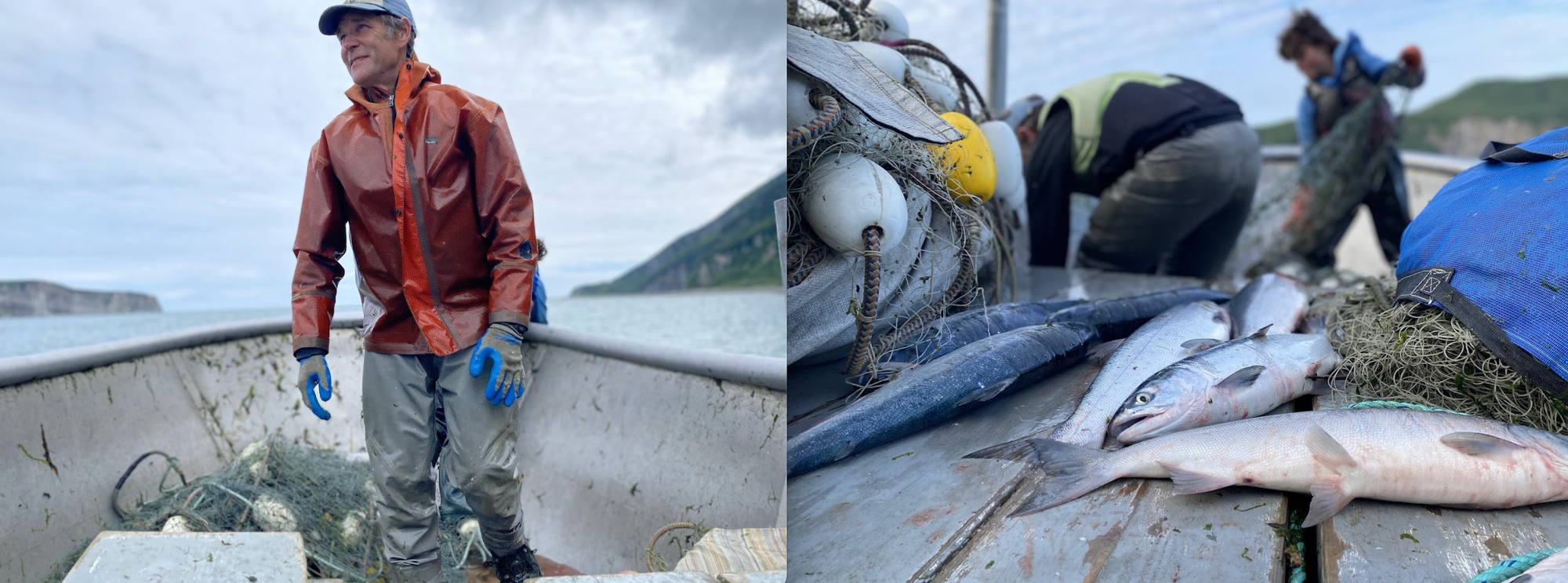
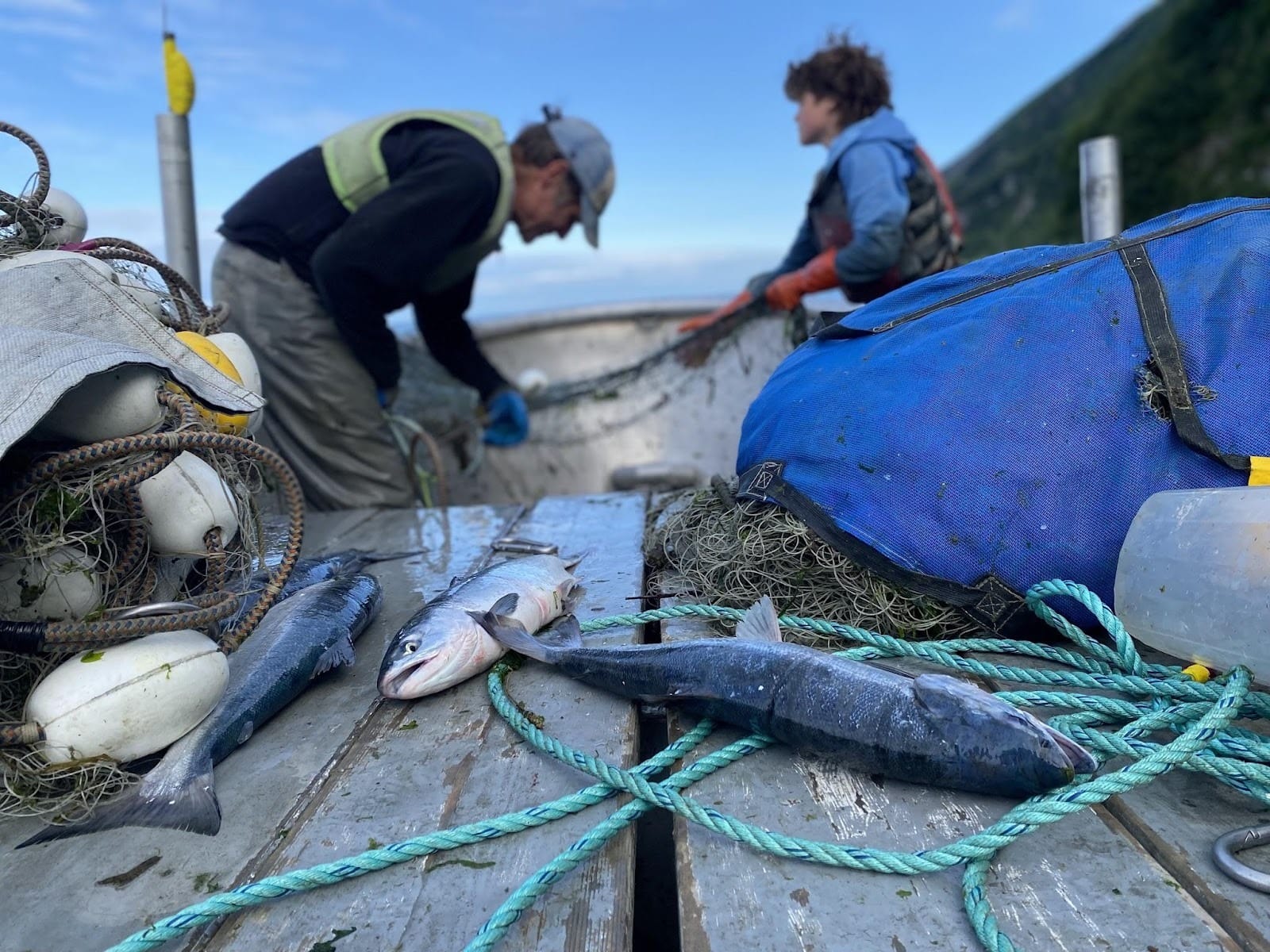
Commercial fisherman Dustin Solberg, left, walks across the bow of his skiff at the mouth of Tuxedni Bay. Solberg fishes with his son, Leif. (Photos by Max Graham/Northern Journal)
Among critics of the mining project is Dustin Solberg, a commercial fisherman and environmental advocate who spends summers with his family setting nets for salmon along the beaches of Tuxedni Bay, about 10 miles northeast of the Johnson Tract. Contango could one day load ore onto ships from the same shore where Solberg and other fishermen haul fish out of the bay.
Standing on a quiet Tuxedni beach one day this summer with dramatic cliffs looming overhead, Solberg imagined mining trucks rumbling down a road nearby.
“I think it would irreversibly change this place,” he said.
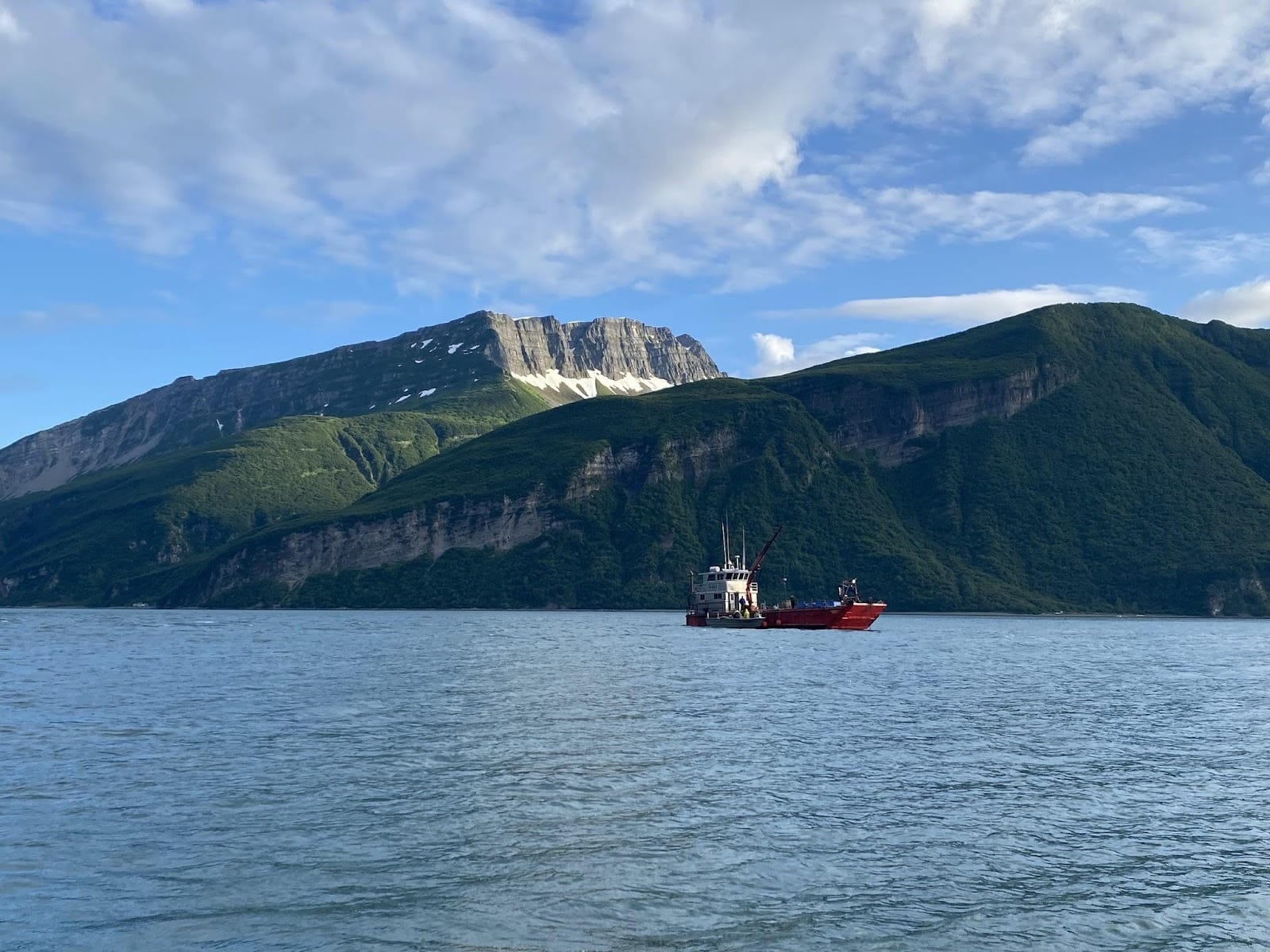
A fishing tender anchored in Tuxedni Channel, with Lake Clark National Park in the background. The tender buys salmon from the bay’s fishermen and transports it across the inlet to a processing plant in the town of Kenai. (Photo by Max Graham/Northern Journal)
A pivotal deal
The Johnson Tract fight is rooted in the Alaska Native Claims Settlement Act.
Intended to resolve disputes over Indigenous land claims in Alaska, the federal legislation in 1971 established 12 for-profit Alaska Native corporations, each owned by Indigenous shareholders with ties to a region in the state. More than 200 other Indigenous companies tied to Native villages also formed.
The act promised to compensate the corporations with nearly a billion dollars and millions of acres of land, to be chosen by the companies’ elected leaders.
Those leaders quickly moved to obtain traditional hunting and fishing grounds and areas with cultural value, but they also sought land thought to be rich in minerals and other resources that they could convert into profits for shareholders.
In the Arctic, Native corporations acquired land with oil deposits. In Southeast Alaska, they logged vast stands of cedar and spruce.
But in CIRI’s region, around Anchorage and neighboring Cook Inlet, the pickings were sparse. The southcentral region is the state’s most populous, and by the time of the settlement, military bases and wildlife refuges had been set aside by the federal government, prime real estate was in the hands of private developers and other parcels had been snatched up by the state.
“You just had so much pressure for lands within the Cook Inlet region,” said Brown, who now serves on CIRI’s board.
The corporation’s leaders argued that they were largely left with glaciers and mountain ridges — dim prospects for shareholders.
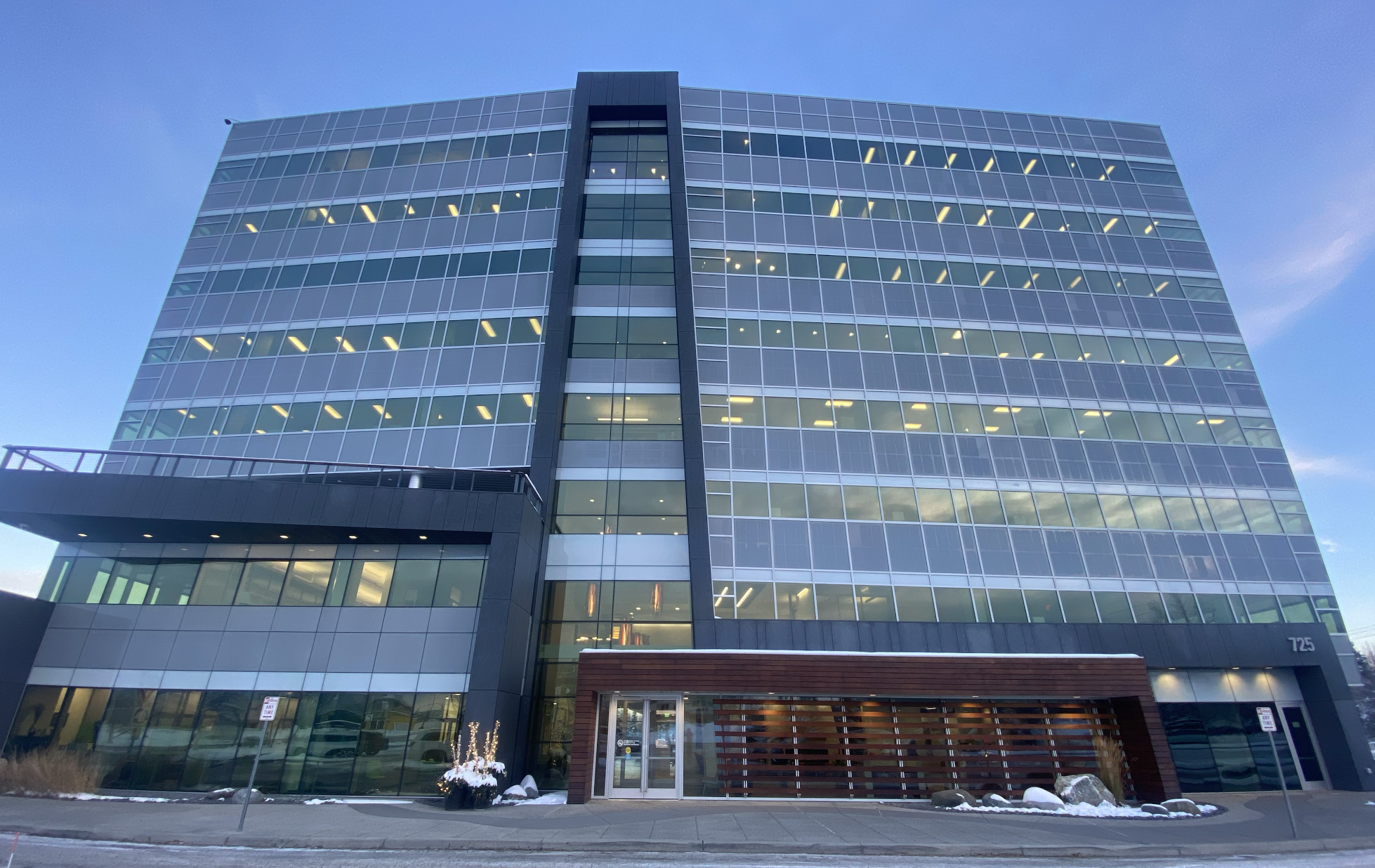
CIRI’s headquarters in Midtown Anchorage. (Photo by Max Graham/Northern Journal)
Two years after Congress approved the settlement, CIRI sued the U.S. interior secretary, arguing that his agency had not made adequate property available for CIRI to develop. Tense negotiations ensued, producing a sprawling agreement between CIRI and the state and federal governments: the Cook Inlet Land Exchange.
The deal called for CIRI to give up half the property around Cook Inlet that the corporation was entitled to under the original settlement, Brown said. Some of that foregone land would be folded into Lake Clark National Park and Preserve when Congress created it a few years later.
In return, CIRI would be able to acquire land elsewhere in Alaska, and even outside the state.
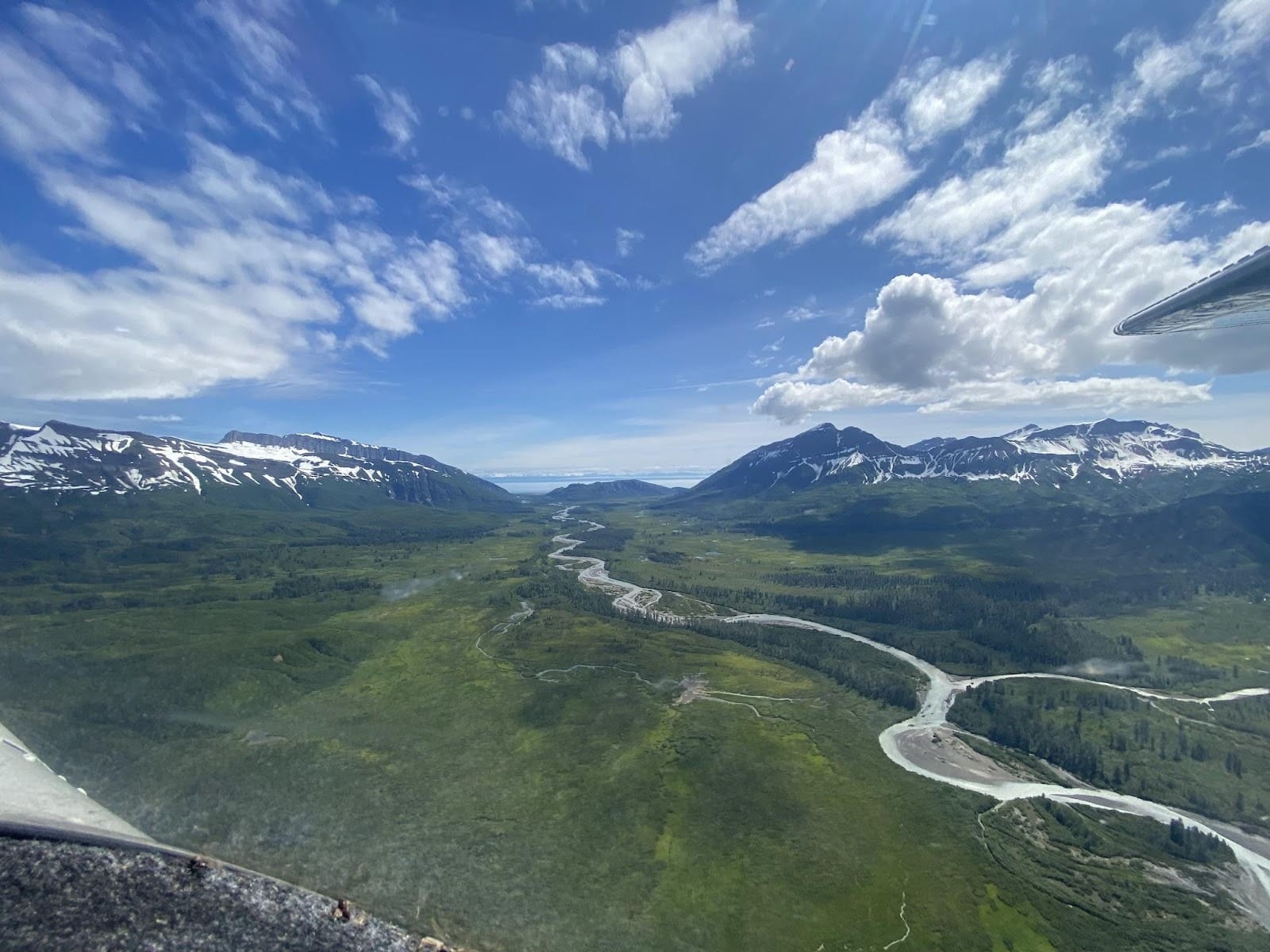
The Johnson River flows about a dozen miles from the Johnson Tract through Lake Clark National Park into Cook Inlet. (Photo by Max Graham/Northern Journal)
The deal also allowed CIRI to pick up some key assets around Cook Inlet, including the Johnson Tract, which the corporation chose specifically for its mineral potential. CIRI’s early leaders viewed the land swap as a hard-fought compromise, and Brown called the Johnson Tract “key to the bargain.”
“The ability to use the land in the way Congress intended is something that needs to be preserved,” she said. “It’s unfortunate that as we move further and further from congressional intent, it’s harder and harder for people to remember that.”
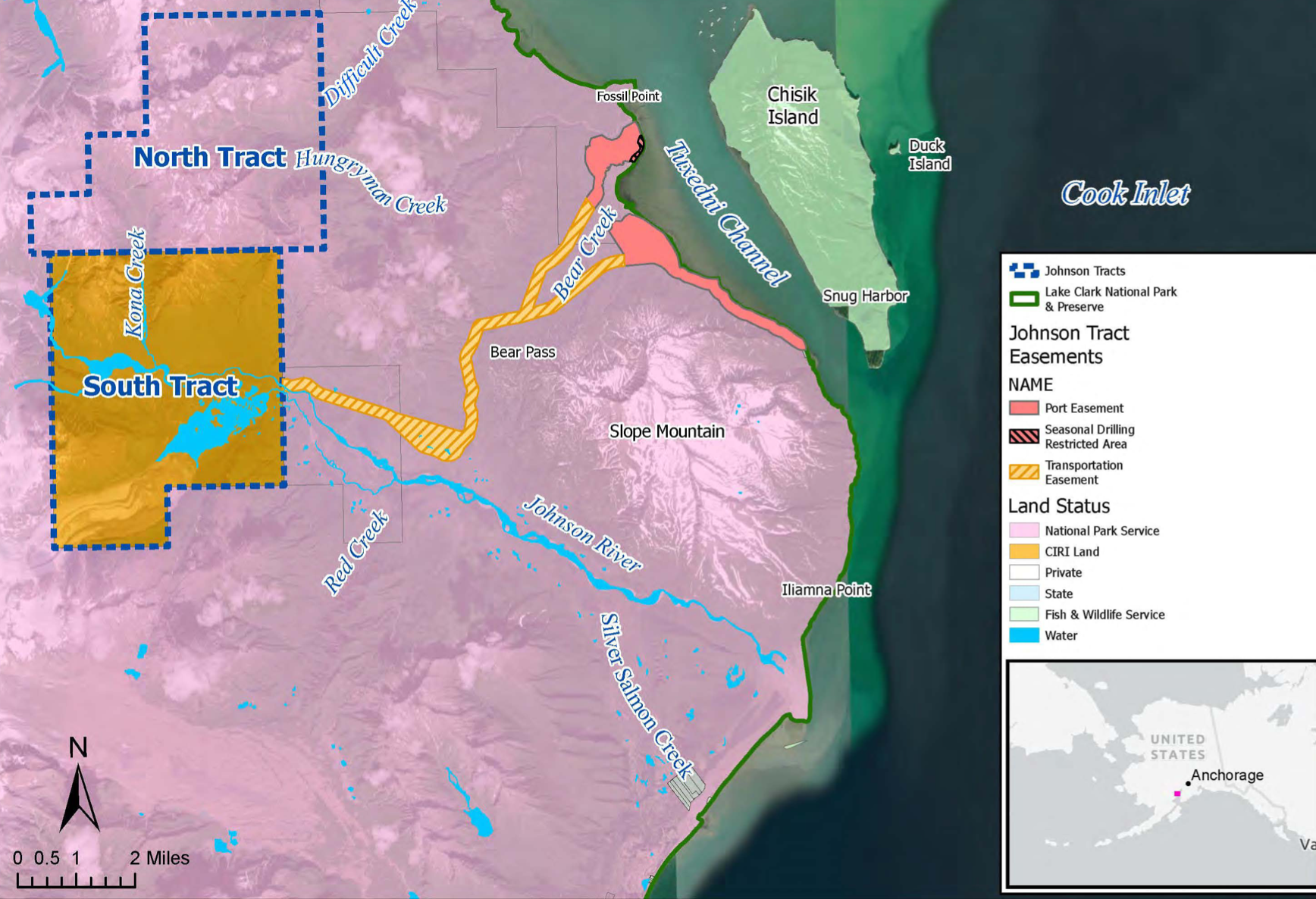
The Johnson Tract is really two adjacent parcels, totaling about 33 square miles. CIRI—now a huge business, with nearly $1 billion in assets—owns the minerals beneath both parcels, and the surface of the south tract, where the main deposit sits. The federal government retained surface ownership of the north tract.
Citing a provision in the land exchange, the Department of Interior earlier this year granted CIRI the rights to transport ore through the park, with certain restrictions to limit environmental impacts. CIRI and Contango have not formally proposed building a haul road and port, which would require additional permits.
An “Awesome” Deposit
Soon after CIRI acquired the Johnson Tract, the corporation began scouring it for more minerals, seeking enough to justify building a mine.
In the early 1980s, CIRI partnered with Anaconda Minerals, a subsidiary of the global oil giant ARCO, to evaluate the prospect.
Anaconda found promising amounts of gold, zinc and copper and at one point—given the area’s prolific amount of snow—envisioned an underground tunnel or aerial tram to move ore the dozen miles from a mine to a port on the coast. But Anaconda went out of business. And aside from another unsuccessful effort to develop the Johnson Tract in the 1990s, the land sat largely dormant until 2019.
That year, CIRI signed a lease with a Vancouver-based mineral exploration company, which quickly handed over the operations to a spinoff firm, HighGold Mining Inc. HighGold spent tens of millions of dollars on exploration and drilled more than 150 core samples before Contango bought the company last year in a deal worth some $35 million.
The Johnson Tract appealed to Contango’s chief executive, Rick Van Nieuwenhuyse, because it seemed to be a good fit for the company’s unconventional development model, which involves shipping raw ore to a processing plant off site, rather than crushing and processing ore next to the deposit, as most mines do.
The approach avoids some of the more expensive and hard-to-permit components of a typical mine, like a mill and a big waste pond. In theory, it keeps construction costs low and makes permitting easier, Van Nieuwenhuyse said. But shipping unprocessed ore also risks higher transportation costs, so Johnson Tract’s close proximity to the ocean and shipping routes made it attractive.
“It’s an awesome deposit,” Van Nieuwenhuyse said, citing the prospect’s high ratio of valuable minerals to rock and its thickness, which he expects will make the mining process more efficient.
Van Nieuwenhuyse is a veteran of Alaska’s mining industry, having worked over the past four decades on some of the state’s most prominent early-stage projects.
He played major roles in advancing Western Alaska’s Donlin project — the state’s biggest proposed gold mine — and high-profile prospects in Northwest Alaska at the end of the controversial proposed Ambler Road. He also led development of the Rock Creek gold mine near Nome, which closed in 2008 soon after opening amid a slew of challenges.
At Contango, where Van Nieuwenhuyse was named chief executive in 2020, he partnered with the multinational Kinross Gold Corp. to spearhead the construction of Alaska’s first large mine in more than a decade, a project in the Interior called Manh Choh.
Unlike that open-pit mine, Johnson Tract would be an underground operation. Several years of exploratory drilling, permitting and engineering are expected before a final decision on building a mine, Van Nieuwenhuyse said.
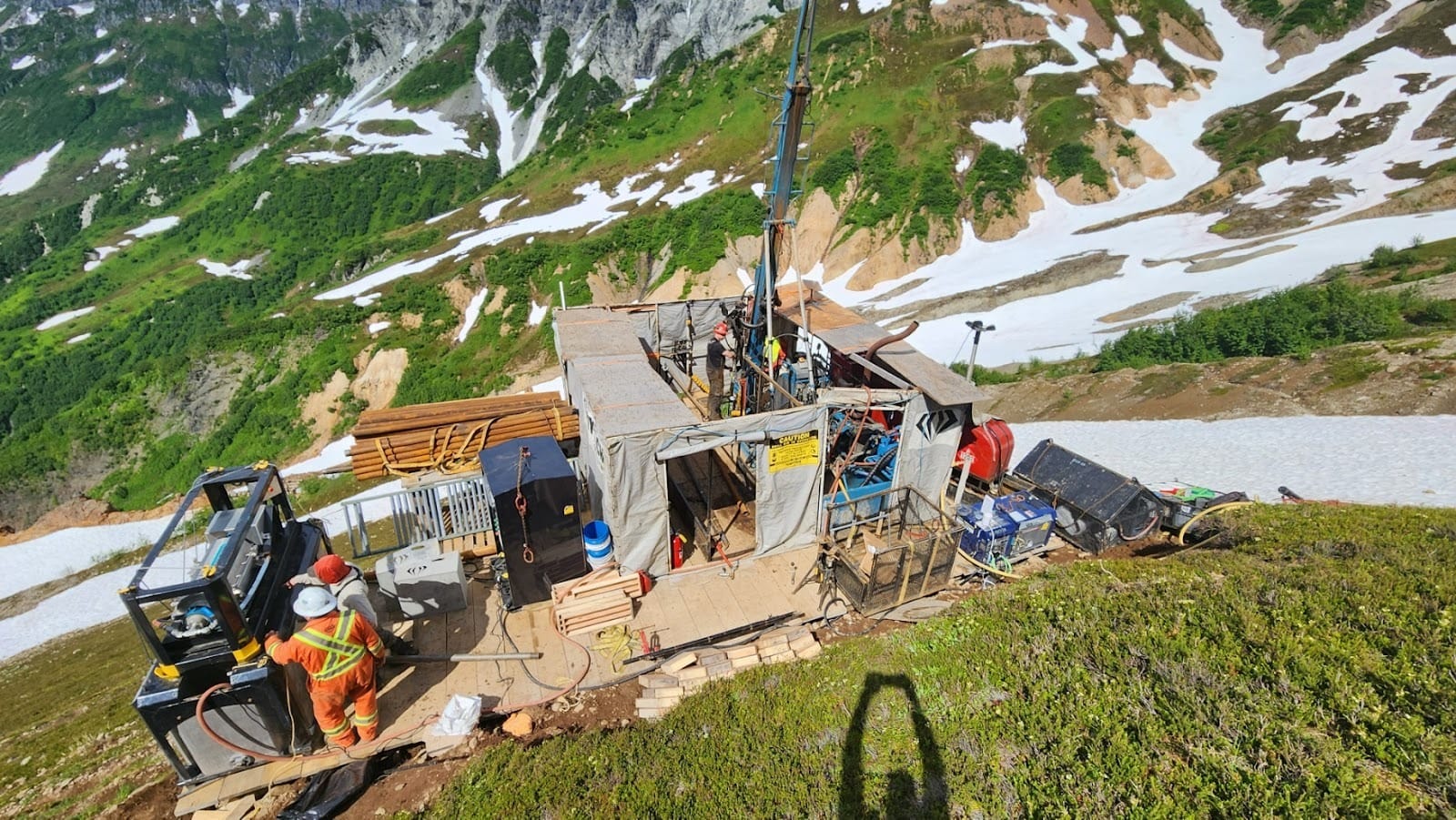
A drilling pad at the Johnson Tract project. (Photo from Contango Ore)
The mine, according to Contango’s preliminary plans, would operate for seven years and would be small compared to other major Alaska mines. Contango would share royalties on mineral sales with CIRI, which has an option to buy as much as a 25 percent stake in the mine.
CIRI declined interview requests about the Johnson Tract, and the corporation’s executives have made few public statements about it.
The project “presents an opportunity to responsibly develop mineral resources to benefit our shareholders while respecting the environment and preserving the land,” CIRI said in a brief update last year. “The Johnson Tract project reflects decades of hard work to build a foundation of self-determination and financial stability.”
“We’re Here Because it’s Beautiful”
Dustin Solberg, the fisherman and mine opponent, was motoring to a net he’d set on the west side of Tuxedni Channel one afternoon last summer when he spotted a brown bear on a rocky beach ahead.
“I think it smells the fish, Dad,” 12-year-old son and deckhand Leif Solberg called out.
Far more worrisome to the elder Solberg is the future of the beach where the bear was roving—near a site that Contango is studying as a port.
Solberg, his family and others who fish in the channel each summer have growing concerns about Contango’s vision. They fear that a new road and industrial dock, and the traffic and noise from trucks and ships, would mar the wild character of the bay and the park around it.
Dustin and Leif Solberg haul salmon out of Tuxedni Channel. (Photo by Max Graham/Northern Journal)
As Solberg looked across the channel, it was remarkably quiet, aside from a few fishing skiffs and an occasional float plane that landed at a bear-viewing lodge on Chisik Island. Other than the lodge and a few fishing cabins, Chisik is a federally designated wilderness area, home to a prolific seabird colony.
A dozen or so crews fish commercially for salmon in the bay. Two or three times a week, from June through August, they set, pick and pull nets along pebbly beaches on either side of Tuxedni Channel, with fishing periods that can last 12 hours or more.
It’s hard labor, Solberg said, but the season moves at a slower pace than Alaska’s bigger-volume salmon fisheries, like Bristol Bay, where boats sometimes work 24-hour shifts.
Dustin and Leif Solberg work their net behind freshly caught salmon in Tuxedni Channel. (Photo by Max Graham/Northern Journal)
“If you wanted to make money, you would fish somewhere else,” said Ann Harding, Solberg’s wife. “We’re here because it’s beautiful.”
The area has “phenomenal” mountains and a striking density of birds and bears, added Harding, a seabird biologist who sometimes fishes alongside Solberg.
Ann Harding handles a freshly caught salmon as Dustin Solberg pulls another out of his net. (Max Graham/Northern Journal)
The family uses a cabin a mile or two down the shoreline from where the bear had been walking. It’s a small plywood structure beneath an A-frame roof, surrounded by an electric fence to keep away curious ursine visitors. The cabin is about a hundred feet back from the water and set fully within Lake Clark National Park.
Solberg and Harding bought the structure several years ago. They don’t have title to the land beneath it or a formal permit from the park service. But the cabin existed before the park was established, and past owners had an informal arrangement with federal officials to keep using it, Solberg said.
A cabin used by fisherman Dustin Solberg and his family stands in Lake Clark National Park, near the shore of Tuxedni Channel. (Photo by Max Graham/Northern Journal)
The cabin now sits in an easement that the Department of Interior earlier this year granted CIRI for a mining port. Solberg doesn’t think his small business will amount to much of an obstacle.
“This is just a little shack that doesn’t really compete with the value of an operation like that,” he said, referring to the mining plans. “So, I don’t expect this to get in the way of anything.”
A National Park Service Map of the Johnson Tract, as well as easements where an access road and port serving a mine could one day be built.
CIRI and Contango have not made a final decision about where to put the port, and a CIRI environmental document said last year that there is “considerable uncertainty” about future construction.
Van Nieuwenhuyse, the Contango mining executive, said his company recognizes the rights of the setnetters, and he believes a mine can co-exist with the fishery.
“I would ask that everybody recognize CIRI’s rights as well,” he added.
Where Belugas “Hang Out”
As it gathers pace, Contango is facing opposition not just from the commercial fishermen but also from conservation groups and some tribal governments in the region.
A national group, the Center for Biological Diversity, along with the Homer-based nonprofit Cook Inletkeeper and the Chickaloon Village Traditional Council, a tribal government, are suing the U.S. Army Corps of Engineers for issuing a key permit to Contango.
Several tribal leaders also have raised concerns about the project and have asked the Trump administration to suspend the permit.
A core concern among those opponents is that a mining operation could threaten Cook Inlet’s beluga whales, which are treasured by many Anchorage residents and local wildlife viewers.
The inlet’s belugas—which are genetically distinct from other beluga populations—once numbered around 1,300 animals, but their numbers sharply declined in the 1990s. They were listed as endangered in 2008 and still have not significantly recovered. The population now stands at some 330 whales.
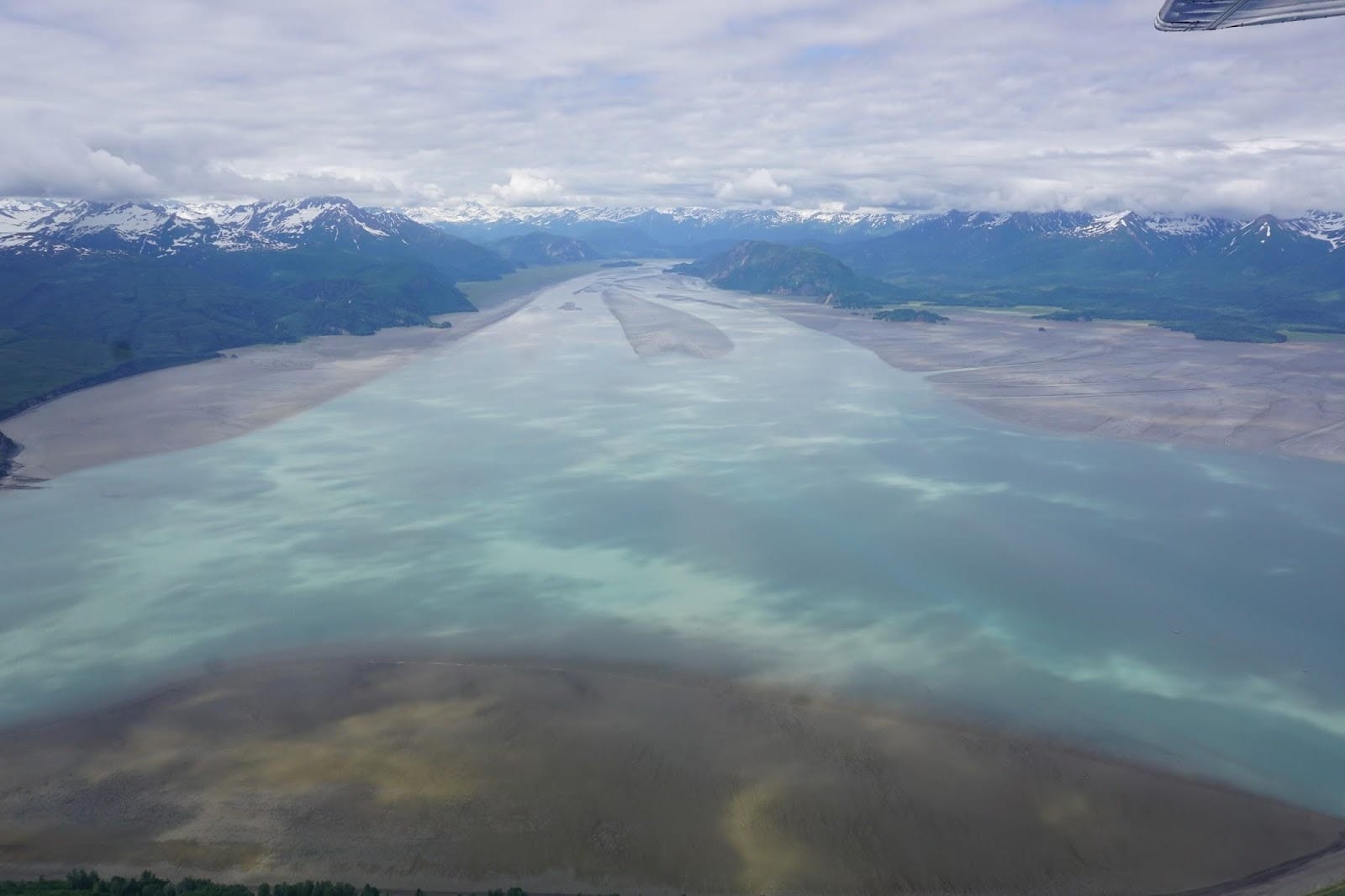
Tuxedni Bay, ringed by the mountains of Lake Clark National Park, is an important winter habitat for an endangered population of beluga whales, according to recent federal research. (Photo by Max Graham/Northern Journal)
During the summer, the belugas are commonly spotted feasting on fish at the mouths of salmon-bearing streams near Anchorage. Where they go in winter has been a mystery.
But last year federal scientists announced a big discovery in a study that analyzed underwater sound recordings.
The researchers, affiliated with the National Oceanic and Atmospheric Administration, identified Tuxedni Bay as the only known foraging ground for the whales between late fall and late spring. They warned that human-caused noise is a “key threat” to the belugas, which use sound to navigate and communicate, and that industrial activity could affect the quality of the whales’ habitat.
NOAA Fisheries, which led the study, declined interview requests. One of its scientists, in a press release announcing the study, said that “maintaining the status quo” may be all that’s needed to help the beluga population recover.
As Contango studies sites for a port, it’s now funding a new beluga survey by biologists working for the state of Alaska, which has often been more friendly to the mining industry than the federal government.
The survey is focused on the narrow channel where Contango is considering shipping ore, while the NOAA-led study looked more broadly at the 10-mile-long Tuxedni Bay.
“We want to know where the belugas like to hang out,” Van Nieuwenhuyse said.
One of the loudest voices advocating for the belugas and against development at the Johnston Tract is Cooper Freeman, a Homer resident and the Alaska director at the Center for Biological Diversity. The center is a 35-year-old nonprofit that aims to protect wildlife and ecosystems across the country, and it’s a participant in nearly a dozen active lawsuits in Alaska’s federal court.
In an interview, Freeman acknowledged CIRI’s right to the minerals at the Johnson Tract. But he noted that federal environmental laws still apply and argued that CIRI does not have an “absolute right” to build a mine.
In his view, the area is too ecologically rich—with its important beluga habitat and high density of brown bears, seabirds and shorebirds—to risk.
“It’s just an incredibly, biologically, intensively rich and completely intact area—one of the only remaining places like it in all of Cook Inlet,” he said. “I don’t think there’s any amount of money that’s worth destroying this place.”
Chisik Island is a federally designated wilderness area, aside from a few commercial fish camps and a bear-viewing lodge. (Photo by Max Graham/Northern Journal)
There are no towns within 40 miles of the Johnson Tract—just roadless mountains, glaciers, forests and streams.
Aside from seasonal fishermen, CIRI and Contango’s neighbors include Silver Salmon Creek Lodge, a bear-viewing and sport-fishing business that’s near the mouth of the Johnson River, a dozen or so miles downstream of the mineral deposit.
Longtime lodge owners David Coray and Joanne Edney have kept loose tabs on the prospect for decades and have grown more concerned as Contango’s project advances.
In a recent interview, Coray and Edney said they’re worried that a mine could pollute the Johnson River and disrupt bear habitat.
“We understand their interest, and we understand their rights,” Edney said of CIRI and Contango. But a mining operation could come into “direct conflict” with her family’s business, she said.
CIRI declined to respond to questions about opposition to the project, and about how it’s gauging the views of its shareholders, some of whom have spoken out against it.
Van Nieuwenhuyse said Contango is committed to protecting wildlife.
“We’ll develop this deposit with minimal impacts to the environment, which we recognize as pristine,” Van Nieuwenhuyse said. “We’re all from Alaska. We enjoy the outdoors. That’s why we all became geologists.”
For Solberg, the fisherman, the convergence of competing interests in the area is “endlessly fascinating—and really complicated and really unfortunate.”
In a conversation after the fishing season, Solberg acknowledged a tension between CIRI’s rights to the Johnson Tract’s minerals and the spectre of a mine transforming the landscape and bay that his family has come to know and love.
Solberg said he feels “really torn” about the issue and that he respects CIRI’s land claims. But as one of the few Alaskans who spends long stretches of time in Tuxedni Bay, he feels obligated to speak in defense of its wildness and beauty.
“I just want decisionmakers to have their eyes wide open,” he said. “And to realize what’s at stake.”
This story was supported by a grant from the Alaska Center for Excellence in Journalism.
Northern Journal contributor Max Graham can be reached at max@northernjournal.com. He’s interested in any and all mining related stories, as well as introductory meetings with people in and around the industry.
This article was originally published in Northern Journal, a newsletter from Nathaniel Herz. Subscribe at this link.
Bravo is shaking up The Real Housewives of Orange County.
With a very familiar face.
During a taping of The Bravos BravoCon in Las Vegas on Friday, November 14, Vicki Gunvalson was surprised by Andy Cohen in front of a legion of fans.
(Bravo)
”Vicki, would you join us as a housewife for Season 20?” Cohen asked the OG of the OC.
The 63-year-old appeared emotional, giving the executive producer a hug and exclaiming, “Yes!”
Gunvalson — who was a full-time cast member when the franchise debuted in 2006 — appeared on 14 seasons of the series before announcing her departure in January 2020.
“I will always be the OG of the OC, but it’s time to say goodbye to The Real Housewives of Orange County. It’s been an incredible ride for 14 years and I want thank all of you for your support, for your love and for ‘whooping it up’ with me along the way,” she wrote in a lengthy statement at the time.
“I’ve been working on new projects that will be exciting, empowering and inspirational. My podcast with Westwood One will be launching soon and I will have much more to say about this on ‘Whoop it up with Vicki.’
“I hope you will join me with my new journey so please stay tuned. I love all my fans, and I want to thank Bravo and Evolution for this incredible experience which my family and I have will never forget.”
(Bravo)
This piece of casting news comes after Gunvalson and former co-star Tamra Judge squashed their feud.
“We’ve had a lot of ups and downs in our 20 years. I always say we’re like sisters,” Tamra told Us Weekly on November 5, adding:
“It’s that love-hate relationship all the time. I’m talking sisterly love, like, you have little arguments. And then, of course, being on a show together, there’s always ups and downs — especially the type of show that we were on together.”
The Real Housewives of Orange County cast from Season 19 included Judge (who may now be gone), Shannon Beador, Heather Dubrow, Gina Kirschenheiter, Emily Simpson, Jennifer Pedranti, and Katie Ginella.
(Bravo)
Shannon Storms Beador, for her part, was asked about the aforementioned moment during the BravoCon 2025 panel Getting Lucky at the Love Hotel, claiming she was very pleased with the casting move.
“You know, I’m so excited for Vicki,” she said, before sharing an anecdote from BravoCon 2023.
“And it was really funny… Two years ago, when she won the Wifetime Achievement award, [Vicki] came back to the seat and said something like, ‘Oh, why didn’t Andy pull an orange out of his pocket?’ And he did that last night… I’m so excited for her.”
Bravo is yet to announced who will be joining Vicki on Season 20.
Sophie Turner has been pregnant more than once — and it was not always by design.
Following her split with ex-husband Joe Jonas, the beloved actress has been making changes in her life.
She found a new boyfriend. Despite reports of a split, they appear to be together again.
Does she have another child on the way? Here’s everything that we know:
Sophie Turner speaks onstage during the “Engineering the Impossible” panel discussion on day two of SXSW London 2025 at the Truman Brewery on June 03, 2025. (Photo Credit: Jack Taylor/Getty Images for SXSW London)
Sophie Turner has two children
In July of 2020, Sophie Turner and Joe Jonas welcomed their first child.
That child was Willa, their first daughter.
In early 2024, the actress opened up to British Vogue about feeling uncertain when she first became pregnant.
However, she soon realized that, despite her doubts, she did want to become a mother.
Joe Jonas and Sophie Turner attend the 2nd Annual Academy Museum Gala at Academy Museum of Motion Pictures on October 15, 2022. (Photo Credit: Frazer Harrison/Getty Images)
Two years after becoming parents, in July of 2022, Sophie and Joe welcomed Baby #2.
The erstwhile couple named their second daughter Delphine.
Both children became the subject of a bitter custody dispute when Sophie and Joe split.
However, it appears that the conflict has died down.
Late in the summer of 2023, Joe Jonas filed to divorce Sophie Turner after only a couple of weeks of split speculation.
She apparently learned about the filing online, the same as the rest of us did.
What followed was something very rare in the world of celebrity divorces: a soon-to-be ex-husband receiving massive backlash.
A hamfisted and wildly inconsistent smear campaign took off against Sophie. Whether Joe approved of it or not, he received a lot of angry social media messages.
The smear campaign soon died down. This is, again, extremely rare.
Joe Jonas and Sophie Turner attend the 2023 Vanity Fair Oscar Party Hosted By Radhika Jones at Wallis Annenberg Center for the Performing Arts on March 12, 2023. (Photo Credit: Amy Sussman/Getty Images)
Of course, the unexplained silence of the divorce-related vitriol has not put any of the mom-shaming on pause.
The Blastreported on much more recent instances of very strange commenters slamming Sophie for her demeanor at a festival — or perhaps simply for attending one at all when she is a mother.
It’s good to remember that there are entire tabloid ecosystems that generate profits from disparaging famous women. There’s a market for that. A sick appetite.
You don’t need a high-powered divorce attorney and a PR firm to smear a famous woman.
More recently, Sophie Turner has been in a relationship with Peregrine Pearson.
Peregrine is the son of Michael Pearson, the 4th Viscount Cowdray.
(Sometimes, it is wise to close your eyes and remind yourself to Europe is not real, and it cannot hurt you)
Though their romance has appeared to be on-again, off-again, recent evidence suggests that they are currently together.
Sophie Turner attends the Louis Vuitton Womenswear Fall/Winter 2025-2026 show as part of Paris Fashion Week on March 10, 2025. (Photo Credit: Pascal Le Segretain/Getty Images)
However, at this time, there is no evidence that Sophie Turner is pregnant.
We know based upon past experience that, if she were expecting, she might not rush to share the news.
But given that her most recent outing involved wearing a bralette instead of a shirt (wise, when attending a summer festival), it would take a minor feat of illusion magic to conceal a baby bump.
If she had one. Which she does not.
Perhaps, one day, Sophie will opt to have more kids if she likes. But she has two amazing kids already.
By all accounts, Cardi B should be a very happy woman right about now.
The musician just gave birth a few days ago to her fourth child, her very first with boyfriend Stefon Diggs.
And yet it’s the father of Cardi B’s first three kids that is causing such problems at the moment that the rapper can’t exactly enjoy her blessed newborn.
Bot when she’s afraid of getting murdered at the hands of Offset.
Cardi B and Offset look happy here at the American Music Awards. But that happiness did not last. (Getty)
On Sunday, Cardi B jumped on social media to allege that she is “still being harassed and threatened to the point that I feel like my life in danger,” telling followers and fans that this sort of thing is “all fun and games until it’s too late.”
To be clear, the artist never mentions Offset by name.
But she does claim that this harassment has been going on for a year — and it’s worth remembering that ffset recently suggested that Cardi’s kid with Diggs could be considered his child according to Georgia law.
He has since deleted the Tweets that made this allegations.
(Twitter)
Cardi B went on:
“Sometimes I sleep and I wonder, ‘This is not normal.’ You see crime documentaries … You see sh-t on social media about women getting killed every other day.”
For the record, the star would like to be left “TF alone.”
Cardi B and Offset wed secretly got married in 2017 and have 3 kids together; the former filed for divorce a second time in 2024 after quite a few ups and downs in her relationship.
Cardi B and Offset had their ups and down. They filed to divorce in September of 2020 and again in 2024. (Getty)
For example?
On March 29, via X Spaces, the Bodak Yellow star claimed that her estranged spouse had been stalking and harassing her amid their pending divorce.
In response, she reached out to Offset’s current girlfriend.
“This guy is upset that I sent his girlfriend text messages of him begging me, saying he was going to take away his life, saying he was going to take away my life,” Cardi said of her ex. “All that sh-t, he was mad.”
Cardi B also alleged that Offset had been harassing her latest boyfriend.
“Mind you, he sent text messages to somebody I was dealing with of videos of me and him having sex. That’s the kind of sh-t that I was dealing with for the past two months,” she added.
An Indiana Senate Republican who President Donald Trump called out in a Truth Social post Sunday for not backing the White House’s plan to draw new congressional maps was later targeted by a swatting, according to local authorities.
Greg Goode, who Trump posted was a “RINO” he was “Very disappointed in” Sunday was targeted hours later by what Vigo County Sheriff Derek Fell called a “swatting” in a statement.
Despite Trump’s social media post insinuating otherwise, Goode has not publicly announced his position on redistricting.
Fell said that around 5 p.m. Sunday “an email was sent to the Terre Haute Police Department advising harm had been done to persons inside a home, located in southeastern Vigo County,” Fell said. “This information was immediately relayed to the Sheriffs Office, at which point deputies responded to the home, which was the home of Senator Greg Goode. Attempts were initially unsuccessful to raise anyone at the residence, but ultimately contact was made with persons inside the home.”
Fell added that Goode and others “were secure, safe, and unharmed. Investigation showed that this was a prank or false email (also known as ‘swatting’).”
In a statement, Goode said he and his family were “victims,” and thanked Fell and Terre Haute Police Chief Kevin Barrett for their “professionalism.”
The news comes as efforts to redistrict have ground to a halt in Indiana on Friday, after Senate President Pro Tempore Rodric Bray refused to reconvene the chamber to redraw congressional maps in favor of Republicans.
The president threatened earlier Sunday that a list of Senate Republicans resistant to gerrymandering the state would be “released to the public later this afternoon,” which so far seems to have not materialized by this evening.
The White House did not immediately respond to a request for a comment.
Earlier this month, Goode held a town hall in Terre Haute on redistricting, and 71 people spoke out against it and nobody spoke for it.
On Tuesday, Indiana lawmakers are expected to convene at the Indiana Statehouse for organization day, a largely ceremonial and administrative event kicking off next year’s session. Already, pro-redistricting advocates have announced a statehouse rally calling for redistricting.
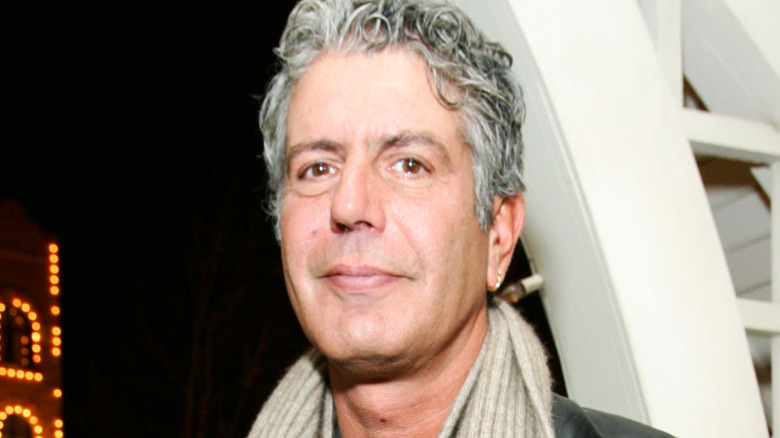
Anthony Bourdain had unfiltered opinions on dining and food culture. His thoughts on one type of meat made an interesting point about the restaurant industry.
Mashed – Fast Food, Celebrity Chefs, Grocery, Reviews
Learn the mistakes to avoid the next time you visit a mall food court, so you’ll choose the tastiest item there and leave feeling like a food court pro.
Mashed – Fast Food, Celebrity Chefs, Grocery, Reviews